
Introduction
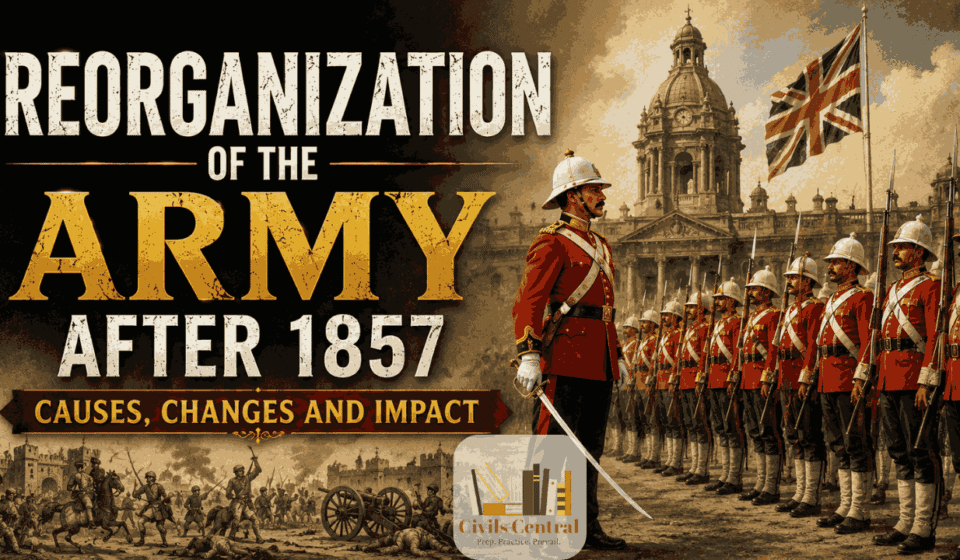
The Revolt of 1857 marked a turning point in the history of British rule in India. One of its most significant consequences was the complete restructuring of the Army, as the British realized that the existing military organization under the East India Company had failed to ensure loyalty and control.
After 1858, with the transfer of power from the East India Company to the British Crown through the Government of India Act, 1858, the army became the primary instrument for consolidating imperial authority in India. The British administration undertook a series of deliberate reforms aimed at preventing future revolts, strengthening European control, and restructuring the composition, recruitment, and command of the army.
These reforms were not merely administrative in nature but were deeply political, reflecting the British policy of “divide and rule” and strategic mistrust of Indian soldiers. Key changes included increasing the proportion of European troops, restricting Indians from sensitive military roles like artillery, and reorganizing recruitment along so-called “martial race” lines.
Thus, the post-1857 army reforms laid the foundation of a more centralized, disciplined, and imperial army, which became a crucial pillar of British colonial rule in India for the rest of the 19th and early 20th centuries.
Objectives of Reorganization of the Army
The reorganization of the Indian Army after the Revolt of 1857 was driven by clear political and strategic objectives of the British Government. These reforms were not routine military adjustments but a deliberate attempt to ensure long-term stability of colonial rule in India and to prevent any recurrence of large-scale rebellions like 1857.
1. Prevention of Future Revolts
The foremost objective was to avoid the possibility of another unified uprising. The British believed that the 1857 revolt had spread largely due to poor control over sepoys, weak discipline, and shared grievances among Indian soldiers. Therefore, reforms were designed to break unity among troops and strengthen surveillance.
2. Strengthening British Imperial Control
The army was reorganized as the primary instrument of British power in India. By increasing European presence and reducing Indian influence in sensitive positions, the British ensured that ultimate military authority remained firmly in their hands.
3. Ensuring Loyalty of the Sepoys
The British administration aimed to build a force that was less politically conscious and more dependent on British officers. Recruitment policies and regimental restructuring were designed to ensure loyalty through division and control rather than trust.
4. Preventing National Unity within the Army
One key lesson from 1857 was that unity among soldiers across regions and communities posed a serious threat to colonial rule. Hence, the army was reorganized to promote regional, caste, and class divisions, reducing the possibility of collective action.
5. Securing Strategic Military Advantage
The British also aimed to maintain superiority in modern warfare technology, especially artillery and advanced weapons, by keeping them exclusively under European control.
Transfer of Control from Company to Crown (Post-1858 Military Reorganization)
The Revolt of 1857 exposed the limitations of the East India Company in governing India, especially in maintaining discipline and loyalty within its army. As a result, one of the most significant outcomes was the transfer of control of the Indian administration and army from the East India Company to the British Crown through the Government of India Act, 1858.
1. End of East India Company’s Military Authority
The Act of 1858 abolished the East India Company’s political and military powers. The administration of India, including the command over armed forces, was directly taken over by the British Crown, marking the beginning of the British Raj.
2. Establishment of Direct Crown Control over the Army
After 1858, the Indian Army came under the direct supervision of the British government. The Secretary of State for India (in Britain) became the highest authority responsible for Indian military affairs, ensuring centralized decision-making from London.
3. Integration and Redistribution of Forces
A key step in reorganization was the merging of Company forces with Crown forces. European troops previously under the Company were now integrated into the British Army structure, ensuring tighter imperial control over military operations in India.
4. Centralized Military Command Structure
The military command was reorganized to ensure stronger coordination between India and Britain. The Commander-in-Chief in India acted under the supervision of the British Crown, reducing autonomy previously enjoyed under Company rule.
5. Strategic Objective Behind the Transfer
This transfer was not only administrative but also strategic. The British Crown aimed to:
- Eliminate the weaknesses of Company rule exposed in 1857
- Ensure direct accountability of military forces to London
- Strengthen imperial security by professionalizing and centralizing army control
Recommendations of the Peel Commission (1859)
After the Revolt of 1857, the British Government realized that the structure and composition of the Indian Army needed urgent reform. To address this, the Peel Commission (1859) was appointed to review the military system and suggest measures to ensure loyalty and efficiency.
The Commission’s recommendations became the foundation of post-1857 army reorganization and were implemented in varying degrees over the following years.
1. Balanced Composition of British and Indian Troops
One of the key recommendations was to maintain a higher proportion of European soldiers in India, especially in sensitive and strategic regions. The aim was to ensure that Indian soldiers could never outnumber or overpower British forces again.
- European troops were increased in key military zones
- Indian troops were retained but kept under strict supervision
- The principle of “balance of power” within the army was introduced
2. Concentration of Europeans in Strategic Locations
The Commission recommended that British troops should be stationed in important cities, cantonments, and strategic points such as:
- Capitals and major administrative centers
- Military strongholds
- Areas prone to rebellion
This ensured rapid response in case of any unrest.
3. Separation of European and Indian Units
One of the key structural reforms after the Revolt of 1857 was the deliberate separation of European and Indian soldiers within the army. The British leadership identified that unity among troops—especially shared grievances and coordinated action—had played a major role in the 1857 uprising.
To prevent such collective mobilisation in the future, the following measures were adopted:
- European and Indian troops were placed in separate units and formations
- The system of mixed regiments was gradually discouraged and reorganized
- Efforts were made to limit social interaction, communication, and joint training between the two groups
- European soldiers were often stationed in strategically important or sensitive locations, while Indian troops were deployed in subordinate roles
This structural segregation ensured that soldiers from different backgrounds could not easily build solidarity or trust across units.
4. Control Over Artillery and Advanced Weapons
A crucial recommendation was that all artillery and modern weaponry must remain exclusively under European control. This was considered essential because artillery had played a key role during the 1857 uprising.
5. Improved Discipline and Military Efficiency
The Commission emphasized the need for:
- Strict military discipline
- Better training systems
- Stronger command hierarchy under British officers
- Enhanced surveillance of Indian soldiers
6. Strategic Military Reorganization
The report also suggested restructuring regiments and improving communication systems so that:
- Rapid troop movement could be ensured
- Rebellions could be suppressed quickly
- Military coordination between India and Britain could be strengthened
The Peel Commission (1859) marked the first systematic attempt to rebuild the Indian Army after 1857, focusing on preventing unity among Indian soldiers and ensuring permanent British dominance over military power in India.
Change in Composition of the Army (European–Indian Ratio)
One of the most important outcomes of the post-1857 military reorganization was a fundamental change in the composition of the Indian Army, aimed at ensuring permanent British dominance and preventing any possibility of another large-scale revolt.
The British policy clearly reflected the principle that military power in India must remain firmly under European control, while Indians would serve only in a subordinate capacity.
1. Increase in the Proportion of European Troops
After 1857, the number of British soldiers stationed in India was significantly increased.
- European troops were reinforced across all major military zones
- The ratio of Europeans to Indian soldiers was revised in favour of the British
- Key strategic regions were heavily guarded by British battalions
This ensured that Indians could never numerically dominate the army again.
2. Fixed European–Indian Ratio Policy
The British established an informal but strict policy of maintaining a balanced but controlled ratio:
- In Bengal: approximately 1 European to 2–3 Indian soldiers (varied over time)
- In Madras and Bombay: relatively higher proportion of Indian troops but still under European dominance
- In sensitive areas: European troops were kept in higher concentration
The exact ratio was not uniform but was always designed to maintain European military superiority.
3. Strategic Deployment of European Forces
European soldiers were deliberately stationed in:
- Capital cities and administrative centres
- Forts, arsenals, and communication hubs
- Railway and telegraph-linked strategic points (later developments)
This allowed quick mobilisation in case of unrest.
4. Reduction of Indian Influence in Key Units
While Indian soldiers continued to form the majority of the army, their influence was reduced through:
- Redistribution of regiments
- Separation of units by region and community
- Strict supervision by British officers
5. Military Policy of Control, Not Trust
The underlying principle of this restructuring was not trust but strategic control:
- Europeans acted as the decisive force
- Indians were kept as auxiliary soldiers
- The army was designed to prevent unified action among Indian troops
The post-1857 change in the European–Indian ratio ensured that the Indian Army became a British-dominated institution, where numerical strength of Indian soldiers did not translate into real military power or authority.
Monopoly of Europeans over Artillery and Key Arms
After the Revolt of 1857, the British considered Indian control over modern weapons—especially artillery—as one of the most dangerous weaknesses of the pre-1857 army system. Since rebels had effectively used artillery in several battles during the uprising, the British adopted a strict policy to ensure that all advanced military technology remained exclusively under European control.
1. Complete Exclusion of Indians from Artillery
One of the most significant reforms was the complete removal of Indians from artillery units.
- Indian soldiers were no longer recruited into artillery regiments
- European personnel exclusively handled cannons, ammunition, and explosives
- This restriction was strictly enforced across all presidencies
This ensured that Indians could not access the most decisive branch of military power.
2. European Control over Modern Weapons
Along with artillery, Europeans maintained monopoly over:
- Heavy firearms and advanced rifles (gradual modernization phase)
- Ammunition depots and arsenals
- Military engineering and explosive handling units
This created a clear technological and operational superiority for British forces.
3. Strategic Importance of Artillery Control
The British recognized that artillery was the “decisive arm” of 19th-century warfare.
- It played a crucial role in breaking fortified positions during 1857
- Control over artillery meant control over battlefield outcomes
- Denying Indians access reduced the risk of organized large-scale rebellion
4. Security and Preventive Policy
This monopoly was part of a broader preventive strategy:
- To eliminate chances of coordinated mutiny
- To ensure that even if Indian infantry rebelled, they lacked heavy firepower
- To maintain quick suppression capability in emergencies
5. Long-Term Institutional Impact
This policy had long-term implications:
- Created a technological dependency of Indian troops on British officers
- Reinforced racial hierarchy within the army
- Became a core feature of colonial military structure until the early 20th century
The monopoly over artillery and key arms ensured that the British retained absolute military superiority in India, making it impossible for Indian soldiers to challenge colonial authority through modern warfare capabilities.
Martial Races Theory and Recruitment Policy
After the Revolt of 1857, the British fundamentally reshaped recruitment in the Indian Army by developing the controversial “Martial Races Theory.” This policy was not based on scientific evidence but on colonial assumptions about loyalty, courage, and suitability for military service.
It became a key pillar of post-1857 army reorganization and had long-lasting social and political consequences.
1. Concept of “Martial” and “Non-Martial” Races
The British classified Indian communities into:
- “Martial races”: considered brave, loyal, and suited for combat
- “Non-martial races”: considered intellectually capable but allegedly less suited for warfare
This classification was largely colonial stereotyping, not based on objective military performance.
2. Preference to Selected Communities
Recruitment was increasingly focused on specific groups believed to be more loyal to the British, such as:
- Sikhs
- Gurkhas (Nepalese soldiers)
- Pathans
- Jats
- Dogras
These groups were often preferred due to perceived loyalty during or after 1857.
3. Exclusion of “Disloyal” Regions and Groups
Communities and regions that had participated significantly in the Revolt of 1857 were:
- Either excluded or underrepresented in recruitment
- Especially affected: soldiers from parts of Bengal and Awadh
- Efforts made to reduce collective strength of previously rebellious groups
4. Policy of “Divide and Rule” in Recruitment
The British deliberately used recruitment policy to:
- Prevent unity among Indian soldiers
- Encourage regional and ethnic fragmentation
- Ensure regiments were composed of single communities
This reduced chances of coordinated rebellion across the army.
5. Institutionalization in Military Structure
Over time, the Martial Races Theory became embedded in:
- Recruitment manuals
- Regimental organization
- Military training and deployment strategies
It shaped the composition of the Indian Army well into the 20th century.
6. Critical Assessment
Modern historical analysis shows that:
- The theory lacked scientific or empirical basis
- Many so-called “non-martial” groups performed excellently in later wars
- It was primarily a colonial administrative tool for control
The Martial Races Theory was a key instrument of British military policy after 1857, designed to ensure loyalty through selective recruitment and to prevent the emergence of a united Indian military identity.
Class-based Regiments and Division of Soldiers
After the Revolt of 1857, the British reorganized the Indian Army in a way that systematically reduced unity among soldiers. One of the most important structural changes was the shift from mixed regiments to class-based regiments, where soldiers were recruited from the same caste, religion, or region.
This was a deliberate policy to prevent collective identity and reduce the chances of future revolts.
1. Shift from Mixed to Single-Class Regiments
Before 1857, many regiments included soldiers from different communities. After the revolt, the British changed this system:
- Regiments were reorganized on caste, tribe, or regional basis
- Soldiers from one regiment often belonged to a single community
- Mixed composition was gradually discouraged
This ensured limited interaction between different groups of soldiers.
2. Prevention of Unity Among Soldiers
The main objective behind this reform was:
- To prevent emotional or social unity among troops
- To reduce the possibility of coordinated rebellion
- To break shared grievances across communities
By dividing soldiers socially, the British reduced the risk of collective action.
3. Strengthening Regimental Loyalty Over National Identity
The British encouraged soldiers to develop loyalty towards:
- Their regiment
- Their British officers
- Their immediate military unit
rather than any broader political or national identity.
4. Easier Control and Surveillance
Class-based regiments made administration easier:
- British officers could monitor specific groups more effectively
- Communication between different regiments was limited
- Discipline could be enforced more efficiently
5. Institutionalization of Social Divisions
This system also reinforced existing social divisions:
- Caste identities were preserved within military structure
- Regional identities were strengthened instead of unified identity
- Religion and ethnicity became organizing principles of army life
The creation of class-based regiments was a calculated British strategy to ensure military control through social fragmentation, making it difficult for Indian soldiers to unite against colonial authority as they had in 1857.
Indianization of Army vs British Monopoly over Officer Ranks
After the Revolt of 1857, while the British expanded and reorganized the Indian Army, they deliberately ensured that real authority and command remained exclusively in European hands. This created a sharp racial divide in the military hierarchy, where Indians were allowed to serve as soldiers but were largely excluded from decision-making positions.
1. Restricted Entry of Indians into Higher Ranks
Post-1857 reforms ensured that:
- Indians were not allowed to occupy senior command positions
- Officer-level posts remained almost entirely reserved for British personnel
- Military authority was concentrated in European officers at every strategic level
This ensured complete British control over planning and operations.
2. Limited Role of Viceroy’s Commissioned Officers (VCOs)
Indians could rise only to the level of Viceroy’s Commissioned Officers (VCOs), which included ranks such as:
- Subedar
- Subedar Major
- Jemadar (later Naib Subedar in some contexts)
However:
- VCOs had very limited authority
- They could not command British troops
- They were subordinate to the lowest British commissioned officer
3. Racial Hierarchy in Military Structure
The army was structured on a clear racial hierarchy:
- British officers → decision-making authority
- Indian soldiers → execution of orders
- VCOs → intermediate but powerless leadership layer
This reinforced the ideology of colonial racial superiority.
4. Absence of Merit-based Promotion for Indians
Even highly experienced Indian soldiers faced barriers:
- No direct promotion to commissioned ranks
- No equality in training institutions
- Limited access to modern military education and strategic roles
5. Strategic Reason Behind Restriction
The British policy was driven by clear objectives:
- Prevent Indians from gaining strategic command experience
- Avoid the emergence of a unified Indian military leadership
- Ensure loyalty and dependency on British officers
6. Long-term Institutional Impact
This structure led to:
- Deep resentment among Indian soldiers and educated classes
- Delayed Indianization of the officer cadre until the 20th century
- Strengthening of nationalist criticism against colonial rule
The post-1857 military system ensured that while Indians formed the bulk of the army, real power, authority, and command remained firmly in British hands, reinforcing the colonial structure of control and racial hierarchy.
Cantonment System and Isolation of Soldiers
After the Revolt of 1857, the British introduced stricter controls over the Indian Army not only through recruitment and composition but also through spatial and social segregation. The expansion and strengthening of the cantonment system became a key instrument to isolate soldiers from civilian influence and reduce the chances of another coordinated uprising.
1. Expansion of the Cantonment System
Cantonments were specially designed military stations where troops were permanently housed.
- After 1857, their number and importance increased significantly
- British and Indian troops were often stationed in separate cantonments or segregated areas
- These settlements were planned to ensure strict military discipline and surveillance
2. Physical Separation from Civil Population
A major objective was to disconnect soldiers from local society:
- Soldiers were kept away from towns and villages
- Interaction with civilians was restricted
- Entry and movement in cantonment areas were controlled
This reduced the influence of local grievances on soldiers.
3. Surveillance and Military Discipline
Cantonments were designed for strict monitoring:
- British officers maintained constant supervision
- Military police and guards controlled movement
- Regulations governed daily life, behavior, and communication
This ensured tighter control over troop activities.
4. Prevention of Collective Mobilization
The cantonment system helped prevent:
- Spread of political ideas among soldiers
- Coordination between different regiments
- Communication between soldiers and civilian rebels
This directly addressed one of the key causes of the 1857 uprising.
5. Controlled Living Environment
Life in cantonments was highly regulated:
- Fixed schedules for training and duties
- Restricted access to weapons and ammunition
- Controlled social interaction and movement
This reduced independence among Indian soldiers.
The cantonment system became a crucial post-1857 reform that ensured physical, social, and psychological isolation of soldiers, making the Indian Army more disciplined but also more detached from Indian society.
Military Reforms in Command and Administration
After the Revolt of 1857, the British undertook significant changes in the command structure and administrative control of the Indian Army to ensure tighter coordination, faster decision-making, and absolute central control from Britain.
These reforms were aimed at preventing decentralised authority, which had contributed to the spread of rebellion in 1857.
1. Centralisation of Military Authority
A key feature of post-1857 reforms was the centralisation of military power:
- Final authority rested with the British Crown and Secretary of State for India
- Military decisions were increasingly controlled from London
- The Governor-General (Viceroy) acted as the Crown’s representative in India
This reduced the autonomy previously exercised during Company rule.
2. Strengthening the Commander-in-Chief’s Role
The position of the Commander-in-Chief in India was made more powerful and clearly defined:
- He became the highest military authority within India
- Operated under strict supervision of the Crown
- Responsible for discipline, deployment, and operational control
However, ultimate strategic control remained with Britain.
3. Improved Hierarchical Chain of Command
The British streamlined the military hierarchy:
- Clear separation between European officers and Indian troops
- Well-defined reporting structure from regiments to headquarters
- Reduced overlap of authority between military and civil administration
This ensured faster execution of orders.
4. Separation of Civil and Military Functions
To avoid concentration of power similar to Company rule:
- Civil administration and military command were more clearly separated
- Military decisions were not left to local discretion
- Coordination was controlled through centralized bureaucratic systems
5. Development of Intelligence and Communication Systems
Post-1857 reforms also strengthened internal security mechanisms:
- Expansion of military intelligence networks
- Improved communication through telegraph and postal systems
- Faster movement of troops using railways (developed later in 19th century)
This enabled rapid response to any unrest.
The reorganization of command and administration after 1857 transformed the Indian Army into a highly centralized and tightly controlled military system, ensuring that authority flowed from Britain to India in a strict hierarchy.
Financial and Economic Impact of Army Reforms
The reorganization of the Indian Army after 1857 was not only a military and political transformation but also had a significant financial burden on the Indian economy. The British reforms required a larger European presence, better infrastructure, and more centralized control, all of which increased military expenditure.
1. Rising Cost of European Troops
One of the most important economic impacts was the high cost of maintaining British soldiers in India:
- European soldiers were far more expensive than Indian troops
- Expenses included higher salaries, transport from Britain, and better facilities
- The number of British troops increased significantly after 1857
This substantially increased the overall military budget.
2. Burden on Indian Revenues
The cost of army reorganization was largely financed through Indian revenue sources:
- Taxes collected from Indian peasants and agrarian economy
- Land revenue remained the main source of funding
- Indians effectively financed the machinery used to control them
This deepened economic exploitation under colonial rule.
3. Expansion of Military Infrastructure Costs
The new army structure required large-scale infrastructure development:
- Construction and expansion of cantonments
- Maintenance of barracks, arsenals, and depots
- Development of roads, railways, and telegraph lines for troop movement
These investments further increased fiscal pressure on the colonial administration.
4. Increased Administrative Expenditure
Centralized military control also led to higher administrative costs:
- Salaries of British officers and officials
- Expenses for intelligence and communication systems
- Cost of maintaining separate European administrative structures
5. Long-Term Economic Consequences
The financial burden of army reforms contributed to:
- Drain of wealth from India to Britain
- Limited investment in welfare or development sectors
- Prioritization of military security over economic growth
The post-1857 military reorganization created a costly colonial army structure, where India bore the financial burden of maintaining a system primarily designed to ensure British control rather than Indian welfare.
Impact on Indian Society and Nationalism
The reorganization of the Indian Army after 1857 had consequences that went far beyond military administration. It deeply influenced Indian society, colonial relationships, and the growth of nationalist consciousness in the later 19th century.
1. Deepening of Social and Regional Divisions
The British recruitment policies such as the “martial races” theory and class-based regiments:
- Reinforced caste, religion, and regional identities
- Encouraged segregation among different Indian communities
- Prevented the emergence of a unified soldier identity
This fragmentation had long-term social consequences.
2. Institutionalization of Racial Discrimination
The army became a strong symbol of colonial racial hierarchy:
- Indians were denied equal military status
- British officers held exclusive command authority
- Pay, privileges, and promotions were highly unequal
This reinforced a sense of racial injustice among Indians.
3. Rise of Political Awareness among Soldiers
Despite strict controls, the Indian Army remained a space where:
- Soldiers experienced colonial discrimination directly
- Awareness of inequality slowly increased
- Grievances circulated informally within ranks
This later contributed to nationalist sentiment among ex-servicemen and recruits.
4. Strengthening of Nationalist Critique
Indian leaders and intellectuals increasingly criticized:
- Exclusion of Indians from higher military ranks
- Economic exploitation through army expenditure
- Divide-and-rule policies in recruitment
This became part of early nationalist discourse in the late 19th and early 20th centuries.
5. Controlled Stability vs Political Alienation
While the reforms ensured:
- Short-term stability of British rule
- Prevention of large-scale military revolts
They also resulted in:
- Long-term alienation of Indian society from colonial institutions
- Growing distrust between rulers and the ruled
The post-1857 army reforms created a controlled but deeply unequal military system, which maintained British dominance but also contributed indirectly to the rise of Indian nationalism and anti-colonial consciousness.
Long-Term Consequences of Army Reorganization
The reorganization of the Indian Army after 1857 had enduring consequences that shaped not only colonial governance but also the future structure of the Indian armed forces and the broader political trajectory of India.
1. Strengthening of British Colonial Rule
One of the most immediate outcomes was the consolidation of British authority:
- The army became a reliable instrument of imperial control
- Large-scale revolts were effectively prevented for decades
- British dominance over India was militarily secured
This made the army the backbone of the British Raj.
2. Institutionalization of a Controlled Military System
The reforms created a highly structured system:
- Centralized command under British officers
- Strict discipline and surveillance mechanisms
- Segregated and divided regimental organization
This system ensured long-term administrative stability for colonial rule.
3. Deep Social and Political Fragmentation
Policies such as martial races theory and class-based regiments:
- Reinforced divisions among Indian communities
- Prevented the emergence of a unified national army identity
- Embedded social fragmentation within military structure
These divisions had lasting societal effects.
4. Economic Drain and Structural Dependency
The army reforms also contributed to colonial economic patterns:
- India bore the financial burden of maintaining a large standing army
- High expenditure on European troops increased fiscal pressure
- Military priorities dominated colonial budgeting
This reinforced economic dependency under colonial rule.
5. Foundation for Modern Military Institutions
Despite colonial intent, some structural elements influenced later developments:
- Cantonment system evolved into modern military bases
- Organizational discipline influenced later Indian Army structure
- Communication and logistics systems were further developed
These features were partially inherited after independence.
6. Growth of Nationalist Criticism
Over time, the system generated strong opposition:
- Demands for Indianization of officer ranks increased
- Nationalist leaders criticized racial discrimination in the army
- Military reforms became part of the broader freedom struggle discourse
The long-term consequences of the post-1857 army reorganization reveal a dual legacy: while it ensured British imperial stability, it also sowed the seeds of social division, economic strain, and nationalist resistance, shaping India’s modern political history.
Critical Analysis of British Army Reorganization after 1857
The reorganization of the Indian Army after the Revolt of 1857 is often seen as one of the most significant administrative and political responses of the British Empire in India. While it succeeded in achieving its immediate objectives, its long-term implications reveal a deeply unequal and strategically designed colonial structure.
1. Success in Preventing Large-scale Revolts
From the British perspective, the reforms were highly effective:
- No revolt of the scale of 1857 occurred again during British rule
- Stronger European presence ensured quick suppression of disturbances
- Centralized command improved military responsiveness
This highlights the efficiency of the restructured army as a tool of control.
2. Institutionalization of “Divide and Rule”
A defining feature of the reforms was the deliberate fragmentation of Indian society:
- Recruitment based on “martial races” theory
- Class- and caste-based regiments
- Limited interaction between different groups of soldiers
This weakened collective identity and reduced the possibility of unified resistance.
3. Racial and Structural Inequality
The reorganization institutionalized racial discrimination:
- Indians were excluded from senior command positions
- Key military technologies remained under European control
- A strict hierarchy placed British officers at the top
This created a permanent inequality within the military system.
4. Economic Exploitation of India
The reforms also reinforced colonial economic interests:
- India financed a costly European-dominated army
- Military expenditure contributed to economic drain
- Resources were prioritized for imperial security over Indian development
Thus, the army became a tool of both political control and economic extraction.
5. Short-term Stability vs Long-term Alienation
While the British achieved stability, the reforms had unintended consequences:
- Strengthened anti-colonial sentiment among educated Indians
- Increased awareness of racial injustice
- Contributed indirectly to the rise of nationalism
6. Historical Evaluation
Modern historians generally view the reforms as:
- Effective in maintaining imperial rule
- Strategically designed for control rather than integration
- Morally and politically exclusionary in nature
The post-1857 reorganization of the Indian Army was a carefully engineered colonial response aimed at preventing future rebellions and securing British dominance in India. While it successfully stabilized British rule, it did so by deepening racial hierarchies, institutionalizing divisions, and increasing Indian economic burden, ultimately contributing to the rise of nationalist consciousness in the long run.
Conclusion
The reorganization of the Indian Army after the Revolt of 1857 marked a decisive shift in the nature of British colonial rule in India. It transformed the army from a relatively decentralized force under the East India Company into a highly centralized, professionally controlled, and strictly regulated instrument of imperial power under the British Crown.
Through measures such as increased European dominance, exclusion of Indians from key military roles, restructuring of recruitment on the basis of “martial races,” and strict segregation of soldiers, the British ensured that the army would remain loyal, fragmented, and easily controllable. These reforms effectively eliminated the structural weaknesses that had contributed to the uprising of 1857.
However, while these changes strengthened British authority in the short term, they also deepened racial discrimination, social divisions, and economic exploitation, leaving a lasting imprint on Indian society. Over time, the very system designed to secure colonial rule also contributed to the growth of nationalist consciousness and anti-colonial sentiment.
Thus, the post-1857 army reforms represent a classic example of colonial governance—successful in maintaining control, but deeply unequal and ultimately contributing to the forces that challenged and ended British rule in India.
About The Author