
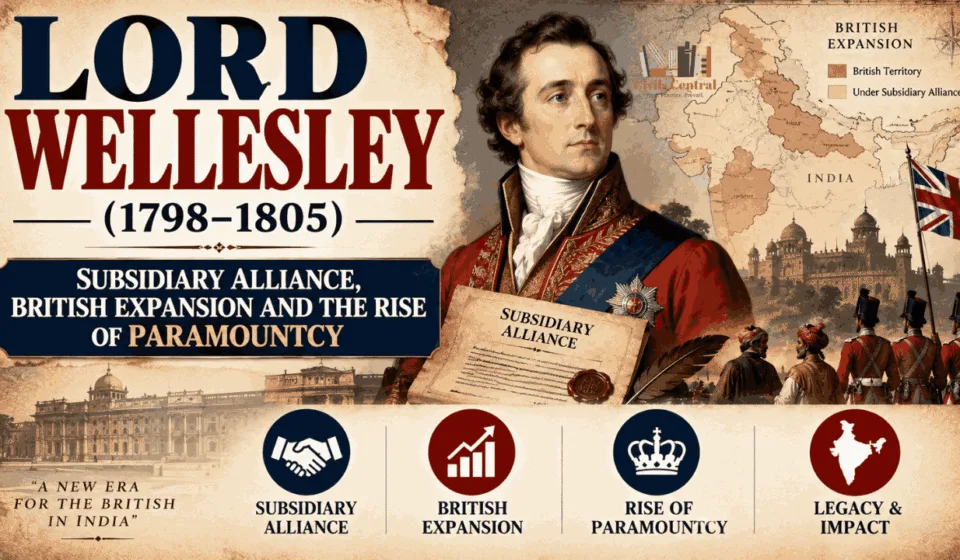
Lord Wellesley (1798–1805): Subsidiary Alliance, British Expansion and the Rise of Paramountcy

Lord Wellesley (1798–1805): Subsidiary Alliance, British Expansion and the Rise of Paramountcy
CivilsCentral Premium Modern History Series
Theme: Subsidiary Alliance, Imperial Expansion, Political Subordination and the Transformation of the East India Company into the Dominant Power in India
Learning Dashboard
| Component | Details |
|---|---|
| Series | Modern History of India (1707–1947) |
| Historical Period | 1798–1805 |
| Historical Phase | British Expansion and the Emergence of Paramountcy |
| Previous Chapter | Anglo-Maratha Wars (1775–1818): British Expansion and the Decline of Maratha Power |
| Current Chapter | Lord Wellesley (1798–1805): Subsidiary Alliance, British Expansion and the Rise of Paramountcy |
| Next Chapter | British Expansion and Consolidation in India |
| Core Theme | Transformation of British power through Subsidiary Alliance, military intervention and political subordination |
| Major Developments | Subsidiary Alliance, Hyderabad Treaty, Fourth Anglo-Mysore War, Treaty of Bassein, Second Anglo-Maratha War |
| Key Personality | Lord Wellesley |
| Major Indian Powers | Hyderabad, Mysore, Marathas |
| Core Concepts | Subsidiary Alliance, Paramountcy, Political Subordination, Resident, Strategic Buffer, French Threat |
| Exam Relevance | UPSC CSE, JKPSC, JKAS, State PCS, CDS, CAPF, UGC-NET |
Introduction
The arrival of Lord Wellesley as Governor-General of India in 1798 marked a decisive change in the character of British expansion. Before Wellesley, the East India Company had certainly acquired substantial territories and exercised considerable political influence, but its expansion was often shaped by defensive calculations, regional conflicts and limited territorial objectives. Under Wellesley, British policy became much more assertive. The central objective was to establish the Company as the paramount political power in India by preventing rival European influence, subordinating major Indian states and extending British control through a combination of military force and treaty relationships.
The most important instrument of this policy was the Subsidiary Alliance System. Under this arrangement, an Indian ruler accepted the protection of the Company but surrendered important elements of sovereignty. A British force was stationed within or near the ruler’s territory, its cost was borne by the Indian state through a subsidy or territorial cession, the ruler’s external relations were brought under British control, and a British Resident was placed at the court. The system therefore offered protection while simultaneously converting the protected state into a dependent political entity. Contemporary educational histories identify Hyderabad in 1798 as the first major state to enter Wellesley’s subsidiary system, followed by the Peshwa in 1802 and other Maratha powers in the course of British expansion.
Wellesley’s policy was closely connected with the international situation of the late eighteenth century. The French Revolutionary and Napoleonic Wars had revived British fears of French influence in India. Indian rulers had increasingly employed European officers and military specialists, and the Nizam of Hyderabad possessed a substantial French-trained military force. Wellesley therefore presented British protection as necessary not only against Indian rivals but also against possible European intervention.
The significance of Wellesley’s administration, however, cannot be reduced to the Subsidiary Alliance alone. His period witnessed the Fourth Anglo-Mysore War and the fall of Tipu Sultan in 1799, the establishment of British predominance over Hyderabad, the restoration of the Peshwa through the Treaty of Bassein in 1802, and the Second Anglo-Maratha War of 1803–1805. These developments collectively transformed the political balance of India.
CivilsCentral Historical Insight
Lord Wellesley’s significance lies in the transformation of British expansion from territorial acquisition into a systematic strategy of political subordination. His government did not need to annex every Indian state directly. By controlling diplomacy, stationing British troops, eliminating rival European influence and compelling rulers to finance their own dependence, the Company could establish paramountcy while allowing many Indian rulers to retain nominal sovereignty.
Part I — British Position before Lord Wellesley
1. From Trading Corporation to Territorial Power
The East India Company had undergone a profound transformation during the eighteenth century. The victories at Plassey in 1757 and Buxar in 1764, followed by the acquisition of the Diwani of Bengal in 1765, gave the Company a territorial and financial base from which it could sustain a large military establishment.
British power subsequently expanded through conflicts with Mysore, the Marathas and other regional powers. The Company was no longer merely a commercial organisation operating through coastal settlements. It had become a major territorial and military power whose interests extended deeply into Indian politics.
Yet by the late eighteenth century, several powerful Indian states remained outside direct British control. Mysore under Tipu Sultan remained hostile, Hyderabad possessed a significant military establishment, and the Maratha Confederacy continued to be one of the most powerful political systems in India.
2. The Earlier Ring-Fence Approach
Before Wellesley, British policy under figures such as Warren Hastings had often involved what historians describe as a Ring-Fence Policy. The basic objective was to secure Company territories by maintaining buffer arrangements with neighbouring states rather than immediately seeking direct control over all of them.
The logic was primarily defensive. If neighbouring Indian states could be maintained as buffers, the Company’s core territories would be protected from invasion and political instability.
The Subsidiary Alliance represented a significant development beyond this approach. It retained the language of protection but converted protection into a mechanism through which the Company could control the military and diplomatic affairs of the protected state.
3. The Changing International Environment
The French Revolution of 1789 transformed European politics, while the rise of Napoleon Bonaparte created renewed British anxiety about French influence overseas. The British feared that France might establish political or military connections with Indian rulers and use Indian territory as a base against British possessions. This concern became particularly significant because Indian rulers were employing European officers and military specialists to modernise their armies.
The Nizam of Hyderabad had a French-trained military establishment, while Mysore under Tipu Sultan maintained diplomatic relations with the French. The British therefore interpreted European military influence in Indian courts as a potential strategic threat.
CivilsCentral Historical Insight
The French threat was real, but Wellesley also used it as a powerful justification for a broader imperial strategy. By presenting British military protection as the only reliable defence against European intervention, the Company could convert geopolitical insecurity into political dependence and persuade—or pressure—Indian rulers to surrender important elements of sovereignty.
Part II — Lord Wellesley and the New Imperial Policy
1. Appointment of Lord Wellesley
Richard Colley Wellesley, later known as the Marquess Wellesley, became Governor-General of India in 1798. He arrived at a moment when the British position was stronger than it had been earlier in the century, but several major Indian powers remained outside direct British control. Wellesley believed that the Company could not remain secure if powerful Indian states continued to maintain independent diplomacy and military forces.
His policy therefore aimed at establishing British supremacy rather than merely defending existing territories.
2. Main Objectives of Wellesley’s Policy
Wellesley’s policy rested upon several interconnected objectives. First, he wanted to eliminate or restrict French political and military influence in India. Second, he wanted to prevent powerful Indian states from forming combinations against the Company. Third, he sought to establish British control over the foreign relations of major Indian states. Finally, he wanted to strengthen British military security by placing Company troops in strategically important regions at the expense of Indian rulers.
These objectives explain why the Subsidiary Alliance was so effective from the Company’s perspective. It could achieve political and military control without immediately undertaking the expensive process of direct annexation.
3. From Balance of Power to Paramountcy
The central difference between Wellesley’s approach and earlier British policy was the concept of paramountcy. The Company was no longer satisfied with being one major power among several. It sought to establish itself as the superior authority whose military and diplomatic power would determine the political behaviour of other Indian states.
This was a fundamental change in the structure of Indian politics. The Company increasingly attempted to determine not merely what territory it directly governed, but also how other states could conduct diplomacy, maintain armies and interact with foreign powers.
Part III — Subsidiary Alliance System
1. Meaning of Subsidiary Alliance
The Subsidiary Alliance was a political and military arrangement under which an Indian ruler accepted the protection of the British East India Company in return for accepting significant restrictions on sovereignty. The system was not entirely an invention of Wellesley. Earlier forms of subsidiary or protective arrangements had existed in different forms, and the idea had precedents in eighteenth-century European and Indian diplomacy. However, Wellesley transformed it into a systematic instrument of British expansion after 1798.
The essence of the system was simple: the Indian ruler retained his throne and nominal internal authority, but the Company acquired control over the state’s external relations and military security.
2. Stationing of British Troops
A ruler accepting the alliance had to permit a British military force to be stationed within or near his territory. The force was ostensibly maintained for the ruler’s protection against external threats and internal disorder. In practice, however, its presence gave the Company a permanent military foothold inside the political territory of the allied state.
3. Payment of Subsidy
The Indian ruler was required to bear the cost of maintaining the British force. This could be done through direct payment or, increasingly, through the cession of territory whose revenues would finance the subsidiary force.
The arrangement therefore transferred the financial burden of British military expansion onto the Indian state itself. The Company could maintain large military forces without bearing the entire cost from its own treasury.
4. Restriction on Foreign Relations
The ruler could not enter into negotiations, alliances or wars with other powers without British approval. This provision represented a major surrender of sovereignty. A state might continue to possess its own ruler, court and internal administration, but it could no longer independently determine its external political strategy.
5. British Resident
A British Resident was stationed at the allied ruler’s court. The Resident was officially a diplomatic representative, but the position increasingly gave the Company access to the internal politics of Indian states. The Resident could influence succession disputes, ministerial appointments, foreign relations and political decisions.
Thus, indirect rule did not mean absence of British interference. Instead, it often created a permanent institutional mechanism for such interference.
6. Restriction on European Officers
Indian rulers accepting subsidiary arrangements were generally required to remove rival European military personnel, especially those associated with France. This served two British objectives simultaneously: it reduced the possibility of European military competition and prevented Indian rulers from developing independent armies with European assistance.
IGNOU notes that one important British objective was to prevent Indian rulers from employing European military specialists who could help modernise their armies.
7. Reduction of the Ruler’s Own Army
The allied ruler was expected to reduce or reorganise his independent military establishment. This was strategically crucial. A ruler who no longer possessed a large independent army became dependent upon British troops for external security and increasingly vulnerable to British political pressure.
The alliance therefore created a paradox: the ruler was protected by the British precisely because he had been deprived of much of the independent military capacity with which he might have protected himself.
CivilsCentral Historical Insight
The Subsidiary Alliance was powerful because it attacked sovereignty indirectly. Instead of overthrowing Indian rulers, it preserved their thrones while removing the essential instruments of independent statehood—an autonomous army, an independent foreign policy and freedom to maintain relations with rival European powers. Political dependence could therefore be achieved without immediate annexation.
Part IV — Objectives of the Subsidiary Alliance
The Subsidiary Alliance served several British objectives simultaneously.
1. Elimination of French Influence
The immediate international objective was to remove French influence from Indian courts and armies. By requiring allied rulers to dismiss European officers and accept British military protection, the Company reduced the possibility of French intervention.
2. Military Expansion without Full Direct Cost
The system enabled the Company to maintain large military forces while requiring allied rulers to finance them. This was a major fiscal advantage. British troops stationed in subsidiary states could serve both as protection for the ally and as instruments of British expansion.
3. Political Control
The Company acquired effective control over the foreign policy of allied states. This prevented Indian rulers from forming independent coalitions against British interests.
4. Strategic Bases
Subsidiary forces could be stationed in strategically important regions. This gave the Company military access to areas that might otherwise have required costly conquest.
5. Isolation of British Enemies
The system prevented Indian states from assisting British opponents. If one state resisted British expansion, other allied states were effectively prevented from joining it. This was particularly important in the British struggle against Mysore and later against the Marathas.
CivilsCentral Historical Insight
The Subsidiary Alliance converted military protection into imperial infrastructure. Every allied state became simultaneously a source of revenue, a military base, a diplomatic dependency and a barrier against rival powers. The system therefore expanded British power even when the Company did not directly annex territory.
Part V — Hyderabad and the First Major Subsidiary Alliance
1. The Nizam and the French Corps
The Nizam of Hyderabad faced military and political pressures from Mysore, the Marathas and the British. His government had employed French officers to organise and train a substantial military force. From the British perspective, this was dangerous because the French force could potentially become an instrument of French influence in the Deccan. Wellesley therefore sought to bring Hyderabad into the British alliance system.
2. Treaty of 1798
In 1798, the Nizam accepted a subsidiary arrangement with the British. The French officers and soldiers associated with the Nizam’s military establishment were removed, while British troops were stationed in Hyderabad. The Nizam agreed to bear the financial cost of the British force. This made Hyderabad the first major state to enter Wellesley’s subsidiary system.
3. Treaty of 1800 and Territorial Cession
The arrangement was subsequently strengthened, and the Nizam ceded territories to meet the cost of the subsidiary force. The British thereby gained strategically important territory while simultaneously eliminating French influence in Hyderabad. The Hyderabad settlement was extremely important because it gave the British a secure position in the Deccan before the final confrontation with Mysore and later the Marathas.
CivilsCentral Historical Insight
Hyderabad illustrates the central logic of Wellesley’s system: British diplomacy presented the alliance as protection against external enemies, but the resulting arrangement weakened the Nizam’s independent military capacity, removed French influence, transferred territory to the Company and established a permanent British military presence in the Deccan.
Part VI — Mysore and the Fourth Anglo-Mysore War
The Mysorean question was central to Wellesley’s early expansion.
1. Tipu Sultan’s Position
Tipu Sultan remained one of the strongest opponents of British expansion in southern India. He had maintained diplomatic connections with the French and sought external assistance to resist the British. Wellesley regarded Mysore as both an Indian strategic threat and a possible point of French intervention.
2. Diplomatic Isolation of Mysore
Before beginning the war, Wellesley strengthened British relations with the Nizam and secured cooperation from the Marathas. This meant that Mysore was increasingly isolated diplomatically. The strategy reflected an important lesson learned from earlier Anglo-Mysore conflicts: the British would avoid confronting a powerful Indian state alone whenever a coalition could be constructed against it.
3. Fourth Anglo-Mysore War, 1799
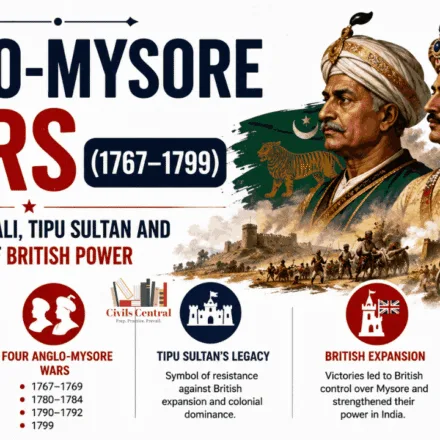
The conflict culminated in the Fourth Anglo-Mysore War of 1799. British and allied forces advanced towards Seringapatam. Tipu Sultan resisted but was ultimately defeated and killed during the assault on the city on 4 May 1799. The fall of Seringapatam ended Mysore’s position as a major independent military power and represented a major expansion of British influence in southern India.
4. Reorganisation of Mysore
The British did not annex the whole of Mysore. Instead, they restored the Wadiyar dynasty to the throne while placing the state within a British-controlled political framework. This settlement demonstrated the flexibility of Wellesley’s policy. Direct annexation was not always necessary. A nominally independent ruler could remain in power while British influence determined the state’s military and diplomatic orientation.
The broader historical treatment of Wellesley’s expansion confirms that Mysore’s defeat in 1799 and the subsequent subsidiary arrangements formed part of the process through which British power expanded across southern India.
CivilsCentral Historical Insight
The fall of Tipu Sultan was important not simply because one ruler was defeated, but because the British eliminated a major centre of organised resistance and replaced it with a political arrangement compatible with British interests. Mysore therefore became an example of Wellesley’s broader principle: destroy resistance where necessary, but preserve indigenous institutions where they can be converted into instruments of indirect control.
Part VII — Subsidiary Alliance and the Maratha Crisis
The defeat of Mysore strengthened the British position, but the Maratha Confederacy remained the most important major power outside British control.
The internal weakness of the Confederacy increasingly provided the opportunity Wellesley needed.
1. Decline of Maratha Political Unity
The deaths of Mahadji Scindia in 1794 and Nana Fadnavis in 1800 weakened the political mechanisms that had previously held the Maratha Confederacy together. Peshwa Baji Rao II faced opposition from powerful chiefs, particularly Holkar and Scindia. The political instability of Pune gradually created an opportunity for British intervention.
2. Holkar’s Victory
In 1802, Holkar defeated the Peshwa’s forces near Pune. Baji Rao II fled and sought British assistance. Wellesley now had the opportunity to apply the Subsidiary Alliance to the formal head of the Maratha Confederacy.
Part VIII — Treaty of Bassein, 1802
1. The Agreement
Baji Rao II signed the Treaty of Bassein in December 1802. The Peshwa accepted British protection and agreed to maintain a British subsidiary force. He also accepted restrictions upon his foreign relations. The treaty effectively made the Peshwa dependent upon British military power for the preservation of his political position.
2. Why Bassein Was Revolutionary
The importance of Bassein lay in the political status of the Peshwa. The Peshwa was not simply another Maratha ruler. He occupied the formal centre of the Confederacy. British control over his foreign policy therefore created a mechanism through which the Company could influence the wider Maratha political system. Scindia and Bhonsle refused to accept this arrangement, and their opposition led directly to the Second Anglo-Maratha War.
3. Restoration of Baji Rao II
British forces restored Baji Rao II to Pune. The restoration demonstrated the practical meaning of the Subsidiary Alliance: the British were now willing to use military force to place a dependent Indian ruler on his throne. This was a major departure from earlier British involvement in Indian politics.
CivilsCentral Historical Insight
The Treaty of Bassein represented the mature form of Wellesley’s imperial strategy. The British did not need to conquer Pune and abolish the Peshwaship immediately; they could restore the Peshwa, preserve his formal authority and simultaneously make his political survival dependent upon British military power. Sovereignty was therefore hollowed out from within.
Part IX — Second Anglo-Maratha War and Wellesley’s Expansion
1. British Military Campaign
Scindia and Bhonsle rejected the Treaty of Bassein, leading to the Second Anglo-Maratha War. British forces operated simultaneously in the Deccan and northern India. Arthur Wellesley commanded important operations in the Deccan, while General Gerard Lake led British campaigns in northern India.
2. Battle of Assaye
The Battle of Assaye in 1803 was a major British victory under Arthur Wellesley. The battle demonstrated the effectiveness of disciplined British-led infantry, artillery and coordinated battlefield command. It also showed that the Maratha chiefs could possess substantial military forces but still suffer defeat when they were unable to coordinate their armies under a unified strategic command.
3. Capture of Delhi
British forces under General Lake captured Delhi in 1803. This was strategically and symbolically important. The Mughal emperor remained a source of political legitimacy, and British control over Delhi strengthened the Company’s claim to superior political authority in northern India.
4. Battle of Laswari
The British victory at Laswari in 1803 further weakened Scindia’s military power. Separate settlements with the Maratha chiefs prevented the emergence of a united anti-British coalition.
5. Limits of Wellesley’s Expansion
Although Wellesley achieved major victories, his aggressive policy was expensive. Maintaining large armies and conducting multiple campaigns placed considerable pressure on the Company’s finances. The British government in Britain also became increasingly concerned about the scale and cost of Wellesley’s wars. His expansion therefore produced both territorial gains and growing financial and political criticism.
CivilsCentral Historical Insight
Wellesley’s greatest achievement was also the source of his greatest problem. The Subsidiary Alliance and military campaigns expanded British political influence at remarkable speed, but each new commitment required troops, subsidies and administrative expenditure. Imperial expansion created a powerful state, yet it also generated financial pressures that eventually limited the pace of further expansion.
Part X — Major States under the Subsidiary System
The system expanded beyond Hyderabad.
| State/Power | Period of Association | Broad Significance |
|---|---|---|
| Hyderabad | 1798 | First major Wellesley-era subsidiary alliance |
| Mysore | 1799 | Reorganisation after Tipu’s defeat |
| Peshwa | 1802 | Treaty of Bassein |
| Bhonsle of Nagpur | 1803 | Defeat during Second Anglo-Maratha War |
| Scindia of Gwalior | 1803 | British political and military predominance |
| Gaekwad of Baroda | Early 19th century | Growing British influence |
| Other Indian states | Later decades | Expansion of subsidiary relationships |
The important point is that the system did not emerge everywhere under identical circumstances. Some rulers entered alliances because of military threats, some because of internal political difficulties, and others after military defeat. The common outcome was increasing British control over foreign policy and military affairs.
Part XI — Why Indian Rulers Accepted the Subsidiary Alliance
The system cannot be understood only as something imposed by British military force. Indian rulers sometimes accepted it because they believed it would protect them against powerful regional enemies.
1. Protection against Rival States
A ruler facing the Marathas, Mysore or internal rebellion could regard British military support as useful. The Nizam, for example, faced pressure from both Mysore and the Marathas and therefore had reasons to seek British protection.
2. Internal Political Stability
British military support could strengthen a ruler against domestic rivals. However, this protection came at the cost of increasing British interference in internal affairs.
3. Fear of Other Indian Powers
The fragmented political environment of eighteenth-century India encouraged rulers to seek powerful allies. The British exploited this security dilemma by presenting themselves as the most reliable source of protection.
4. Absence of a United Indian Front
No single Indian power was capable of consistently balancing British military resources across the subcontinent. The resulting strategic environment encouraged individual rulers to negotiate separately with the Company.
CivilsCentral Historical Insight
The Subsidiary Alliance succeeded partly because it exploited the security dilemma of eighteenth-century India. Indian rulers often accepted British protection because their immediate concern was survival against regional rivals. Yet the alliance that protected them from one enemy simultaneously transferred their strategic independence to another power—the British East India Company.
Part XII — Advantages of the Subsidiary Alliance to the British
1. Expansion without Immediate Annexation
The Company could extend political control without directly administering every state. This reduced the immediate administrative burden of territorial conquest.
2. Financial Benefit
The allied state paid for British troops through subsidies or territorial cessions. The Company therefore shifted part of the cost of maintaining its military establishment onto Indian rulers.
3. Strategic Military Bases
British troops stationed in allied states provided strategically located military bases. These forces could be used against other Indian powers whenever necessary.
4. Elimination of Rival European Influence
French and other European military specialists were removed from allied courts. This reduced the possibility of European competition.
5. Control of Foreign Policy
The Company acquired effective control over the external relations of allied states. This prevented the formation of anti-British coalitions.
6. Political Influence
British Residents gained access to the courts of allied rulers and could influence political decisions. The result was a gradual expansion of indirect British authority.
CivilsCentral Historical Insight
The greatest strength of the Subsidiary Alliance was its economy of conquest. Instead of spending British resources to occupy every Indian state, the Company could make Indian rulers finance British troops, surrender independent diplomacy and accept British political supervision. Imperial control was therefore expanded through dependence rather than annexation alone.
Part XIII — Limitations and Consequences for Indian States
1. Loss of Sovereignty
The most important consequence was the loss of independent foreign policy. An allied ruler could no longer freely determine war, peace or alliances.
2. Military Weakening
The reduction of the ruler’s independent army made the state increasingly dependent upon British protection. This also reduced the ruler’s capacity to resist British interference.
3. Financial Burden
The subsidy could impose a heavy financial burden on the allied state. Failure to meet the obligation could result in territorial cession. Thus, military protection could ultimately become a mechanism of territorial loss.
4. British Interference in Internal Affairs
The presence of a Resident increased British influence over court politics, succession disputes and administrative decisions. The ruler might remain formally sovereign while becoming increasingly dependent in practice.
5. Loss of Military Modernisation
The requirement to dismiss foreign military specialists and reduce independent armies prevented several Indian states from developing autonomous military establishments capable of competing with the Company.
Part XIV — Wellesley’s Administrative and Institutional Legacy
Wellesley’s legacy was not limited to military conquest. His administration also contributed to the institutional development of the Company’s expanding political system. The expansion of British territories required trained officials capable of dealing with Indian languages, laws and administrative systems. The establishment of Fort William College in Calcutta in 1800 reflected Wellesley’s belief that Company officials required specialised training for governance.
Although the College’s role changed over time, its establishment illustrates a broader development: territorial expansion created the need for an increasingly professional colonial administrative structure.
Thus, military conquest and administrative development were interconnected. As the Company acquired greater political authority, it also needed institutions capable of managing its expanding responsibilities.
Part XV — Why Wellesley’s Policy Was Controversial
Wellesley’s aggressive policy attracted criticism both in India and in Britain.
1. High Military Expenditure
The wars against Mysore and the Marathas required substantial expenditure. Although territorial acquisitions and subsidies increased British resources, military campaigns also created major immediate costs.
2. Risk of Continuous Warfare
Every new alliance could generate new military commitments. A system designed to provide security could therefore create a cycle in which the Company became increasingly involved in conflicts among Indian states.
3. Parliamentary Concerns
The Company’s government remained subject to political oversight in Britain. Wellesley’s expansion raised concerns that the Governor-General was pursuing an excessively aggressive imperial policy.
4. Recall of Wellesley
Wellesley eventually left India in 1805. His departure reflected growing concern over the financial and political consequences of his expansionist strategy.
CivilsCentral Historical Insight
Wellesley’s career illustrates a recurring contradiction in imperial expansion: military victories can strengthen a state while simultaneously increasing the costs and responsibilities of empire. His policy expanded British power dramatically, but the financial burden of maintaining that expansion helped generate the political resistance that eventually brought his tenure to an end.
Part XVI — Historiography
1. Imperial Interpretation
Older colonial interpretations often portrayed Wellesley as a visionary statesman who recognised the dangers posed by Mysore, the Marathas and French influence and acted decisively to secure British India. From this perspective, the Subsidiary Alliance represented a rational system of collective security.
2. Nationalist Interpretation
Nationalist historians viewed the Subsidiary Alliance as an instrument of imperial expansion. From this perspective, the British used the language of protection to deprive Indian states of military and diplomatic independence. The system therefore represented a sophisticated method of colonial subordination.
3. Modern Interpretation
Modern scholarship tends to offer a more nuanced assessment. The system was undoubtedly expansionist, but its success also depended upon the political circumstances of Indian states. Some rulers voluntarily or strategically accepted British protection because they faced immediate threats from rival powers.
The Subsidiary Alliance therefore emerged from an interaction between British imperial ambition and Indian political competition.
CivilsCentral Historical Insight
The Subsidiary Alliance should neither be viewed simply as a peaceful system of protection nor solely as a predetermined instrument of conquest. It was a flexible form of imperial power that emerged from the interaction of British ambitions with the security concerns and political rivalries of Indian rulers. Its historical importance lies precisely in how protection could gradually become dependence and dependence could ultimately become domination.
Part XVII — Historical Significance of Lord Wellesley’s Rule
1. Expansion of British Political Authority
Wellesley transformed the Company from a major territorial power into a power capable of determining the political behaviour of other Indian states.
2. Decline of French Influence
French military and diplomatic influence in Indian courts was substantially reduced. This removed an important European rival from the political equation.
3. Defeat of Mysore
The fall of Tipu Sultan in 1799 removed one of the strongest centres of organised resistance to British expansion.
4. Subordination of Hyderabad
The Nizam became dependent upon British military protection and lost much of his independent strategic capacity.
5. Political Capture of the Peshwa
The Treaty of Bassein brought the Peshwa into the British alliance system and provided the immediate political foundation for the Second Anglo-Maratha War.
6. Expansion of British Territory
The wars and treaties associated with Wellesley’s administration significantly expanded British territorial influence in southern, western and northern India.
7. Emergence of Paramountcy
The most important long-term consequence was the emergence of a political hierarchy in which the British increasingly claimed superior authority over Indian states.
This was the foundation of the later British paramountcy system.
CivilsCentral Historical Insight
Wellesley’s greatest historical contribution was not any single territorial acquisition but the creation of a political environment in which British supremacy became structurally embedded. After his tenure, Indian rulers could still retain their dynasties and internal administrations, but increasingly they did so within a political order whose ultimate strategic authority rested with the British.
Part XVIII — Lord Wellesley and the Transformation of British Strategy
The evolution of British policy can now be traced across several stages.
| Phase | Policy | Central Objective |
|---|---|---|
| Early Company Rule | Commercial expansion | Trade and profit |
| Post-Plassey | Territorial intervention | Revenue and political influence |
| Warren Hastings | Ring-Fence Policy | Security of Company territories |
| Cornwallis | Administrative consolidation | Strengthening colonial institutions |
| Wellesley | Subsidiary Alliance | Political subordination |
| Post-Wellesley | Paramountcy | Superior British authority |
This progression demonstrates that British imperialism did not emerge fully formed in 1757. It developed gradually as the Company’s objectives, resources and political capabilities changed.
CivilsCentral Historical Insight
The history of British expansion is best understood as an evolution of methods rather than a single continuous policy. Plassey created a territorial opening, Buxar strengthened the fiscal base, later wars expanded military influence, and Wellesley’s Subsidiary Alliance converted that power into a system of political dependence. Imperial supremacy was therefore constructed incrementally.
Part XIX — Comparative Analysis: Ring-Fence Policy vs Subsidiary Alliance
| Feature | Ring-Fence Policy | Subsidiary Alliance |
|---|---|---|
| Major Period | Mainly late 18th century before Wellesley | Systematised after 1798 |
| Associated Governor-General | Warren Hastings | Lord Wellesley |
| Basic Objective | Protect Company territories | Establish political supremacy |
| Relationship with Indian States | Buffer states | Dependent allies |
| British Troops | Limited/directly controlled by Company | Permanently stationed in allied state |
| Foreign Policy | Relatively greater autonomy | Controlled by British |
| European Influence | Not systematically eliminated | Rival European influence restricted |
| Resident | Not necessarily central to system | Important instrument of influence |
| Strategic Character | Primarily defensive | Expansionist and imperial |
| Historical Outcome | Security of Company territories | Emergence of British paramountcy |
Part XX — Lord Wellesley’s Policy: Advantages and Limitations
Advantages for British Expansion
The Subsidiary Alliance gave the British strategically located military bases, financial resources, diplomatic control and the ability to isolate rival powers. It allowed the Company to expand its influence without annexing every state directly and significantly reduced the possibility of French intervention.
Limitations for the British
The system was expensive to administer and defend. The more states the Company protected, the greater its military commitments became. Wellesley’s wars also produced financial pressure and political criticism in Britain. His aggressive expansion therefore generated the very fiscal and administrative problems that eventually constrained his policy.
Consequences for Indian States
For Indian rulers, the immediate advantage was protection against rival powers and internal threats. However, this protection came at the cost of sovereignty. States lost control over foreign policy, reduced their independent military capacity, incurred financial obligations and became increasingly vulnerable to British interference.
Part XXI — UPSC & JKAS Analytical Themes
Theme 1 — Was the Subsidiary Alliance a system of protection or a system of control?
It was formally presented as a system of mutual protection, but its practical consequences were heavily weighted in favour of the British. The allied ruler received military protection but surrendered independent foreign policy, accepted British troops, financed those troops and permitted British political representation at the court.
Thus, protection became the mechanism through which sovereignty was progressively restricted.
Theme 2 — Why was Wellesley’s policy more effective than direct conquest?
Direct conquest required military expenditure, administrative reorganisation and the assumption of responsibility for newly conquered populations. The Subsidiary Alliance achieved many strategic objectives without requiring immediate annexation.
The British could maintain troops inside allied territories, eliminate rival European influence and control foreign policy while allowing Indian rulers to retain nominal authority.
Theme 3 — How did the French threat contribute to British expansion?
French military influence among Indian rulers provided Wellesley with a powerful justification for expansion. By presenting French influence as a threat to British India, Wellesley could demand the removal of French officers and the acceptance of British military protection.
The French threat was therefore both a genuine strategic concern and an instrument through which British political influence could be expanded.
Theme 4 — Why was the Treaty of Bassein important?
The Treaty of Bassein brought the Peshwa under British protection and gave the Company direct political influence over the formal head of the Maratha Confederacy. It transformed an internal Maratha political crisis into a British strategic opportunity and directly contributed to the Second Anglo-Maratha War.
Theme 5 — Did Wellesley establish British paramountcy?
Wellesley did not create the complete system of paramountcy that developed later in the nineteenth century, but his policies established an important foundation for it.
By 1805, the British had substantially expanded their territorial and diplomatic influence, defeated Mysore, subordinated Hyderabad and brought the Peshwa into a dependent relationship. The idea that the Company possessed superior political authority over other Indian states had consequently become much stronger.
Part XXII — Prelims Revision Zone
Remember the Core Sequence
Wellesley arrives → Subsidiary Alliance → Hyderabad (1798) → Fourth Anglo-Mysore War (1799) → Mysore Settlement → Treaty of Bassein (1802) → Second Anglo-Maratha War (1803–05) → British Paramountcy
Key Facts
- Lord Wellesley: Governor-General, 1798–1805.
- Subsidiary Alliance: Systematised under Wellesley.
- First major state: Hyderabad, 1798.
- Mysore: Defeated in 1799; Tipu Sultan killed.
- Peshwa: Accepted Subsidiary Alliance through Treaty of Bassein, 1802.
- Second Anglo-Maratha War: 1803–1805.
- Major battle: Assaye, 1803.
- Northern campaign: Capture of Delhi and victory at Laswari.
- Major objective: Political subordination of Indian states and elimination of rival European influence.
- Major long-term consequence: Strengthening of British paramountcy.
Part XXIII — Frequently Confused Facts
| Confusion | Correct Fact |
|---|---|
| Subsidiary Alliance was invented entirely by Wellesley | Wellesley systematised and extensively employed it after 1798; earlier precedents existed. |
| Subsidiary Alliance meant direct annexation | No. It generally preserved the ruler while restricting sovereignty. |
| The ruler could freely conduct foreign policy | No. Foreign relations were subject to British control. |
| The allied ruler maintained a completely independent army | No. Independent military capacity was generally reduced. |
| The British paid for the subsidiary force | The Indian ruler bore the cost through subsidy or territorial cession. |
| Hyderabad joined the system after Mysore | Hyderabad entered the major Wellesley system in 1798, before the fall of Tipu in 1799. |
| Mysore was completely annexed in 1799 | No. The Wadiyar dynasty was restored under British influence. |
| Treaty of Bassein was a settlement after the Second Anglo-Maratha War | No. It preceded and helped cause the Second Anglo-Maratha War. |
| Wellesley’s policy was purely defensive | No. It was fundamentally expansionist and aimed at political supremacy. |
| British paramountcy was created entirely by Wellesley | No. Wellesley laid an important foundation; paramountcy developed further during the nineteenth century. |
Chapter Summary
Lord Wellesley’s tenure as Governor-General from 1798 to 1805 marked a decisive phase in the expansion of British power in India. His central objective was to transform the Company from a powerful territorial authority into the paramount political power capable of controlling the diplomatic and military behaviour of the major Indian states.
The principal instrument of this transformation was the Subsidiary Alliance. Under the system, Indian rulers accepted British protection but were required to permit the stationing of British troops, finance those troops through subsidies or territorial cessions, restrict independent foreign relations, accept British political representation and reduce their own military independence. The system therefore preserved nominal sovereignty while progressively weakening substantive sovereignty. The Nizam of Hyderabad became the first major ruler to enter Wellesley’s subsidiary system in 1798. The arrangement removed French military influence from Hyderabad and established a British military presence in the Deccan.
The next major development was the Fourth Anglo-Mysore War of 1799. Tipu Sultan was defeated and killed at Seringapatam, ending Mysore’s position as a major independent military challenge. The Wadiyar dynasty was restored under British influence. The political crisis within the Maratha Confederacy then provided Wellesley with another opportunity. Peshwa Baji Rao II accepted the Treaty of Bassein in 1802, bringing the Peshwa under British protection. The resulting opposition from Scindia and Bhonsle led to the Second Anglo-Maratha War, during which British forces achieved important victories at Assaye and Laswari and extended their influence across large areas of India.
Wellesley’s policy therefore achieved remarkable territorial and political expansion. Yet it also generated substantial financial and military commitments, contributing to criticism of his aggressive policy and ultimately to his departure in 1805.
The larger historical significance of Wellesley’s administration lies in the evolution of British imperial strategy:
Protection → Dependence → Political Control → Military Subordination → Paramountcy
CivilsCentral Historical Insight
Lord Wellesley did not create British supremacy through conquest alone. He created a system in which Indian rulers increasingly financed British armies, surrendered independent diplomacy, removed rival European influence and depended upon British military protection for political survival. The significance of his policy therefore lies in the conversion of British military power into a durable structure of political dependence.
Mind Map — Lord Wellesley and Subsidiary Alliance
                    LORD WELLESLEY
                      1798–1805
                           │
            ┌──────────────┼──────────────┐
            │              │              │
        OBJECTIVES      METHOD         CONTEXT
            │              │              │
     British Paramountcy  Subsidiary    French Threat
     ↓                    Alliance       ↓
     Remove France       ↓              Indian Rivalry
     ↓              British Troops     ↓
     Defeat Mysore        ↓          Security Crisis
     ↓                Subsidy
     Control Marathas     ↓
     ↓              Foreign Policy
     Political Control    ↓
                      Resident
                          │
         ┌────────────────┼────────────────┐
         │                │                │
     HYDERABAD          MYSORE          MARATHAS
       1798              1799             1802
         │                │                │
   French force      Tipu defeated    Bassein Treaty
   removed               │                │
         │           Wadiyar restored    │
   British troops        │          Second War
         │           British control      │
         └────────────────┼────────────────┘
                          │
                          ▼
                  BRITISH EXPANSION
                          │
             ┌────────────┼────────────┐
             │            │            │
          Military     Diplomatic    Financial
          Bases        Control       Burden
             │            │            │
             └────────────┼────────────┘
                          ▼
                  BRITISH PARAMOUNTCY
FAQs
1. Who introduced the Subsidiary Alliance System?
Lord Wellesley systematically developed and extensively employed the Subsidiary Alliance after becoming Governor-General in 1798. Earlier forms of subsidiary arrangements existed before him, so it is more precise to say that Wellesley systematised the policy rather than invented every element of it.
2. Which state first accepted Wellesley’s Subsidiary Alliance?
Hyderabad in 1798 was the first major Indian state to enter Wellesley’s subsidiary system.
3. What was the main purpose of the Subsidiary Alliance?
Its immediate purposes included eliminating rival European influence, especially French influence, controlling the foreign policy of Indian states, establishing British military bases and expanding British political supremacy.
4. Did Indian rulers benefit from the system?
In the short term, rulers gained British military protection against external enemies and internal threats. However, this protection came at the cost of military, diplomatic and financial independence.
5. How did the Subsidiary Alliance weaken Indian states?
It reduced independent armies, restricted foreign policy, imposed financial obligations and increased British interference through Residents.
6. What happened to Tipu Sultan under Wellesley?
Tipu Sultan was defeated and killed during the Fourth Anglo-Mysore War in 1799. Mysore was subsequently reorganised under the Wadiyar dynasty within a British-dominated political framework.
7. Why was the Treaty of Bassein important?
It brought Peshwa Baji Rao II under British protection in 1802 and provided the political basis for British intervention in the Maratha Confederacy and the Second Anglo-Maratha War.
8. Did Wellesley annex all the states he defeated?
No. Wellesley’s system relied heavily upon indirect control. Indian rulers could retain their thrones while surrendering substantial aspects of sovereignty.
9. Why did Wellesley leave India?
His aggressive expansion generated significant military expenditure and political criticism. His expansionist policy was increasingly viewed as financially burdensome, contributing to his departure in 1805.
10. What is the historical significance of Wellesley’s rule?
Wellesley’s administration laid a major foundation for British paramountcy by combining military expansion with treaty-based political subordination.
SEO & Publishing Pack
SEO Title
Lord Wellesley (1798–1805): Subsidiary Alliance, British Expansion and Paramountcy
Meta Description
Study Lord Wellesley’s policy of Subsidiary Alliance, the Nizam of Hyderabad, Fourth Anglo-Mysore War, Treaty of Bassein, Second Anglo-Maratha War and the rise of British paramountcy.
Focus Keyphrase
Lord Wellesley and Subsidiary Alliance
Suggested URL Slug
lord-wellesley-subsidiary-alliance-british-expansion
SEO Tags
Lord Wellesley, Lord Wellesley 1798-1805, Subsidiary Alliance, Subsidiary Alliance System, Wellesley Subsidiary Alliance, Nizam of Hyderabad 1798, Treaty of Bassein 1802, Fourth Anglo-Mysore War, Tipu Sultan 1799, Second Anglo-Maratha War, British Expansion in India, British Paramountcy, French Influence in India, British Imperialism in India, Modern History UPSC
About The Author









[…] Lord Wellesley (1798–1805): Subsidiary Alliance, British Expansion and the Rise of Paramountcy […]