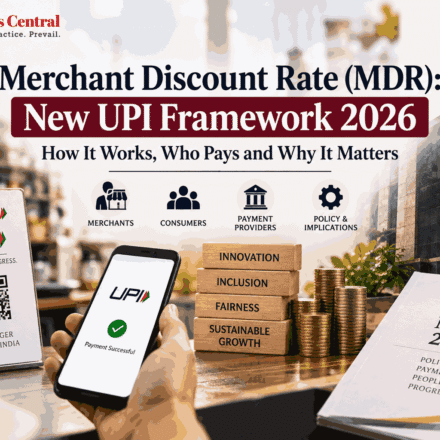
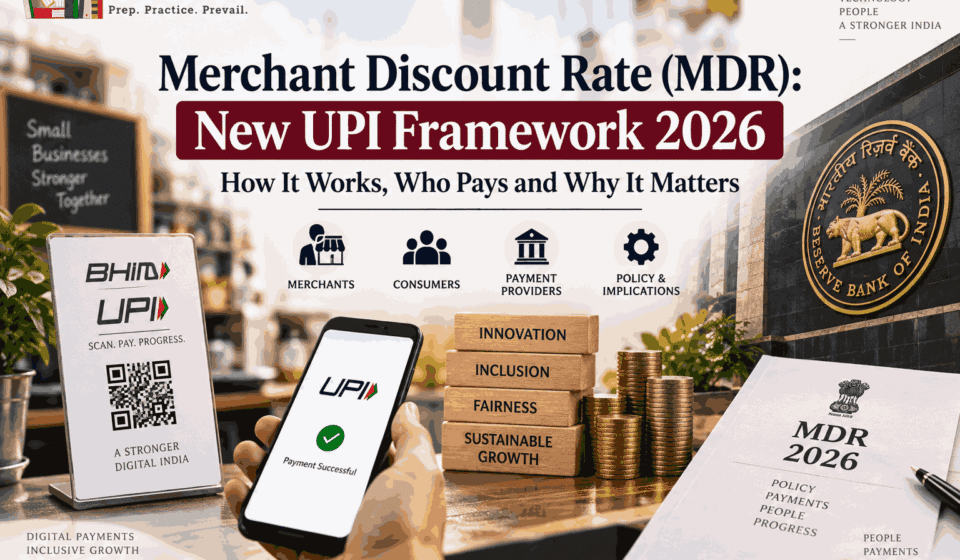
Merchant Discount Rate (MDR): New UPI Framework 2026, How It Works, Who Pays and Why It Matters

Why in News?
Merchant Discount Rate (MDR) is in the news because India is introducing a targeted MDR framework for selected UPI merchant transactions, marking a major change from the broad zero-MDR regime that had been used to accelerate digital-payment adoption.
On 14 September 2026, the Central Government notified a framework under the Payment and Settlement Systems Act, 2007, under which UPI transactions up to ₹2,000 are protected from charges. On 15 September 2026, NPCI announced the detailed MDR framework, which will take effect from 15 October 2026.
The most important point is that UPI is not becoming universally chargeable. Person-to-person (P2P) transactions will remain free regardless of value, while MDR will apply only to specified person-to-merchant (P2M) transactions above ₹2,000. The Government says approximately 96% of P2M transactions will remain unaffected.
This makes MDR important for UPSC because the topic connects digital payments, banking, fintech, financial inclusion, Digital Public Infrastructure (DPI), payment-system regulation and the economics of public digital infrastructure.
What Exactly Is New?
The current development is best understood as a shift from a broad zero-MDR framework for UPI towards a targeted MDR model.
| Dimension | Earlier broad framework | New framework from 15 October 2026 |
|---|---|---|
| P2P UPI | Free | Remains free |
| P2M up to ₹2,000 | Zero MDR | Remains free |
| Specified P2M above ₹2,000 | Zero MDR | 0.4% MDR |
| High-value applicable P2M | Zero MDR | MDR capped at ₹300 |
| Small P2PM merchants | Zero MDR | Zero MDR continues |
| Essential/thin-margin sectors | Zero MDR under UPI framework | Flat ₹5 for specified transactions above ₹2,000 |
| Capital-market transactions | Zero MDR under UPI framework | 0.02%, capped at ₹300 |
The new framework therefore does not mean that every UPI user will start paying a transaction fee. The charge operates within the merchant-payment ecosystem.
1. Understanding the Core Concept: What Is MDR?
Merchant Discount Rate (MDR) is a charge associated with processing a digital payment received by a merchant.
In a digital payment, the apparent simplicity of scanning a QR code or tapping a card conceals a larger ecosystem involving banks, payment networks, payment service providers, payment aggregators and other technology providers. MDR is one mechanism through which the costs associated with this ecosystem can be recovered.
The RBI defines MDR as the rate charged to a merchant for payment-processing services on debit and credit card transactions. Historically, RBI has regulated MDR particularly in the context of card payments.
The concept therefore predates UPI.
This distinction is important: MDR is a payment-system pricing mechanism; UPI is a payment infrastructure.
UPI itself is not synonymous with MDR.
2. Why Does MDR Exist?
A digital payment requires infrastructure even when the transaction appears free to the user. The payment ecosystem has to support:
- transaction routing;
- authentication;
- settlement;
- fraud prevention;
- cybersecurity;
- merchant onboarding;
- transaction processing;
- dispute resolution;
- system maintenance;
- technological upgrades.
These activities generate costs.
This creates a basic economic problem: If users and merchants pay nothing for every transaction, who finances the infrastructure that processes those transactions?
MDR is one possible mechanism for recovering part of those costs.
This is why the present debate is not simply about introducing a “fee”. It concerns the larger question of how India’s digital-payment infrastructure should be financed while preserving affordability and financial inclusion.
3. What Is P2P and P2M?
This distinction is fundamental to understanding the new framework.
Person-to-Person — P2P
P2P refers to a payment from one individual to another.
Examples include:
- sending money to a friend;
- transferring money to family;
- repaying an individual;
- transferring funds between individuals.
Under the new framework, P2P UPI transactions remain completely free irrespective of the amount.
Person-to-Merchant — P2M
P2M refers to payments made by an individual to a business or merchant.
Examples include:
- purchasing goods from a shop;
- paying a restaurant;
- purchasing goods online;
- paying a commercial establishment through UPI.
Specified P2M transactions above ₹2,000 are the principal category to which MDR now applies.
Prelims distinction
P2P ≠ P2M
A ₹50,000 transfer to another individual is not treated in the same way as a ₹50,000 payment to a merchant.
4. What Is the New UPI MDR Framework?
Under the new framework, specified P2M UPI transactions above ₹2,000 attract MDR of 0.4%. For transactions of ₹75,000 and above, the MDR is capped at ₹300 per transaction.
Example
Suppose an eligible merchant receives: ₹3,000
MDR = 0.4% × ₹3,000 = ₹12
For: ₹50,000
MDR = 0.4% × ₹50,000 = ₹200
For: ₹1,00,000
0.4% would produce ₹400, but the cap applies.
Therefore: MDR = ₹300
This makes the ₹75,000 threshold conceptually important: 0.4% × ₹75,000 = ₹300
Beyond this point, the percentage calculation would exceed the maximum permitted MDR.
5. Does Every UPI Payment Above ₹2,000 Attract 0.4%?
No. This is one of the most important Prelims traps. The 0.4% rate applies to specified P2M transactions. Several categories remain exempt or receive different treatment.
The Government explicitly states that P2P transactions remain free, payments to merchants up to ₹2,000 remain free, and transactions covered by the zero-MDR framework for small merchants also remain free.
Therefore: “Every UPI transaction above ₹2,000 will attract 0.4% MDR” is incorrect.
6. Small Merchants and the P2PM Category
One of the most important safeguards concerns small merchants.
Small merchants, including street vendors and neighbourhood shops, receiving up to ₹1 lakh per month through UPI QR codes under the P2PM category will continue to receive zero-MDR treatment.
This reflects a policy distinction between: large/high-value commercial payments and small-scale digital commerce.
The rationale is significant from a financial-inclusion perspective.
A small street vendor operating on narrow margins may be disproportionately affected even by a small percentage charge. Protecting such merchants attempts to preserve the role of UPI in bringing informal and micro businesses into the digital economy.
7. Special MDR for Essential and Thin-Margin Sectors
The Government has not applied the ordinary 0.4% rate uniformly. Specified essential and thin-margin sectors—including:
- railways;
- telecommunications;
- insurance;
- fuel;
- agricultural inputs;
will attract a flat MDR of ₹5 per transaction for transactions above ₹2,000. This is an example of differentiated pricing.
A percentage-based charge can become significant for large-value payments even when the underlying business operates with relatively low margins. A flat ₹5 charge provides greater cost predictability.
8. MDR for Capital-Market Transactions
Payments associated with:
- mutual funds;
- securities;
- stockbrokers;
- dealers;
will attract an MDR of 0.02%, capped at ₹300 per transaction.
The lower rate is intended to support continued retail participation in formal financial markets.
For Prelims, remember that the new framework therefore contains different rates for different transaction categories. There is no single universal MDR rate applicable to every UPI merchant transaction.
9. Who Pays MDR?
This is one of the most important conceptual questions. MDR is a merchant-side charge.
The Government has explicitly clarified that MDR is:
- not a tax;
- not a charge collected by the Government;
- not a charge collected by NPCI for itself.
Instead, the MDR is distributed among participants in the payment ecosystem, including banks, payment service providers and UPI application providers.
Therefore:
Merchant-side MDR ≠ Government tax ≠ Consumer UPI transaction fee
The Government has also advised banks to ensure that merchants do not pass MDR on to customers, while UPI application providers have been prohibited from imposing platform fees or hidden charges in this context.
10. MDR Is Not the Same as Interchange Fee
These concepts are closely related but should not be treated as identical.
MDR
The broader merchant-side charge associated with payment processing.
Interchange Fee
A fee transferred between participants in the payment ecosystem, particularly important in card-payment systems. RBI describes interchange as a transaction fee associated with card payments and paid to the card-issuing bank to cover costs and risks associated with the transaction.
Therefore:
| Concept | Meaning |
|---|---|
| MDR | Merchant-side payment-processing charge |
| Interchange fee | Fee between participants in the payment ecosystem |
| UPI | Digital-payment infrastructure/interface |
| Tax | Statutory levy imposed by government |
This distinction has direct Prelims value.
11. How the Payment Ecosystem Works
To understand MDR, it helps to understand the basic architecture of digital payments.
A conventional card transaction may involve: Customer → Merchant → Acquiring Bank → Payment Network → Issuing Bank
The participants have different functions.
| Participant | Basic role |
|---|---|
| Customer | Initiates payment |
| Merchant | Receives payment |
| Issuing bank | Provides customer’s payment instrument/account |
| Acquiring bank | Enables merchant acceptance |
| Payment network | Routes payment transactions |
| Payment processor/aggregator | Provides processing and technological services |
The exact fee architecture varies across payment instruments.
This is why MDR should not be simplistically described as “the bank’s fee”.
12. RBI and NPCI: Do Not Confuse Their Roles
This is another important Prelims distinction.
RBI
The Reserve Bank of India is India’s central bank and has regulatory responsibilities over payment systems.
NPCI
The National Payments Corporation of India (NPCI) operates major retail-payment infrastructure, including UPI.
Therefore:
RBI → regulatory framework
NPCI → payment-system infrastructure and operations
The Government’s current clarification specifically states that MDR is not a charge collected by NPCI as government revenue.
13. The Legal Framework: Payment and Settlement Systems Act, 2007
The Payment and Settlement Systems Act, 2007 provides an important statutory basis for India’s payment-system regulatory architecture. The current UPI framework follows amendments and notifications under this legal framework.
The Government stated that the amended framework provides the legal basis for specifying electronic payment modes for which charges are not to be imposed. A notification issued on 14 September 2026 specified UPI transactions up to ₹2,000 for zero-MDR treatment.
For Prelims, remember: Payment and Settlement Systems Act → 2007
and distinguish it from:
- RBI Act, 1934;
- Banking Regulation Act, 1949;
- NPCI’s operational role.
14. What Existed Before 2026?
MDR is not a new concept created in 2026. It has historically been associated with debit and credit card payments.
RBI has regulated MDR for debit-card transactions for many years, including differentiated rates based on merchant category and acceptance infrastructure.
For example, RBI’s 2017 framework differentiated MDR based on merchant turnover and acceptance infrastructure, including physical POS and QR-based acceptance.
Therefore, the current development is better understood as:
MDR as an old payment-system concept ,its new application to specified UPI merchant transactions in 2026.
15. Why Was UPI MDR Kept at Zero?
The zero-MDR approach was closely linked with India’s objective of rapidly expanding digital payments.
From January 2020, the Government directed that MDR should not be collected for UPI and RuPay debit-card transactions. RBI records this policy explicitly.
The policy logic was: Zero transaction cost → greater merchant acceptance → greater consumer adoption → reduced dependence on cash → digital-payment expansion
This helped UPI become deeply embedded in everyday transactions.
But it created a second question: Who bears the cost of operating and expanding the infrastructure if merchants and consumers do not pay transaction charges?
16. Government Incentives During the Zero-MDR Period
Zero MDR did not mean that digital payments had no cost. It meant that the cost could not simply be recovered from MDR on the relevant transactions. The Government therefore used incentive mechanisms to support parts of the digital-payment ecosystem.
RBI documentation records the government’s zero-MDR policy, while contemporary policy schemes supported eligible low-value BHIM-UPI and RuPay transactions.
This produces three broad models:
| Model | Basic idea |
|---|---|
| Merchant-funded | Merchant pays MDR |
| Government-supported | Government compensates ecosystem participants |
| Hybrid/targeted | Some transactions remain free while others generate revenue |
The 2026 framework moves UPI towards the third model.
17. Why Is MDR Being Introduced Now?
The central policy argument is long-term sustainability of the UPI ecosystem.
UPI has grown from a relatively new payment infrastructure into a system operating at enormous transaction volumes. Maintaining such infrastructure requires continuous investment in:
- cybersecurity;
- resilience;
- technological upgrades;
- fraud prevention;
- payment processing;
- merchant acceptance;
- system capacity.
The Government says the new framework is intended to support the long-term sustainability and continued expansion of UPI, while protecting individuals and small merchants.
The policy therefore attempts to move from: broad zero pricing
towards: targeted cost recovery.
18. The Central Policy Dilemma
The MDR debate can be understood through three competing objectives:
Affordability
Digital payments should remain inexpensive.
Inclusion
Small businesses and individuals should not be discouraged from using digital payments.
Sustainability
Payment infrastructure needs a sustainable economic model. These objectives can pull in different directions. If charges are too high:
digital adoption may suffer.
If charges remain permanently zero: the ecosystem may become excessively dependent on government support or alternative revenue sources.
A targeted MDR framework attempts to balance the three.
CivilsCentral Insight
The deeper significance of the MDR debate is that India’s Digital Public Infrastructure has reached a stage where the question is no longer only how to maximise adoption, but also how to finance the infrastructure that makes universal adoption possible. The policy challenge is therefore to maintain the network effects and affordability that made UPI successful while creating sufficient economic incentives for cybersecurity, resilience, innovation and expansion. The success of the new framework will ultimately depend not simply on how much MDR is collected, but on whether the pricing model preserves the inclusiveness and ease that made UPI a mass public digital infrastructure.
19. MDR and Digital Public Infrastructure
UPI is an important component of India’s broader Digital Public Infrastructure (DPI) approach. DPI consists broadly of foundational digital systems that enable large-scale economic and social activity.
The UPI model demonstrates an important principle: Public-interest digital infrastructure can be designed for universal access, but universal access does not eliminate the cost of operating the infrastructure.
This raises a broader governance question: How should public digital infrastructure be financed without undermining affordability?
This connects MDR with:
- digital governance;
- fintech;
- financial inclusion;
- state capacity;
- cybersecurity;
- digital sovereignty;
- innovation;
- competition.
20. MDR and Financial Inclusion
MDR has a direct connection with financial inclusion. Digital payments allow small businesses and individuals to participate more easily in formal financial networks.
They can facilitate:
- transaction records;
- banking relationships;
- digital financial histories;
- formalisation;
- easier access to financial services.
However, transaction costs matter particularly for micro-enterprises. This explains the continued zero-MDR treatment for eligible small P2PM merchants.
The broader policy objective is therefore: Digital access + affordable transactions + sustainable infrastructure.
21. MDR and Formalisation of the Economy
Digital transactions can contribute to economic formalisation by generating electronic records.
For merchants, this can potentially support:
- verifiable transaction histories;
- formal banking relationships;
- digital accounting;
- access to formal credit;
- greater transaction traceability.
But excessive payment costs can create an incentive to shift back towards cash.
Therefore, the objective should not simply be: “Increase digital transactions.”
It should be: Increase sustainable, affordable and formal digital transactions.
22. Potential Benefits of the New Framework
The first potential benefit is financial sustainability. Selected higher-value commercial transactions can contribute revenue to the payment ecosystem.
Second, the model introduces cost differentiation. Small payments and P2P transfers remain free, while selected higher-value merchant payments contribute towards system costs.
Third, the framework protects small merchants through the P2PM zero-MDR arrangement.
Fourth, differentiated rates for essential sectors and capital-market transactions attempt to account for their distinct economic characteristics.
Finally, a more sustainable revenue model could support continued investment in the resilience and expansion of digital-payment infrastructure.
23. Challenges and Concerns
The first concern is merchant cost. Although MDR is not supposed to be passed on to customers, merchants may still experience an increase in payment-processing costs.
The second is the possibility of cost pass-through through higher prices or informal charges. The Government has therefore advised banks to ensure that merchants do not pass MDR to customers.
The third concern is cash substitution. If digital payments become relatively more expensive for some businesses, some merchants could have an incentive to favour cash.
The fourth is implementation complexity, because the framework contains multiple thresholds, categories, exemptions and special rates.
The fifth is the challenge of ensuring that the additional revenue actually contributes to better payment infrastructure, resilience and cybersecurity, rather than simply increasing transaction costs without corresponding improvements.
24. MDR and Consumers
From the consumer’s perspective, the most important point is that the new MDR is not designed as a direct UPI transaction fee.
The Government states that:
- P2P UPI remains free;
- P2M payments up to ₹2,000 remain free;
- individuals will not be charged MDR;
- UPI application providers cannot impose platform or hidden fees under the framework;
- merchants are not supposed to pass MDR on to customers.
Therefore:
Merchant MDR ≠ consumer UPI charge
This distinction should be remembered carefully.
25. A Subtle but Important Point: Transaction Limits Are Not Charges
The Government has also clarified that daily UPI transaction limits prescribed by banks or NPCI are risk-management safeguards, not commercial charging thresholds.
This distinction is useful because an aspirant could incorrectly infer:
“If UPI has a daily limit, transactions beyond the limit attract MDR.”
That is incorrect.
Transaction limit = risk/operational control
MDR = payment-processing charge
26. Jammu & Kashmir Dimension
MDR does not create a separate J&K-specific payment regime, so there is no need to manufacture a special regional framework.
However, the issue has genuine relevance to JKAS through financial inclusion and digital economic activity.
Jammu & Kashmir has numerous small businesses, local retailers, tourism-related enterprises, agricultural and horticultural businesses and informal-sector participants increasingly using digital payment systems.
The policy therefore connects with broader JKAS themes such as:
- financial inclusion;
- Digital India;
- MSMEs;
- rural commerce;
- tourism;
- formalisation;
- digital governance;
- fintech.
For JKAS, the useful analytical question is:
How can digital-payment expansion in regions with large numbers of small businesses be achieved without imposing disproportionate transaction costs on micro-enterprises?
27. MDR vs UPI vs Interchange Fee
| Concept | Meaning |
|---|---|
| MDR | Merchant-side charge associated with payment processing |
| UPI | India’s interoperable instant-payment infrastructure |
| Interchange fee | Fee transferred between participants in a payment ecosystem, especially relevant in card payments |
| P2P | Person-to-person transaction |
| P2M | Person-to-merchant transaction |
| P2PM | Framework/category for eligible small merchants |
| NPCI | Operator of major retail-payment infrastructure including UPI |
| RBI | Central bank and payment-system regulator |
| Tax | Statutory levy imposed by government |
Prelims Perspective
MDR is especially important because UPSC has already directly tested the concept.
UPSC CSE Prelims 2018
UPSC asked: “Which one of the following best describes the term ‘Merchant Discount Rate’ sometimes seen in the news?”
The correct concept was the charge to a merchant by a bank for accepting payments from customers through the bank’s debit cards. This is an excellent example of the static + current-affairs model.
The static concept was tested in 2018.
The 2026 development now provides a new application of the same concept to UPI.
High-Value Prelims Facts
1. MDR
Merchant Discount Rate is a merchant-side payment-processing charge.
2. MDR is not a tax
The Government has explicitly clarified this.
3. P2P
P2P UPI transactions remain free irrespective of transaction value.
4. P2M up to ₹2,000
These transactions remain free of MDR.
5. Specified P2M above ₹2,000
MDR = 0.4%.
6. High-value cap
For transactions of ₹75,000 and above, MDR is capped at ₹300.
7. Essential sectors
Specified essential/thin-margin sectors attract ₹5 flat MDR for applicable transactions above ₹2,000.
8. Capital markets
Specified capital-market payments attract 0.02% MDR, capped at ₹300.
9. Small merchants
Eligible P2PM merchants receiving up to ₹1 lakh per month through UPI QR codes continue to receive zero MDR.
10. Scope
The Government estimates that about 96% of P2M transactions remain unaffected.
11. Legal framework
Payment and Settlement Systems Act, 2007
12. RBI
Regulator/central-bank role.
13. NPCI
Operates major retail-payment infrastructure including UPI.
Common Prelims Traps
Trap 1
“MDR is a tax collected by the Government.”
Incorrect.
Trap 2
“MDR is directly paid by the consumer.”
Incorrect under the announced framework.
Trap 3
“Every UPI payment above ₹2,000 attracts 0.4% MDR.”
Incorrect. The framework applies to specified merchant transactions.
Trap 4
“P2P UPI transactions above ₹2,000 will attract MDR.”
Incorrect. P2P remains free.
Trap 5
“MDR and interchange fee are identical.”
Incorrect.
Trap 6
“NPCI is India’s banking regulator.”
Incorrect.
Trap 7
“Zero MDR means digital payments have zero economic cost.”
Incorrect. Zero MDR means that the applicable merchant is not charged MDR; the payment infrastructure still has operating costs.
Trap 8
“A UPI transaction limit is the same thing as a commercial charge.”
Incorrect. Transaction limits can be risk-management measures.
Mains Perspective
GS Paper III
MDR connects with:
- Indian economy;
- digital economy;
- fintech;
- banking;
- financial inclusion;
- digital infrastructure;
- formalisation;
- technological innovation;
- cybersecurity;
- payment systems.
Possible UPSC-style Question
“India’s shift from a broad zero-MDR framework towards targeted pricing for selected UPI merchant transactions reflects the challenge of balancing digital-payment affordability with the financial sustainability of Digital Public Infrastructure. Discuss.”
Answer Framework
Introduction
Define MDR and briefly explain its relationship with digital-payment processing.
Context
Explain India’s zero-MDR approach since 2020 and the new targeted framework.
Core Analysis
Discuss:
- financial sustainability;
- payment infrastructure costs;
- cybersecurity;
- merchant adoption;
- financial inclusion;
- small-business protection;
- formalisation;
- Digital Public Infrastructure.
Concerns
- merchant burden;
- possible cost pass-through;
- cash substitution;
- implementation complexity;
- small-business classification;
- transparency in revenue distribution.
Way Forward
- targeted pricing;
- continued protection of micro-merchants;
- transparent fee architecture;
- monitoring of merchant behaviour;
- strong competition;
- investment in payment resilience;
- cybersecurity;
- periodic review of rates.
Conclusion
India’s objective should be a payment ecosystem that is simultaneously: affordable + inclusive + interoperable + secure + financially sustainable.
Prelims → Mains Bridge
The same fact can be used differently at the two stages.
Prelims
MDR is a merchant-side payment-processing charge.
Mains
The pricing of payment infrastructure raises the policy dilemma between:
affordability + inclusion + sustainability.
Prelims
P2P remains free.
Mains
Maintaining free P2P transactions protects the mass-use character of UPI while allowing targeted commercial cost recovery.
Prelims
Small P2PM merchants remain under zero MDR.
Mains
This illustrates differentiated regulation intended to protect micro-enterprises and financial inclusion.
PYQ Linkage
Direct PYQ — UPSC CSE Prelims 2018
UPSC directly tested the definition of MDR and its application to merchant card payments.
PYQ Pattern Insight
The important pattern is:
Definition → payment ecosystem → policy framework → current application
Therefore, merely memorising: “MDR = Merchant Discount Rate” is insufficient.
An aspirant should understand:
what MDR is → who pays → who receives/distributes it → why it exists → how it differs from interchange → how UPI changed the context.
CivilsCentral Current Affairs Insight
CivilsCentral Insight
MDR illustrates a broader transition in India’s digital economy from an adoption-first phase towards a sustainability-first phase. The initial policy priority was to make digital payments inexpensive enough to overcome resistance to adoption; the new challenge is to maintain that mass adoption while ensuring that the infrastructure behind it remains economically viable. The targeted nature of the 2026 framework—protecting P2P transfers, low-value transactions and eligible small merchants—shows an attempt to separate the objective of universal digital access from the need to recover costs from selected commercial transactions. The larger policy question is therefore not simply whether UPI should be free, but which parts of a public digital infrastructure should remain universally free and how the remaining system should be sustainably financed.
Exam-Oriented Takeaways
Remember the following chain:
MDR
↓
Merchant-side payment-processing charge
↓
Historically associated strongly with card payments
↓
UPI had zero MDR under the earlier framework
↓
2026 introduces targeted MDR
↓
Specified P2M > ₹2,000 → 0.4%
↓
₹75,000+ → ₹300 cap
↓
P2P → free
↓
Eligible small P2PM merchants → zero MDR
↓
Essential sectors → ₹5
↓
Capital-market transactions → 0.02%, capped at ₹300
↓
Consumer does not directly pay MDR
↓
Purpose → ecosystem sustainability
↓
Broader issue → financing Digital Public Infrastructure
Quick Revision Zone
Remember These
- MDR = Merchant Discount Rate.
- It is a merchant-side payment-processing charge.
- It is not a tax.
- P2P UPI remains free.
- P2M up to ₹2,000 remains free.
- Specified P2M above ₹2,000 → 0.4% MDR.
- ₹75,000 and above → ₹300 cap.
- Eligible P2PM small merchants → zero MDR.
- Small P2PM threshold → ₹1 lakh/month through UPI QR.
- Essential/thin-margin sectors → ₹5 flat MDR.
- Capital-market transactions → 0.02%, capped at ₹300.
- Payment and Settlement Systems Act → 2007.
- RBI → regulatory role.
- NPCI → payment-system infrastructure/operator.
- UPSC directly tested MDR in 2018.
Important Distinctions
MDR ≠ Tax
MDR ≠ UPI
MDR ≠ Interchange Fee
P2P ≠ P2M
RBI ≠ NPCI
Transaction Limit ≠ Transaction Charge
Zero MDR ≠ Zero Economic Cost
One-Minute Revision
MDR is a merchant-side payment-processing charge.
UPI itself is not synonymous with MDR.
The 2026 change is targeted, not universal.
P2P remains free.
Specified P2M above ₹2,000 attracts 0.4%.
₹300 is the cap for ₹75,000+ applicable transactions.
Small eligible P2PM merchants remain protected.
Essential sectors receive a flat ₹5 treatment.
Capital-market transactions receive a 0.02% rate.
The larger issue is the financial sustainability of India’s digital-payment infrastructure.
FAQs
1. What is Merchant Discount Rate?
MDR is a merchant-side charge associated with processing digital payments.
2. Is MDR a tax?
No. The Government has explicitly clarified that MDR is not a tax.
3. Does the customer pay MDR?
Under the announced framework, MDR is not a direct charge on the customer, and banks have been advised to prevent merchants from passing it on.
4. Will P2P UPI become chargeable?
No. P2P UPI remains free regardless of transaction value.
5. Does every UPI transaction above ₹2,000 attract 0.4% MDR?
No. The 0.4% rate applies to specified P2M transactions.
6. What is the MDR cap?
For applicable transactions of ₹75,000 and above, MDR is capped at ₹300 per transaction.
7. What is the difference between MDR and interchange fee?
MDR is the merchant-side payment-processing charge, whereas interchange is a fee transferred between payment-system participants, particularly prominent in card-payment arrangements.
8. What is the role of NPCI?
NPCI operates major retail-payment infrastructure, including UPI.
9. What is the role of RBI?
RBI is India’s central bank and has regulatory responsibilities over payment systems.
10. Why is MDR important for UPSC?
Because UPSC directly tested the concept in Prelims 2018, and the 2026 UPI framework gives the same static concept a major contemporary application.
Conclusion
The 2026 MDR framework should not be understood simply as “UPI is no longer free.” The more accurate interpretation is that India is moving from a broad zero-MDR model towards targeted merchant-side cost recovery.
P2P payments remain free, low-value merchant payments remain free, and eligible small merchants continue to receive zero-MDR protection. At the same time, selected higher-value commercial transactions will contribute to the economics of the payment ecosystem.
The deeper significance lies in the evolution of India’s Digital Public Infrastructure. The first phase of UPI policy focused heavily on adoption and inclusion; the emerging challenge is to combine those objectives with financial sustainability, cybersecurity, resilience and continued innovation.
For UPSC, the most useful conceptual chain is:
MDR → Merchant → Payment Ecosystem → UPI → NPCI/RBI → Digital Payments → Financial Inclusion → DPI → Sustainability
That is the level at which MDR becomes more than a current-affairs fact and becomes a permanent Indian Economy + Digital Governance concept.
About The Author