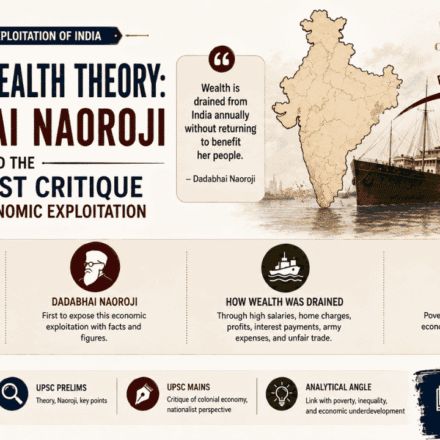
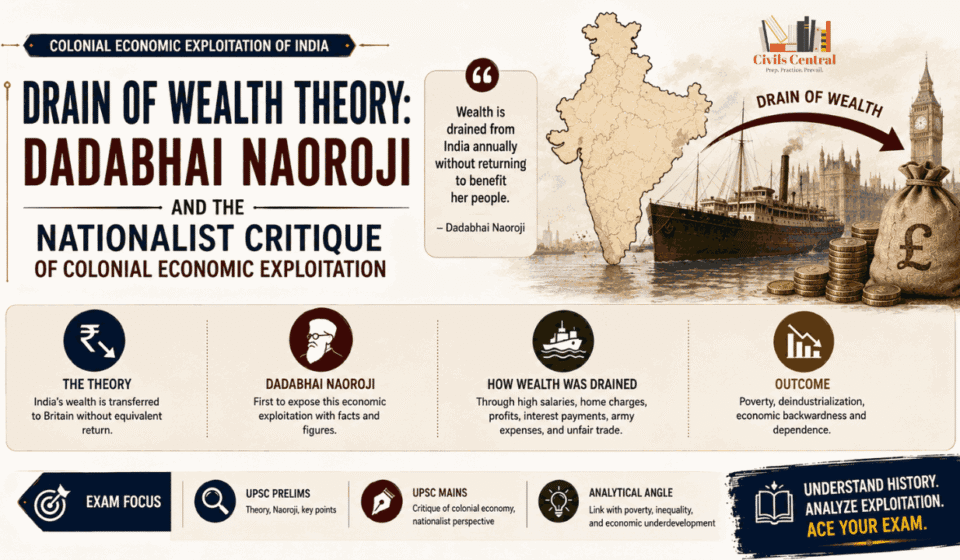
Drain of Wealth Theory: Dadabhai Naoroji and the Nationalist Critique of Colonial Economic Exploitation

Drain of Wealth Theory : Dadabhai Naoroji and the Nationalist Critique of Colonial Economic Exploitation:
Learning Dashboard
| Chapter Information | Details |
|---|---|
| Series | Modern History of India (1707–1947) |
| Historical Period | c. 1860s–1947 |
| Historical Phase | Rise of Economic Nationalism |
| Previous Chapter | Economic Impact of British Rule in India: Colonialism and the Transformation of the Indian Economy |
| Current Chapter | Drain of Wealth Theory: Dadabhai Naoroji and the Nationalist Critique of Colonial Economic Exploitation |
| Next Chapter | Rise of Economic Nationalism and the Early Nationalist Critique of British Rule |
| Core Theme | The Drain of Wealth Theory argued that a substantial portion of India’s economic resources was transferred to Britain without an equivalent economic return to India. Dadabhai Naoroji developed the most systematic formulation of this argument, linking the outward transfer of resources with poverty, inadequate capital formation and the economic underdevelopment of colonial India. |
| Major Developments Covered | Origins of the Drain Theory, Dadabhai Naoroji’s economic analysis, mechanisms of the drain, Home Charges, salaries and pensions, remittances, public debt, military expenditure, impact on capital formation, industrialisation, poverty and the emergence of economic nationalism |
| Key Personalities | Dadabhai Naoroji, R.C. Dutt, M.G. Ranade, G.V. Joshi |
| Key Concepts | Drain of Wealth, Home Charges, Unrequited Exports, Economic Drain, Economic Nationalism, Capital Formation, Colonial Finance, Economic Exploitation |
| Exam Relevance | UPSC CSE, JKPSC, JKAS, State PCS, CDS, CAPF, SSC, UGC-NET (History), University Examinations |
Introduction
Why Did Indian Nationalists Begin Asking Where India’s Wealth Was Going?
The economic transformation produced by British rule raised a fundamental question among educated Indians during the second half of the nineteenth century: if India was producing revenue, agricultural commodities and exportable goods on a large scale, why did widespread poverty continue to exist? British administrators frequently presented colonial rule as a force that had introduced modern administration, law, transport, communication and international trade. Yet the everyday economic condition of a large section of the Indian population appeared inconsistent with the idea that British rule was producing broad-based prosperity. This contradiction encouraged a new generation of Indian intellectuals to examine the colonial economy not merely as a collection of policies but as a system of economic relationships.
The most influential answer came from Dadabhai Naoroji, who argued that India’s poverty was closely connected with the continuous transfer of Indian resources to Britain. According to him, a significant portion of the wealth generated in India did not remain within the Indian economy. Instead, it was transferred abroad through various channels associated with colonial administration, foreign officials, pensions, remittances, debt payments and other imperial financial obligations. Naoroji described this outward movement as the Drain of Wealth.
The importance of Naoroji’s argument lay in the distinction between ordinary international trade and an unrequited transfer of resources. If India exported goods and received machinery, investment or other productive resources in return, the transaction could contribute to economic development. The nationalist objection arose when Indian resources were transferred abroad without an equivalent return that strengthened India’s productive capacity. In such circumstances, the resources could no longer be used within India for consumption, savings, investment or capital formation.
Naoroji’s argument gradually became one of the intellectual foundations of economic nationalism. It changed the way Indian nationalists understood colonialism. British rule was no longer viewed simply as a foreign political administration that occasionally adopted harmful economic policies. Instead, colonialism itself came to be understood as a structure in which political control enabled the systematic transfer of economic resources from the colony to the metropolitan power.
The Drain Theory was subsequently developed by other nationalist thinkers, particularly R.C. Dutt, who examined the relationship between colonial revenue policies, agriculture, famines and economic stagnation. M.G. Ranade and other economic nationalists also emphasised the need for industrialisation and indigenous economic development. Together, these thinkers transformed economic criticism into a broader nationalist argument: India could not achieve sustained economic development without greater control over its own resources and economic policy.
The Drain Theory therefore occupies a crucial position in Modern Indian History. It connects the study of colonial economic policies with the rise of nationalism and explains why economic grievances became increasingly intertwined with the demand for political representation and eventually self-government.
CivilsCentral Historical Insight
The Drain Theory transformed the nationalist critique of British rule from a criticism of individual policies into a structural explanation of Indian poverty. Its central question was simple but powerful: if India’s resources were generated within India, why were substantial portions of those resources being transferred abroad instead of being used for India’s own economic development?
Part I — Background: Why Did the Drain Theory Emerge?
The Changing Economic Understanding of British Rule
The emergence of the Drain Theory was closely connected with the development of a new educated Indian middle class during the nineteenth century. English education, newspapers, public associations and participation in legislative institutions created opportunities for Indians to examine government policies using economic and statistical arguments. Instead of relying only on moral criticism, early nationalists increasingly studied government budgets, land revenue, trade figures, public expenditure and patterns of employment. This encouraged a more systematic examination of the economic consequences of colonial rule.
The development of this economic critique coincided with growing awareness of persistent poverty. India possessed considerable agricultural resources and remained an important producer and exporter of commodities, yet average living standards remained low. Famines periodically exposed the vulnerability of the rural population, while traditional industries had experienced significant decline in the face of British industrial competition. The contrast between India’s economic potential and the condition of its population encouraged nationalist thinkers to look beyond explanations that attributed poverty simply to climate, population or alleged social backwardness.
The question increasingly became one of economic structure. If India was producing substantial revenue and exporting valuable commodities, why was sufficient capital not accumulating within the country? Why were senior government positions dominated by Europeans whose salaries and pensions were paid from Indian revenues? Why were financial obligations connected with British rule being settled in Britain? And why did the expansion of international trade fail to produce a corresponding transformation in the living standards of the majority of Indians?
These questions provided the intellectual environment in which the Drain Theory developed.
Dadabhai Naoroji’s Early Economic Criticism
Dadabhai Naoroji emerged as the most systematic thinker within this new economic critique. He closely examined Indian poverty and the financial relationship between India and Britain, gradually arguing that foreign rule itself created economic disadvantages that could not be removed merely through administrative reforms.
Naoroji’s approach was particularly significant because he attempted to support his arguments with available statistical evidence. He sought to estimate Indian income, examine government finances and identify the channels through which resources were transferred abroad. His objective was not simply to accuse British officials of corruption. Instead, he wanted to demonstrate that the structure of colonial government itself created a persistent outward flow of resources.
This distinction made his argument more powerful. If the problem were merely individual corruption, administrative reform could solve it. But if the problem arose from the employment of foreigners, external financial obligations and the political structure of colonial government, then much deeper changes were required.
From Administrative Criticism to Economic Criticism
Early Indian nationalists initially hoped that British liberal principles could be applied more fairly in India. They demanded greater representation, equality before law and increased Indian participation in administration. Over time, however, economic analysis revealed that political exclusion had direct economic consequences.
The exclusion of Indians from senior administrative positions meant that many highly paid posts were occupied by Europeans. Their salaries were financed from Indian revenues, while their savings, remittances and pensions could ultimately leave India. Thus, the demand for Indianisation of the higher services was simultaneously a political and economic demand.
Naoroji increasingly connected these issues. Political representation was important because Indians needed a greater role in deciding how Indian revenues were collected and spent. Economic development was important because resources had to remain available for investment within India. The two questions were therefore becoming inseparable.
CivilsCentral Historical Insight
The Drain Theory emerged from a broader transformation in nationalist thinking. Educated Indians began using budgets, trade statistics and public finance to examine colonial rule scientifically, and they increasingly concluded that India’s poverty could not be explained only by internal weaknesses. The structure of foreign rule itself had to be examined as an economic problem.
Part II — The Drain of Wealth: What Exactly Did the Theory Mean?
What Did Naoroji Mean by “Drain”?
The expression Drain of Wealth referred to the transfer of Indian resources to Britain without an equivalent economic return to India. The key idea was therefore not that every payment made to Britain was automatically exploitative. Rather, the concern was that resources generated within the Indian economy were being transferred abroad in ways that did not create corresponding productive benefits within India.
This distinction is essential because international trade necessarily involves resources moving between countries. If India exported cotton and used the proceeds to purchase machinery that increased domestic production, the transaction would involve an international transfer but would not necessarily constitute a drain. India would have exchanged one form of economic resource for another that could strengthen its productive capacity.
The nationalist argument was different. Suppose Indian revenue was used to pay the pension of a retired European official living in Britain. The Indian economy had generated the revenue, but the expenditure did not create an equivalent productive asset or purchasing power within India. The resources had effectively left the country.
The Drain Theory was therefore fundamentally concerned with net resource transfer and the loss of domestic economic circulation.
What Were “Unrequited Exports”?
The concept of unrequited exports became particularly important in nationalist economic thought. India could export large quantities of goods, but the existence of exports did not automatically mean that the Indian economy received an equivalent benefit.
If exports were effectively used to settle external obligations rather than to obtain goods, services or productive investment for India, the export earnings did not generate an equivalent inflow into the domestic economy.
This created a paradox. India could record substantial exports while large sections of its population remained poor because the resources represented by those exports were not necessarily available for domestic consumption or investment.
The nationalist argument therefore shifted attention from the volume of trade to the economic purpose and destination of the resources generated by trade.
Why Was the Drain Different from Ordinary Foreign Investment?
Foreign investment can contribute to economic development when capital enters an economy and creates productive capacity. Investment in factories, infrastructure, technology or other productive activities may generate employment and expand output.
The nationalist critique was concerned with situations in which income generated within India was transferred abroad without producing equivalent productive investment within India. The issue was therefore not simply whether foreigners were economically active in India but whether the resulting economic surplus was retained and reinvested within the country.
This distinction is important when assessing the colonial economy. The existence of foreign capital did not automatically prove exploitation, just as the existence of outward payments did not automatically prove that every individual transaction was economically harmful. The nationalist argument concerned the overall structure and direction of resource flows.
CivilsCentral Historical Insight
The Drain Theory was not an argument against international trade or foreign investment in themselves. It was an argument against a persistent net transfer of India’s economic surplus abroad without an equivalent return in the form of goods, services or productive investment that strengthened the Indian economy.
Part III — Mechanisms of the Drain: Through Which Channels Did India’s Wealth Leave?
How Did the Drain Actually Operate?
The Drain of Wealth did not operate through a single mechanism. It emerged through a network of financial and administrative relationships created by colonial rule. Indian revenues financed the colonial state, while substantial payments associated with that state were made to individuals and institutions outside India. European officials could remit their salaries and savings, retired officials could receive pensions in Britain, and various financial obligations were settled abroad.
The important point was that these channels reinforced one another. A foreign official received income from Indian revenues, saved part of that income, remitted it abroad and could later receive a pension outside India. Similarly, the colonial government could borrow funds in Britain and repay interest from Indian revenues. The outward transfer therefore operated across different stages of colonial administration and finance.
Nationalist economists consequently treated the Drain as a systemic process rather than a single annual payment.
Salaries of European Officials
One important channel was the employment of Europeans in high administrative, military and technical positions. These officials received salaries from Indian revenues, often at levels considerably higher than those available to Indian employees performing lower-paid positions.
The economic issue was not simply the difference in salaries. European officials could transfer substantial portions of their income and savings to Britain, meaning that expenditure initially generated from Indian taxation did not necessarily remain within the Indian economy. When these officials retired, their pensions could likewise be paid outside India.
Naoroji therefore regarded the Europeanisation of higher services as both an administrative and economic problem. Greater Indian participation in senior services would, in his view, allow a larger share of government expenditure to circulate within India.
Pensions and Remittances
The economic relationship did not end when European officials left India. Retired officials could receive pensions in Britain, while those working in India could remit part of their salaries and savings abroad.
This created a continuing outward flow of resources.
A salary paid in India could generate domestic economic activity if the recipient spent it locally. But when a substantial portion was transferred abroad, the domestic multiplier effect was reduced. From the nationalist perspective, the issue was therefore not merely the initial payment but the destination of the income generated from Indian revenues.
Home Charges
The term Home Charges referred broadly to payments that the Government of India was required to make in Britain for various expenses associated with the administration and maintenance of British rule in India. The exact composition of these charges changed over time, but they included categories connected with pensions, administrative expenses, financial obligations and other payments outside India.
Home Charges became an important symbol of the Drain because they represented a direct claim on Indian revenues that was settled outside India.
For nationalist economists, the central issue was straightforward: revenue collected from Indian society was being used to finance expenditures in Britain. They therefore viewed Home Charges as an important component of the wider external transfer associated with colonial rule.
Interest on Public Debt
Another channel involved interest payments on certain public debt raised in Britain.
When the colonial government borrowed money in Britain for purposes connected with India, the resulting debt obligations could require payments from Indian revenues to British creditors. The Indian taxpayer consequently bore the fiscal burden, while part of the financial return was realised outside India.
Again, the nationalist argument was not that all borrowing was inherently harmful. Public borrowing can finance productive investment. The issue was that the financial structure of colonial borrowing could create a continuing external claim on Indian revenues.
Military and Imperial Expenditure
Military expenditure was another important area of nationalist criticism. India maintained a large colonial army, and Indian revenues were also used in connection with military operations undertaken in the wider imperial context.
Nationalists objected particularly when Indian resources were used to finance activities that served broader British imperial interests rather than India’s immediate security and development.
The issue therefore became one of who benefited from public expenditure. If Indian taxation financed imperial expansion, nationalists argued, the Indian population was effectively paying for the maintenance and expansion of an empire that was not under Indian control.
Profits, Commercial Payments and Foreign Enterprises
The nationalist critique also extended to foreign-owned enterprises and commercial interests that generated profits in India and transferred part of those profits abroad.
European-owned plantations, trading enterprises and other commercial activities could generate income within India while directing profits towards investors and owners outside India.
This was not unique to colonial India; foreign investors routinely repatriate profits. The nationalist argument, however, placed these flows within the broader structure of colonial political and economic power, in which foreign capital operated within an economy controlled by a foreign state.
CivilsCentral Historical Insight
The Drain operated through interconnected channels—European salaries and pensions, remittances, Home Charges, interest payments, military expenditure and other external financial transfers. What united these different mechanisms was the fact that economic resources generated within India were transferred abroad under the institutional framework of colonial rule.
Part IV — Home Charges and Colonial Finance: Why Did Public Finance Matter?
Why Were Home Charges So Important?
The significance of Home Charges becomes clearer when colonial public finance is viewed as a relationship between revenue collection in India and expenditure outside India. A government normally collects revenue within an economy and spends a substantial part of it within that same economy. Salaries paid to local workers, purchases from domestic producers and investment in local infrastructure can circulate money through the economy and stimulate further production.
Colonial finance created a different pattern. Certain obligations generated by the administration of India had to be paid in Britain. This meant that a portion of Indian revenue was effectively removed from the domestic circulation of income.
For nationalist economists, this was one of the clearest manifestations of the Drain.
Why Did the Nationalists Object to Foreign Administrative Costs?
The nationalist criticism was closely connected with the composition of the colonial bureaucracy. The higher levels of the administration were disproportionately occupied by Europeans, whose salaries, allowances and pensions were financed from Indian revenues.
Naoroji argued that the same administrative functions could increasingly be performed by qualified Indians at lower cost to the colonial state and with a greater proportion of expenditure remaining within India.
The demand for Indianisation of services therefore had an economic logic. Indianisation would not merely give Indians greater political representation; it would also reduce the outward transfer associated with European employment.
Was Every Payment Made in Britain a Drain?
A sophisticated answer must avoid treating every external payment as automatically illegitimate.
Some payments made abroad represented genuine administrative or financial obligations. Similarly, foreign investment could provide capital and infrastructure that had productive effects within India.
The nationalist argument was broader and structural. The question was whether the overall colonial financial system systematically transferred a substantial portion of India’s economic surplus abroad.
This distinction is important because the Drain Theory was an economic interpretation of colonialism rather than an allegation that every foreign transaction was fraudulent.
CivilsCentral Historical Insight
Home Charges became central to the nationalist critique because they revealed the fiscal structure of colonialism: Indian revenues could be generated inside India while important obligations arising from colonial administration were settled outside it. The issue was therefore not merely expenditure, but the externalisation of India’s fiscal surplus.
Part V — Economic Impact: How Did the Drain Affect India?
The Drain and Capital Formation
The most important economic argument concerning the Drain was its effect on capital formation. Economic development requires the accumulation of surplus and its reinvestment in productive activities such as irrigation, agriculture, transport, industry, education and technology. If a significant portion of the surplus generated within an economy is transferred abroad, the resources available for domestic investment are correspondingly reduced.
Naoroji therefore argued that India’s economic problem was not simply a shortage of production. India possessed substantial productive resources, but the economic surplus generated within the country was not being retained to the extent necessary for rapid development. The Drain consequently reduced the resources available for domestic savings and investment.
This created a structural cycle. Low incomes restricted the ability of households and institutions to save, while the outward transfer of economic surplus further reduced the resources available for investment. Limited investment constrained the expansion of productive capacity, which in turn contributed to continued low incomes. In nationalist economic reasoning, the Drain therefore helped reproduce the conditions of poverty rather than merely causing a temporary reduction in income.
The Drain and Industrialisation
The Drain was also connected with India’s limited industrialisation. Modern industry requires substantial investment in machinery, technology, infrastructure, skilled labour and entrepreneurial activity. If domestic savings are weak and economic surplus is continuously transferred abroad, the resources available for indigenous industrial investment are reduced.
This problem became particularly significant because colonial India was simultaneously experiencing the decline of several traditional industries and increasing competition from British manufactured goods. Traditional artisans lost important markets, while the emerging modern industrial sector was not sufficiently large to absorb all those displaced from handicrafts. The result was an economy in which agriculture remained the principal source of employment while industrial development proceeded only in selected sectors.
Nationalist economists did not claim that the Drain alone caused India’s industrial weakness. Colonial trade policies, technological differences, access to credit, infrastructure, market conditions and the wider structure of imperialism also played important roles. Their argument was that the outward transfer of resources aggravated these structural constraints by weakening India’s ability to accumulate indigenous capital.
The Drain and Agricultural Development
The consequences of the Drain extended into agriculture because agriculture generated a large share of colonial revenue. Land revenue systems imposed substantial fiscal obligations upon rural society, while commercialisation exposed cultivators to market fluctuations and dependence on credit.
Nationalists argued that a greater proportion of agricultural surplus should have remained available for irrigation, agricultural improvement, rural infrastructure and productive investment. Instead, part of the revenue extracted from the agricultural economy ultimately financed expenditures outside India.
This argument became particularly important in the writings of R.C. Dutt, who linked land revenue policy with rural poverty and agricultural vulnerability. The issue was therefore not simply how much revenue the state collected, but what happened to that revenue after collection.
The Drain and Poverty
For Naoroji, the persistence of poverty was perhaps the strongest evidence that colonial economic policy required fundamental reconsideration. He attempted to estimate Indian income and argued that the average Indian lived at an extremely low level of subsistence.
The Drain was important in his reasoning because resources that might otherwise have contributed to higher domestic incomes and investment were transferred abroad.
This did not mean that Naoroji believed every aspect of Indian poverty had one cause. Climate, agricultural conditions, population pressure, technological limitations and other factors also mattered. His argument was that colonial economic arrangements constituted an additional structural burden that prevented India from using its own surplus effectively.
The Drain and Famines
The relationship between the Drain and famines requires particular care. Nationalist thinkers linked chronic poverty and low purchasing power with the vulnerability of the Indian population during periods of food crisis. They argued that a population living close to subsistence had very limited capacity to withstand crop failures, price increases and employment shocks.
The existence of famine was therefore not simply a question of whether food was physically available. It was also a question of whether people possessed sufficient purchasing power to obtain it.
The nationalist economic critique consequently connected the Drain with the wider problem of mass poverty and inadequate purchasing power, although famines themselves resulted from complex combinations of agricultural, climatic, market and administrative factors.
The Drain and the Domestic Market
A poor population has limited purchasing power, and limited purchasing power restricts the expansion of domestic markets. This was particularly important for industrial development because growing industries require consumers capable of purchasing manufactured goods.
The colonial economy could therefore become caught in a reinforcing cycle: low incomes restricted demand; weak demand limited industrial expansion; limited industrial employment restricted incomes; and the outward transfer of resources further constrained domestic purchasing power.
For nationalist economists, economic development required breaking this cycle by retaining more of India’s surplus within India and directing it towards productive investment.
CivilsCentral Historical Insight
The nationalist critique of the Drain was fundamentally a critique of lost development. Resources transferred abroad could no longer be used within India for savings, investment, industrialisation, agricultural improvement or expanding domestic purchasing power. The Drain was therefore presented as a structural mechanism that helped reproduce poverty and economic dependence.
Part VI — Dadabhai Naoroji: The Architect of the Drain Theory
Why Is Dadabhai Naoroji Central to the Theory?
Dadabhai Naoroji occupies a unique position in the history of Indian economic nationalism because he transformed scattered economic grievances into a systematic theory of colonial exploitation. Born in 1825, Naoroji became an important public intellectual, political leader and one of the founders of the Indian National Congress. He was also elected to the British House of Commons in 1892, becoming the first Indian to enter the British Parliament.
His position in Britain allowed him to present India’s economic grievances directly before British political opinion. He believed that British liberal principles, if genuinely applied, could produce a more just relationship between Britain and India. Yet his continuing study of Indian poverty and colonial finance increasingly convinced him that the structure of foreign rule itself produced serious economic disadvantages.
Poverty and Un-British Rule in India
Naoroji’s most famous economic work, Poverty and Un-British Rule in India, published in 1901, brought together decades of economic analysis. The title itself reflected his political strategy. Naoroji did not simply accuse Britain of being foreign; he argued that the actual operation of British rule in India contradicted Britain’s own professed principles of justice, representation and good government.
His analysis attempted to demonstrate that Indian poverty was connected to the economic structure of colonial administration. European officials, external financial obligations and other mechanisms of resource transfer meant that India did not retain the full benefit of the wealth generated within its own territory.
Naoroji’s Estimate of Indian Poverty
Naoroji made pioneering attempts to estimate India’s per-capita income. The exact figures he produced have been debated by later economists, partly because the statistical data available in the nineteenth century were limited.
Nevertheless, the importance of his work was not simply numerical accuracy. He was among the first Indian thinkers to use quantitative economic analysis systematically to challenge the official narrative of colonial prosperity.
He wanted to demonstrate that poverty was not merely an impression or emotional grievance. It could be studied through income, revenue, expenditure and resource flows.
Indianisation of the Civil Services
Naoroji’s demand for greater Indian participation in higher administrative services was closely connected with the Drain Theory. If Europeans occupied highly paid posts, Indian revenues financed salaries whose savings and pensions could ultimately leave the country.
Indianisation would therefore retain a larger proportion of government expenditure within India.
This illustrates an important feature of Naoroji’s political thought: representation had an economic dimension. Indians needed a greater role in administration not simply because political participation was desirable, but because control over public expenditure was essential for economic development.
From Reform to Self-Government
Naoroji’s political thought evolved considerably. As an early moderate nationalist, he initially believed that British rule could be reformed and made genuinely beneficial to India. His faith in British liberalism gradually weakened as he observed the persistence of economic exploitation and political exclusion.
The economic argument increasingly led towards the political conclusion that India required self-government.
If decisions regarding taxation, expenditure and economic policy were made by a foreign power whose interests differed from those of the Indian population, then economic development would remain constrained.
The Drain Theory therefore became an intellectual bridge between economic criticism and the demand for Swaraj.
CivilsCentral Historical Insight
Naoroji’s greatest contribution was not merely identifying individual channels of economic transfer. He connected colonial finance, foreign administration, Indian poverty and political representation into one coherent argument. His economic analysis gradually led to the conclusion that genuine economic development required greater Indian control over the state.
Part VII — R.C. Dutt and Other Nationalist Economists: How Was the Critique Expanded?
R.C. Dutt and the Economic History of India
Romesh Chunder Dutt expanded the nationalist economic critique by examining the effects of British rule on agriculture, land revenue, famines and industrial development. His work, particularly The Economic History of India, provided a broad historical analysis of how colonial policies affected different sectors of the Indian economy.
Dutt’s approach complemented Naoroji’s argument. While Naoroji concentrated heavily on the outward transfer of resources, Dutt paid greater attention to the mechanisms through which colonial policy affected production and living conditions within India.
His criticism of land revenue was particularly important. He argued that excessive and inflexible revenue demands could leave cultivators with inadequate resources for investment and make rural society more vulnerable to economic shocks. He also criticised colonial policies that encouraged commercial production without providing adequate protection against fluctuations and crises.
How Did Dutt Complement Naoroji?
The difference between the two thinkers can be expressed through two questions.
Naoroji primarily asked: Where did India’s economic surplus go?
Dutt increasingly asked: How was that surplus extracted from Indian society, and what consequences did the extraction have for agriculture and ordinary people?
The two approaches therefore complemented each other. Naoroji highlighted the external dimension of colonial exploitation, while Dutt examined its internal economic consequences. Together, their arguments produced a more complete nationalist interpretation of colonialism.
M.G. Ranade and Industrial Development
Mahadev Govind Ranade contributed another important dimension to economic nationalism by emphasising industrialisation. He argued that India needed modern industries, greater investment and the development of indigenous economic capabilities.
Ranade’s contribution demonstrates that economic nationalism was not simply negative. Nationalists were not merely demanding an end to British exploitation; they were increasingly asking what economic institutions India needed to develop.
This involved industrialisation, indigenous enterprise, infrastructure and greater Indian participation in economic decision-making.
The Broader Nationalist Economic School
Naoroji, Dutt and Ranade were part of a wider intellectual movement that examined colonial economic policy from different perspectives. Newspapers, public associations, legislative bodies and political organisations increasingly discussed land revenue, trade, industrialisation, taxation and public expenditure.
The result was the emergence of a distinct Indian economic critique of colonialism. This critique would later influence debates surrounding Swadeshi, indigenous industry, protective tariffs and economic self-reliance.
CivilsCentral Historical Insight
Naoroji, Dutt and Ranade developed complementary dimensions of economic nationalism. Naoroji highlighted the external drain, Dutt examined the internal consequences of colonial revenue and agricultural policies, while Ranade emphasised the need for industrialisation and indigenous economic development. Together, they converted economic criticism into a coherent nationalist intellectual tradition.
Part VIII — Historiography: How Should the Drain Theory Be Understood Today?
Why Has the Drain Theory Been Debated?
The Drain Theory became one of the most influential arguments of Indian nationalism, but its precise economic magnitude has been debated by historians and economists. The debate does not necessarily require choosing between the extreme positions that the theory was either completely correct or entirely mistaken.
The more useful approach is to distinguish between the historical reality of colonial resource transfers and the exact measurement of their economic magnitude and developmental consequences.
Nationalist economists identified substantial outward transfers associated with colonial administration and imperial finance. Later scholars have examined whether all the payments included by nationalists should be treated as a pure economic loss and how foreign capital, infrastructure and international trade should be incorporated into the analysis.
The Nationalist Interpretation
The nationalist interpretation held that the colonial state systematically transferred Indian resources to Britain and thereby weakened India’s capacity for economic development.
From this perspective, the Drain was not simply an accounting phenomenon. It was a structural feature of colonialism because the political system itself ensured that Indian resources could be used to meet external obligations.
The nationalist argument therefore linked economic drain with poverty, capital shortage and industrial weakness.
The Colonial Defence
Defenders of British rule argued that payments made abroad could represent legitimate costs of administration, capital and services. They pointed to railways, communications, irrigation, modern industries, legal institutions and international trade as evidence that British rule also generated economic benefits.
From this perspective, the existence of outward payments did not automatically prove exploitation.
This argument is important because it reminds us that colonial economic history cannot be reduced to a simple accounting of money leaving India.
The Modern Analytical Position
A balanced historical interpretation recognises that colonial India experienced both economic transformation and economic subordination. Infrastructure expanded, modern industries developed and markets became increasingly integrated. At the same time, colonial institutions generated substantial external financial obligations and maintained an unequal distribution of economic power.
The key issue is therefore not whether every outward payment was illegitimate, but whether the colonial system as a whole enabled Britain to appropriate a significant share of India’s economic surplus while restricting India’s ability to determine how that surplus should be used.
This interpretation preserves the central insight of the nationalist critique without treating the original calculations as beyond historical debate.
Why Does Historiography Matter for UPSC?
A strong answer should avoid absolute statements such as “the British took away all Indian wealth.” Such statements ignore the complexity of colonial economic relations.
A better formulation is that nationalist economists identified a persistent net transfer of resources from India to Britain and interpreted this transfer as a major structural cause of Indian poverty and underdevelopment, while later historians have debated its precise magnitude and the extent to which outward payments were offset by economic benefits associated with foreign capital, infrastructure and trade.
That approach demonstrates both knowledge of nationalist thought and awareness of historiographical complexity.
CivilsCentral Historical Insight
The Drain Theory remains historically significant even though its precise magnitude is debated. Its lasting contribution was to identify the unequal direction of economic power under colonialism and to ask whether the resources generated within India were being used primarily for Indian development or for sustaining the imperial system.
Part IX — Historical Significance: How Did the Drain Theory Shape Indian Nationalism?
Challenging the Claim of Benevolent Colonialism
The Drain Theory directly challenged the argument that British rule existed primarily for India’s benefit. If colonial administration was genuinely designed to promote Indian prosperity, nationalists asked why substantial economic resources were continuously transferred abroad while poverty remained widespread.
This transformed economic data into a political argument. The British could point to railways, telegraphs and administrative reforms as evidence of progress, but nationalists increasingly responded that the existence of modern institutions did not by itself prove that the colonial system served Indian interests.
The more important question was who controlled the resources and who benefited from economic development.
Creating an Economic Explanation for Poverty
The Drain Theory also changed the explanation of Indian poverty. Instead of treating poverty primarily as a consequence of Indian social backwardness or natural conditions, nationalists argued that colonial economic structures contributed directly to it.
This was a major intellectual shift. Poverty became a political-economic issue rather than simply a social problem.
Linking Economic and Political Freedom
The most important political consequence of the theory was its connection between economic autonomy and political self-government.
If Indian revenues were controlled by a foreign government, and if that government used part of those revenues to meet obligations outside India, then Indians lacked control over the economic surplus generated by their own society. Economic reform therefore required political reform.
This produced the increasingly influential nationalist argument: Political subordination → Economic dependence → Resource drain → Poverty → Need for self-government.
Economic Nationalism
The Drain Theory provided a foundation for economic nationalism. If colonial rule encouraged imports of British manufactured goods while weakening Indian industries and transferring resources abroad, nationalists increasingly advocated indigenous production and economic self-reliance.
This intellectual development later contributed to the Swadeshi movement, which linked political opposition to colonial rule with the promotion of Indian industries and the boycott of foreign goods. Economic nationalism therefore emerged as a bridge between economic analysis and mass political mobilisation.
Influence on Later Nationalism
The economic critique developed by early nationalists influenced later generations of Indian political thinkers. Although later nationalists differed in their economic programmes, the basic understanding that colonialism had both political and economic dimensions remained influential.
The issue of economic exploitation continued to appear in debates concerning poverty, industrialisation, rural distress, tariffs, foreign capital and economic self-reliance. The Drain Theory therefore had a significance much greater than its original nineteenth-century context.
CivilsCentral Historical Insight
The Drain Theory gave Indian nationalism an economic foundation. It transformed poverty from evidence of alleged Indian backwardness into evidence that colonial institutions themselves shaped economic outcomes. By connecting control over economic resources with political power, it helped establish the principle that economic freedom required political self-government.
Part X — Conclusion
The Drain of Wealth Theory was one of the most important intellectual achievements of early Indian nationalism because it provided a systematic economic explanation of colonial exploitation. Dadabhai Naoroji argued that a substantial portion of India’s economic resources was transferred to Britain through the financial and administrative structure of colonial rule. Salaries and pensions of European officials, remittances, Home Charges, interest on certain public debt, military expenditure and other external payments formed important channels through which resources moved outward.
The significance of the theory, however, lay deeper than the identification of these individual channels. Naoroji argued that resources transferred abroad could no longer be used within India for consumption, savings, investment and capital formation. This weakened the capacity of the Indian economy to expand its productive base and contributed, in his interpretation, to the persistence of poverty.
The argument was subsequently strengthened by R.C. Dutt, who examined the internal economic consequences of colonial rule, particularly land revenue, agricultural distress and famines. M.G. Ranade and other nationalist thinkers emphasised industrialisation and the need to develop indigenous economic capabilities. Together, these thinkers established a broader nationalist economic critique that connected colonial extraction, poverty, industrial weakness and economic dependence.
The Drain Theory also changed the political meaning of economic questions. The issue was no longer simply whether particular taxes were too high or whether British trade policy was unfair. The deeper question was whether Indians could achieve economic development while the fundamental decisions concerning revenue, expenditure and resource allocation remained under foreign control. This eventually led to a powerful nationalist conclusion: political self-government was necessary for economic self-government.
At the same time, the theory should be approached critically. Not every payment made from India to Britain represented an illegitimate transfer, and historians have debated the exact size of the drain and the relationship between outward payments, foreign capital, infrastructure and economic development. A balanced interpretation therefore recognises both the importance of colonial resource transfers and the limitations of treating the original nationalist estimates as precise measurements of the entire colonial economy.
Yet the fundamental historical contribution of the Drain Theory remains powerful. It demonstrated that colonialism could not be understood only as political domination. It was also an economic relationship in which political authority influenced the direction in which resources, income and capital moved.
The intellectual journey can therefore be summarised as: Colonial Political Control → Economic Extraction → External Resource Transfer → Reduced Domestic Accumulation → Poverty and Limited Development → Economic Critique → Economic Nationalism → Demand for Self-Government.
The Drain Theory thus became one of the essential intellectual foundations of Indian nationalism and prepared the ground for the next stage of the story: the emergence of economic nationalism as an organised programme involving Swadeshi, indigenous industry, tariff protection and greater Indian control over economic policy.
CivilsCentral Historical Insight
The enduring significance of the Drain Theory lies in its transformation of economics into a nationalist argument. Dadabhai Naoroji and other early nationalists demonstrated that colonialism was not merely foreign political rule; it was also a system of economic dependence in which control over India’s resources remained outside Indian hands. The demand for political self-government consequently acquired a powerful economic justification.
Part XI — UPSC Revision Zone
Drain of Wealth Theory at a Glance
| Aspect | Key Point |
|---|---|
| Principal Thinker | Dadabhai Naoroji |
| Major Work | Poverty and Un-British Rule in India |
| Core Argument | Transfer of Indian resources to Britain without equivalent economic return |
| Nature of Drain | Externalisation of India’s economic surplus |
| Major Channels | Home Charges, salaries, pensions, remittances, debt interest, imperial expenditure |
| Major Economic Effect | Reduced domestic savings and capital formation |
| Industrial Effect | Limited indigenous capital accumulation |
| Agrarian Effect | Reduced resources for agricultural development |
| Social Effect | Persistent poverty and vulnerability |
| Political Effect | Rise of economic nationalism |
| Long-Term Political Link | Self-government / Swaraj |
Major Channels of the Drain
European Officials
European civil, military and other officials were paid from Indian revenues, while a significant part of their income could ultimately be transferred abroad through savings, remittances and pensions.
Home Charges
Various payments connected with the administration and financial obligations of India were made in Britain from Indian revenues. These became one of the most important symbols of colonial financial dependence.
Pensions
European officials who retired from Indian service could receive pensions outside India, creating a continuing outward financial flow even after their active employment ended.
Remittances
Officials and other foreign residents could transfer savings and income earned in India to Britain.
Public Debt
Interest on certain debt raised in Britain was paid from Indian revenues, creating continuing external financial obligations.
Military Expenditure
Indian revenues were used to maintain the colonial military establishment and, in some circumstances, to support wider imperial military operations.
Foreign Profits
Foreign-owned enterprises could transfer profits generated in India to investors and owners abroad, contributing to the wider outward movement of income.
Dadabhai Naoroji and R.C. Dutt
| Dadabhai Naoroji | R.C. Dutt |
|---|---|
| Systematised the Drain Theory | Expanded the broader economic critique |
| Focused strongly on outward resource transfer | Focused strongly on land revenue and agriculture |
| Analysed Indian poverty | Analysed famine and rural distress |
| Examined colonial finance | Examined economic consequences of colonial policy |
| Advocated Indianisation of services | Criticised excessive revenue demands |
| Connected economic drain with self-government | Highlighted the need for economic reform |
Important Conceptual Distinction
Drain of Wealth ≠ Trade Deficit
A trade deficit refers to a situation in which the value of imports exceeds exports. The Drain Theory refers to the net transfer of economic resources from India to Britain without an equivalent economic return. Therefore, India could have substantial exports and still experience a drain.
Why Was Indianisation Economically Important?
European officials
→ Salaries from Indian revenues
→ Savings/remittances abroad
→ Pensions abroad
→ External resource transfer
Whereas:
Indian officials
→ Salaries earned in India
→ Greater domestic expenditure
→ Greater circulation of income within India
Therefore, Naoroji’s demand for Indianisation had both political and economic significance.
CivilsCentral Revision Insight
For UPSC, remember the Drain Theory as a theory of lost economic potential. Naoroji’s central argument was that India’s resources were not being fully retained and reinvested within India. The theory therefore connected colonial finance with poverty, weak capital formation, limited industrialisation and eventually the nationalist demand for self-government.
Chapter Summary
The Drain of Wealth Theory emerged in the second half of the nineteenth century as educated Indian nationalists began examining the economic consequences of British rule through budgets, trade statistics and public finance. Dadabhai Naoroji became its most important theorist and argued that a significant portion of India’s economic resources was transferred to Britain without an equivalent economic return.
The theory did not condemn international trade itself. Its central concern was the net outward transfer of resources. When Indian exports or revenues were used to meet external colonial obligations rather than generating equivalent goods, services or productive investment within India, nationalists regarded the resulting transfer as a drain.
The drain operated through several channels. European officials received salaries from Indian revenues and could transfer their savings and pensions abroad. Home Charges required the Government of India to make various payments in Britain. Interest on certain public debt represented another external financial obligation, while military expenditure and foreign-owned enterprises contributed to the wider pattern of resource transfer.
Naoroji argued that the drain had serious consequences for India’s economic development. Resources transferred abroad were unavailable for domestic consumption, savings and investment. This weakened capital formation and restricted the ability of India to expand agriculture, irrigation, industry, infrastructure and other productive sectors.
The Drain was also connected with India’s limited industrialisation. The decline of traditional industries had already weakened indigenous manufacturing, while the shortage of domestic capital made it more difficult for modern industries to expand sufficiently. The economy consequently remained predominantly agrarian and structurally dependent upon the export of primary commodities.
R.C. Dutt expanded the economic critique by examining land revenue, agricultural distress, famine and the internal consequences of colonial policies. M.G. Ranade emphasised industrialisation and indigenous economic development. Together, these thinkers established the intellectual foundations of Indian economic nationalism.
The political significance of the Drain Theory was even greater than its economic argument. It challenged the claim that British rule was primarily beneficial to India and demonstrated that political domination had material consequences. If Indians did not control their own revenues and economic policies, they could not fully control the economic surplus generated by their own society.
The theory therefore helped establish a fundamental nationalist proposition:
Political freedom was necessary for economic development because economic resources could not be effectively used for national development while their control remained in foreign hands.
The precise magnitude of the Drain remains a subject of historical debate, and not every outward payment can be classified as a pure economic loss. Nevertheless, the theory remains one of the most important intellectual foundations of Indian nationalism because it identified the structural relationship between colonial rule, economic dependence and resource transfer.
FAQs
What was the Drain of Wealth Theory?
The Drain of Wealth Theory argued that a substantial portion of India’s economic resources was transferred to Britain without an equivalent economic return to India. Dadabhai Naoroji developed its most systematic formulation.
Who propounded the Drain Theory?
Dadabhai Naoroji is regarded as the principal theorist of the Drain of Wealth. R.C. Dutt and other nationalist thinkers subsequently expanded the wider economic critique of colonialism.
What was Dadabhai Naoroji’s major work on the Drain Theory?
His most important work was Poverty and Un-British Rule in India, published in 1901. It brought together his arguments concerning Indian poverty, colonial finance and the economic drain.
What were the main channels of the Drain?
The major channels included Home Charges, salaries and pensions of European officials, remittances, interest on certain public debt, military expenditure and other external financial payments associated with colonial rule.
What were Home Charges?
Home Charges were various payments made in Britain by the Government of India for expenses associated with colonial administration, pensions, financial obligations and other costs of maintaining British rule in India.
Did Naoroji oppose international trade?
No. Naoroji did not oppose international trade as such. His criticism concerned the transfer of resources abroad without an equivalent economic return to India.
What are unrequited exports?
Unrequited exports refer, in the nationalist economic context, to exports whose corresponding earnings were effectively used to settle external obligations rather than returning to India in the form of goods, services or productive investment.
How did the Drain affect capital formation?
Nationalists argued that the outward transfer of economic surplus reduced the resources available for domestic savings and investment. This restricted capital formation and therefore limited economic development.
How did the Drain affect industrialisation?
The Drain was viewed as one factor limiting India’s ability to accumulate indigenous capital for industrial investment. However, colonial trade policy, technological differences, infrastructure, access to credit and other factors also affected industrial development.
What was R.C. Dutt’s contribution?
R.C. Dutt expanded the nationalist economic critique by examining land revenue, agriculture, famine and the broader economic consequences of British policies. He complemented Naoroji’s focus on external resource transfer.
How did the Drain Theory contribute to nationalism?
It provided an economic explanation for Indian poverty and challenged the claim that British rule was primarily beneficial to India. It also connected economic self-government with political self-government.
Was the Drain Theory completely accepted by later historians?
No. Historians have debated the precise magnitude of the drain and whether particular outward payments should be treated as pure economic losses. However, the existence and significance of colonial resource transfers remain central to the study of colonial economic history.
Why is the Drain Theory important for UPSC?
It connects Dadabhai Naoroji, colonial economy, poverty, economic exploitation, Home Charges, deindustrialisation, capital formation, economic nationalism, Swadeshi and the demand for self-government into a single analytical framework.
Mind Map
                 DRAIN OF WEALTH THEORY
                           │
                           ▼
                 DADABHAI NAOROJI
                           │
             ┌─────────────┴─────────────┐
             │                           │
             ▼                           ▼
       CORE ARGUMENT                MAJOR WORK
             │                           │
 Indian Resources → Britain      Poverty and Un-British
 Without Equivalent Return          Rule in India
             │
             ▼
       CHANNELS OF DRAIN
             │
    ┌────────┼─────────┬─────────┐
    │        │         │         │
    ▼        ▼         ▼         ▼
 Salaries  Pensions  Home      Debt
 Officials            Charges  Interest
    │        │         │         │
    └────────┼─────────┴─────────┘
             │
             ▼
       Remittances
             │
             ▼
   Imperial Expenditure
             │
             ▼
    RESOURCE TRANSFER
             │
             ▼
   REDUCED DOMESTIC SURPLUS
             │
       ┌─────┼─────┐
       ▼     ▼     ▼
    Savings Investment Capital
                    Formation
       │     │       │
       └─────┼───────┘
             ▼
      LIMITED DEVELOPMENT
             │
       ┌─────┼─────┐
       ▼     ▼     ▼
    Poverty Industry Agriculture
             │
             ▼
    NATIONALIST CRITIQUE
             │
      ┌──────┼──────┐
      ▼      ▼      ▼
   Naoroji R.C. Dutt Ranade
      │      │      │
      └──────┼──────┘
             ▼
    ECONOMIC NATIONALISM
             │
             ▼
      SWADESHI / SELF-RELIANCE
             │
             ▼
       SELF-GOVERNMENT
             │
             ▼
           SWARAJ
About The Author