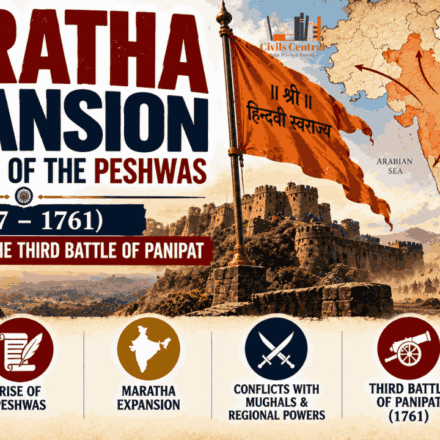

Maratha Expansion and the Rise of the Peshwas (1707–1761): From Shahu to the Third Battle of Panipat

Learning Dashboard
| Category | Details |
|---|---|
| Series | Modern History of India (1707–1947) |
| Historical Period | 1707–1761 |
| Historical Phase | Decline of Mughal Central Authority and Rise of Regional Powers |
| Previous Chapter | Rise of Regional States in Eighteenth-Century India (1707–1765): Emergence, Administration and Historical Significance |
| Current Chapter | Maratha Expansion and the Rise of the Peshwas (1707–1761): From Shahu to the Third Battle of Panipat |
| Next Chapter | Maratha Recovery after Panipat: Madhavrao I and the Maratha Confederacy (1761–1772) |
| Core Theme | Transformation of the Maratha polity from a regional kingdom into the most formidable Indian power challenging Mughal authority |
| Key Personalities | Shahu, Balaji Vishwanath, Baji Rao I, Balaji Baji Rao, Chhatrapati Shivaji, Tarabai, Nizam-ul-Mulk, Chhatrasal Bundela, Malhar Rao Holkar, Ranoji Scindia, Raghuji Bhonsle, Ahmad Shah Abdali, Sadashiv Rao Bhau |
| Key Concepts | Peshwa, Chauth, Sardeshmukhi, Maratha expansion, Maratha Confederacy, Mughal–Maratha relations, Palkhed, Malwa, Bundelkhand, Delhi, Ahmad Shah Abdali, Third Battle of Panipat |
| Exam Relevance | UPSC CSE, JKPSC, JKAS, State PCS, CDS, CAPF, UGC-NET and University Examinations |
Introduction
The death of Aurangzeb in 1707 marked a decisive turning point in the political history of India. The Mughal Empire survived for several decades after his death, but the authority of the imperial centre increasingly weakened as provincial governors, regional elites and military chiefs acquired greater autonomy. Among the forces that benefited most decisively from this transformation were the Marathas. What emerged during the eighteenth century was not simply a revival of the kingdom created by Shivaji, but a substantial reorganisation of Maratha power under the leadership of the Peshwas, who gradually transformed the Maratha state from a predominantly western Indian kingdom into a subcontinental political force. Historians similarly identifies the Marathas as the most important power to emerge during the weakening of the Mughal Empire and highlights the rise of the Peshwas under Shahu.
The period from 1707 to 1761 is therefore fundamental for understanding the transition from Mughal imperial dominance to eighteenth-century political pluralism. It witnessed the release and accession of Shahu, the rise of Balaji Vishwanath, the extraordinary military expansion under Baji Rao I, the extension of Maratha influence across Malwa, Gujarat and Bundelkhand, intervention in Mughal politics, the emergence of competing Maratha houses and, eventually, the confrontation with Ahmad Shah Abdali that culminated in the Third Battle of Panipat in 1761.
The Maratha achievement, however, contained an important contradiction. Their military mobility and system of extracting tribute allowed them to expand rapidly, but their political structure remained less centralised than the Mughal Empire they sought increasingly to replace. By the middle of the eighteenth century, the Maratha polity had become a powerful but increasingly decentralised political formation. The catastrophe at Panipat exposed some of these structural weaknesses. It did not permanently destroy Maratha power, but it interrupted their bid for supremacy and created the conditions for the subsequent rise of regional powers and, eventually, the British.
CivilsCentral Historical Insight
The rise of the Marathas after 1707 should not be understood simply as the replacement of one empire by another. It represented a wider transformation in the nature of Indian power: Mughal centralisation was giving way to a system in which mobile military elites, regional revenue networks and autonomous political houses exercised authority over expanding territories. The Marathas became the most ambitious expression of this new political order, but their inability to convert military supremacy into durable political integration ultimately limited their imperial project.
Part I — The Maratha Polity after Aurangzeb
1. The Crisis of Succession after Shivaji
The Maratha political system had already undergone considerable stress before Aurangzeb’s death. Shivaji’s death in 1680 was followed by succession struggles, while the prolonged Mughal–Maratha conflict placed enormous pressure on Maratha resources.
Shivaji’s elder son Sambhaji was captured and executed by Aurangzeb in 1689. His half-brother Rajaram continued the resistance from the southern fortress of Jinji. After Rajaram’s death in 1700, his widow Tarabai assumed leadership on behalf of her minor son and continued resistance against the Mughals. Her political and military leadership played an important role in keeping the Maratha resistance alive during the final phase of Aurangzeb’s Deccan campaigns. Historians also notes Tarabai’s administrative and political role during this period.
The Mughal strategy eventually produced an unintended consequence. Shahu, the son of Sambhaji, had been held in Mughal custody. After Aurangzeb’s death, the Mughal authorities released him, hoping that his return would divide the Marathas. The strategy worked initially. Shahu’s claim to the Maratha throne was challenged by Tarabai, who supported her own son. The resulting conflict divided Maratha political leadership between competing centres.
The eventual victory of Shahu fundamentally altered the structure of Maratha politics.
2. Shahu and the Reorganisation of Maratha Power
Shahu’s reign began in 1708 and lasted until his death in 1749. Unlike Shivaji, whose authority rested heavily upon personal military leadership and direct political control, Shahu increasingly depended upon capable ministers and military commanders. This created the institutional environment in which the Peshwa became increasingly powerful.
The office of Peshwa had existed under Shivaji, but during Shahu’s reign it evolved from the position of chief minister into the effective centre of Maratha political authority. The Chhatrapati remained the formal sovereign, while the Peshwa gradually acquired control over administration, finance, diplomacy and military expansion.
This transformation was not instantaneous. It developed through the political circumstances of Shahu’s reign and the growing dependence of the Chhatrapati on capable ministers.
CivilsCentral Historical Insight
The most important institutional transformation after 1707 was not the disappearance of the Chhatrapati but the redistribution of effective power within the Maratha state. Shahu’s reign provided the political space in which the Peshwa evolved from a ministerial office into the principal executive authority, creating the foundation for the later Peshwa-dominated Maratha polity.
Part II — Balaji Vishwanath and the Rise of the Peshwa
1. Balaji Vishwanath
Balaji Vishwanath emerged as the most important political architect of Shahu’s early reign. He helped Shahu consolidate his position against Tarabai and other competing Maratha chiefs and was appointed Peshwa in 1713. His significance lay less in battlefield victories than in political organisation.
Balaji Vishwanath worked to reconcile competing Maratha chiefs, strengthen Shahu’s authority and establish a more systematic relationship between Maratha military power and revenue extraction. The Mughal Empire itself was undergoing intense factional conflict during this period. Balaji Vishwanath exploited this instability to secure important concessions for the Marathas.
2. Maratha–Mughal Settlement
Balaji Vishwanath participated in negotiations with the Mughal court and the Sayyid Brothers, who temporarily dominated imperial politics. The Marathas obtained recognition of Shahu’s position and important rights to collect chauth and sardeshmukhi in specified Mughal territories of the Deccan.
This represented a major political development. The Marathas were no longer merely conducting raids against the Mughal Empire. They were obtaining formal recognition of their fiscal claims within parts of the imperial political order. The arrangement also demonstrated the increasingly complex relationship between the two powers: Maratha expansion could operate through both military pressure and negotiated recognition.
Part III — Chauth, Sardeshmukhi and the Fiscal Basis of Expansion
1. Chauth
Chauth literally represented a claim to approximately one-fourth of the assessed revenue of a territory. In practice, it functioned as a tribute or revenue claim imposed by the Marathas in territories where they exercised military influence without necessarily establishing complete direct administration. The system provided the Marathas with substantial resources for maintaining armies and financing further expansion.
2. Sardeshmukhi
Sardeshmukhi was an additional claim traditionally associated with the Maratha assertion of a superior or hereditary fiscal right, generally calculated at around 10 per cent of revenue. Together, chauth and sardeshmukhi created an important fiscal mechanism for the expansion of Maratha military power.
The system was particularly significant because the Marathas did not always need to replace existing administrative structures in conquered or pressured territories. They could extract revenue while leaving local authorities in place.
3. Strength and Limitation
This arrangement gave the Marathas considerable flexibility. They could extend influence across large geographical areas without maintaining a uniform bureaucratic administration everywhere. However, the same system also created a structural limitation. Revenue extraction and political sovereignty did not always coincide.
The Marathas could possess enormous fiscal and military influence in a territory without exercising the same degree of direct administrative control that the Mughal Empire had traditionally sought. This distinction becomes essential when evaluating the later Maratha bid for imperial supremacy.
CivilsCentral Historical Insight
Chauth and sardeshmukhi were not merely taxes; they were instruments of political expansion. They allowed the Marathas to transform military superiority into fiscal claims without immediately constructing a centralised bureaucracy across every conquered region. This made expansion rapid and relatively flexible, but it also produced a political system in which influence could be extensive without being uniformly integrated.
Part IV — Baji Rao I and the Transformation of Maratha Power
1. Baji Rao I: The Expansionist Peshwa
After Balaji Vishwanath’s death in 1720, his son Baji Rao I became Peshwa. He was only around twenty years old, but his tenure transformed the geographical scale of Maratha power. Baji Rao recognised that the Mughal Empire’s weakening created an opportunity that could not be ignored. Rather than concentrating exclusively on defending the Maratha heartland in the Deccan, he advocated taking the struggle into the territories of the declining Mughal Empire.
His strategic vision is often associated with the idea that the Marathas should exploit the weakness of Mughal authority in northern India rather than remain confined to the Deccan.
2. Conflict with the Nizam
One of Baji Rao’s principal rivals was Nizam-ul-Mulk, founder of the autonomous state of Hyderabad. The Marathas and the Nizam competed for influence in the Deccan and over revenue claims. Their confrontation culminated in the Battle of Palkhed in 1728.
Baji Rao employed highly mobile cavalry and manoeuvred the Nizam into a strategically difficult position. The Nizam was compelled to negotiate, and the resulting settlement strengthened Maratha claims. Palkhed is significant not simply because the Marathas won a battle, but because it demonstrated the effectiveness of their mobile warfare against a larger conventional force.
3. Expansion into Malwa
Baji Rao increasingly directed Maratha military activity toward Malwa, one of the most strategically important regions of central India. Malwa was valuable because it connected the Deccan with northern India and provided access to the routes leading toward Gujarat, Bundelkhand and the Gangetic plain.
Maratha influence in Malwa expanded rapidly as Mughal authority weakened. The emergence of Maratha power there was not based upon one decisive conquest. It developed through a combination of military pressure, revenue collection, local alliances and the weakening of Mughal provincial administration.
Part V — Maratha Expansion under Baji Rao I
1. Gujarat
The Marathas also expanded their influence into Gujarat, where competing Maratha houses and Mughal officials struggled for control. The Gaekwad family became particularly important in Gujarat, illustrating a broader development within the Maratha system: military commanders and prominent families increasingly established their own regional bases while remaining connected to the wider Maratha political order.
2. Bundelkhand
Baji Rao’s intervention in Bundelkhand further expanded Maratha influence. The Bundela ruler Maharaja Chhatrasal sought assistance against the Mughal authorities and allied with Baji Rao. Maratha intervention brought territorial and political rewards and extended Maratha influence into central India. The Bundelkhand episode illustrates an important feature of eighteenth-century politics: regional rulers frequently sought alliances with rising powers to protect themselves against declining imperial authority or rival states.
3. Malwa, Gujarat and Bundelkhand: The Strategic Triangle
These territories were not isolated conquests. Together, they created a geographical bridge between the Maratha heartland and northern India. The Marathas were gradually moving from a Deccan-based regional power toward a power capable of intervening in the politics of the Mughal heartland.
Part VI — The Road to Delhi
1. Maratha Intervention in Mughal Politics
By the 1730s, Mughal political authority had weakened considerably. Imperial nobles increasingly competed for influence, while regional powers such as the Marathas, Nizam and Rajputs pursued their own interests. The Marathas increasingly intervened in Mughal politics.
Their objective was not necessarily the immediate destruction of the Mughal emperor. Instead, they sought recognition of their growing political and fiscal influence. This distinction is important. The Mughal emperor retained enormous symbolic legitimacy even while his actual military power declined. The Marathas could therefore benefit by controlling political processes around the emperor rather than immediately abolishing the imperial institution.
2. Baji Rao’s Northern Campaign
In 1737, Baji Rao launched a rapid campaign toward Delhi. The Maratha forces reached the vicinity of the Mughal capital, demonstrating the vulnerability of the imperial centre. Although Baji Rao did not establish permanent control over Delhi at this stage, the campaign had enormous psychological significance. It showed that a regional power from the Deccan could threaten the Mughal capital itself.
3. The Battle of Bhopal
The subsequent confrontation at Bhopal in 1737–38 further strengthened the Marathas’ position in central India. The settlement that followed enhanced Maratha claims in Malwa. By the end of Baji Rao I’s career, therefore, the Marathas had moved decisively beyond the political geography of western India.
CivilsCentral Historical Insight
Baji Rao I’s achievement was fundamentally strategic: he transformed the Maratha struggle from a defensive contest for survival in the Deccan into an offensive struggle for influence over the Mughal political order. His campaigns did not destroy the Mughal Empire, but they demonstrated that effective power had shifted away from the imperial centre.
Part VII — The Portuguese and the Western Coast
Maratha expansion was not confined to the Mughal territories of the interior. The Portuguese presence on the western coast remained an important regional factor, particularly around Bassein (Vasai). In 1739, Maratha forces under the leadership of Chimaji Appa, Baji Rao’s brother, captured Bassein from the Portuguese after a prolonged campaign.
The victory strengthened Maratha control along parts of the western coast and demonstrated that Maratha expansion involved competition with European colonial powers as well as Indian states. The conquest was also economically significant because the western coast contained important commercial centres and maritime connections.
The Marathas therefore increasingly operated within a political environment shaped by both inland power struggles and European commercial-military competition.
Part VIII — Balaji Baji Rao and the Expansion after 1740
1. Succession of Balaji Baji Rao
Baji Rao I died in 1740. He was succeeded by his son Balaji Baji Rao, popularly known as Nana Saheb, who served as Peshwa from 1740 until 1761. The political environment had changed by this stage. The Marathas had already established themselves as a major power in central and western India. The challenge now was to convert expanding military influence into a durable political order.
2. Expansion toward Eastern India
During Balaji Baji Rao’s period, Maratha forces expanded their influence toward Bengal and Odisha. The Bhonsle house of Nagpur became particularly active in eastern India. Maratha incursions into Bengal became a serious problem for the Nawab Alivardi Khan, who eventually reached an agreement with the Marathas in 1751, under which the Marathas obtained important concessions including the cession of Odisha and recognition of a revenue claim associated with Bengal.
This demonstrated the growing geographical reach of the Maratha system.
3. The Maratha Political Structure Becomes More Complex
However, expansion also made the Maratha polity increasingly difficult to control from Pune. Important families and military leaders developed regional bases:
- Scindias in Malwa (Gwalior)0 and later northern India
- Holkars in Malwa (Indore)
- Gaekwads in Gujarat (Baroda)
- Bhonsles at Nagpur
- The Peshwa at Pune
These houses acknowledged the broader Maratha political framework but possessed substantial independent military and fiscal resources. The process laid the foundations of what historians later describe more explicitly as the Maratha Confederacy.
It is important, however, not to project the fully developed nineteenth-century confederate structure backward onto the entire period. The political decentralisation was a gradual process.
Part IX — Ahmad Shah Abdali and the Afghan Challenge
1. Emergence of Ahmad Shah Abdali
The Maratha expansion into northern India brought them into increasing conflict with Afghan interests. After the death of Nadir Shah in 1747, his former military commander Ahmad Shah Abdali, also known as Ahmad Shah Durrani, established the Afghan Durrani Empire.
Abdali repeatedly intervened in North India. His invasions were driven by a combination of strategic, political and economic considerations, while the fragmentation of the Mughal Empire created opportunities for intervention.
2. The Struggle for Punjab and Delhi
The Punjab became a major zone of contest between Afghan, Mughal, Sikh and Maratha interests. Maratha expansion eventually reached the north-western regions, and by 1758, Maratha forces under Raghunath Rao, working with local allies including Adina Beg Khan, extended Maratha influence into Punjab and captured Lahore.
This represented the geographical high point of Maratha expansion before Panipat. But it also exposed the Marathas to a new strategic problem. The farther they moved from the Deccan, the more difficult it became to maintain communications, supply lines and reliable political alliances.
Part X — The Crisis of 1759–1761
1. Abdali Returns
Ahmad Shah Abdali returned to India in 1759. The Maratha presence in Punjab directly threatened Afghan influence, while political instability in Delhi and North India created competing alliances. The Marathas responded by sending a major army under Sadashiv Rao Bhau, accompanied by Vishwas Rao, the son and heir of Peshwa Balaji Baji Rao.
The Maratha objective was to confront Abdali and restore their political position in North India.
2. The Maratha Coalition Problem
The Marathas faced a serious diplomatic challenge. Their rapid expansion had generated apprehension among several regional powers. Important North Indian groups did not unite behind the Marathas. The Rohillas, under leaders such as Najib-ud-Daula, supported Abdali. The Nawab of Awadh, Shuja-ud-Daula, also eventually aligned with the Afghan side.
The Jats and Rajputs likewise did not provide the level of support the Marathas needed. The Marathas therefore entered the decisive confrontation without a sufficiently broad and stable coalition. This diplomatic isolation was one of the most important factors behind the eventual disaster.
Part XI — The Third Battle of Panipat, 1761
1. The Armies Meet
The Maratha army moved north and eventually confronted Abdali’s coalition near Panipat. The armies remained in a prolonged standoff for weeks. The Maratha position became increasingly difficult because their supply situation deteriorated. Their distance from the Deccan, the failure to secure adequate local support and the effectiveness of Abdali’s blockade placed increasing pressure on the Maratha army.
2. The Battle — 14 January 1761
The decisive battle was fought on 14 January 1761. Sadashiv Rao Bhau commanded the main Maratha army, while Vishwas Rao was also present. The Marathas possessed substantial artillery and infantry trained partly along European lines. Their forces initially achieved significant battlefield success.
However, the battle eventually turned in favour of Abdali’s coalition. The death of Vishwas Rao had a severe psychological impact, while the Maratha command structure deteriorated during the later stages of the battle. The Maratha army suffered catastrophic casualties. Sadashiv Rao Bhau was killed, and the defeat became one of the greatest military disasters in eighteenth-century Indian history.
Part XII — Why Did the Marathas Lose at Panipat?
The defeat cannot be explained by a single factor.
1. Diplomatic Isolation
The Marathas failed to build a sufficiently broad North Indian coalition. Several regional powers either remained neutral or supported Abdali. This meant that the Marathas faced the Afghan-led coalition with insufficient local support.
2. Extended Supply Lines
The Maratha army operated far from its principal base in the Deccan. Maintaining a large army in North India created enormous logistical difficulties. The prolonged siege-like situation at Panipat aggravated food shortages and weakened morale.
3. Strategic Overextension
The Maratha expansion had proceeded extraordinarily quickly. By 1758, Maratha influence had reached Punjab, but the political and administrative infrastructure required to sustain such expansion had not developed at the same pace. Military reach had exceeded political consolidation.
4. Internal Political Tensions
The Maratha polity contained powerful regional chiefs whose interests were not always identical. The Peshwa’s authority had grown, but the expansion of powerful houses such as the Scindias, Holkars and Bhonsles created a political structure that was increasingly difficult to coordinate.
5. Nature of the Battlefield
The Marathas had developed a highly mobile cavalry tradition, but the Panipat campaign required sustained logistical coordination and large-scale combined-arms warfare. Their army also contained large numbers of non-combatants, increasing the burden on already strained supplies.
6. Abdali’s Coalition and Military Strategy
Abdali was not fighting alone. His forces were supported by important North Indian allies, including the Rohillas and Shuja-ud-Daula. The Afghan military system also combined mobility, cavalry and effective tactical coordination. Thus, Panipat was not simply a contest between “Marathas” and “Afghans”; it was a wider North Indian coalition conflict.
CivilsCentral Historical Insight
The Maratha defeat at Panipat was fundamentally a failure of strategic overextension rather than evidence that Maratha military power was inherently inferior. The Marathas had reached an unprecedented geographical range, but their political alliances, administrative consolidation and logistical capacity had not developed at the same speed. Panipat therefore exposed the limits of expansion without corresponding integration.
Part XIII — Consequences of the Third Battle of Panipat
1. Immediate Maratha Crisis
The defeat produced enormous losses among the Maratha political and military elite. Vishwas Rao and Sadashiv Rao Bhau were killed. The psychological impact on Peshwa Balaji Baji Rao was severe. He died later in 1761. The immediate effect was therefore a major crisis of leadership.
2. Abdali Did Not Establish a Permanent Indian Empire
A crucial historical point is that the victory at Panipat did not result in the establishment of a durable Afghan empire over northern India. Ahmad Shah Abdali returned to Afghanistan. The political vacuum therefore remained. This distinction is essential when assessing the long-term significance of the battle.
3. Temporary Check to Maratha Expansion
The Maratha attempt to establish decisive supremacy in North India was halted. Their political influence temporarily declined. But the Maratha state itself did not disappear. This is why the history of the Marathas after 1761 must be treated separately. The subsequent rise of Madhavrao I would lead to a significant Maratha recovery.
4. Opportunity for Other Powers
The weakening of both Mughal and Maratha ambitions created opportunities for other powers. The British East India Company was already consolidating its position in Bengal after Plassey (1757) and Buxar (1764). Panipat therefore did not directly establish British supremacy, but it formed part of the broader political environment in which no single Indian power succeeded in replacing the Mughal Empire with a stable subcontinental empire.
Part XIV — The Nature of the Maratha Political System
The Maratha state cannot be understood simply as a centralised territorial empire comparable to the Mughal Empire.
Its political structure combined:
- The formal authority of the Chhatrapati
- The increasing authority of the Peshwa
- Powerful military and landed elites
- Revenue rights such as chauth and sardeshmukhi
- Regional military houses
- Local alliances
- Directly controlled territories
- Areas under indirect influence
The system was therefore flexible but heterogeneous. The Peshwa’s authority was substantial, especially under Baji Rao I and Balaji Baji Rao, but the growth of powerful regional houses gradually limited the possibility of complete centralisation.
This distinction becomes especially important after 1761, when the Maratha polity increasingly operated as a confederacy of powerful houses.
Part XV — Why Did the Marathas Expand So Rapidly?
Several factors explain the extraordinary expansion of Maratha power during the first half of the eighteenth century.
1. Mughal Political Decline
The weakening of the Mughal centre created opportunities across Malwa, Gujarat, Bundelkhand and North India.
2. Military Mobility
Maratha cavalry could move rapidly across large distances, making it difficult for slower-moving opponents to respond effectively.
3. Revenue System
Chauth and sardeshmukhi provided resources for maintaining armies and financing further campaigns.
4. Political Adaptability
The Marathas frequently negotiated with local rulers rather than attempting immediate direct annexation.
5. Leadership
The strategic abilities of Balaji Vishwanath and particularly Baji Rao I were crucial.
6. Mughal Political Legitimacy
Rather than initially rejecting the Mughal emperor altogether, the Marathas often sought recognition of their rights through the imperial framework.
This allowed them to combine military pressure with political legitimacy.
Part XVI — Limitations of the Maratha Expansion
The same characteristics that facilitated rapid expansion also produced long-term weaknesses.
1. Limited Administrative Integration
The Marathas often exercised fiscal influence without creating a uniform administrative system.
2. Regionalisation of Power
Major families developed their own political and military bases.
3. Dependence on Military Extraction
A significant portion of expansion depended upon revenue claims and military pressure rather than the creation of a deeply integrated territorial bureaucracy.
4. Coalition Problems
The Marathas often struggled to transform their power into stable alliances with other regional groups.
5. Geographic Overextension
Expansion into Punjab and North India created logistical problems that became especially severe during the Panipat campaign.
CivilsCentral Historical Insight
The central paradox of Maratha expansion was that the same decentralised flexibility that made expansion possible also constrained imperial consolidation. Maratha commanders could move rapidly, negotiate locally and extract revenue across vast territories, but building a stable political order required institutions capable of integrating those territories. Panipat revealed this gap between expansion and consolidation.
Part XVII — Historiography: How Should the Maratha Rise Be Interpreted?
1. Colonial Interpretation
Older colonial interpretations frequently presented the Marathas primarily as a predatory military power whose expansion was characterised by plunder and political instability. Such interpretations tended to emphasise the weaknesses of the Maratha administrative structure and their dependence upon revenue extraction.
2. Nationalist Interpretation
Nationalist historians gave greater emphasis to the Marathas as a major indigenous force that resisted Mughal domination and challenged foreign political influence. Baji Rao I in particular has often been portrayed as an exceptionally successful military strategist whose campaigns demonstrated the vitality of Maratha power.
3. Modern Historical Interpretation
Modern scholarship takes a more nuanced position. The Maratha movement is examined simultaneously as:
- A regional political formation
- A response to Mughal centralisation
- A military-fiscal system
- A network of powerful elites
- A process of state formation
- A vehicle for political expansion across North India
The Marathas therefore cannot be reduced either to heroic national resistance or to mere plunderers. Their rise was part of the broader restructuring of eighteenth-century Indian politics.
Part XVIII — Historical Significance of the Maratha Expansion, 1707–1761
The rise of the Marathas had several long-term consequences.
1. End of Exclusive Mughal Political Dominance
The Mughal emperor remained symbolically important, but the empire ceased to exercise the same level of effective authority over India.
2. Emergence of a New Political Order
The Marathas became one of the principal powers in an increasingly multipolar India.
3. Expansion of the Peshwa’s Authority
The Peshwa emerged as the effective centre of Maratha political power.
4. Rise of Regional Military Houses
Scindia, Holkar, Gaekwad and Bhonsle power expanded within the broader Maratha framework.
5. Transformation of North Indian Politics
Maratha intervention made them a central factor in the politics of Delhi, Malwa, Bundelkhand and Punjab.
6. Panipat and the Limits of Expansion
The defeat of 1761 demonstrated that military expansion alone could not guarantee durable political supremacy.
7. Indirect Connection with British Expansion
Panipat did not create British supremacy, but the absence of a stable Indian successor to the Mughal Empire contributed to the fragmented political environment in which the East India Company expanded.
Part XIX — From Maratha Expansion to Maratha Recovery
The year 1761 should not be interpreted as the end of Maratha power. It marked the end of one phase. The next phase would begin with the emergence of Madhavrao I as Peshwa and the attempt to rebuild Maratha authority after the catastrophe of Panipat.
Madhavrao’s leadership would restore Maratha influence in several regions and demonstrate the resilience of the Maratha political system. However, the post-1761 Maratha polity would be different from the expansionist system of Baji Rao I. The power of individual houses would become increasingly important, while factional politics at Pune would intensify.
This evolution eventually produced the political environment in which the British confronted the Marathas during the Anglo-Maratha Wars.
Thus, the historical sequence is:
Shahu → Balaji Vishwanath → Baji Rao I → Maratha expansion → Balaji Baji Rao → Panipat → Madhavrao I → Maratha Confederacy → Anglo-Maratha Wars.
UPSC Analytical Framework
The Maratha Rise Can Be Explained Through Five Dimensions
| Dimension | Explanation |
|---|---|
| Political | Mughal decline created a power vacuum |
| Military | Highly mobile cavalry and capable commanders facilitated expansion |
| Fiscal | Chauth and sardeshmukhi financed military activity |
| Institutional | Rise of the Peshwa transformed the political structure |
| Geographical | Expansion moved from the Deccan to Malwa, Gujarat, Bundelkhand, Delhi and Punjab |
UPSC Mains Answer Framework
Question:
“The rise of the Marathas in the eighteenth century was both a consequence of Mughal decline and a major cause of the transformation of Indian politics.” Discuss.
Introduction
Begin with the weakening of Mughal central authority after 1707 and the emergence of the Marathas as the most powerful challenger to the declining imperial order.
Body
1. Causes of Maratha expansion
- Mughal decline
- Shahu’s consolidation
- Rise of Peshwas
- Military mobility
- Chauth and sardeshmukhi
2. Major phases
- Balaji Vishwanath
- Baji Rao I
- Malwa and Gujarat
- Bundelkhand
- Delhi
- Punjab
3. Structural limitations
- Administrative fragmentation
- Regionalisation
- Diplomatic isolation
- Overextension
4. Panipat
- Abdali
- Coalition politics
- Logistical problems
- Military defeat
Conclusion
Conclude that the Marathas successfully transformed the eighteenth-century balance of power but were unable to convert military-fiscal expansion into a fully integrated subcontinental state before Panipat.
Prelims Revision Zone
Important Facts
- Shahu became the principal Maratha ruler after 1708.
- Balaji Vishwanath became Peshwa in 1713.
- Baji Rao I became Peshwa in 1720.
- Battle of Palkhed — 1728
- Baji Rao I died — 1740
- Balaji Baji Rao/Nana Saheb became Peshwa — 1740
- Marathas captured Bassein — 1739
- Maratha influence reached Punjab — 1758
- Ahmad Shah Abdali’s decisive confrontation with the Marathas — 1761
- Third Battle of Panipat — 14 January 1761
- Sadashiv Rao Bhau — Maratha commander at Panipat
- Vishwas Rao — son of Balaji Baji Rao
- Ahmad Shah Abdali — leader of the Afghan coalition
- Panipat did not permanently destroy Maratha power
- Madhavrao I’s recovery belongs to the post-1761 phase
Frequently Confused Facts
Peshwa vs Chhatrapati
Chhatrapati was the formal Maratha sovereign, while the Peshwa was initially the chief minister. During the eighteenth century, effective political authority increasingly shifted toward the Peshwa.
Chauth vs Sardeshmukhi
Chauth was generally a claim of around one-fourth of revenue, while sardeshmukhi was generally an additional claim of around one-tenth.
Baji Rao I vs Balaji Baji Rao
Baji Rao I was the Peshwa from 1720–1740 and was the principal architect of early eighteenth-century Maratha expansion.
Balaji Baji Rao (Nana Saheb) was Peshwa from 1740–1761 and presided over the further geographical expansion of Maratha influence before Panipat.
Panipat vs Maratha Decline
Panipat was a major setback, not the permanent end of Maratha power.
The Marathas recovered substantially under Madhavrao I.
Chapter Summary
The period from 1707 to 1761 witnessed the transformation of the Marathas from a powerful Deccan-based polity into the most formidable Indian challenger to the declining Mughal Empire. The process began with the consolidation of Shahu, whose reign created the political conditions for the rise of the Peshwas.
Balaji Vishwanath strengthened Shahu’s position and secured important fiscal and political concessions from the Mughal court. His successor, Baji Rao I, transformed Maratha expansion through highly mobile military campaigns and strategic exploitation of Mughal weakness. Maratha influence spread across Malwa, Gujarat, Bundelkhand and eventually Delhi, while the conquest of Bassein demonstrated their growing strength on the western coast.
Under Balaji Baji Rao, Maratha expansion continued toward eastern and northern India. The extension of Maratha influence into Punjab brought the Marathas into direct conflict with Ahmad Shah Abdali. The resulting confrontation culminated in the Third Battle of Panipat on 14 January 1761.
The Maratha defeat resulted from a combination of diplomatic isolation, logistical difficulties, geographical overextension, internal political complexities and the strength of Abdali’s coalition. Yet Panipat did not destroy Maratha power. Instead, it marked the end of the first phase of Maratha expansion and created the conditions for the subsequent recovery under Madhavrao I.
The central historical lesson is therefore clear: the Marathas succeeded brilliantly in exploiting Mughal decline but struggled to transform military-fiscal expansion into durable political integration.
CivilsCentral Historical Insight
The Maratha rise was one of the defining processes of eighteenth-century Indian history because it demonstrated that the collapse of Mughal central authority did not produce an immediate British succession. For several decades, the Marathas were the strongest indigenous force capable of claiming a subcontinental role. Their defeat at Panipat interrupted that project, but their subsequent recovery proved that the political struggle for India remained open. The eventual British ascendancy emerged from this prolonged competition among fragmented but resilient regional powers.
Mind Map — Maratha Expansion and the Rise of the Peshwas
MARATHA EXPANSION & RISE OF THE PESHWAS
                    │
                    ├── 1707: Death of Aurangzeb
                    │       │
                    │       └── Mughal decline
                    │
                    ├── Shahu
                    │       │
                    │       ├── Released by Mughals
                    │       ├── Conflict with Tarabai
                    │       └── Consolidation of authority
                    │
                    ├── Balaji Vishwanath
                    │       │
                    │       ├── Peshwa, 1713
                    │       ├── Consolidates Shahu's position
                    │       └── Chauth & Sardeshmukhi
                    │
                    ├── Baji Rao I
                    │       │
                    │       ├── Peshwa, 1720–1740
                    │       ├── Palkhed, 1728
                    │       ├── Malwa
                    │       ├── Gujarat
                    │       ├── Bundelkhand
                    │       ├── Delhi campaign, 1737
                    │       └── Bassein, 1739
                    │
                    ├── Balaji Baji Rao
                    │       │
                    │       ├── Peshwa, 1740–1761
                    │       ├── Eastern expansion
                    │       ├── Bengal/Odisha
                    │       └── Northern expansion
                    │
                    ├── Punjab, 1758
                    │       │
                    │       └── Maratha–Afghan confrontation
                    │
                    ├── Ahmad Shah Abdali
                    │       │
                    │       └── Afghan coalition
                    │
                    └── PANIPAT — 1761
                            │
                            ├── Maratha defeat
                            ├── Leadership losses
                            ├── Expansion halted
                            └── Madhavrao I → Recovery
FAQs
1. Who was the first major Peshwa under Shahu?
Balaji Vishwanath was the first major Peshwa whose political authority became central to the reorganisation of the Maratha state.
2. Why was Baji Rao I important?
Baji Rao I transformed Maratha policy from regional consolidation to aggressive expansion. His campaigns extended Maratha influence into Malwa, Gujarat, Bundelkhand and toward Delhi.
3. What were chauth and sardeshmukhi?
They were important Maratha revenue claims. Chauth generally represented a claim of one-fourth of revenue, while sardeshmukhi represented an additional claim generally calculated at 10 per cent.
4. Why did the Marathas go to Panipat?
The Marathas sought to consolidate their position in North India and confront Ahmad Shah Abdali’s growing influence, particularly after the Maratha expansion into Punjab.
5. Did the Third Battle of Panipat end Maratha power?
No. It was a catastrophic setback, but Maratha power recovered significantly under Madhavrao I.
6. Was Panipat a direct victory for the British?
No. The British did not fight the battle. However, the continued absence of a stable subcontinental political successor to the Mughals contributed to the fragmented political environment in which the Company later expanded.
7. What was the greatest limitation of Maratha expansion?
The central limitation was the gap between military-fiscal expansion and political-administrative integration.
SEO & Publishing Pack
Recommended SEO Title
Maratha Expansion and Rise of Peshwas (1707–1761): From Shahu to Panipat
Meta Description
Learn about Maratha expansion from 1707 to 1761, the rise of the Peshwas, Baji Rao I, chauth and sardeshmukhi, Maratha expansion into North India and the Third Battle of Panipat.
Suggested URL Slug
maratha-expansion-rise-of-peshwas-1707-1761/
Primary Keyword
Maratha Expansion and Rise of Peshwas
Secondary Keywords
Maratha Empire 1707–1761, Peshwas, Shahu, Balaji Vishwanath, Baji Rao I, Balaji Baji Rao, Maratha expansion, Chauth and Sardeshmukhi, Third Battle of Panipat, Ahmad Shah Abdali
AISEO Tags
Maratha Expansion, Rise of Peshwas, Maratha Empire 1707-1761, Shahu, Balaji Vishwanath, Baji Rao I, Balaji Baji Rao, Maratha Confederacy, Chauth and Sardeshmukhi, Battle of Palkhed, Maratha Expansion in North India, Ahmad Shah Abdali, Third Battle of Panipat, Maratha History, Modern History of India
About The Author