
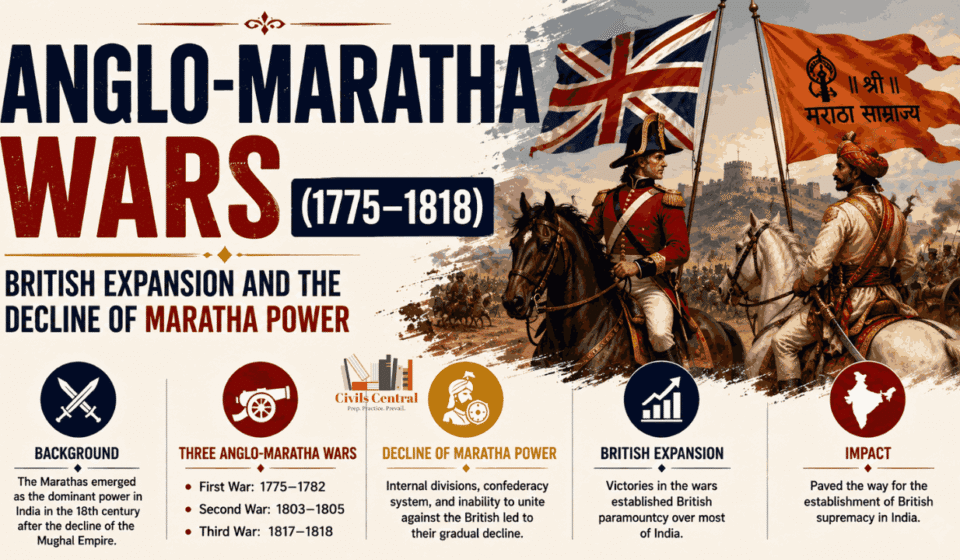
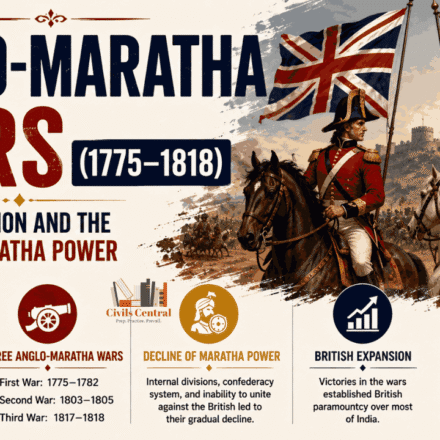
Anglo-Maratha Wars (1775–1818): British Expansion and the Decline of Maratha Power

Learning Dashboard
| Component | Details |
|---|---|
| Series | Modern History of India (1707–1947) |
| Historical Period | 1775–1818 |
| Historical Phase | British Territorial Expansion and Political Consolidation |
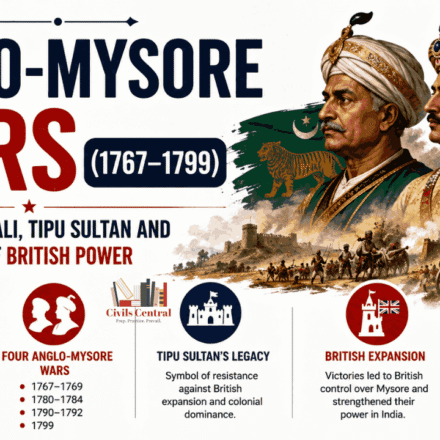
| Previous Chapter | Anglo-Mysore Wars (1767–1799): Mysore, Haider Ali, Tipu Sultan and the Expansion of British Power |
| Current Chapter | Anglo-Maratha Wars (1775–1818): British Expansion and the Decline of Maratha Power |
| Next Chapter | Lord Wellesley (1798–1805): Subsidiary Alliance, British Expansion and the Rise of Paramountcy |
| Core Theme | British expansion through diplomacy, warfare, treaty-making and political intervention |
| Major Wars | First Anglo-Maratha War (1775–1782), Second Anglo-Maratha War (1803–1805), Third Anglo-Maratha War (1817–1818) |
| Important Treaties | Surat (1775), Purandar (1776), Wadgaon (1779), Salbai (1782), Bassein (1802) |
| Major Personalities | Warren Hastings, Raghunath Rao, Madhavrao II, Nana Fadnavis, Mahadji Scindia, Baji Rao II, Daulat Rao Scindia, Jaswant Rao Holkar, Lord Wellesley, Arthur Wellesley, Lord Hastings |
| Core Concepts | Maratha Confederacy, Peshwa, Barabhai Council, Treaty of Bassein, Subsidiary Alliance, British Paramountcy |
| Exam Relevance | UPSC CSE, JKPSC, JKAS, State PCS, CDS, CAPF, UGC-NET |
Introduction
The Anglo-Maratha Wars (1775–1818) constituted a prolonged struggle between the British East India Company and the Maratha Confederacy, one of the most powerful political formations to emerge in India after the decline of Mughal authority. Unlike the Anglo-Mysore Wars, which were fought primarily against a relatively centralised Mysorean state under Haider Ali and Tipu Sultan, the Anglo-Maratha struggle unfolded against a decentralised political system composed of the Peshwa and several powerful Maratha chiefs. This political structure gave the Marathas considerable military and territorial strength, but it also created internal rivalries that the British eventually exploited.
The conflict developed in three distinct phases. The First Anglo-Maratha War (1775–1782) arose from a succession dispute within the Maratha political system and ended without decisive British victory. The Second Anglo-Maratha War (1803–1805) followed the Treaty of Bassein, through which Peshwa Baji Rao II accepted British protection and thereby opened the door to direct British intervention in Maratha politics. The Third Anglo-Maratha War (1817–1818) finally destroyed the political independence of the Peshwa and brought the major Maratha powers under British supremacy.
The historical importance of these wars therefore lies not merely in their battles. They reveal the transformation of British strategy from limited territorial acquisition and political intervention to systematic political subordination and paramountcy. The British increasingly combined military power with diplomacy, treaty-making, financial resources and the exploitation of rivalries among Indian states.
For the Marathas, the wars exposed a fundamental contradiction. They remained militarily formidable for much of the period, but the Confederacy lacked a permanent central authority capable of coordinating the interests of the Peshwa, Scindias, Holkars, Bhonsles and Gaekwads. British strategy increasingly converted this political fragmentation into a military advantage.
CivilsCentral Historical Insight
The Anglo-Maratha Wars should not be understood simply as a story of British military superiority over a declining Indian power. They were a prolonged contest in which British financial strength, diplomatic intervention and strategic learning gradually interacted with internal Maratha rivalries. The decisive British advantage emerged when the Company learned to defeat the Marathas politically before defeating them militarily.
Part I — The Maratha Confederacy Before the Anglo-Maratha Wars
1. From Maratha State to Maratha Confederacy
The political foundations of Maratha power were established under Shivaji, whose state-building created a strong regional kingdom in western India. During the eighteenth century, however, the effective centre of political authority shifted increasingly towards the Peshwas, who originally served as chief ministers but gradually became the principal executive authorities of the Maratha state.
Under Peshwas such as Baji Rao I, Maratha influence expanded far beyond Maharashtra. Maratha armies intervened in northern Indian politics, challenged Mughal authority and established claims to revenue and political influence over extensive territories. The Marathas thus became one of the principal successor powers to the declining Mughal Empire.
However, rapid expansion also encouraged decentralisation. Powerful military commanders and aristocratic families established their own territorial bases and developed independent political interests. The Scindias became powerful in Malwa and northern India, the Holkars developed their base around Indore, the Bhonsles dominated Nagpur and Berar, while the Gaekwads established themselves strongly in Gujarat. The Peshwa remained the nominal head of the Maratha political order, but effective authority depended increasingly upon cooperation among these powerful houses.
This evolution transformed the Maratha state into what historians generally describe as a Maratha Confederacy. It was capable of mobilising considerable military and financial resources, but it did not possess the degree of political centralisation that characterised the British state-building process.
2. The Peshwa and the Maratha Chiefs
The Peshwa at Pune occupied the highest position within the Maratha political structure, but the great chiefs possessed substantial autonomy. Their territories were administered through their own establishments, and their military forces were often maintained independently.
This arrangement had both strengths and weaknesses. Decentralisation allowed different Maratha chiefs to expand into different regions without waiting for a central bureaucracy to direct every operation. It also produced considerable military flexibility. Yet when the British emerged as a common strategic threat, the same structure made coordinated resistance extremely difficult.
The British increasingly understood this weakness. Instead of treating the Maratha Confederacy as a single indivisible political entity, they negotiated separately with individual chiefs and intervened in internal disputes. This approach became one of the defining characteristics of British expansion in western and central India.
3. The Succession Crisis after Narayan Rao
The immediate background to the First Anglo-Maratha War lay in the crisis following the death of Peshwa Narayan Rao in 1773. His uncle, Raghunath Rao, claimed the Peshwaship, while the supporters of Narayan Rao’s posthumous son, Madhavrao II, sought to preserve the succession in the infant’s name.
A group of influential Maratha leaders formed the Barabhai Council to protect Madhavrao II’s position. Among the most important political figures associated with this arrangement was Nana Fadnavis, who became one of the leading statesmen of late eighteenth-century Maratha politics.
The succession dispute provided the Bombay Government with an opportunity to intervene. Raghunath Rao sought British military assistance in return for territorial concessions, transforming an internal Maratha political dispute into an Anglo-Maratha conflict.
CivilsCentral Historical Insight
The First Anglo-Maratha War illustrates how British expansion could begin without an explicit plan to conquer an entire state. By supporting a claimant in an internal succession dispute, the Company acquired an entry point into Maratha politics. Political intervention thus became the first stage of territorial and strategic expansion.
Part II — Causes of the Anglo-Maratha Wars
The three Anglo-Maratha Wars had different immediate causes, but they were connected by the larger struggle for political supremacy in western, central and northern India.
1. Expansion of British Power
The acquisition of the Diwani of Bengal in 1765 provided the East India Company with an expanding fiscal base. Revenue resources enabled the Company to maintain larger armies and undertake increasingly expensive military operations.
As British power expanded from Bengal, Bombay and Madras, the Company came into increasing contact with the major regional states. The Marathas were particularly important because their political influence extended over large parts of western, central and northern India.
British commercial interests gradually became inseparable from strategic and territorial interests. Control over ports, trade routes, revenue-producing territories and political alliances became increasingly important to the Company.
2. Internal Maratha Rivalries
The Maratha Confederacy was powerful, but its leading chiefs often had competing ambitions. The Peshwa, Scindia, Holkar, Bhonsle and Gaekwad did not always perceive British expansion in the same way or cooperate consistently against it.
The British repeatedly exploited these divisions. A political dispute that might otherwise have remained an internal Maratha matter could become an opportunity for British military intervention.
3. British Interest in Western India
The Bombay Presidency had strong strategic and commercial interests in western India. Salsette and Bassein, situated close to Bombay, were particularly important from the perspective of regional security and maritime commerce.
The Treaty of Surat of 1775 demonstrated how British territorial interests became connected with Maratha political disputes. Raghunath Rao offered territorial concessions in return for British military assistance in his struggle for the Peshwaship.
4. Competition for Political Influence
The British and Marathas were competing not merely for territory but for influence over other Indian states. The balance of power involving Mysore, Hyderabad, the Marathas and the British changed repeatedly during the late eighteenth century.
The British increasingly attempted to ensure that no combination of Indian powers could threaten their territorial possessions and commercial interests.
5. Subsidiary Alliance and the Treaty of Bassein
By the time of Lord Wellesley, British strategy had become much more systematic. The Company sought to establish dependent alliances under which Indian rulers would accept British troops and restrictions on their independent diplomacy.
The Treaty of Bassein in 1802 brought the Peshwa into this system. Because the Peshwa was the formal head of the Maratha Confederacy, his acceptance of British protection had consequences far beyond Pune. It challenged the political autonomy of the other Maratha chiefs and directly contributed to the Second Anglo-Maratha War.
CivilsCentral Historical Insight
The causes of the Anglo-Maratha Wars reveal the changing nature of British expansion. The Company moved progressively from commercial competition to political intervention, from political intervention to treaty-based dependence, and finally from dependence to direct territorial and political supremacy.
Part III — First Anglo-Maratha War (1775–1782)
The First Anglo-Maratha War began as a consequence of the succession struggle between Raghunath Rao and the supporters of Madhavrao II. It was the first major military confrontation between the British and the Maratha Confederacy.
1. Treaty of Surat, 1775
Raghunath Rao entered into the Treaty of Surat with the Bombay Government on 6 March 1775. In return for British military assistance, he offered territorial concessions, including Salsette and Bassein, as well as other advantages to the Company. The treaty was significant because the British were no longer merely negotiating commercial privileges. The Bombay Government had committed itself to influencing the political succession of a major Indian power.
However, the agreement also revealed an important administrative problem within the Company itself. The Bombay authorities had acted without the full agreement of the Supreme Government at Calcutta, creating differences within the Company’s own political structure.
2. Treaty of Purandar, 1776
Warren Hastings sought to modify the policy adopted by the Bombay Government. Colonel Upton was sent to negotiate with the Maratha leadership, resulting in the Treaty of Purandar in 1776. Under the settlement, British support for Raghunath Rao was withdrawn, while Madhavrao II’s position was recognised. Raghunath Rao was to receive a pension. The British retained Salsette and obtained certain other advantages.
The agreement temporarily reduced tensions, but the underlying dispute was not permanently resolved. The Bombay Government continued to view Raghunath Rao as a useful political ally, and hostilities eventually resumed.
3. British Advance and Maratha Resistance
British forces attempted to advance towards Pune, but the Marathas were able to exploit the difficult terrain of the Deccan. Their mobility, local knowledge and ability to disrupt British communications created serious problems for the Company forces.
The British discovered that controlling coastal bases such as Bombay did not automatically translate into effective control of the interior. The Marathas could use the geographical depth of western India to avoid direct confrontation and impose pressure on British supply lines.
4. Convention of Wadgaon, 1779
The British force was eventually placed in a difficult position near Wadgaon. Maratha forces surrounded the British and compelled them to accept the Convention of Wadgaon in January 1779. The agreement required the British to abandon several of their gains and withdraw their support for Raghunath Rao. Wadgaon represented a major Maratha military and diplomatic success.
Warren Hastings, however, refused to accept the convention as the final settlement. The Company responded by mobilising additional forces from Bengal, demonstrating that the British could compensate for local military reverses by drawing upon resources from their wider territorial system.
5. British Counter-Offensive
British forces subsequently conducted operations in western and central India. British commanders such as Godard and Popham achieved important successes, including the capture of strategic positions. The British response to Wadgaon revealed an important structural advantage. A local British army could suffer a serious defeat without ending the Company’s overall war effort because the Company could shift troops and resources between its presidencies.
The Marathas, by contrast, had difficulty converting their local military successes into a permanent strategic settlement acceptable to all major chiefs.
CivilsCentral Historical Insight
Wadgaon demonstrated that the Marathas could defeat British forces through mobility, terrain and strategic manoeuvre. Yet the subsequent British counter-offensive revealed the Company’s deeper advantage: its presidency-based military system allowed it to absorb local defeats, mobilise fresh forces and continue the war until a politically acceptable settlement could be obtained.
Part IV — Treaty of Salbai, 1782
The First Anglo-Maratha War eventually ended through negotiation rather than decisive victory. The Treaty of Salbai, concluded in 1782, restored a broad political balance between the British and Marathas. The British recognised Madhavrao II as Peshwa, while Raghunath Rao was provided with a pension. The British retained important territorial advantages, including Salsette, while other territories were restored or adjusted according to the settlement.
The treaty brought relative peace between the British and Marathas for nearly two decades. This was strategically valuable to the Company because it allowed the British to concentrate resources on other conflicts, especially their confrontation with Mysore. For the Marathas, Salbai was important because they had prevented the British from determining the succession to the Peshwaship. The Confederacy remained politically independent.
The treaty should therefore not be interpreted as a straightforward British victory. Both sides made concessions, and neither power achieved complete supremacy.
CivilsCentral Historical Insight
The Treaty of Salbai was a reminder that British expansion was still incomplete in the late eighteenth century. The Marathas had successfully prevented the Company from controlling the Peshwaship, while the British secured limited territorial and strategic gains. The decisive struggle for supremacy would come only after the political balance within the Confederacy deteriorated.
Part V — Maratha Politics between the First and Second Wars
The period between 1782 and 1802 was critical because the internal balance of Maratha power gradually changed.
1. Mahadji Scindia
Mahadji Scindia emerged as one of the most influential Maratha leaders of the late eighteenth century. His authority extended across northern India, where he played an important role in Mughal politics. Mahadji also developed a substantial military establishment and attempted to strengthen his political position through European-influenced military organisation. His power demonstrated that the Marathas remained a major force long after the First Anglo-Maratha War.
2. Nana Fadnavis
At Pune, Nana Fadnavis remained a central figure in Maratha diplomacy and administration. His political strategy sought to preserve the independence of the Maratha Confederacy by balancing the ambitions of the different chiefs and preventing the British from becoming overwhelmingly powerful. The cooperation between Nana Fadnavis and Mahadji Scindia was particularly important because it provided the Confederacy with capable political leadership at both the central and regional levels.
3. Decline of Political Coordination
The death of Mahadji Scindia in 1794 removed one of the most capable Maratha statesmen. Baji Rao II subsequently became Peshwa in 1796, but he lacked the authority and political ability required to maintain the balance among the major chiefs. The death of Nana Fadnavis in 1800 further weakened the political system. Without a statesman capable of balancing the competing interests of the Maratha houses, rivalry intensified.
The resulting political instability created the conditions in which British intervention became increasingly effective.
CivilsCentral Historical Insight
The decline of the Marathas was not simply a consequence of losing battles. The weakening of political coordination preceded the decisive military defeats. As leaders capable of balancing the Confederacy disappeared, internal rivalry increasingly transformed the Maratha political system from a potential united resistance into a collection of competing powers.
Part VI — Treaty of Bassein, 1802: The Turning Point
The Treaty of Bassein represents the most important political turning point in the Anglo-Maratha struggle.
1. Baji Rao II and Maratha Rivalry
Baji Rao II became Peshwa in 1796, but relations between the Peshwa and the major Maratha chiefs deteriorated. The Peshwa’s authority was challenged by powerful figures, particularly Jaswant Rao Holkar and the Scindia establishment. The rivalry culminated in a military confrontation near Pune in 1802.
2. Battle of Pune and Flight of the Peshwa
In 1802, Holkar defeated the combined forces associated with the Peshwa and Scindia near Pune. Baji Rao II fled and sought British assistance. This crisis provided Lord Wellesley with an opportunity to apply the Subsidiary Alliance system to the Maratha political structure.
3. Treaty of Bassein, 1802
Baji Rao II signed the Treaty of Bassein in December 1802. He accepted British military protection and agreed to the stationing of British troops while surrendering substantial freedom in external relations. The treaty fundamentally altered the political position of the Peshwa. The formal head of the Maratha Confederacy was now dependent upon the British for military protection.
The treaty also alarmed the other Maratha chiefs. Scindia and Bhonsle viewed the agreement as a direct threat to Maratha independence, while Holkar remained opposed to the political arrangement.
4. Why Bassein Produced War
The Treaty of Bassein effectively gave the British a political foothold at the heart of the Maratha Confederacy. If the Peshwa accepted British protection, the Company could claim a legitimate basis for intervention in Maratha politics. Scindia and Bhonsle therefore refused to accept the settlement. Their resistance led directly to the Second Anglo-Maratha War.
CivilsCentral Historical Insight
The Treaty of Bassein was more than a defensive alliance. It transformed the Peshwa’s political dependence into a mechanism of British expansion. By placing the formal head of the Maratha Confederacy under British protection, the treaty allowed the Company to enter the internal structure of Maratha politics and confront the remaining chiefs from a position of strategic advantage.
Part VII — Second Anglo-Maratha War (1803–1805)
The Second Anglo-Maratha War represented a major escalation in British military and political power. Unlike the First War, when the British struggled to impose their will upon the Marathas, the Company now possessed greater financial resources, better strategic coordination and a political arrangement that justified military intervention.
1. Restoration of Baji Rao II
British forces restored Baji Rao II to Pune, thereby enforcing the political consequences of the Treaty of Bassein. The restoration demonstrated the new relationship between the Peshwa and the Company. British military power had become the foundation of the Peshwa’s political position.
2. Arthur Wellesley and the Deccan Campaign
British forces under Arthur Wellesley conducted operations against the forces of Scindia and Bhonsle in the Deccan. Wellesley combined infantry, cavalry and artillery with careful attention to logistics and communications. His campaign demonstrated the increasing sophistication of British military operations in India.
3. Battle of Assaye, 1803
The Battle of Assaye, fought on 23 September 1803, was one of the most significant battles of the Second Anglo-Maratha War. Arthur Wellesley’s forces confronted the combined forces associated with Scindia and Bhonsle. Despite the strength of the opposing army, the British achieved victory after intense fighting. Assaye demonstrated the effectiveness of disciplined infantry and artillery when combined with coordinated command. It also highlighted the difficulties faced by the Maratha chiefs in organising their forces under a single strategic command.
4. British Campaign in Northern India
While Wellesley operated in the Deccan, British forces under General Gerard Lake campaigned in northern India against Scindia’s forces. The British captured Delhi and Agra, thereby extending their influence over the Mughal emperor. The victory at Laswari in 1803 further weakened Scindia’s military position.
The capture of Delhi was particularly significant because the Mughal emperor still possessed symbolic political legitimacy. British control over the emperor therefore increased the Company’s political prestige in northern India.
5. Defeat of Scindia and Bhonsle
Military defeats forced Scindia and Bhonsle to conclude separate agreements with the British. Their acceptance of British terms further fragmented the Maratha political system. The British had successfully prevented their opponents from forming a unified military front. Instead, they confronted different Maratha powers separately and converted their military victories into political treaties.
6. Holkar’s Resistance
Jaswant Rao Holkar continued resistance against British expansion. His position demonstrated that the Marathas had not become militarily powerless. However, Holkar was unable to create a sufficiently strong and durable coalition capable of reversing the British strategic position. The Company therefore retained the initiative. The Second Anglo-Maratha War eventually ended after the recall of Lord Wellesley, but the balance of power had shifted decisively in favour of the British.
CivilsCentral Historical Insight
The Second Anglo-Maratha War marked the transition from British competition with the Marathas to British predominance over them. The Company combined the political leverage created by Bassein with multi-front military operations, demonstrating that treaty-making and warfare had become parts of a single imperial strategy.
Part VIII — Maratha Politics after the Second War
The end of the Second Anglo-Maratha War did not immediately eliminate the Maratha states. Scindia, Holkar and other chiefs continued to possess territories and political authority, while the Peshwa remained in office. However, their strategic position had changed fundamentally. The British now possessed extensive territories in western and northern India and exercised considerable influence over several Maratha rulers. The Company’s diplomatic system also made coordinated resistance increasingly difficult.
The Peshwa’s position was particularly unstable. He had regained Pune with British assistance but had thereby sacrificed much of his independent political authority. His resentment towards British interference eventually became one of the immediate causes of the Third Anglo-Maratha War.
Part IX — Third Anglo-Maratha War (1817–1818)
The Third Anglo-Maratha War was the final major conflict between the British and the Maratha political system. It resulted in the abolition of the Peshwaship and the establishment of British paramountcy over the remaining Maratha powers.
1. The Pindari Question
The Pindaris, irregular armed groups operating across central India, became a major concern for the British during the early nineteenth century. Lord Hastings mobilised a large military force to suppress them. The British campaign, however, also increased pressure on the Maratha states because the Pindari regions overlapped with areas where Maratha chiefs exercised influence.
The Maratha rulers increasingly feared that the British campaign would become an instrument for further territorial and political expansion.
2. Growing Conflict with the Peshwa
Baji Rao II had become increasingly dissatisfied with the restrictions imposed by the British. Although the Treaty of Bassein had restored him to the Peshwaship, it had also limited his ability to conduct independent diplomacy. The Peshwa attempted to recover political freedom, but his position was weakened by the lack of reliable support from the other Maratha chiefs.
3. Attack on the British Residency
In November 1817, the Peshwa’s forces attacked the British Residency at Pune. The British responded rapidly, and the conflict expanded into open warfare. The political relationship created by Bassein had now collapsed into direct military confrontation.
4. Battle of Kirkee
The British defeated the Peshwa’s forces at Kirkee near Pune. The defeat demonstrated that the Peshwa could no longer mobilise sufficient military power to challenge British forces effectively.
5. Battle of Nagpur
The Bhonsle forces at Nagpur also confronted the British and were defeated. This further reduced the capacity of the Maratha chiefs to coordinate resistance against the Company.
6. Battle of Mahidpur
The forces of Holkar were defeated at Mahidpur in December 1817. The defeat was strategically important because Holkar remained one of the strongest independent Maratha powers. His submission further isolated the Peshwa and reduced the possibility of a coordinated Maratha resistance.
7. Final Resistance of the Peshwa
The Peshwa continued to resist during 1818, but British forces gradually pursued and defeated his remaining forces. The battles of Koregaon and Ashti formed part of this final phase of resistance. Eventually, Baji Rao II surrendered to the British in 1818. His surrender marked the effective end of the Peshwaship as an independent political institution.
CivilsCentral Historical Insight
The Third Anglo-Maratha War was the culmination of a process that had begun with political intervention in 1775. By 1817, the British had already weakened the Confederacy through treaties, territorial acquisitions and separate settlements. The final war therefore destroyed a political system whose internal cohesion had been progressively undermined over four decades.
Part X — End of the Peshwaship and Reorganisation of Maratha Power
1. Abolition of the Peshwaship
Following the defeat of Baji Rao II, the British abolished the office of Peshwa. This was a major institutional transformation because the Peshwa had been the effective political centre of the Maratha state for much of the eighteenth century. Baji Rao II was removed from political authority and maintained on a pension by the British.
2. Annexation of Peshwa Territories
Large portions of the Peshwa’s territories were incorporated into British-controlled territories. This strengthened the territorial continuity of British India in western and central India and gave the Company greater control over important routes and resources.
3. Treatment of Other Maratha States
The British did not annex every Maratha territory directly. In several cases, existing rulers were retained under treaties that placed their states within the British system of political supremacy. This became an important feature of British imperialism: direct territorial rule was combined with indirect control through subsidiary and subordinate alliances.
4. Restoration of Satara
The British established the princely state of Satara under a descendant of Shivaji’s royal family. This arrangement separated the symbolic Chhatrapati tradition from the political authority previously exercised by the Peshwa. The British could therefore dismantle the Peshwa’s political system while retaining selected elements of Maratha dynastic legitimacy.
CivilsCentral Historical Insight
The British settlement after 1818 reveals that imperial expansion did not always require complete annexation. The Company could destroy a political centre, absorb strategically important territories and simultaneously preserve selected princely houses under British supervision. This combination of direct and indirect rule became a defining feature of British paramountcy.
Part XI — Why Did the Marathas Ultimately Lose?
The Marathas did not lose because they lacked military resources. Their defeat resulted from the interaction of political fragmentation, strategic disunity and growing British structural advantages.
1. Political Fragmentation
The greatest long-term weakness of the Maratha Confederacy was the rivalry among its major houses. Scindia, Holkar, Bhonsle and the Peshwa frequently pursued separate interests. The British exploited these divisions by negotiating with individual chiefs and avoiding simultaneous confrontation with a fully united Maratha coalition.
2. Weakening of Central Leadership
The political system depended heavily upon capable statesmen who could reconcile competing interests. The deaths of Mahadji Scindia and Nana Fadnavis weakened this balancing mechanism. Baji Rao II lacked the political authority necessary to restore cohesion. His dependence on British assistance after 1802 made the problem even more serious.
3. Treaty of Bassein
The Treaty of Bassein effectively divided the Maratha political system. Instead of allowing the Peshwa to function as an independent coordinating authority, it placed him under British protection. The other chiefs consequently regarded the Peshwa himself as a channel of British influence.
4. Lack of Unified Military Command
The Marathas maintained large armies and experienced commanders, but these forces were usually associated with particular chiefs. The British could therefore confront individual Maratha armies separately. The absence of a permanent unified military command reduced the effectiveness of Maratha numerical strength.
5. British Financial Resources
The Company’s expanding territorial revenues provided the financial foundation for prolonged military operations. The acquisition of Bengal was particularly important because it allowed the British to maintain a large standing military establishment and finance campaigns far beyond Bengal itself.
The relationship was cumulative:
Revenue → Military Capacity → Territorial Expansion → Additional Revenue → Greater Military Capacity
6. British Military Organisation
The Company increasingly employed disciplined infantry, artillery and integrated command structures. Its armies were capable of operating in multiple theatres and maintaining long campaigns. The Marathas themselves adopted European military methods in several areas, particularly under Scindia, but this modernisation remained politically fragmented.
7. Diplomatic Isolation
British diplomacy prevented the Maratha chiefs from forming a durable united coalition. The Company could negotiate one settlement with one chief while continuing military operations against another. This strategy repeatedly converted battlefield victories into political isolation.
CivilsCentral Historical Insight
British victory over the Marathas was not inevitable and cannot be reduced to superior weaponry or discipline. The decisive advantage emerged from the Company’s ability to integrate finance, military organisation, diplomacy and political intervention into a single strategic system, while the Maratha Confederacy increasingly struggled to coordinate its own considerable resources.
Part XII — Maratha Military Strength and Its Limitations
The Marathas remained formidable opponents throughout the eighteenth century and into the early nineteenth century.
1. Cavalry and Mobility
Maratha military traditions placed considerable emphasis on rapid cavalry movements. Their forces could move quickly across large areas, threaten supply lines and avoid unfavourable engagements. This mobility had contributed to Maratha expansion and remained an important strength against the British.
2. Knowledge of Terrain
The Marathas possessed extensive knowledge of the Deccan and western Indian terrain. Their ability to exploit mountains, passes and local routes was particularly important during the First Anglo-Maratha War. The British learned from these experiences and increasingly improved their logistical organisation.
3. European-Influenced Infantry
Some Maratha chiefs sought to modernise their forces by employing European officers and organising infantry along European lines. Scindia developed particularly significant infantry formations supported by artillery. This demonstrated that military modernisation was not an exclusively British phenomenon.
4. Fragmented Military Structure
The central limitation was that military modernisation occurred within separate political establishments. Scindia’s army, Holkar’s forces and the Peshwa’s army did not constitute one permanently integrated military organisation. Their political rivalries therefore affected their strategic effectiveness.
CivilsCentral Historical Insight
The Marathas were not militarily obsolete. Their cavalry, regional mobility, artillery and European-trained infantry made them serious opponents. Their central problem was organisational rather than technological: military modernisation occurred without corresponding political integration.
Part XIII — Economic and Fiscal Dimensions
Military power in the Anglo-Maratha Wars was closely connected with access to revenue and financial resources. The Maratha political system depended heavily upon revenue extraction from territories under its authority or influence. The great chiefs maintained military establishments whose strength depended upon the availability of revenue and credit. The Marathas also possessed important commercial and financial networks. Merchant and banking communities played significant roles in financing political and military activity.
The British, however, increasingly operated within a more integrated fiscal-military system. Bengal’s revenues could finance armies that operated in distant regions, while newly acquired territories generated additional resources for future campaigns. This produced a cumulative imperial mechanism in which military expansion and fiscal expansion reinforced each other. The Anglo-Maratha Wars therefore demonstrate that the growth of British power cannot be understood purely through battlefield history. Revenue, credit, administration, logistics and military organisation were all interconnected.
Part XIV — Evolution of British Strategy
The Anglo-Maratha Wars provide a clear illustration of the evolution of British imperial strategy.
| Phase | British Approach | Major Development |
|---|---|---|
| 1775 | Intervention in succession dispute | Treaty of Surat |
| 1776 | Negotiated settlement | Treaty of Purandar |
| 1779 | Military recovery after defeat | British response to Wadgaon |
| 1782 | Balance-of-power settlement | Treaty of Salbai |
| 1802 | Political dependence | Treaty of Bassein |
| 1803–05 | Multi-front military conquest | Second Anglo-Maratha War |
| 1817–18 | Final destruction of independent resistance | Third Anglo-Maratha War |
| After 1818 | Paramountcy and indirect rule | Reorganisation of western and central India |
The transformation can be summarised as:
Intervention → Negotiation → Strategic Learning → Political Dependence → Military Subordination → Paramountcy
CivilsCentral Historical Insight
The real significance of the Anglo-Maratha Wars lies in the evolution of British strategy. The Company gradually learned that territorial conquest could be made easier by first creating political dependence. Treaties such as Bassein therefore became as important to British imperial expansion as battles such as Assaye.
Part XV — Anglo-Maratha Wars and British Paramountcy
The defeat of the Marathas transformed the political geography of India. Before the Anglo-Maratha Wars, the British were one among several competing centres of power. By 1818, the situation had changed dramatically. Mysore had already been defeated and subordinated in 1799, the Maratha Confederacy had been dismantled, and several other Indian states had entered dependent relationships with the Company.
The British therefore emerged as the dominant political power over much of the Indian subcontinent. This did not mean that every Indian state was directly annexed. Instead, the Company developed a hierarchy of relationships ranging from direct administration to subsidiary alliances and other forms of political dependence. The defeat of the Marathas was consequently a major step towards what historians describe as British paramountcy.
Part XVI — Anglo-Mysore Wars and Anglo-Maratha Wars: Comparative Perspective
| Feature | Anglo-Mysore Wars | Anglo-Maratha Wars |
|---|---|---|
| Period | 1767–1799 | 1775–1818 |
| Main Opponent | Mysore | Maratha Confederacy |
| Political Structure | Relatively centralised | Decentralised confederacy |
| Major Leaders | Haider Ali, Tipu Sultan | Nana Fadnavis, Mahadji Scindia, Holkar, Baji Rao II |
| British Strategy | Coalition warfare, military campaigns and diplomacy | Political intervention, treaty-making, diplomacy and warfare |
| Major Turning Point | Fall of Seringapatam, 1799 | Treaty of Bassein, 1802 |
| Major Battles | Pollilur, Porto Novo, Seringapatam | Wadgaon, Assaye, Laswari, Kirkee, Mahidpur |
| Final Outcome | Mysore subordinated | Maratha Confederacy dismantled |
| Historical Significance | British dominance strengthened in South India | British paramountcy established over western and central India |
Part XVII — Historiography
1. Colonial Interpretation
Early colonial historians frequently presented British expansion as the establishment of political order over a fragmented India. They tended to emphasise British military discipline, administrative organisation and political stability while describing Maratha politics largely in terms of factional conflict.
Such interpretations are limited because they underestimate the political and military capabilities of the Maratha states and treat British expansion as more inevitable than it actually was.
2. Nationalist Interpretation
Nationalist historians placed greater emphasis on British imperial expansion and the resistance offered by Indian powers. From this perspective, the Anglo-Maratha Wars represented another major stage in the Company’s destruction of indigenous political autonomy and its gradual transformation into the dominant colonial power.
This interpretation correctly draws attention to the expansionist character of British policy, but it can sometimes understate the internal political dynamics that shaped Maratha decisions.
3. Modern Interpretation
Modern historical interpretation tends to examine the wars through the interaction of Indian political agency and British imperial strategy. The Maratha chiefs were not passive actors. They pursued their own diplomatic strategies, maintained substantial armies, negotiated alliances and attempted to preserve political independence.
At the same time, British success cannot be explained simply by military superiority. It resulted from the interaction of financial resources, military organisation, diplomacy, political intervention, strategic learning and Maratha political fragmentation.
The Anglo-Maratha Wars are therefore best understood as a contest between two evolving political systems, rather than a simplistic confrontation between British “modernity” and Indian “backwardness.”
CivilsCentral Historical Insight
A balanced interpretation of the Anglo-Maratha Wars must recognise both sides of the historical equation: the Marathas possessed substantial political and military agency, while the British possessed an increasingly integrated imperial system. British supremacy emerged from the interaction between these two realities, not from an inevitable superiority predetermined from the beginning.
Part XVIII — Historical Significance
1. End of Maratha Political Supremacy
The Third Anglo-Maratha War ended the Peshwa’s political authority and destroyed the Maratha Confederacy as an independent system of power.
2. Expansion of British Territories
The British acquired extensive territories in western and central India, strengthening the territorial foundations of British India.
3. Abolition of the Peshwaship
The abolition of the Peshwaship ended the institution that had served as the effective political centre of the Maratha state for much of the eighteenth century.
4. Establishment of British Paramountcy
After 1818, the British increasingly occupied the position of the superior political power over numerous Indian states.
5. Transformation of Indian Political Geography
The defeat of Mysore and the Marathas fundamentally altered the balance of power in India. The British were no longer merely one regional power among many. They had become the dominant power over large parts of the subcontinent.
6. Transition towards Nineteenth-Century Colonial Rule
The Anglo-Maratha Wars form an important bridge between the eighteenth-century world of competing regional states and the nineteenth-century system of British imperial paramountcy.
CivilsCentral Historical Insight
The historical importance of the Anglo-Maratha Wars lies in the political transition they produced. The eighteenth century had been characterised by competition among several regional powers; after 1818, the British increasingly occupied the position of the dominant power capable of determining the political framework within which those states survived.
Part XIX — Master Chronology of the Anglo-Maratha Wars
| Year | Event | Historical Significance |
|---|---|---|
| 1773 | Death of Narayan Rao | Succession crisis begins |
| 1774 | Madhavrao II recognised | Barabhai leadership consolidates |
| 1775 | Treaty of Surat | British support Raghunath Rao |
| 1776 | Treaty of Purandar | Temporary settlement |
| 1779 | Convention of Wadgaon | Major Maratha success |
| 1782 | Treaty of Salbai | First War ends |
| 1794 | Death of Mahadji Scindia | Major Maratha statesman lost |
| 1796 | Baji Rao II becomes Peshwa | Political instability intensifies |
| 1800 | Death of Nana Fadnavis | Maratha political coordination weakens |
| 1802 | Holkar defeats Peshwa’s forces | Peshwa flees Pune |
| 1802 | Treaty of Bassein | Peshwa accepts British protection |
| 1803 | Second War begins | Scindia and Bhonsle resist Bassein |
| 1803 | Battle of Assaye | Major British victory |
| 1803 | British capture Delhi | British influence over Mughal emperor |
| 1803 | Battle of Laswari | Scindia’s northern forces defeated |
| 1805 | Second War concludes | British position strengthened |
| 1817 | Third War begins | Final confrontation |
| 1817 | Battle of Kirkee | Peshwa defeated |
| 1817 | Battle of Nagpur | Bhonsle defeated |
| 1817 | Battle of Mahidpur | Holkar defeated |
| 1818 | Baji Rao II surrenders | Peshwaship abolished |
| 1818–19 | Final consolidation | Maratha independence ends |
Part XX — Frequently Confused Facts
| Common Confusion | Correct Understanding |
|---|---|
| Treaty of Surat ended the First Anglo-Maratha War | It helped initiate the conflict in 1775. |
| Treaty of Purandar permanently ended the First War | It produced a temporary settlement; hostilities resumed. |
| Wadgaon was a British victory | It was a major Maratha military success. |
| Treaty of Salbai established British supremacy over the Marathas | It restored peace without destroying Maratha independence. |
| Treaty of Bassein was signed with Scindia | It was signed between the British and Peshwa Baji Rao II. |
| Assaye belonged to the First Anglo-Maratha War | Assaye was fought during the Second War in 1803. |
| The Treaty of Bassein immediately ended Maratha independence | It created British political dependence but led to further warfare. |
| The Third Anglo-Maratha War began in 1803 | The Second War began in 1803; the Third began in 1817. |
| The Peshwa was the same as the Chhatrapati | The Peshwa became the effective political head, while the Chhatrapati represented the traditional royal house. |
| The British annexed every Maratha state after 1818 | Some states survived under subordinate or subsidiary arrangements. |
UPSC & JKAS Analytical Themes
Theme 1 — Why was the Maratha Confederacy powerful yet vulnerable?
The Maratha Confederacy possessed extensive territories, military manpower, financial resources and experienced political leaders. Its decentralised structure also allowed individual chiefs to act with considerable flexibility. However, the same decentralisation created competing political interests. The Peshwa, Scindia, Holkar and Bhonsle did not consistently agree on how to respond to British expansion. Consequently, the Confederacy’s collective military potential was greater than its capacity for coordinated strategic action.
Theme 2 — How did the British exploit Maratha divisions?
British intervention repeatedly began by identifying an internal political dispute and then attaching military assistance to it. The Treaty of Surat linked British support to Raghunath Rao’s claim; the Treaty of Bassein linked British protection to Baji Rao II’s political survival. Once individual Maratha leaders became dependent upon British assistance, the Company could isolate the remaining opponents and confront them separately.
This strategy meant that diplomacy and warfare were not separate instruments. Diplomacy created political divisions, while military operations exploited those divisions.
Theme 3 — Why was Bassein more important than a single battlefield victory?
The Treaty of Bassein fundamentally altered the political structure of the Maratha Confederacy. Earlier British agreements had sought territorial or commercial advantages, but Bassein established a dependent relationship with the Peshwa himself.
Because the Peshwa occupied the formal centre of the Confederacy, British influence over him created a basis for wider intervention. The treaty therefore converted a Maratha internal crisis into a British strategic opportunity.
Theme 4 — Was British victory purely military?
British victory was the product of several interconnected advantages. The Company’s financial resources enabled it to maintain large armies; its military organisation permitted multi-front campaigns; its diplomacy isolated individual opponents; and its treaty system converted victories into political dependence.
The Marathas were capable of military resistance, as Wadgaon demonstrated. Their ultimate defeat resulted from their inability to combine that military capacity with sustained political unity.
Prelims Revision Zone
Three Anglo-Maratha Wars
First Anglo-Maratha War — 1775–1782
Second Anglo-Maratha War — 1803–1805
Third Anglo-Maratha War — 1817–1818
Treaty Sequence
Surat → Purandar → Wadgaon → Salbai → Bassein
Remember the significance:
- Surat (1775): British intervention in the succession dispute.
- Purandar (1776): Temporary settlement.
- Wadgaon (1779): Major Maratha success.
- Salbai (1782): End of the First War.
- Bassein (1802): Peshwa accepts British protection; major turning point before the Second War.
Major Battles
Wadgaon → Assaye → Laswari → Kirkee → Mahidpur
Chapter Summary
The Anglo-Maratha Wars constituted one of the most important stages in the transformation of British power in India. The Marathas had emerged as one of the strongest successor powers after the decline of Mughal authority, but their political structure had evolved into a confederacy in which the Peshwa coexisted with powerful regional chiefs such as the Scindias, Holkars, Bhonsles and Gaekwads.
The First Anglo-Maratha War (1775–1782) originated in the succession dispute involving Raghunath Rao and Madhavrao II. The Treaty of Surat brought the British into the dispute, while the Maratha success at Wadgaon demonstrated that the Company could not easily impose its will. The conflict eventually ended through the Treaty of Salbai, which preserved Maratha political independence while giving the British certain strategic advantages.
The political balance subsequently deteriorated. The deaths of Mahadji Scindia in 1794 and Nana Fadnavis in 1800 weakened the political coordination of the Confederacy. Baji Rao II struggled to control the major chiefs, and his defeat by Holkar in 1802 forced him to seek British assistance.
The resulting Treaty of Bassein in 1802 was the decisive political turning point. Baji Rao II accepted British protection, thereby allowing the Company to establish a position at the centre of Maratha politics. The treaty provoked resistance from Scindia and Bhonsle and contributed directly to the Second Anglo-Maratha War (1803–1805).
British victories at Assaye, Delhi and Laswari, together with separate settlements with Maratha chiefs, substantially weakened the Confederacy. Yet the Marathas remained politically significant until the early nineteenth century.
The final confrontation came with the Third Anglo-Maratha War (1817–1818). The Peshwa’s forces were defeated at Kirkee and other engagements, Holkar was defeated at Mahidpur, the Bhonsle position was broken at Nagpur, and Baji Rao II eventually surrendered. The Peshwaship was abolished and extensive territories were brought under British control.
The larger significance of the Anglo-Maratha Wars lies in the transition from British expansion to British paramountcy. The British combined financial resources, military organisation, diplomacy and political intervention to defeat a powerful but decentralised political system.
The overall trajectory can therefore be remembered as:
Maratha Expansion → Confederacy → Internal Rivalry → British Intervention → Treaty of Bassein → Political Dependence → Military Defeat → End of Peshwaship → British Paramountcy
CivilsCentral Historical Insight
The Anglo-Maratha Wars completed a crucial stage in the transformation of British India. The Company did not defeat the Marathas through one decisive battle; it progressively weakened their political cohesion, exploited internal rivalries, imposed dependent treaties and then used military force to eliminate the remaining resistance. By 1818, the balance of power had shifted decisively from a competitive eighteenth-century political order to an India increasingly dominated by British paramountcy.
Mind Map — Anglo-Maratha Wars
                         ANGLO-MARATHA WARS
                              1775–1818
                                  │
             ┌────────────────────┼────────────────────┐
             │                    │                    │
       MARATHA BACKGROUND     FIRST WAR            SECOND WAR
             │                1775–1782             1803–1805
             │                    │                    │
      Maratha Confederacy    Treaty of Surat     Treaty of Bassein
             │                    │                    │
      ┌──────┼──────┐        Purandar          British Protection
      │      │      │            │                    │
   Peshwa Scindia Holkar      Wadgaon              Assaye
      │      │      │            │                    │
   Bhonsle Gaekwad              Salbai               Delhi
      │                           │                   │
      └──────────────┐            │                Laswari
                     │            │                   │
                INTERNAL          │                   │
                 RIVALRY          │                   │
                     │            │                   │
             Mahadji Scindia      │            Maratha Chiefs
             Nana Fadnavis        │                 Defeated
                     │            │                   │
             Deaths 1794/1800     │                   │
                     │            │                   │
                 Baji Rao II ◄────┴───────────────────┘
                     │
               Treaty of Bassein
                     │
                     ▼
               THIRD WAR
                1817–1818
                     │
        ┌────────────┼────────────┐
        │            │            │
      Kirkee      Nagpur      Mahidpur
        │            │            │
        └────────────┼────────────┘
                     │
             Peshwa defeated
                     │
             Peshwaship abolished
                     │
             Maratha Confederacy
                dismantled
                     │
                     ▼
             BRITISH PARAMOUNTCY
FAQs
1. How many Anglo-Maratha Wars were fought?
There were three major Anglo-Maratha Wars: the First War from 1775–1782, the Second War from 1803–1805 and the Third War from 1817–1818.
2. What caused the First Anglo-Maratha War?
The immediate cause was the succession dispute between Raghunath Rao and the supporters of Madhavrao II. Raghunath Rao sought British assistance, leading to the Treaty of Surat in 1775.
3. What was the significance of Wadgaon?
Wadgaon was a major Maratha military success in 1779. The British were compelled to accept terms that required them to abandon several gains. Warren Hastings subsequently rejected the settlement and continued the war.
4. Which treaty ended the First Anglo-Maratha War?
The Treaty of Salbai of 1782 ended the First Anglo-Maratha War and established a period of relative peace between the British and Marathas.
5. Why was the Treaty of Bassein important?
The Treaty of Bassein of 1802 brought Peshwa Baji Rao II under British protection and became the immediate political background to the Second Anglo-Maratha War.
6. Why did the Maratha chiefs oppose the Treaty of Bassein?
They regarded British control over the Peshwa as a threat to Maratha political independence. Since the Peshwa was the formal head of the Confederacy, British influence over him could be extended to the wider Maratha political system.
7. Where was the Battle of Assaye fought?
The Battle of Assaye was fought in 1803 during the Second Anglo-Maratha War and resulted in a major British victory under Arthur Wellesley.
8. What happened to Baji Rao II?
Baji Rao II was defeated during the Third Anglo-Maratha War and surrendered to the British in 1818. The British abolished the Peshwaship and maintained him on a pension.
9. Why did the Marathas ultimately lose?
Their defeat resulted from political fragmentation, rivalry among the major chiefs, weak central coordination, British financial resources, military organisation, strategic learning and diplomatic intervention.
10. What is the central historical significance of the Anglo-Maratha Wars?
They marked the destruction of the Maratha Confederacy as an independent political force and helped establish British paramountcy over much of India.
About The Author





[…] Anglo-Maratha Wars (1775–1818): British Expansion and the Decline of Maratha Power […]
[…] Anglo-Maratha Wars (1775–1818): British Expansion and the Decline of Maratha Power […]