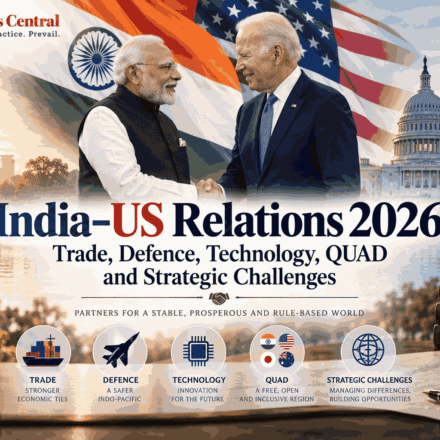
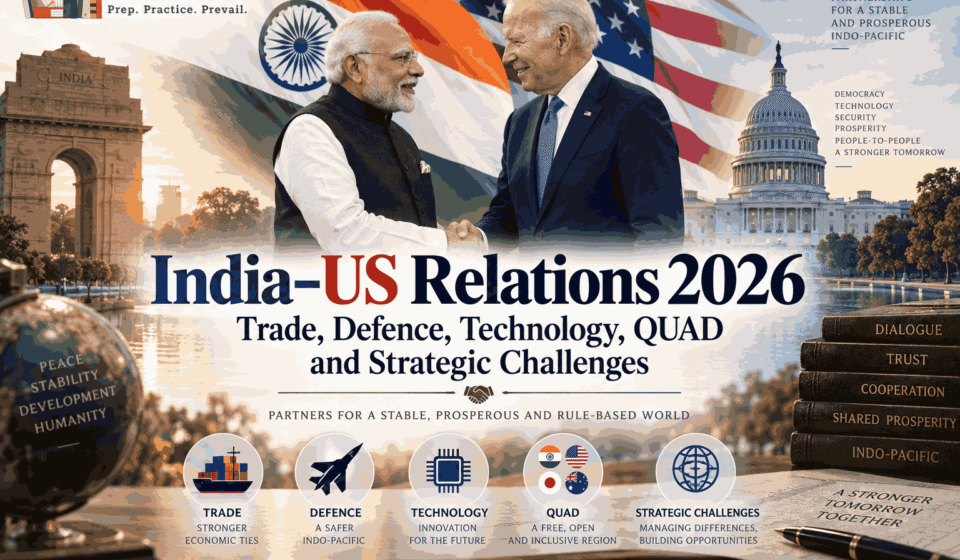
India–US Relations 2026: Trade, Defence, Technology, QUAD and Strategic Challenges

Why in News?
India–United States relations in 2026 have entered a more complex phase in which strategic convergence is deepening alongside economic and geopolitical disagreements. The relationship now extends across trade, defence, critical and emerging technologies, critical minerals, energy, supply-chain resilience, maritime security and the Indo-Pacific.
A major development was the 7 February 2026 framework for an Interim Agreement on reciprocal and mutually beneficial trade, negotiated within the broader India–US Bilateral Trade Agreement (BTA) process. The framework addressed tariffs, non-tariff barriers, digital trade, supply-chain resilience, economic-security cooperation and technology trade. The Indian Ministry of Commerce subsequently confirmed that negotiations continued through April, June and later rounds rather than the framework itself constituting a completed comprehensive BTA.
The strategic relationship also advanced in defence and technology. In February 2026, the 24th India–US Joint Technical Group Plenary reviewed cooperation in defence science and technology and explored stronger collaboration in critical and emerging defence technologies, including participation by universities, defence laboratories and industry.
In May 2026, U.S. Secretary of State Marco Rubio visited India, and New Delhi hosted the 11th Quad Foreign Ministers’ Meeting. India and the United States concluded a framework on securing supplies of critical minerals and rare earths, while the Quad advanced cooperation on critical minerals, maritime surveillance and Indo-Pacific energy security.
The defence relationship remained active in September 2026. The 22nd edition of Yudh Abhyas commenced at Auli in Uttarakhand and Mahajan in Rajasthan, with 600 personnel from each side. The exercise includes drones, autonomous systems, contemporary weapons and discussions on multi-domain warfare.
The latest official records therefore show a relationship that is no longer confined to conventional diplomacy or defence procurement. It is increasingly built around technology, economic security, resilient supply chains and Indo-Pacific cooperation, while differences over trade and strategic issues continue to require management.
What Exactly Is New?
The most important development in 2026 is not the creation of an entirely new India–US relationship. Rather, existing cooperation is being expanded into new domains and institutionalised through newer frameworks.
| Dimension | Earlier Framework | 2026 Development |
|---|---|---|
| Trade | Bilateral trade negotiations and Trade Policy Forum | Interim Agreement framework within broader BTA negotiations |
| Defence | Defence procurement, exercises and foundational agreements | Greater emphasis on co-development, technology and defence industrial cooperation |
| Technology | iCET and sector-specific cooperation | Expansion towards critical defence technologies, AI, advanced manufacturing and strategic supply chains |
| Critical minerals | Emerging area of cooperation | Dedicated India–US framework on mining and processing of critical minerals and rare earths |
| QUAD | Indo-Pacific coordination | Greater focus on maritime surveillance, critical minerals and energy security |
| Economic security | Primarily trade and investment | Supply-chain resilience, export controls and investment-screening cooperation |
| Strategic challenge | Managing China/Russia and regional security | Balancing partnership with the US while preserving India’s strategic autonomy |
The central development is therefore:
India–US relations are moving from a predominantly bilateral strategic partnership towards a wider ecosystem connecting defence, technology, trade, supply chains and Indo-Pacific security.
What Existed Earlier?
The transformation of India–US relations has taken place over several decades.
During the Cold War, India and the United States were separated by major differences in strategic orientation. India’s policy of non-alignment and its close relationship with the Soviet Union contrasted with the United States’ alliance structure and its relationship with Pakistan.
The relationship changed substantially after the Cold War because economic liberalisation in India, the disappearance of the Soviet Union and the emergence of new Asian geopolitical realities created greater space for cooperation.
The 2005 India–US Civil Nuclear Initiative, followed by the 2008 implementation of the civil nuclear agreement, became a major turning point. It helped remove a longstanding obstacle to broader strategic and technological engagement arising from India’s position outside the Nuclear Non-Proliferation Treaty.
Defence cooperation subsequently expanded. India and the United States developed a series of agreements and mechanisms covering logistics, communications, geospatial information, defence technology and industrial cooperation.
The United States recognised India as a Major Defense Partner in 2016, while India was granted Strategic Trade Authorization-1 (STA-1) status in 2018. The bilateral defence relationship subsequently expanded beyond procurement into exercises, interoperability, technology and industrial cooperation.
Thus, the 2026 relationship rests on a long institutional evolution rather than a sudden geopolitical shift.
What Has Changed?
The most important change is the nature of cooperation. Earlier, defence cooperation was often discussed through the lens of platforms, exercises and procurement. Increasingly, the emphasis is on:
technology → innovation → co-development → co-production → industrial ecosystems.
Similarly, economic relations are increasingly being viewed not merely through the volume of trade but through:
trade → supply chains → critical technologies → economic security → strategic resilience.
This is why critical minerals, semiconductors, AI, data-centre technologies and defence technologies have become part of the same strategic conversation.
At the same time, the bilateral relationship has not eliminated differences. Trade negotiations remain unfinished, and India continues to retain independent relationships with other major powers.
1. Background: From Strategic Distance to Comprehensive Partnership
India–US relations have undergone a gradual transformation from strategic distance to broad-based partnership. The post-Cold War period produced greater economic engagement. The civil nuclear agreement then demonstrated that the two countries could overcome major differences through political negotiation.
The subsequent expansion of defence cooperation was particularly significant. India began acquiring major U.S.-origin platforms while the two countries developed increasingly sophisticated military exercises and institutional mechanisms.
The relationship then expanded into the Indo-Pacific, followed by cooperation in emerging technologies.
The establishment of the Initiative on Critical and Emerging Technology (iCET) in 2023 marked another important transition. According to India’s Ministry of External Affairs, iCET was designed to facilitate strategic technology cooperation, including co-development and co-production in areas such as AI, quantum technologies, telecommunications, space, semiconductors, emerging defence technologies and biotechnology.
The trajectory can therefore be represented as:
Economic engagement → strategic dialogue → defence cooperation → technology cooperation → Indo-Pacific partnership → economic-security cooperation.
2. Understanding the Core Concept: Strategic Partnership
A strategic partnership is not necessarily a military alliance. This distinction is extremely important for understanding India–US relations. A formal alliance normally involves treaty-based commitments that can impose defined obligations regarding collective defence or security.
India’s relationship with the United States is different. The two countries cooperate extensively but retain independent foreign-policy decision-making.
India can therefore:
- cooperate with the United States in the Indo-Pacific;
- participate in the QUAD;
- conduct military exercises with the United States;
- cooperate on advanced technologies;
while simultaneously:
- maintaining defence and energy relations with Russia;
- participating in BRICS;
- participating in the Shanghai Cooperation Organisation;
- maintaining its own independent approach towards China.
This is the practical meaning of strategic autonomy in India’s foreign-policy framework.
Strategic autonomy does not mean avoiding partnerships. It means preserving the capacity to make independent strategic choices.
3. How the India–US Strategic Partnership Works
The partnership operates through multiple overlapping channels rather than one single institution.
Political and diplomatic mechanisms
These include:
- leadership-level meetings;
- Foreign Ministers’ engagement;
- the 2+2 Ministerial Dialogue;
- diplomatic consultations;
- sector-specific dialogues.
Defence mechanisms
These include:
- military exercises;
- defence technology cooperation;
- logistics arrangements;
- information-sharing mechanisms;
- defence industrial cooperation.
Technology mechanisms
These include:
- iCET;
- Joint Technical Group;
- industry and innovation platforms;
- university and research cooperation.
Multilateral mechanisms
India and the United States also cooperate through:
- QUAD;
- Indo-Pacific initiatives;
- maritime-domain awareness mechanisms;
- critical-mineral initiatives;
- international institutions.
The result is a networked partnership, rather than a single treaty.
4. Trade Relations: The Economic Pillar
Trade is one of the most important but also one of the most contested dimensions of the relationship. According to the U.S. Trade Representative, total U.S.–India goods and services trade was estimated at $239.6 billion in 2025. U.S. goods trade with India stood at approximately $149.1 billion, while services trade was approximately $90.4 billion.
The figures demonstrate the scale of the economic relationship, but the composition of trade also produces disagreements. The United States has raised concerns regarding India’s tariffs and non-tariff barriers, while India has its own concerns relating to market access, domestic industry, agriculture and the developmental consequences of trade liberalisation.
This makes trade negotiations more than a simple question of reducing tariffs.
They involve a broader negotiation over:
market access + standards + agriculture + digital trade + technology + investment + supply chains.
5. The 2026 Interim Trade Agreement Framework
On 7 February 2026, India and the United States announced a framework for an Interim Agreement on reciprocal and mutually beneficial trade. The framework was explicitly situated within the broader negotiations for a Bilateral Trade Agreement.
Under the framework, India agreed to reduce or eliminate tariffs on a range of U.S. industrial and agricultural products, while the United States set an 18% reciprocal tariff rate on specified originating Indian goods, subject to the terms outlined in the framework.
The framework also addressed non-tariff barriers involving:
- medical devices;
- ICT goods;
- food and agricultural products;
- standards and conformity assessment.
It additionally proposed cooperation on:
- digital trade;
- supply-chain resilience;
- investment reviews;
- export controls;
- economic-security alignment.
India also expressed an intention to purchase $500 billion of U.S. energy products, aircraft and aircraft parts, precious metals, technology products and coking coal over five years, while the two countries committed to increasing technology-product trade, including GPUs and data-centre equipment.
Crucial distinction
The February framework was not itself the completed comprehensive Bilateral Trade Agreement. Indian government releases in June 2026 continued to describe the two countries as negotiating an interim agreement and the broader BTA.
This distinction is highly important for Prelims:
Framework ≠ final agreement
Negotiation ≠ implementation
Commitment ≠ completed transaction
6. What Is the Trade Dispute Really About?
At its core, the trade disagreement reflects different economic priorities.
The United States seeks:
- greater market access;
- lower tariff and non-tariff barriers;
- reciprocal treatment;
- improved access for American goods and services.
India seeks to expand exports and attract investment while protecting:
- agriculture;
- sensitive domestic industries;
- employment;
- MSMEs;
- strategic sectors.
The disagreement is therefore not simply about the numerical level of tariffs.
It involves the larger question:
How should a developing major economy balance global market integration with domestic developmental priorities?
7. Economic Security: The New Trade Dimension
A major conceptual change in 2026 is the growing overlap between trade policy and national security.
The February 2026 India–US framework explicitly linked trade cooperation with:
- supply-chain resilience;
- investment reviews;
- export controls;
- non-market policies of third parties;
- technology cooperation.
This represents the rise of economic security. Economic security refers broadly to the ability of a country to prevent excessive strategic vulnerability arising from dependence on foreign suppliers, technologies, resources or markets.
It is particularly important for:
- semiconductors;
- critical minerals;
- defence equipment;
- pharmaceuticals;
- energy;
- telecommunications;
- advanced computing.
Therefore:
Trade policy is increasingly becoming an instrument of strategic policy.
8. Defence Relations: The Institutional Foundation
Defence cooperation is among the strongest pillars of India–US relations.
Important agreements include:
| Agreement | Year | Core purpose |
|---|---|---|
| LEMOA | 2016 | Logistics exchange |
| COMCASA | 2018 | Secure communications and interoperability |
| Industrial Security Agreement | 2019 | Protection of classified defence information |
| BECA | 2020 | Geospatial information and cooperation |
| INDUS-X | 2023 | Defence innovation ecosystem |
India’s official bilateral brief also identifies mechanisms such as the Defence Technology and Trade Initiative, Joint Technology Group and Defence Production and Procurement Group.
The significance of this institutional architecture is that defence cooperation no longer depends exclusively on individual arms deals.
It now has: logistics + communications + geospatial cooperation + industrial cooperation + technology + exercises.
9. The 2025 Ten-Year Major Defence Partnership Framework
An important foundation for 2026 was the 2025 ten-year update of the U.S.–India Major Defense Partnership framework.
The U.S. Department of Defense’s official fact sheet states that the framework envisages:
- greater information sharing;
- secure communications;
- geospatial cooperation;
- space situational-awareness information;
- multinational maritime cooperation;
- joint development and production;
- cooperation in AI;
- human-machine teaming;
- advanced materials;
- manufacturing;
- testing and standardisation.
This framework is particularly important because it shows the direction of travel:
from defence procurement towards defence-industrial and technological cooperation.
10. INDUS-X: Defence Innovation
The India–U.S. Defense Acceleration Ecosystem (INDUS-X) was launched in June 2023.
It connects:
- start-ups;
- defence companies;
- investors;
- universities;
- incubators;
- researchers;
- government institutions.
Its significance lies in the changing character of warfare.
Modern military advantage increasingly depends on: AI + autonomous systems + sensors + software + advanced materials + manufacturing + data.
Consequently, defence innovation cannot be produced only through traditional government procurement. INDUS-X attempts to connect the innovation ecosystems of both countries. India’s official bilateral brief identifies INDUS-X as part of the broader defence-industrial cooperation architecture.
11. Defence Science and Technology Cooperation in 2026
The 24th India–US Joint Technical Group Plenary was held in New Delhi on 3–4 February 2026. The meeting reviewed ongoing defence science-and-technology cooperation and examined proposals for strengthening collaboration in critical and emerging defence technologies.
Importantly, discussions also considered greater participation by:
- university-affiliated research centres;
- defence laboratories;
- industries.
The meeting also explored cooperation between DRDO and the U.S. Defence Innovation Unit under the Innovation Bridge framework and concluded with a project agreement.
This is significant because it moves cooperation towards an ecosystem involving:
government + laboratories + universities + private industry.
12. Yudh Abhyas 2026
The 22nd India–US Joint Military Exercise Yudh Abhyas commenced on 15 September 2026 at Auli in Uttarakhand and Mahajan Field Firing Range in Rajasthan. The exercise involves 600 personnel from each side.
Its objectives include improving:
- interoperability;
- joint planning;
- integrated battle-group operations;
- mountain and semi-mountain warfare capabilities.
Technology has become a specific focus, with training involving:
- drones;
- autonomous systems;
- surveillance and reconnaissance;
- contemporary weapons;
- multi-domain warfare.
Prelims distinction
Yudh Abhyas = India–US Army exercise.
It should not be confused with:
- Malabar, which is a naval exercise involving India, the United States, Japan and Australia;
- Vajra Prahar, the India–US Special Forces exercise.
13. Technology: The New Centre of Gravity
The most structurally significant development in India–US relations is perhaps the increasing importance of critical and emerging technologies.
The technology agenda encompasses:
- artificial intelligence;
- semiconductors;
- quantum technologies;
- telecommunications;
- space;
- biotechnology;
- advanced defence technologies;
- advanced computing.
The iCET framework was created precisely to facilitate cooperation in such strategic technologies. The February 2026 trade framework further connected technology to economic relations by identifying increased trade in GPUs and other data-centre equipment and expanded joint technology cooperation.
This creates a new strategic equation: Technology capability → economic competitiveness → defence capability → strategic autonomy.
14. Semiconductors and Advanced Computing
Semiconductors have become a strategic sector because they underpin:
- telecommunications;
- artificial intelligence;
- automobiles;
- defence systems;
- consumer electronics;
- industrial automation;
- data centres.
The India–US relationship therefore increasingly intersects with semiconductor supply-chain resilience. For India, the objective is not simply to import advanced chips.
A larger strategic objective is to develop capabilities across:
design → manufacturing → packaging → equipment → materials → skilled workforce.
The February 2026 trade framework’s reference to GPUs and data-centre equipment illustrates the growing importance of advanced computing in bilateral economic relations.
15. Critical Minerals and Rare Earths
Critical minerals have emerged as a new strategic pillar. On 26 May 2026, India and the United States concluded a framework on “Securing of Supply in the Mining and Processing of Critical Minerals and Rare Earths.”
The framework was signed in New Delhi by External Affairs Minister S. Jaishankar and U.S. Secretary of State Marco Rubio.
Critical minerals are important for:
- batteries;
- electric vehicles;
- renewable-energy technologies;
- electronics;
- defence equipment;
- advanced manufacturing.
Rare earth elements are particularly important for high-performance magnets and various advanced technological applications. The strategic issue is not simply availability in the Earth’s crust.
It is: Who controls extraction, processing, refining and supply chains?
A country may possess mineral resources but still remain dependent if processing capacity is concentrated elsewhere.
16. Why Critical Minerals Are a Strategic Issue
The critical-mineral problem demonstrates the changing relationship between economics and security. Suppose a country becomes heavily dependent on an external supplier for a mineral essential to:
- missiles;
- batteries;
- electronics;
- wind turbines;
- electric vehicles.
A disruption in supply could affect both economic activity and national security.
Therefore, critical-mineral policy increasingly involves: resource security + industrial policy + technology policy + national security.
This explains why India–US cooperation in this field also connects naturally with QUAD.
17. QUAD: The Multilateral Dimension
The Quadrilateral Security Dialogue (QUAD) consists of: India + United States + Japan + Australia.
It is a diplomatic and practical cooperation grouping, not a formal collective-defence alliance. Its central geographical focus is the Indo-Pacific. For India, QUAD offers an important mechanism to cooperate with major partners while avoiding the obligations associated with a formal military alliance.
The grouping therefore fits relatively well with India’s broader approach of: partnership without bloc alignment.
18. The 11th Quad Foreign Ministers’ Meeting, 2026
The 11th Quad Foreign Ministers’ Meeting was held in New Delhi on 26 May 2026, hosted by India. The participants were the Foreign Ministers of Australia, India and Japan and the U.S. Secretary of State. The official MEA record identifies the meeting and associated documents, including the Quad Joint Statement, the factsheet, the Critical Minerals Initiative Framework and the Indo-Pacific Energy Security statement.
The 2026 agenda is important because it demonstrates the Quad’s evolution from broad strategic signalling towards practical cooperation.
Major areas included:
- maritime-domain awareness;
- critical minerals;
- energy security;
- critical and emerging technologies;
- humanitarian assistance and disaster response.
19. Maritime-Domain Awareness
Maritime-domain awareness refers to the ability to understand activities occurring within the maritime environment through information, surveillance, sensors and data integration. For India, this has particular significance because of its location in the Indian Ocean Region.
Maritime-domain awareness can help identify:
- shipping movements;
- suspicious vessels;
- illegal activities;
- maritime-security risks;
- potential disruptions to sea lanes.
The Quad’s maritime initiatives therefore have significance beyond military operations.
They also relate to:
trade security + disaster response + maritime governance + protection of sea lanes.
20. Quad Critical Minerals Initiative
The Quad’s critical-minerals cooperation complements the bilateral India–US critical-minerals framework.
The strategic logic is straightforward: Supply concentration → vulnerability → diversification → resilient supply chains.
For India, cooperation with Australia, Japan and the United States can help create alternative sources of:
- minerals;
- processing;
- investment;
- technology;
- recycling.
This also illustrates the growing importance of minilateralism. Instead of attempting to address every strategic problem through a universal global institution, a small group of countries with overlapping interests can cooperate on specific issues.
21. Indo-Pacific Energy Security
The Quad also advanced cooperation on Indo-Pacific energy security in 2026. Energy security is no longer limited to ensuring sufficient petroleum supplies.
It increasingly includes:
- diversification;
- resilient infrastructure;
- clean-energy technologies;
- emergency preparedness;
- supply-chain security;
- access to strategic energy inputs.
This connects energy policy with broader geopolitical resilience.
22. India–US Relations and the Indo-Pacific
The Indo-Pacific is a major area of strategic convergence. India’s geographical position gives it particular importance because it connects: Indian Ocean → Southeast Asia → Western Pacific.
The United States views India as an important partner in maintaining a favourable balance in the Indo-Pacific.
India, however, approaches the region through its own interests, including:
- maritime security;
- freedom of navigation;
- secure sea lanes;
- connectivity;
- economic growth;
- ASEAN centrality;
- strategic autonomy.
Therefore, India’s participation in the Indo-Pacific should not automatically be interpreted as joining a U.S.-led containment strategy.
23. China: Convergence Without Complete Alignment
China is an important factor in India–US strategic convergence.
India’s concerns include:
- the India–China boundary;
- Chinese military infrastructure;
- China’s presence in the Indian Ocean;
- trade dependence;
- technology dependence;
- China–Pakistan strategic cooperation.
The United States has broader concerns relating to China’s global economic, technological and military power. Thus, India and the United States have overlapping but not identical interests regarding China. This distinction is important.
India’s strategic relationship with the United States should not be reduced to: India + US = anti-China alliance
That formulation is analytically inadequate.
The relationship has its own independent pillars in:
- technology;
- trade;
- defence;
- energy;
- education;
- investment;
- global governance.
24. Russia: The Strategic-Autonomy Challenge
Russia represents one of the most important areas of divergence.
India continues to maintain a significant relationship with Russia involving:
- defence;
- energy;
- strategic cooperation;
- Eurasian engagement.
The United States has pursued a different approach towards Russia, particularly following the Russia–Ukraine conflict. The 2026 trade relationship demonstrated how closely economic and geopolitical questions can become intertwined.
The White House stated in February 2026 that the United States removed an additional 25% tariff on Indian imports after citing India’s commitment concerning Russian oil purchases and its broader alignment with the United States on national-security and economic matters.
This development illustrates an important point:
India–US strategic cooperation does not eliminate differences arising from India’s independent relationships with other major powers.
For India, Russia remains important for reasons including energy security, defence relationships and long-standing strategic ties.
25. Strategic Autonomy in Practice
Strategic autonomy should therefore be understood as a capacity, not as opposition to any particular country.
India seeks the ability to:
- cooperate with Washington;
- engage Moscow;
- manage relations with Beijing;
- work with Japan and Australia;
- participate in BRICS;
- participate in the SCO;
- deepen relations with Europe;
- engage the Global South.
This approach is increasingly described through concepts such as: multi-alignment and issue-based partnerships.
The objective is to maximise India’s strategic options rather than become structurally dependent on one geopolitical bloc.
26. The Pakistan Factor
India–US relations also operate within the wider South Asian security environment. The United States maintains its own interests in Pakistan involving:
- counterterrorism;
- regional security;
- Afghanistan;
- nuclear stability;
- broader South Asian geopolitics.
India therefore cannot assume that closer U.S.–India relations will eliminate U.S. engagement with Pakistan. For India, the key issue is ensuring that U.S. engagement with Pakistan does not undermine India’s security interests. This remains an area where Indian and American strategic priorities can differ.
27. India–US Relations and J&K
The J&K dimension is relevant primarily through the South Asian security architecture, rather than because Jammu & Kashmir is a central pillar of the India–US relationship.
For JKAS, the important connections include:
- India–Pakistan relations;
- terrorism and counterterrorism;
- U.S. engagement with Pakistan;
- regional security;
- Afghanistan;
- the wider security environment of the Indian subcontinent.
India’s position remains that Jammu & Kashmir is an integral part of India, and Indian policy strongly rejects external characterisation of the territory that contradicts this position.
However, the J&K dimension should not be exaggerated. The contemporary India–US partnership is much broader, with major areas of engagement in: defence + technology + trade + critical minerals + Indo-Pacific + energy.
28. Why the United States Matters to India
The United States provides India with opportunities across several domains.
Defence
Access to advanced platforms, technologies, training and interoperability.
Technology
Access to global innovation ecosystems in AI, semiconductors, quantum technologies, space and advanced computing.
Investment
Capital, multinational corporate networks and access to global markets.
Indo-Pacific
Cooperation on maritime security and regional stability.
Critical Minerals
Potential diversification of mineral and processing supply chains.
Global Diplomacy
A stronger relationship with a major global power can increase India’s ability to influence international economic and strategic discussions.
29. Why India Matters to the United States
India offers the United States several strategic advantages.
Geography
India’s position in the Indian Ocean gives it considerable maritime significance.
Economic Scale
India represents a major market and production base.
Technology and Talent
India has a large technology and engineering workforce.
Defence Cooperation
Indian military capabilities and exercises contribute to greater interoperability.
Supply Chains
India can contribute to diversification of production and strategic supply chains.
Global South
India’s diplomatic influence provides Washington with an important relationship beyond traditional U.S. alliances.
30. The New Strategic Equation: Trade + Technology + Security
One of the most important conceptual developments is the convergence of three traditionally separate areas:
Trade
↓
Technology
↓
National Security
For example, semiconductors are simultaneously:
- commercial products;
- technological infrastructure;
- defence inputs;
- strategic assets.
Similarly, critical minerals are:
- commodities;
- industrial inputs;
- technology resources;
- strategic-security assets.
This is why the India–US relationship increasingly uses the language of economic security.
31. Major Strategic Challenges
Trade Friction
Tariff and non-tariff disagreements can create pressure even when strategic relations are strong.
Russia
India’s relationship with Russia can conflict with U.S. sanctions and foreign-policy priorities.
Technology Controls
Advanced technology cooperation can be limited by export controls, national-security considerations and intellectual-property concerns.
Defence Dependence
India wants access to advanced foreign technologies while simultaneously seeking greater domestic defence capability.
Different China Strategies
India and the United States share concerns about China but do not have identical strategic objectives.
Domestic Political Economy
Trade liberalisation can create winners and losers within India, particularly in agriculture and sensitive industrial sectors.
Supply-Chain Dependence
Diversifying away from concentrated suppliers is itself costly and technologically demanding.
Strategic Autonomy
India must ensure that deeper cooperation does not gradually create excessive dependence on one external partner.
32. Defence Cooperation vs Defence Self-Reliance
India’s defence relationship with the United States presents an important policy dilemma.
Greater U.S. cooperation can provide:
- advanced technologies;
- better interoperability;
- modern platforms;
- access to innovation.
But excessive dependence on foreign systems can create vulnerabilities involving:
- spare parts;
- maintenance;
- software;
- upgrades;
- supply disruptions;
- export-control restrictions.
Therefore, the strategic objective should be to use international partnerships to strengthen domestic capabilities.
The desired chain is: foreign cooperation → technology absorption → domestic R&D → indigenous production → greater strategic autonomy.
33. Government and Institutional Architecture
| Institution / Mechanism | Broad Role |
|---|---|
| Ministry of External Affairs | Foreign-policy and diplomatic coordination |
| Ministry of Defence | Defence cooperation |
| DRDO | Defence R&D |
| Ministry of Commerce & Industry | Trade negotiations |
| USTR | U.S. trade-policy negotiations |
| 2+2 Ministerial Dialogue | Foreign and defence-policy coordination |
| Joint Technical Group | Defence science and technology |
| INDUS-X | Defence innovation ecosystem |
| iCET | Critical and emerging technology cooperation |
| QUAD | Four-country Indo-Pacific cooperation |
The institutional distinction is important:
- QUAD is not a ministry.
- INDUS-X is not QUAD.
- iCET is not a military alliance.
- USTR is the U.S. trade-policy authority, whereas India’s trade negotiations involve the Ministry of Commerce and Industry.
34. India–US Relations: What Is Actually Changing?
The evolution can be summarised as follows:
| Earlier Model | Emerging Model |
|---|---|
| Defence purchases | Defence industrial cooperation |
| Platform acquisition | Co-development and co-production |
| Bilateral trade | Trade + economic security |
| Conventional technology | Critical and emerging technologies |
| Energy trade | Energy resilience |
| Resource access | Critical-mineral security |
| Military exercises | Interoperability + multi-domain capability |
| Maritime cooperation | Maritime-domain awareness |
| Bilateral engagement | Bilateral + QUAD + Indo-Pacific |
| Strategic partnership | Networked strategic ecosystem |
The relationship is therefore becoming broader and more technologically intensive, but not necessarily equivalent to a formal alliance.
35. Significance for India
The deepening partnership can contribute to India’s:
Strategic capability
Through defence technology, exercises and interoperability.
Technological capability
Through collaboration in AI, semiconductors, quantum technology, space and advanced computing.
Economic resilience
Through investment and diversified supply chains.
Critical-mineral security
Through cooperation in mining, processing and recycling.
Maritime security
Through greater information-sharing and Indo-Pacific cooperation.
Diplomatic influence
Through participation in a major network of strategic partnerships.
However, these benefits depend on India’s ability to convert external cooperation into domestic capability.
36. CivilsCentral Current Affairs Insight
India–US relations in 2026 reveal the changing nature of strategic power. Military strength, economic competitiveness and technological capability are increasingly inseparable. A semiconductor shortage can become an economic problem; a critical-mineral dependency can become a strategic vulnerability; and control over advanced computing can influence both commercial and military power. India therefore has an interest in deepening partnerships with technologically advanced countries while simultaneously building domestic capabilities. The central policy challenge is not choosing between strategic partnership and strategic autonomy, but ensuring that partnership becomes an instrument for strengthening autonomy.
37. Government and Policy Response
The Indian approach in 2026 reflects several parallel strategies.
Bilateral trade negotiations
India and the United States continued negotiations towards an interim agreement and broader BTA. The June 2026 talks covered market access, digital trade, non-tariff measures, customs and trade facilitation, investment promotion and economic-security alignment.
Defence technology cooperation
The Joint Technical Group continued to develop cooperation in defence science and critical technologies.
Defence industrial cooperation
The ten-year defence framework envisages joint development and production in selected areas.
Critical minerals
India and the United States established a dedicated framework for securing supplies in mining and processing.
QUAD cooperation
India used the Quad platform to advance practical cooperation in maritime surveillance, critical minerals and energy security.
38. Way Forward
The relationship can be strengthened if both countries manage differences through institutionalised engagement rather than allowing individual disputes to spill over into unrelated strategic areas.
India should seek greater emphasis on co-development and co-production in defence and advanced technologies. This would help ensure that external partnerships strengthen India’s domestic technological base rather than merely increase dependence on imported platforms.
Trade negotiations should focus on predictable rules, transparent standards and sustainable market access. India must also protect legitimate developmental interests, particularly where agriculture, MSMEs and sensitive domestic industries are involved.
Technology cooperation should increasingly involve Indian universities, laboratories and private firms. The objective should be to move from technology access towards technology absorption and indigenous innovation.
Critical-mineral cooperation should be linked with India’s domestic exploration, processing, recycling and manufacturing capabilities. Diversification of international supply chains will be more meaningful when supported by domestic capacity.
Finally, India should continue to preserve strategic autonomy. Cooperation with the United States can be deepened without converting the relationship into an exclusive alliance structure.
The guiding principle can therefore be: PARTNERSHIP → CAPABILITY → RESILIENCE → AUTONOMY
39. Prelims Perspective
High-Discrimination Facts
- QUAD members: India, United States, Japan and Australia.
- QUAD is not a formal collective-defence alliance.
- LEMOA: 2016 — logistics exchange.
- COMCASA: 2018 — secure communications and interoperability.
- BECA: 2020 — geospatial information cooperation.
- India became a U.S. Major Defense Partner in 2016.
- India received STA-1 status in 2018.
- INDUS-X was launched in 2023.
- iCET was launched in 2023 to advance critical and emerging technology cooperation.
- The 24th India–US Joint Technical Group Plenary was held in February 2026.
- The 11th Quad Foreign Ministers’ Meeting was held in New Delhi on 26 May 2026.
- India and the United States concluded a critical-minerals and rare-earths supply framework on 26 May 2026.
- The 22nd Yudh Abhyas commenced in September 2026.
- The February 2026 trade framework was an interim framework within broader BTA negotiations, not simply a completed comprehensive BTA.
- The U.S. Trade Representative estimated total U.S.–India goods and services trade at $239.6 billion in 2025.
40. Important Distinctions
| Concept | Correct Understanding |
|---|---|
| QUAD | India–US–Japan–Australia diplomatic/minilateral grouping |
| INDUS-X | India–US defence innovation ecosystem |
| iCET | India–US critical and emerging technology cooperation |
| LEMOA | Logistics exchange |
| COMCASA | Secure communications |
| BECA | Geospatial cooperation |
| Yudh Abhyas | India–US Army exercise |
| Malabar | Multilateral naval exercise involving India, US, Japan and Australia |
| BTA | Broader Bilateral Trade Agreement under negotiation |
| Interim Agreement framework | 2026 framework within the broader BTA process |
41. Common Prelims Traps
Trap 1: QUAD is a military alliance.
Incorrect.
Trap 2: QUAD consists of India, US, Japan and South Korea.
Incorrect. Australia is the fourth member.
Trap 3: BECA is the logistics agreement.
Incorrect. LEMOA concerns logistics; BECA concerns geospatial cooperation.
Trap 4: COMCASA is an economic agreement.
Incorrect. It concerns secure communications and interoperability.
Trap 5: INDUS-X is a QUAD institution.
Incorrect. It is a bilateral India–US defence innovation ecosystem.
Trap 6: The February 2026 trade framework was the final comprehensive BTA.
Incorrect. Official Indian releases in June 2026 continued to describe negotiations towards the interim agreement and broader BTA.
Trap 7: Strategic partnership means military alliance.
Incorrect. India and the United States have extensive defence cooperation without being treaty allies.
42. Possible UPSC-Style Prelims Question
Consider the following statements regarding India–US relations:
- QUAD comprises India, the United States, Japan and Australia.
- INDUS-X is an India–US initiative concerning defence innovation.
- BECA primarily provides the framework for reciprocal military logistics support.
- iCET focuses on cooperation in critical and emerging technologies.
Which of the statements given above are correct?
Answer: 1, 2 and 4 only.
Statement 3 is incorrect because logistics cooperation is associated with LEMOA, whereas BECA concerns geospatial cooperation.
43. Mains Perspective
GS Paper II — International Relations
India–US relations connect with:
- bilateral relations;
- strategic partnerships;
- Indo-Pacific;
- QUAD;
- defence cooperation;
- emerging technologies;
- trade diplomacy;
- global governance;
- strategic autonomy.
Dimension 1: Strategic
The relationship strengthens India’s position in the Indo-Pacific and expands defence and maritime cooperation.
Dimension 2: Economic
Trade, investment, technology and supply-chain integration can contribute to growth but also create tensions over market access.
Dimension 3: Technological
AI, semiconductors, quantum technologies and advanced defence technologies increasingly form the backbone of the relationship.
Dimension 4: Security
Defence interoperability, maritime-domain awareness and counterterrorism cooperation have strategic value.
Dimension 5: Strategic Autonomy
India must balance deeper cooperation with Washington against its independent relationships with Russia, China and other major powers.
44. Possible UPSC-Style Mains Question
“India–US relations have evolved from strategic distance into a comprehensive partnership spanning defence, technology, trade and the Indo-Pacific. Yet the relationship remains characterised by significant areas of divergence.” Discuss.
Suggested Answer Framework
Introduction
Briefly trace the transformation of India–US relations since the end of the Cold War and the civil-nuclear agreement.
Body
Discuss:
- defence cooperation;
- critical and emerging technologies;
- trade and investment;
- critical minerals;
- QUAD and Indo-Pacific;
- supply-chain resilience.
Then examine challenges:
- trade barriers;
- Russia;
- technology controls;
- China;
- domestic economic interests;
- strategic autonomy.
Way Forward
- co-development;
- co-production;
- technology absorption;
- predictable trade rules;
- diversified supply chains;
- institutional dialogue;
- strategic autonomy.
Conclusion
India–US relations are best understood as a broad strategic partnership based on overlapping interests rather than as a formal alliance. Its durability will depend on the ability of both countries to deepen cooperation while managing structural differences.
45. Prelims–Mains Bridge
| Prelims Knowledge | Mains Application |
|---|---|
| LEMOA | Defence logistics and interoperability |
| COMCASA | Secure communications and military interoperability |
| BECA | Geospatial capability and strategic awareness |
| INDUS-X | Defence innovation and industrial policy |
| iCET | Technology diplomacy |
| QUAD | Indo-Pacific minilateralism |
| Critical minerals | Economic and technological security |
| Trade framework | Economic diplomacy and market access |
| Russia issue | Strategic autonomy |
| Semiconductors | Technology sovereignty and supply-chain resilience |
| Maritime surveillance | Indian Ocean security |
The integrated chain is: FACT → CONCEPT → STRATEGIC ISSUE → POLICY CHOICE → ANALYTICAL ARGUMENT
46. PYQ Linkage
There is no need to fabricate a direct 2026-specific PYQ. The topic overlaps strongly with recurring UPSC themes involving:
- India’s strategic partnerships;
- Indo-Pacific;
- international groupings;
- defence cooperation;
- nuclear diplomacy;
- globalisation and trade;
- emerging technologies;
- India’s strategic autonomy.
The examination value therefore lies not merely in memorising the latest bilateral event but in understanding the architecture of strategic partnerships and India’s foreign-policy choices.
47. Exam-Oriented Takeaways
For Prelims
Remember:
- QUAD = India + US + Japan + Australia
- LEMOA = Logistics
- COMCASA = Communications
- BECA = Geospatial
- INDUS-X = Defence innovation
- iCET = Critical & emerging technologies
- Yudh Abhyas = India–US Army
- Malabar = Multilateral naval exercise
- BTA = Broader bilateral trade negotiation
- 2026 critical-minerals framework = India–US
For Mains
Remember the five central arguments:
- Strategic convergence is deepening.
- Technology is becoming the new centre of gravity.
- Economic security is merging with trade policy.
- QUAD provides a practical Indo-Pacific platform.
- Strategic autonomy remains the central balancing principle.
48. Quick Revision Zone
Remember These
- India and US are strategic partners, not treaty allies.
- QUAD comprises India, US, Japan and Australia.
- India became a Major Defense Partner of the US in 2016.
- LEMOA — 2016.
- COMCASA — 2018.
- BECA — 2020.
- INDUS-X — 2023.
- iCET — 2023.
- February 2026 — Interim Trade Agreement framework.
- May 2026 — India–US critical-minerals framework.
- May 2026 — 11th Quad Foreign Ministers’ Meeting.
- September 2026 — Yudh Abhyas 22nd edition.
Important Institutions
MEA → foreign policy
Ministry of Defence → defence cooperation
DRDO → defence R&D
Ministry of Commerce & Industry → Indian trade negotiations
USTR → U.S. trade policy
INDUS-X → defence innovation ecosystem
iCET → critical and emerging technologies
QUAD → four-country Indo-Pacific cooperation
Important Distinctions
Strategic partnership ≠ military alliance
QUAD ≠ NATO
INDUS-X ≠ QUAD
iCET ≠ defence treaty
BECA ≠ LEMOA
Framework ≠ final BTA
Negotiation ≠ implementation
Technology access ≠ technology autonomy
One-Minute Revision
India–US relations in 2026 rest on five major pillars:
- Trade
- Defence
- Technology
- Critical minerals
- Indo-Pacific/QUAD
The principal challenge is balancing: Strategic partnership + economic interests + strategic autonomy.
49. FAQs
Is India a formal military ally of the United States?
No. India and the United States have a deep defence and strategic partnership but are not treaty allies.
What is the QUAD?
The Quad is a four-country diplomatic and practical cooperation grouping comprising India, the United States, Japan and Australia.
What is the difference between LEMOA, COMCASA and BECA?
LEMOA concerns logistics exchange; COMCASA concerns secure communications and interoperability; BECA concerns geospatial cooperation.
What is INDUS-X?
INDUS-X is an India–US defence innovation ecosystem connecting companies, start-ups, investors, researchers and other institutions.
What is iCET?
The Initiative on Critical and Emerging Technology is a framework for strategic cooperation in areas such as AI, quantum technologies, telecommunications, space, semiconductors and advanced defence technologies.
What happened to the India–US BTA in 2026?
The two countries reached a framework for an Interim Agreement in February 2026 and continued negotiations during 2026 towards finalising the interim arrangement and broader BTA.
Why are critical minerals important?
They are essential inputs for advanced manufacturing, batteries, electronics, renewable-energy technologies and defence systems. Their supply chains can therefore have both economic and strategic significance.
Why is Russia a challenge in India–US relations?
India maintains significant energy and defence relationships with Russia, while U.S. policy towards Russia has generated sanctions and other pressures. This creates a clear test of India’s strategic autonomy.
Is the QUAD directed exclusively against China?
China is an important strategic context for the Indo-Pacific, but Quad cooperation also covers maritime security, critical minerals, energy, technology, disaster response and other practical areas.
50. Chapter Summary
India–US relations in 2026 represent the maturation of a partnership that has evolved over several decades. The relationship has moved from Cold War-era strategic distance through post-Cold War economic engagement and defence cooperation towards a comprehensive partnership encompassing trade, defence, technology, critical minerals, energy, supply chains and the Indo-Pacific.
The trade relationship illustrates both the depth and complexity of the partnership. The February 2026 framework for an Interim Agreement created a new basis for negotiations involving tariffs, non-tariff barriers, digital trade, supply-chain resilience and economic security, but official Indian records show that negotiations continued during the year. The framework should therefore be understood as a stage in the broader BTA process rather than as the final endpoint.
Defence cooperation is simultaneously becoming more technologically sophisticated. LEMOA, COMCASA and BECA established important foundations, while INDUS-X, the Joint Technical Group and the 2025 ten-year defence framework indicate movement towards defence innovation, joint development and co-production. The 2026 Yudh Abhyas exercise further demonstrates the growing emphasis on interoperability, autonomous systems and multi-domain warfare.
Technology has emerged as the central bridge between economic and strategic cooperation. AI, semiconductors, quantum technologies, advanced computing, space and defence technologies increasingly belong to the same strategic ecosystem. Critical minerals add another layer by linking resource security with industrial and national security.
The QUAD provides the wider Indo-Pacific dimension. Its 2026 agenda demonstrates an increasing focus on practical cooperation in maritime surveillance, critical minerals and energy security rather than simply strategic declarations.
Yet deeper cooperation does not eliminate differences. Trade negotiations, Russia, technology controls, divergent interests regarding China and India’s continuing commitment to strategic autonomy remain important challenges.
The central lesson is therefore not that India is choosing between the United States and other major powers. Rather, India is attempting to use multiple strategic partnerships to expand its own capabilities and preserve room for independent decision-making.
For UPSC and JKAS, the most important conceptual chain is:
India–US Partnership → Defence → Technology → Trade → Economic Security → QUAD → Indo-Pacific → Strategic Autonomy
That is the framework through which the 2026 developments should be understood.
About The Author