Battle of Buxar (1764): Causes, Course, Consequences & Historical Significance for UPSC/JKAS

Introduction
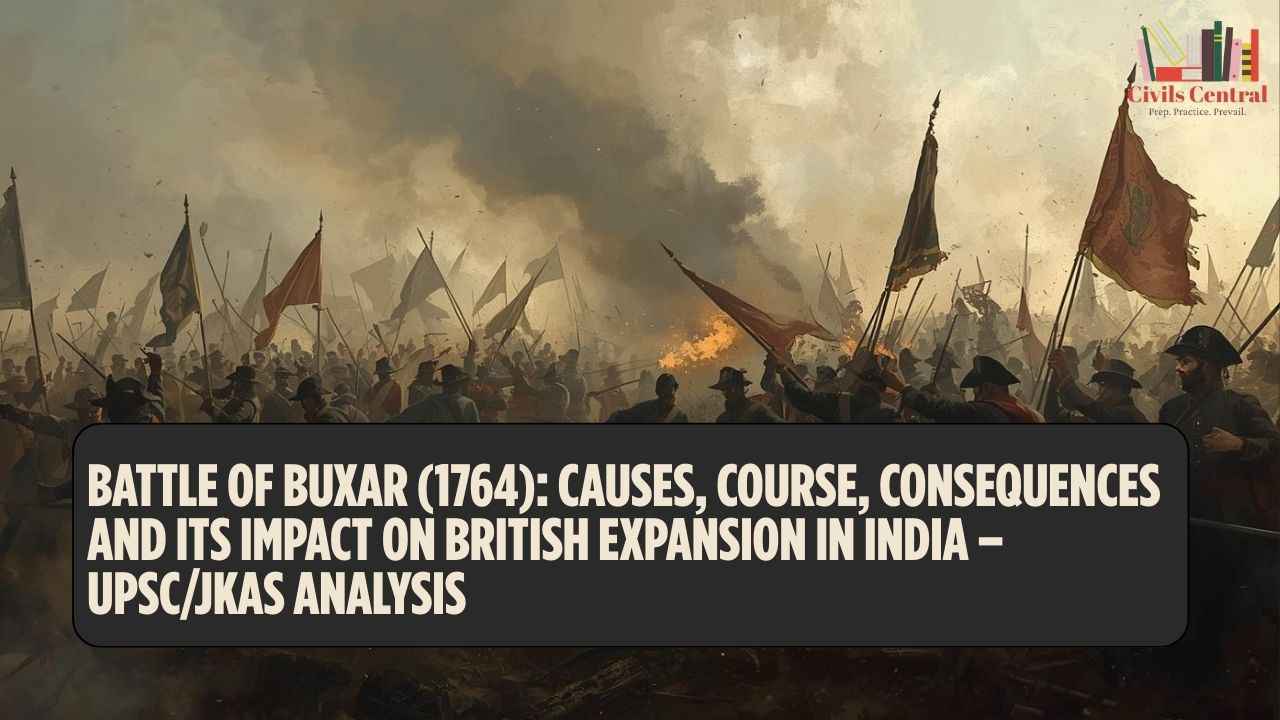
The Battle of Buxar (23 October 1764) was one of the most decisive battles in modern Indian history, fought between the British East India Company and a powerful Indian alliance comprising Shah Alam II, Shuja-ud-Daula, and Mir Qasim. The battle took place at Buxar (present-day Bihar) and marked a decisive shift in the balance of power in India.
While the Battle of Plassey laid the foundation of British influence in Bengal, it was the Battle of Buxar that firmly established British political and fiscal control in eastern India. The victory enabled the Company to secure the Diwani rights of Bengal, Bihar, and Orissa through the Treaty of Allahabad (1765), transforming it from a commercial enterprise into a territorial power.
For UPSC and JKAS aspirants, the Battle of Buxar is significant not merely as a military event but as a turning point that accelerated the decline of Mughal authority and paved the way for British administrative expansion in India. It is frequently linked to themes such as colonial revenue systems, dual government in Bengal, and the beginnings of economic exploitation under Company rule.
Background to the Battle
The Battle of Buxar must be understood in the backdrop of the political developments that followed the Battle of Plassey. After 1757, the British East India Company installed Mir Jafar as the Nawab of Bengal. However, his inability to meet the Company’s financial demands and maintain administrative stability led to his replacement by Mir Qasim in 1760.
1️. Rise of Mir Qasim and Conflict with the Company
Mir Qasim attempted to assert independence by:
- Shifting his capital from Murshidabad to Munger to strengthen military control.
- Modernizing his army along European lines.
- Abolishing internal duties to counter the misuse of dastaks (free trade passes) by Company officials.
These reforms threatened the commercial privileges of the Company, leading to growing tensions.
2️. Economic Disputes and War
The misuse of trade privileges by Company servants caused significant revenue losses to Bengal. When Mir Qasim tried to enforce equal taxation, conflict broke out in 1763. After initial clashes, Mir Qasim was defeated and fled to Awadh.
3️. Formation of the Triple Alliance
Mir Qasim formed an alliance with:
- Shuja-ud-Daula
- Shah Alam II
The combined forces aimed to challenge the growing power of the British in eastern India. This alliance ultimately confronted the Company’s army at Buxar in October 1764.
Key Participants in the Battle
The Battle of Buxar (23 October 1764) was fought between the British East India Company and a powerful Indian confederacy. Understanding the leadership and objectives of each side is crucial for UPSC/JKAS preparation.
British East India Company
- Commander: Hector Munro
- Strength: Approximately 7,000–8,000 troops (including Indian sepoys and European soldiers)
- Advantage: Disciplined infantry, effective artillery, unified command structure
The Company’s objective was to eliminate resistance in Bengal and secure political and fiscal supremacy in eastern India.
Indian Alliance (Triple Confederacy)
1️.Mir Qasim
- Former Nawab of Bengal
- Sought to regain his authority after conflict with the Company
2️. Shuja-ud-Daula
- Nawab of Awadh
- Aimed to prevent British expansion towards Awadh
3️. Shah Alam II
- Mughal Emperor
- Attempted to restore imperial authority and curb British dominance
The allied forces were numerically superior (around 40,000 troops), but lacked coordination and unified military planning.
Course of the Battle (23 October 1764)
The Battle of Buxar was fought on 23 October 1764 near the town of Buxar (present-day Bihar) between the British East India Company and the combined forces of Mir Qasim, Shuja-ud-Daula, and Shah Alam II.
1️. Deployment of Forces
- The Company’s army, led by Hector Munro, was positioned strategically with disciplined infantry formations and well-placed artillery.
- The allied Indian forces, though numerically superior (around 40,000), were spread across a wider front.
2️. The Engagement
- The battle began in the morning with artillery exchanges.
- The Company forces maintained tight infantry lines and effectively used field artillery.
- Lack of coordination among the allied commanders weakened their response.
- The Mughal and Awadh cavalry charges failed to break British formations.
3️. Turning Point
- Continuous artillery fire and disciplined volleys by Company troops caused heavy losses to the allied forces.
- Disorder spread in the allied camp, leading to retreat.
- By afternoon, the Indian confederacy was decisively defeated.
4️. Immediate Outcome
- The allied forces dispersed.
- Shuja-ud-Daula fled towards Awadh.
- Shah Alam II later sought accommodation with the British.
The victory firmly established the Company as the dominant military power in eastern India.
Causes of British Victory
Despite being heavily outnumbered, the British East India Company secured a decisive victory at Buxar. For UPSC/JKAS preparation, it is important to analyse structural and military factors rather than just narrate events.
1️. Superior Military Discipline and Training
The Company’s forces were trained in European warfare techniques.
- Well-drilled infantry
- Coordinated volleys
- Effective field artillery
This discipline allowed them to withstand cavalry attacks and maintain formation under pressure.
2️. Unified Command Structure
The British army operated under a single, clear command led by Hector Munro.
In contrast, the Indian alliance lacked coordination between:
- Mir Qasim
- Shuja-ud-Daula
- Shah Alam II
Divergent interests weakened strategic planning.
3️.Weak Coordination Among the Allied Forces
Although numerically superior (around 40,000 troops), the allied army:
- Failed to maintain battlefield cohesion
- Could not effectively synchronize cavalry and infantry movements
- Suffered from communication gaps
4️.Economic and Logistical Strength
The Company had:
- Stable financial backing from Bengal revenues
- Efficient supply lines
- Access to modern weaponry
This logistical advantage ensured sustained battlefield effectiveness.
5️. Strategic Mistakes of the Indian Alliance
- Overreliance on cavalry
- Poor artillery positioning
- Internal distrust within the alliance
Treaty of Allahabad (1765)
The decisive victory at Buxar paved the way for the Treaty of Allahabad (1765), signed between the British East India Company and Shah Alam II in August 1765. This treaty marked the beginning of formal British political authority in India.
1️. Grant of Diwani Rights
The Mughal Emperor granted the Company the Diwani rights (right to collect revenue) of:
- Bengal
- Bihar
- Orissa
This meant the Company gained control over revenue administration while the Nawab nominally retained the Nizamat (administration of law and order).
2️. Position of Shah Alam II
- The Emperor was granted an annual pension.
- He became dependent on the Company’s financial support.
- Mughal sovereignty was reduced to a symbolic authority.
3️.Settlement with Awadh
- Shuja-ud-Daula was restored to his position as Nawab of Awadh.
- Awadh became a buffer state between British territories and Afghan/Maratha influence.
- Heavy indemnity was imposed on Awadh.
4️. Beginning of Dual Government in Bengal
Following the treaty, the Company introduced the Dual Government (1765–1772) in Bengal:
- Company controlled revenue (Diwani).
- Nawab handled administration (Nizamat).
In reality, power rested with the Company, leading to administrative confusion and economic exploitation.
Historical Significance
The Treaty of Allahabad transformed the Company:
- From a trading corporation into a territorial power.
- From indirect influence (after 1757) to direct fiscal control
It marked the real beginning of British rule in India.
Long-Term Consequences and Historical Significance
The Battle of Buxar proved to be more decisive than the Battle of Plassey in establishing British supremacy in India. Its consequences reshaped the political and economic structure of eastern India.
1️.Establishment of British Political Supremacy
After the victory and the subsequent Treaty arrangements, the British East India Company became the real master of Bengal.
- The Mughal Emperor, Shah Alam II, became a pensioner of the Company.
- The Nawab of Awadh became dependent on British support.
- Bengal’s Nawab was reduced to a nominal ruler.
This marked the beginning of Company rule in India in a formal sense.
2️. Beginning of Economic Control and Exploitation
With the acquisition of Diwani rights:
- The Company gained control over revenue collection.
- Wealth from Bengal financed British military expansion.
- Administrative mismanagement during the Dual Government period contributed to economic distress.
This laid the foundation for later colonial economic policies.
3️. Decline of Mughal Authority
The defeat exposed the weakness of the Mughal Empire.
The Emperor’s dependence on the Company symbolised the end of effective imperial sovereignty.
4️. Strategic Expansion of the British
The victory enabled the Company to:
- Strengthen its military base in eastern India.
- Expand influence towards Awadh and later into northern India.
- Consolidate power before confronting the Marathas and Mysore.
5️. Why Buxar Was More Decisive Than Plassey
- Plassey (1757) gave political influence.
- Buxar (1764) gave legal and fiscal authority.
- Plassey relied on conspiracy; Buxar was a clear military triumph.
Conclusion
The Battle of Buxar (1764) was a decisive turning point in the establishment of British rule in India. Unlike the Battle of Plassey, which secured political influence through intrigue and betrayal, Buxar represented a clear military triumph of the British East India Company over a powerful Indian confederacy led by Shah Alam II, Shuja-ud-Daula, and Mir Qasim.
The subsequent Treaty of Allahabad (1765) granted the Company Diwani rights over Bengal, Bihar, and Orissa, providing it with a stable revenue base. This transformed the Company from a mere trading body into a territorial and fiscal power. The Mughal Emperor became a pensioner, Awadh turned into a buffer state, and Bengal fell under effective Company control.
For UPSC and JKAS aspirants, the significance of the Battle of Buxar lies in its structural consequences: it institutionalised British political authority, initiated systematic economic control, and marked the real beginning of colonial rule in India. It was not merely a battle — it was the foundation of the British Empire in India.
About The Author