

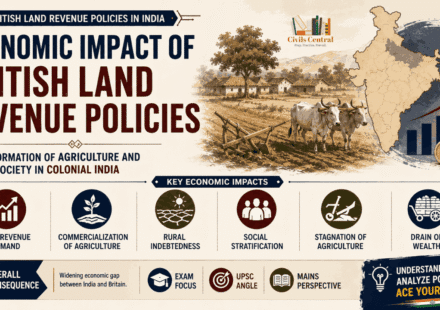
Economic Impact of British Land Revenue Policies: Transformation of Agriculture and Rural Society in Colonial India

British land revenue policies transformed India's agrarian economy by reorganising land rights, strengthening colonial fiscal control, monetising rural obligations and encouraging commercialisation of agriculture. The Permanent, Ryotwari and Mahalwari…
Read More
Mahalwari Settlement: Village-Based Land Revenue System in North India
The Mahalwari Settlement was the third major land revenue system introduced by the British in India. Proposed by Holt Mackenzie in 1822 and implemented extensively by Robert Merttins Bird during the administration of Lord William Bentinck, it was…
Read More
Ryotwari Settlement: Munro’s Land Revenue System in Madras and Bombay
The Ryotwari Settlement was one of the most important land revenue systems introduced by the British in India. Developed through the experiments of Alexander Read and later systematized by Sir Thomas Munro, it was implemented mainly in the Madras and…
Read More
Permanent Settlement (1793): Zamindari System, Features, Objectives, Impact and Legacy
The Permanent Settlement of 1793, introduced by Lord Cornwallis with the assistance of Sir John Shore, was the first comprehensive land revenue system established by the British in India. Implemented in Bengal, Bihar, and parts of Odisha, it permanently…
Read More
Lord Cornwallis (1786–1793): Administrative, Judicial and Revenue Reforms
Lord Cornwallis (1786–1793) is regarded as the Father of the British Civil Service in India because he transformed the East India Company's administration into a professional, centralized, and rule-based bureaucracy. Building upon the constitutional…
Read More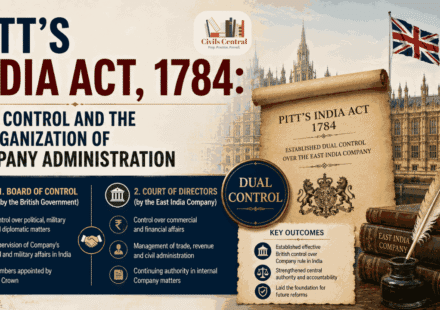
Pitt’s India Act (1784): Dual Control and Parliamentary Supervision over the East India Company
Pitt's India Act (1784) was one of the most significant constitutional reforms in the history of British India. Enacted under the leadership of William Pitt the Younger, the Act transformed the relationship between the British Government and the East…
Read More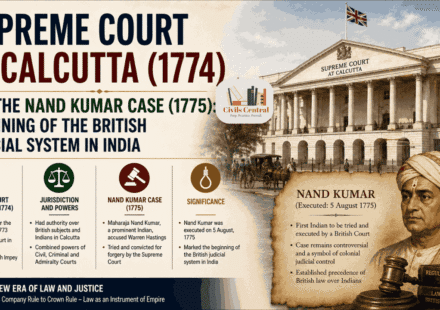
Supreme Court at Calcutta (1774) and the Nand Kumar Case (1775): Beginning of the British Judicial System in India
The Supreme Court at Calcutta (1774) was the first superior court established by the British Crown in India under the Regulating Act of 1773. It introduced an independent judiciary, English common law, and professional judges into British India. However,…
Read More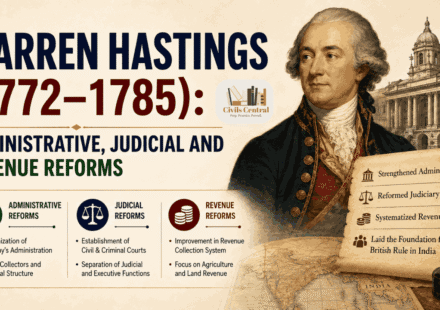
Warren Hastings (1772–1785): Administrative, Judicial and Revenue Reforms
Warren Hastings (1772–1785) was the first Governor-General of Bengal and is widely regarded as the architect of early British administration in India. During his tenure, he abolished the Dual Government, reorganized the revenue system, introduced the…
Read More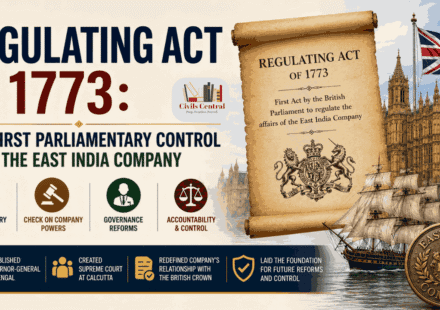
Regulating Act 0f 1773 : The First Parliamentary Control over the East India Company
The Regulating Act 0f 1773 was the first major constitutional measure passed by the British Parliament to regulate the administration of the English East India Company in India. Enacted in response to corruption, administrative failures, the Great Bengal…
Read More
Battle of Buxar (1764): Causes, Course, Consequences and the Establishment of British Supremacy
The Battle of Buxar (22 October 1764) was one of the most decisive events in the history of modern India. Fought between the English East India Company, led by Major Hector Munro, and the combined forces of Mir Qasim, Shuja-ud-Daulah, and Shah Alam II,…
Read More