

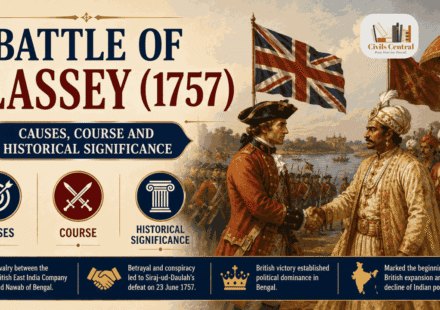
Battle of Plassey (1757): The Beginning of British Political Supremacy in India

The Battle of Plassey (1757) marked the beginning of British political supremacy in India. Explore its causes, major events, conspiracy, military strategy, consequences, historical significance, historiography, and UPSC exam-oriented analysis in this…
Read More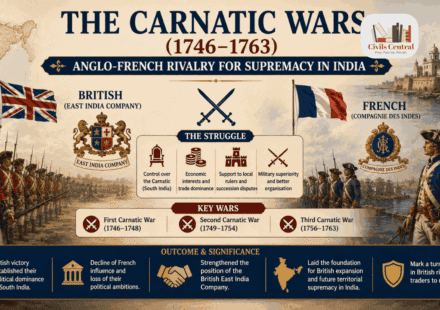
Anglo-French Rivalry in India: The Carnatic Wars (1746–1763): The Struggle for European Supremacy in India
Master the Anglo-French Rivalry in India and the Carnatic Wars (1746–1763) with exam-oriented notes covering the causes, course, and outcomes of the three Carnatic Wars. Learn about the roles of Dupleix, Robert Clive, Joseph François Dupleix, Count de…
Read More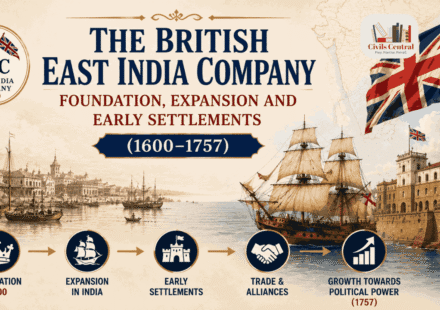
British East India Company: Foundation, Expansion and Early Settlements (1600–1757)
Discover the Foundation, Expansion, and Early Settlements of the British East India Company (1600–1757), from its royal charter by Queen Elizabeth I to the establishment of trading factories at Surat, Madras, Bombay, and Calcutta. Learn how the Company…
Read More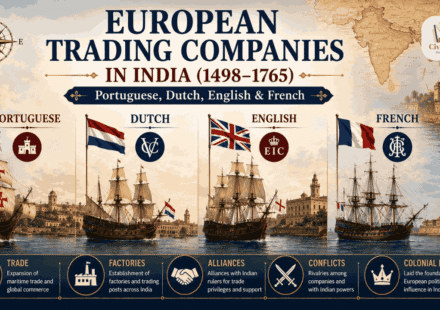
European Trading Companies in India (1498–1765): Portuguese, Dutch, English and French
Learn about the European Trading Companies in India (1498–1765), including the Portuguese, Dutch, English, and French. Understand their arrival, trading activities, settlements, conflicts, and rivalry for supremacy in India, along with the factors that…
Read More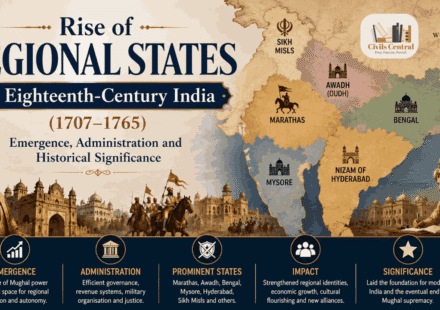
Rise of Regional States in Eighteenth-Century India (1707–1765): Emergence, Administration and Historical Significance
Explore the Rise of Regional States in Eighteenth-Century India (1707–1765) and understand how the decline of the Mughal Empire led to the emergence of powerful regional kingdoms such as Bengal, Awadh, Hyderabad, Mysore, the Marathas, Sikhs, and Jats.…
Read More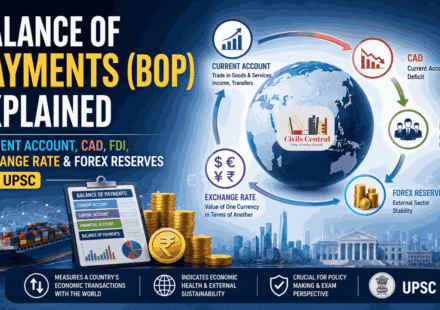
Balance of Payments (BoP) Explained | Current Account, CAD, FDI, Exchange Rate & Forex Reserves for UPSC
Learn the Balance of Payments (BoP) comprehensively for UPSC. Understand the Current Account, Capital and Financial Accounts, CAD, FDI, FPI, exchange rates, forex reserves, the 1991 BoP crisis, RBI's role, and contemporary external sector issues with…
Read More
What is International Relations? Understanding the Discipline That Explains the Modern World
Understand International Relations from first principles with this comprehensive CivilsCentral Knowledge Library chapter. Learn its meaning, evolution, nature, scope, major scholars, key concepts, actors, and UPSC relevance with conceptual clarity…
Read More
The Complete Guide to Preparing International Relations for UPSC & JKAS 2027
International Relations is no longer a subject that can be mastered through isolated current affairs or factual memorization. The examination has steadily evolved from testing information to testing understanding. A news report about a summit is only the…
Read More
Viability Gap Funding (VGF): Meaning, Objectives, PPP Models, Features, Benefits & UPSC Notes
Learn Viability Gap Funding (VGF) in detail with its meaning, objectives, features, PPP models, institutional framework, economic significance, challenges, government initiatives, and UPSC relevance. A comprehensive CivilsCentral guide for UPSC, State…
Read More
Understanding Foreign Capital: Meaning, Need, Evolution and Components
Learn the meaning, need, evolution, and components of foreign capital in India. Explore FDI, FPI, ECBs, NRI investments, benefits, challenges, and UPSC-ready notes.
Read More