
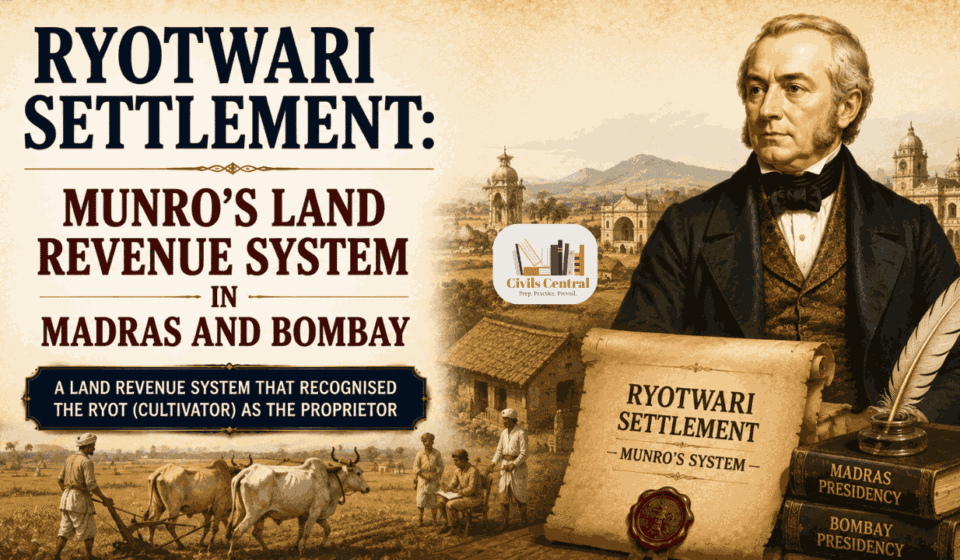

Ryotwari Settlement: Munro’s Land Revenue System in Madras and Bombay:
Learning Dashboard
| Chapter Information | Details |
|---|---|
| Series | Modern History of India (1707–1947) |
| Historical Period | c. 1792–1820 |
| Historical Phase | British Land Revenue Systems |
| Previous Chapter | Permanent Settlement (1793): Zamindari System, Features, Objectives, Impact and Legacy |
| Current Chapter | Ryotwari Settlement: Munro’s Land Revenue System in Madras and Bombay |
| Next Chapter | Mahalwari Settlement: Village-Based Revenue System in North India |
| Core Theme | The Ryotwari Settlement abolished zamindari intermediaries and established a direct relationship between the government and the cultivator (ryot), making the ryot responsible for payment of land revenue. Although intended to protect cultivators and improve administration, it also imposed heavy revenue burdens and periodic reassessments. |
| Major Events Covered | British expansion in South India, Alexander Read’s experiments, Development of the Ryotwari System, Expansion under Sir Thomas Munro |
| Key Personalities | Sir Thomas Munro, Alexander Read, Lord Hastings |
| Key Concepts | Ryotwari Settlement, Ryot, Direct Settlement, Periodic Revenue Assessment, Survey and Measurement, Occupancy Rights |
| Exam Relevance | UPSC CSE, JKPSC, JKAS, State PCS, CDS, CAPF, SSC, UGC-NET (History), University Examinations |
Introduction
Why Did the British Introduce the Ryotwari Settlement?
The Permanent Settlement of 1793 was expected to solve the East India Company’s revenue problems by creating a class of hereditary zamindars who would invest in agriculture, ensure regular payment of land revenue, and support British rule. While the system provided administrative stability in Bengal, Bihar, and parts of Odisha, its practical experience soon revealed several shortcomings. Many zamindars showed little interest in agricultural improvement, absentee landlordism became increasingly common, cultivators were subjected to higher rents, and the government permanently lost the opportunity to increase its share of revenue as agricultural production expanded.
As the East India Company extended its authority into South India following the Anglo-Mysore Wars, British administrators encountered agrarian conditions that differed fundamentally from those of Bengal. In many districts of the Madras Presidency, large hereditary zamindars either did not exist or possessed only limited influence. Instead, cultivation was carried out primarily by individual peasants who traditionally enjoyed hereditary occupancy rights over the land they cultivated. The village economy revolved around these cultivators rather than around powerful landlord families.
These differences compelled the British to reconsider their revenue policy. Instead of creating an artificial class of zamindars, several administrators argued that the government should recognize the cultivator—the ryot—as the principal unit of revenue administration. According to this view, the actual tiller of the soil had the strongest claim over the land and should therefore pay land revenue directly to the government without the intervention of landlords or revenue intermediaries.
The earliest experiments with this approach were conducted by Alexander Read in the 1790s in the newly acquired districts of southern India. His work demonstrated that direct settlements with cultivators were both practical and administratively efficient. These experiments were later expanded and systematically developed by Sir Thomas Munro, whose long experience in South India convinced him that the ryot, rather than the zamindar, represented the true foundation of the agrarian economy.
The resulting system became known as the Ryotwari Settlement. Unlike the Permanent Settlement, it did not recognize zamindars as proprietors and did not permanently fix government revenue. Instead, the government entered into a direct agreement with each cultivator, assessed the quality and productivity of the land through regular surveys, and revised the revenue demand periodically. The ryot received hereditary occupancy rights so long as the assessed revenue was paid, while the government maintained direct control over revenue administration.
The Ryotwari Settlement therefore represented a significant departure from the Bengal model. It reflected the British administration’s growing recognition that India’s agrarian conditions were regionally diverse and that a single land revenue system could not be applied uniformly across the subcontinent. Although the Ryotwari System eliminated zamindari intermediaries and strengthened the direct relationship between the state and the cultivator, it also introduced new challenges in the form of frequent reassessments, high revenue demands, and extensive government intervention in rural life.
For students of Modern Indian History, the Ryotwari Settlement is indispensable because it illustrates the evolution of British agrarian policy after the experience of the Permanent Settlement. Together with the Permanent Settlement and the Mahalwari Settlement, it forms one of the three principal land revenue systems of British India, making it a recurring and highly significant topic in UPSC, JKAS and other competitive examinations.
Part I — Background: Why Did the British Abandon the Zamindari Model in South India?
Why Was the Permanent Settlement Not Extended to the Whole of India?
When the Permanent Settlement of 1793 was introduced in Bengal, Bihar, and parts of Odisha, many British administrators believed that it would become the standard model of land revenue administration throughout India. Lord Cornwallis was convinced that permanently fixing land revenue and creating a class of hereditary zamindars would ensure administrative stability, agricultural prosperity, and political loyalty. Initially, the system appeared successful because it simplified revenue collection and provided the East India Company with a predictable source of income. However, as the British expanded their territorial possessions beyond eastern India, they soon realized that the Bengal model could not be applied uniformly across the Indian subcontinent.
The most important reason for this realization was the enormous diversity of India’s agrarian structure. Different regions possessed different patterns of land ownership, village organization, cultivation, and customary rights. A revenue system that appeared suitable for Bengal was not necessarily appropriate for southern or western India. British administrators therefore began to question whether a single land revenue policy could effectively govern such varied agricultural societies.
British Expansion into South India
The opportunity to formulate a new revenue policy emerged during the Company’s rapid expansion into South India. The Third Anglo-Mysore War (1790–1792) ended with the Treaty of Seringapatam (1792), under which Tipu Sultan ceded extensive territories to the British and their allies. Newly acquired districts such as Baramahal, Salem, Dindigul, and several adjoining regions came under the administration of the East India Company.
These territories required an entirely new administrative framework. Since British authority had only recently been established, officials had the freedom to design a revenue system suited to local conditions rather than merely continuing earlier arrangements. This presented an opportunity to reconsider the assumptions that had guided the Permanent Settlement in Bengal.
Agrarian Conditions in the Madras Presidency
As British officials surveyed the newly acquired territories, they discovered that the agrarian structure differed fundamentally from that of Bengal. In most parts of the Madras Presidency, there were no powerful hereditary zamindars exercising control over vast landed estates. Instead, agriculture was organized around individual cultivators, village communities, and local customary rights that had developed over generations.
The ryot, or cultivator, occupied the central position in the agricultural economy. Many ryot families had cultivated the same fields for generations and enjoyed hereditary occupancy rights that were widely recognized within their villages. Although local chiefs and village headmen exercised influence, they generally did not possess the extensive proprietary rights enjoyed by Bengal’s zamindars after the Permanent Settlement.
These observations convinced several British administrators that the cultivator, rather than an intermediary landlord, formed the true basis of agricultural production in southern India. If the government wished to establish an efficient and equitable revenue system, it would have to recognize this reality.
Lessons Learned from the Permanent Settlement
The British were also beginning to understand the limitations of the Permanent Settlement itself. Although the system had provided administrative stability and created a politically loyal landed class, many of its economic objectives remained unrealized. Instead of investing in agricultural improvement, numerous zamindars preferred to increase rents and maximize their income. The rise of absentee landlordism meant that many estates were managed by agents who were primarily interested in revenue collection rather than agricultural development.
Another serious concern was financial. Because government revenue had been fixed permanently in 1793, the East India Company could not benefit from future increases in agricultural productivity or rising land values. As cultivation expanded and prices increased, the additional income accrued largely to the zamindars instead of the government.
These experiences persuaded many officials that the Bengal model should not automatically be replicated elsewhere. They argued that future revenue systems should be designed according to regional conditions rather than ideological assumptions.
Alexander Read’s Experiments
One of the earliest advocates of a direct settlement with cultivators was Alexander Read, a Company officer who administered the Baramahal district after its acquisition from Mysore. Read spent considerable time studying local patterns of cultivation, village organization, and customary land rights. His investigations convinced him that the ryot was the real cultivator and should therefore be recognized as the principal revenue payer.
Beginning in the 1790s, Read introduced experimental settlements under which each cultivator entered into an individual agreement with the government. Revenue assessments were based upon careful surveys of land, estimates of soil quality, and expected agricultural productivity. Since there were no powerful zamindars controlling extensive estates, the government found it administratively practical to deal directly with individual cultivators.
These experiments proved sufficiently successful to attract the attention of senior British administrators and laid the groundwork for a new system of land revenue administration.
Sir Thomas Munro and the Ryotwari Philosophy
The person most closely associated with the Ryotwari Settlement was Sir Thomas Munro, who served for many years in southern India and later became the Governor of Madras (1820–1827). Munro possessed extensive practical experience in district administration and believed that any successful revenue policy had to reflect local agrarian realities rather than theoretical assumptions imported from Britain.
Munro rejected the idea of creating an artificial class of zamindars in regions where such landlords had never historically existed. He argued that the ryot was the real proprietor of the land, since it was the cultivator who invested labour, maintained agricultural production, and bore the risks associated with farming.
According to Munro, the government should therefore establish a direct relationship with the cultivator, collect revenue without intermediaries, and recognize the ryot’s hereditary right to occupy the land so long as the assessed revenue was paid. Such a system, he believed, would eliminate unnecessary middlemen, reduce opportunities for exploitation, and provide the government with more accurate control over revenue administration.
Munro’s ideas gradually gained official acceptance and ultimately formed the intellectual foundation of the Ryotwari Settlement.
The Emergence of a New Revenue Policy
The development of the Ryotwari Settlement marked a significant turning point in British agrarian administration. Whereas the Permanent Settlement sought to govern rural society through hereditary landlords, the Ryotwari System attempted to establish a direct administrative relationship between the colonial state and the individual cultivator.
This did not mean that the British abandoned their objective of maximizing land revenue. Instead, they adopted a different method of achieving it. The government would now survey land, assess its productive capacity, periodically revise revenue according to changing conditions, and collect taxes directly from the ryot without the intervention of zamindars.
The Ryotwari Settlement therefore represented not merely an alternative revenue system but a broader shift in British administrative thinking. It reflected the growing realization that India’s diverse agrarian landscape required different solutions in different regions and that successful colonial governance depended upon adapting policy to local conditions rather than imposing a single uniform model.
CivilsCentral Historical Insight
The Ryotwari Settlement emerged because British administrators recognized that the agrarian structure of South India differed fundamentally from that of Bengal. The absence of powerful zamindars, the strong customary position of the cultivator, and the shortcomings of the Permanent Settlement encouraged officials such as Alexander Read and Sir Thomas Munro to advocate a direct relationship between the government and the ryot. The Ryotwari System was therefore not merely a replacement for the Zamindari System but an attempt to adapt British revenue administration to the regional realities of southern India.
Part II — Objectives of the Ryotwari Settlement: What Did the British Hope to Achieve?
Why Did the East India Company Introduce the Ryotwari System?
The Ryotwari Settlement was introduced not merely as an alternative to the Permanent Settlement but as a deliberate attempt to create a land revenue system better suited to the agrarian conditions of South India. After studying the social and economic structure of the Madras Presidency, British administrators concluded that the absence of large zamindars made the Bengal model unsuitable. At the same time, the practical experience of the Permanent Settlement had exposed several weaknesses, including absentee landlordism, peasant exploitation, and the permanent loss of future revenue to the government.
Against this background, Alexander Read and Sir Thomas Munro developed a new approach based on a direct relationship between the colonial state and the cultivator. The Ryotwari Settlement was expected to increase government revenue, improve agricultural administration, protect cultivators from intermediaries, and provide greater flexibility in revenue assessment. Although these objectives appeared logical from the perspective of the British administration, their practical implementation produced mixed results.
To Establish a Direct Relationship Between the Government and the Cultivator
The most fundamental objective of the Ryotwari Settlement was to eliminate the role of intermediaries and establish a direct relationship between the government and the ryot. British administrators believed that the cultivator was the actual producer of agricultural wealth and therefore the appropriate person with whom the government should deal.
Under the Permanent Settlement, the government collected revenue through zamindars, who often retained a substantial portion of agricultural income while placing increasing burdens upon the cultivators. Munro argued that if revenue could be collected directly from the ryot, unnecessary intermediaries would disappear, administrative efficiency would improve, and the government would exercise greater control over land revenue administration.
This direct connection between the colonial state and the cultivator became the defining characteristic of the Ryotwari System.
To Eliminate Zamindari Intermediaries
Another important objective was the abolition of the zamindari system in regions where it did not traditionally exist. British officials believed that creating artificial landlords in southern India would unnecessarily complicate revenue administration and encourage exploitation similar to that observed in Bengal.
By dealing directly with cultivators, the government hoped to prevent the emergence of a powerful intermediary class capable of extracting excessive rents from peasants. The Ryotwari Settlement therefore sought to ensure that the benefits of agricultural production would not be diverted through landlords before reaching the state.
This objective also reflected the practical realities of South India, where village society revolved around individual cultivators rather than hereditary zamindars.
To Maximize Government Revenue
Although the Ryotwari Settlement was often presented as a system designed to protect cultivators, one of its principal objectives remained the maximization of government revenue. The East India Company depended heavily upon land revenue to finance its expanding administration, maintain its army, and conduct military campaigns across the Indian subcontinent.
Unlike the Permanent Settlement, where government revenue remained permanently fixed, the Ryotwari System allowed the administration to revise assessments periodically. As agricultural productivity increased or land values changed, the government could reassess the land and increase its revenue demand accordingly.
This flexibility ensured that the colonial state, rather than intermediaries, benefited from future agricultural growth.
To Introduce Scientific Revenue Assessment
British administrators also sought to make land revenue assessment more systematic and scientific. Earlier revenue arrangements often depended upon rough estimates, negotiations, or customary practices. Under the Ryotwari System, officials proposed that each field should be carefully surveyed, measured, and classified according to factors such as soil quality, irrigation facilities, and expected productivity.
Revenue assessments would therefore be based upon detailed administrative surveys rather than arbitrary calculations.
This reflected the growing British emphasis on statistical information, measurement, and bureaucratic record-keeping. Accurate land surveys were expected to improve administrative efficiency while enabling the government to determine a more rational revenue demand.
To Encourage Agricultural Improvement
Like the architects of the Permanent Settlement, the supporters of the Ryotwari System also hoped to promote agricultural development. However, their reasoning differed significantly.
Instead of relying upon zamindars to invest in agriculture, the Ryotwari Settlement expected the cultivator himself to improve the land. Since the ryot dealt directly with the government and enjoyed hereditary occupancy rights as long as revenue was paid, British administrators believed that cultivators would feel more secure and therefore invest in irrigation, better farming methods, and expansion of cultivation.
The government assumed that eliminating intermediaries would allow cultivators to retain a greater share of agricultural income, thereby encouraging long-term investment in agriculture.
To Adapt Revenue Administration to Regional Conditions
The Ryotwari Settlement also reflected an important change in British administrative thinking. The experience of Bengal had demonstrated that a single revenue system could not be applied uniformly throughout India. Different regions possessed different historical traditions, patterns of landholding, and village institutions.
By introducing the Ryotwari System in the Madras Presidency and later extending it to parts of the Bombay Presidency, the British acknowledged that revenue policy should be adapted to regional agrarian conditions rather than imposed according to a uniform model.
This marked a significant departure from earlier assumptions and demonstrated a more pragmatic approach to colonial administration.
To Strengthen Administrative Control
Finally, the Ryotwari Settlement enabled the colonial government to exercise much closer supervision over rural administration. Since officials dealt directly with cultivators, they maintained detailed records regarding land ownership, cultivation, soil quality, crop patterns, and revenue payments.
These records strengthened the government’s administrative capacity and provided valuable information for future revenue revisions. The settlement therefore enhanced not only revenue collection but also the broader ability of the colonial state to monitor and regulate rural society.
This emphasis on direct administrative control became one of the distinguishing features of nineteenth-century British governance in India.
CivilsCentral Historical Insight
The Ryotwari Settlement was designed to achieve multiple objectives simultaneously: eliminate zamindari intermediaries, establish a direct relationship between the government and the cultivator, maximize state revenue through periodic reassessment, promote scientific land surveys, encourage agricultural improvement, and adapt revenue administration to the regional realities of South India. Unlike the Permanent Settlement, which relied upon hereditary landlords, the Ryotwari System placed the individual cultivator at the centre of colonial revenue administration while significantly expanding the government’s direct control over the rural economy.
Part III — Features of the Ryotwari Settlement: What Were the Main Characteristics of the Ryotwari System?
How Did the Ryotwari Settlement Function in Practice?
After years of experimentation under Alexander Read and further refinement by Sir Thomas Munro, the Ryotwari Settlement emerged as the principal land revenue system in the Madras Presidency and was later extended to large parts of the Bombay Presidency. Unlike the Permanent Settlement, which recognized zamindars as hereditary proprietors, the Ryotwari System established a direct relationship between the government and the individual cultivator (ryot).
The system represented a major departure from the Bengal model. It eliminated intermediary landlords, introduced detailed land surveys, allowed periodic revision of revenue, and recognized the cultivator’s right to occupy the land so long as the assessed revenue was regularly paid. These features made the Ryotwari Settlement one of the most distinctive revenue systems introduced during British rule.
Direct Settlement with the Cultivator
The defining feature of the Ryotwari Settlement was that the government entered into a direct agreement with each individual cultivator. Instead of negotiating with zamindars or village chiefs, revenue officials assessed every ryot separately and fixed the amount of land revenue payable by him.
Each cultivator became personally responsible for paying revenue directly to the East India Company. There was no intermediary standing between the government and the producer of agricultural wealth. This direct relationship gave the colonial administration much greater control over revenue collection while also reducing the influence of landlords in rural administration.
For British officials such as Sir Thomas Munro, this arrangement reflected the belief that the cultivator was the true basis of the agrarian economy and therefore the proper person with whom the government should deal.
Recognition of the Ryot’s Occupancy Rights
Although the British Government claimed ultimate ownership of the land, the Ryotwari Settlement recognized the cultivator’s hereditary right to occupy and cultivate the land, provided that the assessed revenue was regularly paid. This was an important difference from the Permanent Settlement. Under the Zamindari System, proprietary rights were vested in the zamindars, whereas under the Ryotwari System the cultivator himself enjoyed legal recognition as the permanent occupant of his holding.
The ryot could generally continue cultivating the land from generation to generation and, subject to government regulations, could transfer or inherit his occupancy rights. However, these rights remained conditional upon the regular payment of land revenue. Failure to pay the assessed amount could result in the loss of the holding.
Thus, while the Ryotwari Settlement strengthened the legal position of cultivators compared to the Permanent Settlement, it did not grant them absolute ownership independent of the state.
Periodic Revision of Land Revenue
One of the most significant features distinguishing the Ryotwari Settlement from the Permanent Settlement was the periodic revision of revenue assessments. Under the Permanent Settlement, the government’s demand had been fixed forever in 1793. In contrast, the Ryotwari System allowed the administration to reassess land revenue at regular intervals, generally after 20 to 30 years, although the exact period varied in different regions.
These periodic revisions enabled the government to revise its revenue demand according to changes in:
- Agricultural productivity.
- Soil conditions.
- Irrigation facilities.
- Market prices.
- Expansion of cultivated land.
From the perspective of the colonial administration, this flexibility prevented the financial losses experienced under the Permanent Settlement, where government revenue remained permanently unchanged despite agricultural growth.
Scientific Survey and Measurement of Land
The Ryotwari Settlement placed great emphasis on systematic land surveys and scientific measurement. Before fixing revenue, British officials conducted detailed examinations of agricultural land. Fields were measured, boundaries were recorded, soil quality was classified, and estimates were made regarding the productive capacity of each plot.
Revenue assessment was therefore based upon factors such as:
- Size of the holding.
- Fertility of the soil.
- Availability of irrigation.
- Type of crops cultivated.
- Estimated agricultural yield.
These surveys reflected the British belief that efficient administration required accurate statistical information and detailed official records. They also marked an important advance in colonial bureaucratic administration by introducing standardized methods of land measurement and documentation.
Absence of Zamindari Intermediaries
Another fundamental characteristic of the Ryotwari Settlement was the elimination of zamindari intermediaries. Since the government dealt directly with each cultivator, there was no legally recognized class of hereditary landlords responsible for collecting revenue. This significantly altered the structure of rural administration. The British believed that eliminating intermediaries would reduce opportunities for exploitation and ensure that a larger share of agricultural income reached the government instead of passing through landlords.
Although local village officials continued to assist in administrative work, they did not enjoy the extensive proprietary rights granted to zamindars under the Permanent Settlement.
This feature represented one of the most important distinctions between the Ryotwari and Zamindari systems.
Individual Responsibility for Revenue Payment
Under the Ryotwari Settlement, each cultivator was individually responsible for paying the assessed revenue. The liability rested with the individual ryot rather than with a landlord or an entire village community. If a cultivator failed to pay the revenue, the government could recover its dues directly from him, and in some cases his occupancy rights could be forfeited.
This principle strengthened the direct financial relationship between the colonial state and the cultivator. At the same time, it also exposed individual peasants to considerable pressure during years of poor harvests, droughts, or crop failures because the responsibility for payment rested entirely upon them.
Extensive Government Control over Land Administration
The Ryotwari Settlement greatly expanded the role of the colonial government in rural administration. Since officials dealt directly with cultivators, they maintained comprehensive records concerning landholdings, ownership, cultivation, productivity, and revenue payments. This enabled the administration to monitor agricultural activity more closely than under the Permanent Settlement. Revenue officials regularly inspected fields, updated land records, and supervised the collection of taxes.
Consequently, the Ryotwari System strengthened the bureaucratic capacity of the colonial state while increasing its direct involvement in the everyday economic life of rural society.
Administrative Character of the Ryotwari System
The Ryotwari Settlement combined two important principles. On the one hand, it recognized the cultivator’s central role in agriculture by eliminating intermediary landlords and establishing a direct relationship with the government. On the other hand, it significantly increased government authority through periodic reassessment, detailed land surveys, and continuous administrative supervision.
Thus, although the system appeared more favourable to cultivators than the Permanent Settlement, it also subjected them to a far greater degree of direct governmental control.
The Ryotwari Settlement therefore represented a distinctive blend of individual occupancy rights and centralized colonial administration, making it one of the defining features of British agrarian policy in southern and western India.
CivilsCentral Historical Insight
The Ryotwari Settlement differed fundamentally from the Permanent Settlement in both philosophy and administration. Instead of recognizing zamindars as hereditary landowners, it established a direct relationship between the government and the cultivator, introduced scientific land surveys, permitted periodic revision of revenue, and eliminated intermediary landlords. While these features strengthened the position of the ryot in comparison with the Zamindari System, they also expanded the direct authority of the colonial state over agriculture, making the government both the principal revenue collector and the dominant force in rural administration.
Part IV — Role and Position of the Ryot Under the Ryotwari Settlement: Did the Cultivator Become the Real Landowner?
Did the Ryotwari Settlement Improve the Position of the Cultivator?
The Ryotwari Settlement is often regarded as a significant departure from the Permanent Settlement because it placed the cultivator (ryot) at the centre of the revenue system. Under the Zamindari System, the British administration dealt primarily with zamindars, while cultivators remained tenants with little legal protection. The Ryotwari System attempted to reverse this arrangement by eliminating intermediary landlords and establishing a direct relationship between the government and the ryot.
At first sight, this appeared to be a major improvement in the condition of cultivators. The ryot was recognized by the government as the person responsible for paying land revenue, and his occupancy rights received official recognition. However, the actual position of the cultivator remained more complex than it appeared. Although the Ryotwari Settlement removed the zamindar from the revenue process, it also brought the cultivator into direct contact with a powerful colonial state that imposed strict revenue demands and exercised extensive administrative control over rural life.
Thus, while the Ryotwari Settlement improved the legal status of the ryot in certain respects, it also created new challenges that continued to affect the rural economy throughout the nineteenth century.
The Ryot Became the Direct Revenue Payer
The most important change introduced by the Ryotwari Settlement was that the government dealt directly with the cultivator. Every ryot entered into an individual agreement with the colonial administration and became personally responsible for paying land revenue.
This arrangement eliminated the role of hereditary zamindars as revenue intermediaries. The cultivator no longer had to pay rent to a landlord who then paid revenue to the government. Instead, the revenue relationship existed directly between the ryot and the East India Company.
From the British perspective, this system was considered more transparent and efficient because it reduced the number of intermediaries involved in revenue collection. It also enabled government officials to maintain closer contact with rural society and supervise cultivation more effectively.
Recognition of Occupancy Rights
An important feature of the Ryotwari Settlement was the recognition of the ryot’s hereditary right to occupy the land. As long as the cultivator paid the assessed revenue, he could continue cultivating the same holding year after year. His occupancy rights could also be transferred to his heirs, giving the family a degree of continuity that had not been formally recognized under many earlier British revenue arrangements.
This recognition provided cultivators with greater legal security than that enjoyed by tenants under the Permanent Settlement. Since there was no zamindar possessing proprietary rights over the land, the ryot occupied a more prominent position in the agrarian system.
However, these rights were not unconditional. They depended entirely upon the regular payment of land revenue. Failure to meet the government’s demand could result in the loss of occupancy rights and the transfer of the holding to another cultivator. Thus, the ryot’s security remained closely tied to his financial ability to satisfy the colonial administration.
Freedom to Cultivate and Transfer Holdings
The Ryotwari Settlement granted cultivators greater freedom in managing their agricultural holdings. Subject to government regulations, ryots could generally choose the crops they wished to cultivate and could transfer, mortgage, or inherit their occupancy rights.
This flexibility distinguished the Ryotwari System from arrangements in which landlords exercised extensive control over tenants. The British believed that such freedom would encourage cultivators to improve their land and increase agricultural productivity because they would directly benefit from the fruits of their labour.
In theory, the Ryotwari Settlement therefore promoted individual initiative and personal responsibility in agriculture. The cultivator enjoyed greater autonomy than under the Zamindari System, although this autonomy continued to operate within the limits imposed by colonial revenue administration.
Heavy Burden of Land Revenue
Despite these advantages, the Ryotwari Settlement placed a considerable financial burden upon the cultivator. Since the government collected revenue directly from each ryot, the cultivator bore the full responsibility for meeting the assessed demand regardless of fluctuations in agricultural conditions.
In years of poor rainfall, crop failure, floods, or drought, many cultivators found it extremely difficult to pay revenue on time. Unlike traditional village arrangements where risks were often shared within the community, the Ryotwari System emphasized individual responsibility.
Revenue officials generally expected payment according to the official assessment rather than the cultivator’s actual financial condition. Consequently, many ryots experienced severe economic pressure during unfavourable agricultural seasons.
Periodic Reassessment and Uncertainty
Another challenge faced by cultivators was the system of periodic revenue reassessment. Unlike the Permanent Settlement, where government revenue remained fixed forever, the Ryotwari Settlement allowed officials to revise assessments after regular intervals.
Although periodic revision enabled the government to adjust revenue according to changing agricultural conditions, it also created uncertainty for cultivators. A ryot who improved his land, expanded cultivation, or increased productivity could subsequently face a higher revenue assessment during the next survey.
This reduced the long-term certainty that many cultivators desired. While the Permanent Settlement permanently fixed government revenue, the Ryotwari System permanently retained the government’s authority to revise its financial demand.
Growth of Rural Indebtedness
The heavy revenue burden imposed under the Ryotwari Settlement frequently compelled cultivators to borrow money from moneylenders, traders, and wealthy landlords. Agricultural income depended heavily upon the monsoon, and poor harvests often left peasants without sufficient resources to meet government demands.
To avoid losing their occupancy rights, many ryots borrowed at high rates of interest. Over time, these debts accumulated, creating a cycle of rural indebtedness that became a persistent feature of the agrarian economy in the Madras and Bombay Presidencies.
Although the Ryotwari Settlement had eliminated zamindari intermediaries, it could not prevent the increasing influence of rural moneylenders, who gradually became important economic actors in village society.
A Better Position Than Under the Permanent Settlement?
Compared with cultivators living under the Permanent Settlement, the ryots under the Ryotwari System undoubtedly occupied a stronger legal position. They dealt directly with the government, possessed recognized occupancy rights, and were not subject to arbitrary rent increases imposed by hereditary landlords.
However, this improvement should not be exaggerated. The cultivator remained subject to a demanding colonial revenue system that emphasized regular payment, detailed administrative supervision, and periodic reassessment. The absence of zamindars reduced one source of exploitation, but the direct authority of the colonial state created another.
Consequently, historians often describe the Ryotwari Settlement as a system that strengthened the legal position of the cultivator while simultaneously increasing the fiscal power of the colonial government.
CivilsCentral Historical Insight
The Ryotwari Settlement replaced the zamindar with the colonial state as the cultivator’s principal authority. The ryot gained recognized occupancy rights and dealt directly with the government, making his legal position stronger than under the Permanent Settlement. However, these advantages were accompanied by heavy revenue demands, periodic reassessment, and increasing rural indebtedness. Thus, the Ryotwari System improved the cultivator’s status but did not free him from economic hardship, as the burden of land revenue now rested directly upon his shoulders.
Part V — Impact of the Ryotwari Settlement on Agriculture and Rural Society: Did the New System Benefit the Cultivators?
What Were the Consequences of the Ryotwari Settlement?
When the Ryotwari Settlement was introduced, British administrators believed that eliminating zamindars and dealing directly with cultivators would create a more efficient and equitable agrarian system. They expected that ryots, enjoying recognized occupancy rights and freedom from intermediary landlords, would invest in agriculture, increase production, and improve the rural economy. At the same time, the government hoped that periodic revision of revenue would ensure a fair assessment while allowing the colonial state to benefit from agricultural expansion.
In practice, however, the consequences of the Ryotwari Settlement were mixed. Although it strengthened the legal position of cultivators compared with the Permanent Settlement, it also imposed heavy financial obligations and subjected rural society to extensive governmental supervision. The system produced both positive and negative effects that continued to influence agriculture in southern and western India throughout the nineteenth century.
Elimination of Zamindari Exploitation
One of the most important achievements of the Ryotwari Settlement was the removal of zamindari intermediaries from the revenue administration. Since the government dealt directly with the cultivator, the ryot no longer had to pay rent to a hereditary landlord who could arbitrarily increase demands or employ intermediaries to collect revenue.
This change reduced one of the major sources of exploitation that had developed under the Permanent Settlement. The cultivator retained a larger share of agricultural income because there was no landlord claiming rent in addition to the government’s revenue demand. In many parts of the Madras and Bombay Presidencies, this direct relationship was welcomed because it reflected traditional patterns of landholding more closely than the zamindari model.
However, the disappearance of the zamindar did not necessarily mean the disappearance of economic hardship. The burden simply shifted from the landlord to the colonial administration.
Increased Government Control Over Rural Life
The Ryotwari Settlement significantly expanded the role of the colonial state in village administration. Revenue officials regularly surveyed fields, classified soils, recorded cultivation, and maintained detailed land registers. Since the government dealt directly with individual cultivators, it acquired far greater knowledge of agricultural conditions than had been possible under the Permanent Settlement.
This extensive administrative machinery strengthened the capacity of the colonial state to regulate rural society. Every cultivator became part of an elaborate bureaucratic system that monitored landholdings, crop patterns, and revenue payments. While this improved administrative efficiency, it also increased official intervention in the daily lives of cultivators, making the government a constant presence in the rural economy.
Heavy Revenue Burden on Cultivators
Despite the absence of zamindars, the land revenue demand remained extremely high. British officials frequently assessed revenue on optimistic estimates of agricultural productivity, expecting cultivators to pay a substantial proportion of the value of their produce. In many cases, the assessment did not adequately reflect local variations in rainfall, soil fertility, or crop failures.
During years of poor harvests, cultivators found it extremely difficult to meet these obligations. Since the government expected regular payment irrespective of seasonal fluctuations, many ryots experienced severe financial pressure. The burden of taxation often consumed a large share of agricultural income, leaving limited resources for investment, savings, or household needs.
Consequently, although the Ryotwari Settlement eliminated landlord exploitation, it exposed cultivators to the direct fiscal demands of the colonial state.
Growth of Rural Indebtedness
The heavy and inflexible revenue demands contributed significantly to the growth of rural indebtedness. Whenever agricultural production declined because of drought, floods, pests, or other natural causes, cultivators still had to pay the assessed revenue. Unable to meet these obligations from their current income, many ryots borrowed money from local moneylenders.
These loans often carried high rates of interest. Over time, repeated borrowing led many cultivators into chronic indebtedness. Some were compelled to mortgage portions of their holdings, while others lost control over their land because they could not repay accumulated debts.
As a result, although the Ryotwari Settlement removed hereditary zamindars from the revenue system, it inadvertently increased the influence of rural moneylenders, who gradually became one of the most powerful economic groups in many villages.
Limited Agricultural Improvement
British administrators expected that cultivators, enjoying greater security than under the Zamindari System, would invest in improving agriculture. In reality, such investment remained limited. The primary reason was that heavy revenue assessments left cultivators with little surplus income for irrigation, better seeds, improved tools, or land reclamation.
Furthermore, the possibility of periodic revenue reassessment reduced the incentive to invest. Many ryots feared that if agricultural productivity increased substantially, future surveys would result in higher revenue demands. Consequently, improvements made by cultivators could ultimately lead to greater taxation rather than lasting economic benefit.
Thus, one of the principal objectives of the Ryotwari Settlement—stimulating agricultural modernization—was only partially achieved.
Greater Administrative Flexibility
From the perspective of the colonial administration, the Ryotwari Settlement offered an important advantage over the Permanent Settlement because it allowed periodic revision of revenue assessments. As agricultural production expanded or market conditions changed, the government could revise its revenue demand and increase public income accordingly.
This flexibility prevented the financial difficulties experienced under the Permanent Settlement, where government revenue remained permanently fixed despite rising agricultural prosperity. The Ryotwari System therefore provided the colonial state with a more dynamic and adaptable source of revenue, enabling it to benefit directly from economic growth.
For this reason, many British administrators considered the Ryotwari Settlement financially superior to the Zamindari System.
Social Consequences
The Ryotwari Settlement also influenced the broader structure of rural society. Since cultivators dealt directly with the government, village administration became more closely integrated with the colonial bureaucracy. Traditional intermediaries lost much of their earlier importance, while government officials assumed greater responsibility for maintaining land records and supervising revenue collection.
At the same time, increasing indebtedness and periodic reassessment created new forms of economic insecurity. Wealthier cultivators often expanded their holdings by purchasing land from indebted neighbours, while poorer peasants became increasingly dependent upon moneylenders and creditors. Consequently, although the Ryotwari System reduced the dominance of hereditary landlords, it did not eliminate social inequality within the rural economy.
Historical Assessment
The Ryotwari Settlement represented a genuine attempt to adapt British revenue policy to the agrarian conditions of southern India. By recognizing the cultivator’s occupancy rights and eliminating zamindari intermediaries, it undoubtedly improved certain aspects of the revenue system when compared with the Permanent Settlement.
However, the benefits of direct settlement were offset by high revenue assessments, periodic reassessment, extensive bureaucratic control, and widespread rural indebtedness. Instead of creating a prosperous class of independent cultivators, the system often produced peasants who remained economically vulnerable despite their improved legal status.
Most historians therefore conclude that the Ryotwari Settlement succeeded administratively but only partially fulfilled its social and economic objectives. It strengthened the government’s control over land revenue while improving the cultivator’s legal position, yet it failed to remove the deeper structural problems affecting rural poverty and agricultural development.
CivilsCentral Historical Insight
The Ryotwari Settlement replaced landlord domination with direct governmental control. It strengthened the cultivator’s legal position by eliminating zamindari intermediaries and recognizing occupancy rights, but heavy revenue assessments, periodic reassessment, and growing indebtedness prevented many ryots from achieving genuine economic security. The system therefore illustrates an important paradox of British agrarian policy: while administrative efficiency improved, the financial burdens on the cultivator remained substantial, ensuring that rural hardship continued under a different institutional framework.
Part VI — Advantages and Limitations of the Ryotwari Settlement: Was It More Successful Than the Permanent Settlement?
How Should the Ryotwari Settlement Be Evaluated?
The Ryotwari Settlement represented one of the most significant experiments in British land revenue administration. Introduced primarily in the Madras and Bombay Presidencies, it differed fundamentally from the Permanent Settlement by eliminating zamindari intermediaries and establishing a direct relationship between the government and the cultivator. British administrators, especially Sir Thomas Munro, believed that this system was better suited to the agrarian conditions of South India and would produce greater administrative efficiency while protecting the interests of the ryots.
Yet, like every major colonial policy, the Ryotwari Settlement produced a combination of successes and failures. It improved certain aspects of land administration and strengthened the legal position of cultivators, but it also imposed heavy financial burdens that limited its overall effectiveness. A balanced evaluation therefore requires examining both its advantages and its shortcomings.
Advantages of the Ryotwari Settlement
Direct Relationship Between the Government and the Cultivator
The greatest strength of the Ryotwari Settlement was the establishment of a direct relationship between the government and the ryot. Unlike the Permanent Settlement, where the government dealt with zamindars, the Ryotwari System recognized the cultivator as the principal unit of revenue administration.
This direct arrangement eliminated intermediary landlords and enabled the government to collect revenue without depending upon a separate landed class. For the cultivator, it meant that he no longer had to pay rent to a zamindar in addition to the government’s revenue demand. Although the state remained the ultimate authority, the ryot occupied a more important legal position within the agrarian system.
Recognition of the Cultivator’s Occupancy Rights
Another important achievement of the Ryotwari Settlement was the recognition of the cultivator’s occupancy rights. The ryot was permitted to continue cultivating his holding as long as he paid the assessed land revenue. These rights could generally be inherited by his descendants, providing greater continuity and legal security than was available under the Zamindari System.
This recognition strengthened the cultivator’s connection with the land and reduced the risk of arbitrary eviction by landlords. It reflected Sir Thomas Munro’s belief that the actual tiller of the soil deserved official recognition within the revenue system.
Elimination of Zamindari Intermediaries
The Ryotwari Settlement abolished the class of hereditary zamindars that had dominated revenue administration under the Permanent Settlement. By removing these intermediaries, the government hoped to reduce opportunities for exploitation and ensure that a larger share of agricultural income reached the cultivator instead of passing through landlords.
Although other forms of economic inequality continued to exist, the elimination of zamindari rent collection represented a significant structural change. It also prevented the emergence of absentee landlordism on the scale witnessed in Bengal.
Flexibility in Revenue Administration
Unlike the Permanent Settlement, the Ryotwari System allowed the government to revise revenue assessments periodically. This flexibility enabled the administration to respond to changes in agricultural productivity, expansion of cultivated land, improvements in irrigation, and fluctuations in market prices.
From the government’s perspective, this was a major advantage because it prevented the financial losses experienced under the Permanent Settlement, where revenue had been permanently fixed in 1793. The Ryotwari Settlement therefore provided a more adaptable and financially sustainable system of revenue administration.
Better Land Records and Surveys
The Ryotwari Settlement encouraged the development of systematic land surveys and accurate revenue records. Government officials carefully measured fields, classified soils, recorded ownership, and maintained detailed administrative registers.
These records improved the efficiency of colonial administration and provided valuable information for future assessments. They also laid the foundation for modern systems of land documentation that continued to influence revenue administration long after the colonial period.
Limitations of the Ryotwari Settlement
High Land Revenue Demands
Despite its administrative strengths, the Ryotwari Settlement imposed very high revenue assessments upon cultivators. British officials often calculated revenue according to the estimated productive capacity of the land rather than the cultivator’s actual income in a particular year. During periods of drought, floods, or crop failure, many ryots found it difficult to pay the assessed amount. Since revenue remained payable even during adverse agricultural conditions, cultivators frequently experienced severe financial hardship.
The heavy revenue burden therefore became one of the most persistent criticisms of the Ryotwari System.
Periodic Reassessment Created Uncertainty
The flexibility that benefited the government often created uncertainty for the cultivator. Because revenue assessments were revised periodically, ryots could never be certain that future demands would remain unchanged. If a cultivator invested in irrigation, improved cultivation, or increased agricultural productivity, the government could subsequently raise the revenue assessment during the next survey. This possibility reduced the incentive for long-term investment because improvements often resulted in higher taxation rather than lasting economic gain.
Thus, the very feature that strengthened government finances weakened the cultivator’s economic security.
Growth of Rural Indebtedness
The combination of high revenue demands and uncertain agricultural conditions forced many cultivators to borrow money from moneylenders. Since government revenue had to be paid regardless of crop failure, borrowing became the only means by which many ryots could avoid losing their holdings.
Over time, accumulated debts placed cultivators in increasingly difficult financial situations. High interest rates, repeated borrowing, and inability to repay loans resulted in chronic indebtedness, which became one of the defining characteristics of rural society under the Ryotwari System.
Consequently, although zamindari intermediaries disappeared, moneylenders gradually emerged as powerful economic actors within village life.
Extensive Government Interference
The Ryotwari Settlement also expanded the direct role of the colonial state in agriculture. Revenue officials regularly inspected fields, conducted surveys, assessed crops, and supervised revenue collection. While this increased administrative efficiency, it also subjected cultivators to continuous governmental supervision.
Many historians argue that the Ryotwari System replaced landlord control with bureaucratic control. Instead of dealing with a zamindar, the cultivator now dealt directly with an elaborate colonial administration whose primary objective remained the collection of land revenue.
Limited Agricultural Transformation
The British hoped that recognizing the cultivator’s occupancy rights would stimulate agricultural investment and modernization. However, heavy taxation and periodic reassessment left many ryots with insufficient resources to improve irrigation, purchase better equipment, or adopt new farming methods.
As a result, agricultural productivity increased only gradually. The Ryotwari Settlement succeeded in improving administrative organization but failed to produce the broad agricultural transformation envisioned by its architects.
Balanced Historical Evaluation
The Ryotwari Settlement represented a considerable improvement over the Permanent Settlement in several respects. It eliminated zamindari intermediaries, recognized the cultivator’s occupancy rights, established direct government-cultivator relations, and introduced more systematic land surveys and revenue administration.
At the same time, its limitations were equally significant. Heavy revenue assessments, periodic reassessment, rural indebtedness, and extensive government control continued to burden cultivators. The system therefore protected the ryot more effectively than the Zamindari System but did not free him from the financial pressures of colonial taxation.
Most historians therefore regard the Ryotwari Settlement as administratively superior to the Permanent Settlement but economically imperfect. It represented an important attempt to adapt British revenue policy to regional conditions, yet its primary objective remained the efficient collection of revenue rather than the long-term welfare of the cultivators.
CivilsCentral Historical Insight
The Ryotwari Settlement corrected several weaknesses of the Permanent Settlement by eliminating zamindars, recognizing the cultivator’s occupancy rights, and introducing scientific land surveys. Nevertheless, it retained the colonial state’s overriding concern with maximizing land revenue. High assessments, periodic reassessment, and growing indebtedness meant that although the ryot enjoyed a stronger legal position than under the Zamindari System, genuine economic security remained elusive. The Ryotwari Settlement was therefore a more rational administrative system, but not necessarily a more humane agrarian system.
Part VII — Historiography of the Ryotwari Settlement: How Have Historians Interpreted Munro’s Land Revenue System?
Why Does the Ryotwari Settlement Occupy an Important Place in Colonial Agrarian History?
The Ryotwari Settlement has attracted considerable attention from historians because it represented a major departure from the Permanent Settlement introduced in Bengal. By eliminating zamindari intermediaries and establishing a direct relationship between the government and the cultivator, the British claimed that they had created a more equitable and efficient system of land revenue administration.
However, historians have differed sharply in their assessment of whether the Ryotwari Settlement genuinely benefited cultivators or simply introduced a different mechanism for extracting revenue. Some scholars have praised it as a progressive reform that recognized the rights of the actual tiller of the soil, while others have argued that it merely replaced landlord domination with direct bureaucratic control. The historiography of the Ryotwari Settlement therefore reflects wider debates about the nature of British colonial rule, agrarian change, and economic exploitation in India.
Imperial Historiography: A Progressive and Scientific Revenue System
Early Imperial historians regarded the Ryotwari Settlement as one of the most enlightened achievements of British administration. They argued that the system was carefully designed after studying the agrarian conditions of South India and was therefore better suited to local circumstances than the Permanent Settlement.
According to this interpretation, Sir Thomas Munro recognized that the cultivator, rather than the zamindar, formed the real foundation of agricultural production. By dealing directly with the ryot, the government eliminated unnecessary intermediaries, reduced opportunities for exploitation, and established a more rational revenue system.
Imperial historians also praised the emphasis on detailed land surveys, scientific measurement, and systematic record-keeping. They believed that these administrative innovations introduced greater efficiency, accuracy, and fairness into land revenue administration. In their view, the Ryotwari Settlement represented an example of Britain’s effort to modernize India’s agrarian economy through better governance rather than through arbitrary taxation.
Nationalist Historiography: Direct Rule, Not Direct Justice
Nationalist historians accepted that the Ryotwari Settlement differed from the Permanent Settlement but questioned the motives behind its introduction. They argued that although zamindari intermediaries were removed, the primary objective of the British remained the same—to maximize land revenue and strengthen colonial control over the countryside.
According to this perspective, the direct relationship between the government and the cultivator did not necessarily benefit the ryot. Instead, it enabled the colonial administration to supervise villages more closely, conduct regular reassessments, and collect revenue more efficiently. The cultivator was protected from landlords but became directly dependent upon a powerful colonial bureaucracy.
Nationalist scholars also pointed out that high revenue assessments and periodic revisions often left cultivators in severe financial distress. During years of crop failure or drought, the government’s insistence on revenue collection forced many peasants into debt. Consequently, they argued that the Ryotwari Settlement changed the method of revenue collection without fundamentally altering the exploitative character of colonial rule.
Marxist Interpretation: Colonial Extraction Through Direct State Control
Marxist historians interpret the Ryotwari Settlement primarily as an instrument of colonial economic exploitation. In their view, the removal of zamindars did not signify a reduction in exploitation but merely changed the agency through which surplus was extracted.
Under the Permanent Settlement, landlords served as intermediaries between the cultivator and the colonial state. Under the Ryotwari Settlement, the state itself assumed this role. The government became both the revenue collector and the regulator of rural society, using land surveys, administrative records, and periodic reassessment to maximize its financial returns.
Marxist scholars argue that heavy revenue demands left cultivators with little surplus for investment or consumption. This contributed to chronic indebtedness, dependence upon moneylenders, and increasing rural poverty. From this perspective, the Ryotwari Settlement represented a more centralized and efficient mechanism of colonial extraction rather than a genuine reform designed to improve peasant welfare.
Revisionist Historiography: A Pragmatic Response to Regional Conditions
More recent Revisionist historians have adopted a more balanced interpretation. They emphasize that the Ryotwari Settlement should be understood within the specific agrarian context of South India rather than judged solely in comparison with the Permanent Settlement.
These historians argue that Sir Thomas Munro did not simply impose an abstract administrative theory. Instead, he carefully studied existing village institutions and recognized that powerful hereditary zamindars were largely absent from the Madras Presidency. The decision to deal directly with cultivators therefore reflected local realities rather than ideological preference alone.
Revisionist scholars also point out that the Ryotwari Settlement provided cultivators with greater legal recognition than the Zamindari System. The ryot’s occupancy rights, though conditional upon revenue payment, represented a significant departure from the position of tenants under the Permanent Settlement.
At the same time, these historians acknowledge that the system suffered from practical limitations. High revenue assessments, administrative rigidity, and periodic reassessment often undermined the advantages created by direct settlement. Thus, the shortcomings of the Ryotwari System arose less from its underlying principles than from the manner in which it was implemented.
Modern Historical Consensus
Although historians continue to debate its overall success, there is broad agreement on several important conclusions regarding the Ryotwari Settlement.
Most scholars agree that the system:
- Eliminated zamindari intermediaries.
- Established a direct relationship between the government and the cultivator.
- Recognized the ryot’s occupancy rights.
- Introduced systematic land surveys and revenue records.
- Strengthened the administrative capacity of the colonial state.
At the same time, historians also agree that it:
- Imposed heavy revenue burdens on cultivators.
- Encouraged rural indebtedness.
- Allowed periodic reassessment that created uncertainty.
- Increased bureaucratic control over village life.
- Failed to achieve the widespread agricultural transformation anticipated by its supporters.
Accordingly, the Ryotwari Settlement is generally viewed as administratively more efficient than the Permanent Settlement but economically less beneficial to cultivators than its architects had hoped.
Historical Legacy
The Ryotwari Settlement occupies an important place in the evolution of British agrarian policy because it demonstrated that colonial administrators were willing to modify revenue systems according to regional circumstances. Unlike the Permanent Settlement, which relied upon hereditary landlords, the Ryotwari System emphasized direct administration, individual responsibility, and continuous government supervision.
Its experience also influenced later debates on land revenue administration in India. Together with the Permanent Settlement and the Mahalwari Settlement, it became one of the three major models through which the British attempted to organize agriculture under colonial rule.
The Ryotwari Settlement therefore remains a crucial subject for understanding both the adaptability and the limitations of British agrarian policy during the nineteenth century.
CivilsCentral Historical Insight
The historiography of the Ryotwari Settlement reflects changing interpretations of British colonialism. Imperial historians praised it as a scientific and progressive reform suited to South Indian conditions, nationalist historians viewed it as a more efficient instrument of colonial control, Marxist scholars interpreted it as a direct mechanism for extracting agrarian surplus, and revisionist historians emphasized its pragmatic adaptation to regional realities while acknowledging its practical shortcomings. Together, these perspectives show that the Ryotwari Settlement was both an administrative innovation and a powerful instrument of colonial governance.
Part VIII — Historical Significance of the Ryotwari Settlement: Why Is the Ryotwari System Important in the Agrarian History of India?
Why Is the Ryotwari Settlement Considered a Landmark in British Land Revenue Policy?
The Ryotwari Settlement occupies a significant place in the agrarian history of colonial India because it marked a decisive shift in the British approach to land revenue administration. While the Permanent Settlement had relied upon hereditary zamindars as intermediaries between the government and the cultivators, the Ryotwari System rejected this model and established a direct relationship between the colonial state and the individual ryot.
This change was more than an administrative adjustment. It reflected the British realization that India’s agrarian conditions were highly diverse and that a single revenue system could not be applied uniformly across the subcontinent. By adapting its policy to the conditions prevailing in the Madras and Bombay Presidencies, the East India Company demonstrated a more pragmatic approach to governance, although its primary objective of maximizing land revenue remained unchanged.
The Ryotwari Settlement therefore represents both an important administrative innovation and a major stage in the evolution of British colonial policy.
Recognition of the Cultivator as the Central Figure in Agriculture
One of the greatest historical contributions of the Ryotwari Settlement was its recognition of the cultivator as the principal unit of revenue administration. Unlike the Permanent Settlement, where legal rights were concentrated in the hands of zamindars, the Ryotwari System acknowledged that the ryot was the actual tiller of the soil and should therefore deal directly with the government.
Although the British Government continued to claim ultimate ownership of the land, the cultivator received recognized occupancy rights that could generally be inherited and transferred, provided that land revenue was regularly paid. This represented a significant departure from earlier colonial policies and brought the cultivator into a much closer relationship with the state.
The Ryotwari Settlement thus shifted the focus of British agrarian administration from landlords to cultivators, even though the underlying objective of securing revenue remained unchanged.
Adaptation to Regional Agrarian Conditions
Another important feature of the Ryotwari Settlement was its demonstration that colonial policies could be modified according to regional circumstances. The British recognized that the agrarian structure of South India differed fundamentally from that of Bengal. Since powerful hereditary zamindars were largely absent from the Madras Presidency, imposing the Permanent Settlement would have required the artificial creation of a landlord class.
Instead, British administrators such as Alexander Read and Sir Thomas Munro studied local institutions and designed a system that reflected existing patterns of cultivation and village organization. This willingness to adapt administrative policy to regional realities distinguished the Ryotwari Settlement from earlier attempts at uniform governance.
The settlement therefore became an important example of how practical administrative experience influenced the evolution of British rule in India.
Strengthening the Colonial Administrative State
The Ryotwari Settlement also played a major role in strengthening the administrative capacity of the colonial government. Since officials dealt directly with individual cultivators, the state developed an elaborate machinery for surveying land, measuring fields, classifying soils, maintaining revenue records, and supervising agricultural production.
These activities greatly expanded the reach of the colonial bureaucracy into rural society. Detailed land records became an essential feature of administration, allowing officials to monitor cultivation, revise revenue assessments, and exercise continuous supervision over village life.
The Ryotwari Settlement therefore contributed significantly to the growth of a centralized administrative system that characterized British rule during the nineteenth century.
Financial Advantage for the Colonial Government
From the perspective of the East India Company, the Ryotwari Settlement offered an important financial advantage over the Permanent Settlement. Because revenue assessments were periodically revised, the government could increase its income whenever agricultural productivity improved or cultivated land expanded.
This flexibility ensured that the colonial state, rather than intermediary landlords, benefited from the long-term growth of agriculture. The Ryotwari System thus corrected one of the principal weaknesses of the Permanent Settlement, under which government revenue had remained permanently fixed despite economic expansion.
Consequently, many British administrators regarded the Ryotwari Settlement as a more efficient and financially sustainable system of land revenue administration.
Influence on Later Revenue Policies
The Ryotwari Settlement became one of the three major land revenue systems introduced by the British in India, alongside the Permanent Settlement and the Mahalwari Settlement. Its experience significantly influenced later debates on colonial agrarian policy.
Administrators increasingly recognized that revenue systems should be designed according to local agrarian conditions rather than imposed uniformly across the empire. The comparative study of these three systems became an important aspect of British administrative thinking during the nineteenth century.
For students of Modern Indian History, the Ryotwari Settlement is therefore essential not only as an individual policy but also as part of the broader evolution of British land revenue administration.
Social and Economic Legacy
The Ryotwari Settlement left a complex social and economic legacy. On the one hand, it improved the legal position of cultivators by eliminating zamindari intermediaries and recognizing occupancy rights. On the other hand, high revenue demands, periodic reassessment, and increasing indebtedness prevented many ryots from enjoying lasting economic security.
The system also strengthened the influence of the colonial bureaucracy over rural society. Revenue officials became central figures in village administration, and the government’s continuous supervision of cultivation transformed the relationship between the state and the countryside.
These developments shaped the rural economy of southern and western India for much of the nineteenth century and continued to influence agrarian relations well into the colonial period.
Place in the Evolution of British Agrarian Policy
The Ryotwari Settlement represents an important stage in the gradual evolution of British agrarian policy. It demonstrated that the colonial administration was willing to abandon earlier assumptions when practical experience suggested the need for change.
The transition from the Permanent Settlement to the Ryotwari Settlement illustrates a broader shift in British thinking. Instead of relying upon hereditary landlords, the government increasingly preferred direct administrative control where local conditions permitted. This change reflected the growing confidence of the colonial bureaucracy and its expanding ability to manage rural society through surveys, records, and regular assessments.
The Ryotwari Settlement therefore marks the transition from indirect revenue collection through intermediaries to direct bureaucratic administration of agriculture.
Historical Evaluation
Modern historians generally regard the Ryotwari Settlement as a more flexible and regionally appropriate system than the Permanent Settlement. It acknowledged the importance of the cultivator, adapted itself to local agrarian conditions, and strengthened administrative efficiency through direct government supervision.
At the same time, it remained fundamentally a colonial revenue policy. Its primary purpose was to secure a reliable and expanding source of income for the East India Company rather than to transform the economic condition of cultivators. Consequently, while the Ryotwari Settlement corrected several defects of the Zamindari System, it also created new challenges associated with heavy taxation, periodic reassessment, and bureaucratic control.
Its historical significance therefore lies in demonstrating both the adaptability of British administration and the continuing priority of colonial financial interests.
CivilsCentral Historical Insight
The Ryotwari Settlement was a landmark because it shifted British land revenue policy from indirect rule through zamindars to direct administration through the cultivator. It recognized the ryot as the central figure in agriculture, adapted revenue policy to South Indian conditions, strengthened the colonial bureaucracy, and provided the government with greater financial flexibility. Yet, despite these innovations, the system remained primarily an instrument of colonial revenue extraction, illustrating that administrative reform under British rule continued to serve imperial interests above rural welfare.
Part IX — Conclusion: What Is the Overall Legacy of the Ryotwari Settlement?
From Zamindars to Cultivators: A New Direction in British Agrarian Policy
The Ryotwari Settlement marked a significant turning point in the evolution of British land revenue administration in India. Introduced through the efforts of Alexander Read and later systematized by Sir Thomas Munro, it emerged as an alternative to the Permanent Settlement, which the British considered unsuitable for the agrarian conditions of southern India. Instead of recognizing hereditary zamindars as landowners, the Ryotwari System established a direct relationship between the colonial government and the individual cultivator, making the ryot the principal unit of revenue administration.
This shift reflected an important change in British administrative thinking. The colonial government recognized that India’s diverse agrarian structures required different revenue arrangements and that policies successful in one region might prove ineffective in another. The Ryotwari Settlement was therefore both a response to the limitations of the Permanent Settlement and an attempt to adapt British governance to local conditions.
Major Achievements
From the perspective of the colonial administration, the Ryotwari Settlement achieved several important objectives. It eliminated zamindari intermediaries and established a direct connection between the government and the cultivator, enabling officials to collect revenue more efficiently and maintain closer supervision over agricultural administration. Through detailed land surveys, systematic measurement, and comprehensive record-keeping, the British created a more organized and bureaucratic revenue system than had previously existed.
The settlement also recognized the cultivator’s occupancy rights, giving the ryot a stronger legal position than that enjoyed by tenants under the Permanent Settlement. Since the government dealt directly with the cultivator, the influence of hereditary landlords was greatly reduced in the regions where the Ryotwari System operated.
Another important advantage was the flexibility of revenue assessment. Because land revenue could be revised periodically, the government was able to increase its income as agricultural productivity and land values changed. This corrected one of the major financial weaknesses of the Permanent Settlement, under which government revenue remained permanently fixed despite economic growth.
Major Weaknesses
Despite these administrative achievements, the Ryotwari Settlement failed to resolve many of the deeper economic problems affecting rural India. The government frequently imposed high revenue assessments, expecting cultivators to pay substantial amounts regardless of variations in rainfall, crop failures, or local economic conditions. Since payment of land revenue remained compulsory, many ryots were forced to borrow money from moneylenders in order to meet their obligations.
Over time, rural indebtedness became one of the most serious consequences of the system. Cultivators who failed to repay loans often lost control over their holdings or became trapped in long-term cycles of debt. Furthermore, the practice of periodic reassessment created uncertainty, as improvements in cultivation could result in higher future revenue demands. This discouraged many cultivators from making long-term investments in irrigation or agricultural development.
The Ryotwari Settlement therefore strengthened the legal position of the cultivator without necessarily improving his economic condition. The removal of zamindars reduced one source of exploitation, but the direct authority of the colonial state introduced new financial pressures.
Long-Term Historical Legacy
The influence of the Ryotwari Settlement extended well beyond the nineteenth century. It became the dominant revenue system in large parts of the Madras and Bombay Presidencies and demonstrated that British agrarian policy could be adapted to regional conditions rather than applied uniformly across India. The settlement also contributed to the expansion of the colonial bureaucracy, as detailed land records, regular surveys, and direct administrative supervision became permanent features of rural governance.
Together with the Permanent Settlement and the Mahalwari Settlement, the Ryotwari System formed one of the three major pillars of British land revenue policy. A comparative study of these systems reveals how the colonial administration continuously modified its methods while remaining committed to its central objective of securing a stable and expanding source of land revenue.
The Ryotwari Settlement also influenced later debates on agrarian reform in colonial and independent India. Questions relating to cultivators’ rights, land ownership, tenancy, and state intervention in agriculture continued to shape rural policy long after British rule had ended.
Historical Evaluation
Modern historians generally regard the Ryotwari Settlement as more suitable to the agrarian conditions of South India than the Permanent Settlement, largely because it recognized the cultivator instead of creating an artificial landlord class. It improved administrative efficiency, strengthened official land records, and reduced the influence of hereditary intermediaries.
Nevertheless, the system remained fundamentally a colonial revenue policy. Its principal aim was not the economic welfare of cultivators but the efficient collection of land revenue. High assessments, periodic revisions, and strict revenue administration ensured that the financial interests of the colonial state continued to take precedence over the long-term prosperity of rural society.
The Ryotwari Settlement therefore occupies a unique position in Indian history. It was both an administrative innovation and an instrument of colonial governance, combining legal recognition of cultivators with rigorous fiscal control. Its legacy illustrates the strengths and limitations of British agrarian policy and explains why debates over land rights and rural welfare continued throughout the colonial period.
CivilsCentral Historical Insight
The Ryotwari Settlement marked the transition from landlord-based revenue administration to direct state–cultivator relations. By recognizing the ryot, eliminating zamindari intermediaries, and introducing scientific land surveys, it represented a significant administrative advance over the Permanent Settlement. Yet its overriding objective remained the maximization of colonial revenue. Consequently, while the system improved the cultivator’s legal status, heavy taxation, periodic reassessment, and rural indebtedness ensured that genuine agrarian prosperity remained largely beyond the reach of most ryots.
Part X — Key Takeaways from the Ryotwari Settlement
The Ryotwari Settlement was the second major land revenue system introduced by the British in India. Developed through the experiments of Alexander Read and later systematized by Sir Thomas Munro, it was introduced primarily in the Madras Presidency and later extended to large parts of the Bombay Presidency. Unlike the Permanent Settlement, which recognized zamindars as hereditary proprietors, the Ryotwari System established a direct relationship between the government and the individual cultivator (ryot).
The settlement recognized the ryot’s occupancy rights, abolished zamindari intermediaries, introduced scientific land surveys, and allowed periodic revision of land revenue. Although it strengthened the legal position of cultivators compared to the Zamindari System, high revenue assessments, periodic reassessment, and growing indebtedness prevented many ryots from achieving lasting economic security.
For UPSC aspirants, the Ryotwari Settlement is an essential topic because it explains the evolution of British agrarian policy and forms one of the three major land revenue systems of colonial India, alongside the Permanent Settlement and the Mahalwari Settlement.
Timeline at a Glance
| Year | Event | Historical Importance |
|---|---|---|
| 1792 | Treaty of Seringapatam | British acquired Baramahal and other territories after the Third Anglo-Mysore War. |
| 1790s | Alexander Read’s Experiments | First direct settlements with cultivators in South India. |
| Early 1800s | Sir Thomas Munro developed the Ryotwari System | Established direct government–cultivator relationship. |
| 1820 | Munro became Governor of Madras | Expanded and consolidated the Ryotwari Settlement. |
| 19th Century | Extension to Bombay Presidency | Ryotwari became the principal revenue system in western India. |
Key Personalities
| Personality | Contribution |
|---|---|
| Sir Thomas Munro | Principal architect of the Ryotwari Settlement. |
| Alexander Read | Conducted the earliest Ryotwari experiments in Baramahal. |
| Lord Hastings | Supported the wider expansion of the Ryotwari System. |
| Lord Cornwallis | Introduced the Permanent Settlement, whose limitations influenced the Ryotwari System. |
Major Features of the Ryotwari Settlement
The Ryotwari System introduced several distinctive features:
- Direct settlement between the government and the cultivator.
- No zamindari intermediaries.
- Ryot recognized as the permanent occupant of the land.
- Government claimed ultimate ownership of land.
- Scientific survey and measurement of fields.
- Revenue based on soil quality and productivity.
- Periodic revision of land revenue.
- Individual responsibility for payment of revenue.
Objectives of the Ryotwari Settlement
The British introduced the Ryotwari Settlement to:
- Eliminate zamindari intermediaries.
- Establish a direct relationship with cultivators.
- Adapt revenue policy to South Indian conditions.
- Maximize government revenue.
- Introduce scientific land surveys.
- Improve administrative efficiency.
- Encourage agricultural development.
Position of the Ryot
Under the Ryotwari Settlement, the cultivator:
- Paid revenue directly to the government.
- Enjoyed recognized occupancy rights.
- Could generally inherit or transfer holdings.
- Faced periodic revenue reassessment.
- Bore individual responsibility for revenue payment.
- Was vulnerable to indebtedness during poor harvests.
Advantages
The Ryotwari Settlement:
- Eliminated zamindari intermediaries.
- Strengthened the legal position of cultivators.
- Established direct government–cultivator relations.
- Introduced scientific land surveys.
- Allowed flexible revenue assessment.
- Improved administrative efficiency.
Limitations
Major weaknesses included:
- Heavy land revenue assessments.
- Periodic reassessment created uncertainty.
- Growth of rural indebtedness.
- Extensive bureaucratic control.
- Limited agricultural investment.
- Revenue remained the primary objective of the colonial state.
Historical Significance
The Ryotwari Settlement:
- Recognized the cultivator as the central figure in revenue administration.
- Adapted British policy to regional agrarian conditions.
- Strengthened colonial bureaucracy.
- Improved land surveys and revenue records.
- Influenced later agrarian administration.
- Became one of the three major British land revenue systems.
Comparison: Permanent Settlement vs Ryotwari Settlement
| Aspect | Permanent Settlement | Ryotwari Settlement |
|---|---|---|
| Introduced By | Lord Cornwallis | Sir Thomas Munro (building on Alexander Read’s experiments) |
| Introduced In | 1793 | Early 19th century |
| Region | Bengal, Bihar, Odisha | Madras & Bombay Presidencies |
| Revenue Agreement | Government ↔ Zamindar | Government ↔ Ryot |
| Landowner Recognized | Zamindar | Ryot (occupancy rights) |
| Revenue Revision | Permanently fixed | Periodically revised |
| Intermediaries | Present | Absent |
| Administrative Control | Indirect | Direct |
Evolution of British Land Revenue Policy
Diwani Rights (1765)
         │
         ▼
Revenue Experiments
(Warren Hastings)
         │
         ▼
Permanent Settlement (1793)
         │
         ▼
Limitations of Zamindari System
         │
         ▼
Alexander Read's Experiments
         │
         ▼
Sir Thomas Munro's Ryotwari Settlement
         │
         ▼
Direct Government–Ryot Relationship
         │
         ▼
Mahalwari Settlement
CivilsCentral Revision Insight
Remember the evolution as: Permanent Settlement (1793) → Shortcomings of the Zamindari System → Alexander Read’s Experiments → Sir Thomas Munro’s Ryotwari Settlement → Direct Government–Ryot Relationship → Scientific Land Surveys → Periodic Revenue Assessment → Mahalwari Settlement. This sequence explains how British land revenue policy evolved from landlord-based administration to direct state control over cultivators while continuing to prioritize revenue collection.
Chapter Summary
The Ryotwari Settlement was one of the three major land revenue systems introduced by the British in India and represented a significant departure from the Permanent Settlement of 1793. Developed through the early experiments of Alexander Read and later systematized by Sir Thomas Munro, the Ryotwari System was introduced primarily in the Madras Presidency and subsequently extended to large parts of the Bombay Presidency. Unlike the Zamindari System, which recognized hereditary landlords as proprietors of land, the Ryotwari Settlement established a direct relationship between the colonial government and the individual cultivator (ryot). This reflected the British belief that the cultivator, rather than an intermediary landlord, formed the true foundation of agricultural production in southern India.
The origins of the Ryotwari Settlement lay in the changing political and administrative circumstances of the late eighteenth century. Following the Third Anglo-Mysore War (1790–1792) and the Treaty of Seringapatam (1792), the East India Company acquired extensive territories in South India, including districts such as Baramahal, Salem, and Dindigul. As British officials examined these newly acquired regions, they found that the agrarian structure differed markedly from that of Bengal. Large hereditary zamindars were either absent or possessed only limited authority, while agriculture was dominated by individual cultivators who enjoyed customary hereditary occupancy rights. These regional conditions convinced administrators that the Permanent Settlement was unsuitable for southern India and that an alternative system better adapted to local realities was required.
The shortcomings of the Permanent Settlement further strengthened this conclusion. Although it had provided administrative stability and created a loyal landed aristocracy, it had also encouraged absentee landlordism, increased the exploitation of cultivators, and permanently deprived the government of additional revenue as agricultural productivity expanded. These experiences persuaded British administrators that future revenue systems should be designed according to regional conditions rather than imposed uniformly across the Indian subcontinent.
The earliest practical experiments with direct settlements were undertaken by Alexander Read in the 1790s. While administering the Baramahal district, Read carefully studied local patterns of cultivation and concluded that the ryot, rather than any intermediary landlord, should be recognized as the principal revenue payer. His experiments demonstrated that direct settlements with cultivators were administratively feasible. These ideas were later refined and expanded by Sir Thomas Munro, whose long administrative experience in South India convinced him that the government should deal directly with the actual cultivator. Munro rejected the creation of artificial zamindars and argued that recognizing the ryot would produce a more efficient, equitable, and regionally appropriate system of land revenue administration.
The Ryotwari Settlement was therefore based upon a fundamentally different philosophy from the Permanent Settlement. The government entered into an individual agreement with each cultivator, who became directly responsible for paying land revenue to the East India Company. Zamindari intermediaries were abolished, and the ryot was recognized as the hereditary occupant of the land so long as the assessed revenue was regularly paid. Although the government claimed ultimate ownership of the land, cultivators generally possessed transferable and inheritable occupancy rights, giving them a stronger legal position than tenants under the Zamindari System.
Another distinguishing feature of the Ryotwari Settlement was its emphasis on scientific revenue administration. Before assessing revenue, British officials conducted detailed land surveys, measured fields, classified soils according to fertility, examined irrigation facilities, and estimated agricultural productivity. Revenue was therefore assessed on the basis of measurable characteristics rather than customary arrangements alone. Unlike the Permanent Settlement, where government revenue had been permanently fixed in 1793, the Ryotwari System permitted periodic reassessment, allowing the government to revise its revenue demand in accordance with changes in agricultural conditions and land values.
The objectives of the Ryotwari Settlement extended beyond simple revenue collection. The British hoped to eliminate intermediary landlords, establish direct relations with cultivators, maximize government revenue through periodic reassessment, introduce scientific land surveys, encourage agricultural improvement, and adapt colonial administration to the regional conditions of South India. Supporters believed that by recognizing the cultivator and removing zamindars from the revenue process, the system would create a more productive and stable rural economy.
The position of the cultivator undoubtedly improved in certain respects. The ryot dealt directly with the government instead of paying rent to a landlord, enjoyed recognized occupancy rights, and possessed greater freedom to cultivate, inherit, or transfer holdings. However, these advantages were accompanied by significant responsibilities. The cultivator bore individual responsibility for paying land revenue regardless of variations in rainfall or agricultural output. Failure to pay could result in the loss of occupancy rights. Moreover, periodic reassessment created uncertainty because improvements in cultivation often led to higher future revenue demands.
The practical consequences of the Ryotwari Settlement were therefore mixed. On the positive side, the elimination of zamindari intermediaries reduced one important source of exploitation, strengthened official land records, expanded administrative efficiency, and enabled the government to maintain closer supervision over agriculture. At the same time, high revenue assessments frequently placed heavy financial burdens upon cultivators. During years of drought or crop failure, many ryots found themselves unable to meet government demands and were compelled to borrow from moneylenders. Over time, rural indebtedness became one of the defining features of the agrarian economy under the Ryotwari System. The anticipated agricultural transformation also remained limited because heavy taxation and periodic reassessment discouraged many cultivators from making long-term investments in irrigation or improved cultivation.
Historians have interpreted the Ryotwari Settlement from different perspectives. Imperial historians praised it as a progressive and scientific system suited to South Indian conditions, emphasizing its elimination of intermediaries and its systematic surveys. Nationalist historians argued that although the system removed zamindars, its principal objective remained the efficient extraction of revenue for the colonial state rather than the welfare of cultivators. Marxist historians viewed it as a mechanism of direct colonial exploitation, arguing that the government simply replaced landlords as the primary extractor of agrarian surplus. Revisionist historians have adopted a more balanced interpretation, recognizing that Munro attempted to adapt revenue administration to local conditions while acknowledging that practical implementation often undermined the advantages of the system.
The historical significance of the Ryotwari Settlement lies in its role as one of the three principal land revenue systems of British India. It demonstrated that British administrators were willing to modify policy according to regional agrarian conditions rather than relying exclusively on the Bengal model. By recognizing the cultivator, introducing systematic land surveys, strengthening bureaucratic administration, and allowing periodic revenue revision, the Ryotwari Settlement marked an important stage in the evolution of colonial governance. At the same time, its continued emphasis on maximizing land revenue revealed that administrative innovation did not necessarily translate into rural prosperity.
The enduring legacy of the Ryotwari Settlement is therefore one of both reform and contradiction. It improved the legal status of cultivators compared with the Permanent Settlement, eliminated hereditary zamindari intermediaries, and strengthened administrative efficiency through direct government supervision. Yet it also imposed heavy revenue burdens, encouraged rural indebtedness, and expanded the authority of the colonial bureaucracy over village life. For this reason, historians regard the Ryotwari Settlement as administratively more rational than the Permanent Settlement but still fundamentally a colonial revenue system whose primary purpose remained the financial interests of the British state rather than the long-term welfare of Indian cultivators.
Frequently Asked Questions (FAQs)
1. What is the Ryotwari Settlement?
The Ryotwari Settlement was a land revenue system introduced by the British in the Madras Presidency and later extended to the Bombay Presidency. Developed through the experiments of Alexander Read and systematized by Sir Thomas Munro, it established a direct relationship between the government and the cultivator (ryot). Unlike the Permanent Settlement, it abolished zamindari intermediaries and made each cultivator directly responsible for paying land revenue to the government.
2. Why was the Ryotwari Settlement introduced?
The Ryotwari Settlement was introduced because the Permanent Settlement was considered unsuitable for the agrarian conditions of South India. British administrators found that powerful zamindars were largely absent in the Madras Presidency, while individual cultivators occupied the central position in agriculture. The new system aimed to establish direct government–cultivator relations, eliminate intermediaries, improve revenue administration, and maximize government revenue through periodic reassessment.
3. Who introduced the Ryotwari Settlement?
The Ryotwari Settlement was developed through the early experiments of Alexander Read during the 1790s and was later systematized and expanded by Sir Thomas Munro, who became the principal architect of the system.
4. In which regions was the Ryotwari Settlement implemented?
The Ryotwari Settlement was introduced mainly in:
- Madras Presidency
- Bombay Presidency
It became the dominant land revenue system across much of southern and western India.
5. What was the main feature of the Ryotwari Settlement?
The most important feature of the Ryotwari Settlement was the direct settlement between the government and the individual cultivator (ryot). The ryot paid land revenue directly to the government without the intervention of zamindars or other hereditary landlords.
6. Who was the ryot under the Ryotwari Settlement?
The ryot was the individual cultivator who actually tilled the land. Under the Ryotwari System, the ryot was recognized as the permanent occupant of the land and entered into a direct revenue agreement with the government. He enjoyed occupancy rights as long as the assessed land revenue was regularly paid.
7. How did the Ryotwari Settlement differ from the Permanent Settlement?
The two systems differed in several important respects:
- The Permanent Settlement recognized zamindars as hereditary landowners, whereas the Ryotwari Settlement dealt directly with the cultivator.
- Under the Permanent Settlement, revenue was permanently fixed; under the Ryotwari Settlement, it was periodically revised.
- Zamindari intermediaries existed under the Permanent Settlement but were abolished under the Ryotwari System.
8. Was land revenue permanently fixed under the Ryotwari Settlement?
No.
Unlike the Permanent Settlement, land revenue under the Ryotwari Settlement was not permanently fixed. The government periodically reassessed land according to factors such as soil quality, irrigation facilities, agricultural productivity, and market conditions.
9. What were the advantages of the Ryotwari Settlement?
The principal advantages included:
- Direct government–cultivator relationship.
- Elimination of zamindari intermediaries.
- Recognition of the cultivator’s occupancy rights.
- Scientific land surveys and measurements.
- Better land records.
- Flexible revenue assessment according to changing conditions.
10. What were the major drawbacks of the Ryotwari Settlement?
Its principal limitations included:
- Heavy land revenue assessments.
- Periodic reassessment creating uncertainty.
- Growth of rural indebtedness.
- Extensive government interference in village administration.
- Limited agricultural investment.
- Continued emphasis on revenue rather than cultivator welfare.
11. Why did rural indebtedness increase under the Ryotwari Settlement?
Many cultivators found it difficult to pay the high land revenue, particularly during years of drought, floods, or crop failure. Since revenue had to be paid regardless of agricultural conditions, they frequently borrowed money from moneylenders at high rates of interest. Repeated borrowing led many ryots into long-term indebtedness.
12. Did the Ryotwari Settlement improve the condition of cultivators?
The Ryotwari Settlement improved the legal position of cultivators by recognizing their occupancy rights and eliminating zamindari intermediaries. However, it did not significantly improve their economic condition because heavy taxation, periodic reassessment, and indebtedness continued to place severe financial pressure upon them.
13. How have historians interpreted the Ryotwari Settlement?
Historians have offered different interpretations:
- Imperial historians praised it as a scientific and progressive revenue system suited to South Indian conditions.
- Nationalist historians argued that it primarily strengthened colonial control while maximizing revenue.
- Marxist historians viewed it as a system of direct colonial extraction that replaced landlords with the colonial state.
- Revisionist historians emphasized that it was a practical adaptation to regional conditions but acknowledged its administrative and economic shortcomings.
14. Why is the Ryotwari Settlement important for UPSC examinations?
The Ryotwari Settlement is an important UPSC topic because it explains:
- The evolution of British land revenue policy.
- The role of Alexander Read and Sir Thomas Munro.
- The agrarian conditions of South India.
- Direct government–cultivator relations.
- Comparison with the Permanent Settlement and Mahalwari Settlement.
- Colonial agrarian administration and historiography.
Questions from this topic frequently appear in UPSC Prelims, UPSC Mains, State PSC, JKPSC, JKAS, and university examinations.
15. What is the long-term legacy of the Ryotwari Settlement?
The Ryotwari Settlement’s greatest legacy was that it established direct relations between the colonial government and the cultivator, replacing the zamindari intermediary system in much of South and Western India. It strengthened administrative efficiency through systematic land surveys, detailed revenue records, and periodic reassessment while recognizing the cultivator’s occupancy rights. However, its continued emphasis on maximizing land revenue also contributed to heavy taxation, rural indebtedness, and extensive bureaucratic control. As one of the three major land revenue systems of British India, alongside the Permanent Settlement and the Mahalwari Settlement, the Ryotwari System played a crucial role in shaping the evolution of colonial agrarian administration and remains a key topic in the study of Modern Indian History.
Mind Map
                     RYOTWARI SETTLEMENT
                             │
      ┌──────────────────────┼──────────────────────┐
      │                      │                      │
      ▼                      ▼                      ▼
   BACKGROUND           OBJECTIVES              FEATURES
      │                      │                      │
 ├─ Mysore Wars        ├─ Direct Settlement   ├─ Govt ↔ Ryot
 ├─ No Zamindars       ├─ Remove Intermediary ├─ No Zamindars
 ├─ South India        ├─ Max Revenue         ├─ Occupancy Rights
 └─ Munro & Read       └─ Better Surveys      └─ Periodic Revision
                             │
      ┌──────────────────────┼──────────────────────┐
      │                      │                      │
      ▼                      ▼                      ▼
      RYOT                 IMPACT               LEGACY
      │                      │                      │
 ├─ Direct Taxpayer     ├─ Better Legal Status ├─ Madras Presidency
 ├─ Occupancy Rights    ├─ High Revenue        ├─ Bombay Presidency
 ├─ Individual Liability├─ Rural Debt          ├─ Scientific Surveys
 └─ No Landlord         └─ Govt Control        └─ Colonial Bureaucracy
                             │
                             ▼
                     HISTORICAL IMPORTANCE
                             │
      ├─ Direct Govt–Cultivator Relation
      ├─ Scientific Land Administration
      ├─ Alternative to Permanent Settlement
      ├─ One of Three Major Revenue Systems
      └─ Influenced Later Agrarian Policy
About The Author










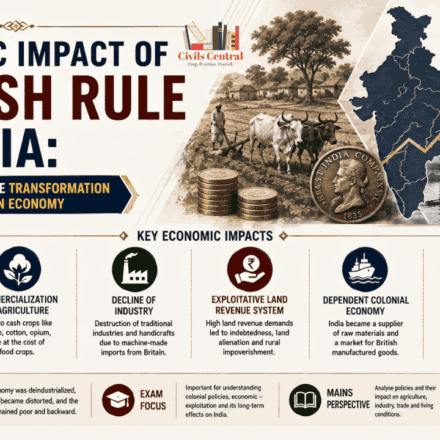
[…] Ryotwari Settlement: Munro’s Land Revenue System in Madras and Bombay […]
[…] Ryotwari Settlement: Munro’s Land Revenue System in Madras and Bombay […]