
Introduction
Few weather events influence India’s economy, society, environment, and governance as profoundly as the Southwest Monsoon. Unlike many countries where rainfall is merely a meteorological phenomenon, in India the monsoon functions as an economic engine, an agricultural lifeline, a determinant of food security, and a critical factor in macroeconomic stability. Every year, policymakers, farmers, industries, financial markets, and disaster management agencies closely monitor the progress of the monsoon because even a small deviation in rainfall can trigger cascading effects across multiple sectors.
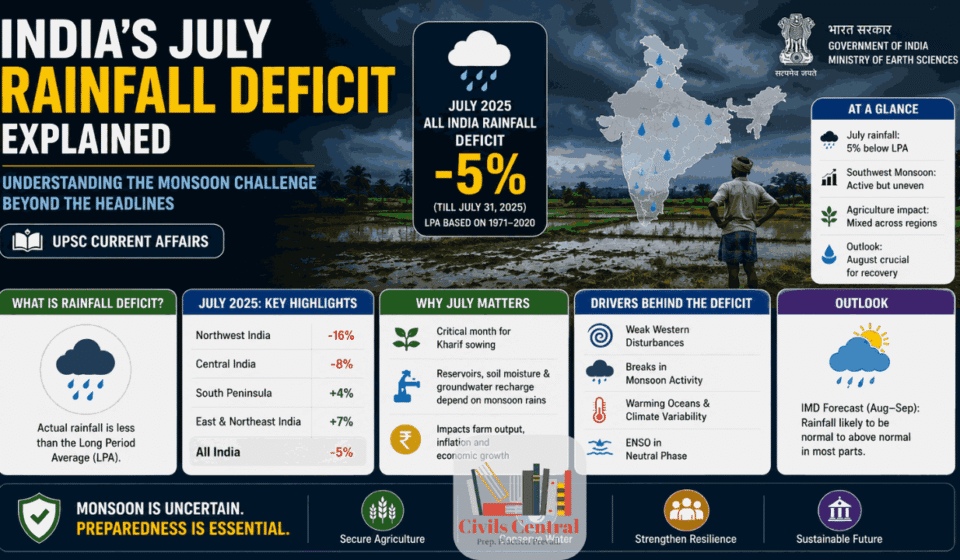
The latest forecast by the India Meteorological Department (IMD) indicating that July rainfall is likely to remain below normal, with an estimated rainfall deficit of nearly 40% during the current period, has therefore attracted considerable attention. July is traditionally the wettest month of the Southwest Monsoon season and contributes a substantial share of India’s seasonal rainfall. A prolonged deficiency during this month can delay sowing operations, reduce soil moisture, affect reservoir storage, increase irrigation demand, and eventually influence agricultural production, inflation, and overall economic growth.
However, understanding this development requires going beyond the headline. A temporary rainfall deficit does not automatically imply drought, nor does it necessarily indicate monsoon failure. Rainfall distribution across time and space, the behaviour of atmospheric systems, oceanic conditions such as El Niño-Southern Oscillation (ENSO) and the Indian Ocean Dipole (IOD), and the growing influence of climate change all interact to determine the final outcome of India’s monsoon season.
For UPSC aspirants, this topic extends far beyond current affairs. It integrates concepts from Indian Geography, Climatology, Agriculture, Disaster Management, Environment, Economy, and Governance, making it highly relevant for Prelims, GS Paper I, GS Paper III, Essay, and even the Personality Test. Understanding the science of the monsoon also helps in analysing issues such as food inflation, water security, rural livelihoods, climate resilience, and sustainable development.
Why in News?
The India Meteorological Department (IMD) has forecast that rainfall during the current phase of July is likely to remain significantly below normal, with rainfall departures in several parts of the country reaching nearly 40% below the long-period average (LPA). The forecast has raised concerns because July generally contributes the largest share of seasonal monsoon rainfall and plays a decisive role in determining the success of the Kharif agricultural season.
According to the IMD, the temporary decline in rainfall is associated with evolving atmospheric conditions, including the weakening of active monsoon systems and the possibility of a ‘break monsoon’ phase over parts of central and northwestern India. At the same time, rainfall may continue over some regions due to localized weather systems, illustrating that the monsoon is never spatially uniform.
The forecast has prompted close monitoring by the Union Government, State Governments, agricultural agencies, reservoir authorities, and disaster management institutions because sustained rainfall deficiency during July could influence sowing progress, reservoir levels, groundwater recharge, hydroelectric power generation, and inflationary pressures arising from agricultural production.
Importantly, the IMD has clarified that this is an assessment of rainfall during a specific period and does not necessarily indicate failure of the overall Southwest Monsoon season. Seasonal rainfall outcomes depend on the evolution of atmospheric and oceanic conditions throughout the remaining months of the monsoon.
Current News Snapshot
The latest forecast issued by the India Meteorological Department indicates that rainfall during the current phase of July 2026 is likely to remain below normal, with rainfall departures reaching nearly 40% below the Long Period Average (LPA) over several parts of the country. The forecast is associated with a break monsoon phase, characterised by a northward shift of the monsoon trough and a temporary reduction in the formation of low-pressure systems over the Bay of Bengal.
The IMD has clarified that this represents an intraseasonal rainfall deficit rather than a forecast of seasonal monsoon failure. Rainfall during the remaining weeks of July, August, and September will determine the overall performance of the Southwest Monsoon.
From a policy perspective, the development has prompted closer monitoring of Kharif sowing, major reservoir storage, groundwater recharge, and food inflation, as these sectors are particularly sensitive to rainfall conditions during July.
What Does “Below Normal Rainfall” Actually Mean?
One of the most common misconceptions during the monsoon season is that below-normal rainfall automatically signifies drought. In reality, meteorologists distinguish between temporary rainfall deficits, seasonal rainfall departures, and meteorological drought, each of which has different implications.
Rainfall is assessed by comparing the actual precipitation received over a given period with the Long Period Average (LPA), which represents the average rainfall calculated over a standard climatological period of 30 years. This comparison, known as rainfall departure, provides a measure of how much rainfall has deviated from normal conditions.
If the actual rainfall is close to the long-term average, it is classified as normal. When rainfall falls significantly below this benchmark, it is termed below normal or deficient depending on the magnitude of the departure. The IMD uses these classifications to communicate the severity of rainfall deviations and to assist governments in planning agricultural and disaster management responses.
IMD Classification of Seasonal Rainfall
| Rainfall Category | Percentage of Long Period Average (LPA) | Significance |
|---|---|---|
| Large Excess | More than 110% | Potential flood risk and waterlogging |
| Excess | 105–110% | Above-average rainfall |
| Normal | 96–104% | Ideal monsoon conditions |
| Below Normal | 90–95% | Slight rainfall deficiency |
| Deficient | Less than 90% | Significant rainfall shortfall |
A rainfall deficit of around 40% during a particular period therefore indicates that rainfall received is substantially below what is normally expected for that phase of the season. However, subsequent active monsoon spells may compensate for this shortfall, depending on evolving weather systems.
Rainfall Deficit Does Not Always Mean Drought
Another important distinction must be understood. Drought is a multidimensional phenomenon and is not determined solely by rainfall.
A region may experience temporary rainfall deficiency but avoid drought if subsequent rainfall compensates for the deficit, irrigation facilities are adequate, and reservoirs maintain sufficient water storage. Conversely, even areas receiving near-normal seasonal rainfall may experience agricultural stress if rainfall is concentrated within a few days rather than being evenly distributed across the growing season.
This explains why modern monsoon analysis increasingly focuses not only on how much rain falls, but also on when, where, and how intensely it falls.
Rainfall Distribution Matters More Than Annual Totals
Consider two hypothetical districts, each receiving 900 mm of rainfall during the monsoon season.
- In the first district, rainfall is spread evenly across three months, ensuring continuous soil moisture and healthy crop growth.
- In the second district, nearly the entire rainfall occurs within five days, followed by several weeks of dry conditions.
Although both districts receive identical annual rainfall, agricultural outcomes will be dramatically different. The second district may experience flash floods initially and drought-like conditions later because crops require consistent moisture rather than isolated bursts of rainfall.
This changing rainfall pattern has become increasingly common in India under the influence of climate change, where the frequency of short-duration extreme rainfall events is rising while the number of rainy days is declining.
Why July Holds Exceptional Importance in India’s Monsoon Calendar
Among the four principal monsoon months—June, July, August, and September—July occupies a uniquely significant position. It is often referred to as the backbone of the Southwest Monsoon because it contributes the highest share of seasonal rainfall across most parts of the country.
By July, the Southwest Monsoon has normally advanced over the entire Indian mainland. Atmospheric circulation becomes well established, moisture transport from the Arabian Sea and the Bay of Bengal reaches its peak, and monsoon depressions frequently move inland, bringing widespread rainfall.
For Indian agriculture, this timing is crucial. The majority of Kharif crops, including paddy, maize, cotton, soybean, pulses, and groundnut, are either sown or enter their early growth stages during July. Adequate rainfall at this stage ensures proper germination, root development, and soil moisture availability.
Beyond agriculture, July rainfall replenishes reservoirs, recharges groundwater aquifers, sustains river flows, supports hydroelectric power generation, and provides drinking water security for millions of people during the subsequent dry months.
Consequently, even temporary rainfall deficits during July attract significant policy attention because they can have multiplier effects across agriculture, energy, industry, and the broader economy.
Why UPSC Frequently Asks Questions on the Monsoon
The Indian monsoon is one of the few topics that simultaneously integrates multiple disciplines of the UPSC syllabus.
Indian Monsoon
        │
        ├── Geography
        │      • Pressure belts
        │      • Winds
        │      • Jet Streams
        │
        ├── Environment
        │      • Climate Change
        │      • Biodiversity
        │
        ├── Agriculture
        │      • Kharif Crops
        │      • Irrigation
        │
        ├── Economy
        │      • Inflation
        │      • GDP
        │      • Rural Demand
        │
        ├── Disaster Management
        │      • Floods
        │      • Droughts
        │
        └── Governance
               • IMD
               • NDMA
               • Water Management
For this reason, UPSC rarely asks only factual questions about the monsoon. Instead, it increasingly frames interdisciplinary questions that require conceptual understanding and the ability to connect geography with economics, governance, agriculture, and environmental sustainability.
Understanding the Indian Monsoon from First Principles
To appreciate why a 40% rainfall deficit in July generates national concern, one must first understand what the Indian monsoon actually is. Contrary to the popular perception that the monsoon is simply a rainy season, it is, in fact, a highly complex atmospheric circulation system driven by the interaction of land, oceans, solar heating, Earth’s rotation, and global climate processes.
The word “monsoon” originates from the Arabic word mausim, meaning season. Early Arab traders sailing across the Indian Ocean observed that the direction of prevailing winds changed seasonally. These predictable reversals enabled maritime trade between East Africa, the Arabian Peninsula, India, and Southeast Asia long before the advent of modern navigation. Thus, the defining characteristic of a monsoon is the seasonal reversal of winds, while rainfall is only one of its most visible consequences.
India experiences one of the strongest monsoon systems in the world because of its unique geographical setting. The vast Asian landmass lies immediately north of the warm Indian Ocean, while the towering Himalayan mountain range forms an almost continuous barrier to atmospheric circulation. This geographical arrangement creates a large seasonal contrast in temperature and pressure, setting the stage for the annual migration of moisture-laden winds towards the Indian subcontinent.
Why Do Monsoon Winds Reverse?
The Earth’s surface does not heat uniformly. Land absorbs and loses heat much faster than oceans because rocks and soils have a lower specific heat capacity than water. During summer, therefore, the Indian landmass becomes significantly hotter than the surrounding Indian Ocean.
As the land heats up, the air above it expands, becomes lighter, and rises. This creates a low-pressure area over northern and central India. At the same time, the comparatively cooler Indian Ocean maintains relatively higher atmospheric pressure.
Nature seeks equilibrium. Air naturally moves from regions of higher pressure to regions of lower pressure. Consequently, moisture-rich winds begin flowing from the Indian Ocean towards the Indian subcontinent. As these winds encounter mountain ranges and rising terrain, the moist air ascends, cools, condenses, and produces rainfall.
This seasonal migration of moisture-bearing winds constitutes the Southwest Monsoon, which delivers nearly three-fourths of India’s annual rainfall.
Thus, the monsoon is fundamentally a gigantic heat engine powered by the differential heating of land and sea.
The Role of the Inter-Tropical Convergence Zone (ITCZ)
One of the most important atmospheric features governing the monsoon is the Inter-Tropical Convergence Zone (ITCZ). It is a belt of low pressure near the Equator where the Northeast Trade Winds from the Northern Hemisphere and the Southeast Trade Winds from the Southern Hemisphere converge. The intense heating in this region causes warm, moist air to rise, leading to cloud formation and heavy rainfall.
The ITCZ is not stationary. It shifts northward during the Northern Hemisphere summer and southward during winter, following the apparent movement of the Sun.
During the Indian summer, the ITCZ moves north of the Equator and often extends over the Indo-Gangetic Plain. This northward shift effectively draws moisture-laden winds from the Southern Hemisphere across the Equator. As these winds cross the Equator, the Coriolis force deflects them to the right, transforming them into the Southwest Monsoon winds.
Without this seasonal migration of the ITCZ, the Southwest Monsoon, as we know it, would not exist.
The Tibetan Plateau
Another distinctive feature of the Indian monsoon system is the role played by the Tibetan Plateau, often referred to as the “heat engine of Asia.” Situated at an average elevation of over 4,500 metres, the plateau experiences intense solar heating during summer.
The heated plateau warms the air above it, creating a strong upper-atmospheric low-pressure region. This enhances the upward movement of air and strengthens the monsoon circulation over South Asia. In essence, the Tibetan Plateau amplifies the thermal contrast between land and ocean, reinforcing the inflow of moisture-bearing winds.
During winter, however, the plateau cools rapidly and acts as a source of high pressure. This reversal contributes to the development of the Northeast Monsoon, illustrating how seasonal changes over the plateau influence atmospheric circulation throughout the year.
The Himalayan Barrier
The Himalayas play a dual role in shaping India’s climate. First, they act as a formidable physical barrier, preventing the moisture-laden monsoon winds from escaping into Central Asia. Forced to ascend along the southern slopes, these winds undergo cooling and condensation, producing widespread rainfall over the Indian subcontinent.
Second, the Himalayas shield the Indian landmass from the cold, dry continental winds originating in Central Asia during winter. Without this protective barrier, much of northern India would experience a climate resembling that of the cold deserts of Central Asia.
Thus, the Himalayas are indispensable to the intensity and spatial distribution of the Indian monsoon.
The Two Branches of the Southwest Monsoon
After crossing the Equator and entering the Indian Ocean, the Southwest Monsoon divides into two principal branches due to the geographical configuration of the Indian peninsula.
Arabian Sea Branch
The Arabian Sea Branch reaches the western coast of India first, usually making landfall over Kerala in early June. The Western Ghats obstruct these winds, causing them to rise rapidly and produce heavy orographic rainfall along the windward side. Regions such as Kerala, coastal Karnataka, Goa, and parts of Maharashtra receive some of the highest rainfall totals in the country due to this mechanism.
However, as the winds descend along the leeward side of the Western Ghats, they lose much of their moisture. This creates the well-known rain-shadow region of the Deccan Plateau, where districts in interior Karnataka, Maharashtra, Telangana, and parts of Tamil Nadu receive comparatively less rainfall.
Bay of Bengal Branch
The Bay of Bengal Branch travels northeastward before being deflected westward by the Himalayan foothills. This branch brings heavy rainfall to northeastern India, including Meghalaya, Assam, Arunachal Pradesh, Nagaland, Manipur, Mizoram, and Tripura.
The unique topography of Meghalaya, particularly the funnel-shaped Khasi Hills, forces the moisture-laden winds to rise abruptly, resulting in exceptionally high rainfall. This explains why places such as Mawsynram and Cherrapunji consistently rank among the wettest locations on Earth.
As the Bay branch moves westward across the Indo-Gangetic Plain, it progressively loses moisture, leading to a gradual decline in rainfall from east to west.
The Jet Streams
Although the monsoon is often explained through surface winds, its behaviour is also strongly influenced by high-altitude air currents known as jet streams. These are narrow bands of extremely fast-moving winds in the upper troposphere.
Two jet streams are particularly important for the Indian monsoon:
- Subtropical Westerly Jet (STWJ): During winter, this jet stream flows south of the Himalayas and inhibits the development of the Southwest Monsoon. As summer approaches, the STWJ shifts north of the Himalayas, removing this barrier and allowing monsoon circulation to establish over India.
- Tropical Easterly Jet (TEJ): During summer, the TEJ develops over peninsular India. Its formation is associated with the intense heating of the Tibetan Plateau and is considered an indicator of a strong monsoon. A well-developed TEJ enhances upper-level divergence, encouraging the ascent of moist air and strengthening rainfall.
The seasonal migration of these jet streams is therefore a key factor determining the onset, intensity, and withdrawal of the monsoon.
The Monsoon as a Dynamic System
A common misconception is that once the monsoon arrives, rainfall continues uniformly until September. In reality, the monsoon is highly dynamic, alternating between active and break phases.
During an active monsoon, the monsoon trough—a zone of low pressure extending across northern India—remains favourably positioned, encouraging the formation of depressions over the Bay of Bengal. These systems travel inland, bringing widespread rainfall to central, northern, and eastern India.
In contrast, a break monsoon occurs when the monsoon trough shifts northwards towards the Himalayan foothills. Rainfall decreases sharply over much of central and northwestern India, while the Himalayan region and parts of northeastern India may continue to receive heavy precipitation.
The current forecast of a significant rainfall deficit in July is closely linked to such a break phase, illustrating how short-term atmospheric changes can temporarily suppress rainfall even during the peak monsoon season.
The Monsoon as an Integrated Atmospheric System
Solar Heating
      │
      ▼
Land becomes hotter than ocean
      │
      ▼
Low Pressure develops over India
      │
      ▼
Northward movement of ITCZ
      │
      ▼
Cross-equatorial winds
      │
      ▼
Coriolis Force deflects winds
      │
      ▼
Southwest Monsoon forms
      │
      ▼
Arabian Sea Branch + Bay of Bengal Branch
      │
      ▼
Interaction with Himalayas, Western Ghats,
Jet Streams and Atmospheric Systems
      │
      ▼
Rainfall over the Indian Subcontinent
This sequence highlights that the Indian monsoon is not the result of a single factor but the outcome of multiple interconnected atmospheric and geographical processes. A disturbance in any one component—whether the position of the ITCZ, the behaviour of jet streams, ocean temperatures, or the formation of monsoon depressions—can alter rainfall patterns across the country.
Historical Evolution of Monsoon Science
The Indian monsoon has fascinated travellers, sailors, philosophers, and scientists for centuries. Long before meteorology emerged as a formal scientific discipline, communities across the Indian subcontinent had developed an intuitive understanding of seasonal rainfall through observation of winds, cloud formations, animal behaviour, and astronomical events. Agricultural calendars, maritime trade, and even cultural festivals evolved around the predictable arrival of the monsoon.
Yet, despite its apparent regularity, the monsoon has always displayed remarkable variability. Some years witness abundant rainfall, while others experience severe droughts or devastating floods. Explaining this variability became one of the greatest challenges in atmospheric science, giving rise to more than a century of intensive research. Today, although forecasting has become far more sophisticated, the monsoon remains one of the most complex weather systems in the world.
Understanding this evolution is important for UPSC because it demonstrates how scientific knowledge progresses—from simple observations to advanced numerical models—and how technological innovation supports governance, agriculture, and disaster management.
Early Understanding
The earliest documented understanding of the monsoon came from Arab traders navigating the Indian Ocean. They observed that winds reversed direction at roughly the same time each year, allowing ships to sail towards India during one season and return during another. This seasonal predictability transformed the Indian Ocean into one of the world’s busiest maritime trade routes.
For centuries, however, the prevailing belief was that the monsoon was merely a system of reversing winds. The underlying atmospheric mechanisms remained poorly understood because there was no scientific framework to explain pressure systems, global circulation, or heat exchange between land and oceans.
It was only during the nineteenth century, with the development of modern meteorology, that scientists began to examine the physical processes governing the monsoon.
Edmond Halley and the Thermal Theory of the Monsoon
A major breakthrough came with the work of Edmond Halley, better known for identifying the comet that bears his name. In the late seventeenth century, Halley proposed the thermal theory of the monsoon, which remains the foundation of monsoon science even today.
Halley argued that land heats and cools much faster than oceans. During summer, the Indian landmass becomes much hotter than the surrounding seas, creating a low-pressure region that draws moist air inland. During winter, the reverse occurs, leading to offshore winds.
Although modern science has shown that the monsoon is influenced by many additional factors—including jet streams, ocean-atmosphere interactions, and planetary circulation—Halley’s explanation correctly identified land-sea thermal contrast as the fundamental driver of seasonal wind reversal.
This marked the beginning of scientific monsoon research.
Discovery of the Global Atmospheric Connection
As meteorological observations expanded during the twentieth century, scientists realised that the Indian monsoon could not be explained solely by local heating.
Researchers discovered that atmospheric circulation over India is closely connected to climatic processes occurring thousands of kilometres away. Ocean temperatures in the Pacific Ocean, pressure systems over the Southern Hemisphere, snow cover across Eurasia, and circulation patterns over the Indian Ocean all influence the strength of the Southwest Monsoon.
This transformed the understanding of the monsoon from a regional weather event into a component of the Earth’s interconnected climate system.
Today, meteorologists describe the monsoon as part of a global atmospheric circulation network in which changes occurring in one ocean basin may influence rainfall over the Indian subcontinent several months later.
Evolution of Monsoon Forecasting in India
Scientific forecasting of the Indian monsoon began during the colonial period when repeated droughts and famines highlighted the urgent need for reliable rainfall prediction. The establishment of the India Meteorological Department in 1875 marked a turning point. Initially, forecasting relied primarily on observations from rain gauges, pressure measurements, and historical weather records.
Early forecasts were largely descriptive and often lacked precision because they depended on limited observational data. Nevertheless, they represented a significant improvement over traditional methods based solely on empirical observations. Following Independence, the expansion of meteorological stations, radiosonde observations, satellites, weather radars, ocean buoys, and computer technology dramatically enhanced India’s forecasting capability.
Today, India possesses one of the world’s largest meteorological observation networks, integrating data from land, sea, air, and space.
From Statistical Models to Dynamic Climate Models
The science of monsoon forecasting has undergone a major transformation over the past few decades.
Initially, forecasts were based on statistical models, which attempted to identify relationships between historical rainfall patterns and climatic indicators. Scientists examined variables such as Himalayan snow cover, sea surface temperatures, pressure differences, and wind circulation to estimate the likely behaviour of the upcoming monsoon.
Statistical forecasting proved useful for seasonal outlooks because many climatic relationships remained relatively stable over time. However, these models struggled when climate patterns changed or when new atmospheric interactions emerged. To overcome these limitations, meteorologists increasingly adopted dynamic forecasting models.
Unlike statistical methods, dynamic models solve the fundamental equations governing atmospheric physics. They simulate the behaviour of the atmosphere, oceans, land surface, and ice cover using powerful supercomputers. Instead of relying solely on historical relationships, they attempt to recreate how the climate system will evolve in real time.
This represents a shift from pattern recognition to physical simulation, significantly improving forecast accuracy.
India’s Monsoon Mission
Recognising the economic importance of accurate rainfall prediction, the Government of India launched the Monsoon Mission under the Ministry of Earth Sciences. The objective of the programme is to improve forecasts across multiple time scales, including:
- Seasonal monsoon outlooks.
- Extended-range forecasts (2–4 weeks).
- Short-range weather forecasts.
- Extreme rainfall prediction.
- Cyclone and heavy rainfall monitoring.
The mission employs high-resolution coupled ocean-atmosphere models capable of capturing the complex interactions that drive the Indian monsoon.
One of its most significant achievements has been the improvement in extended-range forecasting, allowing governments and farmers to anticipate rainfall anomalies several weeks in advance. Such forecasts are increasingly valuable in planning irrigation schedules, crop selection, reservoir operations, and disaster preparedness.
How the IMD Forecasts the Monsoon Today
Modern monsoon forecasting is no longer dependent on a single observation or model. Instead, the IMD integrates information from a vast network of observational systems and advanced numerical models.
India’s Multi-Layered Forecasting Architecture
| Component | Role in Forecasting | Why It Matters |
|---|---|---|
| Automatic Weather Stations | Measure temperature, humidity, rainfall, and pressure | Provides real-time surface observations |
| Doppler Weather Radars | Track clouds and precipitation | Improves short-term rainfall forecasts and severe weather warnings |
| Weather Satellites | Observe cloud systems, moisture, and cyclone formation | Enables continuous monitoring over land and oceans |
| Ocean Buoys (ARGO & Moored Buoys) | Record sea surface temperature, ocean heat content, and currents | Essential because oceans are the primary moisture source for the monsoon |
| Radiosondes | Measure atmospheric conditions at different altitudes | Helps understand vertical structure of the atmosphere |
| Numerical Weather Prediction Models | Simulate future atmospheric evolution | Generates forecasts from hours to weeks ahead |
| Ensemble Forecast Systems | Combine multiple simulations | Reduces uncertainty and improves reliability |
The strength of this integrated system lies in the fact that no single dataset determines the forecast. Instead, observations from different platforms continuously update computer models, improving forecast accuracy as new information becomes available.
Why Monsoon Forecasting Is Still Difficult
Despite enormous technological progress, the Indian monsoon remains one of the most difficult weather systems to predict accurately.
Several factors contribute to this complexity.
First, the monsoon depends on interactions occurring across multiple spatial scales—from local thunderstorms spanning a few kilometres to planetary circulation systems extending across entire oceans.
Second, atmospheric conditions evolve continuously. A slight shift in the position of the monsoon trough, a change in sea surface temperature, or the delayed formation of a low-pressure system can significantly alter rainfall distribution.
Third, climate change is introducing new uncertainties. Rising global temperatures are modifying ocean heat content, atmospheric moisture, and the frequency of extreme weather events, making historical relationships less reliable.
Consequently, forecasting has increasingly shifted from predicting exact rainfall amounts to estimating the probability of different rainfall scenarios.
Rainfall Forecasting Is About Probability, Not Certainty
Many people interpret weather forecasts as guarantees. In reality, modern meteorology operates on probabilities.
For example, when the IMD forecasts below-normal rainfall for a particular week, it does not imply that every district will remain dry or that rainfall will be absent throughout the period. Instead, it indicates that, on average, rainfall across the forecast region is expected to be lower than the climatological normal.
Some districts may still experience heavy rainfall, while others remain dry.
This distinction between weather and climate statistics is crucial for correctly interpreting IMD forecasts and avoiding unnecessary public confusion.
Evolution of India’s Monsoon Forecasting
Traditional Observations
        │
        ▼
Rain Gauges & Surface Records
        │
        ▼
Statistical Forecast Models
        │
        ▼
Satellite Meteorology
        │
        ▼
Numerical Weather Prediction
        │
        ▼
Coupled Ocean–Atmosphere Models
        │
        ▼
Ensemble Forecast Systems
        │
        ▼
AI-Assisted Forecasting + High-Performance Computing
The evolution of monsoon science reflects a broader shift in meteorology—from observing the atmosphere to modelling it. As computational capacity and observational networks continue to improve, forecast accuracy is expected to increase further. However, the inherently chaotic nature of the atmosphere means that uncertainty can never be eliminated entirely.
Why July Is the Most Critical Month of the Southwest Monsoon
When the IMD warns that July rainfall may remain significantly below normal, the concern is not merely about a reduction in precipitation during one calendar month. July occupies a unique position in India’s climatic and economic calendar. It is the month during which the Southwest Monsoon normally reaches its full strength, agricultural operations attain peak intensity, reservoirs receive their largest inflows, and the foundations of the country’s food production for the year are laid.
For this reason, economists often describe July rainfall as one of India’s most closely watched macroeconomic indicators. While industrial production, inflation, or GDP figures are published periodically, the behaviour of the monsoon during July frequently provides an early indication of how agriculture, rural consumption, food prices, and even overall economic growth may evolve in the coming months.
Understanding the importance of July therefore requires looking beyond meteorology and examining how rainfall influences multiple sectors simultaneously.
July: The Peak Phase of the Southwest Monsoon
The Southwest Monsoon usually reaches Kerala around the beginning of June and gradually advances northwards, covering the entire country by the first week of July under normal conditions. By this stage, the monsoon circulation becomes well established, moisture transport from both the Arabian Sea and the Bay of Bengal intensifies, and low-pressure systems begin moving inland with greater frequency.
As a result, July generally records the highest monthly rainfall during the monsoon season across most parts of India.
This abundant rainfall performs several functions simultaneously. It moistens agricultural fields, replenishes rivers, fills reservoirs, recharges groundwater, supports ecosystems, and provides water security for urban and rural populations. Consequently, any prolonged interruption during this phase has implications that extend far beyond agriculture.
The Foundation of India’s Kharif Agriculture
The most immediate impact of July rainfall is observed in agriculture. India continues to cultivate millions of hectares of land under rainfed conditions, where crop growth depends primarily on monsoon rainfall rather than assured irrigation.
The Kharif season begins with the onset of the Southwest Monsoon. Farmers prepare their fields, sow seeds, and rely on continuous rainfall to ensure successful germination and early crop establishment.
Crops such as paddy, maize, soybean, cotton, pulses, groundnut, bajra, and several oilseeds require adequate soil moisture during the early stages of growth. If rainfall remains deficient during July, farmers face multiple challenges.
Delayed or inadequate rainfall may postpone sowing, reduce seed germination, weaken root development, and increase dependence on irrigation. Even where irrigation facilities exist, prolonged dry spells raise production costs because farmers must pump groundwater or purchase water from alternative sources.
The impact is particularly severe in rainfed regions of central India, parts of the Deccan Plateau, eastern India, and semi-arid regions where irrigation coverage remains limited.
Thus, July rainfall often determines whether the agricultural season begins under favourable or stressed conditions.
Rainfall Distribution Matters More Than Seasonal Totals
Modern agricultural science has shown that crops respond not only to the total amount of rainfall but also to its temporal distribution.
A field receiving 300 millimetres of rainfall evenly over four weeks is likely to support healthier crop growth than another receiving the same amount within two days followed by three weeks of dryness.
This distinction has become increasingly important under changing climatic conditions.
India has witnessed a growing tendency towards short-duration, high-intensity rainfall events interspersed with longer dry spells. Such rainfall patterns create a paradoxical situation in which floods and drought-like conditions may occur within the same agricultural season.
Heavy rainfall occurring over a short duration often results in rapid surface runoff rather than infiltration. Instead of replenishing soil moisture, much of the water is lost through rivers, increasing flood risks while leaving crops vulnerable to moisture stress in subsequent weeks.
Consequently, meteorologists increasingly evaluate not only cumulative rainfall but also the frequency, duration, and spatial distribution of rainfall events.
Reservoirs: The Nation’s Water Savings Account
One of the less visible but equally important functions of July rainfall is the replenishment of reservoirs.
Large dams across India serve multiple purposes, including irrigation, drinking water supply, hydroelectric power generation, flood moderation, and industrial water requirements. During the pre-monsoon months, reservoir levels typically decline because stored water is continuously used for agriculture, domestic consumption, and industry.
The arrival of the monsoon initiates the annual process of refilling these reservoirs. July is particularly significant because inflows usually increase sharply as rivers swell with monsoon runoff.
If rainfall remains below normal during this period, reservoir storage may not recover adequately. Lower storage levels can subsequently reduce irrigation availability during the Rabi season, affect urban drinking water supplies, and constrain hydroelectric power generation.
Thus, the consequences of deficient July rainfall often extend well beyond the monsoon months themselves.
Groundwater Recharge: The Hidden Dimension
While rivers and reservoirs are visible indicators of monsoon performance, a substantial proportion of India’s water security depends on groundwater.
India is the world’s largest extractor of groundwater, using it extensively for irrigation, drinking water, and industrial purposes. Millions of farmers rely on tube wells and bore wells, particularly in regions where canal irrigation is limited.
Monsoon rainfall is the principal source of groundwater recharge. When rainfall infiltrates the soil, it replenishes underground aquifers that sustain water availability during the dry season.
However, prolonged dry spells reduce infiltration, particularly if accompanied by high temperatures that increase evaporation. Conversely, extremely intense rainfall may also reduce recharge because much of the water flows rapidly over the land surface instead of percolating into the ground.
Therefore, both rainfall quantity and rainfall intensity influence groundwater sustainability.
Food Inflation: Why Economists Watch the Monsoon
The importance of July rainfall extends into macroeconomic management.
Agricultural production directly influences food availability. When rainfall deficiencies reduce crop yields, market supplies may tighten, leading to higher prices of cereals, pulses, vegetables, fruits, and edible oils.
Food inflation occupies a prominent place in India’s inflation dynamics because food constitutes a significant component of household expenditure, particularly among lower-income groups.
Higher food prices have several wider consequences. They reduce consumers’ purchasing power, influence inflation expectations, complicate monetary policy decisions, and may require government interventions such as buffer stock releases or import adjustments.
Thus, the IMD’s rainfall forecasts are closely monitored not only by farmers but also by the Reserve Bank of India, the Ministry of Finance, commodity markets, and economic analysts.
Rural Economy and Employment
Agriculture continues to support a substantial share of India’s rural population, either directly through farming or indirectly through allied activities such as transportation, agricultural trade, food processing, dairy, and livestock.
A favourable monsoon generally improves rural incomes, increases demand for consumer goods, stimulates agricultural investment, and supports employment in related sectors.
Conversely, prolonged rainfall deficiency may reduce agricultural output, lower farm incomes, and weaken rural demand. Since rural consumption contributes significantly to India’s domestic market, these effects can gradually influence broader economic activity.
The monsoon therefore acts not merely as a weather event but as an important determinant of rural economic confidence.
Energy Security and Hydropower
An often-overlooked consequence of deficient July rainfall relates to the power sector.
Hydroelectric stations depend upon adequate reservoir storage and river flows for electricity generation. During years of below-normal rainfall, reduced inflows may limit hydropower generation, increasing dependence on thermal power plants.
Higher reliance on coal-based electricity raises fuel consumption, increases generation costs, and contributes to greenhouse gas emissions.
Thus, rainfall variability has implications not only for water security but also for India’s energy transition and climate commitments.
Ecosystems and Biodiversity
The ecological significance of July rainfall extends beyond human activities.
Forests depend upon seasonal rainfall for regeneration, soil moisture maintenance, and nutrient cycling. Wetlands require sustained inflows to support migratory birds, aquatic vegetation, and fish populations. Rivers transport sediments essential for maintaining floodplains and delta ecosystems.
Wildlife species also synchronise breeding, migration, and feeding patterns with seasonal rainfall.
Irregular rainfall may therefore disrupt ecological processes, affecting biodiversity and ecosystem services that underpin agriculture and human well-being.
Why a Temporary July Deficit Does Not Always Mean Agricultural Failure
Despite the central importance of July, it is equally important to avoid deterministic conclusions.
Agricultural outcomes depend on several interacting factors:
- Rainfall received during August and September.
- Availability of irrigation infrastructure.
- Soil moisture conservation practices.
- Crop varieties cultivated.
- Government contingency measures.
- Reservoir storage at the beginning of the season.
If rainfall improves during subsequent weeks, many early deficits can be partially or even substantially compensated. Likewise, widespread irrigation in certain regions may reduce dependence on monsoon rainfall.
Therefore, policymakers evaluate the evolving monsoon continuously rather than relying on a single month’s rainfall performance.
Why July Rainfall Shapes India’s Economy
Below-Normal July Rainfall
            │
            ▼
Reduced Soil Moisture & Delayed Sowing
            │
            ▼
Lower Crop Productivity (if deficit persists)
            │
            ▼
Reduced Agricultural Output
            │
            ▼
Higher Food Prices
            │
            ▼
Food Inflation
            │
            ▼
Pressure on Monetary Policy & Household Budgets
            │
            ▼
Impact on Rural Demand, GDP Growth & Economic Stability
This chain is not automatic but illustrates why July rainfall receives such close attention from policymakers. The actual outcome depends on how rainfall evolves during the remainder of the monsoon season and on the effectiveness of mitigation measures.
Why Is India Experiencing a Rainfall Deficit in July? Understanding the Science Behind the Current Monsoon Slowdown
The announcement by the India Meteorological Department (IMD) that rainfall during the current phase of July may remain nearly 40% below normal naturally raises an important question: What causes such sudden interruptions in the peak monsoon season?
Many people assume that the monsoon behaves like a continuous conveyor belt, bringing steady rainfall from June to September. In reality, the Indian monsoon is an inherently dynamic system. It continuously fluctuates in response to atmospheric circulation, ocean temperatures, pressure systems, and global climate phenomena. Active spells of widespread rainfall are often followed by periods of reduced precipitation, known as break phases.
The present rainfall deficit is not the result of a single factor. Rather, it reflects the combined influence of several interacting atmospheric and oceanic processes. Understanding these processes is essential because UPSC increasingly frames questions that test conceptual clarity rather than isolated facts.
The Break Monsoon Phenomenon
One of the most immediate reasons for reduced rainfall during July is the occurrence of a Break Monsoon.
A break in the monsoon does not mean that the Southwest Monsoon has withdrawn from India. Instead, it refers to a temporary weakening of the monsoon circulation during which rainfall decreases sharply over large parts of central, western, and northwestern India. This phenomenon usually lasts for a few days but can occasionally persist for longer periods.
During a break phase, the monsoon winds continue to exist, yet the large-scale atmospheric conditions become less favourable for the formation of widespread rain-bearing systems. As a result, rainfall over agriculturally important regions declines significantly.
Interestingly, while central India may become relatively dry, rainfall often increases over the Himalayan foothills and parts of northeastern India because of changes in the position of the monsoon trough.
Thus, a break monsoon represents a redistribution of rainfall rather than its complete disappearance.
The Monsoon Trough: The Backbone of Monsoon Rainfall
To understand why break phases occur, one must first understand the monsoon trough.
The monsoon trough is an elongated region of low atmospheric pressure extending from northwestern India across the Indo-Gangetic Plain towards the Bay of Bengal. It serves as the principal zone where moist air converges and rises, leading to cloud formation and rainfall.
When the monsoon trough occupies its normal position, atmospheric conditions favour the development of low-pressure systems and widespread rainfall over central and northern India. However, the trough does not remain fixed. It oscillates northward and southward throughout the season.
During a break monsoon, the trough shifts towards the Himalayan foothills. Consequently, rainfall decreases over much of central India while increasing over Uttarakhand, Himachal Pradesh, Nepal, and northeastern India. Such shifts also raise the likelihood of landslides and flash floods in mountainous regions.
The current rainfall deficit is closely associated with such changes in the position of the monsoon trough.
Fewer Low-Pressure Systems Over the Bay of Bengal
Another major determinant of monsoon rainfall is the formation of low-pressure systems and monsoon depressions over the Bay of Bengal.
These weather systems act as carriers of moisture into the Indian mainland. After forming over the warm waters of the Bay of Bengal, they generally move westward or northwestward, bringing widespread rainfall to Odisha, Chhattisgarh, Jharkhand, Madhya Pradesh, Maharashtra, Rajasthan, Uttar Pradesh, and adjoining regions.
In years when these systems form frequently, rainfall tends to be well distributed across the country. Conversely, if the number of low-pressure systems decreases or their trajectories shift, rainfall over large agricultural regions declines.
Meteorologists therefore monitor the frequency, intensity, and movement of these systems throughout the monsoon season.
Madden–Julian Oscillation (MJO)
Among the less familiar but highly influential drivers of the monsoon is the Madden–Julian Oscillation, commonly known as the MJO.
The MJO is a large-scale eastward-moving disturbance of clouds, rainfall, winds, and atmospheric pressure that travels around the tropics approximately every 30 to 60 days. Unlike permanent climate systems, the MJO is continuously moving. As it travels across different ocean basins, it alternately enhances or suppresses rainfall.
When the active phase of the MJO is located over the Indian Ocean, atmospheric conditions become favourable for cloud formation, convection, and monsoon rainfall over India. However, when the active phase shifts towards the western Pacific Ocean, rainfall over India often weakens because the primary zone of tropical convection also moves away.
Thus, the location of the MJO at any given time significantly influences short-term fluctuations in monsoon activity.
El Niño–Southern Oscillation (ENSO)
Perhaps the most widely discussed global climatic phenomenon affecting the Indian monsoon is the El Niño–Southern Oscillation, commonly abbreviated as ENSO. ENSO represents periodic changes in sea surface temperatures and atmospheric pressure across the equatorial Pacific Ocean.
During an El Niño event, sea surface temperatures in the central and eastern Pacific become warmer than normal. This alters global atmospheric circulation, weakening the rising motion of air over the Indian Ocean and reducing moisture transport towards the Indian subcontinent.
Historically, several major drought years in India have coincided with strong El Niño events. However, this relationship is not absolute. Some El Niño years have experienced near-normal monsoons because other favourable climatic factors compensated for its influence.
Conversely, La Niña, characterised by cooler-than-normal Pacific waters, generally strengthens the Indian monsoon by enhancing atmospheric circulation favourable for rainfall.
Therefore, ENSO influences the probability of monsoon strength rather than determining it with certainty.
Indian Ocean Dipole (IOD)
While much public attention focuses on the Pacific Ocean, conditions within the Indian Ocean are often equally important. The Indian Ocean Dipole describes the difference in sea surface temperatures between the western and eastern Indian Ocean.
A Positive IOD occurs when the western Indian Ocean becomes warmer than the eastern part. This enhances moisture availability over the Arabian Sea and often strengthens monsoon rainfall over India.
A Negative IOD produces the opposite effect, reducing moisture transport towards the subcontinent.
An important feature of the IOD is that it can sometimes offset the adverse effects of El Niño. This explains why India occasionally experiences satisfactory monsoon rainfall despite the presence of El Niño conditions. Meteorologists therefore analyse ENSO and IOD together rather than independently.
Climate Change
While atmospheric oscillations such as ENSO and MJO have influenced the monsoon for centuries, climate change is introducing new uncertainties into the system.
Scientific studies indicate that rising global temperatures are increasing the atmosphere’s capacity to hold moisture. A warmer atmosphere can potentially produce more intense rainfall events when conditions become favourable.
However, climate change does not necessarily increase total seasonal rainfall uniformly. Instead, it appears to alter the distribution of rainfall.
Several recent trends have been observed:
- The number of rainy days has declined in many regions.
- Heavy rainfall events have become more frequent.
- Dry spells between rainfall events have lengthened.
- Localised cloudbursts have increased in mountainous areas.
- Rainfall variability has become more pronounced.
This means that India may experience both floods and drought-like conditions within the same monsoon season.
Such increasing variability presents significant challenges for agriculture, urban planning, water resource management, and disaster preparedness.
The Interaction of Multiple Factors
One of the most important lessons in monsoon science is that no single factor controls rainfall. The current rainfall deficit is likely the outcome of several interacting influences:
- A temporary break monsoon phase.
- A northward shift of the monsoon trough.
- Reduced formation of low-pressure systems over the Bay of Bengal.
- The evolving position of the Madden–Julian Oscillation.
- Background influences of ENSO and the Indian Ocean Dipole.
- Long-term climatic changes affecting rainfall variability.
Meteorologists continuously monitor all these variables because changes in any one of them can quickly alter rainfall patterns during the remainder of the season.
Comparative Table: Major Climatic Drivers of the Indian Monsoon
| Climatic Driver | Nature | Effect on Indian Monsoon | UPSC Relevance |
|---|---|---|---|
| Break Monsoon | Temporary atmospheric condition | Reduces rainfall over central and northwestern India while increasing rainfall along the Himalayan foothills | Geography, Disaster Management |
| Monsoon Trough | Seasonal low-pressure belt | Governs spatial distribution of rainfall | Indian Geography |
| Low-Pressure Systems | Synoptic weather systems | Bring widespread rainfall inland from the Bay of Bengal | Climatology |
| Madden–Julian Oscillation (MJO) | Intraseasonal tropical oscillation | Enhances or suppresses rainfall depending on its location | Weather & Climate |
| El Niño | Pacific Ocean warming | Often weakens the Indian monsoon | Environment & Geography |
| La Niña | Pacific Ocean cooling | Generally strengthens the Indian monsoon | Climate Systems |
| Indian Ocean Dipole (IOD) | Indian Ocean temperature gradient | Positive IOD often supports stronger monsoon rainfall | Oceanography |
| Climate Change | Long-term global warming | Increases rainfall variability and extreme events | Environment, GS-III |
Why the Current Rainfall Deficit Has Emerged
Break Monsoon
        │
        ├───────────────┐
        ▼               ▼
Northward Shift   Fewer Low-Pressure
of Monsoon Trough     Systems
        │               │
        └───────┬───────┘
                ▼
 Reduced Moisture Convergence
                │
                ▼
 Less Cloud Formation
                │
                ▼
 Below-Normal Rainfall
                │
                ▼
 Delayed Sowing • Lower Reservoir Inflows
 Groundwater Stress • Inflation Risks
How a Deficient July Monsoon Affects India’s Economy, Society and Environment
The significance of a 40% rainfall deficit in July lies not merely in the reduction of rainfall itself, but in the chain of consequences that it can trigger across multiple sectors. In India, the monsoon functions as a connecting thread between agriculture, water resources, energy, industry, public finance, ecology, and household welfare. A disruption in one part of this system often creates ripple effects across the economy.
However, it is equally important to distinguish between temporary impacts arising from a short-lived rainfall deficit and structural impacts that emerge only if the deficiency persists throughout the monsoon season. Sound policy decisions require this distinction because premature conclusions can lead to unnecessary panic, while delayed responses can aggravate losses.
Impact on Agriculture
Agriculture is the sector most directly exposed to monsoon variability. Although irrigation coverage has expanded significantly over the past few decades, nearly half of India’s net sown area still depends primarily on rainfall. Consequently, the timing, intensity, and distribution of rainfall during July have a decisive influence on agricultural productivity.
The first impact of below-normal rainfall is often seen in delayed sowing. Farmers generally begin sowing Kharif crops immediately after receiving adequate rainfall. If rainfall is insufficient, sowing operations may be postponed because dry soil cannot support seed germination.
Even where sowing has already taken place, prolonged dry spells during the early growth stage can weaken seedlings, reduce plant density, and lower eventual crop yields. Moisture stress during this phase is particularly damaging because young plants have not yet developed deep root systems capable of accessing groundwater.
The crops most vulnerable include paddy, maize, soybean, pulses, cotton, groundnut, and coarse cereals, although the degree of vulnerability varies according to soil type, irrigation availability, and crop variety.
Agriculture Is Increasingly Vulnerable to Rainfall Variability
An important feature of modern agriculture is that farmers face risks not only from reduced rainfall but also from erratic rainfall.
For example, if a prolonged dry spell is suddenly followed by extremely heavy rainfall, crops may experience waterlogging instead of relief. Excess rainfall immediately after moisture stress can damage root systems, increase pest infestations, and reduce nutrient availability in the soil.
Thus, climate variability has made agricultural planning more complex than simply measuring seasonal rainfall totals.
This is one of the reasons why governments increasingly promote climate-resilient agriculture, drought-tolerant crop varieties, micro-irrigation, and weather-based advisories.
Food Security and Nutritional Outcomes
Agricultural production ultimately determines food availability.
If rainfall deficiencies substantially reduce crop output, market supplies may decline, leading to higher prices for cereals, pulses, vegetables, fruits, and edible oils. While buffer stocks maintained by the government can moderate shortages in some commodities, highly perishable products such as vegetables and fruits remain particularly vulnerable.
Rising food prices disproportionately affect economically weaker households because food constitutes a larger share of their monthly expenditure. Reduced purchasing power may lead to changes in dietary patterns, with households consuming fewer nutritious foods and relying more heavily on cheaper staples.
Consequently, prolonged agricultural stress has implications not only for food availability but also for nutritional security.
Water Resources: From Rivers to Groundwater
The effects of below-normal rainfall extend far beyond agricultural fields.
River flows depend on continuous monsoon precipitation across their catchment areas. Reduced rainfall lowers runoff, affecting reservoir inflows and downstream water availability.
Groundwater recharge is similarly influenced by rainfall patterns. When rainfall is well distributed, water infiltrates the soil and replenishes underground aquifers. In contrast, prolonged dry spells reduce recharge, while extremely intense rainfall often results in rapid surface runoff rather than infiltration.
This is particularly significant because India depends heavily on groundwater for irrigation and drinking water. According to various national assessments, groundwater supports a substantial proportion of irrigation in the country and serves as the primary source of drinking water in many rural areas.
Therefore, a weak monsoon can simultaneously reduce both surface water and groundwater availability.
Reservoir Storage and Irrigation Security
Reservoirs act as strategic water reserves that sustain agriculture and urban water supply long after the monsoon has ended.
During years of normal rainfall, reservoirs gradually fill during July and August, providing sufficient storage for irrigation during the Rabi season and ensuring drinking water availability during summer. If inflows remain below normal, reservoir authorities may be compelled to regulate water releases more conservatively.
Such decisions can affect multiple users simultaneously:
- Farmers may receive reduced irrigation allocations.
- Cities may introduce water conservation measures.
- Hydroelectric generation may decline.
- Environmental flows necessary for river ecosystems may become more difficult to maintain.
Thus, water resource management during deficient monsoon years becomes a complex exercise in balancing competing demands.
Inflation and Macroeconomic Stability
The monsoon influences the Indian economy through several transmission channels, the most important of which is food inflation.
Agricultural production affects market supply. Reduced supply, particularly when accompanied by sustained demand, exerts upward pressure on prices. Food inflation can subsequently influence overall retail inflation because food items constitute a significant component of the Consumer Price Index (CPI).
Persistent food inflation presents a policy challenge for the Reserve Bank of India. While monetary policy primarily addresses demand-side inflation, food inflation often arises from supply-side constraints, making it more difficult to control through interest rate adjustments alone.
The government may therefore complement monetary measures with administrative interventions such as releasing buffer stocks, facilitating imports, restricting exports of essential commodities, or improving supply-chain logistics.
This illustrates how a meteorological event can eventually influence fiscal policy, monetary policy, and household consumption.
Rural Economy and Employment
Agriculture supports not only cultivators but also agricultural labourers, transport workers, traders, food processors, and numerous small rural enterprises.
A favourable monsoon typically stimulates rural income, encourages agricultural investment, and increases demand for consumer goods such as farm equipment, two-wheelers, household appliances, and construction materials.
Conversely, prolonged rainfall deficiency may weaken rural purchasing power, reduce employment opportunities in agriculture, and slow economic activity in rural markets.
The impact may also be felt in sectors that appear unrelated to agriculture because rural consumption constitutes an important component of domestic demand.
Thus, monsoon performance often influences the broader trajectory of economic growth.
Energy Sector
India’s energy security is also linked to monsoon performance. Hydroelectric power stations require adequate river flows and reservoir storage for electricity generation. If reservoir inflows remain below normal, hydropower generation may decline, increasing dependence on coal- and gas-based thermal power plants.
Greater reliance on fossil fuels has several consequences:
- Increased fuel imports in certain cases.
- Higher electricity generation costs.
- Greater greenhouse gas emissions.
- Additional pressure on air quality.
This demonstrates how rainfall variability intersects with India’s long-term energy transition and climate commitments.
Public Health Implications
Rainfall anomalies can influence public health in multiple ways. During prolonged dry periods, shortages of safe drinking water may increase the risk of water scarcity and poor sanitation, particularly in vulnerable rural regions.
At the same time, intermittent heavy rainfall following dry spells often creates favourable conditions for mosquito breeding, potentially increasing the incidence of vector-borne diseases such as dengue and malaria.
Food price inflation resulting from reduced agricultural production may also affect household nutrition, particularly among economically weaker sections.
Thus, monsoon variability is increasingly recognised as a public health concern rather than merely an agricultural issue.
Ecological Consequences
Natural ecosystems have evolved in close synchronisation with India’s seasonal rainfall.
Forests depend upon regular rainfall for regeneration, wetlands require seasonal inundation, rivers rely on monsoon flows to transport sediments, and wildlife species often time breeding and migration according to rainfall patterns.
Irregular monsoon behaviour can therefore disrupt ecological processes. Extended dry spells increase the likelihood of forest fires, reduce wetland productivity, and affect aquatic biodiversity. Conversely, sudden extreme rainfall events may erode soil, damage riverbanks, and alter fragile mountain ecosystems.
Such ecological disturbances ultimately affect human livelihoods because agriculture, fisheries, tourism, and water resources all depend upon healthy ecosystems.
Disaster Management
One of the defining characteristics of India’s changing monsoon is the increasing coexistence of floods and drought-like conditions. A district may experience prolonged dry weather for several weeks, followed by a cloudburst producing rainfall equivalent to an entire month’s average within a single day.
This creates a paradox:
- Rainfall totals may appear satisfactory.
- Yet crops suffer from moisture stress during dry periods.
- Urban flooding increases because drainage systems cannot absorb sudden intense rainfall.
- Groundwater recharge remains limited because much of the water flows away as surface runoff.
Consequently, disaster management authorities increasingly prepare simultaneously for drought and flood risks during the same monsoon season.
Impact Assessment Depends on Duration
It is important to recognise that the present rainfall deficit represents a developing situation, not a final outcome.
If active monsoon conditions return during the latter half of July or continue strongly through August and September:
- Agricultural losses may be partially recovered.
- Reservoir storage may improve.
- Groundwater recharge may increase.
- Food inflation risks may moderate.
However, if rainfall deficiency persists over several weeks, cumulative impacts become progressively more difficult to reverse.
Therefore, policymakers continuously revise assessments based on evolving meteorological observations rather than relying on a single forecast.
Integrated Impact Chain
Below-Normal July Rainfall
            │
            ▼
Reduced Soil Moisture
            │
            ▼
Delayed Sowing & Crop Stress
            │
            ▼
Lower Agricultural Production
            │
            ├───────────────┐
            ▼               ▼
Reduced Farm Income    Lower Food Supply
            │               │
            ▼               ▼
Lower Rural Demand   Food Inflation
            │               │
            └───────┬───────┘
                    ▼
      Pressure on Economy & Policy
                    │
                    ▼
Need for Government Intervention
Case Study: The 2009 Drought
India’s 2009 Southwest Monsoon is often cited as a reminder of how deficient rainfall can affect the economy. Seasonal rainfall was significantly below the Long Period Average, leading to reduced Kharif output in several regions, pressure on food prices, and concerns about rural livelihoods. Yet the broader economic impact was moderated compared with earlier droughts because irrigation coverage had expanded, buffer food stocks were available, and policy interventions helped cushion some of the shocks.
The lesson is important: the severity of a rainfall deficit depends not only on nature but also on the resilience of institutions, infrastructure, and policy responses. As India’s irrigation network, forecasting systems, crop insurance, and disaster management improve, the economy becomes better equipped to withstand monsoon variability.
Government Preparedness and Institutional Response
A deficient monsoon is not merely a meteorological challenge; it is a governance challenge. The ability of a country to withstand rainfall variability depends not only on the behaviour of the atmosphere but also on the strength of its institutions, the quality of its forecasting systems, the resilience of its agriculture, and the effectiveness of its disaster management framework.
India has gradually moved away from a reactive approach, where governments primarily responded after droughts or floods occurred, towards a proactive and risk-based approach. Today, multiple institutions continuously monitor weather patterns, reservoir levels, crop conditions, and market prices so that corrective measures can be initiated before a temporary rainfall deficit develops into a larger humanitarian or economic crisis.
This shift reflects an important evolution in public policy—from disaster relief to disaster risk reduction and climate resilience.
The India Meteorological Department (IMD)
At the centre of India’s weather forecasting system is the India Meteorological Department, functioning under the Ministry of Earth Sciences. Established in 1875, the IMD is among the oldest meteorological institutions in the world. Its responsibilities extend far beyond daily weather forecasts.
The IMD continuously monitors atmospheric conditions over land and oceans, tracks the progress of the Southwest Monsoon, issues seasonal and short-range forecasts, predicts extreme weather events, and provides impact-based warnings for agriculture, aviation, shipping, fisheries, and disaster management authorities.
Modern forecasting is supported by an extensive observational network comprising:
- Automatic Weather Stations (AWS)
- Doppler Weather Radars (DWR)
- Weather satellites
- Ocean observation systems
- Radiosonde stations
- High-performance numerical weather prediction models
Rather than merely informing the public about rainfall, the IMD increasingly provides impact-based forecasts, enabling governments and citizens to prepare for the likely consequences of weather events.
Ministry of Agriculture and Farmers Welfare
The Ministry of Agriculture and Farmers Welfare plays the lead role in reducing agricultural risks arising from deficient rainfall. During periods of rainfall deficiency, the Ministry works closely with State Governments, agricultural universities, and the Indian Council of Agricultural Research to monitor crop conditions and recommend contingency measures.
These measures may include:
- Advising farmers to shift towards short-duration crop varieties where sowing has been delayed.
- Promoting drought-tolerant seed varieties.
- Issuing district-specific crop advisories.
- Encouraging efficient irrigation practices.
- Supporting timely availability of seeds, fertilisers, and farm inputs.
The emphasis is increasingly on adaptive agriculture, recognising that climate variability requires flexible farming strategies rather than uniform agricultural practices.
District-Level Crop Contingency Planning
One of India’s significant institutional innovations has been the preparation of District Agriculture Contingency Plans, developed by the Indian Council of Agricultural Research. India’s agro-climatic diversity means that rainfall deficits affect different regions in different ways. A uniform national response is therefore neither practical nor effective.
District-level contingency plans consider:
- Local rainfall patterns.
- Soil characteristics.
- Irrigation availability.
- Dominant cropping systems.
- Water resources.
- Livestock requirements.
Based on these factors, authorities prepare location-specific recommendations for delayed sowing, alternative crops, moisture conservation, fodder management, and irrigation scheduling.
This decentralised planning reflects the broader principle of context-specific climate adaptation.
The Role of the Central Water Commission
Rainfall deficiency directly affects river flows and reservoir storage, making water management a critical component of monsoon governance. The Central Water Commission continuously monitors the water levels of major reservoirs across the country.
Its responsibilities include:
- Assessing reservoir storage.
- Monitoring river discharge.
- Supporting interstate water management.
- Providing flood forecasting services.
- Assisting in reservoir operation planning.
When rainfall remains below normal, reservoir managers may revise water release schedules to balance competing demands for irrigation, drinking water, hydropower generation, and ecological flows.
This highlights an important principle of water governance: during water scarcity, allocation decisions become as important as water availability itself.
National Disaster Management Authority (NDMA)
Monsoon variability creates both drought and flood risks. The National Disaster Management Authority coordinates preparedness and response measures for weather-related disasters.
Its approach increasingly emphasises:
- Early warning systems.
- Community preparedness.
- Capacity building.
- Risk-informed planning.
- Multi-hazard disaster management.
A notable feature of modern disaster management is the recognition that climate change is increasing the frequency of compound disasters.
For example, one region may experience drought conditions while another simultaneously faces flash floods due to intense localised rainfall.
This requires integrated disaster planning rather than hazard-specific responses.
Weather-Based Agricultural Advisory Services
Forecasts become meaningful only when they reach farmers in an understandable form. The Agrometeorological Advisory Services (AAS), jointly implemented by the India Meteorological Department and agricultural institutions, translate meteorological information into practical farm-level advice.
Instead of merely stating that rainfall is expected, advisories may recommend:
- Appropriate sowing dates.
- Irrigation scheduling.
- Fertiliser application timing.
- Pest and disease management.
- Harvest planning.
These advisories increasingly use mobile applications, SMS services, radio broadcasts, television, and digital platforms to improve last-mile communication.
Such services demonstrate how weather forecasting supports climate-smart agriculture.
Crop Insurance
Even the most accurate forecasts cannot eliminate agricultural losses. To reduce farmers’ financial vulnerability, the Government has implemented the Pradhan Mantri Fasal Bima Yojana (PMFBY).
PMFBY aims to provide insurance coverage against crop losses arising from natural calamities, including droughts, floods, cyclones, and unseasonal rainfall.
The scheme seeks to:
- Stabilise farmers’ income.
- Encourage continued investment in agriculture.
- Reduce indebtedness.
- Promote adoption of improved technologies.
However, implementation challenges such as delayed claim settlement, varying State participation, and awareness gaps continue to attract policy debate.
Micro-Irrigation and Water Use Efficiency
A deficient monsoon also underscores the need to improve agricultural water-use efficiency. Traditional flood irrigation often results in substantial water losses through evaporation and runoff.
Consequently, the Government promotes:
- Drip irrigation.
- Sprinkler irrigation.
- Precision agriculture.
- Rainwater harvesting.
- Farm ponds.
- Watershed development.
These interventions not only conserve water but also improve crop productivity under conditions of rainfall uncertainty.
Climate adaptation therefore increasingly involves using available water more efficiently rather than merely expanding water supply.
Strengthening Climate-Resilient Agriculture
The broader policy objective is no longer simply increasing agricultural production. Instead, India seeks to build climate-resilient agriculture, capable of maintaining productivity despite increasing climatic uncertainty.
This involves multiple complementary strategies:
- Developing drought-tolerant crop varieties.
- Diversifying cropping systems.
- Improving soil health.
- Expanding irrigation coverage.
- Enhancing weather forecasting.
- Promoting digital agriculture.
- Strengthening agricultural extension services.
The emphasis has gradually shifted from maximising production under ideal conditions to sustaining production under uncertain climatic conditions.
Technology as a Force Multiplier
Advances in technology are transforming India’s response to monsoon variability. Artificial intelligence, machine learning, remote sensing, Geographic Information Systems (GIS), drones, satellite imagery, and Internet of Things (IoT)-based sensors increasingly support:
- Crop monitoring.
- Soil moisture estimation.
- Rainfall forecasting.
- Reservoir management.
- Precision irrigation.
- Disaster response.
Digital technologies also improve coordination between central agencies, State Governments, and local administrations, enabling faster and more informed decision-making.
However, technological progress must be complemented by institutional capacity and effective last-mile delivery.
Institutional Architecture for Monsoon Management
| Institution | Primary Responsibility | Relevance During Rainfall Deficit |
|---|---|---|
| India Meteorological Department | Weather forecasting and early warnings | Forecasts rainfall, break monsoon conditions, and weather advisories |
| Ministry of Earth Sciences | Scientific research and forecasting infrastructure | Supports atmospheric and oceanic observations |
| Ministry of Agriculture and Farmers Welfare | Agricultural preparedness | Crop advisories, contingency planning, input management |
| Indian Council of Agricultural Research | Agricultural research | Climate-resilient crops and district contingency plans |
| Central Water Commission | Reservoir and river management | Monitors storage and water allocation |
| National Disaster Management Authority | Disaster preparedness | Drought and flood risk management |
| State Governments | Local implementation | Agriculture, irrigation, drinking water, relief measures |
India’s Response to Monsoon Variability
IMD Forecast
      │
      ▼
Early Warning
      │
      ▼
Scientific Assessment
      │
      ├───────────────┐
      ▼               ▼
Agriculture      Water Resources
      │               │
      ▼               ▼
Crop Advisory   Reservoir Management
      │               │
      └───────┬───────┘
              ▼
 Disaster Preparedness
              │
              ▼
 Farmer Support + Public Awareness
              │
              ▼
 Climate-Resilient Development
Critical Evaluation: Progress Made, Challenges Remaining
India has significantly strengthened its capacity to forecast and manage monsoon variability over the past two decades. Forecast accuracy has improved, institutional coordination has expanded, and climate-resilient policies are increasingly integrated into development planning.
Nevertheless, several structural challenges remain:
- Uneven irrigation coverage across regions.
- Declining groundwater levels.
- Delayed dissemination of advisories to some farmers.
- Limited adoption of micro-irrigation in certain areas.
- Urban water management weaknesses.
- Increasing uncertainty due to climate change.
These challenges indicate that while India has become more resilient, resilience must continue to evolve alongside a changing climate.
Climate Change and the Future of the Indian Monsoon
For decades, discussions on the Indian monsoon largely revolved around natural climatic variability. Scientists analysed phenomena such as El Niño, La Niña, the Indian Ocean Dipole (IOD), and the Madden–Julian Oscillation (MJO) to explain why one monsoon season differed from another. While these natural oscillations continue to play a major role, the context within which they operate has fundamentally changed.
Today, the Indian monsoon is increasingly influenced by anthropogenic climate change. Rising global temperatures are altering atmospheric circulation, warming the oceans, changing moisture availability, and increasing the frequency of extreme weather events. Consequently, the challenge facing India is no longer simply whether rainfall will be above or below normal; it is whether rainfall patterns themselves are becoming more unpredictable.
For policymakers, this shift is significant. A country can adapt to a consistently wet or consistently dry climate. Adapting to a climate characterised by increasing variability, however, is considerably more difficult because uncertainty complicates planning across agriculture, water resources, infrastructure, disaster management, and public finance.
Is Climate Change Weakening the Indian Monsoon?
This question often appears in public discourse, but the scientific answer is more nuanced. Current evidence does not conclusively suggest that climate change will permanently weaken the Indian monsoon. Instead, scientific assessments indicate that climate change is increasing monsoon variability.
This distinction is extremely important. A weaker monsoon would imply a long-term decline in seasonal rainfall. Increased variability, on the other hand, means that rainfall becomes more erratic—characterised by intense downpours, prolonged dry spells, and greater year-to-year fluctuations.
Several observational trends over recent decades support this interpretation:
- The number of rainy days has declined in many parts of India.
- Heavy and very heavy rainfall events have become more frequent.
- Dry intervals between rainfall events have lengthened.
- Short-duration cloudbursts have increased, particularly in the Himalayan region.
- Urban flooding has become more common despite near-normal seasonal rainfall totals.
These changes suggest that how rain falls is changing more rapidly than how much rain falls.
A Warmer Atmosphere Holds More Moisture
The physical basis for these changes lies in a fundamental principle of atmospheric science. As temperatures rise, the atmosphere can hold more water vapour. According to the Clausius–Clapeyron relationship, the moisture-holding capacity of the atmosphere increases by roughly 7% for every 1°C rise in temperature.
This additional moisture does not produce continuous rainfall. Instead, when favourable atmospheric conditions develop, it can lead to much more intense precipitation over short periods.
Consequently, climate change tends to increase the probability of:
- Extreme rainfall events.
- Flash floods.
- Cloudbursts.
- Urban flooding.
- Landslides in mountainous regions.
Paradoxically, longer dry spells may also occur because rainfall becomes concentrated into fewer but more intense events.
The Emerging Pattern: Fewer Rainy Days, More Intense Rainfall
One of the most significant climatic shifts observed across India is the changing temporal distribution of rainfall.
Earlier, monsoon rainfall was generally spread over a larger number of rainy days, allowing gradual infiltration into the soil, groundwater recharge, and sustained moisture availability for crops. Increasingly, however, rainfall is occurring in concentrated bursts.
This creates several interconnected problems:
- A large fraction of rainfall is lost as rapid surface runoff.
- Groundwater recharge becomes less efficient.
- Soil erosion increases.
- Reservoir operations become more challenging.
- Agricultural fields experience alternating flood and drought stress.
Thus, even years with near-normal seasonal rainfall may witness severe agricultural losses if rainfall distribution becomes highly uneven.
The Himalayan Region: An Emerging Climate Hotspot
Climate change is particularly evident in the Himalayan region.
Rising temperatures have accelerated glacier retreat, altered snowfall patterns, and increased the frequency of glacial lake formation. Simultaneously, the region has experienced a rise in extreme rainfall events, contributing to flash floods, landslides, and Glacial Lake Outburst Floods (GLOFs).
The Himalayas are especially vulnerable because:
- The terrain is geologically young and unstable.
- Steep slopes amplify runoff.
- Infrastructure expansion has increased exposure.
- River valleys concentrate floodwaters.
- Fragile ecosystems recover slowly after disturbances.
Since the Himalayas influence the Indian monsoon itself, climatic changes in this region have implications extending far beyond mountain communities.
Agriculture in an Era of Climate Uncertainty
Traditional agricultural practices evolved under relatively predictable seasonal rainfall. Climate variability is now challenging these assumptions. Farmers increasingly face:
- Delayed monsoon onset.
- False onset followed by prolonged dry spells.
- Heat stress during crop growth.
- Unseasonal rainfall during harvesting.
- Increased pest and disease outbreaks.
- Greater uncertainty regarding sowing decisions.
As a result, agricultural policy is gradually shifting from maximising production under stable climatic conditions to enhancing resilience under uncertain climatic conditions. Climate-smart agriculture therefore focuses on flexibility, diversification, efficient resource use, and improved climate information services.
Water Security Under Climate Change
India’s water security challenge extends beyond rainfall quantity. Climate change influences:
- River discharge.
- Groundwater recharge.
- Glacier-fed river systems.
- Reservoir management.
- Urban water supply.
- Irrigation planning.
Periods of intense rainfall followed by prolonged dry conditions make water storage infrastructure increasingly important.
Future water management will therefore require integrated planning that combines:
- Surface water.
- Groundwater.
- Rainwater harvesting.
- Watershed management.
- Demand-side efficiency.
The emphasis must shift from simply increasing water supply to improving water security.
Urban India and the New Monsoon Reality
Indian cities illustrate how climate change magnifies existing governance challenges.
Rapid urbanisation has replaced natural drainage systems with impermeable surfaces such as roads, buildings, and pavements. Wetlands that previously absorbed excess rainfall have been encroached upon, while drainage infrastructure has often failed to keep pace with urban expansion. As a result, even moderate episodes of intense rainfall increasingly lead to:
- Urban flooding.
- Traffic disruption.
- Damage to public infrastructure.
- Water contamination.
- Public health emergencies.
- Economic losses.
Climate adaptation in cities therefore requires not only improved weather forecasting but also better urban planning.
International Experience
Many countries facing climatic uncertainty have adopted innovative adaptation strategies.
| Country | Strategy | Lessons for India |
|---|---|---|
| Israel | Precision irrigation and wastewater reuse | Improve agricultural water-use efficiency |
| Australia | Basin-level water allocation and drought planning | Integrated river basin management |
| Netherlands | Flood-resilient infrastructure and nature-based solutions | Living with water rather than only controlling it |
| Japan | Advanced early warning systems and disaster preparedness | Strengthen community resilience and risk communication |
India’s climatic conditions differ substantially from these countries, yet their experiences demonstrate the importance of combining technological innovation with institutional preparedness.
Recommendations from Expert Bodies
Several expert committees and policy documents have emphasised the need for long-term adaptation rather than short-term crisis management. Broad recommendations emerging from scientific institutions and policy bodies include:
- Strengthening weather forecasting and last-mile dissemination.
- Expanding climate-resilient agricultural practices.
- Promoting integrated water resource management.
- Increasing investment in watershed development.
- Encouraging crop diversification.
- Protecting wetlands and natural drainage systems.
- Improving urban flood management.
- Integrating climate risk into development planning.
These recommendations recognise that climate adaptation is not the responsibility of a single ministry but requires coordinated action across multiple sectors.
Way Forward
India cannot control the behaviour of the monsoon, but it can reduce the country’s vulnerability to monsoon variability. The future policy agenda should therefore move beyond emergency responses and focus on strengthening resilience.
1. Improve Forecast Accuracy and Last-Mile Communication
Forecasting has improved significantly, but timely dissemination remains equally important. Farmers, urban administrators, reservoir managers, and disaster management authorities require actionable, location-specific information rather than general weather forecasts.
2. Accelerate Climate-Resilient Agriculture
Agricultural resilience should be strengthened through drought-tolerant varieties, diversified cropping systems, precision irrigation, soil moisture conservation, digital advisories, and improved extension services.
3. Adopt Integrated Water Resource Management
Surface water, groundwater, reservoirs, wetlands, and rainwater harvesting should be managed as interconnected components of a single water system. Basin-level planning and efficient water use must become central to water governance.
4. Strengthen Urban Climate Resilience
Cities should integrate climate risk into master plans by restoring wetlands, protecting floodplains, expanding green infrastructure, improving drainage networks, and adopting sponge-city principles where feasible.
5. Expand Nature-Based Solutions
Healthy forests, wetlands, mangroves, grasslands, and watersheds enhance natural water regulation, reduce flood risks, improve groundwater recharge, and strengthen biodiversity. Conservation should therefore be viewed as an investment in climate resilience rather than merely an environmental objective.
6. Mainstream Climate Risk into Development Planning
Infrastructure, agriculture, energy, transport, housing, and public finance should all incorporate climate risk assessments during planning and implementation. This shift from reactive to anticipatory governance will become increasingly important as climate variability intensifies.
Conclusion
The IMD’s forecast of below-normal rainfall during July is more than a routine weather update. It serves as a reminder of India’s continuing dependence on the monsoon and the growing complexity of managing climate risks in the twenty-first century.
The immediate rainfall deficit may or may not translate into a deficient monsoon season. Much depends on rainfall during the remaining months, the evolution of atmospheric systems, and the effectiveness of policy responses. Nevertheless, the episode highlights a broader reality: India is entering an era in which variability, rather than absolute rainfall, is likely to become the defining characteristic of the monsoon.
The challenge before policymakers is therefore not simply to predict rainfall more accurately, but to build institutions, infrastructure, agricultural systems, and communities capable of thriving despite climatic uncertainty. A resilient India will not be one that avoids every drought or flood, but one that anticipates risks, adapts proactively, and transforms scientific knowledge into effective governance.
Complete Revision
1. Monsoon Terminology at a Glance
| Term | Meaning | Why UPSC Can Ask |
|---|---|---|
| Long Period Average (LPA) | Average rainfall calculated over a standard 30-year climatological period used as the benchmark for comparing current rainfall. | Frequently appears in questions on IMD forecasts. |
| Rainfall Departure | Percentage deviation of actual rainfall from the LPA. | Helps distinguish normal, below normal, deficient and excess rainfall. |
| Break Monsoon | Temporary weakening of rainfall over central and northwestern India while rainfall often shifts towards the Himalayan foothills. | Frequently confused with monsoon withdrawal. |
| Monsoon Trough | Seasonal low-pressure belt extending across northern India that governs rainfall distribution. | Core Geography concept. |
| Monsoon Depression | Low-pressure system originating mainly over the Bay of Bengal that brings widespread rainfall inland. | Links Geography with Disaster Management. |
| Cloudburst | Extremely intense rainfall over a small area within a short duration, often triggering flash floods and landslides. | Increasingly relevant due to climate change. |
| Meteorological Drought | Significant deficiency in rainfall compared to normal. | Different from agricultural and hydrological drought. |
| Agricultural Drought | Soil moisture becomes insufficient to meet crop water requirements. | Important distinction for UPSC. |
| Hydrological Drought | Decline in reservoir levels, river discharge and groundwater despite rainfall history. | Water resource management concept. |
2. Types of Drought
UPSC frequently asks conceptual questions on drought because candidates often confuse the different categories. Although they are related, they occur at different stages and affect different sectors.
| Type | Primary Cause | Major Impact |
|---|---|---|
| Meteorological Drought | Deficient rainfall | Beginning of drought cycle |
| Agricultural Drought | Soil moisture deficit | Crop stress and reduced agricultural output |
| Hydrological Drought | Declining river flow, reservoirs and groundwater | Water scarcity |
| Socio-economic Drought | Water shortages affecting livelihoods and economic activity | Reduced income, migration and food insecurity |
Remember the sequence:
Rainfall Deficit
        │
        ▼
Meteorological Drought
        │
        ▼
Agricultural Drought
        │
        ▼
Hydrological Drought
        │
        ▼
Socio-economic Drought
3. Climatic Drivers Affecting the Indian Monsoon
| Climatic System | Region | General Impact on India |
|---|---|---|
| ENSO (El Niño/La Niña) | Pacific Ocean | Strong influence on monsoon variability |
| Indian Ocean Dipole (IOD) | Indian Ocean | Positive IOD often supports Indian rainfall |
| Madden–Julian Oscillation (MJO) | Tropical Atmosphere | Controls active and break phases |
| Western Disturbances | Mediterranean Region | Winter rainfall over North India |
| Jet Streams | Upper Atmosphere | Control onset and withdrawal of monsoon |
| ITCZ | Tropical Belt | Seasonal migration drives monsoon circulation |
4. Institutions You Must Remember
| Institution | Ministry | UPSC Importance |
|---|---|---|
| India Meteorological Department | Ministry of Earth Sciences | Weather forecasting |
| Indian Council of Agricultural Research | Ministry of Agriculture and Farmers Welfare | Agricultural contingency planning |
| Central Water Commission | Ministry of Jal Shakti | Reservoir monitoring |
| National Disaster Management Authority | Government of India | Disaster preparedness |
| Central Ground Water Board | Ministry of Jal Shakti | Groundwater assessment |
Prelims Revision
Indian Monsoon
       │
       ├── ITCZ
       ├── Jet Streams
       ├── Himalayas
       ├── Tibetan Plateau
       ├── Arabian Sea Branch
       ├── Bay of Bengal Branch
       │
       ├── ENSO
       ├── IOD
       ├── MJO
       │
       ├── Agriculture
       ├── Economy
       ├── Inflation
       ├── Water Security
       ├── Disaster Management
       └── Climate Change
Revision Mind Map
                         INDIAN MONSOON
                                │
      ┌─────────────────────────┼─────────────────────────┐
      │                         │                         │
 Geography                 Climate Drivers          Governance
      │                         │                         │
 ITCZ                     ENSO                    IMD
 Jet Streams              IOD                     ICAR
 Himalayas                MJO                     NDMA
 Tibetan Plateau          SST                     CWC
      │                         │                         │
      └─────────────────────────┼─────────────────────────┘
                                │
                          July Rainfall
                                │
          ┌─────────────────────┼──────────────────────┐
          │                     │                      │
     Agriculture           Water Security        Economy
          │                     │                      │
 Crop Yield             Reservoirs            Inflation
 Soil Moisture          Groundwater           Rural Demand
 Food Security          Rivers                GDP
                                │
                                ▼
                     Climate Change & Variability
                                │
                                ▼
                     Climate-Resilient Development
About The Author