
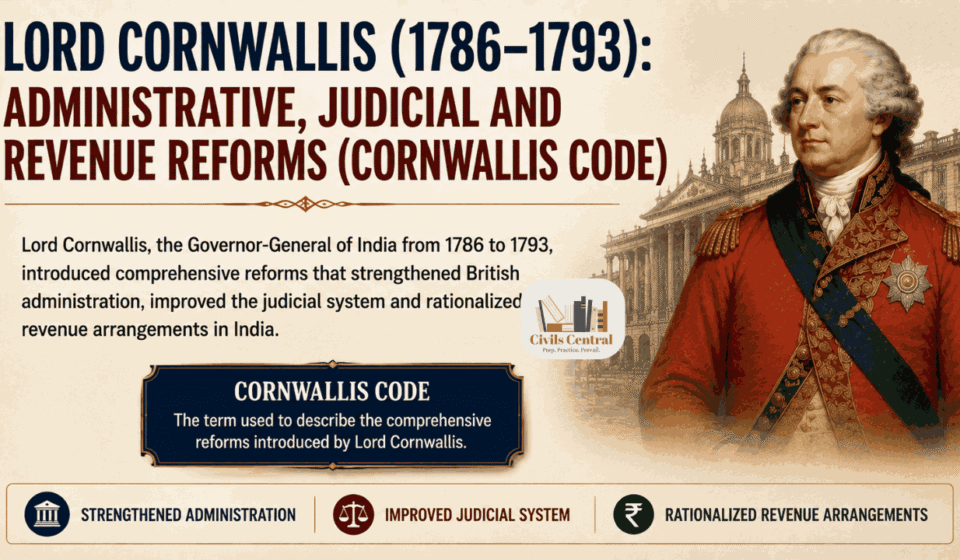

Lord Cornwallis (1786–1793): Administrative, Judicial and Revenue Reforms (Cornwallis Code)
Chapter Summary
| Chapter Information | Details |
|---|---|
| Series | Modern History of India (1707–1947) |
| Historical Period | 1786–1793 |
| Historical Phase | Administrative Consolidation under Company Rule |
| Previous Chapter | Pitt’s India Act (1784): Dual Control and Parliamentary Supervision |
| Current Chapter | Lord Cornwallis (1786–1793): Administrative, Judicial and Revenue Reforms |
| Next Chapter | Permanent Settlement (1793): Zamindari System and Land Revenue Policy |
| Core Theme | Cornwallis transformed British administration by introducing a professional civil service, separating the judiciary from the executive, reorganizing district administration, combating corruption, and codifying administration through the Cornwallis Code. |
| Major Events Covered | Cornwallis Appointment (1786), Cornwallis Code (1793), Civil Service Reforms, Judicial Reforms, Police Reforms, Separation of Powers, Administrative Centralization, Europeanization of Services |
| Key Personalities | Lord Cornwallis, William Pitt the Younger, Sir John Shore, Charles Cornwallis |
| Key Concepts | Cornwallis Code, Civil Service, Separation of Judiciary and Executive, Rule of Law, District Administration, Police Reforms, Europeanization |
| Exam Relevance | UPSC CSE, JKPSC, JKAS, State PCS, CDS, CAPF, SSC, UGC-NET (History), University Examinations |
Introduction
Why Is Lord Cornwallis Called the Father of British Civil Administration in India?
When Lord Cornwallis arrived in India as the Governor-General in 1786, the constitutional relationship between the British Government and the East India Company had already been redefined by Pitt’s India Act (1784). Parliamentary supervision had become effective, the authority of the Governor-General had been strengthened, and the British Government expected the Company to administer its Indian territories with greater efficiency, honesty, and stability.
Yet the administrative machinery inherited by Cornwallis remained deeply flawed.
Although Warren Hastings had abolished the Dual Government, reorganized revenue administration, and established the first structured judicial system, Company administration continued to suffer from serious weaknesses. Corruption among Company servants remained widespread. Revenue officials frequently exercised both executive and judicial powers, creating opportunities for arbitrary government. Salaries were low, encouraging private trade and bribery. Judicial institutions lacked uniform procedures, while policing remained weak and ineffective. District administration also suffered from inadequate supervision and unclear lines of authority.
Cornwallis believed that a stable colonial state required not merely constitutional reforms but efficient administrative institutions. His objective was therefore not to create an entirely new government but to transform the existing system into a professional, centralized, disciplined, and legally regulated administration.
Between 1786 and 1793, he introduced a comprehensive series of reforms covering almost every aspect of governance. He reorganized the Civil Service by raising official salaries, prohibiting private trade, and emphasizing merit and honesty. He separated the judiciary from the executive, reorganized the court system, and sought to establish a more impartial administration of justice. He introduced important police reforms, strengthened district administration, and codified many of these changes through the famous Cornwallis Code of 1793.
At the same time, Cornwallis introduced one of the most significant—and controversial—land revenue reforms in Indian history through the Permanent Settlement (1793), which permanently transformed agrarian relations in Bengal. Because of its enormous historical importance, the Permanent Settlement will be studied separately in the next chapter.
Cornwallis’ reforms profoundly influenced the future evolution of British administration. Many institutions established during his tenure—including the professional civil service, the district administrative system, the separation of judicial and executive functions, and the emphasis on codified administration—continued to shape colonial governance throughout the nineteenth century.
However, his administration also introduced the policy of Europeanization, excluding Indians from higher civil and judicial offices and thereby institutionalizing racial discrimination within the colonial state. For this reason, historians regard Lord Cornwallis as both the architect of the modern colonial administrative system and the administrator who firmly embedded racial exclusiveness within British governance in India.
Part I — Background: Why Were Cornwallis’ Reforms Necessary?
What Administrative System Did Lord Cornwallis Inherit in 1786?
When Lord Cornwallis assumed office as the Governor-General of Bengal in 1786, British rule in India had already entered a new constitutional phase. The Regulating Act (1773) had introduced parliamentary regulation, while Pitt’s India Act (1784) had placed the political administration of India under the effective supervision of the British Government. The East India Company was no longer merely a trading corporation; it had become the governing authority over vast territories inhabited by millions of people.
Yet, despite these constitutional developments, the actual machinery of administration remained far from satisfactory.
The reforms introduced by Warren Hastings had undoubtedly strengthened Company administration by abolishing the Dual Government, reorganizing revenue administration, and creating the first structured judicial system. However, these measures had primarily addressed immediate administrative crises. They had not yet produced a stable, professional, and disciplined bureaucracy capable of governing a rapidly expanding colonial empire.
Cornwallis therefore inherited an administration that possessed constitutional authority but lacked administrative efficiency.
Corruption Among Company Officials
One of the greatest problems confronting Cornwallis was the widespread corruption within the East India Company’s Civil Service. During the eighteenth century, Company servants received relatively low official salaries.
To compensate for this, many officials engaged in:
- Private trade.
- Acceptance of gifts from Indian rulers.
- Bribery.
- Illegal commissions.
- Misuse of official authority for personal enrichment.
Although Warren Hastings had attempted to regulate these practices, corruption continued to undermine public confidence in Company administration. Many officials viewed their positions not as public responsibilities but as opportunities for private profit. This situation damaged both administrative efficiency and the reputation of British rule.
Cornwallis concluded that honest administration could not be achieved merely through stricter punishments. Instead, the entire structure of the Civil Service required fundamental reform.
Weaknesses in the Civil Service
Closely connected with corruption was the absence of a professional Civil Service. Appointments frequently depended upon patronage, personal influence, and recommendations rather than administrative ability. Training remained inadequate. Clear service rules were largely absent. Promotion often lacked objective standards.
As a result, administrative quality varied considerably from one district to another.
Company officials performed numerous responsibilities relating to revenue collection, judicial administration, policing, and general governance without a clearly defined professional structure. Cornwallis believed that the success of British rule depended upon creating a body of well-paid, disciplined, and professionally trained civil servants devoted exclusively to government service.
This idea later became one of the defining characteristics of the British administrative system in India.
Concentration of Executive and Judicial Powers
Another serious weakness lay in the concentration of multiple powers in the hands of individual district officials. Under earlier arrangements, revenue officers frequently exercised:
- Executive authority.
- Judicial authority.
- Revenue administration.
This concentration of functions created significant opportunities for arbitrary decision-making. Officials responsible for collecting revenue also heard disputes arising from the same administration. Such an arrangement made impartial justice difficult. The absence of institutional separation between executive and judicial functions weakened public confidence in the legal system.
Cornwallis considered this concentration of authority inconsistent with the principles of good government. One of his major objectives therefore became the separation of the judiciary from the executive, an important constitutional principle that influenced later administrative development.
Problems in the Judicial System
Although Warren Hastings’ Judicial Plan of 1772 had established district courts and appellate institutions, important weaknesses remained. Judicial procedures often differed from district to district. Appeals could be slow and expensive. The responsibilities of different courts were not always clearly defined. Many judicial officers lacked adequate legal training.
Moreover, executive officials continued to exercise considerable influence over judicial administration. The constitutional conflicts involving the Supreme Court at Calcutta during the 1770s had further demonstrated the need for greater clarity and uniformity within the judicial system.
Cornwallis sought to create a more organized judicial hierarchy with clearly defined jurisdictions, professional judges, and standardized legal procedures.
Ineffective Police Administration
Law and order also presented significant challenges. The traditional policing arrangements inherited from the Mughal period had gradually weakened. Local zamindars often exercised considerable influence over police administration, but supervision remained inconsistent. Criminal investigation lacked organization.
Many districts suffered from:
- Banditry.
- Theft.
- Highway robbery.
- Weak law enforcement.
The Company possessed no centralized police organization capable of maintaining public order across its territories. Cornwallis recognized that efficient administration required not only courts of law but also an effective police system capable of enforcing judicial decisions and preventing crime.
Impact of Pitt’s India Act (1784)
The constitutional changes introduced by Pitt’s India Act also influenced Cornwallis’ reforms. The creation of the Board of Control meant that British ministers expected higher standards of administration from Company officials. Parliament no longer wished merely to regulate Company affairs.
It expected efficient, disciplined, and accountable governance. Cornwallis therefore enjoyed stronger constitutional authority than his predecessors. His administration represented the practical implementation of the constitutional principles established by Pitt’s India Act.
Where Parliament had reorganized constitutional authority, Cornwallis sought to reorganize administrative institutions.
Cornwallis’ Administrative Philosophy
Lord Cornwallis believed that good government depended upon honest officials, clear administrative rules, and institutional discipline. Unlike some earlier administrators who relied heavily upon individual discretion, Cornwallis preferred administration based upon:
- Written regulations.
- Clearly defined responsibilities.
- Fixed procedures.
- Professional officials.
- Strict supervision.
He believed that efficient government should operate through institutions rather than personalities. This philosophy led him to codify many of his reforms in the Cornwallis Code (1793), one of the earliest comprehensive administrative codes introduced by the British in India.
Although many of his policies later attracted criticism—particularly the exclusion of Indians from higher administrative offices—his commitment to institutional administration profoundly influenced the future evolution of the colonial state.
CivilsCentral Historical Insight
Lord Cornwallis inherited an administration that had acquired constitutional authority but lacked administrative professionalism. Corruption, poorly paid officials, overlapping executive and judicial functions, weak policing, and inconsistent legal procedures convinced him that British rule required disciplined institutions rather than temporary administrative adjustments. His reforms were therefore designed not merely to improve governance but to build a permanent colonial administrative structure. For this reason, Cornwallis is remembered as the architect of the professional civil service and institutional administration in British India.
Part II — Civil Service Reforms: How Did Lord Cornwallis Create the First Professional Bureaucracy in British India?
Why Did Cornwallis Consider Civil Service Reform Essential?
Among all the reforms introduced by Lord Cornwallis, none had a more enduring impact than his reorganization of the Civil Service. Cornwallis believed that no administrative system could function efficiently if the officials responsible for governing it were poorly paid, corrupt, or inadequately supervised.
During the eighteenth century, the East India Company’s Civil Service had acquired a reputation for corruption. Many Company servants regarded India as a place where fortunes could be accumulated rapidly through private trade, acceptance of gifts, commissions, and misuse of official authority. Low salaries and weak institutional discipline encouraged these practices, while appointments often depended upon patronage rather than administrative merit.
Cornwallis was convinced that honest administration required structural reform rather than merely stricter punishments. His solution was to create a professional, disciplined, and well-paid bureaucracy whose members would devote themselves exclusively to public administration instead of private commercial gain.
These reforms fundamentally transformed the nature of Company administration and laid the foundations of what later evolved into the Indian Civil Service (ICS).
Raising Salaries to Reduce Corruption
The first major step taken by Cornwallis was the substantial increase in the salaries of Company officials. This policy was based on a simple administrative principle. If public servants received adequate legal remuneration, they would have fewer incentives to engage in corrupt practices. Senior officials, particularly District Collectors and other important administrative officers, received significantly higher salaries than before.
The increase represented a major financial commitment by the Company. However, Cornwallis regarded this expenditure as an investment in administrative integrity. Higher salaries were accompanied by stricter expectations regarding honesty, efficiency, and public conduct. Officials were expected to treat government service as a permanent profession rather than an opportunity for personal enrichment.
This principle became one of the defining characteristics of British civil administration throughout the colonial period.
Prohibition of Private Trade and Acceptance of Gifts
Merely increasing salaries could not eliminate corruption unless alternative sources of private income were also prohibited. Accordingly, Cornwallis introduced strict regulations forbidding Company officials from engaging in:
- Private trade.
- Commercial speculation.
- Acceptance of gifts from Indian rulers or influential individuals.
- Personal financial dealings connected with official responsibilities.
These restrictions represented a significant departure from earlier administrative practices. Previously, many Company servants had supplemented their official income through commercial activities that frequently conflicted with their governmental duties. Cornwallis insisted that government officials should possess only one loyalty—the service of the state.
By separating public office from private commercial interests, he sought to establish the ethical foundations of a professional bureaucracy.
Merit, Discipline and Administrative Responsibility
Cornwallis also emphasized the importance of discipline and administrative responsibility. Officials were expected to maintain accurate records, follow written regulations, and perform their duties according to established administrative procedures. Greater importance was attached to competence, efficiency, and integrity.
Although appointments continued to be influenced by patronage to some extent, Cornwallis encouraged the development of a more professional administrative culture in which official conduct was regulated by institutional rules rather than personal discretion. He believed that administration should depend upon laws and procedures, not upon the individual character of particular officials.
This administrative philosophy later became one of the central features of British governance in India.
Europeanization of the Higher Civil Service
One of the most controversial aspects of Cornwallis’ reforms was the policy known as Europeanization. Cornwallis believed that higher administrative offices should be reserved almost exclusively for Europeans, particularly British officials. He argued that British officers were more trustworthy, better trained, and less susceptible to local political pressures than Indian officials.
Consequently, Indians were largely excluded from senior positions in:
- Civil administration.
- Revenue administration.
- Higher judicial offices.
They continued to serve in many subordinate capacities, but the highest posts increasingly became the exclusive preserve of Europeans. This policy marked a significant departure from earlier practices under both the Mughal administration and Warren Hastings, where experienced Indian officials had continued to play an important role in governance.
The Europeanization of the Civil Service institutionalized racial discrimination within the colonial administrative structure and remained a characteristic feature of British rule for many decades.
Separation Between Administration and Commerce
Another important consequence of Cornwallis’ reforms was the clearer separation between administrative service and commercial activity. During the earlier phase of Company Rule, officials frequently combined governmental responsibilities with commercial interests. Cornwallis considered this arrangement fundamentally incompatible with good governance.
By prohibiting private trade and emphasizing exclusive dedication to public service, he transformed Company officials from merchant-administrators into professional civil servants. This represented an important constitutional and administrative development. The East India Company continued to exist as a commercial corporation, but its administrative officers increasingly functioned as servants of a territorial government rather than commercial agents.
This transformation reflected the broader constitutional changes initiated by Pitt’s India Act (1784).
Impact on British Administration
Cornwallis’ Civil Service reforms produced far-reaching consequences. Corruption declined significantly among senior officials. Administrative discipline improved. Greater uniformity developed in governmental procedures. District administration became more systematic.
Most importantly, the Company acquired a permanent body of professional administrators capable of implementing policies consistently across different regions. Although the Civil Service continued to evolve during the nineteenth century, the essential principles introduced by Cornwallis remained unchanged. High salaries, exclusive public service, strict administrative discipline, and centralized supervision became permanent features of the colonial bureaucracy.
These principles later influenced the organization of the Indian Civil Service, often described as the “steel frame” of British India.
Historical Assessment
Historians generally regard Cornwallis’ Civil Service reforms as among the most successful administrative measures introduced during the eighteenth century. They established professional standards that greatly improved administrative efficiency and reduced corruption. At the same time, the policy of Europeanization attracted sustained criticism.
By excluding Indians from higher offices, Cornwallis created a racially exclusive bureaucracy that limited opportunities for qualified Indians and reinforced the colonial character of British administration. Thus, his Civil Service reforms possessed both administrative strengths and political limitations.
They created one of the world’s most disciplined bureaucratic systems while simultaneously institutionalizing racial inequality within the colonial state.
CivilsCentral Historical Insight
Cornwallis transformed the East India Company’s officials from merchant-administrators into professional civil servants. Through higher salaries, prohibition of private trade, strict discipline, and codified service rules, he created the foundations of a modern bureaucracy. Yet by reserving higher administrative offices almost exclusively for Europeans, he also introduced the policy of Europeanization, embedding racial exclusiveness within the colonial administrative system. His Civil Service reforms therefore represent both the birth of professional administration and the beginning of institutional racial discrimination in British India.
Part III — Judicial Reforms: How Did Lord Cornwallis Build the Foundations of an Independent Judicial System?
Why Did Cornwallis Consider Judicial Reform Necessary?
Although Warren Hastings had introduced the Judicial Plan of 1772 and established the first organized court system in British India, the administration of justice continued to suffer from important weaknesses. Revenue officials frequently exercised judicial powers alongside their executive responsibilities, creating opportunities for arbitrary decisions and conflicts of interest. Judicial procedures varied from district to district, appeals were often delayed, and the distinction between executive authority and judicial authority remained unclear.
Lord Cornwallis believed that a stable government required not only efficient administrators but also an independent and impartial judicial system.
His objective was therefore to establish a judicial structure in which courts functioned according to clearly defined legal procedures rather than administrative convenience. He sought to ensure that justice was administered by judicial officers instead of executive officials whose primary concern was revenue collection.
These reforms culminated in the Cornwallis Code of 1793, which became one of the earliest systematic legal codes introduced by the British in India.
Separation of the Judiciary from the Executive
The most significant feature of Cornwallis’ judicial reforms was the separation of judicial functions from executive administration. Before Cornwallis, district officials often combined multiple responsibilities. The same officer could collect land revenue, supervise district administration, maintain public order, and hear judicial disputes. Cornwallis regarded this concentration of authority as inconsistent with the principles of fair administration.
A revenue officer responsible for maximizing government income could not always act as an impartial judge in disputes involving taxpayers. Accordingly, Cornwallis introduced the principle that judicial authority and executive authority should be exercised by separate officials. Revenue administration remained with executive officers, while judicial work increasingly became the responsibility of dedicated courts and judges.
Although the separation was not absolute by modern standards, it represented a major constitutional advance in colonial administration.
Reorganization of the District Courts
Cornwallis reorganized the judicial system into a clearer hierarchy. At the district level, District Diwani Adalats continued to hear civil cases relating to property, contracts, inheritance, and other civil disputes. Unlike earlier arrangements, these courts came under greater supervision and were expected to follow more uniform legal procedures.
Judicial officers received clearer responsibilities and worked within a more structured administrative framework. For criminal justice, District Faujdari Adalats continued to function. These courts dealt with offences such as theft, assault, robbery, and other criminal matters. Although Islamic criminal law formally continued to influence criminal proceedings during this period, the Company exercised increasing supervision over judicial administration.
The overall objective was to create a more organized and predictable system of justice across Company territories.
Strengthening the Appellate System
Cornwallis also strengthened the system of appeals. Above the district courts stood the:
- Sadar Diwani Adalat for civil appeals.
- Sadar Nizamat Adalat for criminal appeals.
These higher courts exercised supervisory authority over the district judiciary. They reviewed important judgments, corrected procedural errors, and promoted greater uniformity in the interpretation of law. The appellate structure reduced the possibility that local judicial errors would remain uncorrected.
It also contributed to the gradual development of a more centralized judicial administration under Company supervision.
Equality Before the Law
One important principle emphasized by Cornwallis was that judicial decisions should increasingly be based upon legal rules rather than personal status. Company courts sought to administer justice through established legal procedures applicable within their jurisdiction. Although colonial society remained deeply unequal, Cornwallis attempted to strengthen the idea that disputes should be resolved through courts rather than arbitrary executive intervention.
This represented an important development in the growth of the rule of law under British administration. However, equality before the law remained limited in practice. Europeans often enjoyed legal advantages, and important differences continued to exist between the treatment of British subjects and Indian inhabitants.
Nevertheless, the growing emphasis upon regular judicial procedures marked a significant change from earlier administrative practices.
Continued Recognition of Personal Laws
While Cornwallis reorganized judicial institutions, he did not attempt to replace India’s traditional personal laws. The policy introduced by Warren Hastings continued.
Accordingly:
- Hindu law governed Hindus in matters relating to marriage, inheritance, adoption, caste, and religious customs.
- Islamic law governed Muslims in corresponding personal matters.
British judges frequently relied upon Pandits and Maulvis to interpret these legal traditions during judicial proceedings. Thus, although the judicial administration became increasingly British in organization, important aspects of substantive personal law remained rooted in Indian legal traditions. This policy helped reduce resistance to British judicial reforms while allowing the Company to claim respect for established customs.
Codification Through the Cornwallis Code (1793)
The various administrative and judicial reforms introduced by Cornwallis were brought together in the Cornwallis Code of 1793. The Code did not create an entirely new legal system.
Instead, it systematically codified regulations governing:
- Civil administration.
- Judicial organization.
- Revenue administration.
- Police administration.
- Duties of public officials.
- Judicial procedures.
By reducing dependence upon personal discretion and increasing reliance upon written regulations, the Code promoted greater administrative uniformity throughout British territories. It became one of the earliest comprehensive administrative codes enacted during British rule in India. Later Governors-General expanded and modified its provisions, but the principle of codified administration remained a permanent feature of colonial governance.
Impact of Cornwallis’ Judicial Reforms
Cornwallis’ judicial reforms produced lasting consequences. The administration of justice became more systematic and hierarchical. Executive interference in judicial proceedings declined. Appellate supervision strengthened consistency in legal decisions. Written regulations reduced uncertainty regarding judicial procedures.
These reforms also reinforced the broader administrative philosophy introduced by Cornwallis. Government increasingly functioned through institutions governed by written rules rather than through the personal discretion of individual officials. Although many deficiencies remained, the judicial system established under Cornwallis provided the institutional foundation upon which later legal reforms were built during the nineteenth century.
Historical Assessment
Historians generally acknowledge that Cornwallis made a major contribution to the institutional development of the British judicial system in India. His insistence upon separating judicial and executive functions strengthened administrative impartiality and promoted the growth of professional courts.
The Cornwallis Code introduced greater legal certainty and administrative discipline. However, historians also point out important limitations. Senior judicial positions remained largely reserved for Europeans. Indian participation in higher judicial administration was significantly reduced. Furthermore, the judicial system ultimately served the interests of a colonial state whose primary objective remained the maintenance of British political authority.
Thus, Cornwallis’ judicial reforms simultaneously advanced the principles of legal administration while reinforcing the institutional foundations of colonial rule.
CivilsCentral Historical Insight
Cornwallis transformed the administration of justice by separating judicial functions from executive authority, strengthening the appellate system, and codifying legal administration through the Cornwallis Code (1793). These reforms introduced greater judicial professionalism and procedural uniformity, laying the foundations of the colonial legal system. Yet the exclusion of Indians from higher judicial offices ensured that the new system reflected not only the principles of the rule of law but also the racial hierarchy that increasingly characterized British administration in India.
Part IV — Police Reforms and District Administration: How Did Lord Cornwallis Establish Law and Order in British India?
Why Did Cornwallis Reform the Police System?
An efficient judicial system could function only if law and order were effectively maintained. During the eighteenth century, British administration faced a serious challenge in this regard. While courts could pronounce judgments, the machinery responsible for preventing crime, arresting offenders, and enforcing judicial decisions remained weak and disorganized.
Under the Mughal administrative system, responsibility for maintaining law and order largely rested with zamindars, local officials, and village communities. As Mughal authority declined, this traditional arrangement gradually weakened. Many zamindars neglected their policing responsibilities, while others misused their authority for personal or local political interests. Highway robbery, dacoity, theft, and other forms of crime became increasingly common in several parts of Bengal.
The East India Company soon realized that territorial administration required a professional police organization rather than reliance upon traditional local institutions. Lord Cornwallis therefore undertook important reforms to establish a more organized police system capable of supporting the expanding colonial administration.
Removal of Police Powers from Zamindars
One of Cornwallis’ most significant reforms was the withdrawal of police authority from the zamindars. Before these reforms, many zamindars exercised considerable influence over local policing. Although they were expected to maintain peace within their estates, their performance often remained inconsistent.
Some protected criminals connected with their interests, while others failed to maintain effective law and order. Cornwallis believed that policing should become a direct responsibility of the government rather than local landed elites. Accordingly, many policing functions previously exercised by zamindars were transferred to government officials appointed and supervised by the Company.
This measure reduced the independent authority of zamindars and strengthened the administrative control of the colonial state.
Establishment of Police Stations (Thanas)
Cornwallis reorganized police administration by establishing police stations, commonly known as thanas, throughout the districts. Each thana functioned as the basic unit of police administration.
Its principal responsibilities included:
- Maintaining public order.
- Preventing crime.
- Investigating criminal offences.
- Arresting offenders.
- Assisting judicial authorities.
- Supervising local policing activities.
The creation of thanas introduced greater administrative organization into law enforcement. Instead of relying solely upon scattered local arrangements, the government now possessed permanent institutions responsible for policing defined territorial areas. This system became the foundation of police administration throughout much of British India.
Appointment of Darogas
Each thana was placed under the supervision of a government-appointed officer known as the Daroga. The Daroga became one of the most important officials in district police administration.
His duties included:
- Supervising police personnel.
- Investigating criminal complaints.
- Maintaining law and order.
- Reporting important incidents to district authorities.
- Assisting courts during criminal investigations.
Unlike the earlier system dominated by local landed interests, the Daroga represented the direct authority of the colonial government. Through these officers, Cornwallis sought to create a police organization that was accountable to the administration rather than to local political elites.
Although the Daroga system later attracted criticism for corruption and abuse of authority, it represented a major administrative innovation during the late eighteenth century.
Strengthening District Administration
Cornwallis also reorganized the broader structure of district administration. The district increasingly became the basic unit of British governance.
Each district contained officials responsible for:
- Revenue administration.
- Judicial administration.
- Police administration.
- General executive functions.
Although judicial and executive responsibilities were increasingly separated, district administration remained carefully coordinated through clearly defined institutional structures. The District Collector continued to play a central role in revenue administration, while judicial officers and police officials performed their respective duties within their own jurisdictions. This administrative organization improved supervision and increased governmental presence throughout Company territories.
The district system created under Cornwallis remained one of the most enduring features of British administration and continues to influence district administration in modern India.
Administrative Centralization
The police reforms also contributed to the broader process of administrative centralization. Instead of relying upon local chiefs or hereditary authorities, the Company increasingly governed through officials directly appointed by the central administration. Police officers reported through an organized administrative hierarchy.
Instructions flowed from the Governor-General’s government to provincial authorities and then to district officials. This strengthened uniformity in administration and enabled the government to exercise greater control over distant regions. The centralized police organization therefore became an important instrument for maintaining political stability as British territories continued to expand.
Relationship Between Police and Judiciary
Cornwallis also sought to establish a clearer relationship between the police and the judiciary.
The police were responsible for:
- Preventing crime.
- Conducting investigations.
- Arresting accused persons.
- Producing evidence before the courts.
The courts, however, remained responsible for determining guilt and awarding punishment. This distinction reflected Cornwallis’ broader commitment to separating different governmental functions. Although the police assisted judicial administration, they did not themselves exercise judicial authority.
The reform therefore complemented the broader principle of separating executive and judicial powers introduced through Cornwallis’ judicial reforms.
Limitations of the Police Reforms
Despite their administrative importance, Cornwallis’ police reforms possessed several limitations. The Daroga system often became associated with corruption, misuse of authority, and harsh treatment of local populations. Low-ranking police officials sometimes exploited their powers for personal gain.
The police organization primarily served the interests of the colonial government by maintaining order and protecting revenue collection rather than safeguarding civil liberties in the modern sense. Furthermore, senior supervisory positions remained largely occupied by Europeans, while Indians generally served in subordinate roles.
Thus, although the reforms improved administrative organization, they also reinforced the hierarchical and colonial nature of British governance.
Historical Significance
Cornwallis’ police reforms laid the foundations of the modern police administration introduced under British rule. The establishment of thanas, the appointment of Darogas, the removal of police authority from zamindars, and the strengthening of district administration created a more centralized and professional system of law enforcement.
These institutions continued to evolve during the nineteenth century, but the essential organizational framework introduced by Cornwallis remained remarkably durable. His reforms demonstrated that effective governance required not only courts and civil servants but also a disciplined police organization capable of enforcing governmental authority throughout the territory.
CivilsCentral Historical Insight
Cornwallis transformed policing from a decentralized responsibility of zamindars into a centralized function of the colonial state. Through the establishment of thanas, the appointment of Darogas, and the strengthening of district administration, he created the institutional framework of British police administration in India. While these reforms improved law and order and supported judicial administration, they also made the police an important instrument for consolidating colonial authority and maintaining the political stability of the British Empire.
Part V — The Cornwallis Code (1793): How Did Lord Cornwallis Codify the Colonial Administrative System?
Why Is the Cornwallis Code Considered a Landmark in British Indian Administration?
By the early 1790s, Lord Cornwallis had introduced extensive reforms in almost every branch of administration. He had reorganized the Civil Service, strengthened the judicial system, restructured district administration, and introduced a more organized police system. However, Cornwallis understood that administrative reforms could not depend merely upon the personal ability of individual Governors-General.
If British rule was to remain stable and efficient, its institutions had to function according to uniform written rules rather than personal discretion. With this objective, Cornwallis consolidated many of his administrative regulations into a comprehensive body of rules known as the Cornwallis Code of 1793.
Although it was not a single statute enacted at one time, the Code represented a systematic collection of regulations governing the administration of British India. It became one of the earliest attempts to create a codified administrative framework for the colonial state.
The Need for Administrative Codification
Before the Cornwallis Code, many administrative decisions depended upon executive discretion. Different districts often followed different procedures. Officials interpreted regulations inconsistently. Judicial practices varied from one region to another. Revenue administration also lacked complete uniformity.
Such inconsistency created uncertainty for both officials and the people governed by the Company. Cornwallis believed that efficient administration required predictable rules applicable throughout Company territories. Written regulations would reduce confusion, improve accountability, and ensure that officials performed their duties according to established procedures rather than personal preference.
Codification therefore became an essential part of his administrative philosophy.
Major Features of the Cornwallis Code
The Cornwallis Code brought together regulations concerning several branches of government into a coherent administrative system.
Its principal features included:
- Reorganization of the Civil Service.
- Separation of the judiciary from the executive.
- Regulation of district administration.
- Codification of judicial procedures.
- Reorganization of police administration.
- Standardization of official responsibilities.
- Greater administrative accountability.
Rather than creating entirely new institutions, the Code systematized and regularized reforms that had already been introduced during Cornwallis’ administration. This made government more uniform and predictable across Company territories.
Codification of Civil Administration
The Code clearly defined the duties and powers of civil officials.
Administrative officers were expected to:
- Follow written regulations.
- Maintain official records.
- Observe financial discipline.
- Avoid conflicts of interest.
- Perform duties within clearly defined legal limits.
This reduced dependence upon personal discretion. Officials became accountable not only to their immediate superiors but also to the written administrative rules governing their conduct.
The result was a more disciplined and professional bureaucracy.
Standardization of Judicial Procedures
The Cornwallis Code also introduced greater uniformity into judicial administration. The organization of courts, appellate procedures, and judicial responsibilities became more clearly defined.
The Code strengthened:
- District Diwani Adalats.
- District Faujdari Adalats.
- Sadar Diwani Adalat.
- Sadar Nizamat Adalat.
It also established clearer procedural rules regarding:
- Filing of suits.
- Hearing of evidence.
- Appeals.
- Judicial responsibilities.
- Court administration.
The objective was to ensure that justice was administered according to established legal procedures rather than arbitrary local practices.
Administrative Accountability
Another important feature of the Code was its emphasis on administrative accountability. Every government official occupied a clearly defined position within an organized administrative hierarchy.
Each officer possessed:
- Defined responsibilities.
- Defined powers.
- Defined reporting relationships.
Regular supervision became an essential feature of administration. Senior officials reviewed the work of subordinate officers, while written reports created greater transparency within the administrative system. This hierarchical organization strengthened governmental control and improved administrative coordination.
Strengthening Centralized Government
The Cornwallis Code reinforced the process of administrative centralization that had begun under Warren Hastings and received constitutional support through Pitt’s India Act (1784). The Governor-General’s government increasingly exercised authority through standardized regulations applicable across Company territories.
District officials no longer depended solely upon local customs or personal judgment. Instead, they implemented policies formulated by the central administration. This strengthened the authority of the colonial state and promoted greater uniformity throughout British India.
Limitations of the Cornwallis Code
Despite its administrative achievements, the Cornwallis Code reflected the limitations of colonial governance. Its regulations primarily served the interests of the British administration rather than those of the Indian population. The Code emphasized administrative efficiency, revenue collection, and political stability above representative governance. Another significant limitation was the continuation of Europeanization.
Higher administrative and judicial offices remained largely reserved for Europeans. Qualified Indians continued to occupy subordinate positions despite possessing considerable administrative experience. Thus, while the Code promoted institutional efficiency, it also reinforced the racial hierarchy that increasingly characterized British administration. Furthermore, the Code was designed for the Company’s territories in Bengal and was only gradually extended or adapted elsewhere.
It therefore did not immediately create a uniform administrative system throughout the entire Indian subcontinent.
Historical Importance of the Cornwallis Code
The Cornwallis Code occupies an important place in the constitutional and administrative history of British India. It represented one of the earliest attempts to govern a large colonial territory through codified administrative rules rather than personal authority. Its influence extended well beyond Cornwallis’ own administration.
Later Governors-General continued to expand, modify, and refine the institutional framework established by the Code. Many principles introduced by Cornwallis—including professional administration, written regulations, hierarchical supervision, separation of judicial and executive functions, and administrative accountability—remained central to British governance throughout the nineteenth century.
For this reason, historians often describe the Cornwallis Code as the administrative constitution of early British India.
CivilsCentral Historical Insight
The Cornwallis Code (1793) transformed British administration from a collection of individual reforms into a systematic framework governed by written regulations. By codifying civil administration, judicial procedures, police organization, and official responsibilities, Cornwallis ensured that the colonial state functioned through institutions rather than personalities. Although the Code greatly improved administrative discipline and efficiency, it also institutionalized European dominance within the bureaucracy, revealing both the strengths and the limitations of early colonial governance.
Part VI — Historical Evaluation: Was Lord Cornwallis the Architect of Modern Colonial Administration?
How Have Historians Assessed Cornwallis’ Reforms?
The administration of Lord Cornwallis (1786–1793) occupies a distinguished position in the history of British India because it transformed a relatively loose system of Company governance into a structured and disciplined colonial administration. While Warren Hastings laid the foundations of British administration by abolishing the Dual Government, reorganizing revenue administration, and establishing the first judicial institutions, Cornwallis converted these early experiments into permanent administrative institutions governed by written rules and professional officials.
For this reason, historians often describe Cornwallis as the father of British civil administration in India. However, this assessment is not without qualification.
Although Cornwallis introduced important reforms that strengthened administrative efficiency, he also institutionalized racial exclusiveness, restricted Indian participation in higher administration, and built a bureaucratic structure primarily designed to strengthen colonial rule rather than promote representative government.
Consequently, different schools of historiography have interpreted his legacy in markedly different ways.
Imperial Historiography: The Founder of Modern Administration
Early Imperial historians regarded Cornwallis as one of the greatest administrators produced by the British Empire. According to this interpretation, India during the 1780s required an honest, disciplined, and efficient government capable of maintaining political stability after decades of administrative confusion. Cornwallis achieved this objective through comprehensive institutional reforms.
Imperial historians praised his:
- Professional Civil Service.
- Separation of the judiciary from the executive.
- Police reforms.
- Administrative centralization.
- Cornwallis Code (1793).
They argued that these reforms replaced arbitrary government with rule-based administration. The higher salaries granted to officials reduced corruption, while written regulations promoted administrative uniformity. From this perspective, Cornwallis established the institutional foundations of a modern bureaucracy that continued to function effectively throughout the nineteenth century.
Nationalist Historiography: Efficient Administration for Colonial Purposes
Indian Nationalist historians acknowledged Cornwallis’ administrative abilities but questioned the objectives of his reforms. According to this interpretation, the primary purpose of the new administrative system was not the welfare of Indians but the consolidation of British colonial rule.
The Civil Service, judiciary, police, and district administration were designed to ensure:
- Efficient revenue collection.
- Political stability.
- Protection of British authority.
- Expansion of colonial governance.
Nationalist historians also criticized the policy of Europeanization. By excluding Indians from higher administrative and judicial positions, Cornwallis institutionalized racial discrimination within the colonial state. Many capable Indian officials who had previously served under the Mughal administration and Warren Hastings found themselves excluded from important offices.
Thus, although administrative efficiency improved, political inequality also became more firmly entrenched.
Marxist Interpretation: Bureaucracy in the Service of Colonial Economy
Marxist historians interpret Cornwallis’ reforms primarily in relation to the economic objectives of colonialism. According to this perspective, the reorganization of administration created a bureaucratic apparatus capable of ensuring regular revenue collection and protecting British commercial interests. The professional Civil Service supervised taxation.
The judiciary protected property rights. The police maintained political order. District administration integrated these institutions into a centralized system supporting colonial economic exploitation. From this viewpoint, administrative reforms cannot be separated from the broader expansion of colonial capitalism.
The efficiency of the bureaucracy ultimately served imperial economic objectives rather than social justice or representative governance.
Revisionist Historiography: Administrative Modernization with Colonial Constraints
Modern Revisionist historians generally adopt a more balanced interpretation. They argue that Cornwallis was genuinely committed to improving administrative efficiency and reducing corruption.
His reforms introduced important principles such as:
- Professional public service.
- Institutional accountability.
- Separation of powers.
- Written administrative regulations.
- Hierarchical organization.
These principles represented significant advances in governmental administration. At the same time, revisionist historians acknowledge that these institutions functioned within a colonial political framework. The bureaucracy served an imperial government rather than a representative state. Europeanization limited administrative inclusiveness.
Consequently, Cornwallis’ reforms simultaneously represented administrative modernization and colonial consolidation.
Lasting Contributions
Despite continuing historical debate, there is broad agreement regarding Cornwallis’ long-term contributions. He transformed the Civil Service into a professional bureaucracy. He strengthened judicial administration through institutional separation and codification. He reorganized police administration. He strengthened district administration. He promoted administrative centralization.
He introduced one of the earliest comprehensive administrative codes in British India. Many of these institutional principles survived throughout British rule and influenced administrative practices even after independence.
Modern district administration, hierarchical bureaucracy, written service regulations, and several judicial traditions trace important elements of their historical development to Cornwallis’ reforms.
Historical Legacy
Lord Cornwallis occupies a distinctive place in Indian constitutional and administrative history because his reforms gave institutional permanence to British rule. Previous Governors had introduced important innovations, but Cornwallis transformed these innovations into organized administrative systems governed by written rules rather than individual discretion.
His administration demonstrated that the British Empire intended to govern India through bureaucratic institutions rather than temporary commercial arrangements. At the same time, his policy of excluding Indians from higher offices revealed the racial assumptions underlying the colonial state. His legacy is therefore complex. He strengthened administrative professionalism while simultaneously reinforcing political inequality.
For this reason, Cornwallis remains one of the most influential—and one of the most debated—administrators in the history of British India.
CivilsCentral Historical Insight
Lord Cornwallis transformed British rule in India from an experimental administrative system into a permanent bureaucratic state. His Civil Service reforms, judicial reorganization, police administration, and Cornwallis Code created institutions that shaped colonial governance for more than a century. Yet the same reforms also introduced Europeanization, excluding Indians from higher offices and embedding racial hierarchy within the colonial administration. Cornwallis should therefore be remembered as both the architect of modern colonial administration and the administrator who institutionalized bureaucratic imperialism in British India.
Part VII — Conclusion: Why Are Cornwallis’ Reforms a Turning Point in the Evolution of British Administration?
From Constitutional Reform to Administrative Consolidation
The administration of Lord Cornwallis (1786–1793) marks one of the most decisive phases in the evolution of British rule in India. The Regulating Act (1773) had initiated parliamentary regulation, while Pitt’s India Act (1784) established effective governmental supervision over the East India Company. Cornwallis carried this constitutional transformation a step further by creating the administrative institutions necessary to govern a territorial empire efficiently.
His reforms converted the East India Company from a commercial organization exercising political power into a disciplined colonial administration functioning through professional officials, organized courts, codified regulations, and centralized authority. For this reason, Cornwallis occupies a unique position in Indian history.
He was not merely an administrator implementing earlier constitutional reforms; he was the statesman who transformed those constitutional principles into permanent administrative institutions.
Institutional Achievements
Cornwallis’ greatest contribution lay in building institutions rather than relying upon individual administrators. His Civil Service reforms established the principles of professional public administration by increasing salaries, prohibiting private trade, enforcing discipline, and emphasizing official integrity.
His judicial reforms strengthened the rule of law by separating judicial functions from executive authority, reorganizing the hierarchy of courts, and promoting more uniform legal procedures.
His police reforms created a centralized system of law enforcement through thanas and Darogas, reducing the dependence upon zamindars for maintaining public order.
The Cornwallis Code (1793) consolidated these reforms into a systematic administrative framework, ensuring that government operated according to written regulations rather than personal discretion. Collectively, these measures laid the foundations of the colonial bureaucracy that continued to govern British India for more than a century.
Administrative Strengths
The reforms introduced by Cornwallis significantly improved the efficiency of British administration. Corruption among senior officials declined because higher salaries and strict service rules reduced opportunities for personal enrichment.
Administrative responsibilities became more clearly defined. Judicial procedures became more systematic. District administration developed into the basic unit of colonial governance. Greater centralization enabled the Governor-General’s government to supervise distant territories more effectively. These institutional improvements increased the stability of British rule and strengthened the administrative capacity of the colonial state.
Many principles introduced by Cornwallis—including professional bureaucracy, written service rules, hierarchical administration, and institutional accountability—continued to influence governance long after his departure from India.
Limitations of the Reforms
Despite these achievements, Cornwallis’ reforms also possessed important limitations. His policy of Europeanization excluded Indians from higher positions in the Civil Service and judiciary. Although Indians continued to serve in subordinate capacities, the most influential administrative and judicial offices became almost exclusively reserved for Europeans.
This policy institutionalized racial discrimination within the colonial bureaucracy and reduced opportunities for capable Indian administrators. Moreover, the administrative system primarily served the objectives of the colonial government. Its principal concerns were efficient revenue collection, political stability, maintenance of law and order, and protection of British authority.
Representative government, political participation, and democratic accountability remained entirely absent. The reforms therefore strengthened the efficiency of colonial administration without altering its fundamentally imperial character.
Historical Legacy
The influence of Cornwallis extended far beyond his own period of administration. Later Governors-General—including Lord Wellesley, Lord William Bentinck, and Lord Dalhousie—built upon the institutional foundations that Cornwallis had established. The professional Civil Service eventually evolved into the Indian Civil Service (ICS), often described as the “steel frame” of British India.
The district administration, judicial hierarchy, police organization, and codified administrative procedures introduced during his tenure continued to shape colonial governance throughout the nineteenth century.
Even after India’s independence in 1947, several administrative institutions created or strengthened by Cornwallis remained part of the country’s governmental framework, although they were gradually adapted to democratic constitutional principles.
Final Reflection
The historical importance of Lord Cornwallis lies not simply in the number of reforms that he introduced but in the institutional transformation that he achieved. He believed that a stable government should function through professional officials, written laws, organized courts, disciplined administration, and clearly defined responsibilities.
These ideas profoundly influenced the development of British administration in India. At the same time, his commitment to Europeanization ensured that the administrative system remained racially exclusive and politically colonial. For students of Modern Indian History, Cornwallis should therefore be remembered as the architect of the modern colonial administrative system.
His reforms established the institutional foundations of British governance, but they also demonstrated how administrative modernization could coexist with imperial domination and racial inequality. The legacy of Cornwallis is therefore one of administrative excellence combined with colonial exclusiveness, making him one of the most influential administrators in the history of British India.
CivilsCentral Historical Insight
Lord Cornwallis transformed British rule from a collection of administrative experiments into a permanent bureaucratic state. His Civil Service reforms created a professional administration, his judicial reforms strengthened the rule of law, his police reforms centralized law enforcement, and the Cornwallis Code institutionalized governance through written regulations. Yet by excluding Indians from higher offices, he also embedded racial hierarchy within the colonial administration. Cornwallis should therefore be remembered not only as the father of British civil administration in India but also as the architect of a highly efficient yet fundamentally colonial bureaucratic system.
Part VIII — Key Takeaways from Lord Cornwallis (1786–1793) and the Cornwallis Code (1793)
The administration of Lord Cornwallis (1786–1793) marks a decisive stage in the evolution of British rule in India. If Warren Hastings laid the foundations of Company administration and Pitt’s India Act (1784) established parliamentary supervision, Cornwallis transformed these constitutional principles into a professional, centralized, and codified administrative system.
His reforms touched every major branch of governance. He reorganized the Civil Service, separated the judiciary from the executive, reformed the police, strengthened district administration, and consolidated these changes through the Cornwallis Code (1793). At the same time, his policy of Europeanization excluded Indians from higher administrative offices, making the bureaucracy more efficient but also more racially exclusive.
For UPSC aspirants, Cornwallis is remembered as the Father of the British Civil Service in India and one of the principal architects of the colonial administrative system.
Timeline at a Glance
| Year | Event | Historical Importance |
|---|---|---|
| 1784 | Pitt’s India Act | Created the Board of Control and Dual Control. |
| 1786 | Lord Cornwallis became Governor-General | Began comprehensive administrative reforms. |
| 1786–1793 | Civil Service Reforms | Created a professional and better-paid bureaucracy. |
| 1787–1792 | Judicial and Police Reforms | Reorganized courts and law enforcement. |
| 1793 | Cornwallis Code | Codified civil, judicial, police, and administrative regulations. |
| 1793 | Permanent Settlement | Introduced the Zamindari land revenue system in Bengal. |
Key Personalities
| Personality | Contribution |
|---|---|
| Lord Cornwallis | Introduced comprehensive administrative, judicial, police, and civil service reforms. |
| William Pitt the Younger | Created the constitutional framework through Pitt’s India Act (1784). |
| Warren Hastings | Laid the foundations of Company administration before Cornwallis. |
| Sir John Shore | Assisted in revenue administration and later succeeded Cornwallis as Governor-General. |
Constitutional Sequence
Regulating Act (1773)
          │
          ▼
Pitt's India Act (1784)
          │
          ▼
Lord Cornwallis (1786)
          │
          ▼
Civil Service Reforms
          │
          ▼
Judicial Reforms
          │
          ▼
Police Reforms
          │
          ▼
Cornwallis Code (1793)
          │
          ▼
Permanent Settlement (1793)
          │
          ▼
Professional Colonial Administration
CivilsCentral Revision Insight
Remember the sequence as: Pitt’s India Act (1784) → Lord Cornwallis (1786) → Civil Service Reforms → Judicial Reforms → Police Reforms → Cornwallis Code (1793) → Permanent Settlement (1793). This sequence explains how the constitutional framework created by Parliament was transformed into a centralized colonial administrative system. Cornwallis professionalized the bureaucracy, strengthened the judiciary and police, and institutionalized governance through written regulations, making him the architect of British administrative machinery in India.
Chapter Summary
The administration of Lord Cornwallis (1786–1793) marks one of the most significant turning points in the evolution of British administration in India. While the Regulating Act (1773) introduced parliamentary regulation and Pitt’s India Act (1784) established effective governmental supervision over the East India Company, Cornwallis transformed these constitutional principles into a permanent administrative system. His reforms laid the institutional foundations of the colonial state by creating a professional civil service, reorganizing the judiciary, establishing a centralized police system, strengthening district administration, and codifying governance through the Cornwallis Code (1793).
When Cornwallis assumed office in 1786, the East India Company had already become a territorial power, but its administrative machinery remained weak and inconsistent. Corruption among Company servants was widespread because officials received low salaries and frequently supplemented their income through private trade, gifts, and unofficial commissions. Executive officers exercised judicial powers alongside revenue administration, creating conflicts of interest and opportunities for arbitrary government. Police administration depended largely upon local zamindars, whose control over law and order varied considerably from one district to another. Although Warren Hastings had initiated important reforms, British administration still lacked the professional institutions necessary for governing an expanding empire.
Cornwallis believed that an efficient government required honest officials, clear administrative rules, institutional discipline, and separation of governmental functions. His first major objective was therefore the reorganization of the Civil Service. He substantially increased the salaries of Company officials, prohibited private trade and the acceptance of gifts, enforced stricter service discipline, and emphasized integrity in public administration. These reforms transformed Company servants from merchant-administrators into professional government officials. At the same time, Cornwallis introduced the policy of Europeanization, reserving almost all higher civil and judicial offices for Europeans. Although this policy strengthened administrative uniformity from the British perspective, it excluded qualified Indians from positions of authority and institutionalized racial discrimination within the colonial bureaucracy.
Judicial reform formed another central aspect of Cornwallis’ administration. Recognizing that revenue officials should not simultaneously exercise judicial authority, he introduced the principle of separating the judiciary from the executive. Civil and criminal courts were reorganized into a more systematic hierarchy, appellate courts were strengthened, and judicial procedures became more uniform. The District Diwani Adalats, District Faujdari Adalats, Sadar Diwani Adalat, and Sadar Nizamat Adalat were placed within a clearer judicial structure. At the same time, Cornwallis continued the policy of applying Hindu law and Islamic law in matters relating to personal laws while strengthening the Company’s supervision over judicial administration. These reforms promoted greater legal certainty and reinforced the principle that justice should be administered through organized courts rather than executive discretion.
Cornwallis also introduced important police reforms. The traditional system under which zamindars exercised responsibility for policing was replaced by a more centralized structure directly controlled by the colonial government. Police stations (thanas) were established throughout the districts, each supervised by a Daroga appointed by the government. These reforms created a permanent police organization responsible for maintaining law and order, preventing crime, assisting judicial authorities, and enforcing governmental authority. Although the police system later attracted criticism for corruption and excessive use of power, it became one of the enduring institutions of British administration.
These administrative reforms were consolidated through the Cornwallis Code of 1793, which systematically codified regulations relating to civil administration, judicial organization, police administration, and official responsibilities. The Code emphasized government through written regulations rather than personal discretion, promoted administrative accountability, strengthened centralized supervision, and provided greater uniformity across Company territories. Historians frequently describe the Cornwallis Code as the administrative constitution of early British India because it gave institutional permanence to the reforms introduced during Cornwallis’ administration.
Historians have interpreted Cornwallis’ legacy from different perspectives. Imperial historians have praised him as the founder of modern British administration in India, emphasizing his contribution to professional bureaucracy, judicial organization, and administrative efficiency. Nationalist historians have acknowledged the effectiveness of his reforms but argued that they primarily served to strengthen British colonial rule rather than improve the welfare of Indians. They particularly criticize the policy of Europeanization, which excluded Indians from higher offices and institutionalized racial inequality. Marxist historians interpret Cornwallis’ reforms as creating a bureaucratic apparatus capable of protecting colonial revenue collection and British commercial interests, while Revisionist historians view his administration as a pragmatic attempt to modernize governance within the limitations of a colonial political system.
The long-term significance of Cornwallis’ administration extends well beyond the eighteenth century. His reforms established many of the institutional principles that continued to shape British governance throughout the nineteenth century, including a professional bureaucracy, codified administration, hierarchical district governance, separation of judicial and executive functions, centralized police administration, and systematic supervision of public officials. The Indian Civil Service (ICS), often described as the “steel frame” of British India, developed directly from the administrative philosophy introduced by Cornwallis. At the same time, the racial exclusiveness embedded within his reforms remained a defining feature of colonial administration until the gradual opening of higher services to Indians during the late nineteenth and early twentieth centuries.
The historical importance of Lord Cornwallis therefore lies in the institutional transformation that he achieved. He converted the constitutional framework created by earlier legislation into a disciplined administrative system capable of governing a vast colonial empire. Yet this administrative modernization was inseparable from the objectives of British imperialism. Cornwallis created an efficient bureaucracy governed by written rules and professional officials, but he also ensured that this bureaucracy remained firmly under European control. His legacy is consequently one of administrative innovation combined with colonial exclusiveness, making him one of the most influential architects of British rule in India.
Frequently Asked Questions (FAQs)
1. Who was Lord Cornwallis?
Lord Charles Cornwallis served as the Governor-General of Bengal from 1786 to 1793. He is regarded as the Father of the British Civil Service in India because he reorganized the colonial administration through comprehensive reforms in the civil service, judiciary, police, and district administration. He also introduced the Cornwallis Code (1793) and the Permanent Settlement (1793).
2. Why are Lord Cornwallis’ reforms considered important?
Cornwallis’ reforms transformed the East India Company’s administration into a professional, centralized, and rule-based bureaucracy. He reduced corruption, reorganized the judiciary, created a structured police system, strengthened district administration, and codified administrative regulations. These reforms laid the institutional foundations of British colonial administration in India.
3. Why is Lord Cornwallis called the Father of the British Civil Service in India?
Cornwallis reorganized the Civil Service by:
- Increasing the salaries of Company officials.
- Prohibiting private trade.
- Banning the acceptance of gifts.
- Enforcing strict administrative discipline.
- Promoting professionalism and accountability.
These reforms created the first disciplined and professional bureaucracy under British rule and later influenced the development of the Indian Civil Service (ICS).
4. What were the major Civil Service reforms introduced by Cornwallis?
The principal Civil Service reforms included:
- Higher salaries to discourage corruption.
- Prohibition of private trade.
- Ban on accepting presents or gifts.
- Greater administrative discipline.
- Promotion of professional public service.
- Reservation of higher offices largely for Europeans.
These measures significantly improved administrative efficiency while strengthening British control over the bureaucracy.
5. What is meant by the policy of Europeanization?
Europeanization was Cornwallis’ policy of reserving almost all higher administrative and judicial posts for Europeans, particularly British officials. Indians were generally confined to subordinate positions.
Cornwallis believed that Europeans were more reliable and better suited for senior responsibilities. However, this policy institutionalized racial discrimination within the colonial administration and excluded qualified Indians from higher offices.
6. What were Cornwallis’ judicial reforms?
Cornwallis introduced several important judicial reforms:
- Separation of the judiciary from the executive.
- Reorganization of civil and criminal courts.
- Strengthening of appellate courts.
- Standardization of judicial procedures.
- Greater judicial supervision.
- Continued application of Hindu and Muslim Personal Laws in matters of religion, marriage, inheritance, and family.
These reforms strengthened the administration of justice and promoted greater legal uniformity.
7. What was the Cornwallis Code (1793)?
The Cornwallis Code (1793) was a comprehensive collection of administrative regulations that codified reforms relating to:
- Civil administration.
- Judicial administration.
- Police organization.
- Revenue administration.
- Official duties and responsibilities.
It established government through written regulations rather than personal discretion and became the administrative foundation of early British India.
8. What were Cornwallis’ police reforms?
Cornwallis introduced important police reforms by:
- Removing police powers from zamindars.
- Establishing thanas (police stations).
- Appointing Darogas as police officers.
- Creating a more centralized police organization.
- Strengthening district-level law and order.
These reforms made policing a direct responsibility of the colonial government.
9. What was the role of the Daroga?
A Daroga was the officer in charge of a thana (police station).
His responsibilities included:
- Maintaining law and order.
- Supervising police personnel.
- Investigating crimes.
- Arresting offenders.
- Assisting judicial authorities.
- Reporting to district officials.
The Daroga became an important link between the colonial administration and local policing.
10. What was the significance of separating the judiciary from the executive?
Before Cornwallis, many revenue officials also exercised judicial authority, leading to conflicts of interest.
Cornwallis separated these functions so that:
- Executive officers focused on administration and revenue.
- Judicial officers administered justice independently.
This reform promoted greater impartiality, reduced executive interference, and laid the foundation for a more organized judicial system.
11. What were the advantages of Cornwallis’ reforms?
Major advantages included:
- Professional Civil Service.
- Reduction in corruption.
- Organized judicial system.
- Separation of judiciary and executive.
- Centralized police administration.
- Codified administrative regulations.
- Greater administrative efficiency.
- Stronger district administration.
These reforms strengthened the institutional capacity of the British colonial state.
12. What were the limitations of Cornwallis’ reforms?
Despite their administrative success, the reforms had several limitations:
- Higher offices were reserved for Europeans.
- Indians were excluded from senior administrative and judicial positions.
- The bureaucracy primarily served colonial interests.
- The police often functioned as instruments of colonial control.
- The reforms did not introduce representative institutions or political participation for Indians.
13. How have historians evaluated Cornwallis’ reforms?
Historians have offered different interpretations:
- Imperial historians praised Cornwallis for creating a modern and efficient administrative system.
- Nationalist historians argued that the reforms strengthened British colonial rule and institutionalized racial discrimination.
- Marxist historians viewed the reforms as creating a bureaucracy that protected colonial revenue and economic interests.
- Revisionist historians considered them a practical administrative modernization within a colonial framework.
14. Why are Cornwallis’ reforms important for UPSC examinations?
This topic is highly important because it explains:
- Evolution of British administration.
- Development of the Civil Service.
- Judicial reforms under Company Rule.
- Separation of judiciary and executive.
- Police administration.
- Cornwallis Code (1793).
- Europeanization policy.
- Administrative centralization.
- Foundation of the colonial bureaucracy.
15. What is the long-term legacy of Lord Cornwallis?
The greatest legacy of Lord Cornwallis was the creation of a professional and centralized colonial administrative system. His reforms institutionalized a disciplined Civil Service, codified administration through the Cornwallis Code, reorganized the judiciary, strengthened police administration, and established the district as the basic unit of governance. Many of these institutional principles continued throughout British rule and influenced the later Indian Civil Service (ICS). At the same time, his policy of Europeanization entrenched racial exclusiveness within the colonial state, making his legacy one of administrative modernization combined with colonial inequality.
Mind Map
                    LORD CORNWALLIS (1786–1793)
                               │
      ┌────────────────────────┼────────────────────────┐
      │                        │                        │
      ▼                        ▼                        ▼
  BACKGROUND             MAJOR REFORMS          CORNWALLIS CODE
      │                        │                        │
 ├─ Pitt's India Act      ├─ Civil Service       ├─ Codified Rules
 ├─ Corruption            ├─ Judiciary           ├─ Administrative Laws
 ├─ Weak Judiciary        ├─ Police              ├─ Judicial Procedures
 └─ Weak Police           └─ District Admin      └─ Official Duties
                               │
      ┌────────────────────────┼────────────────────────┐
      │                        │                        │
      ▼                        ▼                        ▼
 CIVIL SERVICE            JUDICIAL REFORMS      POLICE REFORMS
      │                        │                        │
 ├─ High Salaries         ├─ Separation          ├─ Thanas
 ├─ No Private Trade      ├─ Civil Courts        ├─ Darogas
 ├─ No Gifts              ├─ Criminal Courts     ├─ Removed Zamindars
 ├─ Discipline            ├─ Appeals             └─ Centralized Police
 └─ Europeanization       └─ Rule of Law
                               │
                               ▼
                     HISTORICAL SIGNIFICANCE
                               │
      ├─ Professional Bureaucracy
      ├─ Rule-Based Administration
      ├─ Centralized Government
      ├─ Foundation of ICS
      ├─ Europeanization
      └─ Colonial Administrative State
About The Author












[…] Lord Cornwallis (1786–1793): Administrative, Judicial and Revenue Reforms […]
[…] Lord Cornwallis (1786–1793): Administrative, Judicial and Civil Service Reforms […]