
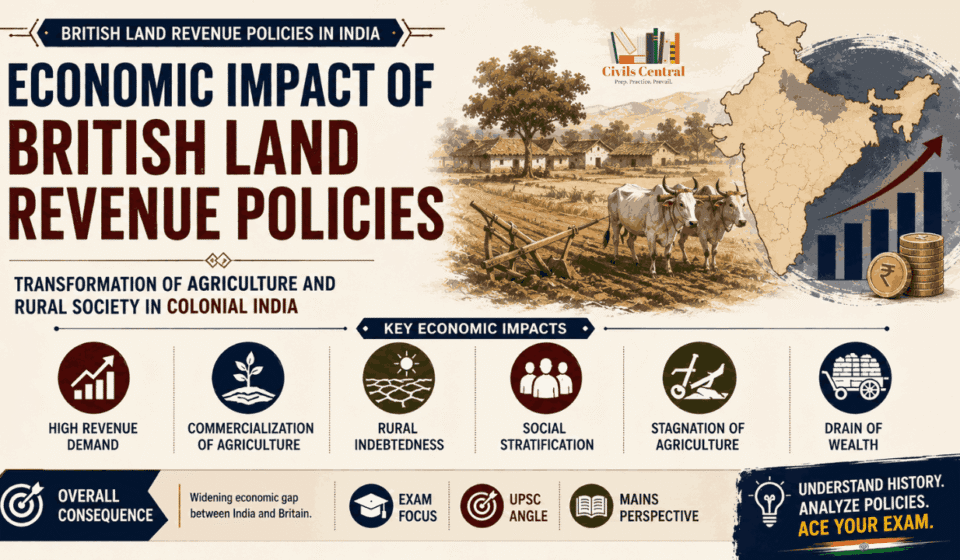
Economic Impact of British Land Revenue Policies: Transformation of Agriculture and Rural Society in Colonial India

Learning Dashboard
| Chapter Information | Details |
|---|---|
| Series | Modern History of India (1707–1947) |
| Historical Period | c. 1793–1947 |
| Historical Phase | British Land Revenue Systems and Colonial Agrarian Transformation |
| Previous Chapter | Mahalwari Settlement: Village-Based Land Revenue System in North India |
| Current Chapter | Economic Impact of British Land Revenue Policies: Transformation of Agriculture and Rural Society in Colonial India |
| Next Chapter | Economic Impact of British Rule in India: Colonialism and the Transformation of the Indian Economy |
| Core Theme | British land revenue policies transformed India’s agrarian economy by reorganizing land rights, increasing the fiscal control of the colonial state, monetising rural obligations, encouraging commercialisation, expanding rural credit, and contributing to indebtedness, land alienation and agrarian differentiation. |
| Major Developments Covered | Permanent Settlement, Ryotwari Settlement, Mahalwari Settlement, transformation of land rights, revenue pressure, monetisation of agriculture, commercialisation, rural indebtedness, land alienation, changing village society, agrarian differentiation, famines, peasant resistance and nationalist critique |
| Key Personalities | Lord Cornwallis, Thomas Munro, Holt Mackenzie, Robert Merttins Bird, Lord William Bentinck, Dadabhai Naoroji, R.C. Dutt |
| Key Concepts | Land Revenue, Zamindari, Ryotwari, Mahalwari, Revenue Demand, Commercialisation of Agriculture, Rural Indebtedness, Land Alienation, Moneylenders, Agrarian Differentiation, Colonial Agrarian Economy |
| Exam Relevance | UPSC CSE, JKPSC, JKAS, State PCS, CDS, CAPF, SSC, UGC-NET (History), University Examinations |
Introduction
Why Was Land Revenue So Important to British Rule in India?
When the East India Company acquired territorial power in India, it inherited an overwhelmingly agrarian economy in which agriculture constituted the principal source of livelihood and the countryside represented the most important source of economic surplus. The acquisition of the Diwani of Bengal, Bihar and Orissa in 1765 transformed the Company’s position fundamentally. It was no longer merely a trading corporation seeking commercial opportunities; it had become a territorial power responsible for maintaining an army, administering large territories and financing an expanding colonial state.
Land revenue consequently became one of the most important foundations of British rule.
The British did not simply inherit an existing system of agricultural taxation and leave it unchanged. Over the nineteenth century, they introduced a series of land revenue settlements designed to identify rights over land, determine who would be responsible for paying revenue, measure agricultural resources and establish a predictable relationship between the colonial government and rural society. The Permanent Settlement of 1793, the Ryotwari Settlement, and the Mahalwari Settlement represented the three principal forms through which this process developed in different regions.
At first sight, these systems appear to have been primarily administrative arrangements. The Permanent Settlement dealt with zamindars, the Ryotwari Settlement dealt directly with cultivators, and the Mahalwari Settlement dealt with village communities. Yet their consequences went much deeper than the collection of taxes. By defining property rights, recording ownership, fixing or revising revenue obligations and enforcing payment through colonial law, the British gradually altered the economic structure of rural India.
The consequences were particularly significant because agricultural revenue had to be paid increasingly in money. A cultivator who previously produced much of what his household consumed now had greater reason to sell agricultural produce in the market in order to obtain cash. This encouraged the expansion of commercial agriculture and connected Indian villages more closely with regional, national and international markets.
However, greater market integration did not automatically mean greater rural prosperity. A cultivator with adequate land, savings and access to markets could benefit from rising prices and commercial crops. A small cultivator facing a poor harvest, high revenue demand and limited access to institutional credit could instead be pushed into debt. The resulting dependence on moneylenders contributed in many regions to land alienation and the emergence of new rural classes.
This transformation also changed the relationship between agriculture and the colonial economy. Indian agriculture increasingly supplied raw materials and commercial crops demanded by British and international markets, while the colonial state extracted revenue from agricultural production. The countryside became more deeply integrated into a wider economic system that was ultimately structured by the priorities of British imperialism.
The impact was therefore contradictory. British rule introduced systematic land surveys, written records, legal definitions of property, expanding markets and, in some regions, improvements in transport and irrigation. Yet these developments occurred within a colonial fiscal framework whose primary objective was not the balanced development of Indian agriculture but the efficient extraction of revenue and the integration of India into the imperial economy.
Understanding this transformation is essential because the economic consequences of British land revenue policies cannot be separated from the wider history of colonialism. The agrarian changes produced by these settlements contributed to rural poverty, indebtedness, social differentiation and peasant resistance, while also becoming an important subject of the emerging economic critique of colonial rule developed by Indian nationalists.
Part I — Background: Why Did British Land Revenue Policies Transform Rural India?
Why Did the British Need a New Agrarian Revenue System?
The British inherited diverse forms of landholding and revenue collection across India. Agricultural rights were shaped by local customs, village institutions, zamindars, chiefs, cultivators and regional political traditions. The colonial state, however, required a system that could convert this complex agrarian structure into a predictable fiscal arrangement.
The Company’s financial requirements made this particularly important. Maintaining armies, paying officials, financing wars and administering newly acquired territories required regular income. Land revenue was attractive because agriculture was widespread and the state could potentially extract a substantial share of the agricultural surplus.
The British therefore began to reorganise the countryside around clearly identifiable revenue-paying units. This process differed across regions. In Bengal, the British relied upon zamindars through the Permanent Settlement. In Madras and Bombay, they increasingly dealt directly with cultivators under the Ryotwari system. In North India, the village became the principal unit under the Mahalwari arrangement.
Despite these institutional differences, the underlying objective was similar: to establish a stable fiscal relationship between agricultural production and the colonial state.
What Was the Significance of the Permanent Settlement?
The Permanent Settlement of 1793, introduced under Lord Cornwallis, represented the most important early attempt to establish a durable property and revenue structure in eastern India. The government recognized zamindars as proprietors and fixed the amount of revenue they were required to pay permanently. The British expected that secure property rights would encourage zamindars to invest in agricultural improvement because any increase in production would allow them to retain additional income.
The arrangement therefore rested on a particular economic assumption: that secure private property would create an incentive for agricultural investment.
However, the actual consequences differed considerably from this expectation. In many areas, zamindars were primarily concerned with rent collection rather than long-term agricultural improvement. Cultivators could face considerable pressure from landlords and intermediaries, while the colonial government remained insulated from fluctuations in agricultural income because its revenue demand had been permanently fixed.
The Permanent Settlement consequently created a particular form of rural inequality in which the relationship between the cultivator and the state was mediated through a landlord class.
Why Was the Ryotwari System Different?
In parts of southern and western India, British officials concluded that the zamindari arrangement was not appropriate. The Ryotwari Settlement, associated particularly with Thomas Munro, therefore established a direct relationship between the government and the individual cultivator or ryot.
This appeared to offer greater security to cultivators because the intermediary zamindar was removed. However, direct settlement also meant that the cultivator became directly responsible for meeting the government’s revenue demand. Since assessments could be revised periodically, cultivators remained exposed to changes in the state’s assessment.
The Ryotwari system therefore altered the identity of the revenue payer without removing the fundamental fiscal relationship between agriculture and the colonial state.
Why Was the Mahalwari System Introduced?
In North India, British officials encountered village communities with collective forms of landholding and customary rights. The Mahalwari Settlement, developed through the work of Holt Mackenzie and later implemented extensively by Robert Merttins Bird, therefore made the village or mahal the basic unit of revenue administration.
The system introduced collective responsibility for revenue payment while retaining periodic reassessment. The three systems consequently represented different institutional solutions to the same broader colonial problem: how could the British state convert India’s diverse agrarian resources into a regular and controllable source of revenue?
What Changed When the British Began Recording Land Rights?
The introduction of systematic land settlements required the British to determine who owned land, who cultivated it, who possessed occupancy rights and who was responsible for revenue. This encouraged the creation of detailed land surveys, cadastral records, settlement registers and legal classifications.
These records provided administrative clarity, but they also transformed the nature of agrarian relationships. Rights that had previously been embedded in local customs and overlapping social arrangements increasingly became defined through colonial law.
Land became easier to identify, transfer, mortgage and litigate over. This was one of the most important long-term consequences of British land revenue policy because it contributed to the gradual commodification of land.
CivilsCentral Historical Insight
British land revenue policy was not merely a method of collecting agricultural tax. Through Permanent, Ryotwari and Mahalwari settlements, the colonial state reorganised land rights, identified revenue-paying units and increasingly converted customary agrarian relationships into legally recorded property relations. The transformation of rural India therefore began at the level of revenue administration but gradually extended into ownership, credit, markets and social structure.
Part II — Objectives of British Land Revenue Policies: What Did the Colonial State Seek to Achieve?
Was Revenue Collection the Only Objective?
Revenue collection was undoubtedly the central objective, but British land policies pursued several interconnected goals. The colonial government wanted to create a stable fiscal base, strengthen administrative control, define property rights, encourage agricultural production and integrate rural India into expanding markets. These objectives were not always compatible.
For example, the British wanted agricultural productivity to increase because higher production could generate greater economic activity and revenue. At the same time, excessive revenue assessments could reduce the surplus available to cultivators for agricultural investment.
The history of British land revenue policy is therefore partly the history of a contradiction between extraction and development.
To Secure a Stable Source of Revenue
The foremost objective was to ensure a regular flow of income to the colonial state. Land revenue was particularly attractive because agricultural land was widespread and the state possessed considerable coercive power to enforce payment. A predictable revenue system could support the military and administrative apparatus upon which British territorial rule depended.
This fiscal objective explains why revenue settlements received such detailed administrative attention.
To Define and Legalise Property Rights
The British also sought to determine who possessed rights over land. Under different settlements, zamindars, cultivators or village communities received varying forms of legally recognized rights and obligations. This created a more formal property regime.
From the British administrative perspective, clear property rights could reduce disputes and make taxation easier. But the process also changed rural society by giving legal and economic significance to rights that could be transferred, mortgaged or sold.
To Encourage Agricultural Improvement
British officials frequently argued that secure property rights would encourage landlords and cultivators to invest in agriculture. The reasoning was straightforward: if a person possessed secure rights over land, he would supposedly have an incentive to improve it because he could retain the benefits of higher production.
This logic influenced both the Permanent Settlement and later revenue policies.
However, the assumption often failed in practice because agricultural investment required surplus capital, while many cultivators operated under considerable financial pressure. Moreover, in systems where revenue could be revised, improvements could lead to increased government demands.
To Integrate Agriculture with Markets
The British also sought to encourage commercial agriculture because India was increasingly being incorporated into the imperial economy. Commercial crops such as indigo, cotton, jute, opium, tea, coffee and sugarcane acquired greater importance in different regions.
The expansion of markets was supported by improved transportation and communications, particularly from the mid-nineteenth century onward. Agricultural regions became increasingly connected to ports, towns and commercial centres.
This created opportunities for trade but also increased rural dependence on market prices.
To Strengthen Colonial Administrative Control
Land settlements enabled the government to gather detailed information about rural India. Officials could determine the extent of cultivated land, identify landholders, assess soil quality, record agricultural practices and monitor revenue payments.
The countryside was consequently transformed into an administratively legible space. This expansion of information strengthened the colonial state and allowed it to intervene more effectively in rural affairs.
CivilsCentral Historical Insight
The objectives of British land revenue policy combined fiscal extraction with administrative transformation. The British sought revenue, legally defined property rights, agricultural improvement, market integration and stronger state control. Yet these objectives contained an inherent contradiction: the colonial state wanted agriculture to become more productive while simultaneously seeking to extract a substantial share of its surplus.
Part III — Features of British Land Revenue Policies: How Did the Three Systems Transform Agrarian Relations?
What Was Common to the Permanent, Ryotwari and Mahalwari Systems?
The three major land revenue systems differed in their institutional structure, but they shared several important features. Each attempted to identify a clear revenue-paying unit, establish legally recognized rights over land, calculate the government’s share of agricultural production and create mechanisms for enforcing payment.
The principal difference concerned who stood between the colonial state and agricultural production. Under the Permanent Settlement, the zamindar occupied the central position. Under Ryotwari, the individual cultivator dealt directly with the state. Under Mahalwari, the village community or mahal became the principal unit.
This distinction is crucial for understanding the different patterns of rural change produced by British rule.
Permanent Settlement: Landlord-Centred Revenue Administration
Under the Permanent Settlement, the zamindar became the principal intermediary between the colonial state and cultivators. The government fixed the revenue demand permanently, while zamindars collected rent from cultivators. The system therefore created a legally significant class of landed proprietors.
Its major structural consequence was the strengthening of landlordism in eastern India.
Ryotwari Settlement: Direct State-Cultivator Relationship
The Ryotwari system eliminated the zamindar as the principal revenue intermediary. The government assessed land directly and dealt with the cultivator. Revenue was periodically revised, and the cultivator’s right to hold land was linked to fulfilment of revenue obligations.
This reduced intermediary control but increased the cultivator’s direct exposure to state demands.
Mahalwari Settlement: Village-Centred Administration
The Mahalwari system recognized the village as the revenue-paying unit. Collective responsibility was combined with periodic reassessment, while village headmen and representatives played important administrative roles.
The system therefore preserved elements of collective village organization while integrating the village into the colonial bureaucracy.
Periodic Revision and Fiscal Flexibility
One of the most important distinctions between the Permanent Settlement and the other two systems was the question of revision. Under the Permanent Settlement, the government’s demand was fixed permanently. Under Ryotwari and Mahalwari, revenue could be reassessed periodically.
This provided the colonial state with greater fiscal flexibility and allowed it to capture a portion of increases in agricultural productivity and land value. For cultivators, however, this meant that improvements did not necessarily translate into proportionately higher disposable income.
Monetisation of Revenue
A major common feature of colonial land revenue administration was the increasing importance of cash payments. The cultivator therefore had to convert agricultural produce into money. This gradually increased the importance of markets, merchants and moneylenders.
The shift from largely customary and local forms of exchange toward monetised obligations represented one of the most important economic transformations associated with colonial agrarian policy.
CivilsCentral Historical Insight
The Permanent, Ryotwari and Mahalwari systems differed in their revenue-paying units—zamindar, ryot and village—but shared a common colonial logic. Each sought to make agricultural production measurable, taxable and legally controllable. The result was the gradual transformation of India’s agrarian economy from a predominantly customary system into one increasingly governed by property law, cash revenue, markets and colonial bureaucracy.
Part IV — Mechanism of Agrarian Transformation: How Did Land Revenue Policy Affect the Everyday Economy of the Cultivator?
How Did a Revenue Settlement Reach the Village Economy?
The economic consequences of British land revenue policy did not arise from the assessment figure alone. They emerged through a chain of interconnected changes.
The colonial state fixed or revised a revenue obligation. The cultivator or revenue intermediary had to meet that obligation in money. To obtain money, agricultural produce increasingly had to be sold. Market participation created dependence on prices and merchants. If the harvest or prices were inadequate, credit became necessary. Repeated borrowing could produce indebtedness, and debt could eventually result in land alienation.
The process can therefore be understood as: Revenue demand → Need for cash → Sale of produce → Market dependence → Credit → Indebtedness → Possible land alienation → Agrarian differentiation.
This chain is central to understanding the economic impact of British land policies.
Why Did Cash Revenue Change Agricultural Behaviour?
Under a system requiring monetary payment, the cultivator could no longer rely entirely upon subsistence production. Suppose a household produced enough grain to meet its food requirements but had little cash income. If the government demanded revenue in money, the household needed to sell some agricultural produce or obtain a loan.
The need for cash therefore encouraged greater participation in markets. Over time, agricultural decisions were increasingly influenced by the possibility of earning monetary income.
Why Did Market Dependence Increase Risk?
Market participation could generate profits, but it also exposed cultivators to price fluctuations. A cultivator producing cotton during a period of high demand could benefit substantially. The same cultivator could suffer severe losses when prices declined.
The problem became especially serious when revenue and debt obligations remained fixed while agricultural income fluctuated. This created an asymmetry: the cultivator’s income could rise and fall, but his financial obligations often remained rigid.
Why Did Credit Become Necessary?
Agriculture is inherently vulnerable to uncertainty. Rainfall may fail, crops may be damaged, prices may decline, or pests may destroy production. Under a revenue system that required regular payment, a cultivator facing a poor harvest might have little choice but to borrow.
In the absence of widespread institutional rural banking, moneylenders became crucial sources of credit. Credit therefore became an essential part of the colonial rural economy.
How Did Credit Change Rural Power?
The person who controlled credit acquired economic influence. A moneylender could provide a cultivator with the cash needed to pay revenue or survive a poor harvest. But if the debt accumulated, the lender could gain claims over future crops, property or land.
Credit consequently became a source of social power. The colonial transformation of agriculture therefore altered not only the relationship between the state and cultivator, but also relationships among cultivators, landlords, traders and moneylenders.
CivilsCentral Historical Insight
The deepest impact of British land revenue policy was indirect. Revenue obligations created a need for cash; the need for cash increased market dependence; market dependence increased exposure to price fluctuations; and financial insecurity encouraged borrowing. Thus, a fiscal policy gradually transformed the entire economic relationship between the cultivator, the market, the creditor and the state.
Part V — Impact on Agriculture and Rural Society: How Did British Land Revenue Policies Transform Rural India?
Did British Land Revenue Policies Improve Agriculture?
The British claimed that their revenue settlements would create secure property rights and encourage agricultural improvement. In some areas, agricultural production and commercialisation certainly expanded. Yet the overall impact on rural welfare was much more complex.
The most important transformation was not simply an increase or decrease in production. It was the reorganization of agricultural production itself. Agriculture became increasingly connected to markets, cash requirements, credit networks and colonial revenue demands.
This transformation affected different sections of rural society differently.
Commercialisation of Agriculture
One of the most important consequences was the commercialisation of agriculture. As markets expanded, cultivators increasingly produced crops for sale rather than exclusively for household consumption.
Commercial crops varied by region. Indigo became important in Bengal and Bihar; cotton expanded in western and central India; jute became significant in Bengal; opium was produced in areas of eastern and northern India; and plantation crops such as tea and coffee developed in specific regions.
Commercialisation connected Indian agriculture to wider markets and global demand. However, it did not necessarily improve the economic position of all cultivators.
Was Commercialisation Always Harmful?
It is important not to treat commercialisation as inherently negative. A cultivator who produced a crop that commanded a high market price could increase income. Commercialisation could encourage specialization, expand trade and connect rural producers with new markets.
The problem was that cultivators often lacked the economic power required to benefit fully from these opportunities. They might have limited storage capacity, poor access to market information and immediate cash requirements. A cultivator needing money to pay revenue or repay debt might be forced to sell immediately, even when prices were low.
Commercialisation therefore created both opportunity and vulnerability.
Indigo and the Problem of Coercive Commercialisation
The experience of indigo in Bengal illustrates how commercial agriculture could produce direct conflict. European planters sought to expand indigo production because of international demand for the dye. Cultivators, however, often considered indigo cultivation unattractive because of the conditions imposed upon them and the returns they received.
The resulting tensions contributed to the Indigo Revolt of 1859–60. The significance of the revolt lies in the fact that it revealed the unequal power relations embedded in colonial commercial agriculture. The issue was not merely whether a particular crop was profitable; it was who controlled production and who captured the resulting economic benefits.
The Growth of Rural Indebtedness
The increasing monetisation of agriculture made credit indispensable. When cultivators could not meet revenue demands or suffered crop failure, they borrowed from moneylenders and traders. If subsequent harvests did not provide sufficient income, loans accumulated. Interest could further enlarge the debt.
The result was the growth of chronic rural indebtedness, particularly among small cultivators. Debt gradually became a structural feature of rural society rather than a temporary response to individual crises.
Land Alienation
One of the most serious consequences of indebtedness was the possibility of land alienation. Land could be mortgaged as security for loans. When debts remained unpaid, creditors could obtain control over the land through legal or customary mechanisms.
A cultivator who lost land could become a tenant, sharecropper or agricultural labourer. Thus, indebtedness could transform not merely the financial condition of a household but its social position and economic identity.
The movement of land from indebted cultivators to creditors contributed to increasing inequality in several regions.
Rise of Moneylenders and Commercial Intermediaries
The colonial rural economy gave moneylenders and traders a more important role. They provided credit, purchased crops, advanced money and sometimes acquired land. Their growing importance was not simply the result of individual exploitation. It reflected a structural change in the rural economy in which cultivators increasingly needed cash but lacked access to affordable institutional credit.
The moneylender therefore occupied a crucial position between the cultivator and the colonial economic system.
Agrarian Differentiation
British land policies contributed to the emergence and strengthening of distinct rural classes. These included zamindars, landlords, tenants, rich peasants, small cultivators, agricultural labourers, moneylenders and commercial intermediaries.
The rural village could no longer be viewed simply as a homogeneous community with identical interests. A large landholder could benefit from rising agricultural prices, while a tenant might face higher rent. A moneylender could benefit from expanding credit demand, while an indebted cultivator could lose land.
Colonial agrarian change therefore produced increasing class differentiation within rural society.
Transformation of the Village Community
The village remained an important institution, particularly in Mahalwari areas, but it became increasingly connected to forces outside the village. Revenue officials, courts, moneylenders, traders, markets and commercial networks penetrated rural life. The village became less economically self-contained.
Its inhabitants increasingly responded to government assessments, market prices, credit conditions and external commercial demand. Thus, colonialism did not simply destroy the village community; it restructured its relationship with the wider economy and state.
Impact on Agricultural Investment
The British expected revenue settlements to encourage investment, but the results were uneven. Agricultural improvement required capital. Many cultivators lacked sufficient surplus after paying revenue, rent, debt and household expenses. In areas where revenue could be periodically revised, cultivators could also fear that increased productivity would lead to increased assessments.
Consequently, the incentive to invest in long-term agricultural improvement was often weak. This helps explain why greater commercialisation did not automatically produce a corresponding transformation in agricultural productivity.
Impact on Famines and Rural Vulnerability
The nineteenth century witnessed several devastating famines in India. Land revenue policy did not independently cause every famine; drought, crop failure, food distribution, prices and administrative responses all played important roles.
However, the agrarian structure created by colonial rule could intensify vulnerability. A heavily indebted cultivator with little savings and rigid financial obligations was less capable of surviving a failed harvest. Commercialisation could also reduce flexibility if cultivators had shifted land toward cash crops and became more dependent on market purchases for food.
The broader issue was therefore purchasing power and economic resilience. A famine was not merely a problem of food availability; it was also a problem of whether ordinary people possessed the economic means to obtain food.
Deccan Riots and Rural Indebtedness
The Deccan Riots of 1875 provide a major example of the social consequences of rural credit and commercial agriculture. During the American Civil War, disruption of American cotton supplies increased demand for Indian cotton, encouraging expansion of cotton cultivation and creating favourable conditions for many cultivators. When the international market situation changed after the war, cotton prices fell and cultivators who had borrowed during the period of prosperity found repayment difficult.
Resentment against moneylenders eventually produced violent attacks on debt records and creditor property. The episode demonstrated how global market fluctuations could travel through the colonial economic system and produce conflict in an Indian village.
CivilsCentral Historical Insight
British land revenue policies transformed rural India by linking agriculture to a chain of fiscal and commercial relationships. Cash revenue encouraged market participation; commercialisation increased exposure to prices; market uncertainty encouraged borrowing; indebtedness could lead to land alienation; and these processes contributed to the emergence of new rural classes. The result was not simply agricultural commercialisation but a fundamental restructuring of rural society.
Part VI — Advantages and Limitations: Did British Land Revenue Policies Modernise or Exploit Indian Agriculture?
Were There Any Positive Consequences?
A balanced historical assessment must acknowledge that British land revenue administration produced certain institutional and economic changes that had lasting significance. Systematic surveys improved knowledge of land. Written records created more formal definitions of property rights. Market integration expanded. Roads, railways and ports later connected agricultural regions with wider markets. Commercial agriculture expanded in several areas.
These developments cannot simply be dismissed. However, their significance must be evaluated within the structure of colonial rule.
Advantages of the New Agrarian Administration
Development of Systematic Land Records
The British introduced extensive surveys, cadastral maps and revenue registers. These records provided greater administrative clarity and influenced later land administration.
Expansion of Market Integration
Agriculture became increasingly connected with regional, national and international markets. This enabled some cultivators and commercial groups to benefit from rising demand.
Growth of Commercial Agriculture
The production of cotton, indigo, jute, opium, tea, coffee and other commercial crops expanded in different regions. This contributed to the development of commercial networks and export trade.
Development of Rural Infrastructure
The expansion of roads, railways, ports and communication networks facilitated the movement of agricultural commodities. These developments were particularly significant in integrating previously separated agricultural regions with urban and international markets.
Greater Administrative Predictability
The creation of defined revenue settlements and written property records gave the colonial government a more predictable fiscal system. In some circumstances, clearer property rights also reduced uncertainty regarding legal claims.
Why Were These Advantages Limited?
The crucial question is who primarily benefited from these changes. Market integration could benefit traders and wealthy cultivators as well as the colonial economy. Infrastructure was frequently designed to facilitate the movement of raw materials and commercial goods toward ports and markets.
Similarly, land records increased legal certainty but also made land more readily transferable and enforceable through colonial courts. Thus, institutional modernization did not automatically mean socially inclusive economic development.
Limitations of Colonial Land Revenue Policies
Heavy Revenue Demands
In many regions, revenue assessments placed substantial pressure on cultivators. A poor harvest did not necessarily eliminate the obligation to pay revenue. This reduced the ability of households to withstand agricultural shocks.
Rural Indebtedness
The need for cash encouraged borrowing. Repeated borrowing could create long-term debt and dependence on moneylenders.
Land Alienation
Debt could result in mortgages, transfers and loss of land. This weakened the economic independence of cultivators.
Agrarian Inequality
Land and credit increasingly became concentrated in the hands of landlords, wealthy peasants, moneylenders and commercial groups in several regions.
Limited Agricultural Investment
High financial pressure and uncertainty about future assessments restricted the capacity and incentive of cultivators to invest.
Market Vulnerability
Commercialisation exposed cultivators to fluctuations in global and regional prices.
Colonial Extraction
The ultimate purpose of the revenue system remained the financial needs of the colonial state.
The Central Contradiction
The most important limitation can be expressed as a contradiction between agricultural development and colonial extraction. The British wanted agriculture to become productive because productive agriculture generated greater revenue and commercial value. But when the colonial state extracted a substantial share of agricultural surplus, cultivators had less capital available for investment. The system could therefore produce a commercially active agricultural economy without producing broad-based rural prosperity.
CivilsCentral Historical Insight
British land revenue policies did introduce important administrative and economic changes—land records, market integration, commercial agriculture and improved transport—but these changes operated within a colonial structure designed primarily for fiscal and imperial purposes. The central contradiction was that the state sought agricultural growth while simultaneously extracting a substantial share of the surplus generated by agriculture.
Part VII — Historiography: How Have Historians Interpreted the Economic Impact of British Land Revenue Policies?
Why Is the Economic Impact Debated?
The economic consequences of British land revenue policies have been interpreted differently by different schools of historians because the same developments can appear very different depending upon the question being asked. If the focus is administrative modernization, British rule introduced systematic surveys, property records and market institutions. If the focus is rural welfare, however, the same period witnessed indebtedness, land alienation, poverty and repeated agrarian crises.
The historiographical debate therefore revolves around a central question: Did British land revenue policies modernise Indian agriculture, or did they primarily reorganise it for colonial extraction?
Imperial Interpretation: Property, Markets and Agricultural Improvement
Imperial historians generally emphasized the administrative and economic modernization associated with British rule. They argued that secure property rights could encourage agricultural investment, that systematic land surveys replaced arbitrary taxation, and that the expansion of markets connected Indian agriculture with the modern world economy.
From this perspective, commercialisation represented an important stage in economic development. British infrastructure—particularly roads, railways and communications—was also presented as facilitating agricultural progress by connecting producers to markets.
The major limitation of this interpretation is that it tends to evaluate economic change primarily from the perspective of administrative efficiency and market expansion, rather than distributional consequences.
Nationalist Interpretation: Rural Distress and Colonial Exploitation
Indian nationalist thinkers developed a fundamentally different interpretation. Dadabhai Naoroji argued that British rule produced a systematic economic drain, through which wealth generated in India ultimately benefited Britain.
R.C. Dutt placed particular emphasis on the relationship between excessive land revenue demands, agricultural poverty and famines. He argued that colonial revenue policies weakened the economic resilience of Indian cultivators.
From this perspective, commercialisation did not represent balanced economic modernization. It reflected the incorporation of Indian agriculture into imperial economic interests.
The nationalist critique therefore connected land revenue policy with the wider structure of colonial exploitation.
Marxist Interpretation: Agrarian Surplus and Class Formation
Marxist historians have emphasized the transformation of agrarian class relations. From this perspective, colonialism introduced new forms of property and revenue relations that facilitated the extraction of agricultural surplus.
The expansion of landlords, tenants, moneylenders, rich peasants and agricultural labourers reflected the growing differentiation of rural society.
The colonial state was therefore not merely an external tax collector. It participated in restructuring the economic relationships through which surplus was produced and appropriated.
Marxist interpretations are particularly useful for understanding why the impact of colonial land policy differed among social classes.
Subaltern and Peasant-Centred Perspectives
Later historians increasingly focused on the experiences and responses of peasants themselves. Rather than treating cultivators as passive victims of colonial policy, this approach emphasizes their agency.
Peasant resistance—from the Indigo Revolt to the Deccan Riots and later agrarian movements—demonstrated that rural communities interpreted and responded to colonial policies in their own ways.
These perspectives highlight the importance of local conditions, caste, community, kinship, market relations and political organisation in shaping rural resistance.
Revisionist Interpretations: Regional Diversity
Revisionist historians have challenged overly uniform explanations of colonial agrarian change. They emphasize that the effects of British land revenue policy differed according to region, crop, irrigation, landholding pattern, market access and social structure.
Commercialisation, for example, could benefit some cultivators while harming others. Similarly, moneylenders were not universally external exploiters; in some regions they were deeply embedded within local social structures.
This approach therefore cautions against treating the entire Indian countryside as economically homogeneous.
Towards a Balanced Interpretation
The strongest historical interpretation combines these perspectives. British land revenue policies undoubtedly produced institutional modernization in certain respects. Surveys, records, courts and markets created new forms of economic organization.
At the same time, these institutions operated within a colonial state whose fiscal and commercial priorities were fundamentally different from the objective of broad-based Indian economic development. The appropriate conclusion is therefore not that British land policies produced no modernization, nor that they simply modernised India.
Rather, they produced selective and uneven economic transformation within a colonial framework.
CivilsCentral Historical Insight
The historiography of British land revenue policy reflects a fundamental tension between two interpretations: one emphasizes administrative modernization, property rights and market integration, while the other emphasizes extraction, rural distress and unequal agrarian transformation. A balanced interpretation recognizes that colonial rule introduced new institutions and markets but asks the more important question—whose interests those institutions ultimately served.
Part VIII — Historical Significance: Why Did British Land Revenue Policies Matter Beyond Agriculture?
Did Land Revenue Policy Affect Only the Countryside?
The significance of British land revenue policy extends far beyond taxation or agriculture. It affected the structure of rural society, the development of markets, the distribution of property, the emergence of rural classes, the growth of commercial agriculture and the development of economic nationalism.
The agrarian changes of the nineteenth century became one of the foundations upon which the wider colonial economy operated.
Transformation of Property Relations
British settlements gave legal and administrative definition to property rights. This changed the relationship between individuals, communities and land. Land became increasingly capable of being treated as a transferable economic asset, creating new possibilities for mortgages, sales and legal disputes.
This represented a major departure from many customary forms of agrarian organisation.
Monetisation of the Rural Economy
The increasing requirement to meet financial obligations in cash encouraged rural households to participate in markets. Agriculture became increasingly connected with monetary exchange.
This was a major step toward the integration of the Indian countryside into a wider market economy.
Commercialisation and Global Integration
Indian agriculture became increasingly connected to international demand. Cotton, indigo, jute, opium, tea and other commodities linked particular agricultural regions with global markets. Indian cultivators therefore became indirectly exposed to international events and price movements.
The Deccan cotton experience demonstrated how events thousands of kilometres away could affect rural households in India.
Emergence of New Rural Classes
Colonial agrarian change contributed to the strengthening or emergence of:
- Zamindars and landlords
- Tenants
- Rich peasants
- Small cultivators
- Agricultural labourers
- Moneylenders
- Traders and commercial intermediaries
The village became increasingly differentiated according to economic power.
Growth of Peasant Resistance
Agrarian transformation generated resistance. The Indigo Revolt, Deccan Riots, and numerous local agrarian protests demonstrated that rural society was actively responding to colonial economic change.
These movements later contributed to a broader tradition of agrarian mobilisation within Indian nationalism.
Contribution to Economic Nationalism
By the late nineteenth century, Indian intellectuals increasingly connected rural poverty with colonial economic structures.
The question evolved from: “Why is the cultivator poor?” to: “What features of colonial rule are producing India’s poverty?”
This intellectual shift was fundamental to the development of economic nationalism.
Link with the Wider Colonial Economy
Land revenue was one part of a larger colonial economic system involving: Agriculture → Revenue → Trade → Raw Materials → Industry → Exports → Imperial Finance.
The countryside therefore became deeply integrated into the economic structure of British India. The next stage in understanding colonial economic history is to examine this wider transformation—including the decline of traditional industries, the growth of modern industries, changes in trade, infrastructure and the Drain of Wealth.
CivilsCentral Historical Insight
The historical significance of British land revenue policies lies in their ability to connect the Indian countryside with the wider colonial economy. By transforming property relations, monetising agriculture, encouraging commercialisation and producing new rural classes, these policies created the agrarian foundations of colonial economic integration. Rural India was therefore not a separate sector of colonialism; it was one of its principal economic foundations.
Part IX — Conclusion: What Was the Overall Economic Impact of British Land Revenue Policies?
British land revenue policies represented one of the most consequential transformations of rural India under colonial rule. Through the Permanent Settlement, Ryotwari Settlement and Mahalwari Settlement, the British created different institutional mechanisms for controlling and taxing agricultural production across different regions.
The immediate objective was fiscal. The colonial state required a dependable source of revenue, and agriculture provided the largest available economic base. Yet the consequences extended far beyond revenue collection.
The British increasingly defined land rights through legal categories, recorded ownership through surveys and registers, demanded monetary payments and connected agriculture with expanding markets. These changes encouraged commercialisation and increased the integration of rural India into regional and international trade.
At the same time, the new system created significant vulnerabilities. Cultivators facing uncertain harvests and rigid financial obligations increasingly depended upon credit. Rural indebtedness expanded, moneylenders gained influence, and land alienation contributed to the emergence of new agrarian classes.
The impact was therefore highly uneven. Some landlords, commercial farmers, traders and moneylenders benefited from the expanding market economy. Others—particularly small cultivators, tenants and agricultural labourers—often experienced increasing economic insecurity.
The British did introduce administrative innovations. Land surveys became more systematic, records more detailed and markets more integrated. Transport and communications later facilitated the movement of agricultural commodities. But these developments must be understood within the framework of colonial priorities.
The central question is not whether British rule changed Indian agriculture. It unquestionably did.
The more important question is what kind of transformation it produced and for whose benefit.
Indian agriculture became more commercial, monetised and administratively regulated, but this did not result in a proportionate improvement in rural welfare. The colonial state gained a stronger fiscal base and the imperial economy gained access to agricultural commodities, while large sections of the rural population remained vulnerable to debt, price fluctuations and agricultural crises.
The economic impact of British land revenue policy therefore illustrates a central paradox of colonialism: India was increasingly integrated into a modern market economy without being allowed to develop that economy primarily according to the needs of its own population.
The agrarian transformation created by land revenue policies consequently became one of the foundations of the wider colonial economy—and one of the strongest subjects of the emerging Indian critique of colonial rule.
CivilsCentral Historical Insight
British land revenue policies transformed Indian agriculture from a predominantly customary and locally organised system into an increasingly monetised, commercialised and legally regulated agrarian economy. Yet this transformation occurred within a colonial structure whose primary priorities were revenue extraction and imperial economic interests. The result was greater market integration without corresponding broad-based rural prosperity, producing indebtedness, land alienation, agrarian differentiation and eventually powerful currents of economic nationalism.
Part X — UPSC Revision Zone
The Three British Land Revenue Systems
| Feature | Permanent Settlement | Ryotwari Settlement | Mahalwari Settlement |
|---|---|---|---|
| Period | 1793 | Early 19th century | From 1822 |
| Associated Personality | Lord Cornwallis | Thomas Munro | Holt Mackenzie / Robert Merttins Bird |
| Main Region | Bengal, Bihar, parts of Odisha | Madras and Bombay | North-Western Provinces, parts of Punjab and Central India |
| Revenue Unit | Zamindar | Individual cultivator | Village/Mahal |
| Revenue Revision | Permanent | Periodic | Periodic |
| Main Relationship | Government–Zamindar | Government–Ryot | Government–Village Community |
| Major Consequence | Strengthening of landlordism | Direct fiscal pressure on cultivator | Collective village responsibility |
| Common Objective | colspan=3: Secure revenue and strengthen colonial control over agriculture |
Major Economic Consequences
Remember the impact through the following sequence:
Land Revenue Settlements
↓
Legal Definition of Land Rights
↓
Monetisation of Revenue
↓
Market Dependence
↓
Commercialisation of Agriculture
↓
Need for Rural Credit
↓
Indebtedness
↓
Land Alienation
↓
Agrarian Differentiation
↓
Peasant Resistance
↓
Economic Nationalism
Commercialisation of Agriculture
Important commercial crops included:
| Crop | Major Historical Context |
|---|---|
| Indigo | European planter interests; Indigo Revolt |
| Cotton | Export demand; major expansion during American Civil War |
| Jute | Bengal; growing export demand |
| Opium | Colonial trade, particularly with China |
| Tea | Plantation economy in Assam and other regions |
| Coffee | Plantation agriculture in southern India |
| Sugarcane | Commercial cultivation in several regions |
UPSC Trap: Commercialisation of agriculture was not uniformly harmful. It created opportunities for some cultivators but also increased vulnerability to price fluctuations, coercion, debt and market dependence.
Important Agrarian Consequences
Rural Indebtedness
Cash revenue + crop uncertainty + limited institutional credit → dependence on moneylenders.
Land Alienation
Debt + mortgage + inability to repay → transfer of land to creditors.
Agrarian Differentiation
Colonial agrarian change strengthened distinctions between landlords, tenants, rich peasants, small cultivators and agricultural labourers.
Market Dependence
Cultivators increasingly had to sell produce to obtain cash for revenue and debt obligations.
Commercialisation
Agricultural production increasingly responded to market demand rather than only local subsistence requirements.
Important Peasant Movements
| Movement | Period | Major Issue |
|---|---|---|
| Indigo Revolt | 1859–60 | Coercive indigo cultivation and planter exploitation |
| Pabna Agrarian Unrest | 1870s | Rent and landlord-related grievances |
| Deccan Riots | 1875 | Rural indebtedness and moneylender domination |
| Later Agrarian Movements | Late 19th–20th century | Revenue, rent, tenancy and colonial economic policies |
Important Thinkers
Dadabhai Naoroji
Associated with the Drain Theory, which argued that colonial rule systematically transferred economic resources from India to Britain.
R.C. Dutt
Critically examined colonial land revenue policies, agricultural poverty and famine, linking them to the economic structure of British rule.
CivilsCentral Revision Insight
For UPSC, never study Permanent, Ryotwari and Mahalwari as three isolated definitions. Study them as three different institutional mechanisms through which the British attempted to establish fiscal control over Indian agriculture. Their wider consequences—commercialisation, indebtedness, land alienation, agrarian differentiation and peasant resistance—are the real key to understanding their historical significance.
Chapter Summary
British land revenue policies transformed India’s agrarian economy by establishing new relationships between the state, land and cultivator. The Permanent Settlement created a zamindari-based structure in eastern India, the Ryotwari Settlement established direct relations between the state and cultivators in parts of southern and western India, and the Mahalwari Settlement placed the village community at the centre of revenue administration in large parts of North India.
Although these systems differed institutionally, they shared the objective of creating a stable and efficient source of revenue for the colonial state. The British introduced surveys, land records and legal definitions of property, thereby transforming customary agrarian relationships.
The demand for monetary revenue encouraged monetisation of agriculture and increased participation in markets. This contributed to the commercialisation of agriculture, with crops such as indigo, cotton, jute, opium, tea and coffee becoming increasingly important in different regions.
Commercialisation created opportunities but also exposed cultivators to market fluctuations. Since institutional rural credit was limited, cultivators increasingly depended upon moneylenders and traders. Repeated borrowing produced rural indebtedness, which in some cases resulted in land alienation.
These processes contributed to agrarian differentiation, strengthening the economic position of landlords, wealthy peasants, moneylenders and commercial intermediaries while increasing the vulnerability of tenants, small cultivators and agricultural labourers. The resulting economic pressures generated peasant resistance, including the Indigo Revolt of 1859–60 and the Deccan Riots of 1875.
The economic impact of land revenue policies also became central to the emerging nationalist critique of colonial rule. Thinkers such as Dadabhai Naoroji and R.C. Dutt argued that British economic policies contributed to Indian poverty and facilitated the transfer of Indian resources to Britain.
The overall historical assessment is therefore complex. British rule introduced administrative systems, land records, market integration and commercial agriculture, but these developments occurred within a colonial framework whose primary priorities were revenue extraction and imperial economic interests.
The countryside became more commercially integrated without experiencing equivalent broad-based rural prosperity.
FAQs
What were the three major British land revenue systems in India?
The three principal systems were the Permanent Settlement, the Ryotwari Settlement, and the Mahalwari Settlement. They differed mainly in the unit through which revenue was assessed and collected: the zamindar, individual cultivator and village community respectively.
What was the main economic impact of British land revenue policies?
Their major economic impact was the transformation of Indian agriculture into an increasingly monetised, commercialised and market-oriented sector, accompanied by changes in land rights, rural credit, indebtedness, land ownership and agrarian class relations.
Did British land revenue policies cause rural indebtedness?
They were an important contributing factor. The combination of monetary revenue obligations, uncertain agricultural incomes and limited institutional credit encouraged cultivators to borrow from moneylenders, often producing chronic indebtedness.
How did British land revenue policies encourage commercialisation of agriculture?
Since revenue increasingly had to be paid in money, cultivators needed cash. This encouraged them to sell agricultural produce and, in some regions, shift toward commercially valuable crops demanded by domestic and international markets.
Was commercialisation of agriculture entirely harmful?
No. Commercialisation could provide opportunities for increased income and market participation. However, cultivators with limited bargaining power, poor access to credit and immediate cash requirements were particularly vulnerable to price fluctuations and exploitation.
How did land revenue policies contribute to land alienation?
Cultivators often borrowed money against land to meet revenue or other obligations. When debts could not be repaid, land could be transferred or mortgaged to creditors, contributing to the emergence of landless labourers and changes in rural class structure.
What was the connection between land revenue policies and peasant movements?
Agrarian pressures generated resistance against landlords, planters, moneylenders and colonial revenue demands. The Indigo Revolt and Deccan Riots are important examples of how economic grievances became collective political action.
What was Dadabhai Naoroji’s relevance to the economic critique of British rule?
Dadabhai Naoroji developed the Drain Theory, arguing that colonial rule resulted in a systematic transfer of India’s wealth and resources to Britain.
What was R.C. Dutt’s criticism of British land revenue policy?
R.C. Dutt argued that excessive land revenue demands and colonial economic policies contributed to agricultural distress, poverty and vulnerability to famine.
Did British land revenue policies modernise Indian agriculture?
They introduced important administrative and institutional changes, including systematic surveys, land records, markets and infrastructure. However, these developments did not produce broad-based agricultural prosperity because they operated primarily within a colonial extractive framework.
Mind Map
             ECONOMIC IMPACT OF BRITISH
                LAND REVENUE POLICIES
                         │
        ┌────────────────┼────────────────┐
        │                │                │
        ▼                ▼                ▼
   THREE SYSTEMS     OBJECTIVES       LAND RIGHTS
        │                │                │
 ┌──────┼──────┐     Revenue         Legalisation
 │      │      │     Property        Surveys
 ▼      ▼      ▼     Markets         Records
PS     Ryot    Mahal  Control
        │
        ▼
  AGRARIAN TRANSFORMATION
        │
 ┌──────┼─────────┬──────────┐
 │      │         │          │
 ▼      ▼         ▼          ▼
Cash   Market   Commercial   Credit
Revenue Integration Agriculture
 │      │         │          │
 └──────┴─────────┴──────────┘
                │
                ▼
       RURAL INDEBTEDNESS
                │
                ▼
        LAND ALIENATION
                │
                ▼
       AGRARIAN DIFFERENTIATION
                │
     ┌──────────┼──────────┐
     │          │          │
     ▼          ▼          ▼
 Landlords   Rich Peasants  Labourers
 Moneylenders Tenants        Small Cultivators
                │
                ▼
        PEASANT RESISTANCE
                │
       ┌────────┴────────┐
       ▼                 ▼
 Indigo Revolt       Deccan Riots
                │
                ▼
       NATIONALIST CRITIQUE
                │
       ┌────────┴────────┐
       ▼                 ▼
 Dadabhai Naoroji      R.C. Dutt
 Drain Theory       Revenue/Famine Critique
                │
                ▼
       COLONIAL ECONOMIC
          TRANSFORMATION
About The Author












[…] Economic Impact of British Land Revenue Policies […]
[…] Economic Impact of British Land Revenue Policies: Transformation of Agriculture and Rural Society in… […]