
Introduction
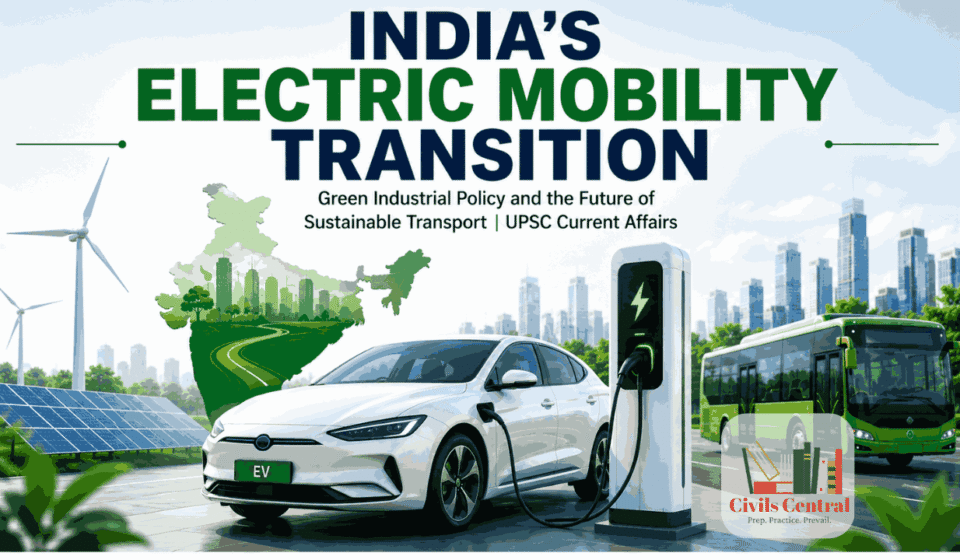
EV Policy 2.0: Transportation has been one of the greatest drivers of economic growth since the Industrial Revolution. It enables trade, connects markets, supports employment, and facilitates social mobility. However, the conventional transport sector has also emerged as one of the largest contributors to greenhouse gas emissions, urban air pollution, and dependence on imported fossil fuels.
As India aspires to become a developed nation by 2047 while simultaneously achieving its climate commitments under the Paris Agreement, transforming the transport sector has become an economic necessity rather than merely an environmental choice. Electric mobility represents one of the most significant structural shifts in India’s development trajectory because it links industrial policy, energy security, environmental sustainability, technological innovation, and urban governance.
The recent announcement by the Chief Minister that the state’s Electric Vehicle (EV) Policy provides a structural roadmap for clean mobility reflects this broader transition. While the immediate news relates to a state-level initiative, the underlying issue is India’s nationwide effort to create an integrated electric mobility ecosystem. For UPSC aspirants, understanding this transition requires much more than memorising policy provisions. It demands an appreciation of why countries are abandoning internal combustion engine vehicles, how governments shape emerging industries, what institutional mechanisms support clean transportation, and what challenges remain before India can become a global leader in electric mobility.
Why in News?
The Chief Minister highlighted that the newly notified Electric Vehicle Policy establishes a long-term structural roadmap for promoting clean mobility through incentives for EV adoption, charging infrastructure development, industrial investment, and sustainable urban transport. The policy aims to accelerate the transition from fossil fuel-based transportation to electric mobility while attracting investments in EV manufacturing and related industries.
The announcement aligns with India’s national objective of achieving net-zero emissions by 2070 and complements central government initiatives such as the PM E-DRIVE Scheme, Production Linked Incentive (PLI) Scheme for Advanced Chemistry Cells (ACC), and the National Electric Mobility Mission Plan (NEMMP).
Understanding Clean Mobility: The Conceptual Foundation
Clean mobility refers to a transport system that minimises environmental impacts while ensuring efficient movement of people and goods. Traditionally, transportation has depended on internal combustion engines powered by petrol and diesel. Although these technologies transformed global economies, they also increased carbon emissions, urban pollution, and fossil fuel dependence.
Electric mobility seeks to replace combustion engines with electrically powered vehicles that emit no tailpipe pollutants. When electricity is generated increasingly from renewable energy sources such as solar and wind, the overall carbon footprint of transportation declines significantly.
However, clean mobility extends beyond electric vehicles. It encompasses integrated public transport, non-motorised transport such as cycling and walking, shared mobility services, hydrogen fuel technologies for heavy transport, intelligent transport systems, and sustainable urban planning. Thus, EVs constitute one pillar of a broader sustainable mobility framework.
Why is the Transport Sector Central to India’s Climate Strategy?
India is the world’s third-largest energy consumer, and the transport sector accounts for a substantial share of petroleum consumption. Road transport dominates freight and passenger movement, making the sector highly dependent on imported crude oil.
This dependence creates multiple challenges. First, fluctuations in international oil prices affect India’s trade balance and inflation. Second, vehicle emissions contribute significantly to deteriorating urban air quality, leading to respiratory illnesses and increased healthcare costs. Third, greenhouse gas emissions from transport complicate India’s efforts to meet international climate commitments.
Electrification addresses these interconnected problems by reducing fossil fuel consumption, improving urban air quality, strengthening energy security, and supporting domestic manufacturing under the vision of Atmanirbhar Bharat.
Evolution of India’s Electric Mobility Journey
India’s electric mobility strategy has evolved gradually rather than emerging overnight.
Initially, electric vehicles were viewed as niche products with limited commercial viability. High battery costs, inadequate charging infrastructure, and consumer apprehension constrained adoption. Recognising the long-term strategic importance of electrification, the Government of India launched the National Electric Mobility Mission Plan (NEMMP) in 2013 to provide a comprehensive roadmap for EV development.
Subsequently, the Faster Adoption and Manufacturing of Electric Vehicles (FAME) Scheme introduced demand incentives to stimulate market growth. FAME-II expanded support for electric buses, commercial vehicles, charging stations, and localisation of manufacturing.
In recent years, policy attention has shifted from merely subsidising vehicle purchases to building an integrated ecosystem involving battery manufacturing, charging infrastructure, research and development, recycling, and supply chain resilience. This marks the transition from a consumer subsidy approach to an industrial policy approach.
What Constitutes the EV Ecosystem?
Electric mobility is often mistakenly understood as simply replacing petrol vehicles with electric ones. In reality, it involves the creation of an entire industrial ecosystem.
| Component | Why it Matters |
|---|---|
| EV Manufacturing | Creates domestic industrial capacity and employment. |
| Battery Manufacturing | Determines cost competitiveness and technological self-reliance. |
| Charging Infrastructure | Reduces range anxiety and increases consumer confidence. |
| Power Grid Integration | Ensures reliable electricity supply for charging demand. |
| Renewable Energy | Maximises environmental benefits of electrification. |
| Battery Recycling | Reduces dependence on imported critical minerals. |
| Digital Platforms | Enable smart charging, payments, and fleet management. |
The success of an EV policy therefore depends on simultaneous progress across all these components rather than isolated interventions.
Structural Features of Modern State EV Policies
Although individual state policies differ, most contemporary EV policies aim to create an enabling ecosystem through multiple complementary measures.
They generally provide purchase incentives to encourage consumers to adopt electric vehicles during the initial market development phase. Manufacturers receive incentives linked to investment, employment generation, and localisation of production. Charging infrastructure receives support through land allocation, electricity tariff rationalisation, and capital subsidies.
Many policies also encourage fleet electrification because commercial vehicles generate higher utilisation and therefore deliver quicker environmental benefits. Public transport electrification, particularly through electric buses, has emerged as another important policy objective due to its substantial impact on reducing urban emissions.
Some states additionally focus on developing battery manufacturing clusters, research centres, skill development programmes, and startup ecosystems to position themselves as hubs of the future mobility industry.
Electric Mobility and India’s Energy Security
One of the most compelling arguments for electric mobility is its contribution to energy security.
India imports a significant proportion of its crude oil requirements, exposing the economy to geopolitical disruptions and volatile international prices. Electrification gradually shifts transport energy demand from imported petroleum towards domestically generated electricity.
As renewable energy capacity expands through solar, wind, hydro, and nuclear power, electric vehicles increasingly operate on cleaner domestically produced energy. This transition reduces import dependence while improving macroeconomic stability.
Moreover, vehicle-to-grid technologies may eventually enable EV batteries to function as distributed energy storage systems, strengthening grid resilience and facilitating renewable energy integration.
EV Policy as an Industrial Policy
Electric mobility is not merely an environmental policy. It is increasingly recognised as a strategic industrial policy.
Countries such as China have demonstrated that early investment in battery manufacturing, electric vehicle production, and critical mineral processing can create globally competitive industries. India’s EV policies similarly seek to attract investments in manufacturing, generate skilled employment, foster innovation, and integrate domestic firms into global value chains.
The Production Linked Incentive Scheme for Advanced Chemistry Cells and automobile manufacturing reflects this industrial strategy by encouraging domestic production instead of continued dependence on imports.
The EV transition therefore aligns closely with initiatives such as Make in India, Atmanirbhar Bharat, Startup India, and Digital India.
Constitutional and Governance Dimensions
Electric mobility illustrates the cooperative federal nature of Indian governance. The Union Government formulates national policies, provides financial incentives, establishes manufacturing programmes, and negotiates international climate commitments. State Governments adapt these objectives to local conditions through state-specific EV policies, fiscal incentives, urban transport planning, and industrial promotion.
Municipal bodies play an equally important role by identifying charging station locations, revising building bye-laws, electrifying public transport fleets, and integrating EV infrastructure within smart city planning.
Thus, clean mobility demonstrates the principle of multi-level governance, where different tiers of government perform complementary functions.
Challenges in India’s Electric Mobility Transition
While India’s electric mobility journey has gained considerable momentum over the past decade, the transition is far from straightforward. Replacing over 300 million internal combustion engine (ICE) vehicles with electric alternatives is not merely a technological substitution; it is a structural transformation of the country’s transport, energy, industrial, and urban systems. Consequently, the challenges are multidimensional, involving economics, technology, infrastructure, governance, consumer behaviour, and geopolitics.
Understanding these challenges is particularly important for UPSC because they explain why governments continue to support EVs through policy incentives instead of allowing market forces alone to drive adoption.
The Economics of Electric Vehicles: Why Cost Remains the Biggest Barrier
For most Indian consumers, the decision to purchase a vehicle is driven primarily by affordability rather than environmental considerations. Although electric vehicles have lower operating and maintenance costs over their lifetime, their initial purchase price remains significantly higher than comparable petrol or diesel vehicles.
This price difference is largely due to the battery pack, which constitutes approximately 30–50% of the total vehicle cost. Lithium-ion batteries require expensive raw materials such as lithium, cobalt, nickel, graphite, and manganese. Since India imports a large proportion of these materials, battery prices remain vulnerable to fluctuations in global commodity markets.
This creates an interesting economic paradox. Over the vehicle’s life cycle, an EV may prove cheaper because electricity costs less than petrol or diesel and electric motors require fewer moving parts, reducing maintenance expenses. However, consumers often make purchasing decisions based on the upfront cost rather than lifetime ownership costs.
Consequently, governments provide demand incentives under schemes such as PM E-DRIVE to bridge this affordability gap until economies of scale and technological advancements naturally reduce battery prices.
Charging Infrastructure: The Foundation of Electric Mobility
One of the most visible challenges facing electric mobility is the availability of charging infrastructure.
Unlike conventional vehicles, where petrol pumps are widespread and refuelling takes only a few minutes, EV users depend on an expanding but still developing charging network. The absence of easily accessible charging stations discourages many potential buyers, particularly those living in apartments or densely populated urban areas where private charging is difficult.
This concern is commonly referred to as “range anxiety”—the fear that a vehicle’s battery may become depleted before reaching a charging point.
Range anxiety is not merely a psychological issue. It has practical implications for logistics companies, commercial transport operators, taxi services, and long-distance travellers. Unless charging stations become as ubiquitous and reliable as conventional fuel stations, widespread EV adoption will remain constrained.
Developing charging infrastructure is itself a complex governance challenge. It requires coordination among electricity distribution companies (DISCOMs), urban local bodies, state governments, private investors, highway authorities, and vehicle manufacturers. Land availability, grid connectivity, standardisation of charging protocols, and commercial viability all influence the pace of expansion.
Electricity Supply and Grid Readiness
Electric vehicles do not eliminate energy demand; they shift it from petroleum products to electricity.
This shift necessitates significant strengthening of India’s electricity infrastructure. Large-scale EV adoption will increase electricity demand, especially during peak charging hours. Without proper planning, concentrated charging loads could strain local distribution networks, increase transformer failures, and create voltage instability.
Therefore, EV deployment must be synchronised with improvements in transmission infrastructure, smart grids, energy storage systems, and renewable energy generation.
Smart charging technologies can play a crucial role by encouraging vehicles to charge during periods of lower electricity demand or when renewable energy generation is abundant. In the future, Vehicle-to-Grid (V2G) technology could allow EV batteries to supply electricity back to the grid during peak demand, transforming vehicles into distributed energy storage assets.
Dependence on Critical Minerals
Perhaps the most strategically significant challenge is India’s dependence on imported critical minerals. Modern lithium-ion batteries require several minerals that are unevenly distributed across the world. Countries such as Australia, Chile, Argentina, the Democratic Republic of Congo, Indonesia, and China dominate the extraction or processing of these resources.
China, in particular, occupies a dominant position in battery manufacturing and critical mineral processing. This creates supply chain vulnerabilities similar to India’s historical dependence on imported crude oil.
The challenge, therefore, is not simply replacing oil imports with battery imports. Instead, India seeks to build domestic manufacturing capabilities while diversifying mineral supply chains through international partnerships, overseas mining investments, recycling technologies, and exploration of domestic reserves.
The discovery of lithium resources in Jammu & Kashmir and other regions has generated optimism, although commercial extraction remains at an early stage.
Battery Recycling: The Emerging Circular Economy Challenge
The success of electric mobility cannot be measured solely by the number of vehicles sold. It must also account for how batteries are managed at the end of their useful life. Lithium-ion batteries contain valuable metals that can be recovered and reused. Without effective recycling systems, discarded batteries may create environmental hazards and increase dependence on fresh mineral extraction.
Battery recycling therefore represents a critical component of the circular economy. Recovering lithium, cobalt, nickel, copper, and other materials reduces resource scarcity, lowers production costs, minimises waste generation, and enhances resource security.
India has begun developing a regulatory framework for battery waste management through Extended Producer Responsibility (EPR), under which manufacturers remain responsible for collecting and recycling used batteries. However, large-scale recycling infrastructure is still evolving.
Technological Uncertainty
Unlike mature automobile technologies, battery technologies continue to evolve rapidly. Although lithium-ion batteries currently dominate the market, researchers are developing several next-generation technologies, including solid-state batteries, sodium-ion batteries, lithium-sulphur batteries, and metal-air batteries.
Each technology offers different advantages in terms of energy density, charging speed, safety, cost, and resource availability. This rapid pace of innovation creates uncertainty for both policymakers and private investors. Investments made today must remain economically viable even if disruptive battery technologies emerge within the next decade.
Governments therefore need technology-neutral policies that encourage innovation rather than locking the industry into a single technological pathway.
Environmental Concerns Beyond Tailpipe Emissions
Electric vehicles are often described as “zero-emission vehicles.” While technically correct regarding tailpipe emissions, this description requires careful qualification. The overall environmental impact of an EV depends on the entire life cycle of the vehicle.
If electricity used for charging is generated predominantly from coal, lifecycle carbon emissions remain relatively high. Similarly, mining of lithium, cobalt, and nickel can cause habitat destruction, water pollution, and biodiversity loss if environmental safeguards are weak.
Therefore, electric mobility delivers its greatest environmental benefits only when combined with:
- Expansion of renewable energy.
- Sustainable mining practices.
- Efficient battery recycling.
- Cleaner manufacturing processes.
- Environmentally responsible disposal systems.
This broader perspective illustrates the concept of Life Cycle Assessment (LCA), which UPSC increasingly tests in environmental governance.
Consumer Behaviour and Market Acceptance
Technological transitions are not determined solely by engineering innovations; they also depend on public acceptance.
Many consumers continue to perceive electric vehicles as less reliable than conventional automobiles. Concerns regarding battery degradation, resale value, maintenance, availability of service centres, charging time, and driving range continue to influence purchasing decisions.
Commercial fleet operators may adopt EVs more rapidly because higher daily utilisation improves economic viability. However, private consumers often require stronger confidence before changing long-established transportation habits.
This explains why public awareness campaigns, demonstration projects, warranty mechanisms, and improved after-sales service are important complements to financial incentives.
Financing the EV Ecosystem
Electric mobility requires substantial capital investment across the value chain. Manufacturing plants, battery gigafactories, charging stations, electricity infrastructure, research laboratories, recycling facilities, and skill development programmes all demand long-term financing.
Private investors often hesitate because returns depend on future market growth, technological developments, and policy stability.
Governments therefore play a catalytic role by reducing investment risks through fiscal incentives, viability gap funding, concessional financing, and clear long-term policy signals.
Battery Technologies: The Heart of Electric Mobility
Understanding battery technologies is essential for UPSC because batteries determine vehicle cost, range, charging speed, safety, and resource requirements.
| Battery Technology | Major Advantages | Key Limitations | UPSC Importance |
|---|---|---|---|
| Lithium-Ion (Li-ion) | High energy density, mature technology, widely commercialised | Dependence on imported lithium and critical minerals | Presently dominates global EV market |
| Lithium Iron Phosphate (LFP) | Better thermal stability, longer life, lower fire risk | Lower energy density than NMC batteries | Increasingly preferred for buses and mass-market EVs |
| Nickel Manganese Cobalt (NMC) | Higher driving range and energy density | Higher cost, dependence on cobalt | Premium electric vehicles |
| Solid-State Batteries | Faster charging, higher energy density, improved safety | Still under commercial development | Future-generation battery technology |
| Sodium-Ion Batteries | Sodium is abundant and cheaper than lithium | Lower energy density | Promising alternative for India due to resource availability |
Critical Minerals
The transition to clean mobility has elevated certain minerals from ordinary industrial commodities to strategic national assets. These minerals are termed critical minerals because they are essential for emerging technologies, have limited substitutes, and face supply risks.
Major Critical Minerals for EVs
| Mineral | Primary Use |
|---|---|
| Lithium | Battery cathodes |
| Cobalt | Battery stability |
| Nickel | Higher energy density |
| Graphite | Battery anodes |
| Rare Earth Elements | Permanent magnets in electric motors |
| Copper | Electrical wiring and charging infrastructure |
Control over these minerals increasingly influences geopolitical competition, industrial policy, and international partnerships.
India’s Critical Mineral Mission, overseas resource partnerships, and domestic exploration efforts aim to secure these strategic resources while reducing dependence on concentrated global supply chains.
Government Initiatives Driving India’s Electric Mobility Revolution
The transition to electric mobility cannot be left entirely to market forces. Unlike conventional industries that evolved over several decades, the EV ecosystem requires simultaneous development of manufacturing capacity, charging infrastructure, technological innovation, consumer confidence, financing, and regulatory support. If any one component develops much more slowly than the others, the entire ecosystem suffers.
Recognising this, the Government of India has adopted a comprehensive policy framework that combines demand-side incentives with supply-side industrial support. Rather than viewing electric mobility merely as an environmental programme, policymakers increasingly treat it as a strategic national mission linked with energy security, industrial competitiveness, technological self-reliance, and sustainable urbanisation.
India’s Policy Architecture for Electric Mobility
The evolution of India’s EV policy reflects a gradual shift in priorities.
In the initial years, the focus was on encouraging consumers to purchase electric vehicles through financial incentives. As the market matured, attention expanded towards domestic manufacturing, battery production, charging infrastructure, research and development, and critical mineral security.
Today, India’s electric mobility strategy rests upon five interconnected pillars:
                  India's EV Strategy

               Electric Mobility Ecosystem
                         │
 ┌──────────────┬──────────────┬──────────────┬─────────────┐
 │              │              │              │
Demand      Manufacturing   Batteries    Infrastructure
Support         Support      & Storage      Expansion
 │              │              │              │
 PM E-DRIVE   Auto PLI     ACC PLI      Charging Network
Each pillar reinforces the others. Consumer demand encourages manufacturers to invest. Manufacturing lowers costs. Lower costs increase adoption. Higher adoption justifies investment in charging infrastructure, creating a virtuous cycle.
National Electric Mobility Mission Plan (NEMMP), 2013
The National Electric Mobility Mission Plan (NEMMP) was India’s first comprehensive policy document aimed at promoting electric and hybrid vehicles. It recognised that reducing dependence on imported petroleum and addressing environmental concerns required a long-term transition towards cleaner transportation.
Rather than focusing solely on subsidies, NEMMP proposed an integrated approach involving technology development, manufacturing, research, charging infrastructure, and policy coordination.
The Mission laid the conceptual foundation for subsequent initiatives such as the FAME Scheme and established electric mobility as a national policy priority.
Significance
- India’s first long-term roadmap for electric mobility.
- Shifted policy from isolated pilot projects to ecosystem development.
- Recognised EVs as instruments of energy security and sustainable growth.
Faster Adoption and Manufacturing of Electric Vehicles (FAME)
The FAME Scheme became the operational arm of India’s electric mobility mission.
FAME-I (2015)
The first phase primarily focused on creating initial market demand through purchase incentives for electric and hybrid vehicles.
Its objectives included:
- Encouraging early adoption.
- Supporting pilot projects.
- Promoting technological innovation.
- Developing initial charging infrastructure.
Since the EV industry was still at a nascent stage, the emphasis was on market creation rather than large-scale manufacturing.
FAME-II (2019)
The second phase represented a significant policy shift.
Instead of broadly subsidising all categories of vehicles, FAME-II concentrated on segments capable of delivering maximum public benefits.
Priority was given to:
- Electric buses.
- Three-wheelers.
- Commercial vehicles.
- Public transport.
- Shared mobility.
This reflected an important economic principle. Commercial vehicles typically travel much greater distances than private cars, resulting in larger reductions in fuel consumption and emissions for every vehicle electrified.
FAME-II also accelerated the establishment of public charging stations across major cities and highways.
PM E-DRIVE Scheme
Recognising that India’s EV ecosystem had entered a more mature stage, the Government introduced the PM Electric Drive Revolution in Innovative Vehicle Enhancement (PM E-DRIVE) Scheme to succeed FAME-II.
The scheme reflects the evolution of India’s policy thinking—from merely supporting adoption to creating a globally competitive electric mobility ecosystem.
Objectives
The scheme seeks to:
- accelerate EV adoption,
- strengthen domestic manufacturing,
- expand charging infrastructure,
- support cleaner public transport,
- reduce fossil fuel dependence,
- promote technological innovation.
Unlike earlier programmes that primarily emphasised vehicle subsidies, PM E-DRIVE adopts a broader ecosystem approach by integrating manufacturing, infrastructure, and innovation.
Production Linked Incentive (PLI) Scheme for Automobile and Auto Components
Electric mobility is also an industrial policy.
India seeks not only to consume electric vehicles but also to become a global manufacturing hub.
The PLI Scheme for the automobile sector encourages manufacturers to invest in advanced automotive technologies, including electric vehicles and hydrogen fuel cell vehicles.
The scheme rewards firms based on incremental production, thereby linking government support directly with manufacturing performance rather than simply providing upfront subsidies.
Why is this important?
This approach encourages:
- technological innovation,
- domestic value addition,
- export competitiveness,
- employment generation,
- integration into global supply chains.
Instead of importing finished electric vehicles, India aims to manufacture them domestically while participating in the global automotive value chain.
Production Linked Incentive for Advanced Chemistry Cells (ACC)
Perhaps no component is more strategically important than batteries. Recognising this, the Government launched the PLI Scheme for Advanced Chemistry Cell (ACC) Battery Storage. Its objective is to establish large-scale battery manufacturing facilities—often referred to as Gigafactories—within India.
This initiative seeks to reduce dependence on imported batteries while strengthening domestic technological capabilities.
Why ACC Manufacturing Matters
Battery production offers several national advantages:
- Lower vehicle costs.
- Reduced import dependence.
- Employment generation.
- Enhanced technological capability.
- Greater resilience against geopolitical supply disruptions.
National Programme on Advanced Chemistry Cell Battery Storage
This programme complements the ACC PLI Scheme by encouraging research, innovation, and commercial-scale battery production. It supports the development of next-generation battery technologies capable of improving:
- energy density,
- charging speed,
- battery life,
- safety,
- affordability.
Since battery technology continues to evolve rapidly, sustained research investment is essential for maintaining long-term competitiveness.
Battery Swapping Policy
Charging an electric vehicle may require several hours depending upon battery size and charging technology. Battery swapping provides an alternative approach. Instead of waiting for charging, users exchange a depleted battery for a fully charged one at designated swapping stations.
This model is particularly suitable for:
- electric two-wheelers,
- three-wheelers,
- delivery fleets,
- urban commercial transport.
Advantages
- Reduces charging time dramatically.
- Improves commercial fleet productivity.
- Reduces battery ownership costs.
- Facilitates standardisation.
However, successful implementation requires:
- interoperable battery standards,
- safety regulations,
- quality assurance,
- digital tracking systems.
National Logistics Policy and EV Integration
India’s logistics sector accounts for a substantial share of transport emissions. Electrification of freight vehicles, warehouse equipment, and urban delivery fleets forms an important component of sustainable logistics. Consequently, EV adoption complements broader logistics reforms aimed at improving efficiency while reducing environmental impacts.
Role of NITI Aayog
NITI Aayog has emerged as one of the principal policy institutions guiding India’s EV transition. Its contributions include:
- preparing EV roadmaps,
- promoting battery swapping,
- encouraging state EV policies,
- coordinating stakeholder consultations,
- supporting innovative business models,
- facilitating public-private partnerships.
NITI Aayog’s policy papers increasingly advocate viewing electric mobility through the lens of integrated energy and industrial planning rather than as an isolated transport initiative.
State Governments: Laboratories of Electric Mobility
Although national policies establish the overall framework, India’s federal structure allows states to experiment with diverse policy models. Many states have introduced their own EV policies to attract investment and accelerate adoption through:
- purchase incentives,
- exemption from road tax,
- registration fee waivers,
- capital subsidies,
- manufacturing incentives,
- charging infrastructure support,
- skill development programmes.
The policy highlighted in the current news reflects this trend. State EV policies often compete to attract automobile manufacturers, battery producers, component suppliers, and research institutions, thereby contributing to regional industrial development.
This demonstrates competitive cooperative federalism, where states innovate within the national policy framework while advancing common national objectives.
International Experiences: What Can India Learn?
Every major economy has adopted a distinct pathway towards electric mobility based on its economic structure, industrial capacity, and policy priorities. Studying these international experiences is valuable because UPSC frequently frames comparative and analytical questions that require understanding not only what India is doing, but also how its approach differs from global practices.
China: Building the World’s Largest EV Ecosystem
China is widely regarded as the global leader in electric mobility. Its success did not arise solely from consumer subsidies but from a long-term industrial strategy that integrated manufacturing, technology, research, and supply chain development.
The Chinese government invested heavily in battery manufacturing, critical mineral processing, charging infrastructure, and domestic EV companies long before global demand accelerated. Today, China dominates global battery production and processing of several critical minerals, giving it a significant strategic advantage.
For India, the key lesson is that industrial competitiveness depends on developing the entire value chain, not merely assembling vehicles.
Norway: Incentivising Consumer Adoption
Norway has achieved the highest proportion of electric vehicle sales in the world. This success has been driven by generous consumer incentives such as tax exemptions, reduced registration fees, free or subsidised parking, access to bus lanes, and extensive charging infrastructure.
Norway demonstrates that financial incentives, when combined with supportive infrastructure and policy certainty, can rapidly change consumer behaviour. However, such a model may not be fully replicable in developing countries because it requires substantial fiscal capacity.
European Union: Climate Regulation as a Driver
The European Union has relied more on stringent emission standards than on direct subsidies alone. By progressively tightening carbon emission norms for automobiles, the EU has compelled manufacturers to shift towards cleaner technologies.
The European approach highlights how environmental regulation can stimulate technological innovation and reshape industrial behaviour.
United States: Innovation and Industrial Revival
The United States has increasingly linked EV promotion with domestic manufacturing and strategic competition. Policies such as the Inflation Reduction Act encourage local production of batteries, critical minerals, and electric vehicles through tax credits and investment incentives.
The American experience illustrates that electric mobility is now viewed not only as a climate policy but also as a tool for industrial revival and geopolitical competitiveness.
Comparative Perspective
| Country | Primary Policy Focus | Key Lesson for India |
|---|---|---|
| China | Manufacturing ecosystem and supply chain dominance | Build complete domestic value chains and reduce import dependence. |
| Norway | Consumer incentives and charging infrastructure | Strong incentives can accelerate adoption where fiscal space permits. |
| European Union | Regulatory standards and decarbonisation | Emission norms can drive technological transition. |
| United States | Industrial policy linked to innovation and strategic manufacturing | Combine clean mobility with domestic manufacturing and technology leadership. |
| India | Balanced approach integrating demand support, industrial policy, federal cooperation, and energy security | Develop a self-reliant EV ecosystem suited to India’s developmental context. |
By this stage, it becomes evident that India’s EV transition is far more than an environmental programme. It represents a coordinated national strategy that integrates climate commitments, industrial development, technological innovation, cooperative federalism, and energy security. The remaining sections will build upon this foundation by examining expert recommendations, the way forward, and comprehensive UPSC enrichment including Prelims 360, Mains, Essay, Interview, PYQs, expected questions, revision mind maps, and key takeaways.
Expert Recommendations and the Way Forward
The rapid growth of electric mobility demonstrates that India has moved beyond the question of whether it should adopt electric vehicles. The more important policy question today is how the transition can be made economically viable, technologically resilient, socially inclusive, and environmentally sustainable.
Electric mobility is not an end in itself. It is a means to achieve broader developmental objectives—cleaner cities, reduced oil imports, competitive manufacturing, climate resilience, and improved public health. Achieving these goals requires coordinated action across governments, industry, research institutions, financial institutions, and consumers.
Recommendations from Policy Institutions
Over the years, several national and international institutions have studied India’s electric mobility ecosystem and suggested measures for accelerating the transition.
NITI Aayog
NITI Aayog has consistently argued that India’s EV transition should not rely solely on consumer subsidies. Instead, the country must create a complete manufacturing ecosystem capable of competing globally.
Its policy papers emphasise:
- localisation of battery manufacturing;
- development of domestic supply chains;
- battery swapping for commercial vehicles;
- promotion of research and innovation;
- public-private partnerships;
- integration of renewable energy with electric mobility;
- strengthening state-level policy implementation.
The institution has also highlighted the importance of adopting technology-neutral policies that encourage innovation rather than favouring a single battery chemistry.
Bureau of Energy Efficiency (BEE)
The Bureau of Energy Efficiency has focused on improving energy efficiency across the transport sector.
Its recommendations include:
- development of energy-efficient charging infrastructure;
- standardisation of charging protocols;
- smart charging systems;
- integration of EV charging with renewable energy;
- improved electricity demand management.
These measures ensure that electrification reduces both emissions and energy intensity.
International Energy Agency (IEA)
The International Energy Agency views electric mobility as one of the most important instruments for achieving global climate targets.
The IEA recommends:
- expanding charging infrastructure ahead of demand;
- strengthening electricity grids;
- investing in battery recycling;
- diversifying critical mineral supply chains;
- encouraging innovation in battery technology;
- reducing dependence on concentrated global suppliers.
For India, these recommendations are particularly relevant because rapid EV adoption must be matched by reliable energy infrastructure.
World Bank
The World Bank has emphasised that developing countries should prioritise public transport electrification because it generates greater environmental benefits per unit of investment.
Accordingly, it recommends:
- electrification of buses;
- sustainable urban transport planning;
- financing mechanisms for municipal EV fleets;
- institutional capacity building;
- integrated mobility planning.
The Way Forward
India’s electric mobility mission has entered a decisive phase. While policy momentum has created a favourable environment, the next decade will determine whether India emerges as a global leader or remains dependent on imported technologies.
The way forward therefore requires a comprehensive and balanced strategy.
1. Build a Complete Domestic EV Value Chain
India should move beyond vehicle assembly towards complete value-chain development. This includes mining and processing of critical minerals, battery manufacturing, component production, power electronics, software development, recycling, and research.
Only an integrated ecosystem can reduce import dependence and strengthen industrial competitiveness.
2. Accelerate Charging Infrastructure
Consumer confidence depends heavily on charging availability.
Charging stations should become an integral part of:
- highways,
- urban planning,
- residential buildings,
- commercial complexes,
- public parking facilities,
- workplaces.
Urban Local Bodies should incorporate charging infrastructure into city master plans rather than treating it as an afterthought.
3. Strengthen Renewable Energy Integration
Electric mobility achieves its full environmental potential only when powered by clean electricity.
India should therefore promote:
- solar-powered charging stations;
- wind-powered charging hubs;
- smart charging;
- distributed renewable generation;
- battery storage systems.
The convergence of renewable energy and electric mobility represents the foundation of a low-carbon economy.
4. Secure Critical Mineral Supply Chains
India must diversify access to lithium, cobalt, nickel, graphite, and rare earth elements. This requires:
- international partnerships;
- overseas mining investments;
- domestic exploration;
- recycling industries;
- strategic mineral reserves.
Critical minerals should increasingly be viewed as strategic national assets similar to petroleum reserves.
5. Promote Circular Economy Practices
Battery recycling should become a central pillar of India’s EV policy. A robust circular economy would:
- reduce import dependence;
- recover valuable minerals;
- minimise waste generation;
- lower production costs;
- reduce environmental degradation.
Extended Producer Responsibility (EPR) should be effectively implemented to ensure responsible battery collection and recycling.
6. Encourage Innovation and Research
Future competitiveness will depend less on manufacturing capacity alone and more on technological leadership. India should invest in:
- solid-state batteries;
- sodium-ion batteries;
- hydrogen-based mobility;
- advanced battery management systems;
- artificial intelligence for smart mobility;
- indigenous power electronics.
Universities, research institutions, startups, and industry should collaborate to create an innovation-driven EV ecosystem.
7. Focus on Public Transport Electrification
Electrifying buses, taxis, and commercial fleets yields greater environmental benefits than focusing exclusively on private cars. Public transport electrification:
- reduces urban pollution;
- lowers fuel imports;
- improves public health;
- demonstrates government leadership;
- creates stable demand for domestic manufacturers.
8. Strengthen Cooperative Federalism
Since transport is influenced by both Union and State Governments, effective coordination is essential.
The Union Government should provide national policy direction while States tailor implementation according to regional priorities.
Municipal bodies should integrate EV infrastructure with urban planning, ensuring seamless implementation at the local level.
Critical Evaluation
Although electric vehicles represent a transformative technology, they should not be viewed as a universal solution to all transport-related problems. Several limitations remain.
If electricity generation continues to rely heavily on fossil fuels, overall emissions reductions may be limited. Similarly, replacing every petrol vehicle with an electric vehicle will not solve urban congestion, road safety concerns, or inefficient land use.
Therefore, sustainable mobility must combine:
- public transport,
- electric mobility,
- non-motorised transport,
- transit-oriented development,
- digital mobility solutions,
- cleaner energy systems.
In other words, clean mobility is broader than electric mobility.
This distinction is particularly important for UPSC because analytical questions often reward candidates who move beyond simplistic technological optimism and adopt a systems perspective.
Conclusion
The transition to electric mobility marks one of the most significant structural transformations in India’s developmental journey since economic liberalisation. It is not merely about replacing petrol vehicles with electric ones; it represents a reimagining of how India produces energy, manufactures vehicles, designs cities, secures strategic resources, and fulfils its climate commitments.
The recent state EV policy, described as a structural roadmap for clean mobility, reflects this larger national vision. By promoting electric vehicles, charging infrastructure, battery manufacturing, and industrial investment, such policies contribute to a broader ecosystem that supports sustainable development.
However, the true success of India’s electric mobility mission will depend not only on the number of electric vehicles sold but also on the creation of resilient supply chains, clean electricity generation, technological innovation, robust recycling systems, and integrated urban transport planning.
As India moves towards the goals of Viksit Bharat 2047 and Net Zero by 2070, electric mobility will remain one of the defining pillars of its green growth strategy. The challenge before policymakers is to ensure that this transition is economically inclusive, technologically self-reliant, environmentally sustainable, and institutionally robust.
India’s Clean Mobility Transition
                   Sustainable Development
                             │
      ┌──────────────────────┼──────────────────────┐
      │                      │                      │
 Climate Action        Energy Security      Industrial Growth
      │                      │                      │
      └──────────────┬───────┴──────────────┬───────┘
                     │
             Electric Mobility Ecosystem
                     │
 ┌────────────┬─────────────┬──────────────┬──────────────┐
 │            │             │              │
 EVs      Batteries    Charging      Renewable Energy
 │            │             │              │
 └────────────┴─────────────┴──────────────┘
                     │
          Lower Emissions • Cleaner Air
      Reduced Oil Imports • Green Jobs • Innovation
                     │
               Viksit Bharat @ 2047
MIND MAP
                           ELECTRIC MOBILITY
                                   │
       ┌───────────────────────────┼────────────────────────────┐
       │                           │                            │
   Environment                 Economy                    Governance
       │                           │                            │
 Air Pollution             Manufacturing              Union Policies
 Net Zero                  PLI Schemes                State EV Policies
 NDCs                      Jobs                       Urban Local Bodies
 Renewable Energy          Innovation                 Cooperative Federalism
       │                           │                            │
       └───────────────────────────┼────────────────────────────┘
                                   │
                           Battery Ecosystem
                                   │
         Critical Minerals ─ Charging ─ Recycling ─ Smart Grids
                                   │
                            Sustainable Mobility
                                   │
                  Energy Security • Green Growth • Viksit Bharat
KEY TAKEAWAYS
| Theme | Core Learning |
|---|---|
| Clean Mobility | Extends beyond EVs to include sustainable transport systems. |
| Electric Vehicles | Reduce tailpipe emissions but must be evaluated through a lifecycle perspective. |
| Energy Security | EVs reduce dependence on imported petroleum by shifting transport energy demand to electricity. |
| Industrial Policy | EVs are central to Atmanirbhar Bharat, advanced manufacturing, and global competitiveness. |
| Battery Ecosystem | Domestic battery production and recycling are strategic priorities. |
| Critical Minerals | Secure supply chains are essential for long-term energy transition. |
| Governance | Successful implementation requires coordinated action by the Union, States, and Urban Local Bodies. |
| UPSC Perspective | Electric mobility is an interdisciplinary topic connecting Environment, Economy, Polity, Science & Technology, Governance, and International Relations. |
About The Author