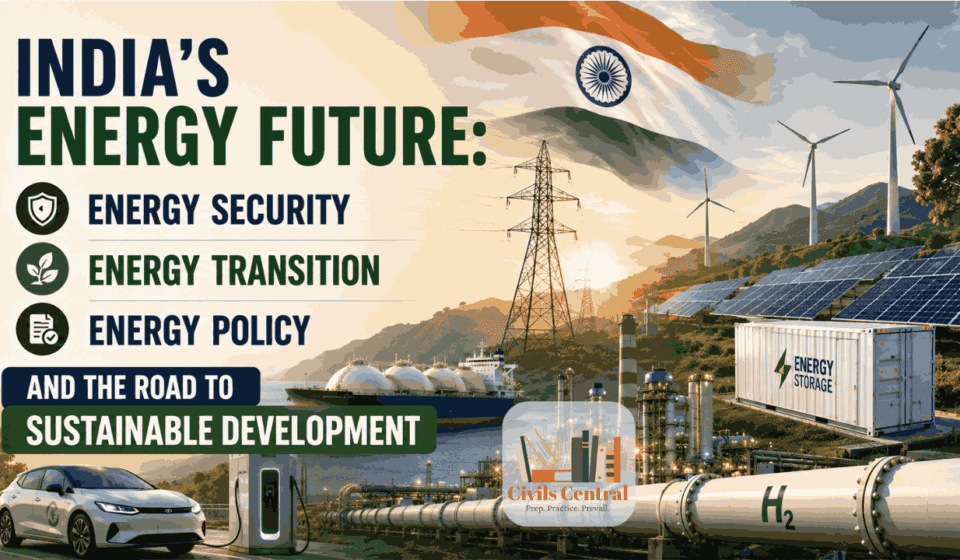
India’s Energy Future: Energy Security, Energy Transition, Energy Policy and the Road to Sustainable Development

(Premium CivilsCentral Knowledge Chapter | CES Edition)
Chapter 1: Understanding Energy from First Principles
“The rise and fall of civilizations has often been determined not merely by military strength or economic wealth, but by their ability to harness, control, and efficiently use energy.”
When historians explain the progress of human civilization, they often speak about the discovery of agriculture, the invention of the wheel, the Industrial Revolution, or the Digital Age. Yet beneath each of these milestones lies a common force that made them possible—energy. Every technological leap, every economic transformation, and every improvement in human living standards has depended on humanity’s ability to access and utilize energy more effectively.
For a UPSC aspirant, energy is far more than a topic under Economy or Environment. It is the invisible thread that connects national security, industrial development, climate change, foreign policy, technological innovation, sustainable development, agriculture, transport, and even public health. India’s aspiration to become a developed nation by 2047 cannot be understood without understanding its energy future.
Therefore, before discussing policies, renewable energy, or climate commitments, it is essential to answer a more fundamental question:
What exactly is energy, and why has it become one of the most strategic resources of the twenty-first century?
Energy: The Foundation of Civilization
Imagine waking up one morning to discover that electricity has disappeared completely. There are no lights, no mobile phones, no internet, no hospitals operating advanced medical equipment, no trains, no factories, no water pumps, and no digital banking. Modern society would come to a standstill within hours.
This thought experiment illustrates a profound reality: energy is not merely another economic input—it is the foundation upon which every other sector depends.
In economics, three classical factors of production are often identified: land, labour, and capital. In the modern world, however, energy functions as the enabling force that allows all three to become productive. Fertile land cannot yield crops without irrigation pumps and fertilizers produced using energy. Labour cannot achieve high productivity without machinery and technology. Capital investments generate returns only when industries have reliable power to operate.
Thus, energy is best understood as the capacity to perform work, but in public policy its significance extends much further. It is the foundation of economic growth, industrial competitiveness, social welfare, and national sovereignty.
What is Energy?
In physics, energy is defined as the capacity to do work. This definition is scientifically accurate but insufficient for understanding energy policy.
From the perspective of economics and governance, energy is the ability to power human activities by converting natural resources into usable forms capable of producing goods, delivering services, transporting people, generating electricity, heating homes, and sustaining industries.
Energy itself cannot be created or destroyed; it merely changes from one form to another. Coal contains chemical energy that is converted into heat, which produces steam to rotate turbines and generate electricity. Sunlight is converted into electrical energy through photovoltaic cells. Flowing water converts gravitational potential energy into mechanical energy and finally into electricity.
Understanding these transformations is essential because energy policy is fundamentally about managing these conversions efficiently, affordably, and sustainably.
Why Energy Matters for Nations
The strength of a modern nation is closely linked to its energy system. Countries with secure, affordable, and reliable energy supplies generally experience:
- Higher industrial output.
- Greater agricultural productivity.
- Better transport networks.
- Faster urbanization.
- Improved healthcare and education.
- Higher standards of living.
- Greater geopolitical influence.
Conversely, countries facing chronic energy shortages often experience slower economic growth, inflationary pressures, unemployment, and vulnerability to external shocks.
For India, which is simultaneously pursuing rapid economic growth, poverty reduction, industrial expansion, and climate commitments, designing the right energy policy is not merely an environmental challenge—it is a development imperative.
The Evolution of Human Energy Use
The story of civilization can also be described as the story of changing energy sources.
The Age of Human and Animal Power
For thousands of years, humans relied almost entirely on their own physical strength and domesticated animals. Agriculture depended on bullocks, transportation relied on horses and camels, and industries were largely manual. Economic productivity remained limited because the amount of usable energy available to society was extremely small.
The Biomass Era
The discovery and widespread use of fire transformed civilization. Wood became the principal source of heat for cooking, pottery, metallurgy, and later small-scale industries. Even today, millions of households across the developing world continue to depend on biomass such as firewood, crop residues, and animal dung for cooking, highlighting the continuing relevance of traditional energy sources.
The Coal Revolution
The Industrial Revolution marked humanity’s first major energy transition. Coal replaced wood as the dominant fuel because it possessed a much higher energy density. Steam engines powered by coal transformed manufacturing, railways, mining, and shipping. The rapid industrialization of Britain, followed by Europe and North America, was fundamentally an energy revolution driven by coal.
The Oil Age
The twentieth century witnessed another transition. Petroleum emerged as the dominant global energy source because of its versatility, high energy density, and suitability for transportation. Automobiles, aviation, petrochemicals, and modern logistics became possible because of oil. This period also transformed geopolitics, making access to oil reserves a major determinant of international relations.
The Natural Gas Era
Natural gas gradually gained importance because it burns more cleanly than coal and oil while offering greater efficiency in electricity generation and industrial use. Today, many countries consider natural gas a transition fuel as they move toward low-carbon energy systems.
The Renewable Energy Revolution
The twenty-first century is witnessing another historic transformation. Solar panels, wind turbines, green hydrogen, battery storage, electric mobility, and smart grids are gradually reshaping the global energy landscape. Unlike previous transitions driven primarily by economic efficiency, this transition is also driven by concerns over climate change, environmental sustainability, and energy security. India stands at the centre of this transformation, seeking to balance rapid development with environmental responsibility.
Energy and Economic Development
One of the strongest relationships in development economics is the correlation between energy consumption and economic growth. Industrial production requires electricity. Modern agriculture requires irrigation pumps, fertilizers, cold storage, and mechanization. The service sector depends on digital infrastructure powered by electricity. Transport networks rely on petroleum products or electricity. As economies develop, energy demand generally increases. However, the challenge is not merely to consume more energy but to consume it more efficiently.
This introduces one of the central themes of India’s energy future: achieving high economic growth with lower energy intensity and lower carbon emissions.
Energy: A Strategic Resource, Not Just a Commodity
Unlike most commodities, energy has strategic significance. Interruptions in energy supply can disrupt:
- Economic activity.
- National defence.
- Food security.
- Healthcare systems.
- Digital infrastructure.
- Financial services.
This is why governments maintain strategic petroleum reserves, diversify import sources, invest in renewable energy, and pursue international energy partnerships. Energy policy, therefore, lies at the intersection of economics, foreign policy, national security, technology, and environmental governance.
From Energy to Energy Policy
Having understood the foundational role of energy in human civilization and national development, the next question naturally arises:
How should a country design an energy system that is affordable, reliable, secure, and environmentally sustainable?
Answering this question requires understanding the different forms of energy, how they are classified, how they are measured, and how nations develop comprehensive energy strategies. That is the subject of the next chapter, where we will build the conceptual framework of India’s energy ecosystem before examining specific policies, institutions, and the country’s long-term energy transition.
Excellent. The first chapter established why energy matters. Now we begin building the conceptual foundation. This is where CES differs from conventional UPSC notes—we teach the language of energy before discussing policy.
Chapter 2: Understanding the Language of Energy – Concepts Every UPSC Aspirant Must Know
One of the most common mistakes made by UPSC aspirants is treating energy as a collection of unrelated facts. They memorize that India imports around 85% of its crude oil, that solar energy is renewable, or that the National Green Hydrogen Mission aims to promote clean hydrogen. However, when UPSC frames conceptual or statement-based questions, many candidates struggle because they have never understood the language of energy policy.
Energy planners, economists, climate scientists, engineers, and policymakers all use a common vocabulary. Terms such as primary energy, secondary energy, energy intensity, energy efficiency, energy conservation, baseload power, installed capacity, and energy mix appear repeatedly in government reports, Economic Surveys, and international publications. These are not technical luxuries—they are the foundation upon which India’s entire energy policy is built.
Energy Sources and Energy Resources: A Fundamental Distinction
Although often used interchangeably in everyday conversation, energy source and energy resource are not identical. An energy resource refers to the naturally occurring material or phenomenon from which energy can be obtained. Coal deposits, crude oil reservoirs, natural gas fields, uranium ore, sunlight, wind, flowing rivers, biomass, and geothermal heat are all examples of energy resources.
An energy source, on the other hand, is the form of energy actually used by society after extraction or conversion. Petrol, diesel, electricity, hydrogen, LPG, and compressed natural gas (CNG) are energy sources that people consume in daily life.
The distinction matters because governments formulate separate policies for resource development and energy supply. India may possess abundant solar radiation as a resource, but it still requires technology, transmission networks, storage systems, and investments before solar electricity becomes a reliable energy source.
The Journey of Energy
Every unit of usable energy follows a chain of transformation before reaching consumers.
Natural Resource
        ↓
Extraction
        ↓
Processing
        ↓
Conversion
        ↓
Transmission
        ↓
Distribution
        ↓
Final Consumption
For example:
Coal underground → Mining → Coal washing → Thermal power plant → Electricity → Transmission grid → Household electricity.
Similarly: Crude oil → Refinery → Petrol/Diesel → Petrol pump → Transport sector.
Every stage involves costs, technological choices, efficiency losses, environmental impacts, and policy decisions. Energy policy is therefore concerned not merely with production but with the entire energy value chain.
Primary Energy and Secondary Energy
One of the most frequently tested concepts in international energy reports is the distinction between primary energy and secondary energy.
Primary Energy
Primary energy is energy obtained directly from nature before any major conversion. Examples include:
- Coal
- Crude oil
- Natural gas
- Solar radiation
- Wind
- Hydropower
- Uranium
- Biomass
- Geothermal energy
These exist in their original natural form.
Secondary Energy
Secondary energy is produced by converting primary energy into a more usable form. Examples include:
- Electricity
- Petrol
- Diesel
- LPG
- Hydrogen
- Coke
- Aviation turbine fuel
Electricity is not a naturally occurring fuel. It is produced by converting coal, water, sunlight, wind, nuclear energy, or natural gas into electrical energy.
Why This Distinction Matters
Many people casually refer to electricity as an energy source. Technically, electricity is an energy carrier because it carries energy produced from another primary source. This distinction becomes particularly important when comparing countries’ energy mixes or interpreting reports from organizations such as the International Energy Agency (IEA).
Energy Carriers: The Hidden Link
An energy carrier is a medium that transports usable energy from producers to consumers. Electricity is the most familiar energy carrier, but it is not the only one. Other examples include:
- Hydrogen
- Petrol
- Diesel
- LPG
- CNG
Hydrogen illustrates this concept particularly well. Hydrogen is not freely available in usable quantities in nature. It must be produced using other energy sources. Therefore, hydrogen is generally regarded as an energy carrier, not a primary energy source.
This is one reason why the National Green Hydrogen Mission focuses heavily on renewable electricity—it is the electricity that ultimately determines how “green” the hydrogen becomes.
Renewable and Non-Renewable Energy
Perhaps no distinction is more familiar to UPSC aspirants than renewable versus non-renewable energy. Yet the conceptual basis is often overlooked. A renewable energy source is one that is naturally replenished on a human timescale. Examples include:
- Solar energy
- Wind energy
- Hydropower
- Biomass (when sustainably managed)
- Geothermal energy
- Ocean energy
These sources are continuously replenished by natural processes.
A non-renewable energy source exists in finite quantities and requires millions of years to form. Examples include:
- Coal
- Petroleum
- Natural gas
- Uranium
Although uranium is used for low-carbon electricity generation, it is still classified as non-renewable because uranium ores are finite mineral resources.
UPSC Trap
“Nuclear energy is renewable because it emits low carbon.” This statement is incorrect. Renewability depends on the availability of the resource, not its carbon emissions.
Conventional and Non-Conventional Energy
Another area of confusion concerns the terms conventional and non-conventional. Historically, conventional energy referred to sources that were widely used for commercial energy production. These included:
- Coal
- Petroleum
- Natural gas
- Large hydropower
Non-conventional energy referred to relatively newer or emerging technologies, such as:
- Solar
- Wind
- Tidal
- Wave
- Geothermal
- Small hydropower
- Hydrogen
Today, however, solar and wind have become mainstream. Consequently, the distinction is gradually losing policy relevance, even though it still appears in textbooks and examination material.
Commercial and Non-Commercial Energy
Energy can also be classified based on how it enters the economy. Commercial energy is bought and sold in organized markets. Examples include:
- Coal
- Electricity
- Petrol
- Diesel
- LPG
- Natural gas
These contribute directly to GDP and national energy statistics.
Non-commercial energy is typically collected and consumed without formal market transactions. Examples include:
- Firewood
- Agricultural residues
- Animal dung
Although these sources play a significant role in rural livelihoods, especially in developing countries, they often contribute to indoor air pollution and lower energy efficiency. India’s energy transition is therefore not only about replacing coal with solar but also about replacing traditional biomass with clean cooking fuels.
Clean Energy and Green Energy: Not the Same
These terms are increasingly used interchangeably in public discussions, but they are not identical. Clean energy generally refers to energy sources that produce relatively low levels of pollution or greenhouse gas emissions. Green energy is a narrower concept, usually referring to energy generated from naturally replenishing sources with minimal environmental impact.
Thus:
- Natural gas may be considered cleaner than coal.
- Solar and wind are generally considered green energy.
- Nuclear power is low-carbon but often debated in terms of whether it qualifies as “green.”
Understanding these nuances helps avoid oversimplification in examination questions.
Energy Mix: The Fingerprint of a Nation
Every country depends on multiple energy sources rather than a single fuel. The proportion contributed by each source is called the energy mix. India’s energy mix currently includes:
- Coal
- Oil
- Natural gas
- Large hydropower
- Nuclear power
- Solar
- Wind
- Biomass
The composition of this mix reflects the country’s geography, resource availability, technological capability, economic priorities, and environmental commitments. One of the central objectives of India’s future energy policy is to diversify this energy mix so that the country becomes less dependent on imported fossil fuels while maintaining reliable and affordable energy supplies.
Installed Capacity vs Actual Electricity Generation
These two terms frequently appear in government reports and are often confused. Installed capacity refers to the maximum electricity a power plant can produce under ideal conditions. Actual generation refers to the electricity actually produced over a given period.
For example, a solar power plant may have a high installed capacity but generate electricity only when sunlight is available. A coal plant, by contrast, can often operate for much longer periods, producing more electricity over the course of a year despite similar installed capacities.
This distinction explains why policymakers also consider indicators such as capacity utilization and plant load factor, which we will examine later in the chapter.
Chapter 3: India’s Energy Landscape – Understanding the Energy Ecosystem
“A country’s energy policy is rarely determined by what it wants; it is determined by what it has, what it lacks, and what it must achieve.”
Every nation builds its energy system around three fundamental realities:
- Its natural resource endowment.
- Its stage of economic development.
- Its strategic and geopolitical circumstances.
Countries blessed with abundant oil reserves, such as those in West Asia, naturally build economies around petroleum. Nations with vast hydropower potential rely heavily on rivers. Some countries possess significant uranium reserves, while others have abundant sunshine or strong coastal winds.
India’s situation is unique.
It is home to nearly one-sixth of humanity, yet possesses only a small share of the world’s proven oil and natural gas reserves. At the same time, it is one of the fastest-growing major economies, with rapidly expanding industries, urban centres, transport networks, and digital infrastructure. This combination creates an enormous and continuously rising demand for energy.
To understand India’s future energy policy, we must first understand the present energy landscape.
India’s Energy Story: A Development Story
India’s energy journey mirrors its economic journey. At Independence in 1947, India’s energy demand was modest. The economy was predominantly agrarian, industrialization was limited, electricity access was restricted to urban centres, and per capita energy consumption was among the lowest in the world.
The first few decades of planned development focused on creating basic energy infrastructure. Large hydroelectric projects, thermal power plants, coal mining, and public sector energy enterprises became symbols of nation-building.
As industrialization accelerated after economic liberalization in 1991, energy demand increased dramatically. Manufacturing expanded, household electricity consumption rose, transport networks grew rapidly, and millions of people gained access to modern energy services.
Today, India’s energy system is one of the largest and most complex in the world, and it continues to evolve at an extraordinary pace.
Understanding India’s Energy Demand
Energy demand is not a fixed number. It changes with economic activity, population, technology, income, and lifestyle. Several structural factors explain why India’s energy demand is expected to remain among the fastest growing globally.
Population
India’s large population naturally creates enormous demand for electricity, transport fuels, cooking energy, industrial power, and agricultural energy. However, population alone does not explain future growth.
Economic Growth
As incomes rise, households purchase more electrical appliances, vehicles, and digital devices. Industries expand production, commercial establishments consume more electricity, and infrastructure projects require significant energy inputs.
Historically, economic growth and energy consumption have moved together, although improvements in efficiency can gradually weaken this relationship.
Urbanisation
Cities consume far more commercial energy than rural areas. Urbanization increases demand for:
- Buildings
- Air conditioning
- Metro systems
- Public transport
- Commercial establishments
- Street lighting
- Digital infrastructure
India’s continuing urban transformation is therefore a major driver of future energy demand.
Industrialisation
Manufacturing sectors such as steel, cement, aluminium, chemicals, fertilizers, automobiles, and textiles are highly energy-intensive. As India seeks to become a global manufacturing hub through initiatives such as “Make in India,” industrial energy demand is expected to grow substantially.
Digital Economy
Modern economies increasingly depend upon data centres, telecommunications, artificial intelligence, cloud computing, and digital financial services. Although less visible than factories, these sectors require reliable electricity on an unprecedented scale.
Energy policy is therefore becoming increasingly linked with digital infrastructure policy.
India’s Energy Mix: Why Diversity Matters
No country depends upon a single energy source. Instead, every nation develops an energy mix, which refers to the proportion of total energy supplied by different fuels and technologies.
A diversified energy mix offers several advantages:
- Reduced dependence on a single fuel.
- Greater resilience against international price shocks.
- Improved energy security.
- Lower environmental risks.
- Better technological flexibility.
India’s energy mix has evolved gradually over several decades and reflects both its domestic resource base and import dependence.
Coal: The Backbone of India’s Energy System
Despite rapid growth in renewable energy, coal continues to occupy the central position in India’s electricity sector. This often surprises observers who focus only on India’s solar expansion. The reasons are rooted in history, economics, and geography.
India possesses one of the world’s largest coal reserves. Coal-based power plants were developed over several decades, creating extensive mining infrastructure, railway networks, thermal power stations, and industrial ecosystems.
More importantly, coal provides dispatchable electricity. Unlike solar and wind power, thermal power plants can generally operate throughout the day and night, making them essential for maintaining grid stability. Coal also supports industries such as steel and cement, where alternatives remain limited at present.
The Policy Dilemma
Coal presents one of India’s greatest policy dilemmas. On one hand, it ensures affordable electricity, supports employment, and strengthens energy security through domestic availability. On the other hand, coal combustion contributes significantly to greenhouse gas emissions, particulate pollution, and environmental degradation.
India’s energy transition is therefore not about eliminating coal overnight, but about reducing its relative dominance while expanding cleaner alternatives.
Petroleum: The Fuel That Drives Mobility
If coal dominates electricity generation, petroleum dominates transportation. Road transport, aviation, shipping, agriculture, and many industrial activities continue to depend heavily upon petroleum products. Unlike coal, however, India possesses relatively limited domestic crude oil reserves.
Consequently, the country imports the overwhelming majority of its crude oil requirements. This dependence creates several strategic challenges. Fluctuations in international oil prices directly influence:
- Inflation.
- Fiscal balance.
- Current account deficit.
- Exchange rate stability.
- Transport costs.
- Industrial competitiveness.
Thus, petroleum is not merely an energy issue—it is also a macroeconomic and geopolitical issue.
Natural Gas: The Transition Fuel
Natural gas occupies an intermediate position between conventional fossil fuels and low-carbon energy systems. Compared with coal, natural gas produces significantly lower carbon dioxide emissions and lower levels of local air pollutants.
Its applications extend across:
- Electricity generation.
- Fertilizer production.
- City gas distribution.
- Industrial heating.
- Commercial establishments.
- Household cooking.
Many policymakers describe natural gas as a transition fuel, capable of supporting economic development while renewable technologies continue to mature.
India’s long-term objective has been to increase the share of natural gas in the overall energy basket, although infrastructure, domestic production, and import dependence continue to present challenges.
Hydropower: India’s Oldest Renewable Energy
Long before solar panels became common, hydropower represented India’s principal renewable energy source. Large dams constructed after Independence served multiple purposes:
- Electricity generation.
- Irrigation.
- Flood control.
- Drinking water supply.
Hydropower offers several advantages. It produces low-carbon electricity and can respond quickly to fluctuations in electricity demand, making it valuable for balancing renewable energy sources.
However, large hydroelectric projects also involve environmental, ecological, and social concerns, including displacement of communities, alteration of river ecosystems, and sedimentation.
Energy policy must therefore balance developmental benefits with environmental safeguards.
Nuclear Energy: Reliable Low-Carbon Baseload Power
Nuclear energy occupies a distinctive position within India’s energy strategy. Unlike solar and wind, nuclear plants can operate continuously for extended periods, providing stable baseload electricity with relatively low greenhouse gas emissions.
India’s nuclear programme also has strategic significance because it contributes to technological self-reliance and long-term energy diversification. However, nuclear expansion faces challenges including:
- High capital costs.
- Long construction periods.
- Public concerns regarding safety.
- Radioactive waste management.
- Fuel supply constraints.
Consequently, nuclear power remains an important but carefully managed component of India’s future energy mix.
Renewable Energy: The New Growth Engine
The most dynamic transformation in India’s energy landscape has undoubtedly been the rapid expansion of renewable energy. Over the past decade, India has emerged as one of the world’s leading markets for:
- Solar power.
- Wind energy.
- Biomass.
- Small hydropower.
Several factors have driven this expansion. Rapid declines in technology costs have made renewable electricity increasingly competitive. Climate commitments encourage cleaner energy investments. Energy security considerations favour domestically available resources such as sunlight and wind. Technological improvements in battery storage, grid management, and forecasting further strengthen renewable integration.
For India, renewable energy is not only an environmental strategy—it is also an economic and strategic opportunity.
Why No Single Source Can Solve India’s Energy Needs
A common misconception is that India can simply replace coal with solar energy. In reality, every energy source possesses unique strengths and limitations. Coal provides reliability but produces emissions. Oil powers transport but depends heavily on imports. Natural gas is cleaner but requires substantial infrastructure. Hydropower is renewable but geographically constrained.
Nuclear energy offers stable electricity but involves high investment and long project timelines. Solar and wind are environmentally friendly but depend upon weather conditions and require storage and grid balancing. This is precisely why India’s energy policy emphasizes diversification rather than dependence.
The future lies not in choosing one source over another, but in creating an integrated energy system where different technologies complement one another.
Energy Access: Beyond Generation
Producing electricity alone does not guarantee development. Electricity must reach consumers reliably, affordably, and safely.
Therefore, India’s energy landscape includes three interconnected dimensions:
- Generation – producing electricity.
- Transmission – carrying electricity over long distances.
- Distribution – delivering electricity to homes, industries, farms, and commercial establishments.
Weakness in any one of these components can undermine the effectiveness of the entire system. This is why reforms in the power sector increasingly focus not only on adding generation capacity but also on strengthening transmission networks, modernizing distribution companies (DISCOMs), and improving grid reliability.
Towards India’s Energy Future
India today stands at a historic crossroads. The country must simultaneously:
- Meet rapidly rising energy demand.
- Maintain affordable electricity for development.
- Reduce dependence on imported fuels.
- Honour international climate commitments.
- Expand renewable energy.
- Ensure universal energy access.
- Build a resilient and technologically advanced energy system.
Balancing these objectives requires more than technological innovation—it requires a coherent national strategy. That strategy begins with one of the most important concepts in modern public policy: Energy Security.
Chapter 4: Energy Security: The Strategic Foundation of India’s Energy Future
“A nation that cannot secure its energy cannot secure its economy, and a nation that cannot secure its economy cannot secure its future.”
When policymakers discuss national security, the conversation often revolves around borders, armed forces, or defence preparedness. Yet modern history repeatedly demonstrates that wars have been fought over oil, economies have collapsed because of energy crises, and governments have faced political instability due to rising fuel prices.
Energy has therefore evolved from being merely an economic commodity to becoming one of the most strategic national assets. For India—a country that imports the majority of its crude oil, depends on global energy markets, and seeks to become a developed economy—energy security is not simply an energy-sector concern. It is a national development strategy.
Understanding India’s energy future begins with understanding what energy security truly means.
What is Energy Security?
Energy security is often misunderstood as the ability to produce more electricity. While electricity generation is important, energy security is a much broader concept. The International Energy Agency (IEA) broadly defines energy security as the uninterrupted availability of energy sources at an affordable price.
This definition contains three critical ideas:
- Energy must be available.
- It must be reliable, even during crises.
- It must remain affordable for households, industries, and governments.
A country with abundant energy resources but unaffordable prices is not energy secure. Similarly, low-cost energy that is frequently interrupted also fails to provide genuine energy security.
Thus, energy security is about ensuring that every citizen, industry, farm, and public institution has continuous access to reliable and affordable energy without exposing the nation to unacceptable economic or geopolitical risks.
Why Energy Security Matters More Than Ever
In the twenty-first century, energy powers virtually every aspect of national life. Electricity sustains hospitals, schools, digital infrastructure, banking systems, metro rail networks, defence installations, communication systems, and industrial production.
Petroleum fuels transportation, aviation, shipping, and agriculture. Natural gas supports fertilizer production, industries, and city gas distribution. A prolonged disruption in energy supplies can therefore trigger cascading consequences:
- Industrial production declines.
- Inflation rises.
- Supply chains are disrupted.
- Food prices increase due to higher transport costs.
- Fiscal deficits widen because of larger energy subsidies.
- External balances deteriorate as import bills increase.
- Economic growth slows.
Energy security is therefore inseparable from economic security.
The Evolution of Energy Security
The idea of energy security has evolved considerably over time.
Phase I: Availability
In the early decades after the Second World War, the principal concern was ensuring sufficient physical supplies of energy. Countries focused on increasing production and securing long-term fuel supplies.
Phase II: Oil Crisis and Strategic Thinking
The oil crises of the 1970s transformed global thinking. Sharp disruptions in oil supplies and dramatic price increases exposed the vulnerability of import-dependent economies. Governments realized that energy security required diversification, strategic reserves, and international cooperation rather than dependence on a single supplier.
Phase III: Sustainability
By the late twentieth century, climate change introduced a new dimension. Energy security could no longer be pursued solely by expanding fossil fuel consumption. Environmental sustainability became an integral component of long-term energy planning.
Phase IV: The Twenty-First Century
Today’s understanding of energy security includes:
- Reliability.
- Affordability.
- Sustainability.
- Technological resilience.
- Cybersecurity of energy systems.
- Supply-chain security for critical minerals.
- Diversification of fuels and technologies.
Thus, modern energy security extends far beyond oil and electricity.
The Four Pillars of Energy Security
A useful way to understand energy security is through its four foundational pillars.
1. Availability
The country must have access to sufficient energy resources. This may come from:
- Domestic production.
- Imports.
- Strategic reserves.
- International agreements.
Without physical availability, the entire energy system collapses.
2. Accessibility
Energy resources must actually reach consumers. This requires:
- Pipelines.
- Transmission lines.
- Ports.
- Railways.
- Distribution networks.
- Fuel stations.
- LNG terminals.
A nation may possess abundant energy resources but still experience shortages if infrastructure is inadequate.
3. Affordability
Energy prices must remain within reasonable limits. Excessively high prices reduce household welfare, weaken industrial competitiveness, and contribute to inflation. Affordable energy is therefore central to inclusive economic development.
4. Sustainability
Long-term energy security cannot rely on environmentally destructive practices. Climate change, pollution, and resource depletion threaten future energy systems. Therefore, renewable energy, energy efficiency, cleaner technologies, and conservation have become essential components of modern energy security.
India’s Energy Security Challenge
India’s energy security challenge is unique because several realities coexist. First, India is among the world’s fastest-growing energy consumers. Second, domestic production of certain fuels is insufficient. Third, development requires expanding energy access while maintaining affordability. Fourth, climate commitments require reducing carbon intensity. Balancing these objectives simultaneously is one of the most difficult policy challenges facing the country.
The Import Dependence Challenge
One of the defining characteristics of India’s energy system is its dependence on imported fossil fuels. Crude oil represents the most significant example. Domestic production satisfies only a limited share of national requirements, making international markets indispensable. Natural gas imports have also increased through liquefied natural gas (LNG).
Although India possesses substantial coal reserves, imports continue for certain grades of coal required by industries such as steel manufacturing. Import dependence creates multiple vulnerabilities. Global conflicts, sanctions, supply disruptions, shipping bottlenecks, or sharp price increases can rapidly affect India’s economy.
The Russia–Ukraine Conflict: A Case Study
The conflict between Russia and Ukraine demonstrated the strategic importance of energy security. International sanctions, disruptions in supply chains, and volatile crude oil prices affected energy-importing countries worldwide. India responded by diversifying crude oil purchases, strengthening diplomatic engagement with multiple suppliers, and balancing economic interests with geopolitical considerations.
The episode highlighted an important lesson: Energy security is deeply intertwined with foreign policy.
Diversification: Never Depend on a Single Source
One of the fundamental principles of energy security is diversification. Diversification operates at several levels.
Diversification of Energy Sources
A balanced energy mix reduces dependence on any single fuel. Coal, natural gas, nuclear power, hydropower, solar, wind, biomass, and hydrogen each contribute differently to national resilience.
Diversification of Import Origins
Depending heavily on one exporting country increases geopolitical risk. India therefore imports crude oil from multiple regions and continues to expand its network of international energy partnerships.
Diversification of Technology
Future energy systems will increasingly rely on multiple technologies rather than a single solution. Renewable energy, storage technologies, smart grids, electric mobility, hydrogen, and nuclear energy all strengthen resilience.
Strategic Petroleum Reserves: Insurance Against Disruption
Every household maintains emergency savings for unexpected situations. Nations adopt a similar principle through Strategic Petroleum Reserves (SPRs). Strategic reserves are underground storage facilities designed to maintain emergency crude oil stocks that can be released during supply disruptions or extraordinary market conditions.
They do not eliminate import dependence. Instead, they provide valuable time for governments to respond during crises. For an economy as dependent on imported oil as India, strategic reserves function as an important component of national resilience.
Energy Security and Critical Minerals
The transition toward renewable energy introduces a new dimension of energy security. Solar panels, wind turbines, batteries, electric vehicles, and hydrogen technologies require minerals such as lithium, cobalt, nickel, graphite, and rare earth elements. Consequently, future energy security will increasingly depend not only on oil and gas but also on secure access to critical minerals.
This represents one of the most significant shifts in global energy geopolitics.
Energy Security and Energy Independence: Are They the Same?
A common misconception is that energy security requires complete energy independence. In reality, these concepts are different.
Energy independence implies meeting virtually all energy needs through domestic resources.
Energy security focuses on ensuring reliable and affordable supplies, regardless of whether they originate domestically or through diversified international trade.
Many advanced economies remain energy secure despite importing significant quantities of energy because they possess diversified suppliers, strong infrastructure, strategic reserves, and resilient institutions.
The Energy Trilemma
Energy policymakers rarely face a single objective. Instead, they must continuously balance three competing goals.
                 ENERGY TRILEMMA

             Energy Security
                    ▲
                   / \
                  /   \
                 /     \
Affordability -------- Sustainability
Every policy decision involves trade-offs.
- Expanding renewable energy may improve sustainability but require significant upfront investment.
- Heavy reliance on coal may strengthen short-term energy security but increase emissions.
- Artificially suppressing energy prices may improve affordability while weakening the financial health of electricity distribution companies.
The challenge is not to maximize one objective but to achieve a sustainable balance among all three.
India’s Energy Security Strategy
India’s long-term strategy increasingly rests on several complementary pillars:
- Expanding domestic renewable energy capacity.
- Improving energy efficiency.
- Strengthening electricity transmission networks.
- Increasing natural gas infrastructure.
- Building strategic petroleum reserves.
- Diversifying international energy partnerships.
- Promoting electric mobility.
- Developing green hydrogen.
- Securing critical mineral supply chains.
- Modernizing electricity distribution.
Together, these initiatives seek to reduce vulnerability while supporting sustained economic growth.
Energy Security in the Twenty-First Century
The traditional image of energy security centred on oil tankers and coal mines. The future will be different. Tomorrow’s energy security will depend equally on:
- Battery storage.
- Smart electricity grids.
- Artificial intelligence for grid management.
- Cybersecurity of energy infrastructure.
- Green hydrogen.
- Rare earth supply chains.
- Distributed renewable generation.
- Regional electricity connectivity.
Energy security is therefore evolving from fuel security to system resilience.
Chapter 5: India’s Energy Policy Framework: From Energy Deficit to Energy Transition
“Energy policy is not simply about producing electricity. It is the art of balancing development, security, affordability, sustainability, and technological progress in a rapidly changing world.”
No country begins with a perfect energy system. Energy policies evolve as economies grow, technologies change, populations expand, and new challenges emerge.
India’s energy policy has undergone one of the most remarkable transformations among major economies. In the decades following Independence, the primary objective was simply to produce enough electricity to support nation-building. Today, India is attempting something far more ambitious—meeting the energy needs of over 1.4 billion people while reducing carbon emissions, improving energy security, and positioning itself as a global leader in clean energy.
Understanding this journey is essential because modern energy policies are not isolated programmes; they are the cumulative result of more than seven decades of policy evolution.
Why Every Country Needs an Energy Policy
Imagine a nation without an energy policy.
Different ministries would work independently. Electricity generation might expand without adequate transmission lines. Oil imports could increase without strategic reserves. Renewable energy might grow without storage technologies. Industries could suffer from unreliable power while households face high electricity prices.
Energy policy exists to prevent such fragmentation. At its core, an energy policy answers five fundamental questions:
- How much energy will the country need in the future?
- Where will that energy come from?
- How will it be delivered to consumers?
- How can it remain affordable and secure?
- How can economic growth be balanced with environmental sustainability?
India’s energy policy framework has gradually evolved to answer these questions.
The Evolution of India’s Energy Policy
Phase I (1947–1970): Nation Building and Infrastructure
The years immediately after Independence were characterised by severe shortages of electricity and industrial capacity. The government’s focus was therefore on creating foundational infrastructure.
Large multipurpose river valley projects such as the Bhakra-Nangal Dam and Hirakud Dam symbolised this period. Thermal power stations expanded rapidly, coal mining received significant public investment, and state electricity boards became the backbone of electricity distribution.
The overriding objective was simple: Generate more power.
Environmental concerns were not yet central to policymaking because the country’s immediate priority was economic development.
Phase II (1970–1990): Energy Security Emerges
The oil shocks of the 1970s fundamentally altered India’s energy strategy. Sharp increases in international oil prices exposed the vulnerability of import-dependent economies. India realised that energy policy could no longer focus solely on electricity generation. It had to address:
- Import dependence.
- Fuel diversification.
- Domestic exploration.
- Energy conservation.
- Strategic planning.
This period marked the emergence of energy security as a national policy objective.
Phase III (1991–2010): Liberalisation and Reform
Economic liberalisation transformed India’s energy sector. Rapid industrial growth, urbanisation, and rising incomes dramatically increased electricity demand. Several important reforms were initiated:
- Greater private sector participation.
- Independent electricity regulation.
- Expansion of transmission networks.
- Modernisation of the power sector.
- Improved pricing mechanisms.
The objective gradually shifted from merely expanding capacity to improving efficiency and reliability.
Phase IV (2010–Present): Energy Transition
The current phase represents a paradigm shift. India’s energy policy now seeks to achieve multiple objectives simultaneously:
- Economic growth.
- Universal energy access.
- Climate commitments.
- Renewable energy expansion.
- Energy security.
- Technological innovation.
- Green industrialisation.
This is no longer simply an energy policy. It is a national development strategy.
The Five Pillars of India’s Energy Policy
Modern Indian energy policy rests on five interconnected pillars.
1. Energy Availability
Every citizen and every industry must have access to sufficient energy. This requires expanding generation capacity across multiple energy sources. Without adequate supply, economic growth becomes impossible.
2. Energy Accessibility
Generating electricity alone is insufficient. Electricity must reach villages, industries, commercial establishments, and households through robust transmission and distribution networks. Policies such as rural electrification and grid expansion address this pillar.
3. Energy Affordability
Electricity and fuels must remain affordable. Excessively high energy prices increase inflation, reduce industrial competitiveness, and disproportionately affect poorer households. Balancing affordability with financial sustainability remains one of India’s greatest policy challenges.
4. Energy Sustainability
Future generations must inherit an energy system that does not irreversibly damage the environment. This requires:
- Renewable energy.
- Energy efficiency.
- Cleaner fuels.
- Low-carbon technologies.
- Reduced pollution.
5. Energy Resilience
Modern energy systems must withstand disruptions arising from geopolitical conflicts, natural disasters, cyberattacks, supply-chain interruptions, and climate-related risks. Resilience has therefore become an increasingly important policy objective.
The Integrated Energy Policy: A Turning Point
One of the most influential milestones in India’s energy planning was the Integrated Energy Policy (IEP) prepared by the Planning Commission in 2006. Rather than treating coal, petroleum, electricity, natural gas, and renewable energy as separate sectors, the IEP advocated a holistic approach.
Its central message was that energy planning should optimise the entire energy system rather than individual fuels. The policy highlighted several enduring priorities:
- Universal access to modern energy.
- Energy security through diversification.
- Improved efficiency across sectors.
- Rational energy pricing.
- Greater role for renewable energy.
- Environmental sustainability.
Many later reforms reflect the conceptual foundations laid by the IEP.
Electricity Act, 2003: Reforming the Power Sector
Electricity is the backbone of India’s energy system, but until the early 2000s, the sector faced persistent challenges:
- Financially weak utilities.
- Limited competition.
- High transmission losses.
- Inadequate investment.
- Poor service quality.
The Electricity Act, 2003 fundamentally restructured the sector.
Its objectives included:
- Promoting competition.
- Encouraging private participation.
- Protecting consumer interests.
- Strengthening regulatory institutions.
- Facilitating open access.
- Improving efficiency.
The Act continues to provide the legal foundation for India’s electricity market.
National Electricity Policy
While the Electricity Act provides the legal framework, the National Electricity Policy provides strategic direction. It seeks to ensure:
- Reliable electricity supply.
- Universal access.
- Financially viable utilities.
- Efficient transmission.
- Sustainable generation.
- Greater renewable energy integration.
Together, the Act and the Policy form the institutional backbone of India’s electricity governance.
National Action Plan on Climate Change (NAPCC)
Energy policy and climate policy increasingly overlap. Recognising this reality, India launched the National Action Plan on Climate Change (NAPCC) with eight national missions. Among them, the National Solar Mission became a turning point for India’s renewable energy ambitions.
The NAPCC signalled that economic development and environmental sustainability should no longer be viewed as competing objectives. Instead, they should reinforce each other.
National Solar Mission
The National Solar Mission transformed India’s approach to renewable energy. Its objectives extended beyond electricity generation.
It aimed to:
- Expand solar capacity.
- Reduce technology costs.
- Encourage domestic manufacturing.
- Promote research and innovation.
- Improve energy access.
The rapid decline in solar tariffs over the past decade reflects both technological progress and supportive policy frameworks.
National Green Hydrogen Mission
The latest phase of India’s energy policy focuses not merely on renewable electricity but also on decarbonising sectors where direct electrification is difficult. Examples include:
- Steel.
- Fertilisers.
- Heavy transport.
- Shipping.
- Aviation.
Green hydrogen is expected to play a crucial role in these sectors. The National Green Hydrogen Mission seeks to position India as both a major producer and exporter of green hydrogen while supporting industrial decarbonisation and energy security.
Energy Conservation Act
Increasing energy supply is only one side of the equation. Reducing unnecessary energy consumption is equally important.
The Energy Conservation Act provides the legal framework for improving energy efficiency across industries, buildings, appliances, and commercial establishments. It also strengthened the role of the Bureau of Energy Efficiency (BEE), which develops standards, promotes energy-efficient technologies, and administers programmes such as appliance star labelling.
Energy conservation effectively creates a “virtual power plant” by reducing demand without constructing additional generating capacity.
Renewable Purchase Obligations (RPOs)
India’s renewable energy transition is supported not only by subsidies but also by regulatory mechanisms. One of the most important is the Renewable Purchase Obligation (RPO). Under this framework, designated electricity distribution companies and certain large consumers are required to procure a specified proportion of their electricity from renewable sources.
The objective is to create predictable demand for renewable energy, thereby encouraging investment and accelerating the transition to cleaner electricity.
Carbon Market Framework
India is gradually developing domestic carbon market mechanisms to support emission reductions while encouraging cost-effective decarbonisation. The idea is to reward entities that reduce emissions and create market incentives for cleaner technologies.
Although still evolving, carbon markets are expected to become an increasingly important component of India’s climate and energy policy architecture.
The Energy Policy Balancing Act
No energy policy can maximise every objective simultaneously. A policy that delivers the cheapest electricity may increase pollution. A policy focused exclusively on rapid decarbonisation may raise short-term costs. A strategy centred solely on domestic resources may limit technological progress.
India’s challenge is therefore not to pursue one objective in isolation but to continuously balance:
- Growth.
- Affordability.
- Security.
- Sustainability.
- Competitiveness.
This balancing act defines the future of India’s energy policy.
Chapter 6: Institutional Architecture of India’s Energy Sector: The Governance Framework Behind India’s Energy Transition
“Policies provide direction, but institutions deliver outcomes.”
A country may possess abundant natural resources, advanced technologies, and ambitious policies, yet fail to achieve energy security if its institutions are weak. Conversely, nations with limited natural resources can become global energy leaders through effective governance, sound regulation, and coordinated policymaking.
India’s energy sector illustrates this principle well.
Unlike sectors governed by a single ministry, energy governance in India is distributed across multiple ministries, regulators, public sector enterprises, research institutions, financial agencies, and state governments. Each institution has a distinct role, but all are interconnected.
Understanding this institutional architecture is essential because India’s energy transition is not being driven by a single policy or organization. It is the result of coordinated action across an entire governance ecosystem.
Why Energy Governance is Complex
Energy is not a single commodity. Coal, petroleum, natural gas, electricity, nuclear power, renewable energy, biofuels, hydrogen, and energy efficiency all involve different technologies, infrastructure, regulatory systems, and economic models.
Consequently, no single institution can govern the entire sector effectively. Instead, India’s energy governance resembles a network where different institutions perform specialized functions while remaining interconnected.
                  Government of India
                          │
     ┌────────────────────┼────────────────────┐
     │                    │                    │
 Ministry of Power     Ministry of      Ministry of
                      Petroleum &       New & Renewable
                      Natural Gas       Energy
     │                    │                    │
 Electricity          Oil & Gas         Renewable Energy
Other ministries, regulators, and agencies interact with this framework, making the governance structure comprehensive but also complex.
Ministry of Power (MoP)
The Ministry of Power is the nodal ministry responsible for India’s electricity sector. Its role extends far beyond generating electricity. The ministry formulates policies relating to:
- Electricity generation.
- Transmission.
- Distribution.
- Rural electrification.
- Power sector reforms.
- Electricity markets.
- Grid modernization.
It also coordinates with state governments because electricity is governed through a combination of Union and State responsibilities under the Constitution. The Ministry of Power therefore acts as the central policy-making institution for the country’s power sector.
Why the Ministry of Power Matters
Electricity is the foundation upon which nearly every other sector depends. Industrial production, digital infrastructure, transport, irrigation, healthcare, education, and urban development all require reliable electricity.
Consequently, reforms initiated by the Ministry of Power often have economy-wide implications. Recent priorities include:
- Smart metering.
- Distribution sector reforms.
- National electricity market development.
- Renewable integration.
- Grid modernization.
Ministry of New and Renewable Energy (MNRE)
The Ministry of New and Renewable Energy (MNRE) represents India’s commitment to a sustainable energy future. It is responsible for promoting:
- Solar energy.
- Wind energy.
- Biomass.
- Small hydropower.
- Green hydrogen.
- Emerging renewable technologies.
Unlike the Ministry of Power, which governs the broader electricity sector, the MNRE focuses specifically on accelerating India’s transition toward cleaner energy systems.
The ministry also coordinates research, supports innovation, designs incentive mechanisms, and facilitates renewable energy deployment across the country.
Why MNRE is Strategically Important
Renewable energy serves multiple national objectives simultaneously. It strengthens:
- Energy security.
- Climate action.
- Industrial competitiveness.
- Rural development.
- Employment generation.
Thus, the MNRE has become one of the key institutions driving India’s long-term development strategy.
Ministry of Petroleum and Natural Gas (MoPNG)
Despite rapid growth in renewables, petroleum and natural gas remain indispensable to India’s economy. The Ministry of Petroleum and Natural Gas is responsible for:
- Oil exploration.
- Petroleum production.
- Natural gas development.
- Refining.
- Marketing.
- LNG infrastructure.
- Strategic petroleum reserves.
- City gas distribution.
Because India imports most of its crude oil, the ministry also plays an important role in energy diplomacy and international energy partnerships.
Ministry of Coal
Coal continues to account for a significant share of India’s electricity generation and industrial energy use. The Ministry of Coal is responsible for:
- Coal exploration.
- Coal mining.
- Resource development.
- Coal allocation.
- Coal sector reforms.
Its challenge is particularly complex.
It must simultaneously:
- Ensure adequate coal availability.
- Improve mining efficiency.
- Support economic growth.
- Facilitate a gradual transition toward cleaner energy.
Thus, the ministry occupies a crucial position in balancing present energy needs with future sustainability goals.
Department of Atomic Energy (DAE)
India’s nuclear energy programme is administered by the Department of Atomic Energy, which functions directly under the Prime Minister. The DAE oversees:
- Nuclear power development.
- Nuclear fuel cycle.
- Atomic research.
- Radiation technologies.
- Advanced reactor development.
Nuclear energy occupies a unique position because it contributes both to electricity generation and to India’s long-term strategic and scientific capabilities.
Bureau of Energy Efficiency (BEE)
Producing more energy is only one side of the equation. Using energy efficiently is equally important. The Bureau of Energy Efficiency (BEE) was established under the Energy Conservation Act, 2001 to promote efficient energy use across the economy.
Its major initiatives include:
- Star labelling of appliances.
- Energy-efficient buildings.
- Industrial energy audits.
- Demand-side management.
- Public awareness campaigns.
Perhaps its most visible contribution is the familiar star-rating system seen on household appliances. For consumers, these labels simplify purchasing decisions. For the nation, they reduce electricity demand, lower fuel imports, and decrease carbon emissions.
Central Electricity Authority (CEA)
The Central Electricity Authority is India’s principal technical advisory body for the power sector. Unlike ministries, which formulate policy, the CEA provides technical expertise relating to:
- Power planning.
- Grid development.
- Electricity demand forecasting.
- Generation planning.
- Technical standards.
- Data collection.
Many national electricity statistics and long-term projections originate from the CEA.
Central Electricity Regulatory Commission (CERC)
Markets require rules. The Central Electricity Regulatory Commission (CERC) regulates interstate electricity transmission and various aspects of India’s wholesale electricity market.
Its objectives include:
- Promoting competition.
- Protecting consumer interests.
- Ensuring transparent pricing.
- Regulating interstate transmission.
- Facilitating electricity market development.
The emergence of competitive electricity markets has significantly increased the importance of independent regulation.
State Electricity Regulatory Commissions (SERCs)
While CERC regulates interstate matters, each state has its own State Electricity Regulatory Commission. These commissions oversee:
- Retail electricity tariffs.
- State-level distribution utilities.
- Consumer protection.
- Licensing.
- Regulatory compliance.
The existence of both central and state regulators reflects India’s federal governance structure.
Grid Controller of India Limited (GRID-INDIA)
Electricity cannot be stored in large quantities economically on a national scale. Generation and consumption must therefore remain balanced every second. This responsibility lies with Grid Controller of India Limited (GRID-INDIA), formerly known as the Power System Operation Corporation (POSOCO).
GRID-INDIA:
- Monitors the national electricity grid.
- Balances supply and demand.
- Maintains grid stability.
- Coordinates regional grid operations.
- Integrates renewable energy into the national grid.
As renewable energy expands, grid management becomes increasingly sophisticated because solar and wind generation fluctuate with weather conditions.
Power Grid Corporation of India Limited (POWERGRID)
If electricity generation is analogous to producing water, transmission networks are the pipelines carrying it across the country. POWERGRID develops, operates, and maintains India’s interstate transmission network.
Its responsibilities include:
- High-voltage transmission lines.
- Grid expansion.
- Interstate electricity transfer.
- Cross-border electricity connectivity.
- Renewable energy evacuation infrastructure.
Without a strong transmission network, renewable energy produced in one region cannot efficiently reach consumers elsewhere.
NTPC Limited
Originally established as the National Thermal Power Corporation, NTPC Limited has evolved into India’s largest power generation company. While thermal power remains important, NTPC is increasingly investing in:
- Solar power.
- Wind energy.
- Green hydrogen.
- Battery storage.
- Carbon capture technologies.
Its transformation reflects India’s broader energy transition.
NHPC Limited
NHPC Limited is India’s leading public sector enterprise specializing in hydropower development. Beyond electricity generation, NHPC contributes to:
- Multipurpose river valley projects.
- Renewable energy expansion.
- Regional development.
The company has also begun diversifying into solar energy projects.
Solar Energy Corporation of India (SECI)
The Solar Energy Corporation of India (SECI) serves as one of the principal implementing agencies for India’s renewable energy programmes. Its functions include:
- Renewable energy auctions.
- Project implementation.
- Power procurement.
- Market development.
- Promotion of innovative renewable technologies.
SECI has played a pivotal role in reducing solar tariffs through transparent competitive bidding.
Energy Efficiency Services Limited (EESL)
Energy efficiency often receives less attention than new power plants, yet it represents one of the cheapest methods of meeting future energy demand. Energy Efficiency Services Limited (EESL) implements large-scale energy efficiency programmes.
Its initiatives include:
- LED lighting.
- Energy-efficient street lighting.
- Smart metering.
- Efficient cooling technologies.
The success of the UJALA LED Programme demonstrated how energy efficiency can reduce electricity demand while lowering consumer costs.
Public Sector Enterprises: More Than Commercial Companies
India’s energy public sector enterprises perform multiple roles. They are commercial entities, but they also contribute to national objectives such as:
- Energy security.
- Infrastructure development.
- Technology adoption.
- Strategic investments.
- Regional development.
This dual role distinguishes them from purely private corporations.
Cooperative Federalism in Energy Governance
Although the Union Government plays a central role, states remain indispensable partners. State governments influence:
- Electricity distribution.
- Renewable energy implementation.
- Land acquisition.
- State energy policies.
- Agricultural electricity.
- Local infrastructure.
India’s energy transition therefore depends upon effective coordination between Union and State institutions.
Governance Challenges
Despite significant progress, India’s institutional architecture faces several challenges:
- Financial stress among distribution companies.
- Coordination across multiple ministries.
- Renewable energy integration.
- Infrastructure financing.
- Technological adaptation.
- Cybersecurity risks.
- Balancing affordability with financial viability.
Addressing these challenges requires institutional innovation alongside technological progress.
Chapter 7: The Global Energy Transition: Redefining India’s Energy Future
“Every major phase of human civilization has been marked by an energy transition—from wood to coal, from coal to oil, and today from fossil fuels to cleaner and more sustainable sources of energy.”
The world is witnessing one of the most profound transformations since the Industrial Revolution. Unlike previous transitions, which were driven primarily by technological innovation or economic efficiency, the present transition is being shaped by a far more complex set of forces.
Climate change threatens ecosystems, economies, and human livelihoods. Air pollution has become a major public health challenge. Geopolitical conflicts have exposed the risks of excessive dependence on imported fossil fuels. Rapid technological advances have dramatically reduced the cost of renewable energy. At the same time, nations are seeking new pathways for sustainable economic growth.
These developments have converged into a single global phenomenon known as the Energy Transition.
For India, energy transition is not merely an environmental agenda. It is a strategic opportunity to strengthen energy security, promote industrial competitiveness, reduce import dependence, create new employment opportunities, and emerge as a global leader in clean energy technologies.
What is an Energy Transition?
An energy transition refers to the gradual transformation of an economy’s energy system from one dominant set of energy sources, technologies, and consumption patterns to another.
Importantly, an energy transition is not simply the replacement of one fuel by another. It involves changes in:
- Energy production.
- Electricity generation.
- Industrial processes.
- Transport systems.
- Buildings.
- Consumer behaviour.
- Markets.
- Technology.
- Public policy.
- Investment patterns.
Thus, an energy transition represents a comprehensive restructuring of an entire energy ecosystem.
Energy Transitions Are Not New
History demonstrates that energy systems have never remained static. The first major transition occurred when human societies shifted from relying almost exclusively on manual labour and biomass to the widespread use of coal during the Industrial Revolution.
Coal dramatically increased industrial productivity and transformed manufacturing, mining, and transportation. The second major transition occurred during the twentieth century when petroleum emerged as the dominant fuel for transport and global commerce.
Natural gas later gained importance because of its greater efficiency and lower emissions relative to coal. The current transition differs fundamentally because it seeks not merely a more efficient fuel but an economy with significantly lower carbon emissions.
Why is the World Transitioning?
Several interconnected forces are driving this transformation.
Climate Change
The most significant driver is climate change. The extensive use of fossil fuels over the past two centuries has increased atmospheric concentrations of greenhouse gases, particularly carbon dioxide.
Scientific evidence demonstrates that rising greenhouse gas concentrations contribute to global warming, changing rainfall patterns, melting glaciers, rising sea levels, and more frequent extreme weather events.
Since the energy sector accounts for a substantial share of global greenhouse gas emissions, transforming energy systems has become central to climate action.
Air Pollution
Even in the absence of climate change, many countries would still seek cleaner energy. Combustion of coal and petroleum releases particulate matter, sulphur dioxide, nitrogen oxides, and other pollutants that affect human health.
Transitioning toward cleaner energy therefore delivers significant public health benefits alongside climate benefits.
Energy Security
The Russia–Ukraine conflict, supply chain disruptions, and volatile fossil fuel prices reminded governments that excessive dependence on imported fuels creates strategic vulnerabilities. Countries increasingly recognise that domestically available renewable resources such as sunlight and wind can strengthen long-term energy security.
Technological Innovation
Rapid technological progress has transformed renewable energy economics. The cost of solar photovoltaic modules, wind turbines, battery storage, and digital grid technologies has declined substantially over the past two decades.
What was once considered expensive has become increasingly competitive with conventional electricity generation. Technology has therefore accelerated the pace of transition.
Economic Opportunity
The energy transition is also creating entirely new industries. Manufacturing of solar panels, batteries, electric vehicles, hydrogen electrolysers, smart grids, and energy management systems has become a major source of investment and employment.
Countries increasingly view clean energy not merely as an environmental obligation but as an industrial opportunity.
Understanding Decarbonisation
One of the most frequently used terms in energy policy is decarbonisation. Decarbonisation refers to the gradual reduction of carbon dioxide emissions from economic activities. This does not necessarily imply eliminating all fossil fuels immediately.
Instead, it involves reducing emissions through multiple strategies, including:
- Greater renewable energy.
- Improved energy efficiency.
- Electrification.
- Cleaner fuels.
- Carbon capture technologies.
- Sustainable industrial processes.
Decarbonisation is therefore a process rather than a single policy.
Electrification: The Backbone of Energy Transition
Historically, many sectors relied directly on fossil fuels. Examples include:
- Road transport.
- Residential cooking.
- Industrial heating.
- Commercial buildings.
The energy transition increasingly seeks to replace direct fossil fuel consumption with electricity generated from cleaner sources.
Examples include:
- Electric vehicles replacing petrol and diesel cars.
- Induction cooking replacing conventional fuels.
- Electric heat pumps replacing fossil-fuel-based heating.
- Electrified rail transport.
This process is known as electrification. However, electrification contributes to emission reduction only if the electricity itself becomes progressively cleaner.
Renewable Energy: More Than an Environmental Choice
Renewable energy is often portrayed solely as an environmental necessity. In reality, it also delivers economic and strategic benefits.
Renewable energy:
- Reduces dependence on imported fuels.
- Enhances energy security.
- Encourages technological innovation.
- Creates new employment opportunities.
- Expands energy access in remote regions.
- Improves air quality.
For India, abundant solar radiation and significant wind potential provide an opportunity to strengthen both development and sustainability simultaneously.
Net Zero: Understanding the Concept
Another term frequently appearing in international climate discussions is Net Zero. Net Zero does not mean eliminating every greenhouse gas emission. Instead, it means achieving a balance where the greenhouse gases released into the atmosphere are matched by those removed through natural or technological means.
Emissions that cannot presently be eliminated may be offset through:
- Forests.
- Carbon capture and storage.
- Other carbon removal technologies.
India has announced the objective of achieving Net Zero emissions by 2070, reflecting its developmental priorities and differentiated responsibilities under international climate negotiations.
Carbon Neutrality vs Net Zero
Although often used interchangeably, these concepts differ. Carbon neutrality generally focuses on balancing carbon dioxide emissions. Net Zero usually encompasses all major greenhouse gases and requires deep reductions across the economy before relying on residual removals.
Understanding this distinction is important because international agreements increasingly refer specifically to Net Zero pathways.
The Role of Green Hydrogen
Some sectors are difficult to electrify directly. Examples include:
- Steel production.
- Fertiliser manufacturing.
- Long-distance shipping.
- Aviation.
- Heavy industries.
Green hydrogen offers an alternative pathway. Hydrogen produced using renewable electricity can replace fossil fuels in these sectors, enabling deeper decarbonisation while supporting industrial competitiveness.
This explains why green hydrogen occupies a central position in India’s future energy strategy.
Battery Storage: Solving the Intermittency Challenge
Renewable energy faces one major challenge. Solar panels generate electricity only during daylight hours. Wind turbines depend upon wind availability.
This variability is known as intermittency. Battery energy storage systems help overcome this challenge by storing excess electricity during periods of high generation and supplying it during periods of lower generation or higher demand.
As battery technologies improve and costs decline, storage is becoming a critical component of future electricity systems.
Smart Grids: The Digital Future of Electricity
Traditional electricity grids were designed for one-way power flows from large power plants to consumers. Future electricity systems are far more dynamic. They integrate:
- Rooftop solar.
- Battery storage.
- Electric vehicles.
- Smart meters.
- Digital monitoring.
- Artificial intelligence.
- Real-time demand management.
Such advanced systems are known as smart grids. Smart grids improve efficiency, reliability, flexibility, and renewable energy integration.
The Concept of a Just Transition
One of the most important principles emerging in international energy policy is the idea of a Just Transition. Energy transitions create winners and losers. Workers employed in coal mining, thermal power generation, and related industries may face economic uncertainty as cleaner technologies expand.
A Just Transition seeks to ensure that the shift toward cleaner energy is socially equitable. It includes:
- Worker retraining.
- Social protection.
- Regional economic diversification.
- Community participation.
- Inclusive development.
The objective is to ensure that climate action does not create new social inequalities.
India’s Unique Energy Transition
India’s transition differs fundamentally from that of many developed economies. Europe and North America are attempting to reduce emissions from already mature industrial systems. India, however, must simultaneously:
- Expand energy access.
- Reduce poverty.
- Support industrialisation.
- Increase electricity consumption.
- Build infrastructure.
- Reduce emissions.
In other words, India must grow and decarbonise at the same time. This makes India’s energy transition one of the most complex public policy challenges in the world.
Energy Transition as an Opportunity
Rather than viewing climate commitments as constraints, India increasingly presents the energy transition as an opportunity to:
- Become a global manufacturing hub.
- Develop new technologies.
- Create green jobs.
- Reduce fossil fuel imports.
- Enhance energy independence.
- Lead international climate cooperation.
This strategic perspective explains India’s growing investments in renewable energy, green hydrogen, electric mobility, and battery manufacturing.
Chapter 8: Renewable Energy Revolution: Powering India’s Sustainable Future
“The energy transition is not replacing one fuel with another; it is redesigning the entire energy system.”
When people hear the term renewable energy, they often think only of solar panels or wind turbines. However, renewable energy is much broader. It encompasses a diverse set of technologies that convert naturally replenishing resources into usable energy.
For India, renewable energy is not merely an environmental initiative. It represents an opportunity to strengthen energy security, reduce dependence on imported fossil fuels, create new industries, generate employment, and meet international climate commitments.
The remarkable decline in the cost of renewable technologies over the past two decades has fundamentally altered global energy economics. Renewable energy is no longer an alternative—it is becoming a central pillar of future development.
What is Renewable Energy?
Renewable energy refers to energy derived from natural resources that are replenished continuously on a human timescale. Unlike fossil fuels, which require millions of years to form, renewable resources are renewed through natural processes.
Major renewable energy sources include:
- Solar energy.
- Wind energy.
- Hydropower.
- Biomass.
- Geothermal energy.
- Ocean energy.
The key characteristic is renewability, not necessarily the complete absence of environmental impacts.
Why Renewable Energy Matters
The global transition toward renewable energy is driven by several strategic considerations. First, renewable resources reduce greenhouse gas emissions and support climate action. Second, they enhance energy security by reducing dependence on imported fossil fuels. Third, technological innovation has made renewable electricity increasingly competitive. Finally, renewable energy promotes decentralised electricity generation, improving energy access in remote regions.
For India, these benefits reinforce one another.
Solar Energy: India’s Greatest Natural Advantage
Among all renewable resources, solar energy holds the greatest long-term potential for India. Located in the tropical region, much of the country receives abundant solar radiation throughout the year. This geographical advantage makes solar energy one of India’s most valuable indigenous energy resources. Solar energy can be harnessed through two principal technologies.
Solar Photovoltaic (PV)
Solar photovoltaic systems convert sunlight directly into electricity using semiconductor materials. Their popularity arises from several advantages:
- Modular design.
- Rapid installation.
- Low operating costs.
- Scalability from rooftops to utility-scale parks.
However, electricity generation depends upon sunlight, making storage and grid integration important.
Solar Thermal Energy
Unlike photovoltaic systems, solar thermal technologies use sunlight to generate heat. This heat may be used directly for industrial applications or to produce steam that drives electricity-generating turbines. Although less widespread than solar PV, solar thermal technologies remain important for certain industrial and commercial applications.
India’s Solar Revolution
India’s solar sector has expanded rapidly because of:
- Declining equipment costs.
- Policy support.
- Competitive bidding.
- Growing private investment.
- Expansion of transmission infrastructure.
Large solar parks, rooftop solar programmes, and decentralised solar applications have collectively transformed the electricity sector. Solar energy has also improved electricity access in remote areas where extending conventional grids is difficult.
Wind Energy: Harnessing Nature’s Motion
Wind energy converts the kinetic energy of moving air into electricity. Modern wind turbines consist of large blades connected to generators. As wind rotates the blades, mechanical energy is converted into electrical energy. India possesses significant wind resources, particularly along coastal regions and elevated terrain. Wind power complements solar energy because seasonal and daily generation patterns often differ.
Offshore Wind Energy
Most existing wind farms are located on land. However, offshore wind involves installing turbines in coastal waters. Offshore projects generally benefit from:
- Stronger winds.
- More consistent wind speeds.
- Higher electricity generation.
At the same time, offshore wind requires higher initial investment and specialised engineering. India has begun exploring offshore wind potential, particularly along the western and southern coasts.
Hydropower: The Original Renewable Energy
Hydropower remains one of the oldest and most reliable renewable energy sources. Water stored behind dams possesses gravitational potential energy. As water flows through turbines, this energy is converted into electricity. Hydropower offers several advantages. It produces low-carbon electricity and responds quickly to changes in electricity demand. This flexibility makes hydropower particularly valuable for balancing variable renewable sources such as solar and wind.
Large Hydro vs Small Hydro
Hydropower projects vary significantly in scale. Large hydroelectric projects contribute substantial electricity generation but may involve:
- Ecological disruption.
- River alteration.
- Community displacement.
- Long construction periods.
Small hydropower projects generally have lower environmental impacts and are especially useful in hilly regions. Understanding this distinction is important because policy frameworks often treat large and small hydro differently.
Biomass Energy: Turning Waste into Wealth
Biomass consists of organic material derived from plants and animals. Examples include:
- Agricultural residues.
- Forestry waste.
- Animal dung.
- Organic municipal waste.
When managed sustainably, biomass represents a renewable source of energy.
Modern biomass technologies enable:
- Electricity generation.
- Biogas production.
- Biofuel manufacturing.
- Industrial heating.
For an agricultural economy like India, biomass provides opportunities for rural income generation while reducing open burning of crop residues.
Bioenergy and the Circular Economy
Biomass also contributes to the concept of a circular economy. Agricultural and organic wastes that might otherwise become pollutants can instead be converted into useful energy.
This simultaneously addresses:
- Waste management.
- Rural livelihoods.
- Energy production.
- Environmental sustainability.
Biofuels
Biofuels are liquid or gaseous fuels produced from biological materials. Important examples include:
- Ethanol.
- Biodiesel.
- Compressed Biogas (CBG).
- Sustainable Aviation Fuel (SAF).
India’s ethanol blending programme seeks to reduce petroleum imports while providing additional income opportunities for farmers. Biofuels therefore represent an important bridge between agriculture and energy policy.
Geothermal Energy
The Earth’s interior contains enormous quantities of heat. Geothermal energy utilises this heat for electricity generation or direct heating. Although global geothermal resources are significant, their development depends upon favourable geological conditions. India possesses geothermal potential in selected regions, but commercial utilisation remains limited.
Ocean Energy
The oceans contain multiple forms of renewable energy. These include:
- Tidal energy.
- Wave energy.
- Ocean Thermal Energy Conversion (OTEC).
Although technologically promising, these remain at relatively early stages of commercial deployment compared with solar and wind. For a country with a long coastline, continued research in ocean energy remains strategically important.
Green Hydrogen: The Renewable Fuel of the Future
Electricity is not always the ideal energy carrier. Certain industrial processes require fuels rather than direct electricity. Green hydrogen is produced through electrolysis using renewable electricity. It offers opportunities for decarbonising sectors such as:
- Steel.
- Fertilisers.
- Heavy transport.
- Shipping.
- Aviation.
Because hydrogen can also store renewable electricity, it is expected to play an increasingly important role in future energy systems.
Battery Energy Storage Systems (BESS)
Renewable energy expansion requires reliable storage technologies. Battery Energy Storage Systems (BESS) perform three critical functions:
- Store excess electricity.
- Supply electricity during periods of low renewable generation.
- Stabilise electricity grids.
Advances in battery technologies are therefore as important as advances in renewable generation itself. Without storage, large-scale renewable integration becomes significantly more difficult.
Pumped Storage Hydropower
Before modern batteries became commercially viable, pumped storage represented one of the most effective methods of storing electricity. During periods of surplus electricity, water is pumped to an upper reservoir. When demand increases, the stored water flows downward through turbines, generating electricity. Pumped storage remains one of the most efficient large-scale energy storage technologies available today.
Distributed Renewable Energy
Traditional electricity systems rely on large centralized power stations. Renewable energy increasingly enables distributed generation, where electricity is produced close to consumers. Examples include:
- Rooftop solar.
- Village microgrids.
- Solar irrigation pumps.
- Community renewable energy projects.
Distributed systems improve resilience and expand energy access, particularly in remote areas.
Challenges Facing Renewable Energy
Despite remarkable progress, renewable energy also faces important challenges.
Intermittency
Solar and wind generation depend upon weather conditions. Reliable electricity systems therefore require storage, forecasting, and flexible backup generation.
Land Requirements
Large renewable projects require substantial land, raising issues relating to agriculture, biodiversity, and local communities.
Transmission Infrastructure
Renewable energy resources are often located far from demand centres. Expanding transmission networks is therefore essential.
Critical Minerals
Solar panels, batteries, wind turbines, and electric vehicles depend upon minerals such as lithium, cobalt, nickel, graphite, and rare earth elements. Securing sustainable supply chains for these materials has become an important strategic priority.
Financing
Renewable energy projects require significant upfront investment. Mobilising long-term finance remains crucial for accelerating deployment.
Renewable Energy Is Not the Whole Solution
An important misconception is that renewable energy alone can solve every energy challenge. In reality, future energy systems will require an integrated combination of:
- Renewable generation.
- Energy storage.
- Nuclear power.
- Natural gas (during transition).
- Smart grids.
- Demand management.
- Energy efficiency.
- Green hydrogen.
- Flexible electricity markets.
The objective is not to replace one technology with another but to build a resilient, diversified, and low-carbon energy ecosystem.
Chapter 9: Energy Efficiency and Energy Conservation: The Invisible Energy Resource
“The cleanest, cheapest and most secure unit of energy is the one that is never consumed unnecessarily.”
Whenever governments discuss expanding electricity generation, public attention naturally focuses on building new power plants, installing solar parks, or discovering oil and gas reserves. However, an equally important question often receives far less attention:
Can we meet future energy needs simply by using existing energy more efficiently?
Surprisingly, the answer is yes.
Modern energy policy recognizes that increasing energy supply is only one approach to meeting rising demand. The other—and often more economical—approach is to reduce waste. Energy efficiency therefore represents an additional source of energy, even though no new electricity is generated. For this reason, many international organizations describe energy efficiency as the “First Fuel.”
Why Energy Efficiency Matters
Every unit of electricity generated involves costs. Coal must be mined. Solar parks require land. Transmission lines require investment. Oil must be imported. Natural gas infrastructure must be developed. If the same economic output can be achieved using less energy, society gains multiple benefits simultaneously.
Energy efficiency therefore reduces:
- Fuel consumption.
- Electricity demand.
- Import dependence.
- Carbon emissions.
- Air pollution.
- Infrastructure investment requirements.
Few public policies deliver such broad economic, environmental and strategic benefits at the same time.
Energy Efficiency vs Energy Conservation
These two terms are among the most frequently confused concepts in energy policy. Although related, they are fundamentally different.
Energy Conservation
Energy conservation means reducing energy consumption through behavioural changes. Examples include:
- Switching off unnecessary lights.
- Using public transport instead of private vehicles.
- Avoiding unnecessary air-conditioning.
- Turning off appliances when not in use.
The objective is to consume less energy.
Energy Efficiency
Energy efficiency means using improved technology to perform the same task while consuming less energy. Examples include:
- LED bulbs replacing incandescent lamps.
- Five-star rated air conditioners.
- Fuel-efficient vehicles.
- High-efficiency industrial motors.
- Smart irrigation pumps.
Here, the level of service remains the same—or may even improve—but energy consumption declines.
The Fundamental Difference
Energy conservation changes behaviour. Energy efficiency improves technology. Both reduce energy demand, but they operate through different mechanisms.
Understanding Energy Intensity
One of the most important indicators used by economists is energy intensity. Energy intensity measures the amount of energy required to produce a unit of economic output. A country with high energy intensity consumes more energy to generate the same level of GDP. A country with low energy intensity produces comparable economic output using less energy.
Lower energy intensity generally reflects:
- Better technology.
- Greater industrial efficiency.
- Improved infrastructure.
- Modern production processes.
Reducing energy intensity has become one of India’s major development objectives.
Why India Must Improve Energy Efficiency
India faces a unique challenge. Energy demand will continue rising because of:
- Population growth.
- Urbanisation.
- Industrialisation.
- Rising incomes.
- Digitalisation.
- Infrastructure expansion.
Meeting this demand entirely by constructing new power plants would require enormous financial resources and environmental costs. Improving efficiency reduces future demand growth without slowing economic development. Thus, energy efficiency is often described as the most economical source of additional energy.
Energy Efficiency Across the Economy
Energy efficiency is relevant to every major sector.
Industry
Heavy industries consume enormous quantities of electricity and thermal energy. Efficiency improvements include:
- Advanced boilers.
- Waste heat recovery.
- Efficient motors.
- Process optimisation.
- Digital monitoring systems.
Since industry accounts for a substantial share of commercial energy consumption, even modest efficiency improvements generate significant national savings.
Buildings
Buildings consume electricity for:
- Lighting.
- Cooling.
- Heating.
- Ventilation.
- Elevators.
- Appliances.
Energy-efficient building design incorporates:
- Better insulation.
- Natural lighting.
- Efficient cooling systems.
- Smart energy management.
Green buildings therefore reduce both electricity consumption and operating costs.
Transport
The transport sector depends heavily on petroleum products. Efficiency improvements include:
- Fuel-efficient engines.
- Electric vehicles.
- Better public transport.
- Rail freight.
- Intelligent traffic management.
Reducing fuel consumption also reduces crude oil imports.
Agriculture
Agriculture relies on electricity and diesel for irrigation, mechanisation and processing. Efficient irrigation pumps, solar-powered pumping systems and precision agriculture can significantly reduce energy demand while improving farm productivity.
Households
Households influence national energy demand through millions of daily decisions. Energy-efficient appliances, LED lighting, efficient fans, inverter air conditioners and improved cooking technologies collectively produce enormous national savings.
The Bureau of Energy Efficiency (BEE)
Recognising the importance of efficiency, India established the Bureau of Energy Efficiency (BEE) under the Energy Conservation Act, 2001. BEE serves as the country’s principal institution for promoting efficient energy use.
Its responsibilities include:
- Developing efficiency standards.
- Appliance labelling.
- Industrial efficiency programmes.
- Building energy codes.
- Public awareness.
- Capacity building.
Rather than generating electricity, BEE reduces the need to generate additional electricity.
Star Labelling Programme
One of the most successful initiatives implemented by BEE is the Standards and Labelling Programme. Household appliances such as:
- Refrigerators.
- Air conditioners.
- Fans.
- Televisions.
- Washing machines.
display star ratings indicating their energy efficiency. A higher star rating generally indicates lower electricity consumption for the same level of performance. Although more efficient appliances may involve higher initial costs, they often reduce electricity bills throughout their operational life.
This illustrates an important principle of energy economics: Lower operating costs can outweigh higher purchase prices.
Energy Conservation Building Code (ECBC)
Buildings remain in use for decades. Design choices made during construction therefore influence energy consumption for many years.
The Energy Conservation Building Code (ECBC) promotes efficient design of commercial buildings by prescribing standards relating to:
- Building envelope.
- Lighting.
- Air-conditioning.
- Electrical systems.
- Renewable energy integration.
Such standards reduce long-term electricity demand while improving occupant comfort.
Perform, Achieve and Trade (PAT) Scheme
Large industrial sectors possess enormous potential for improving efficiency. The Perform, Achieve and Trade (PAT) mechanism establishes specific energy consumption targets for designated energy-intensive industries.
Industries that exceed efficiency targets may receive tradable energy saving certificates, creating market incentives for efficiency improvements. The PAT scheme demonstrates how regulatory mechanisms can complement technological innovation.
UJALA Programme: A Case Study
One of India’s most successful energy-efficiency initiatives has been the UJALA (Unnat Jyoti by Affordable LEDs for All) programme. The programme promoted widespread adoption of LED lighting by making efficient bulbs affordable for households.
Its impacts extend beyond electricity savings. Reduced demand for lighting decreases:
- Peak electricity demand.
- Coal consumption.
- Carbon emissions.
- Household electricity expenditure.
The programme illustrates how small improvements at the household level can collectively transform national energy demand.
Smart Meters: Improving Demand Management
Traditional electricity meters simply record consumption. Smart meters enable two-way communication between consumers and utilities.
They improve:
- Billing accuracy.
- Demand management.
- Outage detection.
- Consumer awareness.
- Grid efficiency.
As electricity systems become increasingly digital, smart metering will play an important role in managing future demand.
Demand-Side Management (DSM)
Historically, electricity planning focused on increasing supply. Modern electricity systems also manage demand.
Demand-Side Management (DSM) refers to measures that encourage consumers to use electricity more efficiently or shift consumption away from peak periods. Examples include:
- Time-of-day tariffs.
- Efficient appliances.
- Industrial load management.
- Smart charging of electric vehicles.
DSM reduces pressure on the electricity system while delaying expensive infrastructure investments.
Rebound Effect
An important concept in energy economics is the rebound effect. Suppose a household purchases a highly efficient air conditioner. Because operating costs decline, the household may use the appliance for longer periods. Some of the expected energy savings are therefore offset by increased usage. This phenomenon is known as the rebound effect.
Understanding this concept helps policymakers design more effective efficiency programmes.
Energy Efficiency and Climate Change
Energy efficiency contributes directly to climate mitigation. Lower energy demand reduces:
- Fossil fuel combustion.
- Carbon dioxide emissions.
- Air pollution.
- Pressure on natural resources.
Consequently, energy efficiency occupies a central position in India’s climate commitments as well as its energy strategy.
Why Energy Efficiency Is Called the “First Fuel”
Traditionally, countries expanded energy supply by discovering new fuels. Today, many experts describe energy efficiency as the First Fuel because it delivers additional usable energy without extracting new resources.
Unlike new power plants, efficiency improvements:
- Require fewer natural resources.
- Generate rapid economic benefits.
- Reduce environmental impacts.
- Strengthen energy security.
- Improve industrial competitiveness.
In many cases, investing in efficiency is cheaper than constructing additional generation capacity.
India’s Future Strategy
As India moves toward becoming a developed economy, energy efficiency will become increasingly important in:
- Industry.
- Buildings.
- Transport.
- Agriculture.
- Urban planning.
- Smart cities.
- Digital infrastructure.
Future policies are likely to integrate artificial intelligence, Internet of Things (IoT), advanced analytics and smart grids to optimise energy consumption across the economy. Efficiency will therefore become as important as generation.
Chapter 10: Policy for India’s Energy Future: Building an Affordable, Secure and Sustainable Energy System
“The challenge before India is unprecedented. It must provide reliable energy to a growing economy, ensure affordability for over 1.4 billion people, reduce dependence on imports, honour climate commitments, and simultaneously become a developed nation. Few countries in history have attempted all these objectives at the same time.”
Unlike many developed countries, India’s energy transition is taking place while the country is still expanding its economy, urbanising rapidly, industrialising, and striving to improve living standards. This makes India’s policy choices fundamentally different from those of countries whose energy demand has already stabilised.
India’s energy future cannot therefore be built around a single fuel or a single technology. It must be guided by a balanced, integrated and resilient policy framework.
The Central Challenge
India’s energy policy must reconcile five objectives that often compete with one another.
                 INDIA'S ENERGY POLICY

                    Economic Growth
                           ▲
                           │
 Energy Security ◄─────────┼─────────► Sustainability
                           │
                           ▼
                     Energy Access
                           │
                           ▼
                     Affordability
Every policy decision—whether relating to coal, solar energy, electric vehicles or hydrogen—must balance these objectives rather than maximise only one.
Pillar I: Universal Energy Access
Economic development begins with access to modern energy. Electricity enables education, healthcare, communication, entrepreneurship and industrial development. Clean cooking fuels improve public health, particularly for women and children. Reliable energy supports irrigation, cold storage, digital services and financial inclusion.
India has made remarkable progress in expanding electricity access. However, future policy must move beyond mere connectivity towards ensuring:
- Reliable supply.
- Quality of service.
- Affordable tariffs.
- Twenty-four-hour electricity availability.
- Modern clean cooking energy.
The objective is not simply electrification, but energy empowerment.
Pillar II: Energy Security Through Diversification
No country can rely indefinitely on a single source of energy. India’s future energy policy therefore emphasises diversification across multiple dimensions.
Fuel Diversification
Rather than depending excessively on coal or imported oil, India seeks a balanced energy basket including:
- Solar.
- Wind.
- Hydropower.
- Nuclear.
- Natural gas.
- Biomass.
- Green hydrogen.
- Storage technologies.
Diversification reduces systemic risks and strengthens long-term resilience.
Import Diversification
India also seeks to diversify the geographical sources of its fuel imports, thereby reducing vulnerability to geopolitical disruptions and supply shocks. This strategy has become increasingly important in an era of global geopolitical uncertainty.
Pillar III: Renewable Energy Expansion
Renewable energy is expected to become the fastest-growing component of India’s future energy system. The policy objective extends beyond climate mitigation. Renewable energy contributes to:
- Energy independence.
- Domestic manufacturing.
- Employment generation.
- Technological leadership.
- Rural development.
- Foreign exchange savings.
Future expansion will increasingly focus not only on utility-scale projects but also on:
- Rooftop solar.
- Decentralised generation.
- Solar irrigation.
- Offshore wind.
- Hybrid renewable parks.
Pillar IV: Modernising the Electricity Grid
Traditional electricity systems were designed around large thermal power stations supplying passive consumers. Future grids must operate differently.
India’s evolving electricity system will increasingly integrate:
- Renewable generation.
- Distributed energy resources.
- Battery storage.
- Electric vehicles.
- Smart meters.
- Artificial intelligence.
- Digital monitoring.
- Demand response.
The grid itself is becoming an intelligent infrastructure capable of balancing highly variable electricity flows. Grid modernisation is therefore as important as renewable energy generation.
Pillar V: Green Hydrogen and Emerging Technologies
Certain sectors such as steel, fertilisers, shipping and aviation cannot be easily electrified. Future policy therefore promotes technologies capable of decarbonising these hard-to-abate sectors. Green hydrogen occupies a central place in this strategy.
At the same time, India is investing in:
- Advanced battery technologies.
- Carbon capture and utilisation.
- Sustainable aviation fuels.
- Small modular reactors (SMRs).
- Long-duration energy storage.
- Artificial intelligence for energy management.
Energy policy is increasingly becoming a technology policy.
Pillar VI: Strengthening Domestic Manufacturing
India’s clean energy transition should not depend solely on imported technologies. Future policy therefore emphasises developing domestic manufacturing capabilities in:
- Solar photovoltaic modules.
- Battery cells.
- Electrolysers.
- Wind turbines.
- Power electronics.
- Smart grid equipment.
This approach aligns energy policy with industrial policy and the broader objective of achieving greater technological self-reliance.
Pillar VII: Critical Minerals Security
The transition to clean energy requires a new class of strategic resources. Lithium, cobalt, nickel, graphite and rare earth elements are becoming as strategically significant for the clean energy economy as oil was for the twentieth century.
India’s future policy must therefore address:
- Domestic exploration.
- International partnerships.
- Overseas mineral acquisitions.
- Recycling.
- Circular economy approaches.
- Strategic reserves where appropriate.
Energy security is increasingly inseparable from mineral security.
Pillar VIII: Reforming the Power Distribution Sector
Electricity generation has expanded significantly over the past decades. However, financial weaknesses among many electricity distribution companies (DISCOMs) continue to constrain sectoral performance.
Future reforms must improve:
- Financial sustainability.
- Billing efficiency.
- Loss reduction.
- Smart metering.
- Consumer services.
- Digital governance.
Without financially healthy distribution utilities, investments in generation and transmission cannot achieve their full potential.
Pillar IX: Climate-Compatible Development
India’s energy policy reflects the principle that development and environmental protection need not be mutually exclusive.
Future policies aim to:
- Reduce emissions intensity.
- Expand renewable energy.
- Promote energy efficiency.
- Increase forest carbon sinks.
- Encourage sustainable mobility.
- Improve air quality.
Rather than choosing between development and sustainability, India seeks to pursue both simultaneously.
Pillar X: International Energy Leadership
India is increasingly emerging as a major participant in global energy governance.
Its future role includes:
- Leadership in the International Solar Alliance.
- Promotion of the Global Biofuel Alliance.
- South-South cooperation.
- Climate diplomacy.
- Green technology partnerships.
- Clean energy investment.
As one of the world’s largest energy consumers and fastest-growing economies, India’s policy choices increasingly influence global energy markets.
The Challenges Ahead
Despite remarkable progress, several structural challenges remain.
Rising Demand
Economic growth and urbanisation will continue increasing energy consumption. Meeting this demand sustainably requires continuous investment and technological innovation.
Financing the Transition
The energy transition requires substantial long-term investment in generation, transmission, storage, manufacturing and research. Mobilising affordable finance remains one of the greatest challenges.
Technology Dependence
Many advanced clean energy technologies still rely heavily on imported components and critical minerals. Reducing these dependencies is essential for long-term resilience.
Land and Environmental Concerns
Large-scale renewable projects require land, transmission corridors and environmental clearances. Balancing infrastructure development with ecological conservation will remain an important policy challenge.
Skilled Workforce
The clean energy economy requires engineers, technicians, researchers, data scientists, and skilled workers capable of operating increasingly sophisticated energy systems. Human capital development must therefore accompany technological transformation.
India’s Energy Vision 2047
As India aspires to become a developed nation by 2047, its energy system is expected to become:
- Cleaner.
- More diversified.
- Digitally integrated.
- Technology-driven.
- Consumer-centric.
- More resilient.
- Globally competitive.
Electricity will increasingly become the dominant energy carrier. Renewable energy, storage technologies and green hydrogen will expand significantly. Energy efficiency will become embedded across every sector of the economy.
Consumers will increasingly become prosumers—both producers and consumers of electricity through rooftop solar, battery storage and smart grids. The future energy system will therefore be more decentralised, intelligent and flexible than today’s model.
Conclusion: India’s Energy Future Is a Development Story
India’s energy future should not be viewed merely through the lens of climate change or electricity generation. It is fundamentally a story of development. The objective is to create an energy system that enables industries to compete globally, farmers to improve productivity, students to study without interruption, hospitals to function reliably, entrepreneurs to innovate, and every citizen to enjoy a better quality of life.
Achieving this vision will require balancing affordability with sustainability, innovation with inclusion, and rapid growth with environmental responsibility. The success of India’s energy policy will ultimately be measured not only by the number of megawatts installed or tonnes of emissions reduced, but by its ability to power an equitable, prosperous and resilient society.
About The Author