
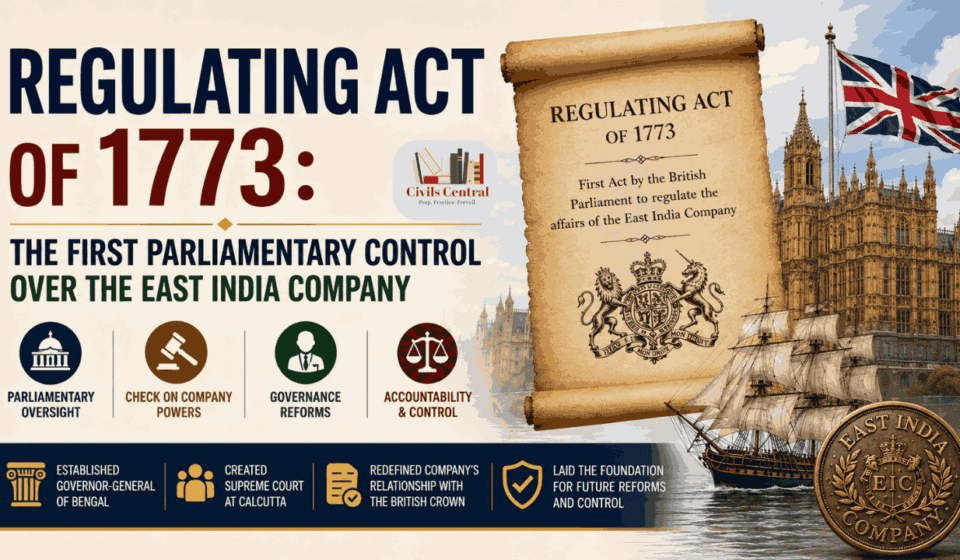
Regulating Act 0f 1773 : The First Parliamentary Control over the East India Company

Chapter Summary
Regulating Act 0f 1773:
| Chapter Information | Details |
|---|---|
| Series | Modern History of India (1707–1947) |
| Historical Period | 1772–1773 |
| Historical Phase | Constitutional Evolution of British Rule in India |
| Previous Chapter | Battle of Buxar (1764): Causes, Course, Consequences and Historical Significance |
| Current Chapter | Regulating Act, 1773: The First Parliamentary Control over the East India Company |
| Next Chapter | Warren Hastings (1772–1785): Administrative, Judicial and Revenue Reforms |
| Core Theme | The Regulating Act of 1773 was the first major attempt by the British Parliament to regulate the affairs of the English East India Company. It marked the beginning of parliamentary supervision over Company administration in India and laid the constitutional foundation for the later system of British governance. |
| Major Events Covered | Financial Crisis of the Company, Bengal Famine (1770), Parliamentary Inquiry, Regulating Act (1773), Governor-General of Bengal, Supreme Court at Calcutta, Executive Council, Constitutional Limitations |
| Key Personalities | Lord North, Warren Hastings, Robert Clive, Philip Francis, Elijah Impey |
| Key Concepts | Parliamentary Control, Governor-General, Executive Council, Supreme Court, Company Rule, Constitutional Development, Checks and Balances |
| Exam Relevance | UPSC CSE, JKPSC, JKAS, State PCS, CDS, CAPF, SSC, UGC-NET (History), University Examinations |
Introduction
Why Did the British Parliament Decide to Control the English East India Company?
The Battle of Buxar (1764) and the subsequent Treaty of Allahabad (1765) transformed the English East India Company from a commercial enterprise into the effective ruler of Bengal, Bihar, and Orissa. Through the Grant of the Diwani, the Company acquired the legal right to collect revenue from the richest provinces of India, while the Dual Government of Bengal enabled it to exercise enormous political influence without accepting full administrative responsibility. Within a few years, the Company controlled extensive territories, maintained a large standing army, collected vast revenues, and exercised powers that traditionally belonged to sovereign governments.
This rapid expansion, however, exposed serious weaknesses in the Company’s system of administration.
The Company’s directors in London were primarily merchants concerned with commercial profit rather than efficient governance. Many officials in India accumulated enormous private fortunes through corruption, misuse of authority, and abuse of commercial privileges. Administrative confusion created by the Dual Government, together with excessive revenue demands and inadequate public administration, contributed to widespread economic distress in Bengal. The catastrophic Great Bengal Famine of 1770, which claimed millions of lives, further exposed the inability of the Company to govern effectively despite exercising immense political power.
Ironically, the Company itself also entered a severe financial crisis.
Although it controlled one of the wealthiest regions in the world, mismanagement, corruption, military expenditure, and declining commercial efficiency left the Company heavily indebted. In 1772, it approached the British Government for financial assistance, creating an unprecedented constitutional dilemma. Parliament now faced an important question: Could a commercial corporation exercising sovereign powers remain free from parliamentary supervision while simultaneously seeking financial support from the British state?
The British Parliament answered this question through the Regulating Act of 1773.
The Act did not abolish the authority of the English East India Company, nor did it transfer India directly to the British Crown. Instead, it represented the first formal intervention of the British Parliament in the governance of India. It sought to regulate Company administration, establish greater political accountability, create centralized authority in Bengal, and introduce judicial institutions capable of supervising the Company’s activities.
The Regulating Act of 1773 therefore occupies a landmark position in Indian constitutional history. It marked the beginning of parliamentary control over the East India Company, initiated the process of administrative centralization, created the office of the Governor-General of Bengal, established the Supreme Court at Calcutta, and laid the constitutional foundation upon which later legislation—such as Pitt’s India Act (1784) and the Charter Acts—would gradually build the structure of British colonial administration.
For this reason, historians regard the Regulating Act not merely as an administrative reform but as the first constitutional milestone in the evolution of British rule in India.
Part I — Why Did the British Parliament Pass the Regulating Act? Political, Administrative and Economic Background (1765–1773)
Why Did a Trading Company Come Under Parliamentary Control?
The Regulating Act of 1773 did not emerge suddenly. It was the result of nearly a decade of political, administrative, and economic developments that followed the Battle of Buxar (1764). During these years, the English East India Company underwent a remarkable transformation. It ceased to be merely a commercial enterprise and gradually assumed the powers of a territorial government. It collected taxes, maintained armies, negotiated treaties, administered justice, and exercised authority over millions of people.
This unprecedented transformation created a constitutional anomaly.
The Company was still legally a private joint-stock corporation accountable to its shareholders, yet in practice it governed vast territories and exercised powers traditionally associated with sovereign states. Such an arrangement had never been anticipated when the Company received its Royal Charter in 1600. Neither the British Parliament nor the British Crown had established clear mechanisms to supervise a commercial corporation exercising governmental authority overseas.
As long as the Company’s activities were confined largely to trade, this ambiguity attracted little attention. However, once it became the effective ruler of Bengal after 1765, the consequences of weak oversight became increasingly visible. Administrative failures, financial mismanagement, political corruption, and humanitarian disasters raised serious questions regarding the Company’s ability to govern responsibly.
By the early 1770s, it had become evident that leaving such extensive political authority entirely in the hands of a private commercial corporation posed serious risks not only for India but also for Britain itself.
Transformation of the Company After the Diwani
The grant of the Diwani in 1765 fundamentally altered the nature of the English East India Company. Before acquiring the Diwani, the Company’s wealth depended primarily upon maritime trade conducted between India and Europe. Although political influence had increased after the Battle of Plassey, commercial profit remained its principal objective. The acquisition of revenue rights over Bengal, Bihar, and Orissa transformed this relationship.
The Company now possessed a regular source of income derived from land revenue rather than trade alone. This new financial base enabled it to maintain larger armies, expand its administrative machinery, and exercise increasing influence over neighbouring states. Yet the Company’s internal structure remained largely unchanged.
Its directors in London continued to think primarily in commercial terms, while many officials in India regarded public office as an opportunity for personal enrichment. The institutional framework required for governing extensive territories simply did not exist.
As a result, political power expanded much more rapidly than administrative capacity.
Failure of the Dual Government
The administrative experiment known as the Dual Government of Bengal (1765–1772) further exposed these structural weaknesses. Under the system introduced by Robert Clive, the Company exercised the Diwani, while the Nawab of Bengal retained the Nizamat. In theory, this division preserved the traditional constitutional order while allowing the Company to control provincial revenues.
In practice, however, the arrangement created a serious imbalance. The Company controlled financial resources but avoided responsibility for day-to-day administration. The Nawab remained formally responsible for maintaining law and order, administering justice, and supervising executive government, yet he lacked the revenues necessary to perform these functions effectively.
This separation of power from responsibility produced widespread administrative confusion. Officials often remained uncertain regarding the authority under which they operated. Public administration deteriorated, judicial institutions weakened, and governmental accountability became increasingly difficult to enforce. Rather than creating efficient governance, the Dual Government produced institutional paralysis.
The failure of this experiment convinced many observers that the existing administrative system required comprehensive reform.
Corruption and the Rise of the “Nabobs”
Another major concern arose from the conduct of many Company officials serving in India. The enormous wealth generated after the acquisition of the Diwani created unprecedented opportunities for private enrichment. Several Company servants accumulated vast personal fortunes through gifts, private trade, revenue manipulation, and various forms of official misconduct.
Upon returning to Britain, these wealthy officials became popularly known as “Nabobs,” a term derived from the Indian word Nawab. Their sudden prosperity attracted widespread public attention. Many members of British society questioned how Company servants receiving comparatively modest official salaries could acquire immense fortunes within a few years of service in India.
Parliamentary debates increasingly focused upon allegations of corruption, misuse of authority, and exploitation of Indian revenues. The activities of the Nabobs gradually transformed the affairs of the East India Company into a matter of national political concern within Britain. The question was no longer merely whether corruption existed.
The more fundamental question was whether a private corporation exercising sovereign powers could regulate its own officials effectively.
The Great Bengal Famine of 1770
The gravest crisis confronting Company administration occurred during the Great Bengal Famine of 1770. Failure of the monsoon, successive crop failures, and widespread food shortages combined to produce one of the worst humanitarian disasters in eighteenth-century India. Contemporary estimates suggested that nearly one-third of Bengal’s population may have perished, although modern historians differ regarding the exact scale of mortality.
Natural causes undoubtedly initiated the crisis. However, many contemporary observers and later historians criticized the Company’s response. Revenue demands remained high despite widespread agricultural collapse. Administrative institutions proved incapable of organizing effective famine relief. The constitutional confusion created by the Dual Government further delayed coordinated governmental action. Although historians continue debating the precise extent of the Company’s responsibility, there is broad agreement that the famine exposed serious weaknesses in its administrative system. The catastrophe also profoundly influenced public opinion in Britain.
For many members of Parliament, the famine demonstrated that the Company could no longer be regarded merely as a commercial enterprise. It had become a governing authority whose administrative decisions directly affected the lives of millions of people.
Financial Crisis of the East India Company
Ironically, the period during which the Company controlled the richest provinces of India also witnessed a severe deterioration in its own financial position. Military campaigns, administrative inefficiency, corruption, and declining commercial profitability imposed heavy financial burdens upon the Company. Large revenues collected in India did not translate into corresponding financial stability because substantial sums were diverted through private fortunes, military expenditure, and inefficient administration.
By 1772, the situation had become critical. The Company faced mounting debts and experienced increasing difficulty meeting its financial obligations in Britain. Unable to resolve the crisis independently, it requested financial assistance from the British Government. This request fundamentally altered the constitutional relationship between the Company and the British state.
If Parliament provided financial support, could it continue allowing the Company complete independence in political and administrative matters? The answer increasingly appeared to be no.
Parliamentary Concern and Demand for Reform
The Company’s financial difficulties, administrative failures, and allegations of corruption prompted growing concern within the British Parliament. Members of Parliament recognized that the East India Company had become far more than a commercial organization. Its decisions affected British finances, imperial policy, international diplomacy, and the governance of millions of Indian subjects.
Parliament therefore concluded that such extensive powers could no longer remain entirely beyond governmental supervision. Several parliamentary committees investigated the Company’s affairs, examining questions relating to corruption, financial management, constitutional authority, and administrative efficiency. These investigations reached a common conclusion.
The existing system had become inadequate. The Company required regulation, not abolition. Parliament sought to preserve the commercial advantages generated by the Company while ensuring greater political accountability and administrative responsibility.
This objective ultimately culminated in the Regulating Act of 1773, the first comprehensive attempt by the British Parliament to supervise the governance of British territories in India.
A Turning Point in British Constitutional History
The years between 1765 and 1773 therefore represent one of the most important transitions in the constitutional history of the British Empire. The acquisition of territory and revenue had transformed the English East India Company into an institution exercising sovereign powers, but its internal organization remained that of a commercial corporation.
The resulting contradiction produced corruption, administrative confusion, financial instability, and increasing parliamentary concern. The Regulating Act of 1773 emerged as Parliament’s response to this unprecedented situation. Rather than ending Company Rule, it sought to regulate it by introducing constitutional checks, administrative centralization, and judicial supervision.
The Act thus marked the beginning of a new relationship between the British Parliament, the East India Company, and the governance of India—a relationship that would continue evolving throughout the nineteenth century.
CivilsCentral Historical Insight
The Regulating Act of 1773 was not enacted because the East India Company had become weak, but because it had become too powerful to remain unregulated. By 1773, the Company collected taxes, maintained armies, governed territories, and influenced imperial policy while still functioning as a private commercial corporation. The financial crisis of the Company, the failure of the Dual Government, the Bengal Famine of 1770, and widespread corruption convinced the British Parliament that political power required constitutional accountability. The Regulating Act therefore marks the beginning of parliamentary governance of British India rather than merely the regulation of a trading company.
Part II — The Regulating Act 0f 1773 : Provisions and Features — How Did Parliament Attempt to Regulate the East India Company?
What Changes Did the Regulating Act Introduce?
After years of political controversy, financial instability, and administrative failures, the British Parliament enacted the Regulating Act of 1773. It was the first law passed by Parliament specifically to regulate the affairs of the English East India Company in India. Although the Act did not abolish the Company’s political authority, it fundamentally altered the relationship between the Company and the British Government. For the first time, Parliament accepted that the governance of India could no longer remain entirely under the control of a private commercial corporation.
The primary objective of the Act was not to replace the Company with direct Crown rule but to improve administration, reduce corruption, centralize authority, and establish constitutional checks on Company officials. The Act therefore marked the beginning of a gradual process through which Parliament increasingly supervised the governance of British India.
Creation of the Office of the Governor-General of Bengal
One of the most important provisions of the Regulating Act was the creation of the office of the Governor-General of Bengal. Before 1773, the three Presidencies of Bengal, Madras, and Bombay functioned largely independently. Each Presidency had its own Governor and Council, and there was no central authority capable of coordinating policy for all British possessions in India. This administrative arrangement often resulted in inconsistent political decisions, duplication of effort, and conflicts between different Presidencies.
The Regulating Act sought to overcome these problems by elevating the Governor of Bengal to the new position of Governor-General of Bengal. The first person to occupy this office was Warren Hastings, who had already been serving as the Governor of Bengal.
This change reflected Parliament’s recognition that Bengal had become the political and financial centre of the Company’s Indian possessions after the acquisition of the Diwani. Since most of the Company’s revenues originated from Bengal, it was considered appropriate that the chief executive authority should also be located there.
The creation of the Governor-General marked the beginning of administrative centralization in British India. It represented the first step towards the unified government that would later develop under the Governors-General and Viceroys.
Establishment of the Governor-General’s Executive Council
Parliament also recognized that concentrating extensive powers in the hands of a single individual might encourage arbitrary government. To prevent this possibility, the Regulating Act established an Executive Council to assist and supervise the Governor-General.
The Council consisted of four members, and all important decisions were to be taken according to the opinion of the majority rather than the personal wishes of the Governor-General. This arrangement introduced an important constitutional principle into the administration of British India.
The Governor-General was no longer expected to govern independently. His authority became subject to collective decision-making through the Executive Council. The first Council included several influential officials, among whom Philip Francis became particularly significant because of his frequent disagreements with Warren Hastings. These disagreements later produced prolonged administrative conflicts that exposed certain weaknesses within the constitutional design of the Act.
Nevertheless, the establishment of the Executive Council represented the first attempt to introduce a system of institutional checks and balances into Company administration.
Subordination of the Presidencies of Madras and Bombay
Another important feature of the Regulating Act was the reorganization of the relationship between the three Presidencies. Prior to 1773, the Presidencies of Madras and Bombay enjoyed considerable autonomy in conducting diplomatic negotiations, concluding treaties, and initiating military operations with neighbouring Indian states.
Such independence frequently created serious problems. Policies pursued by one Presidency were not always consistent with those adopted elsewhere, resulting in administrative confusion and occasionally unnecessary military conflicts. The Regulating Act therefore placed the Presidencies of Madras and Bombay under the general supervision of the Governor-General of Bengal in matters relating to war, peace, and diplomacy.
Although they continued to manage routine local administration, they could no longer independently undertake major political or military actions without reference to the central authority at Bengal except in cases of exceptional emergency.
This provision significantly strengthened administrative unity and marked the beginning of political centralization in British India.
Establishment of the Supreme Court at Calcutta
One of the most far-reaching provisions of the Regulating Act was the establishment of the Supreme Court at Calcutta in 1774. Before the enactment of the Act, judicial administration within Company territories remained fragmented and often inconsistent. Different courts exercised different jurisdictions, while Company officials frequently performed judicial functions without adequate legal supervision.
To address these problems, Parliament created a Supreme Court consisting of one Chief Justice and three Puisne Judges. The first Chief Justice appointed to the Court was Sir Elijah Impey. The Court was empowered to administer English law in specified cases and exercise jurisdiction over British subjects residing in Bengal. It also possessed authority over certain civil and criminal matters arising within the Presidency of Calcutta. The establishment of the Supreme Court represented a significant constitutional innovation because it introduced an independent judicial institution into the governance of British India.
However, the Act failed to define clearly the exact limits of the Court’s jurisdiction. This ambiguity soon produced conflicts between the Supreme Court and the Governor-General’s Council, leading to important constitutional controversies during the administration of Warren Hastings.
Restrictions on Corruption and Private Trade
The British Parliament was deeply concerned about widespread allegations of corruption among Company officials. Numerous servants of the Company had accumulated enormous private fortunes through gifts, unofficial payments, and private commercial activities. Such practices not only damaged the Company’s reputation but also undermined public confidence in its administration.
The Regulating Act attempted to address these problems by introducing restrictions upon the conduct of Company officials. Governors, members of the Executive Council, and judges of the Supreme Court were prohibited from accepting presents, gifts, or bribes from Indian rulers or private individuals. The Act also imposed restrictions upon private commercial activities conducted by senior Company officials. These measures reflected Parliament’s determination to separate public office from private financial gain.
Although corruption did not disappear immediately, the legislation established an important constitutional principle that public authority should be exercised in the interests of good governance rather than personal enrichment.
Greater Parliamentary Supervision of the Company
The Regulating Act also strengthened the relationship between the Company and the British Government. The Court of Directors continued to manage the commercial affairs of the Company, but Parliament required greater transparency in political administration. The Company was instructed to submit regular reports regarding its civil, military, and financial affairs to the British Government.
This requirement represented the beginning of formal parliamentary oversight over Indian administration. For the first time, the British Government acquired the legal authority to examine how the Company exercised its political powers. Although Parliament did not yet assume direct control over India, the principle had been firmly established that the governance of British territories overseas could not remain entirely beyond parliamentary supervision.
This constitutional development would later be strengthened through Pitt’s India Act of 1784.
A Landmark in Constitutional Development
Taken together, the provisions of the Regulating Act of 1773 represented a major constitutional milestone. The Act centralized administration under the Governor-General of Bengal, introduced collective executive responsibility through the Executive Council, subordinated the other Presidencies to Bengal in major political matters, established the Supreme Court at Calcutta, attempted to reduce corruption, and initiated parliamentary supervision over the Company’s political activities.
Although many practical difficulties remained unresolved, the legislation fundamentally altered the constitutional character of Company Rule. The English East India Company continued to govern India, but it no longer exercised unlimited authority. Its political power had become subject to the oversight of the British Parliament.
This marked the beginning of a constitutional evolution that would eventually culminate in the transfer of power from the Company to the British Crown in 1858.
CivilsCentral Historical Insight
The Regulating Act of 1773 was the first written constitutional framework for British administration in India. It did not end Company Rule, but it ended the Company’s political independence. By creating the office of the Governor-General, establishing the Supreme Court, introducing an Executive Council, centralizing administration, and initiating parliamentary oversight, the Act transformed the East India Company from an autonomous commercial corporation into a politically regulated governing authority. It was the first constitutional step in the evolution of the modern Government of India.
Part III — Limitations and Defects of the Regulating Act, 1773: Why Did the First Constitutional Experiment Fail?
Did the Regulating Act Solve the Problems of Company Administration?
The Regulating Act of 1773 occupies an important place in Indian constitutional history because it marked the first attempt by the British Parliament to regulate the administration of the English East India Company. The Act introduced significant institutional reforms, including the office of the Governor-General of Bengal, the Executive Council, and the Supreme Court at Calcutta. It also established the principle that Parliament possessed the authority to supervise the political activities of the Company.
However, despite these important innovations, the Act failed to resolve many of the practical problems it was intended to address.
Its provisions were often incomplete, several constitutional relationships remained poorly defined, and many institutional arrangements created new conflicts instead of eliminating existing ones. Within a few years of its implementation, disputes between the Governor-General and his Council, conflicts between the Executive and the Supreme Court, and uncertainty regarding the powers of different authorities exposed serious weaknesses in the constitutional framework established by the Act.
Consequently, the Regulating Act is remembered not as a perfect constitutional settlement but as an important first experiment that revealed the complexities of governing India through a combination of parliamentary supervision and Company administration.
Conflict Between the Governor-General and the Executive Council
One of the most serious weaknesses of the Regulating Act lay in the relationship between the Governor-General and the Executive Council. The Act required that important decisions should be taken according to the opinion of the majority within the Council. Although this provision was intended to prevent arbitrary government, it unintentionally weakened the authority of the Governor-General.
The problem became immediately evident during the administration of Warren Hastings.
Several members of the Council, particularly Philip Francis, frequently disagreed with Hastings on questions of administration, diplomacy, and finance. Since the Governor-General was bound by majority decisions, he often found himself unable to implement policies that he considered necessary for efficient administration.
Instead of creating cooperation, the constitutional arrangement frequently produced prolonged political deadlock. Governmental decisions were delayed, administrative efficiency suffered, and personal rivalries increasingly influenced official policy. The Act therefore failed to establish a clear balance between executive leadership and collective decision-making.
Unclear Relationship Between the Supreme Court and the Executive
Another major weakness of the Regulating Act was its failure to define clearly the jurisdiction of the Supreme Court at Calcutta. The Court had been created to ensure the proper administration of justice, but the Act did not specify the precise limits of its authority. As a result, uncertainty soon arose regarding whether English law should apply only to British subjects or also to Indian inhabitants living under Company administration.
The judges of the Supreme Court often interpreted their powers broadly, while the Governor-General’s Council believed that judicial interference should remain limited. This difference in interpretation produced repeated constitutional conflicts. Administrative decisions taken by Company officials were challenged before the Court, while judges occasionally questioned actions that the Executive regarded as essential for effective government.
Instead of creating harmony between the judiciary and the executive, the vague language of the Act generated continuous institutional friction. These disputes highlighted the importance of clearly defining constitutional powers, a lesson that later legislation attempted to address.
No Clear Separation Between Commercial and Political Functions
Although the Regulating Act subjected the Company to parliamentary supervision, it did not fundamentally alter the Company’s basic character. The English East India Company continued to function simultaneously as a commercial enterprise and a governing authority.
This dual character created an inherent conflict of interest. As a trading corporation, the Company sought to maximize commercial profits for its shareholders. As a political authority, it was expected to govern territories, administer justice, maintain law and order, and protect the welfare of its subjects.
The Act did not establish clear institutional mechanisms to separate these two objectives. Consequently, commercial considerations frequently continued to influence political decisions, while administrative priorities sometimes conflicted with the Company’s financial interests.
This constitutional contradiction remained unresolved until much later in the evolution of British rule.
Limited Parliamentary Control
The Regulating Act marked the beginning of parliamentary supervision, but that supervision remained limited. Parliament acquired the right to receive reports regarding the Company’s civil, military, and financial affairs, yet it did not establish an effective administrative department capable of exercising continuous oversight.
The Court of Directors continued to manage many aspects of Company administration, while Parliament possessed only indirect supervisory powers. As a result, communication between London and India remained slow, and effective control over distant territories proved difficult. The British Government therefore lacked the institutional machinery necessary to supervise Indian affairs on a regular basis.
This weakness became increasingly apparent during the following decade and eventually led to the enactment of Pitt’s India Act (1784), which created the Board of Control to strengthen parliamentary authority.
Failure to Resolve Corruption Completely
Reducing corruption had been one of the principal objectives of the Regulating Act. The prohibition on accepting gifts and engaging in private commercial activities represented an important constitutional principle. However, legislation alone proved insufficient to eliminate deeply rooted administrative practices.
Many opportunities for misuse of authority continued to exist, particularly in revenue administration and local governance. Enforcing ethical standards across distant territories remained extremely difficult because communication between Britain and India required several months. Consequently, although the Act established higher standards of official conduct, corruption did not disappear immediately.
The problem continued to concern Parliament and became one of the reasons for introducing further administrative reforms during the late eighteenth century.
Continued Administrative Ambiguity
The Regulating Act also failed to establish a fully centralized system of administration. Although the Presidencies of Madras and Bombay were placed under the general supervision of the Governor-General of Bengal, they retained considerable autonomy in many administrative matters. The exact circumstances under which they could act independently remained insufficiently defined.
This ambiguity occasionally produced differences in political and military policy between the Presidencies and the central government. The problem reflected a broader constitutional difficulty. The British Empire in India was expanding rapidly, but its administrative institutions had not yet evolved to match the growing scale of territorial authority.
The Regulating Act represented an important beginning, but it did not create a complete or coherent administrative structure.
Why Was Further Constitutional Reform Necessary?
By the early 1780s, it had become increasingly evident that the Regulating Act had only partially succeeded. It established parliamentary intervention, introduced constitutional institutions, and initiated administrative centralization. At the same time, however, it created new constitutional conflicts, left several institutional relationships undefined, and failed to provide an effective system of political supervision.
Rather than ending constitutional uncertainty, the Act revealed how complex the governance of India had become. The experience gained during the implementation of the Regulating Act convinced the British Government that more comprehensive reforms were necessary.
These reforms eventually took shape in Pitt’s India Act of 1784, which introduced the Board of Control, clarified the relationship between the British Government and the Company, and significantly strengthened parliamentary supervision over Indian administration.
Thus, the limitations of the Regulating Act directly shaped the next stage in the constitutional evolution of British rule in India.
CivilsCentral Historical Insight
The greatest achievement of the Regulating Act of 1773 was not that it created a perfect constitutional system, but that it initiated one. Its weaknesses—conflicts between the Governor-General and the Council, jurisdictional disputes with the Supreme Court, limited parliamentary oversight, and the continued blending of commercial and political functions—demonstrated that governing India required a far more sophisticated constitutional framework. These shortcomings paved the way for Pitt’s India Act (1784), making the Regulating Act the first, rather than the final, step in the constitutional evolution of British India.
Part IV — Significance of the Regulating Act, 1773: Why Is It Called the First Constitutional Milestone of British India?
Why Does the Regulating Act Occupy a Landmark Position in Indian Constitutional History?
The Regulating Act of 1773 occupies a unique position in the constitutional history of India because it marked the first formal intervention of the British Parliament in the administration of the English East India Company. Although the Company continued to govern India, the Act established an entirely new constitutional principle: political authority exercised by the Company was no longer independent of parliamentary supervision.
This development represented a decisive departure from the earlier phase of Company Rule.
Until 1773, the Company governed its Indian territories largely according to its own commercial interests and internal regulations. Parliament had granted the Company trading privileges through royal charters, but it had exercised little direct control over the Company’s political activities in India. The rapid territorial expansion that followed the Battle of Buxar (1764) and the acquisition of the Diwani fundamentally altered this situation. Once the Company became a territorial power responsible for governing millions of people, Parliament concluded that such authority could no longer remain beyond constitutional oversight.
The Regulating Act therefore inaugurated a new era in which the governance of India became an issue of national constitutional importance rather than merely a matter of commercial administration.
Beginning of Parliamentary Sovereignty over Indian Administration
The most enduring significance of the Regulating Act was that it established the supremacy of the British Parliament over the political affairs of the East India Company. Before the enactment of the Act, the Company enjoyed considerable autonomy in managing both its commercial operations and its expanding territorial possessions. Its directors determined administrative policy, military strategy, and financial management with minimal governmental interference.
The Regulating Act fundamentally changed this relationship.
Although the Company retained its corporate existence, Parliament asserted its right to regulate the Company’s political functions. The governance of India ceased to be treated solely as a private commercial enterprise and became a matter of public constitutional responsibility. This principle would subsequently shape every major constitutional reform introduced during British rule.
From Pitt’s India Act (1784) to the Government of India Act (1858), Parliament steadily expanded its authority over Indian administration. The constitutional foundation for this process was laid by the Regulating Act of 1773.
Beginning of Administrative Centralization
The Act also marked the beginning of administrative centralization in British India. Prior to 1773, the three Presidencies of Bengal, Madras, and Bombay functioned with considerable independence. Each Presidency pursued its own administrative and political policies, often without effective coordination with the others.
Such decentralization became increasingly impractical as British territorial possessions expanded. By creating the office of the Governor-General of Bengal and placing the other Presidencies under his general supervision in matters of war and diplomacy, the Regulating Act initiated the process of political unification.
Although complete centralization would emerge only gradually during the nineteenth century, the constitutional principle had now been firmly established. India was to be governed through a central authority rather than through several independent provincial administrations.
This administrative development significantly strengthened the capacity of the British Government to formulate consistent policies across its Indian territories.
Evolution of Responsible Government
Another important contribution of the Regulating Act was the introduction of the concept of institutional responsibility in colonial administration.
The creation of the Executive Council reflected the belief that important governmental decisions should not depend solely upon the discretion of one individual. Instead, executive authority should operate within an institutional framework where decisions were discussed collectively and subject to constitutional procedures.
Although conflicts between Warren Hastings and his Council later revealed weaknesses in this arrangement, the principle itself remained highly significant. The Act emphasized that government should function through established institutions rather than purely through personal authority.
This concept gradually became one of the defining characteristics of British constitutional administration in India.
Establishment of an Independent Judiciary
The establishment of the Supreme Court at Calcutta represented another milestone in the constitutional development of British India. For the first time, Parliament created an independent judicial institution possessing authority separate from the executive administration of the East India Company.
Although disputes soon emerged regarding the Court’s jurisdiction, its creation reflected an important constitutional principle. The administration of justice should not remain entirely under executive control. Instead, judicial authority required institutional independence capable of interpreting and applying the law impartially.
This principle became an essential feature of later constitutional development and influenced the evolution of India’s judicial system throughout the colonial period.
Recognition That India Required Constitutional Governance
Perhaps the most profound significance of the Regulating Act lay in what it revealed about the changing nature of British power in India. The legislation acknowledged that India could no longer be governed simply through commercial regulations designed for a trading corporation.
Territorial administration demanded constitutional institutions, administrative accountability, judicial supervision, and legislative oversight. The Act therefore represented Britain’s first attempt to develop a constitutional framework appropriate for governing an expanding colonial empire.
Although the experiment remained incomplete, it established the principle that political authority required legal regulation. This realization influenced every subsequent stage of British constitutional policy in India.
Foundation for Future Constitutional Reforms
The Regulating Act should also be understood as the starting point of a continuous constitutional evolution. Its practical shortcomings demonstrated that further reforms would be necessary. Conflicts between the Governor-General and the Executive Council, jurisdictional disputes involving the Supreme Court, and limited parliamentary supervision exposed weaknesses that later legislation sought to correct.
Consequently, the Regulating Act directly prepared the way for Pitt’s India Act (1784), which strengthened governmental control through the establishment of the Board of Control. During the nineteenth century, successive Charter Acts, the Government of India Act (1858), and later constitutional reforms continued the process initiated in 1773.
Thus, the constitutional history of British India developed through a series of legislative measures, all of which traced their origins to the first parliamentary intervention represented by the Regulating Act.
A Turning Point in the Constitutional History of India
The Regulating Act of 1773 occupies a landmark position because it fundamentally redefined the constitutional relationship between the British Parliament, the East India Company, and the governance of India. It transformed the Company from an autonomous commercial corporation into a politically regulated institution.
It initiated parliamentary sovereignty over Indian administration. It established centralized executive authority. It created an independent judicial institution. It introduced collective executive responsibility. Most importantly, it recognized that governing India required constitutional principles rather than commercial expediency alone.
For these reasons, historians regard the Regulating Act not merely as an administrative reform but as the first constitutional charter of British India. Although later legislation significantly modified its provisions, the constitutional principles introduced in 1773 continued to influence the evolution of British administration until the end of Company Rule in 1858.
CivilsCentral Historical Insight
The true significance of the Regulating Act of 1773 lies not in the immediate success of its provisions but in the constitutional principles it established. It marked the first assertion of parliamentary sovereignty over the East India Company, initiated administrative centralization, introduced institutional checks on executive authority, created an independent judiciary, and recognized that India required constitutional governance rather than commercial management. Every major constitutional reform of British India—from Pitt’s India Act (1784) to the Government of India Act (1858)—can trace its origins to the constitutional foundations laid by the Regulating Act of 1773.
Part V — Historiography of the Regulating Act, 1773: How Have Historians Evaluated the First Constitutional Reform?
Why Does the Regulating Act Continue to Occupy an Important Place in Historical Debate?
The Regulating Act of 1773 is widely regarded as one of the foundational constitutional measures in the history of British India. However, historians have interpreted its significance in different ways depending upon their understanding of the nature of British imperialism, the role of the East India Company, and the objectives of the British Parliament.
Some historians have viewed the Act as a progressive constitutional reform that introduced accountability into Company administration. Others have argued that it merely strengthened British control over India without addressing the exploitative character of colonial rule. More recent scholars have adopted a balanced perspective, recognizing both its constitutional importance and its practical limitations.
These different interpretations demonstrate that the Regulating Act was not simply an administrative statute. It represented a turning point in the relationship between commerce, constitutional authority, and imperial governance.
Imperial Historiography: The Beginning of Responsible Government
Early British or Imperial historians regarded the Regulating Act as a necessary and enlightened reform. According to this interpretation, the rapid territorial expansion of the English East India Company after the Battle of Buxar had created administrative responsibilities that could no longer be managed through commercial institutions alone. Parliament therefore acted responsibly by introducing constitutional supervision over the Company’s affairs.
Imperial historians emphasized that the Act established centralized administration, created the office of the Governor-General of Bengal, introduced an Executive Council, and established the Supreme Court at Calcutta. These measures were presented as evidence that Britain sought to replace arbitrary commercial management with orderly constitutional government.
From this perspective, the Regulating Act marked the beginning of efficient and responsible administration in India. However, modern historians have criticized this interpretation for paying insufficient attention to the economic interests that continued to shape British policy.
Nationalist Historiography: Consolidation of Colonial Rule
Indian nationalist historians interpreted the Regulating Act quite differently. They argued that the legislation was introduced not primarily to improve the welfare of the Indian people but to protect British political and commercial interests. According to this school, Parliament intervened because the East India Company had become too important to the British economy and too powerful to remain free from governmental supervision.
Nationalist scholars pointed out that the Act did not reduce British authority in India. Instead, it strengthened the constitutional foundations of colonial rule by making Company administration more organized and politically accountable to Britain rather than to the people of India.
The establishment of centralized authority, parliamentary oversight, and judicial institutions therefore represented, in their view, the consolidation of British imperial power rather than the introduction of democratic governance.
From this perspective, the Regulating Act was the first constitutional step towards a more efficient colonial state.
Marxist Interpretation: Regulation for Imperial Interests
Marxist historians focused primarily on the economic background of the legislation. They argued that the Regulating Act emerged because the East India Company had entered a serious financial crisis despite controlling the wealthiest provinces of India. Corruption, military expenditure, and administrative inefficiency threatened not only the Company’s finances but also the broader interests of British capitalism.
According to this interpretation, Parliament intervened to protect the economic value of the Indian empire. The Act therefore represented an attempt to regulate the Company’s political administration so that colonial revenues could be collected more efficiently and commercial interests safeguarded more effectively.
Marxist historians thus viewed the legislation as an important stage in the institutional development of colonial capitalism, where constitutional reforms served the larger objective of maintaining economic control over India.
Revisionist Historiography: A Practical Constitutional Experiment
Modern revisionist historians generally adopt a more balanced interpretation. They argue that the Regulating Act should neither be idealized as a purely humanitarian reform nor dismissed simply as an instrument of colonial exploitation. Instead, it should be understood as Britain’s first serious attempt to solve an entirely new constitutional problem. Never before had a private commercial corporation acquired extensive territorial possessions and exercised sovereign powers on such a scale. Parliament therefore had no historical model upon which it could rely.
The Regulating Act represented an experimental constitutional solution to this unprecedented situation. Its successes and failures both contributed to the subsequent evolution of British administration. The conflicts between the Governor-General and the Council, the jurisdictional disputes involving the Supreme Court, and the limitations of parliamentary supervision revealed problems that later legislation attempted to resolve.
Revisionist historians therefore regard the Act as an evolving constitutional experiment rather than a complete constitutional settlement.
Modern Historical Consensus
Despite differences in interpretation, historians broadly agree on several important conclusions. First, the Regulating Act of 1773 marked the beginning of direct parliamentary involvement in the governance of India. Second, it initiated the process of administrative centralization that eventually produced a unified colonial government.
Third, it established important constitutional institutions whose influence extended far beyond the eighteenth century. Finally, the Act demonstrated that the governance of India had become a matter of national political importance within Britain rather than merely a commercial concern of the East India Company. Most modern historians therefore regard the Regulating Act as the first major constitutional milestone in the evolution of British administration in India.
Its immediate provisions may have proved imperfect, but the constitutional principles it introduced shaped every subsequent stage of British imperial governance.
Historical Legacy of the Regulating Act
The Regulating Act occupies a permanent place in Indian constitutional history because it initiated a legislative tradition that continued throughout the colonial period. Every major constitutional enactment—from Pitt’s India Act (1784) and the Charter Acts to the Government of India Act (1858)—built upon the foundations first established in 1773.
The Act demonstrated that political authority required constitutional regulation, institutional accountability, and parliamentary supervision. Although these principles were introduced to strengthen British control over India, they also contributed to the gradual development of constitutional administration, centralized governance, and judicial institutions.
For this reason, the Regulating Act is remembered not merely as a law passed by Parliament but as the beginning of the constitutional evolution of British India.
CivilsCentral Historical Insight
The historiography of the Regulating Act of 1773 reflects the complexity of British imperialism. Imperial historians viewed it as the beginning of responsible government, nationalist scholars regarded it as the constitutional consolidation of colonial rule, Marxist historians emphasized its role in protecting British economic interests, and revisionist historians interpreted it as an experimental response to the unprecedented challenge of a private corporation exercising sovereign powers. Together, these perspectives demonstrate that the Regulating Act was not merely an administrative reform but the first constitutional foundation of British governance in India.
Part VI — Conclusion: How Did the Regulating Act Change the Course of British Rule in India?
From Commercial Enterprise to Constitutional Governance
The Regulating Act of 1773 occupies a landmark position in the constitutional history of modern India because it marked the first formal recognition by the British Parliament that the governance of India could no longer remain solely in the hands of the English East India Company. The Company’s rapid territorial expansion following the Battle of Buxar (1764), its acquisition of the Diwani, the administrative failures of the Dual Government, the devastating Great Bengal Famine of 1770, and its growing financial crisis collectively demonstrated that a private commercial corporation was ill-equipped to govern a vast empire without constitutional supervision.
Parliament responded not by abolishing the Company’s authority but by introducing a framework of regulation that sought to balance commercial interests with political responsibility. Through the creation of the Governor-General of Bengal, the establishment of the Executive Council and the Supreme Court at Calcutta, and the initiation of parliamentary oversight, the Regulating Act fundamentally altered the constitutional relationship between the Company, the British Government, and the administration of India.
Although the Act contained several institutional weaknesses, it represented the first serious attempt to introduce accountability, administrative centralization, and judicial supervision into British governance in India.
Why Was the Regulating Act a Turning Point?
The historical importance of the Regulating Act lies not merely in the provisions it introduced but in the constitutional principles it established.
For the first time, the British Parliament asserted that political authority exercised by the East India Company was subject to parliamentary control. This principle permanently ended the Company’s political independence, even though it continued to administer India for another eighty-five years.
The Act also recognized that territorial administration required institutions very different from those needed for commercial enterprise. Governing millions of people demanded centralized executive authority, an organized judicial system, defined constitutional offices, and mechanisms capable of supervising public administration.
Although the constitutional framework established in 1773 remained imperfect, it initiated the gradual transformation of Company administration into an organized colonial government.
Legacy of the Regulating Act
The constitutional experiment initiated in 1773 did not conclude with the Regulating Act itself. The practical difficulties encountered during its implementation—particularly conflicts between the Governor-General and the Executive Council, disputes involving the Supreme Court, and the limitations of parliamentary supervision—revealed that further reforms were necessary.
These experiences directly influenced the enactment of Pitt’s India Act (1784), which strengthened governmental control through the creation of the Board of Control and clarified the constitutional relationship between the British Government and the East India Company.
During the nineteenth century, successive constitutional measures—including the Charter Acts, the Government of India Act (1858), and later administrative reforms—continued the process of constitutional evolution that had begun with the Regulating Act.
Thus, the Act should be understood as the first chapter in the constitutional development of British India, rather than a complete constitutional settlement.
CivilsCentral Historical Insight
The Regulating Act of 1773 was the first constitutional bridge between commerce and empire. It acknowledged that the East India Company had evolved beyond a trading corporation into a governing authority and therefore required parliamentary regulation. Although its institutional design was imperfect, it introduced the enduring principles of centralized administration, executive accountability, judicial supervision, and parliamentary sovereignty. In this sense, the Regulating Act was not simply a reform of the Company—it was the constitutional birth of British governance in India.
Part VII — Key Takeaways from the Regulating Act, 1773
The Regulating Act of 1773 marked the beginning of the constitutional evolution of British rule in India. It was the first law passed by the British Parliament to regulate the affairs of the English East India Company, recognizing that a commercial corporation exercising sovereign powers required constitutional supervision. Although the Act did not transfer India to the British Crown, it established the principles of parliamentary control, administrative centralization, judicial independence, and executive accountability, which shaped every subsequent constitutional reform during the colonial period.
For UPSC aspirants, the Regulating Act should be remembered as the first constitutional milestone in British India, forming the foundation for Pitt’s India Act (1784) and the later constitutional development of the Indian administration.
Timeline at a Glance
| Year | Event | Historical Importance |
|---|---|---|
| 1764 | Battle of Buxar | Established British military supremacy in northern India. |
| 1765 | Treaty of Allahabad | Company acquired constitutional recognition. |
| 1765 | Grant of the Diwani | Company became the revenue authority in Bengal, Bihar and Orissa. |
| 1765–1772 | Dual Government of Bengal | First administrative experiment under Company Rule. |
| 1770 | Great Bengal Famine | Exposed administrative failures of Company rule. |
| 1772 | Warren Hastings became Governor of Bengal | Abolished the Dual Government and introduced administrative reforms. |
| 1773 | Regulating Act | Beginning of parliamentary control over the East India Company. |
| 1774 | Supreme Court at Calcutta established | First Supreme Court in British India. |
| 1784 | Pitt’s India Act | Strengthened parliamentary control through the Board of Control. |
Key Personalities
| Personality | Contribution |
|---|---|
| Lord North | British Prime Minister under whose government the Regulating Act was enacted. |
| Warren Hastings | First Governor-General of Bengal under the Regulating Act. |
| Robert Clive | Established Company Rule after Buxar and introduced the Dual Government. |
| Philip Francis | Member of the Governor-General’s Council; frequently opposed Warren Hastings. |
| Sir Elijah Impey | First Chief Justice of the Supreme Court at Calcutta. |
Major Provisions of the Regulating Act
The Regulating Act introduced several important constitutional reforms.
- Created the office of the Governor-General of Bengal.
- Warren Hastings became the first Governor-General.
- Established a four-member Executive Council.
- Subordinated the Madras and Bombay Presidencies to Bengal in matters of war and diplomacy.
- Established the Supreme Court at Calcutta (1774).
- Prohibited Company officials from accepting gifts and engaging in corrupt practices.
- Required the Company to report its civil, military, and financial affairs to the British Government.
Constitutional Sequence
Battle of Buxar (1764)
           │
           ▼
Treaty of Allahabad (1765)
           │
           ▼
Grant of the Diwani
           │
           ▼
Dual Government (1765–1772)
           │
           ▼
Great Bengal Famine (1770)
           │
           ▼
Regulating Act (1773)
           │
           ▼
Supreme Court at Calcutta (1774)
           │
           ▼
Pitt's India Act (1784)
CivilsCentral Revision Insight
Remember the constitutional progression as: Buxar → Diwani → Dual Government → Great Bengal Famine → Regulating Act → Supreme Court → Pitt’s India Act. This sequence explains how the East India Company evolved from an autonomous trading corporation into a politically regulated governing authority under the supervision of the British Parliament.
Chapter Summary
The Regulating Act of 1773 marked the beginning of a new phase in the constitutional history of British India. It was enacted at a time when the English East India Company had ceased to function merely as a commercial enterprise and had emerged as a territorial power exercising political, military, judicial, and financial authority over vast regions of India. The Company’s rapid expansion following the Battle of Buxar (1764), the acquisition of the Diwani, the failure of the Dual Government of Bengal, widespread corruption among Company officials, the devastating Great Bengal Famine of 1770, and the Company’s growing financial crisis convinced the British Parliament that the administration of India could no longer remain outside parliamentary supervision.
The Regulating Act was Parliament’s first attempt to address this constitutional challenge. It sought to improve Company administration by introducing centralized governance, judicial institutions, and executive accountability without abolishing the Company’s political authority. The Act created the office of the Governor-General of Bengal, with Warren Hastings becoming its first incumbent, and established a four-member Executive Council to assist and supervise executive decision-making. It also subordinated the Presidencies of Madras and Bombay to Bengal in matters of war and diplomacy, thereby initiating the process of administrative centralization in British India.
Another major constitutional innovation introduced by the Act was the establishment of the Supreme Court at Calcutta (1774), headed by Sir Elijah Impey. For the first time, an independent judicial institution was created under parliamentary authority to administer justice in British India. At the same time, Parliament attempted to curb corruption by prohibiting Company officials from accepting gifts and engaging in private commercial activities while requiring the Company to submit regular reports regarding its civil, military, and financial administration.
Despite these important reforms, the Regulating Act suffered from several constitutional weaknesses. It failed to define clearly the relationship between the Governor-General and the Executive Council, leading to prolonged administrative conflicts during Warren Hastings’ tenure. The jurisdiction of the Supreme Court remained ambiguous, resulting in repeated disputes between the judiciary and the executive. Furthermore, the Act did not adequately separate the Company’s commercial interests from its political responsibilities, nor did it establish an effective mechanism for continuous parliamentary supervision. These shortcomings demonstrated that governing India required a more comprehensive constitutional framework than the Act had provided.
Nevertheless, the historical significance of the Regulating Act extends far beyond its immediate administrative success or failure. It established the fundamental principle that the British Parliament possessed ultimate authority over the political activities of the East India Company. It marked the beginning of centralized administration, introduced institutional checks on executive authority, laid the foundation of an independent judiciary, and initiated the constitutional evolution of British governance in India. The lessons learned from its implementation directly influenced Pitt’s India Act (1784) and every subsequent constitutional reform enacted during the period of Company Rule.
The Regulating Act of 1773 therefore occupies a landmark place in modern Indian history. It did not end the rule of the English East India Company, nor did it establish direct Crown administration. Instead, it initiated the constitutional transition from commercial management to parliamentary governance, laying the institutional foundations upon which the British colonial state in India would gradually develop. It remains the first constitutional charter of British India and the starting point of the long legislative process that ultimately reshaped the political and administrative history of the Indian subcontinent.
Frequently Asked Questions (FAQs)
1. What was the Regulating Act of 1773?
The Regulating Act of 1773 was the first law passed by the British Parliament to regulate the administration of the English East India Company in India. It marked the beginning of parliamentary control over the Company’s political affairs and laid the constitutional foundation of British administration in India.
2. Why was the Regulating Act of 1773 passed?
The Act was passed because the English East India Company had become a territorial power after the Battle of Buxar (1764) and the Grant of the Diwani (1765). Corruption among Company officials, the failure of the Dual Government, the Great Bengal Famine of 1770, and the Company’s financial crisis convinced the British Parliament that Company administration required constitutional regulation.
3. Who passed the Regulating Act of 1773?
The British Parliament passed the Regulating Act during the ministry of Lord North, the British Prime Minister. It represented the first direct parliamentary intervention in the governance of British territories in India.
4. Who became the first Governor-General under the Regulating Act?
Warren Hastings became the first Governor-General of Bengal under the Regulating Act of 1773. His appointment marked the beginning of centralized executive administration in British India.
5. What was the Executive Council created under the Regulating Act?
The Regulating Act established a four-member Executive Council to assist the Governor-General. Decisions were to be taken by majority vote, introducing the principle of collective executive responsibility. However, frequent disagreements between Warren Hastings and members such as Philip Francis exposed weaknesses in this arrangement.
6. What changes did the Regulating Act make to the three Presidencies?
The Act placed the Presidencies of Madras and Bombay under the general supervision of the Governor-General of Bengal in matters relating to war, peace, and diplomacy. This marked the beginning of administrative and political centralization in British India.
7. Why was the Supreme Court at Calcutta established?
The Supreme Court at Calcutta was established in 1774 to introduce an independent judicial institution under parliamentary authority. It was intended to improve the administration of justice and ensure legal accountability within British-controlled territories.
8. Who was the first Chief Justice of the Supreme Court at Calcutta?
Sir Elijah Impey was appointed as the first Chief Justice of the Supreme Court at Calcutta when it was established in 1774.
9. What were the major provisions of the Regulating Act of 1773?
The Act:
- Created the office of the Governor-General of Bengal.
- Established a four-member Executive Council.
- Subordinated the Madras and Bombay Presidencies to Bengal in major political matters.
- Established the Supreme Court at Calcutta.
- Restricted Company officials from accepting gifts and engaging in corrupt practices.
- Introduced parliamentary supervision over the Company’s political administration.
10. What were the major defects of the Regulating Act?
The Act suffered from several weaknesses, including conflicts between the Governor-General and the Executive Council, an unclear jurisdiction for the Supreme Court, limited parliamentary supervision, continued corruption, and the absence of a clear separation between the Company’s commercial and political functions.
11. Why is the Regulating Act called the first constitutional milestone of British India?
The Regulating Act is regarded as the first constitutional milestone because it established parliamentary authority over the East India Company, initiated administrative centralization, created an organized executive structure, established an independent judiciary, and introduced constitutional regulation into British governance in India.
12. How did the Regulating Act lead to Pitt’s India Act of 1784?
The constitutional ambiguities and administrative conflicts created by the Regulating Act demonstrated that stronger governmental supervision was necessary. These shortcomings led to the enactment of Pitt’s India Act (1784), which established the Board of Control and significantly increased the British Government’s authority over Company administration.
13. Why is the Regulating Act important for UPSC examinations?
The Regulating Act is one of the most important topics in UPSC Modern History and Polity because it marks the beginning of parliamentary control over the East India Company, explains the evolution of British constitutional administration, and forms the foundation for later constitutional developments such as Pitt’s India Act, the Charter Acts, and the Government of India Act, 1858.
14. What is the historical significance of the Regulating Act of 1773?
The Regulating Act transformed the constitutional relationship between the British Parliament and the English East India Company. It ended the Company’s political autonomy, initiated centralized administration, introduced judicial supervision, and laid the constitutional foundations of British rule in India.
15. How did the Regulating Act change the nature of Company Rule?
Before 1773, the East India Company exercised political authority with minimal parliamentary oversight. After the Regulating Act, the Company continued to govern India but did so under constitutional regulation by the British Parliament. This marked the transition from an autonomous commercial corporation to a politically regulated governing institution and initiated the constitutional evolution of British India.
Mind Map for Revision
┌─────────────────────────────────────────────────────────────┐
│                 REGULATING ACT, 1773                        │
│     First Parliamentary Control over the East India Company │
└─────────────────────────────────────────────────────────────┘
                              │
 ┌────────────────────────────┼─────────────────────────────┐
 │                            │                             │
 ▼                            ▼                             ▼
BACKGROUND                PROVISIONS                  DEFECTS
 │                            │                             │
 ├─ Battle of Buxar (1764)    ├─ Governor-General          ├─ Governor-General
 ├─ Diwani (1765)             │   of Bengal               │  vs Council conflict
 ├─ Dual Government           ├─ Warren Hastings          ├─ Supreme Court
 ├─ Corruption                │   (First G.G.)           │  jurisdiction unclear
 ├─ Bengal Famine (1770)      ├─ Executive Council        ├─ Commercial &
 ├─ Financial Crisis          ├─ Supreme Court           │  political functions
 └─ Parliamentary Inquiry     ├─ Madras & Bombay         │  not separated
                              │   subordinated           ├─ Weak Parliamentary
                              ├─ Restrictions on         │  control
                              │   corruption             └─ Continued corruption
                              └─ Parliamentary
                                  supervision
                                      │
                                      ▼
                           HISTORICAL SIGNIFICANCE
                                      │
       ┌──────────────────────────────┼──────────────────────────────┐
       │                              │                              │
       ▼                              ▼                              ▼
 Parliamentary Control        Administrative               Constitutional
 over Company Rule             Centralization                 Development
       │                              │                              │
       ├─ Parliament asserted          ├─ Bengal became              ├─ First written
       │   supremacy over the          │   central authority         │   constitutional
       │   Company                     ├─ Governor-General           │   framework
       ├─ Company lost political       │   became chief executive    ├─ Independent
       │   autonomy                    └─ Presidencies brought       │   judiciary
       └─ Beginning of Crown              under coordination         └─ Foundation for
           supervision                                                 later Acts
                                      │
                                      ▼
                              CONSTITUTIONAL LEGACY
                                      │
        Regulating Act (1773)
                  │
                  ▼
        Pitt's India Act (1784)
                  │
                  ▼
           Charter Acts
                  │
                  ▼
 Government of India Act (1858)
                  │
                  ▼
      British Crown Rule in India
About The Author













[…] Regulating Act, 1773: The First Parliamentary Control over the East India Company […]