

Chapter Summary
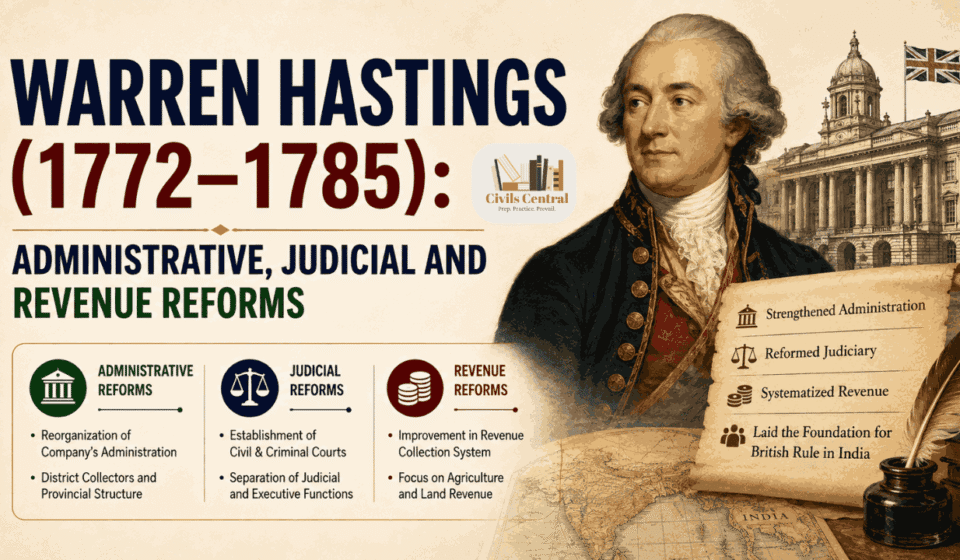
Warren Hastings (1772–1785): Administrative, Judicial and Revenue Reforms:
| Chapter Information | Details |
|---|---|
| Series | Modern History of India (1707–1947) |
| Historical Period | 1772–1785 |
| Historical Phase | Consolidation of Company Rule and Administrative Reforms |
| Previous Chapter | Regulating Act, 1773: The First Parliamentary Control over the East India Company |
| Current Chapter | Warren Hastings (1772–1785): Administrative, Judicial and Revenue Reforms |
| Next Chapter | Supreme Court at Calcutta (1774) and the Nand Kumar Case |
| Core Theme | Warren Hastings transformed the English East India Company from a revenue-collecting corporation into an organized territorial government through administrative, judicial, and revenue reforms. His tenure laid the practical foundations of British colonial administration in India. |
| Major Events Covered | Abolition of Dual Government, Revenue Reforms, Judicial Reforms, Administrative Reforms, Rohilla War, First Anglo-Maratha War, Second Anglo-Mysore War, Regulating Act, Pitt’s India Act, Impeachment |
| Key Personalities | Warren Hastings, Lord North, Sir Elijah Impey, Philip Francis, Raja Nand Kumar, Hyder Ali, Mahadji Scindia, Edmund Burke |
| Key Concepts | Centralization, Company Administration, Revenue Settlement, Civil Courts, Criminal Courts, Rule of Law, Parliamentary Control, Impeachment |
| Exam Relevance | UPSC CSE, JKPSC, JKAS, State PCS, CDS, CAPF, SSC, UGC-NET (History), University Examinations |
Introduction
Why Is Warren Hastings Called the Architect of Early British Administration in India?
The Battle of Buxar (1764) and the Treaty of Allahabad (1765) transformed the English East India Company into the dominant political power in eastern India. Through the Grant of the Diwani, the Company acquired the right to collect revenue from Bengal, Bihar, and Orissa, while the Dual Government of Bengal (1765–1772) allowed it to exercise financial authority without accepting full responsibility for governance. Although this arrangement initially appeared advantageous, it soon exposed serious administrative weaknesses. The separation between financial control and executive responsibility created confusion, encouraged corruption, weakened public administration, and contributed to widespread suffering during the Great Bengal Famine of 1770.
By the beginning of the 1770s, it had become increasingly evident that the Company could no longer govern its expanding territories through indirect arrangements inherited from the Mughal administration. The growing responsibilities of territorial governance demanded systematic institutions capable of collecting revenue efficiently, administering justice impartially, maintaining public order, and coordinating political authority across different regions. At the same time, the British Parliament, alarmed by corruption and financial instability within the Company, passed the Regulating Act of 1773, establishing the office of the Governor-General of Bengal and introducing parliamentary supervision over Company administration.
It was during this critical transitional period that Warren Hastings emerged as the most influential administrator of early British India.
Initially appointed as the Governor of Bengal in 1772, Hastings became the first Governor-General of Bengal under the Regulating Act of 1773. Unlike many earlier Company officials whose primary concern had been commercial profit, Hastings recognized that the Company had become a territorial power whose survival depended upon efficient administration rather than trade alone. His objective was therefore not merely to increase revenue but to create stable institutions capable of governing an expanding colonial state.
During his administration, Hastings abolished the Dual Government, reorganized the revenue system, introduced significant judicial reforms, strengthened central administration, and attempted to adapt British governance to Indian political and social conditions. He also played a crucial role in defending British interests during conflicts such as the Rohilla War, the First Anglo-Maratha War, and the Second Anglo-Mysore War. At the same time, his administration became the subject of intense controversy in Britain, culminating in one of the most famous impeachment trials in British parliamentary history.
The legacy of Warren Hastings is therefore both remarkable and contested.
Supporters regard him as the founder of modern British administration in India, whose reforms created the institutional foundations of the colonial state. Critics argue that his administration reflected the contradictions of early colonial rule, combining administrative innovation with aggressive imperial expansion and controversial political decisions.
Whatever interpretation one adopts, there is little disagreement regarding his historical importance.
Warren Hastings transformed Company Rule from an experiment in revenue collection into an organized system of territorial governance. His administration marks the beginning of modern colonial administration in India and occupies a central place in the constitutional, administrative, and political history of British India.
Part I — India in 1772: Why Did Warren Hastings Begin a New Phase of Company Administration?
Why Was a New Administrative System Necessary?
When Warren Hastings assumed office as the Governor of Bengal in 1772, the English East India Company stood at a critical turning point in its history. Within less than a decade, it had evolved from a commercial corporation into the effective ruler of the richest provinces of India. The victories at Plassey (1757) and Buxar (1764), followed by the Treaty of Allahabad (1765) and the Grant of the Diwani, had provided the Company with military supremacy, constitutional legitimacy, and control over the revenues of Bengal, Bihar, and Orissa. Yet despite these remarkable achievements, the Company’s administrative machinery remained weak, disorganized, and largely unsuitable for governing a vast territorial empire.
The contradiction was becoming increasingly evident.
The Company possessed extensive political authority but lacked the institutions necessary to exercise that authority efficiently. Its officials had originally been trained as merchants rather than administrators. Their experience lay in commerce and trade, not in revenue administration, judicial governance, or public welfare. As Company territories expanded, this institutional weakness became one of the greatest challenges confronting British rule in India.
By 1772, the need for comprehensive administrative reform had become impossible to ignore.
Failure of the Dual Government
The immediate reason for administrative reform was the collapse of the Dual Government of Bengal, introduced by Robert Clive in 1765. Under this arrangement, the Company exercised the Diwani, controlling revenue collection and financial administration, while the Nawab of Bengal retained the Nizamat, remaining formally responsible for law and order, criminal justice, and executive administration.
Although the system appeared to preserve traditional Mughal institutions, it proved fundamentally defective in practice. The Company controlled the financial resources of the province but refused to assume responsibility for governance. The Nawab retained responsibility for administration but lacked the revenues required to discharge those responsibilities effectively.
This separation between authority and accountability created widespread administrative confusion.
Government officials frequently remained uncertain regarding the source of effective authority, judicial administration deteriorated, corruption increased, and public confidence in government steadily declined. The Company enjoyed the benefits of revenue collection while avoiding the obligations associated with territorial administration.
By the early 1770s, even Company officials acknowledged that the Dual Government had become unworkable.
The Great Bengal Famine and Administrative Failure
The weaknesses of the existing administrative system became tragically apparent during the Great Bengal Famine of 1770. Successive crop failures combined with inadequate administrative coordination produced one of the most devastating famines in eighteenth-century India. Large areas of Bengal experienced acute food shortages, widespread disease, and severe demographic decline.
While natural factors initiated the crisis, the Company’s administrative response attracted intense criticism. Revenue assessments continued even as agricultural production collapsed. Local officials failed to organize adequate relief measures. The constitutional confusion created by the Dual Government prevented effective coordination between financial administration and executive authority.
Although historians continue to debate the exact number of deaths, it is generally accepted that the famine caused immense human suffering and exposed the inability of the existing administrative structure to respond effectively during a major humanitarian emergency. For Warren Hastings, the famine demonstrated that the Company could no longer govern indirectly through institutions over which it exercised only partial control.
Effective administration required unified authority.
Financial Crisis of the East India Company
Ironically, the Company faced serious financial difficulties despite controlling the wealthiest province of India. The enormous revenues collected after the Grant of the Diwani did not produce corresponding financial stability. Military campaigns, administrative inefficiency, corruption, private enrichment by Company officials, and poor financial management placed increasing pressure upon the Company’s resources.
By 1772, the Company encountered a severe financial crisis and sought assistance from the British Government. This development had profound constitutional implications. A private corporation that required financial assistance from the British state could no longer claim complete political independence in administering overseas territories. The financial crisis therefore strengthened parliamentary demands for administrative reform and directly influenced the passage of the Regulating Act of 1773.
Warren Hastings assumed office at precisely the moment when the Company required both administrative reconstruction and financial discipline.
Growing Corruption in Company Administration
Another challenge confronting Hastings was the widespread perception of corruption within the Company’s service. During the years following the acquisition of the Diwani, many Company officials accumulated enormous private fortunes through gifts, unofficial payments, private trade, and manipulation of revenue administration.
These officials, popularly known in Britain as “Nabobs,” became symbols of wealth acquired through colonial office. Public criticism intensified as reports of corruption reached Britain. Members of Parliament increasingly questioned whether Company servants were governing India in the interests of the state or merely exploiting public office for personal enrichment.
This criticism damaged the Company’s political reputation and reinforced demands for stricter administrative discipline. Warren Hastings therefore recognized that restoring confidence in Company administration required not only institutional reform but also greater administrative accountability.
Warren Hastings’ Administrative Philosophy
Unlike many earlier Company officials, Warren Hastings understood that the Company had entered a fundamentally new phase of its history. It was no longer simply a trading corporation seeking commercial profit. It had become a territorial government responsible for administering one of the largest and most prosperous regions of Asia.
Hastings believed that British authority in India could not survive through military strength alone. Stable government required efficient institutions capable of collecting revenue fairly, administering justice systematically, maintaining public order, and respecting existing social and legal traditions.
He therefore adopted a pragmatic rather than revolutionary approach. Instead of attempting to replace Indian institutions completely, Hastings sought to reform and reorganize them under Company supervision. Wherever possible, he retained existing administrative practices while introducing greater centralization, accountability, and efficiency.
His reforms reflected a belief that British administration should govern through Indian institutions, not simply in place of them. This philosophy became one of the defining characteristics of his administration.
Abolition of the Dual Government
Recognizing that indirect administration had failed, Warren Hastings abolished the Dual Government in 1772. The Company now assumed direct responsibility for both revenue administration and executive government. This decision represented a major constitutional turning point.
For the first time since acquiring the Diwani, the Company accepted that political authority necessarily carried administrative responsibility. Revenue collection, judicial administration, and executive governance were gradually brought under direct Company supervision. The abolition of the Dual Government also marked the beginning of a more centralized administrative system in Bengal, providing the institutional foundation upon which Hastings would build his subsequent reforms.
It was the first decisive step in transforming the Company from a revenue-collecting corporation into a functioning territorial government.
Beginning of Administrative Reconstruction
The situation confronting Warren Hastings in 1772 was therefore exceptionally challenging. He inherited a province weakened by famine, burdened by financial difficulties, affected by widespread corruption, and governed through institutions that had largely ceased to function effectively. Rather than treating these problems individually, Hastings recognized that they reflected a deeper constitutional issue.
The Company required a comprehensive administrative framework capable of supporting its expanding political responsibilities. His reforms in revenue administration, judicial organization, executive government, and provincial administration were all directed towards this broader objective. The period beginning in 1772 therefore represents the true beginning of systematic British administration in India.
The Company no longer merely exercised political influence. Under Warren Hastings, it began constructing the institutions of a colonial state.
CivilsCentral Historical Insight
The year 1772 marks the real administrative beginning of British India. Warren Hastings inherited a Company that possessed territory but lacked governance, collected revenue but lacked accountability, and exercised power without efficient institutions. By abolishing the Dual Government and accepting direct administrative responsibility, Hastings initiated the transition from commercial management to organized colonial administration. His reforms were therefore not isolated measures but the first comprehensive attempt to build a functioning British government in India.
Part II — Revenue Reforms of Warren Hastings: How Did the Company Reorganize the Revenue Administration?
Why Did Warren Hastings Give Highest Priority to Revenue Reform?
When Warren Hastings assumed charge of Bengal in 1772, he understood that the stability of British administration depended primarily upon an efficient and reliable revenue system. Since the Grant of the Diwani (1765), the English East India Company had acquired the legal right to collect land revenue from Bengal, Bihar, and Orissa. Land revenue constituted the principal source of the Company’s income and financed its civil administration, military establishment, and political expansion. Yet the existing system of revenue collection was highly inefficient, corrupt, and poorly supervised.
During the years of the Dual Government, revenue administration had largely remained in the hands of Indian intermediaries working under nominal Company supervision. Company officials exercised financial authority but rarely participated directly in revenue administration. This arrangement encouraged corruption, weakened accountability, and resulted in considerable uncertainty regarding the actual revenue potential of the province.
For Warren Hastings, administrative reform had to begin with financial reform.
He believed that unless the Company established direct control over revenue administration, no other reform—whether judicial, political, or military—could succeed. Revenue was not merely a source of income; it was the financial foundation upon which the entire structure of British administration rested.
Abolition of the Dual Government
The first step in Hastings’ revenue policy was the abolition of the Dual Government in 1772. This decision fundamentally changed the constitutional relationship between the Company and the administration of Bengal. Instead of exercising only indirect financial authority, the Company assumed direct responsibility for revenue collection as well as civil administration.
The office of the Naib Diwan, through which Indian officials had previously managed revenue affairs, lost its importance as Company officials increasingly took direct control over financial administration. This reform ended the artificial separation between financial authority and executive responsibility that had characterized the earlier system.
For the first time, the institution collecting revenue also became responsible for administering the province. The abolition of the Dual Government therefore represented not only an administrative reform but also a constitutional transformation in the nature of Company Rule.
Establishment of the Board of Revenue
To improve financial supervision, Warren Hastings reorganized the machinery responsible for revenue administration. A Board of Revenue was established at Calcutta to supervise the assessment, collection, and management of land revenue throughout Bengal.
The Board became the highest financial authority under the Company and exercised general supervision over district-level revenue administration. Its principal responsibilities included monitoring revenue collections, examining financial records, issuing administrative instructions, and ensuring greater uniformity in provincial financial management. By centralizing financial administration, Hastings sought to reduce corruption, strengthen accountability, and improve coordination between different districts.
The establishment of the Board of Revenue represented an important step towards creating a professional administrative system capable of managing the Company’s expanding territorial possessions.
District Collectors and Direct Supervision
One of Hastings’ most significant innovations was the appointment of District Collectors. Before his reforms, revenue collection depended largely upon local officials and traditional intermediaries who often exercised considerable autonomy. Hastings introduced Company servants at the district level to supervise revenue administration more directly.
The Collector became responsible for overseeing revenue assessment, supervising local officials, maintaining financial records, and ensuring that land revenue reached the Company’s treasury. This reform greatly strengthened the Company’s presence in the countryside. For the first time, British officials became directly involved in district administration rather than merely supervising Indian intermediaries from provincial headquarters.
Although the office of the Collector underwent further modification in subsequent years, it eventually became one of the most important institutions of British district administration in India.
Five-Year Revenue Settlement
Another important feature of Hastings’ reforms was the introduction of the Five-Year Revenue Settlement in 1772. Instead of revising land revenue annually, the Company decided to lease the right to collect revenue for a period of five years. The contracts were generally awarded through public auction to those who promised to pay the highest amount of revenue to the Company.
The underlying objective was to secure a stable and predictable income while reducing administrative uncertainty. By fixing revenue for a longer period, Hastings hoped to improve financial planning and encourage more efficient revenue collection. However, the system also created significant difficulties.
Many contractors offered unrealistically high bids merely to obtain revenue contracts. Once appointed, they frequently attempted to recover these commitments by imposing excessive demands upon cultivators. Consequently, while the Five-Year Settlement increased the Company’s immediate expectations of revenue, it often imposed severe burdens upon the agricultural population.
These weaknesses later persuaded Hastings to reconsider aspects of the policy.
Use of Indian Revenue Officials
Although Hastings strengthened direct Company supervision, he did not completely replace Indian officials. He recognized that experienced Indian administrators possessed valuable knowledge of local conditions, landholding patterns, customary practices, and regional agricultural systems.
Consequently, Indian officials such as Amins, Kanungos, and Diwans continued to play important roles in revenue administration. The essential difference lay in the relationship between these officials and the Company. Instead of exercising largely independent authority, they now functioned under closer supervision by British Collectors and the Board of Revenue.
This approach reflected Hastings’ broader administrative philosophy. He preferred to reform existing Indian institutions rather than abolish them entirely. By combining British supervision with Indian administrative experience, he hoped to achieve greater efficiency while minimizing administrative disruption.
Objectives of the Revenue Reforms
The revenue reforms introduced by Warren Hastings pursued several interconnected objectives. The first objective was to increase the Company’s financial stability by ensuring regular and efficient collection of land revenue. The second objective was to reduce corruption by strengthening official supervision and limiting opportunities for financial irregularities.
The third objective was to centralize administration, bringing district revenue officials under the authority of the Board of Revenue at Calcutta. Finally, Hastings sought to create an administrative structure capable of supporting long-term British governance rather than merely maximizing immediate commercial profits.
His reforms therefore reflected a transition from temporary financial management to systematic territorial administration.
Limitations of the Revenue Reforms
Despite their importance, Hastings’ revenue reforms were not entirely successful. The Five-Year Settlement often encouraged excessive bidding by revenue contractors, leading to heavy pressure upon cultivators. Accurate information regarding agricultural productivity remained limited, making fair revenue assessment difficult.
Many Company officials lacked sufficient administrative experience, while corruption continued despite institutional reforms. Moreover, the primary objective of maximizing revenue sometimes overshadowed concerns relating to agricultural improvement and peasant welfare. As a result, the system required further modification during the administrations of Lord Cornwallis and later Governors-General.
Nevertheless, the reforms introduced by Hastings represented the first systematic attempt to organize Company revenue administration on a provincial scale.
Foundation of the Colonial Revenue System
The revenue reforms of Warren Hastings marked the beginning of a new phase in British administration. For the first time, the English East India Company developed centralized financial institutions, appointed district-level administrative officers, and assumed direct responsibility for revenue collection throughout Bengal.
Although later administrations introduced important modifications—notably the Permanent Settlement (1793) under Lord Cornwallis—the institutional framework established by Hastings provided the essential foundation upon which subsequent revenue systems were built.
His reforms transformed revenue administration from an improvised commercial activity into one of the principal functions of the colonial state.
CivilsCentral Historical Insight
Warren Hastings’ revenue reforms marked the transition from indirect financial supervision to direct colonial administration. By abolishing the Dual Government, establishing the Board of Revenue, appointing District Collectors, and reorganizing revenue settlements, Hastings created the first centralized revenue administration under the English East India Company. Although many shortcomings remained, these reforms laid the institutional foundation for the later Permanent Settlement and the district administration that became the backbone of British rule in India.
Part III — Judicial Reforms of Warren Hastings: How Did Warren Hastings Lay the Foundations of the Modern Judicial System in British India?
Why Did Warren Hastings Consider Judicial Reform Necessary?
When Warren Hastings assumed office in 1772, he quickly realized that efficient revenue administration alone could not ensure stable governance. A government that collected taxes without providing an organized system of justice could neither command public confidence nor maintain political stability. Under the Dual Government (1765–1772), judicial administration had deteriorated considerably. The separation between the Company’s financial authority and the Nawab’s executive authority had weakened the traditional judicial structure, encouraged corruption, and created uncertainty regarding the administration of justice.
The English East India Company had become the effective political authority in Bengal, yet it still lacked a systematic judicial framework capable of resolving disputes, protecting property rights, and enforcing the law. Civil disputes often remained unresolved for long periods, criminal justice suffered from administrative confusion, and local officials frequently exercised judicial powers without effective supervision.
Warren Hastings therefore concluded that the legitimacy of British rule depended not only upon military strength and financial efficiency but also upon the establishment of an organized judicial system. His judicial reforms of 1772 represented the first comprehensive attempt by the Company to create a regular system of civil and criminal courts under its own supervision.
The Judicial Plan of 1772
The foundation of Hastings’ judicial reforms was the Judicial Plan of 1772, which reorganized the administration of justice throughout Bengal, Bihar, and Orissa.
The plan sought to establish a clearly structured judicial hierarchy while preserving many traditional Indian legal principles. Hastings did not attempt to replace the existing legal system with English law. Instead, he reorganized indigenous institutions under Company supervision, believing that justice would be more acceptable if administered according to the customs and religious laws familiar to the local population.
This approach reflected his broader administrative philosophy. Rather than imposing entirely foreign institutions upon Indian society, Hastings preferred to strengthen existing institutions while improving their organization, supervision, and accountability.
The Judicial Plan of 1772 therefore marked the beginning of an institutional judicial system under Company administration rather than the introduction of a completely new legal order.
Establishment of District Civil Courts (Diwani Adalats)
One of the most significant features of the Judicial Plan was the establishment of District Diwani Adalats, or Civil Courts, in every district. These courts were entrusted with the responsibility of deciding civil disputes relating to property, contracts, inheritance, debt, marriage, caste, and other private matters.
Each District Collector presided over the Diwani Adalat, making him responsible not only for revenue administration but also for civil justice within the district. The jurisdiction of these courts extended to disputes involving landholders, merchants, cultivators, and private individuals.
Importantly, Hastings directed that civil cases should be decided according to the personal laws of the parties involved. Matters concerning Hindus were to be decided according to Hindu law, while disputes involving Muslims were to be governed by Islamic law. To ensure correct interpretation of these legal traditions, the courts were assisted by Pandits for Hindu law and Maulvis for Islamic law.
This arrangement demonstrated Hastings’ attempt to combine British administrative supervision with respect for India’s established legal traditions.
Establishment of District Criminal Courts (Faujdari Adalats)
In addition to civil courts, Hastings also reorganized the system of criminal justice through the establishment of District Faujdari Adalats. These courts dealt with offences such as theft, robbery, murder, assault, and other criminal matters affecting public order. Unlike civil courts, criminal courts formally remained under the authority of the Nawab, since criminal justice continued to be associated with the Nizamat under the traditional Mughal system.
However, in practice, the English East India Company exercised close supervision over their functioning. The Faujdari Adalats were generally presided over by Indian judicial officers, including Qazis and Muftis, who applied Islamic criminal law. Company officials supervised the overall administration to ensure greater regularity and reduce opportunities for corruption.
This arrangement reflected Hastings’ cautious approach to reform. Rather than abruptly replacing established criminal institutions, he preferred gradual administrative supervision while allowing traditional legal principles to continue.
Creation of Appellate Courts
Recognizing that justice required opportunities for review, Hastings also established appellate courts at Calcutta. For civil matters, appeals from the District Diwani Adalats were heard by the Sadar Diwani Adalat. The Governor and members of the Council functioned as judges in this highest civil court, making it the supreme civil appellate authority within Company territories.
For criminal cases, the highest appellate institution was the Sadar Nizamat Adalat. Although this court formally functioned under the authority of the Nawab, it operated under increasing Company supervision. The creation of these appellate courts introduced an important principle into Indian judicial administration.
Judicial decisions could now be reviewed by higher authorities, reducing the possibility of arbitrary judgments and improving consistency in the administration of justice.
Application of Personal Laws
One of the distinctive features of Hastings’ judicial reforms was his policy regarding the application of law. He believed that the Company should not interfere unnecessarily with the religious and social customs of Indian society. Accordingly, Hindu law continued to govern matters relating to Hindus, while Islamic law applied to Muslims in questions concerning marriage, inheritance, family relations, and religious customs.
British judges and Company officials relied upon learned Pandits and Maulvis for authoritative interpretations of these legal systems. This policy represented one of the earliest examples of legal pluralism under British administration. Instead of imposing a uniform legal code, Hastings attempted to govern through the existing legal traditions of Indian society while strengthening administrative supervision.
This principle continued to influence British judicial policy throughout much of the colonial period.
Objectives of the Judicial Reforms
The judicial reforms pursued several important objectives simultaneously. Hastings sought to create a more organized and accessible system of justice throughout Company territories. He aimed to reduce corruption by establishing regular courts with defined jurisdictions and clearer administrative supervision.
He also intended to strengthen public confidence in Company administration by ensuring that disputes could be resolved through recognized judicial institutions rather than through arbitrary official action. Finally, the reforms supported broader administrative centralization by integrating the judicial system with the Company’s territorial administration.
Justice increasingly became an institutional responsibility of the colonial state rather than an informal function exercised by local authorities.
Significance and Limitations
The judicial reforms introduced by Warren Hastings represented a major step in the constitutional development of British India. For the first time, the Company established a regular hierarchy of civil and criminal courts operating under organized administrative supervision.
The distinction between civil and criminal jurisdiction became clearer, appellate institutions were created, and personal laws were formally recognized within judicial administration. At the same time, the reforms possessed important limitations. The combination of revenue and judicial functions in the hands of the District Collector concentrated considerable authority in a single official.
The continued application of different legal systems occasionally produced administrative complexity. Judicial independence also remained limited because executive authorities exercised substantial influence over court administration. Despite these shortcomings, Hastings’ reforms created the institutional foundations upon which later judicial reforms—particularly those introduced by Lord Cornwallis—would build.
Beginning of the Colonial Judicial System
The Judicial Plan of 1772 marks the true beginning of the organized judicial system under British rule. Although many later reforms modified its structure, the essential principles introduced by Warren Hastings remained highly influential.
The establishment of district courts, appellate institutions, judicial hierarchy, and supervised administration created the framework from which the modern judicial administration of British India gradually evolved. His reforms therefore represent one of the earliest and most important attempts to replace administrative uncertainty with institutional justice under Company Rule.
CivilsCentral Historical Insight
The Judicial Reforms of Warren Hastings were the first systematic attempt to establish an organized judicial administration under Company Rule. By creating District Diwani Adalats, Faujdari Adalats, appellate courts, and a structured judicial hierarchy while respecting Hindu and Islamic personal laws, Hastings transformed justice from an informal administrative function into an institutional responsibility of the colonial state. These reforms laid the foundation upon which the later judicial system of British India was constructed.
Part IV — Administrative Reforms of Warren Hastings: How Did He Build the Foundations of British Civil Administration?
Why Were Administrative Reforms Necessary?
When Warren Hastings assumed office in 1772, he understood that the English East India Company could not sustain its territorial empire merely through military victories or efficient revenue collection. The Company had become the governing authority over millions of people, yet its administrative structure remained fragmented and heavily influenced by the commercial practices of a trading corporation. Decisions were often delayed, provincial officials exercised wide discretionary powers without effective supervision, and communication between Calcutta and the districts lacked consistency.
The abolition of the Dual Government had brought both financial and executive authority directly under the Company. However, this constitutional change also imposed new responsibilities. The Company was now expected to administer justice, maintain law and order, supervise provincial officials, regulate public finances, and ensure efficient governance across an expanding territory.
Warren Hastings recognized that these responsibilities required an organized administrative machinery supported by clearly defined institutions. His reforms therefore sought to transform the Company’s administration from a loose commercial organization into a disciplined civil government capable of exercising authority over a large territorial state.
Centralization of Administration
One of the most important objectives of Hastings’ reforms was the centralization of administrative authority. Before his administration, considerable powers were exercised independently by provincial officials and local institutions. Such decentralization frequently resulted in inconsistent policies, weak supervision, and opportunities for corruption.
Hastings attempted to strengthen the authority of the government at Calcutta, which had gradually become the political and financial centre of British India. Important decisions relating to revenue, justice, finance, and provincial administration increasingly came under the supervision of the central government. District officials were made accountable to higher authorities, and administrative procedures became more standardized.
This process of centralization enabled the Company to exercise greater control over its territories and reduced the scope for arbitrary local administration. Although complete administrative centralization was achieved only under later Governors-General, Hastings initiated the process that eventually made Calcutta the unquestioned administrative capital of British India.
Reorganization of Provincial Administration
Hastings also reorganized the administration at the district and provincial levels. The district gradually emerged as the basic unit of British administration. Company officials stationed in the districts were entrusted with clearly defined responsibilities relating to revenue collection, judicial administration, and supervision of local officials.
This reform reduced dependence upon powerful intermediaries who had previously exercised considerable influence during the Mughal period and under the Dual Government. District administration became increasingly systematic, with officials maintaining records, reporting regularly to higher authorities, and functioning within a more structured administrative hierarchy.
By strengthening district administration, Hastings ensured that Company authority extended beyond the provincial capital into rural areas where the majority of the population resided. This development laid the foundation for the district administrative system that remained one of the defining features of British rule throughout the colonial period.
Improvement in Official Record-Keeping
Another significant administrative reform introduced by Warren Hastings was the emphasis on systematic documentation and record-keeping. Efficient governance required accurate information regarding revenue, judicial decisions, landholdings, official correspondence, and financial transactions.
Prior to Hastings’ reforms, administrative records were often incomplete, poorly maintained, or scattered among different offices. Hastings insisted upon greater regularity in official documentation. District officials were required to maintain detailed records of revenue collections, judicial proceedings, administrative orders, and financial accounts. Reports were forwarded to Calcutta for examination and supervision, creating a more organized system of administrative communication.
Improved record-keeping enhanced accountability by enabling higher authorities to monitor the activities of provincial officials more effectively. It also provided the Company with reliable information for future administrative planning and policy formulation.
Separation Between Public Revenue and Private Interests
One of the recurring problems confronting the Company during the years preceding Hastings’ administration had been the widespread misuse of public office for private enrichment. Many Company servants engaged in private trade, accepted valuable gifts from Indian rulers, or used their official authority to accumulate personal wealth.
Although the Regulating Act of 1773 imposed restrictions upon such practices, Hastings also sought to improve administrative discipline through stricter supervision and clearer financial procedures. Officials were increasingly expected to distinguish between public responsibilities and private commercial interests.
Administrative decisions relating to revenue, justice, and finance were subjected to greater scrutiny, reducing opportunities for arbitrary conduct. While corruption did not disappear entirely, Hastings’ reforms contributed to the gradual emergence of a more professional administrative service.
This represented an important departure from the earlier period when Company officials frequently regarded public office primarily as a means of personal enrichment.
Strengthening Communication Between the Centre and the Districts
Effective administration over a vast territory required efficient communication between the central government and provincial authorities. Hastings therefore improved the system through which administrative instructions, financial reports, and official correspondence moved between Calcutta and the districts.
District officials submitted regular reports regarding revenue collections, judicial matters, law and order, and local conditions. The government at Calcutta, in turn, issued instructions designed to ensure greater uniformity in administration throughout Company territories. Although eighteenth-century transportation and communication remained slow by modern standards, these reforms significantly strengthened the administrative integration of British India.
They enabled the central government to exercise more effective supervision over provincial administration than had previously been possible.
Promotion of Administrative Efficiency
A defining characteristic of Hastings’ administration was his emphasis on practical efficiency rather than theoretical innovation. He recognized that the Company lacked the resources to replace all existing Indian institutions immediately. Instead, he preferred to improve administrative efficiency by reorganizing established institutions, strengthening supervision, and introducing greater procedural regularity.
Many traditional Indian officials continued to serve within the administration because they possessed valuable local knowledge and practical experience. Rather than excluding them entirely, Hastings incorporated them into a system supervised by British authorities. This pragmatic approach enabled the Company to expand its administrative capacity without disrupting every aspect of existing governance.
It also reflected Hastings’ belief that successful administration required adaptation to Indian conditions rather than the mechanical application of British institutions.
Significance of the Administrative Reforms
The administrative reforms introduced by Warren Hastings marked the beginning of organized civil administration under Company Rule. For the first time, the English East India Company developed a more coherent administrative hierarchy extending from the central government at Calcutta to district-level officials responsible for implementing policy.
The emphasis on centralization, accountability, documentation, and administrative discipline strengthened the Company’s capacity to govern its expanding territories. Although later Governors-General, particularly Lord Cornwallis, introduced more comprehensive administrative reforms, they built upon the institutional foundations established during Hastings’ administration.
His contribution therefore lies not merely in specific administrative measures but in the broader transformation of the Company from a commercial corporation into a functioning territorial government.
CivilsCentral Historical Insight
Warren Hastings’ administrative reforms transformed governance under the English East India Company from commercial management into organized civil administration. By centralizing authority at Calcutta, strengthening district administration, improving record-keeping, enhancing official accountability, and integrating Indian administrative experience with British supervision, Hastings laid the institutional foundations of the colonial bureaucracy. The administrative framework he created became the basis upon which later Governors-General, especially Lord Cornwallis, constructed the modern civil administration of British India.
Part V — Military and Foreign Policy of Warren Hastings: How Did He Consolidate British Power in India?
Why Did Warren Hastings Follow an Active Foreign Policy?
When Warren Hastings became the Governor of Bengal in 1772 and later the first Governor-General of Bengal under the Regulating Act of 1773, the English East India Company faced challenges that extended far beyond internal administration. Although the Company had established its authority over Bengal after the Battle of Buxar (1764), its political position in the rest of India remained uncertain. Powerful Indian states such as the Maratha Confederacy, the Kingdom of Mysore, the Nizam of Hyderabad, and the Kingdom of Awadh continued to dominate large parts of the subcontinent. At the same time, European rivals, particularly the French, remained active in Indian politics, creating the possibility of foreign intervention.
Warren Hastings believed that administrative reforms within Bengal would be ineffective unless the Company also secured its political and military position throughout India. He therefore adopted an active foreign policy aimed at protecting Company territories, preventing hostile alliances among Indian powers, and maintaining the political balance in favour of British interests.
Unlike later Governors-General such as Lord Wellesley, Hastings did not pursue an openly expansionist policy. His primary objective was the security and consolidation of the Company’s existing possessions rather than large-scale territorial conquest. Nevertheless, the wars fought during his administration significantly strengthened British influence and prepared the way for future imperial expansion.
The Rohilla War (1774)
One of the earliest military controversies during Hastings’ administration was the Rohilla War of 1774. The Rohillas were Afghan chiefs who had established their authority in the fertile region of Rohilkhand, situated between Awadh and the Himalayan foothills. The Nawab of Awadh, Shuja-ud-Daulah, regarded the Rohillas as a political and military threat and sought British assistance in bringing the region under his control.
Warren Hastings agreed to support the Nawab in return for a substantial financial payment to the Company. British troops fought alongside the forces of Awadh, and the Rohillas were defeated. Rohilkhand was subsequently annexed by the Nawab of Awadh. From the Company’s perspective, the campaign strengthened the buffer state of Awadh, increased Company revenues, and enhanced British political influence in northern India.
However, the war attracted severe criticism in Britain.
Many contemporary politicians, including Edmund Burke, accused Hastings of employing British military power for financial gain rather than legitimate defence. During Hastings’ later impeachment, the Rohilla War became one of the principal charges brought against him.
Although historians continue to debate its morality, the conflict demonstrated Hastings’ willingness to use military alliances to safeguard British strategic interests.
The First Anglo-Maratha War (1775–1782)
The most important political challenge during Hastings’ administration arose from developments within the Maratha Confederacy. Following the death of Peshwa Madhavrao I, a succession dispute emerged between Raghunath Rao (Raghoba) and the supporters of the young Peshwa Madhavrao II.
Seeking British military assistance to secure his position, Raghunath Rao signed the Treaty of Surat (1775) with the Bombay Presidency. In return for British support, he promised to grant territorial and commercial concessions to the Company. However, Warren Hastings regarded the treaty with caution because it had been concluded by the Bombay Government without adequate consultation with the central administration at Calcutta. The conflict that followed developed into the First Anglo-Maratha War, which lasted from 1775 to 1782.
The war proved far more difficult than the British had anticipated.
The Marathas, under capable leaders such as Mahadji Scindia and Nana Fadnavis, offered determined resistance. British forces suffered several setbacks, demonstrating that the Maratha Confederacy remained one of the strongest political and military powers in India. Recognizing the need for a negotiated settlement, Hastings eventually pursued diplomacy alongside military operations.
The conflict ended with the Treaty of Salbai (1782).
The treaty restored peace between the Company and the Marathas, recognized Madhavrao II as the Peshwa, and secured nearly two decades of relative stability between the two powers.
Although the Company did not achieve all its original objectives, the treaty prevented the emergence of a united anti-British alliance and allowed Hastings to concentrate upon other strategic challenges.
The Second Anglo-Mysore War (1780–1784)
While the Maratha conflict continued, the Company faced an even greater military challenge in southern India. The ruler of Mysore, Hyder Ali, had transformed his kingdom into one of the strongest military powers in the subcontinent through administrative modernization and military reform. He viewed British expansion with increasing suspicion, particularly after the Company’s growing influence along the eastern coast.
Relations deteriorated rapidly when the British failed to honour earlier understandings and continued expanding their political influence in southern India. In 1780, Hyder Ali launched a major offensive against the Company’s territories, beginning the Second Anglo-Mysore War. The early stages of the war proved disastrous for the British.
Hyder Ali inflicted several significant defeats upon Company forces, exposing weaknesses in British military preparedness. The situation became even more serious because the Company was simultaneously involved in the Maratha conflict. Despite these difficulties, Hastings demonstrated considerable administrative and military determination.
He reorganized Company resources, strengthened military coordination, and prevented the formation of a broader alliance between Mysore, the Marathas, and Hyderabad. Following the death of Hyder Ali in 1782, leadership passed to his son Tipu Sultan, who continued the struggle against the British. The conflict eventually concluded after Hastings had left office through the Treaty of Mangalore (1784).
Although the treaty largely restored the pre-war position, it demonstrated that Mysore remained a formidable opponent whose resistance would continue under Tipu Sultan.
Hastings’ Foreign Policy: A Policy of Strategic Balance
A careful examination of Warren Hastings’ military campaigns reveals that his foreign policy differed significantly from the aggressive imperial expansion associated with later Governors-General. His principal objective was not territorial conquest but strategic security. He believed that British territories in Bengal could be protected only by preventing the emergence of hostile coalitions among powerful Indian states.
Consequently, Hastings relied upon a combination of diplomacy, military alliances, negotiated settlements, and limited military intervention. Where possible, he preferred to maintain a balance of power rather than annex territory directly.
This pragmatic approach reflected both the limited resources available to the Company during the 1770s and Hastings’ understanding that premature expansion could overextend British administrative and military capacity.
Significance of Hastings’ Military Policy
The wars fought during Warren Hastings’ administration had lasting consequences for the future of British rule in India. They demonstrated that the Company had become a major military power capable of confronting the strongest Indian states. They also exposed the importance of centralized political leadership, coordinated military planning, and efficient financial administration in sustaining prolonged military campaigns.
Equally importantly, the diplomatic settlements achieved under Hastings delayed the formation of united resistance against British expansion. By preserving the Company’s political position during a period of considerable instability, Hastings provided his successors with the opportunity to pursue more ambitious policies of imperial expansion.
Thus, although his administration is remembered primarily for administrative and judicial reforms, his military and foreign policy played an equally significant role in consolidating the foundations of British power in India.
CivilsCentral Historical Insight
Warren Hastings’ foreign policy was guided by consolidation rather than conquest. Through the Rohilla War, the First Anglo-Maratha War, and the Second Anglo-Mysore War, he sought to secure British possessions, preserve the balance of power, and prevent hostile alliances against the English East India Company. While later Governors-General expanded the British Empire through systematic annexation, Hastings ensured that the Company first acquired the political stability and strategic security necessary for that expansion.
Part VI — Pitt’s India Act (1784), Impeachment of Warren Hastings and His Legacy
How Did Warren Hastings’ Administration Influence British Constitutional Policy?
By the early 1780s, Warren Hastings had substantially reorganized the administration of the English East India Company. He had abolished the Dual Government, introduced comprehensive revenue and judicial reforms, centralized administration, and defended British political interests against powerful Indian states. Despite these achievements, his administration also exposed important constitutional weaknesses. Frequent conflicts with the Executive Council, disputes with the Supreme Court at Calcutta, criticism of his military policies, and allegations of corruption convinced many British politicians that the Regulating Act of 1773 had not provided an adequate constitutional framework for governing India.
The experience of Hastings’ administration therefore became the principal reason for the enactment of Pitt’s India Act of 1784, one of the most important constitutional measures in the history of British India.
Pitt’s India Act (1784)
The Regulating Act of 1773 had established parliamentary supervision over the East India Company, but it had not created an effective mechanism through which the British Government could continuously supervise Indian administration. To overcome these weaknesses, the British Parliament passed Pitt’s India Act in 1784 during the ministry of William Pitt the Younger.
The Act established a Board of Control, consisting of members appointed by the British Government, to supervise the political, military, and civil affairs of the Company. At the same time, the Court of Directors continued to manage the Company’s commercial affairs. This arrangement created the system known as Dual Control.
Under this system, the East India Company retained responsibility for commercial administration, while the British Government exercised effective control over political administration. The Act therefore significantly strengthened parliamentary authority without immediately abolishing Company Rule. Although Warren Hastings had not framed this legislation, the constitutional problems encountered during his administration directly influenced its enactment.
Pitt’s India Act thus represented the next stage in the constitutional evolution initiated by the Regulating Act of 1773.
Why Was Warren Hastings Impeached?
Despite his administrative achievements, Warren Hastings became one of the most controversial figures in British imperial history. Several of his political decisions generated intense criticism within Britain. Opponents accused him of exceeding his authority, misusing political power, and placing the Company’s financial interests above principles of justice and good governance.
The principal accusations against Hastings included:
- His role in the Rohilla War (1774).
- His treatment of the Raja of Benares, Chait Singh.
- His actions against the Begums of Awadh.
- Allegations of corruption and abuse of official authority.
- Misuse of political and military power in Company administration.
These accusations were strongly supported by prominent parliamentarians such as Edmund Burke, Charles James Fox, and Richard Brinsley Sheridan, who argued that British imperial authority must remain subject to constitutional and moral accountability. For Burke, the issue extended beyond the conduct of one individual.
He believed that Britain’s imperial administration itself required ethical restraint and parliamentary supervision.
The Impeachment Trial
In 1788, impeachment proceedings were initiated against Warren Hastings before the House of Lords. The trial became one of the longest and most celebrated legal proceedings in British constitutional history. It continued for seven years, finally concluding in 1795. Throughout the trial, Edmund Burke delivered powerful speeches condemning what he regarded as arbitrary government and misuse of imperial authority.
Hastings, however, defended his administration by arguing that the extraordinary political conditions prevailing in India required practical and flexible decision-making. He maintained that many of his actions had been essential for preserving British authority during a period of considerable political instability. After examining the evidence over several years, the House of Lords acquitted Warren Hastings of all major charges.
Although legally cleared, the trial profoundly influenced British attitudes towards imperial governance. It reinforced the principle that Company officials exercising political authority could be held accountable before Parliament for their conduct in India.
Historical Assessment of Warren Hastings
Historians have offered differing interpretations of Warren Hastings’ career. Many scholars regard him as the founder of British civil administration in India. They emphasize his abolition of the Dual Government, his reorganization of revenue administration, the establishment of an organized judicial system, and his efforts to centralize Company administration.
According to this interpretation, Hastings transformed the English East India Company into a functioning territorial government capable of administering a large empire. Other historians adopt a more critical perspective. They argue that although Hastings introduced important administrative reforms, his policies also strengthened the foundations of British colonial rule and facilitated future imperial expansion.
His involvement in the Rohilla War, his treatment of Indian rulers, and the concentration of political authority in Company hands have therefore attracted sustained criticism. Modern historians generally adopt a balanced view. They recognize both the administrative achievements and the moral controversies associated with Hastings’ administration.
While acknowledging that his policies contributed significantly to the institutional development of British India, they also emphasize that these institutions served the broader objectives of colonial rule.
Legacy of Warren Hastings
The long-term significance of Warren Hastings lies in the institutions he created rather than in any single political decision. His administration established many of the basic features that characterized British governance throughout the nineteenth century. He abolished the ineffective Dual Government and accepted direct administrative responsibility on behalf of the Company.
He reorganized revenue administration through centralized supervision and district officials. He created a structured judicial hierarchy that distinguished between civil and criminal justice. He strengthened central administration at Calcutta and improved communication between provincial authorities and the central government.
He also demonstrated the necessity of parliamentary supervision over Company administration, thereby contributing indirectly to the enactment of Pitt’s India Act (1784). Many later reforms introduced by Lord Cornwallis, Lord Wellesley, and subsequent Governors-General expanded institutions first developed under Hastings. For this reason, Warren Hastings occupies a unique position in Indian administrative history.
He was not merely an efficient Company servant.
He was the administrator who transformed the English East India Company from a commercial organization exercising political influence into a territorial government possessing organized administrative institutions.
Final Evaluation
The administration of Warren Hastings (1772–1785) marks one of the most important transitional phases in the history of British India. He inherited an administration weakened by the failure of the Dual Government, financial instability, corruption, and institutional confusion. Through comprehensive reforms in revenue administration, judicial organization, executive government, and foreign policy, he laid the practical foundations of the colonial state.
Although many of his policies remained controversial, their long-term influence upon British administration was undeniable. Subsequent Governors-General refined, expanded, and institutionalized the administrative framework that Hastings had first constructed. His career therefore represents both the beginning of organized colonial administration and the beginning of parliamentary accountability in British imperial governance.
For students of Modern Indian History, Warren Hastings should be remembered as the architect of early British administration in India, whose reforms transformed Company Rule from commercial management into a structured system of territorial government.
CivilsCentral Historical Insight
Warren Hastings occupies a distinctive place in Indian history because he combined administrative innovation with imperial consolidation. His revenue, judicial, and administrative reforms created the institutional foundations of British governance, while the controversies surrounding his administration established the equally important principle that imperial officials were answerable to Parliament. Thus, Hastings’ legacy lies not only in building the colonial state but also in shaping the constitutional evolution of British imperial administration.
Part VII — Historiography of Warren Hastings: How Have Historians Judged the First Governor-General of British India?
Why Does Warren Hastings Remain One of the Most Debated Figures in Modern Indian History?
Few administrators in the history of British India have attracted as much historical debate as Warren Hastings. His administration marked the beginning of organized British governance in India, yet it was also associated with military conflicts, controversial political decisions, and one of the longest impeachment trials in British parliamentary history. As a result, historians have interpreted his legacy from very different perspectives.
Some scholars regard Hastings as the founder of British civil administration, whose reforms transformed a commercial corporation into a functioning territorial government. Others view him as an architect of colonial expansion who strengthened British imperial domination over India. More recent historians have attempted to balance these contrasting interpretations by recognizing both his administrative achievements and the colonial objectives that his reforms ultimately served.
The historiography of Warren Hastings therefore illustrates how historical interpretation often depends upon the perspective from which imperial rule is examined.
Imperial Historiography: The Founder of British Administration
Early British historians belonging to the Imperial School generally portrayed Warren Hastings as one of the greatest administrators produced by the British Empire.
According to this interpretation, Hastings inherited an administration weakened by corruption, financial instability, the failure of the Dual Government, and the aftermath of the Great Bengal Famine of 1770. Through his administrative ability and political foresight, he reorganized revenue administration, established a systematic judicial structure, centralized governance, and strengthened British authority in India.
Imperial historians emphasized that Hastings respected Indian customs and institutions instead of attempting to replace them abruptly. His policy of administering Hindu law for Hindus and Islamic law for Muslims was presented as evidence of his practical wisdom and cultural sensitivity.
From this perspective, Warren Hastings laid the institutional foundations upon which later Governors-General, particularly Lord Cornwallis, built the modern administrative structure of British India.
Nationalist Historiography: Architect of Colonial Consolidation
Indian nationalist historians offered a sharply different assessment. They acknowledged Hastings’ administrative abilities but argued that his reforms were designed primarily to strengthen British colonial rule rather than improve the welfare of the Indian people.
According to this interpretation, the abolition of the Dual Government, the reorganization of revenue administration, and the establishment of centralized institutions enabled the English East India Company to exercise more effective political and economic control over India. Nationalist scholars further criticized Hastings’ foreign policy.
The Rohilla War, the treatment of Chait Singh, and the action taken against the Begums of Awadh were interpreted as examples of aggressive imperial intervention motivated by financial and political considerations rather than justice or necessity.
From this viewpoint, Hastings should be remembered as the administrator who transformed Company Rule into a more efficient colonial state capable of sustaining British domination.
Marxist Interpretation: Institutionalizing Colonial Exploitation
Marxist historians focused primarily on the economic significance of Hastings’ reforms. They argued that his revenue policies were intended to maximize the extraction of agricultural surplus for the benefit of the East India Company and the British economy.
The reorganization of revenue administration, the appointment of District Collectors, and the strengthening of centralized financial institutions were interpreted as measures designed to improve the efficiency of colonial exploitation rather than rural development.
Similarly, judicial and administrative reforms were viewed as institutions created to protect the Company’s financial interests and ensure political stability necessary for continued revenue collection.
According to the Marxist interpretation, Hastings’ reforms represented an important stage in the development of the colonial state because they institutionalized mechanisms through which economic resources could be systematically transferred from India to Britain.
Revisionist Historiography: A Pragmatic Administrator
Modern revisionist historians generally adopt a more balanced perspective. They argue that Warren Hastings should neither be idealized as a benevolent reformer nor condemned simply as an imperial oppressor. Instead, he should be understood within the political realities of the eighteenth century.
When Hastings assumed office, the Company possessed extensive territories but lacked effective administrative institutions. The problems confronting him—including administrative collapse, financial crisis, judicial confusion, and military threats—required immediate practical solutions.
Revisionist historians therefore emphasize Hastings’ pragmatism.
Rather than introducing radical institutional changes, he adapted existing Indian administrative traditions to the needs of Company government. His reforms combined British supervision with Indian legal and administrative practices, creating institutions capable of functioning within the social realities of eighteenth-century India.
Although these institutions undoubtedly strengthened British authority, they also introduced greater administrative organization than had existed under the declining system of the Dual Government.
Modern Historical Consensus
Most contemporary historians agree that Warren Hastings occupies a pivotal position in the evolution of British India. There is broad consensus that he transformed the East India Company from a revenue-collecting corporation into a functioning territorial government. His abolition of the Dual Government, reforms in revenue administration, creation of a structured judicial hierarchy, strengthening of district administration, and efforts towards administrative centralization fundamentally altered the nature of Company Rule.
At the same time, historians also recognize that these reforms served the broader objective of consolidating British political authority in India. Thus, Hastings’ administration represented both institutional modernization and colonial consolidation.
These two dimensions are not contradictory but complementary aspects of the same historical process.
Historical Legacy
The significance of Warren Hastings lies in the fact that he governed during a period when the English East India Company was undergoing a profound constitutional transformation. Earlier Company officials had primarily managed commercial affairs and political alliances. Hastings inherited the responsibility of governing territory.
The institutions he established enabled later Governors-General to expand British authority with greater administrative efficiency and political stability. His reforms influenced the policies of Lord Cornwallis, Lord Wellesley, and successive administrations throughout the nineteenth century. Even the constitutional changes introduced through Pitt’s India Act (1784) reflected lessons learned during Hastings’ tenure.
Consequently, historians continue to regard Warren Hastings as one of the principal architects of the colonial administrative state.
CivilsCentral Historical Insight
The historiography of Warren Hastings reflects the complexity of early British rule in India. Imperial historians celebrate him as the founder of British administration, nationalist scholars view him as the consolidator of colonial domination, Marxist historians emphasize the economic objectives of his reforms, while revisionist historians interpret him as a pragmatic administrator responding to unprecedented constitutional challenges. Together, these perspectives reveal that Warren Hastings was not merely an individual administrator but a central figure in the transformation of the East India Company into the governing power of India.
Part VIII — Conclusion: Why Is Warren Hastings Remembered as the Architect of Early British Administration in India?
From a Trading Corporation to a Territorial Government
The administration of Warren Hastings (1772–1785) marks one of the most decisive turning points in the history of British India. When he assumed office, the English East India Company possessed extensive territories but lacked an efficient administrative framework capable of governing them. The Company’s authority rested upon military victories such as the Battle of Buxar (1764) and constitutional arrangements like the Grant of the Diwani (1765), yet its institutions remained those of a commercial corporation rather than a territorial state.
Hastings recognized that political power could not be sustained merely through military success or revenue collection. A stable government required efficient institutions capable of administering justice, collecting revenue systematically, maintaining public order, supervising provincial officials, and exercising centralized authority over an expanding empire.
His reforms therefore represented a fundamental shift in the character of Company Rule.
Instead of functioning primarily as a trading organization exercising indirect political influence, the Company gradually evolved into a territorial government possessing organized administrative institutions. This transformation laid the practical foundation of the British colonial state in India.
Achievements of Warren Hastings
The greatest contribution of Warren Hastings was the creation of a coherent administrative structure for British India. By abolishing the Dual Government in 1772, he ended the constitutional confusion that had separated financial authority from executive responsibility. The Company accepted direct responsibility for governing the territories from which it collected revenue, marking the beginning of systematic colonial administration.
His revenue reforms centralized financial administration, established the Board of Revenue, strengthened district administration, and introduced more organized methods of revenue collection. His judicial reforms created a structured hierarchy of civil and criminal courts, established appellate institutions, and recognized the continued application of Hindu and Islamic personal laws under Company supervision.
His administrative reforms strengthened the authority of the central government at Calcutta, improved record-keeping, increased accountability among officials, and laid the foundations of the district administration that became the backbone of British governance throughout the nineteenth century. His foreign policy protected the Company’s political position during a period of considerable instability and prevented hostile alliances from seriously threatening British authority.
Collectively, these measures transformed the East India Company into an organized governing institution capable of administering a rapidly expanding territorial empire.
Limitations of His Administration
Despite these remarkable achievements, Warren Hastings’ administration was not without important limitations. Many of his reforms remained experimental and required substantial modification by later Governors-General. Revenue policies often prioritized financial returns over agricultural welfare.
Judicial administration continued to suffer from institutional ambiguities, particularly regarding the relationship between executive authorities and the judiciary. Military campaigns such as the Rohilla War and political controversies involving Chait Singh and the Begums of Awadh generated intense criticism both in Britain and in later historical writing.
His administration also revealed the inadequacies of the Regulating Act of 1773, leading directly to the enactment of Pitt’s India Act (1784). Thus, while Hastings established many enduring institutions, he also exposed constitutional problems that required further legislative reform.
Historical Legacy
The historical importance of Warren Hastings extends far beyond the immediate reforms introduced during his administration. He governed during the formative years of British territorial rule, when the Company was undergoing the difficult transition from commerce to government.
The institutions that he established became the foundation upon which later administrators—including Lord Cornwallis, Lord Wellesley, and Lord Hastings—constructed a more elaborate colonial state. The office of the District Collector, the centralized administrative structure centred at Calcutta, the organized judicial hierarchy, and the principle of direct Company administration all developed substantially from the institutional framework created during Hastings’ tenure.
Equally significant was his indirect contribution to constitutional development.
The administrative experiences of his government demonstrated both the possibilities and the limitations of Company Rule, influencing the evolution of parliamentary supervision through Pitt’s India Act and later constitutional legislation.
Final Reflection
Warren Hastings occupies a unique position in the history of modern India because he was the first administrator to govern British India as a territorial state rather than a commercial enterprise. His reforms were neither isolated administrative measures nor temporary experiments.
Together, they represented the first comprehensive attempt to create an organized system of colonial governance capable of administering large territories through centralized authority, institutional justice, and systematic financial administration. Although his administration remains the subject of historical debate, there is broad agreement that the foundations of British civil administration were laid during his tenure.
For students of Modern Indian History, Warren Hastings should therefore be remembered as the architect of early British administration in India, whose policies transformed the English East India Company into a functioning territorial government and prepared the institutional framework upon which the British Empire in India would subsequently be built.
CivilsCentral Historical Insight
Warren Hastings’ greatest achievement was not the victory of a single war or the introduction of a single reform, but the creation of a governing system. By abolishing the Dual Government, reorganizing revenue administration, establishing a judicial hierarchy, centralizing executive authority, and strengthening district administration, he transformed the East India Company from a commercial corporation into a territorial government. If Robert Clive laid the political foundation of Company Rule, Warren Hastings built its administrative structure, making him the true architect of early British administration in India.
Part IX — Key Takeaways from Warren Hastings (1772–1785)
The administration of Warren Hastings (1772–1785) marks the beginning of organized British administration in India. He inherited a Company that possessed extensive territories but lacked efficient institutions of governance. Through comprehensive reforms in revenue administration, judicial organization, civil administration, and foreign policy, Hastings transformed the English East India Company from a revenue-collecting commercial corporation into a functioning territorial government.
For UPSC aspirants, Warren Hastings should be remembered as the architect of early British administration in India. His reforms provided the institutional foundation upon which later Governors-General such as Lord Cornwallis and Lord Wellesley built the British colonial state.
Timeline at a Glance
| Year | Event | Historical Importance |
|---|---|---|
| 1772 | Warren Hastings became Governor of Bengal | Abolished the Dual Government and initiated administrative reforms. |
| 1772 | Judicial Plan introduced | Established Diwani and Faujdari Adalats. |
| 1772 | Revenue Reforms | Board of Revenue established; District Collectors appointed. |
| 1773 | Regulating Act | Warren Hastings became the first Governor-General of Bengal. |
| 1774 | Rohilla War | Strengthened British influence in Awadh but later became controversial. |
| 1774 | Supreme Court at Calcutta established | Beginning of organized British judicial administration. |
| 1775–1782 | First Anglo-Maratha War | Ended with the Treaty of Salbai. |
| 1780–1784 | Second Anglo-Mysore War | Hyder Ali and later Tipu Sultan challenged British power. |
| 1782 | Treaty of Salbai | Restored peace between the Company and the Marathas. |
| 1784 | Pitt’s India Act | Introduced Board of Control and strengthened parliamentary supervision. |
| 1785 | Warren Hastings resigned | Returned to England after thirteen years of administration. |
| 1788–1795 | Impeachment Trial | Acquitted after one of the longest trials in British parliamentary history. |
Key Personalities
| Personality | Contribution |
|---|---|
| Warren Hastings | First Governor-General of Bengal and architect of early British administration. |
| Lord North | Introduced the Regulating Act (1773). |
| William Pitt the Younger | Passed Pitt’s India Act (1784). |
| Sir Elijah Impey | First Chief Justice of the Supreme Court at Calcutta. |
| Philip Francis | Member of the Executive Council and principal opponent of Hastings. |
| Edmund Burke | Led the impeachment proceedings against Hastings. |
| Hyder Ali | Ruler of Mysore during the Second Anglo-Mysore War. |
| Tipu Sultan | Continued resistance against the British after Hyder Ali’s death. |
| Mahadji Scindia | Influential Maratha leader during the First Anglo-Maratha War. |
Constitutional Sequence
Battle of Buxar (1764)
           │
           ▼
Diwani (1765)
           │
           ▼
Dual Government
           │
           ▼
Warren Hastings (1772)
           │
           ▼
Revenue Reforms
           │
           ▼
Judicial Plan (1772)
           │
           ▼
Regulating Act (1773)
           │
           ▼
Supreme Court (1774)
           │
           ▼
Pitt's India Act (1784)
           │
           ▼
Cornwallis Reforms (1786–1793)
CivilsCentral Revision Insight
Remember Warren Hastings through the sequence: Abolition of Dual Government → Revenue Reforms → Judicial Plan (1772) → Regulating Act (1773) → Supreme Court (1774) → Rohilla War → First Anglo-Maratha War → Second Anglo-Mysore War → Pitt’s India Act (1784). This sequence explains how Warren Hastings transformed the English East India Company from a commercial corporation into an organized territorial government and laid the administrative foundations of British rule in India.
Chapter Summary
The administration of Warren Hastings (1772–1785) marks the beginning of organized British administration in India. When he assumed office as the Governor of Bengal in 1772, the English East India Company had already become the dominant political power in eastern India following the Battle of Buxar (1764) and the Grant of the Diwani (1765). However, despite possessing extensive territorial authority, the Company lacked an efficient administrative system capable of governing its newly acquired possessions. The Dual Government of Bengal, introduced by Robert Clive, had separated revenue administration from executive responsibility, leading to corruption, administrative confusion, financial instability, and widespread suffering during the Great Bengal Famine of 1770. Warren Hastings inherited this difficult situation and undertook the task of transforming the Company from a commercial corporation into a functioning territorial government.
His first major reform was the abolition of the Dual Government in 1772, which brought both revenue administration and executive authority directly under Company control. Recognizing that political authority required financial stability, Hastings reorganized the revenue administration by establishing the Board of Revenue, appointing District Collectors, introducing the Five-Year Revenue Settlement, and strengthening central supervision over district officials. Although these reforms did not eliminate all administrative problems, they marked the beginning of a centralized revenue system that later Governors-General would further develop.
Equally significant were his judicial reforms, introduced through the Judicial Plan of 1772. Hastings established District Diwani Adalats for civil cases, District Faujdari Adalats for criminal cases, and appellate institutions such as the Sadar Diwani Adalat and Sadar Nizamat Adalat. While respecting the personal laws of Hindus and Muslims in matters relating to religion, inheritance, and family, he placed the judicial system under organized Company supervision. These reforms created the first structured judicial hierarchy in British India and laid the institutional foundations of the colonial legal system.
Hastings also reorganized the civil administration by strengthening the authority of the government at Calcutta, improving district administration, introducing systematic record-keeping, enhancing official accountability, and reducing opportunities for corruption. His administrative philosophy was based on reforming existing Indian institutions rather than replacing them completely, allowing the Company to govern through established administrative traditions while exercising closer supervision. These reforms transformed the district into the basic unit of British administration and created a more coherent system of governance across Company territories.
Beyond internal administration, Warren Hastings played a decisive role in consolidating British political power through an active but largely defensive foreign policy. During his tenure, the Company became involved in the Rohilla War (1774), the First Anglo-Maratha War (1775–1782), and the Second Anglo-Mysore War (1780–1784). Although these conflicts generated considerable controversy, Hastings successfully preserved British political influence during a period when powerful Indian states such as the Maratha Confederacy and the Kingdom of Mysore posed significant challenges to Company authority. His diplomatic and military policies strengthened the Company’s strategic position and prevented the emergence of a united coalition against British rule.
The constitutional significance of Hastings’ administration became even more apparent with the enactment of Pitt’s India Act (1784). The administrative experience gained during his tenure demonstrated the limitations of the Regulating Act of 1773 and convinced the British Parliament that stronger governmental supervision over the East India Company was necessary. Although Hastings himself did not draft Pitt’s India Act, the constitutional problems encountered during his administration directly influenced its provisions. His later impeachment trial, led by Edmund Burke, further established the principle that Company officials exercising political authority could be held accountable before Parliament for their actions in India.
Historians continue to debate Warren Hastings’ legacy. Imperial historians have praised him as the founder of British civil administration in India, while nationalist historians have viewed him as the administrator who consolidated colonial rule. Marxist scholars have emphasized the economic objectives of his reforms, and revisionist historians have presented him as a pragmatic administrator responding to unprecedented constitutional challenges. Despite these differing interpretations, there is broad agreement that Hastings fundamentally transformed the character of Company Rule.
The lasting importance of Warren Hastings lies not in any single reform but in the administrative system he created. By abolishing the Dual Government, reorganizing revenue administration, establishing a judicial hierarchy, strengthening district administration, and centralizing executive authority, he laid the institutional foundations of British governance in India. Later Governors-General such as Lord Cornwallis, Lord Wellesley, and Lord Hastings expanded and refined the administrative framework that he established. Warren Hastings is therefore rightly remembered as the architect of early British administration in India, whose reforms marked the transition of the English East India Company from a trading corporation into an organized territorial government.
Frequently Asked Questions (FAQs)
1. Who was Warren Hastings?
Warren Hastings was the first Governor-General of Bengal (1773–1785) and one of the most influential administrators of the English East India Company. He laid the foundations of British civil administration in India through important reforms in revenue administration, the judiciary, and provincial governance.
2. When did Warren Hastings become the Governor-General of Bengal?
Warren Hastings became the Governor of Bengal in 1772. After the Regulating Act of 1773, he became the first Governor-General of Bengal, marking the beginning of centralized British administration in India.
3. Why is Warren Hastings called the architect of early British administration in India?
Warren Hastings is called the architect of early British administration because he abolished the Dual Government, reorganized the revenue system, introduced the Judicial Plan of 1772, strengthened district administration, centralized authority at Calcutta, and established the institutional framework upon which later British administrators built the colonial state.
4. Why did Warren Hastings abolish the Dual Government?
The Dual Government (1765–1772) separated revenue administration from executive responsibility, creating corruption, administrative confusion, and weak governance. Warren Hastings abolished it in 1772 to bring both revenue collection and civil administration directly under the control of the English East India Company, thereby improving accountability and administrative efficiency.
5. What were the major revenue reforms of Warren Hastings?
His principal revenue reforms included:
- Abolition of the Dual Government.
- Establishment of the Board of Revenue at Calcutta.
- Appointment of District Collectors.
- Introduction of the Five-Year Revenue Settlement.
- Strengthening supervision over district revenue administration.
- Retention of experienced Indian revenue officials under Company supervision.
These reforms created the first centralized revenue administration under Company Rule.
6. What were the judicial reforms introduced by Warren Hastings?
Through the Judicial Plan of 1772, Warren Hastings:
- Established District Diwani Adalats for civil cases.
- Established District Faujdari Adalats for criminal cases.
- Created the Sadar Diwani Adalat.
- Created the Sadar Nizamat Adalat.
- Applied Hindu law to Hindus and Islamic law to Muslims in personal matters.
- Introduced an organized judicial hierarchy under Company supervision.
These reforms laid the foundation of the modern judicial system in British India.
7. What were the major administrative reforms of Warren Hastings?
His administrative reforms included the centralization of authority at Calcutta, strengthening district administration, improving official record-keeping, enhancing accountability among Company officials, reducing administrative corruption, and integrating existing Indian institutions into the Company’s administrative framework.
8. What was Warren Hastings’ foreign policy?
Warren Hastings pursued a policy of strategic consolidation rather than territorial expansion. His objective was to protect the Company’s existing possessions, prevent hostile alliances among Indian powers, and preserve the political balance in favour of British interests through diplomacy, military action, and negotiated settlements.
9. Which major wars were fought during Warren Hastings’ administration?
The principal military conflicts during his administration were:
- Rohilla War (1774)
- First Anglo-Maratha War (1775–1782)
- Second Anglo-Mysore War (1780–1784)
These conflicts strengthened British political influence while exposing the Company to significant military and diplomatic challenges.
10. What was the relationship between Warren Hastings and Pitt’s India Act (1784)?
The administrative and constitutional difficulties encountered during Warren Hastings’ administration demonstrated the weaknesses of the Regulating Act of 1773. These experiences directly influenced the enactment of Pitt’s India Act (1784), which established the Board of Control and significantly strengthened parliamentary supervision over the East India Company.
11. Why was Warren Hastings impeached?
Warren Hastings was impeached because of allegations relating to the Rohilla War, his treatment of Raja Chait Singh of Benares, actions against the Begums of Awadh, and accusations of corruption and misuse of authority. The impeachment proceedings were led by Edmund Burke before the British Parliament.
12. What was the outcome of Warren Hastings’ impeachment trial?
The impeachment trial began in 1788 and concluded in 1795, making it one of the longest trials in British parliamentary history. After examining the evidence over several years, the House of Lords acquitted Warren Hastings of all major charges, although the trial established the important constitutional principle that Company officials could be held accountable before Parliament.
13. What is the historical significance of Warren Hastings?
Warren Hastings transformed the English East India Company from a trading corporation into a functioning territorial government. His reforms created the first organized system of revenue administration, judicial institutions, district administration, and centralized governance, making him one of the principal architects of British administration in India.
14. Why is Warren Hastings important for UPSC examinations?
Warren Hastings is a highly important topic for UPSC Modern History because his administration explains:
- The abolition of the Dual Government.
- The beginning of centralized administration.
- Early revenue and judicial reforms.
- The evolution of Company Rule.
- The background to Pitt’s India Act (1784).
- The constitutional development of British India.
Questions from his reforms, wars, and impeachment frequently appear in both Prelims and Mains examinations.
15. How did Warren Hastings influence the future of British rule in India?
Warren Hastings laid the institutional foundations upon which later Governors-General such as Lord Cornwallis, Lord Wellesley, and Lord Hastings expanded British rule. His reforms in administration, revenue, justice, and governance created the framework of the colonial state that continued to evolve throughout the nineteenth century. Although many of his policies were modified by later administrators, the administrative principles he established remained central to British governance in India for decades.
Mind Map
┌──────────────────────────────────────────────────────────────┐
│             WARREN HASTINGS (1772–1785)                      │
│   Architect of Early British Administration in India         │
└──────────────────────────────────────────────────────────────┘
                              │
     ┌────────────────────────┼────────────────────────┐
     │                        │                        │
     ▼                        ▼                        ▼
 BACKGROUND             REVENUE REFORMS         JUDICIAL REFORMS
     │                        │                        │
     ├─ Dual Government        ├─ Abolished Dual       ├─ Judicial Plan (1772)
     ├─ Bengal Famine          │  Government           ├─ Diwani Adalats
     ├─ Corruption             ├─ Board of Revenue     ├─ Faujdari Adalats
     ├─ Financial Crisis       ├─ District Collectors  ├─ Sadar Diwani Adalat
     └─ Company Rule           ├─ Five-Year Settlement ├─ Sadar Nizamat Adalat
                               └─ Revenue Supervision  └─ Hindu & Muslim Laws
                                       │
                                       ▼
                           ADMINISTRATIVE REFORMS
                                       │
          ├─ Centralization at Calcutta
          ├─ Strengthened District Administration
          ├─ Better Record Keeping
          ├─ Official Accountability
          └─ Professional Administration
                                       │
          ┌────────────────────────────┼────────────────────────────┐
          │                            │                            │
          ▼                            ▼                            ▼
    FOREIGN POLICY              CONSTITUTIONAL            IMPEACHMENT
          │                     DEVELOPMENTS                   │
          ├─ Rohilla War         ├─ Regulating Act             ├─ Edmund Burke
          ├─ First Anglo-        │   (1773)                   ├─ Chait Singh
          │  Maratha War         ├─ First Governor-           ├─ Begums of Awadh
          ├─ Treaty of Salbai    │   General                 ├─ Rohilla War
          ├─ Second Anglo-       └─ Pitt's India Act         └─ Acquitted (1795)
          │  Mysore War              (1784)
          └─ Hyder Ali &
             Tipu Sultan
                                       │
                                       ▼
                            HISTORICAL SIGNIFICANCE
                                       │
     ├─ Abolished Dual Government
     ├─ Organized Revenue Administration
     ├─ Created Judicial Hierarchy
     ├─ Centralized Administration
     ├─ Foundation of District Administration
     ├─ Strengthened Company Rule
     └─ Architect of Early British Administration
About The Author












[…] Warren Hastings (1772–1785): Administrative, Judicial and Revenue Reforms […]