Skip to content
-
Subscribe to our newsletter & never miss our best posts. Subscribe Now!
Civilscentral.com Civils Central

Prep.Practice.Prevail.

Civilscentral.com Civils Central

Prep.Practice.Prevail.

  • Home
  • History
    • Ancient History
    • Medieval History
  • Contact Us
  • About Us
  • Home
  • History
    • Ancient History
    • Medieval History
  • Contact Us
  • About Us
  • https://www.facebook.com/
  • https://twitter.com/
  • https://t.me/
  • https://www.instagram.com/
  • https://youtube.com/
Civilscentral.com Civils Central

Prep.Practice.Prevail.

Civilscentral.com Civils Central

Prep.Practice.Prevail.

  • Home
  • History
    • Ancient History
    • Medieval History
  • Contact Us
  • About Us
  • Home
  • History
    • Ancient History
    • Medieval History
  • Contact Us
  • About Us
  • https://www.facebook.com/
  • https://twitter.com/
  • https://t.me/
  • https://www.instagram.com/
  • https://youtube.com/
Home/Current Affairs/Mixopathy Debate in India – Health Ethics & Policy Issues
Concept of Mixopathy in Indian healthcare system
Current AffairsScience & Technology

Mixopathy Debate in India – Health Ethics & Policy Issues

By Rohit Thapa

🔷 Introduction

In recent years, the term “Mixopathy” has stirred debate within the Indian medical community and policy circles. It has been a trending topic in both parliamentary discussions and medical ethics debates, making it relevant for UPSC CSE and JKAS aspirants, especially under GS Paper II (Governance, Health) and Current Affairs.


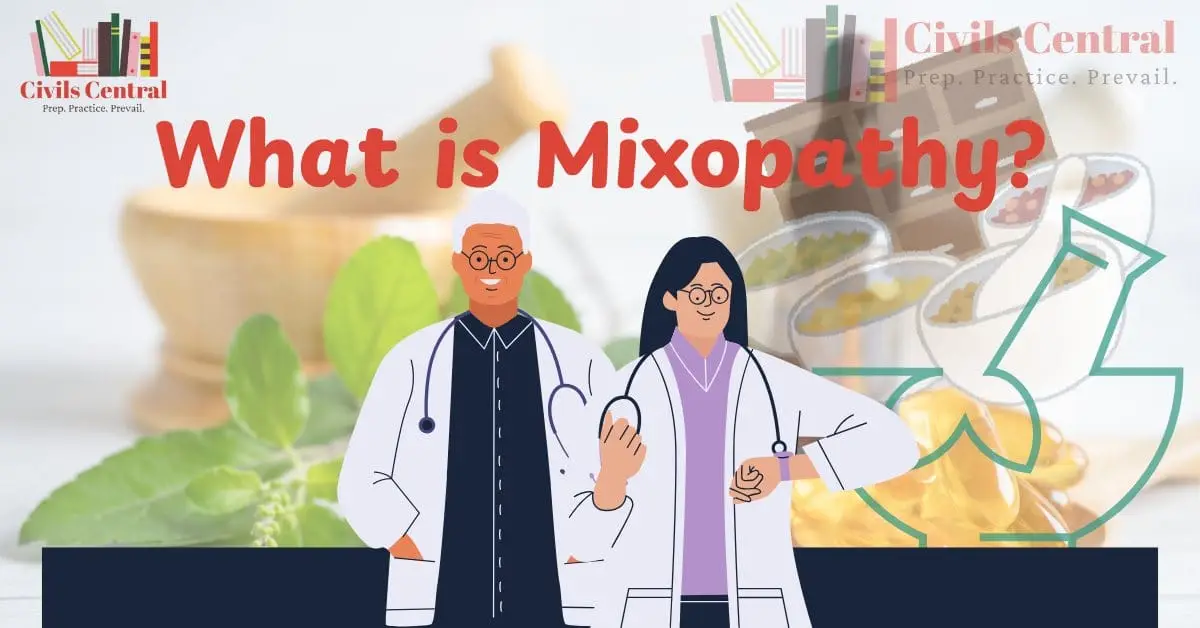
🔷 What is Mixopathy?

Mixopathy refers to the integration or mixing of different systems of medicine, particularly:

  • Allopathy (Modern Medicine)
  • AYUSH systems – Ayurveda, Yoga & Naturopathy, Unani, Siddha, and Homeopathy.

This integration involves allowing practitioners of one medical system to practice aspects of another, such as Ayurvedic doctors performing surgeries or prescribing allopathic drugs.


🔷 Why is Mixopathy in the News?

  • NCISM Guidelines (2020-2021):
    The National Commission for Indian System of Medicine (NCISM) released guidelines allowing Ayurveda postgraduates to be trained for performing 58 surgical procedures traditionally conducted by allopathic doctors.
  • IMA Opposition:
    The Indian Medical Association (IMA) strongly opposed this, calling it an attack on scientific medicine and coining the term “Mixopathy”.
  • Legal and Ethical Debates:
    Petitions were filed in various courts, questioning the scientific validity, patient safety, and medical ethics of cross-practice.
  • NITI Aayog & Policy Support:
    NITI Aayog backed the integration, arguing that the shortage of trained allopathic doctors in rural areas could be mitigated through AYUSH integration.
  • NEET and Educational Integration:
    Proposals have emerged to unify entrance exams and even syllabi across different systems of medicine, further intensifying the debate.

🔷 Arguments For Mixopathy

  • ✅ Accessibility: Reduces the rural healthcare gap by empowering AYUSH practitioners.
  • ✅ Holistic Health: Integration can offer better chronic care, lifestyle modification, and preventive strategies.
  • ✅ Policy Support: Helps realize the National Health Policy 2017 goals of integrating modern and traditional systems.

🔷 Arguments Against Mixopathy

  • ❌ Patient Safety: Lack of scientific training in allopathy can lead to medical errors.
  • ❌ Medical Ethics: Cross-practice may violate the principles of specialization and competence.
  • ❌ Dilution of Standards: Risks lowering the quality of healthcare delivery.

🔷 Current Status (as of 2025)

  • The debate continues with various state governments adopting different approaches.
  • The Supreme Court has directed the government to clearly define the scope of practice for each stream.
  • NMC (National Medical Commission) and NCISM are working on clarity and guidelines for practitioners.

🔷 Relevance for UPSC & JKAS

  • Prelims:
    • Ministries involved (AYUSH, Health & Family Welfare)
    • Bodies like NCISM, NMC, IMA
    • Key reports like National Health Policy 2017
  • Mains:
    • GS II – Issues related to health, governance, regulatory bodies.
    • Ethics Paper – Medical ethics, autonomy, competence.
    • Essay – Health reforms in India.

FAQs

Q. What is Mixopathy?
Mixopathy is the integration of different systems of medicine such as Allopathy and AYUSH, allowing cross-practice.

Q. Why is Mixopathy controversial?
It raises concerns about patient safety, ethics, and quality of healthcare.

About The Author

Rohit Thapa

See author's posts

Tags:

AllopathyHealth Issues in IndiaIMAMixopathyNational Health PolicyNCISMNITI AayogUPSC Current Affairs
Author

Rohit Thapa

Follow Me
Other Articles
Professional woman working on a laptop with text announcing IBPS SO 2025 Specialist Officer vacancies – Civils Central notification banner
Previous

National Commission for Women (NCW) – UPSC & JKAS

“COP29 Azerbaijan logo representing the 2024 UN Climate Change Conference held in Baku”
Next

Paris Agreement & COP29 Explained: A Complete Guide for UPSC & JKAS Aspirants

No Comment! Be the first one.

Leave a Reply Cancel reply

Your email address will not be published. Required fields are marked *

This site uses Akismet to reduce spam. Learn how your comment data is processed.

Recent Posts

  • Election Commission of India 2026: Internal Dissent, Electoral Rolls, SIR, Form 6 and Institutional Independence
  • India–US Relations 2026: Trade, Defence, Technology, QUAD and Strategic Challenges
  • Merchant Discount Rate (MDR): New UPI Framework 2026, How It Works, Who Pays and Why It Matters
  • BRICS Summit 2026: India’s Chairship, New Delhi Declaration and the Future of Global South Cooperation
  • Maratha Expansion and the Rise of the Peshwas (1707–1761): From Shahu to the Third Battle of Panipat

Categories

  • Ancient History
  • Chapter 1.1
  • CivilsCentral Knowledge Library
  • Current Affairs
  • Defence
  • Disaster Management
  • Economics
  • Environment & Ecology
  • Exam Strategy
  • Finance
  • Geography
  • Governance
  • Government Schemes
  • International Organisations
  • International Relations
  • International Relations
  • Latest Notifications
  • Medieval History
  • Modern History
  • Physics
  • polity
  • Polity & Constitution
  • Science & Technology
  • Statutory Bodies
  • Uncategorized
  • UPSC

RECENT POSTS

  • Election Commission of India 2026: Internal Dissent, Electoral Rolls, SIR, Form 6 and Institutional Independence
  • India–US Relations 2026: Trade, Defence, Technology, QUAD and Strategic Challenges
  • Merchant Discount Rate (MDR): New UPI Framework 2026, How It Works, Who Pays and Why It Matters
  • BRICS Summit 2026: India’s Chairship, New Delhi Declaration and the Future of Global South Cooperation
  • Maratha Expansion and the Rise of the Peshwas (1707–1761): From Shahu to the Third Battle of Panipat
  • Ancient History (15)
  • Chapter 1.1 (1)
  • CivilsCentral Knowledge Library (2)
  • Current Affairs (57)
  • Defence (4)
  • Disaster Management (1)
  • Economics (5)
  • Environment & Ecology (10)
  • Exam Strategy (1)
  • Finance (3)
  • Geography (1)
  • Governance (18)
  • Government Schemes (2)
  • International Organisations (3)
  • International Relations (14)
  • International Relations (2)
  • Latest Notifications (1)
  • Medieval History (12)
  • Modern History (33)
  • Physics (1)
  • polity (1)
  • Polity & Constitution (9)
  • Science & Technology (9)
  • Statutory Bodies (1)
  • Uncategorized (4)
  • UPSC (40)

Archives

  • September 2026
  • August 2026
  • July 2026
  • June 2026
  • March 2026
  • February 2026
  • August 2025
  • July 2025
  • June 2025

You May Have Missed

Election Commission of India 2026 Internal Dissent, Electoral Rolls, SIR, Form 6 and Institutional Independence
Current Affairs Governance Polity & Constitution

Election Commission of India 2026: Internal Dissent, Electoral Rolls, SIR, Form 6 and Institutional Independence

Rohit Thapa
By Rohit Thapa
September 24, 2026
India–US Relations 2026 Trade, Defence, Technology, QUAD and Strategic Challenges
Current Affairs International Relations

India–US Relations 2026: Trade, Defence, Technology, QUAD and Strategic Challenges

Rohit Thapa
By Rohit Thapa
September 17, 2026
Merchant Discount Rate (MDR) 2026 UPI Charges, 0.4% MDR, P2M, P2P & UPSC Notes
Current Affairs Governance Science & Technology

Merchant Discount Rate (MDR): New UPI Framework 2026, How It Works, Who Pays and Why It Matters

Rohit Thapa
By Rohit Thapa
September 17, 2026
BRICS Summit 2026 India’s Chairship, New Delhi Declaration and the Future of Global South Cooperation
Current Affairs International Relations

BRICS Summit 2026: India’s Chairship, New Delhi Declaration and the Future of Global South Cooperation

Rohit Thapa
By Rohit Thapa
September 16, 2026
Maratha Expansion and the Rise of the Peshwas (1707–1761): From Shahu to the Third Battle of Panipat
Modern History UPSC

Maratha Expansion and the Rise of the Peshwas (1707–1761): From Shahu to the Third Battle of Panipat

Rohit Thapa
By Rohit Thapa
September 10, 2026
Lord Wellesley (1798–1805) Subsidiary Alliance, British Expansion and the Rise of Paramountcy
Modern History UPSC

Lord Wellesley (1798–1805): Subsidiary Alliance, British Expansion and the Rise of Paramountcy

Rohit Thapa
By Rohit Thapa
September 7, 2026
Anglo-Maratha Wars (1775–1818): British Expansion and the Decline of Maratha Power
Modern History UPSC

Anglo-Maratha Wars (1775–1818): British Expansion and the Decline of Maratha Power

Rohit Thapa
By Rohit Thapa
September 3, 2026
Anglo-Mysore Wars (1767–1799): Mysore, Haider Ali, Tipu Sultan and the Expansion of British Power
Modern History UPSC

Anglo-Mysore Wars (1767–1799): Mysore, Haider Ali, Tipu Sultan and the Expansion of British Power

Rohit Thapa
By Rohit Thapa
September 3, 2026
Drain of Wealth Theory: Dadabhai Naoroji and the Nationalist Critique of Colonial Economic Exploitation
Modern History UPSC

Drain of Wealth Theory: Dadabhai Naoroji and the Nationalist Critique of Colonial Economic Exploitation

Rohit Thapa
By Rohit Thapa
August 9, 2026
Civilscentral.com
  • Election Commission of India 2026: Internal Dissent, Electoral Rolls, SIR, Form 6 and Institutional Independence
  • India–US Relations 2026: Trade, Defence, Technology, QUAD and Strategic Challenges
  • Merchant Discount Rate (MDR): New UPI Framework 2026, How It Works, Who Pays and Why It Matters
  • BRICS Summit 2026: India’s Chairship, New Delhi Declaration and the Future of Global South Cooperation
  • Maratha Expansion and the Rise of the Peshwas (1707–1761): From Shahu to the Third Battle of Panipat
  • Election Commission of India 2026: Internal Dissent, Electoral Rolls, SIR, Form 6 and Institutional Independence
  • India–US Relations 2026: Trade, Defence, Technology, QUAD and Strategic Challenges
  • Merchant Discount Rate (MDR): New UPI Framework 2026, How It Works, Who Pays and Why It Matters
  • BRICS Summit 2026: India’s Chairship, New Delhi Declaration and the Future of Global South Cooperation
  • Maratha Expansion and the Rise of the Peshwas (1707–1761): From Shahu to the Third Battle of Panipat
Copyright 2026 — Civils Central. All rights reserved.