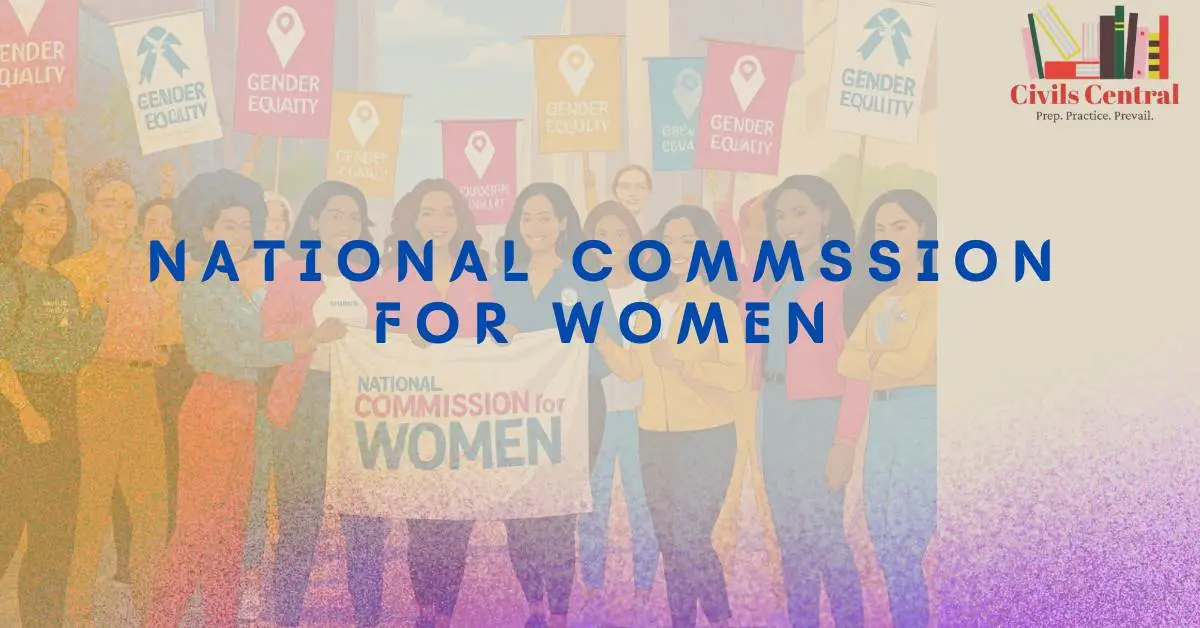

🔶 Introduction – National Commission for Women
The National Commission for Women (NCW) is a statutory body established in 1992 to safeguard and promote the interests of women in India. It acts as a watchdog for women’s rights, policy implementation, and redressal of grievances.
📜 Background and Historical Context
- Towards Equality Report (1974) by the Committee on the Status of Women in India was a landmark document that laid the foundation for NCW.
- Growing concerns over women’s safety, representation, and legal rights led to the need for a dedicated institution.
- NCW was created under the National Commission for Women Act, 1990.
- Officially came into existence on 31st January 1992.
🏛️ Constitutional and Legal Status
| Feature | Description |
|---|---|
| Type | Statutory Body |
| Constituted under | National Commission for Women Act, 1990 |
| Constitutional Status | Not a constitutional body |
| Reporting to | Government of India |
| Under Ministry | Ministry of Women and Child Development |
👤 Composition
| Position | Description |
|---|---|
| Chairperson | Nominated by the Central Government |
| Members | 5 members (at least one from SC/ST/OBC) |
| Member Secretary | An expert in management/sociology/law or an officer in civil service |
🟠 Current Chairperson (as of 2025): Rekha Sharma
🎯 Objectives and Mandate
- Review legal and constitutional safeguards for women.
- Recommend remedial legislative measures.
- Facilitate redressal of grievances related to women’s rights violations.
- Advise government on all policy matters affecting women.
⚙️ Powers and Functions
✔️ Investigative and Advisory
- Inquire suo-motu or on complaints regarding women’s rights violations.
- Fund litigation involving mass women’s rights issues.
- Inspect jails, remand homes, or women’s institutions.
- Suggest amendments in laws for better justice to women.
✔️ Promotional and Educational
- Conduct research and studies.
- Promote legal awareness through campaigns.
- Organize seminars, workshops, and public outreach.
✔️ Monitoring Role
- Monitor implementation of laws like:
- Protection of Women from Domestic Violence Act, 2005
- Dowry Prohibition Act, 1961
- Sexual Harassment at Workplace (Prevention, Prohibition and Redressal) Act, 2013
📌 Recent Initiatives & Why NCW Was in News (2024–2025)
🔷 1. Digital Shakti 5.0
- Initiative in collaboration with Meta (Facebook) to promote online safety for women.
- Focus on cyber awareness and combating cyberstalking, bullying, etc.
🔷 2. She is a Changemaker Program
- Political leadership training for women in rural Panchayats and urban local bodies.
🔷 3. 24×7 Helpline (7827170170)
- Launched to provide emergency response for women in distress.
🔷 4. NCW and AI Integration
- Recently, NCW announced its move to use Artificial Intelligence to analyze gender-based violence data and predict high-risk zones.
🔷 5. Investigation into Institutional Harassment
- NCW investigated cases like the allegations of harassment at WFI (Wrestling Federation of India).
- Acted on complaints from women athletes and recommended strict action.
⚖️ Limitations and Criticism
| Issue | Explanation |
|---|---|
| No enforcement power | NCW can only recommend action; it has no authority to enforce decisions. |
| Government-appointed members | Questions over independence and impartiality. |
| Low visibility in rural areas | Lack of grassroots connect. |
| Inadequate budget | Limits reach and capacity. |
🔍 NCW – Importance for UPSC CSE & JKAS Exams
✅ Prelims Pointers
- Established in 1992 under the NCW Act, 1990.
- Works under the Ministry of Women & Child Development.
- Statutory but not a constitutional body.
- First Chairperson: Jayanti Patnaik.
🧠 Mains Answer Writing Tips
- GS Paper II: Role of statutory bodies.
- GS Paper I: Issues related to women empowerment.
- Link with schemes like Beti Bachao Beti Padhao, and policies such as POSH Act.
- Use examples like Digital Shakti 5.0 or the helpline to show proactiveness.
Sample Intro:
“The National Commission for Women, as India’s premier statutory body for women, plays a pivotal role in bridging the gender justice gap and acts as the conscience keeper for women’s issues in policymaking.”
Sample Conclusion:
“To ensure the NCW becomes a more empowered body, it must be granted quasi-judicial powers and better integration with grassroots-level mechanisms to truly be a transformative force in gender justice.”
About The Author