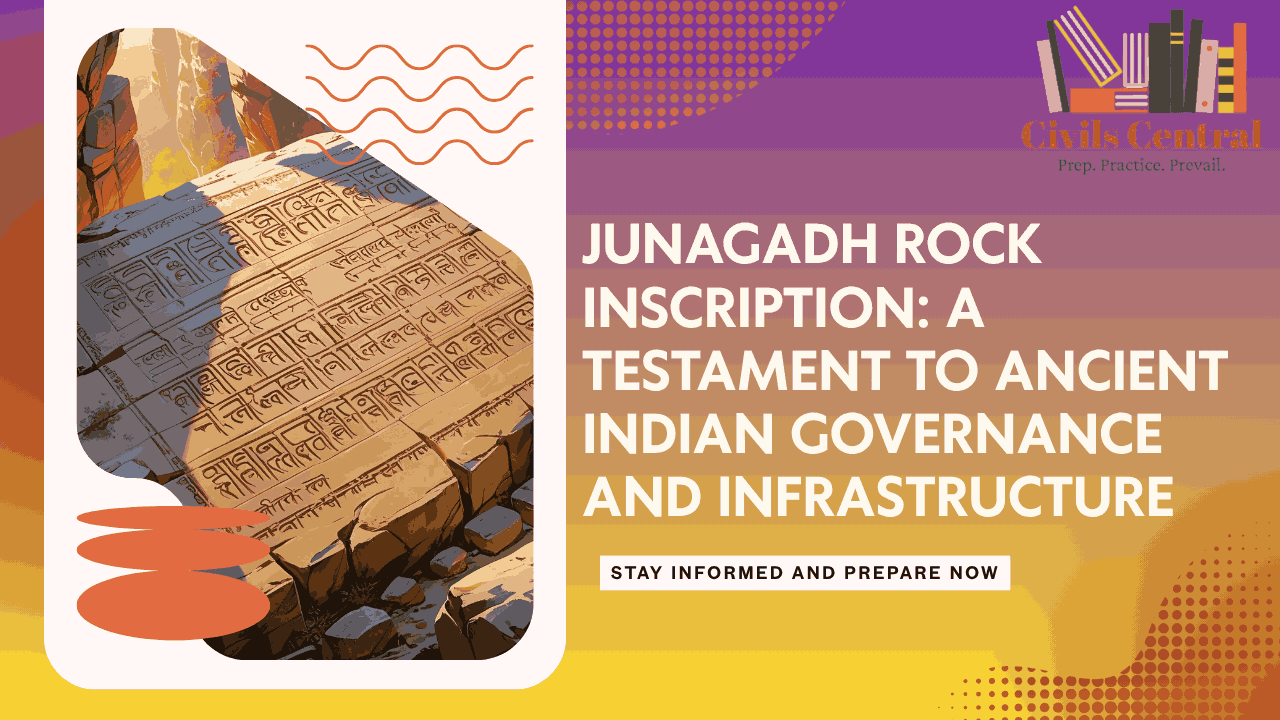
Junagadh Rock Inscription: A Testament to Ancient Indian Governance and Infrastructure

🏛️ Enriched Notes for UPSC & JKAS Aspirants
📍 Geographical Context
- Junagadh is located in the Kathiawar region of Saurashtra, Gujarat.
- The rock inscription is carved on a large granite boulder at the foot of Mount Girnar.
- Strategically located near ancient trade routes linking the western coast with the Deccan and northern plains.
📜 Tripartite Inscriptions on the Rock
🧱 1. Ashoka’s Major Rock Edicts (c. 250 BCE)
- Part of Major Rock Edicts Group I (there are 14 Major Rock Edicts in total).
- Written in Prakrit language using the Brahmi script.
- Edicts I to XIV at Junagadh emphasize:
- Dhamma (moral law): Non-violence, compassion, respect for all sects.
- Religious tolerance and welfare for all communities.
- Medical care for humans and animals across the empire.
- Environmental protection — bans on animal sacrifice and slaughter on certain days.
- Mentions officials like Dhamma Mahamatras appointed for moral oversight.
🔹 UPSC Insight:
The Junagadh edict proves Ashoka’s westernmost reach and is evidence of state-sponsored ethical governance — a unique model in ancient polity.
🏗️ 2. Rudradaman I’s Inscription (c. 150 CE)
- Ruler: Rudradaman I of the Western Kshatrapas (Saka dynasty).
- Language: Classical Sanskrit — first long royal inscription in Sanskrit (linguistic milestone).
- Content Summary:
- Describes repair and restoration of the Sudarshana Lake, originally built by Mauryan governor Pushyagupta and later maintained by Ashoka’s officer Tushaspa.
- Restoration conducted without burdening people with taxes.
- Boasts of Rudradaman’s personal virtues, military victories, and patronage of culture.
- Emphasizes public welfare and continuity of governance, irrespective of dynastic change.
🔹 UPSC Insight:
First significant Sanskrit inscription — shows cultural assimilation by foreign-origin rulers. Important for the theme of Indianization of Central Asian dynasties.
🛠️ 3. Skandagupta’s Inscription (c. 455 CE)
- Ruler: Skandagupta, a powerful Gupta emperor.
- Written in Sanskrit, it documents:
- Repairs to Sudarshana Lake after a natural calamity (floods).
- Acknowledges earlier works of Chandragupta Maurya and Rudradaman.
- Highlights Gupta commitment to infrastructure and legacy governance.
🔹 UPSC Insight:
Demonstrates continuity of state policy over 700 years — across Mauryan, Saka, and Gupta eras — focused on irrigation and public welfare.
🌊 The Sudarshana Lake System: Ancient Hydraulic Engineering
- Built during Chandragupta Maurya’s reign (by his governor Pushyagupta, as per Rudradaman’s record).
- Located in a semi-arid region, it was crucial for:
- Irrigation
- Drinking water
- Flood control
- The repeated repair efforts by Rudradaman and Skandagupta highlight its strategic importance.
- Represents the mature hydraulic engineering tradition of ancient India.
🔹 UPSC Mains Connection:
Use it as a case study for “Irrigation and water management in ancient India”, or in GS1/Essay answers on environmental sustainability through history.
📚 Historical Significance of the Junagadh Inscription
| Aspect | Explanation |
|---|---|
| Administrative Continuity | Reflects dynastic transitions without interruption in public policy (infrastructure upkeep) |
| Cultural Assimilation | Shows Sakas’ and Guptas’ adoption of Sanskrit, Indian traditions, and administrative ideals |
| Welfare State | All three inscriptions emphasize public works without exploitative taxation |
| Moral Governance | Ashoka’s edict is one of the earliest examples of moral statecraft in world history |
| Engineering Legacy | Sudarshana Lake serves as a symbol of scientific and sustainable water management in ancient India |
🔎 Use Junagadh Inscription in These Mains Themes
✒️ GS I (History):
- “Discuss the role of inscriptions in reconstructing the history of ancient India.”
- “How did public infrastructure evolve during Maurya and Gupta periods?”
✒️ GS II (Governance):
- “Moral governance has ancient roots in India’s history. Discuss with examples.”
✒️ Essay Topics:
- “Infrastructure is the backbone of civilizations.”
- “Welfare and governance in ancient India: A timeless model.”
🧾 Prelims Nuggets:
✅ Located in Girnar Hills, Gujarat
✅ Ashoka: Major Rock Edicts (Prakrit, Brahmi)
✅ Rudradaman: 1st classical Sanskrit inscription
✅ Skandagupta: Mentions flood restoration of Sudarshana Lake
✅ Lake originally built by Pushyagupta, a Mauryan official
✅ Script used: Brahmi (Ashoka & Rudradaman), Gupta Brahmi (Skandagupta)
🎯 Summary for Revision (One-Liners):
- Ashoka: Propagated Dhamma and ethical rule.
- Rudradaman: First Sanskrit inscription; repaired Sudarshana Lake.
- Skandagupta: Maintained lake post-flood; shows Gupta engineering and continuity.
- Sudarshana Lake: Symbol of ancient India’s irrigation brilliance and dynastic legacy.
About The Author