
📘 Ancient Indian History Series | For UPSC & JKAS Aspirants
🧭 Introduction: Why the Mauryan Empire Matters
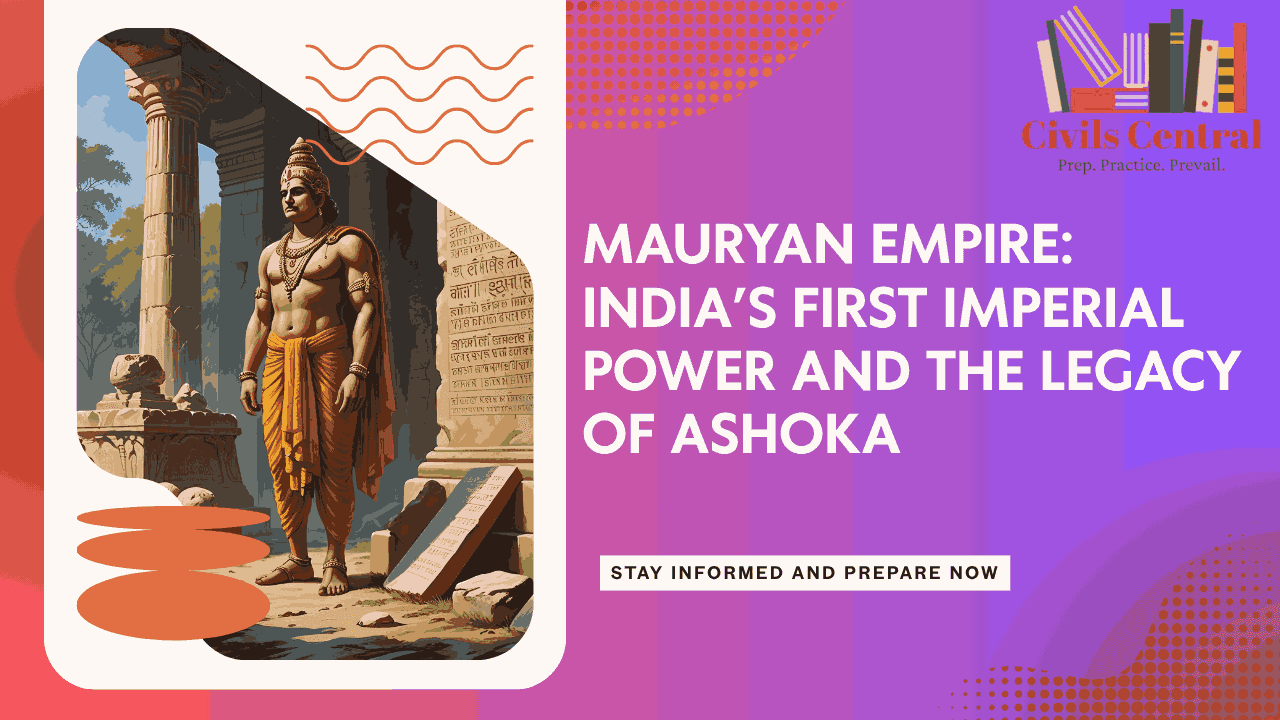
The Mauryan Empire (322–185 BCE) was the first historic empire to unify large swathes of the Indian subcontinent — from Afghanistan in the northwest to Tamil Nadu in the south, and from Bengal in the east to Baluchistan in the west.
It marks a political and administrative breakthrough in ancient Indian history. For the first time, statecraft, diplomacy, taxation, espionage, and a codified administrative structure were implemented on such a grand scale.
Its most celebrated emperor, Ashoka, transformed the empire from a militaristic state to a moral empire based on Dhamma (righteous conduct).
🏹 Foundation of the Mauryan Empire
🔸 Decline of the Nandas:
- The Nanda Dynasty, which ruled Magadha before the Mauryas, was known for its oppressive taxation policies and autocratic rule.
- The Nandas had amassed a vast army and wealth, but lacked popular support.
- The resentment among the masses, coupled with the political vacuum created after Alexander’s retreat, created the perfect opportunity for a new power to rise.
- Chanakya (Kautilya), a Brahmin political strategist from Takshashila, vowed to overthrow the Nandas after being insulted at their court.
🔸 Chandragupta Maurya’s Rise:
- Chandragupta, with Kautilya’s support, united various factions and overthrew Dhana Nanda, the last Nanda king, around 322 BCE.
- He went on to conquer northwestern India, defeating the satraps (governors) left behind by Alexander, and extended his control as far west as Afghanistan.
- His success in diplomacy and warfare was evident in his treaty with Seleucus I Nicator, who ceded territories west of the Indus and offered a marriage alliance(Daughter name: Helina). And in return, got 500 elephants from Chandragupta.
Read about “Junagadh Rock Inscription”
👑 Important Rulers of the Mauryan Empire
1. Chandragupta Maurya (322–298 BCE)
- Also, know as Sandrocottus or Androcottus in Greek literature.
- Seleucus Nicator also sent his ambassador Megasthenes, to the Chandragupta’s Court.
- Book Indica was written by Megasthenes about India and how a society was divided into 7 parts and contained detailed description of administration of Pataliputra.
- Chandragupta Maurya, figures prominently in the book of Mudra-Rakshasa written by Vishakhadatta.
- Other Books:
- Ashvaghosha written by Buddhacharita.
- Sudraka written by Mrichhkatika.
- Pushyagupta Vaishya, the governor of Saurashtra under Chandragupta, constructed the Sudarshan Lake at Girnar(Junagadh).
- A dynamic and visionary ruler, Chandragupta laid the foundation of the Mauryan Empire with the capital at Pataliputra (modern Patna).
- His alliance with Seleucus brought territorial expansion and enhanced Greco-Indian diplomatic relations.
- Towards the end of his life, influenced by Jain monk Bhadrabahu, he abdicated the throne and became an ascetic, eventually dying (through the practice of Sallekhana) at Shravanabelagola in Karnataka.
2. Bindusara (298–273 BCE)
- Son of Chandragupta, known by the title Amitraghata (“Slayer of Enemies”).
- He continued his father’s policy of expansion and extended Mauryan rule to most of peninsular India, stopping short of Kalinga and the deep south.
- Maintained friendly diplomatic relations with the Greek world.
- Greek envoy Deimachus visited his court, sent by Antiochus I.
- He requested Antiochus I to send him sweet wine, dry figs and sophist.
- He appointed his son Ashoka, as the governor of Ujjain.
- His religious leanings were towards the Ajivika sect.
3. Ashoka the Great (273–232 BCE)
- Ashoka was not the immediate heir — he had to fight a succession war after Bindusara’s death.
- His reign is known for two phases:
- Pre-Kalinga: A period of expansion and military aggression.
- Post-Kalinga: A complete transformation into a pacifist and ethical ruler after witnessing the bloodshed at the Kalinga War (261 BCE).
- A Buddhist monk named Upagupta initiated him into Buddhism and became a patron of the Sangha (monastic community), and launched one of the world’s first state-sponsored moral and spiritual campaigns.
- The Kalinga war and its consequenses are described by Ashoka in his 13th Rock edict.
- Last ruler of this Dynasty, was Brihadratha.
Read about “Kalinga War”
🏰 Mauryan Administration: Centralized & Efficient
🔸 Central Administration:
- The Mauryan Empire was governed by a highly centralized bureaucracy, with the emperor as the supreme authority.
- The Arthashastra, written by Kautilya, describes this system in detail.
- The emperor was assisted by a Council of Ministers (Mantriparishad).
🔸 Provincial Administration:
- The empire was divided into four major provinces: Tosali (East), Ujjayini (West), Suvarnagiri (South), and Taxila (Northwest).
- Each province was governed by a Kumara (royal prince), acting as the king’s representative.
- Below provinces were districts (Ahara) and villages, managed by officials like Rajukas and Gopas.
🔸 Key Officials:
| Designation | Role |
|---|---|
| Amatyas | Civil administration |
| Mahamatras | Superintendents of departments |
| Rajukas | Revenue officers with judicial powers |
| Yuktas | Accountants and record-keepers |
| Dandapala | In charge of law and order (police) |
🔸 Espionage System:
- The Mauryan Empire had a sophisticated spy network, used to monitor officials and potential rebels.
- Spies (Gudhapurushas) operated in both rural and urban areas.
📚 Mauryan Economy: State-Controlled and Prosperous
🔸 Agriculture:
- Agriculture formed the economic backbone.
- The state directly managed large tracts of land and encouraged cultivation.
- Irrigation systems were built and maintained by the government.
🔸 Taxation:
- Land revenue was the primary source — usually 1/6th of the produce.
- Other taxes included:
- Taxes on artisans and traders
- Forest and mining taxes
- Salt tax and tolls on trade
🔸 Trade and Commerce:
- Well-maintained roads and highways (e.g., the Royal Road from Pataliputra to Taxila).
- Trade flourished with Greece, West Asia, and Sri Lanka.
- Use of standard weights, measures, and punch-marked silver coins ensured trust in markets.
🔸 State Monopolies:
- State held monopolies in sectors like mining, liquor, arms, salt, and forest produce.
- This ensured revenue and regulated quality and prices.
📜 Ashoka’s Dhamma: A Moral State Policy
🔸 What is Dhamma?
- Not to be confused with orthodox Buddhism.
- Ashoka’s Dhamma was a practical ethical code focusing on:
- Non-violence (Ahimsa)
- Tolerance towards all religions
- Respect for elders and teachers
- Humane treatment of servants and prisoners
🔸 Dhamma Mahamatras:
- Special officers appointed to propagate Dhamma, resolve disputes, and check misconduct.
- Acted as moral watchdogs of society.
🔸 Edicts of Ashoka:
- Ashoka inscribed his messages on pillars, rocks, and caves throughout the empire.
- Written in Prakrit (Brahmi script), Kharosthi, and Greek-Aramaic in the northwest.
🔸 International Missions:
- Ashoka sent Buddhist missions to foreign kingdoms:
- Sri Lanka (by his son Mahendra and daughter Sanghamitta)
- Hellenistic kingdoms (e.g., Ptolemy of Egypt, Antiochus of Syria)
- Southeast Asia and Central Asia
🧱 Mauryan Art & Architecture
🔸 Ashokan Pillars:
- Made of Chunar sandstone.
- Topped with animal capitals like the Lion Capital of Sarnath (now India’s national emblem).
- Show clear influence of Persian Achaemenid style.
🔸 Stupas:
- Ashoka built and renovated 84,000 stupas to enshrine Buddha’s relics.
- The Sanchi Stupa is the best preserved.
🔸 Rock-cut Architecture:
- Barabar Hill caves were gifted to Ajivikas and are earliest examples of rock-cut architecture in India.
🔚 Decline of the Mauryan Empire
🔸 Reasons for Decline:
- Weak Successors:
- Ashoka was followed by ineffective rulers like Dasharatha, leading to administrative disintegration.
- Over-centralization:
- Empire too vast to be managed from Pataliputra alone.
- Economic Strain:
- Welfare and missionary activities post-Ashoka led to exhaustion of resources.
- Brahmanical Resistance:
- Ashoka’s patronage of Buddhism alienated orthodox Brahmins.
- Uprising by Pushyamitra Shunga:
- In 185 BCE, Brihadratha, the last Mauryan ruler, was assassinated by Pushyamitra Shunga, the commander-in-chief.
🧠 Mains Answer Enrichment
Q: Analyze how the Mauryan Empire laid the foundations of statecraft in ancient India.
- Quote the Arthashastra for administrative mechanisms.
- Cite Ashoka’s edicts to show how rulers communicated with subjects.
- Discuss the use of espionage, centralized taxation, and state monopolies.
Q: Evaluate the significance of Ashoka’s Dhamma in Indian polity.
- Emphasize moral governance, welfare state, tolerance, and non-violence.
- Mention how this influenced later Buddhist rulers and even modern Indian secularism.
About The Author