Biomining: A Sustainable Solution for Legacy Waste Management in India | UPSC Current Affairs 2026

Introduction
Imagine you are the District Magistrate of a rapidly growing city. Every day, nearly 1,500 tonnes of municipal solid waste are generated. While today’s waste can be collected and processed, there is another challenge that has been silently growing for decades—a gigantic mountain of garbage occupying valuable urban land. Residents living nearby complain of unbearable foul smell, toxic smoke from recurring fires, contaminated groundwater, and increasing health problems. The National Green Tribunal (NGT) has directed immediate remediation, environmental activists are demanding action, and citizens expect sustainable solutions.
This is not a hypothetical situation. It is the reality of several Indian cities such as Delhi, Mumbai, Chennai, Bengaluru, Hyderabad, and Kolkata, where decades of unscientific dumping have created massive legacy waste dumpsites. The Ghazipur landfill in Delhi, often referred to as a “garbage mountain,” has become a symbol of India’s urban waste management crisis.
To address this challenge, India is increasingly adopting biomining, a scientific process that excavates, treats, and recovers useful materials from old waste while reclaiming valuable land. Unlike conventional waste disposal methods that merely shift the problem from one place to another, biomining seeks to convert waste into resources, making it an important component of the Circular Economy and Swachh Bharat Mission (Urban) 2.0.
For UPSC aspirants, biomining is far more than a current affairs topic. It connects multiple areas of the syllabus:
- GS Paper II: Urban Governance and Municipal Administration
- GS Paper III: Environment, Climate Change, Science & Technology, Disaster Management
- Essay: Sustainable Development, Urbanization, Circular Economy
- Interview: Innovative governance, municipal reforms, environmental sustainability
A clear understanding of biomining helps aspirants appreciate how environmental protection, public health, urban governance, climate commitments, and scientific innovation converge in addressing one of India’s most pressing urban challenges.
Why in News?
The Government of the National Capital Territory (NCT) of Delhi has directed the Municipal Corporation of Delhi (MCD) to accelerate the biomining of the Ghazipur landfill, one of India’s oldest and largest dumpsites. The municipal body has been asked to substantially increase its waste processing capacity with the objective of clearing legacy waste within the targeted timeline. The initiative forms part of a broader national effort under the Swachh Bharat Mission (Urban) 2.0, which emphasizes scientific remediation of legacy waste, reduction of landfill dependency, and promotion of a circular economy.
Although the immediate trigger is the Ghazipur landfill, the issue extends far beyond Delhi. Hundreds of Indian cities face similar challenges, making biomining an increasingly important topic from the perspective of governance, environmental management, and sustainable urban development.
Why This Topic Matters for UPSC?
UPSC rarely asks straightforward questions such as “What is biomining?” Instead, it frames analytical questions that test conceptual understanding and the ability to connect multiple subjects.
For example, UPSC may ask:
- Why are unmanaged landfills major sources of methane emissions?
- How does biomining contribute to climate change mitigation?
- Discuss the role of urban local bodies in scientific waste management.
- Examine the contribution of biomining towards achieving Sustainable Development Goals.
Thus, understanding biomining requires studying not only waste management technology but also constitutional provisions relating to municipalities, environmental governance, urban planning, disaster management, and sustainable development.
India’s Growing Waste Management Crisis
Before understanding biomining, it is essential to understand why India faces a waste crisis in the first place.
Rapid Urbanization and Rising Waste Generation
India is one of the fastest urbanizing countries in the world. Every year, millions of people migrate from rural areas to towns and cities in search of employment, education, and better opportunities. Rapid urbanization has significantly increased the generation of municipal solid waste. At the same time, rising incomes and changing lifestyles have altered consumption patterns. The increased use of packaged food, disposable products, e-commerce packaging, and plastic materials has substantially increased both the quantity and complexity of urban waste.
Unlike traditional biodegradable waste, modern municipal waste contains a large proportion of plastics, multilayer packaging, electronic waste, textiles, and construction debris, making scientific processing more challenging.
Why Did Garbage Mountains Develop?
Many students assume that garbage mountains exist because India does not collect waste. This is a misconception. The real problem lies not in collection but in scientific processing. For decades, municipal corporations primarily followed a simple approach:
Collect → Transport → Dump
Waste was transported to the outskirts of cities and deposited in open dumping grounds without segregation or scientific treatment. Over several decades, these dumping grounds grew into massive mountains of waste. Since fresh waste continued to be added daily, the volume of accumulated waste increased continuously. Today, many of these dumpsites contain waste that is 20–40 years old.
What is Legacy Waste?
Understanding legacy waste is the key to understanding biomining. Legacy waste refers to old municipal solid waste that has accumulated at dumpsites over many years without scientific treatment or processing. However, defining legacy waste is not enough. A UPSC aspirant must understand why it becomes dangerous.
When waste remains buried for years, microorganisms begin decomposing biodegradable material. Since oxygen cannot easily penetrate deep inside the waste heap, decomposition occurs under anaerobic conditions.Anaerobic decomposition produces methane, an extremely potent greenhouse gas. Simultaneously, rainwater seeps through the waste and dissolves harmful chemicals, heavy metals, and organic pollutants, producing a contaminated liquid called leachate.
Leachate gradually infiltrates nearby soil and groundwater, posing serious environmental and health risks. Thus, a legacy waste dumpsite continues to pollute the environment long after the waste has been dumped. It is therefore incorrect to assume that an old landfill is an inactive site. In reality, it remains an active source of pollution.
Components of Legacy Waste
A legacy dumpsite typically contains:
- Partially decomposed organic waste
- Plastics
- Paper and cardboard
- Glass
- Metals
- Construction debris
- Soil
- Rubber
- Textiles
- Hazardous residues
Since waste was dumped without segregation, all these materials become mixed together, making scientific processing difficult.
Why is Legacy Waste a Serious Environmental Problem?
Methane Emissions
Organic waste decomposes anaerobically to produce methane. Methane is a greenhouse gas with a significantly higher global warming potential than carbon dioxide over a 100-year period, making unmanaged landfills an important contributor to climate change. Additionally, methane is highly combustible. Its accumulation inside waste heaps often results in spontaneous landfill fires that are extremely difficult to extinguish.
Formation of Leachate
Rainwater passing through waste dissolves organic matter, heavy metals, ammonia, pathogens, and toxic chemicals. This contaminated liquid, known as leachate, gradually seeps into groundwater and nearby water bodies if proper containment systems are absent. Groundwater contamination may persist for decades and affect drinking water quality.
Public Health Concerns
Legacy waste provides breeding grounds for flies, mosquitoes, rats, and stray animals. Communities living near dumpsites frequently report:
- Respiratory illnesses
- Skin diseases
- Gastrointestinal infections
- Eye irritation
- Allergic disorders
Open burning of waste further worsens air quality by releasing particulate matter and toxic gases.
Loss of Valuable Urban Land
Large dumpsites occupy hundreds of hectares of land. In rapidly expanding cities where land availability is already limited, these areas remain unusable for housing, parks, transportation, or public infrastructure. Scientific remediation through biomining helps reclaim this land for productive purposes.
Dumpsite vs Sanitary Landfill
Many UPSC aspirants confuse these two terms.
| Feature | Open Dumpsite | Sanitary Landfill |
|---|---|---|
| Waste segregation | Not practiced | Mandatory |
| Bottom liner | Absent | Present |
| Leachate collection | Absent | Present |
| Methane collection | No | Yes |
| Daily soil cover | No | Yes |
| Environmental monitoring | Poor | Continuous |
| Pollution risk | Very High | Controlled |
UPSC Tip: Most legacy waste sites in India originated as open dumpsites, not scientifically designed sanitary landfills.
What is Biomining?
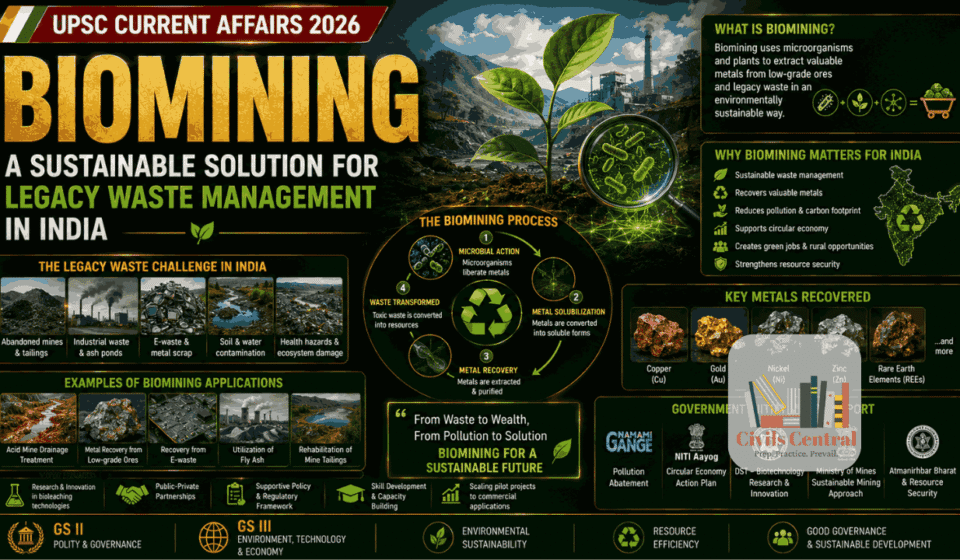
Biomining is a scientific technique used to remediate legacy waste by excavating old garbage, biologically stabilizing the biodegradable fraction, mechanically segregating different materials, recovering useful resources, and reclaiming the land. Unlike ordinary waste management, biomining focuses specifically on historically accumulated waste.
The objective is not merely to remove garbage but to recover valuable materials, reduce pollution, minimize greenhouse gas emissions, and restore degraded land. Biomining represents a shift from the traditional “collect and dump” model towards the “recover, recycle, and reclaim” approach promoted under the Circular Economy.
Why Did Biomining Become Necessary?
Earlier, authorities often attempted to manage old dumpsites by simply covering them with soil. Although this reduced visual pollution, it did not stop methane generation or leachate formation. The garbage remained buried underground, continuing to pollute the environment. Biomining emerged as a better alternative because it addresses the root problem rather than merely covering it.
It enables:
- Recovery of recyclable materials
- Reduction in landfill volume
- Reclamation of valuable land
- Scientific disposal of residual waste
- Reduction in greenhouse gas emissions
For this reason, biomining has become a preferred strategy under the Solid Waste Management Rules, 2016, and Swachh Bharat Mission (Urban) 2.0.
UPSC Concept
Why Should a Civil Servant Understand Biomining?
For an administrator, biomining is not just an environmental technology. It directly influences:
- Urban planning
- Public health
- Climate resilience
- Municipal finance
- Disaster risk reduction
- Compliance with environmental laws
An IAS officer serving as District Magistrate or Municipal Commissioner may be responsible for planning, funding, monitoring, and implementing biomining projects. Therefore, the topic has practical governance significance in addition to examination relevance.
How Does Biomining Work?
Many UPSC aspirants memorize the steps of biomining as:
Excavation → Bio-remediation → Screening → Resource Recovery
However, UPSC is rarely interested in whether a candidate can simply reproduce these steps. Instead, the examination tests whether the aspirant understands why each stage is necessary, what scientific principles are involved, and how biomining differs from other waste management technologies.
The Science Behind Biomining
Imagine a landfill that has been receiving waste continuously for the last 35 years. Inside this garbage mountain are:
- food waste,
- plastics,
- paper,
- metals,
- construction debris,
- textiles,
- glass,
- soil,
- electronic waste,
- biomedical residues,
- moisture.
Over time, these materials become compressed under their own weight. Rainwater enters the waste mass, oxygen becomes scarce, and anaerobic decomposition begins. The waste gradually transforms into a heterogeneous mixture with varying degrees of decomposition. Simply removing the top layer cannot solve the problem because pollution originates from the entire waste mass. Therefore, biomining involves systematic excavation and scientific processing of the entire legacy waste.
Step 1: Excavation of Legacy Waste
The first stage of biomining is the excavation of accumulated waste using heavy earth-moving machinery such as:
- Excavators
- Backhoe loaders
- Front-end loaders
- Bulldozers
Why is Excavation Necessary?
Many students ask: “If microorganisms can decompose waste naturally, why dig it out at all?” The answer lies in understanding landfill conditions. Deep inside a landfill:
- oxygen availability is extremely low,
- moisture distribution is uneven,
- microbial activity becomes inefficient,
- waste remains compacted.
Under such conditions, decomposition slows considerably. Excavation exposes buried waste to atmospheric oxygen and enables scientific processing. It also allows workers to remove bulky objects such as:
- concrete blocks,
- tyres,
- furniture,
- metal scraps,
- large plastic items.
These materials would otherwise interfere with further processing. Biomining is fundamentally different from landfill closure because it actively removes and processes waste, whereas landfill closure generally involves covering the waste with soil and vegetation.
Step 2: Formation of Windrows
Once excavated, the waste is not processed immediately. Instead, it is arranged into long parallel heaps known as windrows. Many coaching notes define a windrow but rarely explain its purpose. Understanding why windrows are created is far more important.
Why Are Windrows Formed?
A large compact heap prevents proper airflow. Without oxygen, microorganisms responsible for aerobic decomposition cannot function efficiently. Windrows solve this problem by:
- increasing surface area,
- improving aeration,
- regulating moisture,
- facilitating microbial activity,
- allowing easy turning of waste.
The waste is periodically turned using machinery so that oxygen reaches deeper layers. This process significantly accelerates stabilization.
Aerobic vs Anaerobic Decomposition
| Feature | Aerobic Decomposition | Anaerobic Decomposition |
|---|---|---|
| Oxygen | Present | Absent |
| Main Products | Carbon dioxide + Water | Methane + Carbon dioxide |
| Odour | Comparatively less | Strong foul smell |
| Speed | Faster | Slower |
| Environmental Impact | Lower | Higher methane emissions |
Biomining attempts to encourage aerobic biological activity, thereby reducing methane generation associated with anaerobic decomposition.
Step 3: Bio-remediation – The Heart of Biomining
This is the most important stage. The term bio-remediation literally means using living organisms to remove or neutralize pollutants. In biomining, specially selected microbial cultures containing bacteria and fungi are sprayed over excavated waste. These microorganisms consume biodegradable organic matter and convert it into simpler compounds.
How Do Microorganisms Work?
Microorganisms require:
- oxygen,
- moisture,
- suitable temperature,
- organic matter as food.
When these conditions are maintained, microbial activity increases rapidly.
During decomposition:
Complex organic compounds
↓
Simple organic molecules
↓
Carbon dioxide
↓
Water
↓
Humus-like stabilized material
As decomposition progresses:
- foul odour decreases,
- disease-causing organisms reduce,
- waste becomes biologically stable,
- volume of biodegradable waste declines.
Important Clarification
A common misconception is that microbes can decompose all waste. This is incorrect. Microorganisms can effectively decompose:
- food waste,
- vegetable waste,
- leaves,
- paper,
- biodegradable organic matter.
However, they cannot decompose:
- plastics,
- metals,
- glass,
- rubber,
- construction debris.
These materials must be separated mechanically and sent for recycling or safe disposal.
UPSC Concept
Bio-remediation vs Biomining
Many aspirants treat these terms as synonyms. They are not. Bio-remediation is only one biological treatment process. Biomining is a comprehensive remediation strategy that includes:
- excavation,
- biological treatment,
- mechanical segregation,
- resource recovery,
- land reclamation.
Thus, bio-remediation is one component of biomining.
Step 4: Mechanical Screening and Segregation
After biological stabilization, the waste is passed through screening equipment. The most commonly used machine is the Trommel Screen.
What is a Trommel?
A trommel is a rotating cylindrical screen fitted with perforations of different sizes. As waste rotates inside the drum:
- smaller particles fall through the holes,
- larger materials continue moving forward.
This separates waste according to particle size. Different screen sizes may be used depending on project requirements.
Why is Screening Important?
Different materials require different treatment methods. Without segregation:
- recycling becomes impossible,
- compost quality deteriorates,
- plastics contaminate organic fractions.
Therefore, mechanical screening forms the backbone of resource recovery.
Step 5: Resource Recovery
One of the biggest advantages of biomining is that it views waste as a resource rather than merely a disposal problem. Recovered materials are separated into different categories.
Organic Fraction
Stabilized organic matter may be used as:
- compost (subject to quality standards),
- landfill cover,
- soil conditioner,
- landscaping material.
Poor-quality organic fractions may require further treatment before utilization.
Recyclable Materials
Recovered recyclables include:
- plastics,
- metals,
- aluminium,
- glass,
- paper.
These materials are supplied to authorized recycling industries. Recycling reduces extraction of virgin raw materials and conserves energy.
Refuse-Derived Fuel (RDF)
Certain combustible materials cannot be recycled economically. These include:
- multilayer plastics,
- contaminated paper,
- textiles,
- rubber fragments.
Such materials are processed into Refuse-Derived Fuel (RDF). RDF is widely used in:
- cement industries,
- industrial boilers,
- selected waste-to-energy facilities.
Why Cement Plants Prefer RDF
Cement kilns operate at temperatures exceeding 1,400°C. These high temperatures ensure efficient combustion while minimizing harmful residues.
Inert Materials
Materials such as:
- soil,
- stones,
- bricks,
- construction debris,
cannot be biologically treated. However, they can often be reused for:
- road sub-base,
- embankments,
- low-lying area filling,
- landscaping.
This further reduces waste requiring final disposal.
Step 6: Land Reclamation
After removal of legacy waste, the land becomes available for redevelopment. Depending on local planning requirements, reclaimed land may be converted into:
- public parks,
- biodiversity parks,
- bus depots,
- solar power installations,
- waste processing facilities,
- logistics hubs,
- urban forests.
Thus, biomining not only removes pollution but also creates valuable urban assets.
Biomining Process Flowchart
Legacy Waste
↓
Excavation
↓
Windrow Formation
↓
Bio-remediation
↓
Mechanical Screening
↓
Segregation
↓
Resource Recovery
↓
Land Reclamation
↓
Circular Economy
Important Terminologies Every UPSC Aspirant Must Know
Municipal Solid Waste (MSW)
Municipal Solid Waste refers to everyday waste generated from households, commercial establishments, institutions, markets, offices, and street sweeping activities. It generally excludes industrial hazardous waste, biomedical waste, and radioactive waste, each of which is governed by separate regulatory frameworks.
Leachate
Leachate is the contaminated liquid produced when rainwater or moisture passes through accumulated waste and dissolves organic matter, heavy metals, ammonia, and toxic chemicals.
Why is Leachate Dangerous?
Unlike surface pollution, leachate infiltrates underground. It contaminates:
- groundwater,
- nearby lakes,
- rivers,
- agricultural land.
Treatment of leachate often requires specialized treatment plants due to its high pollutant concentration.
Methane
Methane (CH₄) is produced during anaerobic decomposition of biodegradable waste. It is significant because:
- it is highly flammable,
- it contributes to landfill fires,
- it is a potent greenhouse gas,
- it contributes to global warming.
Proper landfill gas collection systems can capture methane for energy generation in engineered sanitary landfills.
Refuse-Derived Fuel (RDF)
RDF is a processed fuel prepared from high-calorific combustible municipal waste. It should not be confused with compost. Compost improves soil fertility. RDF is an industrial fuel.
Exam Trap
Remember the following carefully:
| Incorrect Assumption | Correct Understanding |
|---|---|
| Biomining = Bio-remediation | Bio-remediation is only one stage of biomining |
| Legacy waste = Biomedical waste | Completely different concepts |
| Compost = RDF | Compost is organic manure; RDF is combustible fuel |
| Dumpsite = Sanitary landfill | Dumpsites lack scientific engineering |
| Recycling = Resource Recovery | Recycling is only one component of resource recovery |
Why Biomining Represents the Circular Economy?
Traditional waste management followed the Linear Economy Model: Take → Produce → Consume → Dispose
Biomining promotes the Circular Economy Model: Recover → Recycle → Reuse → Restore
Instead of treating waste as a liability, biomining recognizes that even decades-old waste contains recoverable materials that can re-enter the production cycle. This reduces pressure on natural resources, conserves energy, minimizes pollution, and supports sustainable urban development.
Legal Framework, Government Initiatives, International Best Practices, Challenges and Way Forward
Understanding the science of biomining alone is not sufficient for UPSC. The Civil Services Examination also expects aspirants to know who is responsible for managing waste, what laws govern waste management, what institutions regulate it, and why implementation remains challenging despite comprehensive legislation.
Constitutional and Legal Framework for Waste Management in India
Many aspirants believe that waste management is primarily the responsibility of the Central Government. However, the Constitution assigns this responsibility mainly to Urban Local Bodies (ULBs). Understanding this constitutional framework is crucial.
74th Constitutional Amendment Act, 1992
The 74th Constitutional Amendment gave constitutional status to Urban Local Bodies and strengthened urban governance in India. It inserted Part IXA (Articles 243P to 243ZG) into the Constitution and introduced the Twelfth Schedule, which lists 18 functions entrusted to municipalities. Among these functions are:
- Public health
- Sanitation
- Conservancy
- Solid waste management
- Urban planning
- Environmental protection
Why is this important?
Biomining projects are not directly executed by the Central Government. Instead, they are implemented by:
- Municipal Corporations
- Municipal Councils
- Nagar Panchayats
The Union and State Governments provide policy support, technical guidance, and financial assistance, but the primary responsibility lies with Urban Local Bodies.
UPSC Insight
Whenever UPSC asks questions on waste management, remember to connect them with:
- 74th Constitutional Amendment
- Urban Local Bodies
- Decentralized Governance
Environment (Protection) Act, 1986
India’s modern environmental legislation largely originates from the Environment (Protection) Act, 1986, enacted after the Bhopal Gas Tragedy (1984). The Act empowers the Central Government to:
- protect and improve environmental quality,
- regulate pollution,
- issue environmental standards,
- frame rules regarding waste management.
Almost all modern waste management rules derive their authority from this Act.
Solid Waste Management Rules, 2016
The Solid Waste Management (SWM) Rules, 2016, notified under the Environment (Protection) Act, replaced the earlier Municipal Solid Waste (Management and Handling) Rules, 2000. The 2016 Rules represented a paradigm shift from mere waste collection to scientific waste management.
Why were the 2016 Rules needed?
The 2000 Rules mainly focused on municipal authorities. However, rapid urbanization, increasing waste generation, and the emergence of new waste streams demanded a more comprehensive framework. The 2016 Rules expanded their scope to include:
- Urban Local Bodies
- Census towns
- Industrial townships
- Airports
- Railways
- Ports
- Defence establishments
- Special Economic Zones
- Religious places
- Institutions
Thus, scientific waste management became a shared responsibility.
Key Features of the SWM Rules, 2016
1. Source Segregation
Every waste generator must segregate waste into:
- Wet (Biodegradable)
- Dry (Recyclable)
- Domestic Hazardous Waste
Why is segregation important?
Imagine trying to recycle paper soaked in food waste or compost plastic bottles. Mixed waste significantly reduces recycling efficiency. Source segregation therefore forms the foundation of scientific waste management.
2. Scientific Processing of Waste
The Rules emphasize:
- Composting
- Biomethanation
- Recycling
- Waste-to-Energy
- Biomining for legacy waste
Open dumping is discouraged.
3. Remediation of Legacy Waste
Perhaps the most important provision from the perspective of biomining is the requirement to scientifically remediate old dumpsites. Urban Local Bodies are expected to eliminate legacy waste through scientific techniques such as:
- Biomining
- Bio-remediation
- Land reclamation
4. Extended Producer Responsibility (EPR)
Although primarily associated with plastic waste, EPR encourages producers to take responsibility for post-consumer waste. This reduces pressure on municipal waste management systems.
Role of the National Green Tribunal (NGT)
The National Green Tribunal (NGT) has played a significant role in accelerating biomining across India. The Tribunal has repeatedly directed States and Urban Local Bodies to:
- identify legacy waste dumpsites,
- prepare remediation plans,
- undertake biomining,
- submit periodic compliance reports.
In several cases, the NGT has imposed environmental compensation on authorities for failing to manage waste scientifically. The NGT demonstrates how judicial institutions contribute to environmental governance through enforcement and accountability.
Central Pollution Control Board (CPCB)
The CPCB functions under the Ministry of Environment, Forest and Climate Change. Its responsibilities include:
- framing technical guidelines,
- monitoring environmental quality,
- coordinating with State Pollution Control Boards,
- issuing standards for waste processing,
- advising governments on pollution control.
The CPCB has issued detailed guidelines on the remediation of legacy waste and biomining operations.
State Pollution Control Boards (SPCBs)
SPCBs are responsible for:
- granting environmental consent,
- monitoring compliance,
- inspecting waste processing facilities,
- enforcing pollution control standards.
They work closely with Urban Local Bodies during biomining projects.
Swachh Bharat Mission (Urban) 2.0
Launched in 2021, Swachh Bharat Mission (Urban) 2.0 marks the transition from cleanliness campaigns to scientific waste management.
Its major objectives include:
- Garbage-Free Cities
- Scientific processing of municipal waste
- Legacy waste remediation
- Circular Economy
- Source segregation
- Reduction in landfill dependency
Unlike the first phase, which emphasized sanitation and toilet construction, SBM-U 2.0 places greater emphasis on sustainable urban waste management.
Garbage-Free Cities (GFC) Framework
Under SBM-U 2.0, cities are encouraged to achieve Garbage-Free City certification.
The framework evaluates:
- Waste segregation
- Collection efficiency
- Processing capacity
- Scientific disposal
- Legacy waste remediation
- Citizen participation
Biomining plays an important role in improving a city’s GFC ranking.
Circular Economy and Biomining
One of the most important conceptual linkages for UPSC is between biomining and the Circular Economy.
Traditional Linear Economy
Take
↓
Make
↓
Use
↓
Dispose
This model consumes natural resources continuously while generating increasing waste.
Circular Economy
Reduce
↓
Reuse
↓
Recycle
↓
Recover
↓
Restore
↓
Reintegrate into Production
Biomining contributes primarily to:
- Resource Recovery
- Recycling
- Land Restoration
Therefore, it is considered an important component of sustainable resource management.
International Best Practices
Sweden
Sweden processes almost all municipal waste through:
- Recycling
- Waste-to-Energy
- District heating
Very little waste reaches landfills.
Japan
Japan emphasizes:
- strict source segregation,
- public participation,
- advanced recycling technologies.
Citizens are legally required to separate waste into multiple categories.
South Korea
South Korea introduced Pay-As-You-Throw (PAYT). Households pay according to the amount of waste generated. This has significantly reduced municipal waste generation.
Germany
Germany follows one of the world’s most efficient recycling systems. Extended Producer Responsibility ensures manufacturers contribute towards waste management.
India’s Perspective
India cannot simply copy international models. Why? Because India faces unique challenges:
- High population density
- Mixed waste generation
- Large informal recycling sector
- Financial constraints
- Rapid urbanization
- Limited municipal capacity
Therefore, India requires solutions adapted to local conditions. Biomining provides one such context-specific approach for addressing historical waste accumulation.
Challenges in Biomining
Despite its advantages, biomining is not a magic solution. Several implementation challenges remain.
1. Poor Source Segregation
Mixed waste reduces recovery efficiency. Organic waste contaminated with plastics cannot produce good-quality compost.
2. High Operational Costs
Biomining requires:
- heavy machinery,
- labour,
- microbial cultures,
- screening equipment,
- transportation,
- scientific disposal facilities.
Many municipalities face financial constraints.
3. Market for Recovered Materials
Recovered materials have economic value only if markets exist. Low demand for RDF or poor-quality compost can reduce project viability.
4. Seasonal Constraints
Heavy rainfall increases moisture content and hampers excavation and screening. Consequently, biomining projects often experience delays during the monsoon.
5. Environmental Concerns During Excavation
Excavation itself may temporarily increase:
- dust pollution,
- odour,
- bioaerosols,
- noise.
Proper environmental safeguards are therefore essential.
6. Limited Technical Capacity
Many Urban Local Bodies lack:
- trained engineers,
- waste management experts,
- environmental laboratories,
- monitoring systems.
Capacity building remains a major priority.
Way Forward
India must adopt a comprehensive strategy rather than relying solely on biomining.
Strengthen Source Segregation
Scientific waste management begins inside households. Without segregation, downstream technologies become inefficient. Public awareness campaigns and behavioural change initiatives should therefore receive greater attention.
Promote Decentralized Waste Processing
Instead of transporting all waste to distant landfills, cities should establish:
- ward-level composting,
- biomethanation plants,
- Material Recovery Facilities (MRFs).
This reduces transportation costs and landfill dependency.
Strengthen Urban Local Bodies
Municipalities require:
- financial autonomy,
- skilled manpower,
- modern equipment,
- digital monitoring systems.
Capacity enhancement should accompany policy reforms.
Integrate Technology
Modern technologies such as:
- GIS mapping,
- drones,
- Internet of Things (IoT),
- Artificial Intelligence,
can improve landfill monitoring and project management.
Encourage Public Participation
No waste management system can succeed without citizen cooperation. People must practice:
- segregation at source,
- responsible consumption,
- reduction of single-use plastics,
- home composting wherever feasible.
Promote Circular Economy
Recovered materials should be integrated into industrial production through:
- recycling industries,
- RDF utilization,
- green procurement,
- Extended Producer Responsibility.
Waste should be viewed as an economic resource rather than an environmental burden.
Administrator’s Perspective
Imagine you are the Municipal Commissioner of a city with a 30-year-old dumpsite. Your immediate priorities should be:
- Conduct a scientific assessment of legacy waste.
- Prepare a time-bound biomining plan.
- Ensure environmental safeguards during excavation.
- Establish facilities for recycling and RDF utilization.
- Strengthen source segregation to prevent new legacy waste.
- Engage citizens through awareness campaigns.
- Monitor progress using GIS and drone technology.
This integrated approach combines engineering, governance, public participation, and environmental management.
Ethics Perspective
Biomining also reflects the ethical principle of intergenerational equity. By scientifically remediating legacy waste today, society prevents environmental degradation from being passed on to future generations. Thus, biomining is not merely a technological intervention but also an expression of environmental responsibility and sustainable governance.
Essay Perspective
Biomining can enrich essays on:
- Sustainable Urban Development
- Climate Change
- Circular Economy
- Environmental Governance
- Responsible Consumption
- Smart Cities
It provides practical examples of how technology, governance, and citizen participation can collectively address complex environmental challenges.
How UPSC Thinks About Biomining
UPSC generally avoids asking direct definition-based questions. Instead, it integrates multiple concepts into a single question. For example, instead of asking:
“What is biomining?”
UPSC may ask:
- Why do unmanaged landfills contribute to climate change?
- Why is biomining considered an important component of the Circular Economy?
- Which of the following statements regarding legacy waste are correct?
- Which institution is primarily responsible for scientific management of municipal solid waste?
Thus, UPSC examines conceptual clarity, interdisciplinary understanding, and the ability to distinguish between closely related concepts.
Static Topics Connected with Biomining
| Current Affairs Topic | Static Portion to Revise | GS Paper |
|---|---|---|
| Biomining | Municipal Solid Waste Management | GS III |
| Ghazipur Landfill | Urban Governance | GS II |
| Legacy Waste | Pollution | GS III |
| Methane Emissions | Climate Change | GS III |
| Circular Economy | Sustainable Development | GS III |
| Swachh Bharat Mission (Urban) 2.0 | Government Schemes | GS II |
| Solid Waste Management Rules, 2016 | Environmental Laws | GS III |
| Urban Local Bodies | 74th Constitutional Amendment | GS II |
UPSC Prelims Focus
For the Preliminary Examination, candidates should be able to answer factual as well as conceptual questions.
Important Concepts to Remember
- Legacy Waste
- Biomining
- Bio-remediation
- Leachate
- Methane
- Refuse-Derived Fuel (RDF)
- Windrows
- Trommel
- Circular Economy
- Material Recovery Facility (MRF)
- Sanitary Landfill
- Source Segregation
- Extended Producer Responsibility (EPR)
- Solid Waste Management Rules, 2016
- Swachh Bharat Mission (Urban) 2.0
- CPCB
- National Green Tribunal
PYQ Connection
Although UPSC has not yet asked a direct question on biomining, it has repeatedly tested the underlying concepts.
PYQ Theme 1: Waste Management
UPSC has asked questions relating to:
- Municipal Solid Waste
- Composting
- Waste Processing
- Waste-to-Energy
- Plastic Waste
PYQ Theme 2: Climate Change
Questions have been asked on:
- Methane
- Greenhouse gases
- Carbon cycle
- Climate mitigation
PYQ Theme 3: Urban Governance
Questions on:
- Municipalities
- 74th Constitutional Amendment
- Urban Planning
Why Biomining is Important for Future UPSC Papers
Recent UPSC trends indicate increasing emphasis on:
- Circular Economy
- Resource Efficiency
- Climate Action
- Sustainable Cities
- Green Technology
Biomining integrates all these themes, making it a high-probability topic.
Practice MCQs
Question 1
With reference to Biomining, consider the following statements:
- It is used primarily for scientific remediation of legacy waste.
- It includes excavation, segregation and recovery of useful materials.
- Biomining completely eliminates the need for sanitary landfills.
Which of the statements given above is/are correct?
A. 1 only
B. 1 and 2 only
C. 2 and 3 only
D. 1, 2 and 3
Answer
B
Explanation
Statements 1 and 2 are correct.
Statement 3 is incorrect because even after biomining, certain inert or non-recoverable materials still require scientific disposal.
Question 2
Which one of the following gases is mainly responsible for spontaneous landfill fires?
A. Carbon dioxide
B. Nitrogen
C. Methane
D. Oxygen
Answer
C
Explanation
Methane generated through anaerobic decomposition is highly combustible and is responsible for many landfill fires.
Question 3
Leachate is best described as:
A. Gas released from waste decomposition
B. Toxic liquid produced when water passes through waste
C. Organic manure prepared from waste
D. Fuel obtained from municipal waste
Answer
B
Question 4
Which one of the following is NOT generally recovered during biomining?
A. Plastic
B. Metal
C. Glass
D. Crude Petroleum
Answer
D
Question 5
Consider the following:
- Composting
- Biomethanation
- Biomining
- Waste-to-Energy
Which of the above are recognised scientific methods of municipal solid waste management?
A. 1 and 2 only
B. 2, 3 and 4 only
C. 1, 2, 3 and 4
D. 3 only
Answer
C
Question 6
Which institution is primarily responsible for municipal solid waste management at the local level?
A. NITI Aayog
B. Municipal Corporation
C. CPCB
D. Ministry of Environment
Answer
B
Question 7
The concept of Circular Economy aims to:
A. Increase landfill capacity.
B. Promote extraction of natural resources.
C. Keep resources in productive use for as long as possible.
D. Increase consumption of disposable products.
Answer
C
Question 8
Which of the following are major objectives of biomining?
- Recovery of recyclable materials
- Reduction of methane emissions
- Reclamation of urban land
- Promotion of nuclear energy
Select the correct answer.
A. 1 and 2 only
B. 2, 3 and 4 only
C. 1, 2 and 3 only
D. 1, 2, 3 and 4
Answer
C
UPSC Mains Practice Questions
10 Marks (150 Words)
“Biomining is emerging as an effective strategy for scientific remediation of legacy waste in India.” Discuss its significance in achieving sustainable urban development.
15 Marks (250 Words)
Rapid urbanization has transformed municipal solid waste management into one of India’s major environmental governance challenges. Examine the role of biomining in addressing legacy waste while promoting the principles of the Circular Economy.
Common Mistakes Aspirants Make
| Incorrect Understanding | Correct Concept |
|---|---|
| Biomining and Bio-remediation are identical | Bio-remediation is only one stage of biomining |
| Dumpsite means Sanitary Landfill | Dumpsites are unscientific disposal sites |
| Compost and RDF are the same | Compost is organic manure; RDF is industrial fuel |
| Methane is not a greenhouse gas | Methane is a highly potent greenhouse gas |
| Municipal waste is managed only by the Central Government | Primary responsibility lies with Urban Local Bodies |
Revision Box
| Topic | Key Points |
|---|---|
| Legacy Waste | Old untreated municipal waste accumulated over years |
| Biomining | Excavation → Bio-remediation → Screening → Resource Recovery → Land Reclamation |
| Methane | Produced during anaerobic decomposition; potent greenhouse gas |
| Leachate | Toxic liquid formed when water percolates through waste |
| RDF | Fuel produced from combustible municipal waste |
| Governing Rules | Solid Waste Management Rules, 2016 |
| Constitutional Link | 74th Constitutional Amendment (Urban Local Bodies) |
| Government Programme | Swachh Bharat Mission (Urban) 2.0 |
| Key Institutions | MoHUA, CPCB, SPCBs, Urban Local Bodies, NGT |
| Related Concepts | Circular Economy, Sustainable Development, Climate Action |
Beyond the News
The discussion on biomining goes beyond the remediation of old garbage dumps. It reflects a broader transformation in India’s approach to urban environmental governance—from waste disposal to resource management.
As India urbanizes rapidly, simply creating new landfills is neither environmentally sustainable nor economically viable. Future cities will need to adopt integrated waste management systems based on the principles of Reduce, Reuse, Recycle, Recover, and Restore. Biomining addresses the historical burden of legacy waste, but preventing the creation of new garbage mountains requires effective source segregation, decentralized waste processing, robust municipal institutions, technological innovation, and active citizen participation.
For future administrators, biomining is not merely an engineering solution; it represents a governance challenge that demands coordination between local bodies, state governments, regulators, industries, and communities. Its successful implementation will contribute to cleaner cities, reduced greenhouse gas emissions, improved public health, and progress towards India’s Sustainable Development Goals and climate commitments.
Also Read:
- Solid Waste Management Rules, 2016 – Complete UPSC Notes
- Circular Economy: Meaning, Principles and India’s Strategy
- Swachh Bharat Mission (Urban) 2.0 Explained
- National Green Tribunal (NGT): Powers, Functions and Landmark Judgments
- Municipal Solid Waste Management in India: Challenges and Way Forward
- Climate Change and Greenhouse Gases: UPSC Complete Notes
- 74th Constitutional Amendment and Urban Local Bodies
- Sustainable Development Goals (SDGs): Complete UPSC Guide
About The Author