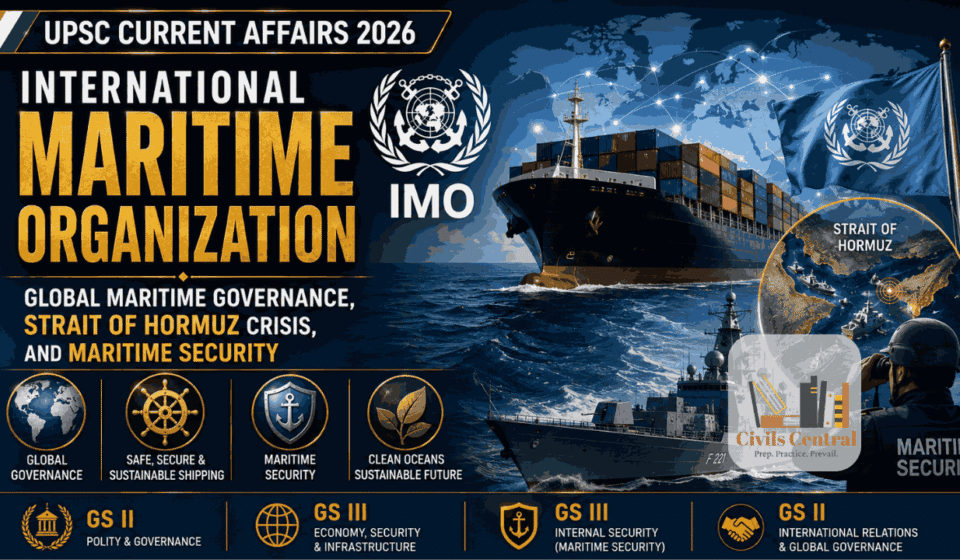
International Maritime Organization (IMO): Global Maritime Governance, Strait of Hormuz Crisis, and Maritime Security

Introduction
Recently, after an Iranian attack on a commercial vessel, the International Maritime Organization (IMO) paused its involvement in coordinating vessel evacuation in the Persian Gulf due to deteriorating security conditions. At first glance, this appears to be merely an international news event. However, from a UPSC perspective, it opens the door to understanding several interconnected themes:
- International Organizations
- Maritime Governance
- Global Shipping
- Law of the Sea
- Energy Security
- India’s Trade Dependence
- Maritime Security
- Gulf Geopolitics
- International Cooperation
Why in News?
The International Maritime Organization (IMO), the United Nations’ specialized agency responsible for regulating international shipping, temporarily suspended its direct role in coordinating the evacuation of commercial vessels stranded in the Persian Gulf after an Iranian attack on a merchant ship.
The incident highlighted the growing risks faced by commercial shipping in the Gulf region amid escalating geopolitical tensions. According to reports, hundreds of commercial vessels remained in the region, with evacuation expected to take several weeks due to security concerns. The development once again drew global attention towards:
- Safety of international shipping
- Strait of Hormuz
- Maritime chokepoints
- Freedom of navigation
- Energy security
- Role of international organizations in conflict zones
For India, the issue is especially significant because a substantial portion of its crude oil imports and overseas trade passes through the Persian Gulf and the Strait of Hormuz.
Why This Topic Matters for UPSC?
| Examination | Relevance |
|---|---|
| Prelims | IMO, Strait of Hormuz, UNCLOS, Maritime Conventions |
| GS-II | International Organizations, India’s Foreign Policy |
| GS-III | Internal Security, Maritime Security, Energy Security, Infrastructure |
| Essay | Globalization, International Cooperation, Peace and Security |
| Ethics | Global Responsibility, Public Safety, International Cooperation |
| Interview | India’s strategic interests in the Indian Ocean and Gulf |
Syllabus Mapping
| Current News | Static Concept | GS Paper |
|---|---|---|
| IMO pauses evacuation | International Organizations | GS-II |
| Iran attacks merchant ship | Maritime Security | GS-III |
| Strait of Hormuz | World Geography | GS-I |
| Vessel evacuation | Disaster & Crisis Management | GS-III |
| Commercial shipping | International Trade | GS-III |
| Gulf conflict | International Relations | GS-II |
| Energy transport | Energy Security | GS-III |
| Shipping disruption | Supply Chain Management | GS-III |
Why Did the IMO Come into Existence?
Before the IMO: A Dangerous Era of Shipping
For centuries, oceans were the backbone of international trade. However, until the mid-20th century, there was no single global authority responsible for ensuring that ships followed common safety standards. Each country framed its own maritime rules, resulting in significant inconsistencies. This led to several problems:
- Poor ship safety standards
- Frequent maritime accidents
- Marine pollution
- Inconsistent training of seafarers
- Conflicts over navigation rules
One of the most influential events that exposed the need for international maritime regulation was the sinking of the RMS Titanic in 1912, which resulted in the deaths of over 1,500 people. The tragedy revealed serious deficiencies in ship safety regulations, including inadequate lifeboats and poor emergency communication systems.
This disaster prompted the first International Convention for the Safety of Life at Sea (SOLAS) in 1914. However, isolated conventions were not enough. A permanent institution was required to continuously update standards, coordinate member states, and respond to emerging maritime challenges.
Birth of the International Maritime Organization (IMO)
Recognizing the need for a dedicated maritime institution, the United Nations convened an international conference in Geneva in 1948. The conference adopted the Convention establishing the Inter-Governmental Maritime Consultative Organization (IMCO). The convention entered into force in 1958, and the organization became operational in 1959. In 1982, IMCO was renamed the International Maritime Organization (IMO) to better reflect its expanded role. Today, the IMO serves as the principal global institution responsible for ensuring that international shipping remains safe, secure, environmentally sustainable, and efficient.
What is the International Maritime Organization (IMO)?
Definition
The International Maritime Organization (IMO) is a specialized agency of the United Nations responsible for developing and maintaining the global regulatory framework for international shipping. Its objective is to ensure that shipping across the world is:
- Safe
- Secure
- Environmentally sustainable
- Efficient
- Uniformly regulated
Rather than operating ships or enforcing laws directly, the IMO develops international conventions and standards that member states implement through their national legislation.
Imagine the world’s oceans as an international highway. Every country owns different vehicles (ships), but without common traffic rules, accidents would be inevitable. The IMO functions like a global traffic authority that prepares the rulebook, while individual countries enforce those rules within their jurisdictions.
Why Was the IMO Needed?
Without a common regulatory framework:
- Ships could avoid safety requirements by registering in countries with weaker regulations.
- Seafarers would receive inconsistent training.
- Marine pollution would increase.
- Rescue operations would become difficult.
- International trade would become inefficient.
The IMO addresses these challenges by establishing uniform global standards that all participating countries agree to follow.
Objectives of the IMO
The IMO seeks to:
- Enhance maritime safety.
- Prevent marine pollution from ships.
- Promote secure navigation.
- Facilitate international maritime trade.
- Improve the welfare and training of seafarers.
- Strengthen maritime security against piracy and terrorism.
- Promote sustainable and environmentally responsible shipping.
- Harmonize shipping regulations across nations.
Headquarters
- Headquarters: London, United Kingdom
- Established: Convention adopted in 1948
- Operational since: 1959
- UN Specialized Agency: Yes
- Official Languages: Arabic, Chinese, English, French, Russian, and Spanish
Membership
As of 2025:
- 176 Member States
- 3 Associate Members
Almost every major maritime nation is a member, making the IMO one of the most representative international organizations in the world.
Organizational Structure of the IMO
Understanding the structure is important for UPSC Prelims.
1. Assembly
The Assembly is the highest decision-making body. It comprises all member states and meets biennially. Functions:
- Approves the work programme.
- Adopts the budget.
- Elects the Council.
- Reviews the organization’s performance.
Think of it as the “Parliament” of the IMO.
2. Council
The Council acts as the executive body between Assembly sessions. It supervises the functioning of the organization and coordinates the work of various committees.
Composition
The Council has 40 elected member states, divided into three categories:
Category A
Countries with the largest interest in providing international shipping services. Examples:
- Greece
- Japan
- China
- United Kingdom
Category B
Countries with the largest interest in international seaborne trade. Examples:
- India
- Brazil
- Australia
- Netherlands
Category C
Countries representing all major geographical regions with special interests in maritime transport. This ensures equitable regional representation.
UPSC Note: India has been consistently elected to the IMO Council under Category B, reflecting its significant interest in international maritime trade.
3. Secretariat
The Secretariat manages the day-to-day functioning of the organization.It is headed by the Secretary-General, who oversees administrative activities, implementation support, and coordination among member states.
4. Technical Committees
Most of the IMO’s substantive work is carried out through specialized committees.
(a) Maritime Safety Committee (MSC)
The oldest and most important committee.
Responsible for:
- Ship safety
- Navigation
- Search and rescue
- Maritime security
- Dangerous goods transport
(b) Marine Environment Protection Committee (MEPC)
Deals with:
- Oil pollution
- Plastic pollution
- Ballast water management
- Greenhouse gas emissions
- Decarbonization of shipping
This committee has become increasingly significant due to global climate commitments.
(c) Legal Committee
Focuses on:
- Liability
- Compensation
- Maritime legal disputes
- International conventions
(d) Facilitation Committee
Works to simplify international maritime procedures, documentation, and customs processes, thereby reducing delays in global shipping.
(e) Technical Cooperation Committee
Supports developing countries by providing training, capacity building, and technical assistance for implementing IMO standards.
How Does the IMO Actually Work?
Many students think the IMO directly controls ships. This is incorrect.
The IMO functions through a structured process:
Identify a global maritime issue
↓
Expert committees study the problem
↓
Member states negotiate solutions
↓
An international convention or amendment is adopted
↓
Countries ratify the convention
↓
National governments incorporate it into domestic law
↓
Flag States and Port States enforce compliance
↓
Safer, cleaner, and more efficient global shipping
This cooperative approach ensures that maritime regulations are accepted internationally rather than imposed unilaterally.
From Maritime Accident to Global Regulation
Maritime Accident / Emerging Challenge
                ↓
Scientific & Technical Assessment
                ↓
IMO Committee Deliberations
                ↓
Negotiation Among Member States
                ↓
International Convention Adopted
                ↓
Ratification by Countries
                ↓
National Maritime Laws
                ↓
Implementation by Shipping Industry
                ↓
Safer Global Oceans
Specialized Agency of the United Nations
A specialized agency is an autonomous international organization linked to the United Nations through formal agreements, established to address a specific sector such as health, aviation, labour, agriculture, or maritime affairs.
Examples
| Agency | Sector |
|---|---|
| WHO | Health |
| FAO | Agriculture |
| ICAO | Civil Aviation |
| ILO | Labour |
| UNESCO | Education & Culture |
| IMO | Maritime Transport |
Why is the Strait of Hormuz One of the World’s Most Strategic Waterways?
Suppose you are travelling from Delhi to Jammu. There are several roads available. Now imagine that all vehicles are forced to pass through a single narrow bridge.
If that bridge is blocked:
- Traffic stops.
- Fuel trucks cannot move.
- Prices rise.
- Supply chains collapse.
- The entire economy is affected.
The Strait of Hormuz plays exactly this role in global trade. It is one of the world’s most important maritime chokepoints, acting as the only sea passage connecting the Persian Gulf with the Gulf of Oman and the Arabian Sea, which ultimately opens into the Indian Ocean.
Whenever conflict erupts in this narrow stretch of water, the consequences are felt not only by Gulf countries but by the entire global economy.
Persian Gulf, Gulf of Oman and Strait of Hormuz
Many UPSC aspirants confuse these three geographical features. Understanding their relationship is essential.
Flow of Water
Persian Gulf
      │
      ▼
Strait of Hormuz
      │
      ▼
Gulf of Oman
      │
      ▼
Arabian Sea
      │
      ▼
Indian Ocean
Explanation
- The Persian Gulf is a semi-enclosed water body surrounded by major oil-producing countries such as Saudi Arabia, Iran, Kuwait, Iraq, Bahrain, Qatar and the United Arab Emirates.
- The Strait of Hormuz is the narrow outlet through which ships leave the Persian Gulf.
- The Gulf of Oman connects the Strait of Hormuz with the Arabian Sea.
- From the Arabian Sea, ships reach Asia, Africa and Europe.
Thus, every oil tanker leaving the Persian Gulf must first pass through the Strait of Hormuz.
What is a Maritime Chokepoint?
Definition
A maritime chokepoint is a narrow sea route through which a significant proportion of global shipping passes. Any disruption in these narrow waterways can have worldwide economic, strategic and security implications.
Think of a city with only one flyover connecting two important areas. If the flyover is blocked:
- Traffic jams occur.
- Businesses suffer.
- Fuel consumption rises.
- Emergency services are delayed.
Similarly, when a maritime chokepoint is disrupted:
- Global trade slows.
- Shipping costs increase.
- Oil prices rise.
- Inflation increases worldwide.
Major Maritime Chokepoints of the World
| Chokepoint | Connects | Importance |
|---|---|---|
| Strait of Hormuz | Persian Gulf–Gulf of Oman | Global oil trade |
| Strait of Malacca | Indian Ocean–Pacific Ocean | India-China-Japan trade |
| Bab-el-Mandeb | Red Sea–Gulf of Aden | Europe–Asia shipping |
| Suez Canal | Mediterranean–Red Sea | Shortest Europe-Asia route |
| Panama Canal | Atlantic–Pacific | Americas trade |
| Turkish Straits | Black Sea–Mediterranean | Russia-Europe access |
UPSC Insight: UPSC frequently asks map-based questions on these chokepoints.
Why is the Strait of Hormuz So Important?
The Strait of Hormuz is strategically significant because it serves as the primary export route for hydrocarbons produced in the Gulf region.
Key Reasons
1. Energy Corridor
A significant share of the world’s seaborne crude oil and liquefied natural gas (LNG) exports transit through this narrow waterway. Major exporters include:
- Saudi Arabia
- Iraq
- Kuwait
- UAE
- Qatar
- Iran
2. Global Trade
Thousands of commercial vessels transport:
- Crude oil
- LNG
- Chemicals
- Fertilizers
- Food grains
- Machinery
- Consumer goods
3. Strategic Importance
Control over this strait provides considerable geopolitical leverage. This is why regional conflicts often focus on maritime navigation.
4. India’s Energy Security
India imports a large proportion of its crude oil from Gulf countries. Therefore, any disruption in Hormuz directly affects:
- Fuel prices
- Inflation
- Fiscal deficit
- Trade balance
- Energy security
Energy Security
Meaning
Energy security refers to the uninterrupted availability of energy at affordable prices.
Four Pillars
- Availability
- Accessibility
- Affordability
- Sustainability
Why Important?
Energy is essential for:
- Industries
- Agriculture
- Transport
- Defence
- Economic growth
Any disruption threatens national security.
How Conflict in Hormuz Affects India?
Conflict in Gulf
        ↓
Ships Avoid Strait
        ↓
Shipping Delays
        ↓
Oil Supply Reduces
        ↓
Crude Oil Prices Rise
        ↓
Petrol & Diesel Become Costlier
        ↓
Transport Cost Increases
        ↓
Inflation
        ↓
Economic Slowdown
What is Maritime Security?
Maritime security refers to the protection of oceans, ports, ships, offshore installations and sea lanes from threats that may disrupt lawful maritime activities. It goes beyond naval warfare and includes a wide range of non-traditional security challenges.
Components of Maritime Security
- Safety of commercial shipping
- Protection of seafarers
- Anti-piracy operations
- Counter-terrorism
- Prevention of smuggling
- Human trafficking
- Illegal fishing
- Protection of offshore energy infrastructure
- Cybersecurity of ports
- Freedom of navigation
Emerging Maritime Threats
1. State Conflict
Wars between countries can endanger commercial shipping, as seen in the Persian Gulf and the Red Sea.
2. Piracy
Pirates attack commercial vessels to demand ransom or steal cargo.
Example
Somalia witnessed widespread piracy in the Gulf of Aden during the late 2000s. India has regularly deployed naval ships to escort merchant vessels in the region.
3. Maritime Terrorism
Terrorist groups may target:
- Ports
- Oil terminals
- Ships
- Offshore platforms
The 2008 Mumbai attacks highlighted the misuse of sea routes for terrorist infiltration.
4. Smuggling
Sea routes are often used for trafficking:
- Narcotics
- Weapons
- Counterfeit currency
- Wildlife products
5. Illegal, Unreported and Unregulated (IUU) Fishing
This threatens marine biodiversity and the livelihoods of coastal communities.
6. Cyber Threats
Modern ships rely heavily on GPS, satellite communication and automated navigation systems. Cyberattacks can:
- Disrupt navigation
- Manipulate cargo information
- Delay port operations
- Threaten critical infrastructure
Maritime Security vs Maritime Safety
| Maritime Safety | Maritime Security |
|---|---|
| Prevents accidents | Prevents deliberate attacks |
| Concerned with navigation | Concerned with threats |
| Weather, equipment failure | Piracy, terrorism, conflict |
| Managed through safety standards | Managed through defence and law enforcement |
Why It Matters?
One of the foundational principles of international maritime law is Freedom of Navigation. It allows ships of all nations to move across international waters without unlawful interference, subject to international law. This principle ensures that global trade remains uninterrupted and that oceans remain open for peaceful use. Restrictions imposed unilaterally by any state can affect not only neighbouring countries but the global economy.
Understanding UNCLOS
The United Nations Convention on the Law of the Sea (UNCLOS), 1982 is often described as the Constitution of the Oceans because it establishes the legal framework governing all uses of the seas and oceans. It defines maritime zones, rights of coastal states, navigation freedoms, resource exploitation and dispute settlement mechanisms. India is a party to UNCLOS and bases its maritime claims and legislation on its provisions.
Major Maritime Zones under UNCLOS
| Maritime Zone | Extent | Coastal State Rights |
|---|---|---|
| Internal Waters | Landward of baseline | Complete sovereignty |
| Territorial Sea | Up to 12 nautical miles | Sovereignty, subject to innocent passage |
| Contiguous Zone | Up to 24 nautical miles | Enforcement of customs, immigration and fiscal laws |
| Exclusive Economic Zone (EEZ) | Up to 200 nautical miles | Sovereign rights over natural resources |
| Continental Shelf | Beyond EEZ in certain cases | Rights over seabed resources |
UPSC Concept : Innocent Passage
Meaning
Foreign ships may pass through the territorial sea of another country as long as the passage is continuous, expeditious and not prejudicial to the peace, security or good order of the coastal state.
Examples of Non-Innocent Activities
- Weapons exercises
- Intelligence gathering
- Fishing
- Pollution
- Smuggling
What is a Flag State?
Every commercial ship must be registered in a country. That country is called the Flag State. The Flag State is responsible for ensuring that ships comply with international standards relating to:
- Safety
- Labour
- Pollution prevention
- Certification
- Inspection
The IMO develops these standards, while Flag States enforce them.
Port State Control
A Port State also has the authority to inspect foreign ships entering its ports to ensure compliance with international conventions. If deficiencies are found, the vessel may be detained until corrective measures are taken. This system strengthens global compliance with IMO regulations.
IMO vs UNCLOS
| Feature | IMO | UNCLOS |
|---|---|---|
| Nature | UN Specialized Agency | International Convention |
| Purpose | Regulates shipping | Governs law of the sea |
| Focus | Safety, pollution, security | Maritime boundaries, navigation, resource rights |
| Headquarters | London | No headquarters (Convention framework) |
| Function | Develops technical standards | Provides legal framework |
India’s Maritime Interests in the Gulf
India’s strategic interests in the Gulf region extend beyond energy imports. They include:
- Safety of Indian seafarers
- Protection of Indian diaspora
- Continuity of trade
- Maritime connectivity
- Regional stability
- Naval presence in the Indian Ocean
The Indian Navy regularly conducts escort missions, anti-piracy patrols and humanitarian assistance operations to protect these interests.
Major IMO Conventions
Many UPSC aspirants memorize the names of IMO conventions without understanding why they were created. UPSC increasingly tests the purpose and application of these conventions rather than their full forms.
Think of the IMO as a Parliament making laws for international shipping. These laws take the form of international conventions, which member states ratify and implement through domestic legislation.
1. SOLAS Convention (Safety of Life at Sea)
Background
The sinking of the RMS Titanic in 1912, resulting in over 1,500 deaths, exposed serious deficiencies in maritime safety regulations. This tragedy led to the adoption of the first SOLAS Convention in 1914. The current version, SOLAS 1974, remains the most important international treaty on ship safety.
Objective
To establish minimum safety standards for the construction, equipment, and operation of ships.
Key Provisions
- Ship construction standards
- Fire protection systems
- Life-saving appliances (lifeboats, life jackets)
- Navigation safety
- Radio communication systems
- Emergency preparedness
- Cargo safety
Why Important?
Without SOLAS:
- Ship accidents would increase.
- Rescue operations would be difficult.
- Passenger safety would be compromised.
2. MARPOL Convention
International Convention for the Prevention of Pollution from Ships (MARPOL 73/78)
Why Was It Needed?
Rapid growth in global shipping increased marine pollution through:
- Oil spills
- Sewage discharge
- Garbage dumping
- Toxic chemicals
- Air emissions
MARPOL seeks to minimize pollution caused by ships.
Six Technical Annexes
| Annex | Subject |
|---|---|
| I | Oil Pollution |
| II | Noxious Liquid Substances |
| III | Harmful Substances in Packaged Form |
| IV | Sewage |
| V | Garbage |
| VI | Air Pollution & GHG Emissions |
India’s long coastline, fishing economy, coral reefs, mangroves, and coastal tourism depend on healthy marine ecosystems. MARPOL helps protect these resources.
3. STCW Convention
Standards of Training, Certification and Watchkeeping for Seafarers
Purpose
To ensure that seafarers across the world possess standardized qualifications and competencies.
Why Important?
A modern commercial ship resembles a floating industrial complex. Poorly trained crew can lead to:
- Collisions
- Fires
- Oil spills
- Environmental disasters
The STCW Convention establishes minimum global standards for training and certification.
4. ISPS Code
International Ship and Port Facility Security Code
Background
Following the 9/11 terrorist attacks, concerns grew about the use of ships and ports for terrorism. The ISPS Code was adopted under SOLAS to strengthen maritime security.
Major Objectives
- Assess security risks
- Protect ports
- Protect ships
- Prevent terrorist attacks
- Improve coordination among governments
Indian Example
Major Indian ports such as:
- Mumbai
- Chennai
- Kochi
- Visakhapatnam
- Kandla
implement ISPS security measures.
5. Ballast Water Management Convention
Ships use ballast water to maintain stability. When this water is discharged elsewhere, it can introduce invasive aquatic species into new ecosystems.
Example
A species harmless in one region may become invasive in another, threatening fisheries and biodiversity.
Objective
To regulate ballast water treatment and prevent biological invasions.
6. Hong Kong Convention
Safe and environmentally sound recycling of ships.
Why Needed?
Old ships often contain:
- Asbestos
- Heavy metals
- Toxic chemicals
- Oil residues
Unsafe dismantling can:
- Harm workers
- Pollute coastal waters
- Damage ecosystems
India, being one of the world’s leading ship-recycling nations (e.g., Alang, Gujarat), has a strong interest in implementing safe recycling practices.
Major IMO Conventions
| Convention | Focus Area | UPSC Keyword |
|---|---|---|
| SOLAS | Ship Safety | Titanic |
| MARPOL | Marine Pollution | Oil Spills |
| STCW | Seafarer Training | Human Resources |
| ISPS Code | Maritime Security | Terrorism |
| Ballast Water Convention | Invasive Species | Biodiversity |
| Hong Kong Convention | Ship Recycling | Circular Economy |
Constitutional, Legal and Institutional Framework in India
Although shipping is international, India has a robust domestic framework aligned with IMO standards.
Constitutional Basis
Union List (Seventh Schedule)
The Union Government has legislative competence over:
- Shipping
- Navigation
- Ports declared as major ports
- Maritime transport
- International treaties
This enables Parliament to enact maritime laws consistent with international obligations.
Major Legislations
Merchant Shipping Act, 1958
The principal legislation governing merchant shipping in India.
It deals with:
- Registration of ships
- Safety standards
- Certification
- Crew welfare
- Marine pollution
- Compliance with IMO conventions
Maritime Anti-Piracy Act, 2022
Provides a legal framework to prosecute piracy on the high seas, aligning India with international obligations under UNCLOS.
Major Port Authorities Act, 2021
Replaced the Major Port Trusts Act, 1963.
Objectives
- Greater autonomy to major ports
- Improved governance
- Enhanced competitiveness
- Efficient port management
Important Institutions
Directorate General of Shipping (DG Shipping)
The apex maritime regulatory authority under the Ministry of Ports, Shipping and Waterways.
Functions
- Ship registration
- Seafarer certification
- Maritime safety
- Implementation of IMO conventions
Indian Coast Guard
Role
- Maritime law enforcement
- Search and Rescue (SAR)
- Marine pollution response
- Coastal security
- Protection of offshore installations
Indian Navy
Responsible for:
- Maritime defence
- Protection of Sea Lanes of Communication (SLOCs)
- Anti-piracy operations
- Humanitarian Assistance and Disaster Relief (HADR)
- Strategic deterrence
Government Initiatives
1. SAGAR
Security and Growth for All in the Region. Launched in 2015, SAGAR is India’s vision for maritime cooperation in the Indian Ocean Region.
Objectives
- Maritime security
- Capacity building
- Regional cooperation
- Sustainable development
- Disaster response
SAGAR reflects India’s aspiration to be a net security provider in the Indian Ocean.
2. MAHASAGAR
Mutual and Holistic Advancement for Security and Growth Across Regions. An evolution of the SAGAR vision, MAHASAGAR expands India’s maritime outreach by emphasizing comprehensive regional cooperation, resilient supply chains, blue economy, and inclusive maritime governance.
UPSC Note: Distinguish between SAGAR (2015 vision) and MAHASAGAR (broader strategic evolution announced later).
3. Sagarmala Programme
Port-led development.
Components
- Port modernization
- Port connectivity
- Coastal economic zones
- Coastal community development
- Logistics efficiency
Benefits
- Lower logistics cost
- Increased exports
- Employment generation
- Industrial development
4. Maritime India Vision 2030
A comprehensive roadmap for transforming India’s maritime sector.
Focus Areas
- Smart ports
- Green shipping
- Digital logistics
- Shipbuilding
- Cruise tourism
- Inland waterways
5. National Logistics Policy
Seeks to reduce logistics costs and improve multimodal connectivity by integrating ports, railways, roads, and inland waterways.
6. IFC-IOR (Information Fusion Centre – Indian Ocean Region)
Located at Gurugram, the IFC-IOR serves as a hub for maritime domain awareness by sharing information on shipping movements with partner countries to combat piracy, trafficking, and other maritime threats.
Challenges
1. Geopolitical Challenges
- Gulf conflicts
- South China Sea disputes
- Red Sea disruptions
- Great power competition
Impact: Increased uncertainty for global shipping.
2. Security Challenges
- Piracy
- Maritime terrorism
- Drone attacks
- Cyber threats
3. Environmental Challenges
- Marine pollution
- Oil spills
- Climate change
- Ocean acidification
4. Economic Challenges
- Rising insurance premiums
- Freight cost escalation
- Supply chain disruptions
- Volatile fuel prices
5. Administrative Challenges
- Coordination among agencies
- Capacity constraints
- Implementation gaps
- Monitoring compliance
Way Forward
India should adopt a multi-dimensional strategy:
Strengthen Maritime Security
- Expand coastal surveillance.
- Enhance naval deployments.
- Improve maritime domain awareness.
Diversify Energy Sources
Reduce dependence on a single region by expanding renewable energy, strategic petroleum reserves, and diversified import partners.
Promote Blue Economy
Balance economic growth with sustainable use of marine resources.
Strengthen International Cooperation
Deepen collaboration with:
- IMO
- Indian Ocean Rim Association (IORA)
- Indian Ocean Naval Symposium (IONS)
- Quad partners
- Gulf countries
Invest in Technology
- Artificial Intelligence for port management
- Satellite-based vessel monitoring
- Smart ports
- Cyber resilience
Administrator’s Perspective
Imagine you are the District Magistrate of a major coastal district or the Chairperson of a Port Authority. Your priorities would include:
- Updating coastal disaster management plans.
- Conducting regular oil spill response drills.
- Coordinating with the Coast Guard, Navy, Customs, and Police.
- Strengthening port cyber security.
- Ensuring environmental compliance.
- Training local fishermen as the “eyes and ears” of coastal security.
- Developing emergency communication systems for shipping incidents.
Ethics Perspective
This topic illustrates several ethical values relevant to public administration:
- Responsibility: States must protect global commons.
- Cooperation: Maritime security requires collective action.
- Accountability: Shipping companies must comply with safety standards.
- Environmental Stewardship: Preventing marine pollution safeguards future generations.
- Intergenerational Equity: Sustainable oceans are a shared inheritance.
Essay Perspective
This topic can enrich essays on:
- Global Commons and International Cooperation
- India’s Maritime Vision in the 21st Century
- Security and Development: Two Sides of the Same Coin
- Blue Economy and Sustainable Development
- Globalization in an Era of Geopolitical Conflicts
PYQ Analysis
Theme 1: International Organisations
UPSC frequently tests the mandate and functions of specialized UN agencies.
Extension: Understanding why IMO regulates shipping while UNCLOS provides the legal framework.
Theme 2: Maritime Zones
Several questions have examined the Territorial Sea, EEZ, and freedom of navigation.
Extension: Apply these concepts to contemporary conflicts in the Gulf and South China Sea.
Practice MCQs
Q1. Which of the following is a specialized agency of the United Nations responsible for regulating international shipping?
A. ICAO
B. IMO
C. IAEA
D. WMO
Answer: B
Explanation: The IMO develops international standards for safe, secure, and environmentally sound shipping.
Q2. The SOLAS Convention is primarily concerned with:
A. Marine Pollution
B. Ship Recycling
C. Safety of Ships
D. Fisheries Management
Answer: C
Q3. MARPOL Convention relates to:
A. Maritime Security
B. Prevention of Pollution from Ships
C. Deep Sea Mining
D. Port Management
Answer: B
Q4. The Strait of Hormuz connects:
A. Red Sea and Mediterranean Sea
B. Persian Gulf and Gulf of Oman
C. Arabian Sea and Bay of Bengal
D. Black Sea and Mediterranean Sea
Answer: B
Q5. The STCW Convention is associated with:
A. Marine Insurance
B. Seafarer Training and Certification
C. Port Development
D. Shipbuilding
Answer: B
Q6. Which convention regulates ballast water to prevent invasive aquatic species?
A. SOLAS
B. MARPOL
C. Ballast Water Management Convention
D. Basel Convention
Answer: C
Q7. The ISPS Code primarily addresses:
A. Fisheries
B. Port Security and Ship Security
C. Marine Biodiversity
D. Ship Recycling
Answer: B
Q8. Which Indian initiative promotes port-led development?
A. Bharatmala
B. Sagarmala
C. PM Gati Shakti
D. UDAN
Answer: B
UPSC Mains Practice
10 Marks
Discuss the role of the International Maritime Organization in ensuring safe, secure, and environmentally sustainable international shipping.
15 Marks
Maritime security has become an indispensable component of India’s national security and economic resilience. Examine in the context of recent developments in the Strait of Hormuz.
Revision Table
| Topic | Key Point |
|---|---|
| IMO | UN specialized agency for shipping |
| SOLAS | Safety of ships |
| MARPOL | Marine pollution prevention |
| STCW | Seafarer training |
| ISPS | Ship and port security |
| Hormuz | Global energy chokepoint |
| UNCLOS | Legal framework for oceans |
| SAGAR | India’s maritime vision |
Mind Map
IMO
│
├── Maritime Safety
│     ├── SOLAS
│     ├── STCW
│     └── Search & Rescue
│
├── Marine Environment
│     ├── MARPOL
│     ├── Ballast Water
│     └── Hong Kong Convention
│
├── Maritime Security
│     ├── ISPS Code
│     ├── Piracy
│     ├── Terrorism
│     └── Cyber Security
│
├── Law of the Sea
│     ├── UNCLOS
│     ├── EEZ
│     ├── Territorial Sea
│     └── Freedom of Navigation
│
├── India
│     ├── SAGAR
│     ├── MAHASAGAR
│     ├── Sagarmala
│     ├── DG Shipping
│     ├── Coast Guard
│     └── Maritime India Vision 2030
│
└── Current Affairs
      ├── Strait of Hormuz
      ├── Gulf Security
      ├── Energy Security
      └── Global Supply Chains
Beyond the News
The IMO’s temporary pause in coordinating vessel evacuation is more than a response to a regional conflict. It underscores the growing intersection of geopolitics, maritime law, energy security, environmental governance, and global trade. As maritime competition intensifies in the Indo-Pacific and West Asia, India must strengthen its maritime capabilities, diversify energy sources, modernize port infrastructure, and actively shape global maritime governance through institutions such as the IMO.
Also Read:
- UNCLOS (United Nations Convention on the Law of the Sea): Complete UPSC Guide
- Blue Economy: Concepts, Opportunities and Challenges
- India’s SAGAR Vision and Maritime Diplomacy
- Indian Coast Guard: Mandate, Structure and Operations
- Maritime Security in the Indian Ocean Region
- International Seabed Authority (ISA): Role and Functions
- Sea Lines of Communication (SLOCs) Explained
- India’s Energy Security: Challenges and Way Forward
- International North-South Transport Corridor (INSTC)
- Chokepoints of the World: Geography and Strategic Importance
About The Author