
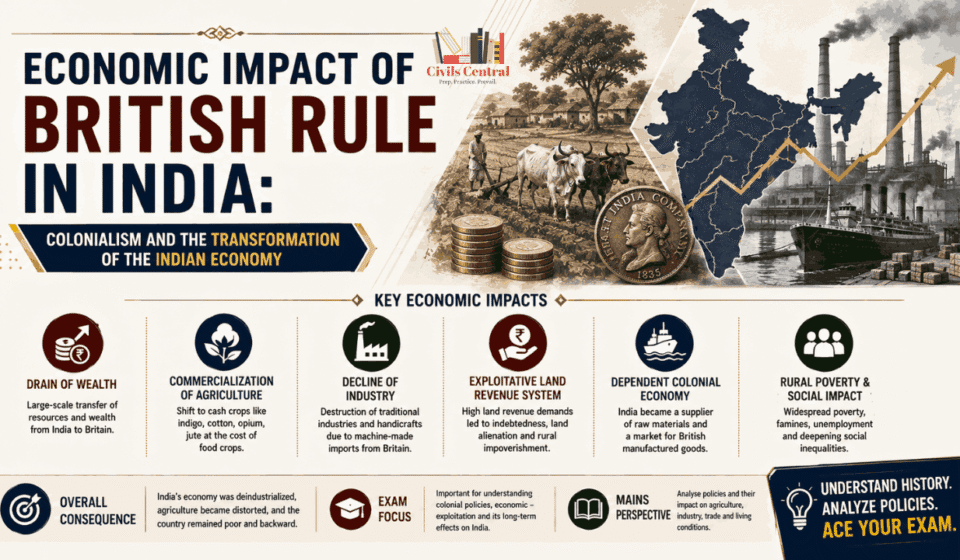
Economic Impact of British Rule in India: Colonialism and the Transformation of the Indian Economy

Economic Impact of British Rule in India: Colonialism and the Transformation of the Indian Economy:
Learning Dashboard
| Chapter Information | Details |
|---|---|
| Series | Modern History of India (1707–1947) |
| Historical Period | c. 1757–1947 |
| Historical Phase | British Economic Policies and Colonial Transformation |
| Previous Chapter | Economic Impact of British Land Revenue Policies: Transformation of Agriculture and Rural Society in Colonial India |
| Current Chapter | Economic Impact of British Rule in India: Colonialism and the Transformation of the Indian Economy |
| Next Chapter | Drain of Wealth Theory: The Nationalist Critique of Colonial Economic Exploitation |
| Core Theme | British rule transformed India’s traditional agrarian, artisanal and commercial economy into a colonial economy increasingly oriented towards British imperial interests. This transformation involved changes in agriculture, deindustrialisation, trade, infrastructure, modern industry, finance and the transfer of economic resources. |
| Major Developments Covered | Commercialisation of agriculture, decline of traditional industries, deindustrialisation, export of raw materials, import of British manufactured goods, colonial trade policy, infrastructure development, modern industries, poverty, famines and economic nationalism |
| Key Personalities | Dadabhai Naoroji, R.C. Dutt, M.G. Ranade, Jamsetji Tata |
| Key Concepts | Colonial Economy, Deindustrialisation, Commercialisation of Agriculture, Economic Drain, Free Trade, Raw-Material Export, Manufactured Goods Import, Infrastructure, Modern Industry, Economic Nationalism |
| Exam Relevance | UPSC CSE, JKPSC, JKAS, State PCS, CDS, CAPF, SSC, UGC-NET (History), University Examinations |
Introduction
How Did British Rule Transform the Indian Economy?
The British conquest of India was not merely a political transformation. It produced a profound restructuring of the Indian economy that unfolded gradually from the eighteenth century until independence in 1947. Before British political domination, India possessed a predominantly agrarian economy, but agriculture existed alongside a substantial handicraft and manufacturing sector, extensive internal commerce and long-distance international trade. Indian cotton and silk textiles, handicrafts and other manufactured goods were widely traded across Asia, Africa and Europe. Indian merchants and artisans therefore participated in a commercial economy that was considerably more interconnected than the image of a completely isolated village economy might suggest.
The decisive change occurred when the East India Company moved from being a trading corporation to becoming a territorial power. The Battle of Plassey in 1757 and the acquisition of the Diwani of Bengal in 1765 gave the Company political authority over a major and economically productive region. Revenue collected from Indian territories could now be used to finance administration, military expansion and commercial activities. Political power and economic interests consequently became closely connected. The Company was no longer simply purchasing Indian goods with resources brought from Europe; it increasingly possessed the authority to obtain resources from India itself and to shape the conditions under which Indian production and trade took place.
During the nineteenth century, this transformation became broader and more systematic. British land revenue settlements reorganised agrarian relations, while commercialisation connected Indian agriculture increasingly with domestic and international markets. Traditional industries, particularly sections of the textile sector, faced intense competition from British machine-made goods. At the same time, India increasingly supplied raw materials and agricultural commodities required by British industry and became an important market for British manufactured products.
This produced a structural transformation in India’s position within the world economy. India increasingly moved from being an important exporter of manufactured goods to becoming a major supplier of raw materials and agricultural commodities and a market for manufactured goods produced elsewhere. This process is closely associated with the concept of deindustrialisation, although the term must be used carefully because traditional industries did not disappear completely and modern industries subsequently emerged in India.
British rule also introduced important economic infrastructure. Railways, telegraphs, ports, roads and modern financial institutions expanded considerably. These developments connected previously separated regions, facilitated movement of goods and people and contributed to the emergence of more integrated markets. Yet the purpose and structure of this infrastructure were deeply connected with colonial priorities. Railways could integrate Indian markets, but they could also transport raw materials towards ports and British goods into Indian markets. Telegraphs strengthened commercial communication but also strengthened colonial administration. Ports facilitated international trade while simultaneously connecting India’s resources to imperial markets.
The central historical issue is therefore not whether British rule brought economic change. It unquestionably did. The more important question is the nature of that transformation.
Did British rule create an autonomous process of Indian economic development, or did it reorganise India’s economy primarily around the requirements of British imperialism?
The answer lies in examining the interconnected changes in agriculture, industry, trade, infrastructure and finance. It also requires attention to the economic critique developed by Indian nationalists such as Dadabhai Naoroji, R.C. Dutt and M.G. Ranade, who increasingly argued that India’s poverty could not be explained simply by internal weaknesses. They connected Indian economic problems with the structure of colonial rule itself.
The transformation of the Indian economy under British rule therefore forms one of the most important themes of Modern Indian History because it explains not only the economic consequences of colonialism but also the emergence of economic nationalism, which gradually linked the demand for political freedom with the demand for economic self-determination.
Part I — Background: What Was the Indian Economy Like Before British Economic Transformation?
Was India Economically Isolated Before British Rule?
The Indian economy before British domination was overwhelmingly agricultural, but it would be inaccurate to describe it as economically isolated or completely stagnant. Agriculture supported a large rural population, while handicrafts, artisanal production, trade and commerce operated alongside it. Different regions specialised in different products, and Indian merchants participated in extensive commercial networks that connected the subcontinent with the wider Indian Ocean world.
The importance of Indian textiles is particularly significant. Cotton and silk textiles produced in regions such as Bengal, Gujarat and the Coromandel Coast were highly valued in international markets. Indian textiles were exported to markets in Asia, Africa and Europe, while European trading companies competed with one another for access to Indian products. The East India Company itself initially came to India primarily as a trading organisation seeking commercially valuable commodities.
This history is important because it establishes the starting point from which colonial economic transformation took place. British rule did not introduce commerce into an economically inactive society. Instead, it gradually restructured an existing commercial economy and subordinated it to a new political and imperial framework.
Why Were Indian Textiles Internationally Important?
Indian textile production was based largely on skilled artisanal labour, household production and specialised regional traditions. Indian weavers and craftsmen produced a wide variety of fabrics suited to different markets and consumer preferences. The quality, diversity and craftsmanship of Indian textiles made them highly competitive in international trade.
The growing popularity of Indian textiles in European markets eventually became a problem for British manufacturers. As Britain underwent the Industrial Revolution, mechanised textile production expanded rapidly. British manufacturers increasingly sought to protect their domestic market from Indian competition while simultaneously seeking access to overseas markets for their own products.
This created an important asymmetry. Britain was becoming an industrial economy with mechanised mass production, while much of India’s manufacturing remained based upon artisanal and small-scale production. Once political power gave Britain the ability to shape trade conditions in India, this technological difference became an important component of colonial economic transformation.
How Did the Acquisition of Political Power Change Economic Relations?
The acquisition of Bengal after the Battle of Plassey in 1757, followed by the grant of the Diwani in 1765, represented a major turning point. The East India Company gained control over revenue collection in Bengal, Bihar and Orissa, giving it access to substantial financial resources.
This created a new relationship between political power and economic activity. The Company could use territorial revenue to finance military operations and commercial activities, while its administrative authority enabled it to influence production and trade.
The significance of this development went beyond Bengal. As British territorial expansion continued, similar relationships between land revenue, trade and political power developed elsewhere. The colonial state increasingly became an institution through which economic resources could be systematically extracted and redirected.
The transformation was therefore not simply a change in who collected taxes. It altered who controlled economic decisions, who benefited from trade and how agricultural and industrial production were connected to wider markets.
CivilsCentral Historical Insight
The British did not enter an economically empty India. They encountered an agrarian, artisanal and commercial economy already connected to regional and international markets. The decisive transformation began when commercial interests acquired political power, allowing the colonial state to reorganise taxation, trade and production around imperial requirements.
Part II — Objectives: What Did British Economic Policies Seek to Achieve?
Was Economic Development of India the Main Colonial Objective?
British economic policies changed over time and were influenced by different interests, including the East India Company, British manufacturers, merchants, financiers and the colonial state. Therefore, it would be misleading to describe British economic policy as one unchanging plan. Nevertheless, a broad pattern can be identified: British policy sought to secure revenue, commercial advantage, access to resources and integration of India into the British imperial economy.
During the early Company period, commercial monopoly and revenue extraction were particularly important. After the Industrial Revolution, British manufacturing interests became increasingly significant. By the nineteenth century, India was being incorporated into an imperial economic structure in which it supplied agricultural commodities and raw materials, provided a large market for British manufactured goods and generated revenues and other financial resources for the colonial state.
The colonial economy was therefore shaped by the requirements of an imperial system rather than by an independent strategy of balanced Indian economic development.
Revenue Extraction
Revenue was fundamental to the functioning of British rule. The colonial state required resources to maintain its army, administration and expanding territorial apparatus. Land revenue consequently remained one of its most important sources of income.
The importance of revenue extended beyond the amount collected. Revenue demands influenced agricultural decisions, land relations, rural credit and the purchasing power of cultivators. As discussed in the previous chapter, the Permanent, Ryotwari and Mahalwari systems reorganised rural society and increasingly integrated agriculture into a monetised fiscal structure.
Revenue extraction therefore became one of the foundations upon which the wider colonial economy rested.
Commercial Interests
The East India Company initially sought profits through trade. With the Industrial Revolution, however, the interests of British manufacturers became increasingly important. Britain required markets for its expanding industrial production and sources of raw materials for its factories.
India possessed both. Its large population provided an enormous potential market, while its agricultural economy could supply cotton, jute, indigo, tea, opium, oilseeds and other commodities.
India consequently became increasingly important within the British imperial commercial system.
Imperial Integration
The British also sought to integrate India’s economy into a larger imperial network. This involved developing transportation and communication systems, expanding ports and establishing administrative and financial institutions that connected Indian production with international trade.
The resulting integration was real and historically significant. However, it was unequal integration. India was increasingly connected to global markets from a subordinate economic position rather than as an autonomous industrial power.
Strategic and Administrative Control
Economic policies also served political and military purposes. Infrastructure such as railways and telegraphs enabled the British to move troops, communicate orders and administer distant territories more efficiently. Economic and political control therefore reinforced one another.
The colonial state did not distinguish neatly between economic infrastructure and imperial administration. The same railway that carried agricultural commodities to a port could carry soldiers to a politically sensitive region. The same telegraph that transmitted commercial information could transmit military orders.
CivilsCentral Historical Insight
British economic policy was not a single unchanging programme, but its major components converged around colonial priorities—revenue extraction, commercial advantage, access to raw materials, markets and stronger imperial control. The central objective was therefore not autonomous Indian economic development but the integration of India into a wider imperial system.
Part III — Features: How Was the Colonial Economy Structured?
What Were the Major Features of the Colonial Economic System?
The colonial economy developed through several interconnected processes rather than through one isolated policy. Land revenue systems placed agriculture under stronger fiscal control; commercialisation connected agricultural production with markets; traditional industries faced increasing competition; British manufactured goods entered Indian markets; raw-material exports expanded; infrastructure connected production with ports; and modern financial and industrial institutions gradually developed.
These changes reinforced one another.
The decline of some handicrafts increased dependence on agriculture. Commercial agriculture increased dependence on markets and credit. Railways made it easier to transport agricultural commodities to ports. Ports facilitated exports and imports. British manufactured goods could then move inland through the same transportation networks.
The result was an increasingly integrated economy, but one marked by a structural imbalance between industrial Britain and predominantly agrarian India.
The Transformation of Colonial Trade
The East India Company’s trading monopoly was gradually weakened during the nineteenth century. The Charter Act of 1813 ended much of the Company’s monopoly over Indian trade, while the Charter Act of 1833 brought an end to its remaining commercial functions.
The end of the Company’s commercial role did not mean the end of colonial economic domination. Instead, private British merchants and manufacturers increasingly participated in India’s trade within an imperial framework. The nature of colonial trade consequently changed from Company-centred commercial control toward a broader system of British imperial economic penetration.
Free Trade and Unequal Competition
During the nineteenth century, Britain increasingly embraced the ideology of free trade. In theory, free trade meant the removal of restrictions and the creation of open markets. In practice, however, India and Britain entered this system with very different levels of industrial development.
British manufacturers possessed mechanised production, capital and technological advantages. Indian producers, particularly traditional artisans, generally operated on a smaller scale and with different production technologies. Therefore, even when trade became formally more liberal, the two sides did not compete from equal economic positions.
The language of free trade could consequently coexist with a deeply unequal economic relationship.
India as a Supplier of Raw Materials
As British industry expanded, India’s role as a supplier of raw materials and agricultural commodities became increasingly important. Cotton was crucial to the textile industry; jute became important for manufacturing and exports; tea developed into a major plantation commodity; while indigo, opium and other products entered international commercial networks.
This encouraged the expansion of commercial agriculture and connected particular Indian regions with global markets. However, the growing importance of raw-material exports also contributed to the structural dependence of the Indian economy on primary production.
India as a Market for Manufactured Goods
At the same time, British manufactured goods entered Indian markets on an increasingly large scale. Cotton textiles were particularly important. British machine-made cloth could be produced in enormous quantities and increasingly competed with Indian handloom products.
The combination of expanding imports and declining traditional industries was one of the central features of colonial economic transformation.
CivilsCentral Historical Insight
The colonial economy increasingly acquired a complementary structure: India supplied agricultural commodities and raw materials, while Britain supplied manufactured goods and controlled important commercial and financial channels. The central issue was therefore not the existence of trade, but the unequal economic relationship within which that trade took place.
Part IV — Mechanisms of Economic Transformation: How Did Colonial Policies Reach the Indian Economy?
How Did Fiscal Policy Connect Agriculture with the Colonial Economy?
The transformation of India’s economy cannot be understood by examining land revenue, trade or industry separately. These sectors became connected through a chain of economic relationships. The cultivator faced a monetary revenue obligation. To obtain cash, agricultural produce had to be sold. Once produce entered the market, cultivators became increasingly exposed to prices, traders and commercial demand. When income was insufficient, credit became necessary. Debt could then affect landholding and social status.
At the same time, the decline of traditional industries pushed some artisans towards agriculture, increasing pressure on land. Railways and ports facilitated the movement of agricultural commodities towards export markets, while British manufactured goods moved in the opposite direction.
The colonial economy therefore functioned through interconnected processes: Revenue → Monetisation → Commercialisation → Market Dependence → Credit → Indebtedness
alongside:
Industrial Imports → Decline of Handicrafts → Artisan Displacement → Greater Dependence on Agriculture
and:
Raw-Material Production → Railways and Ports → Exports → Imperial Trade
These processes together produced the structural transformation of the Indian economy.
How Did Monetisation Affect Economic Behaviour?
The increasing importance of cash obligations altered the economic decisions of cultivators and other rural producers. A household that previously produced primarily for subsistence increasingly needed to produce commodities that could be sold. This did not mean that subsistence production disappeared. Rather, market-oriented production became more important.
The cultivator increasingly had to consider questions that had previously been less central to household production: market prices, demand, access to traders, availability of credit and the timing of sales. The rural economy therefore became increasingly responsive to market forces.
How Did Credit Become Connected with Colonial Economic Change?
Commercialisation and monetary obligations increased the need for credit. A cultivator might need money to pay revenue, purchase agricultural inputs, meet household expenses or survive a poor harvest. In the absence of adequate institutional rural credit, moneylenders and traders became important sources of finance.
This created new relationships of economic dependence. Debt could be carried from one agricultural season to another, and in some circumstances creditors could acquire control over land or agricultural produce. The transformation of the rural economy therefore involved not merely greater market participation but also the expansion of credit relations.
How Did Colonial Infrastructure Reinforce Economic Integration?
Infrastructure connected the different parts of this system. Railways reduced transport costs and linked agricultural regions with commercial centres and ports. Telegraphs accelerated the transmission of commercial and administrative information. Ports connected Indian production with international markets. These developments created a more integrated economic space.
Yet integration did not automatically mean balanced development. Infrastructure could connect a cotton-producing district to a port without creating a strong local manufacturing industry. A railway could carry raw cotton outward while bringing British manufactured cloth inward.
The same infrastructure could therefore contribute simultaneously to economic integration and colonial dependence.
CivilsCentral Historical Insight
The colonial economy worked through interconnected mechanisms rather than isolated policies. Revenue created the need for cash, cash encouraged market participation, markets increased commercialisation, commercialisation expanded credit dependence, and infrastructure connected this rural economy with global trade. At the same time, the decline of handicrafts pushed additional workers towards agriculture.
Part V — Impact on Agriculture and Industry: How Did Colonial Rule Transform Production?
Commercialisation of Agriculture
Commercialisation of agriculture was one of the most important changes produced by British economic policies. Cultivators increasingly produced crops for sale in markets rather than exclusively for household consumption. The process was encouraged by several factors operating together. Revenue obligations created a need for cash, while expanding domestic and international markets generated demand for particular commodities. Infrastructure improvements made it easier to transport produce over longer distances.
Commercial crops varied according to region and market conditions. Cotton, indigo, jute, opium, tea, coffee, sugarcane and oilseeds became important in different parts of India. Commercialisation therefore connected Indian agriculture more closely with the wider economy.
Was Commercialisation Always Harmful?
Commercialisation should not be treated as inherently harmful. It created opportunities for cultivators who possessed sufficient land, capital and market access. When prices were favourable, commercial crops could provide higher incomes than subsistence production. The problem was that the benefits were unevenly distributed.
Small cultivators with limited savings could be forced to sell crops quickly to meet revenue or debt obligations. They were therefore less capable of waiting for favourable prices. Traders, moneylenders and commercial intermediaries could possess greater bargaining power.
Commercialisation consequently created both economic opportunities and new forms of vulnerability.
Cotton and the American Civil War
The cotton economy provides a particularly clear illustration of the connection between Indian agriculture and global events. During the American Civil War (1861–65), disruption of cotton supplies from the United States increased demand for Indian cotton. Cotton cultivation expanded and prices rose, producing a period of considerable commercial optimism in parts of western India.
However, when American supplies returned to the world market after the war, prices declined. Cultivators who had expanded production or borrowed money during the boom could face serious difficulties when market conditions deteriorated.
The episode demonstrated an important feature of colonial commercialisation: Indian cultivators were increasingly exposed to international economic fluctuations over which they had no control.
Indigo and the Indigo Revolt
Indigo became an important commercial crop because of European demand for the dye. European planters sought to expand production in Bengal and encouraged cultivators to devote land to indigo under arrangements that many peasants considered exploitative. The conflict eventually contributed to the Indigo Revolt of 1859–60.
The significance of the revolt extends beyond the history of one crop. It demonstrated that commercial agriculture could operate through unequal relations of power. The question was not simply whether a crop had a market but who decided what would be produced, under what conditions and who would receive the economic benefits.
Opium and Imperial Commerce
Opium provides another example of the relationship between Indian agriculture and imperial trade. Its production was regulated by the colonial state and became connected with the wider British commercial relationship with China. The importance of opium demonstrates that Indian agriculture could be reorganised around external commercial demand even when the crop had little connection with the immediate subsistence requirements of local communities.
Agricultural production was increasingly influenced by the requirements of an international commercial system.
Plantation Agriculture
Plantation agriculture represented another important form of colonial commercialisation. Tea, coffee and other plantation crops developed in regions where European capital and enterprise established specialised production systems. Plantations were closely connected with export markets and often relied upon forms of labour recruitment and control distinct from ordinary peasant agriculture.
The plantation sector therefore became an important component of India’s export-oriented colonial economy.
Decline of Traditional Industries
The transformation of agriculture cannot be separated from the decline of traditional manufacturing. Indian handicrafts, particularly textiles, had previously provided employment to large numbers of artisans. British industrialisation fundamentally changed the competitive environment.
Machine-made British goods could be produced on a much larger scale, while British commercial and tariff policies created conditions favourable to British manufacturers. Indian artisans consequently lost important markets in both domestic and international trade.
Was Indian Handicraft Industry Completely Destroyed?
It would be inaccurate to say that British rule completely destroyed Indian handicrafts. Many traditional industries survived, particularly those serving local, specialised or luxury markets. Indian handloom production also survived and adapted in several regions.
Nevertheless, the relative economic importance of traditional manufacturing declined, while the industrial capacity of Britain expanded rapidly. The crucial consequence was therefore structural rather than absolute. India became increasingly dependent upon agriculture at precisely the time when industrial Britain was expanding its manufacturing power.
What Happened to the Artisans?
The decline of traditional industries affected the occupational structure of Indian society. Artisans who lost markets had to seek alternative sources of livelihood. Many moved into agriculture or agricultural labour. This increased pressure on land and contributed to the persistence of rural poverty.
Deindustrialisation was therefore not merely an industrial problem. It had a direct agrarian consequence.
CivilsCentral Historical Insight
Colonial economic transformation affected agriculture and industry simultaneously. Commercialisation connected cultivators to global markets, while deindustrialisation weakened traditional sources of non-agricultural employment. The two processes reinforced one another: as handicrafts declined, dependence on agriculture increased, while agriculture itself became increasingly oriented towards commercial markets.
Part VI — Infrastructure, Modern Industry and Their Contradictory Impact
Railways
The railway network was one of the most important infrastructural developments of British India and fundamentally changed the economic geography of the subcontinent. The first railway line, between Bombay and Thane in 1853, marked the beginning of a rapidly expanding railway system that eventually connected major cities, agricultural regions, mining centres and ports. Railways reduced the time and cost involved in transporting people and commodities over long distances and gradually integrated previously separated regional markets. Agricultural products could be moved from interior regions to commercial centres and ports much more efficiently, while manufactured goods could penetrate rural markets with greater ease. In this sense, railways contributed to the emergence of a more integrated Indian market and became an important instrument in the transformation of India’s economic structure.
However, the economic significance of the railways cannot be understood only in terms of their developmental contribution. Their construction also served important colonial and imperial purposes. Railways enabled the British administration to move troops rapidly across different parts of India, strengthening its capacity to respond to political disturbances and maintain colonial control. At the same time, railway connections facilitated the movement of raw materials such as cotton, jute and other agricultural commodities from producing regions towards major ports, from where they could be exported to international markets. British manufactured goods could similarly be transported from ports and industrial centres into the interior of India. Thus, railways simultaneously promoted internal economic integration and strengthened India’s incorporation into the wider imperial economy.
From the perspective of Indian economic development, this dual character is particularly important. Railways later became an important foundation for India’s national economy because they connected regions, facilitated mobility and encouraged the expansion of markets. Yet their original development was closely associated with the requirements of colonial administration, military control and imperial commerce. The railway system therefore illustrates a central paradox of colonial infrastructure: an institution created partly to serve imperial interests could nevertheless generate economic possibilities that later became valuable for India’s own development.
CivilsCentral Historical Insight
The railways were both an instrument of colonial control and a mechanism of economic integration. They facilitated the movement of troops and raw materials for the British Empire while simultaneously connecting India’s regional markets and laying an infrastructural foundation that independent India would later inherit and expand.
Telegraphs and Communications
The development of the telegraph transformed the speed at which information could travel across British India. Before the establishment of modern telegraphic communication, information concerning prices, commercial transactions, administrative decisions and political developments could take considerable time to travel between distant regions. The telegraph significantly reduced this delay by allowing messages to be transmitted rapidly between administrative centres, commercial cities, military establishments and ports. This strengthened the ability of the colonial government to coordinate its administration and respond quickly to political developments, while also providing merchants with faster access to information relevant to trade and markets.
The telegraph therefore became closely connected with both commercial activity and colonial administration. Traders could obtain information about market conditions and prices more rapidly, while government officials could communicate across vast distances with greater efficiency. Its importance was particularly evident in a country as geographically extensive as India, where administrative control depended heavily upon the ability to transmit information quickly. The telegraph consequently strengthened the institutional capacity of the colonial state while simultaneously contributing to the wider integration of India’s commercial economy.
CivilsCentral Historical Insight
The telegraph reduced the significance of distance within colonial India. By accelerating the movement of commercial, administrative and political information, it strengthened both market integration and the capacity of the colonial state to exercise control over a geographically vast territory.
Ports
The development and modernization of ports played an equally important role in integrating India into international trade. Major ports such as Bombay, Calcutta and Madras developed into important centres through which agricultural commodities, raw materials and manufactured goods moved between India and the wider world. Improved port facilities allowed exports to be handled more efficiently and strengthened the connection between India’s producing regions and international markets. As railway networks expanded, their links with major ports created a transportation chain through which commodities could move from the interior to the coast and then into global trade networks.
Yet the development of ports also reflected the priorities of the colonial economy. Ports were essential for exporting Indian raw materials and agricultural commodities while simultaneously facilitating the import of British manufactured goods into Indian markets. Bombay, for example, became closely associated with the export of cotton, while Calcutta developed as a major centre for the export of commodities such as jute and other products from eastern India. Ports therefore became gateways through which India was incorporated into the imperial division of labour—supplying raw materials and agricultural commodities while increasingly consuming manufactured products produced elsewhere.
The significance of colonial ports must therefore be understood in the same dual manner as the railways. They contributed to the growth of commercial networks and international connectivity, but they also strengthened the economic relationship in which India’s resources were directed towards imperial markets. The infrastructure of ports was consequently an essential component of the colonial economic structure.
CivilsCentral Historical Insight
Colonial ports connected India’s internal economy to global markets, but the direction of that connectivity mattered. They facilitated both the export of Indian raw materials and the import of foreign manufactured goods, thereby strengthening India’s integration into an international economy structured around British imperial interests.
Modern Industries
British rule did not prevent all industrial development in India. During the nineteenth and early twentieth centuries, modern industries emerged in sectors such as cotton textiles, jute, coal, iron and steel, while plantation industries expanded in tea and other commodities.
Indian entrepreneurs also played an increasingly important role. The growth of modern Indian enterprise demonstrated that Indian capital was capable of participating in industrial development despite the constraints of the colonial economy.
The emergence of modern industry therefore complicates any simple claim that British rule merely destroyed Indian industry. The colonial period witnessed both deindustrialisation of traditional sectors and industrialisation in selected modern sectors.
The two processes occurred simultaneously.
Why Did Industrialisation Remain Limited?
The growth of modern industry was significant but insufficient to transform India into a fully industrial economy. The colonial economic structure continued to give agriculture and primary production a dominant position. Industrial development also faced limitations relating to access to capital, technology, markets and government policy. British economic interests retained substantial influence over important commercial and financial sectors.
Consequently, India experienced partial industrialisation within a predominantly agrarian colonial economy.
CivilsCentral Historical Insight
Colonial India was neither completely deindustrialised nor fully industrialised. Traditional industries declined substantially in relative importance, while selected modern industries emerged and expanded. The resulting economy was therefore a hybrid—modern in certain sectors but predominantly agrarian and structurally subordinate within the imperial economy.
Part VII — Advantages and Limitations: Did British Economic Policies Modernise India?
What Were the Major Economic Changes Introduced Under British Rule?
A balanced assessment must recognise that British rule introduced institutions and technologies that had long-term consequences for India’s economic development. Modern transportation and communication networks expanded, commercial markets became more integrated, modern industries emerged, banking and financial institutions developed and India’s participation in international trade increased.
These changes cannot simply be dismissed. The more important historical question is the purpose for which they were introduced and the distribution of their benefits.
Development of Transport and Communication
Railways, roads, ports and telegraphs reduced geographical isolation and strengthened market integration. Producers could reach distant markets more easily, while merchants could move goods across larger territories. These institutions later became important foundations for independent India’s economic development.
Expansion of Commercial Markets
British rule connected agricultural regions more closely with towns, cities, ports and international markets. Commercial agriculture expanded, while merchants and traders developed increasingly sophisticated networks. This contributed to the emergence of a more integrated national market.
Growth of Modern Industry
Modern industries such as cotton textiles, jute, coal and iron and steel developed during the colonial period. Indian entrepreneurs increasingly participated in industrial activity. This created an important industrial foundation that would later expand after independence.
Development of Financial Institutions
Modern banking, insurance and other financial institutions expanded during the colonial period. These institutions contributed to the monetisation and commercialisation of the economy and facilitated larger-scale trade and investment.
What Were the Major Limitations?
The central limitation was that these developments occurred within a colonial framework. Infrastructure was frequently designed around imperial trade and administration. Industrial policy did not create the conditions required for broad-based autonomous industrialisation. Commercialisation could increase production without improving the economic security of cultivators. Greater trade could coexist with deindustrialisation.
The result was therefore a form of selective modernisation without economic autonomy.
Rural Poverty and Economic Vulnerability
The expansion of markets did not eliminate poverty. Large sections of the rural population remained vulnerable to crop failures, price fluctuations, debt and land alienation. The existence of modern infrastructure therefore did not automatically translate into higher living standards for the majority.
Industrial Weakness
Although modern industries developed, India’s industrial base remained relatively narrow compared with its enormous population and resource potential. The economy remained heavily dependent upon agriculture and primary commodities.
Unequal Distribution of Benefits
The benefits of colonial economic transformation were distributed unevenly. Commercial groups, landlords, wealthy cultivators, traders, plantation interests and sections of the emerging industrial class could benefit from expanding markets. Small cultivators, artisans and agricultural labourers were often more vulnerable to economic shocks.
The transformation therefore produced economic differentiation rather than uniform prosperity.
CivilsCentral Historical Insight
British rule introduced genuine economic changes that later contributed to India’s development, but these changes must be distinguished from autonomous national development. The colonial economy produced infrastructure, markets and modern industries while simultaneously maintaining structural dependence on agriculture, raw-material exports and imperial trade.
Part VIII — Historiography: How Have Historians Interpreted the Economic Impact of British Rule?
Why Is Colonial Economic History Debated?
The economic impact of British rule has generated one of the most important historiographical debates in modern Indian history because the same developments can be interpreted in very different ways.
Railways can be viewed as modern infrastructure or as instruments of imperial extraction. Commercialisation can be seen as market integration or as a source of peasant vulnerability. Free trade can be understood as economic liberalisation or as an unequal system imposed upon a less industrialised economy.
The debate therefore concerns not simply what changed, but why it changed, who benefited and what structural consequences followed.
The Imperial Interpretation
Imperial interpretations generally emphasised the modernising aspects of British rule. From this perspective, British administration introduced systematic land records, modern transportation, communication networks, legal institutions, commercial markets and modern industries.
India’s integration into international trade could therefore be presented as an important step towards economic modernisation. The limitation of this interpretation is that it can understate the unequal distribution of benefits and the colonial objectives behind economic policy.
The Nationalist Economic Critique
Indian nationalist thinkers challenged this interpretation by focusing on poverty, industrial decline, agricultural distress and the transfer of resources to Britain.
Dadabhai Naoroji developed the Drain Theory, arguing that a substantial portion of India’s economic resources flowed to Britain without an equivalent return.
R.C. Dutt examined land revenue, agricultural poverty, famine and industrial decline and argued that colonial economic policies weakened India’s productive capacity.
M.G. Ranade emphasised the need for industrialisation and the development of an indigenous economic base.
The nationalist critique therefore transformed economic history into a political argument: if colonial rule systematically constrained economic development, then political self-government was necessary for economic progress.
Marxist Interpretation
Marxist historians have examined colonialism as a process through which India was incorporated into the capitalist world economy in a subordinate position. They have emphasised changes in land relations, commercialisation, class formation, the extraction of surplus and the development of dependent forms of capitalism.
This perspective is particularly useful for understanding why colonial economic change affected different social classes differently.
Peasant-Centred and Subaltern Perspectives
Later historians shifted greater attention towards the experiences of peasants, artisans and local communities. This approach highlights the agency of ordinary people and demonstrates that colonial economic policies were not simply imposed without resistance.
The Indigo Revolt, Deccan Riots and later agrarian movements reveal how economic grievances could produce collective action. Such approaches also emphasise regional diversity. The impact of commercialisation, land alienation and industrial decline varied considerably between regions.
A Balanced Interpretation
A balanced interpretation recognises that British rule introduced substantial institutional and technological changes while maintaining an unequal colonial economic structure. India was not economically stagnant during British rule. Markets expanded, infrastructure developed and modern industries emerged.
But economic transformation did not equal economic emancipation. India became increasingly integrated into the global economy while remaining structurally subordinate within the imperial system.
CivilsCentral Historical Insight
The historiographical debate should not be reduced to “modernisation versus exploitation.” British rule undeniably introduced new institutions, technologies and markets, but these developments operated within an unequal colonial structure. The decisive question is therefore whether economic change produced autonomous Indian development or primarily strengthened India’s subordinate position within the imperial economy.
Part IX — Historical Significance: Why Did the Colonial Economic Transformation Matter?
From Manufacturer to Supplier of Raw Materials
One of the most significant long-term changes was India’s changing position in international trade. India had historically exported manufactured products, particularly textiles. Under colonial rule, the relative importance of manufactured exports declined while raw materials and agricultural commodities became increasingly important.
This represented a fundamental restructuring of India’s place in the international economy.
Deindustrialisation and Agrarian Pressure
The decline of traditional industries had consequences far beyond the industrial sector. Artisans who lost employment increasingly depended upon agriculture. This increased pressure on land and contributed to the persistence of rural poverty.
Deindustrialisation and agrarian distress were therefore interconnected processes.
Economic Drain
The colonial economy also involved the transfer of Indian resources to Britain through various channels, including certain administrative and military expenses, pensions, salaries, interest payments and other external obligations. Indian nationalists interpreted these transfers as part of a broader Drain of Wealth.
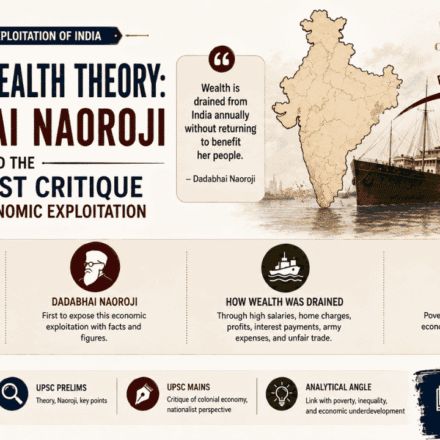
The detailed theoretical development of this argument, particularly by Dadabhai Naoroji, becomes the subject of the next chapter.
Poverty and Famines
India experienced repeated famines during the colonial period despite increasing integration into global markets. Famines were caused by complex combinations of drought, crop failure, prices, distribution and administrative responses. They cannot be attributed to land revenue or colonial trade policy alone.
However, the broader colonial economic structure could increase vulnerability by leaving large sections of the population with low purchasing power, limited savings and substantial financial obligations. The existence of food in an economy therefore did not necessarily guarantee access to food for those who lacked purchasing power.
Emergence of Economic Nationalism
Perhaps the most important political consequence of colonial economic transformation was the emergence of economic nationalism. Indian intellectuals increasingly argued that political freedom and economic development were connected.
The question shifted from “Why is India poor?” to the broader question: “How does the structure of colonial rule contribute to India’s poverty?”
This change in thinking was fundamental to the intellectual development of the Indian national movement.
CivilsCentral Historical Insight
The historical significance of colonial economic transformation lies in the creation of a dependent economic structure. India became more deeply integrated into global markets, but largely as a supplier of raw materials and agricultural commodities and as a market for manufactured goods. This contradiction between integration and dependence became a central foundation of economic nationalism.
Part X — Conclusion
British rule transformed the Indian economy at almost every level. Agriculture became increasingly commercialised, traditional industries declined, British manufactured goods entered Indian markets, raw-material exports expanded, infrastructure connected distant regions, modern industries emerged and financial institutions developed.
Yet these changes cannot be understood simply as a story of modernisation.
The colonial economy was organised around an unequal relationship in which India increasingly supplied agricultural commodities, raw materials, revenue and markets, while Britain possessed greater industrial, commercial and financial power.
The decline of traditional industries weakened an important source of non-agricultural employment. As artisans lost markets, many moved towards agriculture, increasing pressure on land. At the same time, commercialisation exposed cultivators to market fluctuations and increased their dependence upon credit.
Infrastructure introduced during British rule had a similarly contradictory character. Railways, ports and telegraphs undoubtedly integrated India’s economy and later became valuable foundations for independent development. Yet they were also designed and operated within an imperial system in which military control, raw-material exports and the movement of British manufactured goods were important priorities.
Modern industry also developed during the colonial period. Cotton textiles, jute, coal, iron and steel and plantation industries created new forms of production and employment. Indian entrepreneurs demonstrated that indigenous industrial enterprise was possible. Nevertheless, industrialisation remained limited relative to India’s population and economic potential, and agriculture continued to dominate the economy.
The most accurate historical assessment is therefore neither that British rule brought only exploitation nor that it brought successful economic modernisation. Rather, British rule produced selective modernisation within a colonial framework.
The Indian economy became more monetised, commercialised and globally integrated, but its integration occurred from a structurally subordinate position. Economic change therefore did not automatically produce broad-based prosperity or autonomous development.
This contradiction generated the intellectual foundations of economic nationalism. Thinkers such as Dadabhai Naoroji and R.C. Dutt increasingly argued that India’s poverty was connected to the structure of colonial economic relations.
The transformation of India’s economy under British rule must therefore be understood as both an economic and political process. Colonialism reorganised production, trade and resources in ways that strengthened imperial power, but the very process of transformation also created the intellectual and political forces that challenged that power.
The next step in this story is the Drain of Wealth Theory, through which Indian nationalists systematically explained how the colonial system transferred India’s economic resources to Britain.
CivilsCentral Historical Insight
British rule transformed India from an economy with significant agrarian, artisanal and manufacturing capabilities into a more commercially integrated but structurally subordinate colonial economy. The paradox was that modern infrastructure, markets and industries developed alongside deindustrialisation, rural vulnerability and resource transfer. This contradiction ultimately transformed economic criticism into economic nationalism and strengthened the intellectual case for political independence.
Part XI — UPSC Revision Zone
Colonial Economic Transformation at a Glance
| Area | Colonial Transformation | Major Consequence |
|---|---|---|
| Agriculture | Commercialisation | Market dependence |
| Land | Revenue and property restructuring | Agrarian differentiation |
| Handicrafts | Relative decline | Deindustrialisation |
| Trade | Greater integration with imperial markets | Unequal trade structure |
| Raw Materials | Increased export orientation | Colonial specialisation |
| Manufactured Goods | Increased British imports | Pressure on indigenous industries |
| Infrastructure | Railways, ports, telegraph | Market integration + imperial control |
| Modern Industry | Cotton, jute, coal, iron and steel | Partial industrialisation |
| Finance | Banking, credit and insurance expansion | Monetisation |
| Resources | External transfers | Economic drain |
| Society | Occupational restructuring | Greater dependence on agriculture |
Deindustrialisation
The conceptual chain is:
Industrial Revolution in Britain
→ Mechanised production
→ Expansion of British manufactured exports
→ Increasing competition in Indian markets
→ Decline of several traditional industries
→ Artisan displacement
→ Greater dependence on agriculture
→ Increased pressure on land
→ Agrarian vulnerability
UPSC Trap: Do not write that British rule completely destroyed all Indian handicrafts. Traditional industries survived in many regions, while new modern industries also emerged.
Commercialisation of Agriculture
Important commercial crops included cotton, indigo, jute, opium, tea, coffee, sugarcane and oilseeds.
Remember: Commercialisation ≠ automatic agricultural development.
Commercialisation means increasing production for the market. Its benefits depended upon access to land, capital, credit, technology, market information and bargaining power.
Infrastructure: Development or Colonial Control?
A strong UPSC answer should present the dual character of colonial infrastructure.
Developmental consequences:
- Greater market integration
- Reduced transport time
- Improved communication
- Expansion of trade
- Growth of modern industry
- Increased mobility
Colonial functions:
- Military movement
- Administrative control
- Raw-material transportation
- Export facilitation
- Distribution of British manufactured goods
Therefore: Colonial infrastructure was both developmental in consequence and colonial in purpose.
Important Thinkers
Dadabhai Naoroji — Drain of Wealth Theory and critique of colonial economic exploitation.
R.C. Dutt — Critique of land revenue, agricultural distress, famine and colonial economic policy.
M.G. Ranade — Advocacy of industrialisation and development of an indigenous economic base.
Important Terms
Deindustrialisation: Relative decline of traditional manufacturing and handicraft production.
Commercialisation of Agriculture: Increasing production of agricultural commodities for sale in markets.
Colonial Economy: An economic structure organised substantially around the requirements and interests of the colonial power.
Economic Drain: Transfer of resources from India to Britain without an equivalent economic return.
Economic Nationalism: The critique of colonial economic policies and the argument that political and economic development required greater Indian control over the economy.
CivilsCentral Revision Insight
For UPSC, do not study colonial economic policies as isolated facts. Remember the structural relationship: India increasingly supplied revenue, raw materials and markets, while Britain possessed industrial and commercial dominance. This structure explains deindustrialisation, commercialisation, economic drain and the emergence of economic nationalism.
Chapter Summary
British rule fundamentally transformed India’s economic structure between the eighteenth and twentieth centuries. The process began with the East India Company’s transition from a trading corporation into a territorial power and expanded after the British established political control over increasingly large parts of India.
Pre-colonial India possessed a predominantly agrarian economy alongside important handicraft, manufacturing and commercial sectors. Indian textiles and other products participated in extensive regional and international trade. British rule did not introduce commerce into an economically isolated society; rather, it restructured an existing economy through colonial political power.
Land revenue systems created a stronger fiscal relationship between the colonial state and agriculture. Commercialisation increasingly connected cultivation with markets, while the need for cash revenue encouraged monetary transactions and dependence upon credit.
Traditional industries, particularly sections of India’s textile sector, experienced significant decline as British machine-made goods entered Indian markets and Indian producers faced unequal competition. This process of deindustrialisation weakened traditional sources of employment and contributed to greater dependence upon agriculture.
At the same time, Indian agriculture became increasingly commercialised. Cotton, indigo, jute, opium, tea, coffee and other commodities became important within domestic and international markets. Commercialisation created opportunities but also exposed cultivators to global price fluctuations and increased dependence upon traders and creditors.
British infrastructure transformed economic connectivity. Railways, ports and telegraphs integrated markets, facilitated trade and strengthened communication. Yet these institutions also served imperial purposes, including military mobility, administrative control and the movement of raw materials towards export markets.
Modern industries such as cotton textiles, jute, coal and iron and steel emerged, and Indian entrepreneurs increasingly participated in industrial development. Nevertheless, industrialisation remained limited, and India continued to possess a predominantly agrarian economic structure.
Indian nationalist thinkers increasingly criticised this economic system. Dadabhai Naoroji developed the Drain Theory, while R.C. Dutt highlighted the connections between colonial policy, agricultural distress, famine and economic weakness. M.G. Ranade emphasised the need for industrial development and indigenous economic strength.
The central historical conclusion is that British rule produced selective modernisation within a colonial framework. India became more commercially integrated and technologically connected, but largely in a subordinate position within the imperial economy.
This transformation contributed directly to the emergence of economic nationalism, which connected the demand for political freedom with the demand for economic autonomy.
FAQs
What was the main economic impact of British rule in India?
The main impact was the restructuring of India’s economy around colonial interests. Agriculture became commercialised, traditional industries declined, raw-material exports increased, British manufactured goods entered Indian markets, and India became increasingly integrated into the imperial economy.
What was deindustrialisation in colonial India?
Deindustrialisation refers to the relative decline of traditional manufacturing and handicraft industries, particularly textiles, as Indian producers faced increasing competition from British machine-made goods and an unequal colonial economic environment.
Did British rule completely destroy Indian handicrafts?
No. Many traditional industries survived and adapted, particularly those serving local, specialised or luxury markets. However, several major handicraft sectors declined significantly in relative importance.
Why did agriculture become commercialised?
The need for cash revenue, expanding domestic and international markets and improved transportation encouraged cultivators to produce increasing quantities of agricultural commodities for sale.
Was commercialisation of agriculture always harmful?
No. Some cultivators benefited from favourable prices and expanding markets. However, small cultivators with limited capital and bargaining power were particularly vulnerable to price fluctuations, debt and exploitative commercial arrangements.
What was the role of railways in the colonial economy?
Railways integrated regional markets, reduced transportation time, facilitated trade and later became important to India’s economic development. At the same time, they enabled military movement, administrative control and the transportation of raw materials towards ports.
Did British rule industrialise India?
It introduced and encouraged certain modern industries, including cotton textiles, jute, coal and iron and steel. However, industrialisation remained limited and India continued to be predominantly agrarian.
What was the Drain of Wealth?
The Drain of Wealth refers to the transfer of India’s economic resources to Britain without an equivalent economic return. Dadabhai Naoroji developed the most systematic nationalist formulation of the theory.
Who was R.C. Dutt?
R.C. Dutt was a major nationalist economic thinker who criticised British land revenue policies, agricultural exploitation, famine vulnerability and the wider economic consequences of colonial rule.
How did colonial economic policies contribute to nationalism?
The experience of poverty, industrial decline, agrarian distress and resource transfer encouraged Indian intellectuals to analyse the structural causes of economic underdevelopment. This produced economic nationalism, which increasingly linked economic development with political self-government.
Was everything introduced by British rule economically harmful?
No. Railways, telegraphs, modern industries, banking and integrated markets produced important long-term changes and later contributed to India’s development. The critical issue is that these developments were created within a colonial framework whose primary objectives were not identical to those of independent national development.
SEO & Publishing Pack
LSI Keywords
- Economic Impact of British Rule
- British Economic Policies
- Colonial Economy in India
- Economic Drain
- Drain of Wealth
- Deindustrialisation in India
- Commercialisation of Agriculture
- British Trade Policy
- Indian Economy under British Rule
- Decline of Indian Handicrafts
- Economic Nationalism
- Dadabhai Naoroji
- R.C. Dutt
- Colonial Economic Exploitation
- Modern Indian History
Suggested H1
Economic Impact of British Rule in India: Colonialism and the Transformation of the Indian Economy
Article Excerpt
British rule fundamentally transformed India’s economy by reorganising agriculture, weakening traditional industries, expanding raw-material exports, increasing imports of British manufactured goods and developing infrastructure for imperial trade. The process produced commercialisation, deindustrialisation, agrarian vulnerability and limited modern industrialisation while integrating India into a subordinate position within the imperial economy. These changes ultimately contributed to the emergence of economic nationalism.
Suggested Categories
- Modern History
- Economic History
- British Rule in India
- Colonial Economy
- UPSC History
AISEO Tags
Economic Impact of British Rule in India, British Economic Policies, Colonial Economy in India, Deindustrialisation in India, Commercialisation of Agriculture, Economic Drain, Drain of Wealth, British Trade Policy, Decline of Indian Handicrafts, Economic Nationalism, Dadabhai Naoroji, R C Dutt, Modern Indian History, British Rule in India, UPSC Modern History
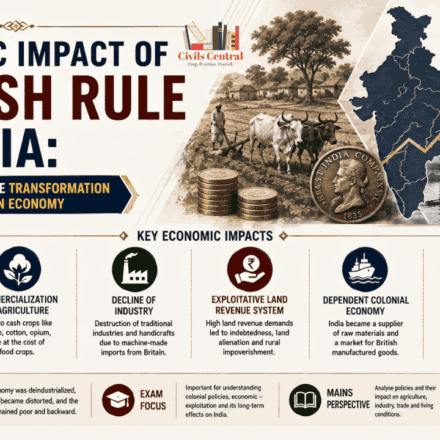
Featured Image
File Name:economic-impact-british-rule-india.jpg
Alt Text:
Economic impact of British rule on Indian agriculture industry and trade
Caption:
British colonial policies transformed India’s agriculture, industries, trade and economic structure.
Mind Map
             ECONOMIC IMPACT OF BRITISH RULE
                         │
        ┌────────────────┼────────────────┐
        │                │                │
        ▼                ▼                ▼
    AGRICULTURE      INDUSTRY          TRADE
        │                │                │
 Commercialisation   Deindustrialisation  Raw Materials
        │                │                │
 Cotton              Handicrafts          Cotton
 Indigo              Textiles             Jute
 Jute                Artisan Decline      Indigo
 Opium                   │                Opium
 Tea                     ▼                Tea
                         Agriculture
        │                │                │
        └────────────────┼────────────────┘
                         ▼
                COLONIAL ECONOMY
                         │
          ┌──────────────┼──────────────┐
          │              │              │
          ▼              ▼              ▼
    Infrastructure    Modern        Finance
          │           Industry         │
    Railways          Cotton           Banking
    Ports             Jute             Credit
    Telegraph         Coal             Insurance
                      Iron & Steel
          │              │              │
          └──────────────┼──────────────┘
                         ▼
                COLONIAL STRUCTURE
                         │
              ┌──────────┼──────────┐
              ▼          ▼          ▼
        Raw-Material   British    Resource
           Export      Imports     Transfer
              │          │          │
              └──────────┼──────────┘
                         ▼
                 ECONOMIC DRAIN
                         │
                         ▼
              POVERTY & ECONOMIC
                  VULNERABILITY
                         │
                         ▼
              NATIONALIST CRITIQUE
                         │
              ┌──────────┴──────────┐
              ▼                     ▼
       Dadabhai Naoroji          R.C. Dutt
        Drain Theory       Economic Critique
              │                     │
              └──────────┬──────────┘
                         ▼
                 ECONOMIC NATIONALISM
                         │
                         ▼
                  POLITICAL NATIONALISM
About The Author








[…] Economic Impact of British Rule in India: Colonialism and the Transformation of the Indian Economy […]