
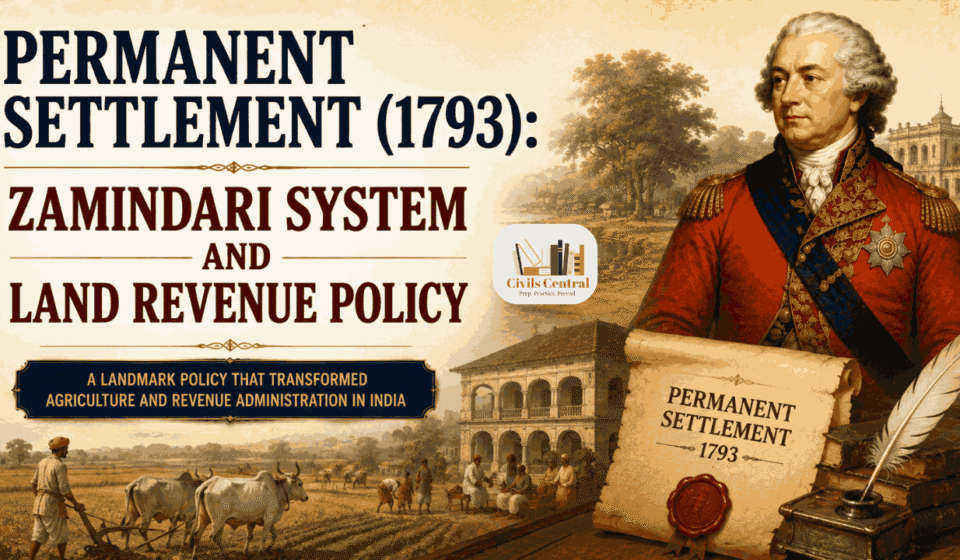
Permanent Settlement (1793): Zamindari System, Features, Objectives, Impact and Legacy

Permanent Settlement (1793): Zamindari System, Features, Objectives, Impact and Legacy
Learning Dashboard
| Chapter Information | Details |
|---|---|
| Series | Modern History of India (1707–1947) |
| Historical Period | 1793 |
| Historical Phase | Revenue Administration under Company Rule |
| Previous Chapter | Lord Cornwallis (1786–1793): Administrative, Judicial and Civil Service Reforms |
| Current Chapter | Permanent Settlement (1793): Zamindari System, Features, Objectives, Impact and Legacy |
| Next Chapter | Anglo-Mysore Wars (1767–1799): Mysore, Haider Ali, Tipu Sultan and the Expansion of British Power |
| Core Theme | The Permanent Settlement fundamentally transformed land ownership and revenue administration by recognizing zamindars as hereditary landowners and permanently fixing land revenue payable to the East India Company. While it aimed to create administrative stability and agricultural prosperity, it produced profound economic and social changes that shaped rural India for more than a century. |
| Major Events Covered | Grant of Diwani (1765), Revenue Experiments of Warren Hastings, Decennial Settlement (1789–1790), Permanent Settlement (1793), Rise of Zamindari System |
| Key Personalities | Lord Cornwallis, Sir John Shore, Charles Grant, Warren Hastings |
| Key Concepts | Permanent Settlement, Zamindari System, Land Revenue, Proprietary Rights, Revenue Fixation, Sunset Law, Agrarian Relations |
| Exam Relevance | UPSC CSE, JKPSC, JKAS, State PCS, CDS, CAPF, SSC, UGC-NET (History), University Examinations |
Introduction
Why Was the Permanent Settlement Introduced?
Among all the reforms introduced during the administration of Lord Cornwallis, none had a more far-reaching impact than the Permanent Settlement of 1793. It was the first comprehensive land revenue system established by the British in India and became the foundation of the Zamindari System in Bengal, Bihar, and parts of Odisha.
Land revenue had always been the principal source of income for Indian states. Under the Mughal Empire, revenue administration was highly organized, although the state generally claimed only the right to collect revenue rather than absolute ownership of land. When the East India Company obtained the Diwani of Bengal, Bihar, and Odisha in 1765 after the Treaty of Allahabad, it inherited responsibility for collecting land revenue from one of the richest agricultural regions in India.
The Company, however, possessed little practical experience in governing a large agrarian society. During the early years of Company Rule, officials experimented with different methods of revenue collection. Annual settlements, farming contracts, and temporary arrangements produced unstable revenue, widespread corruption, and considerable hardship for cultivators. Frequent changes in assessment created uncertainty for both the government and the agricultural population.
By the late eighteenth century, British administrators concluded that a more stable and predictable land revenue system had become essential.
The principal architect of this new policy was Lord Cornwallis, assisted by Sir John Shore, one of the Company’s leading revenue experts. Both believed that permanent certainty in revenue assessment would benefit the government as well as agriculture. They argued that if landholders received secure proprietary rights and knew that government revenue demand would never increase, they would invest in agricultural improvement, expand cultivation, and increase productivity.
These ideas reflected contemporary economic thinking in Britain, particularly the influence of private property, individual enterprise, and the belief that secure ownership encouraged economic development. Consequently, in 1793, Cornwallis introduced the Permanent Settlement, permanently fixing the land revenue payable by zamindars to the Company and recognizing them as hereditary proprietors of land. The reform represented much more than a change in revenue administration.
It fundamentally altered the traditional agrarian structure of eastern India by redefining the relationship between the state, the zamindar, and the cultivator (ryot). For the first time, the British formally recognized zamindars as landowners rather than merely revenue collectors, while peasants increasingly became tenants dependent upon their landlords. The Permanent Settlement therefore had profound economic, social, administrative, and political consequences. Supporters regarded it as a progressive reform that created stability, protected private property, and encouraged agricultural investment. Critics argued that it strengthened absentee landlordism, increased peasant exploitation, reduced state flexibility in revenue policy, and contributed to rural poverty.
Its consequences continued to influence Indian agriculture throughout the nineteenth and early twentieth centuries, making it one of the most debated policies in the history of British India. For students of Modern Indian History, the Permanent Settlement is not merely a revenue reform but the beginning of a new agrarian order under colonial rule. It explains how British economic policies reshaped rural society, altered patterns of land ownership, and created social classes whose influence continued until the abolition of the Zamindari System after India’s independence.
Part I — Background: Evolution of Land Revenue Administration (1765–1793)
Why Did the British Feel the Need to Introduce the Permanent Settlement?
The Permanent Settlement of 1793 did not emerge suddenly. It was the culmination of nearly three decades of administrative experiments undertaken by the East India Company after it acquired the Diwani of Bengal, Bihar, and Odisha in 1765. During this period, British administrators struggled to answer one fundamental question:
How could a commercial company efficiently collect land revenue from one of the largest agrarian regions in the world?
The search for an answer led to repeated changes in revenue policy. Each experiment revealed new weaknesses and ultimately convinced Lord Cornwallis and Sir John Shore that a permanent and stable settlement was necessary. Understanding these earlier experiments is essential for appreciating why the Permanent Settlement assumed such importance in the constitutional and economic history of British India.
Land Revenue under the Mughal System
Before the arrival of British rule, the Mughal Empire possessed one of the most sophisticated land revenue systems in the world. Agriculture formed the backbone of the economy, and land revenue constituted the principal source of state income. Under the Mughal administration, the state claimed a share of agricultural produce rather than absolute ownership of land. The actual cultivator, or ryot, retained customary rights over cultivation, while zamindars generally functioned as intermediaries responsible for collecting revenue and maintaining local order.
They were influential local chiefs and hereditary revenue collectors, but they were not regarded as absolute proprietors of the land. The revenue system introduced by Raja Todar Mal during the reign of Emperor Akbar sought to assess agricultural productivity carefully and determine the state’s share through systematic land measurement and classification. Although the efficiency of this system declined during the later Mughal period, the basic principle remained unchanged:
The state’s primary concern was revenue collection, while customary agrarian relationships continued to govern rural society. When the East India Company assumed the Diwani in 1765, it inherited this existing revenue structure rather than an entirely new administrative system.
Grant of the Diwani (1765)
The decisive turning point came after the Battle of Buxar (1764). Following the Company’s victory, the Treaty of Allahabad (1765) granted the Diwani of Bengal, Bihar, and Odisha to the East India Company. This grant authorized the Company to collect land revenue and administer civil finances in these provinces. The acquisition transformed the Company’s position fundamentally. Until then, it had primarily functioned as a commercial enterprise.
Now it became the principal revenue-collecting authority over one of the wealthiest agricultural regions in Asia. This new responsibility created unprecedented administrative challenges. Company officials possessed extensive experience in trade but relatively little knowledge of agrarian administration. They therefore inherited a complex revenue system without possessing either the institutional machinery or the administrative expertise required to manage it effectively.
Consequently, the years following 1765 became a period of continuous experimentation in revenue administration.
Early Revenue Administration under Robert Clive
During the initial years after obtaining the Diwani, Robert Clive introduced the system known as the Dual Government. Under this arrangement, the Company exercised financial authority by collecting revenue, while the Nawab of Bengal continued to administer civil government in theory. In practice, however, this division of authority created serious administrative confusion. Responsibility became separated from power. The Company controlled revenue but avoided direct responsibility for administration.
The Nawab formally governed the province but lacked the financial resources necessary to perform governmental functions effectively. This arrangement encouraged corruption, weakened public administration, and reduced accountability. The devastating Bengal Famine of 1770, which caused widespread mortality and economic disruption, further exposed the weaknesses of the existing administrative system.
The failure of the Dual Government ultimately convinced British authorities that direct administrative control had become unavoidable.
Warren Hastings’ Revenue Experiments
After abolishing the Dual Government in 1772, Warren Hastings undertook the first serious attempt to reorganize revenue administration. He believed that direct governmental supervision would increase efficiency and reduce corruption. One of his principal measures was the introduction of the Annual Settlement System.
Under this arrangement, land revenue was assessed annually and the right to collect it was auctioned to the highest bidder. These revenue contractors agreed to pay a fixed amount to the Company and recovered revenue from cultivators accordingly. Although the system initially appeared financially attractive, it soon revealed important weaknesses. Because settlements lasted for only one year, contractors possessed little incentive to improve agriculture or invest in long-term development.
Instead, many attempted to maximize immediate collections, often placing severe pressure upon cultivators. Frequent changes in contractors also created uncertainty in rural administration and weakened long-term agricultural stability. Thus, although annual settlements increased short-term revenue in some areas, they failed to establish a durable agrarian system.
The Problem of Revenue Instability
Throughout the 1770s and 1780s, Company officials confronted a recurring problem. Government revenue fluctuated considerably from year to year. Agricultural production depended upon monsoon conditions, local administration, and the conduct of revenue contractors. Because assessments were frequently revised, neither the government nor landholders could predict future financial obligations with confidence. This instability created difficulties for all concerned.
The Company desired a regular and predictable source of income to finance administration, maintain its army, and support expanding territorial responsibilities. Landholders hesitated to invest in agricultural improvements because future revenue demands remained uncertain. Cultivators often suffered from repeated revisions in assessment and the pressure exerted by short-term revenue contractors seeking immediate profits.
The absence of permanence therefore discouraged long-term agricultural development.
The Decennial Settlement (1789–1790)
Recognizing these difficulties, Lord Cornwallis and Sir John Shore introduced the Decennial Settlement between 1789 and 1790. Under this arrangement, land revenue was fixed for a period of ten years rather than reassessed annually. The reform sought to provide greater certainty for both the government and the zamindars. The Company hoped that longer settlements would encourage landholders to improve cultivation, increase agricultural productivity, and expand cultivated land.
At the same time, a fixed revenue demand would provide the government with greater financial stability. The Decennial Settlement represented an important departure from earlier experiments. Instead of emphasizing short-term revenue maximization, it sought to promote long-term administrative stability. However, Cornwallis soon became convinced that even a ten-year settlement did not provide sufficient security. If permanence encouraged investment and agricultural improvement, why should revenue not be fixed forever?
This question became the foundation of the Permanent Settlement of 1793.
Cornwallis’ Vision of a Permanent Agrarian Order
Cornwallis believed that security of property formed the basis of economic prosperity. Influenced by contemporary British economic thought, he argued that individuals invested in land only when they possessed secure ownership and certainty regarding future obligations. If zamindars were recognized as hereditary proprietors and government revenue remained permanently fixed, they would have every incentive to improve agriculture, reclaim wasteland, invest in irrigation, and increase productivity.
Higher agricultural output would increase their private income while simultaneously ensuring stable revenue for the Company. Thus, Cornwallis hoped to create a prosperous class of loyal landowners whose economic interests would remain closely connected with British rule. This philosophy directly shaped the design of the Permanent Settlement of 1793, one of the most influential and controversial agrarian reforms in Indian history.
CivilsCentral Historical Insight
The Permanent Settlement was not an isolated reform but the culmination of nearly thirty years of experimentation in revenue administration. The Mughal system, Clive’s Dual Government, Warren Hastings’ annual settlements, and the Decennial Settlement each exposed different weaknesses in the Company’s approach to land revenue. Cornwallis concluded that only a permanent settlement could provide financial stability, encourage agricultural investment, and create a loyal landed aristocracy. In doing so, he fundamentally transformed the traditional relationship between the state, the zamindar, and the cultivator, laying the foundations of the colonial agrarian order in eastern India.
Part II — Objectives of Lord Cornwallis and Sir John Shore: What Did the Permanent Settlement Seek to Achieve?
Why Did the British Consider a Permanent Land Revenue Settlement Necessary?
The introduction of the Permanent Settlement in 1793 was not merely an attempt to increase land revenue. It represented a carefully designed economic and administrative policy based on the belief that stable property rights, predictable taxation, and a loyal landed class would strengthen both agriculture and British rule in India.
The principal architects of the policy—Lord Cornwallis and Sir John Shore—believed that the repeated revenue experiments conducted after 1765 had demonstrated the limitations of temporary settlements. Annual and short-term settlements encouraged uncertainty, discouraged agricultural investment, and made government revenue unpredictable.
The Permanent Settlement was therefore intended to provide a permanent solution to these recurring administrative problems.
To Ensure a Stable and Predictable Revenue for the Company
The foremost objective of the Permanent Settlement was to secure a regular and permanent source of income for the East India Company. By the late eighteenth century, the Company’s financial responsibilities had expanded enormously. It had to maintain a large standing army, finance civil administration, pay salaries to an expanding bureaucracy, and conduct wars against powerful Indian states such as Mysore and the Marathas.
These growing obligations required a dependable flow of revenue. Frequent reassessments under earlier systems caused considerable uncertainty. Agricultural fluctuations, administrative inefficiency, and changes in revenue contractors often resulted in unstable collections. Cornwallis believed that permanently fixing the government’s demand would eliminate this uncertainty.
Once the annual revenue payable by the zamindars was fixed, the Company could prepare long-term financial plans without the need for repeated assessments. Administrative efficiency, in his view, depended upon financial stability.
To Encourage Agricultural Improvement
Another important objective was to stimulate agricultural development. Cornwallis was strongly influenced by contemporary British economic ideas, particularly the belief that secure private property encouraged investment. He argued that individuals would improve land only when they possessed confidence that the benefits of increased production would remain with them. If zamindars knew that government revenue would never increase, every improvement in agricultural productivity would directly increase their own income.
They would therefore have a strong incentive to:
- Bring uncultivated land under cultivation.
- Invest in irrigation.
- Improve farming techniques.
- Construct embankments and drainage systems.
- Encourage agricultural expansion.
The Permanent Settlement was thus expected to transform zamindars into progressive agricultural entrepreneurs who would modernize rural production. This expectation became one of the central justifications for the policy.
To Create a Loyal Landed Aristocracy
Cornwallis also pursued an important political objective. He believed that British rule in India required the support of a stable and influential landed class. Under the Permanent Settlement, zamindars were recognized as hereditary proprietors of land rather than merely revenue collectors. This legal recognition significantly enhanced their social and economic status.
In return for these proprietary rights, the British expected the zamindars to remain loyal supporters of the colonial government. Their prosperity depended upon the continuation of British authority. The Company therefore hoped to create a powerful class of landowners whose interests would coincide with those of the colonial state. This policy reflected a broader British imperial strategy of governing through influential local elites.
The creation of such a landed aristocracy became one of the most enduring political consequences of the Permanent Settlement.
To Simplify Revenue Administration
Administrative convenience also played an important role. Earlier revenue systems required frequent surveys, repeated assessments, and constant negotiations regarding land revenue. These procedures consumed considerable administrative time and resources. The Company’s revenue officials had to reassess agricultural conditions regularly, creating opportunities for corruption and disputes.
The Permanent Settlement greatly simplified this process. Once revenue had been permanently fixed, government officials no longer needed to undertake periodic reassessment. The administration merely collected the predetermined amount from the zamindars. This reduced administrative expenditure and enabled Company officials to devote greater attention to other aspects of governance.
For an administration still developing its institutional capacity, such simplification appeared highly attractive.
To Reduce Corruption in Revenue Administration
The Permanent Settlement also sought to reduce corruption among revenue officials. Under temporary settlements, officials often exercised considerable discretionary authority while assessing land revenue. This discretion sometimes resulted in favoritism, bribery, manipulation of assessments, and arbitrary demands upon cultivators. By permanently fixing the revenue demand, Cornwallis expected to reduce opportunities for such abuses.
Officials would simply enforce an already established assessment rather than negotiate new settlements every few years. Although corruption did not disappear entirely, the reform aimed to make revenue administration more transparent and rule-based. This objective reflected Cornwallis’ broader administrative philosophy of replacing personal discretion with written regulations and fixed procedures.
To Promote Economic Stability
Cornwallis believed that certainty was essential for economic growth. Frequent changes in taxation created insecurity among landholders and discouraged long-term planning. The Permanent Settlement sought to establish a stable economic environment in which landowners could make investments with confidence.
The British administration expected that increased agricultural production would generate broader economic prosperity. Greater prosperity, in turn, would stimulate trade, strengthen rural markets, and increase the overall wealth of the province. Although government revenue itself remained fixed, expanding economic activity was expected to produce indirect financial benefits for the colonial administration through commercial growth.
To Introduce the British Concept of Private Property
Perhaps the most fundamental objective of the Permanent Settlement was the introduction of the British concept of private landed property into Indian agrarian administration. Traditional Indian revenue systems had generally recognized a complex network of customary rights shared among the state, zamindars, village communities, and cultivators.
Cornwallis sought to simplify this structure by recognizing the zamindar as the legal proprietor of the land. This reflected contemporary British ideas regarding property rights. According to these ideas, clearly defined ownership encouraged economic responsibility, investment, and efficient land management.
The Permanent Settlement therefore represented not merely a fiscal reform but an attempt to reshape Indian agrarian society according to British economic principles. This transformation fundamentally altered rural social relations and became one of the defining features of colonial agrarian policy.
The Vision Behind the Permanent Settlement
Taken together, the objectives of Cornwallis and Sir John Shore reflected an ambitious vision.
They hoped to create a system in which:
- The Company received stable revenue.
- Zamindars became prosperous hereditary landowners.
- Agriculture expanded through private investment.
- Administration became simpler and less corrupt.
- British rule gained the support of a loyal landed aristocracy.
Whether these expectations were realized is a different question. The actual consequences of the Permanent Settlement often differed significantly from its original objectives, producing both intended and unintended results that profoundly shaped the economic and social history of colonial India.
CivilsCentral Historical Insight
The Permanent Settlement was designed to achieve far more than efficient tax collection. Cornwallis sought to create a stable colonial order based on fixed revenue, secure private property, agricultural improvement, administrative simplicity, and the political loyalty of a hereditary landed aristocracy. In essence, the policy attempted to transplant British ideas of property and governance into the agrarian society of eastern India. The gap between these objectives and the actual outcomes of the Permanent Settlement would make it one of the most debated reforms in the history of British India.
Part III — Features of the Permanent Settlement (1793): What Were the Main Provisions of the Zamindari System?
How Was the Permanent Settlement Actually Implemented?
After nearly three decades of experimentation in revenue administration, Lord Cornwallis formally introduced the Permanent Settlement in 1793. The settlement was first implemented in Bengal, Bihar, and parts of Odisha, which constituted the Company’s most important revenue-producing provinces.
The Permanent Settlement was not merely a decision to collect taxes differently. It fundamentally redefined the legal relationship between the East India Company, the zamindars, and the cultivators (ryots). For the first time under British rule, the zamindars were legally recognized as hereditary proprietors of land, while the Company’s demand for land revenue was permanently fixed.
These provisions collectively became known as the Zamindari System under British administration.
Permanent Fixation of Land Revenue
The most important feature of the Permanent Settlement was the permanent fixation of land revenue. Under earlier revenue systems, assessments were revised periodically according to changes in agricultural production or administrative policy. Cornwallis abolished this practice. The amount of revenue payable by each zamindar to the East India Company was fixed permanently in 1793.
The government promised that this assessment would never be increased, irrespective of future improvements in cultivation, rising agricultural prices, or expansion of cultivated land. This permanence distinguished the settlement from all previous revenue experiments. The British administration believed that certainty regarding taxation would encourage long-term investment and agricultural development.
For the Company, it guaranteed a regular and predictable annual income. For the zamindars, it meant that any increase in agricultural production beyond the fixed government demand could be retained as additional income.
Recognition of Zamindars as Hereditary Proprietors
Perhaps the most revolutionary feature of the Permanent Settlement was the recognition of zamindars as hereditary landowners. Before British rule, zamindars had generally functioned as revenue intermediaries responsible for collecting the state’s share of agricultural produce. Although many possessed considerable local influence, they were not regarded as absolute owners of the land.
The Permanent Settlement fundamentally altered this position. The British Government legally recognized zamindars as the proprietors of the estates under their control. These proprietary rights became hereditary and could be transferred through inheritance, sale, or purchase. The zamindars thus acquired legal ownership similar to the concept of private landed property prevailing in Britain.
This change profoundly transformed the agrarian structure of eastern India by converting revenue collectors into landowners.
Fixed Obligation Towards the Government
While zamindars acquired proprietary rights, they also assumed a fixed legal obligation. Each zamindar became responsible for paying the prescribed amount of land revenue to the East India Company every year. The government dealt directly with the zamindar rather than with individual cultivators. The zamindar therefore became the intermediary between the colonial state and the agricultural population.
As long as the annual revenue was paid punctually, the zamindar enjoyed considerable freedom in managing his estate. However, failure to pay government revenue carried severe consequences. The Company regarded punctual payment as an essential condition of proprietary ownership.
Freedom to Collect Rent from Cultivators
The Permanent Settlement fixed only the government’s demand upon the zamindar. It did not permanently fix the rent payable by cultivators (ryots) to the zamindars. Consequently, zamindars possessed considerable discretion in determining the rent demanded from tenants. If agricultural production increased or land values rose, zamindars could raise rents and increase their own income.
The government did not normally interfere in these landlord-tenant relationships. This arrangement significantly strengthened the economic position of zamindars but weakened the security of cultivators. Many peasants gradually became tenants whose rights depended largely upon the policies of individual landlords.
This feature later became one of the most criticized aspects of the Permanent Settlement.
Introduction of the Sunset Law
One of the strictest provisions associated with the Permanent Settlement was the Sunset Law. According to this principle, the zamindar had to deposit the government’s revenue by the prescribed date. If payment was not made before sunset on the due date, the estate could be confiscated and sold through public auction to recover the outstanding revenue. The Company enforced this rule rigorously because its own financial stability depended upon regular revenue collections.
The Sunset Law introduced a new level of financial discipline into revenue administration. However, it also produced significant instability among many traditional zamindar families.
Numerous estates changed hands because proprietors failed to meet government demands punctually, leading to the emergence of a new class of land purchasers during the nineteenth century.
No Periodic Revenue Reassessment
Unlike later land revenue systems such as the Ryotwari and Mahalwari Settlements, the Permanent Settlement completely eliminated the practice of periodic reassessment. Government officials no longer conducted regular surveys to revise revenue demands. The revenue fixed in 1793 remained legally unchanged throughout the period of British rule.
This simplified revenue administration considerably. Officials no longer needed to undertake expensive surveys or negotiate fresh settlements every few years. At the same time, however, the government surrendered the possibility of increasing its revenue when agricultural productivity expanded.
This decision later proved financially disadvantageous to the colonial administration as land values and agricultural output increased during the nineteenth century.
Creation of a New Agrarian Relationship
The Permanent Settlement fundamentally altered the traditional agrarian structure.
The relationship among the three principal actors changed significantly:
| Institution | Position After Permanent Settlement |
|---|---|
| East India Company | Received permanently fixed land revenue from zamindars. |
| Zamindars | Recognized as hereditary proprietors responsible for paying revenue and collecting rent. |
| Ryots (Cultivators) | Became tenants cultivating land under the authority of zamindars. |
This new relationship represented a major departure from the Mughal revenue system. Instead of acting merely as revenue collectors, zamindars now became legal landowners, while cultivators increasingly lost direct recognition in the revenue administration. The British state also withdrew from direct interaction with the peasantry and dealt primarily with the zamindars.
Administrative Consequences of the New System
From the perspective of the colonial government, the Permanent Settlement offered important administrative advantages. Revenue collection became simpler because the Company negotiated with a relatively small number of zamindars rather than millions of cultivators. Government expenditure on surveys and reassessments declined.
Administrative certainty increased because annual revenue demands remained fixed. However, these administrative benefits came at a significant social cost. By concentrating legal ownership in the hands of zamindars while leaving cultivators without comparable legal protection, the settlement fundamentally reshaped rural society in eastern India.
Its consequences extended far beyond revenue administration and deeply influenced the economic, political, and social history of colonial India.
CivilsCentral Historical Insight
The Permanent Settlement introduced three revolutionary principles into British India’s agrarian system: permanently fixed land revenue, hereditary proprietary rights for zamindars, and government withdrawal from direct dealings with cultivators. While these measures simplified revenue administration and created a loyal landed aristocracy, they also transformed the traditional agrarian order by converting revenue collectors into landowners and reducing cultivators to dependent tenants. This structural change became the defining feature of the Zamindari System under British rule.
Part IV — Role of Zamindars Under the Permanent Settlement: How Did Their Position Change After 1793?
Why Did the British Make Zamindars the Pillars of Their Revenue System?
The Permanent Settlement of 1793 transformed the position of the zamindars more profoundly than that of any other social group in eastern India. Before British rule, zamindars generally acted as intermediaries between the state and the cultivators, collecting land revenue on behalf of the government while exercising varying degrees of local influence. Although many zamindars belonged to powerful hereditary families, they were not regarded as absolute owners of the land.
Lord Cornwallis fundamentally altered this traditional arrangement. Under the Permanent Settlement, zamindars were legally recognized as hereditary proprietors of their estates. In return, they accepted the responsibility of paying a permanently fixed amount of land revenue to the East India Company every year.
The British expected that this new class of landed proprietors would become the principal supporters of colonial administration while simultaneously promoting agricultural prosperity.
Zamindars Became Hereditary Landowners
The most important change introduced by the Permanent Settlement was the legal recognition of zamindars as hereditary proprietors. This recognition granted them ownership rights over extensive landed estates.
Their proprietary rights included the authority to:
- Inherit estates.
- Transfer land through sale.
- Mortgage estates.
- Lease land to tenants.
- Manage agricultural property according to their own judgment.
These rights resembled the concept of private landed property prevailing in contemporary Britain. For the first time under British administration, the zamindar ceased to be merely a revenue collector and became the legally recognized owner of the estate.
This transformation fundamentally altered the structure of rural society in Bengal.
Intermediaries Between the Government and the Cultivators
Although zamindars acquired proprietary rights, they also assumed a new administrative responsibility. The East India Company did not collect revenue directly from the cultivators (ryots). Instead, the government dealt exclusively with the zamindars.
Each zamindar became responsible for:
- Collecting rent from cultivators.
- Depositing the fixed land revenue with the Company.
- Managing the estate.
- Supervising agricultural lands.
Thus, the zamindar became the principal intermediary connecting the colonial government with the rural population.
This arrangement greatly simplified revenue administration from the Company’s perspective because it negotiated with a relatively small number of landowners instead of millions of individual cultivators.
Freedom to Determine Rent
A crucial feature of the Permanent Settlement was that only the government’s revenue demand was fixed permanently. The settlement did not fix the rent payable by cultivators. Consequently, zamindars enjoyed considerable freedom in determining the amount of rent collected from their tenants.
If agricultural productivity increased or land values rose, they could:
- Increase rents.
- Impose additional demands.
- Expand cultivation.
- Maximize private income.
The East India Company generally refrained from interfering in these landlord-tenant relationships so long as the government’s own revenue demand was paid punctually. This freedom greatly increased the economic power of zamindars but simultaneously weakened the bargaining position of the cultivators.
Responsibility for Timely Revenue Payment
The privileges granted to zamindars were accompanied by strict financial obligations. Every zamindar had to deposit the fixed government revenue by the prescribed date each year. The British administration regarded punctual payment as the foundation of the entire revenue system. Failure to meet this obligation attracted severe penalties.
Under the Sunset Law, estates whose revenue remained unpaid by the prescribed deadline could be auctioned by the government. This provision placed considerable financial pressure upon zamindars. Even temporary crop failures or local economic difficulties did not ordinarily justify postponement of government revenue.
Thus, although zamindars acquired proprietary rights, those rights remained conditional upon regular payment to the colonial state.
Rise of Absentee Landlordism
One of the unintended consequences of the Permanent Settlement was the growth of absentee landlordism. Many zamindars gradually ceased to participate directly in agricultural management. Instead of residing on their estates, they increasingly lived in urban centres such as Calcutta, leaving estate administration to agents or intermediaries.
These agents frequently sought to maximize rent collections without investing in agricultural improvement. As a result, the connection between the landowner and the cultivator weakened considerably. The emergence of absentee landlords became one of the most criticized features of the Zamindari System.
Instead of creating progressive agricultural entrepreneurs, the settlement often produced landlords primarily interested in collecting rent rather than improving cultivation.
Emergence of a Loyal Landed Elite
From the British perspective, one of the greatest political successes of the Permanent Settlement was the creation of a loyal landed aristocracy. Because their proprietary rights depended upon British law, many zamindars developed a strong interest in maintaining colonial rule. Their economic prosperity became closely linked with the stability of the British administration.
Consequently, the colonial government acquired a powerful social group that generally supported its authority during periods of political uncertainty. Throughout the nineteenth century, many zamindars remained important allies of the British administration.
This political objective formed an essential component of Cornwallis’ broader strategy for consolidating colonial rule.
Economic Incentives and Agricultural Investment
Cornwallis believed that recognizing zamindars as permanent proprietors would encourage them to invest in agriculture. The reasoning appeared straightforward. Since government revenue remained permanently fixed, every increase in agricultural production would increase the zamindar’s own income.
The British expected zamindars to:
- Reclaim wasteland.
- Improve irrigation.
- Introduce better cultivation methods.
- Invest in rural infrastructure.
- Encourage agricultural expansion.
However, in practice, these expectations were realized only to a limited extent. Many zamindars preferred to increase rents rather than undertake expensive agricultural improvements. Consequently, the anticipated agricultural transformation remained largely unrealized in many regions.
Historical Assessment of the Zamindars’ New Role
The Permanent Settlement transformed zamindars into one of the most influential social groups in colonial India. Legally, they became hereditary proprietors enjoying extensive property rights. Administratively, they became the principal intermediaries between the colonial government and the rural population. Politically, they evolved into an important support base for British rule.
Economically, however, the results proved mixed. While some zamindars invested in estate management and agricultural development, many others concentrated primarily on maximizing rental income.
The growth of absentee landlordism, increasing pressure upon cultivators, and limited agricultural investment led many historians to conclude that the settlement strengthened landlord interests more successfully than agricultural productivity.
CivilsCentral Historical Insight
The Permanent Settlement transformed zamindars from hereditary revenue collectors into legally recognized landowners, making them the cornerstone of British agrarian administration in eastern India. The British expected them to become progressive agricultural entrepreneurs and loyal supporters of colonial rule. While the second objective was largely achieved, the first remained only partially successful. Instead of investing extensively in agricultural improvement, many zamindars evolved into rent-collecting landlords, contributing to absentee landlordism and widening the economic gap between landowners and cultivators.
Part V — Impact of the Permanent Settlement on the Peasants (Ryots): How Did the New Agrarian System Affect the Cultivators?
Did the Permanent Settlement Improve the Condition of the Peasants?
Although the Permanent Settlement of 1793 was officially introduced to promote agricultural prosperity and administrative stability, its impact on the cultivators (ryots) was very different from its impact on the zamindars.
The British Government dealt directly only with the zamindars, recognizing them as hereditary landowners and permanently fixing the revenue payable by them. The cultivators, who actually tilled the land, received no proprietary rights under the settlement.
As a result, the Permanent Settlement fundamentally altered the traditional relationship between the peasant and the land. Instead of being directly connected with the state for revenue purposes, the cultivator now became increasingly dependent upon the zamindar.
For many peasants, this marked the beginning of a long period of economic insecurity and social exploitation.
Loss of Traditional Security
Before the Permanent Settlement, cultivators generally possessed customary rights over the land they cultivated under the prevailing agrarian traditions. Although these rights varied from region to region, the peasant was usually recognized as an important participant in the rural economy.
The Permanent Settlement changed this balance. By recognizing the zamindars as the legal proprietors of the land, the British administration failed to provide similar legal recognition to the cultivators. The ryots continued to cultivate the fields, but they no longer enjoyed secure legal protection against the demands of their landlords.
Their position gradually shifted from that of customary cultivators to that of tenants dependent upon the goodwill and policies of the zamindars.
Increase in Rent Demands
One of the most significant consequences of the Permanent Settlement was the continuous increase in rents. The revenue payable by the zamindars to the East India Company remained permanently fixed. However, the rent payable by cultivators was not fixed.
This gave zamindars complete freedom to increase rents whenever agricultural production improved or land values rose. Since every increase in rent directly enhanced the zamindar’s income without increasing his obligation to the government, many landlords sought to maximize their profits by imposing heavier financial burdens upon the cultivators.
As a result, peasants frequently experienced rising rents even though the government’s own revenue demand remained unchanged.
Exploitation by Intermediaries
The situation of the cultivators became even more difficult because many zamindars did not manage their estates personally.
Instead, they appointed:
- Estate managers.
- Revenue agents.
- Rent collectors.
- Middlemen.
These intermediaries were primarily interested in maximizing revenue collection. They often imposed excessive demands, extracted illegal payments, and employed coercive methods to recover rent. Since the colonial administration generally concerned itself only with receiving its fixed revenue from the zamindars, disputes between landlords and tenants received relatively little official attention.
The absence of effective legal protection increased the vulnerability of the peasantry.
Insecurity of Tenancy
Another serious problem created by the Permanent Settlement was the absence of secure tenancy rights.
Cultivators who failed to pay rent could be:
- Evicted from their land.
- Replaced by other tenants.
- Subjected to legal action.
- Burdened with accumulated arrears.
The Permanent Settlement contained no comprehensive safeguards protecting tenants from arbitrary eviction or excessive rent enhancement. This insecurity discouraged long-term agricultural investment by cultivators. Peasants were often reluctant to improve the land when they lacked assurance that they would continue cultivating it in the future.
Thus, one of the principal objectives of the settlement—encouraging agricultural improvement—was weakened by the insecure position of the actual cultivators.
Growing Rural Indebtedness
As rents increased and agricultural uncertainties continued, many cultivators found it difficult to meet their financial obligations. Poor harvests, floods, droughts, or crop failures frequently reduced agricultural income.
To pay rent on time, peasants increasingly borrowed money from:
- Moneylenders.
- Wealthy traders.
- Local creditors.
These loans often carried high rates of interest. Failure to repay debts frequently resulted in further economic hardship. Over time, rural indebtedness became one of the defining characteristics of the agrarian economy in regions governed by the Permanent Settlement.
Many peasant families remained trapped in a cycle of debt that passed from one generation to the next.
Limited Benefits from Agricultural Growth
The British expected that increased agricultural productivity would benefit all sections of rural society. In practice, however, the distribution of these benefits remained highly unequal.
When cultivation expanded or crop prices increased:
- The government’s revenue remained unchanged.
- The zamindars’ rental income generally increased.
- The cultivators rarely received proportional benefits.
Because landlords possessed the authority to revise rents while peasants lacked comparable bargaining power, much of the additional agricultural surplus flowed to the zamindars rather than to the actual producers.
Consequently, agricultural growth did not necessarily translate into improved living standards for the peasantry.
Rise of Agrarian Discontent
The cumulative effect of high rents, insecure tenancy, indebtedness, and landlord domination gradually produced widespread agrarian discontent.
Throughout the nineteenth century, many regions under the Permanent Settlement witnessed:
- Peasant protests.
- Rent disputes.
- Agrarian movements.
- Resistance against oppressive landlords.
Although these movements emerged decades after the introduction of the settlement, many historians trace their origins to the agrarian structure established in 1793. The Permanent Settlement therefore influenced not only the economic condition of cultivators but also the social and political history of rural eastern India.
Historical Assessment
Most historians agree that the Permanent Settlement benefited the zamindars far more than the cultivators. While landlords acquired legal ownership, hereditary rights, and opportunities to increase rental income, peasants received neither ownership rights nor adequate legal protection. The British administration assumed that prosperous landlords would naturally improve the condition of their tenants.
In reality, this assumption proved overly optimistic. Many zamindars prioritized rent collection over agricultural investment, while cultivators continued to bear the principal burden of rural production without enjoying corresponding economic security.
The Permanent Settlement thus created an agrarian system characterized by strong landlord rights but weak peasant rights, a feature that remained central to the rural economy of Bengal until the abolition of the Zamindari System after independence.
CivilsCentral Historical Insight
The Permanent Settlement permanently fixed the government’s revenue but left the cultivators’ rents entirely unfixed. This imbalance fundamentally altered rural society. Zamindars acquired legal ownership and increasing economic power, while peasants became insecure tenants vulnerable to rising rents, indebtedness, and eviction. The British hoped that prosperous landlords would promote agricultural development, but in practice the settlement strengthened landlord dominance far more than peasant welfare, making the ryot the weakest participant in the new colonial agrarian order.
Part VI — Economic and Administrative Consequences: Did the Permanent Settlement Achieve Its Objectives?
Did the Permanent Settlement Produce the Results Expected by the British?
When Lord Cornwallis introduced the Permanent Settlement in 1793, he believed that it would simultaneously solve the Company’s financial problems, stimulate agricultural development, simplify revenue administration, and create a prosperous landed aristocracy loyal to British rule.
In practice, however, the consequences of the settlement were far more complex.
While the policy succeeded in achieving certain administrative and political objectives, it failed to realize many of its economic expectations. Some of its most important outcomes were entirely unintended and profoundly influenced the agrarian economy of eastern India throughout the nineteenth century.
Stable Revenue for the East India Company
One of the immediate achievements of the Permanent Settlement was the creation of a stable and predictable revenue system. Unlike the earlier annual and temporary settlements, the Company no longer needed to conduct repeated surveys or negotiate fresh revenue assessments. The amount payable by each zamindar remained permanently fixed.
This enabled the colonial administration to:
- Prepare long-term financial plans.
- Reduce administrative expenditure.
- Simplify revenue collection.
- Maintain regular government income.
For an expanding colonial state engaged in military campaigns and administrative expansion, such financial certainty represented an important advantage. The Permanent Settlement therefore fulfilled one of its principal administrative objectives.
Administrative Simplicity
The settlement greatly simplified the work of the revenue administration. Instead of dealing with millions of cultivators spread across thousands of villages, the Company collected revenue from a relatively limited number of zamindars.
This reduced the need for:
- Frequent land surveys.
- Repeated revenue assessments.
- Continuous negotiations with cultivators.
- Large numbers of revenue officials.
The administrative machinery became more efficient and less expensive to operate. This reflected Cornwallis’ broader philosophy that government should function through clear rules and institutional simplicity rather than complicated administrative arrangements.
Creation of a Loyal Landed Class
Politically, the Permanent Settlement proved highly successful in creating a landed aristocracy whose interests were closely linked with British rule. Since the zamindars’ proprietary rights depended upon British law, many of them became loyal supporters of the colonial administration.
Their social prestige, economic prosperity, and political influence were strengthened under the new system. During periods of political unrest in the nineteenth century, many zamindars remained important allies of the British Government. In this respect, the Permanent Settlement successfully achieved one of Cornwallis’ most important political objectives.
Failure to Promote Agricultural Improvement
The British had expected that permanently fixed revenue would encourage zamindars to invest in agriculture. Since any increase in production would increase their own income without increasing government revenue, they were expected to improve their estates by:
- Expanding cultivation.
- Constructing irrigation facilities.
- Reclaiming wasteland.
- Improving agricultural methods.
In reality, this expectation was realized only to a limited extent. Many zamindars preferred to increase rents rather than undertake expensive agricultural improvements. Because rental income could often be increased without making significant investments, there was little economic incentive for many landlords to modernize agriculture.
Consequently, the anticipated agricultural transformation did not occur on the scale envisioned by Cornwallis.
Loss of Future Revenue for the Government
One of the most important long-term consequences of the Permanent Settlement was its effect on government finances. In 1793, the British administration believed that permanently fixing land revenue would provide financial stability. However, as agricultural production expanded, prices increased, and cultivated land became more valuable during the nineteenth century, the government’s revenue remained unchanged.
The additional wealth generated by agriculture largely accrued to the zamindars rather than the state.
This meant that:
- Government income remained static.
- Landlords became wealthier.
- The colonial administration lost the opportunity to revise assessments according to changing economic conditions.
Many later British administrators criticized the Permanent Settlement for permanently surrendering a growing source of public revenue.
Growth of Absentee Landlordism
Another unintended consequence was the rapid growth of absentee landlordism. Many zamindars increasingly chose to reside in urban centres such as Calcutta instead of living on their estates.
Estate management was delegated to:
- Agents.
- Estate managers.
- Revenue collectors.
- Middlemen.
These intermediaries frequently concentrated on maximizing rent collections rather than improving agricultural productivity. As a result, the connection between the landowner and the cultivator weakened considerably. The emergence of absentee landlords became one of the defining characteristics of the Zamindari System and attracted severe criticism from later historians.
Expansion of Intermediaries
Over time, the Permanent Settlement encouraged the development of numerous layers of intermediaries between the zamindar and the actual cultivator. Subordinate landlords, estate agents, leaseholders, and revenue farmers often emerged within large estates. Each intermediary sought to extract income from the land.
Consequently, by the time revenue demands reached the cultivator, multiple claims had accumulated upon agricultural production. This complex hierarchy increased the financial burden upon peasants while reducing the direct involvement of the principal landowner in agricultural management.
The multiplication of intermediaries became another structural weakness of the Zamindari System.
Increased Social Inequality
The Permanent Settlement also widened the economic gap within rural society.
The principal beneficiaries were:
- Wealthy zamindars.
- Large landowners.
- Estate purchasers.
The principal sufferers were:
- Small cultivators.
- Tenant farmers.
- Agricultural labourers.
As rents increased and tenancy insecurity persisted, rural inequality became more pronounced. Ownership and control over land became concentrated in relatively few hands, while the majority of cultivators remained economically vulnerable.
The settlement therefore contributed to the emergence of a highly unequal agrarian structure that persisted for generations.
Long-Term Impact on Colonial Agrarian Policy
The mixed experience of the Permanent Settlement profoundly influenced later British revenue policy. When the Company expanded into southern and western India, many administrators questioned whether the Bengal model should be repeated. The shortcomings of the Permanent Settlement encouraged British officials to experiment with alternative systems.
This eventually led to the introduction of:
- Ryotwari Settlement in Madras and Bombay, where the government dealt directly with cultivators.
- Mahalwari Settlement in North-Western Provinces and Punjab, where revenue responsibility rested with village communities.
Thus, the Permanent Settlement became both a model and a warning for subsequent British land revenue experiments.
Historical Assessment
The Permanent Settlement achieved some of its immediate administrative and political objectives. It simplified revenue collection, strengthened British authority, and created a loyal class of zamindars. However, it failed to generate the widespread agricultural improvement that Cornwallis had anticipated.
Instead, it encouraged absentee landlordism, strengthened landlord dominance, widened rural inequality, and permanently limited the government’s share in future agricultural prosperity. For these reasons, historians generally regard the Permanent Settlement as an administratively successful but economically flawed experiment.
Its influence on Indian agrarian society was immense, but many of its long-term consequences differed sharply from the expectations of its architects.
CivilsCentral Historical Insight
The Permanent Settlement succeeded in creating administrative stability and a politically loyal landed aristocracy, but it fell short of its larger economic vision. By permanently fixing government revenue while leaving rents unrestricted, it rewarded zamindars without guaranteeing agricultural investment or protecting cultivators. The policy simplified colonial administration but also fostered absentee landlordism, expanded intermediaries, increased rural inequality, and deprived the government of future gains from agricultural growth. Its mixed legacy shaped every subsequent British land revenue experiment in India.
Part VII — Advantages and Limitations of the Permanent Settlement: Was It a Successful Land Revenue System?
How Should the Permanent Settlement Be Evaluated?
The Permanent Settlement of 1793 has remained one of the most debated agrarian reforms in Indian history. At the time of its introduction, Lord Cornwallis and Sir John Shore believed that permanently fixing land revenue and recognizing zamindars as hereditary proprietors would create agricultural prosperity, administrative efficiency, and political stability.
Some of these objectives were achieved. Others produced results entirely different from those originally anticipated.
Consequently, the Permanent Settlement cannot be judged simply as a success or a failure. Its achievements and shortcomings must both be examined to understand its true historical significance.
Advantages of the Permanent Settlement
Stable Revenue for the Government
One of the greatest achievements of the Permanent Settlement was the establishment of a stable and predictable revenue system. Unlike earlier arrangements based on annual or temporary settlements, the Company’s revenue demand became permanently fixed. This enabled the colonial government to prepare long-term financial plans with greater confidence. Revenue administration also became more systematic because repeated reassessments were no longer necessary.
For a rapidly expanding colonial state, this financial certainty represented an important administrative advantage.
Simplification of Revenue Administration
The Permanent Settlement significantly reduced administrative complexity. Instead of collecting revenue directly from millions of cultivators, the East India Company dealt primarily with a comparatively small number of zamindars.
This reduced:
- Administrative expenditure.
- Frequent land surveys.
- Revenue disputes.
- Repeated assessments.
The simplified structure allowed the government to concentrate on broader administrative and military responsibilities. From the perspective of colonial governance, the settlement increased administrative efficiency.
Creation of a Loyal Landed Aristocracy
The Permanent Settlement successfully created a class of hereditary landowners whose interests became closely associated with British rule. The proprietary rights granted to zamindars depended upon the protection of the colonial government.
Consequently, many zamindars became loyal supporters of British administration. Throughout much of the nineteenth century, this landed aristocracy provided an important social and political foundation for colonial authority.
In this respect, the settlement achieved one of Cornwallis’ principal political objectives.
Introduction of Secure Property Rights
The Permanent Settlement introduced the British concept of private property in land. The legal recognition of hereditary ownership created greater certainty regarding property rights. The British believed that secure ownership would encourage responsible land management and long-term investment.
Although the practical results varied considerably, the introduction of clearly defined proprietary rights represented an important constitutional and legal change in the agrarian structure of eastern India.
Institutional Stability
The settlement remained in operation for more than 150 years. Its basic principles continued until the abolition of the Zamindari System after Indian independence. This longevity itself demonstrates that the system provided a stable administrative framework.
Many later reforms modified aspects of land administration, but the Permanent Settlement remained one of the most enduring institutions created during the early phase of British rule.
Limitations of the Permanent Settlement
Failure to Improve Agriculture
The greatest criticism of the Permanent Settlement concerns its failure to achieve its primary economic objective.
Cornwallis believed that secure proprietary rights would encourage zamindars to invest in:
- Irrigation.
- Better cultivation methods.
- Reclamation of wasteland.
- Agricultural improvements.
In reality, many landlords preferred to increase rents rather than invest their resources. Agricultural modernization therefore proceeded much more slowly than anticipated. The expected agricultural revolution largely failed to materialize.
Exploitation of Cultivators
The Permanent Settlement provided extensive legal protection to zamindars but offered very limited safeguards for cultivators. Since peasant rents were not permanently fixed, landlords frequently increased demands upon their tenants.
Cultivators faced:
- Higher rents.
- Insecure tenancy.
- Eviction.
- Indebtedness.
- Exploitation by intermediaries.
The actual producers of agricultural wealth therefore received few benefits from the settlement. This became one of the strongest criticisms advanced by later historians.
Rise of Absentee Landlordism
Instead of becoming progressive agricultural entrepreneurs, many zamindars gradually became absentee landlords. They increasingly resided in urban centres, particularly Calcutta, while estate management passed into the hands of agents and middlemen.
These intermediaries often concentrated exclusively on rent collection. The direct relationship between landowners and cultivators weakened considerably. The growth of absentee landlordism became one of the most characteristic—and most criticized—features of the Zamindari System.
Permanent Loss of Revenue to the Government
The decision to fix government revenue permanently proved advantageous to zamindars but eventually became disadvantageous to the colonial administration itself.
As:
- Agricultural production increased,
- Population expanded,
- Land values rose,
- Crop prices increased,
the government’s share remained unchanged.
The additional wealth generated by agriculture flowed primarily to the zamindars. Many later British administrators argued that the Permanent Settlement had permanently deprived the government of a growing source of public revenue.
Growth of Rural Inequality
The Permanent Settlement contributed significantly to increasing economic inequality in rural society.
The principal beneficiaries were:
- Large zamindars.
- Wealthy landowners.
- Estate purchasers.
The principal losers were:
- Tenant cultivators.
- Small peasants.
- Agricultural labourers.
The concentration of landownership and rental income in relatively few hands widened the gap between landlords and cultivators. This unequal agrarian structure remained a defining characteristic of Bengal throughout the colonial period.
Institutionalization of Intermediaries
Instead of creating a simple agrarian system, the Permanent Settlement gradually encouraged the multiplication of intermediaries.
Between the zamindar and the actual cultivator emerged:
- Estate managers.
- Leaseholders.
- Revenue agents.
- Sub-landlords.
Each intermediary extracted a share of agricultural income. Consequently, the burden ultimately borne by the cultivator increased while productive investment often remained limited.
Balanced Historical Evaluation
The Permanent Settlement achieved many of its administrative and political objectives. It stabilized government revenue, simplified administration, and created a loyal landed aristocracy that supported British rule. However, it performed far less successfully in achieving its economic and social objectives.
Instead of promoting widespread agricultural improvement, it encouraged landlord dominance. Instead of protecting cultivators, it weakened their position. Instead of creating productive investment, it often fostered absentee landlordism and rent extraction.
For this reason, historians generally regard the Permanent Settlement as administratively efficient but socially unequal and economically imperfect. Its greatest success lay in strengthening the colonial state. Its greatest failure lay in its inability to improve the condition of the actual cultivators who formed the foundation of the agrarian economy.
CivilsCentral Historical Insight
The Permanent Settlement represented a striking contrast between administrative success and socio-economic failure. It gave the British a stable revenue system, simplified governance, and created a politically loyal landed aristocracy. Yet it failed to transform agriculture, strengthened landlordism instead of cultivation, increased rural inequality, and left the cultivator without adequate legal protection. Its mixed legacy explains why later British administrators abandoned the Zamindari model in many newly conquered regions and experimented instead with the Ryotwari and Mahalwari systems.
Part VIII — Historiography of the Permanent Settlement: How Have Historians Interpreted the Zamindari System?
Why Does the Permanent Settlement Remain One of the Most Debated Colonial Policies?
Few British policies in India have generated as much historical debate as the Permanent Settlement of 1793. Introduced by Lord Cornwallis and Sir John Shore, it sought to establish a stable land revenue system by recognizing zamindars as hereditary landowners and permanently fixing the government’s demand. To British administrators of the late eighteenth century, the settlement appeared to be a progressive reform inspired by principles of private property, economic stability, and administrative efficiency.
However, later historians questioned whether these objectives were actually achieved. Some regarded the Permanent Settlement as a landmark in administrative modernization, while others viewed it as a policy that strengthened landlordism, weakened the peasantry, and facilitated colonial exploitation.
The historiography of the Permanent Settlement therefore reflects broader debates concerning colonialism, agrarian change, and economic development in British India.
Imperial Historiography: A Progressive Administrative Reform
Early Imperial historians generally praised the Permanent Settlement as one of the greatest achievements of British administration. According to this interpretation, Bengal before 1793 suffered from unstable revenue administration, uncertain property rights, and inefficient agricultural management. Cornwallis’ reforms introduced certainty where confusion had previously existed.
Imperial historians argued that the Permanent Settlement:
- Established secure private property.
- Simplified revenue administration.
- Reduced governmental interference.
- Encouraged agricultural investment.
- Created political stability.
They believed that permanently fixing land revenue provided zamindars with strong incentives to improve cultivation because future increases in agricultural production would directly benefit them.
From this perspective, the Permanent Settlement represented an enlightened attempt to modernize India’s agrarian economy according to contemporary British economic principles.
Nationalist Historiography: A Policy that Strengthened Colonial Rule
Nationalist historians offered a fundamentally different interpretation. While acknowledging that the settlement simplified revenue administration, they argued that its principal objective was to strengthen British political control rather than improve Indian agriculture.
According to this view, the British deliberately created a powerful class of zamindars because they required loyal local allies to support colonial rule. The recognition of hereditary proprietary rights therefore served political purposes as much as economic ones. Nationalist historians also criticized the settlement for ignoring the interests of the actual cultivators.
The ryots, who produced agricultural wealth, received no ownership rights. Instead, they became tenants subject to increasing rents and exploitation. From this perspective, the Permanent Settlement transferred economic power from the state to the zamindars while leaving the peasantry economically insecure.
Marxist Interpretation: Institutionalization of Colonial Exploitation
Marxist historians interpret the Permanent Settlement primarily in terms of class relations and colonial economy. According to this approach, the settlement fundamentally transformed agrarian society by creating a new class of landlords whose prosperity depended upon extracting rent from the cultivators. The British state, rather than dealing directly with peasants, relied upon zamindars to ensure regular revenue collection.
This arrangement served two important colonial objectives:
First, it guaranteed a stable flow of revenue for the colonial government.
Second, it created a landed class whose economic interests remained closely linked with British imperial rule.
Marxist historians argue that the Permanent Settlement encouraged:
- Rent extraction instead of productive investment.
- Growth of absentee landlordism.
- Expansion of intermediaries.
- Increased peasant indebtedness.
- Rural inequality.
According to this interpretation, the settlement institutionalized an agrarian structure that primarily benefited landlords and the colonial state while placing the burden of agricultural production upon the peasantry.
Revisionist Historiography: A Policy Shaped by Contemporary Knowledge
Modern Revisionist historians generally adopt a more balanced approach. They argue that Cornwallis should be evaluated within the intellectual and administrative context of the late eighteenth century rather than according to later economic outcomes. The British genuinely believed that secure private property encouraged investment and economic growth.
The Permanent Settlement reflected ideas then influential in Britain regarding political economy and property rights. Revisionist historians emphasize that Cornwallis expected zamindars to become progressive agricultural entrepreneurs. The failure of many landlords to invest in agricultural improvement does not necessarily prove that the policy itself lacked rational foundations.
Instead, they argue that unforeseen social conditions, institutional weaknesses, and the behaviour of landlords produced outcomes different from those anticipated by its architects.
Thus, the Permanent Settlement should be understood as a well-intentioned administrative experiment whose practical consequences diverged significantly from its original objectives.
Modern Historical Consensus
Although historians continue to differ in emphasis, several broad conclusions now command widespread agreement.
Most scholars agree that the Permanent Settlement:
- Simplified revenue administration.
- Created a stable and predictable revenue system.
- Established hereditary proprietary rights for zamindars.
- Strengthened British political authority in eastern India.
- Created a loyal landed aristocracy.
At the same time, historians also broadly agree that it:
- Failed to stimulate agricultural modernization on the expected scale.
- Encouraged absentee landlordism.
- Increased the economic vulnerability of cultivators.
- Widened rural inequality.
- Reduced the government’s ability to benefit from future agricultural growth.
Thus, the Permanent Settlement is generally regarded as a policy that achieved its administrative and political objectives more successfully than its economic and social objectives.
Historical Legacy
The Permanent Settlement profoundly influenced later British revenue policy. Its successes encouraged confidence in systematic land revenue administration. Its failures, however, convinced many later administrators that the Bengal model should not be universally applied.
As the British expanded into southern, western, and northern India, they increasingly experimented with alternative systems such as the Ryotwari Settlement and the Mahalwari Settlement, both of which attempted to overcome some of the perceived weaknesses of the Zamindari System. For this reason, the Permanent Settlement occupies a unique place in Indian history.
It was simultaneously the first comprehensive British land revenue settlement, the foundation of the Zamindari System, and the starting point of later debates on colonial agrarian policy.
CivilsCentral Historical Insight
The historiography of the Permanent Settlement illustrates how a single policy can be interpreted in multiple ways. Imperial historians praised it as a modern administrative reform based on secure property rights, nationalist historians viewed it as an instrument for strengthening colonial rule, Marxist scholars interpreted it as a mechanism for landlord domination and colonial exploitation, while revisionist historians emphasized its intellectual context and unintended consequences. Together, these interpretations reveal that the Permanent Settlement was not merely a revenue arrangement but a transformative policy that reshaped the agrarian, social, and political landscape of colonial India.
Part IX — Historical Significance: Why Is the Permanent Settlement a Landmark in the Agrarian History of India?
Why Does the Permanent Settlement Occupy Such an Important Place in Modern Indian History?
The Permanent Settlement of 1793 occupies a unique position in the history of British India because it was the first comprehensive land revenue system introduced by the East India Company after becoming a territorial power. More than a fiscal reform, it represented a fundamental transformation of India’s agrarian structure, redefining the relationship between the state, the zamindars, and the cultivators.
Its significance lies not merely in the revenue it generated but in the institutional changes it introduced. The settlement shaped rural society, colonial administration, and agrarian politics for more than a century and became the model against which all later British land revenue systems were judged.
Foundation of the Zamindari System
The most enduring contribution of the Permanent Settlement was the establishment of the Zamindari System under British rule. For the first time, zamindars were legally recognized as hereditary proprietors of land. This transformed their traditional role.
Under the Mughal administration, zamindars had generally functioned as revenue collectors with customary local authority. After 1793, they became legally protected landowners possessing transferable and inheritable property rights. This change fundamentally altered the social hierarchy of rural eastern India.
The zamindar emerged as the dominant figure in the agrarian economy, while the cultivator increasingly became a tenant dependent upon the landlord.
Transformation of Colonial Revenue Administration
The Permanent Settlement also marked an important stage in the evolution of British administrative policy. Earlier revenue experiments had been temporary and uncertain. By permanently fixing land revenue, the Company introduced a stable and predictable fiscal system that reduced administrative complexity. Revenue administration became simpler because the government dealt primarily with zamindars rather than directly with cultivators.
This reflected the broader administrative philosophy of Lord Cornwallis, who preferred government through clearly defined institutions and written regulations rather than continuous administrative discretion.
The Permanent Settlement therefore became one of the earliest examples of systematic colonial governance.
Beginning of Colonial Agrarian Restructuring
The settlement fundamentally restructured India’s agrarian economy. It introduced the British concept of private landed property into a society where land rights had traditionally been shared among the state, local communities, zamindars, and cultivators. By recognizing only the zamindar as the legal proprietor, the British simplified this complex structure according to European legal principles.
This transformation had far-reaching consequences. Agrarian relationships increasingly became contractual rather than customary. Land acquired greater commercial value because it could be bought, sold, mortgaged, and inherited as private property. The commercialization of land became one of the defining characteristics of colonial rural society.
Strengthening the Colonial State
Politically, the Permanent Settlement strengthened British rule. The creation of a prosperous landed aristocracy provided the colonial government with an influential social group whose economic interests depended upon the continuation of British authority. Many zamindars became important supporters of the colonial administration.
This alliance between the British Government and the landed elite contributed significantly to the political stability of Company Rule in eastern India during the nineteenth century.
Thus, the settlement served not only fiscal objectives but also broader imperial interests.
Influence on Later Revenue Policies
The Permanent Settlement profoundly influenced subsequent British land revenue policy. Its administrative success encouraged confidence in systematic revenue settlements. However, its economic and social shortcomings also became increasingly evident. When British territories expanded into southern, western, and northern India, administrators carefully studied the Bengal experience. Many concluded that the Permanent Settlement should not be universally applied.
Instead, they introduced alternative systems:
- The Ryotwari Settlement, where the government dealt directly with cultivators.
- The Mahalwari Settlement, where revenue responsibility rested with village communities.
Both systems were designed partly to overcome weaknesses observed under the Zamindari System. Thus, the Permanent Settlement became the starting point for all subsequent debates on British agrarian policy.
Long-Term Social Consequences
The settlement also produced profound social consequences that extended far beyond the eighteenth century.
It encouraged:
- Concentration of landownership.
- Growth of absentee landlordism.
- Expansion of intermediaries.
- Rising rural indebtedness.
- Increasing economic inequality.
- Peasant dissatisfaction.
These developments influenced the emergence of numerous agrarian movements during the nineteenth and twentieth centuries. Many later peasant struggles against landlordism traced their origins to the agrarian structure established under the Permanent Settlement.
Even after independence, land reform remained one of independent India’s major policy priorities because of the enduring legacy of the Zamindari System.
Contribution to Constitutional and Administrative History
The Permanent Settlement should also be understood within the broader constitutional evolution of British India. It complemented the administrative reforms introduced by Lord Cornwallis. While the Cornwallis Code (1793) reorganized civil administration, judiciary, and police, the Permanent Settlement reorganized the economic foundation upon which the colonial state rested.
Together, these reforms transformed the East India Company from a commercial corporation into a territorial government supported by:
- Professional bureaucracy.
- Codified administration.
- Stable revenue.
- Loyal landed elites.
In this sense, the Permanent Settlement formed an integral part of the institutional consolidation of British rule.
Historical Legacy
The historical importance of the Permanent Settlement extends far beyond revenue administration. It permanently reshaped rural eastern India by redefining land ownership, strengthening zamindars, weakening cultivators, and introducing British legal concepts of private property. Its administrative innovations influenced later colonial policies, while its economic shortcomings inspired alternative revenue systems and later demands for agrarian reform.
Although the Zamindari System was abolished in independent India after 1947, many patterns of rural inequality created under the Permanent Settlement continued to influence Indian agriculture for decades.
For this reason, historians regard the Permanent Settlement not merely as a fiscal measure but as one of the most transformative agrarian policies in the history of colonial India.
CivilsCentral Historical Insight
The Permanent Settlement was far more than a land revenue arrangement. It laid the foundation of the Zamindari System, introduced the British concept of private landed property, strengthened the colonial state through a loyal landed aristocracy, and permanently altered the relationship between the government, landlords, and cultivators. While it succeeded in providing administrative stability and political support to British rule, it also created enduring agrarian inequalities that shaped the social, economic, and political history of rural India well into the twentieth century.
Part X — Conclusion: Why Is the Permanent Settlement (1793) Considered a Turning Point in the Agrarian History of India?
From Revenue Collection to Agrarian Transformation
The Permanent Settlement of 1793 was one of the most ambitious reforms introduced during the administration of Lord Cornwallis. While earlier British revenue policies focused primarily on maximizing immediate collections, the Permanent Settlement attempted to establish a permanent agrarian order based on stable land revenue, secure property rights, and a loyal landed aristocracy.
In doing so, it fundamentally changed the nature of British rule in India. The East India Company ceased to function merely as a revenue collector and increasingly became an institution that reshaped the ownership, administration, and economic structure of rural society.
The settlement therefore represented not simply a fiscal reform but a profound transformation of India’s agrarian system.
Major Achievements
From the perspective of the colonial administration, the Permanent Settlement achieved several important objectives. It established a stable and predictable source of revenue for the East India Company by permanently fixing the government’s demand. Revenue administration became simpler because the Company dealt directly with zamindars instead of millions of cultivators.
The settlement also created a hereditary landed aristocracy whose political and economic interests became closely connected with British rule. This strengthened the social foundations of colonial authority in eastern India. By recognizing private landed property and introducing permanent revenue assessment, the settlement also reflected contemporary British ideas regarding economic development and administrative efficiency.
These institutional changes contributed significantly to the consolidation of Company Rule during the late eighteenth and early nineteenth centuries.
Major Weaknesses
Despite these administrative achievements, the Permanent Settlement failed to realize many of its broader economic and social objectives. The British expected zamindars to invest in agricultural improvement because government revenue would never increase. However, many landlords found it more profitable to raise rents than to improve cultivation.
Consequently, agricultural modernization remained limited. The greatest weakness of the settlement lay in its treatment of the cultivators (ryots). While zamindars received legal ownership and permanent protection, cultivators received neither proprietary rights nor adequate legal safeguards.
They became increasingly vulnerable to:
- Rising rents.
- Eviction.
- Indebtedness.
- Exploitation by landlords and intermediaries.
The policy therefore strengthened landlord rights far more effectively than peasant welfare.
Long-Term Historical Legacy
The influence of the Permanent Settlement extended far beyond the eighteenth century. It established the Zamindari System, which dominated the agrarian structure of Bengal, Bihar, and parts of Odisha throughout the colonial period. It also shaped later British revenue policy.
The shortcomings of the Permanent Settlement encouraged administrators to experiment with alternative systems such as the Ryotwari Settlement and the Mahalwari Settlement, each attempting to address problems revealed by the Bengal experience. The settlement also contributed to the emergence of rural inequality, absentee landlordism, and agrarian discontent that characterized much of eastern India during the nineteenth century.
Even after the abolition of the Zamindari System following India’s independence, many of the social and economic patterns created under the Permanent Settlement continued to influence rural society.
Historical Evaluation
Modern historians generally agree that the Permanent Settlement achieved its administrative and political objectives more successfully than its economic and social objectives. It simplified revenue administration. It strengthened British authority. It created a politically loyal landed elite.
However, it failed to produce the widespread agricultural improvement expected by its architects. Instead, it concentrated property rights in the hands of zamindars while leaving cultivators economically insecure. The settlement therefore became both a pillar of colonial administration and a source of long-term agrarian inequality.
Its legacy illustrates how administrative efficiency can coexist with social injustice when reforms prioritize state interests over the welfare of the producing classes.
Final Reflection
The historical significance of the Permanent Settlement (1793) lies in the fact that it permanently transformed the agrarian structure of colonial India. By recognizing zamindars as hereditary proprietors, permanently fixing government revenue, and redefining the relationship between the state and the cultivators, the British introduced a new model of landownership that differed fundamentally from earlier Indian traditions.
The policy reflected British confidence in the principles of private property, fixed taxation, and limited governmental intervention. Yet its practical consequences demonstrated that secure property rights for landlords alone could not guarantee agricultural prosperity or rural justice. For students of Modern Indian History, the Permanent Settlement should therefore be remembered as the beginning of the colonial agrarian order.
It was the first major British attempt to reorganize rural India according to European economic ideas, and its successes, failures, and unintended consequences shaped the evolution of colonial land revenue policy for more than a century.
CivilsCentral Historical Insight
The Permanent Settlement (1793) transformed land revenue into an instrument of colonial state-building. It gave the East India Company financial stability, created a loyal zamindari class, and introduced the British concept of private landed property into India. At the same time, it weakened the position of cultivators, encouraged absentee landlordism, and deepened rural inequality. Its dual legacy—administrative success combined with agrarian imbalance—made it one of the most influential and controversial reforms in the history of British India.
Part XI — UPSC Revision Zone: Key Takeaways from the Permanent Settlement (1793)
The Permanent Settlement (1793) was the first comprehensive land revenue system introduced by the British in India. Implemented by Lord Cornwallis with the assistance of Sir John Shore, it permanently fixed the land revenue payable by zamindars to the East India Company and legally recognized them as hereditary landowners. The settlement fundamentally transformed the agrarian structure of Bengal, Bihar, and parts of Odisha, laying the foundation of the Zamindari System.
While the policy achieved administrative stability and created a politically loyal landed aristocracy, it failed to generate the widespread agricultural improvement expected by its architects. Instead, it strengthened landlordism, weakened the position of cultivators, encouraged absentee landlordism, and widened rural inequality.
Timeline at a Glance
| Year | Event | Historical Importance |
|---|---|---|
| 1765 | Treaty of Allahabad | Company received the Diwani of Bengal, Bihar, and Odisha. |
| 1772 | Warren Hastings’ Revenue Reforms | Annual Settlement introduced. |
| 1789–1790 | Decennial Settlement | Revenue fixed for ten years. |
| 1793 | Permanent Settlement | Revenue permanently fixed; Zamindari System established. |
| 1793 | Cornwallis Code | Codified administrative and judicial reforms. |
Key Personalities
| Personality | Contribution |
|---|---|
| Lord Cornwallis | Introduced the Permanent Settlement (1793). |
| Sir John Shore | Principal architect and revenue expert behind the settlement. |
| Warren Hastings | Conducted earlier revenue experiments leading to the Permanent Settlement. |
| Robert Clive | Acquired the Diwani in 1765, beginning Company revenue administration. |
Comparison: Before and After the Permanent Settlement
| Aspect | Before 1793 | After 1793 |
|---|---|---|
| Land Ownership | Customary and shared rights | Zamindars recognized as legal proprietors |
| Revenue Assessment | Temporary and periodically revised | Permanently fixed |
| Government’s Revenue | Variable | Fixed forever |
| Cultivator’s Position | Customary rights | Tenant under zamindar |
| Zamindar’s Role | Revenue intermediary | Hereditary landowner |
| Administration | Frequent reassessments | Simplified revenue collection |
Constitutional Sequence
Treaty of Allahabad (1765)
           │
           ▼
Diwani Rights
           │
           ▼
Revenue Experiments
(Warren Hastings)
           │
           ▼
Decennial Settlement (1789–90)
           │
           ▼
Permanent Settlement (1793)
           │
           ▼
Zamindari System
           │
           ▼
Rise of Landlordism
           │
           ▼
Ryotwari & Mahalwari Settlements
CivilsCentral Revision Insight
Remember the agrarian evolution as: Diwani (1765) → Warren Hastings’ Revenue Experiments → Decennial Settlement (1789–90) → Permanent Settlement (1793) → Zamindari System → Absentee Landlordism → Peasant Exploitation → Ryotwari Settlement → Mahalwari Settlement. This sequence explains how British land revenue policy evolved from experimental taxation to a structured colonial agrarian system, and why the shortcomings of the Permanent Settlement prompted the introduction of alternative revenue systems in other parts of India.
Chapter Summary
The Permanent Settlement of 1793 was one of the most influential economic and administrative reforms introduced during the administration of Lord Cornwallis. It represented the first comprehensive land revenue system established by the British in India and fundamentally transformed the agrarian structure of Bengal, Bihar, and parts of Odisha. More than a fiscal measure, it reshaped the relationship between the East India Company, the zamindars, and the cultivators (ryots), laying the foundations of the Zamindari System that continued until its abolition after India’s independence.
The origins of the Permanent Settlement lay in the Company’s acquisition of the Diwani of Bengal, Bihar, and Odisha through the Treaty of Allahabad (1765). For the first time, the East India Company became responsible for collecting land revenue from one of the richest agricultural regions in India. However, Company officials possessed little experience in agrarian administration. The early years after the Diwani witnessed repeated experiments in revenue collection under Robert Clive and later Warren Hastings. Annual settlements, farming contracts, and temporary revenue arrangements produced instability, corruption, uncertain government income, and widespread hardship among cultivators. Even the Decennial Settlement (1789–1790) introduced by Cornwallis and Sir John Shore failed to provide the permanence they considered necessary for agricultural development.
Influenced by contemporary British ideas regarding private property, economic liberalism, and secure ownership, Cornwallis concluded that permanently fixing land revenue would simultaneously benefit both the government and agriculture. In 1793, the Permanent Settlement legally recognized zamindars as hereditary proprietors of their estates and permanently fixed the amount of land revenue payable by them to the East India Company. The government promised never to increase this assessment, regardless of future improvements in cultivation or increases in agricultural productivity. It was expected that secure property rights would encourage zamindars to invest in irrigation, reclamation of wasteland, and agricultural modernization because every increase in production would increase their own income while government revenue remained unchanged.
The settlement fundamentally transformed the position of the zamindars. Under the Mughal administration, they had generally functioned as hereditary revenue collectors exercising local influence but not absolute ownership over land. The Permanent Settlement converted them into legally recognized landowners with hereditary and transferable proprietary rights. They could inherit, mortgage, sell, or lease their estates while collecting rent directly from cultivators. In return, they assumed responsibility for depositing the permanently fixed government revenue each year. Failure to pay punctually attracted severe penalties under the Sunset Law, under which defaulting estates could be auctioned to recover government dues.
While the zamindars became the principal beneficiaries of the new system, the cultivators (ryots) experienced a significant decline in their position. The British administration dealt directly only with the zamindars and did not recognize cultivators as proprietors. Although government revenue remained permanently fixed, the rents payable by cultivators were not fixed, allowing zamindars to increase demands whenever agricultural production or land values rose. Many peasants therefore faced rising rents, insecure tenancy, indebtedness, and exploitation by landlords and intermediaries. The settlement offered little legal protection against arbitrary rent enhancement or eviction, gradually reducing cultivators to economically vulnerable tenants despite their central role in agricultural production.
From an administrative perspective, the Permanent Settlement achieved several important objectives. It provided the East India Company with a stable and predictable source of revenue, simplified revenue administration by eliminating repeated assessments, reduced administrative expenditure, and created a loyal landed aristocracy whose political and economic interests became closely associated with British rule. By dealing primarily with zamindars instead of millions of cultivators, the government greatly simplified the machinery of revenue collection. These administrative advantages contributed significantly to the consolidation of Company Rule during the late eighteenth and early nineteenth centuries.
However, many of the broader economic objectives of the settlement remained unrealized. Cornwallis expected zamindars to become progressive agricultural entrepreneurs investing in irrigation, improved cultivation, and land development. Instead, many landlords found it more profitable to increase rents than to undertake costly agricultural improvements. The settlement also encouraged the growth of absentee landlordism, as numerous zamindars chose to reside in urban centres such as Calcutta, leaving estate management to agents and intermediaries primarily interested in maximizing rent collections. Over time, multiple layers of middlemen emerged between landlords and cultivators, further increasing the financial burden upon the peasantry while contributing little to agricultural productivity.
Another important consequence of the Permanent Settlement was its impact on government finances. Although the fixed revenue demand initially provided stability, it eventually prevented the colonial state from benefiting as agricultural production, land values, and crop prices increased during the nineteenth century. The additional wealth generated by agriculture accrued primarily to the zamindars rather than to the government. Many later British administrators therefore criticized the Permanent Settlement for permanently surrendering an important source of future public revenue.
Historians have interpreted the Permanent Settlement from different perspectives. Imperial historians praised it as a progressive administrative reform introducing secure property rights, simplified governance, and political stability. Nationalist historians argued that it primarily served to strengthen British colonial rule by creating a loyal landed aristocracy while ignoring the interests of cultivators. Marxist historians viewed it as a mechanism for institutionalizing landlordism, colonial exploitation, and class inequality, emphasizing its role in facilitating rent extraction and strengthening colonial economic control. Revisionist historians have adopted a more balanced approach, arguing that Cornwallis genuinely believed in the economic benefits of secure property rights but underestimated the social realities of rural India and the unintended consequences of landlord behaviour.
The historical importance of the Permanent Settlement extends far beyond the eighteenth century. It established the Zamindari System, introduced the British concept of private landed property, strengthened the political foundations of colonial rule, and fundamentally altered agrarian relations in eastern India. At the same time, its limitations strongly influenced later British revenue policy. The perceived failures of the Zamindari System encouraged the Company to experiment with alternative arrangements, leading to the introduction of the Ryotwari Settlement in Madras and Bombay and the Mahalwari Settlement in the North-Western Provinces and Punjab. The Permanent Settlement thus became both the foundation of British agrarian policy and the benchmark against which subsequent land revenue systems were designed.
The enduring legacy of the Permanent Settlement (1793) lies in its transformation of Indian rural society. It permanently redefined land ownership, elevated zamindars into a privileged landed class, weakened the economic security of cultivators, and introduced a new colonial agrarian order based on British legal and economic principles. While it succeeded in providing administrative stability and political support for British rule, it also generated rural inequality, absentee landlordism, and agrarian discontent whose effects continued well into the twentieth century. For this reason, the Permanent Settlement remains one of the most significant—and one of the most controversial—land revenue reforms in the history of British India.
Frequently Asked Questions (FAQs)
1. What was the Permanent Settlement of 1793?
The Permanent Settlement of 1793 was the first comprehensive land revenue system introduced by the East India Company under Lord Cornwallis. It permanently fixed the land revenue payable to the government and recognized zamindars as hereditary proprietors of land. The system became the foundation of the Zamindari System in Bengal, Bihar, and parts of Odisha.
2. Why was the Permanent Settlement introduced?
The Permanent Settlement was introduced to:
- Ensure a stable and predictable source of revenue for the East India Company.
- Encourage agricultural improvement through secure property rights.
- Create a loyal landed aristocracy that would support British rule.
- Simplify revenue administration.
- Reduce corruption in revenue collection.
- Introduce the British concept of private property in land.
3. Who introduced the Permanent Settlement?
The Permanent Settlement was introduced by Lord Cornwallis in 1793, with significant assistance from Sir John Shore, one of the Company’s leading revenue administrators.
4. Which regions were covered under the Permanent Settlement?
The Permanent Settlement was initially implemented in:
- Bengal
- Bihar
- Parts of Odisha (Orissa)
It was not extended to most other parts of India, where different revenue systems were later introduced.
5. What was the main feature of the Permanent Settlement?
The most important feature was the permanent fixation of land revenue.
The amount payable by each zamindar to the East India Company was fixed permanently in 1793 and could not be increased in the future, regardless of improvements in agricultural production or increases in land value.
6. What changes did the Permanent Settlement bring in the position of zamindars?
The Permanent Settlement transformed zamindars from traditional revenue collectors into hereditary landowners.
They were granted the right to:
- Inherit land.
- Sell estates.
- Mortgage property.
- Lease land.
- Collect rent from cultivators.
In return, they became responsible for paying the fixed government revenue every year.
7. What was the position of cultivators (ryots) under the Permanent Settlement?
The cultivators were not recognized as proprietors of the land.
Instead:
- They became tenants under zamindars.
- Their rents were not permanently fixed.
- They had limited legal protection.
- They faced insecurity of tenancy.
- Many became indebted because of increasing rent demands.
8. What was the Sunset Law?
The Sunset Law required zamindars to deposit the government’s land revenue by the prescribed date. If payment was not made before sunset on the due date, the estate could be confiscated and auctioned by the government to recover the outstanding revenue.
9. What were the advantages of the Permanent Settlement?
Its principal advantages included:
- Stable government revenue.
- Simplified revenue administration.
- Creation of a loyal zamindari class.
- Introduction of secure property rights.
- Reduction in repeated revenue assessments.
- Greater administrative stability.
These benefits strengthened the British colonial administration.
10. What were the major drawbacks of the Permanent Settlement?
The major limitations were:
- Failure to improve agriculture.
- Exploitation of cultivators.
- Rise of absentee landlordism.
- Growth of intermediaries.
- Increasing rural inequality.
- Permanent loss of future revenue for the government.
- Lack of legal protection for tenants.
11. Why did the Permanent Settlement fail to improve agriculture?
Cornwallis expected zamindars to invest in irrigation, land reclamation, and better farming techniques because the government’s revenue demand would remain permanently fixed. However, many zamindars found it more profitable to increase rents rather than invest in agricultural improvements. As a result, agricultural modernization remained limited.
12. How did the Permanent Settlement affect British revenue policy?
The experience of the Permanent Settlement demonstrated both the strengths and weaknesses of the Zamindari System. While it simplified administration, it also exposed serious problems such as landlordism and peasant exploitation.
Consequently, when the British expanded into other regions, they introduced alternative systems like:
- Ryotwari Settlement in Madras and Bombay.
- Mahalwari Settlement in North-Western Provinces and Punjab.
13. How have historians interpreted the Permanent Settlement?
Historians have offered different perspectives:
- Imperial historians regarded it as a progressive administrative reform introducing secure property rights.
- Nationalist historians viewed it as a policy that strengthened colonial rule and ignored the interests of cultivators.
- Marxist historians interpreted it as a mechanism for landlord domination, rent extraction, and colonial exploitation.
- Revisionist historians argued that the policy reflected contemporary British economic ideas but produced unintended consequences.
14. Why is the Permanent Settlement important for UPSC examinations?
The Permanent Settlement is a highly important UPSC topic because it explains:
- The evolution of British land revenue policy.
- The origin of the Zamindari System.
- Changes in agrarian relations.
- Impact on zamindars and cultivators.
- Administrative and economic consequences.
- Comparison with Ryotwari and Mahalwari settlements.
- Historiographical debates on colonial agrarian policy.
15. What is the long-term legacy of the Permanent Settlement?
The greatest legacy of the Permanent Settlement (1793) was that it created the Zamindari System, introduced the British concept of private landed property, and permanently transformed agrarian relations in eastern India. It strengthened the political foundations of British rule by creating a loyal landed aristocracy, but it also encouraged absentee landlordism, weakened the position of cultivators, and widened rural inequality. Its successes and failures profoundly influenced later British land revenue policies, including the Ryotwari and Mahalwari settlements, making it one of the most significant agrarian reforms in the history of colonial India.
Mind Map
                    PERMANENT SETTLEMENT (1793)
                               │
      ┌────────────────────────┼────────────────────────┐
      │                        │                        │
      ▼                        ▼                        ▼
    BACKGROUND            OBJECTIVES              FEATURES
      │                        │                        │
 ├─ Diwani (1765)        ├─ Stable Revenue      ├─ Revenue Fixed Forever
 ├─ Revenue Experiments  ├─ Agricultural Growth ├─ Zamindars as Owners
 ├─ Annual Settlement    ├─ Loyal Landed Class  ├─ Hereditary Rights
 └─ Decennial Settlement └─ Admin Simplicity    └─ Sunset Law
                               │
      ┌────────────────────────┼────────────────────────┐
      │                        │                        │
      ▼                        ▼                        ▼
     ZAMINDARS                RYOTS              CONSEQUENCES
      │                        │                        │
 ├─ Hereditary Owners    ├─ No Ownership        ├─ Stable Revenue
 ├─ Collect Rent         ├─ Tenant Status       ├─ Zamindari System
 ├─ Pay Govt Revenue     ├─ High Rents          ├─ Absentee Landlordism
 ├─ Sunset Law           ├─ Eviction Risk       ├─ Rural Inequality
 └─ Loyal Elite          └─ Indebtedness        └─ Agrarian Discontent
                               │
                               ▼
                         HISTORICAL LEGACY
                               │
      ├─ First British Revenue Settlement
      ├─ British Private Property Concept
      ├─ Influenced Ryotwari Settlement
      ├─ Influenced Mahalwari Settlement
      ├─ Strengthened Colonial Rule
      └─ Abolished After Independence
About The Author











[…] Permanent Settlement (1793): Zamindari System and Land Revenue Policy […]
[…] Permanent Settlement (1793): Zamindari System, Features, Objectives, Impact and Legacy […]