
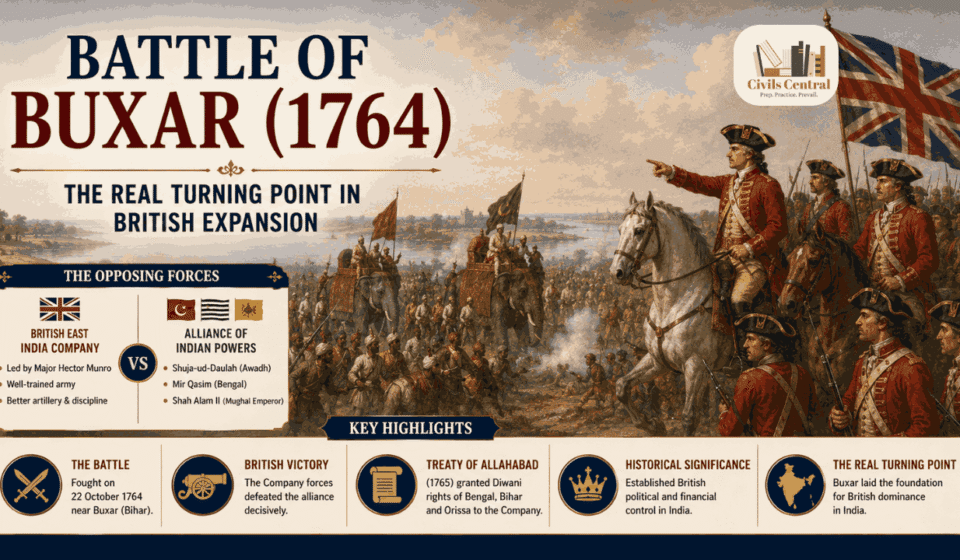
Battle of Buxar (1764): Causes, Course, Consequences and the Establishment of British Supremacy

Chapter Summary
| Chapter Information | Details |
|---|---|
| Series | Modern History of India (1707–1947) |
| Historical Period | 1757–1765 |
| Historical Phase | Consolidation of British Political Power in Northern India |
| Previous Chapter | Battle of Plassey (1757): Causes, Course, Consequences and Historical Significance |
| Current Chapter | Battle of Buxar (1764): Causes, Course, Consequences and the Establishment of British Supremacy |
| Next Chapter | Regulating Act, 1773: The First Parliamentary Control over the East India Company |
| Core Theme | The Battle of Buxar transformed the English East India Company from a political influence in Bengal into the dominant military power in northern India. The victory over the combined forces of Mir Qasim, Shuja-ud-Daulah, and Shah Alam II laid the foundation for the Treaty of Allahabad (1765), the grant of the Diwani, and the establishment of Company rule. |
| Major Events Covered | Reign of Mir Jafar, Rise of Mir Qasim, Administrative Reforms, Trade Dispute, War with the Company, Alliance of Mir Qasim–Shuja-ud-Daulah–Shah Alam II, Battle of Buxar, British Victory |
| Key Personalities | Mir Jafar, Mir Qasim, Robert Clive, Hector Munro, Shah Alam II, Shuja-ud-Daulah, Vansittart, Major Adams |
| Key Concepts | Diwani, Dual Government, Company State, Trade Privileges, Dastaks, Military Supremacy, Revenue Rights, Political Sovereignty, Constitutional Transformation, Historiography |
| Exam Relevance | UPSC CSE, JKPSC, JKAS, State PCS, CDS, CAPF, SSC, UGC-NET (History), University Examinations |
Introduction
How Did the Battle of Buxar Complete What the Battle of Plassey Had Begun?
The Battle of Plassey (1757) marked the beginning of British political influence in India by enabling the English East India Company to place Mir Jafar on the throne of Bengal. Although the Company emerged as the most influential political force in the province, it had not yet become the sovereign authority. The Nawab of Bengal continued to administer the province, while the Mughal Emperor remained the formal sovereign. British power, though immense, still rested primarily upon political influence rather than legal authority.
The years following Plassey revealed the limitations of this arrangement. The Company expected Mir Jafar to satisfy its growing financial demands and protect its expanding commercial interests. Mir Jafar, however, lacked both the resources and the political independence to meet these expectations. His inability to maintain a stable relationship with the Company soon led British officials to replace him with Mir Qasim, a far more energetic and capable ruler.
Unlike his predecessor, Mir Qasim refused to remain a dependent Nawab. He sought to restore the financial strength, administrative efficiency, and political independence of Bengal. His reforms inevitably brought him into conflict with the English East India Company, whose officials increasingly regarded unrestricted commercial privileges and political influence as essential to their interests. What began as a dispute over trade and revenue gradually developed into a wider political and military confrontation.
Recognizing that Bengal alone could no longer resist the Company’s growing power, Mir Qasim formed an alliance with Shuja-ud-Daulah, the Nawab of Awadh, and Shah Alam II, the Mughal Emperor. For the first time since Plassey, the English East India Company confronted a coalition representing three of the most important political authorities in northern India. The decisive encounter occurred at Buxar on 22 October 1764, where the Company achieved one of the greatest military victories in its history.
The importance of Buxar exceeded even that of Plassey in several respects. Plassey had been won largely through political conspiracy and internal betrayal. Buxar, by contrast, was a direct military contest in which the Company defeated a powerful alliance in open battle. The victory established British military supremacy in northern India, compelled both the Nawab of Awadh and the Mughal Emperor to negotiate with the Company, and paved the way for the Treaty of Allahabad (1765) and the grant of the Diwani of Bengal, Bihar, and Orissa.
For this reason, many historians regard the Battle of Buxar, rather than Plassey alone, as the event that firmly established the constitutional and territorial foundations of British rule in India. If Plassey transformed the English East India Company from a merchant into a kingmaker, Buxar transformed it from a kingmaker into the effective ruler of eastern India.
Part I — Bengal After Plassey (1757–1760): Why Did British–Nawab Relations Deteriorate So Quickly?
Did the Battle of Plassey Bring Political Stability to Bengal?
The victory of the English East India Company at the Battle of Plassey (23 June 1757) appeared to resolve the immediate political crisis in Bengal. Siraj-ud-Daulah had been defeated, Mir Jafar had ascended the throne with British support, and the Company had secured enormous political influence over the richest province of India. To many contemporary observers, it seemed that a stable partnership had been established between the new Nawab and the English East India Company.
In reality, however, the arrangement created after Plassey contained serious internal contradictions. The Company expected Mir Jafar to function as a ruler who would faithfully protect British commercial and political interests. Mir Jafar, on the other hand, hoped to recover the independence traditionally enjoyed by the Nawabs of Bengal once his position became secure. Thus, although both parties had cooperated to remove Siraj-ud-Daulah, they possessed fundamentally different expectations regarding the future government of Bengal.
The years immediately following Plassey therefore witnessed the gradual breakdown of this uneasy alliance. The political settlement of 1757, instead of establishing lasting peace, merely postponed another confrontation that would eventually culminate in the Battle of Buxar (1764).
Mir Jafar’s Accession to the Throne
Following the defeat and death of Siraj-ud-Daulah, Mir Jafar was formally installed as the Nawab of Bengal on 29 June 1757. His accession fulfilled the secret agreement negotiated before the Battle of Plassey. The English East India Company had promised to support Mir Jafar’s claim to the throne in return for political cooperation, commercial privileges, and substantial financial payments.
Outwardly, the constitutional structure of Bengal remained unchanged. The Nawab continued to govern in the name of the Mughal Emperor, provincial officials remained in office, and the administrative machinery established by earlier Nawabs continued to function.
In practice, however, an important political transformation had already occurred.
For the first time, the succession to one of the most prosperous provinces of the Mughal Empire had been determined by a foreign commercial corporation. Although Mir Jafar occupied the throne, his authority rested largely upon British military support. His dependence upon the English East India Company fundamentally altered the balance of power within Bengal and reduced the political autonomy traditionally enjoyed by the Nawabs.
Heavy Financial Obligations Imposed on Mir Jafar
One of the first challenges confronting the new Nawab was the enormous financial burden created by the agreements concluded with the Company.
As part of the settlement following Plassey, Mir Jafar promised to pay vast sums of money to compensate the English East India Company for losses suffered during the capture of Calcutta, reward Company officials for their assistance, and fulfil various financial commitments made during the conspiracy against Siraj-ud-Daulah.
These payments amounted to several crores of rupees, placing unprecedented pressure upon the provincial treasury. The immediate beneficiaries were the English East India Company and many of its senior officials. Robert Clive, along with numerous Company officers, received large personal gifts and grants, while the Company itself obtained substantial compensation and valuable commercial concessions.
For Mir Jafar, however, these obligations created a serious financial crisis.
Although Bengal remained one of the wealthiest provinces in India, its revenues were not unlimited. Meeting the Company’s continuous financial demands placed increasing strain upon the provincial administration and reduced the resources available for governance, defence, and public administration.
The political alliance established at Plassey therefore rested upon an economic arrangement that was difficult to sustain over the long term.
Growing Influence of the English East India Company
The victory at Plassey significantly expanded the Company’s influence in Bengal’s internal affairs.
Before 1757, Company officials generally confined themselves to matters directly connected with trade and commercial privileges. After Plassey, however, they increasingly participated in questions relating to provincial administration, finance, military policy, and political appointments. British officials gradually came to expect that important decisions would be taken only after consultation with Company representatives.
This growing intervention deeply affected the authority of the Nawab.
Although Mir Jafar continued to occupy the throne, his freedom to govern independently became progressively limited. Every major political decision had to take into account the wishes of the English East India Company, whose military strength had become the principal guarantee of his position.
Consequently, the Nawab’s government increasingly appeared dependent rather than sovereign.
Mir Jafar’s Attempt to Regain Independence
Mir Jafar soon realized that his dependence upon the Company threatened both his authority and his reputation.
Like earlier Nawabs of Bengal, he wished to govern as an autonomous provincial ruler rather than as a subordinate ally of a foreign trading corporation. Accordingly, he gradually attempted to reduce British influence by strengthening his own political position and exploring diplomatic contacts with other regional powers.
The Company viewed these efforts with growing suspicion. British officials expected complete cooperation from the Nawab and interpreted any attempt to exercise independent authority as evidence of political unreliability. The relationship between the two sides therefore became increasingly strained. This deterioration illustrates an important feature of Company policy during the eighteenth century.
The English East India Company preferred Indian rulers who depended upon British support but opposed any attempt by those rulers to recover genuine political independence.
Dissatisfaction Within the Company
By 1759–1760, many Company officials had become dissatisfied with Mir Jafar’s administration. Their disappointment did not arise primarily from questions of loyalty, for Mir Jafar generally remained cooperative. Rather, the problem lay in his inability to satisfy the Company’s expanding financial expectations.
The enormous payments promised after Plassey had severely weakened the provincial treasury. As additional demands continued to emerge, Mir Jafar found it increasingly difficult to provide the money expected by Company officials without further destabilizing the finances of Bengal.
At the same time, British administrators believed that Bengal required a more energetic ruler capable of maintaining political stability while continuing to support Company interests. Gradually, influential officials within the Company began considering the possibility of replacing Mir Jafar with another Nawab who might better fulfil these objectives.
The Search for a New Nawab
The Company’s growing dissatisfaction eventually produced a remarkable political development. Only three years after placing Mir Jafar on the throne, the English East India Company began negotiating with another claimant—Mir Qasim, Mir Jafar’s son-in-law.
Mir Qasim appeared to possess several qualities that Company officials considered desirable. He was intelligent, energetic, administratively capable, and initially willing to cooperate with British interests. In return for Company support, he agreed to provide financial compensation and grant further political concessions.
The Company therefore decided to repeat the political strategy that had succeeded at Plassey. Just as Siraj-ud-Daulah had been replaced by Mir Jafar in 1757, Mir Jafar would now be replaced by Mir Qasim in 1760.
This second change of government revealed the extraordinary transformation that had occurred in Bengal since Plassey. The English East India Company had assumed the power to decide who should occupy the throne of one of India’s richest provinces.
The Road to a New Conflict
The replacement of Mir Jafar did not solve the Company’s problems. Instead, it created a far more formidable challenge.
Unlike Mir Jafar, Mir Qasim possessed exceptional administrative ability, political determination, and a clear understanding of the dangers posed by British interference. Although he initially cooperated with the Company, he soon recognized that unrestricted British influence threatened the very existence of an independent Bengal.
Determined to restore the authority of the Nawab, Mir Qasim introduced a series of bold administrative, financial, and military reforms that directly challenged the growing power of the English East India Company.
These reforms would fundamentally alter the political situation in Bengal and set the stage for one of the most important confrontations in the history of British expansion in India.
CivilsCentral Historical Insight
The years immediately following Plassey demonstrate that the Company’s objective was not merely to influence Bengal’s government but to control it. The replacement of Mir Jafar after only three years revealed that British support depended upon complete political and financial compliance. This marked the beginning of a new phase in Indian history, in which the English East India Company increasingly claimed the authority to determine the succession and policies of Indian rulers.
Part II — Rise of Mir Qasim (1760): Could Bengal Regain Its Independence?
Why Did the English East India Company Replace Mir Jafar?
By 1760, the political arrangement established after the Battle of Plassey had begun to unravel. The English East India Company had expected Mir Jafar to provide political stability, protect British commercial interests, and fulfil the extensive financial commitments made at the time of his accession. Although Mir Jafar remained personally loyal to the Company, he proved unable to satisfy its ever-increasing demands. The enormous payments promised after Plassey had severely strained the treasury of Bengal, while continuous political interference by Company officials weakened the authority of the Nawab’s administration.
From the Company’s perspective, Bengal required a ruler who could restore administrative efficiency while continuing to cooperate with British interests. Consequently, Company officials once again decided to intervene directly in the succession to the Nawabship. This decision reflected a growing confidence that had emerged after Plassey. Having successfully replaced Siraj-ud-Daulah in 1757, the Company now believed it possessed the authority to remove and appoint Nawabs whenever its political or commercial interests demanded.
The search for a more capable ruler eventually led Company officials to Mir Qasim, the son-in-law of Mir Jafar.
Accession of Mir Qasim to the Throne
In October 1760, with the support of the English East India Company, Mir Qasim was installed as the Nawab of Bengal, while Mir Jafar was compelled to abdicate.
Like the earlier transfer of power after Plassey, the change occurred through political negotiation rather than popular acceptance. In return for British support, Mir Qasim agreed to compensate the Company financially and ceded the strategically important districts of Burdwan, Midnapore, and Chittagong to the Company. These prosperous districts provided a steady source of revenue that further strengthened the Company’s economic position in Bengal.
At first glance, the transition appeared to benefit both sides. The Company obtained additional territory and financial advantages, while Mir Qasim acquired the throne with British assistance. Yet beneath this temporary cooperation lay a fundamental difference in political objectives.
Unlike Mir Jafar, Mir Qasim had no intention of remaining a dependent ruler indefinitely. He regarded British support as a means of acquiring power, not as a permanent basis for surrendering the independence of Bengal.
Mir Qasim’s Personality and Political Vision
Among the Nawabs of eighteenth-century Bengal, Mir Qasim stands out as one of the most capable and determined administrators.
He possessed considerable political intelligence, administrative experience, and a clear understanding of the changing balance of power in India. Unlike many contemporary rulers who underestimated the long-term ambitions of the English East India Company, Mir Qasim quickly recognized that British interference threatened not merely individual rulers but the political autonomy of Bengal itself.
He also understood an important lesson from the fate of Siraj-ud-Daulah and Mir Jafar. Siraj had attempted to confront the Company without first strengthening his administration. Mir Jafar had accepted British dominance and gradually lost his authority. Mir Qasim sought a different path. He believed that only a financially stable administration, an efficient army, and a strong central government could preserve Bengal’s independence against the growing power of the Company.
His reign therefore marked the first systematic attempt after Plassey to reverse the process of British political expansion.
Administrative Reforms and the Strengthening of Government
Soon after ascending the throne, Mir Qasim initiated a series of administrative reforms designed to restore the authority of the Nawab’s government.
He reorganized the provincial administration, sought to improve revenue collection, reduced unnecessary expenditure, and attempted to eliminate corruption among government officials. These measures were intended not only to strengthen the financial position of Bengal but also to reduce dependence upon the English East India Company.
Mir Qasim believed that political independence could not survive without financial stability. Accordingly, he paid close attention to increasing state revenues while ensuring that the provincial administration functioned more efficiently than it had under Mir Jafar.
Although many of these reforms required time to produce results, they reflected a coherent vision of rebuilding the authority of the Bengal government.
Transfer of the Capital to Munger
One of Mir Qasim’s most significant decisions was the transfer of the provincial capital from Murshidabad to Munger (Monghyr). This move was far more than a simple administrative change.
Murshidabad had become a centre of British political influence after Plassey. Company officials, influential bankers, and members of the Bengal court exercised considerable influence over the affairs of government. Mir Qasim concluded that it would be difficult to govern independently while remaining under constant British observation and pressure.
Munger offered several strategic advantages. Located farther from the Company’s principal centres of influence, it enabled the Nawab to reorganize his administration with greater freedom. The city also possessed considerable military importance and could be fortified more effectively than Murshidabad.
By transferring the capital, Mir Qasim signalled his determination to restore the independence and dignity of the Nawab’s government.
Modernization of the Bengal Army
Mir Qasim recognized that administrative reform alone would not secure Bengal’s independence. The events of Plassey had demonstrated that military weakness and organizational inefficiency could expose even the richest province in India to foreign domination.
Accordingly, he undertook an ambitious programme of military modernization. The Bengal army was reorganized along more disciplined lines, new weapons were procured, artillery was strengthened, and soldiers received improved training based upon contemporary European methods. Military workshops were established at Munger for the manufacture of arms and ammunition, reducing dependence upon external suppliers.
These reforms represented one of the earliest attempts by an Indian ruler after Plassey to modernize his armed forces in response to European military techniques.
Although the reorganization remained incomplete, it significantly increased the military capabilities of Bengal and alarmed Company officials, who interpreted these developments as preparation for future confrontation.
A Growing Conflict of Interests
Initially, relations between Mir Qasim and the English East India Company remained outwardly cordial. However, as the Nawab’s reforms progressed, fundamental differences between the two sides became increasingly apparent. Mir Qasim sought to restore the political authority of the Bengal government and ensure equal treatment for all merchants operating within the province.
The Company, by contrast, wished to preserve and expand the extensive commercial privileges it had acquired over previous decades. These conflicting objectives gradually transformed cooperation into suspicion. British officials viewed the Nawab’s reforms as attempts to reduce their influence. Mir Qasim regarded the Company’s growing intervention as a direct challenge to the sovereignty of Bengal.
The stage was therefore set for a confrontation that neither side could easily avoid.
Towards an Inevitable Collision
By the early 1760s, Bengal once again stood on the brink of political crisis. Unlike the conflict with Siraj-ud-Daulah, the coming struggle would not arise primarily from disputes over fortifications or diplomatic misunderstandings.
Instead, it centred upon a far more fundamental question: Who would exercise real authority in Bengal—the Nawab or the English East India Company?
As Mir Qasim strengthened his administration, modernized his army, and asserted the rights of the provincial government, Company officials increasingly concluded that he posed a greater challenge than either Siraj-ud-Daulah or Mir Jafar had ever done.
The conflict that followed would begin with a dispute over trade and taxation, but it would ultimately determine the future political destiny of eastern India.
CivilsCentral Historical Insight
Mir Qasim was the first Nawab after Plassey to recognize that British political influence could not be resisted without comprehensive administrative, financial, and military reform. His transfer of the capital to Munger, modernization of the army, and efforts to strengthen the state reflected a deliberate attempt to restore Bengal’s independence. Ironically, these very reforms convinced the English East India Company that Mir Qasim had become too powerful to remain on the throne, making confrontation increasingly inevitable.
Part III — The Trade Dispute Between Mir Qasim and the English East India Company: How Did Commercial Privileges Lead to War?
Why Did a Dispute Over Trade Become a Political Crisis?
Although Mir Qasim initially cooperated with the English East India Company, the relationship gradually deteriorated as both sides pursued fundamentally different objectives. The Nawab sought to restore the financial strength and political independence of Bengal, while the Company aimed to preserve and expand the extraordinary commercial privileges it had accumulated over several decades.
The immediate cause of conflict was not a territorial dispute or a military confrontation but a disagreement over trade, taxation, and commercial equality. What appeared to be an economic issue soon evolved into a constitutional struggle over sovereignty. Mir Qasim believed that the government of Bengal possessed the exclusive right to regulate trade and levy taxes within its territory. The Company, on the other hand, increasingly behaved as though its commercial privileges placed it beyond the authority of the Nawab.
Thus, the dispute over trade became a larger contest over who exercised supreme authority in Bengal.
The Origin of the Company’s Commercial Privileges
The roots of the conflict lay in the privileges granted to the English East India Company by the Mughal Emperor Farrukhsiyar through the Farman of 1717.
This Farman exempted the Company from paying customs duties on goods intended for its own export trade. The concession was designed to encourage commerce and strengthen relations between the Mughal Empire and the English merchants. At the time, the privilege applied specifically to the Company’s official commercial activities and was never intended to cover private trade conducted by individual Company servants.
During the early eighteenth century, this arrangement caused relatively few disputes because the Company’s commercial operations remained limited.
After the Battle of Plassey, however, the political situation changed dramatically. The Company now enjoyed enormous influence over the government of Bengal, and many of its officials began interpreting these commercial privileges far more broadly than the Mughal authorities had originally intended.
This marked the beginning of one of the most important economic conflicts in modern Indian history.
Misuse of the Dastaks
The Company’s duty-free privileges were exercised through official passes known as Dastaks. Originally, these documents were issued only for goods belonging to the English East India Company. Over time, however, many Company officials began using these Dastaks for their own private commercial activities. Some even allowed Indian merchants to use them in return for personal payments or unofficial commissions.
As a result, large quantities of goods entered and moved within Bengal without paying the customs duties that every ordinary merchant was legally required to pay. This practice produced two serious consequences.
First, the government of Bengal suffered a substantial loss of revenue because customs duties constituted an important source of provincial income.
Second, Indian merchants found themselves at a severe competitive disadvantage. While they continued paying customs duties on their goods, Company servants conducted similar commercial activities virtually free of taxation.
The principle of equal commercial competition gradually disappeared.
Economic Consequences for Bengal
The misuse of Dastaks had profound consequences for Bengal’s economy. As increasing quantities of goods escaped taxation, government revenues steadily declined. The Nawab’s administration found it increasingly difficult to finance public administration, maintain the army, and meet other essential expenditures.
At the same time, Indian merchants experienced growing economic hardship. Unable to compete with duty-free Company officials, many indigenous traders suffered declining profits. Markets became increasingly distorted because taxation no longer applied equally to all participants.
The English East India Company therefore enjoyed commercial advantages that extended far beyond the privileges originally granted under the Farman of 1717. Mir Qasim regarded this situation as both economically unjust and politically unacceptable.
He believed that no independent government could permit one section of merchants to remain permanently exempt from laws that applied to everyone else.
Mir Qasim’s Demand for Commercial Equality
Determined to restore financial stability and administrative authority, Mir Qasim decided to challenge the existing commercial arrangement. His objective was not to prohibit the Company’s trade but to establish equal commercial conditions for all merchants operating within Bengal.
The Nawab argued that either every trader should pay customs duties or no trader should be required to pay them. A system in which one group enjoyed permanent tax exemptions while others bore the entire burden of taxation violated both economic fairness and political sovereignty.
This argument reflected a broader constitutional principle. Mir Qasim believed that taxation was an essential attribute of sovereign authority. If the government of Bengal could not regulate trade and collect customs duties within its own territory, its independence existed only in theory.
The dispute therefore extended beyond commercial policy and became a question of state authority itself.
Abolition of Internal Customs Duties
In 1763, Mir Qasim introduced one of the boldest economic reforms undertaken by any eighteenth-century Indian ruler. Instead of attempting to withdraw the Company’s duty-free privileges directly, he abolished internal customs duties for all merchants, whether Indian or European.
The logic behind this reform was simple. If every merchant enjoyed exemption from internal duties, the special advantage previously enjoyed by Company officials would disappear. Indian merchants would once again compete on equal terms, while the English East India Company would lose the extraordinary commercial monopoly created through the misuse of Dastaks.
Economically, the measure promoted equality. Politically, it reaffirmed the Nawab’s authority to determine fiscal policy within Bengal. Mir Qasim hoped that by removing discrimination rather than imposing new restrictions, he could restore fairness without provoking unnecessary confrontation.
The Company’s Reaction
The English East India Company interpreted Mir Qasim’s reforms very differently. Although the Nawab had not directly withdrawn the Company’s privileges, his decision effectively eliminated the economic advantages that Company servants had enjoyed for many years.
Many British officials had accumulated considerable personal wealth through private trade conducted under the protection of Dastaks. The abolition of internal customs duties threatened these profits by placing Indian merchants on an equal commercial footing.
Consequently, Company officials strongly opposed the Nawab’s policy. They argued that the reform violated earlier agreements and weakened privileges legally granted by the Mughal Emperor. Behind these constitutional arguments, however, lay a more immediate concern. The Company’s commercial dominance—and the personal fortunes of many of its servants—depended upon preserving unequal trading conditions.
Mir Qasim’s policy therefore struck at the very foundation of British economic influence in Bengal.
From Commercial Dispute to Political Conflict
The disagreement over customs duties soon expanded into a wider political confrontation. Mir Qasim regarded the issue as one of sovereignty. The Company regarded it as one of privilege. Neither side showed any willingness to compromise. The Nawab believed that surrendering control over taxation would permanently undermine the authority of his government.
The Company believed that accepting commercial equality would weaken both its economic position and its growing political influence. As negotiations failed, mutual suspicion intensified. Commercial disagreements gradually gave way to military preparations. By 1763, it had become increasingly clear that the conflict between Mir Qasim and the English East India Company could no longer be resolved through diplomacy alone.
The struggle for Bengal was once again moving towards open war.
CivilsCentral Historical Insight
The trade dispute between Mir Qasim and the English East India Company was far more than a disagreement over customs duties. It represented a constitutional conflict over sovereignty itself. By abolishing internal customs duties for all merchants, Mir Qasim sought to establish commercial equality and restore the fiscal authority of the Bengal government. The Company’s opposition revealed that its objective had moved beyond trade towards preserving political and economic dominance. The road to the Battle of Buxar therefore began not with a military campaign, but with a dispute over who possessed the right to govern Bengal’s economy.
Part IV — War Between Mir Qasim and the English East India Company (1763): Why Did Diplomacy Give Way to Armed Conflict?
Could the Conflict Between Mir Qasim and the Company Still Be Resolved Peacefully?
By 1763, relations between Mir Qasim and the English East India Company had deteriorated beyond repair. What had begun as a disagreement over customs duties and commercial privileges gradually evolved into a direct struggle for political authority in Bengal. The issue was no longer confined to taxation or trade. It had become a contest over the fundamental question of sovereignty—whether the Nawab or the Company possessed the ultimate authority to govern Bengal.
Both sides had reached a point where compromise appeared impossible.
Mir Qasim regarded the Company’s continuous interference as a deliberate attempt to reduce the Nawab to a powerless figurehead. The Company, meanwhile, interpreted Mir Qasim’s administrative reforms, military modernization, and insistence upon commercial equality as evidence that he intended to challenge British influence established after Plassey.
The confrontation that followed was therefore not accidental. It represented the inevitable outcome of two incompatible political visions. One sought to restore the independence of Bengal; the other aimed to consolidate the Company’s growing supremacy.
Growing Tensions and Breakdown of Negotiations
During the early months of 1763, repeated attempts were made to resolve the dispute through negotiation. Company representatives demanded the restoration of their commercial privileges and compensation for losses allegedly suffered because of Mir Qasim’s reforms. The Nawab refused to withdraw the policy of equal trade, insisting that every merchant operating within Bengal should be treated alike under the law.
The negotiations soon became increasingly hostile. Neither side trusted the intentions of the other. Mir Qasim believed that every concession would merely encourage further British interference in the affairs of Bengal. The Company believed that accepting the Nawab’s reforms would weaken the privileged position it had acquired after the Battle of Plassey.
As diplomatic discussions collapsed, both sides accelerated military preparations. Garrisons were strengthened, troops were mobilized, and supplies were accumulated. Bengal once again moved towards war.
The Outbreak of Hostilities
Open conflict began in 1763 when Company forces and the Nawab’s army clashed at several important centres across Bengal and Bihar. Unlike the Battle of Plassey, where a single decisive engagement determined the outcome, the conflict with Mir Qasim consisted of a series of military operations fought over several months. Control of strategic towns, communication routes, and administrative centres became the principal objective of both sides.
The Company sought to destroy the military power that Mir Qasim had patiently built during the previous three years. Mir Qasim aimed to demonstrate that Bengal possessed sufficient strength to resist British interference and preserve its political independence.
The struggle therefore assumed the character of a full-scale war rather than a limited military encounter.
The Battle of Katwa
One of the earliest important engagements occurred at Katwa. The English East India Company, relying upon disciplined infantry and efficient artillery, attacked the Nawab’s forces stationed in the region. Although Mir Qasim’s army had undergone significant modernization, it still lacked the battlefield experience and operational coordination enjoyed by the Company’s troops.
The British succeeded in securing Katwa after determined resistance. This victory strengthened Company control over central Bengal and enabled British forces to continue their advance towards other strategic locations.
For Mir Qasim, the loss demonstrated that administrative reform alone could not compensate for the Company’s growing military experience acquired during the Carnatic Wars and the campaigns following Plassey.
The Battle of Murshidabad
The conflict soon spread to Murshidabad, the traditional capital of Bengal. Although Mir Qasim had shifted his administrative headquarters to Munger, Murshidabad retained immense political and symbolic importance. Control over the city represented control over the historical centre of the Bengal Nawabship.
British forces captured Murshidabad after defeating the Nawab’s troops defending the region. The occupation carried consequences extending beyond military success.
Politically, it demonstrated that the English East India Company could occupy the former capital of Bengal without encountering unified resistance from the provincial administration. Symbolically, it weakened the prestige of the Nawab and reinforced the perception that British military power had become the decisive force in Bengal.
The Battle of Giria
Another important engagement took place at Giria, where Company forces again confronted the reorganized army of Mir Qasim.
The Nawab’s commanders fought with considerably greater determination than many of the officers who had served under Siraj-ud-Daulah during the Battle of Plassey. Unlike the earlier conflict, there was no widespread conspiracy or deliberate refusal to fight. The Bengal army resisted the British advance with genuine commitment.
Nevertheless, the Company’s disciplined infantry formations, coordinated artillery, and experienced officers gradually gained the upper hand. The defeat at Giria further reduced Mir Qasim’s capacity to defend Bengal and forced him to withdraw towards his remaining strongholds. These engagements demonstrated an important difference between Plassey and the present conflict.
Whereas Plassey had been shaped largely by political betrayal, the war against Mir Qasim involved sustained military resistance and repeated battlefield engagements.
The Fall of Munger
The most serious blow to Mir Qasim came with the British advance towards Munger (Monghyr). Munger had become the centre of the Nawab’s reform programme. It housed his reorganized administration, military workshops, arsenals, and much of the newly modernized Bengal army. The city symbolized Mir Qasim’s determination to rebuild an independent and militarily strong provincial state.
Company forces launched determined operations against the city. Despite stiff resistance, Munger eventually fell into British hands. Its capture deprived Mir Qasim of his principal military base and destroyed much of the administrative infrastructure that he had painstakingly created after assuming power.
The loss also marked the failure of his ambitious programme to transform Bengal into a modern and independent regional power capable of resisting European intervention.
Mir Qasim’s Desperate Measures
As British victories accumulated, Mir Qasim’s position became increasingly precarious. Faced with continuous military setbacks and convinced that many local elites were secretly assisting the Company, the Nawab adopted increasingly harsh measures in an attempt to preserve his authority.
Among the most controversial episodes of the war was the Patna Massacre (1763), during which several English prisoners and other detainees were executed after the capture of Patna by the Nawab’s forces. Mir Qasim believed that these actions would discourage British resistance and demonstrate his determination to continue the struggle.
Instead, the incident produced the opposite effect. The English East India Company used the executions as powerful propaganda, portraying Mir Qasim as a ruthless ruler whose government had become both dangerous and illegitimate. The event strengthened British resolve and further damaged the Nawab’s political reputation.
Modern historians generally regard the Patna Massacre as a serious strategic mistake, since it failed to alter the military balance while providing the Company with additional justification for pursuing the war vigorously.
Flight from Bengal and the Search for Allies
By the close of 1763, Mir Qasim could no longer defend Bengal effectively. The successive defeats at Katwa, Murshidabad, Giria, and Munger had shattered his military position. Remaining within Bengal offered little prospect of reversing the Company’s advance.
Recognizing this reality, Mir Qasim left Bengal and sought refuge in the neighbouring state of Awadh. This decision marked an important turning point in the conflict. Rather than abandoning resistance altogether, Mir Qasim sought to transform a provincial war into a broader political struggle against the English East India Company. He understood that Bengal alone could no longer challenge British power. Success would require the cooperation of other major Indian rulers who shared similar concerns regarding the Company’s expanding influence.
The search for such allies would soon produce one of the most formidable political and military coalitions of eighteenth-century India.
CivilsCentral Historical Insight
The war between Mir Qasim and the English East India Company differed fundamentally from the Battle of Plassey. Unlike Siraj-ud-Daulah, Mir Qasim reorganized his administration, modernized his army, and resisted the Company through sustained military campaigns rather than isolated confrontation. Although he ultimately lost Bengal, his resistance transformed the conflict from a provincial dispute into a wider struggle involving the Nawab of Awadh and the Mughal Emperor. The road to the Battle of Buxar therefore began with the fall of Munger and Mir Qasim’s determination to continue the fight beyond the boundaries of Bengal.
Part V — The Grand Alliance Against the English East India Company: Why Did Mir Qasim, Shuja-ud-Daulah and Shah Alam II Unite?
Why Did the Conflict Expand Beyond Bengal?
The defeat of Mir Qasim in Bengal did not bring an immediate end to resistance against the English East India Company. Although the Company had successfully occupied the province and forced the Nawab to abandon his capital, its victory remained incomplete. Mir Qasim himself had escaped, and more importantly, the larger political questions raised by the conflict remained unresolved. The rapid expansion of British influence after the Battle of Plassey (1757) had begun to alarm not only the rulers of Bengal but also other important political powers in northern India.
The English East India Company had demonstrated that it could remove one Nawab, appoint another, intervene in provincial administration, and dictate commercial policy according to its own interests. These developments convinced many Indian rulers that British ambitions extended far beyond trade. If Bengal could lose its political independence through Company intervention, the same danger could eventually threaten neighbouring states.
Mir Qasim clearly understood this changing political reality. He recognized that Bengal alone no longer possessed the military resources necessary to defeat the Company. Any successful resistance would require a broader political coalition capable of matching British military strength and restoring the balance of power in northern India.
It was this realization that transformed a provincial conflict into a struggle involving three of the most important political authorities of eighteenth-century India.
Mir Qasim’s Search for Powerful Allies
After leaving Bengal, Mir Qasim sought refuge in the neighbouring state of Awadh, one of the strongest successor states that had emerged following the decline of the Mughal Empire.
Unlike Bengal, Awadh had remained relatively independent of direct British political influence. Under its capable rulers, the province had developed into a prosperous and militarily significant kingdom controlling the fertile Gangetic plains. Mir Qasim hoped that the Nawab of Awadh would recognize the growing danger posed by the English East India Company and support a united effort to resist further British expansion.
His appeal rested upon a simple political argument. If the Company succeeded in permanently establishing its authority over Bengal, it would inevitably seek to extend its influence into neighbouring territories. The independence of Awadh would therefore remain secure only if British expansion were checked before it became irreversible.
This argument proved increasingly persuasive because the Company’s recent actions had already demonstrated a willingness to interfere directly in the internal affairs of Indian states.
Shuja-ud-Daulah and the Strategic Importance of Awadh
The ruler of Awadh at this time was Shuja-ud-Daulah, one of the most influential political leaders in northern India.
Shuja-ud-Daulah governed a wealthy and strategically important kingdom situated between Bengal and the Mughal territories around Delhi. Awadh also served as an important buffer state separating Bengal from the expanding influence of the Afghan and Maratha powers.
Initially, Shuja-ud-Daulah observed the conflict between Mir Qasim and the Company with caution. Like many eighteenth-century rulers, he preferred to avoid unnecessary military confrontation while preserving the independence of his kingdom. Gradually, however, the rapid expansion of British power convinced him that neutrality might no longer remain possible.
The Company had already demonstrated its ability to replace Nawabs in Bengal according to its own interests. If such interference continued unchecked, the political autonomy of Awadh might eventually face a similar challenge. Supporting Mir Qasim therefore became not merely an act of regional diplomacy but a measure undertaken to protect the long-term security of Awadh itself.
The Participation of Shah Alam II
The most significant addition to the emerging alliance was Shah Alam II, the Mughal Emperor.
Although the Mughal Empire had declined considerably since the death of Aurangzeb, the office of the Emperor still possessed immense constitutional and symbolic importance. Indian rulers continued to recognize the Mughal Emperor as the formal sovereign of the subcontinent, even though his actual political authority had become greatly reduced.
The expansion of the English East India Company directly challenged this traditional political order. By determining the succession to the Nawabship of Bengal and increasingly controlling provincial administration, the Company had begun exercising powers that traditionally belonged to the Mughal Emperor or his provincial governors.
For Shah Alam II, supporting the alliance against the Company represented an opportunity to restore at least part of the authority that the Mughal throne had gradually lost during the eighteenth century. His participation also gave the alliance greater constitutional legitimacy. The coming conflict could now be presented not merely as the resistance of one provincial ruler but as an effort led by the formal sovereign of India to defend the established political order against an increasingly powerful commercial corporation.
Formation of the Triple Alliance
By 1764, the negotiations between the three leaders had produced a formal political and military alliance.
The coalition consisted of:
- Mir Qasim, the deposed Nawab of Bengal, determined to recover his lost kingdom.
- Shuja-ud-Daulah, the Nawab of Awadh, seeking to prevent British expansion towards his own territories.
- Shah Alam II, the Mughal Emperor, attempting to restore imperial authority and check the growing influence of the Company.
Although each participant pursued different immediate objectives, they shared a common strategic concern. All three believed that the rapid expansion of the English East India Company threatened the existing political structure of northern India.
Their alliance therefore represented the most serious coordinated challenge yet faced by the Company after the Battle of Plassey. Unlike earlier conflicts involving individual regional rulers, the coming struggle would unite provincial authority, imperial legitimacy, and substantial military resources within a single coalition.
Strengths and Weaknesses of the Alliance
On paper, the alliance appeared formidable. Combined, the three rulers commanded a much larger army than the English East India Company. Their territories possessed considerable financial resources, experienced cavalry, artillery, and access to important strategic routes across northern India.
The participation of the Mughal Emperor also provided political legitimacy that the Company could not easily claim. Nevertheless, the alliance suffered from several structural weaknesses. Each ruler entered the coalition with different priorities. Mir Qasim wished to recover Bengal.
Shuja-ud-Daulah sought primarily to protect Awadh. Shah Alam II hoped to revive imperial prestige. These differing objectives sometimes made it difficult to establish a unified military strategy. Furthermore, the allied forces had little experience of operating together under a single command structure. Differences in organization, training, logistics, and battlefield tactics complicated military coordination.
The English East India Company, although numerically inferior, enjoyed precisely the opposite advantages. Its forces operated under a unified command, followed a coherent military strategy, and benefited from disciplined infantry supported by well-coordinated artillery.
Thus, even before the decisive battle, the conflict reflected a familiar contrast between numerical strength and organizational unity.
Towards the Battlefield of Buxar
Throughout 1764, both sides prepared for what they recognized would be a decisive confrontation. The English East India Company understood that defeat could undermine everything it had achieved since the Battle of Plassey. Bengal, recently secured through years of political intervention and military campaigning, might once again be lost.
The allied rulers were equally aware of the importance of the coming battle. A victory would restore Mir Qasim’s authority, preserve the independence of Awadh, strengthen the position of the Mughal Emperor, and halt the advance of British political influence into northern India.
Failure, however, would leave the Company stronger than ever before. The two armies finally advanced towards one another near the town of Buxar, situated on the banks of the Ganga River in present-day Bihar. On 22 October 1764, they would fight a battle that many historians consider even more decisive than Plassey.
Unlike the Battle of Plassey, where political conspiracy played the dominant role, the Battle of Buxar would be decided primarily by military leadership, discipline, organization, and battlefield tactics.
CivilsCentral Historical Insight
The formation of the alliance between Mir Qasim, Shuja-ud-Daulah, and Shah Alam II transformed the conflict from a provincial rebellion into a struggle for the political future of northern India. For the first time, the English East India Company confronted a coalition representing Bengal, Awadh, and the Mughal Empire. If Plassey tested the Company’s political strategy, Buxar would test its military strength. The outcome would determine whether British influence remained confined to Bengal or expanded into the dominant political power of northern India.
Part VI — The Battle of Buxar (22 October 1764): The Battle That Established British Military Supremacy in India
Why Is the Battle of Buxar Considered More Decisive Than the Battle of Plassey?
The Battle of Plassey (1757) marked the beginning of British political influence in Bengal, but it did not conclusively establish the military supremacy of the English East India Company. The Company’s victory at Plassey had depended heavily upon political conspiracy, internal divisions within the Bengal court, and the betrayal of Mir Jafar. Consequently, many contemporary Indian rulers continued to believe that British success had resulted from exceptional political circumstances rather than from superior military capability.
The Battle of Buxar, fought on 22 October 1764, fundamentally altered this perception.
Unlike Plassey, Buxar was fought against a powerful coalition consisting of Mir Qasim, Shuja-ud-Daulah, and Shah Alam II. There was no large-scale conspiracy within the allied camp comparable to that which had shaped the outcome at Plassey. Instead, the battle became a direct military contest between the disciplined forces of the English East India Company and the combined armies of three major Indian powers.
For this reason, many historians consider Buxar to be the battle that truly established British military supremacy in northern India. If Plassey gave the Company political influence, Buxar gave it military credibility and constitutional authority.
The Battlefield of Buxar
The battle was fought near the town of Buxar, situated on the southern bank of the Ganga River in present-day Bihar. The location possessed considerable strategic importance. Buxar lay along the principal route connecting Bengal with the upper Gangetic plains and the kingdom of Awadh. Whoever controlled this region could influence communication, trade, and military movement across much of northern India.
Unlike the orchards and embankments that characterized the battlefield of Plassey, the terrain around Buxar consisted largely of open plains suitable for the deployment of large infantry formations, cavalry, and artillery. The open landscape provided both armies with sufficient space to manoeuvre, making discipline, battlefield coordination, and tactical leadership far more important than geographical advantage.
The battlefield therefore favoured neither side decisively. Victory would depend upon the effective employment of military resources rather than the accidental advantages of terrain.
Strength of the Opposing Forces
The allied army possessed a clear numerical advantage. The combined forces of Mir Qasim, Shuja-ud-Daulah, and Shah Alam II numbered approximately 40,000 to 50,000 soldiers, including infantry, cavalry, artillery, and irregular troops drawn from different regions of northern India. The alliance also possessed a substantial number of heavy guns and considerable financial resources provided by Awadh and the former administration of Bengal.
The English East India Company, under the command of Major Hector Munro, fielded an army of approximately 7,000 to 8,000 troops. Although much smaller, this force consisted largely of disciplined European soldiers supported by well-trained Indian sepoys organized according to contemporary European military methods.
The Company also possessed an important organizational advantage. Its entire army operated under a single commander following a unified battle plan. The allied army, by contrast, represented three different political authorities with separate military traditions, administrative systems, and strategic priorities. Although united against a common enemy, the coalition lacked the organizational cohesion enjoyed by the Company’s forces.
Thus, as at Plassey, the conflict once again demonstrated the contrast between numerical superiority and military organization.
Major Hector Munro and British Preparations
The English East India Company entrusted the command of its army to Major Hector Munro, an experienced officer who understood both the strengths and limitations of his comparatively small force.
Munro recognized that prolonged warfare against a numerically superior coalition would favour the allied rulers. Accordingly, he sought a decisive engagement in which the Company’s discipline, artillery, and coordinated infantry tactics could offset its numerical inferiority.
British preparations reflected careful military planning. Artillery positions were selected with precision. Supply lines were secured. Infantry units were organized into mutually supporting formations capable of responding rapidly to changing battlefield conditions. Years of campaigning in southern and eastern India had produced a professional army whose effectiveness depended less upon numbers than upon discipline, training, and unified command.
Deployment of the Allied Army
The allied commanders entered the battle with considerable confidence. Their combined forces significantly outnumbered the Company’s army, while the participation of the Mughal Emperor and the Nawab of Awadh gave the coalition both political legitimacy and military strength.
The allied army deployed across a broad front, intending to use its superior numbers to overwhelm the comparatively small British force. Cavalry occupied the flanks, infantry formed the centre, and artillery was positioned to support the advance. Despite these apparent advantages, important weaknesses remained.
The coalition lacked a single undisputed commander exercising complete authority over all participating forces. Each contingent retained considerable operational independence. Communication between different sections of the army proved slower and less efficient than within the Company’s unified command structure.
These organizational limitations would become increasingly significant as the battle progressed.
Opening Phase of the Battle
On the morning of 22 October 1764, the two armies advanced towards one another near Buxar. The battle began with a sustained exchange of artillery fire. The allied forces hoped that their numerical superiority and heavier artillery would weaken the British formations before launching a decisive infantry and cavalry assault.
Major Hector Munro, however, refused to abandon the disciplined tactics that had repeatedly brought success to Company armies. British artillery responded with remarkable accuracy, while infantry maintained carefully organized formations despite the continuous bombardment. Instead of launching premature attacks, Munro allowed the allied army to expend both energy and ammunition before committing his own troops to decisive action.
This patient approach reflected the growing professionalism of the Company’s military leadership. Rather than relying upon individual acts of bravery, British commanders increasingly emphasized discipline, coordination, and controlled battlefield manoeuvres. The opening hours of the battle therefore developed into a contest between numerical pressure and organizational efficiency, a pattern that would ultimately determine the outcome of one of the most decisive battles in Indian history.
CivilsCentral Historical Insight
**The Battle of Buxar differed fundamentally from the Battle of Plassey. Plassey was shaped primarily by political conspiracy and internal betrayal, whereas Buxar tested the Company’s military institutions in open battle against a united coalition of three major Indian powers. The disciplined leadership of Major Hector Munro, combined with unified command and professional organization, enabled the English East India Company to confront an army several times larger than its own. The decisive phase of the battle, however, was still to come, where discipline and battlefield tactics would ultimately outweigh numerical superiority.
The Decisive Phase of the Battle: How Did the English East India Company Defeat a Much Larger Army?
The Allied Offensive and the British Defensive Strategy
As the battle progressed, the allied commanders attempted to exploit their overwhelming numerical superiority by launching repeated attacks against the English East India Company’s position. Their strategy was straightforward. Continuous pressure from infantry, supported by cavalry and artillery, would gradually exhaust the comparatively small British force before delivering a decisive blow.
On paper, this approach appeared entirely reasonable. The allied army possessed nearly five times the strength of the Company’s forces and enjoyed considerable superiority in cavalry. If these advantages could be effectively coordinated, the British army might eventually be overwhelmed through sheer weight of numbers.
Major Hector Munro, however, had anticipated precisely such a strategy.
Rather than allowing his troops to become scattered across the battlefield, he maintained compact infantry formations supported closely by artillery. Every movement of the British army remained carefully coordinated, ensuring that each unit could immediately support neighbouring formations whenever required. This disciplined system prevented the allied forces from exploiting gaps in the Company’s line despite their numerical superiority.
The contrast between the two armies became increasingly apparent as the battle continued. While the allied forces fought bravely, they often advanced in separate formations without sufficient coordination. The British army, though much smaller, functioned as a single integrated military machine.
Discipline and Professional Training Changed the Course of the Battle
The decisive advantage enjoyed by the English East India Company did not arise from superior courage or greater experience alone. It resulted from years of systematic military training based upon contemporary European methods of warfare. Company infantry maintained disciplined firing lines throughout the engagement. Soldiers advanced, halted, reloaded, and fired according to carefully rehearsed drills. These movements enabled continuous musket fire without disrupting battlefield formations.
The allied army contained many courageous and experienced soldiers, but its different contingents followed varying military traditions. Infantry, cavalry, and artillery often operated independently rather than as components of a unified battle plan. Consequently, opportunities created by one section of the army were not always exploited effectively by others.
This difference reflected two contrasting military systems. The allied army represented the traditional structure of eighteenth-century Indian warfare, in which individual commanders exercised considerable independence over their own contingents. The English East India Company represented an increasingly modern military organization characterized by centralized command, standardized training, disciplined formations, and coordinated battlefield tactics.
At Buxar, the superiority of institutional organization gradually outweighed the numerical advantages possessed by the allied coalition.
The Role of British Artillery
Artillery once again played a decisive role in determining the outcome of the battle. Although the allied forces possessed a considerable number of heavy guns, their artillery suffered from problems similar to those observed during earlier conflicts. Many of the larger guns proved difficult to manoeuvre once the battle intensified, reducing their flexibility during rapidly changing battlefield conditions.
The Company’s artillery, by contrast, consisted primarily of lighter and more mobile field guns. These guns could be repositioned quickly to support different sectors of the battlefield. British artillery officers coordinated their fire closely with infantry movements, ensuring that advancing allied formations remained under continuous bombardment.
The effectiveness of British artillery extended beyond the physical damage it inflicted. Repeated and accurate cannon fire disrupted the formation of the allied army, reduced the momentum of its attacks, and weakened coordination between different sections of the coalition. Every unsuccessful advance further increased confusion within the allied ranks while strengthening British confidence.
Thus, artillery became not merely a weapon of destruction but an instrument for controlling the rhythm and direction of the entire battle.
Collapse of Coordination Within the Allied Army
As the engagement continued, the greatest weakness of the allied coalition became increasingly evident. Although Mir Qasim, Shuja-ud-Daulah, and Shah Alam II had united against the English East India Company, their armies had never fully integrated into a single command structure. Each contingent retained its own officers, methods of communication, and tactical traditions.
During the confusion of battle, these differences became increasingly difficult to manage. Orders did not always reach every section of the army simultaneously. Different commanders responded differently to changing battlefield conditions. Infantry advances often lacked adequate artillery support, while cavalry movements were not always synchronized with the operations of the main force.
The Company, meanwhile, benefited from complete unity of command. Every important military decision originated from Major Hector Munro, whose authority over the entire army remained unquestioned throughout the engagement.
This contrast between fragmented leadership and centralized command proved increasingly decisive as the battle entered its final stages.
The Turning Point of the Battle
After several hours of intense fighting, signs of fatigue and disorder began appearing within the allied ranks. Continuous British artillery fire had disrupted repeated attacks, while disciplined infantry formations successfully resisted successive advances. The coalition still possessed numerical superiority, but it could no longer convert that advantage into effective battlefield action.
Recognizing the growing confusion among the allied forces, Major Hector Munro ordered a carefully coordinated advance. Instead of pursuing a reckless offensive, the British army moved forward systematically, maintaining disciplined formations while continuing concentrated artillery and musket fire.
The advance steadily increased pressure upon the coalition. Unable to restore effective coordination between its different contingents, the allied army gradually began losing cohesion. Individual units fought with determination, but the absence of unified leadership prevented them from mounting a sustained counterattack capable of reversing the course of the battle.
At this stage, the initiative passed completely into British hands. The battle no longer depended upon numerical strength but upon organizational discipline and battlefield control.
Retreat of the Allied Forces
As British forces continued advancing, the defensive position of the allied army became increasingly difficult to maintain. The inability to coordinate infantry, cavalry, and artillery operations gradually transformed tactical difficulties into a general retreat. Once sections of the coalition began withdrawing from the battlefield, neighbouring formations also lost confidence in the possibility of continued resistance.
The retreat soon spread across much of the allied line.
Unlike the Battle of Plassey, where political betrayal had largely determined the outcome, the retreat at Buxar resulted primarily from military defeat in open combat. The allied army had fought seriously and without the large-scale conspiracies that characterized Plassey. Nevertheless, disciplined leadership, superior organization, and coordinated battlefield tactics enabled the Company to overcome an opponent several times its own size.
By the afternoon of 22 October 1764, the English East India Company had secured a decisive victory.
A Victory That Changed the Balance of Power
The significance of the Battle of Buxar became immediately apparent. For the first time, the English East India Company had defeated the combined armies of the Nawab of Bengal, the Nawab of Awadh, and the Mughal Emperor in a direct military confrontation. This achievement carried enormous political implications.
Indian rulers could no longer dismiss British victories as the accidental result of conspiracy or betrayal. Buxar demonstrated that the Company’s disciplined military institutions could defeat even the most powerful regional coalition assembled in northern India. The victory therefore established not merely British influence but British military credibility.
It convinced both Indian rulers and European observers that the English East India Company had become the strongest organized military power in northern India. The constitutional and political consequences of this victory would soon become evident through negotiations that culminated in the Treaty of Allahabad (1765), an agreement that permanently altered the relationship between the Mughal Empire and the English East India Company.
CivilsCentral Historical Insight
The decisive phase of the Battle of Buxar demonstrated that disciplined institutions could overcome overwhelming numerical superiority. Unlike Plassey, where political conspiracy shaped the outcome, Buxar was won through unified command, professional military organization, coordinated artillery, and disciplined infantry tactics. The battle convinced Indian rulers that the English East India Company was no longer merely a successful trading corporation but the foremost military power in northern India, preparing the way for the constitutional transformation that followed in 1765.
Part VII — Why Did the English East India Company Win the Battle of Buxar? An Analysis of the Causes of British Victory
Was the Victory at Buxar the Result of Military Superiority Alone?
The victory of the English East India Company at the Battle of Buxar (22 October 1764) cannot be explained by military strength alone. At first sight, the outcome appears surprising because the Company confronted a coalition that possessed greater numerical strength, abundant financial resources, experienced cavalry, and the political legitimacy of both the Mughal Emperor and the Nawab of Awadh. If numerical superiority alone determined military success, the allied forces should have emerged victorious.
Yet history often demonstrates that wars are decided not merely by the size of armies but by the quality of leadership, organization, discipline, logistics, and political unity. The Battle of Buxar provides one of the clearest illustrations of this principle.
Unlike the Battle of Plassey, where political conspiracy and betrayal played the dominant role, the victory at Buxar resulted primarily from the Company’s institutional strength. Superior command, disciplined infantry, efficient artillery, and unified military planning enabled the English East India Company to defeat one of the strongest coalitions assembled against it during the eighteenth century.
The causes of British victory therefore reveal why the Company increasingly emerged as the dominant military power in India.
Unified Military Command Under Major Hector Munro
The first and perhaps the most important advantage enjoyed by the English East India Company was the existence of a single and unified command structure. The entire British army operated under the leadership of Major Hector Munro, whose authority remained unquestioned throughout the campaign. Every unit of infantry, artillery, and cavalry functioned according to a common operational plan. Orders were transmitted efficiently, battlefield movements remained coordinated, and military objectives were clearly understood at every level of command.
This unity of leadership gave the Company remarkable operational flexibility. Whenever the battlefield situation changed, Munro could immediately modify troop movements, reinforce vulnerable positions, or exploit emerging opportunities without consulting multiple commanders. The allied coalition lacked this advantage.
Although Mir Qasim, Shuja-ud-Daulah, and Shah Alam II shared a common enemy, they did not function as a single military organization. Each ruler retained authority over his own contingent, making coordinated battlefield decision-making considerably more difficult.
The contrast between centralized leadership and divided command became one of the defining features of the battle.
Superior Discipline and Professional Training
Another decisive factor behind the British victory was the exceptional discipline of the Company’s army.
By the middle of the eighteenth century, the English East India Company had developed a professional military establishment based upon contemporary European methods of warfare. Soldiers underwent regular training, officers followed standardized tactical procedures, and battlefield formations were maintained with remarkable consistency even under intense enemy pressure.
During the Battle of Buxar, British infantry demonstrated these qualities repeatedly. Musket volleys were delivered in carefully coordinated sequence. Formations remained intact despite repeated attacks. Artillery operated in close cooperation with infantry, ensuring that every advance received adequate fire support.
The allied army, although containing many brave and experienced soldiers, lacked comparable institutional uniformity. Its different contingents had been recruited from separate regions, followed different military traditions, and often employed varying tactical methods. While individual commanders displayed considerable courage, the coalition did not possess the same degree of standardized organization that characterized the Company’s forces.
The battle therefore highlighted the growing importance of professional military institutions over traditional systems based primarily upon personal leadership.
Effective Use of Artillery
Artillery played another crucial role in determining the outcome of the battle. The allied army possessed a substantial number of heavy guns capable of inflicting considerable damage upon enemy formations. However, many of these guns proved difficult to manoeuvre during the rapidly changing conditions of battle. Their effectiveness declined whenever quick repositioning became necessary.
The English East India Company adopted a different approach. Its lighter field artillery emphasized mobility rather than sheer firepower. British artillery units moved efficiently alongside advancing infantry, enabling continuous support throughout different phases of the engagement.
The Company’s artillery officers also maintained closer coordination with infantry commanders than their counterparts within the allied army. This integration allowed British forces to disrupt enemy formations before launching infantry advances, thereby reducing the effectiveness of allied attacks.
The superiority of British artillery therefore lay not merely in technical equipment but in its disciplined employment within a unified tactical system.
Organizational Weaknesses of the Allied Coalition
Although the alliance against the Company appeared formidable on paper, it suffered from significant organizational weaknesses. The coalition united three independent political authorities, each pursuing different strategic objectives. Mir Qasim hoped to recover Bengal and restore his lost authority.
Shuja-ud-Daulah sought primarily to protect the independence of Awadh. Shah Alam II wished to revive the declining prestige of the Mughal Empire. These objectives overlapped but were not identical. As a result, the allied army never developed the complete unity of purpose that characterized the Company’s military establishment.
Differences in command structures, logistical arrangements, communication systems, and battlefield priorities frequently complicated military coordination. The English East India Company, by contrast, pursued a single objective through a single command hierarchy supported by standardized administrative and military institutions.
The battle therefore became a contest between organizational unity and political coalition, with the former ultimately proving more effective.
Logistical Preparation and Battlefield Planning
Military victories are often determined long before armies enter the battlefield. The English East India Company devoted considerable attention to logistics, supply arrangements, ammunition reserves, and communication networks before engaging the allied army.
Major Hector Munro ensured that his troops possessed adequate supplies, secure lines of communication, and carefully selected artillery positions. Every stage of the campaign reflected detailed preparation rather than improvisation. The allied coalition faced greater logistical challenges.
Three separate armies required coordination of supplies, movement, and communication across considerable distances. Differences in administrative procedures complicated these arrangements, reducing operational efficiency during the campaign. The Company’s superior logistical organization therefore provided an important advantage that extended beyond the battlefield itself.
Experience Gained from Earlier Campaigns
The Battle of Buxar was not the Company’s first major military engagement in India. During the preceding decades, Company officers had gained extensive experience through the Carnatic Wars, the Battle of Plassey, and numerous smaller campaigns fought across southern and eastern India.
These experiences produced important institutional lessons. British commanders became increasingly skilled in coordinating infantry and artillery. Sepoy regiments received systematic training. Military administration improved steadily. Logistical planning became more sophisticated. The allied rulers possessed experienced commanders as well, but they had not benefited from the same process of continuous institutional learning within a unified military organization.
Consequently, the Company entered the Battle of Buxar with a mature and increasingly professional army shaped by years of practical campaigning.
Political Stability Within the Company
Another often overlooked factor was the Company’s internal political stability. Despite disagreements among individual officials, the English East India Company pursued a relatively consistent strategic objective. Civil administrators, military commanders, and commercial representatives generally agreed that British political influence in Bengal had to be protected and expanded.
The allied coalition lacked comparable political cohesion. Each ruler entered the alliance under different circumstances and with different expectations regarding the future. Although united temporarily against the Company, the coalition remained an alliance of convenience rather than a fully integrated political partnership.
This difference reduced the coalition’s capacity for sustained military cooperation during prolonged conflict.
The Real Reason Behind British Victory
The Battle of Buxar demonstrates that military history cannot be understood through numerical calculations alone. The English East India Company succeeded because it combined professional leadership, institutional discipline, organizational unity, logistical preparation, effective artillery, and strategic planning within a coherent military system.
The allied rulers possessed greater numbers and considerable political legitimacy, but they lacked the integrated institutions necessary to convert those advantages into decisive military success. The Company’s victory therefore represented far more than battlefield success.
It reflected the emergence of a new model of warfare in India—one based upon disciplined institutions rather than personal authority, coordinated command rather than fragmented leadership, and systematic organization rather than numerical superiority.
This institutional superiority would continue to shape British military success throughout the remainder of the eighteenth century.
CivilsCentral Historical Insight
The Battle of Buxar demonstrated that the decisive advantage of the English East India Company lay not in the size of its army but in the strength of its institutions. Unified command, disciplined infantry, coordinated artillery, efficient logistics, and professional military organization enabled the Company to defeat a numerically superior coalition. Unlike Plassey, where conspiracy played the central role, Buxar established beyond doubt that British military supremacy rested upon institutional excellence rather than political accident, paving the way for the constitutional transformation brought about by the Treaty of Allahabad (1765).
Part VIII — Immediate Consequences of the Battle of Buxar: How Did the Victory Transform the Balance of Power in India?
Did the Battle of Buxar Immediately Establish British Rule?
The Battle of Buxar (22 October 1764) ended with a decisive victory for the English East India Company, but, like the Battle of Plassey, it did not immediately establish direct British rule over northern India. The Mughal Emperor continued to occupy the imperial throne, the Nawab of Awadh remained the ruler of his kingdom, and the administration of Bengal still functioned through traditional institutions.
Yet beneath this outward continuity, the political landscape of India had undergone a profound transformation.
The importance of Buxar lay not merely in the defeat of a military alliance but in the collapse of the last major attempt by the principal political authorities of northern India to halt the expansion of the English East India Company. By defeating the combined forces of Mir Qasim, Shuja-ud-Daulah, and Shah Alam II, the Company established itself as the strongest military power in the Indo-Gangetic plain. The victory compelled even the Mughal Emperor to negotiate from a position of weakness and fundamentally altered the constitutional relationship between Indian rulers and the Company.
Thus, while Plassey opened the door to British political influence, Buxar firmly secured British military supremacy and prepared the ground for legal and constitutional authority.
Collapse of Mir Qasim’s Resistance
The most immediate consequence of the battle was the complete failure of Mir Qasim’s attempt to restore the independence of Bengal.
For nearly four years, Mir Qasim had pursued an ambitious programme of administrative reform, military modernization, and financial reconstruction. His objective had been to reverse the political consequences of Plassey and rebuild Bengal as a strong and independent regional state capable of resisting British interference.
The defeat at Buxar brought these ambitions to an end.
Unable to recover Bengal or rebuild another effective military force, Mir Qasim gradually disappeared from active politics. Although he continued to live for several years after the battle, he never again exercised significant political influence. His death in relative obscurity symbolized the failure of the last serious effort by a Nawab of Bengal to prevent the establishment of British supremacy.
The struggle that Mir Qasim had begun was therefore concluded not through negotiation but through decisive military defeat.
Defeat of the Nawab of Awadh
The consequences of Buxar extended far beyond Bengal. For Shuja-ud-Daulah, the Nawab of Awadh, the defeat represented a major political setback. Awadh had long served as one of the strongest successor states of the declining Mughal Empire and occupied a strategically important position between Bengal and northern India.
Following the battle, Shuja-ud-Daulah found himself unable to continue effective resistance against the Company. Although he retained considerable local influence, his military defeat exposed the vulnerability of Awadh to British intervention. The English East India Company now possessed the ability not only to influence the politics of Bengal but also to shape the future of one of the most powerful kingdoms in northern India.
This development significantly expanded the geographical scope of British political influence.
The Humiliation of the Mughal Emperor
Perhaps the most symbolically important consequence of the battle was the position in which it placed Shah Alam II, the Mughal Emperor. Although the Mughal Empire had declined considerably since the early eighteenth century, the Emperor still represented the highest source of constitutional authority in India. Provincial governors, Nawabs, and other regional rulers formally acknowledged his sovereignty even when exercising practical independence.
The defeat at Buxar dramatically weakened this traditional order. For the first time, the Mughal Emperor found himself compelled to seek terms from a commercial corporation that had originally entered India merely as a trading organization. This reversal carried enormous constitutional significance. The institution that had once granted trading privileges to the Company would soon become dependent upon that same Company for political protection and financial support.
The balance of authority had been fundamentally reversed.
Restoration of Mir Jafar’s Political Legacy
Although Mir Jafar himself had died shortly before the Battle of Buxar, the Company’s victory effectively confirmed the political system first established after Plassey. The English East India Company had demonstrated that its influence no longer depended upon the personality of any individual Nawab. It had successfully defeated every major challenge mounted against its authority in Bengal.
The experiment initiated through the installation of Mir Jafar had now matured into a stable political arrangement backed by overwhelming military power. Indian rulers increasingly recognized that opposing the Company required far greater resources than any single regional state could easily mobilize.
Recognition of British Military Supremacy
One of the most far-reaching consequences of Buxar was the transformation of British military prestige. After Plassey, many Indian rulers had attributed British success primarily to political conspiracy and the betrayal of Mir Jafar. Some believed that the Company had won through exceptional circumstances rather than superior military capability.
Buxar eliminated such doubts. The English East India Company had now defeated the combined armies of three major political powers in open battle. The victory convinced Indian rulers that British military success rested upon disciplined institutions, unified command, professional training, and effective organization rather than merely upon diplomacy or conspiracy.
This change in perception profoundly influenced subsequent Indian politics. Many rulers increasingly preferred diplomatic accommodation with the Company rather than direct military confrontation.
Expansion of British Diplomatic Influence
Military success immediately strengthened the Company’s diplomatic position. States that had previously viewed the English merely as powerful merchants now recognized them as the dominant military force in northern India. Negotiations with the Company increasingly took place on British terms rather than on those dictated by Indian rulers.
The Company’s representatives acquired greater prestige in diplomatic discussions, while neighbouring states became more cautious in opposing British demands. The victory therefore expanded British influence even beyond territories directly affected by the battle.
Military success translated into diplomatic authority.
The Road to Constitutional Transformation
Although the battlefield victory itself was decisive, its greatest consequences would emerge through diplomacy rather than warfare. The defeat of Shah Alam II and Shuja-ud-Daulah created conditions that made comprehensive political negotiations unavoidable. The English East India Company now possessed overwhelming bargaining power.
The Mughal Emperor required protection. The Nawab of Awadh sought the restoration of his kingdom. The Company wished to secure permanent legal recognition for the authority it had acquired through military success. These different objectives would soon converge in one of the most important constitutional settlements in modern Indian history—the Treaty of Allahabad (1765).
Through that agreement, the military victory at Buxar would be transformed into legal authority, financial power, and administrative control. The Company had won the battlefield.
It was now preparing to secure the constitutional foundations of an empire.
CivilsCentral Historical Insight
The immediate importance of the Battle of Buxar lay not merely in the defeat of three rulers but in the transformation of British power. Plassey had given the English East India Company political influence in Bengal; Buxar gave it unquestioned military supremacy in northern India. More importantly, the victory compelled the Mughal Emperor and the Nawab of Awadh to negotiate from a position of weakness, creating the conditions for the Treaty of Allahabad (1765). In this sense, Buxar served as the bridge between military victory and constitutional authority, completing the process that Plassey had begun.
Part IX — The Treaty of Allahabad (1765): How Did the English East India Company Acquire Legal Authority in India?
Why Is the Treaty of Allahabad Considered More Important Than the Battle of Buxar?
The Battle of Buxar (1764) established the military supremacy of the English East India Company, but military victory alone could not provide a stable foundation for long-term political rule. Although the Company had defeated the combined forces of Mir Qasim, Shuja-ud-Daulah, and Shah Alam II, it still required legal recognition for its expanding authority. Without such legitimacy, British power would continue to rest solely upon military force, making its political position uncertain and vulnerable to future challenges.
The Company’s leadership clearly understood this reality.
Rather than annexing vast territories immediately after the battle, Company officials sought to convert military success into constitutional authority. They aimed to obtain formal recognition from the highest political institution that still commanded respect throughout much of India—the Mughal Empire. Such recognition would enable the Company to exercise authority not merely as a victorious army but as a legally acknowledged representative of imperial power.
This objective was achieved through the Treaty of Allahabad, concluded in August 1765 between Robert Clive, Mughal Emperor Shah Alam II, and Shuja-ud-Daulah, the Nawab of Awadh.
Historians frequently describe this treaty as one of the most important constitutional settlements in Indian history because it transformed the English East India Company from a military victor into the legally recognized administrator of India’s richest provinces.
Political Situation After the Battle of Buxar
The months following the Battle of Buxar witnessed a dramatic reversal in the balance of political power in northern India. The English East India Company emerged from the conflict in an exceptionally strong position. Its disciplined army had defeated the most powerful alliance assembled against it since the Battle of Plassey, while its political prestige reached unprecedented heights. Company officials now possessed the military strength necessary to influence negotiations according to their own interests.
The position of the defeated rulers differed considerably. Mir Qasim had effectively disappeared from the political scene and no longer exercised meaningful influence. Shuja-ud-Daulah sought to preserve the independence of Awadh despite his military defeat. Shah Alam II, the Mughal Emperor, faced perhaps the most difficult situation of all. Although he remained the formal sovereign of the Mughal Empire, he lacked the military and financial resources necessary to restore imperial authority independently.
The Emperor therefore required a powerful protector. The Company, meanwhile, required constitutional legitimacy. These complementary needs created favourable conditions for political negotiation.
Robert Clive’s Return to India
An important development preceding the treaty was the return of Robert Clive to India in 1765.
The directors of the English East India Company recognized that the political situation following Buxar demanded experienced leadership. Clive had already demonstrated exceptional diplomatic and administrative ability after the Battle of Plassey, and he was once again entrusted with the responsibility of reorganizing the Company’s affairs in Bengal.
Unlike many Company officials who favoured rapid territorial annexation, Clive adopted a more cautious approach.
He understood that direct administration of extensive territories would impose heavy financial and administrative responsibilities upon the Company. Instead, he sought to secure British interests through carefully negotiated agreements that preserved the outward forms of Indian political institutions while transferring effective authority to the Company.
This strategy reflected Clive’s broader political philosophy. Rather than destroying existing constitutional structures, he preferred to control them from within.
The Treaty of Allahabad became the most successful expression of this approach.
Negotiations at Allahabad
The negotiations took place at Allahabad during August 1765. The choice of location carried symbolic importance. Allahabad had long occupied a significant place in the political geography of northern India and served as an appropriate venue for discussions involving the Mughal Emperor, the Nawab of Awadh, and the English East India Company.
The negotiations revealed the dramatically altered balance of power created by the Battle of Buxar. Although Shah Alam II remained the formal sovereign of India, he now negotiated from a position of dependence. Shuja-ud-Daulah likewise sought to preserve his kingdom through diplomatic compromise rather than renewed military resistance. The Company entered the discussions as the undisputed military power. Its representatives therefore possessed considerable influence in determining the final terms of the agreement.
The resulting settlement reflected not merely diplomatic compromise but the new political realities established on the battlefield of Buxar.
The Treaty with Shah Alam II
One of the most important components of the settlement was the agreement concluded between Robert Clive and Shah Alam II. The Mughal Emperor formally recognized the Company’s position in eastern India and, in return, received British protection together with an annual payment from the revenues that the Company would subsequently collect.
This arrangement represented a remarkable constitutional transformation. For centuries, the Mughal Emperor had granted offices, titles, and administrative authority to provincial governors throughout India. After the Treaty of Allahabad, the Emperor increasingly depended upon a commercial corporation for financial support and political security.
Although his formal status remained unchanged, the practical relationship between the Mughal throne and the English East India Company had been fundamentally reversed. Nominal sovereignty remained with the Emperor.
Effective political power increasingly rested with the Company.
Settlement with Shuja-ud-Daulah
The Company also concluded a separate agreement with Shuja-ud-Daulah, the Nawab of Awadh. Rather than annexing Awadh after its military victory, the Company restored the kingdom to Shuja-ud-Daulah upon certain conditions. The Nawab agreed to pay a substantial indemnity and to maintain friendly relations with the Company.
From the Company’s perspective, this arrangement offered important strategic advantages. Awadh continued to exist as an independent kingdom, serving as a buffer state between British-controlled Bengal and the turbulent political regions of north-western India.
The Company avoided the administrative burden of directly governing Awadh while ensuring that the kingdom remained politically dependent upon British goodwill. This decision illustrates the Company’s growing preference for indirect political control rather than immediate territorial annexation.
A New Constitutional Order
The Treaty of Allahabad created a constitutional arrangement unlike anything previously witnessed in Indian history. The Mughal Emperor remained the nominal sovereign. The Nawab of Awadh retained his kingdom. The Nawab of Bengal continued to exist formally.
Yet the English East India Company exercised increasing control over the revenues, administration, and political decisions of eastern India. This distinction between legal authority and actual authority became one of the defining characteristics of British expansion during the eighteenth century. The Company rarely sought immediate sovereignty. Instead, it preferred to acquire the practical powers of government while preserving the constitutional appearance of traditional Indian institutions.
Such a system enabled British influence to expand with comparatively limited political resistance.
The Road to the Diwani
The most revolutionary provision associated with the Treaty of Allahabad was still to come. Having secured the cooperation of Shah Alam II, the English East India Company was now in a position to obtain the Diwani—the legal right to collect revenue from the provinces of Bengal, Bihar, and Orissa.
This grant would fundamentally transform the Company’s position. Until this point, British political influence had rested primarily upon military success and diplomatic negotiation. The acquisition of the Diwani would provide a formal legal basis for Company authority and convert Bengal into the financial foundation of British expansion throughout India.
Thus, the Treaty of Allahabad served as the essential constitutional bridge between the Battle of Buxar and the establishment of Company rule.
The military victory achieved on the battlefield would now be translated into lawful administrative authority through one of the most consequential constitutional settlements in modern Indian history.
CivilsCentral Historical Insight
The Treaty of Allahabad (1765) transformed the English East India Company from a victorious military power into a legally recognized political authority. Rather than relying solely upon conquest, Robert Clive secured imperial legitimacy through agreement with the Mughal Emperor while preserving Awadh as a strategic buffer state. The treaty demonstrated that British expansion depended as much upon constitutional innovation and diplomatic negotiation as upon battlefield success. Most importantly, it prepared the way for the grant of the Diwani, through which the Company would acquire the revenues necessary to finance the future British Empire in India.
Part X — The Grant of the Diwani (1765): How Did the English East India Company Become the Financial Ruler of India?
Why Was the Grant of the Diwani More Revolutionary Than the Battle of Plassey or Buxar?
The victories at Plassey (1757) and Buxar (1764) established the military and political supremacy of the English East India Company in eastern India. Yet these victories alone did not transform the Company into a territorial power. Military success could secure influence, but lasting political authority required a stable source of revenue. Without independent financial resources, the Company would remain dependent upon commercial profits from overseas trade and periodic financial assistance from Britain.
The decisive transformation occurred in 1765, when the Mughal Emperor Shah Alam II granted the Company the Diwani of Bengal, Bihar, and Orissa. This grant gave the Company the legal right to collect land revenue and administer the civil finances of the richest provinces of the Mughal Empire.
The significance of this development cannot be overstated.
For the first time in its history, the English East India Company acquired the legal authority to collect taxes from millions of Indian subjects. A corporation originally established to conduct overseas trade had now become the financial administrator of one of the wealthiest regions in the world.
Historians therefore frequently regard the Grant of the Diwani as the true beginning of Company Rule in India, because it provided the economic foundation upon which British imperial expansion would be built.
What Was the Diwani?
To understand the importance of the grant, it is first necessary to understand the meaning of the term Diwani. Under the administrative system of the Mughal Empire, provincial government was broadly divided into two major spheres of authority.
The first was the Diwani, which referred to the administration of civil finance. The Diwan supervised the assessment and collection of land revenue, managed provincial finances, maintained financial records, and ensured that revenue reached the imperial treasury.
The second was the Nizamat, which concerned the maintenance of law and order, criminal justice, policing, and military administration. These responsibilities normally remained under the authority of the provincial governor or Nawab.
Thus, revenue administration and executive administration were institutionally distinct.
When Shah Alam II granted the Diwani to the English East India Company in 1765, he transferred to the Company the right to collect and manage the revenues of Bengal, Bihar, and Orissa. The office of the Nawab formally continued, but one of its most important functions—the control of provincial finances—passed into Company hands.
This constitutional separation would soon produce far-reaching consequences.
Why Did Shah Alam II Grant the Diwani?
The grant of the Diwani was the product of the dramatically altered political circumstances following the Battle of Buxar. The Mughal Emperor Shah Alam II had suffered military defeat and lacked the resources necessary to restore imperial authority independently. His financial position had deteriorated, while his dependence upon the English East India Company had steadily increased.
For the Emperor, granting the Diwani offered practical advantages.
In return for recognizing the Company’s right to collect revenue, he received an annual payment, often described as an imperial tribute or pension, from the revenues of Bengal. The Company also undertook to provide political protection for the Emperor, whose authority had become largely symbolic by the middle of the eighteenth century.
From the Company’s perspective, the arrangement was even more advantageous.
Instead of conquering Bengal through outright annexation, it acquired legal authority from the highest constitutional institution that still existed in India. Company officials could now present themselves not as usurpers but as lawful holders of imperial revenue rights granted by the Mughal Emperor himself.
Military victory had thus been transformed into constitutional legitimacy.
The Richest Revenue Source in India
The provinces of Bengal, Bihar, and Orissa constituted the most prosperous region of the Indian subcontinent during the eighteenth century. The fertile plains of Bengal produced abundant agricultural output, while its flourishing textile industry supplied markets across Asia and Europe. Commercial centres such as Murshidabad, Patna, and Dacca (Dhaka) generated immense wealth through trade, manufacturing, and agriculture.
The acquisition of the Diwani therefore gave the Company access to one of the largest and most reliable sources of revenue available anywhere in Asia. Unlike commercial profits, which depended upon fluctuations in international trade, land revenue provided a regular and predictable income.
This steady flow of revenue fundamentally transformed the Company’s financial position. The English East India Company no longer depended primarily upon commerce. It now possessed the fiscal resources necessary to maintain armies, administer territories, finance wars, and expand its political influence throughout India.
In effect, the wealth of India began financing the expansion of British power within India itself.
Transformation of the Company’s Character
The grant of the Diwani permanently altered the nature of the English East India Company.
When it received its Royal Charter in 1600, the Company had been conceived as a commercial organization seeking profitable overseas trade. Even after the Battle of Plassey, its political influence remained closely connected with the protection of commercial interests.
The acquisition of revenue rights in 1765 fundamentally changed this relationship. The Company now exercised one of the essential functions of government—the collection of taxes. Revenue collection required administrative machinery, financial supervision, judicial arrangements, and extensive interaction with local officials. The Company therefore found itself gradually assuming responsibilities traditionally performed by sovereign states.
It had evolved from a merchant corporation, to a political power, and finally into a territorial and fiscal authority. This transformation represents one of the most remarkable institutional developments in the history of the modern world.
Financial Independence from Britain
The Diwani also transformed the Company’s relationship with Britain. Before 1765, military campaigns in India often depended upon commercial profits and financial assistance from the Company’s headquarters in London. After acquiring the revenues of Bengal, the Company increasingly financed its own administration and military expansion through Indian resources.
This development produced profound imperial consequences. British armies operating in India were now largely funded by Indian land revenue. Administrative institutions expanded using Indian finances. Future campaigns against Mysore, the Maratha Confederacy, and the Sikh Empire were financed substantially from the wealth generated by Bengal.
Historians frequently summarize this transformation with a simple observation: After 1765, India increasingly financed its own conquest.
Constitutional Consequences of the Diwani
The grant of the Diwani produced a constitutional arrangement unprecedented in Indian history. Formally, the Mughal Emperor remained the sovereign. The Nawab of Bengal continued to administer criminal justice and maintain public order through the office of the Nizamat.
The English East India Company, however, controlled the entire revenue administration. This division created a situation in which financial authority and executive authority were exercised by different institutions. Although this arrangement appeared workable in theory, it soon generated serious administrative confusion. The Nawab retained responsibility for governance but no longer controlled the financial resources necessary to discharge those responsibilities effectively.
The Company possessed the revenues but initially avoided assuming corresponding administrative obligations. This constitutional contradiction would soon lead to the establishment of the Dual Government of Bengal, one of the most controversial administrative experiments in the history of British India.
A New Era in Indian History
The grant of the Diwani marked the beginning of an entirely new phase in the history of modern India. The English East India Company had moved beyond commercial enterprise and military intervention. It had become the lawful collector of revenue in India’s richest provinces and acquired the financial foundation necessary for sustained imperial expansion.
Unlike Plassey, which demonstrated political influence, or Buxar, which established military supremacy, the Diwani provided something even more enduring—economic power institutionalized through legal authority. From this point onward, British expansion ceased to be merely the story of successful military campaigns.
It became the story of a revenue-collecting state whose financial strength enabled continuous territorial growth across the Indian subcontinent.
CivilsCentral Historical Insight
The Grant of the Diwani (1765) was the decisive moment when the English East India Company ceased to be merely a victorious military power and became the financial ruler of eastern India. By acquiring the legal right to collect revenue from Bengal, Bihar, and Orissa, the Company gained the economic resources necessary to sustain armies, administer territories, and finance future conquests. If Plassey began British political influence and Buxar established military supremacy, the Diwani provided the financial engine that transformed British influence into a durable empire.
Part XI — The Dual Government of Bengal (1765–1772): Why Did the Company’s First Administrative Experiment Fail?
Why Did the English East India Company Introduce the Dual Government?
The acquisition of the Diwani in 1765 fundamentally transformed the position of the English East India Company in India. The Company now possessed the legal right to collect revenue from Bengal, Bihar, and Orissa, making it the financial authority over the richest provinces of the former Mughal Empire. However, Company officials were not yet prepared to assume the full responsibilities of governing these vast territories directly.
This hesitation arose from both practical and political considerations.
The Company remained, at least officially, a commercial corporation rather than a sovereign state. Its directors in London were primarily concerned with maximizing profits and minimizing administrative expenditure. Direct governance would require a large bureaucracy, an extensive judicial system, and responsibility for maintaining law and order. Such responsibilities would increase costs while exposing the Company to greater political criticism both in India and Britain.
Robert Clive therefore devised an administrative arrangement intended to secure the advantages of political power without assuming its corresponding responsibilities. This arrangement became known as the Dual Government of Bengal, introduced in 1765.
Although the system appeared ingenious in theory, it soon became one of the most unsuccessful administrative experiments in the history of British India.
What Was the Dual Government?
The Dual Government was a constitutional arrangement under which the powers of government were deliberately divided between the English East India Company and the Nawab of Bengal. Under this system, the Company exercised the Diwani, meaning that it controlled the assessment and collection of land revenue together with the administration of civil finance.
The Nawab formally retained the Nizamat, which included responsibility for law and order, criminal justice, policing, and the maintenance of public administration. On paper, this arrangement appeared to preserve the traditional constitutional structure of the Mughal provincial administration. The Nawab remained the visible head of government, while the Company merely exercised financial authority under the grant received from Shah Alam II.
In reality, however, the balance of power had shifted decisively. The Company controlled the revenues that financed the administration, while the Nawab retained responsibilities that could no longer be effectively discharged without adequate financial resources.
Thus, real authority rested with the Company, whereas formal responsibility continued to remain with the Nawab.
Distribution of Powers Under the Dual Government
The constitutional division created by the Dual Government can be understood by examining the respective powers of the two authorities.
The English East India Company exercised control over land revenue, financial administration, civil taxation, and the management of provincial income. Company officials determined how revenue would be collected and how the surplus would be utilized. Since land revenue constituted the principal source of income in eighteenth-century India, this effectively placed the financial foundations of government under British control.
The Nawab of Bengal, on the other hand, continued to supervise criminal justice, policing, internal security, and executive administration. In theory, these functions remained independent of the Company. In practice, however, the Nawab depended upon financial allocations made by the Company to perform these duties.
The result was a striking constitutional contradiction. The authority responsible for governance lacked financial resources, while the authority possessing financial resources refused to accept direct responsibility for governance.
This imbalance lay at the heart of the system’s eventual failure.
Why Did Robert Clive Introduce This System?
The Dual Government was not created accidentally. It reflected Robert Clive’s carefully considered political strategy. His primary objective was to secure the enormous revenues of Bengal without exposing the Company to the burdens associated with direct administration.
By leaving the Nawab formally responsible for executive government, the Company could avoid criticism for administrative failures while continuing to enjoy the financial benefits of the Diwani. The arrangement also offered diplomatic advantages.
Since the Mughal Emperor had formally granted the Diwani to the Company, the traditional constitutional framework appeared to remain intact. Indian rulers could therefore be reassured that the Company had not formally overthrown the existing political order.
From the perspective of the Company’s directors in London, the system also reduced administrative expenditure. Instead of creating an entirely new governmental structure, the Company utilized the existing institutions established under the Nawabs while exercising effective control over provincial finances.
The Dual Government therefore represented an attempt to combine maximum financial gain with minimum administrative responsibility.
How Did the System Actually Function?
Although the constitutional framework appeared balanced, the practical operation of the Dual Government quickly revealed serious weaknesses. The Company rarely collected revenue directly during the initial years. Instead, it exercised financial control through Indian officials known as Deputy Diwans, who administered revenue on behalf of the Company while remaining subject to British supervision.
Similarly, the Nawab continued to govern through his own administrative officers. However, every important governmental activity required financial resources. Police administration, criminal justice, maintenance of officials, and public order all depended upon revenue that was now controlled by the Company. Consequently, the Nawab increasingly found himself responsible for performing governmental functions without possessing the financial capacity necessary to perform them effectively.
At the same time, Company officials exercised enormous influence over provincial administration despite claiming that executive responsibility remained with the Nawab. The distinction between formal authority and actual power became increasingly blurred.
Administrative Confusion and Lack of Accountability
One of the greatest weaknesses of the Dual Government was the absence of clear administrative accountability. When revenue collection proved oppressive, Company officials argued that executive administration remained the responsibility of the Nawab.
When law and order deteriorated, the Nawab lacked sufficient financial resources to improve the situation and therefore found it difficult to discharge his constitutional responsibilities. The result was an administrative vacuum. Neither authority accepted full responsibility for the welfare of the province.
The Company possessed effective power but denied administrative responsibility. The Nawab retained formal responsibility but lacked effective power. This confusion weakened every branch of provincial administration. Officials increasingly became uncertain regarding the source of authority to which they were answerable, while ordinary inhabitants experienced growing difficulty obtaining effective governmental protection.
The constitutional separation between finance and administration proved unsustainable in practice.
Economic Consequences for Bengal
The Dual Government also produced significant economic consequences. Since the Company’s principal objective was to maximize revenue, increasing pressure was placed upon revenue collection throughout Bengal. Revenue officials frequently demanded higher assessments from cultivators and local landholders, while comparatively little attention was devoted to agricultural improvement or public welfare.
At the same time, the provincial administration responsible for irrigation, infrastructure, policing, and famine relief remained chronically underfunded. This imbalance gradually weakened the economic foundations of Bengal. Agricultural productivity declined in several regions, administrative efficiency deteriorated, and public confidence in government diminished steadily.
The situation became particularly severe during periods of economic distress, when the absence of effective coordination between revenue administration and executive government prevented timely official intervention.
The weaknesses of the Dual Government would become tragically evident during the Great Bengal Famine of 1770, when administrative paralysis contributed significantly to one of the worst humanitarian disasters in eighteenth-century India.
Growing Criticism of the Dual Government
Within a few years of its introduction, criticism of the Dual Government emerged from multiple directions. Many Company officials concluded that indirect administration produced confusion rather than efficiency. British politicians increasingly questioned whether a commercial corporation exercising sovereign powers could avoid responsibility for the condition of the territories under its control.
Indian administrators likewise recognized that the constitutional division between financial authority and executive responsibility had become impractical. The system had succeeded in generating substantial revenue for the Company, but it had failed to provide stable and effective government for Bengal.
The contradiction between power without responsibility and responsibility without power proved impossible to sustain over the long term.
The Road Towards Administrative Reform
By the early 1770s, it had become increasingly clear that the Dual Government could not continue indefinitely. The administrative confusion, financial imbalance, declining efficiency, and humanitarian difficulties experienced under the system demonstrated the limitations of indirect governance.
Recognizing these failures, Warren Hastings, upon becoming the Governor of Bengal in 1772, abolished the Dual Government and brought both the Diwani and the Nizamat under the effective control of the English East India Company. This reform marked the beginning of direct Company administration in Bengal.
The constitutional experiment initiated by Robert Clive had ended, but the lessons learned from its failure would profoundly influence the subsequent development of British colonial administration in India.
CivilsCentral Historical Insight
The Dual Government of Bengal (1765–1772) represented the Company’s first major experiment in territorial administration. Designed by Robert Clive to secure revenue without assuming administrative responsibility, it divided financial authority and executive power between the English East India Company and the Nawab of Bengal. While the arrangement maximized British financial gains, it created administrative confusion, weakened governance, and exposed the fundamental contradiction of exercising power without responsibility. Its abolition by Warren Hastings in 1772 marked the transition from indirect influence to direct Company rule, completing the constitutional transformation that had begun with Plassey and Buxar.
Part XII — Long-Term Consequences of the Battle of Buxar: How Did the Victory Lay the Foundations of British Rule in India?
Why Is the Battle of Buxar Considered the Real Foundation of British Rule?
The Battle of Buxar (1764) occupies a unique position in the history of modern India because its consequences extended far beyond a single military victory. While the Battle of Plassey (1757) initiated British political influence in Bengal, the events that followed Buxar transformed that influence into a stable constitutional and territorial authority. The victory not only eliminated the most powerful military coalition assembled against the English East India Company but also enabled the Company to acquire legal recognition, financial resources, and administrative powers that permanently altered the political structure of India.
For this reason, many historians argue that Plassey opened the gates of empire, but Buxar built its foundations.
The long-term consequences of Buxar affected every aspect of British expansion—political, military, economic, constitutional, and administrative. The battle marked the beginning of a new era in which the Company ceased to function merely as an influential political actor and emerged as the dominant governing authority in eastern India.
British Political Supremacy Became Irreversible
One of the most important consequences of Buxar was that British political supremacy acquired a permanence that it had lacked after Plassey. Following the victory at Plassey, many Indian rulers still believed that British success had resulted largely from political intrigue and the betrayal of Mir Jafar. Since the Company had not defeated a united Indian coalition in open battle, several regional powers assumed that its growing influence could eventually be reversed through determined military resistance.
The outcome at Buxar fundamentally changed this perception.
The English East India Company had now defeated the combined forces of the Nawab of Bengal, the Nawab of Awadh, and the Mughal Emperor in a direct military engagement. The victory demonstrated that British power rested not merely upon diplomacy or conspiracy but upon disciplined military institutions, efficient administration, and professional leadership.
Consequently, the Company emerged as the undisputed political power in eastern and northern India. From this point onward, few Indian rulers underestimated the Company’s military capabilities.
Decline of the Mughal Empire Accelerated
The Battle of Buxar also marked a decisive stage in the decline of the Mughal Empire.
Although Mughal authority had been weakening since the death of Aurangzeb in 1707, the office of the Emperor continued to command constitutional respect throughout much of India. Provincial governors still sought imperial appointments, while political legitimacy formally flowed from the Mughal throne.
The events following Buxar fundamentally altered this relationship. The Treaty of Allahabad (1765) transformed Shah Alam II from the sovereign who granted offices into a ruler dependent upon the English East India Company for protection and financial support. His authority increasingly became ceremonial rather than effective.
This constitutional reversal had profound implications. The Company, originally a subordinate commercial corporation operating under Mughal permission, had become the institution upon which the Emperor himself depended.
The traditional hierarchy of political authority had effectively been inverted.
The Beginning of Company Rule
Perhaps the most revolutionary consequence of Buxar was the establishment of Company Rule. The Grant of the Diwani in 1765 enabled the Company to collect revenue from Bengal, Bihar, and Orissa, making it the effective financial authority over the richest provinces in India.
This development permanently transformed the Company’s character. It was no longer merely a trading corporation seeking commercial profits. It became a territorial power exercising sovereign functions such as taxation, financial administration, judicial supervision, and eventually executive governance.
Historians often describe 1765 as the beginning of Company Rule because the acquisition of the Diwani provided both the legal authority and the financial resources necessary for sustained imperial expansion.
The Company had evolved from merchant, to political power, and finally into a revenue-collecting state.
Bengal Became the Financial Centre of the British Empire in India
The long-term economic consequences of Buxar proved equally significant. The acquisition of Bengal’s revenues transformed the financial position of the English East India Company. Instead of depending primarily upon profits generated through overseas trade, the Company now financed its administration, military establishment, and territorial expansion from Indian land revenue.
This represented a fundamental shift in the economics of empire. The wealth produced by Indian agriculture, trade, and industry increasingly financed the conquest of other Indian territories. Campaigns against Mysore, the Maratha Confederacy, and later the Sikh Empire became possible because the Company possessed a stable and expanding fiscal base.
Bengal therefore became the economic heart of British imperial expansion. Without its immense revenues, the creation of a subcontinental empire would have been considerably more difficult.
Expansion of British Military Power
The regular revenues obtained after 1765 enabled the Company to maintain a permanent standing army on an unprecedented scale. Recruitment of Indian sepoys expanded steadily. European officers received better logistical support. Artillery improved in both quality and mobility.
Military workshops and supply systems became increasingly sophisticated. Unlike earlier periods, when campaigns depended largely upon commercial resources or emergency funding, the Company now possessed the financial capacity to sustain prolonged military operations across multiple regions simultaneously.
This permanent military establishment became one of the principal instruments through which British authority expanded during the late eighteenth and early nineteenth centuries.
Military superiority increasingly rested upon institutional organization rather than temporary mobilization.
Constitutional Transformation of Indian Governance
The Battle of Buxar initiated one of the most important constitutional changes in Indian history. Traditionally, political authority within the Mughal system rested upon a hierarchy extending from the Emperor to provincial governors and local officials. After the Treaty of Allahabad and the Grant of the Diwani, this constitutional order underwent fundamental alteration.
The Company acquired the legal right to collect revenue while the Nawab retained only limited executive functions under the Dual Government. Although traditional institutions continued to exist, real authority increasingly shifted to Company officials.
This separation between nominal sovereignty and effective power became a defining feature of early British rule. The constitutional transformation initiated after Buxar eventually culminated in direct Company administration under Warren Hastings and later in the centralized colonial state established during the nineteenth century.
British Diplomacy Acquired New Influence
The victory at Buxar also reshaped diplomatic relations throughout the Indian subcontinent. Indian rulers now recognized that the English East India Company possessed not only military strength but also considerable political influence and financial resources. Negotiations with the Company increasingly reflected this new balance of power.
Many regional states concluded that diplomatic cooperation offered greater security than direct military confrontation. This change in political perception greatly assisted later British expansion. The Company increasingly secured influence through treaties, alliances, subsidies, and diplomatic agreements rather than relying exclusively upon warfare.
The methods later associated with the Subsidiary Alliance System under Lord Wellesley owed much to the political prestige established after Buxar.
Foundation for the British Colonial State
The consequences of Buxar extended far beyond the eighteenth century. The institutional framework created between 1764 and 1765 formed the basis of the colonial state that would eventually govern most of the Indian subcontinent. The Company’s control over revenue enabled administrative expansion.
Administrative expansion strengthened military organization. Military strength facilitated further territorial conquest. Each stage reinforced the next, creating a cycle of imperial growth that continued for several decades. In this sense, Buxar was not simply another military victory.
It was the event that made systematic British imperial expansion financially, constitutionally, and administratively possible.
A Turning Point in the Political History of India
The long-term consequences of the Battle of Buxar demonstrate that the battle was far more than an isolated military encounter. It confirmed British military supremacy. It accelerated the decline of Mughal authority. It established Company Rule through the acquisition of the Diwani.
It transformed Bengal into the financial foundation of empire. It reshaped constitutional relations between Indian rulers and the English East India Company. Most importantly, it created the institutional foundations upon which the British Empire in India would be built during the following century.
If Plassey marked the beginning of British political influence, Buxar transformed that influence into durable imperial power.
CivilsCentral Historical Insight
The long-term importance of the Battle of Buxar lay not merely in the defeat of a military alliance but in the creation of a new political order. Through the Treaty of Allahabad and the Grant of the Diwani, the English East India Company acquired military supremacy, constitutional legitimacy, and financial independence simultaneously. These three pillars—military power, legal authority, and economic resources—formed the enduring foundation of British rule in India. Buxar therefore represents the decisive transition from political influence to institutional empire.
Part XIII — Historical Significance of the Battle of Buxar: Why Was Buxar More Decisive Than Plassey?
Why Do Many Historians Consider the Battle of Buxar More Important Than the Battle of Plassey?
The Battle of Plassey (1757) is widely remembered as the beginning of British political influence in India. It enabled the English East India Company to install Mir Jafar as the Nawab of Bengal and demonstrated that a European trading corporation could intervene successfully in the internal politics of an Indian state. However, British authority after Plassey remained uncertain. The Company exercised influence, but it did not yet possess unquestioned military supremacy, constitutional legitimacy, or an independent financial base.
The Battle of Buxar (1764) transformed this situation completely.
Unlike Plassey, Buxar was not won through political conspiracy or the betrayal of key commanders. It was a direct military confrontation in which the Company defeated the combined armies of the Nawab of Bengal, the Nawab of Awadh, and the Mughal Emperor. The victory established British military superiority beyond dispute and created the conditions for the Treaty of Allahabad (1765), the Grant of the Diwani, and the beginning of Company Rule.
For this reason, historians frequently describe Plassey as the beginning of British political influence, whereas Buxar marked the beginning of British political authority.
Buxar Established British Military Supremacy
The first and most immediate historical significance of Buxar was the establishment of the English East India Company’s military supremacy in northern India.
Following Plassey, many Indian rulers believed that the Company’s success had resulted primarily from internal divisions within Bengal and the conspiracy against Siraj-ud-Daulah. There remained a widespread belief that a determined and united Indian coalition could reverse British gains through military action.
The events at Buxar decisively disproved this assumption.
The Company defeated a coalition representing three of the most important political authorities in northern India through superior discipline, organization, leadership, and battlefield tactics. The victory demonstrated that British military strength rested upon institutional efficiency rather than political accident.
From this point onward, British armies were increasingly regarded as the most effective organized military force on the Indian subcontinent.
This change in perception profoundly influenced the diplomatic and political calculations of Indian rulers during the subsequent decades.
Constitutional Beginning of Company Rule
The most enduring significance of Buxar lay in its constitutional consequences. Military victories alone rarely produce stable governments. The Company required legal authority to administer territories, collect revenue, and exercise political power.
The defeat of Shah Alam II enabled Robert Clive to negotiate the Treaty of Allahabad (1765), through which the Mughal Emperor granted the Diwani of Bengal, Bihar, and Orissa to the English East India Company. This development fundamentally changed the constitutional structure of India.
For the first time, the Company exercised governmental authority under formal legal sanction from the Mughal Emperor. Revenue collection, previously an imperial function, now became the responsibility of a commercial corporation. The Company therefore ceased to be merely a political influence operating behind Indian rulers.
It became a legally recognized governing authority.
Foundation of the British Fiscal State
Another major consequence of Buxar was the creation of a financially self-sustaining colonial state. The Grant of the Diwani provided the Company with direct access to the revenues of the richest provinces in India. These revenues financed administrative expansion, military recruitment, judicial institutions, and future territorial conquests.
Before 1765, Company expansion depended largely upon commercial profits and occasional financial support from Britain. After the acquisition of the Diwani, the economic foundations of British power changed fundamentally. Indian land revenue increasingly financed British administration and military expansion within India.
Historians often regard this transformation as one of the defining features of British imperialism. The conquest of India increasingly became financed by India’s own resources.
Decline of the Mughal Political Order
The Battle of Buxar also accelerated the constitutional decline of the Mughal Empire. Although Mughal authority had weakened throughout the eighteenth century, the Emperor continued to represent the formal source of sovereignty within the traditional political system. Following Buxar, this relationship underwent a dramatic reversal.
The Mughal Emperor no longer exercised effective authority over the Company. Instead, he became financially dependent upon the very institution that had originally entered India as a subordinate trading corporation. The annual pension received by Shah Alam II symbolized this reversal.
The sovereign who had once appointed provincial governors now depended upon the Company for political protection and financial security. Thus, Buxar marked the effective transfer of real political authority from the Mughal Empire to the English East India Company.
Expansion of British Influence Beyond Bengal
The significance of Buxar extended far beyond the provinces directly involved in the conflict. The defeat of Awadh and the participation of the Mughal Emperor transformed the Company’s position throughout northern India. Regional rulers increasingly recognized that the Company possessed the military strength, financial resources, and political legitimacy necessary to influence the affairs of neighbouring states.
As a result, British diplomacy acquired unprecedented importance. Many rulers began preferring negotiation and alliance with the Company over direct military confrontation. This shift in political attitudes later facilitated the expansion of British influence through instruments such as the Subsidiary Alliance System, reducing the need for constant warfare.
Administrative Transformation of British Rule
The developments following Buxar also initiated the administrative transformation of British power. The acquisition of revenue rights required the Company to establish systems of financial administration, judicial supervision, and territorial governance. The Dual Government of Bengal (1765–1772) represented the Company’s first attempt to reconcile commercial objectives with administrative responsibilities.
Although the experiment ultimately failed, it demonstrated that the Company could no longer function solely as a trading organization. The demands of territorial administration gradually compelled it to develop permanent governmental institutions. This administrative evolution eventually produced the centralized colonial state associated with Warren Hastings, Lord Cornwallis, and later Governors-General.
Plassey and Buxar: A Comparative Historical Perspective
The historical importance of Buxar becomes even clearer when compared with Plassey. The Battle of Plassey gave the Company influence over the Nawab of Bengal, but its authority remained dependent upon political alliances and the continued cooperation of local rulers. The Battle of Buxar removed these limitations.
Military supremacy was firmly established. The Mughal Emperor formally recognized Company authority. Revenue administration passed into British hands. The constitutional basis of Company Rule came into existence. Thus, the two battles represent successive stages in the creation of the British Empire. Plassey initiated British expansion. Buxar institutionalized it.
Together they transformed the English East India Company from a trading corporation into the dominant political authority in India.
A Defining Turning Point in Modern Indian History
The Battle of Buxar occupies a central place in the history of modern India because it completed the transformation that Plassey had begun. It established British military supremacy through open battle. It provided constitutional legitimacy through the Treaty of Allahabad. It created financial independence through the Grant of the Diwani.
It initiated administrative experimentation through the Dual Government. These developments collectively laid the institutional foundations of British rule in India. For this reason, many historians conclude that while Plassey opened the door to empire, Buxar constructed the constitutional, financial, and administrative framework upon which that empire ultimately rested.
CivilsCentral Historical Insight
The Battle of Buxar (1764) was more than a military victory—it was the decisive constitutional turning point in the rise of British India. By defeating the combined forces of Bengal, Awadh, and the Mughal Empire, the English East India Company secured military supremacy. Through the Treaty of Allahabad and the Grant of the Diwani, it converted that supremacy into legal authority and financial power. If Plassey created British political influence, Buxar transformed that influence into an organized colonial state, making it one of the most consequential events in the history of modern India.
Part XIV — Historiography of the Battle of Buxar: How Have Historians Interpreted the Battle?
Why Does the Battle of Buxar Continue to Attract Historical Debate?
The Battle of Buxar (1764) occupies a central place in the historiography of modern India because it represented far more than a military engagement. It marked the culmination of a long process through which the English East India Company evolved from a commercial corporation into a territorial power. While historians generally agree that Buxar fundamentally altered the political destiny of India, they differ significantly in explaining why the Company succeeded, what the battle represented, and how its long-term consequences should be interpreted.
These differing interpretations arise from contrasting historical perspectives rather than disagreement over the facts themselves. Imperial historians emphasized British military efficiency and administrative ability. Nationalist historians regarded the battle as the beginning of systematic colonial domination. Marxist scholars highlighted its economic consequences and the emergence of colonial capitalism. Revisionist historians, meanwhile, have focused upon the complex political realities of eighteenth-century India, arguing that British success cannot be understood without examining the role of Indian rulers, regional politics, and institutional change.
Together, these schools of thought demonstrate that the Battle of Buxar was not merely a battlefield victory but a transformative event whose significance extends into political theory, constitutional history, and the study of empire.
Imperial Historiography: The Triumph of British Military and Administrative Superiority
Nineteenth-century British historians regarded the Battle of Buxar as the decisive confirmation of British superiority in India.
Historians such as Robert Orme, John Malcolm, and later Thomas Babington Macaulay argued that the victory reflected the discipline, courage, organization, and administrative efficiency of the English East India Company. According to this interpretation, the Company succeeded because it represented a more modern and better-governed political institution than the fragmented regional states that had emerged after the decline of the Mughal Empire.
From the imperial perspective, the victory at Buxar justified the Company’s growing political authority.
The acquisition of the Diwani and the establishment of Company administration were portrayed as necessary developments that brought stable government, financial order, and efficient administration to regions weakened by political instability and administrative decline.
Imperial historians therefore interpreted Buxar as the beginning of enlightened governance rather than colonial conquest.
Modern scholarship, however, has criticized this interpretation for overlooking the Company’s commercial motives, revenue extraction, and political intervention in the internal affairs of Indian states.
Nationalist Historiography: The Beginning of Colonial Rule
Indian nationalist historians developed a sharply contrasting interpretation of the battle. Historians such as R.C. Majumdar, Jadunath Sarkar, Bipan Chandra, and other nationalist scholars viewed Buxar as the event that transformed British influence into colonial domination.
According to this school, the significance of Buxar lay not merely in military victory but in the constitutional changes that followed. Through the Treaty of Allahabad and the Grant of the Diwani, the English East India Company acquired the legal authority to collect revenue while continuing to pursue its commercial interests.
Nationalist historians argued that this combination of political power and economic control initiated a new phase of colonial exploitation. Unlike imperial historians, they emphasized that the Company’s primary objective was not administrative reform but the extraction of wealth from India. The revenues of Bengal, Bihar, and Orissa increasingly financed British military expansion while simultaneously enriching Company officials and shareholders.
From this perspective, Buxar marked the beginning of systematic colonial rule founded upon military conquest, economic exploitation, and constitutional manipulation.
Marxist Interpretation: The Economic Foundation of Colonial Capitalism
Marxist historians shifted attention from political events to the economic transformations initiated after the Battle of Buxar. They argued that the real significance of the battle lay in the Company’s acquisition of the Diwani, which gave it direct access to the revenues of India’s richest provinces. This revenue fundamentally altered the relationship between commerce and political power.
Instead of earning profits primarily through trade, the Company increasingly financed its commercial activities, military campaigns, and administrative expansion through land revenue collected from Indian cultivators. arxist scholars therefore regarded Buxar as the point at which colonial capitalism acquired a stable fiscal foundation.
The wealth generated by Bengal was no longer merely exchanged through trade; it became the financial engine that sustained British imperial expansion across the Indian subcontinent.
This interpretation also emphasizes that the Company’s political authority cannot be separated from its economic objectives. Military conquest, constitutional change, and revenue administration formed interconnected components of a single colonial system designed to facilitate the extraction of resources.
Revisionist Historiography: Indian Politics and Institutional Change
Recent historical scholarship has adopted a more nuanced interpretation of Buxar. Revisionist historians argue that British success cannot be explained solely through military superiority or economic ambition. Instead, they emphasize the broader political environment of eighteenth-century India.
According to this interpretation, the decline of Mughal authority, the emergence of regional successor states, administrative fragmentation, and competition among Indian elites created conditions that the English East India Company successfully exploited. The alliance formed by Mir Qasim, Shuja-ud-Daulah, and Shah Alam II demonstrated that Indian rulers recognized the growing danger posed by the Company.
However, differences in political objectives, administrative traditions, and military organization limited the effectiveness of the coalition. Revisionist historians therefore argue that British victory resulted not simply from European superiority but from the interaction between Company institutions and the existing political realities of eighteenth-century India.
This approach restores significant agency to Indian actors while avoiding simplistic explanations based exclusively upon either colonial conquest or indigenous weakness.
Modern Historical Consensus
Although historians continue to debate particular aspects of the Battle of Buxar, several broad conclusions command widespread acceptance. Most scholars agree that Buxar was more decisive than Plassey in establishing the foundations of British rule. The battle demonstrated the military effectiveness of the English East India Company in open warfare against a united coalition of major Indian powers.
The constitutional settlements that followed provided legal authority for Company administration. The acquisition of the Diwani supplied the financial resources necessary for sustained imperial expansion. Modern historians also recognize that Buxar should not be viewed as an isolated military event. Rather, it formed part of a broader process through which military success, constitutional legitimacy, financial administration, and institutional development combined to create a new political order in India.
The battle therefore represents a turning point where commercial enterprise evolved into organized colonial governance.
Historical Legacy of the Battle of Buxar
More than two and a half centuries after the battle, historians continue to regard Buxar as one of the defining events in the making of modern India. Its significance extends beyond military history into constitutional development, colonial administration, economic transformation, and the decline of the Mughal political system.
The debates surrounding Buxar also illustrate an important principle of historical scholarship. Major historical events rarely possess a single meaning. Their interpretation changes as historians ask new questions, examine new evidence, and adopt different analytical perspectives.
The Battle of Buxar therefore remains not only a crucial historical event but also an enduring subject of historical debate, reflecting the complexity of India’s transition from regional political autonomy to British colonial rule.
CivilsCentral Historical Insight
The historiography of the Battle of Buxar reveals that its significance extends far beyond the battlefield. Imperial historians celebrated it as the triumph of British military and administrative superiority; nationalist scholars regarded it as the constitutional beginning of colonial domination; Marxist historians emphasized the creation of a revenue-based colonial economy; and revisionist historians highlighted the complex political realities of eighteenth-century India. Together, these interpretations demonstrate that Buxar was not simply a military victory—it was the decisive moment in which military supremacy, constitutional legitimacy, and fiscal authority converged to create the foundations of British India.
Part XV — Conclusion: Why Does the Battle of Buxar Mark the Real Beginning of Company Rule in India?
From Military Victory to Constitutional Empire
The Battle of Buxar (22 October 1764) stands as one of the most decisive turning points in the history of modern India because it completed the transformation that had begun with the Battle of Plassey (1757). Plassey had enabled the English East India Company to exercise political influence over Bengal through the installation of Mir Jafar, but that influence remained dependent upon alliances, diplomacy, and the cooperation of Indian rulers. Buxar fundamentally changed this situation. By defeating the combined forces of Mir Qasim, Shuja-ud-Daulah, and Shah Alam II, the Company demonstrated that its authority rested not merely upon political intrigue but upon disciplined military institutions capable of defeating the most powerful coalition assembled against it in northern India.
The consequences of this victory extended far beyond the battlefield. Through the Treaty of Allahabad (1765), the Company secured constitutional recognition from the Mughal Emperor. Through the Grant of the Diwani, it acquired the legal right to collect revenue from Bengal, Bihar, and Orissa, thereby obtaining an independent and permanent financial base. Through the Dual Government of Bengal, it experimented with new forms of territorial administration that, despite their shortcomings, marked the beginning of direct British involvement in governance. Collectively, these developments transformed the English East India Company from a commercial corporation into a territorial state exercising military, financial, and administrative authority.
Why Was Buxar More Significant Than Plassey?
Although both Plassey and Buxar occupy central positions in the rise of British rule, their historical significance differed in important respects.
The Battle of Plassey demonstrated that the Company could influence succession disputes and intervene successfully in the politics of Indian states. However, the British victory depended heavily upon political conspiracy, diplomatic negotiation, and the betrayal of senior commanders within the Bengal army. Consequently, many contemporary observers regarded Plassey as an exceptional political event rather than conclusive evidence of British military superiority.
The Battle of Buxar, by contrast, removed these doubts.
The Company confronted a united coalition consisting of the Nawab of Bengal, the Nawab of Awadh, and the Mughal Emperor in open battle. Its victory resulted from disciplined military organization, effective leadership, logistical preparation, and coordinated battlefield tactics rather than secret agreements or internal treachery.
Even more importantly, the constitutional settlements that followed Buxar permanently altered the structure of political authority in India. The Company acquired legal recognition, revenue rights, and administrative responsibilities that Plassey alone had never provided.
Thus, while Plassey initiated British political influence, Buxar institutionalized British political authority.
Lessons from the Battle of Buxar
The Battle of Buxar also provides several broader historical lessons regarding the nature of political power and state formation.
The first lesson concerns the importance of institutional strength. The allied coalition possessed greater numerical strength and considerable political legitimacy, yet it failed to match the Company’s disciplined military organization and unified command. The battle demonstrated that effective institutions often prove more decisive than superior numbers or abundant resources.
The second lesson relates to the close relationship between economic power and political authority. Military victories alone could not sustain imperial expansion. The acquisition of the Diwani enabled the Company to finance its armies, expand its administration, and consolidate its authority without depending upon commercial profits alone. Revenue became the foundation upon which political power rested.
The third lesson concerns the role of constitutional legitimacy. Rather than abolishing the Mughal system immediately, the Company acquired authority through formal recognition by the Mughal Emperor. This strategy reduced political resistance while allowing the Company to exercise real power behind the existing constitutional framework.
Finally, Buxar illustrates that major historical transformations rarely occur through a single event. The battle formed part of a longer process extending from the decline of the Mughal Empire and the rise of regional states to the establishment of Company Rule and, eventually, the British Raj. Understanding Buxar therefore requires viewing it within this broader historical continuum.
The End of One Era and the Beginning of Another
The decades preceding Buxar witnessed the gradual fragmentation of Mughal authority and the emergence of powerful regional kingdoms. The decades following Buxar witnessed a different historical process—the steady consolidation of British political and administrative power.
The English East India Company no longer functioned merely as one among several competing commercial organizations operating within India. It had become the principal political authority in eastern India and possessed the resources necessary to expand its influence across the subcontinent.
The constitutional order that emerged after 1765 would shape every major development in subsequent British administration. The reforms of Warren Hastings, the parliamentary interventions represented by the Regulating Act (1773) and Pitt’s India Act (1784), the administrative restructuring under Lord Cornwallis, and the territorial expansion of the nineteenth century all rested upon the foundations established after the Battle of Buxar.
In this sense, Buxar did not merely conclude a military campaign. It inaugurated a new political order whose consequences would influence the history of India for nearly two centuries.
Final Reflection
The Battle of Buxar represents the decisive moment when the English East India Company completed its transformation from a commercial enterprise into a territorial power. Through military victory, constitutional recognition, financial independence, and administrative experimentation, the Company acquired all the essential attributes of a sovereign state.
For students of modern Indian history, Buxar serves as the critical link between the Battle of Plassey and the later constitutional development of British India. Without understanding Buxar, it is impossible to understand the emergence of Company Rule, the decline of Mughal sovereignty, or the institutional foundations of the British Empire in India.
It is therefore rightly remembered not merely as a battle, but as the constitutional birth of British India.
CivilsCentral Historical Insight
The Battle of Buxar was the moment when military victory evolved into constitutional power. Plassey had given the English East India Company political influence; Buxar gave it military supremacy, legal legitimacy, financial independence, and administrative authority. These four pillars formed the foundation of Company Rule and transformed a trading corporation into the governing power of India. If Plassey opened the path to empire, Buxar laid the constitutional, fiscal, and institutional foundations upon which that empire would endure for the next two centuries.
Part XVI — UPSC Revision Zone: Key Takeaways from the Battle of Buxar (1764)
The Battle of Buxar (22 October 1764) was one of the most decisive events in the history of modern India because it transformed the military success achieved at Plassey (1757) into constitutional, financial, and administrative authority. While Plassey gave the English East India Company political influence in Bengal, Buxar enabled it to acquire legal recognition through the Treaty of Allahabad (1765), financial independence through the Grant of the Diwani, and the institutional foundation of Company Rule.
For UPSC aspirants, Buxar should be remembered not merely as a battle but as the event that established the constitutional beginning of British rule in India.
Timeline at a Glance
| Year | Event | Historical Importance |
|---|---|---|
| 1757 | Battle of Plassey | Beginning of British political influence in Bengal. |
| 1760 | Mir Qasim became Nawab of Bengal | Replaced Mir Jafar and initiated administrative reforms. |
| 1763 | War between Mir Qasim and the Company | Conflict over trade privileges and sovereignty. |
| 22 October 1764 | Battle of Buxar | Established British military supremacy in northern India. |
| 1765 | Treaty of Allahabad | Company received constitutional recognition after Buxar. |
| 1765 | Grant of the Diwani | Company acquired revenue rights over Bengal, Bihar and Orissa. |
| 1765–1772 | Dual Government of Bengal | First experiment in Company administration. |
| 1772 | Warren Hastings abolished Dual Government | Beginning of direct Company administration. |
Key Personalities
| Personality | Contribution |
|---|---|
| Major Hector Munro | Commander of the English East India Company at the Battle of Buxar. |
| Mir Qasim | Former Nawab of Bengal who organized resistance against the Company. |
| Shuja-ud-Daulah | Nawab of Awadh and leader of the allied coalition. |
| Shah Alam II | Mughal Emperor who joined the alliance and later granted the Diwani. |
| Robert Clive | Negotiated the Treaty of Allahabad and introduced the Dual Government. |
| Warren Hastings | Abolished the Dual Government in 1772 and initiated direct Company administration. |
Plassey vs Buxar
| Aspect | Battle of Plassey (1757) | Battle of Buxar (1764) |
|---|---|---|
| Nature | Political victory through conspiracy | Open military victory |
| Main Opponent | Siraj-ud-Daulah | Mir Qasim, Shuja-ud-Daulah and Shah Alam II |
| British Commander | Robert Clive | Major Hector Munro |
| Immediate Result | Mir Jafar became Nawab | Defeat of the allied coalition |
| Constitutional Result | Political influence in Bengal | Treaty of Allahabad and Diwani |
| Historical Importance | Beginning of British political influence | Beginning of Company Rule and British constitutional authority |
Constitutional Sequence (Most Important for UPSC)
Battle of Plassey (1757)
            │
            ▼
Mir Jafar became Nawab
            │
            ▼
Mir Qasim's Reforms
            │
            ▼
Battle of Buxar (1764)
            │
            ▼
Treaty of Allahabad (1765)
            │
            ▼
Grant of the Diwani
            │
            ▼
Dual Government (1765–1772)
            │
            ▼
Direct Company Rule
Chapter Summary
The Battle of Buxar (22 October 1764) was one of the most decisive events in the history of modern India because it transformed the English East India Company from an influential political power into the effective ruler of eastern India. While the Battle of Plassey (1757) had enabled the Company to intervene in the politics of Bengal through the installation of Mir Jafar, British authority remained uncertain and largely dependent upon alliances with Indian rulers. The events that followed demonstrated that political influence alone could not ensure lasting control.
The accession of Mir Qasim in 1760 marked the first serious attempt to restore the independence of Bengal after Plassey. Through administrative reforms, military modernization, and the abolition of discriminatory internal customs duties, Mir Qasim sought to strengthen the authority of the Nawab and challenge the Company’s growing interference in provincial affairs. However, these reforms threatened the Company’s commercial privileges and eventually led to open war.
After suffering defeat in Bengal, Mir Qasim formed an alliance with Shuja-ud-Daulah, the Nawab of Awadh, and Shah Alam II, the Mughal Emperor. This coalition represented the strongest military challenge yet faced by the English East India Company. On 22 October 1764, the allied forces confronted the Company’s army under Major Hector Munro at Buxar. Despite being heavily outnumbered, the Company’s disciplined infantry, unified command, efficient artillery, and superior military organization secured a decisive victory.
The consequences of the battle permanently altered the political structure of India. The defeat compelled Shah Alam II and Shuja-ud-Daulah to negotiate with the Company, resulting in the Treaty of Allahabad (1765). Through this agreement, the Mughal Emperor granted the Diwani of Bengal, Bihar, and Orissa, giving the Company the legal right to collect revenue from the richest provinces of the subcontinent. This transformed the Company into a revenue-collecting territorial power and provided the financial resources necessary for future British expansion.
The Company initially exercised these new powers through the Dual Government of Bengal (1765–1772), introduced by Robert Clive. Under this arrangement, the Company controlled revenue administration while the Nawab retained responsibility for law and order. Although the system reduced administrative responsibilities for the Company, it created serious constitutional contradictions and administrative inefficiency. Its eventual abolition by Warren Hastings in 1772 marked the beginning of direct Company administration in Bengal.
Historically, the Battle of Buxar occupies a position even more significant than Plassey in many respects. It established British military supremacy through open battle, secured constitutional legitimacy through the Treaty of Allahabad, created financial independence through the Grant of the Diwani, and initiated the administrative foundations of Company Rule. The victory completed the transformation of the English East India Company from a commercial corporation into a territorial state and laid the institutional foundations upon which the British Empire in India would subsequently be built.
In the broader narrative of modern Indian history, Plassey marked the beginning of British political influence, whereas Buxar marked the beginning of British political authority. The events between 1764 and 1765 created the military, constitutional, financial, and administrative framework that enabled the Company to emerge as the dominant power in India during the late eighteenth and early nineteenth centuries.
Frequently Asked Questions (FAQs)
1. What was the Battle of Buxar?
The Battle of Buxar was fought on 22 October 1764 between the English East India Company, led by Major Hector Munro, and the combined forces of Mir Qasim (former Nawab of Bengal), Shuja-ud-Daulah (Nawab of Awadh), and Shah Alam II (Mughal Emperor). It ended in a decisive British victory and established the Company’s military supremacy in northern India.
2. When and where was the Battle of Buxar fought?
The Battle of Buxar was fought on 22 October 1764 near the town of Buxar, located on the southern bank of the Ganga River in present-day Bihar.
3. Who fought in the Battle of Buxar?
The battle was fought between:
English East India Company
- Commander: Major Hector Munro
Allied Indian Forces
- Mir Qasim (Former Nawab of Bengal)
- Shuja-ud-Daulah (Nawab of Awadh)
- Shah Alam II (Mughal Emperor)
4. What were the main causes of the Battle of Buxar?
The principal causes included:
- Misuse of Dastaks (duty-free trade passes) by Company officials.
- Trade disputes between Mir Qasim and the Company.
- Mir Qasim’s administrative and military reforms.
- Abolition of internal customs duties by Mir Qasim to establish commercial equality.
- British interference in Bengal’s administration.
- Formation of the alliance between Mir Qasim, Shuja-ud-Daulah, and Shah Alam II against the Company.
5. Why did the English East India Company win the Battle of Buxar?
The Company won because of:
- Unified command under Major Hector Munro.
- Better military discipline and training.
- Superior coordination between infantry and artillery.
- Efficient logistics and battlefield planning.
- Organizational weaknesses and lack of unified command within the allied forces.
6. Why is the Battle of Buxar considered more important than the Battle of Plassey?
While Plassey (1757) gave the Company political influence in Bengal through conspiracy and diplomacy, Buxar (1764) established its military supremacy through open warfare. The victory also led to the Treaty of Allahabad (1765), the Grant of the Diwani, and the beginning of Company Rule, making it constitutionally more significant.
7. What was the Treaty of Allahabad (1765)?
The Treaty of Allahabad was signed between Robert Clive, Shah Alam II, and Shuja-ud-Daulah after the Battle of Buxar. Through this treaty, the Mughal Emperor granted the Diwani of Bengal, Bihar, and Orissa to the English East India Company, providing it with legal authority to collect revenue.
8. What was the Diwani?
The Diwani was the legal right to collect land revenue and administer the civil finances of a province. After receiving the Diwani in 1765, the English East India Company became the financial authority over Bengal, Bihar, and Orissa, laying the economic foundation of British rule in India.
9. What was the Dual Government of Bengal?
The Dual Government (1765–1772) was an administrative system introduced by Robert Clive. Under this arrangement, the Company controlled revenue administration (Diwani), while the Nawab retained responsibility for law and order (Nizamat). The system ultimately failed because it separated power from responsibility and created administrative confusion.
10. Who abolished the Dual Government?
The Dual Government was abolished in 1772 by Warren Hastings, who brought both revenue administration and executive authority under the direct control of the English East India Company, marking the beginning of direct Company administration in Bengal.
11. What were the immediate consequences of the Battle of Buxar?
The immediate consequences included:
- Defeat of Mir Qasim and the collapse of resistance in Bengal.
- Defeat of the Nawab of Awadh.
- Weakening of the Mughal Emperor’s political authority.
- Recognition of British military supremacy.
- Negotiation of the Treaty of Allahabad (1765).
12. What were the long-term consequences of the Battle of Buxar?
The long-term consequences were:
- Beginning of Company Rule in India.
- Grant of the Diwani.
- Establishment of the Dual Government.
- Financial independence of the English East India Company.
- Acceleration of the decline of the Mughal Empire.
- Transformation of Bengal into the financial base of British expansion.
- Foundation of the British colonial state in India.
13. Why did Mir Qasim oppose the English East India Company?
Mir Qasim opposed the Company because it increasingly interfered in Bengal’s administration and misused its commercial privileges. He attempted to restore the independence of Bengal by strengthening the administration, modernizing the army, and introducing equal trade policies, which brought him into direct conflict with the Company.
14. Why is the Battle of Buxar important for UPSC?
The Battle of Buxar is one of the most important topics in UPSC Modern History because it explains:
- The rise of the English East India Company as a territorial power.
- The constitutional transition from Mughal authority to Company Rule.
- The significance of the Treaty of Allahabad and the Diwani.
- The administrative evolution leading to the Regulating Act of 1773 and later constitutional reforms.
15. What is the historical significance of the Battle of Buxar?
The Battle of Buxar marks the constitutional beginning of British rule in India. It established British military supremacy, provided constitutional legitimacy through the Treaty of Allahabad, secured financial power through the Grant of the Diwani, and initiated the administrative foundations of Company Rule. While Plassey opened the path to British influence, Buxar laid the military, constitutional, financial, and administrative foundations of the British Empire in India.
About The Author











[…] Battle of Buxar (1764): The Real Foundation of British Rule in India […]
[…] Battle of Buxar (1764): Causes, Course, Consequences and Historical Significance […]