
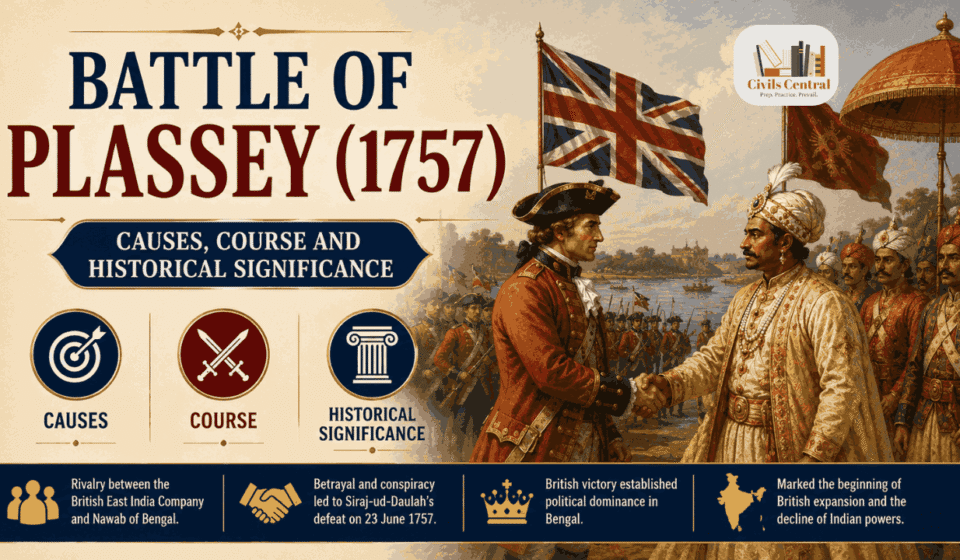

Chapter Summary
| Chapter Information | Details |
|---|---|
| Series | Modern History of India (1707–1947) |
| Module | Rise of British Power in India |
| Historical Period | 1756–1757 |
| Historical Phase | Transition from Commercial Influence to Political Control |
| Previous Chapter | Anglo-French Rivalry in India: The Carnatic Wars (1746–1763): The Struggle for European Supremacy in India |
| Current Chapter | Battle of Plassey (1757): The Beginning of British Political Supremacy in India |
| Next Chapter | Battle of Buxar (1764): The Real Foundation of British Rule in India |
| Core Theme | The Battle of Plassey marked the transformation of the English East India Company from a powerful commercial corporation into a decisive political power in India through diplomacy, conspiracy, military intervention, and control over Bengal’s resources. |
| Key Personalities | Siraj-ud-Daulah, Robert Clive, Mir Jafar, Jagat Seth, Rai Durlabh, Yar Lutuf Khan, Omichand (Amin Chand), Alivardi Khan, William Watts, Admiral Charles Watson |
| Key Places | Murshidabad, Calcutta (Fort William), Plassey (Palashi), Kasimbazar, Alinagar, Hugli River |
| Key Concepts | Political Conspiracy, Company-State, Dastaks, Black Hole Controversy, Treaty of Alinagar, Dual Loyalty, Commercial Imperialism, British Political Expansion |
| Major Events Covered | Accession of Siraj-ud-Daulah (1756), Capture of Kasimbazar, Capture of Calcutta, Black Hole Incident, Treaty of Alinagar (1757), Conspiracy against Siraj-ud-Daulah, Battle of Plassey (23 June 1757), Installation of Mir Jafar as Nawab |
| Historical Significance | Plassey gave the English East India Company decisive political influence in Bengal, immense financial resources, and the confidence to pursue territorial expansion across India. It marks the beginning of British political supremacy in the Indian subcontinent. |
| Exam Relevance | Extremely important for UPSC Prelims, UPSC GS Paper I (Modern History), JKPSC, JKAS, State PCS, CDS, CAPF, SSC, UGC-NET History, and University Examinations. |
Timeline
| Year | Event |
|---|---|
| 1740 | Alivardi Khan becomes Nawab of Bengal. |
| 1756 (April) | Siraj-ud-Daulah succeeds Alivardi Khan as Nawab of Bengal. |
| 1756 (June) | English capture tensions escalate; Kasimbazar Factory seized by Siraj-ud-Daulah. |
| 20 June 1756 | Calcutta captured by Siraj-ud-Daulah. |
| 1756 | Black Hole of Calcutta incident (controversial in historiography). |
| January 1757 | Robert Clive recaptures Calcutta. |
| February 1757 | Treaty of Alinagar signed between Siraj-ud-Daulah and the English. |
| March–June 1757 | Secret conspiracy organised against Siraj-ud-Daulah involving Mir Jafar and Company officials. |
| 23 June 1757 | Battle of Plassey fought between Siraj-ud-Daulah and the English East India Company. |
| 24 June 1757 | Siraj-ud-Daulah flees Murshidabad. |
| 29 June 1757 | Mir Jafar installed as Nawab of Bengal. |
The previous chapter examined the Carnatic Wars (1746–1763), where the English East India Company defeated the French and emerged as the strongest European power in India. Those conflicts demonstrated that commercial companies could influence Indian politics, maintain professional armies, and intervene in regional succession disputes. Yet, despite these achievements, the Company remained primarily a commercial organization. It possessed profitable trading settlements and growing military strength, but it did not yet exercise direct political authority over any major Indian province.
The opportunity to move beyond commerce emerged not in southern India but in Bengal, the richest province of the Mughal Empire. Blessed with fertile agriculture, flourishing industries, and thriving international trade, Bengal generated enormous wealth and occupied a central position in the economy of eighteenth-century India. Control over Bengal promised not only commercial prosperity but also the financial resources necessary to sustain large armies and ambitious political projects.
The accession of Siraj-ud-Daulah in 1756 brought the English East India Company into direct conflict with the Nawab of Bengal. What began as a dispute over fortifications, commercial privileges, and political authority quickly escalated into one of the most consequential confrontations in Indian history. Through diplomacy, conspiracy, military action, and strategic alliances, the Company transformed a regional political crisis into an opportunity for imperial expansion.
The Battle of Plassey, fought on 23 June 1757, was not the largest battle of the eighteenth century, nor was it the bloodiest. Yet its consequences were extraordinary. It altered the balance of power in eastern India, brought Bengal under decisive British influence, and supplied the English East India Company with the wealth and political authority that would finance its future conquests. Historians therefore regard Plassey as one of the defining turning points in modern Indian history—a battle whose significance far exceeded its scale.
Introduction
Few battles in world history have produced consequences as profound as the Battle of Plassey (23 June 1757). Fought between the army of Nawab Siraj-ud-Daulah and the forces of the English East India Company under Robert Clive, the engagement itself lasted only a few hours and involved relatively limited fighting. Yet its outcome transformed the political destiny of India. Within a single day, the balance of power shifted decisively in favour of a commercial corporation that had arrived in India merely to conduct trade a century and a half earlier. From this point onward, the English East India Company ceased to be simply one among several foreign trading companies; it became an emerging political power capable of determining the future of Indian states.
The significance of Plassey cannot be understood in isolation. It was the culmination of a series of developments that had reshaped eighteenth-century India. The decline of the Mughal Empire after the death of Aurangzeb had weakened central authority and encouraged the rise of autonomous regional states. Simultaneously, the Carnatic Wars had eliminated France as Britain’s principal European rival, leaving the English East India Company free to concentrate its resources on expanding its influence within India. Bengal, with its immense agricultural productivity, prosperous textile industry, and strategic commercial position, naturally became the focal point of this new phase of British ambition.
The immediate conflict arose from disputes between the Company and Siraj-ud-Daulah, the young Nawab of Bengal. Differences over unauthorized fortifications, misuse of commercial privileges, political interference, and the Company’s increasingly independent behaviour created an atmosphere of mutual suspicion. However, the dispute soon extended beyond administrative disagreements. Company officials realized that replacing an independent Nawab with a ruler dependent upon British support could secure not only commercial advantages but also political influence over the wealthiest province of the Mughal Empire. Consequently, diplomacy gave way to conspiracy, and commercial competition evolved into a struggle for political supremacy.
Unlike many earlier battles in Indian history, Plassey was decided as much by political betrayal as by military action. Secret negotiations with influential Bengali nobles, bankers, and military commanders—including Mir Jafar, Jagat Seth, and Rai Durlabh—weakened the Nawab’s position long before the armies met on the battlefield. The battle therefore illustrates an important feature of eighteenth-century politics: imperial expansion often depended less upon overwhelming military superiority than upon the successful manipulation of internal political divisions.
The consequences of Plassey were immediate and far-reaching. The installation of Mir Jafar as Nawab transformed Bengal into a state heavily dependent upon the English East India Company. Vast financial rewards flowed into Company coffers, enabling it to strengthen its armies, expand its administration, and finance future campaigns across India. In effect, Bengal became the economic foundation of British imperial expansion.
For this reason, historians frequently describe the Battle of Plassey as the beginning of British political supremacy in India. It did not establish complete British rule overnight, nor did it immediately destroy the authority of Indian states. Rather, it marked the moment when the English East India Company acquired the political confidence, financial resources, and strategic position necessary to transform itself into an imperial power. The road to British India, opened by the Carnatic Wars, truly began at Plassey.
Part I — Bengal on the Eve of Plassey: Why Was Bengal the Richest Province of India?
Why Did Bengal Become the Centre of British Imperial Ambitions?
To understand why the Battle of Plassey (1757) transformed the history of India, one must first understand the extraordinary importance of Bengal during the eighteenth century. The conflict between Siraj-ud-Daulah and the English East India Company was not fought over an ordinary province. Bengal was widely regarded as the wealthiest, most prosperous, and economically advanced province of the Mughal Empire. Its fertile agricultural lands, flourishing industries, extensive river network, and thriving international commerce made it one of the richest regions not only in India but in the entire world. Whoever exercised influence over Bengal acquired access to immense financial resources capable of shaping the political future of the Indian subcontinent.
During the reign of the Mughal emperors, Bengal had occupied a privileged position within the imperial administration. Governed by a Subahdar (Governor) appointed by the emperor, the province enjoyed remarkable prosperity due to its fertile delta formed by the Ganga, Brahmaputra, and Meghna river systems. Annual floods deposited nutrient-rich alluvial soil, making Bengal one of the most productive agricultural regions in Asia. Rice formed the staple crop, while sugarcane, oilseeds, indigo, silk, cotton, and opium were cultivated extensively. Agricultural abundance not only sustained a large population but also generated substantial land revenue, making Bengal the largest contributor to the Mughal imperial treasury.
Agriculture alone, however, does not explain Bengal’s exceptional prosperity. Equally important was its highly developed manufacturing sector. Bengal had earned an international reputation for producing some of the finest textiles in the world. The delicate Muslin of Dacca (Dhaka), often described by European travellers as “woven air,” represented one of the greatest achievements of pre-industrial craftsmanship. Equally renowned were Bengal’s silk fabrics from Murshidabad, fine cotton textiles, embroidered cloth, and printed fabrics, all of which enjoyed enormous demand in the markets of Europe, West Asia, and Southeast Asia. European trading companies competed intensely to secure contracts with Bengali weavers, recognising that textile exports formed the backbone of their commercial profits.
The province also occupied a uniquely advantageous geographical position. Bengal’s vast network of navigable rivers connected inland production centres with major ports along the Bay of Bengal, facilitating the efficient movement of agricultural produce, manufactured goods, and imported commodities. The Port of Calcutta, together with older commercial centres such as Hugli, Kasimbazar, and Murshidabad, emerged as important hubs of regional and international trade. Merchants from India, Persia, Arabia, Armenia, Southeast Asia, and Europe conducted business within Bengal, making it one of the most cosmopolitan commercial regions of the eighteenth-century world.
This commercial prosperity naturally attracted every major European trading company operating in India. The Portuguese, Dutch, French, Danish, and English all established factories in Bengal to participate in its lucrative trade. Yet by the middle of the eighteenth century, the English East India Company had acquired a particularly strong commercial position. From its settlement at Calcutta (Fort William), the Company exported enormous quantities of textiles, silk, saltpetre, and other valuable commodities to Europe. Bengal gradually became the Company’s most profitable trading centre in India, contributing a substantial proportion of its global commercial earnings.
The Company’s commercial privileges had been significantly strengthened by the Farman of Emperor Farrukhsiyar (1717). This imperial decree granted the English East India Company extensive trading concessions, including the right to carry goods within Bengal through dastaks without paying many internal customs duties. Although intended to facilitate Company trade, these privileges were increasingly abused by Company officials for private commercial gain. Goods belonging to private English merchants were frequently transported under Company protection, depriving the Nawab’s government of valuable customs revenue. What had originally been a commercial privilege gradually became a source of political tension between the Nawab of Bengal and the Company.
By the mid-eighteenth century, Bengal had also developed one of the most sophisticated financial systems in Asia. Wealthy banking families, particularly the influential Jagat Seths, exercised enormous economic influence by financing trade, advancing loans to rulers, and managing large-scale financial transactions. These banking networks linked Bengal’s economy with commercial centres across India and beyond. Their financial strength enabled them to influence political developments, a fact that would become critically important during the events leading to the Battle of Plassey.
Despite its prosperity, Bengal’s political situation was becoming increasingly fragile. The weakening authority of the Mughal Empire after Aurangzeb’s death in 1707 allowed provincial governors to exercise greater autonomy. Under capable rulers such as Murshid Quli Khan, Shuja-ud-Din Muhammad Khan, and later Alivardi Khan, Bengal remained relatively stable and prosperous while maintaining only nominal allegiance to the Mughal emperor. However, this growing autonomy also meant that the province increasingly had to defend its own political and economic interests without relying upon effective imperial support from Delhi.
Another important feature of Bengal was the coexistence of immense wealth with relatively limited military preparedness. Successive Nawabs concentrated upon efficient administration, revenue collection, and commercial development rather than maintaining exceptionally large standing armies. This policy proved successful during periods of political stability but became increasingly problematic as European trading companies expanded their military capabilities. By the 1750s, the English East India Company possessed fortified settlements, disciplined European-trained troops, and growing political ambitions that extended far beyond commerce.
The Company’s officials gradually realized that control over Bengal promised advantages far greater than profitable trade alone. The province’s immense revenues could finance larger armies, sustain military campaigns, and support territorial expansion throughout India. The wealth of Bengal therefore represented not merely economic prosperity but also the financial foundation of future imperial power. This strategic realization fundamentally changed the Company’s objectives. It no longer sought merely to trade within Bengal; it increasingly aspired to influence the government that controlled Bengal itself.
Historians often describe Bengal as the economic heart of eighteenth-century India, and this characterization is fully justified. Its agricultural abundance, thriving textile industry, advanced banking system, strategic location, and international commercial connections made it uniquely valuable. The struggle that culminated at Plassey was therefore not simply a conflict between a Nawab and a trading company. It was a contest over the wealthiest province of the Mughal Empire—a province whose resources would soon finance the rise of British power across the Indian subcontinent.
CivilsCentral Historical Insight
The Battle of Plassey was fought in Bengal because Bengal represented the greatest prize in eighteenth-century India. Its fertile agriculture, world-famous textile industry, prosperous banking networks, and flourishing international trade made it the economic centre of the Mughal Empire. By gaining control over Bengal, the English East India Company acquired not merely a province but the financial engine that would power the expansion of the British Empire throughout India.
Part II — Alivardi Khan and the Political Situation in Bengal: The Last Strong Nawab Before Plassey
How Did Alivardi Khan Preserve Bengal’s Stability in an Age of Political Fragmentation?
The prosperity that made Bengal the most coveted province of eighteenth-century India did not emerge by accident. It was the result of decades of capable administration, efficient revenue management, and political stability established under Nawab Alivardi Khan (1740–1756). By the time the English East India Company began expanding its political ambitions, Bengal had already become one of the best-governed regions of the former Mughal Empire. Yet the very stability that Alivardi Khan painstakingly created concealed structural weaknesses that became apparent only after his death. His reign therefore represents the final phase of independent and effective provincial governance before Bengal entered the turbulent politics that culminated in the Battle of Plassey.
Alivardi Khan assumed power in 1740 after defeating Sarfaraz Khan in the Battle of Giria. Although he formally acknowledged the authority of the Mughal Emperor, his accession reflected the growing political reality of eighteenth-century India. Like the rulers of Hyderabad, Awadh, and other regional states, Alivardi exercised almost complete autonomy in internal administration while maintaining only nominal allegiance to Delhi. Bengal thus remained a Mughal province in theory but functioned as an independent state in practice.
From the outset of his reign, Alivardi Khan recognized that political stability depended upon efficient administration rather than military conquest. Unlike many contemporary rulers who sought territorial expansion, he concentrated upon strengthening Bengal’s internal governance. Revenue administration was carefully supervised, corruption among provincial officials was controlled as far as possible, and agricultural production was actively protected. These measures enabled Bengal to continue generating enormous revenues while maintaining relative prosperity despite the widespread political instability affecting much of northern India.
One of the greatest challenges confronting Alivardi Khan was the repeated invasion of Bengal by the Marathas. During the 1740s, the Maratha forces launched a series of devastating raids, commonly remembered in Bengal as the Bargi invasions. These expeditions were not intended to establish permanent political control but to extract tribute and plunder the prosperous province. The raids caused extensive destruction of villages, disrupted agricultural production, weakened trade, and created widespread insecurity among the rural population. Contemporary Bengali literature vividly describes the fear and suffering caused by these incursions, illustrating the profound social impact of the Maratha campaigns.
Alivardi Khan devoted a significant portion of his reign to resisting these invasions. Despite his advanced age, he personally directed several military campaigns against the Marathas and attempted to protect Bengal’s productive heartland. However, the repeated nature of the attacks imposed enormous financial and administrative burdens upon the provincial government. Eventually, recognizing the limitations of prolonged warfare, Alivardi adopted a pragmatic approach. Through negotiation, he accepted the payment of chauth over parts of Orissa, thereby reducing the intensity of Maratha incursions and restoring relative peace to Bengal. Although this settlement involved political compromise, it enabled the province to recover economically and prevented even greater destruction.
While confronting external threats, Alivardi Khan remained equally cautious about the growing influence of European trading companies. By the mid-eighteenth century, the English, French, Dutch, and other European companies had established important commercial settlements within Bengal. Alivardi welcomed foreign trade because it contributed significantly to the provincial economy. However, he drew a clear distinction between commercial activity and political authority. European merchants were permitted to conduct business, but they were not allowed to interfere in the administration of the province or strengthen their military establishments without the Nawab’s approval.
This policy reflected Alivardi’s keen understanding of the changing international environment. He closely observed the Carnatic Wars in southern India, where the English and French East India Companies had transformed themselves from commercial organizations into military and political powers. The experiences of the Carnatic convinced him that European companies could become dangerous if permitted to fortify their settlements or intervene in regional politics. Consequently, he consistently opposed any attempt by the English East India Company to expand its military infrastructure within Bengal.
According to later historical accounts, Alivardi Khan is believed to have warned his successor about the dangers posed by the English East India Company. Although the exact wording of these statements remains debated among historians, the underlying principle is widely accepted. Alivardi understood that the Company’s ambitions extended beyond commerce and that failure to regulate its growing military strength could eventually threaten the sovereignty of Bengal. His cautious approach therefore represented not hostility towards European trade but a realistic assessment of the political transformation taking place in India.
Despite his administrative abilities, Alivardi Khan faced one challenge that he could not fully resolve—the question of succession. Having no surviving sons, he designated his grandson Siraj-ud-Daulah as his successor. This decision generated considerable resentment within influential sections of the Bengal nobility. Powerful court factions, wealthy banking families, senior military commanders, and members of the Nawab’s extended family held differing political preferences regarding the succession. Although Alivardi managed to maintain their loyalty during his lifetime through personal authority and political experience, these underlying rivalries remained unresolved.
When Alivardi Khan died in April 1756, Bengal lost not merely an experienced administrator but also the central figure who had balanced competing political interests for more than fifteen years. His death removed the authority that had restrained factional conflict within the provincial administration. The accession of the young and inexperienced Siraj-ud-Daulah immediately exposed these divisions, creating an atmosphere of political uncertainty that the English East India Company would soon exploit with remarkable effectiveness.
Modern historians generally regard Alivardi Khan as the last great independent Nawab of Bengal. Under his leadership, Bengal remained prosperous, politically stable, and largely free from European interference despite the decline of Mughal authority elsewhere in India. Yet his reign also illustrates a broader pattern visible across eighteenth-century India. Strong regional rulers could preserve stability through personal leadership and administrative competence, but they often failed to establish institutions capable of ensuring the same stability after their death. The transition from Alivardi Khan to Siraj-ud-Daulah therefore marked the beginning of a political crisis that would culminate in one of the most consequential battles in Indian history.
The story of Plassey cannot be understood without appreciating Alivardi Khan’s legacy. He left behind a province of extraordinary wealth, efficient administration, and strategic importance. However, he also left a politically divided court, unresolved succession disputes, and a rapidly expanding European trading company whose ambitions extended far beyond commerce. These circumstances would define the challenges confronting his successor and shape the events that followed.
CivilsCentral Historical Insight
Alivardi Khan preserved Bengal’s prosperity through efficient administration, cautious diplomacy, and firm control over European trading companies. Yet the stability of his regime depended heavily upon his personal authority rather than durable political institutions. His death in 1756 removed the strongest defender of Bengal’s sovereignty, leaving a wealthy but politically divided province that soon became the principal target of the English East India Company’s imperial ambitions.
Part III — Siraj-ud-Daulah: Accession, Personality and the Challenges Before the Young Nawab
Why Did Siraj-ud-Daulah Face a Crisis Immediately After Becoming Nawab?
When Alivardi Khan died in April 1756, the province of Bengal stood at the height of its economic prosperity but at the threshold of a major political crisis. His chosen successor, Siraj-ud-Daulah, inherited one of the richest provinces of the former Mughal Empire, yet he also inherited a deeply divided political establishment. Unlike his grandfather, whose long experience and personal authority had enabled him to maintain stability, Siraj-ud-Daulah ascended the throne at a time when powerful nobles, wealthy bankers, military commanders, and European trading companies were all competing to shape the future of Bengal. His reign began not with political unity but with suspicion, factional rivalry, and growing external pressure.
Siraj-ud-Daulah was the grandson of Alivardi Khan and had been designated as his successor several years before the latter’s death. Alivardi regarded him as energetic, courageous, and capable of defending Bengal’s independence against both internal and external threats. However, this nomination was far from universally accepted. Several influential members of the Bengal aristocracy believed that other claimants possessed stronger political credentials and greater administrative experience. Consequently, the moment Siraj ascended the throne, he faced opposition from within his own court rather than from foreign enemies alone.
Among the most influential opponents was Ghaseti Begum, the wealthy and politically ambitious eldest daughter of Alivardi Khan. Possessing immense financial resources and considerable influence among sections of the Bengal nobility, she became the centre of a powerful faction opposed to Siraj’s succession. Equally important was Mir Jafar, the Commander-in-Chief of the Bengal army. Although outwardly loyal, Mir Jafar felt increasingly dissatisfied with Siraj’s policies and believed that his own political ambitions had been ignored. These court rivalries, though initially concealed beneath formal expressions of loyalty, would later play a decisive role in the events leading to the Battle of Plassey.
Another influential group whose relationship with the new Nawab soon deteriorated consisted of Bengal’s leading banking and commercial families. Foremost among them were the Jagat Seths, whose financial resources were so extensive that they exercised considerable influence over provincial politics. For decades, successive Nawabs had relied upon these banking houses to finance administration, military campaigns, and commercial transactions. Siraj-ud-Daulah, however, sought to reduce the political influence of these powerful financiers and strengthen the authority of the Nawab over the provincial administration. This policy generated resentment among sections of Bengal’s commercial elite, many of whom gradually became receptive to alternative political arrangements.
Historians have often debated the personality and administrative abilities of Siraj-ud-Daulah. Early British writers portrayed him as impulsive, inexperienced, and tyrannical, arguing that his alleged misgovernment justified British intervention. Such descriptions strongly influenced nineteenth-century imperial historiography and were frequently used to present the English East India Company as a force restoring political stability.
Modern historical scholarship, however, presents a far more balanced assessment. Many historians argue that these earlier portrayals were shaped by the desire to justify British conquest after Plassey. Contemporary Persian records and later Indian historians suggest that although Siraj-ud-Daulah was undoubtedly young and occasionally impulsive, he was neither an incompetent ruler nor an unusually oppressive monarch by the standards of eighteenth-century politics. Rather, he faced extraordinary challenges immediately upon his accession, including entrenched court factions, ambitious military commanders, influential financiers, and increasingly assertive European trading companies.
One of Siraj-ud-Daulah’s defining political objectives was the preservation of Bengal’s sovereignty. Like his grandfather, he accepted the commercial presence of European companies but strongly opposed their growing military and political ambitions. By the mid-eighteenth century, the English East India Company had begun fortifying Fort William at Calcutta, expanding its military establishment, and increasingly behaving as an autonomous political authority rather than a commercial organization. Siraj regarded these developments as a direct challenge to the authority of the Nawab.
His concerns were not unfounded. The experiences of southern India during the Carnatic Wars had already demonstrated how European companies could exploit internal political divisions to establish territorial influence. Siraj carefully observed these developments and feared that Bengal might become the next arena of European political intervention. Consequently, he adopted a firm policy towards all foreign trading companies, insisting that they respect the authority of the provincial government and refrain from undertaking military activities without official permission.
This policy inevitably brought him into conflict with the English East India Company. Company officials believed that their commercial privileges under the Farman of Farrukhsiyar (1717) entitled them to considerable autonomy in Bengal. They continued strengthening the fortifications of Calcutta, expanded military preparations without the Nawab’s consent, and frequently misused dastaks to evade customs duties. From Siraj’s perspective, these actions represented not merely administrative disagreements but systematic violations of his sovereign authority. From the Company’s perspective, they were necessary measures to protect commercial interests during a period of international instability.
Siraj also faced the difficult task of consolidating authority over a province whose administrative machinery had become increasingly decentralized. Powerful zamindars, provincial officials, military commanders, and commercial interests had accumulated considerable influence during the later years of Alivardi Khan’s reign. Attempting to reassert central authority inevitably created political resistance. Thus, even before confronting the English East India Company, Siraj found himself engaged in a struggle to establish effective control over his own administration.
The greatest weakness of Siraj-ud-Daulah’s position was therefore not military inferiority but political isolation. Although he possessed a large army and governed the richest province of India, he could not rely upon the wholehearted loyalty of many influential figures within his own court. The English East India Company would later exploit precisely these internal divisions, demonstrating that political conspiracies could prove more decisive than battlefield victories.
Modern historians increasingly argue that Siraj-ud-Daulah should be understood not as a reckless ruler whose actions invited British conquest but as the last Nawab of Bengal who made a determined attempt to preserve the political independence of his province. His insistence that the English East India Company remain a commercial organization rather than an autonomous military power reflected a realistic appreciation of the changing political circumstances in eighteenth-century India. Ironically, the policies that brought him into conflict with the Company were motivated by the very objective that later generations would recognize as the defence of Bengal’s sovereignty.
The accession of Siraj-ud-Daulah therefore marked the beginning of an inevitable confrontation. On one side stood a young Nawab determined to preserve the authority of his government; on the other stood a rapidly expanding commercial corporation increasingly prepared to use military force and political intrigue to secure its objectives. The collision between these two visions of power would soon transform Bengal—and ultimately the entire Indian subcontinent.
CivilsCentral Historical Insight
Siraj-ud-Daulah inherited wealth but not stability. His greatest challenge was not the strength of the English East India Company alone, but the growing disunity within Bengal’s political elite. Determined to preserve the sovereignty of his province, he confronted a commercial corporation whose ambitions had already outgrown trade. The conflict that followed was therefore not simply a clash of personalities but a contest between indigenous political authority and an emerging colonial power.
Part IV — Growing Tensions Between Siraj-ud-Daulah and the English East India Company: From Commercial Disputes to Political Confrontation
Why Did Relations Between the Nawab of Bengal and the English East India Company Deteriorate?
When Siraj-ud-Daulah ascended the throne of Bengal in 1756, neither he nor the English East India Company initially sought open war. Both understood the immense economic importance of Bengal and recognized the mutual benefits of continued trade. The Nawab depended upon commerce for provincial prosperity and revenue, while the Company derived a substantial portion of its global profits from Bengal’s flourishing textile and export trade. Yet beneath this apparent cooperation lay a series of disputes that steadily eroded mutual trust. These disagreements were not isolated incidents but reflected a deeper conflict over political authority. Siraj-ud-Daulah believed that the English East India Company remained subject to the sovereignty of the Nawab, whereas the Company increasingly behaved as an autonomous political and military power. This fundamental disagreement transformed commercial disputes into an inevitable political confrontation.
One of the earliest sources of conflict was the unauthorized fortification of Calcutta. During the early eighteenth century, the English settlement at Fort William had functioned primarily as a commercial centre. However, the outbreak of the Seven Years’ War in Europe and the recent experience of the Carnatic Wars convinced Company officials that their settlements required stronger military protection. Without obtaining permission from the Nawab, the Company began repairing and strengthening the fortifications of Fort William, constructing additional defensive works, and increasing the military preparedness of Calcutta.
From the Company’s perspective, these measures were purely defensive. British officials argued that French aggression elsewhere in India made improved fortifications essential for protecting Company property and personnel. Siraj-ud-Daulah, however, interpreted these actions very differently. He regarded the construction of military defences without official approval as a direct challenge to his authority. In eighteenth-century India, the right to build forts and maintain armed establishments belonged to the sovereign ruler. By fortifying Calcutta independently, the Company appeared to be asserting political autonomy rather than merely ensuring commercial security.
A second and equally contentious issue concerned the misuse of dastaks. Under the Farman issued by Emperor Farrukhsiyar in 1717, the English East India Company had received valuable commercial privileges, including exemption from many internal customs duties on goods transported for Company trade. These privileges were originally intended to facilitate international commerce. Over time, however, Company officials increasingly extended the use of dastaks to their own private commercial activities. Goods belonging to individual English merchants were transported under Company protection, enabling them to evade customs duties that Indian merchants were still required to pay.
The consequences for the Bengal government were severe. Customs duties constituted an important source of provincial revenue, and their widespread evasion reduced the income of the Nawab’s administration. More importantly, Indian merchants found themselves at a serious competitive disadvantage because they continued paying taxes while their European competitors frequently escaped them. Siraj-ud-Daulah viewed this practice as both economically harmful and politically unacceptable. In his opinion, the Company was exploiting privileges granted for trade to undermine the fiscal authority of the Bengal government.
Relations deteriorated further because of the Company’s growing interference in Bengal’s internal politics. During the later years of Alivardi Khan’s reign, Company officials had generally avoided open involvement in court affairs. Under Siraj-ud-Daulah, however, the English increasingly established close relationships with influential members of the Bengal aristocracy, wealthy bankers, and dissatisfied military commanders. Although such contacts were initially presented as ordinary diplomatic interactions, the Nawab suspected that the Company intended to influence political developments within his court. These suspicions proved well founded, for many of the individuals with whom Company officials maintained close relations—including Mir Jafar, Jagat Seth, and other influential nobles—would later become central figures in the conspiracy that led to the Battle of Plassey.
Another incident that intensified the conflict involved Krishna Das, the son of Raj Ballabh, an influential official associated with political opposition to Siraj-ud-Daulah. Fearing the Nawab’s actions against rival factions, Krishna Das sought refuge within the English settlement at Calcutta, taking with him considerable wealth and valuable property. Siraj demanded that the English hand him over, arguing that harbouring individuals accused of political offences constituted interference in the internal affairs of Bengal.
The Company refused to comply. English officials claimed that they could not surrender a person who had sought their protection. To Siraj-ud-Daulah, however, this refusal represented a direct affront to his sovereign authority. By providing asylum to one of his political opponents, the Company appeared to be acting not as a foreign trading corporation but as an independent political entity capable of challenging the jurisdiction of the Nawab’s government.
The cumulative effect of these disputes profoundly altered Siraj-ud-Daulah’s perception of the English East India Company. During his grandfather’s reign, European companies had remained commercial organizations operating under provincial authority. By 1756, however, the English possessed fortified settlements, disciplined armies, expanding commercial privileges, growing political influence, and increasing confidence derived from their recent successes against the French. To Siraj, these developments suggested that the Company no longer intended to remain merely a merchant enterprise. It was gradually transforming itself into a political power within Bengal.
The Company’s own behaviour reinforced these fears. Instead of treating the Nawab as the unquestioned sovereign of Bengal, Company officials increasingly negotiated from a position of equality. Decisions concerning military preparations, commercial privileges, and political relations were often taken without consulting the provincial government. Such conduct reflected the Company’s growing belief that its commercial interests justified an unusual degree of administrative independence. What Company officials regarded as necessary autonomy, Siraj regarded as a systematic erosion of his authority.
Modern historians emphasize that the conflict between Siraj-ud-Daulah and the English East India Company was therefore not caused by a single dispute. Unauthorized fortifications, misuse of dastaks, protection of political fugitives, and growing political interference each contributed to rising tensions, but all reflected a more fundamental disagreement over sovereignty. Siraj insisted that every foreign trading company remained subject to the authority of the Nawab. The English increasingly behaved as though their commercial privileges entitled them to political independence. By the middle of 1756, reconciliation had become increasingly difficult because the dispute concerned not merely trade but the question of who exercised supreme authority in Bengal.
These tensions soon reached a breaking point. Convinced that peaceful warnings had failed, Siraj-ud-Daulah decided to assert his authority through military action. His first objective would be the English factory at Kasimbazar, followed by the Company’s principal settlement at Calcutta. What had begun as a commercial disagreement was about to become an armed conflict whose consequences would permanently transform the history of India.
CivilsCentral Historical Insight
The conflict between Siraj-ud-Daulah and the English East India Company was fundamentally a constitutional struggle over sovereignty. The Nawab sought to enforce his authority over a foreign trading corporation, while the Company increasingly claimed privileges that placed it beyond provincial control. The disputes over fortifications, dastaks, and political asylum were therefore symptoms of a deeper transformation—the emergence of the English East India Company from a commercial enterprise into an autonomous political power.
Part V — Immediate Causes of the Battle of Plassey: Why Did Conflict Become Inevitable?
Why Did Political Tension Finally Turn into War?
By the middle of 1756, relations between Siraj-ud-Daulah and the English East India Company had deteriorated beyond ordinary diplomatic disagreement. The disputes over unauthorized fortifications, misuse of commercial privileges, political interference, and the protection of the Nawab’s political opponents had created an atmosphere of deep mistrust. Nevertheless, neither side had yet resorted to military action. The final step towards war resulted from a series of immediate developments that convinced Siraj-ud-Daulah that the Company no longer respected the sovereignty of Bengal and that decisive action was necessary to restore his authority.
These immediate causes did not arise in isolation. Rather, they represented the culmination of a gradual transformation in the Company’s role within Bengal—from a commercial corporation operating under the Nawab’s protection to a military and political power increasingly acting according to its own interests.
Unauthorized Fortification of Calcutta
The most visible cause of conflict was the Company’s continued fortification of Fort William at Calcutta without the permission of the Nawab.
Following the outbreak of the Seven Years’ War in Europe, Company officials feared that French forces might attack their settlements in Bengal, just as they had done during the Carnatic Wars. To strengthen their defences, they repaired the walls of Fort William, constructed additional fortifications, mounted new artillery, and expanded military preparations.
From the Company’s perspective, these measures were purely defensive and intended to protect British commercial interests. Siraj-ud-Daulah, however, interpreted them very differently. Under the political traditions of the Mughal Empire, the construction of fortifications and the maintenance of military establishments were privileges reserved for the sovereign authority. No foreign trading company possessed the right to strengthen its military position without official approval.
Siraj therefore ordered the English to stop all fortification work immediately.
The Company ignored these instructions.
To the Nawab, this refusal was not merely an act of disobedience; it was an open challenge to the authority of the Bengal government. If a foreign trading corporation could fortify its settlements independently, it was effectively asserting political autonomy within his province.
Misuse of Dastaks and Loss of Revenue
A second major cause of conflict concerned the widespread misuse of dastaks. The Farman of Emperor Farrukhsiyar (1717) had granted the English East India Company the privilege of transporting goods for Company trade without paying many internal customs duties. These exemptions were intended to encourage international commerce and applied specifically to the Company’s official business.
Over time, however, Company officials increasingly used these privileges for private trade. Individual English merchants transported their personal goods under Company passes, thereby avoiding taxes that Indian merchants continued to pay.
This practice created two serious problems.
First, it caused substantial financial losses to the Bengal government by reducing customs revenue.
Second, it created unfair competition by placing Indian merchants at a disadvantage in their own markets.
Siraj-ud-Daulah regarded this misuse of imperial privileges as a violation of both economic justice and provincial authority. The English, however, showed little willingness to abandon these profitable practices. Thus, what began as a commercial privilege gradually became an important political dispute.
Political Interference in Bengal’s Internal Affairs
Siraj-ud-Daulah became increasingly convinced that the English East India Company was interfering in the internal politics of Bengal.
Company officials maintained close contacts with influential nobles, wealthy bankers, military commanders, and dissatisfied members of the Bengal court. Although these relationships were presented as normal diplomatic interactions, the Nawab suspected that they formed part of a broader attempt to influence political developments within his administration.
Subsequent events proved that these suspicions were well founded.
Several individuals with whom the Company maintained secret communications—including Mir Jafar, Jagat Seth, and Rai Durlabh—would later become principal participants in the conspiracy against the Nawab.
To Siraj-ud-Daulah, these activities demonstrated that the Company no longer intended merely to conduct trade. It was gradually positioning itself as an active participant in the politics of Bengal.
Protection Given to Krishna Das
Another immediate source of confrontation involved Krishna Das, the son of Raj Ballabh, an influential official opposed to Siraj-ud-Daulah. When political tensions increased after Siraj’s accession, Krishna Das fled to Calcutta, taking with him considerable wealth, and sought protection within the English settlement.
The Nawab demanded that the Company surrender him immediately. The English refused. From the Company’s perspective, this decision reflected a humanitarian obligation to protect a person seeking refuge.
From Siraj’s perspective, however, it represented direct interference in the internal administration of Bengal. By sheltering one of his political opponents and refusing to obey his orders, the Company appeared to deny the Nawab’s judicial and political authority.
The incident further convinced Siraj that the English were behaving as an independent political power rather than as subjects engaged in foreign trade.
Growing Military Ambitions of the English East India Company
Behind these immediate disputes lay an even deeper concern. The English East India Company had undergone a remarkable transformation during the previous decade. Its victories in the Carnatic Wars, its disciplined European-trained armies, its expanding fortifications, and its increasing confidence all suggested that the Company was no longer satisfied with commercial prosperity alone.
Siraj-ud-Daulah had carefully observed developments in southern India, where European companies had intervened in succession disputes and influenced regional politics. He feared that Bengal might become the next victim of the same strategy.
His apprehensions were reinforced by the Company’s growing military establishment at Calcutta and its refusal to recognize the authority of the provincial government. Consequently, Siraj concluded that delay would only strengthen the Company’s position further.
Breakdown of Trust Between the Nawab and the Company
By June 1756, the relationship between the two sides had reached a point where peaceful compromise became increasingly difficult.
Siraj-ud-Daulah believed that:
- the Company was violating his sovereignty,
- weakening Bengal’s finances,
- interfering in provincial politics,
- strengthening its military position,
- and preparing to challenge the authority of the Nawab.
The English East India Company, on the other hand, believed that its commercial privileges, military preparations, and defensive measures were necessary to protect its interests during a period of international uncertainty.
Neither side trusted the intentions of the other. Diplomatic negotiations gradually gave way to military preparations.
Convinced that the Company’s growing independence posed a serious threat to the sovereignty of Bengal, Siraj-ud-Daulah decided to act decisively. His first objective was to seize the English factory at Kasimbazar, followed by the Company’s principal settlement at Calcutta. These actions would set in motion the chain of events that ultimately culminated in the Battle of Plassey on 23 June 1757.
CivilsCentral Historical Insight
The Battle of Plassey did not arise from a single dispute but from the gradual collapse of political trust between the Nawab of Bengal and the English East India Company. The issues of fortifications, dastaks, political interference, and military expansion all reflected a deeper constitutional conflict over sovereignty. By 1756, the question was no longer whether conflict would occur, but when and under what circumstances it would begin.
Part VI — Capture of Kasimbazar and Calcutta (1756): The Nawab’s Assertion of Sovereign Authority
Why Did Siraj-ud-Daulah Attack the English Settlements?
By June 1756, Siraj-ud-Daulah had reached the conclusion that diplomatic warnings alone would no longer compel the English East India Company to respect the authority of the Bengal government. Repeated instructions to halt the fortification of Fort William, surrender Krishna Das, and discontinue the misuse of commercial privileges had either been ignored or only partially implemented. To the Nawab, the Company’s conduct demonstrated a deliberate refusal to acknowledge his sovereignty. Consequently, he decided to enforce his authority through military action.
His objective was not initially to expel the English from Bengal or destroy their commercial activities. Rather, he intended to compel the Company to obey the laws of the province and reaffirm that every European trading company remained subordinate to the authority of the Nawab. The first target of this campaign was the Company’s important commercial factory at Kasimbazar, followed shortly afterwards by its principal settlement at Calcutta.
The Capture of Kasimbazar Factory
The English East India Company’s factory at Kasimbazar, located near the provincial capital Murshidabad, was one of its most valuable commercial establishments in Bengal. It served as an important centre for the purchase and storage of silk, textiles, and other export commodities. Owing to its proximity to the Nawab’s capital, it also functioned as a key administrative and diplomatic centre for Company operations.
In June 1756, Siraj-ud-Daulah marched towards Kasimbazar with his army and surrounded the English factory. The Company’s officials, surprised by the speed of the Nawab’s advance and lacking adequate military resources, were unable to organize effective resistance. The factory was surrendered without any significant fighting. Company property was seized, military stores were confiscated, and English officials were taken into custody.
The capture of Kasimbazar carried considerable symbolic importance. It demonstrated that the Nawab possessed both the authority and the military capacity to act against a European trading company that disregarded provincial orders. More importantly, it served as a warning to the English authorities at Calcutta that continued defiance would invite even stronger action.
However, instead of encouraging compromise, the fall of Kasimbazar further deepened mutual suspicion. Company officials at Calcutta interpreted the Nawab’s action as a direct threat to their commercial interests and accelerated preparations for defence.
March Towards Calcutta
Having secured Kasimbazar, Siraj-ud-Daulah turned his attention towards Calcutta, the headquarters of the English East India Company in Bengal.
Unlike Kasimbazar, Fort William possessed stronger fortifications and a larger European population. Nevertheless, the settlement was poorly prepared for a determined military assault. Many defensive works remained incomplete, military coordination was weak, and disagreements existed among Company officials regarding the appropriate response to the Nawab’s advance.
As Siraj’s army approached Calcutta, confusion spread among the English administration. Some officials advocated negotiation, while others favoured military resistance. The absence of unified leadership seriously weakened the Company’s position at a critical moment.
The situation deteriorated further when several senior English officials abandoned the settlement and escaped by ship down the Hugli River. Among those who fled was Governor Roger Drake, whose departure created widespread panic among the defenders. The responsibility for defending Fort William consequently fell upon a much smaller group of officers and soldiers who remained within the fort.
The Fall of Fort William
After advancing upon Calcutta, Siraj-ud-Daulah laid siege to Fort William. The Company’s defenders resisted for a brief period, but the disparity in numbers and the lack of effective leadership made prolonged defence impossible.
On 20 June 1756, the English surrendered the fort.
The capture of Calcutta represented one of the most significant military successes achieved by an Indian ruler against the English East India Company during the eighteenth century. For Siraj-ud-Daulah, it appeared to confirm that the sovereignty of Bengal had been successfully reasserted. The unauthorized fortifications had been dismantled, Company resistance had been overcome, and the principal English settlement had been brought under the authority of the provincial government.
The Nawab ordered the city to be renamed Alinagar, honouring his grandfather Alivardi Khan, symbolizing the restoration of his authority over the province.
At this stage, there was little indication that the English East India Company would soon recover from this setback. On the contrary, many contemporary observers believed that the Company had suffered one of the greatest defeats in its Indian history.
British Reaction to the Loss of Calcutta
The fall of Calcutta profoundly shocked the English East India Company. Calcutta was not merely an important trading station; it served as the administrative headquarters of British commercial operations in Bengal. Its loss threatened the Company’s investments, interrupted trade, and damaged British prestige throughout India.
News of the defeat quickly reached Madras, where Company officials immediately recognized the seriousness of the situation. Unlike earlier commercial disputes, the capture of Calcutta directly challenged British influence in eastern India. The Madras Council therefore resolved to dispatch a powerful expedition under Colonel Robert Clive, supported by Admiral Charles Watson, to recover the settlement.
Thus, an operation that Siraj-ud-Daulah had intended as an assertion of provincial sovereignty inadvertently triggered a much larger military response from the English East India Company.
A Temporary Victory with Long-Term Consequences
From Siraj-ud-Daulah’s perspective, the capture of Kasimbazar and Calcutta represented a legitimate exercise of sovereign authority. European companies operating within Bengal were expected to obey provincial laws, and those who violated them could be punished accordingly.
The English East India Company, however, interpreted these events very differently. Company officials regarded the loss of Calcutta as an unacceptable attack upon British commercial interests and believed that only decisive military retaliation could restore their prestige.
The fall of Calcutta therefore became the immediate turning point in Anglo-Bengal relations. It transformed a constitutional dispute over commercial privileges into an open military conflict between the Nawab of Bengal and the English East India Company.
In the months that followed, Robert Clive would arrive from Madras, recapture Calcutta, negotiate the Treaty of Alinagar, and simultaneously begin secret negotiations with dissatisfied Bengali nobles. These developments would ultimately culminate in one of the most famous conspiracies in Indian history and the decisive Battle of Plassey (23 June 1757).
CivilsCentral Historical Insight
The capture of Kasimbazar and Calcutta was not initially an attempt to establish British rule or overthrow the Nawab. It was Siraj-ud-Daulah’s effort to enforce the sovereignty of Bengal over a foreign trading company that had increasingly challenged provincial authority. Ironically, this assertion of independence provoked the very military intervention that would ultimately destroy Bengal’s political autonomy.
Part VII — The Black Hole of Calcutta (1756): History, Controversy and Historical Debate
Did the Black Hole of Calcutta Really Happen?
Among all the events associated with the Battle of Plassey, few have generated as much historical controversy as the Black Hole of Calcutta. For more than a century, British historians presented it as one of the greatest atrocities committed against Europeans in India and used it to justify the subsequent military actions of the English East India Company. Modern historians, however, have questioned many aspects of the traditional narrative, arguing that it was exaggerated and later employed as an instrument of colonial propaganda.
Consequently, the Black Hole of Calcutta is significant not only because of what may have happened on the night of 20 June 1756, but also because it illustrates how historical events can be interpreted differently according to changing political and intellectual contexts.
The Traditional British Narrative
According to the traditional British account, after the capture of Fort William on 20 June 1756, the surviving English prisoners were arrested by the soldiers of Siraj-ud-Daulah. During the night, they were allegedly confined inside a small guardroom within the fort, later known as the “Black Hole.”
The principal source for this account was John Zephaniah Holwell, a senior Company official who claimed to have survived the incident. Holwell asserted that 146 prisoners were forced into a room measuring approximately 18 feet by 14 feet. According to his description, the room lacked adequate ventilation, and the prisoners suffered extreme heat, thirst, and suffocation throughout the night. By the following morning, he claimed that only 23 persons survived, while the remaining prisoners died from overcrowding and exhaustion.
Holwell’s account was published soon after the event and quickly became widely known in Britain. It profoundly influenced public opinion by portraying Siraj-ud-Daulah as a cruel and tyrannical ruler. The incident was frequently cited to justify British military retaliation and later became an important element of imperial historiography.
British Interpretation and Political Impact
For nineteenth-century British historians, the Black Hole of Calcutta symbolized what they described as the barbarity of Indian rulers and the necessity of British intervention in India.
The event was repeatedly presented in official histories, school textbooks, and public speeches as evidence that the English East India Company had fought not merely for commercial interests but also to restore justice and civilized government.
A memorial was even erected in Calcutta to commemorate the alleged victims, reinforcing the incident’s symbolic importance within the British Empire.
As a result, the Black Hole narrative became closely associated with the justification of British political expansion following the Battle of Plassey.
Revisionist Criticism of Holwell’s Account
From the twentieth century onwards, historians began to re-examine Holwell’s narrative with greater critical scrutiny.
Several scholars questioned the accuracy of his figures, observations, and conclusions.
One of the principal criticisms concerns the number of prisoners. Modern researchers argue that the small guardroom described by Holwell could not physically accommodate 146 individuals. Contemporary military records also fail to support such a large number of prisoners being present after the fall of Fort William.
Historians have therefore suggested that the actual number of prisoners was likely much smaller and that the number of deaths was significantly lower than Holwell claimed.
Another important issue concerns Siraj-ud-Daulah’s personal responsibility. Holwell’s account implied that the tragedy resulted directly from the Nawab’s cruelty. Later historical research, however, indicates that there is no convincing evidence that Siraj personally ordered the imprisonment of the prisoners under such conditions.
Many scholars argue that if the incident occurred, it was more likely the result of confusion, negligence, or poor supervision by local guards following the capture of the fort rather than a deliberate act planned by the Nawab himself.
Nationalist Interpretation
Indian nationalist historians challenged the traditional British version even more strongly. Historians such as R.C. Majumdar, Brijen Gupta, and others argued that the incident had been greatly exaggerated in order to create moral justification for British conquest.
They pointed out that British officials rarely emphasized the Company’s own violations of Bengal’s sovereignty—such as unauthorized fortifications, misuse of dastaks, and political interference—while repeatedly highlighting the Black Hole episode.
From this perspective, the incident became part of a broader colonial narrative portraying British expansion as an act of justice rather than imperial ambition.
Nationalist historians therefore regard the Black Hole controversy as an example of how historical events may be selectively interpreted to support political objectives.
The Modern Historical Consensus
Most contemporary historians adopt a balanced position. Few deny that some prisoners were almost certainly confined under extremely harsh conditions after the fall of Fort William. However, the dramatic figures presented by Holwell are generally regarded with considerable skepticism.
Modern scholarship suggests that:
- Some prisoners probably died due to overcrowding and lack of ventilation.
- The number of prisoners and deaths was almost certainly much lower than Holwell claimed.
- There is insufficient evidence to attribute deliberate responsibility to Siraj-ud-Daulah.
- The incident was later magnified in British political discourse to justify colonial expansion.
Thus, the Black Hole of Calcutta is now studied not merely as an isolated historical event but also as an important example of the relationship between history, memory, and political propaganda.
Historical Importance of the Black Hole Controversy
Regardless of the precise number of victims, the Black Hole incident had enormous political consequences. News of the event spread rapidly to Madras, where it intensified demands for immediate military retaliation.
The English East India Company used the capture of Calcutta and the reported deaths of British prisoners to justify dispatching a powerful expedition under Robert Clive and Admiral Charles Watson. The recapture of Calcutta in early 1757 marked the beginning of the chain of events that eventually culminated in the Battle of Plassey.
In this sense, the historical significance of the Black Hole lies less in the disputed details of the incident itself than in its influence upon British public opinion, Company policy, and the subsequent expansion of British political power in India.
CivilsCentral Historical Insight
The Black Hole of Calcutta remains one of the most debated episodes in modern Indian history. While there is little doubt that some prisoners suffered after the fall of Fort William, modern scholarship questions the scale of the tragedy and rejects many of the dramatic claims made by John Zephaniah Holwell. Today, historians study the incident not only as a historical event but also as an example of how narratives can be shaped, amplified, and employed to serve political and imperial purposes.
Part VIII — Robert Clive’s Return and the Treaty of Alinagar (1757): The Recovery of British Power in Bengal
How Did the English East India Company Recover So Quickly After the Fall of Calcutta?
The capture of Calcutta by Siraj-ud-Daulah in June 1756 appeared to be a decisive assertion of Bengal’s sovereignty. The English East India Company had lost its principal settlement in eastern India, its commercial activities had been disrupted, and its prestige had suffered a severe blow. Yet this apparent victory proved short-lived. Within a few months, the Company not only recovered Calcutta but also transformed a military setback into a political opportunity that ultimately led to the Battle of Plassey. This remarkable recovery resulted from superior military organization, effective naval support, and the political vision of Robert Clive, who understood that lasting security required more than merely recapturing a city.
The Company’s Decision to Recover Bengal
The news of Calcutta’s fall reached Madras at a time when the English East India Company had already emerged stronger from the Carnatic Wars. The Company’s directors recognized that Bengal was far too valuable to abandon. It was their richest commercial centre in India, supplying enormous quantities of textiles, silk, saltpetre, and other valuable exports. Losing Bengal would not only reduce Company profits but also damage British prestige throughout the Indian subcontinent.
Accordingly, the Madras Council organized a powerful military expedition under Colonel Robert Clive, assisted by Admiral Charles Watson, commander of the Royal Navy in Indian waters. The choice of these two officers reflected Britain’s growing ability to coordinate military and naval operations. Unlike earlier trading companies that depended primarily upon diplomacy, the English East India Company increasingly relied upon disciplined armies supported by maritime superiority.
Robert Clive’s Return to Bengal
In December 1756, Robert Clive sailed from Madras with a well-trained force consisting of European soldiers, Indian sepoys, artillery, and naval support. Although the immediate objective of the expedition was the recovery of Calcutta, Clive’s broader vision extended much further. His experience during the Carnatic Wars had convinced him that military victories alone could not guarantee permanent political influence. The Company’s position in Bengal would remain insecure unless the political relationship with the Nawab was fundamentally altered.
Thus, from the very beginning, Clive combined military operations with careful political planning, a strategy that would later become a hallmark of British expansion in India.
The Recapture of Calcutta
The British expedition reached Bengal in January 1757. Supported by Admiral Watson’s fleet, British forces secured control over the Hugli River, ensuring uninterrupted supplies and communications during their advance. The combination of naval firepower and disciplined land forces enabled Clive to move rapidly towards Calcutta.
Unlike the prolonged siege through which Siraj-ud-Daulah had captured the city, the British recovery proved comparatively swift. The Nawab had never intended to station a large permanent army within Calcutta after its conquest. Consequently, the English encountered only limited resistance and successfully recaptured Fort William in January 1757.
The recovery of Calcutta restored British prestige and demonstrated that the Company possessed both the military strength and organizational efficiency to recover quickly from serious reverses. Nevertheless, Clive understood that simply regaining the settlement did not eliminate the deeper political conflict between the Company and the Nawab.
The Attack on Hugli and the Shift to Offensive Strategy
Rather than remaining on the defensive after recovering Calcutta, Robert Clive immediately adopted an offensive strategy. British forces attacked the prosperous commercial town of Hugli, an important centre under the authority of the Nawab. The assault inflicted considerable damage and sent a clear political message that the English East India Company was now prepared to carry military operations beyond the defence of its own settlements.
For Siraj-ud-Daulah, this development created a difficult strategic situation. At the same time that he faced renewed British military pressure, Europe had entered the Seven Years’ War, raising the possibility that Bengal could become another theatre of Anglo-French conflict. Moreover, political opposition within his own court continued to grow. Under these circumstances, prolonging hostilities with the English appeared increasingly risky.
The Treaty of Alinagar (February 1757)
Recognizing the dangers of continued warfare, both sides entered negotiations that resulted in the Treaty of Alinagar, signed in February 1757.
Under the treaty, Siraj-ud-Daulah restored all commercial privileges previously granted to the English East India Company under Emperor Farrukhsiyar’s Farman of 1717. The Company regained possession of Calcutta, recovered its confiscated property, resumed commercial activities, and received permission to strengthen the fortifications of Fort William. In return, the Company formally acknowledged Siraj-ud-Daulah as the lawful Nawab of Bengal and agreed to maintain peaceful relations.
On the surface, the agreement appeared to restore political stability. In reality, it merely postponed a conflict that had already become unavoidable.
A Peace Without Trust
Although hostilities temporarily ceased, neither side regarded the treaty as a permanent settlement.
Siraj-ud-Daulah remained deeply suspicious of the Company’s growing military strength and feared that its ambitions extended far beyond commerce. The English, meanwhile, believed that the Nawab’s authority rested upon fragile political foundations and that many influential figures within the Bengal administration were dissatisfied with his rule.
Thus, while diplomacy publicly restored peace, both parties privately prepared for another confrontation.
Clive’s Secret Political Strategy
Robert Clive recognized that military victories alone could not permanently secure British influence in Bengal. Drawing upon his experiences during the Carnatic Wars, he understood that political divisions within an Indian state could often achieve what armies alone could not.
Consequently, shortly after the Treaty of Alinagar, Clive quietly established secret contacts with influential opponents of Siraj-ud-Daulah. Among them were Mir Jafar, the Commander-in-Chief of the Bengal army; the powerful banking family of Jagat Seth; Rai Durlabh; and Yar Lutuf Khan. Their dissatisfaction with the Nawab convinced Clive that Bengal could be won as much through political intrigue as through military force.
At this stage, the Company’s objective had undergone a profound transformation. It no longer sought merely to defend its commercial privileges; it now sought to determine who would rule Bengal.
From Diplomacy to Conspiracy
The Treaty of Alinagar therefore represents a decisive turning point in the history of British expansion in India. It restored the Company’s military position, revived its commercial activities, and provided valuable time to strengthen Fort William. More importantly, it created the political space within which Robert Clive organized one of the most famous conspiracies in Indian history.
By the spring of 1757, the struggle for Bengal had entered a new phase. The decisive contest would no longer be fought solely on the battlefield but also within the court of Murshidabad, where ambition, betrayal, financial interests, and secret diplomacy would determine the fate of the Nawab long before the armies met at Plassey.
CivilsCentral Historical Insight
The Treaty of Alinagar did not end the conflict between Siraj-ud-Daulah and the English East India Company; it merely changed its character. Open warfare gave way to secret diplomacy, political intrigue, and calculated conspiracy. Robert Clive realized that the future of Bengal would be decided not only by military victories but by winning over the Nawab’s own supporters. In this sense, the Battle of Plassey was prepared in the council chambers of Murshidabad long before it was fought on the battlefield.
Part IX — The Conspiracy Against Siraj-ud-Daulah: How Was the Battle of Plassey Decided Before It Was Fought?
Why Did the English East India Company Choose Conspiracy Instead of Direct War?
By the time the Treaty of Alinagar was signed in February 1757, open hostilities between Siraj-ud-Daulah and the English East India Company had temporarily ceased. Outwardly, relations appeared to have been restored. The Company had recovered Calcutta, regained its commercial privileges, and formally acknowledged Siraj as the lawful Nawab of Bengal. Yet beneath this diplomatic settlement, neither side trusted the other. Siraj remained convinced that the English intended to undermine his authority, while Robert Clive believed that the Nawab would never permit the Company to enjoy lasting political security in Bengal.
Clive therefore reached an important conclusion. A military victory alone would not permanently solve the Company’s problems. Even if Siraj were defeated in battle, another independent Nawab might continue the same policy of resisting British political ambitions. The Company required not merely victory over the existing ruler but the establishment of a government that would depend upon British support. Consequently, Clive abandoned the objective of negotiating with Siraj and instead began planning to replace him altogether.
The strategy he adopted reflected the political methods first pioneered by Joseph François Dupleix during the Carnatic Wars. Rather than relying exclusively upon military strength, Clive sought to exploit internal divisions within the Bengal court. The success of this policy depended upon identifying influential individuals who were dissatisfied with Siraj-ud-Daulah and persuading them that their own interests would be better served under British protection.
Political Divisions Within the Bengal Court
The conspiracy against Siraj-ud-Daulah became possible because the political unity established during the reign of Alivardi Khan had already begun to disintegrate.
Siraj’s accession had intensified rivalries among powerful sections of the Bengal administration. Several influential nobles believed that the young Nawab lacked the political experience required to govern such a wealthy province. Others feared losing their own influence under his increasingly assertive style of administration. Wealthy bankers, senior military commanders, and members of the Nawab’s extended family all pursued different political interests, creating an atmosphere of mutual suspicion.
Robert Clive carefully observed these divisions. Instead of attempting to create opposition where none existed, he sought to organize and unite existing discontent into a coordinated political movement. The English East India Company thus transformed Bengal’s internal rivalries into an instrument of imperial expansion.
Mir Jafar: The Central Figure in the Conspiracy
The most important participant in the conspiracy was Mir Jafar, the Commander-in-Chief of the Bengal army.
Mir Jafar had served under Alivardi Khan with distinction and occupied one of the highest military positions in the province. However, his relationship with Siraj-ud-Daulah gradually deteriorated after the latter’s accession. Feeling politically marginalized and increasingly distrustful of the Nawab, Mir Jafar became receptive to proposals that promised both personal advancement and political authority.
Robert Clive immediately recognized the importance of securing Mir Jafar’s support. As commander of the Nawab’s army, his cooperation could determine the outcome of any future military confrontation. Accordingly, the Company secretly promised to recognize Mir Jafar as the next Nawab of Bengal if he supported British operations against Siraj-ud-Daulah.
This agreement transformed the political situation fundamentally. The Company was no longer preparing merely for battle; it was actively deciding who would occupy the throne of Bengal.
The Role of the Jagat Seth Banking House
Equally significant was the participation of the powerful Jagat Seth banking family.
By the eighteenth century, the Jagat Seths had become the wealthiest financiers in Bengal, exercising enormous influence over provincial commerce and public finance. Successive Nawabs depended upon their financial resources for administration, military expenditure, and revenue management.
The relationship between Siraj-ud-Daulah and the Jagat Seths, however, had become increasingly strained. The banking house feared that the Nawab’s policies threatened both its financial security and political influence. Seeking greater stability, its leading members concluded that a change of government would better protect their interests.
Their support proved invaluable to the English East India Company. In addition to political legitimacy among sections of the Bengal elite, the Company gained access to financial resources capable of sustaining future military operations. The conspiracy therefore rested not only upon military alliances but also upon economic power.
Rai Durlabh and Other Disaffected Nobles
Another influential conspirator was Rai Durlabh, one of the senior officials in the Bengal administration.
Like Mir Jafar, Rai Durlabh had become dissatisfied with Siraj-ud-Daulah’s leadership and increasingly doubted the stability of his government. He believed that supporting the English-backed coalition offered better prospects than remaining loyal to a ruler whose position appeared increasingly uncertain.
Several other nobles and military commanders also adopted a cautious attitude, waiting to support whichever side appeared most likely to succeed. Their reluctance to commit themselves wholeheartedly to Siraj significantly weakened the unity of the Bengal administration during the critical months preceding Plassey.
Omichand and the Famous Double Treaty
One of the most dramatic episodes associated with the conspiracy involved Omichand (Amin Chand), a wealthy merchant with close commercial connections to both the Bengal court and the English East India Company. Having learned of the secret negotiations, Omichand threatened to reveal the conspiracy to Siraj-ud-Daulah unless he received a substantial financial reward. His demand posed a serious threat to Clive’s carefully constructed political strategy.
To overcome this difficulty, Company officials prepared two separate agreements. The first treaty, shown to Omichand, included a clause promising him a large payment. The second and genuine treaty, signed by the principal conspirators, omitted any such provision.
Believing the first document to be authentic, Omichand remained silent until the conspiracy had succeeded. After the Battle of Plassey, however, he discovered that he had been deliberately deceived and received nothing.
The “Double Treaty” remains one of the most controversial episodes in Robert Clive’s career. While some British historians defended it as a necessary act during wartime, many later historians have criticized it as evidence of the Company’s willingness to employ deception in pursuit of political objectives.
A Battle Decided Before the Battlefield
By June 1757, the conspiracy against Siraj-ud-Daulah had reached its final stage.
The English East India Company had secured the support—or at least the neutrality—of several of the most influential figures within the Bengal administration. The Nawab still possessed a much larger army than Robert Clive, but the loyalty of many of his senior commanders had already been compromised through secret agreements.
This fundamentally altered the nature of the coming conflict. The Battle of Plassey would not be determined solely by military strength or battlefield tactics. It would be shaped by political betrayal, financial interests, diplomatic negotiation, and carefully planned conspiracy.
In many respects, the outcome had already begun to take shape before either army marched towards Plassey. The decisive test would come on 23 June 1757, when Siraj-ud-Daulah confronted not only the English East India Company but also disloyalty within his own camp.
CivilsCentral Historical Insight
The conspiracy against Siraj-ud-Daulah reveals that the Battle of Plassey was won as much through political intrigue as through military action. Robert Clive successfully united dissatisfied nobles, influential bankers, and ambitious commanders behind a common objective, ensuring that the Nawab entered the battlefield with an army whose leadership was already divided. In this sense, Plassey was decided in the court of Murshidabad before it was decided on the field of battle.
Part X — The Battle of Plassey (23 June 1757): The Battle That Changed the Political Destiny of India
How Was the Battle of Plassey Fought, and Why Did It Become a Turning Point in Indian History?
On the morning of 23 June 1757, two armies faced each other near the small village of Plassey (Palashi) on the eastern bank of the Bhagirathi River in Bengal. At first glance, the encounter appeared to be a highly unequal contest. Siraj-ud-Daulah, Nawab of Bengal, commanded one of the largest provincial armies in eighteenth-century India, while Robert Clive led a comparatively small force belonging to a commercial corporation whose primary purpose had originally been overseas trade. Judged purely by numbers, the outcome should have favoured the Nawab overwhelmingly.
Yet the Battle of Plassey has never been remembered because of the size of the armies involved or the intensity of the fighting. Instead, it occupies a unique position in Indian history because it fundamentally altered the relationship between Indian rulers and European trading companies. By the end of the day, the English East India Company had secured not merely a military victory but the political future of Bengal. The battle demonstrated that diplomacy, conspiracy, finance, and intelligence could prove even more decisive than battlefield strength. For this reason, historians often describe Plassey as a political revolution fought under the appearance of a military battle.
The Battlefield of Plassey: Geography and Strategy
The battlefield was located near the village of Plassey (Palashi), approximately 150 kilometres north of Calcutta, along the eastern bank of the Bhagirathi River. Although the location appeared ordinary, its geographical features played an important role in shaping the course of the battle.
The area consisted largely of open agricultural fields interspersed with mango orchards and bounded in places by raised earthen embankments. Among these orchards stood a large enclosed mango grove, protected by thick mud banks and dense rows of trees. Robert Clive immediately recognized its strategic value. Instead of advancing into the open plain where the Nawab’s cavalry enjoyed overwhelming numerical superiority, he positioned his troops inside this orchard.
This decision reflected Clive’s understanding of both terrain and tactics. The embankments provided natural cover against artillery fire, while the trees reduced the effectiveness of cavalry charges. At the same time, the nearby Bhagirathi River secured the Company’s line of communication with its naval support, ensuring that supplies and reinforcements remained available if required.
Siraj-ud-Daulah, by contrast, deployed his much larger army across the open plain in the traditional manner. Confident of his numerical superiority, he expected that the sheer size of his forces would eventually overwhelm the Company’s comparatively small contingent. At this stage, neither side anticipated that the decisive factor would emerge not from geography but from politics.
Strength of the Opposing Armies: Numbers Versus Reliability
From every conventional military perspective, the Nawab possessed an overwhelming advantage.
Siraj-ud-Daulah commanded an army of approximately 50,000 soldiers, including infantry, cavalry, artillery, and war elephants. His artillery park contained nearly 50 heavy guns, several of which were operated by experienced French artillerymen under the command of Monsieur Saint-Fraix. The Bengal army also included numerous distinguished commanders, among them Mir Madan, Mohan Lal, Mir Jafar, Rai Durlabh, and Yar Lutuf Khan.
The English East India Company, in contrast, fielded only about 3,000 troops. Of these, nearly 900 were European soldiers, while approximately 2,100 were trained Indian sepoys. Their artillery consisted of only eight light field guns supported by a few small howitzers. Numerically, the British force represented barely one-sixteenth of the strength of the Nawab’s army.
However, military strength depends not merely upon numbers but upon unity of command and reliability of leadership.
This was precisely where Siraj-ud-Daulah faced his greatest weakness.
A substantial portion of his army was commanded by officers who had already entered into secret agreements with the English East India Company. Mir Jafar, the Commander-in-Chief, together with Rai Durlabh and Yar Lutuf Khan, had privately promised Robert Clive that they would not actively oppose British forces. Consequently, although the Nawab appeared to command fifty thousand soldiers, only a fraction of this army could be relied upon to fight loyally.
The Company, by contrast, possessed a comparatively small but highly disciplined force united under a single command structure. Every officer and soldier understood the objective of the campaign and remained committed to its successful execution.
Thus, before the battle even began, the apparent numerical superiority of the Nawab concealed a profound political weakness.
The Opening Phase of the Battle
At sunrise on 23 June 1757, the opposing armies completed their deployment.
The humid atmosphere of the Bengal monsoon hung over the battlefield as both commanders prepared for what promised to be a decisive encounter. Siraj-ud-Daulah expected his superior numbers to secure victory through sustained pressure upon the Company’s position. Robert Clive, meanwhile, adopted a cautious defensive posture. He understood that his greatest advantage did not lie in numbers but in discipline, artillery efficiency, and the secret understanding already reached with several of the Nawab’s commanders.
The battle opened with an exchange of artillery fire.
The Nawab’s heavy cannon possessed greater range and firepower than the lighter British guns. However, these large pieces proved difficult to manoeuvre and required considerable time between successive rounds of firing. Their effectiveness was further reduced by inadequate coordination between different sections of the army.
The Company’s artillery, although much smaller, enjoyed important advantages. Its field guns could be repositioned rapidly, fired more frequently, and operated under a unified command structure. British gunners maintained a steady rhythm of fire, concentrating upon carefully selected targets rather than relying upon the overwhelming volume of artillery available to the Nawab.
For several hours, neither side achieved a decisive breakthrough. The British remained sheltered within the mango grove, while the Nawab’s forces continued bombarding their defensive position without launching a coordinated general assault.
At this stage, the battle remained undecided.
The Monsoon Rain and the Changing Course of the Battle
During the afternoon, nature unexpectedly intervened. A sudden monsoon shower swept across the battlefield, drenching soldiers, artillery, and ammunition on both sides. For a brief period, the heavy rain appeared to interrupt military operations entirely.
Yet the two armies responded very differently. The English East India Company had taken careful precautions by covering its gunpowder and ammunition with waterproof tarpaulins. Consequently, when the rain subsided, British artillery remained fully operational.
Many sections of the Nawab’s army failed to adopt similar measures. Their exposed gunpowder became damp, reducing the effectiveness of their artillery. Believing that the British guns had suffered the same fate, some commanders in the Nawab’s army advanced towards the Company’s position.
They soon discovered their mistake. As the rain ended, British artillery immediately resumed firing with full effectiveness, inflicting heavy losses upon the advancing troops.
The incident had consequences extending beyond its immediate tactical effect. It demonstrated the superior discipline, preparation, and logistical organization of the Company’s forces. The British had anticipated the challenges of monsoon warfare; many sections of the Nawab’s army had not.
Although the rain itself did not determine the outcome of the battle, it shifted the tactical initiative firmly towards Robert Clive.
Death of Mir Madan: The Collapse of Loyal Resistance
As the battle progressed, it became increasingly evident that not every commander in the Nawab’s army had joined the conspiracy against Siraj-ud-Daulah. Among those who remained completely loyal was Mir Madan, one of the Nawab’s most courageous and capable military commanders.
Unlike several senior officers who remained passive despite the ongoing battle, Mir Madan believed that the English East India Company could still be defeated through a determined offensive. Observing that Robert Clive’s comparatively small force remained confined within the mango grove, he repeatedly urged the Nawab to launch a full-scale attack before the British could consolidate their position.
With Siraj’s approval, Mir Madan personally led an aggressive assault against the Company’s lines. His troops advanced with determination despite the continuous artillery fire from the British position. For a brief period, it appeared that the Nawab’s loyal forces might finally force the Company into open combat, where numerical superiority could be fully exploited.
However, during this advance, Mir Madan was struck by a cannonball and mortally wounded. He was carried from the battlefield but succumbed to his injuries soon afterwards.
The death of Mir Madan proved to be one of the most decisive moments of the entire battle.
Military history often demonstrates that the loss of a capable commander can influence the morale of an army more profoundly than the loss of hundreds of ordinary soldiers. This principle was clearly illustrated at Plassey. Mir Madan had been among the few senior officers who remained genuinely committed to defending the Nawab’s cause. His death deprived Siraj-ud-Daulah not merely of an experienced general but of one of the very few commanders actively encouraging decisive military action.
His fall also produced an immediate psychological impact upon the Bengal army. Soldiers who had fought confidently under his leadership now found themselves uncertain about the direction of the battle. At precisely the moment when determined leadership was most essential, the Nawab lost one of his strongest supporters.
Modern historians frequently identify the death of Mir Madan as the moment when the military initiative passed irreversibly into British hands.
Conflicting Advice and Growing Confusion
Following Mir Madan’s death, Siraj-ud-Daulah convened his principal commanders to determine the next course of action. Instead of receiving clear military guidance, the Nawab encountered deeply conflicting opinions that reflected the political divisions already existing within his administration.
The loyal commander Mohan Lal strongly urged Siraj to continue the battle. He argued that the British remained heavily outnumbered and that a determined attack could still overwhelm Robert Clive’s position before the English gained further advantage.
In sharp contrast, Mir Jafar advised caution.
Presenting himself as a loyal and experienced commander, he argued that the army should temporarily withdraw, reorganize its formations, and resume the battle the following day under more favourable conditions. On the surface, this appeared to be prudent military advice. In reality, Mir Jafar had already committed himself to the English East India Company through the secret conspiracy negotiated before the battle.
His recommendation therefore served British interests rather than those of the Nawab. For Siraj-ud-Daulah, the situation became extraordinarily difficult. He could no longer distinguish genuine military advice from calculated political deception. The commanders upon whom he depended most were no longer united by a common objective.
The greatest crisis confronting the Nawab was therefore not the strength of the British army but the collapse of trust within his own leadership.
The Silent Army of Mir Jafar
Throughout the battle, one remarkable feature attracted increasing attention. Although Mir Jafar commanded a substantial portion of the Bengal army, his troops remained almost entirely inactive.
Likewise, the forces under Rai Durlabh and Yar Lutuf Khan refrained from launching any serious attack against the English position. Together, these commanders controlled thousands of soldiers who should have formed the decisive striking force of the Nawab’s army. Instead, they observed the battle from a distance while the loyal troops under Mir Madan and Mohan Lal bore the entire burden of the fighting.
To Siraj-ud-Daulah, this hesitation initially appeared to be temporary caution. Only gradually did he begin to suspect that something far more serious had occurred.
The inactivity of these commanders fundamentally altered the military balance. Robert Clive had prepared his defensive strategy expecting that the Nawab’s full army might attack simultaneously from multiple directions. Such an assault would have posed a formidable challenge even to the disciplined Company troops. It never materialized. Instead, only a comparatively small portion of the Nawab’s army engaged actively, while the majority remained passive spectators.
This transformed numerical superiority into practical weakness.
Robert Clive Recognizes the Moment
Throughout the morning, Robert Clive carefully observed the movements of the Bengal army. He had entered the battle fully aware of the secret understandings reached with Mir Jafar and other conspirators. Nevertheless, until those agreements were visibly honoured on the battlefield, a degree of uncertainty remained. Had Mir Jafar chosen to abandon the conspiracy at the last moment, the Company would have confronted an overwhelmingly superior force.
As the hours passed, however, Clive noticed that large sections of the Nawab’s army continued to remain inactive. No coordinated cavalry attack developed. No general infantry advance followed. No serious attempt was made to exploit the Company’s limited numbers.
The political strategy that Clive had patiently constructed over several months was unfolding exactly as planned. Confident that the principal conspirators would not oppose him, Clive gradually shifted from a defensive posture to a cautious offensive. British artillery intensified its bombardment, while Company infantry began advancing methodically against the increasingly disorganized Bengal forces.
The battle was now moving towards its inevitable conclusion.
The Collapse of Siraj-ud-Daulah’s Position
As British troops advanced and the inactivity of several commanders became increasingly obvious, panic spread through sections of the Nawab’s camp. The death of Mir Madan had weakened military leadership. The silence of Mir Jafar’s army destroyed confidence.
Conflicting advice created uncertainty at the highest level of command. Faced with these developments, Siraj-ud-Daulah gradually lost confidence in his own generals. He could no longer determine who remained loyal and who had secretly abandoned his cause.
Believing that the army could regroup more effectively after withdrawal, the Nawab finally accepted Mir Jafar’s recommendation and ordered a retreat.
This decision proved catastrophic.
The withdrawal, intended as a temporary tactical movement, quickly developed into widespread confusion. Soldiers interpreted the order as evidence that defeat had become inevitable. Units began abandoning their positions without coordination, discipline rapidly collapsed, and the retreat turned into a general disintegration of the Bengal army.
Observing the confusion, Robert Clive immediately ordered his forces to advance. The British occupied the abandoned positions with little resistance. By late afternoon on 23 June 1757, the Battle of Plassey had effectively come to an end.
The English East India Company had defeated the richest province of India—not because it possessed the larger army, but because it had successfully divided the leadership of its opponent before the battle had even begun.
CivilsCentral Historical Insight
The decisive turning point at Plassey was not the death of Mir Madan alone, nor the superiority of British artillery. It was the combination of military misfortune and political betrayal. As loyal commanders fell, conspirators remained inactive, and the unity of the Bengal army disintegrated. The Company’s greatest victory lay in ensuring that Siraj-ud-Daulah entered the battlefield commanding an army whose leadership no longer shared a common purpose. The collapse of political trust proved far more destructive than any British cannon.
Flight, Capture and Death of Siraj-ud-Daulah: The End of Independent Bengal
What Happened to Siraj-ud-Daulah After the Battle of Plassey?
By the evening of 23 June 1757, the Battle of Plassey had effectively come to an end. Yet the political consequences of the battle were only beginning to unfold. Military defeat alone did not immediately transfer power in Bengal. The English East India Company still needed to ensure that the existing Nawab could no longer organize resistance and that the new political arrangement carefully planned before the battle could be implemented without opposition.
For Siraj-ud-Daulah, the defeat at Plassey represented not merely the loss of a battle but the collapse of the political order that his grandfather Alivardi Khan had spent more than fifteen years constructing. Within a single day, the loyalty of his commanders had evaporated, influential nobles had abandoned him, and the richest province of India had become the centre of an unprecedented political revolution.
The Nawab’s Retreat from the Battlefield
As the Bengal army disintegrated, Siraj-ud-Daulah withdrew from the battlefield and hurried towards Murshidabad, the capital of Bengal. His decision to retreat was not an admission that the war had been permanently lost. Rather, he hoped to reorganize his administration, rally loyal officers, and prepare for another military campaign against the English East India Company.
Such a strategy was not unusual in eighteenth-century warfare. Defeat in a single battle rarely meant the immediate collapse of an entire kingdom. Many Indian rulers had successfully rebuilt their armies after temporary reverses and resumed military operations. Siraj therefore believed that if he could safely reach Murshidabad, collect the provincial treasury, and mobilize loyal supporters, resistance against the Company might still continue.
However, the political situation within the capital had already changed dramatically.
Collapse of Political Support in Murshidabad
The conspiracy carefully organized by Robert Clive extended far beyond the battlefield. Long before the armies met at Plassey, influential nobles, military commanders, financiers, and court officials had secretly agreed to recognize Mir Jafar as the next Nawab of Bengal. Consequently, the moment news of Siraj’s defeat reached Murshidabad, many of the province’s most powerful figures rapidly shifted their allegiance.
This reaction reflected a characteristic feature of eighteenth-century politics. Loyalty often depended upon the perceived ability of a ruler to maintain power. Once Siraj appeared defeated, many who had previously professed allegiance to him concluded that supporting Mir Jafar offered greater political security and personal advantage.
The Jagat Seth banking family, influential nobles, provincial officials, and sections of the military administration gradually accepted the political transition that had been secretly negotiated before the battle. The conspiracy that had begun in private discussions now emerged openly into public politics.
Siraj discovered that although he still possessed the formal title of Nawab, he no longer commanded the confidence of the political elite whose support was essential for governing Bengal.
A Desperate Attempt to Escape
Realizing that Murshidabad could no longer guarantee his safety, Siraj-ud-Daulah decided to leave the capital.
Accompanied by a small group of loyal followers, he departed secretly during the night, carrying whatever treasure and valuables could be transported quickly. His objective was to reach Patna, where he hoped to seek assistance from Ram Narayan, the Deputy Governor of Bihar, or possibly gather fresh military support before launching a campaign to recover Bengal.
The journey itself illustrates the dramatic reversal in Siraj’s fortunes. Only a few days earlier, he had ruled the wealthiest province of India and commanded an army numbering nearly fifty thousand soldiers.
Now he travelled in disguise, accompanied by only a handful of supporters, uncertain whom he could trust. His political authority had collapsed with extraordinary speed because the foundations of that authority had already been weakened by conspiracy and betrayal before the battle itself.
Capture of Siraj-ud-Daulah
Siraj’s escape proved unsuccessful. Information regarding his movements quickly reached the supporters of Mir Jafar, who had already begun consolidating control over Bengal. Search parties were dispatched to locate the deposed Nawab before he could organize fresh resistance.
Within a short time, Siraj-ud-Daulah was captured near Rajmahal while attempting to continue his journey towards Bihar.
His arrest effectively ended any realistic possibility of restoring his authority. The conspirators understood that as long as Siraj remained alive, he could become a rallying point for loyal soldiers, dissatisfied nobles, or other opponents of the new regime. His continued existence therefore represented a political danger not only to Mir Jafar but also to the English East India Company, whose entire strategy depended upon ensuring the stability of the newly established government.
The Execution of Siraj-ud-Daulah
After his capture, Siraj-ud-Daulah was brought back under the control of Mir Jafar’s supporters. On 2 July 1757, he was executed on the orders of Miran, the ambitious son of Mir Jafar.
The English East India Company did not formally conduct the execution. Nevertheless, historians generally agree that the elimination of Siraj greatly strengthened the political position created by the victory at Plassey. Without the former Nawab, there remained no immediate claimant capable of challenging Mir Jafar’s authority or reversing the political transformation initiated by Robert Clive.
The death of Siraj-ud-Daulah therefore marked far more than the end of a ruler’s life.
It symbolized the collapse of the last determined attempt by an independent Nawab of Bengal to prevent the English East India Company from transforming commercial influence into political power.
Installation of Mir Jafar as Nawab
Only a few days after the battle, the political agreement negotiated before Plassey was implemented. On 29 June 1757, Mir Jafar was formally installed as the Nawab of Bengal. The ceremony outwardly preserved the traditional institutions of Mughal provincial government. The Nawab continued to occupy the throne, provincial administration remained formally intact, and the Mughal Emperor still retained nominal sovereignty over Bengal.
Yet beneath these constitutional forms, the distribution of power had changed fundamentally. Mir Jafar owed his throne entirely to the English East India Company. His political survival depended upon maintaining British support.
The Company, meanwhile, acquired decisive influence over the government of Bengal without assuming direct administrative responsibility. This arrangement enabled it to exercise enormous political authority while allowing the Nawab to continue performing the formal functions of government.
Thus emerged a new model of imperial expansion. Instead of immediately annexing territory, the Company preferred to govern indirectly through rulers who depended upon British military and political support.
This method would later become a defining feature of British expansion throughout India.
The End of One Era and the Beginning of Another
The fall of Siraj-ud-Daulah marked the conclusion of an important chapter in Indian history.
Since the decline of the Mughal Empire, Bengal had remained one of the strongest and most prosperous regional states under rulers such as Murshid Quli Khan, Shuja-ud-Din Muhammad Khan, Alivardi Khan, and finally Siraj-ud-Daulah. Despite increasing autonomy from Delhi, these Nawabs had successfully preserved the province’s political independence while encouraging economic prosperity.
Plassey fundamentally altered this historical trajectory. Although Bengal continued to possess a Nawab, the real centre of political decision-making increasingly shifted towards the English East India Company. The Company had entered Bengal as a commercial corporation seeking profitable trade.
After Plassey, it emerged as the decisive political power behind the provincial government. The transition from merchant to kingmaker had been completed.
The transformation into a territorial sovereign would soon follow.
CivilsCentral Historical Insight
The defeat of Siraj-ud-Daulah did not merely remove a ruler; it transformed the political structure of Bengal. By placing Mir Jafar on the throne, the English East India Company pioneered a new method of imperial expansion—governing through dependent Indian rulers rather than immediate territorial annexation. Plassey therefore marked not only the end of Siraj-ud-Daulah’s reign but also the beginning of indirect British political control, a model that would shape the Company’s expansion across India in the decades that followed.
Part XI — Why Did the British Win the Battle of Plassey? An Analysis of the Causes of British Victory
Was the Battle of Plassey Won on the Battlefield Alone?
The Battle of Plassey (23 June 1757) has often been described as one of the most decisive victories in British imperial history. Yet historians have repeatedly emphasized that the outcome cannot be explained simply through military superiority or battlefield tactics. From a purely numerical perspective, the English East India Company possessed neither the larger army nor the more powerful artillery. Indeed, if the contest had depended solely upon military strength, the victory should almost certainly have belonged to Siraj-ud-Daulah.
The British triumph resulted instead from the interaction of several political, military, diplomatic, financial, and organizational factors. The Company combined disciplined military leadership with careful political planning, effective intelligence gathering, financial influence, and strategic diplomacy. Equally important, the internal divisions within the Bengal administration weakened the Nawab’s ability to employ his overwhelming military resources effectively.
The Battle of Plassey therefore demonstrates that wars are often decided long before armies meet on the battlefield. The British succeeded because they systematically transformed Bengal’s political weaknesses into their own strategic advantages.
Political Conspiracy and Internal Betrayal
The single most important reason for the British victory was the political conspiracy organized before the battle.
For several months, Robert Clive had secretly negotiated with influential figures within the Bengal administration, including Mir Jafar, Jagat Seth, Rai Durlabh, and Yar Lutuf Khan. These negotiations ensured that some of the Nawab’s most powerful supporters would either remain inactive during the battle or openly support the English after Siraj’s defeat.
As a result, Siraj-ud-Daulah entered the battlefield commanding an army whose senior leadership no longer shared a common objective. Although the Nawab possessed overwhelming numerical superiority, a significant portion of his forces never participated actively in the fighting.
This political betrayal neutralized Bengal’s greatest military advantage. Historians therefore frequently argue that Plassey was won through conspiracy before it was won through combat.
Superior Leadership of Robert Clive
Another decisive factor was the leadership of Robert Clive.
Unlike many eighteenth-century commanders who relied primarily upon battlefield courage, Clive combined military ability with political foresight. His experience during the Carnatic Wars had taught him that diplomacy, intelligence, and internal political divisions could often produce greater results than direct military confrontation.
Throughout the Plassey campaign, Clive carefully coordinated military operations with secret negotiations. He selected a strong defensive position at the mango grove, avoided unnecessary risks against a numerically superior army, and waited patiently for the political divisions within the Nawab’s camp to weaken resistance.
His greatest achievement lay not in defeating a larger army through force alone but in ensuring that much of that army never fought against him.
Unity of Command Versus Divided Leadership
The two opposing armies also differed fundamentally in the quality of their command structures.
The English East India Company operated under a clear and unified chain of command. Robert Clive exercised effective control over his officers, artillery, infantry, and sepoys. Orders were communicated efficiently, military objectives remained consistent, and every section of the army worked towards a common purpose.
The Bengal army lacked such unity.
Although Siraj-ud-Daulah formally commanded nearly 50,000 soldiers, many senior commanders pursued their own political ambitions rather than the Nawab’s military objectives. While loyal officers such as Mir Madan and Mohan Lal advocated determined resistance, others deliberately avoided active participation in the battle.
Consequently, the Nawab commanded a large army but not a united one. This contrast between organizational cohesion and political fragmentation played a decisive role in determining the outcome.
Discipline and Military Organisation
The English East India Company’s army was considerably smaller, yet it possessed a high degree of professional discipline. European soldiers and trained sepoys had undergone regular military training based upon contemporary European methods. Infantry, artillery, and supporting units operated in close coordination, enabling them to respond quickly to changing battlefield conditions.
The Bengal army, by contrast, consisted of forces raised under different commanders, each possessing varying levels of training and operational coordination. Although many individual soldiers fought with courage, the army lacked the institutional discipline necessary for sustained and coordinated military action under rapidly changing circumstances.
Plassey therefore demonstrated that professional organization could outweigh numerical superiority.
Effective Use of Artillery
Artillery also contributed significantly to the British victory. Although the Nawab possessed a larger number of guns, most were heavy artillery pieces that proved difficult to move across the battlefield. Their slow rate of fire reduced their effectiveness during a rapidly changing engagement.
The British artillery, though much smaller in number, consisted primarily of light field guns that could be repositioned quickly and fired with greater frequency. Their mobility enabled Company forces to maintain continuous pressure upon the advancing Bengal troops.
The tactical advantage became even more pronounced after the monsoon rain, when British ammunition remained protected while parts of the Nawab’s artillery became temporarily ineffective.
Thus, British success resulted not from possessing more artillery but from employing it more efficiently.
Financial Resources and Support of the Jagat Seths
The English East India Company also benefited from substantial financial support.
The participation of the influential Jagat Seth banking family gave the Company access to financial networks that extended across Bengal and beyond. Wealthy financiers regarded political stability as essential for commercial prosperity and increasingly viewed Siraj-ud-Daulah as an unpredictable ruler.
Their support strengthened the Company’s political position and reassured conspirators that a change of government would receive financial backing. The British therefore entered the struggle not only with military resources but also with significant economic support from within Bengal itself.
Strategic Patience and Political Realism
Unlike Siraj-ud-Daulah, Robert Clive refused to allow military impatience to determine his strategy.
Throughout the battle, he maintained a defensive posture until circumstances became favourable. Rather than launching reckless attacks against a much larger army, he relied upon political developments within the Nawab’s camp to weaken the enemy before committing his own forces.
This strategy reflected a broader principle of British expansion in India. The Company rarely sought costly military victories when diplomacy, intelligence, financial influence, and political alliances could achieve the same objective at far lower cost.
Plassey became one of the earliest and most successful examples of this approach.
Weaknesses of Siraj-ud-Daulah’s Leadership
While British strengths contributed significantly to victory, the weaknesses confronting Siraj-ud-Daulah also influenced the final outcome.
The Nawab had inherited a politically divided administration following the death of Alivardi Khan. Powerful nobles, military commanders, and influential banking families had never fully accepted his authority. Consequently, Siraj entered the conflict without the unanimous support essential for effective wartime leadership.
During the battle itself, the death of Mir Madan, contradictory advice from senior commanders, uncertainty regarding the loyalty of his officers, and the inactivity of large sections of his army gradually undermined his confidence.
His decision to withdraw, although understandable under the circumstances, accelerated the collapse of resistance and transformed military uncertainty into political defeat.
A Victory of Institutions Over Individuals
The Battle of Plassey also illustrates a broader historical reality. The English victory did not depend solely upon the personal abilities of Robert Clive, just as the Nawab’s defeat cannot be attributed entirely to the personality of Siraj-ud-Daulah.
Behind Clive stood a highly organized commercial corporation possessing stable finances, disciplined military institutions, efficient communication, naval support, and a coherent long-term political strategy.
Siraj, by contrast, depended upon a provincial administration weakened by factional rivalries, competing political ambitions, and uncertain loyalties. In the long run, institutional strength proved more decisive than individual courage.
The Real Reason for British Victory
Historians today generally agree that no single factor explains the outcome of Plassey. The British succeeded because several advantages operated simultaneously. Political conspiracy weakened the Nawab’s leadership. Superior organization improved military efficiency.
Disciplined troops employed artillery more effectively. Financial support strengthened British diplomacy. Robert Clive successfully integrated military operations with political strategy.
Meanwhile, the Bengal administration remained divided at the very moment when unity was most essential. The Battle of Plassey was therefore not merely a military victory but the triumph of organization, diplomacy, intelligence, and political calculation over numerical superiority.
CivilsCentral Historical Insight
The British won the Battle of Plassey not because they possessed the largest army but because they possessed the most effective strategy. Robert Clive united military discipline with political conspiracy, financial influence, diplomacy, and institutional organization, while Siraj-ud-Daulah confronted the English with a divided administration and an army whose leadership had already lost its unity. Plassey therefore demonstrates that in history, political cohesion often proves more decisive than military numbers.
Part XII — Immediate Consequences of the Battle of Plassey: How Did British Power Expand After the Victory?
Did the Battle of Plassey Immediately Establish British Rule in India?
The Battle of Plassey (23 June 1757) marked one of the most significant turning points in Indian history, yet its immediate consequences are often misunderstood. Contrary to popular belief, the English East India Company did not become the sovereign ruler of Bengal immediately after its victory. The Mughal Emperor continued to remain the formal sovereign, while Mir Jafar occupied the throne as Nawab. The traditional institutions of provincial government therefore survived, at least in appearance.
Behind this constitutional continuity, however, a profound political transformation had taken place. For the first time, the English East India Company had successfully determined the succession to the government of a major Indian province. The Company discovered that it could influence Indian politics without formally annexing territory, while Indian rulers increasingly realized that European trading companies had become decisive political actors. Thus, although Plassey did not immediately establish British rule, it fundamentally altered the balance of power in eastern India and laid the foundations for future imperial expansion.
Installation of Mir Jafar as Nawab
The most immediate consequence of the British victory was the fulfilment of the secret agreement negotiated before the battle.
On 29 June 1757, Mir Jafar was formally installed as the Nawab of Bengal with the support of the English East India Company. The ceremony outwardly followed established Mughal traditions, preserving the appearance of political continuity. The provincial administration remained intact, revenue officials continued their work, and the Nawab formally exercised executive authority in Bengal.
In reality, however, Mir Jafar’s position rested almost entirely upon British military support.
Unlike his predecessors, who derived authority from Mughal recognition and regional political strength, Mir Jafar owed his throne to the success of the English East India Company. His political survival therefore depended upon maintaining the confidence of Robert Clive and the Company’s leadership.
This marked a significant innovation in British policy. Instead of governing directly, the Company preferred to exercise influence through a ruler who remained formally independent but was politically dependent upon British support. This model of indirect political control would later become an important feature of British expansion in India.
Enormous Financial Gains for the Company
The victory at Plassey transformed not only the political position of the Company but also its financial resources.
According to the agreements concluded after Mir Jafar’s accession, the new Nawab agreed to pay enormous sums of money to compensate the English East India Company for losses suffered during the capture of Calcutta and to reward those who had supported his elevation to the throne.
The Company received substantial financial compensation, while many of its officers—including Robert Clive—were personally rewarded with large grants of money and valuable gifts.
These payments dramatically strengthened the Company’s financial position. Before Plassey, the English East India Company depended largely upon profits generated through overseas trade.
After Plassey, it gained access to the immense wealth of Bengal, enabling it to finance larger armies, strengthen its administration, and undertake further military campaigns without relying exclusively upon commercial income from Europe.
The economic consequences of the battle therefore extended far beyond Bengal itself. The resources acquired after Plassey became the financial foundation upon which later British expansion across India was built.
Political Influence Without Direct Annexation
One of the most remarkable consequences of Plassey was the emergence of a new method of imperial expansion. The English East India Company did not immediately annex Bengal or abolish the office of the Nawab. Instead, it exercised influence indirectly by controlling the ruler who formally governed the province.
This arrangement offered several advantages. The Company avoided the administrative burden of directly governing a vast and prosperous province. At the same time, it exercised considerable influence over important political decisions through its relationship with Mir Jafar.
The existing administrative machinery continued to function, while real political power gradually shifted towards the Company. This strategy enabled British influence to expand without immediately provoking widespread resistance against direct foreign rule.
Decline of the Nawab’s Independence
Although Mir Jafar occupied the throne, his freedom of action was severely restricted. The promises made to the English East India Company placed enormous financial and political obligations upon the new Nawab. He was expected to satisfy the Company’s continuous demands for money, commercial privileges, and political cooperation.
These obligations soon created serious difficulties.
The treasury of Bengal, despite its immense wealth, could not indefinitely satisfy the Company’s growing financial expectations. As British demands increased, Mir Jafar found it increasingly difficult to maintain both his own administration and the confidence of his British supporters.
Thus, the Nawab gradually lost the independence traditionally associated with his office. He remained the formal head of the provincial government, but the Company’s influence increasingly determined the direction of Bengal’s politics.
Strengthening of British Prestige
The victory at Plassey also produced important psychological consequences. Indian rulers throughout the subcontinent carefully observed the outcome of the battle.
The English East India Company had defeated the richest provincial government of the former Mughal Empire despite possessing a much smaller army. This success greatly enhanced British prestige and convinced many Indian rulers that the Company had become a major political and military power rather than merely a foreign trading corporation.
The Company’s reputation therefore expanded far beyond Bengal. States that had previously regarded the English primarily as merchants now recognized them as influential participants in Indian politics.
This growing prestige later assisted the Company in negotiating alliances, securing commercial concessions, and expanding its political influence in other regions of India.
Weakening of French Prospects in Eastern India
The consequences of Plassey also affected the wider European struggle for influence in India. Although the Carnatic Wars had already weakened French political ambitions, the acquisition of Bengal’s enormous financial resources gave the English East India Company an overwhelming strategic advantage.
The revenues and wealth obtained after Plassey enabled the Company to finance military campaigns on a scale that the French East India Company found increasingly difficult to match. Thus, Plassey reinforced the broader process through which Britain emerged as the dominant European power in India.
The combination of victory in the Carnatic Wars and control over Bengal’s wealth significantly strengthened Britain’s position in the ongoing Anglo-French rivalry.
Bengal Becomes the Financial Base of British Expansion
Perhaps the most far-reaching immediate consequence of Plassey was the transformation of Bengal into the financial centre of British expansion in India. The immense revenues generated by Bengal’s agriculture, trade, and industry provided the Company with resources far exceeding those available through ordinary commercial profits.
These resources financed larger standing armies, improved military organization, and future campaigns against powerful Indian states such as Mysore, the Maratha Confederacy, and later the Sikh Empire.
Historians often emphasize that Britain’s subsequent victories across India would have been far more difficult without access to Bengal’s wealth. In this sense, Plassey provided the economic foundation upon which the British Empire in India would eventually be constructed.
A New Phase in Indian History
The immediate consequences of Plassey extended far beyond the replacement of one Nawab by another. The battle demonstrated that a European trading company could influence succession, determine provincial governments, control enormous financial resources, and shape the politics of one of India’s most prosperous regions without formally annexing territory.
For Indian rulers, Plassey served as a warning that European commercial corporations had become powerful political institutions. For the English East India Company, it proved that political intervention could produce greater rewards than commerce alone.
The age in which the Company merely sought trading privileges had effectively come to an end. The age of British political expansion had begun.
CivilsCentral Historical Insight
The immediate significance of Plassey lay not in the annexation of Bengal but in the transformation of British influence. By placing Mir Jafar on the throne, acquiring Bengal’s immense wealth, and exercising authority through indirect political control, the English East India Company pioneered a new model of imperial expansion. Plassey therefore marks the moment when commercial power began to evolve into political sovereignty—a transformation that would reshape the history of the Indian subcontinent.
Part XIII — Long-Term Consequences of the Battle of Plassey: How Did a Single Battle Transform the Future of India?
Why Is the Battle of Plassey Considered the Beginning of British Political Supremacy?
The immediate consequences of the Battle of Plassey were significant, but its long-term consequences proved far more revolutionary. Within a few days of the battle, Mir Jafar occupied the throne of Bengal and the English East India Company emerged as the dominant political influence in the province. Yet the real importance of Plassey did not lie merely in the replacement of one Nawab by another. Its enduring significance lay in the profound transformation it initiated in the political, economic, military, and constitutional history of India.
Before 1757, the English East India Company had been one among several European trading corporations operating under the authority of Indian rulers. After Plassey, it gradually evolved into an imperial power capable of shaping governments, controlling revenues, maintaining large armies, and ultimately exercising sovereignty over vast territories. The battle therefore marks the transition from the age of commercial enterprise to the age of British political domination.
Transformation of the Company from Merchant to Political Power
Perhaps the most fundamental consequence of Plassey was the transformation of the English East India Company itself.
When Queen Elizabeth I granted the Company’s Royal Charter in 1600, its objective had been exclusively commercial. For more than one and a half centuries, the Company concentrated on establishing factories, obtaining trading privileges, and expanding overseas commerce.
Plassey fundamentally changed this character.
For the first time, the Company successfully determined the succession to the government of a major Indian province. It demonstrated that political influence could generate far greater advantages than commercial negotiation alone. Instead of merely requesting privileges from Indian rulers, the Company now possessed the power to decide who those rulers would be.
This transformation altered the Company’s identity permanently. It ceased to function merely as a trading corporation and increasingly became a Company-State exercising many of the powers traditionally associated with sovereign governments.
Bengal Became the Financial Foundation of the British Empire
The victory at Plassey gave the Company access to one of the richest economies in the world.
Although direct revenue administration would begin only after the Treaty of Allahabad (1765), the political influence acquired in Bengal enabled the Company to obtain enormous financial resources through gifts, compensation, commercial privileges, and increasing control over provincial finances.
These resources transformed Britain’s position in India. Until Plassey, military campaigns depended largely upon funds received from Britain or generated through overseas trade. After Plassey, Bengal itself became the principal source of finance for British expansion.
The wealth of Bengal paid for larger armies, financed military campaigns, strengthened administrative institutions, and enabled the Company to confront powerful Indian states in the decades that followed.
Historians therefore frequently describe Bengal as the economic engine of British imperial expansion. Without Bengal’s financial resources, later victories over Mysore, the Marathas, and the Sikhs would have been considerably more difficult.
Beginning of British Political Supremacy in India
Plassey also marked the beginning of British political supremacy. The Company no longer depended exclusively upon the goodwill of Indian rulers for its commercial security. Instead, it possessed sufficient military strength and political influence to shape regional politics according to its own interests.
This represented a completely new phase in Indian history. European companies had previously competed for commercial privileges within Indian political systems. After Plassey, the English East India Company increasingly sought to dominate those political systems themselves.
Although British rule over the whole of India remained many decades away, the political direction of future expansion had already been established.
Decline of Independent Regional Sovereignty
The Battle of Plassey fundamentally altered the relationship between Indian regional states and European powers. The success of the English East India Company demonstrated that even wealthy and powerful Indian provinces could become vulnerable when internal political divisions were exploited by an organized external force.
The rulers of Awadh, Hyderabad, the Maratha Confederacy, Mysore, and other regional states carefully observed the developments in Bengal. Many recognized that future conflicts with the Company would involve not merely military confrontation but also diplomacy, intelligence, financial pressure, and political intervention.
Plassey therefore introduced a new dimension into Indian politics. The greatest danger to regional states increasingly came not from direct invasion alone but from the Company’s ability to influence succession disputes, cultivate political allies, and exploit administrative weaknesses.
Growth of British Military Power
The enormous financial gains obtained after Plassey enabled the English East India Company to expand its military establishment on an unprecedented scale. Larger revenues meant larger armies.
The Company recruited increasing numbers of Indian sepoys, improved military training, expanded artillery, and strengthened its logistical capabilities. Its armies gradually became permanent institutions rather than temporary forces assembled only during emergencies.
This military expansion fundamentally changed the balance of power within India. The Company could now undertake prolonged campaigns against major Indian states without depending entirely upon financial support from Britain.
Military strength increasingly rested upon Indian revenues financing Indian armies commanded by British officers.
Shift in British Imperial Strategy
Plassey also transformed British imperial policy. Before 1757, Company officials generally sought commercial privileges while avoiding extensive territorial responsibilities. After Plassey, political intervention became an accepted instrument of Company policy.
British administrators increasingly realized that influencing succession disputes, supporting favourable rulers, negotiating unequal treaties, and exercising indirect control often proved more effective than immediate annexation.
This strategy would later be employed repeatedly throughout India. The Company perfected the art of expanding political influence while preserving the outward appearance of indigenous rule.
Thus, Plassey became the first successful example of the indirect imperial methods that later characterized British expansion.
Weakening of French Influence in India
Although the Carnatic Wars had already reduced French political ambitions, the consequences of Plassey widened the gap between Britain and France. Control over Bengal’s financial resources enabled the English East India Company to sustain military operations on a scale that the financially weaker French East India Company could no longer match.
British commercial profits increased dramatically. Military expenditure became easier to finance. Political influence expanded steadily. Consequently, the Anglo-French rivalry increasingly ceased to be a contest between equals.
By combining strategic victories in the Carnatic with economic dominance in Bengal, Britain established the foundations of its long-term supremacy in India.
Constitutional Transformation of Indian Politics
One of the most overlooked consequences of Plassey was its constitutional significance. Traditionally, sovereignty in India rested with Indian rulers who granted trading privileges to foreign merchants. After Plassey, this relationship gradually reversed. The English East India Company increasingly exercised authority over rulers whom it had helped to place on the throne.
This constitutional transformation was subtle but profound. Formal institutions remained unchanged. The Nawab continued to govern. The Mughal Emperor remained the nominal sovereign. Yet the effective centre of political power increasingly shifted towards the Company.
This distinction between nominal authority and real authority became one of the defining characteristics of British expansion during the second half of the eighteenth century.
Opening the Road to Buxar and British Empire
The victory at Plassey did not complete British conquest. Instead, it opened the road towards even greater political transformation. Mir Jafar soon proved unable to satisfy the Company’s growing financial demands. Political instability continued. Conflicts between the Nawab and the Company re-emerged.
These developments eventually led to the Battle of Buxar (1764), where the English East India Company defeated the combined forces of Mir Qasim, the Nawab of Awadh, and the Mughal Emperor Shah Alam II. If Plassey marked the beginning of British political influence, Buxar established the legal and territorial foundations of British rule through the acquisition of the Diwani of Bengal in 1765.
Thus, Plassey and Buxar should not be studied as isolated battles but as two successive stages in the creation of British India.
A Turning Point in the History of Modern India
Historians across different schools of interpretation agree that Plassey was one of the greatest turning points in Indian history, even though they differ regarding its broader implications. Imperial historians celebrated it as the beginning of British political leadership.
Nationalist historians regarded it as the starting point of colonial domination and economic exploitation. Marxist scholars emphasized the growing connection between political conquest and commercial capitalism. Revisionist historians highlighted the importance of internal political divisions and Indian agency in determining the outcome.
Despite these differing interpretations, one conclusion remains widely accepted. The Battle of Plassey fundamentally changed the trajectory of Indian history by initiating the transition from regional political autonomy to British imperial supremacy.
CivilsCentral Historical Insight
The long-term significance of Plassey lay not in the battlefield itself but in the new political order it created. It transformed a commercial corporation into a territorial power, made Bengal the financial foundation of British expansion, pioneered indirect imperial rule through dependent Indian rulers, and opened the road to Buxar, the Diwani, and eventually the British Empire in India. If Plassey began the process of British political supremacy, the decades that followed would convert that supremacy into sovereignty.
Part XIV — Historical Significance of the Battle of Plassey: Why Is It Regarded as a Watershed in Modern Indian History?
Why Does the Battle of Plassey Occupy Such a Unique Place in Indian History?
The Battle of Plassey (23 June 1757) occupies a unique position in the history of modern India because its consequences extended far beyond the defeat of Siraj-ud-Daulah or the installation of Mir Jafar as the Nawab of Bengal. Many battles have changed rulers, altered frontiers, or redistributed political authority. Plassey, however, transformed the very nature of power in India. It marked the beginning of a process through which a commercial corporation gradually evolved into the sovereign ruler of one of the world’s oldest civilizations.
The significance of Plassey therefore lies not in the scale of the military engagement but in the political, economic, constitutional, and imperial transformations that followed. Historians consistently identify it as the point where British involvement in India ceased to be primarily commercial and became fundamentally political.
The Beginning of British Political Supremacy
The most widely recognized significance of Plassey is that it marked the beginning of British political supremacy in India.
Before 1757, the English East India Company functioned largely as a foreign trading corporation. Although it possessed military forces and commercial privileges, its factories still operated under the authority of Indian rulers. Company officials negotiated with Nawabs, Subahdars, and Mughal emperors because political sovereignty remained firmly in Indian hands.
After Plassey, this relationship fundamentally changed.
For the first time, the Company successfully determined the succession to the government of a major Indian province. By installing Mir Jafar on the throne of Bengal, it demonstrated that it could influence not merely commerce but the political leadership of Indian states themselves.
This marked the beginning of British political dominance—a process that would continue through Buxar (1764), the Diwani (1765), and ultimately the establishment of the British Raj.
Transformation of the English East India Company
Plassey permanently altered the character of the English East India Company.
Founded in 1600 as a commercial enterprise, the Company had spent more than one and a half centuries expanding trade across Asia. Its principal objective had always been the acquisition of profitable markets rather than territorial sovereignty.
The victory at Plassey transformed these priorities.
The Company discovered that political influence could generate greater wealth and security than commercial negotiation alone. Instead of depending upon privileges granted by Indian rulers, it increasingly sought to exercise influence over those rulers themselves.
Historians therefore regard Plassey as the moment when the Company began its transformation from merchant to kingmaker, and soon afterwards from kingmaker to ruler.
Bengal Became the Financial Foundation of Empire
The political victory at Plassey quickly produced profound economic consequences.
Although direct control over Bengal’s revenues would only emerge after the Treaty of Allahabad (1765), the Company immediately gained access to enormous financial resources through gifts, compensation, commercial privileges, and political influence over the Nawab.
This wealth fundamentally altered Britain’s capacity for expansion. The revenues of Bengal financed larger standing armies, improved military organization, strengthened Company administration, and supported campaigns against powerful Indian states.
For this reason, historians often describe Bengal as the treasury of the British Empire in India. Without Bengal’s immense financial resources, later victories against Mysore, the Marathas, and the Sikhs would have been far more difficult to achieve.
A New Model of Imperial Expansion
Plassey also introduced an entirely new method of imperial rule. Earlier European powers generally sought either commercial privileges or direct military conquest. The English East India Company pioneered a different strategy.
Instead of immediately annexing Bengal, it retained the office of the Nawab while exercising decisive influence behind the throne. Political authority increasingly rested not upon formal sovereignty but upon the Company’s ability to control those who formally governed.
This system of indirect rule enabled Britain to expand its influence without assuming the immediate administrative burdens of governing vast territories. The same strategy would later be employed repeatedly across India through alliances, subsidiary treaties, and dependent rulers.
Demonstration of the Importance of Political Unity
The Battle of Plassey also conveyed an important lesson regarding the nature of political power. Siraj-ud-Daulah did not lose because Bengal lacked wealth, military resources, or manpower. On the contrary, Bengal was the richest province of eighteenth-century India and possessed overwhelming numerical superiority.
The decisive weakness lay in political disunity.
Internal rivalries among nobles, military commanders, bankers, and court officials enabled the English East India Company to exploit divisions that proved far more damaging than military defeat itself. Plassey therefore demonstrated that political cohesion often determines the outcome of historical conflicts more decisively than numerical military strength.
This lesson remained relevant throughout the subsequent history of British expansion in India.
The End of European Multipolarity in Eastern India
The significance of Plassey extended beyond Indian politics. During the first half of the eighteenth century, several European companies—including the Portuguese, Dutch, French, and English—competed for commercial influence in India. The Carnatic Wars had already greatly weakened French political ambitions.
The acquisition of Bengal’s wealth after Plassey widened this advantage dramatically. The English East India Company now possessed financial resources unavailable to any of its European rivals. Consequently, Britain gradually emerged not merely as the strongest European trading company but as the dominant imperial power in India.
Constitutional Transformation of Sovereignty
One of the most significant yet often overlooked consequences of Plassey was the constitutional transformation it initiated. Formally, very little appeared to change immediately. The Mughal Emperor remained the nominal sovereign. The Nawab of Bengal continued to administer the province.
Traditional administrative institutions remained largely intact. Yet the effective centre of political authority had shifted. Real power increasingly rested with the English East India Company, while Indian rulers retained much of the formal constitutional authority.
This separation between nominal sovereignty and actual political control became a defining feature of British expansion during the second half of the eighteenth century.
Opening the Road to the British Empire
Historians often emphasize that Plassey should not be viewed as an isolated event. Rather, it marked the beginning of a sequence of developments that transformed India over the following decades. The political influence acquired in 1757 enabled the Company to intervene more deeply in Bengal’s administration.
Financial resources obtained after Plassey strengthened British military power. This growing strength culminated in the Battle of Buxar (1764), where the Company defeated the combined forces of Mir Qasim, Shuja-ud-Daulah, and Shah Alam II.
The subsequent Treaty of Allahabad (1765) granted the Company the Diwani of Bengal, Bihar, and Orissa, providing it with legal authority to collect revenue. Thus, Plassey initiated the process that Buxar and the Diwani later institutionalized.
Together, these developments created the foundations of the British Empire in India.
A Turning Point in the History of Modern India
Few events in Indian history have generated consequences comparable to those of Plassey. The battle altered the political destiny of Bengal. It transformed the English East India Company into a major political power. It initiated the rise of British imperial supremacy.
It redirected India’s economic resources towards the financing of colonial expansion. It introduced new methods of indirect political control. Above all, it changed the relationship between Indian states and European powers forever.
For these reasons, historians almost unanimously regard the Battle of Plassey as one of the greatest turning points in the history of modern India. It represents the moment when the decline of indigenous political autonomy and the rise of British imperial power decisively intersected.
CivilsCentral Historical Insight
The historical significance of Plassey lies not in the number of soldiers who fought or the casualties they suffered, but in the transformation it initiated. It marked the beginning of British political supremacy, converted a commercial corporation into an imperial power, made Bengal the financial foundation of empire, pioneered indirect colonial rule, and opened the road to Buxar, the Diwani, and ultimately the British Raj. If the Battle of Plassey was the birth of British political power in India, the decades that followed witnessed its steady evolution into imperial sovereignty.
Part XV — Historiography of the Battle of Plassey: How Have Historians Interpreted the Battle?
Why Do Historians Differ in Their Assessment of the Battle of Plassey?
Few events in modern Indian history have generated as much historical debate as the Battle of Plassey (1757). While there is broad agreement that the battle marked a decisive turning point in the history of British expansion in India, historians have differed considerably in explaining why the English East India Company succeeded, what Plassey represented, and how its consequences should be understood. These differing interpretations reflect not only the available historical evidence but also the intellectual traditions and political contexts within which historians have written.
The historiography of Plassey illustrates how historical events can be interpreted from multiple perspectives. Imperial historians viewed the battle as the beginning of enlightened British governance in India. Nationalist historians regarded it as the starting point of colonial exploitation and the loss of Indian political independence. Marxist scholars emphasized its economic implications, while modern revisionist historians have focused on indigenous political dynamics and the role of Indian elites. Together, these interpretations provide a richer and more balanced understanding of the battle.
Imperial Historiography: The Triumph of British Ability
Early British historians regarded the Battle of Plassey as one of the greatest achievements of British military and political leadership.
Writers such as Robert Orme, Thomas Babington Macaulay, and several nineteenth-century imperial historians portrayed Robert Clive as an exceptional military commander whose courage, intelligence, and administrative ability laid the foundations of British India. According to this interpretation, the victory at Plassey demonstrated the superiority of British discipline, military organization, and political leadership over what they described as the unstable and inefficient governments of eighteenth-century India.
Imperial historians also presented Siraj-ud-Daulah as an impulsive and oppressive ruler whose removal allegedly restored political stability to Bengal. The English East India Company was therefore depicted not merely as a successful commercial organization but as an agency that introduced order, efficient administration, and modern governance into India.
Modern historians have criticized this interpretation for overlooking the Company’s political intrigues, financial motives, and deliberate intervention in Bengal’s internal affairs. Nevertheless, the imperial school remained highly influential during the nineteenth and early twentieth centuries because it supported the broader ideological justification for British rule in India.
Nationalist Historiography: The Beginning of Colonial Rule
Indian nationalist historians offered a fundamentally different interpretation.
Historians such as R.C. Majumdar, Jadunath Sarkar, and later nationalist scholars regarded Plassey as the beginning of British colonial domination rather than a triumph of enlightened administration. In their view, the Company’s victory resulted less from military brilliance than from political conspiracy, betrayal, and the exploitation of divisions within the Bengal court.
Nationalist historians rejected the imperial portrayal of Siraj-ud-Daulah as an incompetent ruler. Instead, they argued that he represented one of the last Nawabs who seriously attempted to preserve the political independence of Bengal against the growing ambitions of the English East India Company.
From this perspective, Mir Jafar’s betrayal, the support of the Jagat Seth banking house, and Robert Clive’s secret diplomacy were the decisive factors behind the British victory. Plassey therefore symbolized the beginning of foreign political domination and the gradual erosion of India’s economic and political autonomy.
Marxist Interpretation: The Economic Foundations of Empire
Marxist historians shifted attention from military and political events to their broader economic consequences.
According to this interpretation, the significance of Plassey lay primarily in the transfer of economic resources from Bengal to the English East India Company. The conquest enabled the Company to gain access to one of the richest agrarian and commercial regions in the world, transforming Bengal into the financial foundation of British imperial expansion.
Marxist scholars argue that the wealth acquired after Plassey financed the Company’s military campaigns, strengthened British capitalism, and facilitated the expansion of colonial power across the Indian subcontinent. They therefore interpret the battle not merely as a political event but as the beginning of a new phase of economic exploitation, in which commercial interests increasingly determined imperial policy.
This approach also emphasizes the close relationship between colonial conquest and the growth of global capitalism during the eighteenth century.
Revisionist Historiography: Indian Agency and Political Complexity
Recent historical scholarship has adopted a more nuanced approach.
Rather than explaining Plassey solely through British superiority or colonial exploitation, revisionist historians emphasize the complexity of eighteenth-century Indian politics. They argue that the English East India Company succeeded largely because influential Indian elites actively participated in the political transformation.
According to this interpretation, figures such as Mir Jafar, Jagat Seth, Rai Durlabh, and other members of the Bengal elite were not merely passive victims of British expansion. They made conscious political choices based upon their own interests, ambitions, and assessments of the changing balance of power.
Revisionist historians therefore stress that the British conquest of Bengal cannot be understood without examining the internal political divisions, competing interests, and administrative weaknesses that already existed within the province. The Company exploited these conditions effectively, but it did not create them entirely on its own.
Modern Historical Consensus
Although historians continue to debate many aspects of the Battle of Plassey, certain broad conclusions command widespread acceptance.
Most scholars agree that the battle cannot be explained simply as a triumph of military superiority. The Company’s success resulted from a combination of political conspiracy, disciplined military organization, effective leadership, financial resources, and the internal divisions within the Bengal administration.
Modern historians also recognize that the battle represented a turning point not because of its scale but because of its consequences. It fundamentally altered the relationship between European trading companies and Indian states, initiated the rise of British political supremacy, and created the conditions that eventually led to the establishment of the British Empire in India.
Thus, Plassey is now understood as both a military encounter and a constitutional transformation that reshaped the political history of the Indian subcontinent.
Historical Debate Continues
More than two and a half centuries after the battle, historians continue to revisit Plassey because it raises enduring questions about power, empire, political legitimacy, and historical change. Was the British victory primarily the result of superior organization or Indian disunity? Did the battle represent an inevitable outcome of eighteenth-century political fragmentation, or could events have unfolded differently under a more united Bengal administration?
While definitive answers remain elusive, one conclusion remains beyond dispute. The Battle of Plassey permanently changed the course of Indian history by transforming the English East India Company from a powerful trading corporation into the dominant political force in eastern India. Every subsequent stage of British expansion—from Buxar to the Diwani, from the Subsidiary Alliance System to the establishment of the British Raj—can ultimately be traced back to the developments initiated on the battlefield of Plassey in 1757.
CivilsCentral Historical Insight
The historiography of Plassey demonstrates that history is not merely a record of events but also an interpretation of their meaning. Imperial historians celebrated the battle as the triumph of British leadership, nationalist historians viewed it as the beginning of colonial subjugation, Marxist scholars emphasized economic exploitation, and revisionist historians highlighted the decisive role of Indian political actors. Together, these perspectives remind us that Plassey was not simply a battle—it was a watershed whose significance continues to shape historical debate even today.
Part XVI — Conclusion: Why Does the Battle of Plassey Remain a Defining Turning Point in Modern Indian History?
From a Commercial Victory to the Beginning of an Empire
The Battle of Plassey, fought on 23 June 1757, occupies a unique place in the history of modern India because its consequences extended far beyond the battlefield. Militarily, it was neither the largest nor the bloodiest battle of the eighteenth century. The engagement lasted only a few hours, involved relatively limited casualties, and did not witness prolonged or intense fighting comparable to the Third Battle of Panipat (1761). Yet few battles have produced consequences as profound and far-reaching as those that followed Plassey.
The true significance of the battle lay in the transformation of political power that it initiated. Before Plassey, the English East India Company remained a powerful commercial corporation operating under the authority of Indian rulers. Although it possessed fortified settlements and disciplined armies, its primary objective continued to be profitable trade. After Plassey, however, the Company entered an entirely new phase of its existence. It no longer depended solely upon commercial privileges granted by Indian governments. Instead, it acquired the ability to shape those governments according to its own interests.
This transformation fundamentally altered the course of Indian history. For the first time, a European trading company demonstrated that it could determine the succession to the government of one of India’s richest provinces. The installation of Mir Jafar as Nawab illustrated that political influence had become more valuable than commercial concessions alone. The Company had begun its journey from merchant to kingmaker, a transformation that would soon culminate in its emergence as the sovereign power over large parts of the Indian subcontinent.
Why Did Plassey Become a Watershed?
The importance of Plassey cannot be understood merely through the military events of 23 June 1757. The battle represented the convergence of several long-term historical developments.
The decline of the Mughal Empire had weakened central authority and encouraged the emergence of powerful regional states. At the same time, European trading companies had expanded their commercial activities and gradually strengthened their military establishments. The rivalry between Britain and France during the Carnatic Wars demonstrated that European powers were increasingly willing to intervene in Indian politics to protect their commercial interests.
Plassey brought these developments together at a decisive historical moment.
The internal political divisions within Bengal provided the English East India Company with an opportunity to intervene directly in regional politics. Robert Clive combined military discipline with diplomatic negotiation, financial influence, intelligence gathering, and political conspiracy to secure victory against a numerically superior opponent. The battle therefore revealed that the future of India would be shaped not merely by military strength but by the interaction of political strategy, economic resources, and institutional organization.
The Legacy of Plassey
The consequences of Plassey continued to unfold long after the battle itself had ended.
The financial resources acquired in Bengal strengthened the Company’s military establishment and enabled it to undertake future campaigns against powerful Indian states. Political influence gradually evolved into administrative authority, eventually leading to the acquisition of the Diwani of Bengal, Bihar, and Orissa in 1765. During the following decades, the Company expanded its control through diplomacy, warfare, and administrative innovation until it emerged as the dominant political power in India.
The methods first employed at Plassey also became characteristic of later British expansion. Instead of relying solely upon direct conquest, the Company frequently combined military force with alliances, financial pressure, intelligence, and political intervention. This approach proved remarkably successful and remained central to British imperial policy throughout the eighteenth and early nineteenth centuries.
Consequently, the significance of Plassey extends beyond Bengal. It marked the beginning of a process that eventually reshaped the political geography, economy, administration, and constitutional development of the entire Indian subcontinent.
Lessons for the Study of Modern Indian History
The Battle of Plassey also offers important historical lessons that remain relevant for understanding the broader development of modern India.
First, it demonstrates that political unity is often more decisive than numerical military superiority. Siraj-ud-Daulah commanded a larger army and greater resources, yet internal divisions prevented their effective utilization.
Second, the battle illustrates the growing importance of institutional organization. The English East India Company succeeded because it combined disciplined administration, efficient military organization, financial strength, and long-term political planning into a coherent strategy.
Third, Plassey highlights the close relationship between economic power and political authority. Commercial wealth enabled military expansion, while political influence secured greater economic advantages, creating a cycle that strengthened British imperial ambitions.
Finally, the battle reminds us that major historical transformations rarely result from a single event. Plassey was the product of the decline of Mughal authority, the rise of regional states, European commercial rivalry, and internal political fragmentation. Likewise, its consequences unfolded gradually through later events such as the Battle of Buxar (1764), the Treaty of Allahabad (1765), and the expansion of Company rule across India.
Final Reflection
The Battle of Plassey should therefore be remembered not simply as a military engagement but as the beginning of a new political era in Indian history. It marked the transition from the age of Indian regional powers to the age of British imperial expansion. It transformed the English East India Company from a commercial corporation into a political power and initiated the process through which British influence gradually evolved into colonial rule.
For students of modern Indian history, Plassey represents far more than an isolated battle. It serves as the essential link between the decline of the Mughal Empire, the rise of regional states, and the eventual establishment of the British Empire in India. Understanding Plassey is therefore indispensable for understanding the political transformation of eighteenth-century India and the origins of colonial rule.
CivilsCentral Historical Insight
The Battle of Plassey was not the end of one conflict but the beginning of a new historical epoch. It demonstrated that political strategy could outweigh military numbers, that commercial corporations could become imperial powers, and that internal political divisions could reshape the destiny of nations. From the fields of Plassey emerged a new balance of power that would influence the history of India for the next two centuries.
Part XVII — UPSC Revision Zone: Key Takeaways from the Battle of Plassey (1757)
The Battle of Plassey (23 June 1757) represents one of the most important milestones in modern Indian history because it transformed the English East India Company from a commercial corporation into a decisive political power. Although the battle itself was relatively small in terms of military engagement and casualties, its consequences reshaped the political, economic, and constitutional future of India. For UPSC aspirants, Plassey should be understood not merely as a battle but as the beginning of the British political conquest of India.
The following points summarize the most important concepts that must be retained for examination purposes.
Timeline at a Glance
| Year | Event | Historical Importance |
|---|---|---|
| 1717 | Farrukhsiyar’s Farman | Granted extensive trading privileges to the English East India Company. |
| 1756 | Siraj-ud-Daulah captured Calcutta | Asserted the sovereignty of Bengal over the English East India Company. |
| February 1757 | Treaty of Alinagar | Restored Company privileges but failed to remove political distrust. |
| 23 June 1757 | Battle of Plassey | Beginning of British political supremacy in India. |
| 29 June 1757 | Mir Jafar became Nawab | Established indirect British political control over Bengal. |
| 1760 | Mir Jafar replaced by Mir Qasim | Demonstrated the Company’s growing authority over the Nawabship of Bengal. |
| 1764 | Battle of Buxar | Confirmed British military supremacy in northern India. |
| 1765 | Treaty of Allahabad and Diwani | Gave the Company the right to collect revenue in Bengal, Bihar, and Orissa. |
Key Personalities
| Personality | Contribution |
|---|---|
| Siraj-ud-Daulah | Last independent Nawab of Bengal before British political dominance. |
| Robert Clive | Led the English East India Company to victory through military strategy and political diplomacy. |
| Mir Jafar | Commander-in-Chief who joined the conspiracy and became Nawab after Plassey. |
| Mir Madan | Loyal commander of Siraj-ud-Daulah who died fighting during the battle. |
| Mohan Lal | Trusted adviser and military commander who urged continued resistance. |
| Jagat Seth | Influential banking house that supported the conspiracy against Siraj-ud-Daulah. |
| Omichand (Amin Chand) | Merchant associated with the conspiracy and the famous Double Treaty episode. |
| Admiral Charles Watson | Supported Robert Clive through British naval operations. |
Why Did the British Win?
The British victory resulted from the interaction of several factors rather than a single cause.
- Political conspiracy involving Mir Jafar, Jagat Seth, Rai Durlabh, and other influential elites.
- Superior leadership and strategic planning under Robert Clive.
- Better discipline, organization, and coordination within the Company’s army.
- Effective use of mobile field artillery.
- Political disunity within the Bengal administration.
- Financial support from influential banking interests.
- Passive role of key commanders during the battle.
- Death of Mir Madan, which weakened the Nawab’s loyal resistance.
Why Was Plassey a Turning Point?
The Battle of Plassey became a watershed because it fundamentally changed the nature of British involvement in India.
- The English East India Company evolved from a merchant into a political power.
- Bengal became the principal financial base of British expansion.
- The Company successfully influenced the succession to an Indian throne.
- Indirect British political control replaced purely commercial relations.
- The victory paved the way for the Battle of Buxar (1764) and the Diwani of Bengal (1765).
- It marked the beginning of British political supremacy in India.
Historiographical Perspectives
| School | Interpretation |
|---|---|
| Imperial | Celebrated Plassey as the triumph of British military discipline and administrative ability. |
| Nationalist | Viewed it as the beginning of colonial domination through conspiracy and betrayal. |
| Marxist | Emphasized the economic exploitation of Bengal and the rise of colonial capitalism. |
| Revisionist | Highlighted the decisive role of Indian political actors, court factions, and regional dynamics. |
CivilsCentral Revision Insight
Remember Plassey through the sequence: Commercial Conflict → Political Conspiracy → Military Victory → Puppet Nawab → Financial Control → British Political Supremacy → Buxar (1764) → Diwani (1765). This chronological chain is frequently tested in both UPSC Prelims and Mains and forms the foundation for understanding the rise of British rule in India.
Mind Map
                                   BATTLE OF PLASSEY (1757)
                                              │
        ┌─────────────────────────────────────┼─────────────────────────────────────┐
        │                                     │                                     │
        ▼                                     ▼                                     ▼
      CAUSES                              THE BATTLE                         CONSEQUENCES
        │                                     │                                     │
 ┌──────┼────────┐                  ┌─────────┼─────────┐               ┌───────────┼───────────┐
 │      │        │                  │         │         │               │           │           │
 ▼      ▼        ▼                  ▼         ▼         ▼               ▼           ▼           ▼
Fortification  Misuse of       Political   Monsoon   Betrayal of     Mir Jafar   British     Bengal as
of Calcutta    Dastaks         Conspiracy    Rain      Mir Jafar      became      Political   Financial
without        (1717 Farman)      │          │            │            Nawab      Supremacy     Base
Permission                         │          │            │
                                   ▼          ▼            ▼
                             Treaty of    Death of     Collapse of
                              Alinagar    Mir Madan    Siraj's Army
                                   │
                                   ▼
                           Robert Clive's Return
                                   │
                                   ▼
                         Secret Alliance with
                Mir Jafar • Jagat Seth • Rai Durlabh
                                   │
                                   ▼
                          Battle of Plassey
                           (23 June 1757)
                                   │
                                   ▼
                           British Victory
                                   │
        ┌──────────────────────────┼──────────────────────────┐
        │                          │                          │
        ▼                          ▼                          ▼
 Company became             Beginning of              Road to Buxar
 Political Power          British Expansion             (1764) & Diwani
                                                         (1765)
                                   │
                                   ▼
                     FOUNDATION OF THE BRITISH EMPIRE IN INDIA
Frequently Asked Questions (FAQs)
1. What was the Battle of Plassey?
The Battle of Plassey, fought on 23 June 1757 between the English East India Company led by Robert Clive and the Nawab of Bengal, Siraj-ud-Daulah, marked the beginning of British political supremacy in India. Although militarily a small engagement, it had far-reaching political and economic consequences.
2. When and where was the Battle of Plassey fought?
The battle was fought on 23 June 1757 near the village of Plassey (Palashi) on the eastern bank of the Bhagirathi River in present-day West Bengal.
3. Who fought the Battle of Plassey?
The battle was fought between the English East India Company, commanded by Robert Clive, and the army of Siraj-ud-Daulah, the Nawab of Bengal. Several of the Nawab’s commanders, particularly Mir Jafar, secretly conspired with the British before the battle.
4. What were the main causes of the Battle of Plassey?
The major causes included the Company’s unauthorized fortification of Calcutta, misuse of trading privileges under the Farman of 1717, political interference in Bengal’s internal affairs, the protection given to Krishna Das, and the growing mistrust between Siraj-ud-Daulah and the English East India Company.
5. Why did the British win the Battle of Plassey?
The British victory resulted from a combination of political conspiracy, superior leadership under Robert Clive, disciplined military organization, effective artillery, financial support from influential bankers, and the betrayal of Siraj-ud-Daulah by Mir Jafar and other senior commanders.
6. Who was Mir Jafar and what was his role in the Battle of Plassey?
Mir Jafar was the Commander-in-Chief of the Bengal army. Before the battle, he secretly entered into an agreement with the English East India Company to support its cause in return for being made the Nawab of Bengal. His failure to actively participate in the battle was one of the decisive reasons for Siraj-ud-Daulah’s defeat.
7. What was the significance of the Treaty of Alinagar (1757)?
The Treaty of Alinagar, signed in February 1757, restored the Company’s trading privileges and allowed it to strengthen Fort William. Although it temporarily ended hostilities, it failed to remove mutual distrust and gave Robert Clive time to organize the conspiracy against Siraj-ud-Daulah.
8. What was the Black Hole of Calcutta controversy?
The Black Hole of Calcutta refers to the alleged imprisonment of British prisoners in a small room after the fall of Fort William in 1756. While John Zephaniah Holwell described it as a major tragedy, modern historians question the number of prisoners and deaths, considering many aspects of the story exaggerated and politically motivated.
9. Why is the Battle of Plassey considered a turning point in Indian history?
The Battle of Plassey marked the transition of the English East India Company from a trading corporation to a political power. It enabled the Company to influence the government of Bengal, acquire immense financial resources, and lay the foundation for the establishment of British rule in India.
10. What were the immediate consequences of the Battle of Plassey?
The immediate consequences included the installation of Mir Jafar as Nawab of Bengal, enormous financial gains for the English East India Company, expansion of British political influence, weakening of Bengal’s independence, and the emergence of Bengal as the financial base of British expansion.
11. What were the long-term consequences of the Battle of Plassey?
In the long term, Plassey transformed the English East India Company into a political power, strengthened British military and financial resources, weakened independent Indian regional states, paved the way for the Battle of Buxar (1764), and ultimately led to the acquisition of the Diwani of Bengal in 1765.
12. How did the Battle of Plassey affect the English East India Company?
The battle fundamentally changed the Company’s character. It evolved from a commercial enterprise seeking trading privileges into a political authority exercising influence over Indian rulers and eventually governing large territories.
13. Why is Robert Clive regarded as the architect of British success at Plassey?
Robert Clive combined military leadership with diplomacy, intelligence gathering, political negotiation, and strategic planning. His ability to exploit divisions within the Bengal court and organize the conspiracy against Siraj-ud-Daulah proved more decisive than military strength alone.
14. How do historians interpret the Battle of Plassey?
Imperial historians viewed Plassey as the triumph of British leadership, nationalist historians regarded it as the beginning of colonial domination, Marxist historians emphasized its economic consequences, and revisionist historians highlighted the role of Indian political factions and internal divisions in shaping the outcome.
15. Why is the Battle of Plassey important for UPSC and State PCS examinations?
The Battle of Plassey is one of the most frequently tested topics because it explains the beginning of British political supremacy, the transformation of the English East India Company, the role of political conspiracy in colonial expansion, and the events leading to the Battle of Buxar (1764) and the Diwani Settlement (1765). It is important for both Prelims (facts, chronology, personalities) and Mains (analysis of causes, consequences, and historical significance).
About The Author








[…] Battle of Plassey (1757): Causes, Course, Consequences and Historical Significance […]