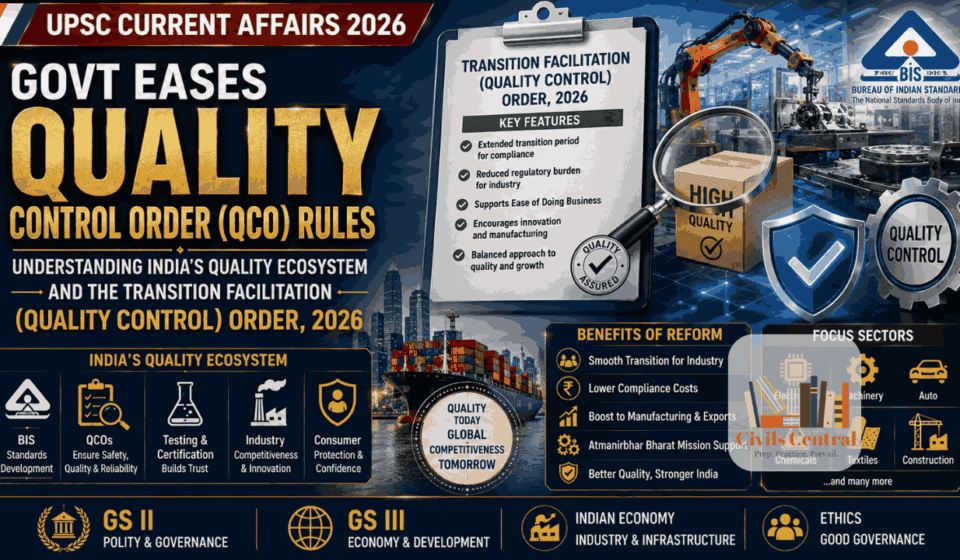
Govt Eases Quality Control Orders (QCO) Rules: Understanding India’s Quality Ecosystem and the Transition Facilitation (Quality Control) Order, 2026

Introduction
India’s ambition to become a global manufacturing hub depends not only on increasing production but also on ensuring that products meet internationally accepted quality and safety standards. Over the last few years, the Government of India has increasingly relied on Quality Control Orders (QCOs) to improve product quality, protect consumers, curb imports of substandard goods, and enhance the global competitiveness of Indian manufacturing.
However, industries—particularly Micro, Small and Medium Enterprises (MSMEs)—have raised concerns regarding the compliance burden associated with these regulations. Responding to these concerns, the Ministry of Commerce and Industry has introduced the Transition Facilitation (Quality Control) Order, 2026, which eases certain compliance requirements while retaining the objective of quality assurance.
For UPSC aspirants, this topic is significant because it connects Governance (GS-II), Economy (GS-III), Consumer Protection, Ease of Doing Business, Industrial Policy, Manufacturing, BIS, WTO obligations, and India’s vision of Atmanirbhar Bharat.
Why in News?
The Ministry of Commerce and Industry has notified the Transition Facilitation (Quality Control) Order, 2026 to provide a smoother transition for industries complying with Quality Control Orders (QCOs). The Order allows eligible manufacturers to procure inputs from manufacturers licensed under a relatively less stringent BIS certification scheme during a transition period of five years, thereby reducing compliance costs and avoiding disruption in production.
The relaxation applies to selected products covered under notified QCOs while continuing to maintain consumer safety and product quality standards.
Understanding Quality Control Orders (QCOs)
What are Quality Control Orders?
Quality Control Orders (QCOs) are legal notifications issued by the Government of India that make compliance with specified Indian Standards mandatory for certain products. Normally, adherence to Indian Standards is voluntary. However, when public safety, environmental protection, national interest or consumer welfare is involved, the government may make compliance compulsory through a Quality Control Order.
Once a QCO is notified, manufacturers, importers and sellers cannot manufacture, store, sell, distribute or import the notified product unless it conforms to the prescribed Indian Standard and carries the Standard Mark (ISI Mark) wherever applicable. Thus, QCOs transform voluntary standards into legally enforceable requirements.
Legal Basis of QCOs
The primary legal framework governing Quality Control Orders is the Bureau of Indian Standards (BIS) Act, 2016.
The Act empowers the Central Government to:
- Notify mandatory standards.
- Specify products requiring compulsory certification.
- Prevent manufacture and sale of substandard goods.
- Protect public health and safety.
- Promote standardization across industries.
Violation of QCO provisions can attract penalties under the BIS Act.
Objectives of Quality Control Orders
QCOs serve multiple policy objectives.
Consumer Protection
Consumers often cannot assess the quality and safety of products before purchasing them. Mandatory certification ensures that products meet minimum safety standards and reduces risks associated with defective or hazardous goods.
Improving Manufacturing Quality
QCOs encourage industries to adopt modern production techniques, quality management systems and internationally accepted manufacturing practices.
Supporting Make in India
High-quality manufacturing enhances India’s reputation in international markets and strengthens domestic industries against low-quality imports.
Facilitating Exports
Products manufactured according to recognized standards are more readily accepted in global markets, improving India’s export competitiveness.
Environmental Protection
Many QCOs prescribe standards that reduce pollution, improve energy efficiency and promote sustainable manufacturing.
Bureau of Indian Standards (BIS): India’s National Standards Body
The Bureau of Indian Standards (BIS) is India’s National Standards Body functioning under the Ministry of Consumer Affairs, Food and Public Distribution. Established under the Bureau of Indian Standards Act, 2016, BIS is responsible for developing Indian Standards and operating certification schemes.
Its major functions include:
- Formulating Indian Standards.
- Product certification.
- Hallmarking of precious metals.
- Conformity assessment.
- Laboratory testing.
- Consumer awareness.
- International standardization cooperation.
Certification Schemes of BIS
BIS operates multiple certification schemes depending upon the level of risk associated with products.
Generally,
- Scheme I involves a more comprehensive certification process with factory inspection and continuous surveillance.
- Scheme II is a relatively simplified conformity assessment mechanism applicable to specified products under prescribed conditions.
The newly notified Transition Facilitation Order allows certain industries to source inputs from manufacturers certified under Scheme II instead of requiring certification exclusively under the more stringent Scheme I during the transition period.
Transition Facilitation (Quality Control) Order, 2026
The newly notified Order aims to balance two competing objectives:
- Maintaining product quality.
- Reducing compliance burden on industry.
Rather than diluting quality standards, it provides industries with greater operational flexibility while they adapt to the new regulatory framework.
Key Features
Five-Year Transition Period
Eligible manufacturers can gradually transition to the stricter certification regime over a period of five years, avoiding sudden disruptions in production.
Alternative Risk-Based Compliance
Manufacturers may procure inputs from suppliers licensed under the less rigorous Scheme II certification for specified products instead of relying solely on Scheme I certified suppliers.
Limited Scope
The relaxation is not universal. It applies only to products specifically notified under the Order, including categories such as:
- Toys
- Personal protective equipment (PPE)
- Rubber footwear
- Electrical appliances
- Washing machines
- Certain electrical safety equipment
Consumer Protection Continues
Finished products must continue to satisfy all prescribed Indian Standards. The Order merely relaxes the sourcing requirements for intermediate inputs during the transition period.
Why Was This Relaxation Needed?
Since 2020, the Government has significantly expanded the number of QCOs across sectors. While this has improved product quality, industries reported several practical challenges.
Limited Certified Suppliers
Many manufacturers found that only a small number of suppliers had obtained BIS certification, leading to shortages of compliant raw materials.
Higher Compliance Costs
Obtaining certification involves testing, inspections, documentation and infrastructure upgrades, increasing costs especially for MSMEs.
Production Delays
Industries experienced delays in obtaining certified inputs, affecting production schedules and supply chains.
Impact on MSMEs
Smaller manufacturers often lack the financial and technical capacity to immediately comply with stringent certification requirements. The Transition Facilitation Order seeks to address these issues without compromising overall quality objectives.
Importance of QCOs for India’s Economy
Strengthening Consumer Confidence
Mandatory standards improve public trust by ensuring that products available in the market meet minimum quality and safety benchmarks.
Enhancing Industrial Competitiveness
Standardization encourages industries to adopt better manufacturing practices, making Indian products more competitive globally.
Supporting Atmanirbhar Bharat
High-quality domestic manufacturing reduces dependence on inferior imports and strengthens indigenous production capabilities.
Promoting Exports
Compliance with internationally aligned standards improves acceptance of Indian products in overseas markets.
Encouraging Technological Upgradation
Industries investing in quality certification often modernize production processes, resulting in higher productivity and innovation.
Challenges Associated with QCOs
Despite their benefits, QCOs present certain implementation challenges.
- High compliance costs for MSMEs.
- Inadequate testing laboratories in some regions.
- Delays in certification approvals.
- Limited awareness among small manufacturers.
- Supply chain disruptions due to shortage of certified vendors.
- Need to harmonize Indian standards with international standards to avoid trade disputes.
Balancing regulatory objectives with ease of doing business remains a key policy challenge.
Way Forward
India’s quality ecosystem must evolve through a balanced approach. The Government should:
- Expand BIS testing laboratories across the country.
- Digitize and simplify certification procedures.
- Provide financial and technical support to MSMEs.
- Increase awareness regarding quality standards.
- Promote mutual recognition agreements with major trading partners.
- Encourage industry consultation before notifying new QCOs.
- Continuously align Indian Standards with global best practices while safeguarding domestic interests.
Such measures would strengthen India’s manufacturing ecosystem without imposing excessive regulatory burdens.
UPSC Perspective
Prelims
Focus Areas:
- Bureau of Indian Standards (BIS)
- BIS Act, 2016
- Quality Control Orders (QCOs)
- ISI Mark
- Product Certification Schemes
- Consumer Protection
- Standardization
PYQ Connection
UPSC Mains (GS III), 2019
“Do you agree that the Indian economy has recently experienced V-shaped recovery? Give reasons.”
Practice MCQs
Q1. Quality Control Orders (QCOs) are primarily issued to:
(a) Increase customs duties on imports
(b) Mandate compliance with specified Indian Standards
(c) Regulate stock markets
(d) Promote foreign investment
Answer: (b)
Explanation: QCOs make compliance with specified Indian Standards mandatory for notified products.
Q2. The Bureau of Indian Standards functions under:
(a) Ministry of Commerce and Industry
(b) Ministry of Consumer Affairs, Food and Public Distribution
(c) Ministry of Heavy Industries
(d) Ministry of MSME
Answer: (b)
Q3. Which legislation governs the functioning of the Bureau of Indian Standards?
(a) Consumer Protection Act, 2019
(b) BIS Act, 2016
(c) Legal Metrology Act, 2009
(d) Competition Act, 2002
Answer: (b)
Q4. The primary objective of the Transition Facilitation (Quality Control) Order, 2026 is to:
(a) Eliminate quality standards.
(b) Reduce customs duties.
(c) Ease industry transition while maintaining quality assurance.
(d) Privatize BIS.
Answer: (c)
Q5. Which among the following is not an objective of Quality Control Orders?
(a) Consumer safety
(b) Standardization
(c) Export competitiveness
(d) Currency stabilization
Answer: (d)
UPSC Mains Practice Question
“Quality standards are essential for improving India’s manufacturing competitiveness, but excessive compliance requirements can adversely affect ease of doing business.” Discuss in the context of the Transition Facilitation (Quality Control) Order, 2026. (15 Marks, 250 Words)
Quick Revision
| Topic | Key Points |
|---|---|
| Why in News? | Government notified Transition Facilitation (Quality Control) Order, 2026 |
| Purpose | Smooth transition to mandatory quality standards while reducing compliance burden |
| Legal Basis | Bureau of Indian Standards Act, 2016 |
| Implementing Body | Bureau of Indian Standards (BIS) |
| Main Objective of QCOs | Mandatory compliance with Indian Standards |
| Major Benefits | Consumer protection, quality manufacturing, exports, Make in India |
| Challenges | Compliance costs, certification delays, MSME constraints |
| GS Linkage | GS-II (Governance), GS-III (Economy, Industry, MSMEs, Ease of Doing Business) |
About The Author