Queen’s Proclamation of 1858: Background, Provisions, Significance, Criticism and Impact on British Rule in India

Introduction
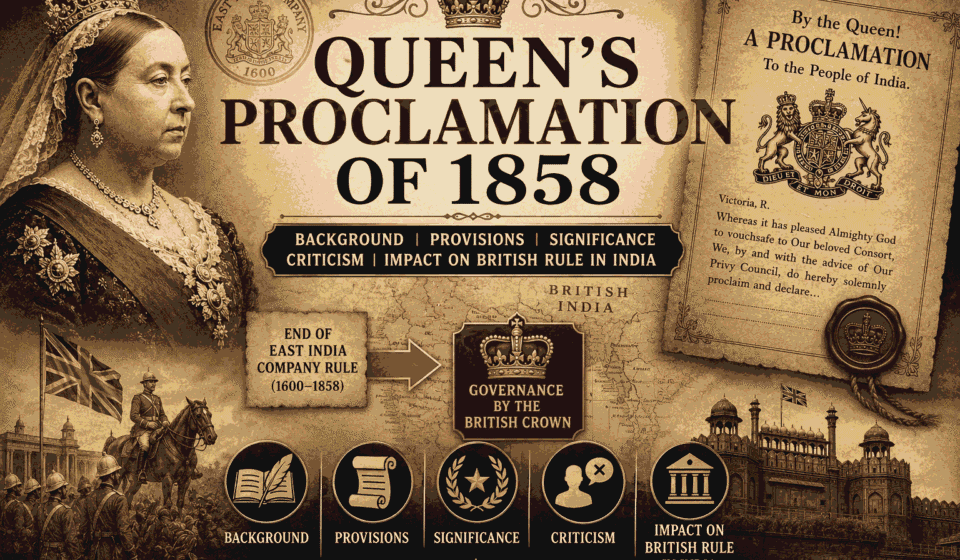
The Queen’s Proclamation of 1858, also known as Queen Victoria’s Proclamation, was one of the most significant constitutional and administrative documents in the history of British India. Issued on 1 November 1858 by Queen Victoria and formally announced by Lord Canning at Allahabad, the proclamation marked the official transfer of power from the East India Company to the British Crown following the Revolt of 1857. It laid the foundation for Crown Rule in India, which continued until India’s independence in 1947.
The proclamation was issued in the aftermath of the Revolt of 1857, a major uprising that exposed the weaknesses of the East India Company’s administration and shook British confidence in its ability to govern India. To prevent future rebellions and restore stability, the British Parliament enacted the Government of India Act, 1858, abolishing Company rule and placing India directly under the authority of the British Crown.
Queen Victoria’s Proclamation sought to reassure the people of India by promising religious neutrality, equal protection under the law, respect for the rights of Indian princes, and fair opportunities in public employment irrespective of race or religion. It also marked the abandonment of aggressive annexation policies such as the Doctrine of Lapse, which had contributed significantly to discontent among Indian rulers before 1857.
Often described by historians as the “Magna Carta of Indian Administration,” the proclamation represented a major shift in British policy towards India. While it promised justice, equality, and good governance, the extent to which these promises were implemented remains a subject of historical debate. Nevertheless, the document became a landmark in the constitutional development of British India and influenced the future course of Indian nationalism.
For UPSC and JKAS aspirants, the Queen’s Proclamation of 1858 is an important topic because it connects the Revolt of 1857, the Government of India Act, 1858, the beginning of Crown Rule, and subsequent administrative and constitutional developments in India.
Historical Background of the Queen’s Proclamation of 1858
The Queen’s Proclamation of 1858 did not emerge in isolation. It was the culmination of a series of political, administrative, military, and economic developments that had generated widespread dissatisfaction with the East India Company’s rule in India. The immediate catalyst was the Revolt of 1857, but the roots of the proclamation lay in the growing realization that the Company’s governance had failed to maintain stability and legitimacy.
The Revolt of 1857 and Its Aftermath
The Revolt of 1857 was the most serious challenge faced by British authority in India during the nineteenth century. Beginning as a mutiny of Indian soldiers (sepoys) in the Bengal Army, it soon spread to several regions of North and Central India and transformed into a broader political and social uprising against Company rule.
Several factors contributed to the revolt:
- Political grievances arising from annexation policies such as the Doctrine of Lapse.
- Economic exploitation of peasants, artisans, and traditional industries.
- Military discontent among Indian soldiers.
- Social and religious fears regarding British interference in Indian customs and traditions.
- Immediate resentment caused by the introduction of the Enfield rifle cartridges allegedly greased with cow and pig fat.
Although the revolt was eventually suppressed by the British, it exposed the deep dissatisfaction prevailing among different sections of Indian society and demonstrated the inability of the East India Company to govern India effectively.
Failure of the East India Company’s Administration
The Revolt of 1857 convinced British policymakers that the existing system of administration under the East India Company was no longer viable. The Company had evolved from a trading organization into a territorial power, but its governance was often criticized for:
- Excessive centralization of authority.
- Aggressive expansionist policies.
- Poor communication between British authorities in India and the government in Britain.
- Neglect of Indian sentiments and interests.
- Administrative inefficiency and corruption.
Many British statesmen believed that continuing Company rule would endanger British interests in India and increase the likelihood of future rebellions.
Government of India Act, 1858
In response to the revolt, the British Parliament enacted the Government of India Act, 1858. This landmark legislation brought about a fundamental restructuring of the administration of India.
The Act introduced several important changes:
- The East India Company was abolished as a governing authority.
- All territories under Company control were transferred directly to the British Crown.
- The office of the Secretary of State for India was created to supervise Indian affairs from Britain.
- A Council of India was established to assist the Secretary of State.
- The Governor-General of India also became the Viceroy, representing the British Crown in India.
These changes marked the beginning of a new phase in British rule known as the Crown Rule (1858–1947).
Need for Reconciliation and Political Stability
After suppressing the revolt, the British government recognized that military victory alone would not ensure long-term stability. There was a need to rebuild trust among Indian princes, landlords, soldiers, and the general population.
The British therefore decided to adopt a more conciliatory approach by:
- Assuring Indian rulers that their territories would be respected.
- Promising non-interference in religious matters.
- Offering equal protection under the law.
- Projecting the Crown as a benevolent and impartial authority.
These assurances were formally expressed through Queen Victoria’s Proclamation issued on 1 November 1858.
Transition from Company Rule to Crown Rule
The Queen’s Proclamation symbolized the end of one era and the beginning of another. It represented the formal transfer of governance from a commercial corporation to the British monarchy. More importantly, it sought to redefine the relationship between the British rulers and their Indian subjects by emphasizing justice, religious tolerance, and administrative responsibility.
Thus, the historical background of the Queen’s Proclamation lies in the combined impact of the Revolt of 1857, the failure of Company administration, and the British government’s desire to establish a more stable and acceptable framework for governing India under direct Crown control.
What is the Queen’s Proclamation of 1858?
The Queen’s Proclamation of 1858, also known as Queen Victoria’s Proclamation, was a historic declaration issued by Queen Victoria on 1 November 1858 following the enactment of the Government of India Act, 1858. The proclamation formally announced the transfer of authority from the East India Company to the British Crown and outlined the principles that would guide British governance in India thereafter.
The proclamation was publicly read by Lord Canning, the first Viceroy of India, at Allahabad. It served as a policy statement of the British Crown and sought to reassure the people of India after the upheaval caused by the Revolt of 1857.
Why Was the Proclamation Issued?
The British government realized that the policies pursued by the East India Company had generated widespread resentment among various sections of Indian society. The Revolt of 1857 demonstrated that military force alone could not ensure stable governance. Therefore, the Crown sought to win the confidence of Indians through promises of justice, religious neutrality, and fair administration.
The proclamation aimed to:
- Restore political stability in India.
- Secure the loyalty of Indian princes and chiefs.
- Reduce fears of religious interference.
- Present the British Crown as a benevolent ruler.
- Establish a new administrative relationship between Britain and India.
Main Objectives of the Queen’s Proclamation
The proclamation laid down several guiding principles for future governance:
- Direct rule by the British Crown instead of the East India Company.
- Religious neutrality and non-interference in religious beliefs and practices.
- Equal treatment before the law irrespective of race or religion.
- Protection of the rights and dignity of Indian princes and native states.
- Abandonment of aggressive territorial expansion and the Doctrine of Lapse.
- Promotion of public welfare and good governance.
- Opening public employment to Indians based on merit and qualification.
Why is it Called the “Magna Carta of Indian Administration”?
Historians often describe the Queen’s Proclamation as the “Magna Carta of Indian Administration” because it laid down the fundamental principles upon which British rule in India was expected to operate.
Like the historic Magna Carta of 1215 in England, the proclamation promised:
- Justice and fairness in administration.
- Respect for existing rights.
- Protection of religious freedom.
- Equal opportunities in government service.
- Responsible governance under the Crown.
Although many of these promises were not fully implemented in practice, the proclamation became an important constitutional document in the history of British India.
Key Themes of the Proclamation
The Queen’s Proclamation rested on four major themes:
1. Political Reconciliation
The political reconciliation clause in the Queen’s Proclamation of 1858 aimed to rebuild trust after the Revolt of 1857. The British Crown assured Indian princes that their rights, treaties, and territories would be respected, marking a clear shift from earlier annexation policies like the Doctrine of Lapse.
It also offered partial clemency to many rebels and tried to restore stability by reducing hostility between the rulers and the ruled. This policy helped the British secure the loyalty of Indian elites and princely states, which became an important base for maintaining Crown Rule.
However, this reconciliation was largely strategic, focused on securing British control rather than creating equal political partnership.
2. Religious Neutrality
The religious neutrality clause in the Queen’s Proclamation of 1858 assured Indians that the British government would not interfere in their religion, beliefs, or customs. This was a direct response to the religious fears that had contributed to the Revolt of 1857, especially concerns about forced conversion and interference in traditional practices.
The Crown declared that all subjects would be free to follow their own faith without state interference, and officials were instructed to avoid actions that could be seen as religious bias.
This policy helped reduce suspicion of British intentions and created a more stable environment for colonial rule. However, in practice, missionary activities continued, so complete neutrality was not fully achieved.
3. Administrative Reform
The administrative reform aspect of the Queen’s Proclamation of 1858 marked the transition from East India Company rule to a more centralized system under the British Crown. After the Revolt of 1857, the British realized the need for a stronger and more organized administrative structure in India.
Power was now concentrated under the Secretary of State for India in London and the Viceroy in India, ensuring direct and efficient control. The proclamation also emphasized governance based on justice, efficiency, and public welfare, laying the ideological foundation for Crown Rule.
Although these reforms improved coordination and control, they mainly strengthened imperial authority rather than increasing Indian participation in administration.
4. Imperial Consolidation
The imperial consolidation aspect of the Queen’s Proclamation of 1858 focused on strengthening and stabilizing British rule in India after the Revolt of 1857. The transfer of power from the East India Company to the British Crown ensured more direct and centralized control over Indian affairs.
The British consolidated their authority by securing the loyalty of princely states, reorganizing the army, and improving administrative coordination between India and Britain. Policies were designed to prevent future rebellions and maintain long-term political stability.
While presented as reforms for better governance, these measures primarily served to reinforce British imperial control over India.
Historical Importance
The Queen’s Proclamation marked a major turning point in Indian history because it:
- Ended nearly a century of political rule by the East India Company.
- Initiated the era of Crown Rule (1858–1947).
- Redefined British relations with Indian princely states.
- Influenced future administrative and constitutional developments.
- Created expectations of equality and justice that later inspired the growth of Indian nationalism.
Thus, the Queen’s Proclamation of 1858 was not merely a ceremonial declaration; it was a landmark political document that shaped the nature of British rule in India for the next ninety years.
Major Provisions (Promises) of the Queen’s Proclamation of 1858
The Queen’s Proclamation of 1858 was designed to reassure Indians after the Revolt of 1857 and establish the principles that would guide the new system of Crown Rule. The proclamation contained several important promises relating to administration, religion, princely states, public employment, and governance. These provisions became the foundation of British policy in India after 1858.
1. End of the East India Company’s Rule
One of the most significant provisions of the proclamation was the formal announcement that the East India Company would no longer govern India.
Key Features
- All territories previously administered by the Company were transferred to the British Crown.
- India would henceforth be governed in the name of Queen Victoria.
- The Governor-General became the Viceroy, representing the Crown in India.
- Administrative control was placed under the Secretary of State for India in Britain.
This marked the beginning of Crown Rule (1858–1947) and ended nearly a century of Company administration.
2. Equal and Impartial Protection of All Subjects
The proclamation declared that all subjects of the Crown would receive equal and fair treatment under the law.
Key Features
- The government promised to administer justice impartially.
- No discrimination would be made on the basis of race, religion, or caste in matters of legal protection.
- The rights and dignity of all subjects were to be respected.
This provision sought to create confidence among Indians and project the Crown as a just and impartial ruler.
3. Non-Interference in Religious Matters
The British government recognized that fears of religious interference had contributed significantly to the Revolt of 1857.
Key Features
- The Crown pledged not to interfere with the religious beliefs and practices of Indians.
- Officials were instructed to maintain strict neutrality in matters of religion.
- No individual would be favored or disadvantaged because of religious affiliation.
This marked a major shift from the earlier perception that British policies were threatening Indian religious traditions.
4. Recognition and Protection of Indian Princes
The proclamation sought to improve relations with Indian rulers and princely states.
Key Features
- Existing treaties with Indian princes would be honored.
- Their rights, dignity, and territorial possessions would be respected.
- The British government promised not to pursue unnecessary annexations.
This provision helped secure the loyalty of princely states, many of which later became important allies of British rule.
5. Abandonment of the Doctrine of Lapse
The controversial Doctrine of Lapse, aggressively used by Lord Dalhousie, had been one of the major causes of political discontent before 1857.
Key Features
- The policy of annexing states without a natural heir was effectively abandoned.
- Indian rulers were allowed to adopt heirs according to their traditions.
- The Crown assured princes that their dynasties would be protected.
This removed one of the biggest fears among Indian rulers and reduced tensions between princely states and the British government.
6. Equal Opportunity in Public Employment
The proclamation promised that public offices would be open to all subjects based on merit.
Key Features
- Appointments would be based on education, ability, and qualification.
- No discrimination would be made on the basis of race or religion.
- Indians were theoretically made eligible for government employment.
Although the promise was not fully implemented in practice, it later became the basis for Indian demands for greater participation in administration.
7. Respect for Traditional Customs and Laws
The Crown assured Indians that their customs and social traditions would be respected.
Key Features
- Traditional rights and usages would be protected.
- Local customs and personal laws would be taken into consideration while governing.
- The government would avoid unnecessary interference in social practices.
This provision aimed to reduce fears that British rule intended to undermine Indian society and culture.
8. Amnesty to Rebels (With Certain Exceptions)
The proclamation offered clemency to many participants in the Revolt of 1857.
Key Features
- General amnesty was granted to those who laid down arms and accepted British authority.
- Individuals involved in the murder of British civilians were excluded from the pardon.
- The policy sought reconciliation rather than widespread punishment.
The amnesty was intended to restore peace and encourage cooperation with the new administration.
9. Commitment to Public Welfare and Good Governance
The proclamation emphasized that the government would work for the welfare of its subjects.
Key Features
- Promotion of peace, prosperity, and good administration.
- Improvement of public institutions.
- Governance based on justice and responsibility.
This reflected the Crown’s attempt to portray British rule as beneficial and welfare-oriented.
Summary of Major Promises
| Provision | Main Promise |
| End of Company Rule | Direct governance by the British Crown |
| Religious Neutrality | No interference in religious matters |
| Protection of Princes | Respect for treaties and princely states |
| End of Doctrine of Lapse | No arbitrary annexations |
| Equal Employment Opportunity | Merit-based public service |
| Equality Before Law | Fair and impartial justice |
| Respect for Customs | Protection of traditions and laws |
| Amnesty to Rebels | Reconciliation after the Revolt of 1857 |
| Good Governance | Welfare and prosperity of the people |
The provisions of the Queen’s Proclamation of 1858 were intended to heal the wounds caused by the Revolt of 1857 and establish a more stable foundation for British rule in India. While the proclamation promised justice, equality, religious neutrality, and administrative fairness, the actual implementation of many of these commitments remained limited. Nevertheless, it became the guiding charter of Crown Rule and significantly influenced the political and administrative evolution of British India.
Important Clauses of the Queen’s Proclamation Explained
The Queen’s Proclamation of 1858 was not merely an official announcement marking the transfer of power from the East India Company to the British Crown. It was a carefully crafted political document intended to address the grievances that had led to the Revolt of 1857 and to rebuild confidence among Indians in the new system of governance. Every major clause of the proclamation reflected the lessons the British had drawn from the uprising and revealed how they intended to consolidate their rule while presenting themselves as benevolent rulers.
Clause on Religious Neutrality
One of the most significant assurances contained in the proclamation related to religion. Before 1857, many Indians had become suspicious of British intentions. Social reform measures, the activities of Christian missionaries, and certain government policies had created a widespread belief that the British intended to promote Christianity at the expense of traditional Indian religions. The controversy surrounding the Enfield rifle cartridges, which were rumored to be greased with cow and pig fat, further strengthened these fears and became an immediate trigger for the revolt.
Recognizing the sensitivity of the issue, Queen Victoria declared that the British government would not interfere in the religious beliefs and practices of its subjects. The Crown assured Indians that no one would be favored or discriminated against because of religion and that the government would maintain complete neutrality in matters of faith.
This clause marked a major shift in British policy. After 1858, officials were expected to avoid actions that could be interpreted as religious interference. Although missionary activities continued, the government became more cautious in dealing with religious issues. By promising religious neutrality, the Crown attempted to remove one of the most important causes of distrust that had contributed to the Revolt of 1857.
Clause on Equal Opportunity in Public Employment
Another important promise of the proclamation concerned access to public employment. The British government declared that appointments to public offices would be made on the basis of education, ability, and merit rather than race, religion, or social background. This appeared to offer Indians an opportunity to participate more actively in the administration of their country.
For many educated Indians, this clause generated considerable hope. They believed that the new system would allow capable Indians to enter higher government services and contribute to governance. However, the reality was quite different. The prestigious Indian Civil Service (ICS) examination continued to be conducted in England, making it difficult for most Indians to compete. Furthermore, the age limits and examination pattern favored British candidates. As a result, very few Indians could secure positions in the higher ranks of administration.
Nevertheless, this clause had long-term political consequences. Educated Indians repeatedly reminded the British government of its promise and demanded greater representation in administration. In later decades, organizations such as the Indian National Congress used this promise as a basis for seeking administrative reforms and equality of opportunity.
Clause on Protection of Indian Princes
The proclamation also sought to reassure Indian princes and rulers. Prior to 1857, many princely states had been annexed by the British under expansionist policies, particularly the Doctrine of Lapse introduced by Lord Dalhousie. This policy had created widespread anxiety among Indian rulers, who feared that their states could be absorbed into British territory at any time.
To address these concerns, the Crown promised that existing treaties and agreements with princely states would be respected. The rights, dignity, and territorial possessions of Indian rulers would be protected, and the British government would no longer pursue unnecessary annexations.
This assurance transformed the relationship between the British and the princely states. Instead of viewing Indian rulers as obstacles to expansion, the British now treated them as allies whose loyalty could strengthen imperial rule. Consequently, many princely states became important supporters of the British administration and remained loyal to the Crown in subsequent decades.
Clause on the Abandonment of the Doctrine of Lapse
Closely related to the protection of princely states was the effective abandonment of the Doctrine of Lapse. Under this policy, states without a natural male heir could be annexed by the British government. Several prominent states, including Jhansi, Satara, and Nagpur, had been annexed on this basis, generating widespread resentment among Indian rulers.
Although the proclamation did not explicitly mention the Doctrine of Lapse, its provisions clearly indicated that the policy would no longer be pursued. Indian rulers were allowed to adopt heirs according to their traditions, and their succession rights were recognized by the Crown.
The significance of this change cannot be overstated. By abandoning the Doctrine of Lapse, the British removed one of the major political grievances that had contributed to the Revolt of 1857. It also ensured the continued existence of princely states within the British Indian Empire and helped create a more stable political environment.
Clause on Justice and Equality Before Law
The proclamation emphasized that all subjects of the Crown would be treated with fairness and justice. The British government declared its commitment to impartial administration and equal protection under the law. This promise was intended to reassure Indians that arbitrary actions and discriminatory practices would not characterize the new system of governance.
In theory, this clause suggested that Indians and Europeans would enjoy equal legal protection. However, in practice, racial discrimination remained deeply embedded within the colonial system. Europeans often enjoyed privileges that were denied to Indians, and senior administrative positions continued to be dominated by British officials.
Despite these limitations, the proclamation created expectations of legal equality and fairness. Over time, Indian political leaders used these principles to demand constitutional reforms, representative institutions, and equal rights. Thus, even though the promise was only partially fulfilled, it played an important role in shaping India’s political awakening.
Clause on Public Welfare and Good Governance
The final major theme of the proclamation was the commitment to public welfare and good governance. Queen Victoria declared that the prosperity, happiness, and welfare of the people would be the primary concern of the government. The Crown promised to maintain peace and order, protect life and property, and ensure efficient administration.
This clause reflected the British attempt to portray Crown Rule as more responsible and humane than the rule of the East India Company. The government sought to present itself as a guardian of public welfare rather than merely an instrument of imperial control.
However, historians have pointed out that the reality often differed from the promise. Economic policies continued to serve British interests, and many Indians remained excluded from meaningful participation in governance. Nevertheless, the language of welfare and good governance became an important justification used by the British to legitimize their rule in India.
Administrative Implications of the Clauses
The clauses of the Queen’s Proclamation had profound consequences for the administration of India. They marked the transition from Company Rule to Crown Rule, reshaped relations with princely states, established the principle of religious neutrality, and laid the foundation for a more centralized administrative structure under the Secretary of State for India and the Viceroy.
At the same time, these promises raised expectations among Indians regarding equality, justice, and participation in governance. When many of these expectations remained unfulfilled, dissatisfaction began to grow, particularly among the educated middle class. This discontent eventually contributed to the rise of organized political movements and Indian nationalism.
Critical Observation
A closer examination of the Queen’s Proclamation reveals that it was both a document of reconciliation and an instrument of imperial consolidation. It sought to heal the divisions exposed by the Revolt of 1857 through promises of justice, religious neutrality, and respect for Indian traditions. Yet its broader objective was to secure British authority and ensure the long-term stability of imperial rule.
The proclamation therefore occupies a unique place in Indian history. It symbolized a new beginning under the British Crown, but it also exposed the gap between colonial promises and colonial realities. This contradiction would later become a powerful force driving the growth of Indian nationalism and the demand for self-government.
Significance of the Queen’s Proclamation of 1858
The Queen’s Proclamation of 1858 occupies a landmark position in the constitutional and administrative history of India. It was far more than a ceremonial declaration announcing the transfer of power from the East India Company to the British Crown. Issued in the aftermath of the Revolt of 1857, the proclamation represented a fundamental shift in British policy towards India and laid the foundation of the administrative system that governed the country until independence in 1947.
Its significance can be understood from political, administrative, constitutional, social, and historical perspectives.
Political Significance
Politically, the proclamation marked the end of an era and the beginning of a new phase in India’s colonial history. For nearly a century, the East India Company had exercised political authority over vast parts of India. However, the Revolt of 1857 exposed the weaknesses of Company rule and convinced the British Parliament that governance could no longer be entrusted to a commercial corporation.
Through the proclamation, all powers of administration were transferred directly to the British Crown. This formally inaugurated the period of Crown Rule, which lasted from 1858 to 1947. The British monarchy now became the ultimate source of authority in India, while the Viceroy acted as its representative.
The proclamation also attempted to create political stability by reassuring Indian princes, landlords, and influential groups that their rights and interests would be protected. This policy helped the British secure the loyalty of powerful sections of Indian society and reduced the likelihood of another large-scale rebellion.
Administrative Significance
From an administrative perspective, the proclamation initiated a new framework of governance. The British government sought to make administration more organized, centralized, and accountable than it had been under the East India Company.
The establishment of the office of the Secretary of State for India in Britain and the appointment of the Viceroy in India created a more direct chain of command between London and India. Decision-making became more centralized, and administrative control came under closer parliamentary supervision.
The proclamation also emphasized justice, efficiency, and public welfare as guiding principles of governance. Although these ideals were not always implemented fully, they became important elements of colonial administrative policy.
Constitutional Significance
The Queen’s Proclamation is often regarded as one of the most important constitutional documents in the history of British India. It outlined the principles upon which the Crown intended to govern India and served as a moral and political charter for future administration.
For this reason, historians frequently refer to it as the “Magna Carta of Indian Administration.” Just as the Magna Carta in England established certain principles of governance, the Queen’s Proclamation laid down commitments regarding religious neutrality, equality before law, protection of princely states, and access to public employment.
The proclamation also influenced later constitutional developments. Many of the demands raised by Indian political leaders in the late nineteenth and early twentieth centuries were based on the promises contained in this document. Indians repeatedly demanded that the British government fulfill its commitments regarding equality and representation.
Significance for Indian Princely States
One of the most important consequences of the proclamation was the transformation of British relations with Indian princely states. Before 1857, policies such as the Doctrine of Lapse had created fear and hostility among Indian rulers. Several states had been annexed, and many princes believed that their sovereignty was under constant threat.
The proclamation changed this approach by guaranteeing respect for existing treaties and recognizing the rights of Indian princes. The effective abandonment of the Doctrine of Lapse reassured rulers that their territories would not be arbitrarily annexed.
As a result, the princely states became important allies of the British Crown. Their loyalty helped strengthen British authority and contributed to the stability of the colonial system.
Social and Religious Significance
The proclamation had considerable social and religious significance because it directly addressed one of the major causes of the Revolt of 1857—the fear of religious interference.
By declaring that the government would remain neutral in matters of religion, the Crown attempted to reassure both Hindus and Muslims that their faiths, customs, and traditions would be respected. This represented a significant departure from the perception that British rule was promoting cultural and religious change.
Although social reform measures did not completely disappear, the government became more cautious in intervening in sensitive religious matters. This policy helped reduce tensions and contributed to a more stable relationship between the rulers and the ruled.
Significance for the Growth of Indian Nationalism
Ironically, the proclamation also contributed to the rise of Indian nationalism. Its promises of equality, justice, and merit-based employment created expectations among educated Indians. However, when these promises were not fully implemented, dissatisfaction began to grow.
Indians observed that despite assurances of equal opportunity, higher administrative posts remained dominated by Europeans. Similarly, despite promises of impartial treatment, racial discrimination continued in many areas of public life.
This gap between promise and reality became a powerful source of political criticism. Early nationalist leaders frequently cited the Queen’s Proclamation to highlight British failure to honor its commitments. Thus, a document intended to strengthen imperial rule eventually provided intellectual and moral support to the nationalist movement.
Historical Significance
Historically, the proclamation represents a turning point in the evolution of British rule in India. It ended the phase of aggressive territorial expansion associated with the East India Company and ushered in a period characterized by political consolidation and administrative reorganization.
The document reflected the lessons the British had learned from the Revolt of 1857. Instead of relying solely on military power, the Crown attempted to govern through a combination of conciliation, cooperation with Indian elites, and administrative reforms.
For nearly ninety years, the principles outlined in the proclamation continued to influence British policy in India. Therefore, it remains one of the most significant milestones in modern Indian history.
The significance of the Queen’s Proclamation of 1858 lies in its role as a bridge between Company Rule and Crown Rule. It redefined British policy towards India, strengthened relations with princely states, established the principle of religious neutrality, and provided the constitutional basis for future governance. At the same time, its unfulfilled promises inspired political awareness and contributed to the growth of Indian nationalism. Thus, the proclamation was both a cornerstone of British imperial administration and an important stepping stone in India’s journey towards self-government and independence.
Impact of the Queen’s Proclamation on British Policy in India
The Queen’s Proclamation of 1858 was not merely a declaration of intentions; it significantly influenced the direction of British policy in India for the next several decades. Issued in the aftermath of the Revolt of 1857, it compelled the British government to reconsider many of its earlier policies and adopt a more cautious, pragmatic, and centralized approach to governance.
The proclamation affected almost every aspect of colonial administration, including relations with princely states, religious policy, civil services, military organization, and the overall structure of governance. These changes shaped the nature of Crown Rule and helped the British maintain their authority in India until independence.
Change in Relations with Princely States
One of the most immediate impacts of the proclamation was the transformation of British relations with Indian princely states. Before 1857, British policy had been largely expansionist. Governors-General such as Lord Dalhousie had pursued territorial annexation through instruments like the Doctrine of Lapse and the policy of annexing territories on grounds of alleged misgovernance.
The Revolt of 1857 demonstrated the dangers of alienating Indian rulers. Many princes who remained loyal to the British played a crucial role in suppressing the uprising. Consequently, the British realized that cooperation with princely states was more beneficial than annexation.
After 1858, the Crown abandoned its aggressive expansionist approach and adopted a policy of political partnership. Existing treaties were respected, rulers were allowed to adopt heirs, and princely states were assured protection. As a result, the princely states became reliable allies of British rule and served as an important pillar of the colonial system.
Shift Towards Religious Neutrality
Religious concerns had been one of the major causes of the Revolt of 1857. Many Indians believed that British policies threatened their religious beliefs and traditional practices. The proclamation attempted to address these fears by explicitly assuring non-interference in matters of religion.
Following 1858, the government adopted a more cautious approach towards religious and social issues. While Christian missionary activities continued, the state avoided actions that could be interpreted as official support for religious conversion. British administrators became increasingly careful in dealing with matters affecting religious sentiments.
This policy of religious neutrality helped reduce tensions and became a defining feature of British governance after 1858. Although critics argue that complete neutrality was never achieved, the government generally avoided the kind of direct intervention that had generated resentment before the revolt.
Impact on Civil Services and Administration
The proclamation promised that public employment would be open to all subjects based on merit, education, and ability. This principle influenced discussions regarding the recruitment and organization of the colonial bureaucracy.
The administration became more professionalized and centralized under the control of the Secretary of State for India and the Viceroy. The importance of the Indian Civil Service (ICS) increased, making it the backbone of British administration in India.
However, despite the promise of equal opportunity, Indians faced numerous barriers in entering higher services. The civil service examination continued to be conducted in England, and administrative positions remained dominated by Europeans. Nevertheless, the proclamation encouraged educated Indians to seek greater participation in governance, leading to future demands for administrative reforms.
Reorganization of the Indian Army
The Revolt of 1857 had exposed serious weaknesses in the military structure of the East India Company. As a result, the British government undertook a comprehensive reorganization of the army after 1858.
The proportion of European soldiers in the army was increased to reduce dependence on Indian troops. Recruitment policies were also revised. The British increasingly favored communities they considered “martial races,” such as Sikhs, Gurkhas, Pathans, and certain groups from Punjab and North-Western regions, while reducing recruitment from areas that had actively participated in the revolt.
Another important change was the deliberate policy of maintaining divisions among different military units based on region, caste, and religion. The objective was to prevent the emergence of unity among soldiers that could facilitate another large-scale rebellion.
These reforms enabled the British to maintain tighter control over the military and significantly reduced the risk of coordinated uprisings.
Greater Centralization of Administration
The proclamation marked the beginning of a more centralized system of governance. Under Company Rule, authority had been divided among various institutions, creating administrative complications. After 1858, power became more concentrated in the hands of the British government.
The Secretary of State for India, based in London, exercised extensive control over Indian affairs. The Viceroy acted as the chief executive authority in India and implemented policies formulated by the British government.
This centralized structure improved administrative coordination and allowed the British Parliament to exercise greater oversight over Indian governance. At the same time, it strengthened imperial control and reduced the autonomy previously enjoyed by local authorities.
Emergence of a Policy of Conciliation
The British recognized that excessive reliance on coercion had contributed to the outbreak of the Revolt of 1857. Consequently, they adopted a policy that combined authority with conciliation.
Indian princes were honored, landlords were reassured about their property rights, and influential social groups were encouraged to cooperate with the government. The British increasingly sought support from traditional elites rather than challenging their position.
This policy helped create a class of loyal allies who benefited from British rule and contributed to the stability of the colonial regime.
Long-Term Impact on Indian Nationalism
Although the proclamation was intended to strengthen British rule, it had unintended consequences for the development of Indian nationalism. The promises of equality, justice, and merit-based employment created expectations among educated Indians.
As Indians became more politically aware, they began comparing British actions with the commitments made in the proclamation. They observed that racial discrimination persisted, opportunities remained limited, and political power continued to be concentrated in British hands.
This gap between promises and reality became a major source of criticism. Nationalist leaders frequently invoked the Queen’s Proclamation to demand constitutional reforms, greater representation, and equal treatment. In this way, a document designed to consolidate imperial rule indirectly contributed to the growth of political consciousness and nationalist aspirations.
The Queen’s Proclamation of 1858 profoundly influenced British policy in India. It transformed relations with princely states, introduced a policy of religious neutrality, reorganized the army, strengthened administrative centralization, and encouraged a more conciliatory approach towards Indian society. While these changes helped the British maintain control over India, the unfulfilled promises of equality and justice eventually fueled the rise of Indian nationalism. Thus, the proclamation not only shaped the structure of Crown Rule but also influenced the political developments that ultimately challenged British authority in India.
Was the Queen’s Proclamation Implemented in Practice? (Promise vs Reality)
The Queen’s Proclamation of 1858 was welcomed by many Indians because it promised justice, equality, religious neutrality, protection of princely states, and equal opportunities in public employment. On paper, it appeared to mark the beginning of a more liberal and inclusive phase of British rule. However, as the decades passed, it became evident that there was a considerable gap between the promises made in the proclamation and their actual implementation.
While some provisions were implemented to a significant extent, many others remained largely symbolic. The contradiction between British assurances and colonial realities became one of the major causes of political dissatisfaction and contributed to the emergence of Indian nationalism.
Religious Neutrality: Largely Implemented
Among the various promises made in the proclamation, the commitment to religious neutrality was one of the most successfully implemented. The British government became much more cautious after the Revolt of 1857 and generally avoided direct interference in religious matters.
Administrators were instructed to respect the religious beliefs and customs of Indians. The government refrained from supporting any particular religion and sought to maintain a position of neutrality. This policy helped reduce fears of forced religious conversion and contributed to political stability.
However, complete neutrality was difficult to achieve. Christian missionary activities continued, and many Indians remained suspicious of British intentions. Nevertheless, compared to the period before 1857, the government adopted a far more cautious and restrained approach toward religious issues.
Protection of Princely States: Successfully Implemented
The promise to respect the rights of Indian princes and honor existing treaties was largely fulfilled. After 1858, the British abandoned aggressive annexation policies and no longer pursued the Doctrine of Lapse.
Indian rulers were allowed to adopt heirs, and princely states were assured that their territories would be protected. As a result, relations between the British government and princely states improved significantly.
This policy proved highly successful from the British perspective. The princely states became loyal allies of the Crown and played an important role in maintaining the stability of the colonial system. Therefore, this was one of the promises that was genuinely implemented.
Equality in Public Employment: Promise Largely Unfulfilled
One of the most attractive promises of the proclamation was that public offices would be open to all subjects based on merit and qualification. Educated Indians interpreted this as a commitment to equal opportunities in administration.
In reality, the higher levels of government remained dominated by British officials. The Indian Civil Service (ICS) examination continued to be held in England, making it difficult for most Indians to compete. The age limits and examination system further favored British candidates.
Although a small number of Indians eventually entered the civil services, their representation remained extremely limited. Consequently, the promise of equal opportunity remained largely unfulfilled and became a major grievance among educated Indians.
This issue later became one of the central demands of the early nationalist movement and the Indian National Congress.
Equality Before Law: Limited Implementation
The proclamation promised justice and impartial treatment for all subjects of the Crown. While the British introduced modern legal institutions and codified laws, true equality before the law was not achieved.
Racial discrimination remained a prominent feature of colonial society. Europeans often enjoyed privileges unavailable to Indians, particularly in matters of employment, social status, and political influence. In many situations, Indians felt that British officials and European residents received preferential treatment.
As a result, although legal reforms improved the administration of justice, the ideal of complete equality before the law remained largely unrealized.
Public Welfare and Good Governance: Mixed Results
The proclamation emphasized that the welfare and prosperity of the people would be the primary concern of the government. To some extent, the British undertook measures aimed at improving administration, communication, and infrastructure.
The construction of railways, telegraph networks, canals, and roads contributed to economic development and administrative efficiency. Educational institutions were also expanded during the later nineteenth century.
However, these developments were often designed to serve imperial interests rather than the needs of Indians. Economic policies continued to favor British industries, and India remained a source of raw materials and a market for British manufactured goods.
Furthermore, recurring famines during the nineteenth century exposed the limitations of British claims regarding public welfare. Many historians argue that the colonial government’s response to these crises was inadequate and reflected its prioritization of imperial interests over Indian welfare.
The Gap Between Promise and Reality
The most important feature of the Queen’s Proclamation was not merely what it promised but the contrast between those promises and the realities of colonial rule.
The British government spoke of equality, yet racial discrimination persisted. It promised equal access to public employment, yet higher administrative positions remained overwhelmingly British. It emphasized justice and welfare, yet economic exploitation continued. While princely states received protection and religious neutrality was largely maintained, many other commitments were only partially fulfilled.
This growing gap between ideals and practice gradually eroded Indian confidence in British rule. Educated Indians began demanding that the government honor its own commitments and implement the principles proclaimed in 1858.
Impact on the Growth of Nationalism
Ironically, the failure to fully implement the promises of the Queen’s Proclamation contributed significantly to the rise of Indian nationalism. The proclamation created expectations regarding equality, justice, and participation in governance. When these expectations were not met, disappointment turned into political criticism.
Early nationalist leaders frequently cited the Queen’s Proclamation while demanding reforms. They argued that Indians were merely seeking the rights and opportunities that had already been promised by the British Crown.
Thus, a document intended to strengthen imperial authority eventually became a powerful tool in the hands of Indian nationalists.
The implementation of the Queen’s Proclamation produced mixed results. Its promises regarding religious neutrality and protection of princely states were largely fulfilled, contributing to the stability of British rule. However, commitments relating to equality in public employment, racial justice, and fair representation remained largely unfulfilled. The gap between promise and reality exposed the contradictions of colonial rule and became a major factor behind the growth of Indian political consciousness and nationalism. Therefore, the Queen’s Proclamation of 1858 stands as both a landmark declaration of reform and a reminder of the limitations of British imperial governance.
Critical Evaluation of the Queen’s Proclamation of 1858
The Queen’s Proclamation of 1858 is often regarded as one of the most important documents in the constitutional history of British India. It marked the beginning of Crown Rule, announced several reforms, and promised justice, equality, and religious neutrality. However, historians have long debated whether the proclamation represented a genuine commitment to improving governance or was primarily a political strategy designed to stabilize British rule after the Revolt of 1857.
A critical evaluation requires examining both its achievements and its limitations. While the proclamation introduced significant policy changes and helped restore stability, many of its promises remained only partially fulfilled. Consequently, it has been viewed both as a landmark reform and as an instrument of imperial consolidation.
Arguments Supporting the Importance of the Proclamation
From one perspective, the proclamation represented a major departure from the policies of the East India Company. It acknowledged the mistakes that had contributed to the Revolt of 1857 and attempted to establish a more cautious and conciliatory framework of governance.
One of its greatest achievements was the formal end of Company Rule. By transferring authority to the British Crown, the proclamation introduced a more direct and accountable system of administration. The British Parliament now exercised greater supervision over Indian affairs, and governance became more centralized under the Secretary of State for India and the Viceroy.
The proclamation also played a crucial role in improving relations with Indian princely states. The effective abandonment of the Doctrine of Lapse removed a major source of political tension and reassured Indian rulers that their territories would be protected. This policy helped create long-term political stability and secured the loyalty of princely states.
Another important achievement was the commitment to religious neutrality. By assuring Indians that the government would not interfere in matters of faith, the Crown addressed one of the principal grievances associated with the Revolt of 1857. This helped reduce suspicion and contributed to a more stable political environment.
The proclamation also introduced the principle that public employment should be based on merit rather than race or religion. Although imperfectly implemented, this principle later became an important foundation for demands for administrative reforms and greater Indian participation in governance.
For these reasons, many historians describe the proclamation as the “Magna Carta of Indian Administration”, emphasizing its constitutional and administrative significance.
Criticisms and Limitations
Despite its lofty ideals, the proclamation has been criticized for the wide gap between its promises and actual practice. Many of its assurances remained largely theoretical and were never fully translated into reality.
The promise of equal opportunity in public employment is a clear example. Although the proclamation declared that government offices would be open to all subjects based on merit, higher administrative positions continued to be monopolized by Europeans. The Indian Civil Service (ICS) examination was held in England, making it difficult for most Indians to compete effectively.
Similarly, the promise of equality before the law was undermined by the persistence of racial discrimination. Europeans often enjoyed social and administrative privileges unavailable to Indians. The colonial system continued to treat Indians as subjects rather than equal partners in governance.
Critics also argue that the proclamation did not fundamentally alter the exploitative economic structure of British rule. Land revenue policies, the export of raw materials, and the prioritization of British economic interests continued largely unchanged. Consequently, the material conditions of many Indians did not improve significantly despite promises of welfare and good governance.
Another criticism is that the proclamation was primarily intended to secure British authority rather than empower Indians. Its conciliatory language helped pacify discontented groups, but political power remained firmly concentrated in British hands. Indians continued to have little influence over major policy decisions.
Thus, while the proclamation promised reform, it did not challenge the basic structure of colonial domination.
Historians’ Views on the Proclamation
Historians have offered differing interpretations of the Queen’s Proclamation.
Some scholars view it as a sincere attempt by the British government to learn from the mistakes of the East India Company and establish a more stable and responsible administration. They emphasize its role in promoting religious neutrality, protecting princely states, and laying the foundations for later constitutional development.
Other historians adopt a more critical perspective. They argue that the proclamation was essentially a political document designed to restore confidence after the Revolt of 1857. According to this view, its promises were intended to secure loyalty rather than bring about genuine equality or self-government.
Nationalist historians have often highlighted the contradiction between the ideals proclaimed in 1858 and the realities of colonial rule. They argue that the failure to fulfill these promises exposed the limitations of British liberalism and contributed to the growth of Indian nationalism.
Modern historians generally adopt a balanced approach. They recognize that the proclamation introduced important changes in policy and administration, but they also acknowledge that many of its commitments remained unfulfilled.
Was the Proclamation a Reform or a Political Strategy?
The answer lies somewhere between the two extremes. The proclamation undoubtedly introduced meaningful reforms, particularly in the areas of religious policy and relations with princely states. It helped stabilize India after a major rebellion and provided a framework for governance under the Crown.
At the same time, it served a strategic purpose. The British government needed to restore confidence, prevent future uprisings, and strengthen imperial control. The promises of justice, equality, and welfare helped create an image of benevolent rule while leaving the essential structure of colonial domination intact.
Therefore, the proclamation can be understood as both a reformist document and a political instrument designed to secure the long-term interests of the British Empire.
The Queen’s Proclamation of 1858 was a landmark document that reshaped British policy in India after the Revolt of 1857. It ended Company Rule, established Crown Rule, promoted religious neutrality, and improved relations with princely states. However, many of its promises regarding equality, representation, and public employment were only partially implemented. The resulting gap between promise and reality became a major source of political dissatisfaction and contributed to the rise of Indian nationalism.
In historical terms, the proclamation was neither a complete failure nor a complete success. It was a significant step in the evolution of colonial governance, but it also revealed the inherent contradictions of British rule in India. Its legacy therefore lies not only in the reforms it introduced but also in the expectations it created and the debates it continues to inspire.
Queen’s Proclamation and the Growth of Indian Nationalism
The Queen’s Proclamation of 1858 was intended to restore stability and strengthen British rule after the Revolt of 1857. By promising justice, equality, religious neutrality, and opportunities in public employment, the British Crown hoped to win the confidence and loyalty of the Indian people. In the short term, the proclamation helped the British consolidate their authority and reduce political tensions. However, in the long run, it produced an outcome that the British had not anticipated—it contributed significantly to the growth of Indian nationalism.
The proclamation raised hopes among educated Indians that British rule would become more liberal, fair, and inclusive. When these expectations were not fulfilled, disappointment gradually transformed into political awareness, organized criticism, and eventually the demand for self-government.
Creation of New Expectations Among Indians
One of the most important effects of the proclamation was that it created expectations of equality and justice. The Crown promised that all subjects would receive impartial treatment and that public employment would be based on merit rather than race or religion.
For the emerging class of educated Indians, these assurances appeared to signal the beginning of a new era. Many believed that Indians would gradually gain greater opportunities in administration and a more meaningful role in governance. Western education, which was spreading during the nineteenth century, further encouraged Indians to embrace ideas such as liberty, equality, constitutionalism, and representative government.
As a result, the proclamation generated hopes that British rule would evolve into a system based on fairness and equal rights.
Growing Disillusionment with British Rule
As time passed, however, many Indians realized that the promises made in 1858 were not being fully implemented. Although equality was promised, higher administrative positions remained largely reserved for Europeans. Although public employment was theoretically open to all, the structure of the Indian Civil Service (ICS) examination made it extremely difficult for Indians to enter the higher ranks of government.
Similarly, despite assurances of impartial treatment, racial discrimination continued in social, political, and administrative life. Indians increasingly felt that the principles proclaimed by the Crown were being ignored in practice.
This gap between promise and reality created widespread dissatisfaction among educated Indians. They began questioning the sincerity of British claims regarding justice and equality and started demanding reforms that would translate these promises into reality.
Emergence of Constitutional and Political Demands
The unfulfilled promises of the proclamation provided an important foundation for early political movements in India. Rather than immediately demanding independence, early Indian leaders sought constitutional reforms within the framework of British rule.
Educated Indians argued that the British government should honor the commitments made in the Queen’s Proclamation. They demanded greater access to civil services, increased representation in legislative councils, equality before the law, and a larger role in administration.
Many of these demands were framed not as radical challenges to British authority but as requests for the implementation of principles already promised by the Crown itself.
Thus, the proclamation became an important reference point in the constitutional and political discourse of the late nineteenth century.
Influence on the Formation of the Indian National Congress
The establishment of the Indian National Congress (INC) in 1885 marked a new phase in the development of Indian nationalism. Early Congress leaders frequently referred to the principles contained in the Queen’s Proclamation while presenting their demands to the British government.
Moderate leaders such as Dadabhai Naoroji, Surendranath Banerjee, and Gopal Krishna Gokhale argued that Indians were merely seeking the rights and opportunities that had already been promised in 1858.
The Congress therefore used the proclamation as both a moral and political instrument to criticize discriminatory policies and demand reforms.
Development of Political Consciousness
The proclamation also contributed indirectly to the growth of political consciousness. By introducing concepts such as equality, justice, merit, and responsible governance into public discourse, it encouraged Indians to evaluate British rule according to these standards.
Educated Indians began comparing British actions with British promises. Newspapers, public associations, and political organizations increasingly highlighted inconsistencies between the ideals proclaimed by the Crown and the realities experienced by Indians.
This process gradually transformed isolated grievances into a broader political movement aimed at securing rights, representation, and eventually self-government.
From Loyalty to Nationalism
In the decades immediately following 1858, many educated Indians remained loyal to the British Crown and hoped that reforms would gradually improve their position. However, repeated disappointments weakened this faith.
The failure to provide meaningful representation, the persistence of racial discrimination, economic exploitation, and the exclusion of Indians from higher administrative positions convinced many leaders that the colonial system was unwilling to grant genuine equality.
As a result, Indian political thought evolved from demands for administrative reforms to demands for greater autonomy and, eventually, complete independence. In this sense, the unfulfilled promises of the Queen’s Proclamation became one of the factors that transformed loyal subjects into political nationalists.
Historical Significance
The historical significance of the Queen’s Proclamation lies in the fact that it unintentionally nurtured the very forces that later challenged British rule. While the British intended the document to strengthen imperial authority, it created expectations that could not be fully satisfied within the colonial framework.
The ideals of equality, justice, and merit contained in the proclamation became powerful tools in the hands of Indian political leaders. They repeatedly invoked these principles to expose the contradictions of colonial governance and mobilize public opinion against discriminatory policies.
Thus, the proclamation occupies an important place in the history of Indian nationalism because it helped create the intellectual and political environment in which nationalist ideas could flourish.
The Queen’s Proclamation of 1858 played a paradoxical role in Indian history. It was issued to stabilize British rule and secure the loyalty of the Indian people, yet its promises generated expectations that the colonial state was unable or unwilling to fulfill. The resulting gap between ideals and reality fostered political awareness, encouraged constitutional demands, and strengthened the foundations of Indian nationalism. Consequently, the proclamation not only marked the beginning of Crown Rule but also contributed indirectly to the rise of the nationalist movement that would eventually bring British rule to an end.
Comparison: Before and After the Queen’s Proclamation of 1858
The Queen’s Proclamation of 1858 marked a decisive turning point in the history of British India. It brought an end to the era of the East India Company and inaugurated the period of Crown Rule. The proclamation was not merely a transfer of authority; it also signaled important changes in British policies relating to administration, princely states, religion, public employment, and governance.
A comparison of conditions before and after the proclamation helps us understand the magnitude of this transformation and its impact on Indian society and administration.
| Aspect | Before Queen’s Proclamation (Before 1858) | After Queen’s Proclamation (After 1858) |
| Ruling Authority | India was governed by the East India Company, a commercial organization that had gradually acquired political power. | India came under the direct control of the British Crown, marking the beginning of Crown Rule. |
| Head of Administration | The Governor-General acted as the chief executive authority of British territories in India. | The Governor-General also became the Viceroy, serving as the direct representative of the British monarch. |
| Control Over Indian Affairs | The British government exercised indirect control through the Board of Control and the East India Company. | Indian administration was supervised directly by the Secretary of State for India and the British Parliament. |
| Nature of Governance | Governance was largely influenced by the Company’s commercial and territorial interests. | Governance was officially presented as being based on justice, welfare, and responsibility under the Crown. |
| Policy Towards Princely States | Expansion and annexation were common features of British policy. | The British adopted a policy of cooperation and protection toward princely states. |
| Doctrine of Lapse | Frequently used to annex states lacking a natural male heir. | Effectively abandoned, and rulers were allowed to adopt heirs. |
| Relations with Indian Princes | Characterized by suspicion and fear of annexation. | Relations improved due to assurances regarding treaties, rights, and territorial integrity. |
| Religious Policy | Many Indians believed British policies threatened their religious traditions. | The Crown officially adopted a policy of religious neutrality and non-interference. |
| Public Employment | Senior government positions were dominated by Europeans, with limited opportunities for Indians. | The proclamation promised equal access to public employment based on merit, although implementation remained limited. |
| Legal and Administrative Philosophy | Focused primarily on maintaining Company authority and expanding territorial control. | Emphasized justice, impartial administration, and good governance. |
| Military Policy | Indian soldiers formed a large proportion of the Company’s army. | The army was reorganized, and the proportion of European troops was increased after 1857. |
| Political Objective | Territorial expansion and consolidation of Company power. | Political stability, imperial consolidation, and prevention of future rebellions. |
| Indian Perception of British Rule | Widespread dissatisfaction culminated in the Revolt of 1857. | Initial optimism followed by growing disillusionment due to unfulfilled promises. |
| Impact on Nationalism | Nationalist sentiment was still in its early stages. | The gap between promises and reality contributed significantly to the growth of Indian nationalism. |
Analysis of the Transformation
The transition from Company Rule to Crown Rule represented much more than a change in administrative authority. Before 1858, British policy was characterized by territorial expansion, annexations, and growing interference in Indian affairs. The Revolt of 1857 exposed the dangers of these policies and forced the British government to reconsider its approach.
After the Queen’s Proclamation, the emphasis shifted from expansion to consolidation. The British sought to secure the loyalty of Indian princes, reassure religious communities, and create a more stable administrative framework. This change helped strengthen British control and ensured the survival of colonial rule for nearly ninety more years.
However, the transformation was not complete. Although the language of governance became more liberal and conciliatory, the essential structure of colonial domination remained intact. Political power continued to rest in British hands, and many of the promises of equality and representation remained unrealized.
Historical Significance of the Comparison
The contrast between the periods before and after 1858 demonstrates how the British Empire adapted its methods of rule after the Revolt of 1857. The proclamation marked the end of aggressive Company expansionism and the beginning of a more sophisticated system of imperial governance based on cooperation with Indian elites and centralized administration.
At the same time, it highlights a recurring theme in colonial history—the difference between official promises and actual practice. While the proclamation introduced important reforms, its limitations eventually encouraged Indians to question the legitimacy of British rule and contributed to the rise of organized nationalism.
The Queen’s Proclamation of 1858 fundamentally altered the nature of British governance in India. It ended Company Rule, established Crown Rule, improved relations with princely states, introduced religious neutrality, and promised equality in administration. Yet the persistence of colonial inequalities ensured that many Indians remained dissatisfied. Therefore, the period after 1858 was characterized by both administrative reform and the gradual emergence of political movements that would ultimately challenge British authority.
Conclusion
The Queen’s Proclamation of 1858 stands as one of the most significant milestones in the constitutional and administrative history of British India. Issued in the aftermath of the Revolt of 1857, it formally ended the rule of the East India Company and inaugurated the era of Crown Rule, which continued until India’s independence in 1947. By promising religious neutrality, protection of princely states, equality before the law, and merit-based public employment, the proclamation sought to rebuild trust and establish a more stable framework for British governance in India.
The document marked a clear shift in British policy from territorial expansion to political consolidation. The abandonment of the Doctrine of Lapse, improved relations with princely states, and greater administrative centralization helped strengthen British control and prevent the recurrence of large-scale rebellions. In this sense, the proclamation succeeded in laying the foundation of a more durable colonial administration.
However, the historical importance of the proclamation extends beyond its immediate administrative impact. While it promised justice, equality, and fair opportunities, many of these commitments remained only partially fulfilled. Racial discrimination, limited Indian participation in governance, and continued economic exploitation exposed the gap between British promises and colonial realities. This contradiction gradually generated political awareness among educated Indians and became a catalyst for the growth of Indian nationalism.
Thus, the Queen’s Proclamation occupies a unique place in Indian history. It was simultaneously a document of reconciliation, a tool of imperial consolidation, and a catalyst for political awakening. While it strengthened British rule in the short term, its unfulfilled promises provided Indian nationalists with powerful arguments against colonial governance in the long run.
From a UPSC and JKAS perspective, the proclamation is important not only because it marked the transition from Company Rule to Crown Rule, but also because it illustrates how colonial policies evolved after the Revolt of 1857 and how those very policies contributed to the emergence of the nationalist movement that eventually ended British rule in India.
About The Author