
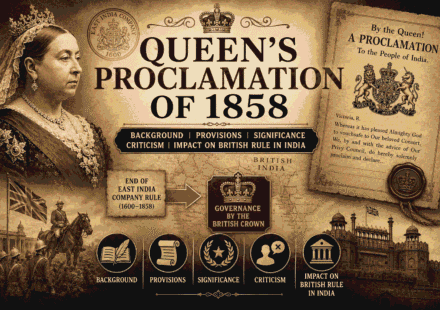
Queen’s Proclamation of 1858: Background, Provisions, Significance, Criticism and Impact on British Rule in India

The Queen's Proclamation of 1858, also known as Queen Victoria's Proclamation, was one of the most significant constitutional and administrative documents in the history of British India.
Read More
Government of India Act, 1858: Features, Objectives, Impact and Historical Significance
The Government of India Act, 1858 was a landmark legislation passed by the British Parliament that fundamentally transformed the system of governance in India. Enacted in the aftermath of the Revolt of 1857, the Act abolished the rule of the East India…
Read More
Charter Act of 1853: Features, Significance, Impact on British Administration | UPSC/JKAS
Introduction The Charter Act of 1853 was one of the most important constitutional developments during British rule in India. Passed by the British Parliament, the Act introduced major administrative and legislative reforms in the governance of India…
Read More
Pitt’s India Act, 1784: Features, Significance & Impact on British Administration (UPSC/JKAS)

Introduction The Pitt’s India Act of 1784 marked a decisive stage in the constitutional evolution of British rule in India. Enacted by the British Parliament under Prime Minister William Pitt the Younger, the Act was passed to rectify the administrative…
Read More
Regulating Act of 1773: Features, Significance & Impact on British Administration
Introduction The Regulating Act of 1773 marked the first direct intervention of the British Parliament in the affairs of the East India Company in India. Enacted during the reign of George III, the Act was passed by the British Parliament under the…
Read More