Skip to content
-
Subscribe to our newsletter & never miss our best posts. Subscribe Now!
Civilscentral.com Civils Central

Prep.Practice.Prevail.

Civilscentral.com Civils Central

Prep.Practice.Prevail.

  • Home
  • History
    • Ancient History
    • Medieval History
  • Contact Us
  • About Us
  • Home
  • History
    • Ancient History
    • Medieval History
  • Contact Us
  • About Us
  • https://www.facebook.com/
  • https://twitter.com/
  • https://t.me/
  • https://www.instagram.com/
  • https://youtube.com/
Civilscentral.com Civils Central

Prep.Practice.Prevail.

Civilscentral.com Civils Central

Prep.Practice.Prevail.

  • Home
  • History
    • Ancient History
    • Medieval History
  • Contact Us
  • About Us
  • Home
  • History
    • Ancient History
    • Medieval History
  • Contact Us
  • About Us
  • https://www.facebook.com/
  • https://twitter.com/
  • https://t.me/
  • https://www.instagram.com/
  • https://youtube.com/
Home/Ancient History/Foreign Invasions: Iranian and Alexander’s Invasion of India
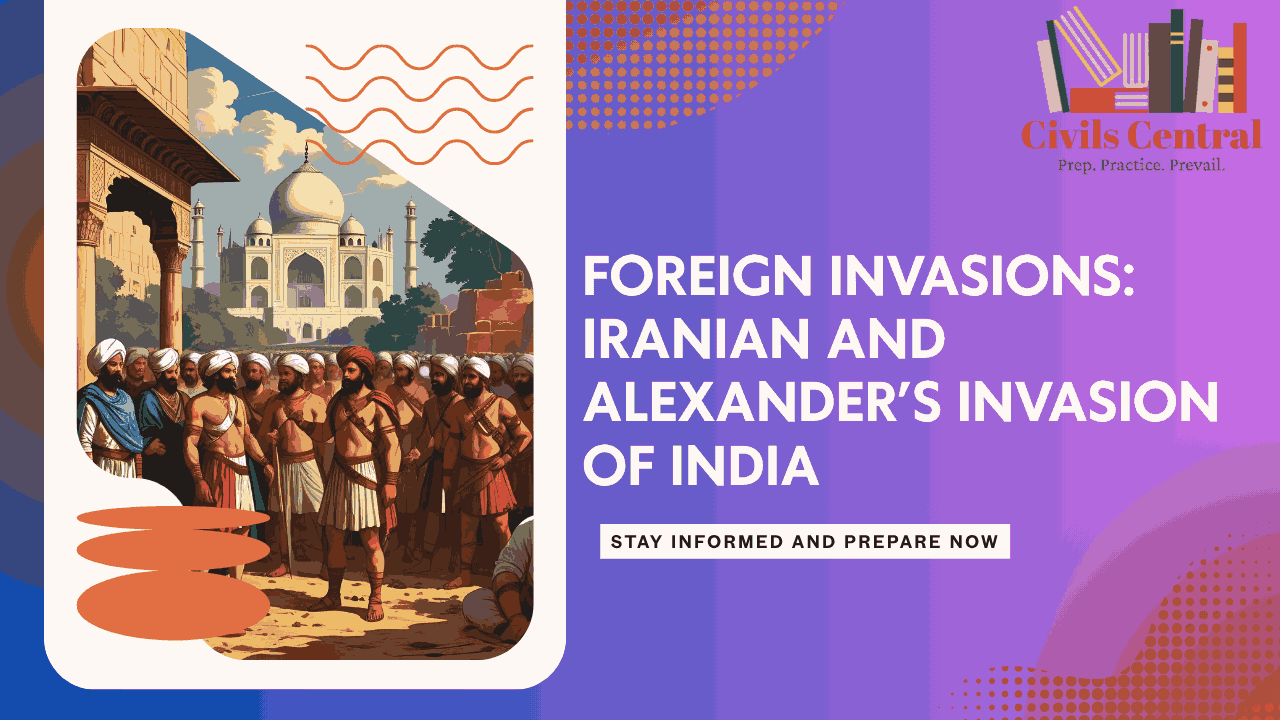
Illustration of Iranian and Alexander’s Invasion of India with ancient soldiers and classical Indian architecture, used for UPSC/JKAS history blog.
Ancient History

Foreign Invasions: Iranian and Alexander’s Invasion of India

By Rohit Thapa

📘 Ancient Indian History Series | For UPSC & JKAS Aspirants


🧭 Introduction: Why Study Foreign Invasions?

Foreign invasions before the Mauryan Empire (particularly the Iranian invasions and Alexander’s campaign) had a lasting impact on India’s political structure, art, coinage, and military organization. These invasions acted as a catalyst for the emergence of powerful centralized states like the Mauryan Empire.


🏹 Part I: The Iranian Invasions (6th century BCE onwards)

🔹 Background:

  • The Achaemenid Empire of Persia (Iran) under rulers like Cyrus the Great, Darius I, and Xerxes was expanding eastward.
  • The north-western part of the Indian subcontinent (modern-day Pakistan and Afghanistan) came under their control.

🔹 Timeline & Rulers:

RulerPeriodContribution/Action in India
Cyrus the Great~550 BCEFirst to annex parts of Gandhara
Darius I522–486 BCEConquered Sindh, Punjab (Indus Valley) – included as 20th Satrapy
Xerxes486–465 BCEMaintained control, recruited Indian soldiers in wars

🔹 Region Conquered:

  • Parts of Gandhara, Sindh, and Punjab became Achaemenid Satrapies (provinces).

🔹 Impact of Iranian Invasion:

  1. Political Administration:
    • Introduced the concept of Satrapy (provincial governance) — influenced Mauryan administrative structure.
  2. Art & Architecture:
    • Achaemenid influence seen in Ashokan Pillars (Kharoshthi Script) and Mauryan court architecture (e.g. Pataliputra).
  3. Coinage:
    • Introduction of punch-marked coins and idea of standardizing weights.
  4. Trade & Communication:
    • Improved infrastructure like roads and trade routes linking India with West Asia.
  5. Cultural Exchange:
    • Diffusion of Persian language, ideas, and courtly traditions.
  6. Military Tactics:
    • Exposure to mounted cavalry and archery techniques.

⚔️ Part II: Alexander’s Invasion (327–325 BCE)

🔹 Who was Alexander?

  • Alexander the Great, King of Macedonia, conquered the Persian Empire and aimed to reach the “ends of the world” — India.

🔹 Route of Invasion:

  • Crossed the Hindu Kush, entered via Kabul valley, conquered Gandhara and Punjab.

🔹 Key Battles:

  1. Battle of Hydaspes (326 BCE):
    • Fought between Alexander (Sikandar) and King Porus (Paurava)
    • Porus fought bravely but was defeated.
    • Alexander impressed by his valor, reinstated him as Satrap(Governor).
  2. Advance towards Ganges:
    • Wanted to march eastward, but troops mutinied at the Beas River, fearing the Nanda Empire and elephants.

🔹 Alexander’s Return:

  • Retreated through the Makran Desert(Balochistan), suffering heavy losses.
  • Left Greek governors (satraps) in north-west India — including Seleucus I Nicator.

🧠 Impact of Alexander’s Invasion on India:

AreaContribution
PoliticalDisrupted small kingdoms in the northwest; created a power vacuum exploited by Chandragupta Maurya
MilitaryIntroduced new war techniques, especially phalanx formation and use of cavalry
Cultural ExchangeIncreased Greco-Indian interaction, especially in art (Gandhara School)
Geographical KnowledgeGreeks produced detailed records of Indian geography, culture, and governance (e.g., Megasthenes’ Indica)
Coinage & ArtHellenistic art & coinage influenced Indo-Greek kingdoms later

🔍 Comparative Overview: Iranian vs. Alexander’s Invasion

FeatureIranian InvasionAlexander’s Invasion
DurationLong-term control (200+ years)Short-term (2 years)
GovernanceIntegrated Indian regions as satrapiesLeft governors temporarily
Cultural ImpactPersian influence on art, administrationHellenistic influence on art, urban planning
Military ImpactIntroduced cavalry tacticsExposure to Greek warfare, formation
LegacyInfluenced Mauryan administrationTriggered fall of Nandas, rise of Mauryas

🧾 Prelims Pointers:

✅ Gandhara was the first Indian region to fall under Persian rule.
✅ The 20th satrapy of Darius included Sindh and Punjab.
✅ Battle of Hydaspes was fought on the banks of River Jhelum.
✅ Alexander’s eastward campaign was halted at River Beas.
✅ Seleucus Nicator later ceded territories to Chandragupta Maurya.


🧠 Mains Answer Enrichment:

  • “The Iranian and Greek invasions, though short-lived, laid the foundation for imperial governance and Indo-Hellenistic culture. Discuss.”
  • “Examine the political and cultural impact of Alexander’s invasion on the Indian subcontinent.”

📘 Conclusion:

While the Iranian and Greek invasions did not bring lasting foreign rule, they acted as bridges between India and the West. Their legacy is evident in the administrative and artistic developments of the Mauryan Empire. These invasions catalyzed India’s transition from tribal polities to large empires.


About The Author

Rohit Thapa

See author's posts

Author

Rohit Thapa

Follow Me
Other Articles
Ancient Indian city with people walking through grand architectural structures, symbolizing the rise of Mahajanapadas and urban centers during second urbanization
Previous

Mahajanapadas & Second Urbanization (600 BCE onwards): The Rise of States and Cities in Ancient India

Ancient Junagadh rock inscription carved in Brahmi script showcasing India’s early administrative and irrigation achievements.
Next

Junagadh Rock Inscription: A Testament to Ancient Indian Governance and Infrastructure

No Comment! Be the first one.

    Leave a Reply Cancel reply

    Your email address will not be published. Required fields are marked *

    This site uses Akismet to reduce spam. Learn how your comment data is processed.

    Recent Posts

    • What is International Relations? Understanding the Discipline That Explains the Modern World
    • The Complete Guide to Preparing International Relations for UPSC & JKAS 2027
    • Viability Gap Funding (VGF): Meaning, Objectives, PPP Models, Features, Benefits & UPSC Notes
    • Understanding Foreign Capital: Meaning, Need, Evolution and Components
    • National Food Security Act (NFSA) 2013 Explained: Features, PDS, MSP, ONORC, Challenges & UPSC Notes

    Categories

    • Ancient History
    • Chapter 1.1
    • CivilsCentral Knowledge Library
    • Current Affairs
    • Defence
    • Disaster Management
    • Economics
    • Environment & Ecology
    • Exam Strategy
    • Finance
    • Geography
    • Governance
    • Government Schemes
    • International Organisations
    • International Relations
    • International Relations
    • Latest Notifications
    • Medieval History
    • Modern History
    • Modern History
    • Physics
    • polity
    • Polity & Constitution
    • Science & Technology
    • Statutory Bodies
    • UPSC

    RECENT POSTS

    • What is International Relations? Understanding the Discipline That Explains the Modern World
    • The Complete Guide to Preparing International Relations for UPSC & JKAS 2027
    • Viability Gap Funding (VGF): Meaning, Objectives, PPP Models, Features, Benefits & UPSC Notes
    • Understanding Foreign Capital: Meaning, Need, Evolution and Components
    • National Food Security Act (NFSA) 2013 Explained: Features, PDS, MSP, ONORC, Challenges & UPSC Notes
    • Ancient History (15)
    • Chapter 1.1 (1)
    • CivilsCentral Knowledge Library (2)
    • Current Affairs (53)
    • Defence (4)
    • Disaster Management (1)
    • Economics (4)
    • Environment & Ecology (10)
    • Exam Strategy (1)
    • Finance (3)
    • Geography (1)
    • Governance (16)
    • Government Schemes (2)
    • International Organisations (3)
    • International Relations (12)
    • International Relations (2)
    • Latest Notifications (1)
    • Medieval History (13)
    • Modern History (8)
    • Modern History (11)
    • Physics (1)
    • polity (1)
    • Polity & Constitution (8)
    • Science & Technology (8)
    • Statutory Bodies (1)
    • UPSC (19)

    Archives

    • July 2026
    • June 2026
    • March 2026
    • February 2026
    • August 2025
    • July 2025
    • June 2025

    You May Have Missed

    What is International Relations?
    Chapter 1.1 CivilsCentral Knowledge Library International Relations

    What is International Relations? Understanding the Discipline That Explains the Modern World

    Rohit Thapa
    By Rohit Thapa
    July 8, 2026
    The Complete Guide to Preparing International Relations for UPSC & JKAS 2027
    CivilsCentral Knowledge Library International Relations

    The Complete Guide to Preparing International Relations for UPSC & JKAS 2027

    Rohit Thapa
    By Rohit Thapa
    July 7, 2026
    Viability Gap Funding
    Current Affairs Economics

    Viability Gap Funding (VGF): Meaning, Objectives, PPP Models, Features, Benefits & UPSC Notes

    Rohit Thapa
    By Rohit Thapa
    July 6, 2026
    Foreign Capital
    Current Affairs Economics

    Understanding Foreign Capital: Meaning, Need, Evolution and Components

    Rohit Thapa
    By Rohit Thapa
    July 4, 2026
    NFSA,2013
    Current Affairs Economics Governance

    National Food Security Act (NFSA) 2013 Explained: Features, PDS, MSP, ONORC, Challenges & UPSC Notes

    Rohit Thapa
    By Rohit Thapa
    July 4, 2026
    India Energy Security
    Current Affairs Governance International Relations

    India’s Energy Future: Energy Security, Energy Transition, Energy Policy and the Road to Sustainable Development

    Rohit Thapa
    By Rohit Thapa
    July 4, 2026
    Indias Electric Mobility
    Current Affairs Environment & Ecology Governance Science & Technology

    Delhi CM Launches EV Policy 2.0

    Rohit Thapa
    By Rohit Thapa
    July 3, 2026
    Digital Push for Criminal Justice System_ Towards a Faster, Transparent and Citizen-Centric Justice Delivery System
    Current Affairs Governance Polity & Constitution

    Digital Push for Criminal Justice System

    Rohit Thapa
    By Rohit Thapa
    July 3, 2026
    New FCRA Portal & e-OCI Card Launched_ Transforming India’s Digital Governance for Foreign Contributions and Overseas Indian Services
    Current Affairs Governance

    New FCRA Portal & e-OCI Card Launched: Transforming India’s Digital Governance for Foreign Contributions and Overseas Indian Services

    Rohit Thapa
    By Rohit Thapa
    July 2, 2026
    Civilscentral.com
    • What is International Relations? Understanding the Discipline That Explains the Modern World
    • The Complete Guide to Preparing International Relations for UPSC & JKAS 2027
    • Viability Gap Funding (VGF): Meaning, Objectives, PPP Models, Features, Benefits & UPSC Notes
    • Understanding Foreign Capital: Meaning, Need, Evolution and Components
    • National Food Security Act (NFSA) 2013 Explained: Features, PDS, MSP, ONORC, Challenges & UPSC Notes
    • What is International Relations? Understanding the Discipline That Explains the Modern World
    • The Complete Guide to Preparing International Relations for UPSC & JKAS 2027
    • Viability Gap Funding (VGF): Meaning, Objectives, PPP Models, Features, Benefits & UPSC Notes
    • Understanding Foreign Capital: Meaning, Need, Evolution and Components
    • National Food Security Act (NFSA) 2013 Explained: Features, PDS, MSP, ONORC, Challenges & UPSC Notes
    Copyright 2026 — Civils Central. All rights reserved.