Skip to content
-
Subscribe to our newsletter & never miss our best posts. Subscribe Now!
Civilscentral.com Civils Central

Prep.Practice.Prevail.

Civilscentral.com Civils Central

Prep.Practice.Prevail.

  • Home
  • History
    • Ancient History
    • Medieval History
  • Contact Us
  • About Us
  • Home
  • History
    • Ancient History
    • Medieval History
  • Contact Us
  • About Us
  • https://www.facebook.com/
  • https://twitter.com/
  • https://t.me/
  • https://www.instagram.com/
  • https://youtube.com/
Civilscentral.com Civils Central

Prep.Practice.Prevail.

Civilscentral.com Civils Central

Prep.Practice.Prevail.

  • Home
  • History
    • Ancient History
    • Medieval History
  • Contact Us
  • About Us
  • Home
  • History
    • Ancient History
    • Medieval History
  • Contact Us
  • About Us
  • https://www.facebook.com/
  • https://twitter.com/
  • https://t.me/
  • https://www.instagram.com/
  • https://youtube.com/
Home/Ancient History/Mahajanapadas & Second Urbanization (600 BCE onwards): The Rise of States and Cities in Ancient India
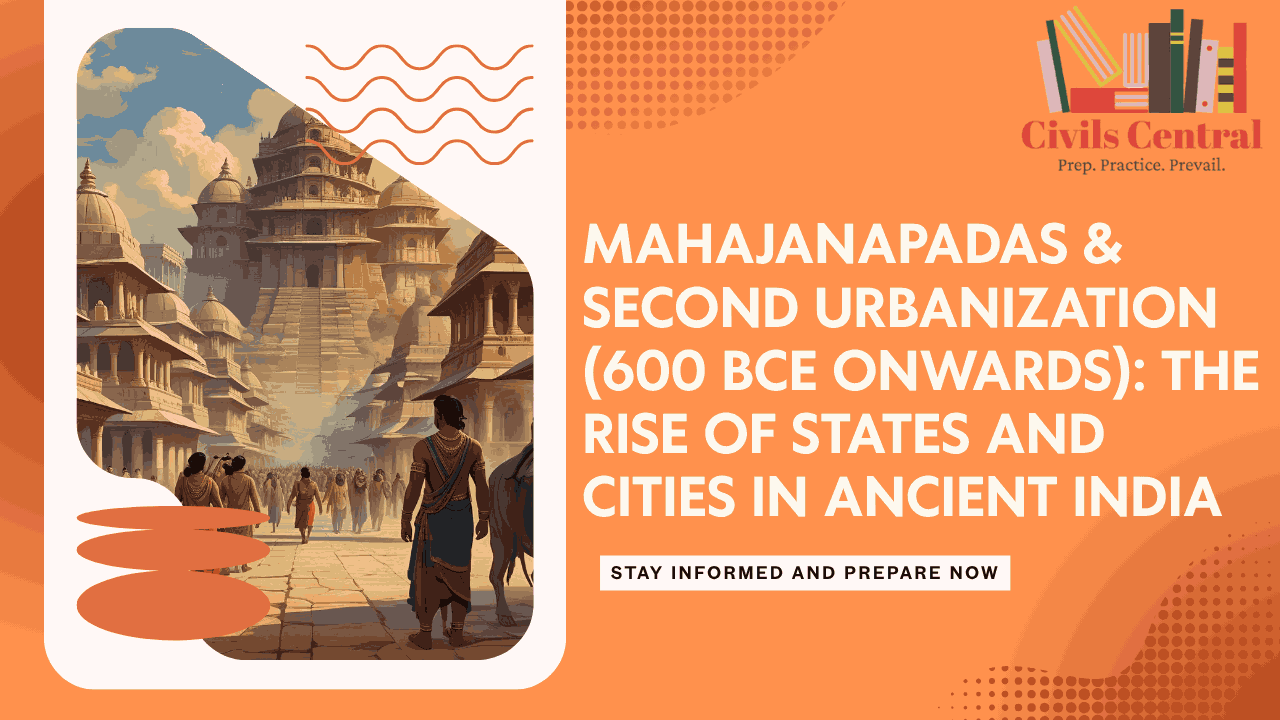
Ancient Indian city with people walking through grand architectural structures, symbolizing the rise of Mahajanapadas and urban centers during second urbanization
Ancient History

Mahajanapadas & Second Urbanization (600 BCE onwards): The Rise of States and Cities in Ancient India

By Rohit Thapa

🪔 Introduction: From Cattle Raids to Kingdoms

By 600 BCE, India stood on the cusp of a new transformation. The simple tribal society of the Vedic era began evolving into territorial states, with powerful rulers, urban centers, and complex socio-political structures. This age witnessed the rise of Mahajanapadas—the sixteen great kingdoms—and marked what historians call the Second Urbanization in Indian history.

While the First Urbanization was associated with the Indus Valley Civilization, the Second Urbanization was deeply linked to the Ganga Valley, iron technology, and the development of cities, coins, and philosophies that would shape Indian civilization for centuries.


📜 What Were Mahajanapadas?

The term Mahajanapada combines two words:

  • Maha = great
  • Janapada = foothold of a tribe or people (Jana = people; Pada = foothold)

These were large territorial units or proto-states that emerged in Northern India by 600 BCE.

📍 Sources of Information:

  • Buddhist texts like Anguttara Nikaya of Suttapitaka mention 16 Mahajanapadas.
  • Jain texts like Bhagavati Sutra
  • Later Vedic texts such as Shatapatha Brahmana
  • Panini’s Ashtadhyayi also refers to many Janapadas.

🗺️ List of 16 Mahajanapadas

MahajanapadaCapitalRegion (Modern Area)Notes
AngaChampaBiharConquered by Magadha
MagadhaRajagriha / PataliputraBiharLater became most powerful
KashiVaranasiUttar PradeshFrequent conflict with Kosala
KosalaShravastiEastern UPRuled by King Prasenjit
VajjiVaishaliNorth BiharRepublic, confederacy of clans
MallaKusinara, PavaEastern UPRepublic, Buddha died here
ChediShuktimatiBundelkhandMentioned in Mahabharata
VatsaKaushambiNear AllahabadRuled by Udayana
KuruHastinapurDelhi-Haryana regionDeclined post-Vedic era
PanchalaAhichhatra, KampilyaWestern UPHome of Draupadi (in Epic)
MatsyaViratanagaraRajasthanMinor power
SurasenaMathuraUPKrishna’s region
AssakaPotanaMaharashtraOnly southern Mahajanapada
AvantiUjjayini, MahishmatiMPDivided into North/South Avanti
GandharaTaxilaPakistan-Afghanistan borderGreat seat of learning
KambojaRajapuraKabul regionKnown for horses

✅ Prelims Fact Tip: Only Asmaka was located in the Deccan; rest were in north/northwest.


🧱 Second Urbanization: The Ganga Valley Boom

Unlike the earlier Indus cities, this wave of urbanization was organic, rooted in agriculture, iron use, and new social formations.

🔨 Iron Technology:

  • Widespread use of iron tools (Krishna-Ayas) boosted agriculture and forest clearing in the fertile Ganga plains.
  • Allowed expansion of settlements and surplus production.

🏙️ Rise of Towns:

  • Cities like Rajagriha, Vaishali, Kaushambi, Ujjayini grew in economic and political importance.
  • These towns became centers of trade, administration, education, and religious movements (e.g., Buddhism & Jainism).

💰 Use of Coinage:

  • First coins: Punch-marked coins (silver), indicating the rise of a monetary economy.
  • Facilitated trade, taxation, and state power.

👑 Types of Polities: Monarchies vs Republics

🏰 Monarchies:

  • Hereditary rulers
  • Examples: Magadha, Kosala, Kashi, Avanti

🗳️ Republics (Gana-sanghas):

  • Ruled by oligarchies or clan assemblies, Brahmanas had no place.
  • Had ganas (clans) and sabhas (deliberative councils)
  • Examples: Vajji, Malla, Kamboja

📝 UPSC Mains Angle: Contrast monarchical centralization in Magadha vs oligarchic decentralization in Vajji can be a good analytical point in essays or polity questions.


🧭 Why Did This Period Matter?

✅ Key Contributions:

  • Emergence of large states → laid the foundation for empires like Magadha, Mauryas.
  • Urbanization → led to trade networks, monetization, and crafts.
  • Religious ferment → rise of Buddhism and Jainism as a response to socio-economic changes.
  • Political experimentation → from absolute monarchy to republicanism.

🏛️ Mahajanapadas and Buddhism

  • Most Mahajanapadas were the backdrop for Buddha’s life and sermons.
  • Cities like Rajagriha, Shravasti, Vaishali, and Kushinagar became Buddhist pilgrimage sites.
  • Buddhist councils were held in Rajagriha and Vaishali.

📘 Relevance for UPSC/JKAS Mains

🔑 GS Paper I (History):

  • “Examine the socio-political impact of the Mahajanapada system on the rise of Indian empires.”
  • “Discuss the factors responsible for the Second Urbanization and its consequences.”

🧠 Analytical Pointers:

  • Role of geography (Ganga valley) in urban spread
  • Contrast between Janapadas and Mahajanapadas
  • How religious movements were intertwined with economic and social discontent

✍️ Conclusion

The era of Mahajanapadas and Second Urbanization wasn’t just about political expansion—it was a time of economic dynamism, urban awakening, and intellectual revolution. The groundwork laid during this period would culminate in the rise of empires, the spread of Buddhism, and the cultural foundation of classical India.


About The Author

Rohit Thapa

See author's posts

Tags:

16 MahajanapadasAncient Indian HistoryBuddhism and MahajanapadasGana SanghasIron Age IndiaJanapadas vs MahajanapadasJKAS Ancient HistoryMagadha EmpireMahajanapada SystemMahajanapadasPunch-marked CoinsRise of Cities in Ancient IndiaSecond UrbanizationUPSC ancient historyUPSC GS Paper 1 HistoryUrbanization in Ganga ValleyVajji Confederacy
Author

Rohit Thapa

Follow Me
Other Articles
Ancient Indian monks seated under a tree in meditation, symbolizing the rise of Jainism and Buddhism during 6th century BCE.
Previous

Jainism and Buddhism: Religious Reform Movements of 6th Century BCE India

Illustration of Iranian and Alexander’s Invasion of India with ancient soldiers and classical Indian architecture, used for UPSC/JKAS history blog.
Next

Foreign Invasions: Iranian and Alexander’s Invasion of India

No Comment! Be the first one.

    Leave a Reply Cancel reply

    Your email address will not be published. Required fields are marked *

    This site uses Akismet to reduce spam. Learn how your comment data is processed.

    Recent Posts

    • What is International Relations? Understanding the Discipline That Explains the Modern World
    • The Complete Guide to Preparing International Relations for UPSC & JKAS 2027
    • Viability Gap Funding (VGF): Meaning, Objectives, PPP Models, Features, Benefits & UPSC Notes
    • Understanding Foreign Capital: Meaning, Need, Evolution and Components
    • National Food Security Act (NFSA) 2013 Explained: Features, PDS, MSP, ONORC, Challenges & UPSC Notes

    Categories

    • Ancient History
    • Chapter 1.1
    • CivilsCentral Knowledge Library
    • Current Affairs
    • Defence
    • Disaster Management
    • Economics
    • Environment & Ecology
    • Exam Strategy
    • Finance
    • Geography
    • Governance
    • Government Schemes
    • International Organisations
    • International Relations
    • International Relations
    • Latest Notifications
    • Medieval History
    • Modern History
    • Modern History
    • Physics
    • polity
    • Polity & Constitution
    • Science & Technology
    • Statutory Bodies
    • UPSC

    RECENT POSTS

    • What is International Relations? Understanding the Discipline That Explains the Modern World
    • The Complete Guide to Preparing International Relations for UPSC & JKAS 2027
    • Viability Gap Funding (VGF): Meaning, Objectives, PPP Models, Features, Benefits & UPSC Notes
    • Understanding Foreign Capital: Meaning, Need, Evolution and Components
    • National Food Security Act (NFSA) 2013 Explained: Features, PDS, MSP, ONORC, Challenges & UPSC Notes
    • Ancient History (15)
    • Chapter 1.1 (1)
    • CivilsCentral Knowledge Library (2)
    • Current Affairs (53)
    • Defence (4)
    • Disaster Management (1)
    • Economics (4)
    • Environment & Ecology (10)
    • Exam Strategy (1)
    • Finance (3)
    • Geography (1)
    • Governance (16)
    • Government Schemes (2)
    • International Organisations (3)
    • International Relations (12)
    • International Relations (2)
    • Latest Notifications (1)
    • Medieval History (13)
    • Modern History (8)
    • Modern History (11)
    • Physics (1)
    • polity (1)
    • Polity & Constitution (8)
    • Science & Technology (8)
    • Statutory Bodies (1)
    • UPSC (19)

    Archives

    • July 2026
    • June 2026
    • March 2026
    • February 2026
    • August 2025
    • July 2025
    • June 2025

    You May Have Missed

    What is International Relations?
    Chapter 1.1 CivilsCentral Knowledge Library International Relations

    What is International Relations? Understanding the Discipline That Explains the Modern World

    Rohit Thapa
    By Rohit Thapa
    July 8, 2026
    The Complete Guide to Preparing International Relations for UPSC & JKAS 2027
    CivilsCentral Knowledge Library International Relations

    The Complete Guide to Preparing International Relations for UPSC & JKAS 2027

    Rohit Thapa
    By Rohit Thapa
    July 7, 2026
    Viability Gap Funding
    Current Affairs Economics

    Viability Gap Funding (VGF): Meaning, Objectives, PPP Models, Features, Benefits & UPSC Notes

    Rohit Thapa
    By Rohit Thapa
    July 6, 2026
    Foreign Capital
    Current Affairs Economics

    Understanding Foreign Capital: Meaning, Need, Evolution and Components

    Rohit Thapa
    By Rohit Thapa
    July 4, 2026
    NFSA,2013
    Current Affairs Economics Governance

    National Food Security Act (NFSA) 2013 Explained: Features, PDS, MSP, ONORC, Challenges & UPSC Notes

    Rohit Thapa
    By Rohit Thapa
    July 4, 2026
    India Energy Security
    Current Affairs Governance International Relations

    India’s Energy Future: Energy Security, Energy Transition, Energy Policy and the Road to Sustainable Development

    Rohit Thapa
    By Rohit Thapa
    July 4, 2026
    Indias Electric Mobility
    Current Affairs Environment & Ecology Governance Science & Technology

    Delhi CM Launches EV Policy 2.0

    Rohit Thapa
    By Rohit Thapa
    July 3, 2026
    Digital Push for Criminal Justice System_ Towards a Faster, Transparent and Citizen-Centric Justice Delivery System
    Current Affairs Governance Polity & Constitution

    Digital Push for Criminal Justice System

    Rohit Thapa
    By Rohit Thapa
    July 3, 2026
    New FCRA Portal & e-OCI Card Launched_ Transforming India’s Digital Governance for Foreign Contributions and Overseas Indian Services
    Current Affairs Governance

    New FCRA Portal & e-OCI Card Launched: Transforming India’s Digital Governance for Foreign Contributions and Overseas Indian Services

    Rohit Thapa
    By Rohit Thapa
    July 2, 2026
    Civilscentral.com
    • What is International Relations? Understanding the Discipline That Explains the Modern World
    • The Complete Guide to Preparing International Relations for UPSC & JKAS 2027
    • Viability Gap Funding (VGF): Meaning, Objectives, PPP Models, Features, Benefits & UPSC Notes
    • Understanding Foreign Capital: Meaning, Need, Evolution and Components
    • National Food Security Act (NFSA) 2013 Explained: Features, PDS, MSP, ONORC, Challenges & UPSC Notes
    • What is International Relations? Understanding the Discipline That Explains the Modern World
    • The Complete Guide to Preparing International Relations for UPSC & JKAS 2027
    • Viability Gap Funding (VGF): Meaning, Objectives, PPP Models, Features, Benefits & UPSC Notes
    • Understanding Foreign Capital: Meaning, Need, Evolution and Components
    • National Food Security Act (NFSA) 2013 Explained: Features, PDS, MSP, ONORC, Challenges & UPSC Notes
    Copyright 2026 — Civils Central. All rights reserved.