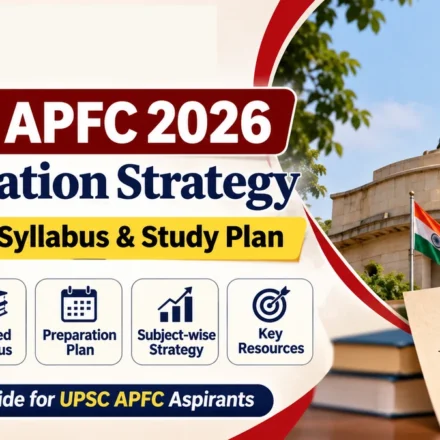
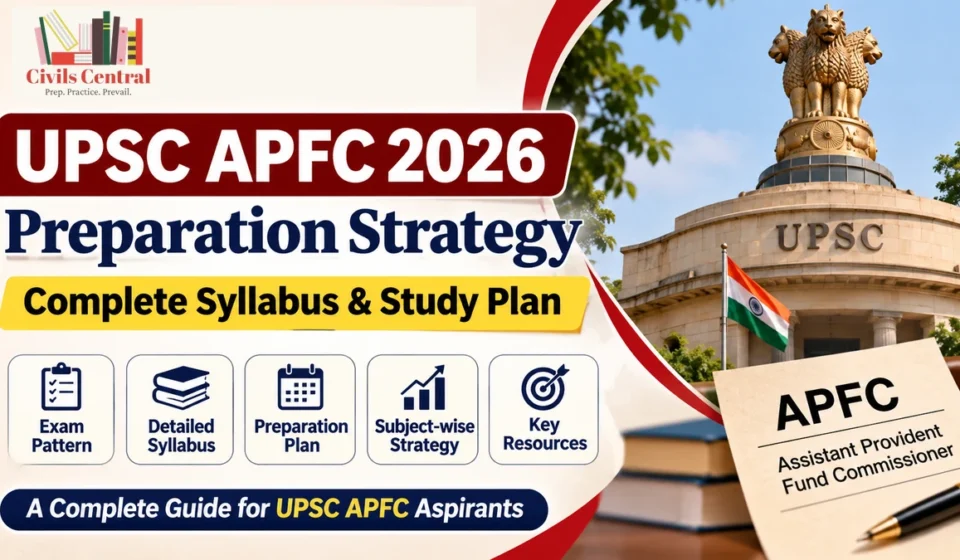

Recruitment Test: 20 December 2026 | Total RT Marks: 300 | Duration: 2 Hours
The Union Public Service Commission (UPSC) conducts recruitment for the post of Assistant Provident Fund Commissioner (APFC) in the Employees’ Provident Fund Organisation (EPFO), Ministry of Labour and Employment, Government of India. The position is an important Group A-level administrative post responsible for statutory functions relating to provident funds, pension, social security, enforcement, recovery, accounts and administration.
Through Special Advertisement No. 52/2026, UPSC has announced 80 vacancies for Assistant Provident Fund Commissioner. The recruitment process includes a pen-and-paper Recruitment Test (RT), followed by an interview for candidates shortlisted by the Commission. The Recruitment Test is scheduled for 20 December 2026.
Preparing for the APFC examination requires more than reading general competitive-examination books. Candidates must develop a strong understanding of labour legislation, industrial relations, social security, accountancy, auditing, Indian economy, governance and other prescribed subjects.
This comprehensive preparation guide explains the official examination pattern, all nine syllabus areas, important preparation topics, subject-wise study methods, recommended resources, a 29-day intensive preparation schedule, MCQ practice and mock-test strategy.
Whether you are beginning your preparation or revising subjects already studied, this guide provides a structured framework for preparing systematically for UPSC APFC 2026.
1. UPSC APFC 2026: Examination Overview
The Assistant Provident Fund Commissioner is a Group A, non-ministerial post in EPFO, a statutory organisation under the administrative control of the Ministry of Labour and Employment.
According to the recruitment advertisement, the APFC position involves responsibilities relating to enforcement, recovery, accounts, administration, cash management, legal matters, pension and computer-related functions. These include conducting inquiries, settling claims, maintaining financial records and handling administrative responsibilities.
Important examination details
| Particulars | Details |
| Recruiting authority | Union Public Service Commission |
| Post | Assistant Provident Fund Commissioner |
| Organisation | Employees’ Provident Fund Organisation |
| Administrative ministry | Ministry of Labour and Employment |
| Advertisement number | Special Advertisement No. 52/2026 |
| Total vacancies | 80 |
| Vacancy number | 26085201722 |
| Recruitment Test date | 20 December 2026 |
| Recruitment Test marks | 300 |
| Test duration | 2 hours |
| Examination mode | Pen-and-paper |
| Question format | Objective-type MCQs |
| Medium | English and Hindi |
| Negative marking | One-third of marks assigned to an incorrect answer |
| Pay level | Level 10, Seventh CPC |
| Probation | One year |
The post is permanent and carries All India Service liability, with headquarters at New Delhi. Selected officers may be required to serve in any part of India.
Educational qualification: A degree from a recognised university or equivalent is the essential qualification. A diploma in Company Law, Labour Laws or Public Administration is listed as a desirable qualification.
The online application window specified in the advertisement closed on 11 September 2026 at 6 PM. This guide is intended for candidates preparing for the scheduled Recruitment Test.
2. UPSC APFC 2026 Examination Pattern and Selection Process
The APFC recruitment process consists of a Recruitment Test (RT), followed by an interview for candidates shortlisted by UPSC.
Recruitment Test
The Recruitment Test is the first stage of the selection process. It evaluates candidates across nine broad areas, covering general knowledge, Indian economy, governance, history, science, quantitative aptitude, industrial relations, labour legislation, social security and accountancy.
According to Appendix I of Special Advertisement No. 52/2026, the examination scheme is as follows:
| Examination parameter | Official provision |
| Examination mode | Pen-and-paper |
| Duration | 2 hours |
| Total marks | 300 |
| Question format | Objective-type multiple-choice questions |
| Marks per question | Equal marks for all questions |
| Medium | English and Hindi |
| Incorrect answer penalty | One-third of the marks assigned to the question |
| Unattempted question | No penalty |
The notification does not prescribe a subject-wise distribution of questions or marks. Therefore, candidates should not rely on unofficial claims that a particular subject carries a fixed number of questions or a predetermined percentage of the total marks.
Negative Marking and Question Selection
Every incorrect answer attracts a penalty of one-third of the marks assigned to that question. The penalty is proportional to the marks allocated to the question.
For example:
| Response | If the question carries 1 mark | If the question carries 2 marks |
| Correct answer | +1 | +2 |
| Incorrect answer | −1/3 | −2/3 |
| Unattempted | 0 | 0 |
Candidates should develop a disciplined approach to question selection. Questions should be classified into three practical categories:
- High-confidence questions: Questions for which the candidate knows the correct answer.
- Elimination-based questions: Questions where one or more options can be ruled out through sound reasoning.
- High-uncertainty questions: Questions where the candidate lacks sufficient knowledge to make a reasoned choice.
The decision to attempt an uncertain question should be based on the candidate’s ability to eliminate options and the expected benefit of attempting it. Blind guessing should be avoided.
Interview and Overall Weightage
Appendix I states that, as per prevailing practice, the following weightage may be adopted:
| Stage | Marks | Indicative weightage |
| Recruitment Test | 300 | 75% |
| Interview | 100 | 25% |
| Total | 400 | 100% |
The notification uses the expression “may be adopted”. Accordingly, the 75:25 ratio should be understood as the weightage framework indicated by UPSC, rather than an unconditional guarantee that the same arrangement will necessarily apply in every circumstance.
The minimum interview suitability standards specified in the notification are:
| Category | Minimum interview marks out of 100 |
| General/EWS | 50 |
| OBC | 45 |
| SC/ST/PwBD | 40 |
The minimum suitability standard for the Recruitment Test will be determined by UPSC on a case-by-case basis.
3.UPSC APFC 2026 Syllabus and Expanded Topic-Wise Preparation Checklist
The official syllabus is provided in Appendix I of UPSC Special Advertisement No. 52/2026. It consists of nine broad subject areas.
Important syllabus clarification: UPSC has prescribed broad syllabus headings rather than a detailed topic-by-topic list under each subject. The topics below constitute CivilsCentral’s recommended preparation checklist to help candidates interpret and cover the scope of the official syllabus. They should not be treated as an exhaustive list separately issued by UPSC.
Subject 1: General English
Official syllabus heading: General English – understanding of English and workman-like use of words.
Recommended preparation areas include reading comprehension, vocabulary, grammar and correct usage of the English language.
Candidates should cover:
- Reading comprehension and inference-based questions.
- Vocabulary and contextual word usage.
- Synonyms and antonyms.
- Idioms and phrases.
- One-word substitutions.
- Sentence correction and improvement.
- Error detection.
- Subject-verb agreement.
- Tenses.
- Articles and prepositions.
- Active and passive voice.
- Direct and indirect speech.
- Sentence completion.
- Para-jumbles and sentence arrangement.
Preparation approach: Practise comprehension passages regularly, revise vocabulary in context and solve grammar-based MCQs. Candidates should focus on understanding the meaning and structure of sentences rather than memorising isolated grammatical rules.
Subject 2: Indian Culture, Heritage and Freedom Movements
Official syllabus heading: Indian Culture, Heritage and Freedom Movements.
Preparation should cover the historical development of India, major cultural traditions, heritage, political developments and the freedom struggle.
Ancient Indian History
- Indus Valley Civilisation.
- Vedic period and later Vedic developments.
- Mahajanapadas.
- Buddhism and Jainism.
- Mauryan Empire and Ashokan policies.
- Post-Mauryan developments.
- Gupta period.
- Ancient education and learning centres.
- Major dynasties and their cultural contributions.
- Art, architecture, literature and religious developments.
Medieval Indian History
- Delhi Sultanate.
- Mughal Empire.
- Regional kingdoms.
- Administrative and revenue systems.
- Bhakti and Sufi movements.
- Medieval architecture.
- Literature and cultural developments.
- Religious and social interactions.
Modern Indian History and Freedom Movement
- Arrival of European trading companies.
- Expansion of British political control.
- Major battles and administrative developments.
- Revolt of 1857: causes, nature and consequences.
- Socio-religious reform movements.
- Formation of the Indian National Congress.
- Moderate and Extremist phases.
- Swadeshi and Boycott movements.
- Home Rule Movement.
- Gandhian movements.
- Non-Cooperation Movement.
- Civil Disobedience Movement.
- Quit India Movement.
- Revolutionary nationalism.
- Constitutional developments under British rule.
- Subhas Chandra Bose and the Indian National Army.
- Independence and Partition.
Indian Art, Culture and Heritage
- Temple and Buddhist architecture.
- Indian sculpture.
- Classical and folk dances.
- Hindustani and Carnatic music.
- Paintings and regional art traditions.
- Literature and languages.
- Cultural institutions.
- UNESCO World Heritage Sites.
- Heritage conservation.
Preparation approach: Prepare chronological timelines, compare important movements and reform organisations, and maintain concise notes on personalities, constitutional developments, cultural traditions and major historical events.
Subject 3: Developmental Issues and Present Trends in Indian Economy
Official syllabus heading: Developmental Issues and Present Trends in Indian Economy.
This subject requires an understanding of economic concepts, India’s development experience, public finance, monetary policy, employment and contemporary economic developments.
Fundamental Economic Concepts
- National income and its measurement.
- Gross Domestic Product and related aggregates.
- Economic growth and economic development.
- Inflation and deflation.
- Poverty and inequality.
- Unemployment and underemployment.
- Human development.
- Inclusive growth.
- Sustainable development.
- Productivity and structural transformation.
Indian Economic Development
- Economic planning in India.
- Five-Year Plans and their historical significance.
- Economic reforms of 1991.
- Liberalisation, privatisation and globalisation.
- NITI Aayog.
- Agricultural development.
- Industrial development.
- Service-sector expansion.
- Infrastructure and investment.
- Regional and sectoral disparities.
Banking and Monetary Policy
- Reserve Bank of India and its functions.
- Commercial banking.
- Monetary policy framework.
- Repo rate and other policy rates.
- Cash Reserve Ratio.
- Statutory Liquidity Ratio.
- Inflation targeting.
- Non-performing assets.
- Financial inclusion.
- Digital banking and payment systems.
Public Finance
- Union Budget.
- Revenue and capital expenditure.
- Fiscal deficit.
- Revenue deficit.
- Primary deficit.
- Public debt and government borrowing.
- Direct and indirect taxation.
- Goods and Services Tax.
- Fiscal policy.
- Finance Commission and fiscal federalism.
Employment and Labour Economics
This area deserves particular attention because of the nature of the APFC position.
Candidates should study:
- Labour force and workforce concepts.
- Labour Force Participation Rate.
- Worker Population Ratio.
- Unemployment Rate.
- Organised and unorganised sectors.
- Formal and informal employment.
- Employment generation.
- Labour productivity.
- Wage determination.
- Skill development.
- Demographic dividend.
- Social protection and labour welfare.
- Employment-related government programmes.
Candidates should understand the definitions, methodology and limitations of important employment indicators. Figures should be taken from the relevant official publications rather than from unverified secondary sources.
Preparation approach: Combine conceptual study with the latest Economic Survey, Union Budget, RBI publications, official employment statistics and relevant government reports. Give particular attention to the relationship between economic development, employment generation and social security.
Subject 4: Governance and Constitution of India
Official syllabus heading: Governance and Constitution of India.
Candidates should understand the constitutional framework, institutions, administrative processes and mechanisms of public accountability.
Constitutional Framework
- Historical background of the Constitution.
- Constituent Assembly.
- Salient features of the Constitution.
- Preamble.
- Fundamental Rights.
- Directive Principles of State Policy.
- Fundamental Duties.
- Citizenship.
- Constitutional amendments.
- Basic Structure Doctrine.
- Emergency provisions.
- Federal structure and Centre-State relations.
Union Government
- President and Vice-President.
- Prime Minister and Council of Ministers.
- Parliament.
- Lok Sabha and Rajya Sabha.
- Parliamentary committees.
- Legislative procedure.
- Budgetary procedure.
- Ordinance-making power.
Judiciary
- Supreme Court.
- High Courts.
- Judicial review.
- Independence of judiciary.
- Public Interest Litigation.
- Constitutional remedies.
- Judicial activism and judicial restraint.
Constitutional and Statutory Institutions
- Election Commission of India.
- Comptroller and Auditor General.
- Union Public Service Commission.
- Finance Commission.
- National Human Rights Commission.
- Central Information Commission.
- Central Vigilance Commission.
- Lokpal and Lokayuktas.
Governance and Public Administration
- Transparency and accountability.
- Right to Information.
- Citizen charters.
- E-governance.
- Good governance.
- Public service delivery.
- Social audits.
- Direct Benefit Transfer.
- Grievance redressal.
- Digital governance.
- Administrative reforms.
- Ethics and accountability in public institutions.
Preparation approach: Focus on constitutional provisions, institutional roles, accountability mechanisms and important governance developments. Understand how constitutional and statutory institutions function in practice.
Subject 5: General Science and Basic Knowledge of Computer Applications
Official syllabus heading: General Science and Basic Knowledge of Computer Applications.
This area combines fundamental scientific knowledge with basic computer literacy.
Physics
- Motion, force and laws of motion.
- Work, energy and power.
- Electricity and magnetism.
- Light and sound.
- Heat and temperature.
- Basic scientific principles and everyday applications.
Chemistry
- Atoms and molecules.
- Elements and compounds.
- Acids, bases and salts.
- Metals and non-metals.
- Chemical reactions.
- Everyday chemistry.
- Environmental chemistry.
Biology
- Cell structure and function.
- Human body systems.
- Nutrition and health.
- Communicable and non-communicable diseases.
- Immunity.
- Genetics and heredity.
- Reproduction.
- Plant physiology.
- Ecology and environment.
- Basic biotechnology.
Computer Applications
- Computer fundamentals.
- Hardware and software.
- Input and output devices.
- Operating systems.
- Memory and storage.
- Computer networks.
- Internet and web technologies.
- Email and digital communication.
- Basic office applications.
- Cybersecurity.
- Computer viruses and malware.
- Data protection and digital safety.
- Digital payments and online services.
Preparation approach: Concentrate on fundamental concepts, definitions, practical applications and basic terminology. For computer applications, practise questions on hardware, software, operating systems, networks, internet services and cybersecurity.
Subject 6: Elementary Mathematics, Statistics and General Mental Ability
Official syllabus heading: Elementary Mathematics, Statistics and General Mental Ability.
This subject requires conceptual clarity, numerical accuracy and regular practice.
Elementary Mathematics
- Number system.
- Simplification.
- Fractions and decimals.
- Percentage.
- Ratio and proportion.
- Average.
- Profit and loss.
- Simple and compound interest.
- Time and work.
- Time, speed and distance.
- Mensuration.
- Basic algebra.
Statistics
- Meaning, scope and importance of statistics.
- Collection and classification of data.
- Tabulation and frequency distribution.
- Graphical presentation of data.
- Measures of central tendency.
- Arithmetic mean.
- Median and mode.
- Measures of dispersion.
- Range.
- Variance.
- Standard deviation.
- Correlation.
- Basic probability.
- Interpretation of statistical tables and charts.
General Mental Ability
- Number and alphabetical series.
- Analogy.
- Classification.
- Coding and decoding.
- Logical reasoning.
- Direction sense.
- Blood relations.
- Ranking and ordering.
- Statements and conclusions.
- Basic analytical reasoning.
- Data interpretation.
Preparation approach: Maintain a formula notebook and practise numerical questions daily. For statistics, understand the meaning and application of each measure instead of memorising formulas without understanding them. Regularly solve questions involving tables, graphs and numerical interpretation.
Subject 7: Industrial Relations, Labour Codes and Social Security in India
Official syllabus heading: Industrial Relations, Labour Codes and Social Security in India.
This is a specialised area directly connected with EPFO’s statutory responsibilities. Candidates should develop a sound understanding of industrial relations, labour legislation, social security institutions and the administration of employee welfare benefits.
Industrial Relations
- Meaning, nature and evolution of industrial relations.
- Industrial disputes.
- Trade unions and their functions.
- Collective bargaining.
- Industrial democracy.
- Workers’ participation in management.
- Industrial discipline.
- Grievance redressal.
- Conciliation.
- Arbitration.
- Adjudication.
- Strikes and lockouts.
- Industrial employment conditions.
- Labour-management relations.
Labour Legislation and the Four Labour Codes
Candidates should study the objectives, definitions, applicability, authorities, institutional mechanisms and important provisions of the four Labour Codes:
- Code on Wages, 2019.
- Industrial Relations Code, 2020.
- Code on Social Security, 2020.
- Occupational Safety, Health and Working Conditions Code, 2020.
Preparation must distinguish between the enactment of a Code, commencement of its provisions, notification of rules and practical implementation. These are separate legal and administrative stages.
The commencement history is Code-specific. Candidates should therefore consult the relevant commencement notifications, amendments and rules rather than assuming that every provision of all four Codes became operational on the same date.
As of the preparation date, the Ministry of Labour and Employment’s official materials include Central Rules notified in 2026 for the four Codes. Candidates should use the latest applicable rules, statutory amendments, commencement notifications and official Ministry FAQs while preparing.
Social Security in India
- Meaning and objectives of social security.
- Social insurance and social assistance.
- Provident fund.
- Pension.
- Employee insurance.
- Gratuity.
- Maternity benefits.
- Employee welfare.
- Social security for unorganised workers.
- Government social security programmes.
- Role of social security institutions.
Employees’ Provident Fund Organisation
Candidates should study EPFO from both statutory and administrative perspectives.
Important areas include:
- Establishment and evolution of EPFO.
- Employees’ Provident Funds and Miscellaneous Provisions Act, 1952.
- EPFO’s institutional and organisational structure.
- Central Board of Trustees.
- Employees’ Provident Fund Scheme, 1952.
- Employees’ Pension Scheme, 1995.
- Employees’ Deposit Linked Insurance Scheme, 1976.
- Membership and applicability.
- Employer and employee contributions.
- Wage-related provisions.
- Provident fund withdrawals and advances.
- Pension eligibility and benefits.
- EDLI benefits.
- Exempted establishments.
- Compliance and enforcement.
- Assessment and recovery.
- Settlement of claims.
- Digital services and administrative initiatives.
Understanding the Three Principal EPFO Schemes
| Scheme | Primary purpose | Preparation focus |
| Employees’ Provident Fund Scheme, 1952 | Provident fund savings and related benefits | Membership, contributions, accounts, withdrawals and advances |
| Employees’ Pension Scheme, 1995 | Pension and related benefits | Eligibility, pensionable service, pensionable salary and benefits |
| Employees’ Deposit Linked Insurance Scheme, 1976 | Insurance benefit linked to eligible EPF membership | Coverage, eligibility, benefit calculation and claim conditions |
Candidates should study the schemes separately and understand their relationship with the parent legislation and the Code on Social Security, 2020. The continued relevance of existing schemes, provisions and administrative arrangements must be examined in light of applicable commencement notifications, amendments and transitional or savings provisions.
Other Social Security Institutions
- Employees’ State Insurance Corporation.
- National Social Security Board.
- Labour welfare institutions.
- Institutions responsible for pension and insurance programmes.
- Social security arrangements for unorganised workers.
Preparation approach: Give this subject substantial attention. Prepare separate statutory notes for every major Act, Code and scheme. Focus on definitions, applicability, authorities, contributions, benefits, enforcement, recovery and important amendments. Always verify statutory provisions against current official sources.
Subject 8: Principles of Accountancy, Auditing and Insurance
Official syllabus heading: Principles of Accountancy, Auditing and Insurance.
This subject requires conceptual understanding as well as regular numerical practice. Candidates should understand basic accounting procedures, financial statements, auditing principles and the fundamentals of insurance.
Principles of Accountancy
- Meaning, objectives and functions of accounting.
- Accounting concepts and conventions.
- Accounting principles.
- Accounting equation.
- Double-entry bookkeeping.
- Rules of debit and credit.
- Journal entries.
- Ledger accounts.
- Trial balance.
- Cash book and subsidiary books.
- Bank reconciliation statement.
- Capital and revenue expenditure.
- Capital and revenue receipts.
- Depreciation and its methods.
- Rectification of errors.
- Suspense account.
- Final accounts.
- Trading account.
- Profit and loss account.
- Balance sheet.
- Basic financial statement analysis.
Auditing
- Meaning, objectives and scope of auditing.
- Principles of auditing.
- Types of audit.
- Internal audit and external audit.
- Statutory audit.
- Audit planning.
- Audit evidence.
- Audit risk.
- Internal control and internal check.
- Vouching.
- Verification and valuation of assets and liabilities.
- Audit sampling.
- Errors and frauds.
- Audit reports.
- Auditor’s duties and responsibilities.
- Basic understanding of audit standards and professional ethics.
Insurance
- Meaning and principles of insurance.
- Risk and uncertainty.
- Life insurance.
- General insurance.
- Insurable interest.
- Utmost good faith.
- Indemnity.
- Contribution.
- Subrogation.
- Proximate cause.
- Reinsurance.
- Insurance contracts.
- Insurance regulation in India.
- Role and functions of the Insurance Regulatory and Development Authority of India (IRDAI).
Preparation approach: Understand the underlying accounting rules before attempting numerical questions. Practise journal entries, ledger posting, trial balance, bank reconciliation, depreciation and final accounts. For auditing and insurance, focus on concepts, definitions, distinctions and practical applications.
Subject 9: Current Events of National and International Importance
Official syllabus heading: Current Events of National and International Importance.
Current affairs preparation should be connected to the official syllabus and the responsibilities of the APFC post.
Important areas include:
- Government policies and programmes.
- Labour and employment developments.
- Social security reforms.
- EPFO notifications, initiatives and developments.
- Economic developments.
- RBI policies and financial-sector developments.
- Union Budget and Economic Survey.
- Employment and labour-market statistics.
- Important national and international reports.
- International organisations.
- Science and technology.
- Important appointments and institutional developments.
- Awards and honours.
- Environment and climate developments.
- Major national and international events.
Candidates should give particular attention to labour, employment, pensions, social protection, economic policy and government welfare programmes.
Preparation approach: Maintain subject-wise current-affairs notes rather than collecting unclassified daily news. Prioritise official government releases, ministry notifications, statutory updates and authoritative reports. Revise important developments regularly and connect them with the relevant static syllabus areas.
4. Subject-Wise Preparation Strategy
Completing the syllabus requires different methods for different subjects. A uniform reading-based approach is not sufficient for an examination that combines statutory knowledge, factual awareness, numerical ability and conceptual understanding.
| Subject | Preparation method | Revision tool |
| General English | Daily comprehension, vocabulary and grammar practice | Vocabulary and grammar notebook |
| History and Culture | Chronological study, movements, personalities and cultural themes | Timelines and comparison tables |
| Indian Economy | Conceptual study linked with current economic developments | Economic terms, indicators and report notes |
| Constitution and Governance | Study constitutional provisions, institutions and governance mechanisms | Articles, bodies and institutional comparison tables |
| Science and Computer | Fundamental concepts, terminology and practical applications | Short factual notes and MCQs |
| Mathematics and Statistics | Daily numerical practice and formula-based questions | Formula sheet and solved examples |
| Industrial Relations and Social Security | Detailed study of legislation, Codes, schemes and institutions | Statutory comparison charts |
| Accountancy, Auditing and Insurance | Conceptual understanding, numerical exercises and application-based questions | Accounting formats and concept notes |
| Current Affairs | Daily selective reading and subject-wise classification | Monthly revision notes |
Integrating Static and Current Preparation
Candidates should avoid treating static subjects and current affairs as separate areas. Instead, connect contemporary developments with the relevant concepts.
For example, a recent development concerning social security should be studied alongside the relevant statutory framework, responsible institution, eligibility provisions and policy objective.
Similarly, employment statistics should be studied with the definitions of labour force, workforce, unemployment and labour-force participation.
This integrated approach improves conceptual understanding and helps candidates answer application-based questions.
5. UPSC APFC 2026: Recommended 29-Day Study Plan
With the UPSC APFC Recruitment Test scheduled for 20 December 2026, candidates entering the final month of preparation need a structured plan that balances syllabus coverage, revision and objective-question practice. The following CivilsCentral timetable is designed for the period from 21 November to 19 December 2026. It is a suggested preparation framework, not an official UPSC timetable, and should be adjusted according to the candidate’s existing preparation level and available study time.
| Period | Primary focus | Supporting work |
| 21–23 November | Industrial Relations and Labour Codes | Definitions, statutory framework and important provisions |
| 24–25 November | Social Security and EPFO | EPF, EPS, EDLI, ESI and institutional framework |
| 26–27 November | Accountancy | Journal, ledger, trial balance, BRS and final accounts |
| 28 November | Auditing and Insurance | Audit principles, internal control and insurance concepts |
| 29 November–1 December | Indian Economy | Economic concepts, public finance, banking and employment |
| 2–3 December | Constitution and Governance | Constitutional provisions, institutions and accountability |
| 4–6 December | Mathematics, Statistics and Mental Ability | Formula revision, numerical practice and reasoning |
| 7–9 December | History, Freedom Movement and Culture | Chronology, movements, personalities and heritage |
| 10 December | General Science | Fundamental concepts in physics, chemistry and biology |
| 11 December | Computer Applications and English | Computer fundamentals, grammar and comprehension |
| 12–13 December | First comprehensive revision | Subject-wise tests and correction of knowledge gaps |
| 14–16 December | Full syllabus consolidation | Revision of all nine syllabus areas |
| 17 December | Full-length mock examination 1 | Detailed performance analysis |
| 18 December | Full-length mock examination 2 | Final correction of weak areas |
| 19 December | Final revision | Short notes, formulas, statutory provisions and current affairs |
| 20 December | Recruitment Test | Examination day |
Daily Non-Negotiable Activities
The timetable should not be followed as a sequence of isolated subjects. The following activities should continue throughout the preparation period:
- Daily objective-question practice.
- Current-affairs revision.
- Revision of previously studied subjects.
- Numerical practice for Mathematics, Statistics and Accountancy.
- Revision of statutory definitions and provisions.
- Maintenance of an error notebook.
Candidates should not postpone revision until the final week. Every major topic should be revised shortly after its initial study and again during the comprehensive revision phase.
6. Recommended Daily Study Timetable
A full-time aspirant may use the following timetable as a framework. The allocation can be adjusted for working candidates and those with other responsibilities.
| Study session | Activity | Duration |
| Morning | Main subject: conceptual study | 2 hours |
| Morning | Statutory provisions or advanced topics | 1 hour |
| Late morning | MCQ practice and question analysis | 1 hour |
| Afternoon | Supporting subject | 1.5 hours |
| Afternoon | Mathematics, Statistics or Accountancy practice | 1 hour |
| Evening | Current affairs | 45 minutes |
| Night | Revision and error notebook | 45 minutes |
| Optional | Additional practice or weak-topic revision | 1 hour |
The core timetable provides approximately eight hours of focused study. The optional session can be used when time and concentration permit.
The objective should be productive study, not merely completing a fixed number of hours. Candidates should monitor topic completion, accuracy in practice questions and improvement in mock-test performance.
7. How to Prepare for APFC Using MCQs
Objective-question practice should begin alongside conceptual study rather than being postponed until the entire syllabus has been completed.
MCQs help candidates identify knowledge gaps, understand question framing, improve recall and develop an effective examination strategy.
Recommended Practice Targets
| Preparation stage | Suggested daily practice |
| Initial subject coverage | 40–60 MCQs |
| Expanding syllabus coverage | 60–80 MCQs |
| Intensive revision | 80–100 MCQs |
| Final consolidation | Mixed subject tests and timed practice |
These are suggested practice targets, not official UPSC requirements. Candidates should prioritise accuracy and proper analysis over the total number of questions attempted.
How to Analyse Incorrect Answers
Every incorrect or doubtful answer should be reviewed to identify the reason for the mistake.
Common categories include:
- Incomplete conceptual understanding.
- Lack of factual knowledge.
- Confusion between similar statutory provisions or definitions.
- Misinterpretation of the question.
- Calculation error.
- Incorrect elimination or excessive guessing.
Maintain an error notebook containing the question or topic, correct answer, explanation and reason for the mistake.
Review this notebook regularly. Repeated mistakes should be converted into short revision notes and revisited before mock examinations.
Subject-Wise MCQ Practice
Candidates should use different question formats for different subjects:
- Labour Laws: statutory definitions, applicability, authorities and provisions.
- EPFO and Social Security: scheme features, contributions, eligibility and benefits.
- Accountancy: journal entries, calculations and financial statements.
- Auditing and Insurance: concepts, principles and application-based questions.
- Economy: concepts, indicators, institutions and current developments.
- Polity: constitutional provisions, institutions and governance.
- Mathematics and Statistics: numerical problems and data interpretation.
- History and Culture: chronology, personalities and factual understanding.
- English: comprehension, grammar and vocabulary.
- Science and Computer: fundamental concepts and terminology.
8. Full-Length Mock Test Strategy
Mock examinations should be used to evaluate preparation, improve time management and identify weak areas. They should replicate the official examination conditions as closely as possible.
Mock Test Conditions
- Two-hour duration.
- Objective-type questions.
- Equal marks for each question.
- One-third negative marking for an incorrect answer.
- No penalty for an unanswered question.
- No unnecessary interruptions.
Performance Analysis
After every mock examination, record the following:
| Performance indicator | What it reveals |
| Questions attempted | Attempt strategy |
| Correct answers | Knowledge accuracy |
| Incorrect answers | Conceptual and factual gaps |
| Unattempted questions | Time management and question selection |
| Accuracy percentage | Reliability of attempted answers |
| Net marks | Overall performance |
| Subject-wise performance | Strong and weak subjects |
| Time spent per question | Efficiency and pacing |
Candidates should analyse incorrect answers and questions that were guessed correctly. A correct answer based on an incorrect assumption may indicate a knowledge gap that needs attention.
Mock Test Improvement Cycle
Use the following process after every mock:
- Attempt the test under timed conditions.
- Calculate the score using the applicable negative-marking scheme.
- Identify weak subjects and recurring mistakes.
- Revise the concepts behind incorrect answers.
- Reattempt selected questions after revision.
- Track whether accuracy improves in subsequent tests.
The objective is not to attempt the maximum number of questions. It is to maximise the accuracy and quality of attempts while managing the available examination time.
9. Previous Question Papers and Practice Resources
Previous APFC recruitment examinations can provide useful insights into question framing, conceptual depth and the type of factual knowledge expected.
However, previous papers should be used as supplementary preparation resources. Candidates must follow the nine syllabus areas specified in Special Advertisement No. 52/2026 rather than assuming that the question distribution of an earlier examination will necessarily be repeated.
Use previous questions to identify:
- Commonly tested concepts.
- Question framing.
- Factual requirements.
- Numerical difficulty.
- Conceptual depth.
- Elimination techniques.
Where questions are reproduced in study material, their examination year and source should be verified. Do not label newly created practice questions as previous-year questions.
10. Important Preparation Resources and Official Sources
A reliable resource strategy should prioritise original legislation, official notifications, government reports and standard reference material. Candidates should avoid collecting too many books and overlapping notes.
| Subject | Recommended resources |
| UPSC APFC notification | Original UPSC Special Advertisement No. 52/2026 |
| Labour Codes | Ministry of Labour and Employment, India Code and Gazette notifications |
| EPFO and Social Security | EPFO publications, statutory schemes, relevant Acts and official notifications |
| Indian Economy | Economic Survey, Union Budget, RBI publications and official economic statistics |
| Polity and Governance | Constitution of India, standard Indian polity references and official institutional publications |
| History | NCERT textbooks and standard Indian history references |
| Culture | Ministry of Culture and authoritative heritage publications |
| Mathematics and Statistics | Standard elementary mathematics and statistics textbooks |
| Accountancy | Standard accounting textbooks and practice exercises |
| Auditing | Standard auditing references and relevant professional material |
| Insurance | IRDAI publications and standard insurance references |
| Current Affairs | PIB, ministry releases and official reports |
| English | Standard grammar and comprehension resources |
| Science and Computers | NCERT science and basic computer references |
Important Official Websites
- UPSC: https://upsc.gov.in/
- UPSC Online Recruitment Application Portal: https://upsconline.nic.in/ora/
- EPFO: https://www.epfindia.gov.in/
- Ministry of Labour and Employment: https://labour.gov.in/
- India Code: https://www.indiacode.nic.in/
- Reserve Bank of India: https://www.rbi.org.in/
- Press Information Bureau: https://pib.gov.in/
- Ministry of Statistics and Programme Implementation: https://mospi.gov.in/
- IRDAI: https://irdai.gov.in/
For statutory subjects, the original legislation, applicable amendments, commencement notifications and rules should take precedence over simplified summaries or coaching notes.
Candidates should also distinguish between a government announcement, a draft proposal, a notified rule and an enforceable statutory provision. These are not interchangeable.
11. Important Labour Law and Social Security Preparation Framework
Labour legislation deserves detailed attention because it is explicitly included in the official syllabus and is closely connected with the responsibilities of an APFC.
For every major Act or Code, prepare a structured study sheet covering the following components:
| Component | What to study |
| Background | Historical context and need for legislation |
| Objectives | Purpose of the legislation |
| Definitions | Important statutory definitions |
| Applicability | Establishments and employees covered |
| Authorities | Boards, officers and institutions |
| Contributions | Applicable contribution provisions |
| Benefits | Rights and entitlements |
| Enforcement | Inspection, recovery and compliance |
| Dispute resolution | Remedies and adjudication |
| Amendments | Important changes and effective dates |
For EPFO-specific preparation, give particular attention to the historical framework of the Employees’ Provident Funds and Miscellaneous Provisions Act, 1952 and the three principal schemes:
- Employees’ Provident Fund Scheme, 1952.
- Employees’ Pension Scheme, 1995.
- Employees’ Deposit Linked Insurance Scheme, 1976.
Study these schemes in the context of the Code on Social Security, 2020 and the relevant commencement, savings and transitional provisions.
Also examine the relationship between provident fund, pension benefits, insurance coverage and broader social security objectives.
Current-affairs note: The Ministry of Labour and Employment’s compilation of FAQs on the four Labour Codes and Central Rules, dated 25 October 2026, is an important supplementary resource for understanding the updated regulatory framework. Candidates should also follow subsequent Gazette notifications and official clarifications.
12. How to Prepare Labour Laws and Social Security Effectively
Labour legislation and social security are central areas of APFC preparation because the post involves statutory enforcement, compliance, recovery, pension administration and delivery of employee welfare benefits.
Candidates should study labour legislation systematically rather than memorising isolated sections or definitions.
A. Use a Standard Framework for Every Act and Code
For every important Act or Code, prepare a structured study sheet covering:
| Component | What to study |
| Historical background | Circumstances and reasons for enactment |
| Objectives | Purpose and policy goals |
| Definitions | Important statutory definitions |
| Applicability | Establishments, employees and persons covered |
| Authorities | Boards, officers and institutions |
| Contributions | Contribution-related provisions, where applicable |
| Benefits | Rights, entitlements and protections |
| Compliance | Employer obligations and statutory requirements |
| Enforcement | Inspection, assessment and recovery mechanisms |
| Dispute resolution | Appeals, adjudication and remedies |
| Amendments | Important amendments and their effective dates |
| Rules | Relevant Central Rules and applicable subordinate legislation |
This approach helps candidates understand the structure and practical operation of each law.
B. Study the Four Labour Codes in Their Current Legal Context
The four Labour Codes consolidate and reorganise important areas of Indian labour legislation:
| Labour Code | Broad area |
| Code on Wages, 2019 | Wages, minimum wages, payment of wages and related matters |
| Industrial Relations Code, 2020 | Trade unions, industrial disputes and conditions of employment |
| Code on Social Security, 2020 | Social security, provident fund, pension, insurance and related benefits |
| Occupational Safety, Health and Working Conditions Code, 2020 | Occupational safety, health and working conditions |
Candidates must distinguish among:
- Enactment of the Code by Parliament.
- Commencement of individual provisions through notifications.
- Notification of Central Rules.
- Subsequent amendments.
- Transitional and savings provisions.
- Actual administrative implementation.
The commencement history is not identical for all four Codes. The Code on Social Security, in particular, has had provisions brought into force through notifications issued on different dates.
As of November 2026, the Ministry of Labour and Employment’s official materials include Central Rules notified in 2026 for the four Codes. Candidates should study the applicable statutory text and rules together with relevant commencement notifications and amendments.
Do not rely exclusively on older coaching material or assume that a Code’s enactment date is the commencement date of every provision.
C. Study the EPFO Framework Alongside the Social Security Code
The EPF Act, 1952 and the three principal EPFO schemes remain essential subjects for APFC preparation.
Candidates should study:
- The statutory framework and scope of the EPF Act.
- The organisational and administrative structure of EPFO.
- The functions of the Central Board of Trustees.
- The Employees’ Provident Fund Scheme, 1952.
- The Employees’ Pension Scheme, 1995.
- The Employees’ Deposit Linked Insurance Scheme, 1976.
- Membership, contributions and eligibility.
- Withdrawals, advances and claims.
- Pension-related provisions and benefits.
- Exempted establishments.
- Compliance, enforcement and recovery.
At the same time, candidates should understand the relationship between the existing EPFO framework and the Code on Social Security, 2020, including applicable commencement notifications, amendments, savings provisions and transitional arrangements.
D. Compare Social Security Institutions
Candidates should also understand the roles of other institutions involved in social protection.
| Institution | Broad area of responsibility |
| EPFO | Provident fund, pension and deposit-linked insurance framework |
| ESIC | Employment-related medical and social insurance benefits under its applicable framework |
| IRDAI | Regulation and development of the insurance sector |
| National Social Security Board | Institutional role in matters relating to unorganised workers under the applicable legal framework |
E. Connect Legal Provisions with Administrative Responsibilities
APFC preparation should not stop at learning the text of legislation. Candidates should understand how the statutory framework operates in practice.
For example, the study of provident fund provisions should be connected with membership, contribution compliance, inspection, assessment, recovery and settlement of claims.
Similarly, pension-related provisions should be studied with reference to eligibility, qualifying service, benefit determination and the administrative responsibilities of EPFO.
This approach develops the statutory understanding and administrative perspective expected from candidates preparing for a Group A position.
13. Final Revision Strategy: Last Seven Days
The final week should be devoted primarily to consolidation, practice and correction of mistakes. Candidates should avoid starting large new topics unless a critical syllabus area remains completely uncovered.
| Date | Revision focus |
| 14 December | Labour Codes, Industrial Relations and important statutory definitions |
| 15 December | EPF Act, EPF Scheme, EPS, EDLI and social security institutions |
| 16 December | Accountancy, Auditing, Insurance, Economy and Polity |
| 17 December | Full-length mock examination and detailed analysis |
| 18 December | Second full-length mock examination and correction of weak areas |
| 19 December | Final revision of History, Culture, Science, Computers, English, Mathematics, Statistics and Current Affairs, along with short statutory notes |
| 20 December | Recruitment Test |
Final-Day Revision Checklist
Before the examination, candidates should revise:
- Important statutory definitions and provisions.
- Labour Code structure and applicable legal updates.
- EPF, EPS and EDLI framework.
- Industrial relations concepts.
- Important constitutional provisions and institutions.
- Economic concepts and important indicators.
- Accounting principles and formats.
- Statistics and mathematics formulas.
- Important historical movements and personalities.
- Basic science and computer terminology.
- Current affairs notes.
- Frequently repeated mistakes from the error notebook.
Candidates should avoid excessive last-minute reading. Adequate sleep, proper time management and a calm examination approach are important for effective performance.
14. Frequently Asked Questions (FAQs)
Q1. When will the UPSC APFC 2026 Recruitment Test be conducted?
The Recruitment Test is scheduled for 20 December 2026, according to UPSC Special Advertisement No. 52/2026.
Q2. How many vacancies have been announced for APFC 2026?
UPSC has announced 80 vacancies for Assistant Provident Fund Commissioner in EPFO.
Q3. What is the duration and total marks of the APFC Recruitment Test?
The Recruitment Test carries 300 marks and has a duration of two hours.
Q4. Is there negative marking in the UPSC APFC examination?
Yes. Every incorrect answer attracts a deduction of one-third of the marks assigned to that question. There is no penalty for an unanswered question.
Q5. What are the subjects included in the UPSC APFC syllabus?
The official syllabus includes General English; Indian Culture, Heritage and Freedom Movements; Developmental Issues and Present Trends in Indian Economy; Governance and Constitution of India; General Science and Basic Knowledge of Computer Applications; Elementary Mathematics, Statistics and General Mental Ability; Industrial Relations, Labour Codes and Social Security in India; Principles of Accountancy, Auditing and Insurance; and Current Events of National and International Importance.
Q6. Is labour law important for APFC preparation?
Yes. Industrial Relations, Labour Codes and Social Security in India form one of the nine explicitly prescribed syllabus areas. Candidates should study the relevant legislation, statutory provisions, institutions and social security mechanisms.
Q7. What is the interview weightage in APFC recruitment?
Appendix I indicates that, as per prevailing practice, 300 marks may be allocated to the Recruitment Test and 100 marks to the interview, representing a 75:25 ratio.
Q8. Can candidates prepare for APFC in one month?
The amount of preparation possible in one month depends on the candidate’s existing knowledge, available study time and familiarity with the syllabus. Candidates with an intermediate or advanced foundation can use an intensive schedule for targeted coverage, practice and revision. However, no preparation plan can guarantee selection.
Q9. Which subjects should APFC aspirants prioritise?
Labour legislation, industrial relations, social security, accountancy, auditing and insurance deserve substantial attention because of their specialised relevance. However, all nine official syllabus areas should be covered.
Q10. Where can candidates find official APFC recruitment information?
Candidates should consult the UPSC website and the official recruitment portal for the original Special Advertisement No. 52/2026, admit card, recruitment updates and other official instructions.
15. Conclusion: Prepare Strategically for UPSC APFC 2026
The UPSC Assistant Provident Fund Commissioner examination requires a combination of general awareness, conceptual understanding, statutory knowledge, numerical ability and familiarity with India’s economic and administrative institutions.
The nine broad syllabus areas make it essential for candidates to adopt a balanced preparation strategy. Specialised subjects such as industrial relations, labour legislation and social security deserve focused attention, while accountancy, auditing, economy, polity, mathematics, statistics, English, history, science, computer applications and current affairs must also be covered systematically.
The final phase of preparation should focus on regular MCQ practice, timed mock examinations, revision of important statutory provisions and detailed analysis of mistakes.
The objective should not simply be to complete the syllabus but to develop the ability to apply knowledge accurately under examination conditions.
Prepare systematically. Practise consistently. Revise strategically.
CivilsCentral – Prep. Practice. Prevail.
About The Author