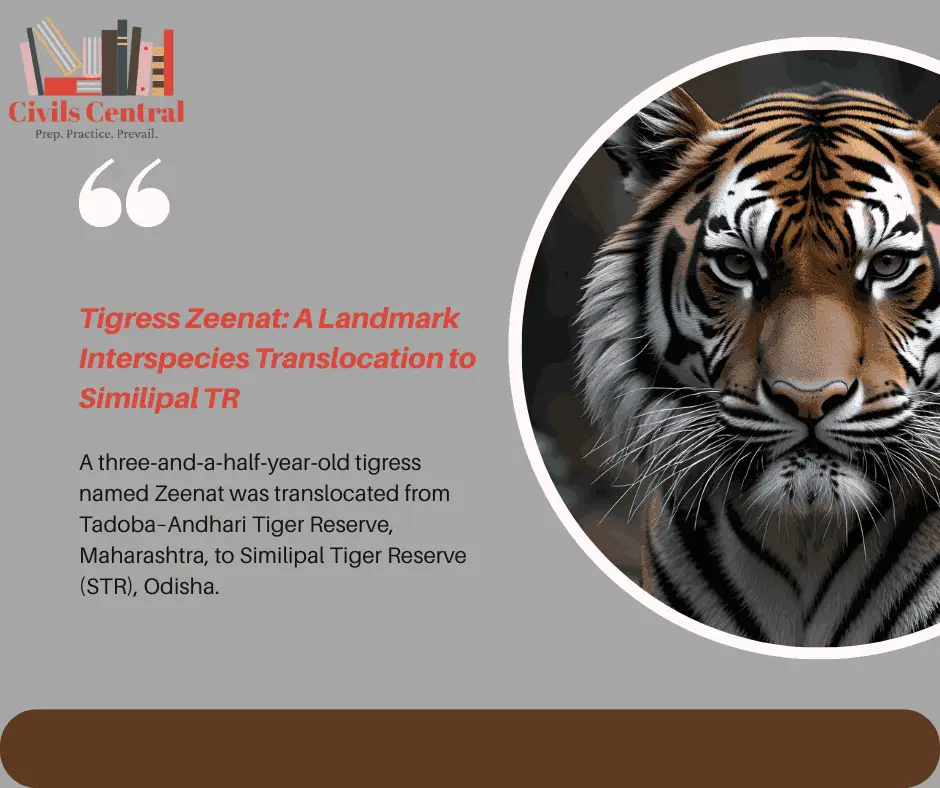
Tigress Zeenat: A Landmark Interspecies Translocation to Similipal TR

🐯 Tigress Zeenat: A Landmark Interspecies Translocation to Similipal TR
📌 Why It’s Newsworthy
- Origin & Purpose: In November 2024, a three‑and‑a‑half‑year‑old tigress named Zeenat was translocated from Tadoba–Andhari Tiger Reserve, Maharashtra, to Similipal Tiger Reserve (STR), Odisha. The objective was to enrich the tiger gene pool and boost population in an ecologically isolated reserve .
- Wander & Recapture: After being released in STR’s northern core (Chahala), Zeenat traveled across Jharkhand and West Bengal, moving over 300 km, eventually tranquilised and brought back on December 28, 2024 (newindianexpress.com). After capture, Zeenat was kept at the Alipore Zoo, which is the biggest zoological park in West Bengal.
- Soft Enclosure Strategy: Initially held in a small enclosure upon return, then shifted in mid‑March 2025 to a 20‑acre larger boma per NTCA guidance, to simulate wild-like hunting conditions (newindianexpress.com).
- Promising Behavior in Enclosure: Latest updates (June 2025) from WII confirm Zeenat exhibits strong hunting instincts, no human-dependence, and is being prepared for final wildlife release under NTCA oversight (newindianexpress.com).
🌲 Similipal Tiger Reserve: Profile & Significance
📍 Location & Protected Status
- Located in Mayurbhanj district, northernmost Odisha, STR spans approximately 2,750 km² comprising core, buffer, and wildlife sanctuary zones (en.wikipedia.org).
- Project Tiger designation in May 1973; wildlife sanctuary by Odisha government in 1979, national park (~846 km²) proposed in 1980, biosphere in 1994, and UNESCO Biosphere recognition in 2009.
- In April 2025, 845.7 km² of STR was officially notified as India’s 107th National Park, ensuring stricter protection.
🌳 Landscape & Biodiversity
- Terrain: Hilly and undulating plateau, highest peaks being Khairiburu (~1,000 m) and Meghasani (~1,165 m); notable waterscapes include Barehipani (217 m) & Joranda (181 m) waterfalls.
- Forest types: Tropical moist deciduous (Sal), semi-evergreen, and grasslands. Rich plant diversity: ~1,076 plant species (102 families), including ~96 orchid species (en.wikipedia.org).
- Rivers: More than 12 rivers (e.g., Budhabalanga, Kharkai, Deo) drain into the Bay of Bengal.
- Wildlife: Key fauna include Bengal tiger, melanistic tigers (only wild population globally), Asian elephants, leopards, barasingha, chausingha, and crocodiles. Over 42 mammals, 242 avian species, 30 reptiles, 21 amphibians, and numerous fish & butterfly species are recorded (en.wikipedia.org).
👥 Tribes & Human Interface
- Indigenous communities like Erenga Kharia, Mankirdia, Khadia, and Kolha live in and around STR. Some villages in core zones were relocated as per NTCA—for example, 2013 relocation of Khadia hamlets and 2015 relocation of Jamunagarh (en.wikipedia.org).
- Communities hold forest rights but also face displacement challenges—and conservation programs aim to balance tribal welfare and wildlife protection.
🧪 Conservation, Research & Management Efforts
- Tiger Population: Odisha’s 2023–24 estimation: ~30 tigers, including eight cubs, of which STR alone harbors ~24 adults; nearly 13 are pseudo‑melanistic (en.wikipedia.org, deccanchronicle.com).
- Prey Base: WII research (May 2025) reports healthy prey densities: ~31 ungulates/km² (chital ~10/km², sambar ~9/km², barking deer ~7/km²), up significantly since 2014 (timesofindia.indiatimes.com).
- Grassland Management: STR authorities recently initiated rotational benchmark meadow rejuvenation (~50–60 ha) to balance grazing pressure and ensure prey nutrition (timesofindia.indiatimes.com).
- Tech Integration: Under the “Greater Similipal Landscape Programme”, AI-enabled cameras, V‑SAT links, and other modern surveillance tools have been deployed (April 2025 notification).
📚 UPSC Relevance: Prelims & Mains Angles
✅ Prelims-Focused MCQs
- True melanistic tiger populations are found in:
- a) Sundarbans
- b) Similipal
- c) Kanha
- d) Pench
- ★ Answer: b) Similipal .
- Similipal TR declared a national park in:
- a) 1979
- b) 1994
- c) 2009
- d) 2025
- ★ Answer: d) 2025
- Peaks in STR include Khairiburu and Meghasani.
- Stratified conservation approach: NR – core, buffer, sanctuary, biosphere, elephant reserve.
📝 Mains Discussion Points (GS Paper III – Environment)
- “Evaluate the efficacy of inter-reserve tiger translocations (e.g., Zeenat) in enhancing genetic diversity and ecological balance.”
- “Critically analyze the role of biosphere reserves in integrating wildlife conservation, tribal welfare, and sustainable development, using Similipal as a case study.”
- “Discuss the impact of prey base improvement and meadow management on predator population stability.”
🧩 Conclusion
The case of Tigress Zeenat stands as a pioneering example of India’s adaptive wildlife management and inter-state collaboration under NTCA guidance. It highlights the significance of Similipal Tiger Reserve as a global hotspot for melanistic tigers, backed by its rich biodiversity, robust conservation strategies, and integration with local communities. This case is a treasure trove of UPSC-relevant facts—ideal for enriching answers in Prelims and Mains.
About The Author