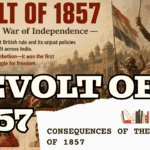
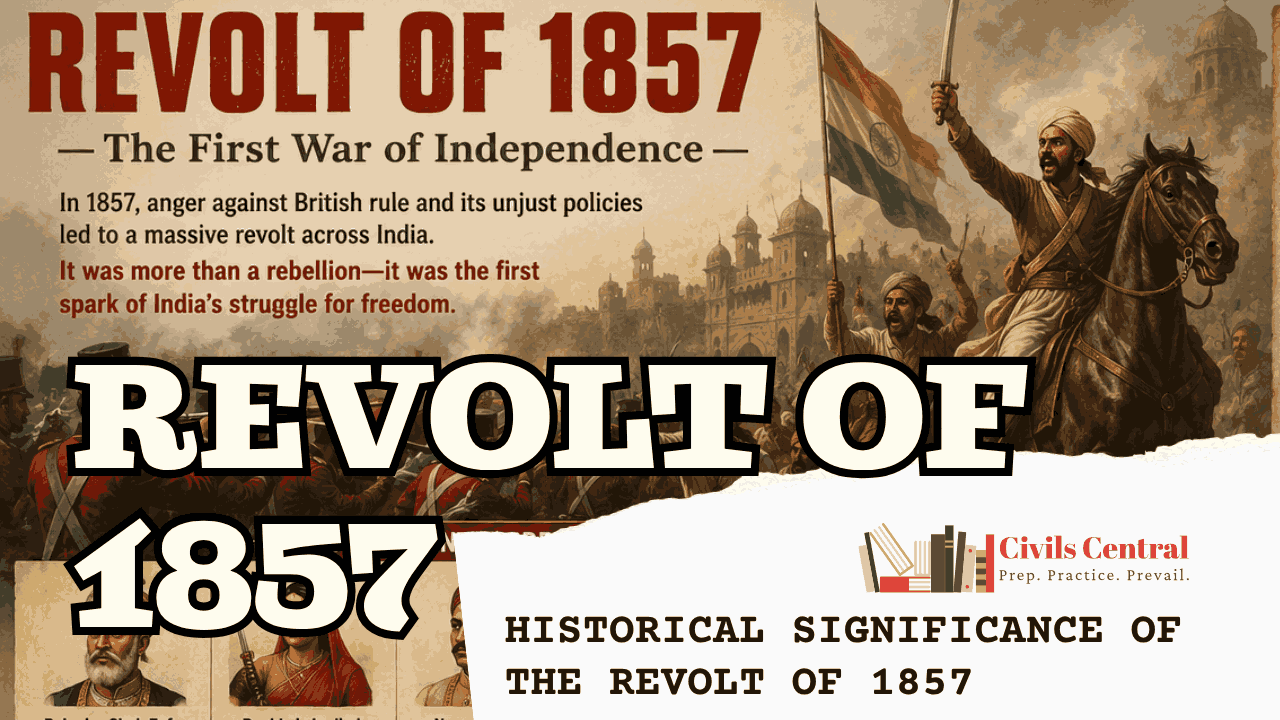
Historical Significance of the Revolt of 1857: Was it a Sepoy Mutiny, a Popular Revolt, or the First War of Independence?

Introduction
The Revolt of 1857 occupies a unique and controversial place in Indian history. While its causes, events, and consequences have been extensively studied, historians continue to debate its true nature and historical significance. Was it merely a military mutiny by Indian sepoys against the British East India Company, a widespread popular uprising involving different sections of society, or the first organized struggle for India’s independence? The answers to these questions have shaped different interpretations of the revolt over time.
The uprising began as a rebellion of Indian soldiers at Meerut in May 1857 but quickly spread across large parts of northern and central India. Princes, zamindars, peasants, artisans, religious leaders, and ordinary citizens joined the movement in various regions. This broad participation transformed the revolt from a military disturbance into a major challenge to British authority. Although the rebellion was eventually suppressed, it exposed the weaknesses of colonial rule and forced the British government to undertake significant administrative and political reforms.
The historical significance of the Revolt of 1857 extends beyond its immediate military outcome. It marked the end of the East India Company’s rule, initiated direct Crown administration, and became a powerful symbol of resistance against foreign domination. At the same time, differing interpretations by British, nationalist, and modern historians have led to an enduring historiographical debate regarding its character. Some view it as a “Sepoy Mutiny,” others as a “Popular Revolt,” while nationalist historians regard it as the “First War of Independence.”
Understanding these perspectives is essential for UPSC and JKAS aspirants because the Revolt of 1857 represents a crucial stage in the evolution of anti-colonial resistance and the gradual emergence of Indian nationalism. Its legacy continues to influence historical scholarship and remains a significant milestone in India’s struggle against colonial rule.
More Than a Military Mutiny
When the revolt first broke out, British officials and contemporary European observers largely described it as a “Sepoy Mutiny.” According to this interpretation, the uprising began as a rebellion of Indian soldiers serving in the Bengal Army who were dissatisfied with their service conditions and offended by the Enfield rifle cartridge controversy.
At first glance, this argument appears reasonable because the revolt was indeed initiated by sepoys at Meerut. The first major acts of rebellion came from soldiers who refused to use the controversial cartridges and challenged British military authority.
However, a closer examination reveals that the revolt quickly expanded far beyond the confines of the army. In many regions, peasants, zamindars, artisans, dispossessed rulers, religious leaders, and ordinary citizens joined the movement. Entire towns and districts witnessed popular participation. The rebellion therefore cannot be explained solely as a military mutiny.
The sepoys may have ignited the revolt, but they were not its only participants.
The Emergence of a Popular Uprising
As the revolt spread across northern and central India, it acquired characteristics of a broader social and political movement. In Awadh, peasants and talukdars actively participated in resistance against British rule. In Bihar, Kunwar Singh mobilized local support against colonial authority. In Delhi, large sections of the population rallied behind Bahadur Shah Zafar.
The participation of diverse social groups suggests that the revolt reflected widespread dissatisfaction with British policies. Political annexations had angered rulers and princes, economic exploitation had affected peasants and artisans, and social-religious anxieties had created distrust among different communities.
For many participants, the revolt represented an opportunity to challenge colonial domination and restore traditional political authority.
Nevertheless, the movement remained regionally concentrated and did not encompass the entire subcontinent. Large parts of southern India, eastern India, and western India remained relatively unaffected. Therefore, while the revolt possessed popular dimensions, it did not become a nationwide mass movement in the modern sense.
The Question of Nationalism
One of the central debates surrounding the Revolt of 1857 concerns the issue of nationalism. Modern nationalism is generally characterized by a shared sense of national identity and a collective political objective.
In 1857, such a unified national consciousness had not yet fully developed. Most participants were motivated by local grievances rather than by a clearly articulated vision of an independent Indian nation-state.
Rulers sought to recover lost kingdoms, landlords wanted to regain estates, soldiers opposed discriminatory policies, and religious leaders feared interference in traditional customs. Although these groups shared a common enemy in British rule, they did not necessarily share a common programme for the future.
For this reason, several historians have argued that the revolt cannot be described as a fully developed national movement.
At the same time, it would be incorrect to dismiss the revolt as entirely lacking nationalist significance. The participation of people from different regions and communities demonstrated an emerging awareness of collective opposition to foreign rule. In this sense, the revolt represented an important stage in the gradual evolution of Indian nationalism.
Historians and Their Interpretations
The debate over the nature of the Revolt of 1857 has produced a wide range of historical interpretations.
The British Interpretation: “Sepoy Mutiny”
Many British historians portrayed the uprising as a military rebellion limited primarily to Indian soldiers.
According to this view, the revolt lacked broad public support and was essentially a breakdown of military discipline. By emphasizing its military character, British writers sought to minimize its political significance and deny its legitimacy as a national movement.
This interpretation dominated colonial historiography for many decades.
V.D. Savarkar: “The First War of Independence”
A very different interpretation emerged in the early twentieth century. V.D. Savarkar, in his influential work The Indian War of Independence, 1857, argued that the revolt was a united national struggle against British colonial rule.
Savarkar emphasized the cooperation between Hindus and Muslims, the participation of diverse social groups, and the anti-colonial character of the movement. He regarded 1857 as the first major attempt by Indians to achieve independence from foreign domination.
His interpretation played an important role in nationalist historiography and remains highly influential.
R.C. Majumdar: A Critical Perspective
Historian R.C. Majumdar challenged the nationalist interpretation. He argued that the revolt lacked the essential features of a national war because it was confined largely to certain regions and did not enjoy widespread support throughout India.
According to Majumdar, many influential groups either remained neutral or actively supported the British. He therefore concluded that the revolt should not be regarded as the First War of Independence.
His work represents one of the most important revisionist interpretations of the revolt.
S.N. Sen: A Balanced View
S.N. Sen adopted a more nuanced position. He acknowledged that the revolt was not a fully developed national movement, but he also emphasized that it was much more than a mere sepoy mutiny.
According to Sen, the uprising involved multiple social groups and represented a significant challenge to colonial rule. While it may not have been a national war in the modern sense, it possessed undeniable political and anti-colonial dimensions.
This balanced interpretation is often considered closer to the consensus among modern historians.
Why the Revolt Remains Historically Significant
Regardless of the debates surrounding its character, the Revolt of 1857 occupies a unique place in Indian history.
For the first time, British authority faced a large-scale and coordinated challenge across multiple regions. The uprising demonstrated the depth of resentment against colonial rule and exposed the vulnerabilities of the East India Company’s administration.
The revolt also brought together diverse sections of Indian society. Although their objectives differed, rulers, soldiers, peasants, landlords, and religious leaders collectively participated in resistance against foreign domination.
Perhaps most importantly, the memory of the revolt survived long after its suppression. The stories of Rani Lakshmibai, Tantia Tope, Nana Sahib, Begum Hazrat Mahal, Kunwar Singh, and Bahadur Shah Zafar inspired later generations of nationalists. Their sacrifices became symbols of patriotism and resistance.
The Revolt of 1857 and the Rise of National Consciousness
While the revolt did not achieve independence, it contributed significantly to the growth of political awareness in India. The uprising highlighted the need for broader unity and more effective organization if colonial rule was to be challenged successfully.
Future nationalist leaders learned important lessons from the failures of 1857. They recognized the importance of creating a common political programme, developing all-India organizations, and mobilizing support across regions, religions, and social groups.
In this way, the revolt served as a bridge between traditional forms of resistance and the modern nationalist movement that emerged in the late nineteenth century.
A Balanced Assessment
A careful analysis suggests that the Revolt of 1857 cannot be adequately described by a single label.
It was certainly more than a sepoy mutiny because it involved widespread participation beyond the army. It was also more than a collection of local rebellions because it reflected common opposition to British rule.
At the same time, it was not a fully developed national movement in the modern sense, since a unified national ideology and nationwide participation were still absent.
Therefore, the most balanced conclusion is that the Revolt of 1857 was a broad anti-colonial uprising with significant popular participation that marked an important stage in the evolution of Indian nationalism.
Conclusion
The Revolt of 1857 was a landmark event that cannot be confined to a single interpretation. It was more than a mere sepoy mutiny because it drew support from princes, peasants, zamindars, artisans, and religious leaders across large parts of northern and central India. At the same time, it was not a fully developed national movement in the modern sense, as the ideas of nationalism, national unity, and a common political programme were still in their formative stages.
A balanced assessment suggests that the Revolt of 1857 was a broad-based anti-colonial uprising that represented the collective resentment of diverse sections of Indian society against British rule. Although it failed to achieve its immediate objective of ending colonial domination, it profoundly altered the course of Indian history by ending Company Rule, reshaping British policies, and inspiring future generations of freedom fighters.
The true significance of the Revolt of 1857 lies not merely in its military struggle but in its enduring legacy. It marked the first major challenge to British authority on an unprecedented scale and laid the psychological, political, and ideological foundations of India’s national movement. For this reason, the Revolt of 1857 remains a watershed in Indian history—a bridge between localized resistance and the organized struggle for independence that ultimately culminated in 1947.
Historiography at a Glance
| Historian | Interpretation |
| British Historians | Sepoy Mutiny |
| V.D. Savarkar | First War of Independence |
| R.C. Majumdar | Not a National War |
| S.N. Sen | More than a Mutiny, Less than a National Movement |
| Modern Historians | Broad Anti-Colonial Uprising |
UPSC Mains Practice Question
“The Revolt of 1857 was a watershed event in the evolution of Indian nationalism.” Critically examine.
About The Author