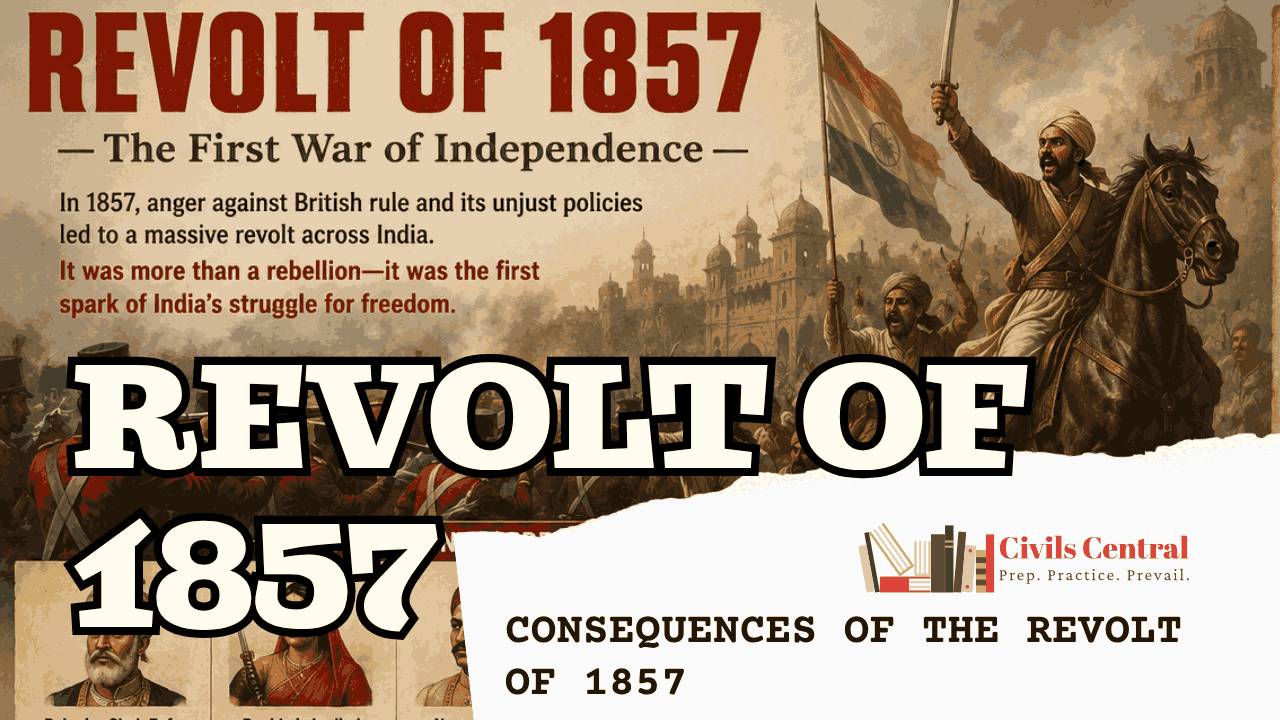
Consequences of the Revolt of 1857: Political, Administrative, Military, Economic and Social Impact

Introduction
The Revolt of 1857 was suppressed militarily by the British, but its impact was profound and far-reaching. The uprising exposed the weaknesses of the East India Company’s administration and convinced British policymakers that significant changes were necessary to prevent similar rebellions in the future.
As a result, the revolt became a major turning point in the history of British rule in India. It transformed the political structure of colonial governance, altered military policies, reshaped relations with Indian princes, and influenced British attitudes towards Indian society. Many historians regard 1858 as the beginning of a new phase of colonial rule in India.
The End of the East India Company
Perhaps the most significant consequence of the revolt was the end of the rule of the British East India Company. For more than a century, the Company had gradually expanded its political and territorial control over India. However, the Revolt of 1857 revealed that a commercial organization was no longer capable of governing such a vast and diverse country.
The British Parliament concluded that direct intervention was necessary. Consequently, the administration of India was transferred from the East India Company to the British Crown.
This marked the end of Company Rule and the beginning of Crown Rule in India.
Government of India Act, 1858: Beginning of Crown Rule
In response to the revolt, the British Parliament passed the Government of India Act of 1858.
The Act introduced major constitutional changes. The office of the Governor-General continued, but the Governor-General now also served as the Viceroy, representing the British Crown in India. Lord Canning became the first Viceroy of India under the new system.
The Act also created the office of the Secretary of State for India in Britain, who was assisted by a Council of India. Through this arrangement, the British government gained direct control over Indian affairs.
The significance of this change was immense. For the first time, India came directly under the authority of the British monarchy, fundamentally altering the nature of colonial administration.
Queen Victoria’s Proclamation (1858)
On 1 November 1858, Queen Victoria issued a historic proclamation that outlined the future policy of the British government towards India.
The proclamation promised non-interference in the religious beliefs and practices of Indians. It assured equal treatment before the law and declared that Indians would be eligible for government employment based on merit, although this promise was only partially implemented.
The British also announced that they would respect the rights and territories of princely states and would no longer pursue aggressive annexation policies.
Although many of these promises remained limited in practice, the proclamation was intended to reassure Indians and reduce the possibility of future rebellions.
A New Policy Towards Princely States
One of the major lessons learned by the British from the revolt was the importance of maintaining the loyalty of Indian princes.
Before 1857, policies such as the Doctrine of Lapse had created widespread resentment among rulers. After the revolt, the British abandoned this policy and adopted a more conciliatory approach.
Indian princes were assured that their kingdoms would not be annexed arbitrarily. They were also granted the right to adopt heirs, a practice that had previously been denied under the Doctrine of Lapse.
As a result, the princely states became important allies of the British Empire and remained largely loyal during later political crises.
Reorganization of the Army
The revolt demonstrated the dangers of relying heavily on Indian soldiers without adequate safeguards. Consequently, the British undertook a major restructuring of the Indian army.
The proportion of European soldiers was increased, while the number of Indian soldiers in sensitive military units was reduced. The British also ensured that artillery, considered the most crucial branch of the army, remained largely under European control.
Another important change was the policy of recruiting soldiers from different regions and communities rather than concentrating recruitment in a few areas. This strategy was designed to prevent the emergence of unity among soldiers.
The British increasingly favoured recruitment from communities they classified as “martial races,” including Sikhs, Gurkhas, Pathans, and certain groups from Punjab and Nepal.
These changes significantly reduced the possibility of a large-scale military uprising similar to that of 1857.
Growth of Racial Discrimination
The revolt deepened racial divisions between the British and Indians.
Many British officials became convinced that Indians could not be trusted politically. As a result, racial attitudes hardened after 1857. Social interaction between the rulers and the ruled declined, and discriminatory practices became more pronounced.
Higher administrative positions continued to be dominated by Europeans, despite official promises of equality. Indians increasingly found themselves excluded from the upper levels of government.
This growing racial arrogance contributed to the rise of nationalist sentiment in later decades.
Strengthening of the Divide and Rule Policy
The British interpreted the revolt as evidence of the dangers of unified resistance. To prevent future uprisings, they increasingly adopted a policy of dividing different sections of Indian society.
Differences based on religion, caste, region, and community were often emphasized in administrative policies. The colonial government sought to cultivate separate political identities and discourage united opposition.
This strategy, commonly known as “Divide and Rule,” became a defining feature of British colonial governance in the late nineteenth and early twentieth centuries.
Economic Consequences
The revolt imposed enormous financial costs on the British administration.
The expenses incurred in suppressing the rebellion were largely recovered from Indian revenues. This increased the economic burden on Indian taxpayers.
The British also accelerated the development of railways, telegraphs, roads, and other infrastructure. While these projects contributed to modernization, they were primarily intended to strengthen administrative control, facilitate troop movements, and serve imperial economic interests.
Furthermore, British economic policies continued to favour the export of raw materials from India and the import of manufactured goods from Britain, deepening colonial economic dependence.
Impact on Indian Society
The revolt left a lasting impression on Indian society. It demonstrated that British rule could be challenged through collective action, even though the rebellion itself was unsuccessful.
The participation of soldiers, peasants, artisans, landlords, and rulers revealed the widespread nature of dissatisfaction with colonial rule. The heroic sacrifices of leaders such as Rani Lakshmibai, Tantia Tope, Begum Hazrat Mahal, and Kunwar Singh became part of India’s national memory.
These stories inspired future generations of freedom fighters and contributed to the development of nationalist consciousness.
The Rise of Indian Nationalism
Although the Revolt of 1857 was not a modern nationalist movement in the strict sense, it played a crucial role in the evolution of Indian nationalism.
The revolt exposed the exploitative nature of colonial rule and encouraged Indians to think collectively about political freedom. In the decades that followed, new political organizations, social reform movements, and intellectual debates emerged across the country.
Eventually, these developments culminated in the formation of the Indian National Congress in 1885 and the rise of a more organized nationalist movement.
For this reason, many historians regard the Revolt of 1857 as an important precursor to India’s struggle for independence.
Historical Significance of the Consequences
The Revolt of 1857 fundamentally transformed the relationship between Britain and India. It ended Company Rule, initiated direct Crown administration, altered military and administrative policies, and shaped colonial governance for the next ninety years.
At the same time, the revolt left behind a legacy of resistance that inspired future generations. Even though the rebellion failed to overthrow British rule, it demonstrated the possibility of collective opposition and became an enduring symbol of India’s quest for freedom.
Conclusion
The consequences of the Revolt of 1857 extended far beyond the battlefield. Politically, it ended the rule of the East India Company and brought India under direct British Crown administration. Administratively, it led to significant reforms in governance and military organization. Socially, it widened racial divisions while simultaneously encouraging nationalist consciousness. Economically, it reinforced colonial exploitation, and ideologically, it inspired future movements for independence.
Thus, the Revolt of 1857 stands as a watershed event in Indian history—an uprising that failed in its immediate objective but transformed the course of colonial rule and laid the foundations of modern Indian nationalism.
“The Revolt of 1857 was not merely a rebellion against British authority; it was a turning point that reshaped the structure of colonial governance and sowed the seeds of Indian nationalism.”
Previous Year UPSC Mains Theme
“The Revolt of 1857 was a watershed in the history of British India.” Discuss.
About The Author