
Introduction
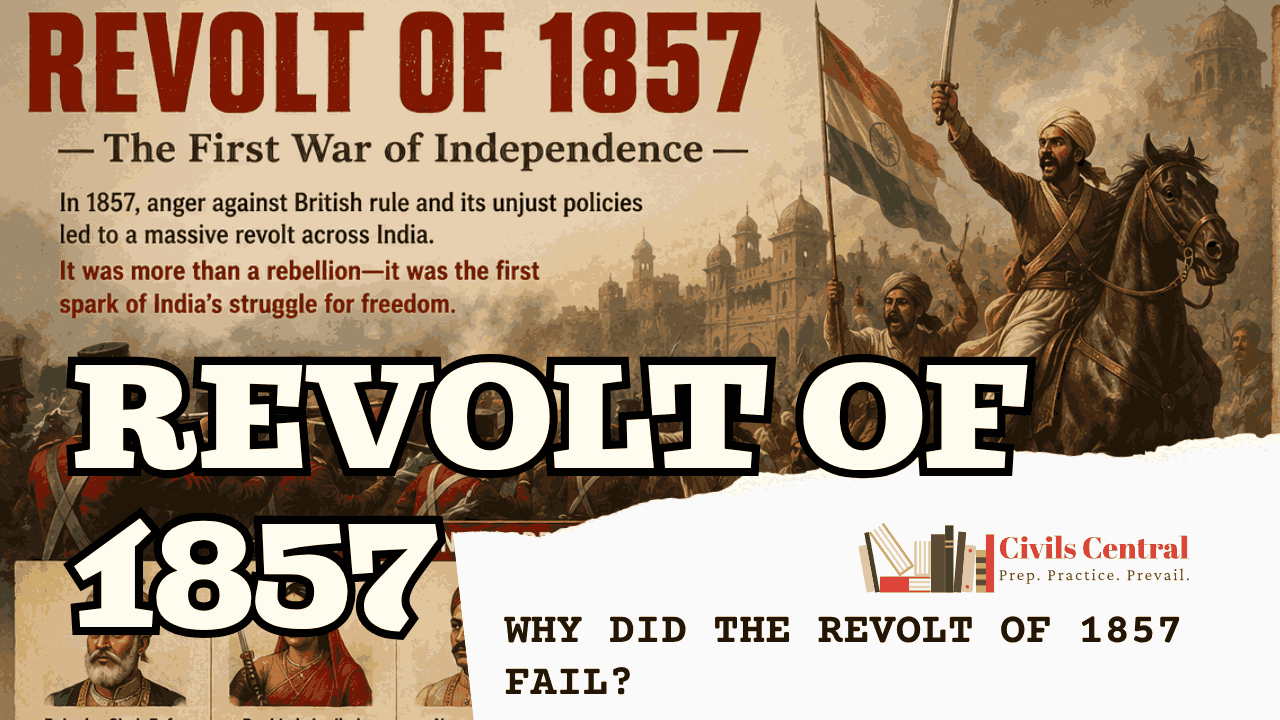
The Revolt of 1857 was the first major and organized challenge to British rule in India. Beginning as a military uprising at Meerut on 10 May 1857, it rapidly spread across large parts of northern and central India, drawing support from sepoys, princes, zamindars, peasants, artisans, and religious leaders. The revolt witnessed remarkable acts of courage and leadership from figures such as Bahadur Shah Zafar, Rani Lakshmibai, Nana Sahib, Tantia Tope, Begum Hazrat Mahal, and Kunwar Singh. Despite its widespread nature and initial successes, the revolt was ultimately suppressed by the British by 1859.
The failure of the Revolt of 1857 remains one of the most important topics in Modern Indian History. Historians have pointed out that while the uprising demonstrated widespread resentment against British policies, it lacked several essential elements required for a successful national movement. Factors such as the absence of a unified leadership, limited geographical spread, lack of a common political objective, inadequate military resources, and the superior organization of the British played a crucial role in its defeat.
A critical analysis of the failure of the Revolt of 1857 helps us understand both the strengths and weaknesses of India’s first large-scale anti-colonial struggle. Although the revolt did not succeed in overthrowing British rule, it exposed the vulnerabilities of colonial administration and profoundly influenced subsequent nationalist movements. The lessons learned from its failure later guided Indian leaders in developing more organized and inclusive strategies for achieving independence.
For UPSC, JKAS, SSC, State PCS, and other competitive examinations, understanding the reasons behind the failure of the Revolt of 1857 is essential. Questions are frequently asked in both Prelims and Mains regarding the limitations of the revolt, its historical significance, and its role in shaping the future course of the Indian national movement.
The Revolt of 1857 shook the foundations of British rule in India like never before. From the streets of Delhi and Kanpur to the battlefields of Jhansi and Lucknow, thousands of Indians rose against the East India Company. Princes, soldiers, peasants, zamindars, and religious leaders united in a common struggle against colonial domination. For a moment, it appeared as if British authority in India might collapse. Yet, despite the courage, sacrifice, and determination displayed by the rebels, the revolt was eventually suppressed. By 1859, the British had regained control over all major centres of rebellion. This raises an important question: Why did such a widespread uprising fail?
The answer lies not in the bravery of the rebels, but in the structural weaknesses of the movement and the advantages enjoyed by the British.
A Revolt Without a Central Command
One of the greatest challenges facing the rebels was the absence of a unified leadership. The uprising was led by several remarkable personalities, including Bahadur Shah Zafar in Delhi, Nana Sahib in Kanpur, Rani Lakshmibai in Jhansi, Begum Hazrat Mahal in Lucknow, Kunwar Singh in Bihar, and Tantia Tope in Central India. Each leader fought with determination in his or her respective region.
However, there was no central authority capable of coordinating military operations across the country. No common strategy was formulated, and there was no supreme commander to direct the movement as a whole. As a result, rebel centres functioned independently and often lacked communication with one another. The British exploited this weakness by isolating and defeating each centre separately.
The Absence of a National Vision
The Revolt of 1857 occurred before the rise of modern Indian nationalism. Although many groups participated in the uprising, they did not share a common political programme or a unified vision for India’s future.
The princes were primarily concerned about the loss of their kingdoms through British annexation policies. Zamindars opposed the confiscation of their estates, peasants suffered under heavy taxation, and soldiers were angered by discrimination within the army. Religious leaders feared interference in traditional customs and beliefs.
While all these groups opposed British rule, their motivations were different. Consequently, the revolt lacked the ideological unity that later became the strength of the Indian National Movement. The absence of a common national objective limited its effectiveness and prevented it from becoming a truly united struggle.
A Movement Confined to Certain Regions
Although the revolt spread rapidly across northern and central India, it did not become a nationwide uprising. Delhi, Kanpur, Lucknow, Jhansi, Bareilly, and parts of Bihar emerged as major centres of resistance. However, large parts of the country remained unaffected.
The Punjab largely supported the British. The Bengal Presidency remained relatively peaceful, while the Bombay and Madras Presidencies witnessed little significant participation. Most regions of South India did not join the revolt.
This limited geographical spread proved to be a major disadvantage. Since the rebellion was concentrated in specific areas, the British could deploy their military resources more effectively and focus on suppressing one rebel centre after another.
The Military Disadvantage of the Rebels
The courage of the rebels was unquestionable, but courage alone could not compensate for the lack of modern military resources. British forces possessed superior weapons, better artillery, and a steady supply of ammunition. They also had access to professionally trained European troops who were experienced in warfare.
In contrast, many rebels depended on outdated weapons or arms captured from British arsenals. Ammunition was often scarce, and there was no organized system for supplying military resources. The technological superiority of the British gave them a decisive advantage in prolonged military engagements.
The Role of Railways and Telegraph
The Revolt of 1857 was one of the first major conflicts in India in which modern communication and transport systems played a crucial role.
The British used the telegraph to transmit information rapidly between different military centres. Orders that once took days or weeks to communicate could now be delivered within hours. This enabled British commanders to respond swiftly to developments on the battlefield.
Similarly, railways allowed troops, weapons, and supplies to be moved quickly across large distances. While the rebels relied on traditional methods of communication and transport, the British benefited enormously from these technological innovations.
Why Many Princes Chose the British Side
An often-overlooked reason for the failure of the revolt was the support that the British received from several influential rulers and communities.
Many princely states chose not to join the rebellion. The rulers of Hyderabad, Patiala, and several other states remained loyal to the British. Their support provided valuable military assistance and logistical resources.
The Sikhs, who had fought bitter wars against the British only a few years earlier, largely sided with the colonial government. Historical tensions with the Mughal Empire and distrust of the rebel leadership influenced their decision. Similarly, Gurkha soldiers from Nepal played an important role in helping British forces suppress the uprising.
Without this support, the British would have faced a much more difficult challenge.
Organizational Weaknesses Within the Revolt
Even in areas where the rebels achieved initial success, they struggled to establish effective systems of administration. Capturing a city was one thing; governing and defending it was another.
The rebels lacked organized institutions capable of managing revenue collection, maintaining supplies, coordinating military operations, and administering territories under their control. This organizational weakness reduced their ability to sustain the revolt over an extended period.
As British forces advanced, many rebel administrations collapsed due to the absence of strong institutional structures.
Financial Limitations and Resource Constraints
Sustaining a large-scale war requires enormous financial resources. The rebels lacked a stable source of revenue and often faced difficulties in maintaining their armies.
The British East India Company, on the other hand, possessed substantial financial resources. It controlled extensive territories, collected revenue from large populations, and enjoyed support from Britain. This financial strength enabled the British to recruit troops, purchase weapons, and continue military operations for as long as necessary.
The rebels simply could not match this economic power.
The Limited Role of the Educated Middle Class
By the mid-nineteenth century, a small but growing educated middle class had emerged in India. However, this group did not actively participate in the revolt.
Many educated Indians viewed the uprising as a reactionary movement aimed at restoring old political structures rather than creating a modern nation. Some feared that the success of the revolt might lead to instability and disorder. Others hoped that reforms could be achieved through constitutional methods rather than armed rebellion.
As a result, the revolt lacked the intellectual and ideological leadership that later became a defining feature of India’s national movement.
British Military and Diplomatic Superiority
The British response to the revolt was systematic and coordinated. Experienced commanders such as Colin Campbell, Henry Havelock, Hugh Rose, and John Nicholson led military operations against the rebels.
Rather than attempting to suppress all centres simultaneously, the British adopted a strategic approach. They first recaptured Delhi, then focused on Kanpur and Lucknow, before moving against Jhansi and Gwalior. This methodical campaign gradually weakened the rebellion until organized resistance collapsed.
The combination of military discipline, strategic planning, and diplomatic alliances gave the British a decisive advantage.
Did the Revolt Really Fail?
If success is measured solely in military terms, then the Revolt of 1857 undoubtedly failed. British rule survived, and the rebellion was suppressed.
However, history is not judged only by immediate outcomes. The revolt exposed the vulnerabilities of colonial rule and demonstrated that British authority was not invincible. It forced the British government to abolish the rule of the East India Company and transfer power directly to the British Crown through the Government of India Act of 1858.
More importantly, the memory of the revolt inspired future generations of nationalists. The sacrifices of Rani Lakshmibai, Tantia Tope, Nana Sahib, Begum Hazrat Mahal, and countless others became symbols of resistance and patriotism. In this sense, although the revolt failed militarily, it succeeded in awakening political consciousness and laying the foundations of India’s long struggle for independence.
Conclusion
The Revolt of 1857 failed because it lacked many of the elements necessary for a successful national revolution. The absence of centralized leadership, limited geographical spread, weak organization, inadequate resources, and the lack of a common national ideology undermined the movement. At the same time, the British benefited from superior military strength, modern technology, financial resources, and the support of influential allies.
Nevertheless, the revolt remains one of the most important milestones in Indian history. It marked the first major challenge to British rule and planted the seeds of nationalism that would eventually culminate in India’s independence in 1947.
About The Author