
Introduction
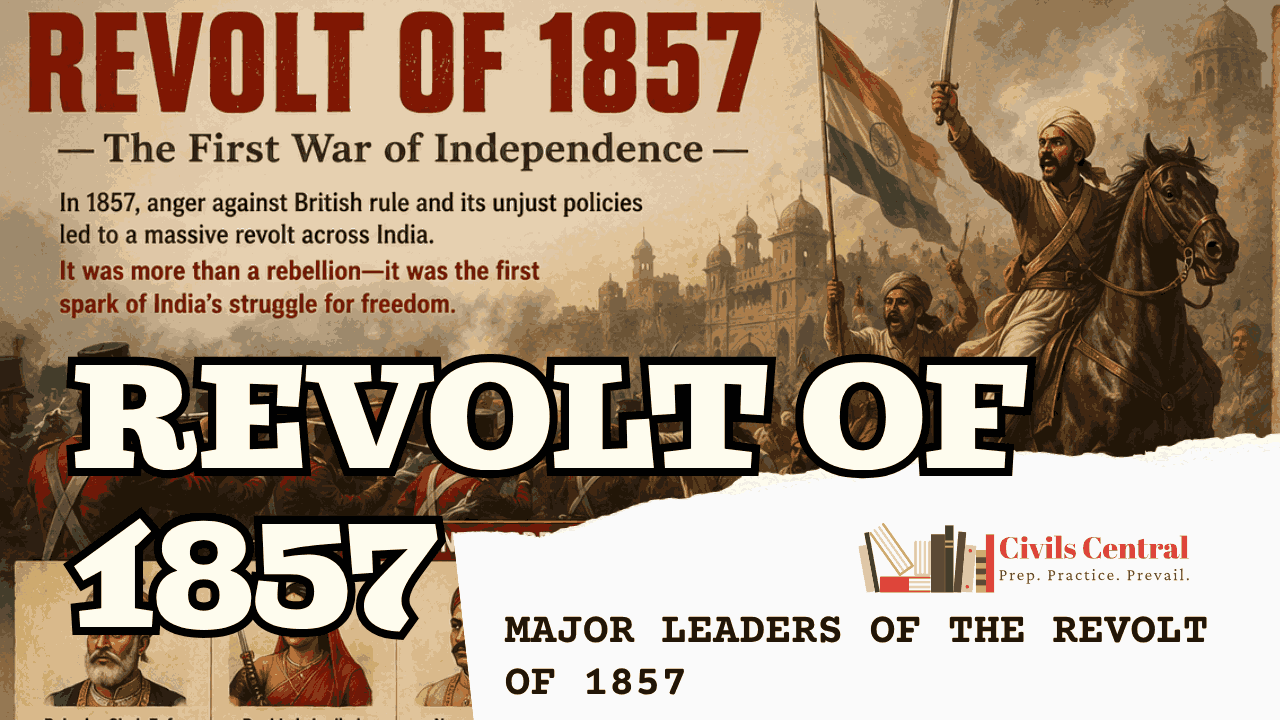
The Revolt of 1857 was one of the most significant turning points in the history of British rule in India. Often described as the First War of Indian Independence, it represented the first large-scale and coordinated challenge to the authority of the British East India Company. While the uprising began as a military rebellion among Indian sepoys at Meerut on 10 May 1857, it quickly transformed into a widespread movement involving princes, landlords, peasants, artisans, religious leaders, and ordinary citizens across northern and central India.
One of the most remarkable aspects of the Revolt of 1857 was the leadership displayed by several courageous individuals who mobilized resistance against British rule in their respective regions. These leaders came from diverse social, political, and cultural backgrounds but were united by a common objective—to oppose British domination and protect their political rights, traditional institutions, and regional interests. Their leadership provided direction, inspiration, and legitimacy to the uprising.
Among the prominent leaders were Bahadur Shah Zafar, the last Mughal Emperor who became the symbolic head of the revolt; Rani Lakshmibai of Jhansi, whose bravery made her an enduring symbol of resistance; Nana Sahib and Tantia Tope, who led the struggle in Kanpur and Central India; Begum Hazrat Mahal, who spearheaded the rebellion in Awadh; Kunwar Singh of Bihar, who fought despite his advanced age; and Maulvi Ahmadullah Shah, who inspired resistance through his religious and political influence.
Although the revolt was ultimately suppressed by the British, the contributions and sacrifices of these leaders left a lasting impact on India’s freedom struggle. Their courage inspired future generations of nationalists and played a crucial role in shaping the collective memory of resistance against colonial rule. Understanding the role, contributions, achievements, and legacy of these leaders is essential for comprehending the nature of the Revolt of 1857 and its place in the evolution of Indian nationalism.
One of the most remarkable features of the Revolt of 1857 was the emergence of several courageous leaders who challenged British authority in different regions of India. Although the revolt lacked a centralized command structure, these leaders inspired resistance, mobilized local support, and became symbols of India’s struggle against colonial rule.
Their leadership reflected the diverse social and political character of the revolt, as it included emperors, queens, princes, zamindars, religious leaders, and military commanders.
1. Bahadur Shah Zafar (1775–1862)
Background
- Last Mughal Emperor.
- Ascended the Mughal throne in 1837.
- Primarily known as a poet and patron of culture rather than a political ruler.
Role in the Revolt
When the rebels captured Delhi on 11 May 1857, they proclaimed Bahadur Shah Zafar as the Emperor of Hindustan.
Importance
- Provided legitimacy to the revolt.
- Served as a unifying symbol for rebels.
- Represented the continuation of Mughal sovereignty.
Although he had limited military authority, his symbolic role was crucial.
Fate
- Arrested after the fall of Delhi.
- Tried by the British.
- Exiled to Rangoon (present-day Yangon, Myanmar).
He died in exile in 1862.
Historical Legacy
Bahadur Shah Zafar became a symbol of the end of Mughal rule and the resistance against British colonialism.
2. Nana Sahib (1824–Unknown)
Background
- Adopted son of Peshwa Baji Rao II.
- Resided at Bithoor near Kanpur.
Grievance against the British
The British refused to continue the pension granted to his adoptive father.
This became a major source of resentment.
Role in the Revolt
- Led the uprising in Kanpur.
- Established rebel control over the city.
- Became one of the principal leaders of the revolt.
Fate
After the British recaptured Kanpur, Nana Sahib disappeared.
His ultimate fate remains uncertain.
Historical Legacy
Nana Sahib is remembered as one of the foremost political leaders of the Revolt of 1857.
3. Tantia Tope (1814–1859)
Background
- Close associate of Nana Sahib.
- One of the most skilled military commanders of the revolt.
Military Contributions
Leadership in Kanpur
- Assisted Nana Sahib.
- Organized rebel forces.
Guerrilla Warfare
After the collapse of major centres, Tantia Tope continued resistance through guerrilla tactics.
Campaigns
- Central India
- Rajasthan
- Gwalior region
His mobility and strategic skills troubled British forces for months.
Capture and Execution
- Betrayed by a local ruler.
- Captured in 1859.
- Executed by the British.
Historical Legacy
Tantia Tope is regarded as one of the greatest military leaders of the revolt.
4. Rani Lakshmibai of Jhansi (1828–1858)
Background
- Queen of Jhansi.
- Wife of Raja Gangadhar Rao.
Cause of Conflict
After the death of her husband, the British annexed Jhansi under the Doctrine of Lapse and refused to recognize her adopted son Damodar Rao as the heir.
Role in the Revolt
Defence of Jhansi
- Organized the administration.
- Raised an army.
- Defended Jhansi against British attacks.
Alliance with Rebel Forces
- Joined forces with Tantia Tope.
- Participated in campaigns in Central India.
Death
Rani Lakshmibai died fighting British troops near Gwalior on 18 June 1858.
Historical Legacy
She became a symbol of courage, patriotism, and resistance.
Famous Tribute
Subhadra Kumari Chauhan immortalized her bravery in the famous line:
“Khoob ladi mardani, woh to Jhansi wali Rani thi.”
5. Begum Hazrat Mahal (1820–1879)
Background
- Wife of Nawab Wajid Ali Shah of Awadh.
Role in the Revolt
After the annexation of Awadh, she emerged as a leading figure of resistance.
Contributions
- Led the revolt in Lucknow.
- Declared her son Birjis Qadr as ruler.
- Organized opposition against British rule.
Leadership Qualities
- Mobilized local nobles and soldiers.
- Maintained resistance despite difficult circumstances.
Fate
After British victory, she sought refuge in Nepal. She died there in 1879.
Historical Legacy
Begum Hazrat Mahal is remembered as one of the most prominent female leaders of the revolt.
6. Kunwar Singh (1777–1858)
Background
- Zamindar of Jagdishpur in Bihar.
- Around 80 years old at the time of the revolt.
Role in the Revolt
Despite his advanced age, he became one of the most successful rebel commanders.
Contributions
- Led rebellion in Bihar.
- Conducted military operations against British forces.
- Recovered Jagdishpur from British control.
Courage and Determination
According to popular accounts, after being wounded, he severed his injured hand and continued fighting.
Death
He died shortly after recapturing Jagdishpur in April 1858.
Historical Legacy
Kunwar Singh remains one of the greatest heroes of Bihar and the Revolt of 1857.
7. Khan Bahadur Khan (1797–1860)
Background
- Descendant of the Rohilla rulers.
- Influential leader in Bareilly.
Role in the Revolt
Contributions
- Organized resistance in Rohilkhand.
- Established a rebel administration.
- Challenged British authority in Bareilly.
Fate
After the suppression of the revolt, he was captured and executed by the British.
Historical Legacy
He is remembered as an important leader of resistance in northern India.
8. Maulvi Ahmadullah Shah (1787–1858)
Background
- Religious leader from Faizabad.
- Popularly known as the “Maulvi of Faizabad.”
Role in the Revolt
Contributions
- Inspired people through speeches and religious appeals.
- Mobilized soldiers and civilians.
- Coordinated resistance in Awadh.
British officials themselves acknowledged his leadership abilities.
Fate
He was killed in 1858 after being betrayed.
Historical Legacy
He is regarded as one of the most charismatic and influential leaders of the revolt.
Comparative Table of Major Leaders
| Leader | Region | Main Contribution |
| Bahadur Shah Zafar | Delhi | Symbolic head of revolt |
| Nana Sahib | Kanpur | Political leadership |
| Tantia Tope | Central India | Military strategy and guerrilla warfare |
| Rani Lakshmibai | Jhansi | Heroic resistance against British forces |
| Begum Hazrat Mahal | Lucknow | Leadership in Awadh |
| Kunwar Singh | Bihar | Successful military campaigns |
| Khan Bahadur Khan | Bareilly | Rebel administration |
| Maulvi Ahmadullah Shah | Faizabad | Mass mobilization and resistance |
Women Leaders in the Revolt
The Revolt of 1857 witnessed extraordinary participation by women leaders.
Prominent Women Leaders
- Rani Lakshmibai
- Begum Hazrat Mahal
- Rani Avantibai Lodhi
- Rani Tace Bai of Jalaun
Their contributions challenged traditional gender roles and demonstrated remarkable leadership during a period of crisis.The leaders of the Revolt of 1857 transformed a military rebellion into a broader challenge to British authority. Although they came from different regions and social backgrounds, they shared a common objective of resisting colonial domination.Their sacrifices inspired future generations of nationalists and freedom fighters, making them enduring symbols of India’s struggle for independence.
Conclusion
The Revolt of 1857 was not merely a military uprising but a broad-based resistance movement that brought together diverse sections of Indian society against British rule. The success and spread of the revolt in various regions were largely due to the leadership, courage, and determination of several remarkable individuals who emerged as symbols of resistance. Leaders such as Bahadur Shah Zafar, Rani Lakshmibai, Nana Sahib, Tantia Tope, Begum Hazrat Mahal, Kunwar Singh, Maulvi Ahmadullah Shah, Bakht Khan, and Khan Bahadur Khan played crucial roles in mobilizing people, organizing military campaigns, and challenging British authority.
Although the revolt ultimately failed due to factors such as lack of coordination, limited resources, and the superior military strength of the British, the contributions of these leaders left an enduring legacy in India’s struggle for freedom. Their sacrifices inspired future generations of nationalists and laid the foundation for the growth of anti-colonial consciousness across the country. Many of these leaders became national heroes whose stories continue to symbolize patriotism, courage, and resistance against oppression.
From a historical perspective, the leaders of the Revolt of 1857 demonstrated that opposition to colonial rule was not confined to a single region, community, or social class. Their collective efforts transformed a military rebellion into a wider political challenge to British domination. Consequently, the Revolt of 1857 occupies a significant place in Indian history as an important precursor to the organized national movement that eventually culminated in India’s independence in 1947.
For UPSC, JKAS, SSC, and other competitive examinations, understanding the contributions, areas of operation, and historical significance of these leaders is essential, as they represent key personalities in the evolution of India’s freedom struggle and the rise of nationalist consciousness.
About The Author