
Introduction
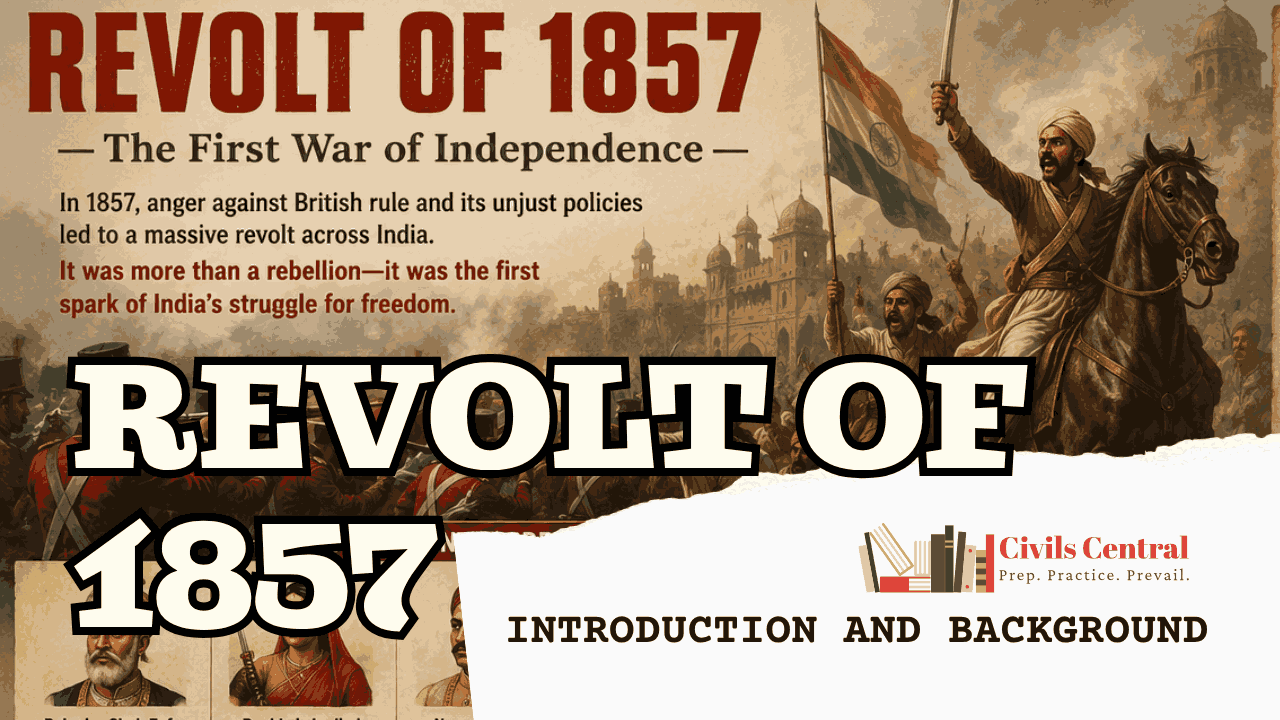
The Revolt of 1857 was one of the most significant events in the history of British rule in India. It marked the first large-scale and organized resistance against the policies and administration of the British East India Company. Beginning as a military uprising among Indian sepoys stationed at Meerut on 10 May 1857, the revolt soon spread across large parts of northern and central India, drawing the participation of princes, zamindars, peasants, artisans, soldiers, and religious leaders.
The uprising was not merely the result of the immediate controversy surrounding the greased cartridges of the Enfield rifle. Rather, it was the culmination of decades of political annexations, economic exploitation, military grievances, social reforms, and cultural interference that had created widespread discontent among different sections of Indian society. Policies such as the Doctrine of Lapse, the annexation of Awadh, heavy land revenue demands, discrimination in the army, and fears regarding religious conversion contributed significantly to the outbreak of the revolt.
The Revolt of 1857 witnessed remarkable leadership from figures such as Bahadur Shah Zafar, Rani Lakshmibai of Jhansi, Nana Sahib, Tantia Tope, Begum Hazrat Mahal, Kunwar Singh, and Maulvi Ahmadullah Shah. Although the revolt was ultimately suppressed by the British by 1859, its impact was far-reaching. It led to the end of the East India Company’s rule, the transfer of power to the British Crown through the Government of India Act, 1858, and significant changes in administrative and military policies.
Historians have interpreted the revolt differently. British historians often described it as the “Sepoy Mutiny,” emphasizing its military character, whereas nationalist historians such as V.D. Savarkar regarded it as the “First War of Indian Independence.” Modern historians view it as a complex movement that combined military rebellion, popular resistance, and regional aspirations. Regardless of differing interpretations, the Revolt of 1857 occupies a crucial place in Indian history as a major precursor to the organized nationalist movement that eventually culminated in India’s independence in 1947.
For UPSC and JKAS aspirants, the Revolt of 1857 is an important topic because it is frequently asked in both Prelims and Mains examinations. Understanding its causes, course, leadership, consequences, and historiographical debates is essential for developing a comprehensive understanding of the evolution of Indian nationalism and colonial governance.
Background of the Revolt of 1857
The Revolt of 1857 did not emerge suddenly because of the Enfield rifle cartridges. It was the outcome of deep-rooted dissatisfaction that had been building up among various sections of Indian society for several decades. By the middle of the nineteenth century, the expansionist policies of the British East India Company, economic exploitation, administrative changes, and social interventions had created widespread resentment among rulers, soldiers, peasants, landlords, artisans, and religious groups.
To understand the outbreak of the Revolt of 1857, it is essential to examine the political, economic, social, and military conditions prevailing in India before the uprising.
1. British Expansion before 1857
During the eighteenth and nineteenth centuries, the British East India Company transformed itself from a trading organization into a territorial power. Through wars, treaties, and annexation policies, it gradually brought large parts of India under its control.
Subsidiary Alliance System
The Subsidiary Alliance was introduced by Lord Wellesley in 1798.
Main Features
- Indian rulers were required to accept British troops within their territories.
- The ruler had to pay for the maintenance of these troops.
- The ruler could not enter into alliances with other states without British permission.
- A British Resident was stationed at the ruler’s court.
Impact
- Reduced the sovereignty of Indian states.
- Increased British political influence.
- Many rulers became dependent upon the British.
Examples: Hyderabad, Awadh, Mysore, and several Maratha states entered into Subsidiary Alliances.
Doctrine of Lapse
The Doctrine of Lapse was aggressively implemented by Lord Dalhousie between 1848 and 1856. It meant that If a ruler died without a natural male heir, his kingdom would be annexed by the British, and adopted heirs would not be recognized.
States Annexed
| State | Year |
| Satara | 1848 |
| Jaitpur | 1849 |
| Sambalpur | 1849 |
| Udaipur (Central India) | 1852 |
| Jhansi | 1854 |
| Nagpur | 1854 |
Impact
- Generated resentment among Indian princes.
- Violated traditional Indian practices of adoption.
- Created insecurity among ruling families.
Rani Lakshmibai of Jhansi became one of the strongest opponents of this policy.
Annexation of Awadh (1856)
Awadh was annexed in 1856 on the pretext of maladministration.
Why Awadh Was Important
- It was one of the most prosperous regions of India.
- A large number of soldiers in the Bengal Army belonged to Awadh.
- The Nawabs of Awadh had traditionally maintained close relations with the British.
Consequences
- The ruling family lost power.
- Thousands of nobles and officials lost their positions.
- Talukdars lost their privileges and estates.
- Soldiers from Awadh felt humiliated and aggrieved.
The annexation of Awadh became one of the most important causes of the Revolt of 1857.
2. Socio-Economic Conditions before the Revolt
British economic policies severely affected various sections of Indian society.
Impact on Peasants
The British introduced various land revenue systems:
- Permanent Settlement
- Ryotwari System
- Mahalwari System
Problems Faced by Peasants
- Excessive land revenue demands.
- Revenue had to be paid even during crop failures.
- Increasing indebtedness to moneylenders.
- Frequent land confiscations.
As a result, rural distress increased significantly.
Decline of Traditional Industries
Before British rule, India was famous for its textiles, handicrafts, and cottage industries.
Reasons for Decline
- Import of cheap machine-made British goods.
- Heavy duties on Indian products entering Britain.
- Lack of protection for indigenous industries.
Effects
- Loss of employment among artisans.
- Destruction of traditional handicrafts.
- Increased poverty in urban centres.
This process is often referred to as the deindustrialization of India.
Commercialization of Agriculture
British policies encouraged the cultivation of cash crops such as:
- Indigo
- Cotton
- Opium
- Jute
Consequences
- Reduced area under food crops.
- Increased dependence on market fluctuations.
- Worsened food insecurity among peasants.
3. Social and Religious Atmosphere
Many Indians believed that British policies threatened their traditional social and religious practices.
Social Reforms Introduced by the British
Some important reforms included:
- Abolition of Sati (1829)
- Widow Remarriage Act (1856)
- Promotion of Western education
Although these reforms were progressive, many conservative sections viewed them with suspicion.
Activities of Christian Missionaries
Missionaries received support in certain areas from the colonial administration.
Resulting Fears
- Fear of forced religious conversion.
- Concern about interference in traditional customs.
- Growing distrust of British intentions.
These fears spread among both Hindus and Muslims.
4. Military Conditions before the Revolt
The Bengal Army contained a large number of Indian soldiers but was controlled entirely by British officers.
Discrimination in the Army
Indian soldiers faced several grievances:
- Lower salaries than European soldiers.
- Limited opportunities for promotion.
- Poor treatment by British officers.
- Racial discrimination.
General Service Enlistment Act (1856)
The Act required soldiers to serve overseas if necessary.
Why It Was Opposed
Many Hindu soldiers believed that crossing the sea would lead to loss of caste status.
This created further resentment within the army.
Growing Dissatisfaction among Sepoys
By 1857, Indian soldiers were unhappy because of:
- Annexation of their native states.
- Loss of allowances.
- Religious concerns.
- Discriminatory treatment.
The Bengal Army thus became a fertile ground for rebellion.
Significance of the Background
The Revolt of 1857 was not merely a reaction to the greased cartridges controversy. The cartridge issue acted as a spark, but the real causes lay in decades of accumulated grievances. Political annexations angered rulers, economic exploitation affected peasants and artisans, social policies created fears among religious communities, and military discrimination alienated sepoys. Together, these factors created the conditions that eventually led to the largest anti-British uprising of the nineteenth century.
The Revolt of 1857 was the result of the convergence of political discontent, economic exploitation, social-religious fears, and military grievances. The immediate cause merely triggered an already volatile situation.
Causes of the Revolt of 1857
The Revolt of 1857 was the result of a combination of political, economic, military, social, and religious factors that generated widespread dissatisfaction against British rule. Different sections of Indian society—rulers, landlords, peasants, artisans, soldiers, and religious leaders—had their own grievances against the British East India Company. The immediate cause may have been the Enfield rifle controversy, but the roots of the revolt lay in decades of accumulated resentment.
For analytical purposes, the causes of the Revolt of 1857 can be classified into five major categories:
- Political Causes
- Economic Causes
- Military Causes
- Social and Religious Causes
- Immediate Cause
1. Political Causes
Political grievances constituted one of the most important causes of the revolt. The aggressive expansionist policies of the British East India Company alienated rulers, princes, zamindars, and traditional elites.
Doctrine of Lapse
Lord Dalhousie introduced the Doctrine of Lapse to expand British territory.
Main Provision
If an Indian ruler died without a natural male heir, his kingdom would be annexed by the British. Adopted sons were not recognized as legitimate successors.
States Annexed
- Satara (1848)
- Jaitpur (1849)
- Sambalpur (1849)
- Udaipur (1852)
- Jhansi (1854)
- Nagpur (1854)
Impact
- Violated long-established Indian traditions.
- Created insecurity among princely states.
- Generated hostility towards British rule.
The annexation of Jhansi deeply angered Rani Lakshmibai, who later emerged as one of the most prominent leaders of the revolt.
Annexation of Awadh (1856)
The annexation of Awadh was one of the most significant causes of the revolt.
British Justification
The British accused Nawab Wajid Ali Shah of maladministration and annexed Awadh in 1856.
Consequences
- Thousands of court officials lost employment.
- Talukdars lost estates and privileges.
- Soldiers from Awadh felt insulted.
- Traditional ruling elites were displaced.
Since a large proportion of Bengal Army soldiers came from Awadh, resentment spread rapidly among sepoys.
Discontent among Traditional Rulers
British policies weakened the authority of many Indian rulers.
Examples
- Mughal Emperor Bahadur Shah Zafar was informed that after his death his successors would lose the right to reside in the Red Fort.
- Nana Sahib, the adopted son of Peshwa Baji Rao II, was denied his pension.
- Several local rulers lost political influence.
This alienated influential sections of society who later supported the revolt.
Discontent among Zamindars and Talukdars
British land policies resulted in:
- Confiscation of estates.
- Increased revenue demands.
- Reduction of traditional privileges.
Many dispossessed landlords actively participated in the revolt.
2. Economic Causes
British economic policies caused widespread hardship among peasants, artisans, landlords, and traders.
Exploitation of Peasants
High Land Revenue Demands
The British introduced:
- Permanent Settlement
- Ryotwari Settlement
- Mahalwari Settlement
These systems often imposed heavy tax burdens.
Consequences
- Indebtedness
- Land confiscation
- Rural poverty
- Frequent peasant distress
Peasants viewed British rule as exploitative and oppressive.
Decline of Traditional Industries
Before British rule, India was a major producer of textiles and handicrafts.
British Policies
- Import of cheap machine-made goods from Britain.
- Destruction of local industries.
- Unfavourable trade policies.
Effects
- Unemployment among artisans.
- Collapse of handicraft industries.
- Economic insecurity.
Many artisans supported anti-British activities during the revolt.
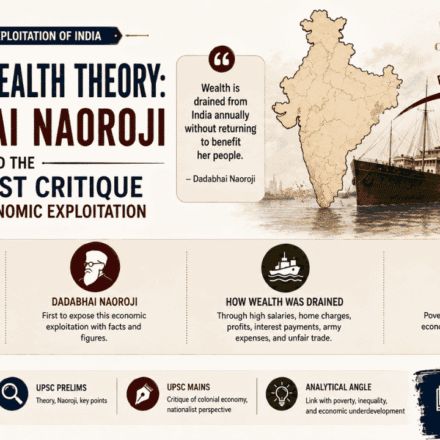
Drain of Wealth
Indian resources were increasingly transferred to Britain through:
- Revenue extraction
- Trade profits
- Administrative expenses
This contributed to economic stagnation and poverty.
3. Military Causes
The army became the immediate vehicle through which dissatisfaction erupted into rebellion.
Discrimination against Indian Soldiers
Indian sepoys faced numerous disadvantages.
Salary Differences
- European soldiers received better pay.
- Indian soldiers received lower wages.
Promotion Restrictions
- Higher ranks were reserved for Europeans.
- Indians could rarely advance beyond junior positions.
Racial Discrimination
British officers often treated Indian soldiers with contempt.
This created deep resentment within the army.
General Service Enlistment Act (1856)
The Act required soldiers to serve overseas whenever necessary.
Why It Was Opposed
Many Hindu soldiers believed that crossing the sea (Kala Pani) would result in the loss of caste status.
This generated strong opposition among sepoys.
Reduction of Allowances
Many soldiers lost special allowances when serving outside their native regions.
This further increased dissatisfaction.
4. Social and Religious Causes
Many Indians feared that British policies threatened their traditional customs, social institutions, and religious beliefs.
Fear of Religious Conversion
The growing activities of Christian missionaries led to widespread suspicion.
Many Indians believed that:
- The British intended to convert Indians to Christianity.
- Traditional religions were under threat.
These fears were often exaggerated but became widely accepted.
Social Reform Measures
Several social reforms introduced by the British generated controversy.
Important Reforms
- Abolition of Sati (1829)
- Hindu Widow Remarriage Act (1856)
- Promotion of Western education
Although these reforms aimed at social progress, many conservative groups perceived them as interference in Indian traditions.
Spread of Western Education
English education introduced new ideas but also created fears regarding:
- Cultural domination.
- Loss of traditional values.
- Religious interference.
Railways and Telegraph
Some sections of society viewed new technologies with suspicion.
Rumours spread that these innovations were intended to undermine social and religious customs.
5. Immediate Cause: The Enfield Rifle Controversy
The immediate spark that ignited the revolt was the introduction of the new Enfield rifle.
The Cartridge Issue
The cartridges of the Enfield rifle were reportedly greased with:
- Cow fat
- Pig fat
Before loading the rifle, soldiers had to bite off the cartridge covering.
Religious Objections
For Hindus
The cow is considered sacred.
For Muslims
The pig is considered unclean and prohibited.
As a result, both Hindu and Muslim soldiers felt that their religious sentiments had been deliberately insulted.
Barrackpore Incident and Mangal Pandey
In March 1857, sepoy Mangal Pandey attacked British officers at Barrackpore.
Importance
- First major act of defiance.
- Demonstrated growing unrest within the army.
- Inspired other soldiers.
Mangal Pandey was executed on 8 April 1857.
Revolt at Meerut (10 May 1857)
When 85 soldiers refused to use the cartridges, they were punished and imprisoned.
On 10 May 1857:
- Soldiers at Meerut revolted.
- British officers were attacked.
- Prisoners were released.
- Rebels marched towards Delhi.
This marked the formal beginning of the Revolt of 1857.
Conclusion
The causes of the Revolt of 1857 were multidimensional. Political annexations alienated rulers and princes, economic exploitation affected peasants and artisans, military discrimination angered sepoys, and social-religious concerns created widespread suspicion of British intentions. The Enfield rifle controversy acted merely as the immediate trigger that transformed long-standing discontent into a large-scale uprising.
Thus, the Revolt of 1857 was not a spontaneous event but the culmination of decades of accumulated grievances against British rule.
Major Centres and Leaders at a Glance
| Centre | Leader |
| Delhi | Bahadur Shah Zafar |
| Kanpur | Nana Sahib |
| Lucknow | Begum Hazrat Mahal |
| Jhansi | Rani Lakshmibai |
| Bihar | Kunwar Singh |
| Bareilly | Khan Bahadur Khan |
| Faizabad | Maulvi Ahmadullah Shah |
| Gwalior | Tantia Tope & Rani Lakshmibai |
NEXT: Major Leaders of the Revolt of 1857: Contributions, Role and Legacy
About The Author