The Complete Guide to Preparing International Relations for UPSC & JKAS 2027

A CivilsCentral Masterclass on Building Conceptual Mastery for Prelims, Mains, Essay & Interview
Why This Guide Exists
“Every day, thousands of UPSC aspirants read international news. Yet many still find International Relations difficult—not because they lack effort, but because they try to understand current affairs before understanding the concepts that explain those current affairs.”
Every year, thousands of UPSC and JKAS aspirants dedicate countless hours to reading newspapers, following international summits, memorizing bilateral relations, and revising monthly current affairs magazines. Yet when they sit in the examination hall, many find themselves unable to answer even seemingly familiar questions. They remember reading about BRICS, QUAD, the WTO, or the Indo-Pacific, but the questions framed by UPSC are rarely direct. Instead of asking what happened, the examination increasingly asks why it happened, how it relates to broader concepts, and what implications it carries for India’s foreign policy and global governance.
This difference lies at the heart of modern Civil Services preparation.
International Relations is no longer a subject that can be mastered through isolated current affairs or factual memorization. The examination has steadily evolved from testing information to testing understanding. A news report about a summit is only the visible tip of a much larger conceptual iceberg. Beneath it lie ideas such as national interest, balance of power, strategic autonomy, multilateralism, international law, regional integration, maritime security, economic diplomacy, and global governance. Unless these foundations are understood, current affairs remain disconnected events that are quickly forgotten after a few months.
This guide has been written to address that problem.
Unlike conventional preparation strategies that begin with newspapers or current affairs magazines, this masterclass begins with the philosophy of learning International Relations itself. Before deciding which books to read or which newspaper to follow, an aspirant must first understand what International Relations actually is, why it forms an integral part of the UPSC and JKAS syllabus, and how the examination expects candidates to think about global affairs.
The objective of this guide is therefore much larger than providing a list of resources. It seeks to build a roadmap for developing conceptual mastery. By the time you complete this guide, you should know not only what to study, but why you are studying it, how different topics are connected, and how to approach the subject in a manner that serves you across the Preliminary Examination, Main Examination, Essay Paper, and Personality Test.
This guide also serves another purpose. It is the official preface to the CivilsCentral International Relations Knowledge Library. Every article that follows in the library has been designed around a single philosophy:
Learn Like a Scholar. Think Like UPSC.
Instead of treating International Relations as a collection of bilateral relations and current affairs, CivilsCentral approaches it as an interconnected discipline where history, geography, economics, law, diplomacy, strategy, and governance converge. Once this conceptual framework is established, every international event becomes easier to understand, remember, and analyse.
If you are beginning your preparation, this guide will help you build a strong foundation from the very first day. If you have already studied International Relations but continue to find it confusing or fragmented, it will help you reorganize your preparation into a coherent learning system.
The chapters that follow are not merely about scoring marks in an examination. They are about developing the analytical ability expected of a future civil servant—someone who can understand international developments, appreciate India’s strategic interests, evaluate competing viewpoints, and make informed decisions in an increasingly interconnected world.
Welcome to the CivilsCentral International Relations Masterclass. Your journey begins here.
Why International Relations Has Changed in UPSC & JKAS
“The syllabus has remained almost the same. The examination has not.”
If an aspirant compares UPSC question papers from two decades ago with those of recent years, one important pattern immediately becomes evident. The transformation has not occurred in the wording of the syllabus but in the nature of the questions themselves.
Earlier, International Relations often rewarded factual preparation. Knowing the headquarters of an international organization, the year of its establishment, or the members of a regional grouping was frequently sufficient to answer a question. Such factual knowledge remains relevant even today, particularly in the Preliminary Examination, but it is no longer adequate on its own.
Modern UPSC increasingly expects aspirants to understand the forces shaping international politics rather than merely recalling isolated information. Questions now demand conceptual clarity, interdisciplinary thinking, and the ability to connect static principles with contemporary developments.
Consider how an international summit is treated by the examination. UPSC is rarely interested in whether a summit took place. Instead, it asks why that summit matters, how it reflects shifts in global power, what implications it has for India’s strategic interests, and which underlying concepts of International Relations it illustrates. The current affair becomes merely the context through which deeper understanding is evaluated.
This shift explains why many aspirants who diligently follow newspapers still struggle in the examination. They often remember the event but fail to understand the concept behind the event.
For example, a summit involving the Quad is not merely about four countries meeting together. It raises broader questions concerning the Indo-Pacific, maritime security, freedom of navigation, strategic balancing, China’s rise, minilateral diplomacy, and India’s foreign policy. Unless these foundational ideas are understood, every new summit appears to be another isolated news item requiring separate memorization.
The same pattern applies across the subject. News concerning the World Trade Organization reflects deeper concepts of global trade governance and economic diplomacy. Developments relating to the United Nations illustrate issues of collective security, multilateralism, institutional reform, and international law. A border dispute cannot be understood without appreciating geography, historical treaties, national interest, and strategic competition.
Consequently, successful preparation today requires moving beyond current affairs to build a durable conceptual framework.
International Relations has therefore evolved into one of the most integrated components of the Civil Services Examination. It simultaneously draws upon History, Geography, Polity, Economy, Security, Environment, Ethics, and Science & Technology. An aspirant who develops these connections finds that the subject becomes easier rather than more difficult, because individual news events begin to fit into an existing mental framework.
This guide adopts precisely that philosophy. Rather than beginning with newspapers, bilateral relations, or organizations, we shall first construct the intellectual foundations upon which every future current affair can be understood.
Only then will newspapers transform from daily information into meaningful learning.
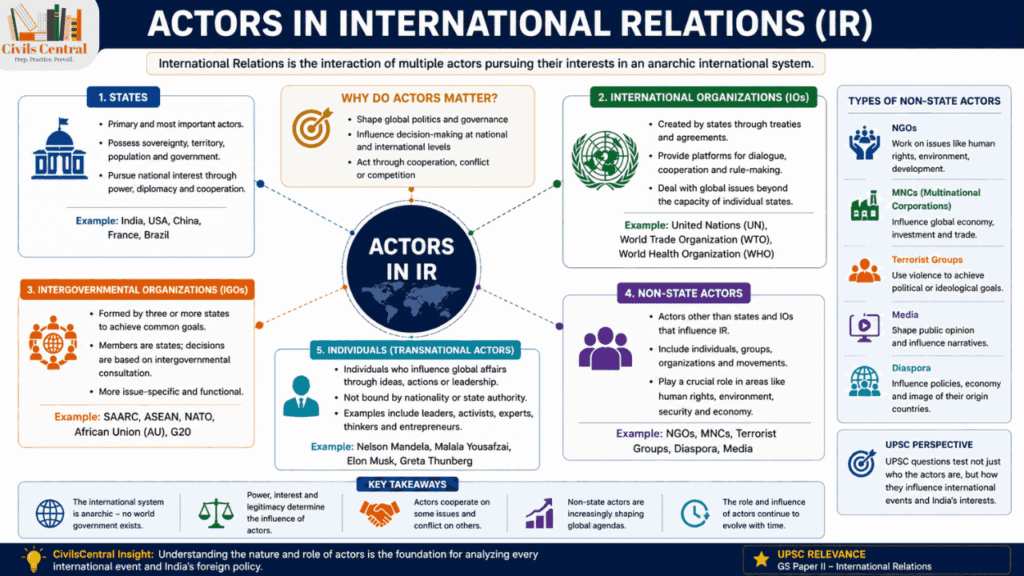
Why International Relations is One of the Most Scoring Subjects in UPSC & JKAS
Many aspirants approach International Relations with unnecessary anxiety. They often assume that it is a vast and unpredictable subject because international events change every day. Every summit, diplomatic visit, military conflict, trade agreement, or geopolitical crisis appears to introduce yet another topic that must be studied separately. As a result, many students believe that mastering International Relations requires memorizing an endless stream of current affairs.
This perception is both understandable and incorrect.
International Relations is, in fact, one of the most logical and concept-driven subjects in the entire Civil Services Examination. Unlike subjects where a large number of isolated facts must be remembered, International Relations is governed by a relatively small set of enduring principles. Once these principles are understood, even unfamiliar international developments become easier to analyse.
Consider the example of India’s relations with different countries. At first glance, India’s relationship with the United States, China, Russia, Japan, France, Australia, or Bangladesh may appear to be completely independent topics. However, as you study further, you realise that each relationship is shaped by the same underlying concepts—national interest, strategic autonomy, security, economic cooperation, geography, history, energy needs, and regional balance of power.
The country changes, but the principles remain remarkably similar.
This is precisely why conceptual understanding is far more valuable than memorizing individual events.
Suppose tomorrow a completely new geopolitical crisis emerges in a region that has never previously appeared in the examination. A student who has merely memorized current affairs may struggle because the event is unfamiliar. However, a student who understands concepts such as national interest, balance of power, alliance formation, maritime security, economic diplomacy, and international law can analyse the situation logically, even without having studied that specific event in detail.
This ability to apply concepts to new situations is exactly what UPSC seeks to evaluate.
The Commission is not attempting to identify candidates who can reproduce newspaper headlines. It is attempting to identify future administrators who can understand complex international developments, appreciate India’s strategic interests, and make informed judgments based on sound reasoning.
For this reason, International Relations rewards understanding far more consistently than memorization.
Another important characteristic of the subject is its interdisciplinary nature. International Relations does not exist in isolation. It draws continuously from History, Geography, Economics, Polity, Environment, Internal Security, Science and Technology, and even Ethics. A maritime dispute cannot be understood without geography. A trade agreement cannot be understood without economics. Climate negotiations require knowledge of environmental governance. Border disputes demand an understanding of history, international law, and national security.
Far from making the subject more difficult, these connections make it intellectually richer. Every concept learned in International Relations strengthens understanding in several other parts of the syllabus, creating a multiplier effect throughout preparation.
This is why experienced aspirants often describe International Relations as a high-return subject. The time invested in building strong conceptual foundations benefits not only GS Paper II but also Essay, Interview, current affairs, and even portions of General Studies Papers I and III.
The objective of preparation, therefore, should never be to memorize every international event. That is neither practical nor necessary. Instead, the objective should be to develop a conceptual framework through which every important international development can be understood, analysed, and connected with the broader syllabus.
That is the philosophy upon which the CivilsCentral International Relations Knowledge Library has been built.
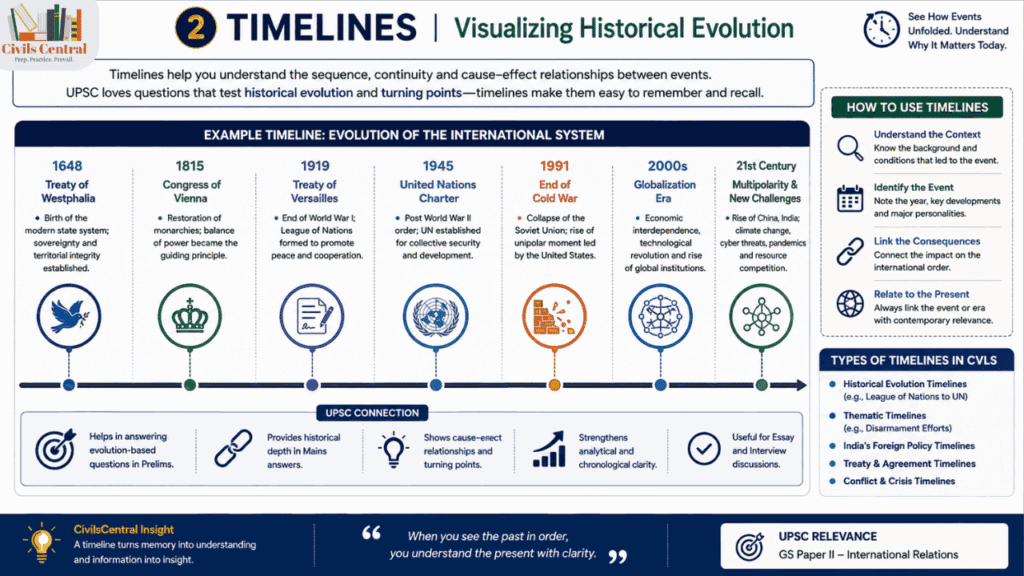
Why International Relations Cannot Be Prepared Like Current Affairs
One of the most common questions asked by beginners is whether International Relations is primarily a static subject or a current affairs subject. At first glance, the answer appears obvious. Every day newspapers report diplomatic visits, international summits, armed conflicts, trade negotiations, climate conferences, sanctions, strategic partnerships, and decisions taken by international organisations. Naturally, many aspirants conclude that mastering International Relations simply requires reading newspapers regularly and keeping track of global events.
This conclusion, although understandable, is fundamentally incorrect. It represents perhaps the single biggest reason why many otherwise hardworking aspirants continue to struggle with International Relations despite spending hours every day following current affairs.
To understand why this happens, we must first understand what the Civil Services Examination is actually trying to assess.
The Union Public Service Commission is not conducting a quiz competition on international events. Its objective is not to identify candidates who can recall yesterday’s headlines or remember the venue of every international summit. Instead, the Commission is entrusted with selecting future administrators who will eventually occupy positions of responsibility in the Government of India. During their careers, these officers will confront situations that cannot be anticipated today. They may have to respond to geopolitical crises, negotiate international agreements, manage humanitarian emergencies, formulate public policy, or advise governments on matters that have never appeared in any textbook or newspaper. Such responsibilities require analytical ability, conceptual clarity, and sound judgement rather than the mechanical recall of facts.
This fundamental objective shapes the nature of UPSC questions.
Consider a simple example. Imagine that tomorrow a completely new regional organisation is formed by a group of countries in Africa or Latin America. Since the organisation did not exist during your preparation, it would obviously be impossible for you to have memorised its name, objectives, headquarters, or membership. If UPSC were to frame a question asking only factual details about this newly created organisation, every candidate would be equally disadvantaged because nobody could have prepared those facts in advance. Such a question would therefore fail to distinguish between genuine understanding and accidental memory.
Instead, UPSC is far more likely to frame questions that examine the concepts underlying the organisation. Why do countries establish regional organisations? What strategic, economic, or security interests encourage states to cooperate? How do regional organisations differ from global organisations? Under what circumstances do nations prefer bilateral agreements over multilateral institutions? Which principles of international law or international politics explain such cooperation? A candidate who understands these concepts can analyse even a completely unfamiliar organisation through logical reasoning. A candidate who has merely memorised existing organisations cannot.
This distinction explains why International Relations should never be approached as a collection of unrelated current affairs. Every summit, treaty, military exercise, diplomatic visit, trade agreement, or international dispute reported in newspapers represents only the visible manifestation of much deeper concepts. Newspapers describe what has happened; they rarely explain why it happened, why it matters, or how it fits into the broader framework of international politics. Those questions belong to the discipline of International Relations itself.
The relationship between current affairs and International Relations can be understood through a simple analogy. Consider the study of medicine. Every day a doctor encounters patients suffering from different symptoms such as fever, chest pain, skin rashes, respiratory infections, or neurological disorders. An inexperienced observer may view each patient as presenting an entirely new problem. A trained physician, however, approaches these cases differently. Instead of memorising every individual symptom, the doctor first studies anatomy, physiology, pathology, microbiology, and pharmacology. Once these foundational disciplines are understood, every patient becomes an application of principles that are already familiar.
International Relations operates in exactly the same manner. A newspaper reports that India has signed a new trade agreement, participated in a naval exercise, supported a resolution in the United Nations, or attended a summit of the G20. To a beginner, each event appears to be an independent topic requiring separate preparation. To someone who understands the conceptual foundations of International Relations, these developments are simply different manifestations of recurring ideas such as national interest, diplomacy, balance of power, strategic autonomy, economic cooperation, international law, regional integration, and global governance. The events change constantly, but the underlying concepts remain remarkably stable.
This is precisely why many aspirants experience information overload during their preparation. They attempt to memorise every international development without first building the conceptual framework required to organise that information. After several months, they accumulate hundreds of pages of notes containing details of bilateral visits, summit declarations, new partnerships, and international agreements. Yet when confronted with an unfamiliar statement-based question in the Preliminary Examination or an analytical question in the Main Examination, they discover that they possess information but lack understanding.
A conceptually prepared student experiences the subject very differently. Instead of viewing each newspaper article as a new topic, they recognise it as another example illustrating ideas they have already mastered. A discussion on the Indo-Pacific immediately connects with maritime security, freedom of navigation, strategic competition, and India’s Act East Policy. A report on WTO negotiations naturally links with international trade, dispute settlement, protectionism, and global economic governance. A summit of BRICS or the G20 is understood within the larger framework of multilateral diplomacy and the changing distribution of global power. Because every new development is connected to an existing conceptual network, learning becomes cumulative rather than repetitive.
This explains why CivilsCentral adopts a fundamentally different approach to International Relations. We do not begin with newspapers, current affairs magazines, or lists of international organisations. We begin with concepts. We first seek to understand why states behave as they do, what objectives foreign policy seeks to achieve, how international institutions evolve, why conflicts emerge, why cooperation becomes necessary, and how geography, economics, security, and history shape international politics. Once this conceptual foundation has been established, current affairs cease to be isolated pieces of information and instead become practical illustrations of ideas that the student already understands.
The ultimate objective of preparing International Relations is therefore not to remember the greatest number of international events. It is to develop the intellectual framework through which any international event—whether familiar or unfamiliar—can be analysed with clarity, confidence, and logical reasoning. That is precisely the ability the Civil Services Examination seeks to identify, and it is the ability that every serious aspirant must consciously cultivate throughout their preparation.
Where Should You Begin? Understanding the Correct Sequence for Studying International Relations
If ten beginners decide to start preparing International Relations tomorrow, most of them are likely to follow a remarkably similar approach. They will purchase a monthly current affairs magazine, begin reading the international pages of newspapers, make notes on bilateral relations, memorise the members of various international organisations, and try to keep pace with every important summit or geopolitical development reported in the media. At first, this approach appears sensible because International Relations is widely perceived as a current affairs-driven subject. However, after a few months, many aspirants begin experiencing the same difficulty. Despite investing considerable time, they feel that the subject is becoming increasingly vast rather than increasingly clear.
The reason for this is not the volume of the syllabus but the sequence in which it is being studied.
Every academic discipline has a natural order of learning. A student cannot understand calculus without first learning algebra. One cannot study constitutional amendments without understanding the basic structure of the Constitution. Similarly, it is impossible to appreciate the significance of a diplomatic summit or a regional conflict without first understanding the principles that govern the behaviour of states. When this natural sequence is ignored, learning becomes fragmented. Information accumulates, but understanding does not.
International Relations is no exception. Although newspapers present us with new events every day, those events are merely applications of a relatively small number of enduring concepts. Every treaty, alliance, organisation, conflict, trade agreement, and diplomatic initiative ultimately revolves around questions that have occupied scholars and statesmen for centuries. Why do nations cooperate? Why do they compete? What determines foreign policy? How do geography, economics, military capability, ideology, and domestic politics influence international behaviour? Why do international institutions emerge, and why do they sometimes fail? Until these foundational questions are understood, current affairs appear as isolated stories rather than connected developments.
This is precisely where many aspirants unintentionally reverse the learning process. They begin with applications before understanding the principles. It is similar to attempting to solve complex numerical problems in physics without first understanding Newton’s laws of motion. The formulas may be memorised, but genuine problem-solving remains difficult because the conceptual foundation is weak. In International Relations, newspapers become those numerical problems. They present real-world situations whose significance can only be appreciated after the underlying concepts have been mastered.
For this reason, the preparation of International Relations should follow a progression from the simple to the complex, from the permanent to the temporary, and from the conceptual to the applied. The first stage should always involve understanding the nature of the international system itself. Before studying India’s foreign policy or the functioning of international organisations, an aspirant must understand what a sovereign state is, why states pursue national interests, how power shapes international politics, and why cooperation becomes necessary despite the absence of a world government. These ideas form the intellectual vocabulary of International Relations. Without them, subsequent topics remain disconnected.
Once these foundations are established, the next step is to understand the major instruments through which states pursue their objectives. Diplomacy, foreign policy, international law, treaties, international organisations, regional groupings, economic cooperation, and strategic partnerships are not separate chapters to be memorised independently. They are different mechanisms through which states attempt to secure their interests in an interconnected world. Studying them in isolation often leads to confusion because the learner fails to recognise the common principles that unite them.
Only after this conceptual framework has been built should an aspirant begin systematically studying India’s foreign policy. This sequence is important because India’s actions cannot be understood without first appreciating the broader principles of international politics. Why does India participate in BRICS while simultaneously strengthening relations with the United States? Why does India emphasise strategic autonomy rather than formal military alliances? Why does it advocate reform of the United Nations? Why is the Indian Ocean central to India’s security? These questions cannot be answered merely by reading newspapers. They require an understanding of geography, history, national interest, diplomacy, economic priorities, and the changing distribution of global power.
Current affairs should therefore occupy the final stage of preparation rather than the first. By the time an aspirant reaches this stage, newspapers cease to be overwhelming because every news report naturally connects with concepts that have already been learned. A report on the G20 becomes an illustration of global economic governance. Developments in the Indo-Pacific reinforce previously understood ideas concerning maritime security and strategic competition. Discussions on climate negotiations connect with international environmental governance and the principle of common but differentiated responsibilities. Instead of creating new topics every day, newspapers simply enrich an existing conceptual framework.
This sequence also explains why serious aspirants often find that their preparation becomes easier over time rather than more difficult. In the initial months, effort is invested in constructing the conceptual foundation. Once that foundation is in place, every subsequent current affair strengthens rather than complicates understanding. Learning becomes cumulative because new information continuously attaches itself to concepts that already exist in the learner’s mind. This is the difference between memorising events and understanding International Relations as an academic discipline.
The CivilsCentral International Relations Knowledge Library has been designed entirely around this philosophy. Rather than presenting isolated notes on bilateral relations or international organisations, it begins with the foundations of the discipline and gradually progresses towards India’s foreign policy, regional and global institutions, contemporary geopolitical developments, and current affairs. Every chapter builds upon the previous one so that understanding develops systematically instead of accidentally.
For a serious UPSC or JKAS aspirant, this is perhaps the single most important lesson to remember. The objective is not to study more material than everyone else. The objective is to study the right material in the right order. Once the sequence of learning is corrected, International Relations transforms from one of the most intimidating parts of the syllabus into one of the most logical and rewarding subjects in the entire Civil Services Examination.
What Exactly Is International Relations? Understanding the Discipline Before Studying the Subject
Before deciding how to study International Relations, it is important to answer a more fundamental question: What exactly is International Relations? Surprisingly, many aspirants spend months reading newspapers, current affairs magazines, and bilateral relations without ever attempting to understand the nature of the discipline itself. As a result, they encounter dozens of seemingly unrelated topics but fail to recognise that all of them belong to a single academic framework.
International Relations, often abbreviated as IR, is the systematic study of interactions among sovereign states and other actors operating in the international system. These interactions include cooperation, competition, conflict, diplomacy, trade, security, environmental negotiations, humanitarian assistance, technological partnerships, and the functioning of international organisations. In simple terms, International Relations seeks to answer one central question: How do countries behave, and why do they behave the way they do?
At first glance, this question appears deceptively simple. Every day, countries sign agreements, conduct military exercises, impose sanctions, negotiate trade deals, participate in climate conferences, or vote on resolutions in the United Nations. Newspapers describe these events as isolated developments, but an academic discipline asks a different set of questions. Why did the countries choose cooperation instead of confrontation? Why did negotiations fail? Why did one country support a particular resolution while another opposed it? Why do some conflicts continue for decades whereas others are resolved through diplomacy? These questions cannot be answered merely by collecting facts. They require an understanding of the principles that shape international behaviour.
The study of International Relations therefore differs fundamentally from the daily reporting of international news. News informs us what happened; International Relations explains why it happened. Consider, for example, a report that India and Japan have strengthened their strategic partnership. A newspaper may discuss the agreements signed during the visit, the leaders who participated, and the immediate outcomes of the meeting. An International Relations scholar, however, would go much further. They would ask why India and Japan have moved closer in recent decades, how China’s rise has influenced this partnership, what role the Indo-Pacific plays in their strategic calculations, how maritime security affects their cooperation, and what implications this relationship has for the broader balance of power in Asia. The same event is being examined, but at a much deeper level.
This distinction explains why International Relations is recognised as an academic discipline across universities throughout the world. Like Economics, Political Science, Sociology, or History, it has developed its own concepts, theories, terminology, methods of analysis, and intellectual traditions. Understanding these concepts is essential because they provide the analytical tools through which contemporary international developments can be interpreted. Without them, every international event appears unique. With them, patterns begin to emerge.
One of the reasons International Relations fascinates scholars is that the international system is fundamentally different from domestic governance. Within a country, there exists a government capable of making laws, enforcing those laws through police and courts, collecting taxes, and resolving disputes between citizens. If two individuals disagree, they can approach a judicial institution whose decision is legally binding. At the international level, however, no such world government exists. There is no global parliament that can legislate for every country, no universal police force capable of enforcing every international rule, and no supreme authority that can compel all sovereign states to obey its decisions. Countries remain legally sovereign, meaning that they possess the authority to govern themselves and pursue their own national interests.
This absence of a central authority profoundly shapes international politics. Because states cannot rely upon a world government for their security, they must continuously evaluate their own strategic environment. They build military capabilities, establish alliances and partnerships, negotiate treaties, participate in international organisations, and engage in diplomacy to protect their interests. Cooperation becomes necessary because many challenges—such as climate change, terrorism, pandemics, cyber security, maritime piracy, or global trade—cannot be managed by any country acting alone. At the same time, competition remains inevitable because states often pursue conflicting political, economic, or strategic objectives. International Relations is therefore the study of how cooperation and competition coexist within an international system composed of sovereign states.
This understanding has direct relevance for the Civil Services Examination. When UPSC asks questions on the United Nations, the World Trade Organization, BRICS, QUAD, the Indo-Pacific, India’s neighbourhood policy, maritime disputes, climate negotiations, or international treaties, it is not treating them as unrelated chapters. It expects the aspirant to recognise that each of these topics represents a different aspect of the same discipline. International organisations exist because states require mechanisms for cooperation. Trade agreements emerge because countries seek economic growth while protecting national interests. Strategic partnerships develop because governments attempt to balance opportunities with security concerns. Environmental negotiations become necessary because ecological problems ignore political boundaries. Every topic in the syllabus ultimately revolves around the behaviour of states in an interconnected yet politically fragmented world.
For this reason, a serious student of International Relations must cultivate the habit of asking questions that go beyond immediate events. Instead of asking only what happened, one should ask why did it happen, whose interests are involved, what principles explain this behaviour, and how does this event fit into the larger international system. These questions gradually transform the learner from a passive reader of current affairs into an analytical observer of global politics. More importantly, they cultivate exactly the mindset that UPSC seeks to identify in future civil servants.
This is also the philosophy that will guide every article in the CivilsCentral International Relations Knowledge Library. We shall not study organisations merely to remember their headquarters or founding dates, nor shall we study bilateral relations as isolated diplomatic events. Every topic will be approached as part of a coherent intellectual discipline whose central objective is to understand how the international system functions and how India navigates that system in pursuit of its national interests.
Decoding the International Relations Syllabus: What UPSC Really Expects You to Study
One of the most common mistakes made by beginners is assuming that the UPSC syllabus is self-explanatory. They read a few lines from the official notification, underline some keywords such as India and its neighbourhood, bilateral relations, international organisations, or important international institutions, and conclude that they now know what needs to be studied. Unfortunately, this assumption often leads to an incomplete understanding of the subject because the UPSC syllabus is intentionally concise. It identifies broad areas of learning but leaves it entirely to the aspirant to interpret their depth, scope, and interconnections.
The International Relations syllabus is perhaps the best example of this approach. At first glance, it occupies only a few lines in the General Studies Paper II syllabus. Yet those few lines encompass subjects as diverse as diplomacy, international law, geopolitics, regional organisations, global governance, maritime security, international trade, climate negotiations, India’s foreign policy, and the functioning of multilateral institutions. An aspirant who studies only the words appearing in the syllabus will almost certainly miss the larger conceptual framework that binds these themes together.
For this reason, the first step in preparing International Relations is not to memorise the syllabus but to interpret it. Every keyword in the syllabus should raise a series of questions. What does this term actually mean? Why has UPSC included it? Which static concepts are hidden behind it? How does it connect with current affairs? Which previous questions have emerged from this area? Unless these questions are answered, the syllabus remains a list of topics rather than a roadmap for preparation.
Consider the expression “India and its Neighbourhood – Relations.” Many beginners immediately start making separate notes on Pakistan, China, Nepal, Bangladesh, Sri Lanka, Bhutan, Myanmar, Maldives and Afghanistan. Although knowledge of these bilateral relationships is undoubtedly important, this is only one dimension of the syllabus. UPSC is equally interested in understanding whether the candidate appreciates the principles that shape India’s neighbourhood policy. Why are neighbouring countries given such importance in foreign policy? How does geography influence diplomatic priorities? What role do historical linkages, river systems, ethnic communities, trade routes, migration, and border management play in shaping these relationships? Why do developments in neighbouring countries directly affect India’s internal security and economic interests? Once these questions are understood, studying each neighbouring country becomes far more meaningful because individual facts are connected to broader strategic ideas.
A similar misunderstanding often occurs with the syllabus component relating to bilateral, regional and global groupings involving India. Aspirants sometimes attempt to memorise every organisation independently—SAARC, BIMSTEC, ASEAN, BRICS, G20, SCO, QUAD, IORA, I2U2 and many others. This approach soon becomes overwhelming because new groupings continue to emerge. A more effective approach is to recognise that these organisations represent different models of international cooperation. Some focus on economic integration, others on regional security, maritime cooperation, energy partnerships, technological collaboration or strategic dialogue. Once the purpose behind each organisation is understood, remembering their objectives and significance becomes considerably easier.
The syllabus also mentions important international institutions, agencies and fora—their structure and mandate. Here again, the emphasis should not be confined to factual information such as headquarters, founding dates or membership. Those facts remain relevant for the Preliminary Examination, but they represent only the outer layer of preparation. The deeper questions concern why these institutions were created, how they function, why reforms are demanded, what limitations they face, and how India’s interests are affected by their decisions. For example, understanding the United Nations requires far more than remembering its principal organs. It requires appreciating the historical circumstances that led to its establishment, the philosophy of collective security, the structure of the Security Council, the debate surrounding Security Council reforms, India’s longstanding position on UN reform, and the contemporary challenges confronting multilateralism itself.
This pattern can be observed across the entire syllabus. Every keyword points towards a larger body of concepts that must be mastered before current affairs can be understood in their proper context. The syllabus therefore functions less as a checklist of topics and more as a map indicating the intellectual territory that the aspirant must gradually explore.
For this reason, CivilsCentral does not organise International Relations strictly according to the wording of the UPSC syllabus. Instead, we organise it according to the conceptual foundations that give meaning to the syllabus. Concepts such as the State, Sovereignty, National Interest, Power, Diplomacy, Foreign Policy, International Law, Global Governance, Regionalism, Security, and International Organisations are studied first because they repeatedly appear behind almost every contemporary international development. Once these concepts become familiar, the official syllabus begins to make much greater sense, and preparation becomes significantly more systematic.
A serious aspirant should therefore remember an important principle throughout their preparation. The UPSC syllabus tells you what to study. It rarely tells you how to study it. Discovering that sequence is the responsibility of the learner. The purpose of the CivilsCentral Knowledge Library is precisely to provide that missing sequence, enabling students to move from isolated topics to an integrated understanding of International Relations.
Should You Prepare International Relations Separately for Prelims and Mains?
One of the earliest decisions every UPSC or JKAS aspirant must make is whether International Relations should be prepared separately for the Preliminary Examination and the Main Examination or whether a common strategy should be adopted for both stages. This question appears simple, yet the answer has significant implications for the efficiency of one’s preparation. Many beginners, influenced by coaching material and current affairs compilations, unknowingly create separate notes for Prelims and Mains, believing that each stage demands an entirely different approach. Although this appears systematic, it often results in duplication of effort, fragmented understanding, and unnecessary revision.
To appreciate why this happens, we must first understand the relationship between the Preliminary Examination and the Main Examination. These two stages are not independent examinations conducted by different institutions. They are different methods adopted by the same Commission to assess different dimensions of the same candidate. The Preliminary Examination primarily evaluates conceptual clarity, factual precision, and analytical elimination skills through objective questions. The Main Examination, on the other hand, examines the candidate’s ability to organise ideas, analyse issues, evaluate competing viewpoints, and communicate arguments effectively through descriptive answers. The skills being tested are different, but the knowledge base from which these skills emerge is largely the same.
International Relations illustrates this principle particularly well. Consider the topic of the United Nations. A Preliminary Examination question may ask about the composition of the Security Council, the functions of the General Assembly, the powers of the Secretary-General, or the relationship between the UN and its specialised agencies. These questions require conceptual accuracy and factual understanding. A Main Examination question, however, may ask whether the present structure of the Security Council reflects contemporary geopolitical realities, whether reforms are necessary, or how India’s aspirations for permanent membership should be assessed. Although the format of the questions differs, both are rooted in the same conceptual foundation. A student who does not understand why the United Nations was established, how it functions, and why reform has become a global issue will struggle in both examinations, regardless of the format.
A similar pattern can be observed across almost every topic in International Relations. During the Preliminary Examination, the World Trade Organization may appear through statement-based questions concerning dispute settlement, trade agreements, or institutional mechanisms. In the Main Examination, the same organisation may be discussed in the context of global trade governance, agricultural subsidies, digital commerce, or India’s negotiating position. The subject has not changed; only the depth of analysis expected from the candidate has changed.
This observation leads to an important conclusion. The distinction between Prelims and Mains does not lie primarily in what should be studied but in how deeply it should be understood and how effectively it should be applied. If an aspirant prepares only factual notes for the Preliminary Examination, they often discover that they have to revisit the same topics almost from the beginning while preparing for the Main Examination. Conversely, if one studies only analytical discussions without paying attention to institutional details, treaties, geographical locations, and factual distinctions, statement-based Preliminary questions become unnecessarily difficult. Both approaches create avoidable inefficiencies because they separate two stages of an examination that are conceptually interconnected.
For this reason, CivilsCentral follows what may be described as a layered approach to learning. Every topic is first studied conceptually so that the learner understands its historical evolution, purpose, institutional structure, and relevance to India’s foreign policy. Once this conceptual layer is secure, factual details are added to strengthen Preliminary preparation, and analytical dimensions are simultaneously developed to support Main Examination answer writing. Instead of maintaining separate streams of preparation, both stages grow from the same conceptual foundation.
This integrated approach also produces an important psychological advantage. Many aspirants experience considerable stress after the Preliminary Examination because they feel that they must immediately begin studying an entirely new syllabus for the Main Examination. In reality, candidates who have built their preparation around concepts rather than isolated facts often find that the transition is much smoother. They are not beginning afresh; they are simply adding greater analytical depth to knowledge that already exists. The months spent before the Preliminary Examination therefore continue to yield benefits throughout the remainder of the examination cycle.
It is equally important to recognise that International Relations extends beyond both the Preliminary and Main Examinations. During the Personality Test, candidates are frequently asked to discuss contemporary geopolitical developments, India’s relations with neighbouring countries, the implications of ongoing conflicts, the functioning of international organisations, or the strategic significance of emerging technologies. Interview boards are rarely interested in hearing memorised newspaper editorials. They seek balanced judgement, clarity of thought, awareness of multiple perspectives, and the ability to explain complex issues in a structured and reasoned manner. These qualities cannot be developed through separate preparation for different stages of the examination. They emerge only when the subject is studied as a coherent academic discipline.
A serious aspirant should therefore avoid thinking in terms of Prelims preparation and Mains preparation while studying International Relations. A more useful distinction is between concept building and application. Concepts remain constant throughout the examination process. Only their application changes. In the Preliminary Examination, concepts help identify the correct option among four alternatives. In the Main Examination, they help construct a persuasive argument. During the Interview, they help express informed and balanced opinions. The examination format changes, but the intellectual foundation remains the same.
This understanding is central to the CivilsCentral philosophy. We do not write separate chapters for Prelims and Mains because International Relations itself does not exist in separate forms. Instead, every Knowledge Chapter is designed to build a strong conceptual foundation first, after which factual reinforcement, analytical enrichment, and examination-oriented applications are layered upon it. Such an approach not only reduces duplication of effort but also reflects the integrated manner in which UPSC itself views the discipline.
The Correct Roadmap for Studying International Relations: A Step-by-Step Learning Framework
Once an aspirant understands that International Relations is fundamentally a conceptual discipline rather than merely a collection of current affairs, the next question naturally arises: Where should the preparation actually begin? This question is more important than it appears because the quality of preparation depends not only upon what is studied but also upon the sequence in which it is studied. An incorrect sequence often creates unnecessary confusion, whereas a logical sequence allows every new topic to build naturally upon previously acquired knowledge.
Most aspirants unknowingly begin at the wrong end of the syllabus. They start with bilateral relations, international organisations, or newspaper editorials because these are the topics they encounter every day. While these areas are undoubtedly important, they represent the applications of International Relations rather than its foundations. Studying them without first understanding the underlying principles is similar to attempting to interpret judgments of the Supreme Court without first studying the Constitution. One may remember individual cases, but the broader constitutional philosophy remains unclear. The same principle applies to International Relations.
The first stage of preparation should therefore focus on understanding the fundamental building blocks of the discipline. Before reading about India’s relationship with any country or organisation, an aspirant must develop clarity regarding concepts such as the State, Sovereignty, Nation, National Interest, Power, Diplomacy, Foreign Policy, Balance of Power, Collective Security, International Law, and Global Governance. These concepts are not isolated chapters; they constitute the language through which international politics is understood. Every newspaper article, diplomatic statement, military exercise, or international agreement ultimately reflects one or more of these foundational ideas. Once these concepts become familiar, international developments cease to appear random and instead begin to reveal recognisable patterns.
The second stage should involve understanding the structure of the international system. This includes studying how countries interact with one another, why international organisations emerge, how regional groupings evolve, and what role institutions such as the United Nations, World Trade Organization, International Monetary Fund, and World Bank play in global governance. At this stage, the emphasis should not be confined to institutional facts such as headquarters or membership. More important is an appreciation of why these institutions were created, what problems they were intended to solve, how they function, and why many of them are currently undergoing reform. Such an approach equips the learner to analyse both static concepts and contemporary developments simultaneously.
Only after these conceptual foundations have been established should the aspirant proceed to India’s foreign policy. This sequence is deliberate. Foreign policy is not an independent topic that can be studied in isolation; it is the practical expression of a country’s national interests within the international system. Without first understanding concepts such as power, security, diplomacy, strategic autonomy, and economic cooperation, many of India’s foreign policy decisions appear inconsistent or contradictory. However, once these concepts are mastered, India’s engagement with the United States, Russia, China, Japan, the European Union, the Global South, and neighbouring countries begins to display a coherent strategic logic.
The fourth stage involves the study of regional and global developments. At this level, bilateral relations, multilateral organisations, regional groupings, geopolitical conflicts, international negotiations, climate diplomacy, maritime security, technological cooperation, and economic partnerships should all be examined through the conceptual framework already developed. This is the stage at which newspapers and current affairs become exceptionally valuable. Instead of generating fresh confusion every morning, each news report now reinforces an existing body of knowledge. A summit is no longer merely a meeting of leaders; it becomes an illustration of diplomacy, strategic balancing, economic cooperation, or institutional reform. Current affairs transform from isolated information into practical case studies.
The final stage of preparation is continuous integration and revision. International Relations is one of the few subjects in which yesterday’s concepts continually reappear in today’s news. Consequently, revision should not consist merely of rereading notes. It should involve consciously connecting every important international development with the underlying principles already studied. When reading about a naval exercise, ask how geography, maritime strategy, and national interest explain it. When studying climate negotiations, identify the principles of international cooperation and equity that shape the discussions. When analysing a trade agreement, relate it to international trade, economic diplomacy, and India’s developmental priorities. This habit of continuous integration gradually develops the analytical mindset expected by UPSC.
It is important to recognise that this roadmap is not designed merely to complete the syllabus. Its purpose is to organise learning in a manner consistent with how knowledge itself is structured. Every academic discipline progresses from foundational principles to specialised applications. International Relations is no different. Students who respect this sequence generally find that their preparation becomes progressively easier because each new topic naturally extends concepts they already understand. Those who ignore this sequence often experience the opposite. Every new newspaper article appears to introduce another independent topic, increasing the burden of memorisation without improving conceptual clarity.
The CivilsCentral International Relations Knowledge Library has been organised according to this philosophy. Rather than beginning with countries, organisations, or current affairs, it begins with the conceptual foundations of the discipline and gradually progresses towards India’s foreign policy, regional dynamics, global governance, and contemporary geopolitical developments. Each chapter prepares the intellectual ground for the next, ensuring that understanding develops systematically rather than accidentally. By following this sequence, an aspirant is not merely preparing for an examination but building a durable framework through which international events can be understood throughout a career in public service.
The CivilsCentral International Relations Roadmap
Every serious aspirant should visualise International Relations as a journey rather than a collection of chapters.
Understanding the Discipline
            ↓
Core Concepts
(State • Sovereignty • National Interest • Power • Diplomacy)
            ↓
The International System
            ↓
International Organisations & Global Governance
            ↓
India's Foreign Policy
            ↓
India's Bilateral & Regional Relations
            ↓
Contemporary Geopolitics
            ↓
Current Affairs Integration
            ↓
Revision Through Concepts
            ↓
UPSC Prelims • Mains • Interview
The Biggest Mistakes Aspirants Make While Preparing International Relations
Every year, thousands of aspirants devote substantial time to International Relations. They read newspapers diligently, collect current affairs magazines, prepare notes from multiple coaching institutes, and follow every important diplomatic development. Yet when the examination arrives, many of them discover that the subject still feels uncertain. Questions that appear familiar become difficult, analytical answers lack depth, and current affairs that were studied only a few months earlier are quickly forgotten.
This recurring problem cannot be explained by a lack of hard work. In most cases, aspirants fail not because they study less but because they unknowingly adopt methods that prevent genuine understanding from developing. Over the years, certain mistakes have appeared so consistently that they deserve careful attention. Understanding these mistakes is as important as understanding the correct strategy because avoiding the wrong approach often saves more time than adopting a new one.
Mistake 1: Treating International Relations as a Current Affairs Subject
This is by far the most common mistake made by beginners. Because International Relations frequently appears in newspapers, many students conclude that reading newspapers is equivalent to studying the subject. Consequently, they spend months collecting information about diplomatic visits, international summits, defence agreements, and geopolitical developments without first understanding the concepts that explain these events.
The immediate consequence of this approach is information overload. Every day introduces another summit, another organisation, another bilateral meeting, and another agreement. Since none of these developments are connected to an underlying conceptual framework, the learner is forced to memorise each event independently. Over time, the subject begins to feel endless.
A concept-first approach produces the opposite experience. Once the learner understands ideas such as national interest, diplomacy, strategic autonomy, balance of power, international law, and multilateralism, newspapers no longer introduce entirely new topics. Instead, they become practical illustrations of concepts that are already familiar. Learning becomes cumulative rather than repetitive.
Mistake 2: Memorising Countries Instead of Understanding India’s Foreign Policy
Many aspirants prepare International Relations by making separate notes on every country. India–United States relations are treated as one chapter, India–China relations as another, India–Russia relations as a third, and so on. Although this method appears organised, it often prevents the learner from recognising the broader principles that guide India’s engagement with the world.
Foreign policy is not a collection of unrelated bilateral relationships. It is the systematic pursuit of India’s national interests through diplomacy, economic cooperation, strategic partnerships, and international engagement. Once India’s foreign policy objectives are understood, individual country relationships become much easier to interpret. The details differ from one country to another, but the underlying strategic logic often remains remarkably consistent.
For example, India’s engagement with neighbouring countries cannot be understood solely through bilateral agreements. Geography, historical linkages, border management, regional connectivity, security concerns, energy cooperation, and economic integration all influence these relationships. Similarly, India’s relations with major powers such as the United States, Russia, Japan, or France become far more meaningful when viewed through the broader framework of strategic autonomy, technological cooperation, defence partnerships, and economic development.
Mistake 3: Ignoring the Static Foundation
Another frequent error is postponing the study of static concepts until after completing current affairs. Many aspirants assume that topics such as diplomacy, sovereignty, international law, global governance, or the evolution of the international system can be learned later because they rarely appear directly in newspapers.
In reality, these concepts form the intellectual foundation upon which every contemporary international development rests. Without understanding them, current affairs remain descriptive rather than analytical. A student may remember that a treaty was signed or that a summit was held, but they often struggle to explain why the event occurred, why it matters, or how it fits into the larger framework of international politics.
Static preparation should therefore not be viewed as separate from current affairs. It is the lens through which current affairs become meaningful.
Mistake 4: Collecting More Sources Than Understanding Them
In the digital age, aspirants have access to an unprecedented quantity of educational material. Multiple newspapers, monthly magazines, coaching notes, YouTube channels, podcasts, think-tank reports, government publications, and social media discussions are available at the click of a button. While this abundance appears advantageous, it often creates a different problem—continuous accumulation without sufficient assimilation.
Many students mistakenly believe that reading more sources automatically leads to better preparation. However, the quality of understanding depends far more on repeated engagement with core concepts than on the number of sources consulted. Reading five different explanations of the same issue rarely produces five times more understanding. In many cases, it merely introduces additional terminology and repetitive information.
A disciplined aspirant should therefore focus on building conceptual clarity from a limited number of reliable resources before expanding to supplementary material. Depth almost always proves more valuable than breadth.
Mistake 5: Studying for the Examination Instead of Studying the Subject
Perhaps the most subtle mistake is treating International Relations purely as an examination requirement. Aspirants often ask whether a particular summit, organisation, or agreement is “important for UPSC” before attempting to understand why it exists. Although examination orientation is undoubtedly necessary, excessive dependence on this mindset can become counterproductive.
The Civil Services Examination consistently rewards candidates who understand the subject rather than those who merely anticipate probable questions. International developments are inherently unpredictable. New organisations emerge, geopolitical crises evolve rapidly, and strategic priorities change over time. No coaching institute can predict every topic that UPSC may ask. What remains constant is the conceptual framework used to analyse these developments.
For this reason, the most successful aspirants gradually shift their perspective. They stop asking, “Will UPSC ask this topic?” and begin asking, “What does this topic teach me about the international system?” Ironically, this deeper approach often results in better examination performance because genuine understanding enables candidates to answer unfamiliar questions through logical reasoning rather than memory.
A Different Way of Thinking
If there is one lesson that emerges from all these mistakes, it is that International Relations should not be approached as a subject of accumulation but as a subject of understanding. The objective is not to collect the largest number of notes, newspaper clippings, or coaching handouts. The objective is to develop a coherent intellectual framework through which every important international development can be interpreted.
This shift in perspective marks the transition from an aspirant who merely prepares for the examination to one who genuinely understands the discipline. Once that transition occurs, preparation becomes more efficient, revision becomes easier, and current affairs become significantly less intimidating.
It is this transformation—from information gathering to conceptual understanding—that lies at the heart of the CivilsCentral approach to International Relations.
Choosing the Right Resources: Why Reading More Does Not Mean Learning More
One of the most common anxieties among UPSC and JKAS aspirants concerns study material. Almost every beginner wants to know which books are essential, which coaching notes should be followed, whether one newspaper is sufficient, whether monthly magazines should be read, and whether online resources need to be supplemented with government reports. While these questions are natural, they often divert attention from a more fundamental issue. Before asking which resource should I read, an aspirant should first ask what purpose should this resource serve?
This distinction is important because no single resource can teach the entire discipline of International Relations. Every source has been created with a different objective, and expecting one book or one newspaper to fulfil all learning requirements inevitably leads to disappointment. A textbook explains concepts, a newspaper reports events, a government document explains policy, a think-tank publication offers specialised analysis, and previous years’ questions reveal examination trends. Each contributes something unique to preparation, but none can replace the others.
The mistake made by many aspirants is that they evaluate resources based on the quantity of information they contain rather than the quality of understanding they develop. As a result, they continuously search for “better notes” or “more comprehensive material” while repeatedly postponing the actual process of learning. Over time, the collection of resources expands, but conceptual clarity remains limited. This phenomenon, often described as resource accumulation, has become one of the defining challenges of modern Civil Services preparation.
The objective should therefore not be to identify the largest number of resources but to assign a specific academic purpose to each one. Once this principle is understood, selecting study material becomes considerably easier.
The first category of resources should always be concept-building material. These are resources that teach the foundations of International Relations as an academic discipline. Their purpose is to explain concepts such as sovereignty, national interest, diplomacy, power, foreign policy, international law, global governance, regionalism, and strategic studies. Such resources should be studied slowly because they form the intellectual framework through which all future current affairs will be interpreted. Without this conceptual foundation, newspapers often become collections of disconnected events rather than meaningful learning opportunities.
The second category consists of current affairs resources. Newspapers, PIB releases relating to foreign policy, official government statements, and monthly current affairs compilations belong to this category. Their function is fundamentally different from that of textbooks. They do not introduce entirely new concepts. Instead, they demonstrate how previously learned concepts operate in contemporary international politics. Every important diplomatic visit, summit, trade negotiation, conflict, or multilateral initiative should therefore be analysed by asking which concepts it illustrates rather than treating it as an isolated event.
The third category includes official government documents and policy sources. Publications issued by the Ministry of External Affairs, speeches delivered by the External Affairs Minister, official joint statements after bilateral meetings, India’s submissions at international forums, and documents relating to major policy initiatives provide an authentic understanding of India’s diplomatic priorities. Although such sources may appear lengthy, they are valuable because they reveal the language, objectives, and strategic thinking that guide India’s foreign policy. They also help aspirants develop the balanced administrative perspective expected in the Main Examination and the Personality Test.
A fourth category comprises analytical sources, including reputed think tanks, international organisations, research institutions, and scholarly publications. These resources should not be treated as primary study material during the initial stages of preparation. Instead, they become valuable after conceptual foundations have been established because they expose the learner to multiple perspectives on complex international issues. Reading such material too early often creates confusion because advanced analysis presupposes conceptual understanding. At the appropriate stage, however, these sources significantly enrich answer writing by providing balanced arguments, comparative perspectives, and contemporary policy debates.
Equally important is recognising what not to do. Aspirants frequently read multiple newspapers covering the same international event, watch several video lectures discussing identical topics, and prepare separate notes from each source. While this may create the impression of extensive preparation, it rarely produces proportional gains in understanding. International Relations rewards repeated engagement with core concepts far more than repeated exposure to the same factual information. Once a reliable resource has explained a concept clearly, the learner should invest time in reflecting upon, revising, and applying that concept rather than searching for additional explanations.
Another important principle concerns the relationship between resources and revision. Every new source introduces fresh terminology, examples, and information. Unless sufficient time is allocated for revision, the accumulation of resources gradually weakens long-term retention. A student who has revised one high-quality source several times is generally better prepared than another who has superficially read five different sources without revision. This is particularly true in International Relations, where concepts frequently reappear in different contexts throughout the examination cycle.
At CivilsCentral, we therefore recommend that aspirants construct a layered resource ecosystem rather than an ever-expanding resource collection. A limited number of carefully selected sources should perform clearly defined functions. One resource should build concepts. Another should provide current affairs. Official documents should explain India’s policy positions. Previous years’ questions should reveal examination trends. Together, these sources create a coherent system of learning in which every resource complements the others instead of duplicating them.
Ultimately, the quality of preparation is determined not by the number of books on the study table but by the depth of understanding they produce. The best resource is not the one that contains the greatest quantity of information; it is the one that helps you think more clearly about the international system and equips you to analyse unfamiliar developments with confidence. That, after all, is precisely what the Civil Services Examination seeks to evaluate.
Recommended Resource Framework
| Purpose | Recommended Source | Why You Are Reading It |
|---|---|---|
| Build concepts | CivilsCentral IR Knowledge Library + standard IR text | To understand the discipline from first principles |
| Daily developments | The Hindu / The Indian Express | To observe concepts in current affairs |
| Official policy | Ministry of External Affairs, PIB, PMO statements | To understand India’s official position |
| Deeper analysis | ORF, IDSA/MP-IDSA, Carnegie India, UN reports | To enrich analytical understanding after the basics are clear |
| Examination trends | UPSC & JKPSC Previous Year Questions | To understand how concepts are converted into examination questions |
How to Read Newspapers for International Relations?
Reading newspapers is an indispensable part of Civil Services preparation. No serious aspirant can develop a mature understanding of International Relations without regularly following important global developments. However, the value of newspaper reading depends entirely upon the method adopted by the learner. Two aspirants may spend the same amount of time reading the same newspaper every morning and yet derive completely different benefits from the exercise. One finishes with a deeper understanding of international politics, while the other merely accumulates information that is forgotten within a few weeks.
The difference lies not in the newspaper but in the approach.
Most beginners read newspapers in the same manner as ordinary readers. They move from one headline to another, trying to remember the names of visiting leaders, the venues of international summits, the declarations issued after meetings, or the sequence of diplomatic events. While such information may occasionally be relevant, it is rarely the reason why the article deserves attention from a Civil Services aspirant. Newspapers are written to inform citizens about current events. They are not written to teach International Relations. The responsibility of transforming news into knowledge rests entirely upon the learner.
To appreciate this distinction, let us examine how an experienced aspirant approaches an international news report. Imagine that the newspaper carries a headline stating that India and the European Union have resumed negotiations for a comprehensive trade agreement. A beginner often reacts by making factual notes. They record the date of the negotiations, the names of the participating leaders, the location of the meeting, and perhaps a few points mentioned in the official statement. Within a few weeks, however, these notes begin to lose their relevance because another round of negotiations, another summit, or another diplomatic visit takes their place.
An experienced learner asks a completely different set of questions. Instead of beginning with the event, they begin with the concepts hidden behind the event. Why are India and the European Union negotiating such an agreement? What is the difference between a Free Trade Agreement and a Comprehensive Economic Partnership Agreement? Which sectors of the Indian economy are likely to benefit? What concerns may delay negotiations? How do such agreements relate to the World Trade Organization? Why is economic diplomacy becoming increasingly important in India’s foreign policy? These questions convert a newspaper article from a temporary news report into a permanent learning opportunity.
This approach reflects a broader principle that should guide all newspaper reading. Every important international development should be viewed as an illustration of one or more concepts that have already been studied. A summit is not merely a summit; it is an example of diplomacy and multilateral engagement. A military exercise is not merely a defence event; it illustrates strategic cooperation, maritime security, or regional balancing. A sanctions regime is not merely a political decision; it raises questions concerning international law, economic statecraft, and the changing nature of global power. Once the learner begins identifying these conceptual connections, newspapers cease to be overwhelming because every article strengthens an existing framework of understanding.
Another common mistake is attempting to read every international news item with equal attention. This is neither necessary nor desirable. Newspapers contain information intended for a wide range of readers, many of whom have no connection with the Civil Services Examination. A serious aspirant must therefore develop the ability to distinguish between information that is academically significant and information that is merely transient. Routine diplomatic courtesies, ceremonial meetings, political statements made for domestic audiences, and speculative media commentary rarely deserve detailed notes. By contrast, developments that introduce new institutions, alter India’s foreign policy priorities, reshape regional geopolitics, influence international law, modify global trade arrangements, or reflect significant changes in the international balance of power require careful study because they have lasting conceptual value.
It is equally important to resist the temptation to convert every newspaper article into elaborate notes. Many aspirants unknowingly spend more time writing notes than understanding the issues themselves. Effective note-making is selective rather than exhaustive. Notes should capture the enduring concepts, significant developments, official positions, and analytical insights that are likely to remain relevant beyond the immediate news cycle. Details that are purely event-specific often become obsolete within a short period and need not occupy valuable revision time.
The newspaper should also be read in conjunction with previously acquired knowledge. Whenever an important international event appears, pause for a moment and consciously connect it with concepts you have already studied. Ask yourself whether the event relates to national interest, strategic autonomy, diplomacy, international law, maritime security, regional cooperation, economic integration, or global governance. If the answer is yes, revisit the relevant concept before moving to the next article. This habit gradually transforms newspaper reading from passive information consumption into active conceptual reinforcement.
Another valuable practice is to compare the reporting of a major international event with the official position taken by the Government of India. Newspapers often focus on political developments and immediate reactions, whereas official statements issued by the Ministry of External Affairs emphasise India’s diplomatic objectives, policy priorities, and carefully chosen language. Reading both together enables aspirants to distinguish between media interpretation and official policy, a distinction that becomes particularly valuable in the Main Examination and the Personality Test.
Ultimately, the purpose of reading newspapers is not to remember the greatest number of international events. It is to cultivate the habit of analysing those events through the conceptual framework of International Relations. When this habit develops, every day’s newspaper becomes an extension of the classroom. Current affairs no longer appear as isolated developments demanding fresh memorisation; they become practical demonstrations of principles that the learner already understands. This transformation—from reading news to studying International Relations—is what distinguishes effective preparation from routine information gathering.
Converting a Newspaper Article into UPSC Notes: The CivilsCentral Method
Whenever you encounter an important international news report, avoid asking only “What happened?” Instead, train yourself to answer the following questions before making notes:
- What is the core issue being reported?
- Which concept of International Relations does this issue illustrate?
- Why is this development important for India?
- Which static topics should I revise after reading this news?
- How can UPSC convert this issue into a Preliminary or Main Examination question?
If every significant newspaper article is analysed through these five questions, note-making becomes more meaningful, revision becomes easier, and conceptual understanding develops naturally over time.
How to Study International Relations Every Day: A Practical Daily Workflow for UPSC & JKAS Aspirants
One of the greatest difficulties faced by aspirants is not understanding what should be studied but deciding how to study it consistently every day. Unlike subjects such as Polity or History, where the syllabus appears relatively stable, International Relations evolves continuously. Every week brings new diplomatic engagements, geopolitical tensions, international summits, trade negotiations, technological partnerships, humanitarian crises, and decisions taken by international organisations. Consequently, many students develop the feeling that they are perpetually falling behind. They complete one topic only to discover that several new developments have already emerged.
This feeling usually arises because International Relations is being approached as a subject driven by events rather than by concepts. Once preparation becomes event-centred, there is no natural endpoint. Every day’s newspaper appears to create fresh work, revision becomes increasingly difficult, and the learner begins to confuse activity with progress.
An effective daily routine should therefore be designed around a simple principle: concepts remain constant, while current affairs merely provide fresh illustrations of those concepts. If this principle guides daily study, preparation becomes both structured and sustainable.
A typical study session should not begin with the newspaper. Instead, it should begin by revisiting the conceptual topic currently being studied. Suppose your present chapter concerns diplomacy. Before opening the newspaper, spend some time revising the meaning of diplomacy, its objectives, different forms of diplomatic engagement, India’s diplomatic traditions, and the role diplomacy plays in protecting national interests. This revision need not be lengthy. Even twenty or thirty minutes devoted to strengthening conceptual understanding creates an intellectual framework through which subsequent news reports can be interpreted.
Only after this conceptual revision should the newspaper be opened. At this stage, the purpose of reading changes completely. Rather than searching for new topics to memorise, you are now looking for examples of diplomacy in practice. A bilateral summit, a ministerial visit, negotiations concerning a trade agreement, or discussions at the United Nations immediately become illustrations of concepts that have already been studied earlier in the day. Because the conceptual framework already exists, the newspaper reinforces learning instead of overwhelming it.
After completing the newspaper, resist the temptation to prepare lengthy notes. Instead, identify only those developments that possess lasting academic significance. Ask yourself whether the news introduces a new concept, modifies India’s official position, represents a significant geopolitical development, or illustrates an important principle that is likely to remain relevant beyond the immediate news cycle. If the answer is no, simply understand the news and move on. Not every article deserves a separate page in your notebook.
The next stage of the daily routine should involve connecting the day’s developments with previously studied topics. Suppose the newspaper reports a meeting of the Shanghai Cooperation Organisation. Rather than preparing an isolated note titled “SCO Summit,” pause and ask broader questions. Which chapter in your notes does this belong to? Does it relate to regional organisations, Eurasian geopolitics, counter-terrorism cooperation, India’s Central Asia policy, or the evolving balance of power in Asia? Linking the event to an existing chapter ensures that knowledge grows organically instead of becoming fragmented.
Another useful habit is to end every study session with a brief exercise in reflection rather than immediate revision. Close the newspaper and attempt to explain the most important international development of the day in your own words without looking at your notes. Ask yourself why the event occurred, why it matters for India, which concepts explain it, and how UPSC could frame a question around it. This simple exercise strengthens conceptual recall far more effectively than repeatedly rereading highlighted passages because it forces the mind to retrieve and organise knowledge independently.
Weekly consolidation is equally important. At the end of each week, avoid rereading every newspaper article. Instead, identify the major themes that dominated international developments during the week. Were there recurring discussions concerning maritime security? Did several events relate to India’s neighbourhood? Were multiple developments connected with international trade, climate diplomacy, or technological cooperation? Organising current affairs around themes rather than dates gradually develops the analytical thinking expected in the Main Examination while simultaneously making revision more efficient for the Preliminary Examination.
Monthly revision should follow the same philosophy. Instead of asking, “What happened in June?” ask, “What did June teach me about International Relations?” The first question produces a chronological list of events. The second produces conceptual understanding. This distinction is subtle but transformative. The objective is not to remember the sequence of diplomatic events but to strengthen the concepts that explain those events.
Aspirants should also remember that International Relations cannot be mastered in isolation. Whenever a newspaper article raises issues concerning international trade, revise the relevant economic concepts. If a report concerns maritime disputes, revisit the geographical features involved. When reading about climate negotiations, connect the discussion with environmental governance and international conventions. Such interdisciplinary integration reflects the manner in which UPSC itself frames questions and prevents the artificial compartmentalisation of knowledge.
Perhaps the most important aspect of the daily workflow is consistency. International Relations rewards continuous engagement rather than occasional intensive study. Spending a moderate amount of time with the subject every day gradually develops familiarity with international developments, diplomatic language, and global issues. Over several months, this consistent exposure produces a level of confidence that cannot be achieved through hurried revision immediately before the examination.
Ultimately, an effective daily routine is one that steadily converts information into understanding. The purpose of every study session should be to emerge with a clearer understanding of how the international system functions, how India pursues its national interests, and how contemporary developments reflect enduring principles of International Relations. Once this objective becomes the centre of preparation, daily study ceases to be a mechanical exercise in note-making and instead becomes a process of continuous intellectual growth.
The CivilsCentral Daily Learning Cycle
Rather than measuring your progress by the number of pages read, evaluate your preparation through a structured learning cycle.
Concept Revision
        ↓
Read Newspaper
        ↓
Identify the Core Concept
        ↓
Connect with Existing Notes
        ↓
Update Only If Necessary
        ↓
Explain the Issue in Your Own Words
        ↓
Revise the Concept, Not the News
If you follow this cycle consistently, every day contributes not merely to your current affairs file but to your long-term understanding of International Relations.
How to Know Whether You Are Actually Learning International Relations
One of the greatest illusions in Civil Services preparation is the belief that studying automatically leads to learning. It is an assumption that appears reasonable because the more time we spend reading books, newspapers, or notes, the more confident we feel that our preparation is progressing. Unfortunately, this confidence is often misleading. Reading is an activity; learning is a transformation. The two are related, but they are not identical.
International Relations illustrates this distinction more clearly than almost any other subject. Many aspirants spend months following international developments, making extensive notes on bilateral relations, international organisations, and global conflicts. Yet when confronted with a fresh question in the examination, they hesitate. They recognise the topic, remember reading about it somewhere, but struggle to explain it logically or eliminate incorrect options with confidence. The problem is not a lack of effort. The problem is that information has entered the notebook but has not become part of the learner’s understanding.
For this reason, every serious aspirant should periodically pause and evaluate not how much has been read, but how much has actually been understood. Genuine learning can be identified through a few simple but powerful tests.
The first test is the explanation test. After completing any topic, close your books and attempt to explain the concept in your own words without looking at your notes.
Imagine that a friend who has never studied International Relations asks you a simple question:
- Why was the United Nations created?
- Why does India refuse to join formal military alliances?
- Why do countries sign trade agreements?
- What is strategic autonomy?
If you can explain these ideas clearly, logically, and without relying upon memorised definitions, you have probably understood the concept. If your explanation depends upon recalling textbook sentences or scattered facts, your understanding is still incomplete.
The second test is the connection test. International Relations is not a subject of isolated chapters. Every important concept should naturally connect with several others. Suppose you have just studied the Indo-Pacific. Can you relate it to maritime geography, India’s Act East Policy, the Quad, freedom of navigation, China’s maritime expansion, international trade routes, and energy security? If these connections emerge naturally in your mind, it indicates that knowledge is becoming integrated rather than fragmented. If the topic remains confined to a single chapter in your notebook, further conceptual work is required.
A third and particularly valuable method is the application test. Newspapers provide an excellent opportunity for this exercise. Whenever an important international event appears, avoid reading the analysis immediately. Instead, first ask yourself how you would interpret the development using the concepts you already know. Which national interests are involved? Which international principles apply? How might India respond? Only after making this intellectual effort should you compare your reasoning with expert analysis. This habit gradually develops independent analytical thinking instead of passive dependence upon coaching material or newspaper editorials.
Perhaps the most reliable indicator of conceptual maturity is the ability to answer questions that you have never seen before. Many aspirants become comfortable solving previous years’ questions because they have repeatedly revised them. However, the real examination frequently presents unfamiliar situations. If your understanding is genuinely conceptual, you should be able to analyse a completely new geopolitical development by applying principles such as national interest, balance of power, diplomacy, international law, economic cooperation, and strategic autonomy. The ability to reason through unfamiliar situations is precisely what distinguishes conceptual preparation from factual preparation.
It is equally important to recognise signs that indicate preparation is moving in the wrong direction. If your notes continue to expand every week while revision becomes increasingly difficult, it is often a sign that information is accumulating faster than understanding. If every new international development appears to require a separate notebook page, you are probably studying events rather than concepts. If newspaper reading leaves you feeling more confused than informed, your conceptual foundation may require strengthening. These warning signs should not be ignored because they often become more serious as the examination approaches.
Another useful habit is to revisit topics after several weeks without prior revision. If you can still explain the fundamental ideas behind concepts such as diplomacy, sovereignty, foreign policy, or global governance after a significant gap, your understanding is likely to have entered long-term memory. If the concepts appear entirely unfamiliar despite having studied them recently, the issue is not memory but insufficient conceptual clarity during the initial learning process. Strong understanding naturally improves long-term retention because ideas connected through logic are easier to remember than isolated facts.
Ultimately, the purpose of self-assessment is not to judge whether preparation is progressing quickly. It is to ensure that preparation is progressing correctly. Civil Services preparation is a long journey, and genuine confidence develops not from the number of books completed but from the ability to think independently about unfamiliar issues. Every topic studied should therefore leave the learner with a greater ability to analyse the world rather than merely a larger collection of notes.
The CivilsCentral philosophy is built upon this principle. We do not measure progress by the number of chapters completed. We measure progress by the number of concepts that have become part of the learner’s way of thinking. When that transformation occurs, International Relations ceases to be a difficult subject. It becomes a discipline through which every new international development can be understood with clarity, confidence, and intellectual curiosity.
A One-Year Roadmap for Preparing International Relations for UPSC & JKAS 2027
Every serious aspirant eventually reaches a stage where conceptual clarity, study material, and newspaper reading are no longer the primary concerns. The real challenge becomes organising preparation over an extended period. Many students begin with great enthusiasm but gradually lose direction because they have no clear roadmap indicating what should be accomplished each month and how different stages of preparation should build upon one another. Without such a roadmap, preparation often becomes reactive rather than systematic. Students read whatever appears in the newspaper, attend whichever classes are currently available, and prepare whichever topic seems important at the moment. Although considerable effort is invested, the absence of long-term planning frequently results in uneven preparation and repeated revision of the same topics.
An effective preparation plan should therefore be viewed not as a rigid timetable but as a sequence of intellectual milestones. Every stage of preparation should create the foundation for the next stage. The objective is not to complete the syllabus as quickly as possible but to ensure that understanding deepens steadily throughout the year. International Relations rewards cumulative learning. Concepts studied during the initial months continue to support newspaper reading, answer writing, revision, and interview preparation many months later. Consequently, the early stages of preparation deserve the greatest attention because they determine the quality of everything that follows.
During the first three months, the emphasis should remain almost entirely on building conceptual foundations. At this stage, resist the temptation to prepare bilateral relations or memorise international organisations. Instead, invest time in understanding the discipline itself. Learn how the international system evolved, why sovereign states remain the principal actors in world politics, how national interest shapes foreign policy, what role power plays in international affairs, why diplomacy exists, how international law operates despite the absence of a world government, and why international organisations emerged after major global conflicts. These concepts may initially appear abstract, but they form the intellectual framework through which every subsequent topic will be interpreted. Simultaneously, develop the habit of reading newspapers, not to prepare notes, but to observe these concepts operating in real-world situations.
The next three months should focus on institutions, organisations, and India’s foreign policy. Having acquired the conceptual language of International Relations, the learner is now in a position to understand the functioning of the United Nations, the World Trade Organization, the International Monetary Fund, the World Bank, BRICS, the G20, ASEAN, BIMSTEC, SCO, QUAD, and other significant regional and global groupings. More importantly, begin studying India’s foreign policy not as a chronology of diplomatic events but as a practical application of national interest, geography, economic priorities, and strategic considerations. At this stage, newspapers become considerably more meaningful because every important international development can now be interpreted through concepts that have already been mastered.
The following three months should be devoted to integrating concepts with contemporary developments. By this stage, aspirants should move beyond merely understanding institutions and begin analysing how they respond to evolving geopolitical realities. Study India’s relations with major powers, neighbouring countries, regional organisations, and the Global South. Examine issues such as maritime security, climate diplomacy, international trade, emerging technologies, energy security, cyber governance, and global supply chains. Instead of treating these as isolated topics, consciously relate them to the conceptual framework established during the first half of the year. This period should also include regular practice of previous years’ questions because they reveal how UPSC converts static concepts into examination problems.
The final three months before the Preliminary Examination should primarily focus on consolidation rather than expansion. Avoid the temptation to continuously add new sources or extensive notes. Instead, strengthen conceptual understanding through repeated revision, newspaper integration, and question practice. Every important international development occurring during this period should be immediately connected with the relevant chapter in your existing notes rather than being treated as a completely new topic. This discipline prevents last-minute information overload and ensures that revision remains manageable. By the end of this phase, the objective should not merely be to remember facts but to recognise recurring patterns in international politics and confidently apply conceptual understanding to unfamiliar questions.
The period between the Preliminary Examination and the Main Examination requires a subtle but important shift in emphasis. The conceptual foundation remains unchanged, but greater attention should now be devoted to analytical writing. Instead of asking whether a statement is correct or incorrect, begin examining why different countries adopt particular foreign policy positions, what competing viewpoints exist on major international issues, and how India’s interests can be balanced with broader global responsibilities. Editorials, government documents, and reports issued by international organisations become particularly valuable during this stage because they provide balanced perspectives and contemporary examples that enrich descriptive answers. Nevertheless, conceptual revision should continue because analytical depth depends upon conceptual clarity.
Throughout the year, one principle should remain constant. Never allow current affairs to replace concepts. Every important event should reinforce ideas that have already been studied rather than creating entirely new chapters. The learner should gradually reach a stage where reading the international page of a newspaper no longer feels like studying a new subject. Instead, it should feel like watching familiar concepts unfold in real time. This transformation is the clearest indication that preparation is progressing in the right direction.
It is equally important to appreciate that no preparation plan can eliminate uncertainty. International politics is dynamic by nature, and unexpected events will continue to emerge throughout the year. Wars may begin unexpectedly, governments may change, new regional organisations may be created, trade disputes may intensify, and technological developments may reshape global politics. Such unpredictability should not create anxiety. On the contrary, it provides an opportunity to test whether conceptual understanding has become sufficiently strong to interpret unfamiliar developments independently. A well-prepared aspirant is not distinguished by knowing every future event in advance but by possessing the intellectual tools necessary to analyse those events when they occur.
For this reason, the roadmap presented here should not be interpreted as a checklist to be completed mechanically. It is a framework for developing progressively deeper understanding. If followed with consistency and intellectual curiosity, it enables the learner to move from basic conceptual clarity to examination readiness in a systematic and sustainable manner. More importantly, it cultivates habits of thinking that remain valuable not only for the Civil Services Examination but also throughout a career in public administration, where international developments increasingly influence domestic governance, economic policy, national security, and global cooperation.
A Suggested Annual Learning Framework
| Phase | Primary Objective | Expected Outcome |
|---|---|---|
| Months 1–3 | Build conceptual foundations | Understand the language and principles of International Relations |
| Months 4–6 | Study institutions and India’s foreign policy | Develop structural understanding of global governance and India’s role |
| Months 7–9 | Integrate current affairs with concepts | Learn to analyse contemporary developments through conceptual frameworks |
| Months 10–12 | Revision, PYQs, and examination practice | Strengthen application, retention, and examination confidence |
| After Prelims | Analytical enrichment for Mains | Develop answer-writing ability and balanced perspectives |
How UPSC Converts International Relations into Questions
One of the most significant differences between an average aspirant and a successful one lies not in the amount of knowledge they possess but in the manner in which they view the examination itself. Many students believe that once they have completed the syllabus, read newspapers regularly, revised their notes, and solved a few previous years’ questions, they are adequately prepared for International Relations. Yet when the question paper appears, they often discover that the examination seems to be asking something entirely different from what they studied.
This experience is not accidental. It arises because many aspirants prepare the subject but never prepare for the examination.
The Civil Services Examination does not reward information in isolation. Every question, whether asked in the Preliminary Examination or the Main Examination, represents an attempt to assess the candidate’s understanding of a concept through a particular format. Unless the learner understands these formats, preparation remains incomplete.
The Preliminary Examination provides perhaps the clearest illustration of this principle. At first glance, objective questions appear to reward factual memory because the candidate must select one correct option from four alternatives. However, a careful examination of recent papers reveals that purely factual questions have steadily declined. Instead, the Commission increasingly frames questions that require conceptual clarity, careful interpretation of statements, elimination of partially incorrect options, and the ability to connect static knowledge with contemporary developments.
Consider an international organisation such as the World Trade Organization. A beginner often prepares by memorising its headquarters, year of establishment, number of members, and major agreements. While these facts remain useful, recent examination trends indicate that UPSC is more interested in whether the candidate understands the organisation’s purpose, institutional mechanisms, dispute settlement procedures, relationship with international trade, and India’s interests within the organisation. In other words, factual knowledge serves only as the starting point; conceptual understanding determines whether the question can actually be solved.
This explains why statement-based questions have become increasingly important in recent years. Such questions rarely ask whether a candidate has memorised a definition. Instead, they examine whether the candidate understands the boundaries of a concept. A single incorrect statement may appear convincing because it resembles something that the learner has encountered previously. Only conceptual clarity enables the candidate to distinguish between accurate information, incomplete information, and subtly misleading information. Consequently, every topic should be studied with the objective of understanding not merely what is correct but also why similar alternatives may be incorrect.
The Main Examination evaluates the same concepts through a different intellectual process. Instead of selecting an option, the candidate must organise ideas into a coherent argument. This requires more than factual knowledge. It demands an understanding of historical context, competing perspectives, India’s national interests, institutional mechanisms, contemporary developments, and possible policy options. A well-written answer therefore reflects not only information but also judgement. The examiner expects the candidate to explain, analyse, evaluate, and conclude in a balanced manner rather than merely reproducing newspaper reports or coaching notes.
An important implication follows from this observation. Every time you study a topic in International Relations, you should consciously ask how the same concept could appear in different stages of the examination. A concept such as strategic autonomy may appear in the Preliminary Examination through a statement-based question testing conceptual understanding. The same concept may appear in the Main Examination through a question evaluating India’s foreign policy choices in a changing geopolitical environment. During the Personality Test, the Interview Board may ask whether strategic autonomy remains relevant in an increasingly polarised world. The concept remains unchanged; only the mode of assessment evolves. Recognising this continuity allows aspirants to prepare in an integrated rather than fragmented manner.
Previous Years’ Questions occupy a particularly important place within this framework. Unfortunately, many aspirants solve them merely to calculate scores. This approach overlooks their greatest educational value. Every previous question represents evidence of how the Commission thinks. By carefully analysing these questions, one begins to recognise recurring patterns. Certain concepts repeatedly appear in different forms. International organisations are examined through their objectives rather than only their headquarters. Treaties are tested through their provisions and implications rather than only their dates. Bilateral relations are analysed through India’s strategic interests rather than through diplomatic chronology. Such patterns reveal far more about preparation than any list of probable questions.
For this reason, Previous Years’ Questions should be treated as learning material rather than examination material. After solving each question, ask yourself why the Commission framed the question in that manner. Which concept was being tested? Which incorrect assumption was the examiner expecting candidates to make? What static topic lay behind the current affair? Could the same concept appear differently in the future? Such reflection gradually develops what may be called examination intelligence—the ability to think like the paper setter rather than merely like the candidate.
Ultimately, the objective of International Relations preparation is not to predict future questions but to become intellectually prepared for any reasonable question that may arise from the syllabus. Current affairs will continue to evolve, geopolitical realities will continue to change, and new international institutions may emerge. A preparation strategy based solely on prediction will therefore remain vulnerable to uncertainty. A strategy based upon concepts, however, remains resilient because concepts endure even when events change.
This is the philosophy underlying every chapter of the CivilsCentral International Relations Knowledge Library. We do not attempt to anticipate every question that UPSC may ask. Instead, we seek to build such a strong conceptual foundation that even unfamiliar questions become approachable through logical reasoning. That ability, more than the memorisation of facts, ultimately determines success in the Civil Services Examination.
The CivilsCentral Examination Principle
Before considering any topic complete, ask yourself four questions:
- Can I explain this concept in simple language without referring to my notes?
- Can I identify why this concept is important for India’s foreign policy?
- Can I solve a statement-based Preliminary question based on this concept?
- Can I write a balanced 150-word Main Examination answer explaining this concept?
If the answer to all four questions is yes, you have probably learned the topic. If the answer to any one of them is no, the chapter requires another reading—not because you have forgotten it, but because you have not yet fully understood it.
International Relations Is Not Just a Subject—It Is a Way of Understanding the World
By the time an aspirant reaches the end of this guide, one important realization should have become clear. International Relations is fundamentally different from many other components of the Civil Services syllabus. Subjects such as History, Geography, or Polity possess relatively well-defined boundaries. Although they continue to evolve, their core content remains reasonably stable over time. International Relations, on the other hand, is a living discipline. Every election, every diplomatic visit, every conflict, every technological breakthrough, every trade negotiation, every climate conference, and every major economic decision has the potential to reshape the international system. Consequently, the subject can never be mastered simply by completing a set of notes or finishing a particular book.
This characteristic often intimidates beginners, but it should instead be viewed as one of the greatest strengths of the discipline. Since International Relations is constantly evolving, preparation cannot depend upon memorising every new development. Such an objective is neither realistic nor necessary. Instead, the aspirant must develop the ability to interpret changing events through stable concepts. Once this ability is acquired, learning becomes continuous because every important international development reinforces rather than disrupts existing understanding.
This is precisely why the purpose of this guide has never been to provide another list of books, websites, newspapers, or coaching materials. Such recommendations are useful, but they cannot substitute for a correct understanding of how the subject should be approached. Throughout this guide, we have repeatedly returned to one central idea—that concepts must always precede current affairs. Newspapers report events, but concepts explain those events. Current affairs provide examples, but concepts provide understanding. Revision strengthens memory, but concepts strengthen reasoning. Once these distinctions are appreciated, preparation becomes significantly more focused because every resource begins to serve a clearly defined purpose.
Another important lesson concerns the nature of the Civil Services Examination itself. Many aspirants unconsciously prepare for individual stages of the examination in isolation. They collect factual notes for the Preliminary Examination, analytical material for the Main Examination, and newspaper opinions for the Personality Test. Although this appears systematic, it often results in unnecessary duplication because all three stages ultimately examine the same intellectual foundation. The Preliminary Examination asks whether the candidate understands a concept accurately. The Main Examination asks whether the candidate can analyse the same concept critically. The Personality Test asks whether the candidate can discuss the same concept with balance and maturity. The format changes, but the underlying knowledge remains remarkably consistent. For this reason, conceptual preparation is not merely an efficient strategy; it is the only sustainable strategy.
Perhaps the most important message of this guide concerns the mindset with which International Relations should be studied. The objective is not to become a walking encyclopedia of international events. A civil servant is not expected to memorise every summit declaration or every diplomatic communiqué. What is expected is the ability to understand competing interests, appreciate different perspectives, interpret international developments objectively, and evaluate their implications for India’s national interests. These are habits of thinking rather than collections of facts. They develop gradually through disciplined reading, thoughtful reflection, and continuous engagement with the subject.
As you proceed further into the CivilsCentral International Relations Knowledge Library, remember that every chapter has been designed with this philosophy in mind. We shall not study organisations merely because they appear in the syllabus. We shall first understand why they came into existence, what problems they were intended to solve, how they function, why reforms have become necessary, and how they influence India’s foreign policy. We shall not memorise treaties merely to remember dates or signatories. We shall examine the historical circumstances that produced them, the principles they embody, and the contemporary challenges they continue to address. In other words, we shall attempt to understand International Relations as a discipline before attempting to master it as an examination subject.
If this approach initially appears slower than conventional preparation, do not be discouraged. Conceptual learning almost always demands greater effort at the beginning because it requires genuine understanding rather than mechanical memorisation. However, the long-term benefits are substantial. Once concepts become firmly established, revision becomes easier, newspaper reading becomes more meaningful, answer writing becomes more analytical, and unfamiliar questions become significantly less intimidating. The investment made during the early stages of preparation continues to yield returns throughout the Preliminary Examination, the Main Examination, the Personality Test, and indeed throughout a career in public service.
The changing international environment also reminds us that learning can never truly end. New technologies, emerging powers, climate challenges, artificial intelligence, cyber security, energy transitions, demographic changes, and evolving geopolitical rivalries will continue to reshape global politics over the coming decades. A future civil servant must therefore cultivate intellectual curiosity alongside examination preparation. The habit of asking why, how, and what next is far more valuable than the habit of memorising isolated facts. Examinations eventually conclude, but the responsibility of understanding the world remains.
This is the educational philosophy upon which CivilsCentral has been built. We do not aspire merely to help students clear an examination. Our objective is to help future administrators understand the world they will one day help govern. Success in the Civil Services Examination is an important milestone, but it should be viewed as the beginning of a much longer journey of public service, informed decision-making, and lifelong learning.
The chapters that follow in the CivilsCentral International Relations Knowledge Library have been designed to accompany you on that journey. They begin not with contemporary headlines but with the timeless concepts that shape international politics. If you study them patiently, connect them with current affairs, revise them consistently, and apply them thoughtfully, International Relations will gradually cease to be a subject that demands memorisation. It will become a framework through which the changing world begins to make sense.
Welcome to the study of International Relations. The journey now truly begins.
Frequently Asked Questions (FAQ)
1. Is International Relations more important for the Preliminary Examination or the Main Examination?
International Relations is one of the few subjects that plays an equally important role across all stages of the Civil Services Examination. In the Preliminary Examination, it appears through statement-based and concept-oriented objective questions that test factual precision and conceptual clarity. In the Main Examination, the same concepts are examined analytically through descriptive questions requiring balanced arguments and policy understanding. During the Personality Test, candidates are expected to discuss contemporary international developments with maturity and objectivity. Consequently, International Relations should never be prepared separately for different stages of the examination. A strong conceptual foundation serves all three stages simultaneously.
2. Should I read newspapers before completing the static syllabus?
Yes, but your expectations should be realistic. Newspapers should not be treated as your primary source for learning International Relations. During the initial months, they should simply help you become familiar with international developments and diplomatic terminology. As your conceptual understanding improves, the same newspaper articles will gradually become easier to interpret because you will begin recognising the ideas hidden behind current events. Therefore, continue reading newspapers from the beginning, but remember that concepts should always guide your interpretation of the news.
3. Which newspaper is better for International Relations?
Both The Hindu and The Indian Express provide reliable coverage of international developments. Rather than attempting to read multiple newspapers every day, choose one newspaper and study it consistently. The objective is not to compare newspapers but to develop the habit of analysing international events through the concepts of International Relations.
4. Is it necessary to make notes from newspapers every day?
Not every article deserves detailed notes. Effective note-making is selective. Prepare notes only when a development introduces a new concept, reflects an important change in India’s foreign policy, significantly alters international politics, or is likely to remain relevant beyond the immediate news cycle. Routine diplomatic meetings, ceremonial visits, and repetitive political statements usually do not require separate notes.
5. How much time should I devote to International Relations every day?
The exact duration depends upon your overall preparation schedule. However, consistency is more important than the number of hours studied. A daily routine involving conceptual revision, newspaper analysis, and periodic integration with current affairs is generally more effective than studying the subject intensively only once or twice a week.
6. Do I need to study International Relations theories for UPSC?
A detailed academic study of theories such as Realism, Liberalism, Constructivism, or Marxism is not required to the extent expected in university courses. However, understanding the basic ideas behind these approaches can significantly improve conceptual clarity and analytical ability. More importantly, many contemporary international developments can be better understood when viewed through these theoretical perspectives.
7. Should I memorise the headquarters, members, and founding years of every international organisation?
Such factual information remains relevant, particularly for the Preliminary Examination. However, memorisation should never replace understanding. Before remembering where an organisation is headquartered or when it was established, understand why it was created, what objectives it pursues, how it functions, and why it matters for India. Facts supported by concepts are easier to remember and far more useful in the examination.
8. How should I revise International Relations?
Revision should focus primarily on concepts rather than chronological events. Organise your notes around themes such as diplomacy, foreign policy, international organisations, trade, security, climate negotiations, and regional cooperation. As you revise these concepts, continuously integrate recent current affairs with them. This approach reduces the burden of memorising isolated events and strengthens long-term understanding.
9. Can I prepare International Relations only from current affairs magazines?
No. Current affairs magazines are valuable revision tools, but they cannot replace conceptual study. They summarise events efficiently but generally assume that the reader already understands the underlying principles of International Relations. Without a strong static foundation, magazines often become collections of information rather than sources of understanding.
10. What is the single most important advice for mastering International Relations?
Develop the habit of asking “Why?” before asking “What?”
Instead of merely remembering that a summit took place, ask why it was necessary. Instead of memorising the objectives of an international organisation, ask why it was created. Instead of reading about a diplomatic dispute, ask what national interests are involved. This habit of seeking explanations rather than information gradually transforms International Relations from a subject that demands memorisation into a discipline that rewards understanding.
CivilsCentral International Relations Knowledge Library
If this guide has helped you understand how to prepare International Relations, the next step is to begin learning the discipline itself.
The recommended reading sequence is:
- What is International Relations?
- Evolution of the International System
- The Concept of the State
- Sovereignty
- Nation and Nationalism
- National Interest
- Power in International Relations
- Diplomacy
- Foreign Policy
- International Law
Each chapter builds upon the previous one, creating a structured learning journey from first principles to advanced applications.
About The Author