Government Appoints General Dhiraj Seth as 31st Chief of Army Staff (COAS): Role, Powers, Defence Reforms

Introduction
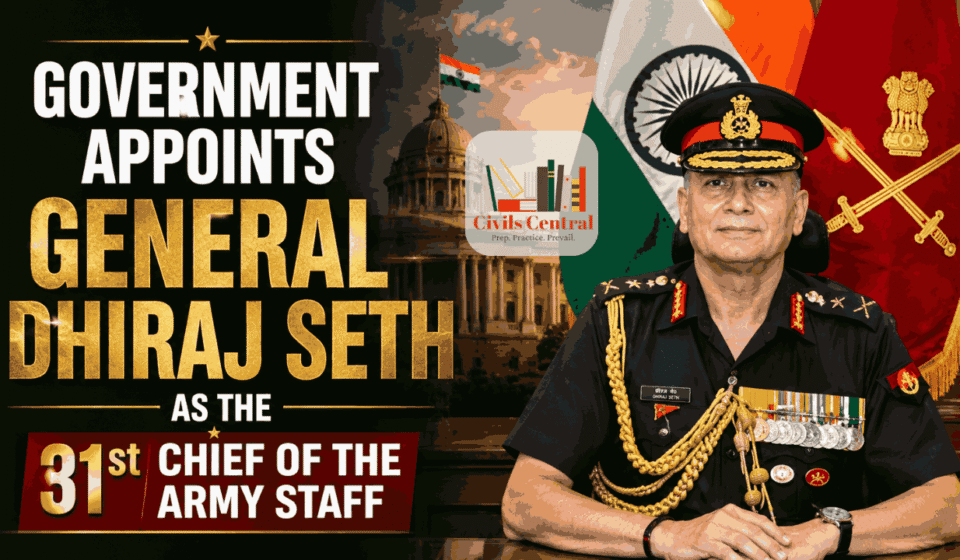
The Government of India has appointed General Dhiraj Seth as the 31st Chief of the Army Staff (COAS) of the Indian Army, marking an important transition in India’s military leadership. He assumed office on 30 June 2026, succeeding General Upendra Dwivedi, who retired after completing his tenure. General Seth, previously serving as the Vice Chief of the Army Staff, is an officer of the Armoured Corps with nearly four decades of distinguished military service spanning operational, strategic, instructional, and capability development roles.
Although the appointment of a new Army Chief is a significant current affairs event, UPSC rarely confines itself to asking factual questions such as the name of the incumbent COAS. Instead, the examination uses such developments to assess a candidate’s understanding of India’s higher defence organisation, constitutional principles governing civilian control over the military, defence reforms, national security architecture, military modernization, and evolving warfare doctrines.
Therefore, this article uses the appointment of General Dhiraj Seth as the entry point to comprehensively explain the institution of the Chief of the Army Staff and its relevance within India’s defence and governance framework.
Why in News?
The Appointments Committee of the Cabinet (ACC) approved the appointment of Lieutenant General Dhiraj Seth as the next Chief of the Army Staff with effect from 30 June 2026. On assuming office, he was promoted to the rank of General, becoming the 31st Chief of the Army Staff of the Indian Army. He succeeded General Upendra Dwivedi, who demitted office upon reaching the age of superannuation.
General Seth assumed command at a strategically important time for India. The country continues to face persistent security challenges along the Line of Actual Control (LAC) with China and the Line of Control (LoC) with Pakistan, while simultaneously pursuing ambitious military reforms such as integrated theatre commands, indigenous defence manufacturing, artificial intelligence-enabled warfare, and force restructuring. Soon after taking charge, General Seth articulated his vision of a technology-enabled, future-ready Army under the theme “VIJAY”, aligned with the broader goals of jointness, self-reliance, and innovation. (The Times of India)
General Dhiraj Seth
| Particular | Details |
|---|---|
| Name | General Dhiraj Seth |
| Position | 31st Chief of the Army Staff (COAS) |
| Assumed Office | 30 June 2026 |
| Succeeded | General Upendra Dwivedi |
| Previous Appointment | Vice Chief of the Army Staff |
| Arm/Regiment | Armoured Corps (2nd Lancers – Gardner’s Horse) |
| Commissioned | December 1986 |
| Alma Mater | National Defence Academy (NDA), Khadakwasla |
| Career Span | Nearly four decades of military service |
| Important Commands | XXI Corps, South Western Command, Southern Command |
| Major Decorations | PVSM, UYSM, AVSM |
| Current Vision | “VIJAY” – Building a technology-enabled, future-ready Indian Army |
Why is This Appointment Important?
The appointment of a Chief of the Army Staff is not merely a change in leadership. It represents continuity in military command, strategic planning, and institutional evolution. Every Army Chief leaves a distinct imprint on the organisation through doctrinal reforms, capability development, personnel management, and operational preparedness.
General Dhiraj Seth takes over at a time when the Indian Army is transitioning from a manpower-intensive force towards a technology-intensive and network-centric military capable of operating across multiple domains—land, air, maritime, cyber, space, and the electromagnetic spectrum. His leadership is expected to accelerate reforms relating to indigenous defence production, joint military operations, artificial intelligence, unmanned systems, and integrated warfighting capabilities. (The Times of India)
For UPSC aspirants, this makes the appointment relevant not because of the individual alone, but because it opens the door to understanding India’s evolving national security architecture.
What Can UPSC Ask from This News?
Instead of asking “Who is the current Chief of the Army Staff?”, UPSC is more likely to frame questions such as:
- Explain the constitutional position of the Chief of the Army Staff in India’s governance framework.
- Discuss the role of the Chief of Defence Staff (CDS) vis-à-vis the Chief of the Army Staff.
- Examine the importance of civil-military relations in a constitutional democracy.
- Analyse the need for integrated theatre commands and defence reforms.
- Discuss India’s preparedness for multi-domain warfare.
Thus, the current affair serves as a gateway to a much broader understanding of India’s defence administration.
Understanding the Office of the Chief of the Army Staff (COAS)
To appreciate the significance of General Dhiraj Seth’s appointment, it is essential to understand the institution he now heads. UPSC is rarely interested in personalities alone; instead, it examines the constitutional, administrative, and strategic importance of key offices. The office of the Chief of the Army Staff (COAS) is one such institution that lies at the heart of India’s national security architecture.
The Chief of the Army Staff is the highest-ranking professional military officer of the Indian Army and serves as its commander, principal military adviser on Army-related matters, and administrative head. Holding the four-star rank of General, the COAS is responsible for ensuring that the Army remains operationally prepared, professionally trained, technologically modern, and capable of defending India’s sovereignty and territorial integrity across the full spectrum of conflict.
It is important to distinguish between operational leadership and political authority. While the COAS exercises command over the Indian Army, the armed forces remain firmly under the control of the elected civilian government. This principle of civilian supremacy over the military is a cornerstone of India’s constitutional democracy and has been one of the defining strengths of the Republic since Independence.
Unlike countries where military establishments have periodically intervened in politics, India has maintained an unbroken tradition of democratic civilian control. The President of India is the Supreme Commander of the Armed Forces, but this authority is exercised on the aid and advice of the Council of Ministers headed by the Prime Minister. Consequently, the COAS functions within a constitutional framework where military professionalism is combined with democratic accountability.
Evolution of the Office of the Army Chief
The office of the Chief of the Army Staff has undergone a significant transformation since Independence.
During British rule, the Indian Army was headed by the Commander-in-Chief, India, one of the most powerful officials in the colonial administration. The Commander-in-Chief not only exercised military command but also held considerable influence in governance. Such concentration of authority was inconsistent with the principles of a democratic republic envisioned by the framers of the Constitution.
After Independence in 1947, India temporarily retained the office of the Commander-in-Chief to ensure continuity in military administration. However, as democratic institutions matured, the Government recognised the need to restructure higher defence management in accordance with constitutional values.
A landmark reform took place in 1955, when the post of Commander-in-Chief was abolished and replaced by the Chief of the Army Staff through amendments to military regulations. This change was more than symbolic. It reflected India’s commitment to ensuring that the armed forces remained subordinate to elected civilian authority rather than functioning as an independent centre of power.
Over the decades, the role of the COAS has evolved alongside India’s changing security environment. From defending territorial boundaries during the conventional wars of 1947–48, 1962, 1965 and 1971, to combating insurgencies, counter-terrorism operations, United Nations peacekeeping missions, humanitarian assistance and disaster relief, cyber security challenges, and preparations for multi-domain warfare, the responsibilities of the Army Chief have expanded considerably.
Today, the COAS is expected not only to command troops but also to lead organisational transformation, technological innovation, force restructuring, and joint military planning in an increasingly complex strategic environment.
Historical Evolution of India’s Military Leadership
| Year | Development | Why It Matters |
|---|---|---|
| 1947 | India gains Independence; office of Commander-in-Chief retained temporarily | Ensured continuity during transition from colonial rule |
| 1950 | Constitution of India comes into force | Established democratic civilian control over the armed forces |
| 1955 | Post of Commander-in-Chief abolished; Chief of the Army Staff created | Marked the institutional shift towards constitutional governance |
| 1999 | Kargil Review Committee recommends higher defence reforms | Highlighted shortcomings in defence management and jointness |
| 2001 | Group of Ministers recommends restructuring of higher defence organisation | Led to several institutional reforms |
| 2020 | Creation of the Chief of Defence Staff (CDS) and Department of Military Affairs | Promoted integration among the three services |
| Present | Ongoing Integrated Theatre Command reforms | Aim to enhance joint operational capability and resource optimisation |
Constitutional Position of the Armed Forces
One of the most frequently misunderstood aspects of India’s defence administration is the constitutional status of the armed forces. Surprisingly, the Constitution does not contain a separate chapter dealing exclusively with the organisation or command of the military. Instead, the constitutional framework is distributed across several provisions that collectively establish civilian oversight and parliamentary control.
The President of India, under Article 53, is the constitutional repository of the Union’s executive power and serves as the Supreme Commander of the Armed Forces. However, this authority is exercised in accordance with Article 74, which mandates that the President acts on the aid and advice of the Council of Ministers headed by the Prime Minister.
Legislative competence over defence is vested exclusively in Parliament through Article 246 read with the Union List (Seventh Schedule), which includes subjects such as defence of India, armed forces, deployment of troops, war and peace, and defence industries. Parliament therefore enacts laws governing military service, allocates defence expenditure, and exercises oversight over defence policy through parliamentary committees and budgetary processes.
This constitutional arrangement ensures that while the armed forces enjoy operational autonomy in military matters, strategic direction and political accountability remain firmly with the elected civilian government.
Constitutional Provisions Relevant to Defence
| Constitutional Provision | Significance |
|---|---|
| Article 53 | Executive power of the Union vested in the President, who is the Supreme Commander of the Armed Forces |
| Article 74 | President acts on the aid and advice of the Council of Ministers |
| Article 246 | Parliament has exclusive legislative competence over defence |
| Seventh Schedule (Union List) | Defence, armed forces, war, peace, and related matters fall under the exclusive jurisdiction of the Union Government |
Why Civilian Control Over the Military Matters
The principle of civilian control is not merely a constitutional formality; it is fundamental to the survival of democratic governance. In many countries, military institutions have intervened in politics during periods of instability, often resulting in coups, suspension of constitutions, or prolonged military rule. India’s experience has been markedly different.
Since Independence, the Indian Armed Forces have consistently upheld the values of political neutrality, constitutional loyalty, and professional discipline. This institutional culture has enabled the military to remain one of the most respected public institutions while avoiding political entanglement.
Appointment of the Chief of the Army Staff
Having understood the constitutional position of the office, the next logical question is how the Chief of the Army Staff is appointed. Unlike appointments to constitutional bodies such as the Election Commission or the Union Public Service Commission, the appointment of the COAS is governed primarily by statutory provisions, service regulations, established conventions, and the executive powers of the Union Government.
The appointment is one of the most important personnel decisions in India’s national security system because the selected officer will lead an institution of over one million active personnel, oversee military preparedness across diverse operational theatres, advise the political executive on land warfare, and contribute to the formulation of national defence strategy.
Who Appoints the Chief of the Army Staff?
The President of India formally appoints the Chief of the Army Staff on the advice of the Union Government. In practice, the appointment is approved by the Appointments Committee of the Cabinet (ACC) based on recommendations made by the Ministry of Defence.
The process reflects the constitutional principle that while the President is the Supreme Commander of the Armed Forces, executive authority regarding appointments is exercised through the elected government.
Unlike constitutional offices where selection committees may be prescribed by law, there is no separate statutory collegium or independent commission for appointing the Army Chief. The decision rests with the executive, ensuring that the leadership of the armed forces remains accountable to the civilian government.
Appointment Process
The appointment generally follows a well-established sequence designed to ensure continuity of command.
Vacancy due to retirement of incumbent COAS
                │
                ▼
Assessment of eligible senior-most Army Commanders
                │
                ▼
Recommendation by the Ministry of Defence
                │
                ▼
Approval by the Appointments Committee of the Cabinet (ACC)
                │
                ▼
Formal appointment by the President of India
                │
                ▼
Assumption of office as Chief of the Army Staff
The announcement is usually made a few days before the retirement of the outgoing Chief so that there is no interruption in military command.
Is Seniority the Only Criterion?
A common misconception is that the senior-most Lieutenant General automatically becomes the Army Chief. In reality, seniority is an important convention but not an absolute legal rule.
Successive governments have generally followed the principle of appointing the senior-most eligible Army Commander to preserve institutional stability and avoid unnecessary controversy. However, the Government retains the authority to supersede seniority if it considers another officer better suited to meet strategic or organisational requirements.
This executive discretion has occasionally been exercised in India’s military history, though such instances have been relatively rare.
Thus, while seniority promotes predictability and morale within the armed forces, the final appointment remains an executive decision based on broader considerations of leadership, operational experience, integrity, and national interest.
Eligibility to Become the Chief of the Army Staff
Although no single constitutional provision specifies formal eligibility criteria, certain institutional norms have evolved over time.
An officer considered for appointment as COAS is generally expected to:
- Hold the rank of Lieutenant General before appointment.
- Have commanded a Corps and an Army Command.
- Possess extensive operational experience in both conventional and counter-insurgency environments.
- Have served in senior staff, instructional, and strategic planning appointments.
- Demonstrate an impeccable service record and high standards of professional integrity.
- Be capable of leading military transformation in an increasingly technology-driven security environment.
The increasing complexity of modern warfare means that strategic vision and organisational leadership have become as important as battlefield command experience.
Appointment of General Dhiraj Seth
The appointment of General Dhiraj Seth illustrates the contemporary expectations from an Army Chief. Before assuming office as the 31st COAS, he served as the Vice Chief of the Army Staff and held several important operational and command appointments, including leadership of the Southern Command and the South Western Command.
His career reflects experience across armoured warfare, operational planning, force modernization, and higher military management. Such diverse exposure is increasingly important as the Indian Army adapts to the demands of multi-domain operations, technological disruption, and greater jointness among the three services.
His appointment also signals continuity in the government’s emphasis on defence modernisation, indigenisation under the Aatmanirbhar Bharat initiative, and the proposed transition towards Integrated Theatre Commands.
Tenure of the Chief of the Army Staff
The Chief of the Army Staff holds office until the earliest of the following:
- Attaining the age of 62 years.
- Completion of the prescribed tenure if applicable.
- Earlier retirement or resignation accepted by the Government.
The retirement age of 62 years is intended to provide sufficient time for strategic leadership while ensuring periodic succession within the senior ranks of the Army. Unlike certain constitutional offices that have fixed terms irrespective of age, the tenure of the COAS is primarily age-based.
Rank of the Chief of the Army Staff
The Chief of the Army Staff holds the four-star rank of General, the highest active rank in the Indian Army. Above the rank of General lies the five-star rank of Field Marshal, which is an honorary distinction awarded only in exceptional circumstances for extraordinary military service. It is not a regular operational appointment.
India has conferred the rank of Field Marshal on only two distinguished military leaders:
| Officer | Year Conferred | Significance |
|---|---|---|
| Field Marshal Sam Manekshaw | 1973 | Architect of India’s victory in the 1971 Indo-Pak War and the creation of Bangladesh |
| Field Marshal Kodandera M. Cariappa | 1986 | First Indian Commander-in-Chief of the Indian Army after Independence |
The rarity of this honour underlines its exceptional nature.
COAS, CDS and Defence Minister
Understanding the distinction between these offices is essential for UPSC because questions increasingly focus on institutional roles rather than individual office holders.
| Institution | Primary Role | Why It Matters |
|---|---|---|
| Chief of the Army Staff (COAS) | Professional head of the Indian Army | Responsible for operational readiness, administration, and modernization of the Army |
| Chief of Defence Staff (CDS) | Principal Military Adviser to the Government and head of the Department of Military Affairs | Promotes jointness among the Army, Navy, and Air Force and drives integrated defence reforms |
| Defence Minister | Political head of the Ministry of Defence | Frames defence policy, oversees defence administration, and is accountable to Parliament |
| President of India | Supreme Commander of the Armed Forces | Constitutional head exercising powers on the aid and advice of the Council of Ministers |
This layered structure ensures a balance between military professionalism, democratic accountability, and strategic coordination.
Why Does the Appointment Process Matter?
For the Civil Services Examination, the significance of the appointment process lies not in memorising procedural details but in understanding the constitutional philosophy behind it. The executive’s authority to appoint the Army Chief reinforces the principle of civilian supremacy, while the convention of seniority promotes institutional stability and professionalism. Together, these conventions have contributed to one of the most stable civil-military relationships among democratic nations.
The appointment of General Dhiraj Seth is therefore not simply an administrative decision; it reflects the continuity of India’s democratic traditions, the professionalism of its armed forces, and the evolving priorities of national security in an era of rapid geopolitical and technological change.
CivilsCentral Pointer
UPSC often asks indirect questions. Instead of asking “Who appoints the Army Chief?”, the Commission is more likely to ask candidates to analyse how India’s defence leadership structure reflects the constitutional principle of civilian control over the military, or to compare the institutional roles of the COAS, CDS, and the Ministry of Defence.
Organisation of the Indian Army and the Role of the Chief of the Army Staff
Understanding the office of the Chief of the Army Staff is incomplete without understanding the institution that the officer commands. The Indian Army is one of the largest and most battle-experienced land forces in the world. It is not merely a fighting force but a complex organisation comprising operational commands, specialised arms and services, training institutions, logistics networks, intelligence units, engineering capabilities, aviation assets, cyber and electronic warfare components, and medical support systems.
The Chief of the Army Staff (COAS) is responsible for ensuring that all these components function as an integrated and combat-ready force capable of responding to conventional wars, sub-conventional conflicts, hybrid warfare, humanitarian crises, and emerging technological challenges.
The Indian Army
The Indian Army is the land warfare branch of the Indian Armed Forces and constitutes the largest of the three services. It is entrusted with safeguarding India’s territorial integrity, defending national sovereignty against external aggression, supporting civil authorities during emergencies, participating in counter-insurgency and counter-terrorism operations, and contributing to international peacekeeping under the United Nations.
Since Independence, the Army has continuously evolved in response to changing security challenges. From fighting conventional interstate wars in 1947–48, 1962, 1965, 1971, and 1999, it has expanded its capabilities to address cross-border terrorism, insurgencies, cyber threats, space-enabled operations, and multi-domain warfare. This evolution has transformed the Army from a manpower-centric force into an increasingly technology-driven organisation.
Organisational Structure of the Indian Army
The organisational hierarchy of the Indian Army reflects the need for decentralised operational command while maintaining strategic unity under the Chief of the Army Staff.
                    Chief of the Army Staff (COAS)
                               │
                      Army Headquarters (New Delhi)
                               │
                     Vice Chief of the Army Staff
                               │
        ┌────────────────────────────────────────────┐
        │                                            │
  Principal Staff Officers                 Army Commanders
        │                                            │
        └────────────────────────────────────────────┘
                               │
                      Army Commands (7 Operational + 1 Training)
                               │
                             Corps
                               │
                           Divisions
                               │
                           Brigades
                               │
                          Battalions
                               │
                     Companies → Platoons → Sections
This hierarchical structure ensures unity of command, clear lines of responsibility, and efficient execution of military operations across diverse geographical theatres.
Army Headquarters
The Army Headquarters (AHQ), located in New Delhi, serves as the central command and administrative nerve centre of the Indian Army. It functions under the leadership of the Chief of the Army Staff and is responsible for strategic planning, operational oversight, personnel management, force modernisation, logistics, intelligence coordination, military training, procurement planning, and doctrinal development.
The Headquarters also coordinates closely with the Ministry of Defence, the Chief of Defence Staff (CDS), the Department of Military Affairs (DMA), and the Headquarters of the Indian Navy and Indian Air Force to ensure joint planning and integrated national defence.
Supporting the COAS are the Vice Chief of the Army Staff (VCOAS), the Deputy Chiefs, the Adjutant General, the Quartermaster General, the Military Secretary, the Engineer-in-Chief, and other Principal Staff Officers, each heading specialised branches that collectively manage the Army’s vast organisational responsibilities.
Commands of the Indian Army
For effective operational management, the Indian Army is divided into seven operational commands and one training command, each headed by a General Officer Commanding-in-Chief (GOC-in-C) with the rank of Lieutenant General.
Each command is responsible for military preparedness within a defined geographical or functional area.
| Army Command | Headquarters | Primary Responsibility |
|---|---|---|
| Northern Command | Udhampur | Operations along the Line of Control (LoC) and Line of Actual Control (LAC), including Jammu & Kashmir and Ladakh |
| Western Command | Chandimandir | Defence of Punjab, parts of Jammu, and the western frontier with Pakistan |
| South Western Command | Jaipur | Security along the Rajasthan sector and desert warfare preparedness |
| Eastern Command | Kolkata | Borders with China, Nepal, Bhutan, Bangladesh, and counter-insurgency operations in the North-East |
| Central Command | Lucknow | Strategic reserve, logistics, and operations across central India and parts of the Himalayan region |
| Southern Command | Pune | Security of peninsular India, training, logistics, and support functions |
| Army Training Command (ARTRAC) | Shimla | Development of military doctrine, training, education, and future warfare concepts |
| Centralised Operational Coordination | Through Army Headquarters | Ensures strategic direction and coordination among commands under the COAS |
Why This Matters for UPSC
The geographical distribution of commands reflects India’s strategic priorities. For instance, the Northern Command remains central to India’s response to challenges from Pakistan and China, while the Eastern Command plays a crucial role in securing the North-Eastern region and managing the sensitive Himalayan frontier. ARTRAC, though not an operational command, shapes military doctrine and prepares the Army for future conflicts.
Arms and Services of the Indian Army
The Indian Army functions through a combination of Combat Arms, Combat Support Arms, and Services, each performing specialised roles that together create an integrated fighting force.
Combat Arms
These are the primary fighting branches that directly engage the enemy on the battlefield.
- Infantry
- Armoured Corps
- Mechanised Infantry
- Regiment of Artillery
Combat Support Arms
These branches enhance the combat effectiveness of frontline formations by providing specialised operational capabilities.
- Corps of Engineers
- Corps of Signals
- Army Aviation Corps
- Army Air Defence
Services
The Services provide logistical, technical, administrative, and medical support necessary to sustain military operations.
- Army Service Corps (ASC)
- Army Ordnance Corps (AOC)
- Corps of Electronics and Mechanical Engineers (EME)
- Army Medical Corps (AMC)
- Army Dental Corps
- Military Nursing Service (MNS)
- Judge Advocate General’s Department (JAG)
- Corps of Military Police (CMP)
The effectiveness of the Indian Army depends on seamless coordination among these diverse branches rather than on combat arms alone.
Operational Hierarchy
Military operations are conducted through a carefully structured chain of command.
| Formation | Commanded By | Approximate Role |
|---|---|---|
| Command | Lieutenant General | Strategic regional command |
| Corps | Lieutenant General | Conducts major operational campaigns |
| Division | Major General | Tactical operational formation |
| Brigade | Brigadier | Coordinates multiple battalions |
| Battalion | Colonel | Basic fighting unit of the Army |
| Company | Major/Captain | Sub-unit for tactical operations |
| Platoon | Lieutenant | Small combat unit |
| Section | Junior Commissioned Officer/Non-Commissioned Officer | Smallest tactical element |
This hierarchy ensures effective command, control, communication, and coordination during both peace and wartime operations.
Role of the Chief of the Army Staff in Commanding the Army
Although each Army Command enjoys operational autonomy within its designated theatre, overall responsibility for the Army rests with the Chief of the Army Staff.
The COAS provides strategic direction, formulates military doctrine, determines force development priorities, oversees personnel policies, approves operational plans, supervises military training, and ensures combat readiness across all commands. During crises, the COAS coordinates with the Chief of Defence Staff, the Ministry of Defence, intelligence agencies, and the political leadership to translate national strategic objectives into military action.
In recent years, the role has expanded beyond conventional command responsibilities. The Army Chief is expected to lead technological transformation by integrating artificial intelligence, drones, robotics, cyber capabilities, electronic warfare, precision-guided munitions, and network-centric operations into military planning. The office has thus evolved from managing manpower-intensive operations to shaping a modern, technology-enabled force capable of responding to complex security challenges.
The Indian Army in the Era of Multi-Domain Warfare
Modern conflicts are no longer confined to land, sea, and air. They increasingly involve cyber space, outer space, information warfare, artificial intelligence, autonomous systems, and the electromagnetic spectrum. Consequently, the Indian Army is undergoing a doctrinal shift towards Multi-Domain Operations (MDO), where military power is exercised simultaneously across multiple domains in close coordination with the Navy, Air Force, and strategic agencies.
The Chief of the Army Staff plays a pivotal role in steering this transformation by promoting joint planning, technological innovation, indigenous defence production, and interoperability with the other services. General Dhiraj Seth’s emphasis on building a technology-enabled, future-ready Army reflects this strategic transition and aligns with India’s broader vision of creating agile, integrated, and self-reliant armed forces.
Powers, Functions and Responsibilities of the Chief of the Army Staff (COAS)
The office of the Chief of the Army Staff is often perceived merely as the highest military appointment in the Indian Army. In reality, it is one of the most significant leadership positions in India’s national security system. The COAS is not simply a battlefield commander but also a strategic planner, institutional reformer, military diplomat, administrator, and adviser to the Government of India.
The responsibilities of the Army Chief have expanded significantly over the past two decades. Traditional concerns such as border defence and combat readiness now coexist with challenges arising from cyber warfare, artificial intelligence, space-enabled military operations, autonomous weapon systems, hybrid warfare, information warfare, and the need for greater jointness among the three armed services. Consequently, the modern COAS must combine operational expertise with strategic vision and organisational leadership.
Principal Responsibilities of the Chief of the Army Staff
The responsibilities of the COAS may be understood under five broad dimensions: operational leadership, force development, administration, strategic advisory functions, and international military cooperation. Together, these responsibilities ensure that the Indian Army remains capable of safeguarding India’s sovereignty while adapting to emerging security challenges.
1. Operational Leadership
The foremost responsibility of the Chief of the Army Staff is to ensure that the Indian Army remains fully prepared to defend the nation against external aggression and internal security threats.
The COAS exercises overall operational control over the Army through the chain of command. While individual Army Commanders are responsible for operations within their respective theatres, the Army Chief provides strategic direction, approves operational doctrines, supervises military preparedness, and coordinates large-scale deployments during crises.
Operational leadership involves maintaining continuous readiness along sensitive frontiers such as the Line of Control (LoC) with Pakistan and the Line of Actual Control (LAC) with China. It also includes overseeing counter-insurgency and counter-terrorism operations, ensuring rapid mobilisation during emergencies, and coordinating humanitarian assistance and disaster relief operations whenever required.
The Army Chief therefore acts as the principal guardian of India’s land-based military preparedness.
2. Force Development and Modernisation
Modern military effectiveness depends as much on technology as on manpower. Accordingly, one of the most important responsibilities of the COAS is to prepare the Army for future warfare.
This involves identifying capability gaps, preparing long-term force development plans, prioritising procurement requirements, encouraging indigenous defence manufacturing, and integrating emerging technologies into military operations.
The Army is presently undergoing significant transformation through the induction of advanced surveillance systems, drones, loitering munitions, precision-guided weapons, artificial intelligence, robotics, cyber capabilities, quantum communication, electronic warfare systems, and network-centric command-and-control platforms.
The Army Chief plays a decisive role in ensuring that these technological advancements are incorporated into operational doctrine, training, and force structure.
General Dhiraj Seth has repeatedly emphasised that the Indian Army must evolve into a technology-enabled, future-ready force capable of operating effectively in an increasingly complex strategic environment. His vision reflects the broader national objective of enhancing military capability while reducing dependence on imported defence equipment through the Aatmanirbhar Bharat initiative.
3. Administration and Human Resource Management
The Indian Army is among the world’s largest professional military organisations, comprising officers, Junior Commissioned Officers (JCOs), soldiers, and civilian personnel. Managing such a vast institution requires robust administrative leadership.
The COAS is responsible for personnel policies, recruitment planning, promotions, career progression, military education, discipline, welfare measures, housing, healthcare, pensions, and veteran affairs. Ensuring high morale and maintaining professional standards across all ranks are integral aspects of this responsibility.
Military leadership extends beyond command during war. It also involves creating an organisational culture based on discipline, integrity, professionalism, and commitment to constitutional values. The Army Chief therefore functions as both a military commander and the custodian of the Army’s institutional ethos.
4. Strategic Adviser to the Government
The Chief of the Army Staff serves as the Government’s principal adviser on matters relating to land warfare and military capability.
The COAS provides professional military assessments on issues such as border security, operational preparedness, force deployment, military strategy, defence procurement, infrastructure development along border areas, and emerging security threats.
These inputs assist the political leadership in making informed decisions regarding national security policy.
Following the creation of the Chief of Defence Staff (CDS) and the Department of Military Affairs (DMA) in 2020, strategic military advice has become increasingly integrated across the three services. Nevertheless, the COAS continues to remain the foremost professional authority on all matters concerning the Indian Army and plays a central role in shaping defence policy through consultations with the CDS, the Defence Minister, the National Security Council Secretariat, and other strategic institutions.
5. Military Diplomacy and International Cooperation
In the twenty-first century, armed forces are not only instruments of war but also instruments of diplomacy.
The Army Chief represents India in bilateral military engagements, strategic dialogues, joint exercises, defence cooperation agreements, and high-level visits with partner countries. Such interactions strengthen mutual trust, improve interoperability, facilitate technology sharing, and contribute to regional stability.
India regularly conducts military exercises with countries including the United States, France, Australia, Japan, Russia, the United Kingdom, Singapore, and several ASEAN and African nations. The COAS plays an important role in shaping these engagements and advancing India’s strategic partnerships.
Military diplomacy has therefore become an increasingly important dimension of the Army Chief’s responsibilities.
The Expanding Role of the Army Chief in the Twenty-First Century
The character of warfare is undergoing rapid transformation. Conventional military threats are now accompanied by cyber attacks, misinformation campaigns, economic coercion, satellite disruption, artificial intelligence-enabled decision-making, and autonomous weapon systems.
As a result, the Army Chief’s role has expanded beyond conventional battlefield leadership.
Today’s COAS must simultaneously prepare the Army for:
- Multi-domain operations
- Integrated theatre warfare
- Artificial intelligence and autonomous systems
- Cyber defence
- Space-enabled military operations
- Information and cognitive warfare
- Precision strike capabilities
- Unmanned aerial and ground systems
- Climate-related security challenges
- Humanitarian assistance and disaster relief (HADR)
This transformation demands strategic foresight, technological literacy, organisational innovation, and effective inter-service coordination.
Relationship Between the COAS and Other Defence Institutions
The Chief of the Army Staff does not function in isolation. India’s higher defence management system is designed to promote coordination among political leadership, civilian bureaucracy, and the three armed services.
                    President of India
                    (Supreme Commander)
                             │
                             ▼
                     Prime Minister & CCS
                             │
                             ▼
                    Ministry of Defence
                             │
                             ▼
                 Chief of Defence Staff (CDS)
                             │
      ┌──────────────────────┼──────────────────────┐
      ▼                      ▼                      ▼
Chief of Army Staff    Chief of Naval Staff   Chief of Air Staff
      │
      ▼
Army Headquarters
      │
      ▼
Army Commands → Corps → Divisions → Brigades → Battalions
This structure ensures that military decisions remain aligned with national political objectives while preserving operational effectiveness.
Challenges Before the New Chief of the Army Staff
General Dhiraj Seth assumes office at a time when India’s strategic environment is becoming increasingly complex.
Some of the major challenges include:
| Challenge | Strategic Significance |
|---|---|
| Border tensions with China | Sustained military preparedness along the LAC and infrastructure development |
| Cross-border terrorism | Counter-terrorism operations and intelligence coordination |
| Integrated Theatre Commands | Managing organisational restructuring while preserving operational efficiency |
| Defence Modernisation | Balancing capability enhancement with fiscal constraints |
| Indigenous Defence Manufacturing | Accelerating self-reliance without compromising operational readiness |
| Emerging Technologies | Integrating AI, drones, cyber capabilities, and electronic warfare into military doctrine |
| Human Resource Reforms | Adapting organisational structures to future operational requirements |
Addressing these challenges will require balancing immediate operational readiness with long-term institutional transformation.
Why This Topic Matters?
For UPSC, the office of the Chief of the Army Staff is not merely an administrative appointment. It represents the intersection of constitutional governance, national security, defence policy, military ethics, technology, public administration, and strategic affairs.
Questions may examine the COAS from multiple dimensions:
- Constitutional principle of civilian control over the armed forces.
- Defence reforms and higher defence management.
- Military modernisation and indigenous capability development.
- Civil-military relations in a democracy.
- Emerging security challenges in the Indo-Pacific.
- India’s preparedness for multi-domain warfare.
A well-prepared candidate should therefore understand not only who the Army Chief is but also why the institution matters, how it functions, and what strategic role it plays in safeguarding India’s national interests.
Chief of Defence Staff (CDS), Department of Military Affairs (DMA) and Higher Defence Reforms
The appointment of a new Chief of the Army Staff cannot be understood in isolation from the broader reforms that have transformed India’s higher defence management over the last two decades. Until recently, the Army, Navy and Air Force largely functioned as separate entities, each with its own planning processes, procurement priorities and operational doctrines. While this arrangement had served India reasonably well in earlier decades, changing security challenges exposed the need for greater integration among the three services.
Modern warfare is no longer confined to a single domain. Military operations today require simultaneous coordination across land, sea, air, cyber, space and the electromagnetic spectrum. A conflict may involve cyber attacks on communication networks, satellite disruption, drone swarms, long-range precision strikes, information warfare and conventional military operations occurring at the same time. Such an environment demands seamless coordination among all branches of the armed forces.
Recognising these realities, India initiated a series of reforms culminating in the creation of the Chief of Defence Staff (CDS) and the Department of Military Affairs (DMA) in 2020. These reforms have fundamentally changed the role of the Chief of the Army Staff, who now functions as the professional head of the Indian Army while contributing to integrated military planning under the leadership of the CDS.
Why Were Higher Defence Reforms Needed?
For decades after Independence, India’s defence management evolved gradually without a single authority responsible for integrating the functioning of the Army, Navy and Air Force. Each service planned independently, resulting in duplication of capabilities, delays in procurement, and limited joint operational planning.
The shortcomings of this system became particularly evident during the 1999 Kargil War. Although the armed forces successfully repelled Pakistani intrusions, post-war assessments highlighted weaknesses in intelligence coordination, inter-service communication and higher defence management.
These findings triggered an extensive review of India’s national security architecture.
Evolution of Higher Defence Reforms
| Year | Reform | Significance |
|---|---|---|
| 1999 | Kargil Review Committee (KRC) | Examined operational and institutional shortcomings exposed during the Kargil conflict |
| 2001 | Group of Ministers (GoM) Report | Recommended comprehensive restructuring of national security institutions |
| 2012 | Naresh Chandra Task Force | Recommended creation of a Permanent Chairman of the Chiefs of Staff Committee |
| 2016 | Shekatkar Committee | Proposed reforms for enhancing combat capability and optimising defence expenditure |
| 2019 | Government approves creation of CDS | Historic restructuring of higher defence management |
| 2020 | Department of Military Affairs established | Integrated military administration under the CDS |
| Ongoing | Integrated Theatre Commands | Aimed at creating joint operational commands for future warfare |
These reforms represent a gradual transition from service-specific functioning towards integrated military planning.
Kargil Review Committee (KRC)
The Kargil Review Committee, chaired by K. Subrahmanyam, was constituted in 1999 after the Kargil conflict to analyse the circumstances leading to the intrusion and recommend measures to strengthen India’s national security system.
Rather than focusing solely on military operations, the Committee examined intelligence coordination, defence planning, civil-military relations, and institutional decision-making.
Among its key observations were:
- Need for greater jointness among the three armed services.
- Better intelligence coordination.
- Strengthening higher defence management.
- Institutional reforms in national security decision-making.
- Long-term strategic planning.
The Committee laid the intellectual foundation for many of the defence reforms implemented over the following two decades.
The Chief of Defence Staff (CDS)
One of the most significant recommendations emerging from successive reform committees was the creation of a single military adviser to the Government.
Accordingly, the Government established the office of the Chief of Defence Staff (CDS) in January 2020. The CDS is a four-star military officer who serves as the Principal Military Adviser to the Government of India on all tri-service matters. Unlike the Chiefs of the Army, Navy and Air Force, who head their respective services, the CDS focuses on integration, joint planning, capability development and long-term military reforms.
The creation of the CDS marked the most important reform in India’s higher defence organisation since Independence.
Major Responsibilities of the CDS
The CDS performs several strategic functions that extend beyond the responsibilities of any individual Service Chief.
These include:
- Acting as the Principal Military Adviser to the Defence Minister.
- Promoting jointness among the Army, Navy and Air Force.
- Facilitating integrated capability development.
- Prioritising defence procurement based on national requirements.
- Overseeing tri-service organisations.
- Leading the implementation of Integrated Theatre Commands.
- Promoting indigenous defence capability.
- Enhancing efficiency in defence resource utilisation.
The CDS does not exercise direct operational command over the three Services. Operational command continues to remain with the respective Service Chiefs until theatre command reforms are fully implemented.
Department of Military Affairs (DMA)
A major institutional innovation accompanying the creation of the CDS was the establishment of the Department of Military Affairs (DMA) within the Ministry of Defence.
The CDS functions as the Secretary of the Department of Military Affairs, making it the first time a serving military officer has headed a department within the Ministry of Defence.
The DMA is responsible for:
- Administration of the Armed Forces.
- Promotion of jointness.
- Military staffing.
- Training policies.
- Procurement of military equipment (except capital acquisitions handled separately).
- Facilitation of theatre command reforms.
- Integration of service headquarters with the Ministry of Defence.
The creation of the DMA has significantly improved coordination between civilian administrators and the military establishment.
Chief of the Army Staff vs Chief of Defence Staff
This comparison is extremely important for UPSC because confusion between the two offices is common.
| Aspect | Chief of the Army Staff (COAS) | Chief of Defence Staff (CDS) |
|---|---|---|
| Scope | Indian Army only | Army, Navy and Air Force collectively |
| Primary Role | Professional head of the Army | Principal Military Adviser to the Government |
| Operational Responsibility | Army operations and administration | Promotes integration and jointness |
| Focus | Combat readiness, personnel, doctrine and capability of the Army | Tri-service planning, reforms and capability integration |
| Department | Army Headquarters | Department of Military Affairs |
| Objective | Strengthen the Indian Army | Strengthen India’s overall military capability |
Why does this distinction matter?
The COAS ensures that the Indian Army remains an effective fighting force, whereas the CDS ensures that the three Services operate as an integrated military instrument capable of responding to modern security challenges.
Integrated Theatre Commands
Perhaps the most ambitious defence reform currently under consideration is the creation of Integrated Theatre Commands (ITCs).
Traditionally, each Service operates through its own command structure. For example, the Army, Navy and Air Force have separate operational commands even when responding to the same strategic challenge.
Integrated Theatre Commands seek to replace this arrangement with geographically organised commands in which personnel from all three Services function under a single operational commander.
Existing Structure
Army Command
      │
Independent Operations

Navy Command
      │
Independent Operations

Air Force Command
      │
Independent Operations
Proposed Theatre Command Structure
Integrated Theatre Commander
             │
 ┌───────────┼───────────┐
 │           │           │
Army       Navy      Air Force
             │
      Joint Operational Planning
             │
      Single Military Objective
Advantages of Theatre Commands
Integrated Theatre Commands are expected to provide several strategic benefits.
They can improve operational coordination by ensuring that land, air and maritime assets function as a single fighting force rather than as independent services. They are also expected to reduce duplication of resources, enhance logistical efficiency, accelerate decision-making during crises and improve India’s ability to conduct multi-domain operations.
For a country facing simultaneous challenges on multiple fronts, integrated commands offer greater flexibility and faster military response.
Challenges in Implementing Theatre Commands
Despite broad agreement on the need for reform, implementation remains complex.
Major challenges include:
| Challenge | Explanation |
|---|---|
| Inter-service differences | Each Service has distinct operational doctrines and priorities |
| Command and control | Defining authority within integrated structures |
| Resource allocation | Balancing competing procurement priorities |
| Organisational culture | Managing institutional transition without affecting morale |
| Legal and administrative adjustments | Aligning existing rules with new command structures |
The success of theatre commands will therefore depend not only on organisational restructuring but also on sustained political commitment, military consensus and effective institutional change management.
Role of General Dhiraj Seth in Defence Reforms
As the 31st Chief of the Army Staff, General Dhiraj Seth is expected to play a central role in implementing many of these reforms.
His responsibilities will include:
- Strengthening operational readiness along India’s borders.
- Supporting the transition towards Integrated Theatre Commands.
- Accelerating technology adoption across Army formations.
- Promoting indigenous defence capability under Aatmanirbhar Bharat.
- Enhancing interoperability with the Navy and Air Force.
- Preparing the Army for future multi-domain conflicts.
His close coordination with the CDS and the Ministry of Defence will be crucial in ensuring that these reforms translate into improved military effectiveness.
CivilsCentral Exam Insight
A possible UPSC question is unlikely to ask “When was the CDS created?” Instead, it may ask:
“The creation of the Chief of Defence Staff represents the most significant reform in India’s higher defence management since Independence.” Discuss its significance in the context of integrated military capability and emerging security challenges.
India’s Evolving Security Landscape and the Significance of the New Chief of Army Staff
The appointment of General Dhiraj Seth comes at a time when India’s security environment is undergoing one of the most profound transformations since Independence. Unlike previous decades, where military planning largely focused on conventional interstate wars, contemporary security challenges are multidimensional, technologically sophisticated, and increasingly interconnected. The responsibilities of the Chief of the Army Staff have consequently expanded from leading a land force to preparing the Army for an era of integrated, technology-driven, and multidomain warfare.
India’s Contemporary Security Environment
India today faces a complex security matrix that extends far beyond traditional border defence. Security threats originate from conventional military rivals, cross-border terrorism, cyber attacks, misinformation campaigns, space-based vulnerabilities, maritime competition, and rapidly evolving military technologies.
Unlike the Cold War era, where threats were largely military in nature, contemporary conflicts involve the simultaneous use of diplomatic, informational, economic, technological, and military instruments of national power. This phenomenon is often described as hybrid warfare.
Consequently, the Indian Army must be prepared not only to defend territory but also to operate effectively within a broader national security ecosystem.
Major Security Challenges Before India
1. The Northern Border Challenge
The Line of Actual Control (LAC) with China remains India’s most significant strategic concern. The military standoff in Eastern Ladakh since 2020 fundamentally altered India’s threat perception and highlighted the need for sustained military preparedness, improved border infrastructure, enhanced surveillance capabilities, and rapid mobilisation.
The Army has responded by strengthening deployments, modernising equipment, constructing strategic roads and tunnels, and integrating advanced surveillance systems. These developments have placed unprecedented demands on military planning and logistics.
For the new Army Chief, maintaining operational readiness along the northern frontier while preventing inadvertent escalation remains one of the foremost priorities.
2. The Western Front
The Line of Control (LoC) with Pakistan continues to witness challenges arising from cross-border terrorism, infiltration attempts, ceasefire violations, and the use of drones for smuggling arms and narcotics.
Although the ceasefire understanding renewed in 2021 has reduced large-scale firing incidents, the security situation remains dynamic. The Army must therefore balance conventional deterrence with effective counter-infiltration and counter-terrorism operations.
This requires close coordination among the Army, intelligence agencies, border guarding forces, and local civil administration.
3. Internal Security Challenges
The Indian Army has historically supported civil authorities in regions affected by insurgency and terrorism, particularly in Jammu & Kashmir and parts of the North-East. Although the primary responsibility for internal security lies with the police and Central Armed Police Forces (CAPFs), the Army continues to play a crucial role whenever the situation demands.
The gradual improvement in the security environment has enabled a shift from large-scale military deployments towards capacity building, intelligence-led operations, and development-oriented governance. Nevertheless, maintaining peace while respecting democratic rights remains a delicate balancing act.
4. Emerging Domains of Warfare
Perhaps the most significant transformation in military affairs is the emergence of new operational domains.
Modern conflicts increasingly involve:
- Cyber warfare
- Artificial intelligence
- Autonomous weapon systems
- Space-based military assets
- Electronic warfare
- Information warfare
- Quantum technologies
- Drone and counter-drone operations
- Cognitive warfare
Victory in future conflicts will depend not merely on troop strength but on technological superiority, data integration, real-time intelligence, and network-centric operations.
Preparing the Indian Army for this transition is one of the defining responsibilities of General Dhiraj Seth.
Defence Modernisation
The Indian Army has traditionally been recognised for its large manpower base and extensive operational experience. However, future conflicts demand a shift towards technology-intensive capabilities.
Modernisation is therefore centred on enhancing the Army’s ability to detect, decide, and respond faster than potential adversaries. This includes the induction of advanced communication systems, integrated battlefield management systems, precision-guided munitions, armed drones, loitering munitions, artificial intelligence-enabled decision support, and improved surveillance through satellites and unmanned aerial vehicles.
Equally important is the development of indigenous capabilities that reduce dependence on foreign suppliers and strengthen strategic autonomy.
Aatmanirbhar Bharat in Defence
The Government’s Aatmanirbhar Bharat initiative has emerged as a cornerstone of India’s defence policy. The objective is not merely to replace imports but to build a robust domestic defence industrial ecosystem capable of designing, developing, manufacturing, and exporting advanced military equipment.
Key policy initiatives include:
| Initiative | Purpose |
|---|---|
| Positive Indigenisation Lists | Restrict import of specified defence equipment to encourage domestic production |
| Defence Acquisition Procedure (DAP) 2020 | Prioritises procurement from Indian industry |
| Innovations for Defence Excellence (iDEX) | Encourages innovation and start-ups in defence technology |
| Defence Industrial Corridors | Promote manufacturing clusters in Uttar Pradesh and Tamil Nadu |
| Increased FDI in Defence | Attract advanced technologies and investment |
| Defence Exports Promotion | Position India as a global defence manufacturing hub |
The Army Chief plays a critical role in identifying operational requirements, validating indigenous technologies, and ensuring that modernisation aligns with battlefield realities.
Defence Budget
A recurring policy challenge is balancing defence expenditure with developmental priorities. India must simultaneously invest in infrastructure, education, healthcare, climate resilience, and social welfare while maintaining credible military capabilities.
This requires:
- Efficient resource utilisation.
- Joint procurement.
- Indigenous manufacturing.
- Technology-driven force multiplication.
- Long-term capability planning.
Higher defence reforms, including Integrated Theatre Commands and joint logistics, are intended partly to improve efficiency and optimise defence expenditure.
What Can India Learn?
Many major military powers have already transitioned towards integrated command structures.
| Country | Institutional Feature | Learning for India |
|---|---|---|
| United States | Unified Combatant Commands | Joint operational planning across all services |
| United Kingdom | Integrated Defence Command Structure | Civil-military integration and strategic flexibility |
| France | Joint Armed Forces Command | Centralised military planning |
| Australia | Integrated Defence Force | Multi-domain operational capability |
While India’s strategic environment is unique, these examples demonstrate that integration, interoperability, and technology are becoming universal characteristics of modern military organisations.
Challenges in Defence Reforms
Despite substantial progress, several challenges remain.
First, the pace of technological change often exceeds the speed of institutional adaptation. Integrating artificial intelligence, cyber capabilities, and autonomous systems requires not only new equipment but also revised doctrines, specialised training, and organisational restructuring.
Second, achieving jointness among the three Services demands overcoming long-established organisational cultures and ensuring consensus on command structures.
Third, defence modernisation is resource-intensive. Balancing competing procurement priorities while maintaining fiscal discipline remains a persistent challenge.
Finally, self-reliance in defence manufacturing requires sustained investment in research and development, public-private partnerships, skilled human resources, and stronger linkages between the armed forces, industry, academia, and start-ups.
Government Initiatives Strengthening National Security
The Government has undertaken several initiatives to modernise India’s defence ecosystem and improve military preparedness.
| Initiative | Objective |
|---|---|
| Chief of Defence Staff (CDS) | Promote tri-service integration |
| Department of Military Affairs (DMA) | Improve higher defence management |
| Integrated Theatre Commands (Proposed) | Enhance joint operational capability |
| Agnipath Scheme | Reform personnel management and create a younger force profile |
| Aatmanirbhar Bharat in Defence | Promote indigenous capability and reduce import dependence |
| Defence Cyber Agency | Strengthen cyber defence capabilities |
| Defence Space Agency | Enhance military utilisation of space assets |
| Armed Forces Special Operations Division | Improve joint special operations capability |
Collectively, these initiatives aim to prepare the armed forces for future security challenges while improving efficiency and self-reliance.
Way Forward
India’s security environment is likely to become even more complex in the coming decades. The future Army will need to be smaller in some areas, technologically superior, highly mobile, network-centric, and capable of seamless integration with the Navy, Air Force, intelligence agencies, and strategic institutions.
To achieve this objective, the following priorities deserve sustained attention:
- Accelerate the implementation of Integrated Theatre Commands while ensuring institutional consensus.
- Expand investment in indigenous defence research, innovation, and advanced manufacturing.
- Strengthen cyber security, space capabilities, artificial intelligence, and electronic warfare.
- Enhance border infrastructure and logistics along the northern frontier.
- Deepen military diplomacy and defence partnerships while preserving India’s strategic autonomy.
- Foster closer collaboration among the armed forces, industry, academia, and start-ups to build an innovation-driven defence ecosystem.
- Continue reforms in higher defence management to improve decision-making, resource optimisation, and operational readiness.
Conclusion
The appointment of General Dhiraj Seth as the 31st Chief of the Army Staff represents more than a routine change in military leadership. It comes at a time when the Indian Army is navigating one of the most consequential periods in its history—a transition from a manpower-intensive force to a technology-enabled, integrated, and future-ready military.
The success of this transformation will depend not only on the leadership of the Army Chief but also on sustained institutional reforms, technological innovation, indigenous capability development, and effective civil-military cooperation. As India seeks to secure its national interests in an increasingly uncertain geopolitical environment, the office of the Chief of the Army Staff will remain central to safeguarding sovereignty, strengthening deterrence, and ensuring preparedness across the entire spectrum of conflict.
FAQ Section
Q1. Who is the new Chief of the Army Staff of India?
General Dhiraj Seth has been appointed as the 31st Chief of the Army Staff (COAS) of the Indian Army with effect from 30 June 2026.
Q2. Who appoints the Chief of the Army Staff?
The Chief of the Army Staff is appointed by the President of India on the advice of the Union Government after approval by the Appointments Committee of the Cabinet (ACC).
Q3. What is the role of the Chief of the Army Staff?
The COAS is the professional head of the Indian Army and is responsible for operational preparedness, military leadership, force modernisation, personnel management, doctrine, and advising the Government on land warfare.
Q4. What is the difference between the COAS and the CDS?
The COAS commands the Indian Army, while the Chief of Defence Staff (CDS) is the Principal Military Adviser to the Government and promotes integration among the Army, Navy, and Air Force.
Q5. Why are Integrated Theatre Commands important?
Integrated Theatre Commands improve coordination among the three Services, reduce duplication of resources, enhance operational efficiency, and prepare the armed forces for multi-domain warfare.
Q6. Why is the appointment of General Dhiraj Seth important for UPSC?
The appointment is significant because it provides an opportunity to study India’s higher defence organisation, defence reforms, civil-military relations, Integrated Theatre Commands, and national security architecture, all of which are important topics for UPSC Prelims, Mains, Essay, and Interview.
About The Author