
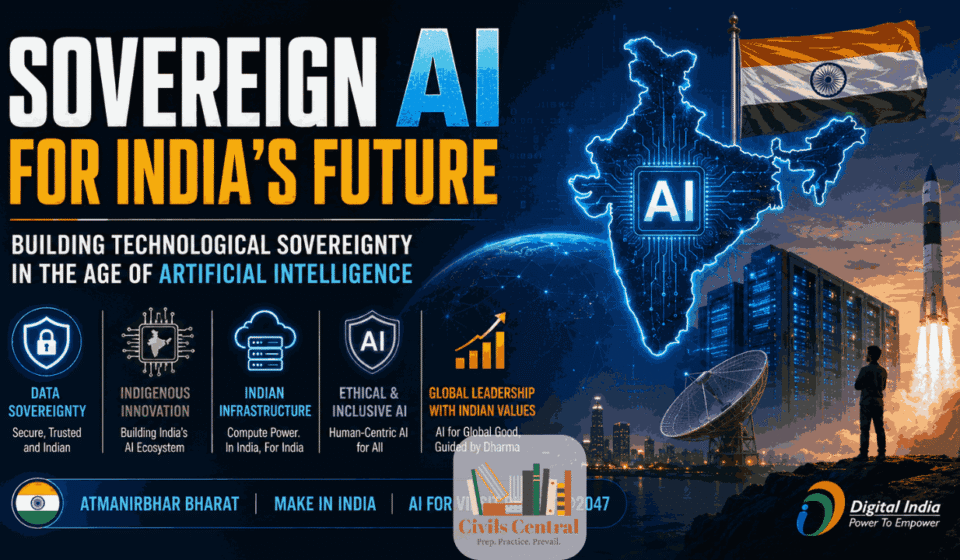
Sovereign AI for India’s Future: Building Technological Sovereignty in the Age of Artificial Intelligence

Artificial Intelligence (AI) has rapidly emerged as one of the defining technologies of the twenty-first century. Governments across the world are no longer viewing AI merely as a commercial innovation but as a strategic national asset comparable to nuclear technology, space capabilities, or advanced defence systems. The race to develop powerful AI models, secure advanced semiconductor supply chains, and build sovereign computing infrastructure has intensified, making AI a central element of geopolitical competition.
India has also entered this strategic race through initiatives such as the IndiaAI Mission, AIKosha, Bhashini, BharatGen, the India Semiconductor Mission, and investments in AI compute infrastructure. These initiatives aim to ensure that India’s AI ecosystem is built on indigenous capabilities, trusted data, secure infrastructure, and inclusive innovation.
The concept increasingly guiding these efforts is Sovereign AI—the ability of a nation to independently develop, deploy, govern, and benefit from Artificial Intelligence while safeguarding its national interests, cultural values, economic priorities, and strategic autonomy.
Why This Topic Matters for UPSC?
From a governance perspective, AI can improve the efficiency of public service delivery by supporting decision-making in healthcare, agriculture, education, disaster management, and urban planning. At the same time, it raises questions about accountability, privacy, transparency, and citizens’ rights. Therefore, UPSC may ask candidates to analyse both its developmental potential and governance challenges.
Economically, AI is expected to become a major driver of productivity, innovation, and industrial competitiveness. Countries capable of building indigenous AI ecosystems are likely to gain advantages in manufacturing, financial services, pharmaceuticals, agriculture, and digital commerce. India’s aspiration to become a developed economy by 2047 depends significantly on its ability to leverage AI responsibly.
Strategically, AI has become an essential component of defence systems, cybersecurity, intelligence gathering, and critical infrastructure management. Dependence on foreign AI technologies could expose countries to vulnerabilities arising from geopolitical tensions, export restrictions, or technological monopolies. Hence, Sovereign AI has emerged as an important pillar of national security.
Learning Objectives
After studying this, you should be able to answer the following questions confidently:
- What is Artificial Intelligence, and how has it evolved over time?
- Why has AI become a strategic technology comparable to space and nuclear capabilities?
- What is Sovereign AI, and why is it increasingly important for India?
- How does Sovereign AI differ from Digital Sovereignty, Data Sovereignty, and AI Governance?
- What are the major components of a Sovereign AI ecosystem?
- How is India building its AI ecosystem through various government initiatives?
- What lessons can India learn from the AI strategies of major global powers?
- What opportunities and challenges does Sovereign AI present for India’s development?
- How can India balance innovation with ethical and responsible AI governance?
Understanding Sovereign AI
Digital Revolution
        │
        ▼
Artificial Intelligence
        │
        ▼
Machine Learning
        │
        ▼
Deep Learning
        │
        ▼
Generative AI
        │
        ▼
Foundation Models
        │
        ▼
Large Language Models (LLMs)
        │
        ▼
National AI Ecosystems
        │
        ▼
SOVEREIGN AI
Remember: Sovereign AI is not a separate technology. It is a national strategy to ensure that a country retains meaningful control over the technologies, infrastructure, data, talent, and governance required to develop and deploy AI in accordance with its own priorities.
Understanding Artificial Intelligence
Before exploring Sovereign AI, it is essential to understand what Artificial Intelligence actually is. Many discussions on AI assume prior knowledge, leading to confusion among learners. Building a strong conceptual foundation helps in understanding why AI has become central to national development strategies.
Artificial Intelligence refers to the capability of computer systems to perform tasks that traditionally require human intelligence. These tasks include learning from experience, recognising patterns, understanding language, making decisions, solving problems, and even generating creative content. Unlike conventional software, which follows predefined instructions, AI systems can improve their performance by analysing data and identifying patterns.
The defining characteristic of AI is its ability to adapt. As it processes more data, an AI model can refine its predictions or decisions, making it increasingly effective over time. This capacity to learn distinguishes AI from traditional rule-based computer programs.
How Does Artificial Intelligence Work?
At its core, AI functions through a combination of three essential components:
1. Data
Data is the foundation upon which AI systems are built. AI models learn by analysing vast quantities of information, such as text, images, videos, speech, medical records, satellite imagery, or financial transactions. The quality, diversity, and representativeness of this data largely determine the accuracy and reliability of AI systems.
For example, an AI model trained to recognise crop diseases requires thousands of accurately labelled images of healthy and diseased plants. If the dataset is incomplete or biased, the model’s predictions will also be unreliable. This highlights why countries increasingly view data as a strategic national resource.
2. Algorithms
Algorithms are mathematical methods that enable AI systems to identify relationships and patterns within data. They determine how the model learns, makes predictions, and improves over time.
Different AI applications employ different types of algorithms. Recommendation systems used by online platforms rely on algorithms that analyse user behaviour, while autonomous vehicles use algorithms capable of interpreting sensor data in real time.
Advances in algorithms have significantly improved AI capabilities, enabling machines to perform tasks once considered uniquely human.
3. Computing Power
Even the most advanced algorithms cannot function effectively without sufficient computational resources. Modern AI models require enormous computing power, often provided by specialised processors such as Graphics Processing Units (GPUs) and Tensor Processing Units (TPUs).
Training a state-of-the-art Large Language Model may involve processing trillions of data points across thousands of GPUs over several weeks. Such computational requirements make AI infrastructure one of the most strategic technological assets of the modern era.
This is one of the principal reasons behind the growing emphasis on Sovereign AI. Nations that lack adequate computing infrastructure remain dependent on foreign technology providers.
The Evolution of Artificial Intelligence
The journey of AI spans several decades, marked by alternating periods of optimism and setbacks.
Phase I: Rule-Based AI
Early AI systems operated using explicitly programmed rules. These systems could perform well in narrowly defined tasks but lacked the ability to learn from new experiences. Their usefulness was therefore limited to structured environments.
Phase II: Machine Learning
The emergence of Machine Learning represented a significant breakthrough. Instead of relying entirely on predefined rules, computers began learning patterns directly from data. This enabled substantial improvements in applications such as fraud detection, spam filtering, recommendation systems, and medical diagnostics.
Phase III: Deep Learning
Deep Learning further advanced AI by using artificial neural networks inspired by the structure of the human brain. These networks can process highly complex data, making breakthroughs possible in image recognition, speech processing, autonomous driving, and language understanding.
Deep Learning dramatically improved AI’s ability to solve real-world problems that were previously considered too complex for machines.
Phase IV: Generative AI
The latest phase involves Generative AI, which can create original content rather than merely analysing existing information. It can generate text, images, music, software code, videos, and scientific hypotheses.
Unlike earlier AI systems that primarily classified or predicted outcomes, Generative AI produces new content based on learned patterns. This capability has transformed sectors ranging from education and healthcare to software development and scientific research.
Machine Learning vs Deep Learning vs Generative AI
| Technology | Primary Function | Example |
|---|---|---|
| Machine Learning | Learns patterns from data to make predictions | Spam email detection |
| Deep Learning | Uses multi-layer neural networks to solve complex problems | Face recognition |
| Generative AI | Creates new content such as text, images, audio, or code | AI chatbots, image generation |
Exam Tip: UPSC frequently frames questions that test conceptual distinctions rather than simple definitions. Understanding these differences is therefore important.
What Are Foundation Models?
A Foundation Model is a large AI model trained on massive and diverse datasets so that it can perform a wide variety of tasks with minimal additional training. Instead of developing separate AI systems for every application, a single Foundation Model can serve as the basis for numerous specialised applications.
For example, one Foundation Model can subsequently be adapted for:
- medical diagnosis,
- legal research,
- agricultural advisory,
- language translation,
- educational tutoring,
- customer support,
- scientific research.
This significantly reduces development costs while accelerating innovation. Countries capable of building indigenous Foundation Models possess an important strategic advantage because these models become the core infrastructure upon which future AI applications are built.
Large Language Models (LLMs): Why Are They Important?
Large Language Models (LLMs) are a category of Foundation Models trained primarily on textual data. They learn the statistical structure of language, enabling them to understand context, answer questions, summarise documents, generate code, translate languages, and engage in human-like conversations.
LLMs have become the backbone of modern conversational AI systems. Their emergence has fundamentally changed how people interact with technology by enabling natural language interfaces across education, governance, healthcare, law, finance, and customer services.
For multilingual countries such as India, developing LLMs capable of understanding Indian languages is particularly important. Models trained predominantly on foreign datasets may not adequately capture India’s linguistic diversity, cultural nuances, or local knowledge systems. This makes indigenous language models an essential component of Sovereign AI.
UPSC Insight Box
Artificial Intelligence is no longer merely a technological innovation. It has evolved into a strategic national capability that influences economic competitiveness, governance, defence preparedness, scientific research, and geopolitical power. Understanding this transformation is the first step toward understanding the concept of Sovereign AI.
From Artificial Intelligence to Sovereign AI
Artificial Intelligence has evolved from being a technological innovation used by private companies to becoming a strategic capability that shapes national power. Countries are increasingly recognising that AI will influence economic growth, military capabilities, governance, healthcare, education, scientific research, and even cultural narratives. Consequently, AI is no longer viewed merely as software; it is now considered a strategic national asset.
Historically, nations sought sovereignty over their territories, natural resources, financial systems, and defence capabilities. In the digital age, sovereignty has expanded to include control over data, digital infrastructure, cyberspace, and now Artificial Intelligence. Just as energy security and food security became national priorities in the twentieth century, AI sovereignty is emerging as a defining strategic objective in the twenty-first century.
The increasing concentration of advanced AI technologies in a handful of countries and companies has accelerated this shift. A few corporations control the world’s most advanced AI chips, cloud infrastructure, and frontier AI models. Such concentration creates dependencies that may expose other countries to technological, economic, and geopolitical vulnerabilities. Sovereign AI seeks to reduce these dependencies while ensuring that AI development aligns with national priorities and public interests.
What is Sovereign AI?
Sovereign AI refers to a nation’s ability to independently develop, deploy, govern, and utilise Artificial Intelligence using trusted domestic capabilities, while ensuring that AI systems operate in accordance with the country’s laws, values, strategic interests, and developmental priorities.
Unlike conventional discussions that focus only on AI software, Sovereign AI encompasses the entire ecosystem required to build and sustain AI. This includes computing infrastructure, semiconductor supply chains, data resources, skilled human capital, research institutions, regulatory frameworks, and governance mechanisms.
Therefore, Sovereign AI is not a single technology or government programme. It is a comprehensive national strategy aimed at ensuring that AI serves the country’s long-term interests rather than creating technological dependence on external actors.
Breaking Down the Definition
To fully understand Sovereign AI, let us examine each component of the definition.
1. Independent Development
A sovereign AI ecosystem should possess the capability to design and build AI technologies domestically. This does not imply complete self-sufficiency in every component; rather, it emphasises reducing critical dependencies in strategic areas.
Independent development includes indigenous research, domestic AI startups, academic innovation, local talent development, and the creation of foundational AI models suited to national requirements. Countries that lack such capabilities remain dependent on foreign technologies, limiting their ability to innovate independently.
For India, independent development means strengthening institutions, universities, startups, and public-private partnerships to create AI solutions tailored to Indian conditions rather than relying exclusively on imported technologies.
2. Independent Deployment
Developing AI is only one aspect of sovereignty; the ability to deploy it securely is equally important.
Deployment requires reliable cloud infrastructure, data centres, secure networks, high-performance computing facilities, and trusted digital platforms. If these infrastructures remain under external control, countries may face operational risks arising from geopolitical tensions, commercial restrictions, or supply disruptions.
For example, critical government AI applications in healthcare, taxation, defence, or disaster management should operate on trusted infrastructure that ensures security, reliability, and continuity.
3. Independent Governance
AI systems increasingly influence decisions affecting citizens’ lives. Therefore, governments must establish mechanisms to ensure that AI remains transparent, accountable, fair, and legally compliant.
Independent governance means that decisions regarding AI regulation should reflect domestic constitutional values, legal frameworks, and societal priorities rather than being dictated solely by foreign technological standards or corporate interests.
For India, AI governance must harmonise innovation with constitutional principles such as equality, privacy, justice, and human dignity.
4. Independent Utilisation
AI should address national development priorities instead of merely replicating applications developed elsewhere.
India’s development challenges differ significantly from those of many advanced economies. AI applications are required in multilingual education, agricultural extension, disease surveillance, disaster management, judicial case management, urban governance, and financial inclusion.
A sovereign AI strategy ensures that AI investments contribute directly to solving domestic developmental challenges.
Sovereign AI is More Than Building Chatbots
A common misconception is that Sovereign AI simply means creating an Indian alternative to foreign AI chatbots. This understanding is incomplete.
A truly sovereign AI ecosystem requires the development of:
- indigenous computing infrastructure,
- secure cloud ecosystems,
- trusted datasets,
- multilingual AI models,
- semiconductor manufacturing capabilities,
- skilled human resources,
- research institutions,
- regulatory frameworks,
- cybersecurity mechanisms,
- ethical governance systems.
Therefore, Sovereign AI should be understood as national technological capacity, not merely software development.
Core Characteristics of Sovereign AI
A country aspiring to achieve Sovereign AI generally seeks the following characteristics:
Strategic Autonomy
The nation should possess sufficient domestic capability to avoid excessive dependence on external technological providers for critical AI functions.
Trusted Infrastructure
Sensitive AI applications should operate on secure and reliable computing infrastructure that safeguards national interests and critical information.
Indigenous Innovation
Universities, research institutions, startups, and industry should contribute to developing AI technologies tailored to domestic requirements.
Data Security
Nationally important datasets should be protected against misuse while ensuring responsible and lawful access for innovation.
Inclusive Development
AI should benefit all sections of society rather than deepening digital divides. Multilingual capabilities, accessibility, and affordability become especially important in countries like India.
Responsible Governance
AI deployment must remain transparent, explainable, accountable, and aligned with constitutional values and human rights.
Why Has Sovereign AI Become Important Now?
Several technological and geopolitical developments have transformed Sovereign AI from an academic concept into a strategic necessity.
1. AI Has Become a General-Purpose Technology
Like electricity or the internet, AI is now a foundational technology with applications across virtually every sector of the economy. It influences manufacturing, agriculture, education, finance, healthcare, transportation, logistics, defence, scientific research, and governance.
Countries leading in AI are therefore likely to enjoy sustained advantages in productivity, innovation, and economic competitiveness.
2. Concentration of AI Capabilities
Although AI is a global technology, its most advanced capabilities are concentrated among a limited number of companies and countries. Frontier AI models require vast datasets, sophisticated algorithms, specialised chips, and massive computational resources, all of which demand substantial investments.
This concentration creates barriers for developing countries attempting to build indigenous AI capabilities. It also raises concerns regarding equitable access, technological dependence, and market dominance.
3. Geopolitical Competition
Technological competition has become an important dimension of international relations. Export controls on advanced AI chips, restrictions on technology transfers, and strategic investments in semiconductor manufacturing illustrate how AI has become intertwined with geopolitical considerations.
Countries increasingly recognise that dependence on foreign AI technologies could constrain their strategic autonomy during periods of international tension.
4. National Security Concerns
AI has become integral to defence technologies, cyber operations, intelligence analysis, autonomous systems, and critical infrastructure management.
Reliance on externally controlled AI systems for sensitive national security applications may expose countries to operational vulnerabilities, supply disruptions, or security risks. Consequently, governments seek greater control over critical AI capabilities.
5. Data as a Strategic Resource
Data has often been described as the “new oil.” While the analogy is imperfect, it highlights the economic and strategic value of data in the AI era.
Countries generating vast amounts of high-quality data possess significant advantages in developing AI systems. However, data must also be governed responsibly to protect privacy, prevent misuse, and ensure public trust.
CivilsCentral UPSC Insight
Sovereign AI is not about technological isolation or complete self-sufficiency. Rather, it is about ensuring that a nation retains sufficient strategic control over critical AI capabilities while continuing to participate in global innovation, trade, and scientific collaboration.
In a Mains answer, avoid presenting Sovereign AI as protectionism. Emphasise the balance between strategic autonomy and international cooperation.
Sovereign AI vs Related Concepts
Many aspirants confuse Sovereign AI with Digital Sovereignty, Data Sovereignty, and AI Governance. UPSC often tests conceptual clarity by asking candidates to distinguish between closely related terms.
| Concept | Meaning | Primary Focus | Example |
|---|---|---|---|
| Sovereign AI | National capability to develop, deploy, and govern AI independently | Entire AI ecosystem | India developing indigenous AI models, compute infrastructure, and governance frameworks |
| Digital Sovereignty | National control over digital infrastructure and digital ecosystems | Digital technologies broadly | Domestic control over cloud infrastructure, telecom networks, and digital platforms |
| Data Sovereignty | Data is governed by the laws of the country where it is generated or stored | Ownership, storage, and regulation of data | Personal data stored and processed according to Indian law |
| AI Governance | Framework of principles, institutions, and regulations ensuring responsible AI | Ethical and legal oversight | Transparency, accountability, explainability, fairness, human oversight |
| AI Regulation | Specific legal rules governing AI development and deployment | Legal compliance | Risk-based regulation, liability, consumer protection |
Examination Tip
Remember the hierarchy:
Digital Sovereignty
        │
        ├── Data Sovereignty
        │
        ├── Cyber Sovereignty
        │
        └── Sovereign AI
                 │
                 ├── AI Infrastructure
                 ├── AI Models
                 ├── AI Governance
                 ├── AI Talent
                 └── AI Innovation
Sovereign AI is one component of broader digital sovereignty, but it draws upon data sovereignty, cybersecurity, and governance mechanisms.
Why Countries are Racing Towards Sovereign AI
The competition for AI leadership resembles earlier strategic competitions in nuclear technology, space exploration, and semiconductor manufacturing. Countries perceive AI leadership as essential for long-term economic prosperity and national resilience.
The race is driven by multiple factors:
- AI-driven productivity gains across industries.
- Leadership in emerging technologies and innovation.
- Military applications and strategic deterrence.
- Control over critical digital infrastructure.
- Reduced dependence on external technology providers.
- Greater influence in shaping global AI standards and governance.
However, unlike previous technological races, AI development is deeply interconnected with global research, supply chains, and international collaboration. Therefore, the challenge lies in achieving strategic autonomy without undermining openness and innovation.
Why Should India Pursue Sovereign AI?
Artificial Intelligence is expected to become the foundational technology of the Fourth Industrial Revolution. Just as electricity transformed industrial production and the internet revolutionised communication, AI is poised to redefine how governments function, businesses compete, scientific discoveries are made, and citizens interact with public institutions.
For India, the question is no longer whether AI should be adopted, but how AI should be developed. Should India remain a consumer of foreign AI technologies, or should it build indigenous capabilities that reflect its own developmental priorities, constitutional values, linguistic diversity, and strategic interests?
The answer lies in Sovereign AI.
India is home to over 1.4 billion people, hundreds of languages, one of the world’s largest digital public infrastructures, and a rapidly expanding digital economy. These unique characteristics require AI systems that understand India’s socio-economic realities rather than merely adapting technologies designed for other countries.
Sovereign AI is therefore not about technological nationalism or isolationism. It is about ensuring that India possesses the capacity to innovate independently while participating actively in the global AI ecosystem.
1. Sovereign AI and National Security
Why AI Has Become a Strategic Asset
In earlier decades, military strength was measured primarily by the size of armed forces, weapon systems, and industrial production. Today, strategic power increasingly depends on technological superiority. Artificial Intelligence has become a force multiplier that enhances intelligence gathering, surveillance, cyber defence, autonomous systems, logistics, and battlefield decision-making.
Countries that master AI will possess significant advantages not only in conventional warfare but also in cyber operations, information warfare, and critical infrastructure protection. Consequently, AI has become an integral component of national security strategies worldwide.
For India, located in a complex geopolitical environment with multiple security challenges, developing trusted AI capabilities is essential for safeguarding national interests.
AI in Modern Defence
Artificial Intelligence is transforming defence in several ways:
- Autonomous drones capable of surveillance and precision operations.
- AI-assisted satellite image analysis for border monitoring.
- Predictive maintenance of military equipment.
- Real-time battlefield intelligence.
- Cyber threat detection.
- Decision-support systems for commanders.
These technologies enable faster and more informed decision-making, reduce operational risks, and improve military preparedness.
However, excessive dependence on foreign AI platforms or computing infrastructure for such critical applications could expose vulnerabilities. Supply disruptions, software restrictions, or geopolitical conflicts may compromise operational readiness.
Therefore, Sovereign AI strengthens national resilience by reducing strategic dependence in critical sectors.
AI and Cybersecurity
Cybersecurity has become one of the fastest-growing domains of AI application. Modern cyberattacks occur at a scale and speed that often exceed human monitoring capabilities. AI systems can analyse enormous volumes of network traffic, detect anomalies, identify malicious activities, and respond to cyber threats in real time.
Similarly, malicious actors are also using AI to automate phishing attacks, generate sophisticated malware, create convincing deepfakes, and exploit software vulnerabilities more efficiently.
This creates an “AI versus AI” security environment.
India’s expanding digital infrastructure—including digital payments, healthcare databases, e-governance platforms, power grids, and transportation systems—requires robust AI-enabled cybersecurity capabilities. Developing these capabilities domestically enhances trust and reduces dependence on external technologies for securing critical infrastructure.
AI and Information Warfare
Artificial Intelligence has transformed the nature of information warfare. Generative AI can produce realistic text, images, audio, and videos that may be used to spread misinformation, manipulate public opinion, or undermine democratic institutions. Deepfakes and AI-generated propaganda can influence elections, social harmony, and international perceptions.
For a diverse democracy like India, safeguarding the integrity of information ecosystems is crucial. Sovereign AI enables the development of indigenous tools for detecting manipulated content, verifying authenticity, and strengthening digital resilience.
2. Sovereign AI and Economic Growth
AI as the Engine of the Next Industrial Revolution
Every major technological revolution has reshaped the global economy. Steam engines powered industrialisation, electricity enabled mass production, computers digitised businesses, and the internet transformed communication.
Artificial Intelligence represents the next transformative wave. AI improves productivity by automating repetitive tasks, optimising resource allocation, supporting data-driven decision-making, and enabling entirely new business models. Countries that successfully integrate AI across sectors are expected to experience higher productivity, greater innovation, and stronger economic growth.
For India, AI offers an opportunity to accelerate progress towards the vision of Viksit Bharat 2047.
AI Across Key Sectors
Manufacturing
AI supports predictive maintenance, quality control, supply chain optimisation, and smart factories. This enhances industrial efficiency while reducing operational costs.
Agriculture
AI can analyse satellite imagery, weather patterns, and soil conditions to provide farmers with personalised recommendations on crop selection, irrigation, fertiliser use, and pest management.
Given the importance of agriculture to India’s economy, AI-driven precision farming can improve productivity while promoting sustainable resource use.
Healthcare
AI assists in medical imaging, disease diagnosis, drug discovery, hospital management, and personalised treatment planning.
In rural and underserved regions, AI-powered decision-support systems can strengthen primary healthcare by assisting frontline health workers and improving access to quality medical advice.
Financial Services
Banks and financial institutions increasingly use AI for fraud detection, credit assessment, risk management, customer service, and regulatory compliance.
India’s digital payment ecosystem can benefit significantly from AI-enabled financial innovation while enhancing security.
Education
AI enables personalised learning, intelligent tutoring systems, multilingual educational content, and adaptive assessments tailored to individual learning needs.
For a country with diverse educational challenges, AI can improve both accessibility and learning outcomes.
AI and the Digital Economy
India already possesses one of the world’s largest digital economies, supported by digital public infrastructure, fintech innovation, and expanding internet connectivity.
AI can further strengthen this ecosystem by:
- enhancing digital commerce,
- improving logistics,
- supporting MSMEs,
- enabling intelligent public services,
- fostering startup innovation,
- accelerating scientific research.
Consequently, Sovereign AI is expected to become a major driver of long-term economic competitiveness.
3. Strategic Autonomy in the AI Era
What is Strategic Autonomy?
Strategic autonomy refers to a nation’s ability to pursue its national interests independently while engaging constructively with the international community.
India has traditionally sought strategic autonomy in foreign policy, defence procurement, nuclear technology, and energy security. The AI era extends this principle to digital technologies.
If critical AI capabilities remain concentrated outside the country, India’s policy choices could become constrained by external technological dependencies.
Why Technological Dependence Matters
Suppose a country’s healthcare system, defence applications, banking infrastructure, and governance platforms rely entirely on foreign AI providers.
If geopolitical tensions disrupt access to these technologies or commercial priorities change, critical public services may face operational challenges.
Strategic autonomy therefore requires diversification of technology sources alongside the development of indigenous capabilities.
Importantly, Sovereign AI does not advocate technological isolation. India will continue collaborating internationally while strengthening domestic capabilities in strategically important areas.
4. Sovereign AI and Digital Public Infrastructure (DPI)
India’s Unique Advantage
India has emerged as a global leader in building Digital Public Infrastructure (DPI). Platforms such as digital identity, digital payments, and digital document systems have demonstrated how technology can deliver public services at scale.
These digital platforms generate valuable, consent-based, and structured data that can support responsible AI innovation while respecting privacy and legal safeguards.
Unlike many countries, India possesses a large-scale digital ecosystem that can provide a strong foundation for AI applications in governance and public welfare.
AI + DPI = Smarter Governance
When Artificial Intelligence is integrated with Digital Public Infrastructure, governments can improve:
- service delivery,
- grievance redressal,
- fraud detection,
- welfare targeting,
- policy planning,
- resource allocation.
For example, AI can analyse patterns in welfare programme implementation to identify leakages, predict future demand, or optimise resource distribution.
Such applications enhance administrative efficiency while enabling evidence-based policymaking.
Improving Citizen-Centric Governance
AI has the potential to make governance more proactive rather than merely reactive.
Instead of responding only after problems arise, governments can use AI to anticipate challenges such as disease outbreaks, disaster risks, infrastructure failures, or agricultural distress.
Predictive governance enables faster interventions and better utilisation of public resources. However, these benefits must be balanced with safeguards relating to privacy, transparency, and accountability.
5. Sovereign AI for Inclusive Development
AI Must Benefit Every Citizen
Technological progress should not remain confined to large corporations or urban centres.
India’s AI strategy emphasises “AI for All,” recognising that technology must contribute to inclusive development by addressing challenges faced by farmers, students, patients, entrepreneurs, persons with disabilities, and citizens living in remote regions.
Sovereign AI therefore prioritises socially relevant innovation rather than purely commercial applications.
Bridging the Urban–Rural Divide
AI-powered solutions can support rural development through:
- precision agriculture,
- telemedicine,
- multilingual education,
- weather forecasting,
- financial inclusion,
- market intelligence for farmers.
These applications reduce information asymmetry and improve access to essential services. By enabling affordable and context-specific AI solutions, Sovereign AI can contribute to reducing regional disparities.
Multilingual AI
India’s linguistic diversity is one of its greatest strengths but also presents unique technological challenges. Many global AI systems perform best in English and a few major international languages. Such limitations restrict access for millions of Indians who communicate primarily in regional languages.
Developing multilingual AI capable of understanding and generating Indian languages promotes digital inclusion while preserving linguistic diversity. This is one of the defining objectives of India’s Sovereign AI strategy.
6. Cultural and Civilisational Sovereignty
Artificial Intelligence learns from the data on which it is trained. If most training data originates from a limited number of countries, AI systems may inadvertently reflect their cultural assumptions, historical narratives, and linguistic biases.
India possesses one of the world’s richest civilisational traditions, extensive linguistic diversity, and unique knowledge systems.
Developing indigenous datasets, language models, and culturally contextual AI applications ensures that technology reflects Indian realities rather than treating them as peripheral cases. This dimension of Sovereign AI extends beyond technology—it concerns cultural representation, linguistic preservation, and knowledge sovereignty.
7. AI for Scientific and Technological Leadership
Scientific discovery increasingly depends on AI-assisted research.
AI accelerates:
- drug discovery,
- climate modelling,
- materials science,
- genomic research,
- space exploration,
- quantum research.
Countries with strong AI capabilities gain significant advantages in innovation ecosystems. For India, investing in Sovereign AI strengthens research institutions, universities, startups, and industry collaborations while enhancing the country’s global scientific competitiveness.
Why Does India Need Sovereign AI?
| Dimension | Importance |
|---|---|
| National Security | Trusted defence and cybersecurity capabilities |
| Economy | Higher productivity, innovation, competitiveness |
| Governance | Efficient, evidence-based public service delivery |
| Strategic Autonomy | Reduced dependence on external AI ecosystems |
| Inclusion | AI for agriculture, healthcare, education, rural development |
| Culture | Protection and promotion of Indian languages and knowledge systems |
| Research | Stronger scientific and technological leadership |
Sovereign AI is an Ecosystem, Not a Product
Many discussions on Artificial Intelligence focus primarily on AI models such as ChatGPT or image-generation tools. However, these visible applications represent only the tip of the iceberg. Beneath every advanced AI system lies an extensive ecosystem of hardware, software, data, institutions, researchers, policies, and infrastructure.
To understand this, consider the analogy of a modern city. A city’s prosperity depends not only on buildings but also on roads, electricity, water supply, communication networks, skilled professionals, laws, and governance. Similarly, a country’s AI capabilities depend on several interconnected pillars working together.
If even one of these pillars is weak—whether it is computing power, semiconductor availability, skilled talent, or regulatory certainty—the entire AI ecosystem is affected. Therefore, building Sovereign AI requires simultaneous investment across multiple domains rather than focusing on a single technology.
Pillar 1: Compute Infrastructure – The Engine of Artificial Intelligence
What is Compute Infrastructure?
Every AI system requires computational resources to process information, learn from data, and generate outputs. These resources are collectively referred to as compute infrastructure.
Compute infrastructure includes:
- High-performance Graphics Processing Units (GPUs)
- Tensor Processing Units (TPUs)
- AI accelerators
- Supercomputers
- High-speed networking systems
- Advanced data centres
- Cloud computing platforms
- High-capacity storage systems
Without adequate compute, even the best algorithms and datasets cannot produce effective AI systems.
Why is Compute Called the “New Oil” of AI?
In the industrial age, coal powered factories, while oil fuelled transportation and economic growth. In the AI age, computational power has become the essential fuel for innovation.
Training modern Foundation Models involves analysing trillions of data points using thousands of GPUs operating continuously for weeks or even months. Such large-scale computations require enormous investments in hardware, electricity, cooling systems, and networking infrastructure.
As a result, access to compute has become a strategic resource. Countries possessing robust AI computing infrastructure enjoy significant advantages in research, innovation, defence, and economic competitiveness.
India’s Challenge in Compute Infrastructure
India has a vibrant software ecosystem but has historically relied on imported high-performance AI hardware. Most advanced GPUs and AI accelerators are manufactured by a small number of global companies, creating supply constraints and strategic dependencies.
This dependence poses several challenges:
- High acquisition costs.
- Limited availability during periods of global demand.
- Exposure to export restrictions.
- Dependence on foreign cloud providers.
- Unequal access for Indian startups and researchers.
These challenges explain why the Government of India has prioritised the development of shared AI compute infrastructure through the IndiaAI Mission, enabling researchers, startups, and academic institutions to access high-performance computing resources.
Pillar 2: Data Infrastructure – The Fuel that Powers AI
Why Data Matters
Artificial Intelligence learns from examples rather than explicit programming. These examples are provided through data. Consequently, the quality of AI systems depends fundamentally on the quality, diversity, accuracy, and representativeness of the datasets used during training.
For instance, an AI model designed to detect crop diseases requires extensive datasets containing images of healthy and infected crops from different climatic regions. Similarly, a medical AI system requires carefully curated clinical data representing diverse patient populations.
Poor-quality data leads to poor-quality AI. This principle is often summarised as “Garbage In, Garbage Out (GIGO).”
Characteristics of High-Quality AI Data
A robust data infrastructure should ensure that datasets are:
- Accurate and free from significant errors.
- Diverse and representative of different populations.
- Properly labelled and annotated.
- Securely stored.
- Ethically collected.
- Privacy-preserving.
- Easily accessible for legitimate research under appropriate safeguards.
In a country as diverse as India, datasets must also capture linguistic, regional, cultural, and socio-economic diversity to ensure that AI systems perform effectively across different contexts.
Data as a National Resource
Data generated through governance, healthcare, agriculture, transport, education, scientific research, and public services constitutes a valuable national resource. However, unlike natural resources, data can be replicated, reused, and continuously expanded.
A Sovereign AI strategy therefore seeks to maximise the developmental value of data while protecting privacy, security, and citizens’ rights. This requires institutional mechanisms for responsible data sharing, standardisation, interoperability, and governance.
India’s initiatives such as AIKosha are designed to create trusted repositories of datasets that can support responsible AI innovation while maintaining legal and ethical safeguards.
Pillar 3: Foundation Models – The Brain of Sovereign AI
What are Foundation Models?
Foundation Models are large-scale AI models trained on extensive datasets so that they can perform a wide variety of downstream tasks without requiring separate models for each application.
Instead of developing different AI systems for translation, summarisation, question answering, or content generation, a single Foundation Model can perform all these tasks after suitable adaptation.
These models therefore become foundational infrastructure upon which numerous AI applications can be built.
Why Are Foundation Models Strategically Important?
Countries capable of developing indigenous Foundation Models gain several advantages:
- Reduced dependence on foreign AI platforms.
- Better adaptation to domestic languages and cultures.
- Greater control over sensitive applications.
- Enhanced innovation ecosystems.
- Improved national security.
Foundation Models also create positive spillover effects by enabling startups, researchers, educational institutions, and government agencies to build specialised AI solutions more efficiently.
India’s Need for Indigenous Foundation Models
India’s linguistic diversity presents unique challenges rarely encountered elsewhere.
A Foundation Model trained predominantly on English-language content from Western countries may struggle to understand Indian languages, administrative terminology, legal systems, or cultural references. Such limitations reduce the usefulness of AI for governance and public service delivery.
Developing Indian Foundation Models capable of understanding multiple Indian languages and socio-cultural contexts is therefore central to India’s Sovereign AI strategy.
Initiatives such as BharatGen aim to strengthen this capability by supporting indigenous multimodal AI models designed for Indian conditions.
Pillar 4: Semiconductor Ecosystem – The Hardware Foundation
Why Semiconductors Matter
Every AI system ultimately runs on semiconductor chips. Whether an AI application operates in a smartphone, autonomous vehicle, supercomputer, medical device, or satellite, semiconductor chips perform the underlying computations. Consequently, semiconductors constitute the hardware foundation of the AI revolution.
Without reliable access to advanced semiconductor technologies, AI development becomes severely constrained.
Understanding the Semiconductor Value Chain
The semiconductor ecosystem is far more complex than manufacturing chips alone. It includes several interconnected stages:
- Research and Design – Developing chip architectures and electronic designs.
- Fabrication (Fab) – Manufacturing semiconductor wafers using advanced fabrication facilities.
- Assembly, Testing, Marking, and Packaging (ATMP) – Preparing chips for commercial use.
- Distribution and Integration – Supplying chips to device manufacturers and system integrators.
Each stage requires specialised expertise, advanced equipment, and significant investment.
Why India Needs a Strong Semiconductor Ecosystem
Historically, India has excelled in semiconductor design but has had limited domestic fabrication capacity. This dependence on global supply chains became evident during recent semiconductor shortages, which disrupted industries ranging from automobiles to consumer electronics.
Strengthening domestic semiconductor capabilities supports:
- AI infrastructure.
- Electronics manufacturing.
- Telecommunications.
- Defence systems.
- Space technologies.
- Digital economy.
- Strategic resilience.
This explains the strategic importance of the India Semiconductor Mission, which seeks to promote semiconductor manufacturing and strengthen India’s position within global semiconductor value chains.
Pillar 5: Cloud Infrastructure – Democratizing Access to AI
What is Cloud Computing?
Cloud computing enables users to access computing resources—including storage, processing power, software, and AI tools—over the internet without owning the underlying hardware.
Instead of purchasing expensive servers, organisations can rent computing capacity as required. This model has significantly reduced the cost of AI innovation.
Why Cloud Infrastructure Matters for Sovereign AI
Developing advanced AI models requires enormous computational resources that many universities, startups, and MSMEs cannot afford independently.
Shared cloud infrastructure enables these organisations to:
- Access AI compute.
- Develop innovative applications.
- Conduct research.
- Scale AI solutions.
- Reduce infrastructure costs.
National cloud infrastructure therefore promotes inclusive AI innovation while reducing barriers to entry.
Pillar 6: Research and Innovation Ecosystem
Innovation Requires Institutions
Technological leadership cannot be achieved solely through government programmes. It depends on vibrant research ecosystems involving:
- Universities.
- IITs.
- IIITs.
- IISc.
- National laboratories.
- Startups.
- Private industry.
- International collaborations.
These institutions generate new knowledge, develop cutting-edge technologies, and train future researchers.
Why Research Matters
AI is evolving rapidly. Countries that merely adopt existing technologies may remain dependent on external innovation. Long-term technological leadership requires original research in:
- Machine Learning.
- Robotics.
- Computer Vision.
- Natural Language Processing.
- AI Safety.
- Edge AI.
- Explainable AI.
- Multimodal AI.
Investing in research therefore strengthens both economic competitiveness and strategic autonomy.
Pillar 7: Talent Ecosystem – The Human Capital of AI
Technology Alone is Not Enough
AI ultimately depends on people. Even the world’s most advanced computing infrastructure cannot produce innovation without skilled scientists, engineers, researchers, entrepreneurs, policymakers, ethicists, and domain experts.
Human capital is therefore one of the most important pillars of Sovereign AI.
India’s Demographic Advantage
India possesses one of the world’s largest youth populations and a rapidly expanding digital workforce. If appropriately skilled, this demographic advantage can become a significant source of AI innovation.
However, challenges remain:
- shortage of advanced AI researchers,
- limited doctoral programmes,
- brain drain,
- uneven access to AI education,
- shortage of interdisciplinary expertise.
Addressing these gaps requires reforms in higher education, research funding, industry-academia collaboration, and lifelong learning.
Skilling for the AI Economy
Future AI ecosystems require professionals with diverse expertise, including:
- AI engineering.
- Data science.
- Cybersecurity.
- Cloud computing.
- Semiconductor engineering.
- Ethics.
- Public policy.
- Law.
- Healthcare.
- Agriculture.
Thus, Sovereign AI requires not only technical experts but also professionals capable of integrating AI into different sectors of society.
Pillar 8: Responsible AI and Governance
Why Governance is Essential
Powerful technologies generate both opportunities and risks. Artificial Intelligence can improve healthcare, education, and governance, but it can also amplify bias, spread misinformation, violate privacy, or make opaque decisions affecting citizens’ lives.
Therefore, technological capability alone is insufficient. Responsible governance is equally essential.
Principles of Responsible AI
A trustworthy AI ecosystem should be guided by:
Fairness
AI should avoid unjust discrimination against individuals or communities.
Transparency
Users should understand how AI systems make important decisions.
Accountability
Clear responsibility should exist for AI-driven outcomes.
Privacy
Citizens’ personal data must be protected.
Security
AI systems should resist cyberattacks and malicious manipulation.
Human Oversight
Critical decisions affecting rights and public welfare should retain meaningful human supervision.
Balancing Innovation and Regulation
An overly restrictive regulatory framework may discourage innovation, while an excessively permissive approach may expose society to significant risks.
The objective of Sovereign AI is therefore responsible innovation—encouraging technological progress while safeguarding constitutional values, public trust, and democratic accountability.
| Pillar | Why It Matters |
|---|---|
| Compute Infrastructure | Enables AI training and deployment |
| Data Infrastructure | Provides high-quality training data |
| Foundation Models | Core AI capabilities for multiple applications |
| Semiconductor Ecosystem | Hardware backbone of AI |
| Cloud Infrastructure | Affordable access to AI resources |
| Research Ecosystem | Drives long-term innovation |
| Talent Ecosystem | Supplies skilled human capital |
| Responsible Governance | Builds trust, accountability, and ethical AI |
India’s Approach to Sovereign AI
Unlike some countries that view AI primarily through the lens of commercial competition or military dominance, India’s approach is centred on inclusive development, digital public infrastructure, and responsible innovation. The vision is not merely to create cutting-edge AI models but to ensure that AI addresses the developmental needs of a diverse and populous nation.
India’s AI strategy can be summarised through the principle of “AI for All.” This approach seeks to democratise access to AI by making computing resources, datasets, language technologies, and innovation opportunities available to startups, researchers, educational institutions, and government agencies rather than concentrating them in a few large corporations.
To achieve this vision, the Government of India has launched several complementary initiatives. Individually, each programme addresses a specific component of the AI ecosystem. Collectively, they form the foundation of India’s Sovereign AI strategy.
1. IndiaAI Mission
What is the IndiaAI Mission?
The IndiaAI Mission is the Government of India’s flagship initiative to build a comprehensive AI ecosystem that is inclusive, trusted, and globally competitive. Rather than focusing only on AI applications, the mission adopts a holistic approach by strengthening compute infrastructure, data access, innovation, talent development, and responsible AI.
The mission recognises that AI leadership cannot be achieved through isolated projects. Instead, it requires coordinated investments across multiple dimensions of the AI value chain. Consequently, the IndiaAI Mission acts as an umbrella framework that brings together infrastructure, policy, research, and entrepreneurship.
Objectives of the IndiaAI Mission
The mission aims to:
- Democratise access to AI compute for startups, researchers, and academia.
- Develop indigenous AI capabilities.
- Promote innovation through public-private partnerships.
- Build high-quality datasets.
- Strengthen AI research and education.
- Encourage responsible and ethical AI development.
- Position India as a global hub for AI innovation.
These objectives align closely with India’s broader goals of Atmanirbhar Bharat, Digital India, and Viksit Bharat 2047.
Why is the IndiaAI Mission Important?
India possesses one of the world’s largest pools of software professionals, a thriving startup ecosystem, and extensive Digital Public Infrastructure. However, access to advanced AI computing resources has historically been limited due to high costs and dependence on imported hardware.
The IndiaAI Mission addresses this gap by creating shared infrastructure that allows innovators to access high-performance computing without making prohibitively expensive investments.
This democratisation of AI resources is expected to encourage innovation beyond major technology companies, enabling universities, MSMEs, and startups to participate actively in AI development.
2. AI Compute Infrastructure
Why Compute is the Biggest Bottleneck
As discussed earlier, compute infrastructure is the engine of Artificial Intelligence.
Training modern Foundation Models requires thousands of advanced GPUs operating simultaneously. Such infrastructure is extremely expensive and inaccessible for many Indian startups and educational institutions.
Consequently, limited access to compute has become one of the greatest barriers to AI innovation.
India’s Response
Under the IndiaAI Mission, the Government aims to establish a robust AI compute ecosystem by facilitating access to high-performance computing resources.
Instead of requiring every startup or university to purchase expensive AI hardware independently, shared compute facilities enable broader participation in AI research and innovation. This approach promotes equitable access while reducing duplication of investments.
Significance for Sovereign AI
Domestic compute infrastructure strengthens:
- Research independence.
- Startup innovation.
- Scientific competitiveness.
- National security.
- Digital resilience.
By reducing dependence on foreign cloud providers for critical AI workloads, India enhances its strategic autonomy.
3. AIKosha
What is AIKosha?
AI systems require high-quality datasets for training and evaluation. Recognising this need, India has initiated AIKosha, a trusted platform intended to provide curated datasets that support responsible AI development.
AIKosha aims to improve the availability of high-quality datasets while ensuring compliance with legal, ethical, and privacy requirements.
Why Does AIKosha Matter?
Many AI projects fail not because of weak algorithms but because of poor-quality data. India’s diversity presents both opportunities and challenges. AI models require datasets representing different languages, regions, climatic conditions, agricultural practices, healthcare patterns, and socio-economic contexts.
AIKosha seeks to facilitate responsible access to such datasets, enabling researchers to develop AI systems that better reflect India’s realities.
Contribution to Sovereign AI
AIKosha strengthens Sovereign AI by:
- Improving dataset quality.
- Supporting indigenous AI models.
- Encouraging research.
- Promoting interoperability.
- Enhancing trust in AI systems.
A trusted national data ecosystem reduces dependence on externally sourced datasets that may not adequately represent Indian conditions.
4. BharatGen
What is BharatGen?
BharatGen is an initiative aimed at developing indigenous multimodal Foundation Models tailored to India’s linguistic and cultural diversity.
Unlike generic global AI models, BharatGen focuses on Indian languages, contexts, and applications. Its objective is to create AI systems capable of understanding text, speech, images, and other forms of information across India’s diverse linguistic landscape.
Why Does India Need BharatGen?
Many internationally developed AI models perform exceptionally well in English but have comparatively weaker capabilities in several Indian languages.
For effective governance, education, healthcare, and digital inclusion, AI systems must understand local languages and cultural contexts. BharatGen addresses this gap by creating models specifically designed for India’s needs.
Long-Term Importance
Indigenous Foundation Models provide several advantages:
- Greater linguistic inclusion.
- Better performance in Indian contexts.
- Reduced technological dependence.
- Stronger innovation ecosystem.
- Enhanced digital sovereignty.
Over time, BharatGen may become foundational infrastructure for numerous AI applications across sectors.
5. Bhashini
What is Bhashini?
India is home to hundreds of languages and dialects. This linguistic diversity enriches the nation’s cultural heritage but also creates barriers to digital inclusion.
Bhashini is a national initiative that leverages Artificial Intelligence to enable seamless multilingual communication through translation, speech recognition, text generation, and language technologies.
Its vision is to ensure that language does not become a barrier to accessing digital services.
Why is Bhashini Important?
Many citizens remain excluded from digital services because these services are predominantly available in English or a limited number of languages.
AI-powered language technologies can:
- Translate government services.
- Enable multilingual education.
- Improve healthcare communication.
- Support judicial accessibility.
- Facilitate e-governance.
Thus, Bhashini directly contributes to inclusive digital transformation.
6. India Semiconductor Mission
Why Chips Matter for AI
Every AI model ultimately depends on semiconductor chips. Without reliable access to advanced semiconductors, AI development becomes increasingly difficult. Recognising this strategic importance, India launched the India Semiconductor Mission to strengthen domestic semiconductor capabilities.
Objectives
The mission seeks to:
- Promote semiconductor manufacturing.
- Encourage fabrication facilities.
- Strengthen chip design capabilities.
- Develop packaging and testing infrastructure.
- Reduce dependence on imported semiconductors.
Relevance to Sovereign AI
Semiconductors form the hardware foundation upon which AI systems operate. A robust semiconductor ecosystem strengthens:
- AI innovation.
- Electronics manufacturing.
- Defence preparedness.
- Telecommunications.
- National resilience.
Therefore, semiconductor policy is integral to Sovereign AI.
7. Digital Public Infrastructure (DPI)
India’s Global Strength
India’s Digital Public Infrastructure (DPI) has emerged as one of the country’s greatest technological achievements.
Platforms enabling digital identity, payments, document exchange, and public service delivery have demonstrated how technology can be deployed at population scale.
This provides India with a unique advantage in developing AI solutions grounded in real-world governance needs.
AI and DPI Together
Integrating AI with DPI can significantly improve:
- Welfare delivery.
- Healthcare.
- Agricultural advisory.
- Urban governance.
- Disaster management.
- Fraud detection.
- Policy evaluation.
The combination of trusted digital infrastructure and AI creates opportunities for evidence-based governance while maintaining public trust.
8. Centres of Excellence and Research Institutions
Why Research Institutions Matter
Sustained technological leadership depends on strong academic and research ecosystems.
India’s IITs, IISc, IIITs, national laboratories, and Centres of Excellence play a crucial role in:
- Fundamental AI research.
- Talent development.
- Industry collaboration.
- Technology transfer.
- Startup incubation.
These institutions bridge the gap between scientific research and commercial innovation.
Public-Private Collaboration
AI innovation requires collaboration among:
- Government.
- Academia.
- Industry.
- Startups.
- Civil society.
Such partnerships accelerate research while ensuring that innovation addresses societal priorities.
9. AI Startups
India’s Startup Advantage
India has one of the world’s largest startup ecosystems. AI startups are developing solutions in:
- Agriculture.
- Healthcare.
- Education.
- Finance.
- Logistics.
- Manufacturing.
- Cybersecurity.
These startups transform research into practical solutions that improve productivity and public welfare.
Why Startups Matter
Unlike large corporations, startups often specialise in solving highly specific local challenges. Their agility enables rapid experimentation and innovation, making them essential contributors to Sovereign AI. Government support through funding, incubation, mentorship, and compute access helps these startups compete globally.
10. Responsible AI Framework
Innovation with Trust
Technological advancement must be accompanied by public trust. India’s AI vision therefore emphasises responsible innovation grounded in principles such as:
- Fairness.
- Transparency.
- Accountability.
- Privacy.
- Security.
- Human oversight.
Responsible AI enhances public confidence while encouraging wider adoption across sectors.
Balancing Growth and Regulation
Excessive regulation may discourage innovation. Conversely, inadequate regulation may expose society to risks such as algorithmic bias, discrimination, misinformation, and privacy violations. India seeks a balanced framework that promotes innovation while protecting citizens’ rights.
How India’s AI Ecosystem Fits Together
                           Sovereign AI
                                 │
 ┌────────────────────────────────────────────────────┐
 │                                                    │
 IndiaAI Mission                              Semiconductor Mission
 │                                                    │
 AI Compute                                      AI Hardware
 │                                                    │
 AIKosha                                         Data Centres
 │                                                    │
 BharatGen                                    Cloud Infrastructure
 │                                                    │
 Bhashini                                Research Institutions
 │                                                    │
 Digital Public Infrastructure                AI Startups
 │                                                    │
 Responsible AI Governance          Skilled Human Resources
| Initiative | Primary Objective | Contribution to Sovereign AI |
|---|---|---|
| IndiaAI Mission | Comprehensive AI ecosystem | Umbrella mission for AI development |
| AI Compute | Shared computing resources | Democratises AI innovation |
| AIKosha | Trusted datasets | High-quality data for AI |
| BharatGen | Indigenous Foundation Models | Multilingual AI tailored for India |
| Bhashini | AI-powered language technologies | Linguistic inclusion and accessibility |
| India Semiconductor Mission | Domestic chip ecosystem | Hardware foundation for AI |
| Digital Public Infrastructure | Population-scale digital platforms | Enables AI-powered governance |
| Research Institutions | Knowledge generation | Innovation and talent development |
| AI Startups | Sector-specific innovation | Practical AI solutions for India |
Why Compare AI Strategies?
Artificial Intelligence has become one of the principal arenas of strategic competition in the twenty-first century. Similar to the space race of the Cold War or the industrial competition of the twentieth century, countries today are competing to build AI capabilities that will shape economic growth, military power, scientific leadership, and geopolitical influence.
However, there is no single model for developing AI. Different countries have adopted different approaches based on their political systems, economic structures, technological capabilities, and societal values.
For UPSC aspirants, understanding these approaches is important because India does not operate in isolation. Its AI policies are influenced by global technological developments, international standards, geopolitical realities, and economic partnerships.
The Global AI Race
The global AI race extends far beyond the development of chatbots or image-generation tools. It encompasses competition over:
- Advanced semiconductor technologies.
- High-performance computing infrastructure.
- Foundation Models.
- Research talent.
- Cloud computing.
- Data ecosystems.
- AI standards and governance.
- Military AI.
- AI-enabled industries.
- Digital diplomacy.
Countries leading in these domains are expected to shape the future international order.
The Four Major AI Models
Broadly, four distinct AI development models have emerged:
| Model | Primary Driver | Main Objective |
|---|---|---|
| United States | Private sector innovation | Technological leadership |
| China | State-led development | National strategic power |
| European Union | Regulation and rights | Trustworthy AI |
| Singapore | Balanced governance | Responsible innovation |
India’s model combines elements of all four while emphasising inclusive development and Digital Public Infrastructure.
1. United States: Innovation-Led AI Leadership
The American Approach
The United States has long been the global leader in technological innovation. Rather than relying primarily on government-owned enterprises, it has built its AI ecosystem around universities, private companies, venture capital, and entrepreneurial culture.
Many of the world’s leading AI companies, cloud service providers, semiconductor firms, and research laboratories are based in the United States. This concentration has enabled rapid advances in AI research and commercialisation.
The American model demonstrates how strong research institutions, access to capital, and a vibrant startup ecosystem can accelerate technological innovation.
Strengths of the US Model
World-Class Research Ecosystem
American universities and research institutions have played a pioneering role in AI research for decades. Close collaboration between academia and industry facilitates the rapid translation of scientific discoveries into commercial applications.
Strong Private Sector
Technology companies invest billions of dollars annually in AI research, enabling continuous improvements in algorithms, computing infrastructure, and Foundation Models.
Competition among private firms also encourages rapid innovation.
Venture Capital Ecosystem
The United States possesses one of the world’s most mature venture capital ecosystems, providing startups with access to funding required for scaling innovative technologies.
This environment encourages experimentation and entrepreneurship.
Global Talent Attraction
The country attracts researchers, scientists, and entrepreneurs from around the world, strengthening its technological leadership.
Limitations
Despite its strengths, the American model faces several challenges:
- Market concentration among a few technology companies.
- Ethical concerns regarding algorithmic bias.
- Data privacy debates.
- Digital monopolies.
- Unequal access to AI resources.
These issues have intensified discussions on AI regulation and competition policy.
Lessons for India
India can learn from the United States by:
- strengthening university-industry collaboration,
- encouraging AI startups,
- improving research funding,
- expanding venture capital availability,
- fostering innovation-friendly regulatory environments.
However, India must simultaneously ensure that AI development remains inclusive and aligned with public welfare.
2. China: State-Led AI Development
China’s Vision
China views Artificial Intelligence as a strategic technology essential for national rejuvenation, economic transformation, and global competitiveness.
Unlike the market-driven American model, China’s AI ecosystem is characterised by strong government leadership, long-term planning, and close coordination between the state and industry.
AI forms an integral component of China’s broader technological development strategy.
Features of China’s AI Strategy
Strong Government Direction
The Chinese government actively supports AI through industrial policies, research funding, infrastructure investments, and strategic planning.
This coordinated approach enables rapid mobilisation of financial and institutional resources.
Massive Investments
China has invested heavily in:
- AI research.
- Semiconductor manufacturing.
- Smart cities.
- Robotics.
- Supercomputing.
- Digital infrastructure.
These investments aim to reduce dependence on external technologies.
Large Domestic Market
China’s vast population generates enormous volumes of digital data, supporting AI training and commercial applications.
Its extensive digital ecosystem enables rapid deployment of AI across sectors.
Challenges
The Chinese model also faces challenges:
- International concerns regarding surveillance.
- Limited transparency.
- Export restrictions on advanced semiconductors.
- Geopolitical tensions affecting technology access.
- Dependence on imported high-end chip manufacturing equipment.
Lessons for India
India should not replicate China’s governance model.
However, it can learn from:
- long-term strategic planning,
- investments in research,
- semiconductor ecosystem development,
- large-scale infrastructure creation,
- coordinated national AI missions.
3. European Union: Trustworthy AI
The European Perspective
Unlike the United States, which prioritises innovation, or China, which emphasises state-led development, the European Union places significant emphasis on human rights, ethics, and regulation.
The EU recognises AI’s transformative potential but seeks to ensure that technological advancement does not undermine fundamental rights or democratic values. Its regulatory approach aims to build public trust in AI.
Key Features
Human-Centric AI
The EU promotes AI that respects:
- human dignity,
- privacy,
- equality,
- non-discrimination,
- accountability.
Technology should serve people rather than the reverse.
Risk-Based Regulation
Instead of regulating all AI systems identically, the EU classifies AI applications according to their potential risks. Higher-risk applications, such as those used in healthcare or law enforcement, are subject to stricter requirements. This proportional approach seeks to balance innovation with public protection.
Transparency
Developers are expected to explain how AI systems operate, particularly when decisions significantly affect individuals. Transparency improves accountability and public confidence.
Lessons for India
India can draw valuable lessons by:
- promoting responsible AI.
- strengthening transparency.
- protecting privacy.
- ensuring fairness.
- developing trustworthy governance frameworks.
At the same time, regulatory frameworks should remain flexible enough to support innovation.
4. Singapore: Responsible Innovation
Why Singapore Matters
Although relatively small, Singapore has emerged as an influential AI hub due to its balanced policy approach. Rather than focusing exclusively on regulation or commercialisation, Singapore integrates:
- innovation,
- governance,
- digital infrastructure,
- talent development,
- international collaboration.
Its policies emphasise practical implementation and public trust.
Key Features
Singapore invests heavily in:
- AI education.
- Government digital transformation.
- Research partnerships.
- Regulatory experimentation.
- Ethical AI frameworks.
It has also developed governance models that encourage responsible deployment without unnecessarily discouraging innovation.
Lessons for India
India can learn from Singapore’s emphasis on:
- evidence-based policymaking,
- regulatory flexibility,
- government adoption of AI,
- continuous skill development,
- international cooperation.
Comparing the Global AI Models
| Country/Region | Strength | Limitation | Key Lesson for India |
|---|---|---|---|
| United States | Innovation, startups, research | Market concentration | Encourage entrepreneurship and research |
| China | Infrastructure, long-term planning | Limited transparency | Invest strategically in national capabilities |
| European Union | Ethics and regulation | Slower innovation | Build trustworthy AI governance |
| Singapore | Balanced governance | Smaller ecosystem | Promote responsible innovation and agile policymaking |
| India | Digital Public Infrastructure, demographic advantage, multilingual diversity | Compute, semiconductor dependence, research gaps | Build an inclusive Sovereign AI ecosystem combining innovation with public interest |
Global AI Approaches
| Country | Core Philosophy |
|---|---|
| United States | Innovation-driven |
| China | State-led technological power |
| European Union | Rights-based AI governance |
| Singapore | Responsible innovation |
| India | Inclusive Sovereign AI with Digital Public Infrastructure |
Challenges Before India’s Sovereign AI Journey
While India has laid a strong foundation through the IndiaAI Mission, Digital Public Infrastructure, semiconductor initiatives, and language technologies, achieving Sovereign AI remains a long-term endeavour. Several structural, technological, economic, and governance challenges need to be addressed.
1. Dependence on Advanced AI Hardware
The Challenge
Modern AI models require advanced Graphics Processing Units (GPUs), AI accelerators, and high-performance computing infrastructure. The global production of these advanced chips is concentrated among a limited number of firms and countries.
This concentration creates supply bottlenecks, increases costs, and exposes countries to export restrictions or geopolitical disruptions. For India, dependence on imported AI hardware remains one of the biggest constraints on developing frontier AI models.
Furthermore, large AI clusters require not only chips but also specialised networking equipment, cooling systems, and reliable electricity, making infrastructure development capital-intensive.
Why It Matters
If India lacks assured access to advanced compute, startups, universities, and research institutions may struggle to compete with global AI leaders. Compute inequality can widen the innovation gap even if India has abundant talent.
Therefore, strengthening domestic AI compute capacity and diversifying hardware supply chains should remain a strategic priority.
2. Semiconductor Manufacturing Constraints
Although India has strong capabilities in semiconductor design, domestic fabrication capacity is still developing. Establishing semiconductor fabrication plants requires enormous investments, sophisticated technology, highly skilled personnel, and resilient supply chains.
Moreover, semiconductor manufacturing depends on critical minerals, ultra-pure water, specialised chemicals, precision equipment, and uninterrupted electricity. Building this ecosystem takes years rather than months.
Consequently, India must simultaneously strengthen domestic manufacturing while integrating into trusted global semiconductor value chains.
3. Data Availability and Quality
Artificial Intelligence is only as effective as the data used to train it.
India generates enormous volumes of digital data through governance, healthcare, education, agriculture, finance, and digital public infrastructure. However, these datasets are often fragmented across institutions, stored in different formats, or lack standardisation.
In addition, ensuring data privacy, consent, interoperability, and security while promoting responsible innovation remains a complex governance challenge.
Developing high-quality multilingual datasets for Indian languages is equally important, as many existing global datasets underrepresent India’s linguistic diversity.
4. Shortage of Advanced AI Talent
India produces a large number of engineering graduates every year. However, frontier AI research requires highly specialised expertise in areas such as:
- Machine Learning
- Deep Learning
- Natural Language Processing
- Robotics
- AI Safety
- Computer Vision
- Semiconductor Engineering
- High-Performance Computing
The country also faces challenges relating to limited doctoral research, insufficient interdisciplinary programmes, and the migration of highly skilled professionals to global technology hubs.
Strengthening research universities, expanding doctoral fellowships, promoting industry-academia collaboration, and encouraging global research partnerships will be essential.
5. Ethical and Societal Challenges
Artificial Intelligence can unintentionally reinforce existing social inequalities if developed or deployed irresponsibly.
Major concerns include:
Algorithmic Bias
AI models trained on biased or unrepresentative datasets may produce discriminatory outcomes affecting recruitment, lending, policing, healthcare, or welfare delivery.
Lack of Explainability
Many advanced AI models function as “black boxes,” making it difficult to explain how specific decisions are reached.
For governance applications, explainability is crucial to maintaining public trust and ensuring accountability.
Privacy Risks
AI systems often require access to large quantities of personal data. Without adequate safeguards, individuals’ privacy may be compromised.
Misinformation and Deepfakes
Generative AI has significantly increased the sophistication of synthetic media. Deepfakes can influence elections, damage reputations, facilitate fraud, and undermine social trust.
These challenges require robust technological safeguards alongside public awareness and legal frameworks.
6. Cybersecurity Risks
AI strengthens cybersecurity by detecting threats more effectively. However, malicious actors also use AI to automate cyberattacks, generate phishing campaigns, exploit software vulnerabilities, and create adaptive malware.
Critical sectors such as banking, energy, telecommunications, healthcare, and transportation increasingly depend on AI-enabled systems. Securing these systems against AI-powered attacks is therefore an essential element of Sovereign AI.
7. Energy and Environmental Challenges
Training and deploying advanced AI models require enormous computational resources, which consume substantial amounts of electricity.
Large AI data centres also require extensive cooling infrastructure and water resources. As AI adoption expands, balancing technological growth with environmental sustainability becomes increasingly important.
India’s AI strategy should therefore encourage:
- Energy-efficient computing
- Green data centres
- Renewable energy integration
- Sustainable semiconductor manufacturing
Responsible AI includes environmental responsibility.
8. Global Technology Competition
Artificial Intelligence has become a strategic domain shaped by geopolitics.
Competition over semiconductors, cloud infrastructure, AI standards, and research talent has intensified. Export controls and technology restrictions may affect access to advanced hardware or critical software.
India must therefore pursue a balanced strategy that strengthens domestic capabilities while maintaining international technological cooperation.
Way Forward
India’s journey towards Sovereign AI requires coordinated action across technology, governance, education, research, and international cooperation.
1. Strengthen AI Compute Infrastructure
Expand access to high-performance computing through public investments, cloud-based AI infrastructure, and shared national compute facilities.
Affordable compute will enable startups, universities, and research institutions to develop advanced AI applications.
2. Accelerate Semiconductor Ecosystem Development
Continue strengthening fabrication, assembly, packaging, testing, and semiconductor design capabilities while integrating with trusted global supply chains.
Semiconductors should be treated as strategic infrastructure similar to energy or telecommunications.
3. Invest in Indigenous Foundation Models
India should continue supporting multilingual Foundation Models capable of understanding Indian languages, governance systems, cultural contexts, and developmental priorities.
Such models will enhance digital inclusion while reducing dependence on externally trained AI systems.
4. Develop World-Class AI Talent
Higher education reforms should promote:
- AI research.
- Doctoral programmes.
- Industry-academia collaboration.
- International research partnerships.
- Lifelong skilling.
AI literacy should extend beyond engineers to include policymakers, judges, administrators, teachers, healthcare professionals, and civil society.
5. Promote Responsible AI Governance
India should continue developing governance frameworks based on:
- Fairness
- Transparency
- Accountability
- Privacy
- Security
- Human oversight
Such principles strengthen public trust while encouraging innovation.
6. Encourage Public-Private Partnerships
Government alone cannot build Sovereign AI.
Collaboration among:
- Government
- Academia
- Startups
- Industry
- Civil society
- International partners
will accelerate innovation and improve policy outcomes.
7. Strengthen International Cooperation
India should actively participate in international discussions on:
- AI ethics.
- Technical standards.
- Digital governance.
- Cross-border research.
- Capacity building.
India’s democratic experience and Digital Public Infrastructure position it well to contribute to the development of inclusive global AI governance.
Future Outlook
Artificial Intelligence is likely to become a General-Purpose Technology (GPT) comparable to electricity, the internet, and the steam engine. Countries that develop trusted AI ecosystems will shape future economic growth, scientific discovery, defence capabilities, and governance models.
India possesses several structural advantages:
- Large digital economy.
- Demographic dividend.
- World-class software talent.
- Expanding startup ecosystem.
- Digital Public Infrastructure.
- Rich linguistic diversity.
However, these strengths must be complemented by investments in compute, semiconductors, research, governance, and human capital.
India’s vision of AI for All provides an opportunity to demonstrate that technological leadership can coexist with inclusion, democracy, and ethical governance.
Revision Sheet
| Topic | Key Points |
|---|---|
| Sovereign AI | National capability to develop, deploy, and govern AI in alignment with domestic priorities |
| Core Pillars | Compute, Data, Foundation Models, Semiconductors, Cloud, Talent, Research, Governance |
| India’s Key Initiatives | IndiaAI Mission, AIKosha, BharatGen, Bhashini, India Semiconductor Mission, Digital Public Infrastructure |
| Opportunities | Economic growth, strategic autonomy, governance, inclusion, scientific research |
| Challenges | Compute dependence, chips, data quality, talent, ethics, cybersecurity, energy |
| Way Forward | AI infrastructure, indigenous models, semiconductor ecosystem, skilling, responsible governance, international cooperation |
Sovereign AI as a Pillar of Viksit Bharat 2047
Artificial Intelligence is redefining the foundations of economic power, governance, scientific progress, and national security. For India, Sovereign AI is not an aspiration of technological isolation but a strategy for strategic autonomy with global engagement. It seeks to ensure that AI systems are built upon trusted infrastructure, high-quality datasets, indigenous innovation, and democratic governance while remaining responsive to India’s developmental needs.
India’s comparative advantages—its Digital Public Infrastructure, vibrant startup ecosystem, demographic dividend, multilingual society, and growing research capabilities—provide a strong foundation for this journey. Yet, realising the vision of Sovereign AI will require sustained investments in compute infrastructure, semiconductor manufacturing, frontier research, skilled human capital, and responsible governance.
Ultimately, India’s success will not be measured merely by the number of AI models it develops, but by its ability to create trustworthy, inclusive, and human-centric AI that advances economic prosperity, safeguards constitutional values, enhances national security, and improves the lives of all citizens. If pursued with foresight and collaboration, Sovereign AI can become a cornerstone of Viksit Bharat 2047 and position India as a leading voice in shaping the future global AI order.
About The Author