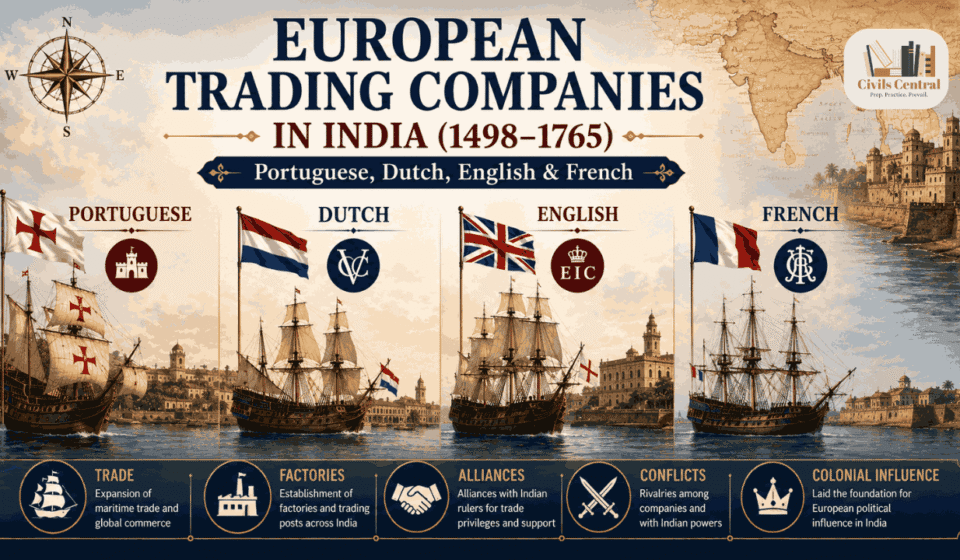
European Trading Companies in India (1498–1765): Portuguese, Dutch, English and French

Chapter Summary
| Chapter Information | Details |
|---|---|
| Series | Modern History of India (1707–1947) |
| Module | European Commercial Expansion and the Foundation of British Rule |
| Historical Period | 1498–1765 |
| Historical Phase | European Maritime Expansion and Commercial Rivalry in India |
| Previous Chapter | Rise of Regional States in Eighteenth-Century India (1707–1765): Emergence, Administration and Historical Significance |
| Current Chapter | European Trading Companies in India (1498–1765): Commercial Expansion, Colonial Rivalry and the Foundations of British Power |
| Next Chapter | The British East India Company: Foundation, Expansion and Early Settlements (1600–1757) |
| Core Theme | The arrival of European trading companies in India, their commercial objectives, maritime expansion, mutual rivalry, interaction with Indian rulers, and the gradual transformation of the English East India Company from a trading corporation into the dominant colonial power. |
| Major Trading Companies | Portuguese Estado da Índia, Dutch East India Company (VOC), English East India Company (EIC), French East India Company, Danish East India Company |
| Key Personalities | Vasco da Gama, Prince Henry the Navigator, Francisco de Almeida, Afonso de Albuquerque, Sir Thomas Roe, Jean-Baptiste Colbert, Joseph François Dupleix, Robert Clive |
| Key Concepts | Age of Discovery, Mercantilism, Factory System, Charter Companies, Blue Water Policy, Cartaz System, Maritime Trade, Colonial Rivalry, Commercial Imperialism, Navigation, European Expansion |
| Historical Significance | Explains how European commercial expansion reshaped Indian Ocean trade, intensified colonial competition, weakened the dominance of earlier European powers, and laid the foundations for British political supremacy in India. |
| Exam Relevance | UPSC CSE, JKPSC, JKAS, State PCS, CDS, CAPF, SSC, UGC-NET (History), University Examinations |
Historical Timeline
| Year | Event |
|---|---|
| 1453 | Constantinople captured by the Ottoman Turks |
| 1488 | Bartholomeu Dias rounds the Cape of Good Hope |
| 1498 | Vasco da Gama reaches Calicut |
| 1505 | Francisco de Almeida appointed first Portuguese Viceroy |
| 1510 | Albuquerque captures Goa |
| 1600 | English East India Company established |
| 1602 | Dutch East India Company (VOC) established |
| 1612 | Battle of Swally; English gain naval superiority over the Portuguese |
| 1613 | English establish first factory at Surat |
| 1664 | French East India Company established |
| 1746–1763 | Carnatic Wars between the English and French |
| 1757 | Battle of Plassey |
| 1764 | Battle of Buxar |
| 1765 | Diwani Rights granted to the English East India Company |
Before understanding the rivalry among the Portuguese, Dutch, English, and French in India, it is essential to appreciate that Europeans did not initially arrive as conquerors. They came as merchants searching for profitable trade opportunities. The transition from commerce to conquest occurred gradually over nearly three centuries and was shaped by developments both in Europe and India.
The previous chapter demonstrated how the Mughal Empire fragmented into numerous regional states after Aurangzeb’s death. While these kingdoms were economically prosperous and administratively capable, they lacked political unity. This changing political landscape coincided with the expansion of European maritime powers, who had already begun searching for direct access to Asian markets. Their commercial ambitions eventually intersected with India’s political fragmentation, creating conditions that enabled one European company—the English East India Company—to transform itself from a trading corporation into a territorial power.
This chapter therefore serves as the bridge between the rise of regional states and the establishment of British rule, explaining how European commercial competition gradually reshaped the political future of the Indian subcontinent.
Introduction
The arrival of the European trading companies in India marked one of the most significant turning points in world history. It connected the Indian subcontinent to a rapidly expanding global maritime economy and transformed the Indian Ocean from a largely Asian trading arena into a theatre of European imperial competition. What began as a search for spices and luxury goods ultimately resulted in the establishment of one of the largest colonial empires in history.
For centuries before the arrival of Europeans, India occupied a central position in the commercial networks of the Indian Ocean. Indian textiles, spices, indigo, silk, sugar, precious stones, and handicrafts were in high demand across Asia, Africa, and Europe. Arab, Persian, Gujarati, Tamil, and Malay merchants maintained flourishing maritime trade routes linking the ports of Calicut, Cochin, Cambay, Surat, Masulipatnam, and Bengal with the Red Sea, the Persian Gulf, Southeast Asia, and East Africa. European consumers depended heavily on these eastern commodities, but access to them was controlled by a complex chain of intermediaries.
The political developments in Europe during the fifteenth century fundamentally altered this commercial system. The Renaissance stimulated intellectual curiosity and scientific inquiry, while improvements in navigation, cartography, and shipbuilding enabled longer oceanic voyages. At the same time, the Ottoman conquest of Constantinople in 1453 strengthened Turkish control over traditional overland trade routes connecting Europe with Asia. European merchants, particularly those from Portugal and Spain, therefore sought an alternative sea route that would bypass Ottoman and Arab intermediaries and provide direct access to the lucrative markets of the East.
Portugal emerged as the pioneer of this maritime revolution. Supported by advances in navigation and royal patronage, Portuguese explorers gradually mapped the western coast of Africa before finally reaching India in 1498 when Vasco da Gama landed at Calicut. His successful voyage demonstrated that Europe could establish direct maritime links with India, fundamentally transforming the history of global commerce. Over the following centuries, other European powers—including the Dutch, English, French, and Danes—followed the Portuguese example, establishing trading companies that competed fiercely for commercial dominance in Asia.
Initially, these companies sought only profitable trade. They established coastal factories, negotiated trading privileges with Indian rulers, and participated in existing commercial networks without attempting large-scale territorial expansion. However, the immense profits generated by Indian trade, combined with intense rivalry among European powers and the gradual weakening of centralized political authority in India, encouraged these commercial enterprises to acquire military capabilities and intervene increasingly in regional politics.
Among the various European companies, the English East India Company proved exceptionally successful in adapting to changing circumstances. Unlike its rivals, it combined commercial enterprise with naval strength, diplomatic flexibility, financial resources, and military organization. By exploiting political rivalries among Indian states and defeating competing European powers, it gradually converted commercial influence into political authority. The grant of Diwani rights in Bengal in 1765 symbolized the culmination of this transformation, marking the beginning of Company rule in India.
The story of the European trading companies is therefore not merely a history of commerce. It is the story of how global economic competition, maritime expansion, technological innovation, and Indian political developments converged to reshape the destiny of the subcontinent. Understanding this process is essential for explaining not only the decline of indigenous political authority but also the emergence of British colonial rule and India’s integration into the modern global economy.
The Age of Discovery and the Search for a Sea Route to India
Why Did Europeans Begin Looking for India?
The arrival of Europeans in India at the end of the fifteenth century was not an isolated event but the culmination of profound economic, political, technological, and intellectual transformations taking place in Europe. Their voyages across unknown oceans were driven by the desire to establish direct commercial links with the wealthy markets of Asia, particularly India, whose spices, textiles, precious stones, and luxury goods had long fascinated European consumers. The search for a sea route to India therefore marked the beginning of a new phase in world history, one that connected continents more closely than ever before and eventually transformed both Europe and Asia.
For centuries before the arrival of the Portuguese, Europe maintained commercial relations with the East through a vast network of overland and maritime trade routes collectively known as the Old World Trade Network. Indian merchants exported cotton textiles, silk, spices, sugar, indigo, ivory, precious stones, and metalware to markets extending from Southeast Asia to the Mediterranean. These commodities reached Europe through Arab, Persian, Venetian, and Ottoman intermediaries, who controlled different segments of the trade. Although this system ensured a continuous flow of Eastern goods into Europe, every intermediary added transportation costs and commercial profits, making Asian products extremely expensive by the time they reached European consumers.
Among all Eastern commodities, spices occupied a particularly significant place in European life. Pepper, cloves, cinnamon, nutmeg, and cardamom were not merely culinary ingredients but valuable commercial products used for preserving food, preparing medicines, manufacturing perfumes, and displaying wealth and social prestige. The immense European demand for these products made the spice trade one of the most profitable businesses of the medieval world. Since India and Southeast Asia were the principal sources of these commodities, European rulers and merchants increasingly sought ways to eliminate the costly middlemen who dominated this lucrative trade.
A major turning point came in 1453, when the Ottoman Turks captured Constantinople, the capital of the Byzantine Empire. The city occupied a strategic position linking Europe with Asia, and its conquest strengthened Ottoman control over important overland trade routes. Although commerce between Europe and Asia did not cease after 1453, access became more expensive and politically dependent upon Ottoman goodwill. European kingdoms, particularly Portugal and Spain, viewed this growing dependence as both an economic burden and a strategic challenge. The search for an alternative maritime route to Asia thus became an urgent national objective rather than merely a commercial ambition.
Economic motivations alone, however, do not fully explain the remarkable voyages undertaken during this period. Europe itself was undergoing a period of profound transformation known as the Renaissance, which revived interest in scientific inquiry, geography, mathematics, astronomy, and classical learning. Scholars produced more accurate maps, sailors gained improved knowledge of winds and ocean currents, and advances in navigation made long-distance voyages increasingly feasible. Instruments such as the magnetic compass, astrolabe, and later improved nautical charts enabled mariners to determine direction and latitude with greater confidence, while innovations in shipbuilding produced stronger and more manoeuvrable vessels such as the caravel, capable of undertaking extended oceanic expeditions.
At the same time, powerful European monarchies began actively supporting maritime exploration. Unlike the fragmented political order of medieval Europe, emerging centralized kingdoms possessed the financial resources to sponsor expensive overseas expeditions whose outcomes remained uncertain. Among these states, Portugal became the undisputed pioneer of oceanic exploration. Under the inspiration of Prince Henry the Navigator, Portuguese sailors gradually explored the western coast of Africa throughout the fifteenth century, establishing trading posts and accumulating valuable knowledge of Atlantic navigation. Their objective was not simply geographical discovery but the identification of a continuous sea route that would ultimately lead to the markets of India.
These explorations reached a decisive milestone in 1488, when Bartholomeu Dias successfully rounded the southern tip of Africa, later named the Cape of Good Hope. Although Dias did not continue to India, his voyage proved that the Atlantic and Indian Oceans were connected, making a direct maritime route to Asia theoretically possible. A decade later, Vasco da Gama built upon this achievement. Sailing around the Cape of Good Hope and crossing the Indian Ocean with the assistance of experienced Arab navigators, he reached Calicut (Kozhikode) on the Malabar Coast in 1498. His arrival established the first direct sea link between Europe and India, fundamentally transforming the history of global trade.
The significance of Vasco da Gama’s voyage extended far beyond the success of a single expedition. For the first time, European merchants could bypass traditional intermediaries and trade directly with Indian markets. This dramatically altered the balance of commercial power in the Indian Ocean and initiated an era of intense competition among European maritime nations. Inspired by Portugal’s success, the Dutch, English, French, and Danes soon established their own trading companies, each seeking access to the immense wealth generated by Asian commerce.
The Age of Discovery, therefore, was not merely an age of geographical exploration but the beginning of a new global economic order. Improvements in navigation, the rise of centralized European monarchies, the expansion of mercantilist policies, and the search for direct trade routes collectively shifted the centre of world commerce from the Mediterranean to the Atlantic Ocean. India, already one of the world’s foremost manufacturing and trading economies, became a principal destination in this expanding maritime network. What initially appeared to be a commercial venture would, over the next two and a half centuries, evolve into one of the most consequential political transformations in Indian history, laying the foundations for European colonial expansion and ultimately for British rule over the subcontinent.
CivilsCentral Historical Insight
The search for a sea route to India was driven by far more than geographical curiosity. It was the outcome of Europe’s economic ambitions, technological progress, political centralization, and changing global trade patterns. Vasco da Gama’s arrival at Calicut in 1498 not only opened a new maritime highway between Europe and Asia but also inaugurated an era in which commerce gradually became the foundation of colonial empire.
Mercantilism and the Rise of Chartered Trading Companies
Why Did European Governments Establish Trading Companies?
The discovery of a direct sea route to India fundamentally transformed European commercial ambitions, but the challenges of long-distance overseas trade soon became evident. Voyages to Asia required enormous financial investments, months of navigation across dangerous oceans, heavily armed ships to protect valuable cargo, and permanent settlements in distant lands to facilitate commerce. No individual merchant possessed the resources necessary to undertake such expensive and risky enterprises alone. Consequently, European governments devised a new institutional mechanism that combined private investment with state support—the chartered trading company. This innovation would profoundly influence the history of Asia and eventually alter the political destiny of India.
The emergence of these companies was closely linked to the economic philosophy of Mercantilism, which dominated European economic thought between the sixteenth and eighteenth centuries. Mercantilist thinkers believed that the wealth and power of a nation depended upon the accumulation of precious metals such as gold and silver. Since the global supply of these metals was considered limited, governments assumed that one nation’s prosperity could only be achieved at the expense of another. International trade therefore became a competitive struggle in which every kingdom sought to maximize exports, minimize imports, acquire colonies, and monopolize profitable markets abroad.
Under mercantilism, colonies were not viewed merely as overseas territories but as essential components of national economic policy. They supplied raw materials unavailable in Europe, provided exclusive markets for manufactured goods, and generated customs revenues that strengthened royal treasuries. Control over maritime trade consequently became a matter of national security as well as commercial profit. European monarchies actively encouraged overseas expansion because successful trading enterprises increased state revenues, strengthened naval power, and enhanced international prestige.
To achieve these objectives, governments granted special royal charters to selected groups of merchants. These charters conferred extraordinary privileges that transformed ordinary commercial associations into powerful corporate institutions. Chartered companies generally enjoyed exclusive trading rights within specified regions, enabling them to operate without domestic competition. They could establish factories, negotiate treaties with foreign rulers, maintain armed ships, recruit soldiers, administer justice within their settlements, and in some cases even declare war or conclude peace on behalf of their governments. Although they remained commercial organizations, many gradually acquired powers traditionally associated with sovereign states.
Among the earliest and most influential of these institutions was the English East India Company, established on 31 December 1600 by a royal charter granted by Queen Elizabeth I. The Company received a monopoly over English trade with the East Indies for fifteen years, providing its investors with legal protection against competitors while encouraging the large-scale investment necessary for overseas commerce. Similar institutions soon emerged elsewhere in Europe. The Dutch East India Company (VOC) was established in 1602 and became one of the most powerful commercial corporations in history, while the French East India Company, founded in 1664 under the patronage of Jean-Baptiste Colbert during the reign of Louis XIV, sought to challenge Dutch and English dominance in Asian trade. Denmark and other European states also created trading companies, though on a comparatively smaller scale.
Although these companies shared a common objective of profitable trade, their organizational structures differed considerably. The Portuguese expansion had been directed primarily by the Crown through the Estado da Índia, whereas the Dutch and English relied upon joint-stock companies financed by private investors. This arrangement distributed commercial risks among numerous shareholders, enabling companies to mobilize unprecedented amounts of capital for overseas ventures. The joint-stock model proved particularly successful because it combined entrepreneurial initiative with institutional continuity, allowing companies to survive individual commercial failures and undertake long-term investments across multiple continents.
The competition among these chartered companies rapidly extended beyond commerce. Each sought exclusive access to lucrative markets, strategic ports, and favourable trading privileges from Asian rulers. Their rivalry encouraged the construction of fortified settlements, the maintenance of permanent naval squadrons, and the recruitment of professional soldiers to defend commercial interests. Commercial disputes increasingly assumed military dimensions, blurring the distinction between trade and warfare. In India, this transformation would become especially significant during the eighteenth century, when European companies began intervening in regional politics and supporting rival claimants to Indian thrones.
India occupied a central place within this mercantilist world. Its flourishing textile industry, abundant agricultural production, skilled artisans, and well-developed commercial networks made it one of the richest manufacturing economies of the early modern world. European demand for Indian cotton textiles, silk, indigo, saltpetre, spices, and luxury goods ensured that every major trading company regarded India as indispensable to its commercial strategy. Securing trading privileges in Indian ports therefore became an objective of immense economic and political importance.
The rise of the chartered trading companies thus marked a decisive stage in the evolution of European expansion. These organizations were far more than commercial enterprises; they represented a new partnership between state power and private capital that enabled European nations to project their influence across the oceans. In India, this combination of economic ambition, naval strength, military organization, and political diplomacy would gradually transform commercial competition into imperial conquest. The companies that arrived as merchants would, in time, become rulers, fundamentally reshaping the course of Indian history.
CivilsCentral Historical Insight
The chartered trading company was one of the most revolutionary institutions of the early modern world. By combining private investment with state patronage, it enabled European powers to extend their commercial, military, and political influence far beyond their own borders. In India, this institutional innovation allowed trade to become the foundation of empire, with the English East India Company eventually evolving from a merchant corporation into the sovereign ruler of vast territories.
The Portuguese in India: Pioneers of European Maritime Expansion
How Did the Portuguese Establish Their Power in India?
Among all the European powers that arrived in Asia, the Portuguese were the first to establish a direct maritime connection with India and the first to transform commercial activity into an organized colonial enterprise. Their arrival at the end of the fifteenth century inaugurated a new era in the history of the Indian Ocean, breaking the long-standing dominance of Arab and Venetian merchants over the spice trade and introducing a powerful European naval presence into Asian waters. Although the Portuguese Empire in India eventually declined, its influence permanently altered the political, commercial, and cultural landscape of the Indian Ocean.
The Portuguese quest for India culminated in 1498, when Vasco da Gama landed at Calicut (Kozhikode) on the Malabar Coast after successfully navigating around the Cape of Good Hope. He was received by the Zamorin of Calicut, one of the most influential rulers on the western coast of India. Although the first voyage yielded only modest commercial results, it proved beyond doubt that Europe could reach India by sea without relying on traditional overland routes. This achievement transformed Portugal from a relatively small European kingdom into the pioneer of global maritime exploration and opened a direct commercial highway between Europe and Asia.
Portugal’s objective extended far beyond the purchase of spices. The Portuguese Crown sought to monopolize the lucrative Indian Ocean trade by eliminating Arab merchants and securing exclusive control over the maritime routes connecting Europe with Asia. Unlike later European companies, which initially concentrated on commerce, the Portuguese combined trade, naval warfare, diplomacy, and territorial expansion from the very beginning. Their strategy was to dominate the sea rather than conquer vast inland territories, recognizing that control of maritime commerce could generate enormous wealth with comparatively limited territorial commitments.
The foundation of Portuguese authority in India was laid by Francisco de Almeida, who was appointed the first Viceroy of Portuguese India in 1505. Almeida believed that Portuguese supremacy depended upon complete control of the seas rather than the acquisition of extensive territories. This approach became known as the Blue Water Policy, which emphasized naval dominance, the protection of Portuguese merchant vessels, and the destruction of rival fleets operating in the Indian Ocean. Under his leadership, the Portuguese strengthened their naval forces and defeated a combined fleet of the Mamluks of Egypt, the Zamorin of Calicut, and the Sultan of Gujarat in the Battle of Diu (1509). This decisive victory established Portuguese naval supremacy in the Indian Ocean for several decades and significantly weakened the influence of competing maritime powers.
While Almeida secured the seas, his successor Afonso de Albuquerque transformed Portuguese influence into a durable colonial administration. Appointed Governor of Portuguese India in 1509, Albuquerque recognized that naval superiority alone could not guarantee long-term commercial dominance. He therefore adopted a more ambitious strategy that combined maritime power with the acquisition of strategically located ports. In 1510, he captured Goa from the Bijapur Sultanate, making it the headquarters of Portuguese India. Goa soon developed into the political, administrative, commercial, and religious centre of the Portuguese Empire in Asia and remained under Portuguese control until 1961, making it the longest-held European colony in India.
Albuquerque also consolidated Portuguese influence by capturing Malacca in 1511, thereby controlling the vital maritime passage between the Indian Ocean and the South China Sea. Together with their strongholds at Goa, Hormuz, and other strategic ports, the Portuguese established a chain of fortified settlements that enabled them to dominate important sea lanes across the Indian Ocean. Rather than relying on extensive territorial conquest, they created a maritime empire based upon fortified ports, naval patrols, and commercial monopolies.
A distinctive feature of Portuguese administration was the establishment of the Estado da Índia, a centralized colonial administration directly controlled by the Portuguese Crown. Unlike the English and Dutch East India Companies, which operated as chartered commercial corporations, Portuguese activities were managed as an extension of royal authority. The Viceroy at Goa exercised both civil and military powers, supervised trade, administered justice, negotiated with Asian rulers, and coordinated Portuguese naval operations across the Indian Ocean.
To strengthen their commercial monopoly, the Portuguese introduced the Cartaz System, one of the earliest forms of maritime regulation in Asia. Under this system, every merchant vessel sailing in the Indian Ocean was required to obtain a Portuguese-issued permit or cartaz. Ships travelling without this license risked seizure, confiscation of cargo, or destruction by Portuguese naval forces. The system enabled Portugal to regulate maritime commerce, collect customs revenues, and weaken competing traders, particularly Arab merchants who had traditionally dominated Indian Ocean trade. Although effective in the short term, the cartaz system also generated widespread resentment among Asian merchants and coastal rulers.
The Portuguese presence in India was not confined to commerce and administration. Missionary activity formed an integral part of Portuguese imperial policy. The Crown actively encouraged the spread of Christianity, leading to the arrival of several missionary orders, most notably the Jesuits. Among them, St. Francis Xavier emerged as one of the most influential missionaries, working extensively along the western coast and in South India during the sixteenth century. Churches, seminaries, educational institutions, and charitable establishments were founded in Portuguese territories, contributing to lasting cultural and religious interactions between Europe and India.
Despite these achievements, Portuguese dominance gradually declined from the late sixteenth century onwards. Several factors contributed to this decline. Portugal’s limited population and financial resources restricted its ability to defend a vast overseas empire. The union of the Portuguese and Spanish crowns (1580–1640) drew Portugal into Spain’s European conflicts, exposing its colonies to attacks by rival powers. More importantly, the emergence of the Dutch and English East India Companies introduced competitors with stronger financial resources, superior commercial organization, and increasingly powerful navies. Portuguese officials were also criticized for corruption, administrative inefficiency, and an excessive reliance on monopolistic practices that alienated Indian merchants and rulers.
Although Portuguese political influence diminished, their historical legacy remained significant. They introduced direct maritime trade between Europe and India, established the first enduring European colonial settlements in the subcontinent, pioneered naval warfare in the Indian Ocean, and demonstrated that commercial enterprises could be sustained through a combination of military power and strategic diplomacy. Their administrative institutions, fortified ports, and maritime practices later influenced other European powers, particularly the English East India Company, which adapted many aspects of Portuguese experience while building a far more extensive colonial empire.
The Portuguese, therefore, occupy a unique place in Indian history. They were not merely the first Europeans to reach India by sea but the pioneers of European imperial expansion in Asia. Their successes revealed the immense commercial possibilities of the Indian Ocean, while their failures provided valuable lessons that subsequent European powers would exploit with far greater effectiveness.
CivilsCentral Historical Insight
The Portuguese transformed the Indian Ocean from a predominantly Asian trading arena into a contested maritime space dominated by European naval power. Although they failed to establish lasting political supremacy over India, they pioneered the model of combining commerce, naval strength, fortified settlements, and colonial administration—a model that later European powers, especially the British, refined into a far more powerful imperial system.
The Dutch East India Company (VOC): Commercial Dominance Without Territorial Empire
Why Did the Dutch Come to India?
The remarkable success of the Portuguese in establishing a direct maritime route to Asia inspired other European powers to challenge their monopoly over the lucrative eastern trade. Among the earliest and most formidable competitors were the Dutch, whose commercial enterprise transformed the nature of global trade during the seventeenth century. Unlike the Portuguese, whose expansion was closely directed by the Crown and combined commerce with missionary activity and territorial conquest, the Dutch approached Asia primarily as merchants. Their principal objective was to dominate the spice trade and maximize commercial profits rather than establish a vast colonial empire in India. Nevertheless, through superior financial organization, naval strength, and commercial efficiency, the Dutch East India Company emerged as one of the most powerful business corporations in world history.
The rise of Dutch maritime power must be understood in the context of political developments in Europe. During the late sixteenth century, the Netherlands was engaged in a prolonged struggle for independence against Spanish rule. Since Portugal had come under Spanish control in 1580 through the Iberian Union, Dutch merchants were effectively excluded from the profitable Portuguese-controlled spice trade. Unable to obtain Asian goods through traditional channels, Dutch merchants resolved to establish direct commercial links with the East. This decision marked the beginning of an ambitious overseas enterprise that would soon challenge Portuguese supremacy across the Indian Ocean.
To coordinate these commercial ventures, the Dutch government established the Vereenigde Oostindische Compagnie (VOC) or Dutch East India Company in 1602. The VOC is widely regarded as the world’s first truly multinational joint-stock corporation. It received extensive powers from the Dutch government, including the authority to conclude treaties, establish fortified settlements, maintain armies and navies, administer justice, mint coins, and wage war whenever necessary to protect Dutch commercial interests. In effect, the Company exercised many of the powers of a sovereign state while remaining a commercial enterprise accountable to its shareholders.
The Dutch strategy in Asia differed significantly from that of the Portuguese. While Portugal sought to control the entire network of Indian Ocean trade through fortified ports and naval patrols, the Dutch concentrated on securing monopolies over specific high-value commodities, particularly spices such as cloves, nutmeg, and mace. Their primary commercial focus lay in the Indonesian archipelago, especially the Spice Islands (Moluccas), which produced some of the most valuable spices in the world. Consequently, although the Dutch established important trading settlements in India, they regarded the Indian subcontinent chiefly as a supplier of textiles and other goods needed to support their wider Asian trade.
The Dutch established several factories and trading posts along the Indian coastline. Their principal settlements included Pulicat on the Coromandel Coast, which became the headquarters of Dutch operations in India, Masulipatnam, Nagapattinam, Cochin, Surat, Chinsurah in Bengal, Kasimbazar, Patna, and Balasore. These centres enabled the Company to procure cotton textiles, indigo, silk, saltpetre, and opium, all of which were exchanged for spices in Southeast Asia or exported to European markets. Indian textiles, in particular, played a vital role in the Dutch commercial network because they were highly valued throughout the Indonesian islands and served as an important medium of exchange within intra-Asian trade.
Commercial success was supported by exceptional naval power. Throughout much of the seventeenth century, the Dutch possessed one of the strongest merchant fleets in the world, allowing them to transport goods efficiently across vast maritime distances. Their ships dominated important sea routes connecting Europe, Africa, India, Southeast Asia, China, and Japan. This maritime superiority enabled the VOC to challenge Portuguese influence aggressively, capturing several Portuguese possessions and gradually displacing them from many strategic locations in Asia.
The decline of Portuguese influence in India reflected this growing Dutch strength. A series of naval victories weakened Portuguese dominance, while Dutch commercial efficiency enabled them to attract merchants seeking more reliable trading arrangements. The capture of Cochin in 1663 symbolized the transfer of power from the Portuguese to the Dutch along parts of the Malabar Coast. Although the Portuguese retained Goa, Daman, and Diu, their broader maritime monopoly had effectively been broken.
Despite these achievements, the Dutch never attempted to establish extensive territorial authority in India comparable to that later created by the British. Their commercial priorities remained firmly centred on Southeast Asia, where the spice trade generated far greater profits than territorial administration in India. Consequently, Dutch involvement in Indian politics remained relatively limited. They generally avoided direct participation in succession disputes or regional conflicts, preferring stable commercial relations with Indian rulers over costly military intervention.
The fortunes of the Dutch East India Company began to decline during the eighteenth century. Several factors contributed to this reversal. Continuous wars in Europe imposed heavy financial burdens on the Dutch Republic, while increasing competition from the English East India Company gradually eroded Dutch commercial advantages. Administrative corruption, rising operational costs, and declining profitability further weakened the VOC. Most importantly, the English shifted from purely commercial competition to active political expansion in India, enabling them to acquire territorial revenues that financed future military campaigns. The Dutch, by contrast, remained primarily a trading organization and therefore lacked the financial and political foundations necessary to compete with an increasingly expansionist English East India Company.
A decisive setback occurred in 1759, when the Battle of Chinsurah (also known as the Battle of Biderra) ended Dutch attempts to challenge British influence in Bengal. The English victory demonstrated that commercial competition in India had now become inseparable from political and military supremacy. Thereafter, Dutch influence steadily declined, and their settlements gradually lost strategic importance within the evolving colonial order dominated by Britain.
Although the Dutch failed to establish a territorial empire in India, their historical significance remains considerable. They revolutionized corporate organization through the VOC, demonstrated the effectiveness of joint-stock finance, expanded intra-Asian commerce on an unprecedented scale, and contributed significantly to the development of global maritime trade. Their experience also highlighted an important lesson of eighteenth-century India: commercial success alone was no longer sufficient to dominate the subcontinent. As political conditions changed, economic power increasingly required military strength, diplomatic influence, and territorial control—advantages that the English East India Company would soon exploit with remarkable success.
CivilsCentral Historical Insight
The Dutch East India Company represented the peak of early modern commercial capitalism. Its extraordinary financial organization and maritime efficiency enabled it to dominate Asian trade for much of the seventeenth century. Yet its reluctance to transform commercial influence into territorial authority proved a decisive limitation in eighteenth-century India, where political power increasingly became the key to commercial supremacy.
The English East India Company: From Commercial Enterprise to Political Influence
How Did the English Establish Their Position in India?
Among all the European trading companies that arrived in India, none exercised a greater influence on the country’s future than the English East India Company. Unlike the Portuguese, who relied primarily on royal authority and naval supremacy, or the Dutch, whose principal objective remained commercial profit, the English East India Company gradually combined commerce, diplomacy, military organization, and political intervention into a coherent strategy of expansion. What began as a private trading corporation at the beginning of the seventeenth century evolved, within less than two centuries, into the most powerful political institution in India. Understanding this transformation is essential for explaining the origins of British colonial rule.
The English East India Company was established on 31 December 1600, when Queen Elizabeth I granted a royal charter to a group of London merchants under the name “The Governor and Company of Merchants of London Trading into the East Indies.” The charter provided the Company with an exclusive monopoly over English trade east of the Cape of Good Hope for fifteen years. As a joint-stock corporation, the Company pooled investments from numerous shareholders, allowing it to undertake long and expensive voyages that individual merchants could not afford. Although founded as a commercial enterprise, the extensive privileges granted under the royal charter—including the right to negotiate treaties and defend its settlements—laid the institutional foundations for its later political ambitions.
The Company’s earliest expeditions were directed towards the rich spice markets of Southeast Asia. However, it soon encountered fierce competition from the Dutch East India Company, whose superior naval strength and established commercial network made it difficult for the English to secure a dominant position in Indonesia. The Amboyna Massacre of 1623, in which several English merchants were executed by the Dutch authorities, convinced the Company that competing directly with the Dutch in the Spice Islands would be both costly and unproductive. Consequently, the English shifted their commercial focus towards India, where flourishing textile industries and relatively stable political conditions offered enormous opportunities for profitable trade.
The establishment of English commerce in India was greatly facilitated by the strength and stability of the Mughal Empire. Unlike many European colonies elsewhere, the English did not conquer territory at the outset but sought permission from Indian rulers to establish trading settlements. Their first major success came after the Battle of Swally (1612), fought near Surat, where the English fleet defeated the Portuguese navy. This victory demonstrated that the Portuguese monopoly over the Arabian Sea could be challenged and considerably enhanced English prestige among Mughal officials.
Recognizing the Company’s growing naval capabilities, Emperor Jahangir permitted the English to establish their first permanent factory at Surat in 1613. Located on the western coast of India, Surat was one of the busiest ports of the Mughal Empire and served as the principal centre of English trade for several decades. From this base, English merchants exported cotton textiles, indigo, silk, spices, saltpetre, and other valuable commodities to Europe while importing bullion that stimulated commercial activity within the Mughal economy.
Diplomatic engagement with the Mughal court became another cornerstone of English expansion. In 1615, Sir Thomas Roe arrived at Jahangir’s court as the official ambassador of King James I. Rather than demanding territorial concessions, Roe pursued a policy of respectful negotiation, seeking commercial privileges that would secure the Company’s long-term interests. His diplomatic efforts resulted in the grant of important trading rights, allowing the English to establish factories in several parts of the Mughal Empire and conduct commerce with relatively limited interference. This peaceful approach contrasted sharply with the more aggressive methods employed earlier by the Portuguese and helped the English gain the confidence of Mughal authorities.
During the seventeenth century, the Company steadily expanded its commercial network by establishing three major centres that would later become the foundations of British India. On the eastern coast, Madras (Fort St. George) was established in 1639 after obtaining land from the local ruler of Chandragiri. The settlement soon developed into the headquarters of English activities on the Coromandel Coast and an important centre for textile exports.
A second major acquisition occurred in western India. The island of Bombay was transferred to the English Crown in 1661 as part of the marriage treaty between King Charles II of England and Catherine of Braganza of Portugal. In 1668, the Crown leased Bombay to the East India Company for a nominal annual rent. Possessing an excellent natural harbour, Bombay gradually replaced Surat as the Company’s principal western port and evolved into one of the most important commercial cities in India.
The Company’s eastern headquarters emerged through the efforts of Job Charnock, who established a settlement at Calcutta in 1690 on the banks of the Hooghly River. The Company subsequently fortified the settlement by constructing Fort William, which became the administrative centre of English activities in Bengal. Together, Madras, Bombay, and Calcutta formed the three great Presidency towns that later served as the administrative pillars of British rule in India.
As English trade expanded, the Company increasingly sought legal guarantees for its commercial privileges. One of the most significant concessions came through the Farman of Emperor Farrukhsiyar in 1717, often described as the “Magna Carta of the East India Company.” This imperial decree granted the Company extensive trading privileges in Bengal, including the right to conduct duty-free trade on the payment of a nominal annual fee. Similar concessions were extended in Gujarat and the Deccan, substantially strengthening the Company’s commercial position. Although intended to encourage trade, these privileges were frequently abused by Company officials, leading to growing tensions with Indian authorities, particularly the Nawabs of Bengal.
By the early eighteenth century, the English East India Company had evolved into far more than a merchant organization. It maintained fortified settlements, employed thousands of soldiers, possessed an expanding naval fleet, and accumulated immense financial resources through trade. Yet, unlike the Portuguese or the Dutch, its greatest strength lay in its remarkable ability to adapt to changing political conditions. As the Mughal Empire weakened and regional states emerged, Company officials increasingly intervened in local disputes, cultivated alliances with Indian rulers, and used military force whenever commercial interests appeared threatened.
This gradual transition from commerce to politics distinguished the English East India Company from its European rivals. The Company never abandoned its commercial objectives, but it increasingly recognized that secure trade required political influence, and political influence often demanded military power. By the middle of the eighteenth century, particularly during the Carnatic Wars, the English had begun to compete not merely for markets but for political supremacy. Their victories over both Indian rivals and competing European powers would ultimately enable them to transform a trading corporation into the sovereign authority over vast parts of the Indian subcontinent.
The rise of the English East India Company therefore represents one of the most remarkable institutional transformations in modern history. It illustrates how commercial enterprise, when supported by financial strength, naval superiority, disciplined administration, and political adaptability, could evolve into an instrument of imperial expansion. The decisive phase of this transformation would unfold during the Anglo-French rivalry in South India, where commercial competition gave way to open warfare and the foundations of British political dominance were firmly established.
CivilsCentral Historical Insight
The English East India Company did not conquer India immediately after its arrival. Its success lay in a gradual and calculated strategy of combining commerce with diplomacy, fortified settlements, military preparedness, and political intervention. By patiently adapting to India’s changing political landscape, the Company converted trading privileges into political influence and eventually transformed commercial power into colonial sovereignty.
The French East India Company: Ambition, Expansion and the Failure to Establish an Indian Empire
Why Did the French Fail Despite a Promising Beginning?
Among the European powers that competed for influence in India, the French came closest to challenging the growing dominance of the English East India Company. Although they entered the Indian trade later than the Portuguese, Dutch, and English, the French rapidly established important commercial settlements and, under visionary leadership, attempted to transform their trading company into a major political power. During the middle of the eighteenth century, it appeared entirely possible that India might become a French rather than a British colony. Yet within a few decades these ambitions collapsed, leaving the English East India Company as the undisputed European power in the subcontinent. The rise and decline of the French in India therefore illustrates how commercial rivalry evolved into a struggle for political supremacy.
The French East India Company (Compagnie des Indes Orientales) was established in 1664 under the initiative of Jean-Baptiste Colbert, the influential Finance Minister of King Louis XIV of France. Like other European chartered companies, it was granted extensive privileges, including monopoly rights over French trade with the East, authority to establish settlements, negotiate treaties, and maintain military forces. The Company’s creation reflected France’s determination to participate in the profitable Asian trade and to challenge the commercial supremacy already enjoyed by the Dutch and the English.
Unlike the Portuguese, who had arrived in India at the close of the fifteenth century, the French entered an Indian Ocean trading system that was already intensely competitive. Consequently, their early efforts focused on establishing commercial settlements rather than attempting immediate political expansion. Over time, they secured important trading centres at Surat, Masulipatnam, Chandernagore in Bengal, Mahé on the Malabar Coast, Karaikal on the Coromandel Coast, and most importantly Pondicherry, which became the headquarters of French activities in India. Pondicherry soon developed into a thriving commercial port and emerged as the political and administrative centre of French India.
For several decades, French activities remained largely commercial. The Company exported Indian cotton textiles, silk, indigo, spices, and other luxury goods to European markets while importing silver and manufactured products into India. However, by the eighteenth century the political situation in India had changed dramatically. The weakening of Mughal authority and the emergence of regional states created opportunities for European companies to intervene in local politics. French administrators increasingly recognized that commercial security could no longer be separated from political influence.
This transformation reached its most significant phase under the leadership of Joseph François Dupleix, who became Governor-General of French India in 1742. Dupleix possessed an ambitious vision that extended far beyond commercial profit. He believed that European military discipline, combined with alliances with Indian rulers, could enable France to establish political supremacy over large parts of India. Rather than relying solely on trade, he sought to influence succession disputes among Indian princes, support friendly claimants to regional thrones, and thereby secure French political influence without undertaking extensive territorial conquest.
Dupleix’s strategy represented a major innovation in European policy towards India. Instead of remaining neutral merchants, the French actively participated in the internal politics of the Carnatic and the Deccan, providing military assistance to rival Indian claimants in return for political concessions and commercial privileges. They also organized Indian soldiers, known as sepoys, into disciplined European-style infantry trained and commanded by French officers. This demonstrated that relatively small European forces, supported by locally recruited troops, could decisively influence Indian political conflicts.
For a time, Dupleix’s policy achieved remarkable success. French influence expanded rapidly across South India, and many contemporary observers believed that France would emerge as the dominant European power on the subcontinent. However, these gains soon encountered determined resistance from the English East India Company. The rivalry between the two companies culminated in the Carnatic Wars (1746–1763), a prolonged series of military conflicts fought in South India that fundamentally altered the balance of European power in India.
Although the French displayed considerable military skill and diplomatic ingenuity, several structural weaknesses undermined their position. The French East India Company suffered from chronic financial difficulties and depended heavily upon financial assistance from the French Crown. Unlike the English East India Company, whose commercial success generated substantial private capital, the French Company lacked a stable financial base capable of sustaining prolonged military campaigns. Delays in funding, administrative inefficiency, and frequent changes in official policy weakened its ability to respond effectively to changing circumstances in India.
The political situation in Europe further complicated French ambitions. Throughout the eighteenth century, France became deeply involved in a series of major European conflicts, including the War of the Austrian Succession and the Seven Years’ War (1756–1763). These wars diverted military resources and naval strength away from India, preventing France from providing adequate support to its colonial possessions. The English, by contrast, benefited from the growing strength of the Royal Navy, which ensured regular communication, reinforcements, and supplies between Britain and India.
Leadership also played an important role in determining the outcome of Anglo-French rivalry. Although Dupleix possessed exceptional vision and administrative ability, his ambitious policies failed to receive consistent support from the French government. He was eventually recalled to France in 1754, effectively ending the most dynamic phase of French expansion in India. The English, meanwhile, benefited from capable leaders such as Robert Clive, whose military victories and political strategy fundamentally transformed the position of the English East India Company.
The decisive blow to French ambitions came during the Third Carnatic War (1758–1763), which formed part of the wider Seven Years’ War. The Battle of Wandiwash (1760) resulted in a decisive English victory over French forces under Count de Lally. This defeat destroyed French military power in India and effectively ended their hopes of establishing a territorial empire. The Treaty of Paris (1763) restored several French settlements, including Pondicherry, Chandernagore, Mahé, Karaikal, and Yanam, but prohibited their fortification and military expansion. Thereafter, the French presence in India remained primarily commercial and never again posed a serious challenge to British supremacy.
Despite their ultimate failure, the French left an enduring legacy in Indian history. They demonstrated that European companies could exercise significant influence over Indian politics through diplomacy, military organization, and strategic alliances. Dupleix’s methods of intervening in succession disputes and employing trained sepoy armies were later adopted and refined by the English East India Company with far greater success. In this sense, the French inadvertently contributed to the very process that eventually established British colonial rule.
The French experience therefore represents one of the great turning points in the history of European expansion in India. Their early successes revealed that political influence could emerge from commercial enterprise, while their eventual defeat demonstrated that lasting imperial power required more than military brilliance. Financial stability, naval superiority, institutional continuity, and sustained governmental support ultimately proved decisive in determining which European power would dominate the Indian subcontinent.
CivilsCentral Historical Insight
The French did not fail in India because they lacked ambition or military capability. Under Dupleix, they pioneered the strategy of combining diplomacy, military intervention, and alliances with Indian rulers to expand European influence. Their failure resulted primarily from financial weakness, inadequate naval support, inconsistent backing from the French Crown, and England’s superior institutional and maritime strength. Ironically, the methods pioneered by the French became the very techniques through which the English East India Company built the British Empire in India.
Comparative Analysis of the European Trading Companies
How Did the European Trading Companies Differ from One Another?
Although the Portuguese, Dutch, English, and French all arrived in India in pursuit of commercial profit, they did not follow identical strategies nor did they achieve similar outcomes. Their objectives, methods of expansion, administrative structures, relations with Indian rulers, and long-term ambitions differed significantly. These differences ultimately determined which European power succeeded in transforming commercial influence into political authority and which remained confined to trade.
The Portuguese were pioneers of European maritime expansion in Asia. Their empire was directed by the Portuguese Crown through the Estado da Índia, making it a state-controlled colonial administration rather than a private commercial enterprise. Their primary objective was to monopolize the Indian Ocean trade by controlling strategic ports and sea routes. Consequently, they emphasized naval supremacy, fortified settlements, and maritime regulation through the Cartaz System. While they established influential centres such as Goa, Daman, and Diu and played a pioneering role in introducing direct maritime trade between Europe and India, their commercial policies remained highly monopolistic and often alienated Indian merchants. Limited financial resources, administrative corruption, and the rise of stronger European rivals eventually reduced Portuguese influence.
The Dutch East India Company (VOC) represented a different model of expansion. Established as a powerful joint-stock corporation, it became one of the world’s earliest multinational business enterprises. Unlike the Portuguese, the Dutch focused overwhelmingly on commercial profitability rather than territorial conquest. Their greatest interests lay in the spice-producing islands of Indonesia, while India primarily supplied textiles and other goods required for intra-Asian trade. Superior financial organization and naval efficiency enabled the Dutch to dominate Asian commerce for much of the seventeenth century, yet their reluctance to intervene deeply in Indian politics prevented them from establishing lasting political authority on the subcontinent. Commercial success alone proved insufficient in an era when political influence increasingly determined economic advantage.
The French East India Company combined commercial objectives with growing political ambitions during the eighteenth century. Under Joseph François Dupleix, the French pioneered the strategy of intervening in Indian succession disputes, supporting friendly rulers, and employing disciplined sepoy armies to expand their influence. For a brief period, France appeared capable of challenging English supremacy in India. However, chronic financial weakness, inconsistent support from the French Crown, repeated European wars, and the decisive English victory in the Carnatic Wars ultimately ended French aspirations. Their experience demonstrated that military skill and diplomatic innovation required equally strong institutional and financial foundations to produce lasting imperial success.
The English East India Company differed from all its competitors because of its extraordinary capacity to adapt its methods according to changing circumstances. Initially pursuing trade through peaceful diplomacy with the Mughal Empire, it gradually established fortified settlements at Surat, Madras, Bombay, and Calcutta while securing valuable trading privileges through imperial farmans. As India’s political landscape fragmented during the eighteenth century, the Company increasingly combined commerce with diplomacy, military organization, financial management, and political intervention. Unlike the Dutch, it did not remain merely a commercial organization, and unlike the Portuguese, it did not rely exclusively upon naval domination. Instead, it systematically integrated commercial wealth, military discipline, diplomatic alliances, and territorial expansion into a unified strategy that enabled it to outlast every European rival.
Relations with Indian rulers also varied considerably among the European powers. The Portuguese frequently employed coercive methods and attempted to enforce maritime monopolies through naval power. The Dutch generally preferred stable commercial relationships and avoided extensive political involvement. The French actively cultivated alliances with Indian princes as part of their broader political strategy but lacked the institutional continuity necessary to sustain these alliances. The English, by contrast, demonstrated remarkable diplomatic flexibility, negotiating with Mughal emperors, regional nawabs, and local rulers whenever advantageous while simultaneously preparing to employ military force when diplomacy failed. This pragmatic approach allowed them to exploit political rivalries more effectively than any of their competitors.
Military organization became another decisive factor distinguishing the European companies. All four powers maintained armed forces, but the English gradually developed the most disciplined and financially sustainable military establishment in India. Revenues generated from expanding commercial operations—and later from territorial acquisitions such as Bengal—enabled the English East India Company to maintain large standing armies supported by efficient logistics and regular financial resources. This institutional advantage became increasingly important as commercial competition evolved into military conflict during the Carnatic Wars and subsequent struggles for political supremacy.
By the middle of the eighteenth century, it had become evident that European success in India depended upon far more than profitable trade. Naval superiority, administrative efficiency, financial stability, diplomatic adaptability, and the ability to intervene successfully in Indian politics together determined the outcome of imperial rivalry. The English East India Company excelled in integrating all these elements into a coherent long-term strategy, whereas its competitors generally remained constrained by narrower commercial objectives or structural weaknesses.
The comparison of the European trading companies therefore reveals that British supremacy was not the result of a single decisive battle or isolated event. It emerged gradually through institutional evolution, organizational flexibility, and the Company’s ability to convert commercial enterprise into political authority more effectively than any other European power operating in India.
Comparative Overview of the European Trading Companies
| Feature | Portuguese | Dutch (VOC) | English (EIC) | French |
|---|---|---|---|---|
| Year of Arrival/Formation | Vasco da Gama reached India (1498) | VOC established (1602) | EIC established (1600) | French East India Company established (1664) |
| Primary Objective | Control maritime trade and establish colonial settlements | Commercial monopoly, especially spice trade | Commerce followed by political expansion | Trade with growing political ambitions |
| Administrative Model | Crown-controlled (Estado da Índia) | Joint-stock company | Joint-stock company | State-supported chartered company |
| Main Indian Headquarters | Goa | Pulicat | Calcutta, Madras, Bombay | Pondicherry |
| Approach to Indian Politics | Limited political alliances; emphasis on naval control | Minimal political involvement | Extensive diplomacy, alliances, and intervention | Active intervention under Dupleix |
| Military Strength | Strong navy | Powerful merchant fleet | Strong navy and disciplined army | Effective army but weaker naval support |
| Major Strength | Maritime pioneering and naval dominance | Commercial efficiency and financial organization | Institutional flexibility and political adaptability | Visionary leadership under Dupleix |
| Major Weakness | Limited resources and administrative decline | Lack of territorial ambition | — | Financial weakness and inadequate government support |
| Historical Outcome | Declined after the seventeenth century | Lost commercial dominance in India | Established the British Empire in India | Reduced to minor trading settlements after 1763 |
CivilsCentral Historical Insight
The four European trading companies entered India with broadly similar commercial objectives, yet they left profoundly different historical legacies. The Portuguese pioneered maritime expansion, the Dutch perfected commercial capitalism, the French demonstrated the political possibilities of European intervention, but it was the English East India Company that successfully combined commerce, diplomacy, military organization, and territorial ambition into a comprehensive imperial strategy. Britain’s eventual dominance was therefore not accidental but the product of superior institutional adaptation to India’s changing political environment.
Why Did the English East India Company Ultimately Succeed?
What Enabled the English to Defeat Every European Rival?
By the middle of the eighteenth century, several European powers had established trading settlements across the Indian coastline. The Portuguese possessed the advantage of early arrival, the Dutch dominated Asian commerce through superior financial organization, and the French displayed remarkable diplomatic and military skill under leaders such as Dupleix. Yet, within a few decades, all these competitors had either declined or been reduced to minor commercial establishments, while the English East India Company emerged as the dominant political power in India. This outcome was neither inevitable nor accidental. It resulted from a combination of institutional, military, economic, diplomatic, and political advantages that enabled the English to adapt more effectively than their rivals to the changing conditions of eighteenth-century India.
One of the Company’s greatest strengths lay in its organizational structure. As a joint-stock corporation, the English East India Company possessed a stable financial base supported by thousands of private investors. Commercial profits could be continuously reinvested into expanding trade, constructing fortified settlements, maintaining naval fleets, and recruiting professional armies. Unlike the French East India Company, which depended heavily upon financial assistance from the French Crown, the English Company enjoyed far greater financial autonomy. This institutional stability allowed it to pursue long-term strategies without being excessively constrained by changing political priorities in Britain.
Equally important was Britain’s growing naval supremacy. During the seventeenth and eighteenth centuries, the Royal Navy emerged as one of the strongest maritime forces in the world. Control of the seas enabled Britain to maintain secure communication between Europe and India, transport troops and supplies efficiently, protect merchant shipping, and isolate rival European settlements during wartime. Naval superiority also ensured that reinforcements, military equipment, and financial resources could reach India with greater regularity than those available to the French or Portuguese. Since overseas empires depended upon uninterrupted maritime connections, British naval dominance became one of the fundamental pillars of imperial expansion.
The English also demonstrated exceptional commercial adaptability. Rather than concentrating exclusively on spices, as the Dutch had done, the Company diversified its commercial interests by trading in cotton textiles, silk, indigo, saltpetre, tea, opium, and numerous other commodities. Its extensive trading network connected Indian markets not only with Britain but also with Africa, the Middle East, Southeast Asia, and China. This diversified commercial strategy generated enormous revenues that could be redirected towards military and political objectives whenever required.
A decisive advantage emerged from the Company’s ability to integrate commerce with politics. Earlier European powers generally treated trade and governance as separate activities. The English gradually abandoned this distinction. As Mughal authority weakened and regional kingdoms competed for power, Company officials increasingly intervened in succession disputes, negotiated alliances, financed rival claimants, and provided military assistance to Indian rulers. These interventions were rarely motivated by territorial ambition alone; they were carefully designed to secure commercial privileges, political influence, and strategic advantage. Over time, commercial diplomacy evolved into direct political control.
The English also proved remarkably successful in understanding and exploiting India’s fragmented political landscape. The previous chapter demonstrated that eighteenth-century India was characterized by the rise of numerous regional states whose administrative systems remained effective but whose political interests often diverged. Instead of confronting these kingdoms collectively, the Company pursued a policy of selective alliances, exploiting rivalries among Indian rulers to isolate potential opponents. By supporting one claimant against another or aligning with one regional power against its rival, the English frequently achieved political objectives without committing overwhelming military resources. This strategy of divide and negotiate, reinforced when necessary by military intervention, became one of the defining features of British expansion.
Another significant advantage lay in the professionalization of the Company’s military forces. The English East India Company developed disciplined armies trained according to contemporary European military methods. Indian sepoys were organized into permanent regiments under professional command, equipped with standardized firearms, and supported by efficient artillery and logistics. Unlike many regional armies, whose effectiveness often depended upon individual commanders or temporary alliances, the Company’s forces functioned as a permanent military institution with consistent organization, regular salaries, and centralized administration. This institutional discipline frequently proved more decisive than numerical superiority on the battlefield.
The acquisition of Bengal after the Battle of Plassey (1757) fundamentally transformed the Company’s position. For the first time, it gained access not merely to commercial profits but to one of the richest revenue systems in Asia. The subsequent grant of Diwani rights in 1765 provided direct control over the revenues of Bengal, Bihar, and Orissa. These enormous financial resources enabled the Company to finance its own military campaigns, reduce dependence upon investors in Britain, and sustain continuous expansion without placing excessive strain on its commercial operations. In effect, Indian revenues began financing the conquest of India itself—a strategic advantage unmatched by any European rival.
The weaknesses of the Company’s competitors further strengthened its position. The Portuguese suffered from limited national resources and administrative decline. The Dutch remained primarily committed to Southeast Asian commerce and avoided large-scale political involvement in India. The French, despite Dupleix’s remarkable vision, faced persistent financial difficulties, inadequate naval support, and inconsistent assistance from the French Crown. Repeated European wars diverted French resources away from India at critical moments, while the recall of Dupleix deprived French policy of its most capable architect. The English benefited greatly from these structural disadvantages affecting their rivals, but they also demonstrated a superior ability to capitalize upon every opportunity created by them.
Modern historians increasingly emphasize that British success cannot be explained solely by military victories. Historians such as P. J. Marshall, C. A. Bayly, and Seema Alavi argue that the Company’s rise resulted from its capacity to combine multiple forms of power into a single institutional framework. Commercial wealth generated military strength; military victories secured political influence; political authority increased fiscal revenues; and enhanced revenues financed further commercial and territorial expansion. This self-reinforcing cycle distinguished the English East India Company from every other European enterprise operating in India.
The English therefore succeeded not because they entered India with a predetermined plan to establish an empire, but because they consistently adapted their institutions to changing historical circumstances. Beginning as merchants, they became diplomats, military commanders, revenue administrators, and ultimately sovereign rulers. Their greatest achievement lay not in any single battle but in creating an organization capable of converting commercial enterprise into durable political authority.
CivilsCentral Historical Insight
The English East India Company did not triumph because it possessed the largest army or the greatest wealth at the outset. Its decisive advantage was institutional adaptability. By combining commercial capital, naval supremacy, disciplined military organization, diplomatic flexibility, and fiscal administration into a unified system, the Company transformed itself from a trading corporation into the architect of the British Empire in India.
Impact of the European Trading Companies on India
How Did the Arrival of European Trading Companies Transform India?
The arrival of the European trading companies marked the beginning of a profound transformation in India’s economic, political, military, and social history. Although the Portuguese, Dutch, English, and French initially came to India as merchants seeking profitable trade, their activities gradually reshaped the existing commercial networks, altered the balance of political power, introduced new military practices, and integrated the Indian subcontinent more closely into the emerging global economy. The consequences of their presence extended far beyond commerce, laying the foundations for colonial rule and permanently changing the trajectory of Indian history.
The most immediate impact of the European companies was on India’s maritime trade. Before their arrival, commerce in the Indian Ocean had largely been conducted by Arab, Persian, Gujarati, Tamil, and Malay merchants through a relatively open trading system. European powers introduced a new model based upon naval superiority and commercial monopolies. The Portuguese attempted to regulate maritime commerce through the Cartaz System, while the Dutch and English sought exclusive control over profitable commodities and strategic ports. As European naval power expanded, the Indian Ocean gradually evolved from a predominantly Asian commercial space into an arena dominated by competing European maritime powers.
Despite these changes, the European companies did not immediately weaken the Indian economy. On the contrary, during the seventeenth and early eighteenth centuries, they significantly expanded international demand for Indian products. Cotton textiles from Gujarat, Bengal, and the Coromandel Coast became highly sought after in European, African, and Southeast Asian markets. Indian silk, indigo, saltpetre, spices, sugar, and handicrafts also witnessed growing exports. The resulting expansion of overseas trade stimulated agricultural production, encouraged urban growth, and strengthened the position of merchant communities in many regions of India. Cities such as Surat, Masulipatnam, Hooghly, Madras, Bombay, Calcutta, and Pondicherry developed into thriving commercial centres connected to global markets.
European commerce also contributed to the increasing sophistication of India’s financial system. Indian merchants, bankers, moneylenders, and banking houses—including influential families such as the Jagat Seths—became indispensable partners of the European companies. Through instruments such as hundis, commercial credit, and bills of exchange, they facilitated large-scale financial transactions that linked Indian markets with international trade. Rather than replacing indigenous commercial institutions, the European companies initially relied heavily upon them, demonstrating the resilience and complexity of India’s pre-colonial economy.
The political consequences of European expansion, however, proved far more significant in the long term. During the sixteenth and seventeenth centuries, European companies generally respected the authority of Indian rulers and sought trading privileges through negotiation. As the Mughal Empire weakened during the eighteenth century and regional kingdoms competed for power, the companies increasingly intervened in Indian politics. Commercial rivalry gradually evolved into political rivalry, with European companies supporting rival claimants in succession disputes, negotiating military alliances, and influencing regional conflicts. This transformation blurred the distinction between merchants and rulers, allowing commercial enterprises to emerge as important political actors within the Indian state system.
Military developments accompanied this political transformation. European companies introduced disciplined infantry trained according to contemporary European methods, improved artillery organization, fortified coastal settlements, and increasingly relied upon professionally trained sepoy armies. Although Indian rulers rapidly adopted many of these military innovations, the companies often possessed greater organizational cohesion, financial stability, and logistical efficiency. The Carnatic Wars demonstrated that relatively small but disciplined European-led forces could decisively influence Indian political contests, fundamentally altering the character of warfare in the subcontinent.
The establishment of European settlements also produced important social and cultural interactions. Coastal cities became centres of linguistic exchange, artistic interaction, scientific knowledge, and architectural innovation. Missionary activities, particularly under the Portuguese, introduced Christianity into several parts of India, leading to the construction of churches, educational institutions, and charitable establishments. European architectural styles influenced urban development in settlements such as Goa, Madras, Pondicherry, and Calcutta, while Indian textiles, cuisine, botanical products, and artistic traditions simultaneously left a lasting impression on European society. These exchanges reflected a complex process of cultural interaction rather than a one-sided transfer of ideas.
Perhaps the most far-reaching consequence of European commercial expansion was India’s growing integration into the global economy. For centuries, India had participated actively in Asian trade, but the arrival of European maritime powers linked Indian commerce directly with the Atlantic world. Goods produced in Indian villages and manufacturing centres now reached markets across Europe, Africa, and the Americas, while silver from the New World entered the Indian economy through European merchants. India thus became an essential component of an increasingly interconnected system of global commerce, illustrating the early stages of economic globalization.
Yet this expanding commercial integration also contained the seeds of political subordination. The English East India Company gradually recognized that secure commerce required political influence and that political authority could generate enormous financial advantages. Following the Battle of Plassey (1757) and the grant of the Diwani of Bengal (1765), the Company’s economic relationship with India fundamentally changed. Instead of merely purchasing Indian goods through trade, it increasingly financed its commercial activities through revenues collected from Indian territories. This marked the beginning of a new colonial economic order in which political power and commercial profit became inseparably linked.
Modern historians therefore distinguish between two phases of European influence in India. The first phase was characterized by commercial partnership, during which European companies functioned primarily as participants in India’s prosperous trading economy. The second phase witnessed the gradual transformation of commerce into empire, particularly under the English East India Company, where economic interests became inseparable from military conquest and territorial administration. Understanding this transition is essential for explaining how European merchants ultimately became the rulers of one of the world’s richest civilizations.
The impact of the European trading companies, therefore, cannot be reduced to either commerce or conquest alone. They revolutionized maritime trade, stimulated international commerce, introduced new forms of military organization, transformed political relationships, encouraged cultural interaction, and integrated India into the expanding global economy. At the same time, their activities created the institutional and political foundations upon which British colonial rule would eventually be constructed. The story of the European companies is thus not merely the history of foreign merchants in India but the beginning of a new era in which global commerce, imperial ambition, and political power became deeply intertwined.
CivilsCentral Historical Insight
The European trading companies did not transform India overnight. Their earliest impact was commercial, expanding overseas trade and integrating India into the global economy. Over time, however, commercial privileges evolved into political influence, military intervention, and territorial control. The history of European expansion in India is therefore the story of how global trade gradually became the foundation of colonial empire.
Historiographical Perspectives: From Commercial Contact to Colonial Empire
How Have Historians Interpreted the Role of the European Trading Companies in India?
The history of the European trading companies in India has generated one of the most significant historiographical debates in modern Indian history. At the centre of this debate lies a fundamental question: Did the European companies merely exploit the political weakness of India, or did they actively create the conditions that led to colonial domination? The answer has varied considerably across different schools of historical writing, reflecting changing perspectives on colonialism, capitalism, global trade, and the nature of imperial expansion.
For much of the nineteenth century, colonial historians portrayed the arrival of the European trading companies, particularly the English East India Company, as a civilizing and progressive force. Historians such as James Mill, Vincent Arthur Smith, and other imperial writers argued that European merchants introduced political stability, modern commerce, efficient administration, and improved governance into a fragmented India. According to this interpretation, the decline of the Mughal Empire and the rivalry among regional states had produced political disorder that only the English East India Company possessed the organizational capacity to overcome. British political supremacy was therefore presented as the natural and beneficial outcome of India’s internal weaknesses rather than as a process of imperial conquest.
This interpretation served an important ideological purpose during the colonial period. By portraying the Company as the restorer of law and order, colonial historians sought to justify British rule as both necessary and progressive. Commercial expansion was presented as a vehicle for modernization, while military conquest was described as an unavoidable response to Indian political instability. The exploitative dimensions of colonial trade, the Company’s aggressive intervention in Indian politics, and the economic consequences of British expansion received comparatively little attention within this framework.
Indian nationalist historians strongly challenged this colonial interpretation during the late nineteenth and early twentieth centuries. Scholars such as R. C. Dutt, Jadunath Sarkar, and later Tara Chand argued that the European companies did not merely benefit from Indian political divisions but actively deepened them through calculated diplomacy, military intervention, and economic manipulation. In this view, the English East India Company systematically exploited the rivalries among Indian rulers, secured commercial privileges through unequal agreements, and gradually transformed its trading rights into political authority. British expansion was therefore interpreted not as a civilizing mission but as a deliberate process of imperial conquest driven by commercial interests.
Nationalist historians also emphasized the economic consequences of Company rule. They argued that the enormous wealth generated by Indian trade and territorial revenues was increasingly transferred to Britain, weakening indigenous industries and altering traditional patterns of economic development. Although many of these arguments were developed more fully in later discussions of colonial economic policy, nationalist scholarship fundamentally challenged the colonial claim that European expansion had been uniformly beneficial for India.
A different perspective emerged through Marxist historiography, particularly in the writings of historians such as Irfan Habib, Bipan Chandra, and those influenced by broader Marxist interpretations of colonialism. These historians examined the European trading companies within the larger framework of the global expansion of capitalism. According to this interpretation, the companies were not isolated commercial organizations but instruments of an emerging capitalist world economy seeking new markets, raw materials, and profitable investment opportunities. Their transformation from merchants into rulers reflected the growing connection between commercial capitalism and imperial expansion. Political conquest, from this perspective, became a means of securing economic domination rather than an end in itself.
From the late twentieth century onwards, modern revisionist historians introduced a more nuanced interpretation of European expansion in India. Historians such as C. A. Bayly, P. J. Marshall, Sanjay Subrahmanyam, Om Prakash, and Muzaffar Alam argue that the relationship between European companies and Indian society was far more complex than either colonial or nationalist historians had suggested. Rather than viewing European expansion solely as a story of foreign domination, they emphasize the active participation of Indian merchants, bankers, administrators, soldiers, and regional rulers in shaping the Company’s rise.
According to this interpretation, the English East India Company succeeded not because it imposed an entirely foreign political order upon India but because it became deeply integrated into existing Indian commercial and political networks. Indian bankers financed Company operations, local merchants supplied goods for export, Indian sepoys formed the backbone of Company armies, and alliances with regional rulers often determined political outcomes. British expansion was therefore the product of continuous interaction between European institutions and Indian political realities rather than the simple replacement of one system by another.
Modern historians also emphasize that the early European companies were commercial corporations before they became colonial governments. For much of the seventeenth century, they functioned as participants within India’s already prosperous trading economy rather than as its rulers. Only during the eighteenth century, when political fragmentation created new opportunities for intervention, did the English East India Company gradually assume territorial responsibilities and fiscal authority. This interpretation highlights the importance of historical contingency, suggesting that British rule was not inevitable but emerged through a combination of commercial success, political opportunity, institutional adaptability, and military advantage.
The historiography of the European trading companies therefore reflects broader changes in historical scholarship itself. Early historians focused primarily on imperial achievements, nationalist scholars emphasized colonial exploitation and Indian resistance, Marxist historians examined the dynamics of capitalism and imperialism, while contemporary revisionists seek to understand the complex interactions between Indian society and European commercial institutions. Each perspective contributes valuable insights, but together they reveal that the history of the European companies cannot be reduced to a simple narrative of either commercial enterprise or colonial conquest.
Today, most historians agree that the European trading companies fundamentally transformed the Indian Ocean world by linking India more closely with global commerce, introducing new forms of corporate organization, and reshaping patterns of political power. At the same time, they recognize that the transition from trade to empire was neither immediate nor predetermined. It evolved gradually through changing economic interests, diplomatic alliances, military conflicts, and the political circumstances of eighteenth-century India. The rise of the English East India Company was therefore the outcome of both European initiative and Indian historical developments, making it one of the most significant examples of the interaction between global and regional history.
CivilsCentral Historical Insight
Modern historiography rejects the simplistic view that the European trading companies either “civilized” India or conquered it through military superiority alone. Their rise resulted from a complex interaction between global commercial expansion, the growth of European corporate institutions, and the political transformation of eighteenth-century India. The English East India Company became an empire not merely because it was European, but because it successfully adapted itself to India’s changing political and economic landscape.
Conclusion
The history of the European trading companies in India represents one of the most decisive turning points in the evolution of modern Indian history. What began with Vasco da Gama’s arrival at Calicut in 1498 as a search for profitable maritime trade gradually developed into a prolonged contest among European powers for commercial dominance, political influence, and ultimately territorial control. Over nearly three centuries, India witnessed the arrival of the Portuguese, Dutch, English, and French, each seeking access to its immense wealth, flourishing textile industry, strategic ports, and vibrant commercial networks. Although all four entered India as merchants, their methods, ambitions, and historical legacies differed profoundly.
The Portuguese pioneered direct sea-borne commerce between Europe and India and established the first European colonial settlements on Indian soil. The Dutch demonstrated the power of organized commercial capitalism and dominated Asian maritime trade for much of the seventeenth century without pursuing extensive territorial ambitions in India. The French, under the visionary leadership of Dupleix, revealed that European companies could become influential political actors by intervening in Indian affairs and forging alliances with regional rulers. Yet it was the English East India Company that most effectively combined commercial enterprise, institutional flexibility, military organization, diplomatic negotiation, and financial strength into a comprehensive strategy of expansion. Through gradual adaptation rather than immediate conquest, it transformed itself from a private trading corporation into the foundation of the British Empire in India.
The significance of the European companies extends far beyond the history of colonial expansion. They reshaped India’s maritime trade, integrated the subcontinent into an increasingly interconnected global economy, introduced new corporate institutions, transformed military organization, and altered the political balance among Indian states. Their activities accelerated the transition from the medieval Indian Ocean trading world to the modern age of global commerce and imperial competition. The eighteenth century, in particular, demonstrated how commercial privileges could evolve into political authority and how economic interests increasingly became inseparable from military power and territorial administration.
At the same time, the rise of the English East India Company cannot be understood solely through the lens of European superiority. Modern historical scholarship demonstrates that British success emerged through continuous interaction with Indian political institutions, merchant communities, banking networks, regional rulers, and military traditions. The Company’s expansion was facilitated as much by the fragmentation of the Mughal Empire, the ambitions of regional powers, and the participation of Indian intermediaries as by British naval strength or military discipline. The history of European expansion in India is therefore not merely a story of foreign conquest but a complex process shaped by both global and indigenous historical forces.
For students of Modern Indian History, this chapter serves as the essential bridge between the decline of the Mughal Empire and the establishment of British political supremacy. The arrival of the European trading companies explains how commercial rivalry evolved into colonial domination and provides the necessary background for understanding the Carnatic Wars, the Battle of Plassey (1757), the Battle of Buxar (1764), and the emergence of British rule. It marks the transition from an era in which Europeans participated in India’s economy to one in which they increasingly sought to control its politics, revenues, and administration.
The story of the European trading companies is therefore not simply the history of merchants crossing oceans in search of spices and textiles. It is the story of how commerce transformed into empire, how private corporations became sovereign powers, and how the changing relationship between trade and politics reshaped the destiny of the Indian subcontinent. Understanding this transformation is indispensable for comprehending the origins of colonial rule and the subsequent course of India’s modern history.
Key Takeaways
- 1498 marked the beginning of direct European maritime contact with India through Vasco da Gama’s voyage.
- The Portuguese pioneered European expansion but gradually declined because of limited resources, administrative weaknesses, and increasing competition.
- The Dutch East India Company (VOC) achieved remarkable commercial success but remained primarily focused on trade rather than territorial expansion in India.
- The French East India Company briefly challenged English influence under Joseph François Dupleix, but financial weakness and inadequate naval support led to its decline.
- The English East India Company succeeded because it effectively integrated commerce, diplomacy, military organization, and political intervention into a unified imperial strategy.
- The European companies transformed India’s maritime trade, connected the subcontinent to the global economy, introduced new military institutions, and reshaped regional politics.
- The transition from trade to territorial empire was gradual and accelerated during the political fragmentation of the eighteenth century.
- Modern historiography emphasizes that British expansion resulted from the interaction of European corporate institutions with Indian political and economic realities rather than from military superiority alone.
- The European trading companies laid the institutional, economic, and political foundations for the establishment of British colonial rule in India.
- This chapter provides the historical context for understanding the Carnatic Wars, Plassey (1757), Buxar (1764), and the rise of the British Empire in India.
Frequently Asked Questions (FAQs)
1. Why did Europeans begin searching for a sea route to India?
Europeans sought a direct sea route to India primarily to bypass the traditional overland trade routes controlled by Arab merchants and the Ottoman Empire after the fall of Constantinople in 1453. Indian spices, textiles, and luxury goods were in great demand in Europe, but multiple intermediaries made these commodities expensive. The development of improved navigation techniques during the Renaissance encouraged maritime exploration, ultimately leading to Vasco da Gama’s arrival at Calicut in 1498 and the opening of direct sea trade between Europe and India.
2. Which European power first established its presence in India?
The Portuguese were the first Europeans to establish a permanent presence in India. Vasco da Gama reached Calicut in 1498, and under Francisco de Almeida and Afonso de Albuquerque, the Portuguese established a network of fortified coastal settlements. Goa, captured in 1510, became the headquarters of Portuguese India and remained the centre of their eastern empire for centuries.
3. What was the Cartaz System introduced by the Portuguese?
The Cartaz System was a naval licensing system introduced by the Portuguese to regulate maritime trade in the Indian Ocean. All merchant ships were required to obtain a Portuguese-issued pass, known as a cartaz, to sail safely. Ships without this permit risked confiscation or attack. The system enabled the Portuguese to monopolize maritime commerce and exercise naval control over important sea routes.
4. Why were the Dutch commercially successful but politically unsuccessful in India?
The Dutch East India Company (VOC) concentrated primarily on maximizing commercial profits, especially through the spice trade in Southeast Asia. Although it established important trading centres in India, it showed little interest in acquiring territorial possessions or intervening extensively in Indian politics. Consequently, while the Dutch became one of the wealthiest trading companies of the seventeenth century, they failed to establish a lasting political empire in India.
5. What was the significance of the English East India Company’s royal charter of 1600?
The royal charter granted by Queen Elizabeth I on 31 December 1600 created the English East India Company as a joint-stock corporation with exclusive trading rights in the East Indies. The charter also permitted the Company to negotiate treaties, establish settlements, maintain armed forces, and defend its commercial interests. These powers later enabled the Company to expand beyond commerce into politics and administration.
6. Why was the Battle of Swally (1612) important?
The Battle of Swally marked the first major naval victory of the English over the Portuguese in Indian waters. The victory demonstrated that Portuguese naval supremacy could be challenged and convinced the Mughal authorities that the English could become valuable commercial partners. Soon afterward, the English were permitted to establish their first permanent factory at Surat.
7. What was the importance of Farrukhsiyar’s Farman of 1717?
The Farman of 1717, issued by Mughal Emperor Farrukhsiyar, granted extensive commercial privileges to the English East India Company, including duty-free trade in Bengal upon payment of a nominal annual fee. Historians often describe it as the “Magna Carta of the East India Company” because it significantly strengthened the Company’s economic position and later became a major source of conflict with the Nawabs of Bengal.
8. Why did the French fail despite Dupleix’s leadership?
Although Joseph François Dupleix introduced an innovative policy of intervening in Indian politics and supporting rival claimants to regional thrones, the French East India Company suffered from chronic financial weakness, inconsistent support from the French Crown, and inferior naval strength compared to Britain. The decisive English victory at the Battle of Wandiwash (1760) effectively ended French hopes of establishing an empire in India.
9. Why did the English East India Company ultimately succeed over its European rivals?
The English East India Company succeeded because it combined several advantages that none of its rivals possessed simultaneously. These included a strong financial base, institutional continuity, naval supremacy, disciplined military organization, diplomatic flexibility, and the ability to exploit the political fragmentation of eighteenth-century India. Its gradual transition from commercial enterprise to political authority enabled it to establish the foundations of British rule.
10. How did the European trading companies influence the Indian economy?
Initially, the European companies expanded overseas demand for Indian textiles, silk, spices, indigo, and other commodities, integrating India more closely into the global economy. They also stimulated the growth of ports such as Surat, Madras, Bombay, Calcutta, and Pondicherry. However, after the English East India Company acquired territorial revenues, commercial relations increasingly became linked with colonial exploitation and political domination.
11. How do modern historians interpret the rise of the English East India Company?
Modern historians such as C. A. Bayly, P. J. Marshall, and Sanjay Subrahmanyam argue that British expansion cannot be explained solely through military superiority. Instead, they emphasize the Company’s ability to integrate itself into Indian political institutions, merchant networks, banking systems, and regional alliances. The rise of British power is therefore viewed as the result of interaction between European corporate institutions and India’s changing political environment.
12. Why is the study of European trading companies important for understanding Modern Indian History?
The history of the European trading companies forms the bridge between the decline of the Mughal Empire and the establishment of British colonial rule. It explains how commercial competition evolved into political rivalry, how European companies became territorial powers, and why the English East India Company ultimately emerged as the ruler of India. The chapter provides the essential background for understanding the Carnatic Wars, the Battles of Plassey and Buxar, and the expansion of the British Empire.
About The Author