
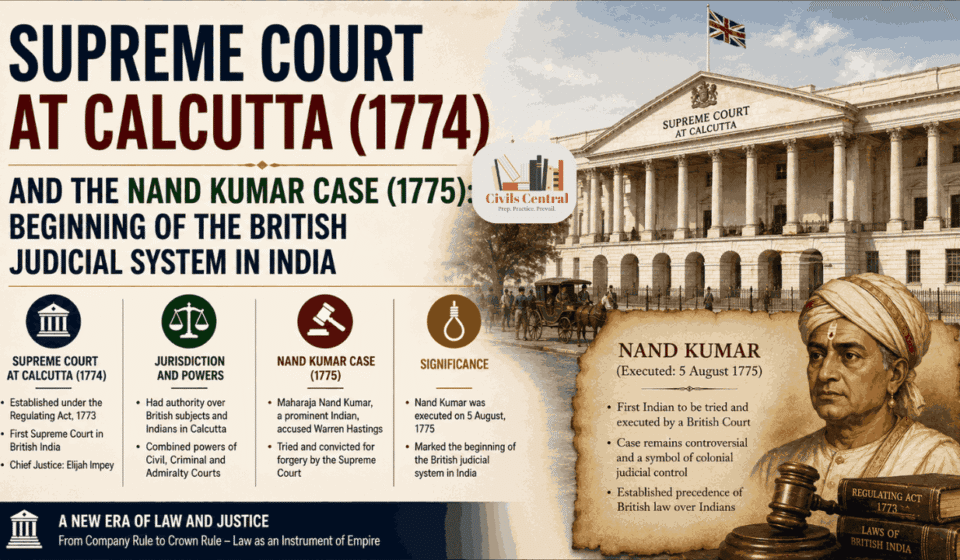
Supreme Court at Calcutta (1774) and the Nand Kumar Case (1775): Beginning of the British Judicial System in India

Chapter Summary
Supreme Court at Calcutta (1774) and the Nand Kumar Case (1775): Beginning of the British Judicial System in India:
| Chapter Information | Details |
|---|---|
| Series | Modern History of India (1707–1947) |
| Historical Period | 1774–1775 |
| Historical Phase | Constitutional and Judicial Development under Company Rule |
| Previous Chapter | Warren Hastings (1772–1785): Administrative, Judicial and Revenue Reforms |
| Current Chapter | Supreme Court at Calcutta (1774) and the Nand Kumar Case (1775) |
| Next Chapter | Pitt’s India Act (1784): Dual Control and Parliamentary Supervision |
| Core Theme | The establishment of the Supreme Court at Calcutta marked the beginning of an independent British judicial system in India, while the Nand Kumar Case exposed the constitutional conflict between the judiciary and the executive under Company Rule. |
| Major Events Covered | Regulating Act (1773), Establishment of the Supreme Court (1774), Charter of 1774, Jurisdiction of the Court, Conflict with Warren Hastings’ Government, Nand Kumar Case (1775), Impeachment Controversy |
| Key Personalities | Warren Hastings, Sir Elijah Impey, Raja Nand Kumar, Philip Francis, Lord North, Edmund Burke |
| Key Concepts | Rule of Law, Judicial Independence, Executive vs Judiciary, English Law in India, Constitutional Conflict, Judicial Authority |
| Exam Relevance | UPSC CSE, JKPSC, JKAS, State PCS, CDS, CAPF, SSC, UGC-NET (History), University Examinations |
Introduction
Why Was the Supreme Court at Calcutta Established?
The Regulating Act of 1773 represented the first major constitutional intervention by the British Parliament in the affairs of the English East India Company. While the Act created the office of the Governor-General of Bengal and introduced parliamentary supervision over Company administration, it also sought to establish a judicial institution capable of administering justice independently of the Company’s executive government. Parliament believed that the rapid territorial expansion of the Company had created a political authority that required not only efficient administration but also a regular system of law capable of protecting rights, resolving disputes, and checking abuses of power.
Accordingly, the Royal Charter of 1774 established the Supreme Court at Calcutta, the first Crown-created superior court in British India. Unlike the earlier Mayor’s Courts, which possessed limited jurisdiction, the Supreme Court was a court of record exercising broad civil, criminal, admiralty, ecclesiastical, and equity jurisdiction. It symbolized the direct involvement of the British Crown in the judicial administration of India and introduced the principles of English common law into the colonial legal system.
However, the constitutional experiment soon encountered serious difficulties.
The Regulating Act had not clearly defined the relationship between the Supreme Court and the Governor-General’s Council, nor had it specified the precise extent of the Court’s jurisdiction over Indians living outside Calcutta. The judges interpreted their authority broadly, while the executive government believed that judicial interference threatened effective administration. This ambiguity produced repeated constitutional conflicts between the judiciary and the executive, exposing one of the major weaknesses of the Regulating Act.
The most famous of these controversies emerged in 1775 through the Nand Kumar Case.
Raja Nand Kumar, a prominent Bengali official, accused Warren Hastings of accepting bribes from Munni Begum. Before these allegations could be investigated politically, Nand Kumar himself was prosecuted before the Supreme Court on charges of forgery under English law. He was convicted and sentenced to death by hanging.
The execution created an immediate political storm.
Many contemporaries believed that the trial had been influenced by political considerations because Sir Elijah Impey, the Chief Justice, was a close associate of Warren Hastings. Although legal historians continue to debate the correctness of the judgment, the case became one of the most controversial episodes in the history of British India and later formed an important charge during Hastings’ impeachment.
The establishment of the Supreme Court at Calcutta and the Nand Kumar Case therefore occupy a central place in Indian constitutional history. Together, they illustrate the opportunities and limitations of the first British judicial institutions in India, reveal the constitutional tensions between executive authority and judicial independence, and demonstrate the difficulties of applying English law within a diverse Indian society.
Part I — Why Was the Supreme Court at Calcutta Established? Historical Background and Constitutional Context
Why Did the British Parliament Feel the Need for a Supreme Court in India?
The establishment of the Supreme Court at Calcutta in 1774 was one of the most important constitutional developments in the early history of British India. It represented the first serious attempt by the British Crown to create an independent judicial institution capable of administering justice within the expanding territories of the English East India Company.
This development did not occur in isolation.
It was the outcome of profound political, administrative, and constitutional changes that had transformed the Company during the previous two decades. The victories at Plassey (1757) and Buxar (1764), followed by the Treaty of Allahabad (1765) and the Grant of the Diwani, converted the Company from a commercial enterprise into the effective ruler of vast territories in eastern India. As the Company acquired sovereign powers, questions naturally arose regarding the administration of justice, the protection of legal rights, and the constitutional limits of executive authority.
By the early 1770s, both the British Parliament and the Company itself recognized that an expanding territorial empire required a more organized judicial system than the one that already existed.
Judicial Administration Before 1774
Before the establishment of the Supreme Court, judicial administration in British settlements was neither uniform nor centrally organized. The Company primarily exercised judicial authority through Mayor’s Courts, which had been established under the Charter of 1726 in the Presidency towns of Calcutta, Madras, and Bombay.
These courts were mainly designed to resolve civil disputes involving British merchants, Company servants, and residents of the Presidency towns. Their jurisdiction remained limited. They were not intended to function as superior constitutional courts, nor did they possess authority over the vast rural territories that came under Company control after the acquisition of the Diwani.
Outside the Presidency towns, judicial administration continued largely according to the traditional Mughal legal system, supervised by local Indian officials such as Qazis, Muftis, and revenue authorities. As Company territories expanded rapidly after 1765, this fragmented judicial arrangement became increasingly inadequate.
The Company governed millions of people but lacked a unified judicial institution capable of ensuring consistent administration of justice throughout its territories.
The Expansion of Company Rule Created New Judicial Problems
The transformation of the Company into a territorial power fundamentally altered its responsibilities. Originally established for commercial purposes, the Company had never been expected to administer justice on behalf of an empire. However, after obtaining the Diwani, it became responsible for revenue administration, civil governance, and the maintenance of political authority across Bengal, Bihar, and Orissa.
These new responsibilities generated entirely new legal questions. Disputes increasingly arose between Company officials and Indian subjects. Questions emerged regarding the legality of executive actions, the protection of property rights, contractual obligations, criminal jurisdiction, and the authority of different administrative institutions. The existing judicial system lacked both the authority and the institutional capacity to resolve these issues effectively.
Consequently, many British politicians concluded that judicial administration should no longer remain entirely under the influence of Company officials. Instead, an independent court created directly by the British Crown appeared necessary to uphold the rule of law.
The Regulating Act of 1773 and Judicial Reform
The immediate constitutional foundation for the Supreme Court was laid by the Regulating Act of 1773. The Act represented Parliament’s first comprehensive attempt to regulate the political administration of the East India Company. While much attention has been given to its creation of the office of the Governor-General of Bengal, the Act also contained an equally significant judicial provision.
It authorized the British Crown to establish a Supreme Court of Judicature at Fort William in Calcutta through a Royal Charter. This provision reflected Parliament’s belief that the administration of justice should not remain entirely dependent upon executive authority. A judicial institution created under the authority of the Crown would enjoy greater independence than courts established directly by the Company.
Thus, for the first time, Parliament sought to separate judicial authority from the executive administration of Company Rule. This marked the beginning of the constitutional principle of an independent judiciary in British India.
The Royal Charter of 1774
Acting under the authority granted by the Regulating Act, King George III issued the Royal Charter of 1774, formally establishing the Supreme Court at Fort William, Calcutta. The Court began functioning in 1774, replacing the earlier Mayor’s Court.
Its composition reflected the importance attached to judicial independence. The Court consisted of:
- One Chief Justice
- Three Puisne (Associate) Judges
All judges were appointed directly by the British Crown, not by the East India Company. The first Chief Justice was Sir Elijah Impey, while the other judges included Stephen Caesar Lemaistre, John Hyde, and Robert Chambers. Because the judges derived their authority from the Crown rather than the Company, the Supreme Court occupied a constitutional position independent of the Governor-General and the Executive Council.
This institutional arrangement represented an important innovation in the constitutional development of British India.
Objectives Behind Establishing the Supreme Court
The creation of the Supreme Court served several important constitutional and administrative objectives. The first objective was to establish an independent judicial authority capable of administering justice without direct executive control. The second objective was to ensure that British subjects residing in India remained subject to English law administered by professionally trained judges. A third objective was to improve public confidence in Company administration by creating an institution capable of checking abuses of power and protecting legal rights.
Finally, Parliament hoped that the Court would strengthen the constitutional legitimacy of British rule by demonstrating that political authority would operate within the framework of law rather than arbitrary executive discretion.
Thus, the Supreme Court was conceived not merely as a judicial institution but as an essential component of constitutional government in British India.
Constitutional Importance of the Supreme Court
The establishment of the Supreme Court marked a turning point in the constitutional evolution of British India. For the first time, judicial authority in India derived directly from the British Crown rather than the East India Company. This reflected a broader constitutional transformation initiated by the Regulating Act of 1773. The British Parliament no longer regarded India merely as the sphere of a commercial corporation.
Instead, it increasingly viewed India as a territory requiring organized institutions of government operating under constitutional principles. However, the constitutional experiment contained a serious weakness. Neither the Regulating Act nor the Royal Charter clearly defined the relationship between the Supreme Court and the executive government headed by the Governor-General.
Nor did they specify the precise limits of the Court’s jurisdiction over Indians living outside Calcutta. These ambiguities soon produced intense constitutional conflicts between the judiciary and the executive, making the Supreme Court one of the most controversial institutions of early British India.
CivilsCentral Historical Insight
The Supreme Court at Calcutta was far more than a new court of law. It represented the first attempt to establish an independent judicial authority under the British Crown in India. By separating judicial power from Company administration, Parliament introduced the constitutional principle that executive authority should operate under the supervision of law. Yet the vague jurisdiction granted to the Court also created conflicts that exposed the weaknesses of the Regulating Act of 1773, making the Supreme Court both a milestone in constitutional development and a source of prolonged institutional controversy.
Part II — Composition, Jurisdiction and Powers of the Supreme Court at Calcutta: What Made It the First Superior Court in British India?
How Was the Supreme Court Organized?
The Royal Charter of 1774, issued under the authority of the Regulating Act of 1773, established the Supreme Court of Judicature at Fort William, Calcutta as the highest judicial institution in British India. Unlike the earlier Mayor’s Court, which possessed limited jurisdiction and functioned primarily as a municipal court for European residents, the Supreme Court was conceived as a superior court of record exercising extensive judicial authority.
The Court derived its authority directly from the British Crown, not from the English East India Company. This constitutional distinction was extremely significant.
While the Governor-General and the Executive Council exercised authority on behalf of the Company, the judges represented the judicial authority of the Crown. Consequently, the Supreme Court occupied an independent constitutional position within the administrative structure established by the Regulating Act.
This separation between executive and judicial authority was one of the earliest attempts to introduce the principle of judicial independence into British India.
Composition of the Supreme Court
The Supreme Court consisted of one Chief Justice and three Puisne (Associate) Judges, all appointed directly by the British Crown.
The first judges appointed to the Court were:
| Judge | Position |
|---|---|
| Sir Elijah Impey | Chief Justice |
| Stephen Caesar Lemaistre | Puisne Judge |
| John Hyde | Puisne Judge |
| Robert Chambers | Puisne Judge |
All four judges were professionally trained lawyers who had practiced before English courts. This represented a significant departure from earlier judicial institutions in India, where many judges lacked formal legal education and judicial administration often depended upon Company officials or municipal authorities.
The appointment of experienced legal professionals reflected Parliament’s intention to create a court capable of administering justice according to established legal principles rather than executive convenience.
A Court of Record
The Supreme Court was established as a Court of Record. A Court of Record possesses two important constitutional characteristics. First, it permanently records its judicial proceedings, judgments, and orders, creating authoritative legal precedents for future cases. Second, it possesses the inherent authority to punish acts of contempt of court, thereby protecting the dignity and effectiveness of the judicial process. These powers gave the Supreme Court greater institutional authority than any previous judicial body established by the Company.
Its decisions carried significant legal weight and contributed to the gradual development of judicial precedent within British India.
Civil Jurisdiction
One of the principal functions of the Supreme Court was the exercise of civil jurisdiction.
The Court heard disputes relating to:
- Contracts
- Property
- Commercial transactions
- Debt recovery
- Succession
- Civil rights
Initially, its civil jurisdiction primarily extended to:
- British subjects residing in Bengal.
- Company servants.
- European merchants.
- Persons living within the town of Calcutta who came within the Court’s authority.
However, the judges frequently interpreted their jurisdiction more broadly. They sometimes claimed authority over Indian inhabitants who had commercial dealings with British subjects or whose cases involved Company officials. This expansive interpretation later became one of the principal causes of constitutional conflict between the judiciary and the executive government.
Criminal Jurisdiction
The Supreme Court also exercised extensive criminal jurisdiction. It possessed authority to try offences committed by British subjects within its jurisdiction.
Serious criminal offences such as:
- Murder
- Forgery
- Fraud
- Theft
- Assault
- Conspiracy
could all be heard before the Court according to English criminal law.
One of the most famous criminal proceedings conducted by the Supreme Court was the trial of Raja Nand Kumar in 1775, who was prosecuted for forgery and sentenced to death. The Nand Kumar Case subsequently became one of the most controversial judicial decisions in the history of British India.
Admiralty Jurisdiction
The Supreme Court also exercised Admiralty Jurisdiction, enabling it to decide disputes arising from maritime commerce. Since Calcutta had become an important commercial centre connected with international trade through the Hooghly River, numerous disputes involved shipping, navigation, maritime contracts, insurance, and cargo. The Court therefore possessed authority over legal matters relating to maritime trade.
This jurisdiction reflected the continuing commercial importance of the English East India Company even as it evolved into a territorial government.
Ecclesiastical Jurisdiction
In addition to civil and criminal authority, the Supreme Court also exercised Ecclesiastical Jurisdiction. This jurisdiction concerned matters affecting members of the Church of England residing in British India.
The Court dealt with issues such as:
- Probate of wills.
- Administration of estates.
- Marriage-related matters involving Christians.
- Other ecclesiastical legal proceedings recognized under English law.
Although this jurisdiction affected only a relatively small section of the population, it reflected the Court’s character as a British institution operating according to English constitutional and legal traditions.
Equity Jurisdiction
The Supreme Court also possessed Equity Jurisdiction. Courts of equity were empowered to provide remedies where strict application of common law might produce injustice. In appropriate circumstances, the judges could issue equitable relief based upon principles of fairness, justice, and good conscience.
This authority enabled the Court to exercise considerable judicial discretion in resolving complex legal disputes. The inclusion of equity jurisdiction further strengthened the Court’s position as a comprehensive superior court modeled upon the judicial system of England.
Application of English Law
Perhaps the most distinctive feature of the Supreme Court was its application of English law. Unlike the judicial system created by Warren Hastings, where Hindu law and Islamic law continued to govern personal matters, the Supreme Court administered English legal principles derived from:
- English Common Law.
- Statutory Law.
- Principles of Equity.
This introduced an entirely new legal tradition into India. However, the application of English law also generated serious practical difficulties. Many Indian inhabitants had little familiarity with English legal procedures, while several offences recognized under English law had no equivalent under existing Indian legal traditions.
The differences between these legal systems became dramatically evident during the Nand Kumar Case, where an Indian official was convicted under English criminal law for an offence that carried a different legal significance within the traditional Indian judicial system.
Constitutional Ambiguity in Jurisdiction
Despite its impressive judicial powers, the Supreme Court suffered from one major constitutional weakness. The Royal Charter of 1774 did not define with sufficient clarity the territorial and personal limits of its jurisdiction. The judges interpreted their authority broadly, often claiming jurisdiction over Company officials, Indian inhabitants, and administrative matters extending far beyond the town of Calcutta.
The Governor-General and Executive Council, however, believed that the Court should exercise jurisdiction primarily over British subjects residing within Calcutta. This difference in interpretation soon produced repeated constitutional conflicts. Instead of complementing executive administration, the Supreme Court frequently challenged administrative decisions, leading to serious disputes that threatened the efficient functioning of government.
These jurisdictional controversies ultimately compelled Parliament to enact the Act of Settlement (1781), which clarified and restricted the powers of the Court.
CivilsCentral Historical Insight
The Supreme Court at Calcutta introduced the first professionally organized superior judiciary in British India. As a Court of Record exercising civil, criminal, admiralty, ecclesiastical, and equity jurisdiction under English law, it represented the direct judicial authority of the British Crown. Yet its greatest strength—its broad judicial authority—also became its greatest weakness. The vague jurisdiction granted by the Royal Charter led to repeated clashes with the executive, demonstrating that judicial independence without clearly defined constitutional limits could generate institutional conflict rather than constitutional stability.
Part III — Constitutional Conflicts Between the Supreme Court and the Executive: Why Did the First British Judicial System Face Immediate Opposition?
Why Did Conflict Arise Soon After the Supreme Court Was Established?
The establishment of the Supreme Court at Calcutta in 1774 was intended to strengthen the administration of justice under British rule. Parliament expected that an independent judiciary would ensure the rule of law, protect legal rights, and check arbitrary exercise of executive authority. However, within a short period of its establishment, the Court became the centre of intense constitutional controversy.
The primary reason for this conflict lay in the Regulating Act of 1773 and the Royal Charter of 1774, both of which failed to define clearly the relationship between the Supreme Court and the Governor-General’s Council. While the judges believed that the Court possessed extensive judicial authority over all persons living within the Company’s territories, the executive government argued that the Court’s jurisdiction should remain confined largely to British subjects residing in Calcutta.
This disagreement created one of the earliest constitutional crises in British India. Instead of functioning as complementary institutions, the judiciary and the executive frequently challenged each other’s authority.
Conflict Over Jurisdiction
The most important constitutional dispute concerned the extent of the Court’s jurisdiction. The judges interpreted the Royal Charter broadly. They argued that since the English East India Company governed Bengal on behalf of the British Crown, the Supreme Court possessed authority over:
- Company officials.
- British subjects.
- Indian inhabitants connected with Company administration.
- Persons residing outside Calcutta in certain circumstances.
The executive government rejected this interpretation. Warren Hastings and his Council maintained that the Court had been established primarily to administer justice within the Presidency town of Calcutta and should not interfere with the ordinary administration of the provinces.
According to the executive, extending English judicial authority throughout Bengal would seriously disrupt administration because most Indian institutions continued to function according to traditional laws and customs.
The absence of clear constitutional provisions allowed both interpretations to appear legally plausible, thereby intensifying institutional conflict.
Conflict Between English Law and Indian Legal Traditions
A second source of controversy arose from the Court’s application of English law. The judicial reforms introduced by Warren Hastings had deliberately preserved the principle that:
- Hindu law should govern Hindus in matters of religion, marriage, inheritance, and family.
- Islamic law should govern Muslims in corresponding personal matters.
The Supreme Court, however, administered justice primarily according to English common law. This created practical difficulties because English legal principles often differed significantly from established Indian legal traditions. Many Indian inhabitants neither understood English legal procedures nor expected disputes to be decided according to unfamiliar legal principles.
Consequently, the application of English law occasionally appeared inconsistent with existing social and legal customs, generating dissatisfaction among both Company administrators and Indian litigants. The conflict therefore extended beyond constitutional questions to include broader issues concerning the appropriate legal system for governing a culturally diverse society.
Judicial Interference in Executive Administration
Another important cause of conflict was the Court’s willingness to examine actions taken by executive authorities. The judges believed that Company officials were subject to judicial review and could be held legally accountable for actions performed in their official capacity. Accordingly, the Supreme Court occasionally summoned Company servants, questioned administrative decisions, and entertained legal proceedings against executive officials.
Warren Hastings regarded such intervention as highly problematic. He argued that effective administration required executive officers to perform their duties without constant judicial interference. If every administrative decision could become the subject of litigation before the Supreme Court, government itself would become inefficient and uncertain.
Thus, both institutions claimed to be defending constitutional principles. The judiciary emphasized the rule of law, while the executive emphasized the practical necessities of governance. The constitutional framework established by the Regulating Act failed to reconcile these competing objectives.
Conflict with the Revenue Administration
Revenue administration became another important area of disagreement. The English East India Company depended upon efficient collection of land revenue to finance its civil administration and military establishment. Executive officials therefore considered revenue administration an essential governmental function.
The Supreme Court, however, occasionally accepted cases involving revenue officials and administrative actions connected with revenue collection. Executive authorities feared that judicial intervention would delay revenue collection, weaken administrative discipline, and encourage unnecessary litigation against Company officers. This conflict reflected a broader constitutional issue.
Should judicial institutions possess authority to review executive decisions involving matters of public administration? The Regulating Act provided no clear answer. As a result, constitutional uncertainty continued to increase.
The Governor-General Versus the Chief Justice
The institutional conflict was also influenced by differences in personality and administrative philosophy. Warren Hastings, as Governor-General, believed that maintaining political stability required practical flexibility and administrative discretion. Sir Elijah Impey, as Chief Justice, maintained that executive power should remain subject to legal supervision.
Although Hastings and Impey were personally close associates, the institutions they represented increasingly occupied competing constitutional positions. Ironically, later political controversies—including the Nand Kumar Case—would lead many critics to accuse Impey of favouring Hastings rather than opposing him.
Nevertheless, the broader constitutional conflict between the judiciary and the executive remained real and continued throughout the early years of the Supreme Court’s existence.
Consequences of the Constitutional Conflict
The disputes between the Supreme Court and the executive produced significant administrative difficulties. Government officials often became uncertain regarding the limits of their authority. Judicial proceedings occasionally interrupted administrative activities. Public confusion increased because different institutions claimed overlapping powers.
Most importantly, Parliament realized that the constitutional arrangements established by the Regulating Act of 1773 were incomplete. The Supreme Court had been created to strengthen the rule of law, yet the absence of clearly defined jurisdiction had instead produced constitutional instability.
The experience demonstrated that judicial independence, while essential, required carefully defined constitutional boundaries.
The Need for Constitutional Clarification
By the end of the 1770s, it had become evident that the relationship between the Supreme Court and the executive government required legislative clarification. Neither the Company nor the British Parliament wished to weaken the judiciary. At the same time, efficient administration could not continue if constitutional disputes remained unresolved.
Parliament therefore enacted the Act of Settlement (1781), which clarified the jurisdiction of the Supreme Court, restricted judicial interference in executive administration, and defined more precisely the constitutional relationship between the judiciary and the Governor-General’s Council.
This legislation became one of the earliest examples of constitutional adjustment in British India, demonstrating that the institutions created by the Regulating Act required further refinement through practical experience.
CivilsCentral Historical Insight
The constitutional conflict between the Supreme Court and the Governor-General’s Council revealed one of the greatest weaknesses of the Regulating Act of 1773. By creating an independent judiciary without clearly defining its jurisdiction, Parliament unintentionally produced institutional rivalry between the executive and the judiciary. The resulting disputes demonstrated that constitutional government required not only independent institutions but also clearly demarcated powers—a lesson that directly led to the Act of Settlement (1781).
Part IV — The Nand Kumar Case (1775): Was It a Judicial Decision or a Judicial Murder?
Why Is the Nand Kumar Case One of the Most Controversial Trials in Indian History?
Among all the controversies associated with the Supreme Court at Calcutta, none attracted greater attention than the trial and execution of Raja Nand Kumar in 1775. The case occupies a unique place in the constitutional history of British India because it brought together questions of judicial independence, executive influence, English criminal law, and political accountability.
To some contemporaries, the trial represented the impartial application of English law by an independent court. To others, it appeared to be a politically motivated prosecution designed to eliminate a powerful critic of Warren Hastings.
For nearly two and a half centuries, historians have continued to debate whether the execution of Nand Kumar was a lawful judicial decision or one of the earliest examples of the misuse of colonial justice for political purposes.
Who Was Raja Nand Kumar?
Raja Nand Kumar (also known as Maharaja Nuncomar) was an influential Bengali administrator who had served under the Nawab of Bengal before the expansion of Company Rule. He possessed considerable administrative experience and maintained close connections with influential political circles in Bengal.
After the establishment of British authority, Nand Kumar continued to participate in provincial administration and became one of the prominent Indian figures interacting with the English East India Company. His political importance increased because he maintained contact with members of the Governor-General’s Council, particularly those who frequently opposed Warren Hastings, such as Philip Francis.
This political alignment would later prove crucial in the events leading to his trial.
Allegations Against Warren Hastings
In 1775, Raja Nand Kumar presented serious allegations against Warren Hastings before the Governor-General’s Council. He accused Hastings of accepting substantial bribes from Munni Begum, who had been appointed guardian of the young Nawab of Bengal. According to Nand Kumar, these payments had influenced important administrative appointments.
The accusations generated immediate political controversy. Several members of the Council, especially those already critical of Hastings’ administration, demanded that the allegations be investigated. For Warren Hastings, these charges threatened not only his political authority but also his personal reputation.
Before the Council could pursue the matter further, however, events took an unexpected turn.
The Forgery Charge
Shortly after making these allegations, Raja Nand Kumar himself was arrested on an entirely different matter. He was charged with forging a bond relating to a financial transaction that had allegedly occurred several years earlier. The case was brought before the newly established Supreme Court at Calcutta, where it was tried under English criminal law.
This immediately raised important constitutional questions. The alleged offence had occurred before the establishment of the Supreme Court. Moreover, forgery under traditional Indian legal systems did not ordinarily carry the death penalty. However, under the Forgery Act of English law, forgery constituted a capital offence, punishable by death.
The application of English criminal law to an Indian official for an act committed before the creation of the Court soon became one of the principal sources of historical controversy.
Trial Before the Supreme Court
The trial commenced before the Supreme Court under the presidency of Chief Justice Sir Elijah Impey. A jury found Nand Kumar guilty of forgery after examining the evidence presented during the proceedings. Following English legal principles applicable at the time, the Court sentenced him to death by hanging.
On 5 August 1775, Raja Nand Kumar was executed at Calcutta. His execution shocked many contemporary observers. It was the first recorded execution of an Indian by the Supreme Court under English criminal law. The severity of the punishment, the political circumstances surrounding the case, and the recent accusations against Warren Hastings immediately gave rise to widespread suspicion.
Many believed that the judicial process had been influenced by political considerations.
Why Did the Trial Become So Controversial?
Several factors contributed to the extraordinary controversy surrounding the Nand Kumar Case. First, the prosecution occurred immediately after Nand Kumar had accused Warren Hastings of corruption. The close timing of these events led many contemporaries to suspect political retaliation. Second, Chief Justice Sir Elijah Impey was known to be a personal friend of Warren Hastings. Although no direct evidence established judicial misconduct, critics argued that this relationship created an appearance of partiality inconsistent with judicial independence.
Third, the Court applied English criminal law to an Indian defendant for an offence allegedly committed before the establishment of the Supreme Court. Many observers questioned whether such retrospective application of jurisdiction was constitutionally justified. Finally, the punishment itself appeared unusually severe. Forgery, though undoubtedly a serious offence under English law, had not traditionally attracted capital punishment under prevailing Indian legal practices.
These factors combined to make the case one of the most disputed judicial proceedings in colonial history.
Edmund Burke and the Charge of Judicial Murder
The Nand Kumar Case later assumed great importance during the impeachment of Warren Hastings. Edmund Burke, the principal architect of the impeachment proceedings, regarded the execution as evidence of the misuse of political power. He argued that the prosecution had effectively removed the principal witness against Hastings before the corruption allegations could be properly investigated.
Many critics therefore described the execution as “judicial murder.” This expression suggested that although the execution had been carried out through formal legal procedures, the judicial process itself had been manipulated to achieve political objectives. The phrase became one of the most enduring descriptions associated with the case.
However, it is important to note that the British Parliament never legally established that Warren Hastings had conspired to procure Nand Kumar’s conviction.
The allegation remained part of the political controversy rather than a judicially proven fact.
Modern Historical Assessment
Modern historians generally approach the Nand Kumar Case with greater caution than many earlier writers. Most scholars acknowledge that the trial was conducted according to the English law then applicable within the jurisdiction claimed by the Supreme Court. At the same time, they recognize that the constitutional circumstances surrounding the case created understandable doubts regarding the fairness of the proceedings.
Historians emphasize that the controversy arose not only from the legal judgment itself but also from broader constitutional questions:
- Should English criminal law have been applied in this manner?
- Did the Supreme Court possess valid jurisdiction over the case?
- Could judicial independence be maintained when senior judges maintained close personal relationships with executive authorities?
These questions extend beyond the individual trial and illustrate the wider constitutional difficulties created by the Regulating Act of 1773.
Historical Significance of the Nand Kumar Case
The Nand Kumar Case occupies a landmark position in the constitutional history of British India. It demonstrated the practical difficulties involved in introducing English legal institutions into an Indian society governed by different legal traditions. It exposed the dangers arising from vague judicial jurisdiction and highlighted the importance of maintaining both the reality and the appearance of judicial independence.
Most importantly, the controversy contributed to growing criticism of the constitutional framework established by the Regulating Act of 1773. Together with other disputes involving the Supreme Court, it strengthened demands for legislative clarification, eventually leading to the Act of Settlement (1781).
Thus, although the trial concerned a single individual, its constitutional consequences extended far beyond the immediate case.
CivilsCentral Historical Insight
The Nand Kumar Case (1775) was far more than a criminal trial. It became the first major test of the relationship between law, politics, and executive authority under British rule in India. Whether viewed as a lawful application of English criminal law or as an instance of “judicial murder,” the case exposed the constitutional weaknesses of the newly established Supreme Court and demonstrated that judicial independence required not only legal authority but also public confidence in judicial impartiality.
Part V — The Act of Settlement (1781): How Were the Conflicts Between the Supreme Court and the Executive Resolved?
Why Did Parliament Pass the Act of Settlement?
Within a few years of the establishment of the Supreme Court at Calcutta, it became evident that the constitutional arrangements created by the Regulating Act of 1773 were incomplete. Instead of promoting harmonious governance, the relationship between the judiciary and the executive had become a source of continuous conflict. Disputes over jurisdiction, the application of English law, judicial interference in revenue administration, and controversies such as the Nand Kumar Case revealed that the constitutional boundaries between different institutions had not been clearly defined.
The British Parliament recognized that these disputes threatened both efficient administration and public confidence in British justice. On the one hand, the Supreme Court claimed extensive judicial authority in the name of the rule of law. On the other hand, the Governor-General and the Executive Council argued that excessive judicial intervention made effective administration increasingly difficult.
Neither institution could function efficiently unless their respective powers were clearly demarcated. To resolve this constitutional crisis, Parliament enacted the Act of Settlement (1781), also known as the Declaratory Act of 1781. Its primary objective was not to weaken the judiciary but to clarify the constitutional relationship between the Supreme Court, the Governor-General’s Council, and the Company’s provincial administration.
Clarification of the Supreme Court’s Jurisdiction
The most important provision of the Act related to the jurisdiction of the Supreme Court. The vague language of the Royal Charter of 1774 had enabled the judges to interpret their powers broadly. The Act of Settlement therefore defined these powers more precisely.
It clarified that the Supreme Court’s ordinary jurisdiction primarily extended to:
- British subjects residing in Calcutta.
- Persons living within the Presidency town who fell under the Court’s legal authority.
- Company servants in matters specifically covered by law.
This clarification significantly reduced the uncertainty that had existed since 1774. The Court could no longer claim unrestricted authority over the entire population of Bengal merely because the Company governed the province. The Act therefore established clearer constitutional limits upon judicial power.
Protection of Revenue Administration
One of the major concerns of Warren Hastings’ government had been judicial interference in revenue administration. The Company depended almost entirely upon land revenue to finance its civil government and military establishment. Executive authorities argued that frequent litigation against revenue officials disrupted financial administration and delayed revenue collection.
The Act of Settlement accepted this concern.
It provided that the Supreme Court should not interfere in matters relating to revenue administration carried out by Company officials in their official capacity. Revenue officers performing their lawful administrative duties received protection from unnecessary judicial intervention. This provision represented a significant constitutional compromise.
It recognized that while judicial supervision remained essential, certain governmental functions required protection from excessive litigation in order to ensure administrative efficiency.
Protection of Executive Officials
The Act also clarified the legal position of the Governor-General, the Executive Council, and other Company officials. It declared that officials acting in their official capacity under lawful authority would enjoy protection against routine judicial proceedings relating to administrative actions. This did not place executive officers above the law.
Rather, it recognized that governmental decisions should ordinarily be reviewed through appropriate constitutional mechanisms rather than through constant interference by ordinary judicial proceedings. The provision strengthened executive confidence while preserving the broader principle of legal accountability. It also reduced one of the principal causes of conflict between the Supreme Court and the executive administration.
Recognition of Indian Personal Laws
Another important feature of the Act of Settlement was its recognition of the continued importance of Indian personal laws. Parliament accepted that India possessed long-established legal traditions which could not simply be replaced by English law.
Accordingly, the Act reaffirmed that:
- Hindu law should govern Hindus in matters relating to religion, inheritance, marriage, caste, and family affairs.
- Islamic law should govern Muslims in corresponding personal matters.
This provision strengthened the legal policy already introduced by Warren Hastings’ Judicial Plan of 1772. It acknowledged that the administration of justice in India required respect for indigenous legal traditions alongside the operation of British judicial institutions.
This principle remained a defining feature of colonial judicial administration throughout much of the nineteenth century.
Reduction of Constitutional Conflict
The immediate consequence of the Act of Settlement was a substantial reduction in constitutional disputes. The Supreme Court continued to function as the highest judicial authority established by the Crown, but its powers were now exercised within more clearly defined constitutional limits.
The executive government likewise obtained greater certainty regarding the scope of its administrative authority. Although occasional disagreements continued, the intense institutional conflicts that had characterized the years 1774–1781 gradually diminished.
The Act therefore restored greater stability to the constitutional system established under the Regulating Act of 1773.
Constitutional Significance of the Act of Settlement
The Act of Settlement (1781) occupies an important position in the constitutional development of British India. It represented one of the earliest examples of Parliament modifying colonial institutions in response to practical administrative experience. Rather than abolishing the Supreme Court or weakening judicial independence, Parliament refined the constitutional framework by defining the powers of different institutions more clearly.
The legislation also demonstrated an important constitutional principle. An effective system of government requires not merely independent institutions but clearly defined jurisdictions. The conflicts between the Supreme Court and the executive had shown that institutional independence without constitutional clarity could produce administrative paralysis.
The Act of Settlement therefore became an early lesson in constitutional design under British rule.
Legacy of the Act of Settlement
Although later constitutional reforms—particularly Pitt’s India Act (1784) and the Charter Acts—introduced additional changes, the Act of Settlement successfully resolved many of the immediate problems created by the Regulating Act of 1773. It clarified the relationship between the judiciary and the executive, protected revenue administration, recognized Indian personal laws, and strengthened the practical functioning of British government in India.
The Act thus represents an important stage in the gradual constitutional evolution of British India. It demonstrated that constitutional institutions could be modified through legislative experience, creating a more balanced relationship between judicial independence and executive efficiency.
CivilsCentral Historical Insight
The Act of Settlement (1781) was the first constitutional correction to the Regulating Act of 1773. By defining the jurisdiction of the Supreme Court, protecting executive and revenue administration from unnecessary judicial interference, and reaffirming the application of Hindu and Islamic personal laws, Parliament transformed a period of constitutional conflict into one of greater institutional stability. The Act demonstrated that successful constitutional government depends not only on independent institutions but also on clearly defined limits to their powers.
Part VI — Historiography of the Supreme Court at Calcutta and the Nand Kumar Case: How Have Historians Interpreted the First Constitutional Crisis in British India?
Why Do Historians Continue to Debate the Supreme Court and the Nand Kumar Case?
The establishment of the Supreme Court at Calcutta (1774) and the Nand Kumar Case (1775) remain among the most debated events in the constitutional history of British India. While there is broad agreement that the Supreme Court represented a major step towards the development of an organized judicial system, historians differ significantly in their assessment of its objectives, functioning, and political consequences.
The principal controversy concerns two related questions. First, was the Supreme Court genuinely intended to establish the rule of law, or was it primarily an instrument for strengthening British authority in India?
Second, was the execution of Raja Nand Kumar an impartial application of English criminal law, or was it influenced by political considerations designed to protect Warren Hastings?
The answers to these questions have varied according to different schools of historical interpretation.
Imperial Historiography: The Beginning of the Rule of Law
Early British or Imperial historians regarded the establishment of the Supreme Court as one of the greatest constitutional achievements of the Regulating Act of 1773. According to this interpretation, the rapid territorial expansion of the English East India Company required an independent judicial institution capable of protecting legal rights and ensuring that executive power remained subject to law.
Imperial historians argued that the Supreme Court introduced important constitutional principles previously absent from Company administration. For the first time, professionally trained judges appointed by the British Crown administered justice independently of the Company’s executive government. The Court strengthened legal certainty, protected property rights, and established judicial procedures based upon English legal traditions.
From this perspective, the conflicts between the Court and the executive were viewed not as institutional failures but as evidence that the judiciary was performing its constitutional duty by preventing arbitrary government.
Similarly, many Imperial historians defended the judgment in the Nand Kumar Case, arguing that the judges merely applied the law then in force without political interference.
Nationalist Historiography: Justice in the Service of Colonial Rule
Indian nationalist historians presented a markedly different interpretation. While acknowledging the constitutional importance of the Supreme Court, they argued that its primary function was to strengthen the legal foundations of British colonial rule rather than to protect the interests of the Indian population.
According to this view, the introduction of English law often ignored established Indian legal traditions and subjected Indians to unfamiliar judicial procedures. Nationalist historians regarded the Nand Kumar Case as the clearest example of this problem.
They pointed out that Nand Kumar was prosecuted soon after accusing Warren Hastings of corruption, was tried under English criminal law for an offence allegedly committed before the establishment of the Supreme Court, and received a punishment far more severe than would ordinarily have been imposed under prevailing Indian legal practices.
Many nationalist writers therefore described the execution as “judicial murder,” arguing that legal procedures had been used to eliminate a political opponent of the Governor-General.
Although direct evidence of conspiracy remained limited, the political circumstances surrounding the trial continued to generate deep suspicion.
Marxist Interpretation: Law as an Instrument of Colonial Power
Marxist historians approached the Supreme Court from the perspective of the colonial state. They argued that legal institutions established by the British were designed primarily to protect the economic and political interests of the East India Company. According to this interpretation, the Supreme Court strengthened the institutional framework necessary for the consolidation of colonial authority.
The introduction of English legal institutions helped create greater administrative stability, protected commercial transactions, and reinforced the political dominance of the colonial government. The Nand Kumar Case, from this perspective, symbolized the manner in which legal institutions could operate alongside executive authority to preserve the interests of the ruling colonial elite.
Marxist historians therefore interpreted the Court not merely as a judicial institution but as an important component of the broader machinery of colonial governance.
Revisionist Historiography: A Constitutional Experiment with Unintended Consequences
Modern revisionist historians generally reject both the highly favourable Imperial interpretation and the strongly critical nationalist interpretation. They argue that the Supreme Court should be understood within the broader constitutional context of the 1770s. The British Parliament had never previously attempted to establish a judicial institution for territories governed by a private commercial corporation exercising sovereign authority.
The Supreme Court therefore represented an experimental constitutional institution created in response to an unprecedented political situation. Revisionist historians emphasize that many conflicts arose not because judges or administrators acted in bad faith but because the Regulating Act of 1773 failed to define institutional powers clearly.
The judges interpreted their jurisdiction according to the broad language of the Royal Charter, while the executive interpreted the same constitutional provisions more narrowly. Similarly, the controversy surrounding the Nand Kumar Case reflected deeper constitutional uncertainties regarding jurisdiction, applicable law, and the relationship between English legal principles and Indian legal traditions.
According to this interpretation, the institutional weaknesses lay primarily in the constitutional framework rather than solely in the conduct of individual judges or administrators.
Modern Historical Consensus
Most contemporary historians accept several important conclusions. First, the Supreme Court at Calcutta represented the beginning of an independent judicial institution under the authority of the British Crown, introducing important constitutional principles such as judicial professionalism and the rule of law.
Second, the Court’s jurisdiction was insufficiently defined, leading to avoidable conflicts with the executive administration. Third, the Nand Kumar Case became controversial because legal proceedings occurred within a highly charged political environment, making it difficult to separate legal judgment from political perception. Finally, the constitutional disputes generated by the Supreme Court directly influenced the enactment of the Act of Settlement (1781), which clarified the Court’s jurisdiction and reduced institutional conflict.
Thus, historians generally regard the Supreme Court not as a failed institution but as the first constitutional experiment in establishing an independent judiciary in British India.
Historical Legacy
The Supreme Court at Calcutta occupies a permanent place in the constitutional history of India because it introduced principles that continue to influence modern legal systems. It demonstrated the importance of judicial independence, professional legal administration, appellate procedures, and constitutional limitations upon executive authority.
At the same time, the controversies surrounding its jurisdiction revealed that judicial independence must be accompanied by clearly defined constitutional boundaries. The Nand Kumar Case likewise remains an enduring reminder that public confidence in the judiciary depends not only upon legal correctness but also upon the perception of fairness and impartiality.
Together, the Supreme Court and the Nand Kumar Case illustrate both the achievements and the limitations of the earliest British judicial institutions in India.
CivilsCentral Historical Insight
The historiography of the Supreme Court at Calcutta and the Nand Kumar Case reflects the complexity of colonial constitutional development. Imperial historians celebrated the Court as the beginning of the rule of law, nationalist scholars viewed it as an instrument of colonial domination, Marxist historians emphasized its role in consolidating imperial power, while revisionist historians interpreted it as an imperfect constitutional experiment. Together, these perspectives reveal that the first British judicial institution in India was simultaneously a milestone in constitutional history and a source of profound political controversy.
Part VII — Conclusion: How Did the Supreme Court at Calcutta Shape the Constitutional Development of British India?
The Beginning of an Independent Judicial System
The establishment of the Supreme Court at Calcutta in 1774 marked one of the most significant milestones in the constitutional evolution of British India. For the first time, the British Crown created an independent superior court in India, separate from the executive authority of the English East India Company. This represented a decisive departure from the earlier judicial arrangements, in which courts largely functioned under Company supervision or municipal authority.
The Supreme Court introduced several enduring constitutional principles into Indian administration. It established professionally trained judges appointed directly by the Crown, exercised authority as a superior Court of Record, and administered justice according to established legal procedures. Through its civil, criminal, admiralty, ecclesiastical, and equity jurisdictions, it sought to provide a comprehensive judicial system capable of meeting the needs of an expanding colonial state.
In constitutional terms, the Court symbolized the growing involvement of the British Parliament and the British Crown in the governance of India, demonstrating that judicial authority should not remain entirely subordinate to executive administration.
Constitutional Successes and Institutional Weaknesses
Despite its importance, the Supreme Court immediately encountered serious constitutional difficulties.
The Regulating Act of 1773 and the Royal Charter of 1774 had created an independent judiciary but failed to define clearly the limits of its authority. As a result, the judges frequently interpreted their jurisdiction broadly, while the Governor-General’s Council adopted a much narrower interpretation. This disagreement produced repeated institutional conflicts involving executive administration, revenue collection, and the application of English law to Indian society.
The controversy reached its greatest intensity during the Nand Kumar Case (1775), which became one of the most debated judicial proceedings in colonial history. Although the conviction was legally delivered according to the English law then applied by the Supreme Court, the surrounding political circumstances generated widespread suspicion regarding the impartiality of colonial justice.
The case demonstrated that judicial independence required not only legal authority but also clearly defined constitutional boundaries and public confidence in judicial fairness.
The Importance of the Act of Settlement (1781)
The constitutional conflicts created by the Supreme Court ultimately compelled Parliament to intervene once again. Through the Act of Settlement (1781), Parliament clarified the Court’s jurisdiction, protected executive and revenue administration from unnecessary judicial interference, and reaffirmed the continued application of Hindu and Islamic personal laws in matters relating to religion, inheritance, marriage, and family affairs.
The Act did not diminish the importance of the judiciary. Instead, it strengthened the constitutional system by defining more clearly the relationship between the judiciary and the executive. This legislation demonstrated an important lesson in constitutional development. Independent institutions cannot function effectively unless their respective powers are carefully defined.
The Act of Settlement therefore completed the constitutional framework that the Regulating Act of 1773 had left unfinished.
Historical Legacy
The Supreme Court at Calcutta occupies a permanent place in the constitutional history of India because it laid the foundations of the modern judicial tradition under British rule. It introduced the concept of an independent superior judiciary, emphasized the professional administration of justice, and established the principle that executive authority should remain subject to legal scrutiny.
Although its jurisdiction was later modified, the institutional model created in 1774 influenced the subsequent development of the judicial system throughout the colonial period. The constitutional debates generated by the Court also shaped later legislative reforms, including Pitt’s India Act (1784), the Charter Acts, and the gradual evolution of judicial institutions across British India.
In this sense, the Supreme Court represented not merely a court of law but a major constitutional experiment whose successes and failures influenced the future development of British governance.
Final Reflection
The Supreme Court at Calcutta (1774) and the Nand Kumar Case (1775) together illustrate both the promise and the challenges of introducing constitutional government into colonial India. The Court represented the beginning of judicial independence under the British Crown, while the constitutional conflicts surrounding its jurisdiction revealed the practical difficulties of balancing judicial authority with executive administration.
The Nand Kumar Case further demonstrated that the legitimacy of the judiciary depends not only upon the correct application of law but also upon public confidence in its impartiality.
For students of Modern Indian History, the Supreme Court should therefore be remembered as the first superior court of British India, the Nand Kumar Case as the first major judicial controversy under Company Rule, and the Act of Settlement (1781) as the first constitutional correction to the judicial system established by the Regulating Act of 1773.
Together, these developments laid the constitutional foundations of the British judicial system in India and shaped the evolution of colonial governance for decades to come.
CivilsCentral Historical Insight
The Supreme Court at Calcutta was the first great constitutional experiment in establishing an independent judiciary in British India. It introduced the rule of law, judicial professionalism, and Crown-appointed judges into the colonial administration. Yet its early conflicts with the executive and the controversy surrounding the Nand Kumar Case demonstrated that constitutional governance requires more than independent institutions—it also requires clearly defined powers, respect for established legal traditions, and public confidence in judicial impartiality. The Act of Settlement (1781) completed this first phase of British judicial constitutionalism by restoring the balance between judicial independence and effective administration.
Part VIII — Key Takeaways from the Supreme Court at Calcutta (1774) and the Nand Kumar Case (1775)
The establishment of the Supreme Court at Calcutta in 1774 marked the beginning of the British judicial system in India. Created under the Regulating Act of 1773 through the Royal Charter of 1774, it was the first Crown-established superior court in British India. It introduced the principles of judicial independence, rule of law, and professional judiciary into colonial administration.
However, the Court’s broad interpretation of its jurisdiction soon brought it into conflict with the Governor-General’s Council, revealing serious constitutional weaknesses in the Regulating Act. These disputes culminated in the Nand Kumar Case (1775) and were ultimately resolved through the Act of Settlement (1781).
For UPSC aspirants, this chapter is important because it explains the origin of the British judicial system, the first constitutional conflict between the executive and the judiciary, and the beginning of judicial constitutionalism in India.
Timeline at a Glance
| Year | Event | Historical Importance |
|---|---|---|
| 1773 | Regulating Act | Authorized the establishment of the Supreme Court. |
| 1774 | Royal Charter issued | Established the Supreme Court at Fort William, Calcutta. |
| 1774 | Supreme Court began functioning | First superior court under the British Crown in India. |
| 1775 | Nand Kumar accused Warren Hastings | Alleged acceptance of bribes from Munni Begum. |
| 1775 | Trial of Raja Nand Kumar | Tried for forgery under English law. |
| 5 August 1775 | Execution of Nand Kumar | One of the most controversial judicial decisions in colonial India. |
| 1774–1781 | Executive–Judiciary conflicts | Jurisdictional disputes between the Supreme Court and Governor-General’s Council. |
| 1781 | Act of Settlement | Clarified the Court’s jurisdiction and reduced constitutional conflicts. |
Key Personalities
| Personality | Contribution |
|---|---|
| Warren Hastings | Governor-General involved in constitutional disputes with the Supreme Court. |
| Sir Elijah Impey | First Chief Justice of the Supreme Court at Calcutta. |
| Raja Nand Kumar | Accused Warren Hastings of corruption; later executed after conviction for forgery. |
| Philip Francis | Council member and political opponent of Warren Hastings. |
| Edmund Burke | Criticized the Nand Kumar Case during Hastings’ impeachment. |
| Lord North | Prime Minister responsible for the Regulating Act of 1773. |
Constitutional Sequence
Regulating Act (1773)
           │
           ▼
Royal Charter (1774)
           │
           ▼
Supreme Court at Calcutta
           │
           ▼
Executive–Judiciary Conflict
           │
           ▼
Nand Kumar Case (1775)
           │
           ▼
Constitutional Crisis
           │
           ▼
Act of Settlement (1781)
           │
           ▼
Pitt's India Act (1784)
CivilsCentral Revision Insight
Remember the sequence as: Regulating Act (1773) → Royal Charter (1774) → Supreme Court at Calcutta → Executive–Judiciary Conflict → Nand Kumar Case (1775) → Act of Settlement (1781) → Pitt’s India Act (1784). This sequence explains the birth of the British judicial system in India, the first constitutional crisis between the judiciary and the executive, and the legislative correction that shaped the future evolution of colonial constitutional governance.
Chapter Summary
The establishment of the Supreme Court at Calcutta in 1774 marked the beginning of the modern judicial system under British rule in India. Created through the Royal Charter of 1774 under the authority of the Regulating Act of 1773, it was the first superior court established directly by the British Crown rather than by the English East India Company. Its creation reflected the growing realization that the Company had evolved from a commercial corporation into a territorial power whose administration required an organized and independent judicial institution capable of upholding the rule of law, protecting legal rights, and exercising constitutional supervision over executive authority.
Before 1774, judicial administration in British settlements depended largely upon the Mayor’s Courts established under the Charter of 1726, whose jurisdiction was confined mainly to the Presidency towns and European residents. Outside these urban centres, justice continued to be administered through traditional Mughal institutions. As Company territories expanded after the Grant of the Diwani (1765), this fragmented judicial structure proved increasingly inadequate. Parliament therefore sought to establish a superior court possessing wider authority and greater constitutional independence.
The Supreme Court at Calcutta consisted of a Chief Justice and three Puisne Judges, all appointed directly by the British Crown. Sir Elijah Impey became its first Chief Justice. As a Court of Record, it exercised extensive civil, criminal, admiralty, ecclesiastical, and equity jurisdiction while administering justice according to English common law, statutory law, and principles of equity. The Court represented the first professionally organized superior judiciary in British India and introduced important constitutional principles such as judicial independence, judicial professionalism, and legal accountability.
Despite these significant achievements, the Court soon became involved in serious constitutional disputes. The Regulating Act of 1773 and the Royal Charter of 1774 failed to define clearly the extent of its jurisdiction or its relationship with the Governor-General’s Council. The judges interpreted their authority broadly, claiming jurisdiction over Company officials, revenue administration, and even many Indian inhabitants beyond Calcutta. Warren Hastings and his Council argued that such judicial intervention disrupted executive administration and exceeded Parliament’s original intentions. These disagreements produced one of the earliest constitutional conflicts between the judiciary and the executive under British rule.
The most famous controversy associated with the Supreme Court was the Nand Kumar Case (1775). Raja Nand Kumar, a prominent Bengali official, accused Warren Hastings of accepting bribes from Munni Begum. Shortly afterwards, Nand Kumar himself was prosecuted before the Supreme Court for forgery, convicted under English criminal law, and executed on 5 August 1775. The timing of the prosecution, the friendship between Chief Justice Sir Elijah Impey and Warren Hastings, the application of English law to an Indian defendant, and the severity of the punishment generated immediate controversy. Many contemporaries and later historians described the execution as “judicial murder,” although no court or parliamentary proceeding ever conclusively established a conspiracy between Hastings and the judges. Nevertheless, the case became one of the principal charges during Hastings’ impeachment and remains one of the most debated judicial episodes in colonial history.
The continuing constitutional conflicts between the Supreme Court and the executive convinced the British Parliament that the judicial provisions of the Regulating Act required clarification. This led to the enactment of the Act of Settlement (1781), which clearly defined the Court’s jurisdiction, protected executive and revenue administration from unnecessary judicial interference, reaffirmed the application of Hindu and Islamic personal laws, and restored greater constitutional balance between the judiciary and the executive. The Act demonstrated that constitutional institutions required not only independence but also clearly defined powers to function effectively.
Historians have interpreted these developments from different perspectives. Imperial historians viewed the Supreme Court as the beginning of the rule of law and judicial independence in India. Nationalist historians argued that it strengthened the constitutional foundations of British colonial rule and regarded the Nand Kumar Case as evidence of political misuse of judicial authority. Marxist historians emphasized the role of legal institutions in protecting colonial economic and political interests, while revisionist historians interpreted both the Court and the Nand Kumar Case as products of an imperfect constitutional experiment created under unprecedented political circumstances.
The historical significance of the Supreme Court at Calcutta lies in the constitutional principles it introduced. It established the first independent superior judiciary under the British Crown, initiated the professional administration of justice, and demonstrated that executive authority should function within a legal framework. At the same time, its early conflicts with the executive and the controversy surrounding the Nand Kumar Case revealed the necessity of clearly defining constitutional powers and preserving public confidence in judicial impartiality. Together with the Act of Settlement (1781), these developments laid the institutional foundations of the British judicial system in India and profoundly influenced the subsequent constitutional evolution of colonial governance.
Frequently Asked Questions (FAQs)
1. What was the Supreme Court at Calcutta?
The Supreme Court at Calcutta was the first Crown-established superior court in British India, created by the Royal Charter of 1774 under the provisions of the Regulating Act of 1773. It introduced an independent judiciary under the British Crown and marked the beginning of the British judicial system in India.
2. Why was the Supreme Court at Calcutta established?
The Supreme Court was established to provide an independent judicial institution capable of administering justice, protecting legal rights, and supervising the exercise of executive authority. It also reflected Parliament’s growing involvement in the governance of India after the East India Company became a territorial power.
3. Which Act led to the establishment of the Supreme Court at Calcutta?
The Regulating Act of 1773 authorized the British Crown to establish the Supreme Court. It was formally created through the Royal Charter of 1774 issued by King George III.
4. Who was the first Chief Justice of the Supreme Court at Calcutta?
Sir Elijah Impey was the first Chief Justice of the Supreme Court at Calcutta. The other Puisne Judges were Stephen Caesar Lemaistre, John Hyde, and Robert Chambers.
5. What were the powers and jurisdiction of the Supreme Court?
The Supreme Court exercised:
- Civil jurisdiction
- Criminal jurisdiction
- Admiralty jurisdiction
- Ecclesiastical jurisdiction
- Equity jurisdiction
It functioned as a Court of Record and administered justice according to English Common Law, English Statutory Law, and the principles of Equity.
6. Why did the Supreme Court come into conflict with Warren Hastings?
The conflict arose because the Regulating Act of 1773 did not clearly define the Court’s jurisdiction. The judges interpreted their authority broadly, while Warren Hastings believed that the Court should not interfere with executive administration, revenue collection, or provincial governance. This constitutional ambiguity led to repeated disputes between the judiciary and the executive.
7. What was the Nand Kumar Case (1775)?
The Nand Kumar Case involved the trial of Raja Nand Kumar, who had accused Warren Hastings of accepting bribes from Munni Begum. Shortly afterwards, he was prosecuted before the Supreme Court for forgery, convicted under English criminal law, and executed on 5 August 1775.
8. Why is the Nand Kumar Case called “Judicial Murder”?
Many contemporaries and later historians described the execution as “Judicial Murder” because:
- Nand Kumar was prosecuted soon after accusing Warren Hastings of corruption.
- Chief Justice Sir Elijah Impey was a close associate of Hastings.
- English criminal law was applied to an Indian defendant.
- Forgery carried the death penalty under English law, unlike prevailing Indian legal practices.
However, no court or parliamentary inquiry conclusively proved that Warren Hastings influenced the judicial verdict.
9. What was the constitutional significance of the Nand Kumar Case?
The case exposed important constitutional issues relating to:
- Judicial independence.
- Executive influence.
- Application of English law in India.
- Jurisdiction of the Supreme Court.
- Public confidence in colonial justice.
It became one of the major controversies during the impeachment of Warren Hastings and highlighted weaknesses in the constitutional framework created by the Regulating Act.
10. What was the Act of Settlement (1781)?
The Act of Settlement (1781), also known as the Declaratory Act, was enacted to resolve conflicts between the Supreme Court and the executive government. It clarified the Court’s jurisdiction and restored constitutional balance between the judiciary and the Governor-General’s Council.
11. What were the major provisions of the Act of Settlement (1781)?
Its major provisions included:
- Clarified the jurisdiction of the Supreme Court.
- Protected revenue administration from unnecessary judicial interference.
- Protected executive officials acting in their official capacity.
- Reaffirmed the application of Hindu and Islamic personal laws.
- Reduced constitutional conflicts between the judiciary and the executive.
12. What is the historical significance of the Supreme Court at Calcutta?
The Supreme Court introduced:
- The first independent superior judiciary in British India.
- Judicial professionalism.
- The concept of judicial independence.
- Rule of law under the British Crown.
- Constitutional checks on executive authority.
It also laid the foundations for the later development of the colonial judicial system.
13. How have historians interpreted the Supreme Court and the Nand Kumar Case?
Different schools of historiography have offered different interpretations:
- Imperial historians viewed the Court as the beginning of the rule of law.
- Nationalist historians considered it an instrument of colonial domination and regarded the Nand Kumar Case as an example of political misuse of justice.
- Marxist historians emphasized its role in strengthening the colonial state.
- Revisionist historians interpreted it as an imperfect constitutional experiment created under unprecedented political circumstances.
14. Why is this topic important for UPSC examinations?
This topic is important because it explains:
- The beginning of the British judicial system in India.
- The constitutional provisions of the Regulating Act (1773).
- The origin of judicial independence under British rule.
- The first executive–judiciary conflict in India.
- The significance of the Nand Kumar Case.
- The constitutional importance of the Act of Settlement (1781).
15. What is the lasting legacy of the Supreme Court at Calcutta?
The Supreme Court’s greatest legacy was introducing the idea that government should function under the authority of law rather than executive discretion alone. Although its jurisdiction was later modified, it established the institutional foundations of the British judicial system in India. The constitutional lessons learned from its early conflicts influenced later legislation such as Pitt’s India Act (1784) and contributed to the gradual evolution of a more balanced relationship between the judiciary and the executive in colonial governance.
Mind Map
                    SUPREME COURT AT CALCUTTA (1774)
                                   │
        ┌──────────────────────────┼─────────────────────────┐
        │                          │                         │
        ▼                          ▼                         ▼
   BACKGROUND                ESTABLISHMENT              COMPOSITION
        │                          │                         │
  ├─ Regulating Act 1773      ├─ Royal Charter 1774    ├─ Sir Elijah Impey
  ├─ Company Rule             ├─ Crown Court           ├─ Three Puisne Judges
  ├─ Need for Judiciary       ├─ Court of Record       └─ Independent Judiciary
  └─ Rule of Law              └─ English Law
                                   │
                                   ▼
                             JURISDICTION
                                   │
         ├─ Civil
         ├─ Criminal
         ├─ Admiralty
         ├─ Ecclesiastical
         └─ Equity
                                   │
        ┌──────────────────────────┼──────────────────────────┐
        │                          │                          │
        ▼                          ▼                          ▼
 CONSTITUTIONAL              NAND KUMAR CASE         ACT OF SETTLEMENT
    CONFLICT                     (1775)                    (1781)
        │                          │                          │
 ├─ Jurisdiction dispute      ├─ Accused Hastings      ├─ Clarified jurisdiction
 ├─ Executive vs Judiciary    ├─ Forgery trial         ├─ Protected revenue admin
 ├─ English vs Indian Law     ├─ Execution             ├─ Protected executive
 └─ Revenue interference       └─ "Judicial Murder?"    └─ Recognized personal laws
                                   │
                                   ▼
                         HISTORICAL SIGNIFICANCE
                                   │
      ├─ First Crown-established Court
      ├─ Beginning of British Judicial System
      ├─ First Executive–Judiciary Conflict
      ├─ Beginning of Judicial Independence
      ├─ Constitutional Development
      └─ Foundation for Later Judicial Reforms
About The Author













[…] Supreme Court at Calcutta (1774) and the Nand Kumar Case (1775) […]