
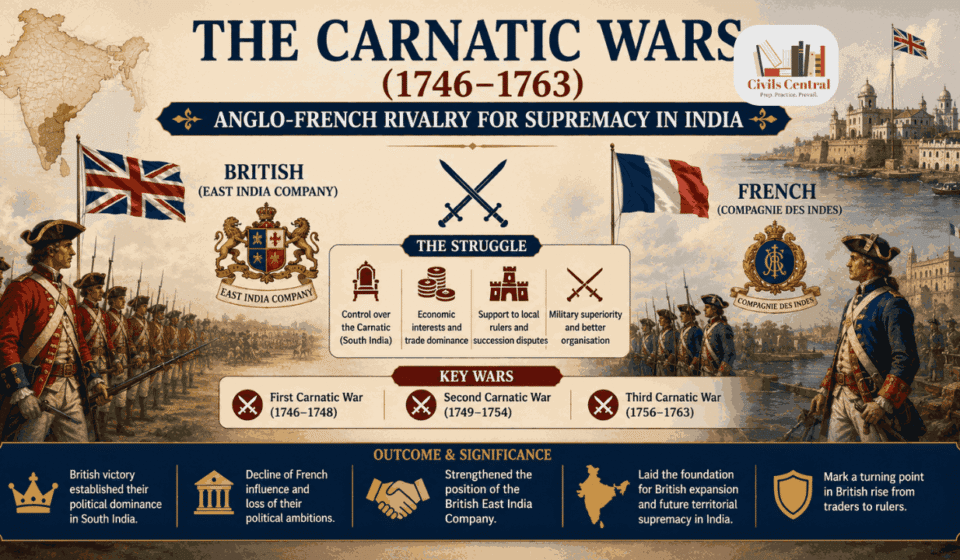
Anglo-French Rivalry in India: The Carnatic Wars (1746–1763): The Struggle for European Supremacy in India

Chapter Summary
| Chapter Information | Details |
|---|---|
| Series | Modern History of India (1707–1947) |
| Module | Rise of British Power in India |
| Historical Period | 1746–1763 |
| Historical Phase | Anglo-French Rivalry and the Militarization of European Competition in India |
| Previous Chapter | The British East India Company: Foundation, Expansion and Early Settlements (1600–1757) |
| Current Chapter | Anglo-French Rivalry in India: The Carnatic Wars (1746–1763): The Struggle for European Supremacy in India |
| Next Chapter | Battle of Plassey (1757): Causes, Course and Consequences |
| Core Theme | Explains how commercial rivalry between the English and French East India Companies evolved into military and political competition, culminating in British supremacy over European rivals in India. |
| Key Personalities | Joseph François Dupleix, Robert Clive, Count de Lally, Charles Joseph Patissier (Marquis de Bussy-Castelnau), Anwar-ud-din Khan, Chanda Sahib, Muhammad Ali, Nasir Jang, Muzaffar Jang, Admiral Edward Boscawen, Sir Eyre Coote |
| Key Places | Madras (Chennai), Pondicherry (Puducherry), Arcot, Trichinopoly (Tiruchirappalli), Wandiwash (Vandavasi), Fort St. David, Hyderabad, Carnatic |
| Key Concepts | Carnatic Wars, Balance of Power, Proxy Wars, European Colonial Rivalry, Presidency Towns, Subsidiary Alliances (early forms), Military Revolution, Company-State |
| Major Events Covered | First Carnatic War (1746–1748), Treaty of Aix-la-Chapelle (1748), Second Carnatic War (1749–1754), Siege of Arcot (1751), Recall of Dupleix (1754), Third Carnatic War (1756–1763), Battle of Wandiwash (1760), Fall of Pondicherry (1761), Treaty of Paris (1763) |
| Historical Significance | Demonstrates how British victory over the French eliminated the only serious European challenger in India, enabling the English East India Company to concentrate on territorial expansion and laying the groundwork for British colonial rule. |
| Exam Relevance | Highly important for UPSC Prelims, UPSC GS Paper I (Modern History), JKPSC, JKAS, State PCS, CDS, CAPF, SSC, UGC-NET History, and university examinations. |
Timeline
| Year | Event |
|---|---|
| 1664 | French East India Company established by Jean-Baptiste Colbert under King Louis XIV. |
| 1674 | French establish Pondicherry as their principal settlement in India. |
| 1740 | War of the Austrian Succession begins in Europe, setting the stage for colonial conflict. |
| 1746 | First Carnatic War begins; French capture Madras. |
| 1746 | Battle of St. Thomé demonstrates the superiority of disciplined European-trained forces. |
| 1748 | Treaty of Aix-la-Chapelle ends the First Carnatic War; Madras restored to the English. |
| 1749 | Second Carnatic War begins amid succession disputes in Hyderabad and the Carnatic. |
| 1751 | Robert Clive captures Arcot, marking a turning point in British fortunes. |
| 1754 | Joseph François Dupleix recalled to France, weakening French influence in India. |
| 1756 | Third Carnatic War begins as part of the global Seven Years’ War. |
| 1760 | Battle of Wandiwash decisively defeats the French in India. |
| 1761 | British capture Pondicherry, ending French military ambitions in India. |
| 1763 | Treaty of Paris restores French trading settlements but prohibits military fortification, confirming British supremacy in India. |
The previous chapter traced the remarkable transformation of the English East India Company from a modest trading corporation established in 1600 into a wealthy commercial institution with fortified settlements, Presidency towns, diplomatic influence, and growing military capability. By the middle of the eighteenth century, however, the Company had not yet become the unquestioned European power in India. A formidable rival stood in its path—the French East India Company.
Unlike the Portuguese and the Dutch, whose influence had gradually declined, the French entered India with strong state support, ambitious administrators, capable military commanders, and an innovative political strategy. Under the leadership of Joseph François Dupleix, the French recognized that the weakening of the Mughal Empire created opportunities to influence Indian politics. Rather than competing solely through commerce, they sought to shape succession disputes, build alliances with Indian rulers, and use disciplined European-trained armies to expand their influence.
The English East India Company quickly realized that trade alone could no longer guarantee survival. Commercial rivalry had evolved into military confrontation, and European wars were now being fought on Indian soil. Over the next seventeen years, a series of conflicts known collectively as the Carnatic Wars transformed the nature of European competition in India. These wars determined not merely which company would dominate Indian trade but which European power would ultimately shape the political future of the Indian subcontinent.
The Carnatic Wars therefore represent a decisive turning point in modern Indian history. They mark the transition from commercial competition to imperial rivalry, from merchant companies to military powers, and from coastal trading settlements to the foundations of colonial empire. Most importantly, they explain why, despite the early brilliance of French leadership, it was ultimately the English East India Company that emerged as the dominant European power before the decisive events at Plassey (1757).
Introduction
When the English East India Company first arrived in India during the early seventeenth century, its principal competitors were the Portuguese and the Dutch. The Portuguese possessed a century-old maritime empire, while the Dutch dominated much of the lucrative spice trade in Southeast Asia. France, by contrast, entered the Indian Ocean comparatively late. Yet within less than a century, the French East India Company emerged as the most serious challenge the English had ever faced in India. By the 1740s, the struggle between the two companies had expanded far beyond warehouses, ports, and merchant ships. It had become a contest over diplomacy, military innovation, political alliances, and ultimately the future of European power in the Indian subcontinent.
This rivalry did not arise solely because English and French merchants desired larger profits. It reflected a much broader transformation taking place across the eighteenth-century world. Europe had entered an era of intense imperial competition in which wars fought on the continent increasingly extended to North America, Africa, the Caribbean, and Asia. Colonial possessions, maritime trade routes, and overseas commerce became vital components of national power. As Britain and France confronted one another across multiple continents, India emerged as one of the most strategically significant theatres in this global struggle.
The timing of this rivalry was equally important. The Mughal Empire, which had provided political stability during the seventeenth century, was steadily weakening after the death of Aurangzeb in 1707. Powerful provincial governors asserted greater independence, succession disputes became increasingly common, and regional kingdoms competed for influence. European companies soon realized that these internal political developments created opportunities to intervene in Indian affairs in ways that had previously been impossible. Military assistance offered to one claimant could secure commercial privileges, territorial concessions, and lasting political influence.
Among the first Europeans to appreciate this changing political landscape was Joseph François Dupleix, the visionary Governor-General of the French settlements in India. Dupleix believed that European companies should no longer remain passive traders dependent upon the goodwill of Indian rulers. Instead, they should actively participate in Indian politics, support friendly rulers, build disciplined armies, and transform commercial influence into political authority. His ideas revolutionized European strategy in India and forced the English East India Company to abandon its traditional defensive approach.
The conflicts that followed became known as the Carnatic Wars (1746–1763). Although fought primarily in southern India, their consequences extended far beyond the Carnatic region. They demonstrated the effectiveness of European military organization, introduced systematic political intervention into Indian succession disputes, produced leaders such as Robert Clive, and eliminated France as a serious imperial rival. Above all, they shifted the balance of power decisively in favour of the English East India Company, creating the strategic conditions that made the victories at Plassey (1757) and Buxar (1764) possible.
The Carnatic Wars are therefore not simply a chapter in the history of Anglo-French rivalry. They represent the moment when European commercial competition evolved into the struggle for political supremacy in India. To understand how Britain established one of the largest empires in history, one must first understand why Britain defeated France in the Carnatic. The road to British India passed not only through Bengal but also through the battlefields of southern India, where two European trading companies fought to determine the future course of Indian history.
Background to the Anglo-French Rivalry: Why Did European Wars Reach India?
How Did Commercial Competition Turn into Military Conflict?
When the English East India Company and the French East India Company first established themselves in India, neither organization intended to wage large-scale wars against the other. Their principal objective was commerce. Both companies sought permission from Indian rulers to establish factories, purchase textiles and spices, and export valuable commodities to Europe. For several decades, commercial competition remained largely peaceful. Although occasional disputes arose over trade and maritime routes, neither company possessed the military strength nor the political ambition to dominate the Indian subcontinent. By the middle of the eighteenth century, however, this situation changed dramatically. The peaceful rivalry of merchants gave way to the violent rivalry of empires, and India became one of the principal battlefields of European global conflict.
The origins of this transformation lay not in India but in Europe. During the eighteenth century, European politics entered an era characterized by intense rivalry among the major powers. Britain and France emerged as the two leading maritime and colonial states, each seeking commercial dominance, naval superiority, and overseas possessions. Unlike earlier centuries, when wars were often confined to the European continent, these new conflicts assumed a truly global character. Colonial settlements in North America, trading posts in Africa, sugar plantations in the Caribbean, and commercial establishments in Asia all became extensions of European geopolitical competition. Consequently, whenever Britain and France went to war in Europe, their respective trading companies inevitably confronted one another across the world.
This new phase of international politics reflected the growing importance of mercantilism, the dominant economic philosophy of the seventeenth and eighteenth centuries. Mercantilist thinkers believed that national wealth depended upon accumulating precious metals, maintaining favourable balances of trade, and controlling overseas markets and colonies. Governments therefore viewed commercial companies not merely as private enterprises but as instruments of national power. Every successful trading settlement strengthened the economic resources of the mother country, while every commercial defeat benefited a rival state. Under such circumstances, commercial rivalry naturally acquired strategic and military significance.
The English and French East India Companies were therefore closely connected to the broader ambitions of their respective governments, although the nature of that relationship differed considerably. The English East India Company operated as a private joint-stock corporation with considerable autonomy, relying primarily upon private investment and commercial discipline. The French East India Company, established in 1664 under the guidance of Jean-Baptiste Colbert, functioned with far greater support from the French monarchy. It enjoyed substantial financial assistance from the Crown and was expected to promote French imperial interests overseas. This closer relationship with the state enabled the French Company to pursue ambitious political objectives but also made it more dependent upon decisions taken in Paris.
The expansion of the French East India Company transformed the balance of European power in India. The French established Pondicherry in 1674, which soon developed into their principal settlement on the Coromandel Coast. Additional factories were established at Chandernagore in Bengal, Mahe on the Malabar Coast, Karaikal, and Yanam, creating a network of commercial centres comparable to that of the English Company. By the early eighteenth century, France had become the only European power capable of seriously challenging British commercial interests in India.
While European rivalry intensified, political developments within India created favourable conditions for foreign intervention. The death of Emperor Aurangzeb in 1707 initiated a prolonged period of political decentralization. Although the Mughal Empire remained formally intact, provincial governors increasingly exercised independent authority. Powerful regional states emerged in Hyderabad, Bengal, Awadh, and the Carnatic, while succession disputes became increasingly common. Rival claimants frequently sought external military assistance to strengthen their positions. European companies soon recognized that supporting one claimant against another could yield commercial privileges, territorial concessions, and political influence that peaceful negotiation alone could never secure.
Among all regions of India, the Carnatic proved particularly suitable for such intervention. The Carnatic, corresponding broadly to the southeastern coastal region of present-day Tamil Nadu, lay strategically between the English settlement of Madras and the French capital at Pondicherry. Although nominally subordinate to the Nizam of Hyderabad, the Carnatic was effectively governed by its own Nawab, whose authority was increasingly challenged by succession disputes and regional rivalries. This political instability created opportunities for both the English and the French to influence local affairs under the pretext of supporting legitimate claimants.
Another important factor was the growing confidence of European military commanders in the superiority of their methods of warfare. By the eighteenth century, European armies emphasized disciplined infantry formations, standardized firearms, coordinated artillery, and rigorous military training. Indian armies were often much larger in number, but they frequently relied upon feudal levies, irregular cavalry, and decentralized command structures. European officers gradually realized that relatively small, well-trained forces could defeat much larger armies under favourable conditions. This confidence encouraged European companies to intervene more actively in Indian political disputes, believing that military assistance could produce significant diplomatic and commercial rewards.
The rivalry was further intensified by the emergence of visionary leaders, particularly Joseph François Dupleix, who became Governor-General of the French settlements in India in 1742. Unlike many earlier Company officials, Dupleix recognized that the decline of centralized Mughal authority had fundamentally altered the political landscape. He believed that European companies should no longer limit themselves to commerce but should actively participate in Indian politics, influence succession disputes, maintain disciplined armies, and establish friendly rulers whose dependence upon French support would ensure lasting commercial advantages. His ideas marked a revolutionary departure from traditional European policy in India.
The English East India Company initially viewed these developments with caution. Its directors remained primarily concerned with protecting profitable trade rather than engaging in costly military conflicts. However, the Company’s officials in India gradually recognized that French political activism posed a direct threat to British commercial interests. If the French succeeded in dominating the Carnatic and Hyderabad through political alliances, English settlements such as Madras could become strategically vulnerable. The Company therefore found itself compelled to adopt many of the same methods pioneered by Dupleix, setting the stage for a prolonged struggle that would reshape the history of India.
The immediate spark that transformed this rivalry into open warfare came not from India but from another European conflict—the War of the Austrian Succession (1740–1748). When Britain and France entered this war on opposing sides in Europe, hostilities quickly spread to their colonial possessions across the world. India was no exception. In 1746, French and English forces confronted one another in southern India, inaugurating the First Carnatic War. What had begun as a European dynastic dispute soon evolved into a contest for supremacy in India itself.
The background to the Carnatic Wars therefore illustrates the growing interconnectedness of the eighteenth-century world. European diplomatic rivalries, global commercial competition, Indian political fragmentation, military innovation, and corporate ambition combined to transform India into one of the principal theatres of international conflict. The Carnatic Wars were not accidental episodes of local warfare; they were the Indian manifestation of a much larger struggle for global power between Britain and France. Their outcome would determine not only the future of European influence in India but also the political destiny of the Indian subcontinent.
CivilsCentral Historical Insight
The Carnatic Wars did not originate because English and French merchants quarrelled over trade. They emerged from the convergence of global imperial rivalry and Indian political transformation. European wars supplied the conflict, while the weakening Mughal order supplied the opportunity. Together, these forces converted commercial companies into political and military powers, fundamentally altering the course of Indian history.
The French East India Company and the Rise of Joseph François Dupleix
How Did the French Become the Strongest European Rival of the British in India?
When discussing the struggle for supremacy in eighteenth-century India, it is easy to assume that the English East India Company always enjoyed a decisive advantage over its European competitors. In reality, the opposite appeared true during the first half of the eighteenth century. By the 1740s, many contemporary observers believed that the French East India Company possessed greater political vision, stronger leadership, and a more dynamic strategy than its English counterpart. At the centre of this transformation stood one remarkable individual—Joseph François Dupleix. More than any other European administrator of his time, Dupleix understood that the future of European influence in India would not be decided solely by commerce but by politics, diplomacy, and military power. His policies fundamentally changed the nature of European competition in India and forced the English East India Company to abandon its traditional role as a purely commercial organization.
The French East India Company (Compagnie française des Indes orientales) had been established in 1664 by Jean-Baptiste Colbert, the influential Finance Minister of King Louis XIV. Inspired by the principles of mercantilism, Colbert sought to create a powerful French trading corporation capable of challenging the commercial dominance of the Dutch and the English in Asia. Unlike the English East India Company, which relied primarily upon private investment and shareholder capital, the French Company enjoyed extensive support from the French monarchy. Financial assistance, royal patronage, and political backing enabled it to establish trading settlements across the Indian Ocean, although this dependence upon the state also made it vulnerable to changing priorities within the French government.
During the late seventeenth century, the French gradually expanded their presence in India by establishing commercial centres at Pondicherry, Chandernagore, Mahe, Karaikal, and Yanam. Among these settlements, Pondicherry, founded in 1674 on the Coromandel Coast, emerged as the administrative and commercial headquarters of French activities in India. Its excellent harbour, strategic location, and carefully planned urban development made it one of the finest European settlements in the subcontinent. By the beginning of the eighteenth century, Pondicherry had become a thriving centre of trade, attracting Indian merchants, artisans, and administrators while serving as the principal base of French influence in southern India.
Despite these successes, the French Company initially followed a commercial policy broadly similar to that of its English rival. Its officials concentrated on acquiring textiles, spices, indigo, and other valuable commodities for export to Europe while maintaining cordial relations with Indian rulers. The Company’s settlements remained dependent upon the goodwill of local authorities, and military forces were primarily intended for defensive purposes. This cautious approach changed dramatically after the arrival of Joseph François Dupleix, whose vision extended far beyond the traditional objectives of overseas commerce.
Joseph François Dupleix was appointed Governor of Pondicherry in 1742 and soon became the Governor-General of all French settlements in India. An exceptionally intelligent administrator, skilled diplomat, and ambitious strategist, Dupleix possessed a deep understanding of both European politics and Indian society. Unlike many European officials who regarded India merely as a source of commercial profit, Dupleix carefully studied the changing political conditions within the subcontinent. He recognized that the decline of centralized Mughal authority had created a political vacuum in which European companies could exercise unprecedented influence if they acted decisively.
Dupleix’s greatest innovation lay in his realization that commercial success depended upon political influence. He argued that European companies should no longer remain passive merchants requesting privileges from Indian rulers. Instead, they should actively participate in regional politics by supporting friendly princes, influencing succession disputes, maintaining disciplined military forces, and rewarding loyal allies with political assistance. In return, these rulers would grant commercial monopolies, territorial concessions, and administrative privileges that could never be obtained through trade alone. This strategy represented a revolutionary departure from the traditional European approach to India.
To implement this vision, Dupleix cultivated close relationships with influential Indian rulers and noble families. Unlike many earlier European administrators, he made a conscious effort to understand Indian political customs, ceremonial traditions, and diplomatic practices. He frequently adopted elements of Indian court culture, participated in elaborate diplomatic ceremonies, and presented himself not merely as a European merchant but as an important political figure within the regional balance of power. Such gestures enhanced his prestige among Indian elites and enabled him to negotiate from a position of greater influence.
Dupleix also appreciated the military implications of India’s changing political landscape. Rather than relying solely upon European soldiers, he expanded the recruitment of Indian sepoys trained according to European military methods. These troops combined local knowledge with modern discipline, standardized firearms, and effective battlefield organization. Their success demonstrated that relatively small, well-trained forces could decisively influence regional conflicts despite being heavily outnumbered by traditional armies. This military innovation would soon be adopted and perfected by the English East India Company, becoming one of the defining features of colonial warfare in India.
Another important aspect of Dupleix’s policy was his willingness to intervene directly in succession disputes. Instead of remaining neutral during conflicts between rival claimants, he supported candidates who promised to advance French interests upon securing power. Such intervention required military assistance, financial support, and diplomatic negotiation, but it also offered enormous rewards. Friendly rulers granted the French Company commercial privileges, strategic territories, and political influence that greatly strengthened its position in southern India. Through these methods, Dupleix transformed the French Company into an influential participant in Indian politics rather than merely an observer of regional events.
The English East India Company watched these developments with increasing concern. For many decades, English officials had concentrated upon protecting profitable trade while avoiding costly political entanglements. Dupleix’s remarkable successes demonstrated that this cautious strategy might no longer be sufficient. If the French succeeded in establishing political dominance over the Carnatic and Hyderabad, British settlements such as Madras could become isolated and strategically vulnerable. Consequently, the English gradually abandoned their earlier reluctance to intervene in Indian politics and began adopting many of the methods pioneered by Dupleix. Ironically, the very strategy that later contributed to British imperial success had first been conceived and implemented by the French.
Nevertheless, Dupleix’s ambitious vision faced significant limitations. The French East India Company remained heavily dependent upon financial assistance from France, while the French government was frequently preoccupied with wars in Europe. Resources available to Dupleix often proved insufficient to sustain prolonged military campaigns in India. Moreover, communication with Paris was slow, and political decisions made in Europe did not always reflect conditions on the Indian subcontinent. These structural weaknesses would eventually undermine many of Dupleix’s achievements despite his exceptional personal abilities.
Modern historians continue to regard Joseph François Dupleix as one of the most influential figures in the early history of European India. Although his ultimate objective of establishing lasting French supremacy was never realized, his ideas fundamentally transformed colonial strategy. He demonstrated that commercial companies could shape political outcomes, influence regional succession disputes, build disciplined indigenous armies, and convert diplomatic alliances into instruments of imperial expansion. In doing so, he inadvertently provided the English East India Company with the strategic model that it would later employ with even greater success.
The rise of the French East India Company under Dupleix therefore marks a decisive turning point in Indian history. It was the moment when European rivalry ceased to be confined to trade and entered the sphere of politics, diplomacy, and warfare. The English East India Company could no longer remain merely a commercial institution. To survive, it would have to compete on the same political battlefield that Dupleix had created. The first major test of these competing strategies would soon arrive with the outbreak of the First Carnatic War (1746–1748).
CivilsCentral Historical Insight
Joseph François Dupleix was the first European administrator to recognize that the future of colonial power in India depended less on commerce than on politics. By integrating diplomacy, military intervention, and regional alliances into Company strategy, he transformed European trading corporations into political actors. Although France ultimately lost the struggle, the British Empire in India would later be built upon many of the strategic principles first pioneered by Dupleix.
The First Carnatic War (1746–1748): The Beginning of European Military Rivalry in India
Why Did the First Carnatic War Break Out?
By the middle of the eighteenth century, relations between the English East India Company and the French East India Company had become increasingly competitive, but open warfare had not yet become inevitable. Both companies continued to derive enormous profits from Indian trade, and neither wished to disrupt commerce unnecessarily. The immediate cause of the First Carnatic War (1746–1748) therefore did not originate in India itself. Instead, it was a direct consequence of the War of the Austrian Succession (1740–1748), a major European conflict involving several continental powers. As Britain and France entered the war on opposing sides in Europe, their rivalry quickly spread to their colonial possessions across the world. India, which had become an increasingly important centre of global commerce, naturally became one of the theatres of this wider international conflict.
The outbreak of war demonstrated an important characteristic of eighteenth-century imperial politics. European colonies and trading settlements were no longer isolated commercial outposts; they had become integral components of national strategy. Victories achieved in distant colonies could strengthen a nation’s bargaining position during peace negotiations in Europe, while defeats overseas could weaken its global influence. Consequently, Company officials in India were compelled to fight wars whose origins lay thousands of kilometres away in European dynastic disputes. The First Carnatic War thus illustrates how deeply India had already become integrated into the emerging global balance of power.
At the beginning of the conflict, the English East India Company and the French East India Company possessed comparable commercial settlements along the Coromandel Coast. The principal English base was Madras (Fort St. George), while the French operated from Pondicherry, located only a short distance away. Although both settlements were fortified, neither expected to become the centre of a prolonged military campaign. However, the arrival of French naval forces under Bertrand-François Mahé de La Bourdonnais, the Governor of the French island of Mauritius (Île de France), dramatically altered the situation.
In 1746, La Bourdonnais sailed to the Coromandel Coast with a powerful French fleet and launched an attack upon Madras. The English settlement, unable to withstand sustained naval bombardment and lacking adequate military support, surrendered after a brief resistance. The capture of Madras represented the first major French military success against the English in India and demonstrated the growing importance of naval power in determining the fate of colonial settlements. For the English East India Company, the loss of Madras was both a strategic and psychological setback, raising serious doubts about its ability to protect its commercial interests.
The French victory, however, soon exposed differences within the French leadership itself. La Bourdonnais favoured returning Madras to the English after obtaining a substantial ransom, believing that commercial interests should remain the primary objective of French policy. Joseph François Dupleix, by contrast, opposed this proposal. He regarded the capture of Madras as an unprecedented opportunity to establish permanent French supremacy in southern India. Dupleix argued that territorial and political advantages should take precedence over immediate financial gain. This disagreement between two of France’s most capable administrators revealed a fundamental strategic division within the French colonial administration—one that would later weaken French prospects in India.
The capture of Madras also attracted the attention of the Nawab of the Carnatic, Anwar-ud-din Khan. As the nominal ruler of the region, the Nawab believed that European settlements within his territory remained subject to his authority. Concerned by the growing military conflict between foreign trading companies, he ordered the French to hand over Madras to him. Dupleix refused to comply, making it clear that the French no longer intended to act merely as merchants operating under the protection of Indian rulers. This refusal marked an important turning point in European-Indian relations, demonstrating that European companies were increasingly prepared to challenge the authority of regional powers.
Determined to assert his sovereignty, Anwar-ud-din Khan dispatched a large army to recover Madras from the French. The resulting confrontation occurred near the River Adyar, close to the village of St. Thomé, in 1746. Although the Nawab’s forces vastly outnumbered the French contingent, the battle produced an outcome that astonished contemporary observers. The disciplined French troops, supported by well-trained artillery and modern infantry tactics, decisively defeated the much larger Carnatic army.
The Battle of St. Thomé became one of the most significant military engagements of eighteenth-century India, not because of its size but because of its implications. For the first time, an Indian ruler witnessed a relatively small European-trained force defeating a numerically superior traditional army through superior discipline, coordinated firepower, and effective battlefield organization. The battle demonstrated that military effectiveness depended not merely upon numbers but upon training, leadership, tactical coordination, and technological efficiency. This lesson profoundly influenced both Indian rulers and European companies during the decades that followed.
For Joseph François Dupleix, the victory at St. Thomé confirmed the practicality of his broader political strategy. If European-trained forces could determine the outcome of regional conflicts, then foreign companies could influence succession disputes, support allied rulers, and acquire political power without maintaining enormous armies. Military intervention thus became an instrument of diplomacy, while diplomacy increasingly served commercial objectives. The distinction between commerce and politics grew progressively weaker.
The English East India Company also drew important lessons from these events. The fall of Madras revealed the vulnerability of relying solely upon commercial prosperity without adequate military preparation. Equally significant, the Battle of St. Thomé demonstrated that disciplined European military methods could decisively influence Indian politics. English officials recognized that survival required not merely defending factories but building professional armies, strengthening fortifications, improving naval coordination, and developing capable military leadership. The transformation of the Company into a military organization accelerated considerably after 1746.
Despite these dramatic military developments, the First Carnatic War ultimately remained subordinate to events in Europe. Neither Britain nor France intended to wage an unlimited colonial war in India independent of their larger diplomatic objectives. Consequently, when the War of the Austrian Succession ended in Europe through the Treaty of Aix-la-Chapelle (1748), the colonial conflict in India also came to an end. Under the terms of the treaty, Madras was restored to the English in exchange for the return of Louisbourg in North America to France. The settlement clearly illustrated that colonial territories could become bargaining instruments in wider European diplomacy.
Although the territorial situation returned largely to its pre-war condition, the First Carnatic War permanently transformed the political landscape of India. It demonstrated that European rivalries could no longer be confined to commercial competition. It revealed the effectiveness of disciplined European armies, exposed the growing military weakness of many regional Indian states, and encouraged European companies to intervene more actively in Indian political affairs. Most importantly, it convinced both the English and the French that future supremacy in India would depend not only upon successful trade but also upon military organization, diplomatic alliances, and political influence.
The First Carnatic War therefore marked the true beginning of European military rivalry in India. It ended without producing decisive territorial changes, yet it fundamentally altered the methods through which European companies pursued their ambitions. The next conflict, the Second Carnatic War, would move beyond European dynastic disputes and become deeply intertwined with the internal politics of the Indian subcontinent itself.
CivilsCentral Historical Insight
The First Carnatic War demonstrated that the future of European influence in India would be decided not in counting houses or trading factories but on the battlefield. The capture of Madras and the Battle of St. Thomé proved that disciplined European-trained forces could decisively influence Indian politics, marking the beginning of a new era in which commerce, diplomacy, and military power became inseparable.
The Treaty of Aix-la-Chapelle (1748): Peace in Europe, Unfinished Rivalry in India
Why Did the First Carnatic War End Without Resolving the Struggle for India?
The First Carnatic War (1746–1748) ended without producing a decisive victor in India, despite the remarkable military successes achieved by the French. Madras had been captured, the Nawab of the Carnatic had suffered a humiliating defeat at St. Thomé, and Joseph François Dupleix appeared to have demonstrated the superiority of his political and military strategy. Yet, within a short period, these achievements seemed to disappear. The reason lay not in India but in Europe. Just as the conflict had originated from the War of the Austrian Succession, its conclusion was also determined by European diplomacy. The Treaty of Aix-la-Chapelle (1748) formally ended the war in Europe, and with it the First Carnatic War in India. However, while the treaty restored peace between Britain and France, it failed to address the deeper political and strategic rivalry that had emerged on Indian soil. In many respects, it merely postponed a much larger confrontation.
The negotiations leading to the treaty reflected the global nature of eighteenth-century imperial politics. Britain and France were no longer fighting solely for influence within Europe; they were competing for colonial possessions across North America, the Caribbean, Africa, and Asia. Consequently, peace negotiations involved exchanges of territories located thousands of kilometres apart. Colonial settlements became diplomatic bargaining chips rather than isolated possessions whose fate depended solely upon local military victories.
One of the most significant provisions of the Treaty of Aix-la-Chapelle concerned the exchange of conquered territories between Britain and France. Under the agreement, Madras, which had been captured by the French in 1746, was returned to the English East India Company. In return, Britain restored Louisbourg, an important French fortress in North America, to France. This exchange clearly demonstrated that the destiny of colonial settlements was often determined not by events in India but by diplomatic calculations made in European capitals.
For the English East India Company, the recovery of Madras represented an enormous relief. The settlement was not merely an important trading centre but also the Company’s principal headquarters on the Coromandel Coast. Its restoration enabled the English to resume commercial activities, rebuild their administrative institutions, and strengthen their military defences. Yet the English leadership also recognized that the treaty had exposed serious weaknesses in their colonial strategy. The temporary loss of Madras had demonstrated the dangers of inadequate naval protection and insufficient military preparation. Consequently, the Company immediately began improving the fortifications of its settlements, expanding its military establishment, and preparing for the possibility of renewed conflict.
The treaty produced a more complex reaction within the French administration. From the perspective of Joseph François Dupleix, the return of Madras represented a profound disappointment. He believed that the capture of the city had fundamentally altered the balance of power in southern India and offered France an unparalleled opportunity to establish lasting political supremacy. The decision taken in Europe to restore Madras to the English effectively nullified one of his greatest military achievements. Dupleix increasingly concluded that French interests in India could not depend entirely upon diplomatic settlements negotiated in Europe. Instead, they required independent political influence within the Indian subcontinent itself.
This realization profoundly influenced Dupleix’s future strategy. During the First Carnatic War, military operations had been largely extensions of European conflict. After 1748, however, Dupleix sought to pursue French ambitions through direct involvement in Indian succession disputes rather than waiting for another European war. He believed that supporting friendly Indian rulers could secure permanent political influence regardless of changing diplomatic arrangements in Europe. This marked a significant shift in French policy—from fighting Britain’s wars in India to shaping India’s own political future.
The treaty also revealed an important limitation of European colonial warfare during the eighteenth century. Military victories alone could not guarantee lasting political gains unless they were supported by diplomatic agreements at the international level. French commanders had captured Madras through military skill, yet European diplomacy required its return. Similarly, British success elsewhere in the world had to be balanced against French interests during peace negotiations. Colonial commanders therefore operated within a broader international system over which they exercised only limited control.
Despite restoring peace, the treaty failed to resolve the underlying causes of Anglo-French rivalry in India. Both companies continued to compete for commercial privileges, political alliances, and strategic influence. Neither accepted the other as the permanent dominant European power. Moreover, the First Carnatic War had fundamentally altered their methods of competition. The conflict had demonstrated that European-trained armies could defeat larger Indian forces, that local rulers could be influenced through military assistance, and that commercial objectives could be advanced through political intervention. These lessons remained valid even after formal peace had been concluded.
The response of Indian rulers to the treaty was equally significant. Many recognized that European companies had acquired military capabilities capable of influencing regional politics. At the same time, they observed that European settlements remained closely connected to distant political decisions made in Europe. This encouraged several Indian princes to regard the English and the French as potential allies whose military resources could be employed in domestic succession disputes. European companies were no longer merely foreign merchants; they had become valuable political and military partners within India’s evolving regional balance of power.
The period immediately following the treaty witnessed increasing instability within both the Carnatic and Hyderabad. Succession disputes emerged simultaneously in these strategically important states, providing precisely the kind of opportunity that Dupleix had anticipated. Rather than remaining neutral, the French actively supported claimants favourable to their interests. The English, fearing the consequences of unchecked French influence, responded by backing rival candidates. Thus, the next phase of conflict would no longer arise from European diplomacy but from direct intervention in Indian political affairs.
Historians frequently describe the Treaty of Aix-la-Chapelle as an inconclusive peace. It ended one war without resolving the strategic issues that had produced it. Territorial boundaries remained largely unchanged, yet the political environment had been permanently transformed. The methods of warfare, the ambitions of European companies, and the perception of military power had all changed fundamentally. Consequently, the treaty did not restore the pre-war situation; instead, it created a brief interval before a far more consequential struggle.
In retrospect, the Treaty of Aix-la-Chapelle occupies a crucial place in the history of British India. It marked the conclusion of the first phase of Anglo-French rivalry—a phase dominated by European diplomacy and naval conflict. The second phase would be very different. Instead of merely fighting each other, the English and the French would begin competing for influence over Indian rulers themselves. Commerce would increasingly become subordinate to politics, and regional succession disputes would become the principal arena of European rivalry. These developments would soon culminate in the Second Carnatic War (1749–1754), a conflict that transformed the struggle for European supremacy into an integral part of Indian political history.
CivilsCentral Historical Insight
The Treaty of Aix-la-Chapelle ended the First Carnatic War but not the Anglo-French struggle for India. By restoring Madras to the English while leaving political rivalries unresolved, the treaty shifted the contest from European battlefields to Indian courts. From this point onward, succession disputes within Indian states—not European dynastic wars alone—became the principal instruments through which European companies pursued imperial ambitions.
The Second Carnatic War (1749–1754): European Intervention in Indian Succession Politics
How Did Indian Succession Disputes Become a Battlefield for European Powers?
The Treaty of Aix-la-Chapelle (1748) ended the First Carnatic War, but it did not end the rivalry between the English and the French in India. Instead, it marked the beginning of a far more dangerous phase of competition. During the First Carnatic War, the English and French had fought primarily because their parent countries were at war in Europe. The Second Carnatic War (1749–1754) was fundamentally different. This conflict did not arise from European diplomacy but from internal political disputes within India itself. For the first time, European trading companies actively intervened in the succession struggles of Indian states, supporting rival claimants in exchange for political influence and commercial privileges. The war thus transformed the English and French East India Companies from foreign merchants into decisive participants in Indian politics.
The immediate background to the conflict was the political instability that followed the decline of Mughal authority after the death of Aurangzeb in 1707. As the power of the Mughal emperor weakened, provincial governors exercised increasing independence. Although they continued to acknowledge the emperor’s nominal sovereignty, many regions effectively became autonomous states. Among the most important of these were the Deccan, governed by the Nizam of Hyderabad, and the Carnatic, which was formally subordinate to Hyderabad but functioned as a semi-independent province under its own Nawab. In both regions, disputes over succession created opportunities for ambitious local leaders—and equally ambitious European companies.
The first succession crisis emerged in Hyderabad after the death of Nizam-ul-Mulk Asaf Jah I in 1748. Two principal claimants sought control of the Deccan: Nasir Jang, the Nizam’s son, and Muzaffar Jang, his grandson. Their rivalry quickly attracted the attention of Joseph François Dupleix, who recognized that supporting the successful claimant could greatly strengthen French influence in southern India. Dupleix therefore extended military and diplomatic support to Muzaffar Jang, believing that a grateful Nizam would reward the French with commercial privileges, territorial concessions, and political authority.
Almost simultaneously, a similar succession dispute developed in the Carnatic. The incumbent Nawab, Anwar-ud-din Khan, faced a challenge from Chanda Sahib, a former claimant who sought to recover the office with French assistance. Dupleix again intervened decisively, supporting Chanda Sahib while simultaneously backing Muzaffar Jang in Hyderabad. His objective was strategically brilliant. If French-supported rulers controlled both Hyderabad and the Carnatic, the French East India Company would dominate southern India politically without directly annexing territory. Commercial influence would be secured through allied Indian governments rather than through formal colonial rule.
Initially, Dupleix’s strategy appeared remarkably successful. In 1749, the combined forces of Muzaffar Jang, Chanda Sahib, and the French confronted the army of Anwar-ud-din Khan at the Battle of Ambur. The Nawab was defeated and killed, while Chanda Sahib emerged as the new Nawab of the Carnatic under French protection. Shortly afterwards, Muzaffar Jang secured the position of Nizam of Hyderabad with French military assistance. As a reward for these victories, the French received extensive territorial grants, commercial privileges, and political influence unprecedented in their history in India.
The spectacular success of Dupleix alarmed the English East India Company. Until this point, English officials had generally pursued a more cautious policy, concentrating upon the protection of trade rather than political intervention. However, the possibility that both Hyderabad and the Carnatic might come under French influence posed a direct threat to the security of Madras and to British commercial interests throughout southern India. The English therefore abandoned their earlier neutrality and entered the conflict by supporting rival claimants.
The English chose to support Muhammad Ali, the son of the slain Anwar-ud-din Khan, as the legitimate Nawab of the Carnatic. In Hyderabad, they backed Nasir Jang against Muzaffar Jang. Thus, the succession disputes evolved into a proxy war between the two European companies. Indian rulers sought European military assistance to secure political power, while European companies used Indian political conflicts to expand their influence. The relationship between commerce and politics had now become inseparable.
The war also demonstrated the growing importance of European-trained sepoy armies. Both the English and the French increasingly relied upon Indian soldiers disciplined according to European military methods and commanded by European officers. These forces proved highly effective in supporting allied rulers, capturing strategic positions, and influencing the outcome of regional conflicts. The widespread use of sepoys marked an important transformation in the military history of India and would later become the foundation of Company armies throughout the subcontinent.
Despite Dupleix’s early successes, his position gradually became more complicated. Maintaining military campaigns, supporting allied rulers, and financing prolonged political interventions required enormous financial resources. The French East India Company, heavily dependent upon assistance from the French government, found it increasingly difficult to sustain these commitments. Meanwhile, the English East India Company, supported by stronger commercial revenues and a more stable financial structure, gradually strengthened its military organization and prepared to challenge French dominance.
One of the most important consequences of the Second Carnatic War was the emergence of a new generation of military leaders. Among the English, Robert Clive began to demonstrate extraordinary courage, initiative, and strategic imagination. Although still a relatively junior Company officer, Clive recognized that the French could be defeated not merely through defensive operations but by bold offensive action. His daring campaign against Arcot in 1751 would soon transform the course of the war and establish him as one of the most influential figures in British imperial history.
Modern historians regard the Second Carnatic War as a decisive turning point because it fundamentally changed the character of European expansion in India. The First Carnatic War had demonstrated the military superiority of European forces; the Second Carnatic War demonstrated the political potential of European intervention. Both the English and the French discovered that influence over Indian rulers could be more valuable than direct territorial conquest. By controlling succession disputes, they acquired allies, strategic territories, commercial privileges, and political authority without formally annexing Indian states.
The conflict also exposed an important weakness within many regional Indian powers. Succession disputes increasingly invited external intervention, enabling foreign companies to influence domestic politics. Rather than acting as neutral observers, the English and French became kingmakers whose military support often determined the outcome of political contests. This development significantly accelerated the erosion of indigenous political autonomy and prepared the ground for even deeper European involvement in Indian affairs.
The Second Carnatic War therefore represents the moment when the struggle between the English and the French ceased to be a contest between rival trading companies and became a competition for political supremacy in India. The outcome of this struggle would not be decided solely by diplomacy or commercial wealth but by military leadership, strategic innovation, and the ability to shape the politics of Indian states. The next phase of the war would witness one of the most remarkable military exploits in modern Indian history—the Siege of Arcot (1751) led by Robert Clive, an event that dramatically reversed French fortunes and transformed the balance of power in southern India.
CivilsCentral Historical Insight
The Second Carnatic War marked the beginning of systematic European intervention in Indian politics. By supporting rival claimants in Hyderabad and the Carnatic, the English and French East India Companies transformed succession disputes into instruments of imperial expansion. From this point onward, political influence—not commerce alone—became the key to European supremacy in India.
Robert Clive and the Siege of Arcot (1751): The Turning Point of the Second Carnatic War
How Did a Small English Force Reverse French Dominance in Southern India?
By 1751, the Second Carnatic War appeared to be moving decisively in favour of the French. Through the diplomatic skill of Joseph François Dupleix and the military successes of French-supported forces, Chanda Sahib had established himself as the Nawab of the Carnatic, while French influence extended deep into the politics of Hyderabad. The English East India Company, despite supporting Muhammad Ali, struggled to match French political influence and military resources. Muhammad Ali’s strongest position remained the fortress city of Trichinopoly (Tiruchirappalli), where he was surrounded by the combined forces of Chanda Sahib and the French. If Trichinopoly fell, English influence in the Carnatic would almost certainly collapse.
At this critical moment, an unlikely figure emerged to change the course of Indian history. Robert Clive, then only a young Company officer with limited military experience, proposed a strategy that differed radically from conventional military thinking. Rather than attempting to reinforce the besieged city of Trichinopoly directly, Clive suggested attacking Arcot, the capital of the Carnatic. His reasoning was remarkably simple yet strategically brilliant. If the English captured the capital, Chanda Sahib would be compelled to divert his forces from Trichinopoly in order to defend his own seat of power. Instead of confronting superior French forces where they were strongest, Clive sought to attack where they were politically most vulnerable.
The directors of the English East India Company approved the plan despite its obvious risks. Clive marched towards Arcot in August 1751 with a remarkably small force consisting of approximately 200 European soldiers, 300 sepoys, and a few light artillery pieces. Compared with the armies maintained by Chanda Sahib and the French, this was an insignificant force. Success therefore depended not upon numerical superiority but upon speed, surprise, discipline, and psychological impact.
As Clive approached Arcot, an extraordinary event occurred. A violent thunderstorm struck the region, yet Clive continued his advance without hesitation. The defenders, interpreting the determined march through severe weather as evidence of exceptional confidence and strength, abandoned the city with little resistance. Arcot fell into English hands almost without a battle. Although the capture itself involved little fighting, its psychological consequences were enormous. For the first time during the Second Carnatic War, the English had seized the political capital of the Carnatic and demonstrated that they could undertake bold offensive operations rather than merely defend their settlements.
The capture of Arcot forced Chanda Sahib to respond immediately. Recognizing the symbolic and political importance of his capital, he dispatched a large army, supported by French troops, to recover the city. Contemporary accounts estimate that the besieging force numbered several thousand soldiers, vastly outnumbering Clive’s small garrison. Once again, the English appeared to face overwhelming odds.
The Siege of Arcot, which lasted for nearly fifty days, became one of the most celebrated episodes in the military history of the English East India Company. Throughout the siege, Clive displayed remarkable leadership, determination, and tactical skill. His troops maintained strict discipline despite shortages of food, ammunition, and manpower. European soldiers and Indian sepoys fought side by side, demonstrating a degree of cohesion that impressed even their opponents. Clive carefully organized the defence of the fortifications, launched occasional surprise attacks against the besiegers, and maintained the morale of his soldiers under extremely difficult conditions.
One of the most frequently cited incidents during the siege illustrates the growing loyalty of the Company’s sepoy forces. When food supplies became critically scarce, many Indian soldiers reportedly offered to survive on minimal rations so that the European troops could receive sufficient nourishment for combat. Whether every detail of these accounts is historically verifiable or partly embellished by later British narratives, they reflect the increasing importance of disciplined sepoy regiments within the Company’s military organization. The English had begun to build an army that combined European command with Indian manpower, a model that would later become the foundation of British military power across the subcontinent.
The besieging forces repeatedly attempted to storm Arcot but failed to overcome the determined defence. Superior discipline, effective artillery, well-planned fortifications, and Clive’s aggressive leadership compensated for numerical inferiority. After weeks of unsuccessful assaults, the attackers gradually lost confidence. When English reinforcements approached, the besieging army abandoned the siege, leaving Arcot firmly under Company control.
The successful defence of Arcot produced consequences far greater than the military value of the city itself. First, it compelled Chanda Sahib to divert substantial forces away from Trichinopoly, thereby relieving pressure on Muhammad Ali, the English-supported claimant. Second, it shattered the widespread belief that the French and their Indian allies were militarily invincible. Third, it greatly enhanced the prestige of the English East India Company among Indian rulers, many of whom now began to reconsider their political alliances. Confidence, an often overlooked factor in eighteenth-century warfare, shifted decisively towards the English.
For Joseph François Dupleix, the events at Arcot represented a serious strategic setback. His carefully constructed political system depended upon maintaining the perception of French superiority. The unexpected success of Clive undermined this image and encouraged several Indian rulers to question the long-term reliability of French support. Although Dupleix continued to pursue his ambitious policies, the momentum that had characterized the early years of the Second Carnatic War had begun to fade.
The Siege of Arcot also transformed the reputation of Robert Clive. Until this campaign, he had been a relatively obscure Company servant. After Arcot, he emerged as one of the most promising military leaders in British India. His willingness to employ unconventional strategy, exploit psychological advantage, and undertake calculated risks distinguished him from many of his contemporaries. These qualities would later prove decisive during the Battle of Plassey (1757), where Clive would once again alter the course of Indian history.
Modern historians frequently describe the capture and defence of Arcot as the turning point of the Second Carnatic War. Although the conflict continued for several more years, the strategic initiative increasingly passed to the English. French influence, once rapidly expanding under Dupleix, now faced growing resistance. The English East India Company had demonstrated that disciplined leadership and strategic imagination could overcome numerical inferiority, a lesson that would shape British military policy throughout the remainder of the eighteenth century.
The significance of Arcot extends beyond the battlefield. It marked the emergence of a new style of Company warfare in which relatively small, highly disciplined forces, supported by loyal sepoys and decisive leadership, could influence the political destiny of entire regions. More importantly, it established Robert Clive as the principal architect of Britain’s military expansion in India. The road to Plassey began not in Bengal but at Arcot, where the English first proved that they could defeat French ambitions through superior strategy rather than superior numbers.
CivilsCentral Historical Insight
The Siege of Arcot was far more than a successful military defence. It transformed the balance of confidence in southern India. Robert Clive demonstrated that disciplined leadership, strategic innovation, and psychological warfare could outweigh numerical superiority. Arcot marked the moment when the English East India Company seized the strategic initiative from the French, setting the stage for British political ascendancy in India.
The Decline of French Fortunes and the Recall of Joseph François Dupleix (1754)
Why Did France Fail Despite Its Early Successes?
The spectacular defence of Arcot marked a decisive turning point in the Second Carnatic War, but it did not immediately end French influence in India. Fighting continued across the Carnatic and Hyderabad, with both the English and the French supporting their respective Indian allies. Nevertheless, after 1751, the momentum gradually shifted towards the English East India Company. The brilliant political strategy that had once brought France to the verge of supremacy began to unravel, not because Joseph François Dupleix had lost his vision, but because structural weaknesses within the French colonial system increasingly outweighed his personal abilities. By 1754, these difficulties culminated in one of the most consequential decisions in the history of French India—the recall of Dupleix to France.
At the heart of the problem lay the enormous financial burden of Dupleix’s ambitious policies. Supporting rival claimants in Hyderabad and the Carnatic required continuous military operations, diplomatic missions, subsidies to allied rulers, and the maintenance of European troops alongside large bodies of sepoys. Unlike earlier commercial ventures, these political interventions generated immediate expenses while offering uncertain long-term returns. The French East India Company, whose financial resources were already limited, found it increasingly difficult to sustain such costly commitments.
The financial situation was aggravated by the structure of the French colonial administration itself. Unlike the English East India Company, which functioned as a relatively autonomous joint-stock corporation financed largely through private capital and commercial profits, the French Company depended heavily upon the French Crown. This dependence initially provided important advantages, including royal patronage and state support. However, it also meant that developments in India were closely tied to political priorities in Paris. During the early 1750s, the French government faced mounting financial pressures arising from European wars and domestic administration. Indian affairs, despite Dupleix’s repeated appeals, no longer received the level of attention or financial assistance necessary to sustain his expansive strategy.
Another serious difficulty arose from the weakness of French naval support. Throughout the eighteenth century, Britain’s greatest strategic advantage lay in the strength of the Royal Navy, which increasingly dominated maritime communications between Europe and Asia. Although French commanders occasionally achieved important naval successes, France struggled to maintain a consistent naval presence in the Indian Ocean. Reinforcements, military supplies, and financial assistance often arrived irregularly or too late to influence events on the ground. The English East India Company, by contrast, benefited from more reliable maritime communications and greater protection for its commercial shipping.
While French resources declined, the English position steadily improved. The successful defence of Arcot had enhanced British prestige among Indian rulers, many of whom now regarded the English as a more dependable military ally. Commercial revenues flowing through Madras, Bombay, and increasingly Bengal strengthened the Company’s financial position, enabling it to recruit additional troops, improve fortifications, and maintain prolonged military operations. The English were gradually acquiring the institutional stability that the French increasingly lacked.
The political situation within the Carnatic also changed significantly. Muhammad Ali, the English-supported claimant, gradually consolidated his position with continued Company assistance, while the influence of Chanda Sahib steadily declined. In 1752, Chanda Sahib was captured and killed after seeking refuge with local allies. His death dealt a severe blow to French policy because he had served as Dupleix’s principal political partner in the Carnatic. Without a reliable allied ruler exercising effective authority, French influence in the region weakened considerably.
In Hyderabad, the situation likewise became increasingly unstable. Although French officers such as the Marquis de Bussy continued to exercise considerable influence at the court of the Nizam, the broader political objectives envisioned by Dupleix became increasingly difficult to sustain. Military victories alone could no longer compensate for financial shortages, administrative weaknesses, and declining political support from France.
Perhaps the greatest obstacle facing Dupleix, however, was the inability of the French government to appreciate the significance of his achievements. Officials in Paris often viewed the Indian campaigns primarily through the lens of commercial profitability. They questioned the enormous expenses incurred in maintaining armies and supporting Indian rulers, arguing that the East India Company’s purpose was trade rather than political conquest. Dupleix, by contrast, believed that political influence was the essential foundation of profitable commerce. In his view, temporary military expenditure would ultimately secure permanent commercial advantages and establish France as the dominant European power in India. This fundamental disagreement between the Governor-General in India and the authorities in France gradually became irreconcilable.
Under growing political and financial pressure, the French government decided to abandon Dupleix’s ambitious policy. In 1754, he was recalled to France and replaced by Charles Godeheu, whose instructions emphasized peace and commercial cooperation rather than political expansion. Godeheu quickly negotiated an agreement with the English that effectively recognized the existing balance of power and required both companies to reduce their political involvement in Indian affairs.
For Joseph François Dupleix, the recall was a personal tragedy. After devoting years to building French influence in India, he returned to France in disappointment and relative obscurity. Despite submitting detailed accounts of his achievements and repeatedly requesting reimbursement for the personal funds he had spent in French service, he received little recognition from the government. He died in 1763, burdened by debt and convinced that France had squandered an extraordinary opportunity to establish a lasting empire in India.
Ironically, many of Dupleix’s ideas survived even though his own career ended in failure. The English East India Company carefully observed the methods he had pioneered. The British adopted his practice of intervening in succession disputes, cultivating Indian allies, recruiting large sepoy armies, and converting military success into political authority. In effect, Britain succeeded by applying the very principles that Dupleix had first articulated but which France ultimately lacked the resources and political will to sustain.
Modern historians frequently distinguish between Dupleix’s strategic vision and France’s institutional capacity. Few question his extraordinary understanding of Indian politics or his ability to exploit the decline of Mughal authority. Instead, they argue that his failure resulted largely from structural disadvantages beyond his control—insufficient financial support, weak naval communications, administrative dependence upon the French Crown, and inconsistent government policy. In contrast, the English East India Company enjoyed greater financial autonomy, stronger maritime support, and an organizational structure better suited to prolonged imperial expansion.
The recall of Joseph François Dupleix therefore marked far more than the replacement of a colonial administrator. It symbolized the gradual decline of French political ambition in India. Although France would continue to fight during the Third Carnatic War, it would never again possess a leader with Dupleix’s combination of political imagination, diplomatic skill, and strategic foresight. The initiative had now passed decisively to the English East India Company.
Yet the struggle for European supremacy was not over. A much larger conflict was about to engulf the world. In 1756, Britain and France once again entered war in Europe during the Seven Years’ War. This global conflict would trigger the Third Carnatic War (1756–1763)—the final and decisive confrontation that would permanently determine the future of European power in India.
CivilsCentral Historical Insight
Joseph François Dupleix lost not because his strategy was flawed, but because France lacked the financial, naval, and institutional capacity to sustain it. His recall in 1754 marked the end of France’s grand imperial vision in India. Ironically, the British Empire would later be built upon many of the political and military methods that Dupleix had pioneered, demonstrating that his ideas outlived his own career.
The Third Carnatic War (1756–1763): The Final Struggle for European Supremacy in India
How Did the Third Carnatic War End French Imperial Ambitions in India?
Although the Second Carnatic War concluded with the recall of Joseph François Dupleix in 1754, the rivalry between Britain and France remained unresolved. Both countries continued to compete for colonial possessions across the globe, and neither was willing to concede commercial or political supremacy to the other. The temporary peace in India proved to be only an interlude before a much larger international conflict erupted. In 1756, Europe was once again engulfed in war with the outbreak of the Seven Years’ War (1756–1763). Often described by historians as the first truly global war, it involved military campaigns across Europe, North America, the Caribbean, West Africa, and Asia. India became one of its most important theatres, where the conflict assumed the form of the Third Carnatic War (1756–1763). Unlike the earlier Carnatic Wars, this conflict would decisively determine which European power would dominate the Indian subcontinent.
By the time the Third Carnatic War began, the balance of power had already shifted noticeably in favour of the English East India Company. The English had recovered from the setbacks of the First Carnatic War, successfully resisted French political expansion during the Second Carnatic War, and strengthened their military organization under capable officers such as Robert Clive. More importantly, the English position had been transformed by developments outside southern India. In 1757, while fighting continued in the Carnatic, Robert Clive’s victory at the Battle of Plassey brought the wealthy province of Bengal under British influence. The immense revenues of Bengal provided the Company with financial resources far greater than those available to its French rival. Thus, when the decisive phase of Anglo-French rivalry unfolded, the English possessed a substantial economic advantage.
The French also entered the conflict under less favourable circumstances than before. The departure of Joseph François Dupleix had deprived French India of its most visionary leader. Although experienced officers remained in the subcontinent, the coherence and political imagination that had characterized Dupleix’s administration were largely absent. To restore French fortunes, the government appointed Thomas Arthur, Comte de Lally, commonly known as Count de Lally, as Commander-in-Chief of French forces in India in 1758.
Count de Lally was an energetic and courageous military commander with considerable experience in European warfare. However, he faced enormous challenges from the moment of his arrival. French finances were severely strained, reinforcements from Europe arrived irregularly, naval support remained inadequate, and relations between military commanders and civilian officials were often marked by disagreement and mistrust. Unlike Dupleix, who excelled in diplomacy and political negotiation, Lally concentrated primarily on military operations. While this approach reflected his professional background, it proved less effective in the complex political environment of eighteenth-century India, where military success often depended upon maintaining alliances with Indian rulers.
Lally’s first objective was to eliminate British strongholds along the Coromandel Coast. Shortly after arriving in India, he captured Fort St. David near Cuddalore, an important English settlement that strengthened French morale and briefly revived hopes of reversing earlier setbacks. Encouraged by this success, Lally advanced against Madras, the principal English headquarters in southern India. The Siege of Madras (1758–1759) became one of the most significant operations of the Third Carnatic War.
Despite mounting a determined assault, Lally encountered difficulties that reflected the broader weaknesses of French strategy. Shortages of artillery ammunition, financial resources, and naval support limited the effectiveness of the siege. The British defenders, benefiting from stronger fortifications and reinforcements delivered by sea, successfully resisted French attacks. Eventually, the arrival of the Royal Navy forced the French to abandon the siege. The failure to capture Madras represented a major strategic disappointment because it deprived France of the opportunity to eliminate the principal British base in southern India.
The difficulties experienced by the French were compounded by deteriorating relations with several Indian allies. Unlike Dupleix, who had carefully cultivated political partnerships with regional rulers, Lally often displayed impatience towards Indian princes and local elites. His inability to maintain strong diplomatic relationships weakened French influence within the Deccan and the Carnatic. Even the experienced French commander Marquis de Bussy, who had built considerable prestige at the court of the Nizam of Hyderabad, found his achievements undermined as French political influence steadily declined.
Meanwhile, the English East India Company strengthened its military position under the leadership of officers such as Sir Eyre Coote. Unlike the French, the English enjoyed more reliable naval communications, better financial resources, and increasing confidence following their successes in Bengal. These advantages gradually shifted the strategic initiative towards the British.
The decisive moment arrived in January 1760 at the Battle of Wandiwash (Vandavasi). This engagement would become the most important military confrontation of the Third Carnatic War and the final major battle between British and French forces in India.
The French army, commanded by Count de Lally and supported by experienced officers including Marquis de Bussy, confronted the British forces under Sir Eyre Coote near the town of Wandiwash in present-day Tamil Nadu. Although both armies consisted of European soldiers supported by Indian sepoys, the British enjoyed superior organization, more effective cavalry support, and stronger logistical arrangements.
The battle resulted in a decisive British victory. The disciplined infantry and artillery of Sir Eyre Coote successfully broke the French lines, while the capture of several senior French officers, including Bussy, further weakened French resistance. The defeat shattered French military power in southern India. Unlike earlier reverses, from which French commanders had managed to recover, the loss at Wandiwash proved irreversible. It destroyed the last realistic possibility of restoring French political supremacy in the Indian subcontinent.
Following the victory at Wandiwash, the English rapidly advanced against the remaining French possessions. In 1761, they captured Pondicherry, the administrative headquarters of French India and the symbol of French colonial ambition since the late seventeenth century. The fall of Pondicherry effectively ended organized French military resistance. Although a few smaller settlements remained under French control, they no longer possessed the capacity to challenge British authority.
The Third Carnatic War therefore marked the decisive conclusion of more than fifteen years of Anglo-French rivalry in India. The English East India Company had emerged as the undisputed dominant European power, while France had lost both the military capability and the political influence necessary to compete for empire. The final diplomatic settlement would come with the Treaty of Paris (1763), which formally concluded the Seven Years’ War and permanently defined the future of French possessions in India.
CivilsCentral Historical Insight
The Third Carnatic War differed fundamentally from the earlier Carnatic Wars. It was not merely a struggle between two trading companies but part of the global Seven Years’ War. Britain’s naval supremacy, stronger finances, and military victories at Wandiwash and elsewhere ensured that French ambitions in India collapsed permanently. After 1760, the question was no longer whether Britain would dominate European politics in India—it was how rapidly the English East India Company would expand its rule over Indian states.
The Battle of Wandiwash (1760): The Decisive British Victory
Why Is the Battle of Wandiwash Considered the Decisive Turning Point in Anglo-French Rivalry?
Although the Third Carnatic War witnessed several important military campaigns, historians almost unanimously identify the Battle of Wandiwash (22 January 1760) as the decisive engagement that determined the future of European power in India. Earlier battles had produced temporary victories and setbacks for both the English and the French. Wandiwash, however, permanently destroyed French military strength in India and eliminated the only European power capable of preventing the rise of the British East India Company. If the Battle of Plassey (1757) opened the doors of Bengal to the British, the Battle of Wandiwash ensured that no European rival remained capable of challenging British expansion across the rest of India.
The battle occurred against the backdrop of steadily declining French fortunes. The failure of Count de Lally to capture Madras, the weakening of French alliances with Indian rulers, financial shortages, and Britain’s growing naval superiority had already shifted the strategic balance. Nevertheless, the French still possessed experienced commanders, disciplined troops, and important military positions in southern India. A decisive victory in the field could potentially restore French influence. Consequently, both sides recognized that the forthcoming engagement would have consequences extending far beyond the immediate battlefield.
The town of Wandiwash (modern Vandavasi), situated in present-day Tamil Nadu, occupied a strategically important position between the principal British and French settlements on the Coromandel Coast. Control of the region would influence communications, troop movements, and the security of remaining French possessions, particularly Pondicherry. As both armies manoeuvred to secure strategic advantage, confrontation became unavoidable.
The French army, commanded by Count de Lally, included experienced European infantry, trained sepoys, artillery units, and cavalry contingents. Among his most capable officers was the distinguished Marquis de Bussy, whose earlier diplomatic and military achievements in Hyderabad had greatly enhanced French prestige. Despite the professionalism of many French soldiers, the army suffered from chronic shortages of supplies, financial difficulties, and declining morale caused by repeated setbacks during the campaign. Internal disagreements among senior commanders further complicated military planning.
Opposing them stood the British East India Company army under the command of Sir Eyre Coote, one of the Company’s most capable military leaders. Coote had carefully reorganized British forces, ensuring better discipline, reliable logistical support, and effective coordination between European troops and Indian sepoys. The British also benefited from the broader strategic situation. Victories elsewhere, particularly in Bengal, had strengthened the Company’s financial position, while British naval superiority enabled the steady flow of reinforcements, equipment, and supplies from overseas. Thus, although the two armies appeared comparable in numbers, their overall strategic circumstances differed considerably.
On 22 January 1760, the opposing forces met near Wandiwash. The battle reflected the evolution of warfare in eighteenth-century India. Both armies relied upon disciplined infantry formations supported by artillery and cavalry, demonstrating how European military methods had become firmly established on the subcontinent. Unlike many earlier Indian battles characterized by large but loosely coordinated armies, Wandiwash was fought according to the principles of contemporary European warfare, emphasizing discipline, coordinated manoeuvres, and effective firepower.
During the engagement, Sir Eyre Coote displayed exceptional tactical leadership. British infantry maintained disciplined formations under heavy fire, while artillery was employed with greater precision and coordination than that of the French. The British cavalry also played an important role by disrupting French movements and preventing effective counterattacks. Throughout the battle, superior organization and battlefield coordination gradually shifted the advantage towards the British.
One of the most significant developments was the capture of Marquis de Bussy, one of France’s finest officers in India. Bussy’s loss deprived the French army of an experienced commander whose diplomatic and military abilities had long compensated for many institutional weaknesses within the French colonial administration. His capture further undermined French morale and symbolized the collapse of French leadership in the campaign.
As the battle progressed, the French line gradually disintegrated under sustained British pressure. Unable to reorganize their forces effectively, the French were compelled to retreat, leaving behind artillery, equipment, and prisoners. The British victory was complete and decisive. Unlike earlier engagements, the French lacked both the financial resources and the military capacity to rebuild another field army capable of confronting the British on equal terms.
The significance of Wandiwash extended far beyond the immediate military outcome. First, it permanently destroyed the offensive capability of the French army in India. Although French settlements continued to exist, they could no longer undertake major military operations against the British. Second, the battle accelerated the collapse of French political influence among Indian rulers. Regional powers that had once viewed France as a potential protector increasingly recognized that the British East India Company had become the dominant European military power. Consequently, many rulers adjusted their diplomatic policies accordingly.
The battle also demonstrated the cumulative advantages enjoyed by the British during the later stages of the Anglo-French rivalry. Military leadership alone did not explain the outcome. British success rested upon a combination of factors, including superior naval support, stronger financial resources, better logistical organization, institutional stability, and effective cooperation between military and commercial administration. The French, despite possessing talented commanders, could no longer compensate for these structural disadvantages.
For Count de Lally, the defeat at Wandiwash proved disastrous. Having failed to reverse French fortunes, he retreated towards Pondicherry, where the remaining French forces prepared for a final defensive struggle. His hopes of restoring French supremacy had effectively ended. Meanwhile, British commanders recognized that victory at Wandiwash had opened the path to eliminating the last major French stronghold in India.
Modern historians frequently compare the Battle of Wandiwash with the Battle of Plassey because both fundamentally altered the political future of the Indian subcontinent. Yet their historical significance differed. Plassey established British influence over the immensely wealthy province of Bengal, providing the financial foundation for future expansion. Wandiwash, on the other hand, removed the only serious European competitor capable of challenging that expansion. Together, these two victories transformed the English East India Company from one among several competing trading corporations into the dominant colonial power in India.
The victory at Wandiwash also marked the effective end of French dreams of building an Indian empire. Although France would continue to maintain a limited commercial presence after the war, its political and military ambitions had been irreversibly defeated. The final confirmation of this new balance of power came with the capture of Pondicherry in 1761 and the Treaty of Paris (1763), which formally recognized Britain’s dominant position in India.
CivilsCentral Historical Insight
The Battle of Wandiwash was the decisive military victory that ended French ambitions in India. While Plassey gave the British wealth, Wandiwash gave them security. By eliminating France as a serious European rival, the battle ensured that the English East India Company could expand across India without facing another equally powerful colonial competitor.
The Fall of Pondicherry (1761) and the Treaty of Paris (1763): The End of French Political Ambitions in India
How Did the Third Carnatic War Finally Establish British Supremacy?
The decisive British victory at the Battle of Wandiwash (1760) fundamentally altered the balance of power in India, but it did not immediately end the Third Carnatic War. Although the French field army had been defeated, several French settlements still remained under their control, most importantly Pondicherry, the administrative headquarters of French India. As long as Pondicherry continued to function as a fortified military base, there remained a theoretical possibility that France could rebuild its strength and resume the struggle. The English East India Company therefore recognized that complete victory required not merely defeating French armies but eliminating their principal centre of political and military power in India.
Following Wandiwash, the British rapidly consolidated their strategic advantage. The defeat had severely weakened French communications, depleted their military resources, and shattered the confidence of many Indian allies who had previously supported French ambitions. British control of the surrounding countryside further isolated French settlements by restricting the movement of supplies and reinforcements. At sea, the Royal Navy maintained effective control over the Indian Ocean, preventing France from sending substantial assistance from Europe. Thus, even before the final siege began, Pondicherry had become increasingly isolated.
The responsibility for defending the city rested primarily with Count de Lally, whose position had become almost impossible. The French army had suffered repeated defeats, financial resources were exhausted, food supplies were diminishing, and communications with France had virtually collapsed. Despite these overwhelming difficulties, Lally resolved to defend Pondicherry as long as possible, hoping either for reinforcements from Europe or for a favourable diplomatic settlement.
The Siege of Pondicherry (1760–1761) became the final major military operation of the Carnatic Wars. British forces gradually surrounded the city, tightening their blockade by land while the Royal Navy prevented relief by sea. Unlike earlier campaigns, where both sides had possessed opportunities to manoeuvre across southern India, the defenders of Pondicherry found themselves trapped within the fortified settlement. Every passing week weakened their capacity to resist.
The conditions inside the city steadily deteriorated. Food shortages became acute, military supplies dwindled, disease spread among soldiers and civilians, and morale declined sharply. French commanders struggled to maintain discipline under increasingly desperate circumstances. The inability of the French government to dispatch meaningful reinforcements highlighted one of the central weaknesses that had plagued French policy throughout the Carnatic Wars—its dependence upon distant political decisions and unreliable maritime communications.
In contrast, the English East India Company enjoyed significant strategic advantages. The revenues flowing from Bengal, acquired after the Battle of Plassey (1757), enabled the Company to finance prolonged military operations. British naval superiority ensured a steady flow of supplies, ammunition, and reinforcements. Moreover, the Company’s administrative organization had become increasingly efficient, allowing it to coordinate military campaigns across multiple regions simultaneously. These institutional strengths, accumulated over several decades, now produced decisive results.
Unable to withstand the prolonged siege, Count de Lally surrendered Pondicherry to the British in January 1761. The fall of Pondicherry represented far more than the capture of a single colonial settlement. Since 1674, the city had served as the political, commercial, and administrative heart of French India. It symbolized nearly a century of French commercial enterprise and imperial ambition on the Indian subcontinent. Its surrender therefore marked the effective collapse of French military power in India.
Following the capture of Pondicherry, the British systematically occupied the remaining French settlements. Although minor trading posts such as Karaikal, Mahe, Yanam, and Chandernagore still existed, none possessed the military resources necessary to challenge British authority. For all practical purposes, the Anglo-French struggle for supremacy in India had ended.
Nevertheless, the formal conclusion of the conflict awaited the broader diplomatic settlement of the Seven Years’ War. In 1763, Britain, France, and the other major European powers signed the Treaty of Paris, one of the most significant peace agreements of the eighteenth century. The treaty reshaped colonial possessions across the world and confirmed Britain’s emergence as the dominant global imperial power.
With respect to India, the Treaty of Paris adopted a compromise approach. France was permitted to recover several of its trading settlements, including Pondicherry, Karaikal, Mahe, Yanam, and Chandernagore. However, these restorations came with strict limitations. The French were prohibited from fortifying these settlements or maintaining substantial military forces. They could continue commercial activities, but they could no longer pursue political or territorial expansion in India.
These provisions fundamentally transformed the nature of the French presence in India. Before the Carnatic Wars, the French East India Company had aspired to become a major political power capable of influencing Indian rulers and competing with the English for imperial supremacy. After the Treaty of Paris, France was reduced to the status of a commercial participant operating under British strategic dominance. Its settlements survived, but its imperial ambitions did not.
For the English East India Company, the consequences of the treaty were immense. With the elimination of France as a serious European rival, the Company no longer faced the constant danger of foreign military intervention while expanding its influence over Indian states. This newfound security enabled British leaders to concentrate their resources on conflicts with Indian powers such as Mysore, the Marathas, and the Sikhs during the later eighteenth and early nineteenth centuries. Had France remained a strong military presence, British expansion across India would almost certainly have been slower and more uncertain.
Historians often emphasize that the Treaty of Paris (1763) marked the beginning of a new phase in Indian history. The earlier period had been characterized by competition among multiple European powers—the Portuguese, Dutch, French, and English. After 1763, however, the political contest increasingly became one between the British East India Company and the various Indian states. European rivalry ceased to be the principal factor shaping Indian politics. British expansion now depended primarily upon its interactions with indigenous powers rather than upon defeating foreign colonial competitors.
The treaty also confirmed Britain’s emergence as the world’s leading colonial and maritime power. Victories in North America, the Caribbean, and India collectively established the foundations of what would later become the British Empire. India occupied a particularly important position within this expanding imperial system because of its immense commercial wealth, strategic location, and growing political significance.
Modern historians therefore regard the Fall of Pondicherry and the Treaty of Paris as the final acts of the Anglo-French struggle in India. Military victories at Arcot, Plassey, and Wandiwash had created the conditions for British supremacy, but it was the Treaty of Paris that gave those victories lasting diplomatic recognition. From this point onward, the English East India Company no longer competed for survival against rival European powers. Instead, it began the far larger task of constructing a territorial empire across the Indian subcontinent.
CivilsCentral Historical Insight
The Fall of Pondicherry and the Treaty of Paris (1763) ended nearly two decades of Anglo-French rivalry in India. France retained a commercial presence but lost all realistic prospects of building an empire. Britain emerged as the sole dominant European power, allowing the English East India Company to focus its attention on conquering Indian states rather than competing with European rivals. This marked the true beginning of British imperial expansion across India.
Why Did the British Win and the French Lose? Explaining the Outcome of the Carnatic Wars
What Factors Enabled British Supremacy in India?
The conclusion of the Third Carnatic War and the Treaty of Paris (1763) firmly established the English East India Company as the dominant European power in India. To many contemporaries, however, this outcome appeared surprising. During the early stages of the Anglo-French rivalry, the French seemed to possess several important advantages. They were led by the brilliant Joseph François Dupleix, successfully intervened in Indian politics, and at one point appeared on the verge of controlling both the Carnatic and Hyderabad. Yet within little more than a decade, French ambitions had collapsed completely, while the English East India Company stood poised to build one of the largest empires in history.
The explanation for this dramatic reversal cannot be attributed to a single battle or individual. Rather, British success resulted from the interaction of political, military, economic, naval, administrative, and institutional factors that gradually strengthened the English position while exposing the structural weaknesses of French imperial policy.
1. British Naval Supremacy
Perhaps the single most important advantage enjoyed by Britain was its overwhelming naval superiority. Throughout the eighteenth century, the Royal Navy emerged as the strongest maritime force in the world. Control of the sea enabled Britain to maintain uninterrupted communication between India and Europe, transport reinforcements rapidly, protect commercial shipping, and blockade enemy settlements.
France, by contrast, struggled to maintain a consistent naval presence in the Indian Ocean. French fleets occasionally achieved temporary successes, but they lacked the sustained maritime dominance necessary to support prolonged military campaigns. During the Siege of Madras and the Siege of Pondicherry, British naval control proved decisive by ensuring continuous supplies while isolating French forces from assistance arriving from Europe.
The Carnatic Wars demonstrated that in an age of overseas empires, command of the sea often determined success on land. Without naval superiority, even brilliant military commanders found it difficult to sustain operations thousands of kilometres from their homeland.
2. Financial Strength of the English East India Company
Another decisive factor was the superior financial position of the English East India Company. As a joint-stock corporation, the Company enjoyed substantial commercial revenues and relatively efficient financial management. It could raise capital from private investors, expand trade, and reinvest profits into military and administrative development.
The situation improved dramatically after the Battle of Plassey (1757). British influence over Bengal, India’s richest province, provided enormous revenues that financed future military campaigns throughout the subcontinent. Bengal became the financial backbone of British expansion.
The French East India Company, however, remained heavily dependent upon financial support from the French Crown. Whenever the French government encountered fiscal difficulties or prioritized European affairs, resources available for India declined sharply. Consequently, French commanders frequently struggled with shortages of money, ammunition, and supplies, even when their military strategy was sound.
Economic strength ultimately enabled Britain to wage longer wars, recruit larger armies, and sustain expensive military operations that France could no longer afford.
3. Superior Organizational Structure
The organizational structure of the two companies also differed significantly. The English East India Company enjoyed considerable operational autonomy. Its directors expected commercial success, but local officials possessed enough flexibility to respond rapidly to changing political conditions. Military commanders, administrators, and commercial officials increasingly worked together toward common strategic objectives.
The French East India Company, in contrast, operated under much closer supervision from the French government. Important decisions often required approval from authorities in Paris, creating delays and uncertainty. Furthermore, disagreements frequently emerged between military officers, Company officials, and government representatives.
The conflict between Joseph François Dupleix and the French authorities illustrates this weakness. While Dupleix believed that political influence would eventually produce commercial prosperity, officials in France viewed his campaigns as unnecessarily expensive. His recall in 1754 deprived France of its most capable leader at the very moment when continuity was most essential.
4. Stable Political Leadership
Leadership played a significant role in determining the outcome of the Carnatic Wars. France undoubtedly produced one of the most remarkable colonial administrators of the eighteenth century in Joseph François Dupleix. His understanding of Indian politics, diplomatic skill, and strategic imagination surpassed that of many of his contemporaries.
However, France failed to provide sustained institutional support for his policies. After Dupleix’s recall, French leadership became inconsistent. Count de Lally, though personally courageous, possessed greater experience in European warfare than in Indian diplomacy. His strained relations with Indian rulers and disagreements with fellow French officers weakened the French position further.
The English, by contrast, gradually developed a succession of capable leaders, including Robert Clive, Stringer Lawrence, and Sir Eyre Coote. These commanders complemented one another and benefited from increasing institutional stability within the Company.
British success therefore depended less upon extraordinary individuals than upon the Company’s ability to develop and sustain effective leadership over time.
5. Effective Use of Indian Alliances
Both the English and the French recognized the importance of cultivating alliances with Indian rulers. Initially, the French achieved remarkable success under Dupleix by supporting Chanda Sahib and Muzaffar Jang, thereby acquiring significant political influence.
The English learned quickly from this example. Rather than abandoning political intervention, they adopted and refined the same strategy. By supporting Muhammad Ali, cooperating with influential banking families, and cultivating relationships with regional elites, they gradually built a more durable political network.
Unlike the French, the English also demonstrated greater flexibility in adapting their alliances to changing circumstances. They increasingly combined military assistance with financial support, diplomatic negotiation, and commercial incentives, thereby strengthening long-term relationships with Indian rulers.
6. Military Discipline and Professionalism
The Carnatic Wars highlighted the growing importance of disciplined European-style armies. Both companies recruited large numbers of sepoys, but the English progressively developed a more efficient military organization. Training became standardized, logistics improved, and battlefield coordination between infantry, artillery, cavalry, and sepoy regiments became increasingly effective.
Victories at Arcot, Plassey, and Wandiwash demonstrated that disciplined leadership, superior planning, and coordinated tactics could consistently overcome larger but less organized opponents.
The British also proved more successful in maintaining the morale, regular payment, and loyalty of their troops, factors that became increasingly important during prolonged campaigns.
7. Britain’s Global Strategic Position
The Carnatic Wars cannot be understood in isolation from global events. During the Seven Years’ War, Britain achieved significant victories not only in India but also in North America, the Caribbean, and on the high seas. These successes weakened France simultaneously across multiple theatres of war.
French resources had to be divided between Europe, America, Africa, and Asia, while Britain’s stronger navy enabled it to project power more effectively across the world. The global balance of power therefore increasingly favoured Britain, making sustained French resistance in India progressively more difficult.
8. Institutional Continuity and Long-Term Vision
Perhaps the most fundamental difference between the two rivals lay in their institutional capacity. The English East India Company steadily evolved from a trading corporation into an efficient political and military organization capable of governing territory, collecting revenue, maintaining armies, and negotiating with Indian rulers.
The French East India Company never completed this transformation. Despite possessing visionary leaders, it lacked the financial independence, administrative continuity, and governmental support necessary to sustain long-term imperial expansion. In many respects, the British inherited the strategic ideas first developed by Joseph François Dupleix, but they possessed stronger institutions capable of implementing those ideas over several generations.
Consequently, British victory reflected not merely tactical success but institutional superiority. The Carnatic Wars therefore demonstrated that empires are rarely built through isolated military victories alone. They emerge when military strength is reinforced by economic resources, administrative efficiency, political adaptability, and sustained institutional support.
CivilsCentral Historical Insight
Britain won the Carnatic Wars not because it always possessed better generals or larger armies, but because it combined naval supremacy, financial strength, institutional stability, disciplined military organization, and political adaptability into a coherent imperial system. France often produced brilliant leaders, but Britain built stronger institutions. In the long run, institutions proved more decisive than individual genius.
Historical Significance of the Carnatic Wars: The Foundation of British Supremacy in India
Why Do Historians Regard the Carnatic Wars as a Turning Point in Modern Indian History?
The Carnatic Wars (1746–1763) were far more than a series of military engagements fought between the English and the French in southern India. They marked the decisive transition from commercial rivalry to imperial domination, fundamentally altering the political trajectory of the Indian subcontinent. Before these wars, European companies largely depended upon the goodwill of Indian rulers for trading privileges. By the end of the conflict, the English East India Company had emerged as the strongest military and political power in India, capable not merely of conducting trade but of influencing governments, deciding succession disputes, and ultimately establishing territorial rule. The historical importance of the Carnatic Wars therefore lies in the profound institutional, political, military, and strategic transformations they initiated.
Elimination of the French Challenge
Perhaps the most immediate consequence of the Carnatic Wars was the complete destruction of France as Britain’s principal European rival in India. During the first half of the eighteenth century, British expansion remained uncertain because every military campaign or political alliance carried the possibility of French intervention. The victories at Arcot, Wandiwash, and the subsequent Fall of Pondicherry, followed by the Treaty of Paris (1763), permanently altered this balance. Although France retained a few trading settlements, it lost the right to fortify them or maintain substantial military forces. Its political ambitions in India effectively ended. This allowed the English East India Company to pursue expansion without facing another equally powerful European competitor.
Transformation of the East India Company into a Political Power
The Carnatic Wars fundamentally transformed the nature of the English East India Company. Established in 1600 as a commercial corporation, the Company had spent nearly one and a half centuries focusing primarily on overseas trade. The continuous military campaigns and political negotiations of the Carnatic Wars forced it to develop standing armies, diplomatic networks, administrative institutions, and territorial ambitions. By 1763, the Company had evolved into what historians often describe as a Company-State—a commercial organization exercising many of the powers traditionally associated with sovereign governments. This transformation became the institutional foundation of British rule in India.
Political Intervention Became the New Instrument of Empire
One of the most enduring lessons of the Carnatic Wars was that political influence could produce greater advantages than commercial negotiation alone. Joseph François Dupleix was the first European administrator to recognize that supporting rival claimants in succession disputes could secure long-term political and commercial benefits. Although France ultimately failed, the English East India Company perfected this strategy. Rather than relying solely upon conquest, the British increasingly expanded their influence by supporting allied rulers, financing political factions, negotiating favourable treaties, and exercising indirect control over Indian states. This approach became a defining feature of British expansion throughout the eighteenth century.
Revolution in Military Organisation and Warfare
The Carnatic Wars also introduced a new military reality into Indian politics. Battles such as St. Thomé, Arcot, and Wandiwash demonstrated that disciplined infantry, coordinated artillery, professional leadership, and effective logistics could defeat much larger armies. These conflicts accelerated the recruitment of sepoys trained according to European military methods, creating disciplined Company armies that became the backbone of British expansion. Indian rulers carefully observed these developments and increasingly attempted to modernize their own armed forces. Consequently, the Carnatic Wars transformed not only British military policy but also the military evolution of several Indian states.
Emergence of Robert Clive and a New Generation of Company Leaders
The wars also produced leaders who would shape the future of British India. Among them, Robert Clive emerged as the most significant. His successful capture and defence of Arcot established his reputation as an innovative military commander capable of combining strategic vision with political calculation. The confidence gained during the Carnatic campaigns later enabled him to lead the English East India Company at the Battle of Plassey (1757), where British political supremacy in Bengal began. In this sense, the Carnatic Wars served as the training ground for the individuals who would later build the British Empire in India.
Strategic Foundation for British Territorial Expansion
The significance of the Carnatic Wars becomes even clearer when viewed alongside the Battle of Plassey. Plassey provided the English East India Company with access to the immense financial resources of Bengal, while the Carnatic Wars eliminated the principal European rival capable of challenging British expansion. These two developments reinforced one another. Bengal supplied the wealth necessary to finance military campaigns, while victory over France provided the strategic security required for territorial expansion. Together they created the conditions under which Britain could gradually extend its authority across the Indian subcontinent.
Shift from European Rivalry to British–Indian Conflict
Before 1763, Indian politics were influenced by competition among several European powers, including the Portuguese, Dutch, French, and English. The Carnatic Wars effectively ended this multipolar European rivalry. After the Treaty of Paris, the principal political struggle was no longer between competing European empires but between the British East India Company and the various Indian states seeking to preserve their independence. The later conflicts against Mysore, the Marathas, and the Sikhs all unfolded within the strategic environment created by the Carnatic Wars.
Global Significance of the Carnatic Wars
The Carnatic Wars formed an important chapter in the wider eighteenth-century struggle between Britain and France for global supremacy. Their outcome complemented British victories in North America, the Caribbean, and other theatres during the Seven Years’ War, contributing significantly to Britain’s emergence as the world’s foremost maritime and colonial power. India subsequently became the most valuable possession of the British Empire, not merely because of its economic wealth but because of its strategic importance within Britain’s expanding imperial system.
A Defining Turning Point in Modern Indian History
The greatest significance of the Carnatic Wars lies in the precedent they established for the future of British rule in India. They demonstrated that a commercial company could maintain professional armies, influence succession disputes, administer territories, negotiate with Indian rulers, and exercise sovereign authority over vast populations. Every subsequent phase of British expansion—from Bengal to Mysore, from the Marathas to Punjab—was built upon the political experience, military organization, and administrative structures first developed during these wars. The Carnatic Wars therefore represent the bridge between the age of European merchants and the age of British imperial rule.
CivilsCentral Historical Insight
The Carnatic Wars transformed the destiny of India by ending European competition and establishing the English East India Company as the dominant foreign power. They converted a trading corporation into a political state, introduced systematic intervention in Indian affairs, and created the strategic conditions that made British conquest possible. If the Battle of Plassey financed the British Empire in India, the Carnatic Wars secured it.
Historiography of the Carnatic Wars: How Have Historians Interpreted Their Legacy?
Why Do Historians Differ in Their Interpretation of the Carnatic Wars?
The Carnatic Wars (1746–1763) have attracted considerable attention from historians because they marked a decisive transition in the history of European expansion in India. While there is broad agreement that these wars paved the way for British supremacy, historians have differed significantly in explaining why Britain emerged victorious and what the larger historical significance of these conflicts was. Over time, interpretations have evolved from traditional imperial narratives that celebrated British success to nationalist critiques highlighting colonial exploitation and, more recently, to revisionist approaches that emphasize the agency of Indian rulers and the complexity of eighteenth-century politics.
Understanding these competing interpretations is essential because historiography reminds us that history is not merely a record of events but also an ongoing debate about their meaning and significance.
Imperial Historians: The Triumph of British Institutions
Early British historians viewed the Carnatic Wars as the inevitable triumph of British political and military superiority. Writers such as James Mill, Robert Orme, and later Vincent Arthur Smith argued that Britain succeeded because of its stronger institutions, disciplined armies, efficient administration, and capable leadership.
In this interpretation, commanders such as Robert Clive, Stringer Lawrence, and Sir Eyre Coote were portrayed as exceptional individuals whose courage and strategic brilliance secured British dominance. The defeat of France was presented as proof of the superiority of British constitutional government, commercial enterprise, and military organization.
Imperial historians therefore regarded the Carnatic Wars as the beginning of a civilizing mission that ultimately brought political unity, administrative efficiency, and stable governance to India. Their narratives largely celebrated British expansion while paying comparatively little attention to its impact on Indian society.
Nationalist Historians: The Beginning of Colonial Domination
Indian nationalist historians offered a fundamentally different interpretation. Scholars such as R.C. Majumdar, Tara Chand, and Bipan Chandra accepted that the Carnatic Wars marked a turning point but argued that they inaugurated the era of colonial domination rather than national progress.
According to this perspective, the wars demonstrated how European trading companies exploited the political fragmentation of eighteenth-century India. Rather than conquering India through overwhelming military strength alone, the English East India Company expanded by intervening in succession disputes, manipulating regional rivalries, and gradually subordinating Indian rulers to its own commercial interests.
Nationalist historians therefore see the Carnatic Wars as the first major stage in the establishment of British colonial rule, whose long-term consequences included political subjugation, economic exploitation, and the erosion of indigenous sovereignty.
Marxist Interpretation: Economic Interests Behind Imperial Expansion
Marxist historians shifted attention from military campaigns and political leaders to the economic forces driving imperial expansion. Historians such as Rajat Kanta Ray, Irfan Habib, and other economic historians argue that the Carnatic Wars cannot be understood solely as struggles for political supremacy.
Instead, they emphasize that European companies fought primarily to secure control over profitable trade, revenue sources, and commercial monopolies. Military victories were valuable because they protected economic interests, while political influence enabled the Company to acquire financial resources that sustained further expansion.
From this perspective, the Carnatic Wars represented the increasing integration of military power with commercial capitalism. The transformation of the English East India Company into a territorial power was therefore driven not merely by imperial ambition but by the search for stable sources of revenue and profit.
Revisionist Historians: Restoring Indian Agency
More recent historians have challenged earlier interpretations that portrayed Indian rulers as passive spectators in the Anglo-French rivalry. Scholars such as P.J. Marshall, Seema Alavi, and Muzaffar Alam argue that the Carnatic Wars unfolded within the complex political environment created by the decline of the Mughal Empire.
Indian rulers were not merely manipulated by European companies; they actively sought European assistance to strengthen their own positions in succession disputes and regional conflicts. The Nizam of Hyderabad, the Nawab of the Carnatic, the Marathas, and other powers pursued their own political objectives, often using European alliances as instruments of statecraft.
Revisionist historians therefore interpret the Carnatic Wars as a multidirectional political process in which Indian and European actors continually negotiated, cooperated, and competed for advantage.
Global Historians: India as Part of an Eighteenth-Century World Conflict
Modern global historians place the Carnatic Wars within the broader context of eighteenth-century international politics. Rather than treating them as isolated Indian conflicts, they emphasize their connection with the War of Austrian Succession and the Seven Years’ War, both of which involved competing European empires across multiple continents.
From this perspective, events in the Carnatic cannot be separated from developments in Europe, North America, Africa, or the Caribbean. British victory in India was closely linked to its naval supremacy, financial strength, and global imperial strategy.
This interpretation highlights the Carnatic Wars as one theatre in the worldwide struggle between Britain and France for commercial and colonial supremacy.
The Modern Consensus
While historians continue to debate the relative importance of different factors, a broad consensus has gradually emerged. Most scholars agree that the British victory cannot be explained by a single cause such as military superiority or individual leadership. Instead, it resulted from the interaction of multiple factors, including naval dominance, financial resources, institutional strength, political adaptability, effective diplomacy, and the ability to exploit opportunities created by the fragmentation of eighteenth-century Indian politics.
Similarly, historians increasingly recognize that the French failure was not simply the result of incompetent leadership. Structural weaknesses within the French East India Company, inconsistent support from the French Crown, and Britain’s wider global advantages all contributed to the final outcome.
Consequently, the Carnatic Wars are now viewed not merely as a sequence of battles but as a transformative phase in which commercial corporations evolved into political powers and the foundations of British imperial rule in India were firmly established.
CivilsCentral Historical Insight
Historiography of the Carnatic Wars reflects changing perspectives on colonialism itself. Imperial historians celebrated Britain’s rise, nationalist historians viewed the wars as the beginning of colonial subjugation, Marxist scholars highlighted economic motives, while revisionist and global historians emphasized Indian agency and the wider international context. Together, these interpretations demonstrate that the Carnatic Wars were not simply military conflicts but a defining moment in the making of the modern world.
Chapter Summary: The Carnatic Wars at a Glance
The Carnatic Wars (1746–1763) marked one of the most decisive turning points in the history of modern India. Although they began as an extension of European rivalries into the Indian subcontinent, they ultimately transformed the nature of British and French involvement in India. By the end of these conflicts, the English East India Company had evolved from a commercial enterprise into the dominant political and military power among the European trading companies, laying the foundation for the establishment of the British Empire in India.
The origins of the Carnatic Wars lay in the decline of the Mughal Empire and the simultaneous expansion of European colonial ambitions. As central authority weakened after the death of Aurangzeb, powerful regional states such as Hyderabad and the Carnatic emerged as semi-independent political entities. At the same time, Britain and France were engaged in a global struggle for commercial and colonial supremacy. The weakening of Indian political authority provided both European powers with an opportunity to intervene in local succession disputes and gradually expand their influence beyond trade.
The First Carnatic War (1746–1748) arose from the War of Austrian Succession in Europe. The French capture of Madras and their victory over the Nawab of the Carnatic at the Battle of St. Thomé demonstrated the superiority of disciplined European-style armies over traditional Indian forces. Although the Treaty of Aix-la-Chapelle (1748) restored Madras to the English, it failed to resolve Anglo-French rivalry and instead encouraged both companies to seek influence through Indian politics.
The Second Carnatic War (1749–1754) represented a significant change in strategy. Rather than fighting directly against each other, the English and the French supported rival claimants in the succession disputes of Hyderabad and the Carnatic. Under the leadership of Joseph François Dupleix, the French initially gained considerable influence through political alliances. However, the remarkable defence of Arcot (1751) by Robert Clive shifted the balance of power in favour of the English and demonstrated that military initiative combined with political strategy could decisively influence regional politics.
The Third Carnatic War (1756–1763) formed part of the wider Seven Years’ War and proved to be the decisive phase of the conflict. British victories at the Battle of Wandiwash (1760), followed by the Fall of Pondicherry (1761), destroyed French military power in India. The Treaty of Paris (1763) formally ended French political ambitions by allowing France to retain only limited trading settlements without the right to fortify them or maintain significant military forces.
The outcome of the Carnatic Wars was shaped by several interconnected factors. Britain enjoyed overwhelming naval superiority, greater financial resources, stronger institutional organization, more effective political leadership, and increasing access to the revenues of Bengal after the Battle of Plassey (1757). France, despite the brilliance of Joseph François Dupleix, suffered from financial weakness, inconsistent support from the French Crown, inferior naval strength, and administrative instability. In the long run, British institutional strength proved more decisive than individual military brilliance.
The historical significance of the Carnatic Wars extends far beyond the defeat of France. They eliminated Britain’s only serious European rival in India, transformed the English East India Company into a Company-State, established political intervention as the principal instrument of colonial expansion, and demonstrated the effectiveness of European military organization. Most importantly, they created the strategic environment that enabled the Company to focus its attention on conquering Indian states rather than competing with rival European powers.
Historians have interpreted the Carnatic Wars from different perspectives. Imperial historians viewed them as evidence of British institutional superiority, nationalist historians regarded them as the beginning of colonial domination, Marxist scholars emphasized their economic motivations, while revisionist and global historians highlighted the agency of Indian rulers and the wider international context. Despite these differing interpretations, there is broad agreement that the Carnatic Wars fundamentally reshaped the political future of India.
In retrospect, the Carnatic Wars represent the bridge between two distinct phases of Indian history. They brought an end to the era in which European companies merely sought commercial privileges and inaugurated the age in which the English East India Company pursued territorial conquest and political sovereignty. If the Battle of Plassey supplied the economic resources necessary for empire, the Carnatic Wars provided the strategic security that made that empire possible. Together, they marked the beginning of British supremacy in India and paved the way for nearly two centuries of colonial rule.
Key Takeaways
- The Carnatic Wars (1746–1763) were fought between the English and French East India Companies for supremacy in India.
- They originated from European conflicts but were shaped by the political fragmentation of eighteenth-century India.
- Joseph François Dupleix pioneered political intervention through Indian succession disputes, a strategy later perfected by the English.
- Robert Clive’s defence of Arcot (1751) marked a major turning point in the Anglo-French struggle.
- The Battle of Wandiwash (1760) decisively destroyed French military power in India.
- The Treaty of Paris (1763) ended French political ambitions, restricting France to limited commercial settlements.
- British victory resulted from naval supremacy, financial strength, institutional stability, and effective political leadership.
- The Carnatic Wars transformed the English East India Company from a trading corporation into a political and military power.
- They removed European competition and enabled Britain to concentrate on expanding its authority over Indian states.
- The Carnatic Wars laid the strategic foundation of the British Empire in India and remain one of the most significant turning points in modern Indian history.
Frequently Asked Questions (FAQs)
1. What were the Carnatic Wars?
The Carnatic Wars (1746–1763) were a series of three military conflicts fought primarily between the English East India Company and the French East India Company in southern India. Although they originated as an extension of European wars, they gradually evolved into a struggle for political and commercial supremacy in India. These wars ultimately established the English East India Company as the dominant European power in the Indian subcontinent.
2. Why were the Carnatic Wars fought?
The Carnatic Wars were fought because of the convergence of both European and Indian political developments. In Europe, Britain and France were engaged in continuous colonial and commercial rivalry. In India, the decline of the Mughal Empire created political instability, leading to succession disputes in Hyderabad and the Carnatic. Both European companies exploited these disputes to expand their influence beyond trade and establish political dominance.
3. How many Carnatic Wars were fought?
There were three Carnatic Wars:
- First Carnatic War (1746–1748) – Linked to the War of Austrian Succession.
- Second Carnatic War (1749–1754) – Fought over succession disputes in Hyderabad and the Carnatic.
- Third Carnatic War (1756–1763) – Part of the global Seven Years’ War and the decisive phase of Anglo-French rivalry in India.
4. Who was Joseph François Dupleix, and why is he important?
Joseph François Dupleix was the Governor-General of the French settlements in India and one of the most visionary colonial administrators of the eighteenth century. He realized that European companies could gain influence by intervening in Indian politics rather than relying solely on trade. Although his strategy initially brought remarkable success, lack of support from the French government and Britain’s growing advantages ultimately led to its failure. Ironically, the English East India Company later adopted and perfected many of the political methods pioneered by Dupleix.
5. Why is the Battle of Arcot (1751) considered a turning point?
The Siege of Arcot (1751) demonstrated the importance of leadership, discipline, and strategic planning over numerical superiority. Robert Clive’s successful defence of Arcot weakened French influence, strengthened British prestige among Indian rulers, and shifted the momentum of the Second Carnatic War in favour of the English East India Company. It also established Clive as one of Britain’s most capable military leaders in India.
6. Why was the Battle of Wandiwash (1760) decisive?
The Battle of Wandiwash (1760) effectively destroyed French military power in India. The victory of Sir Eyre Coote over Count de Lally eliminated France’s ability to wage large-scale military campaigns in the subcontinent. It paved the way for the capture of Pondicherry and ultimately led to the Treaty of Paris (1763), which ended French political ambitions in India.
7. What was the significance of the Treaty of Paris (1763)?
The Treaty of Paris (1763) formally ended the Anglo-French struggle for supremacy in India. France recovered some of its trading settlements, including Pondicherry, but was prohibited from fortifying them or maintaining significant military forces. Consequently, France remained a commercial presence but ceased to be a political rival, leaving the English East India Company as the uncontested European power in India.
8. Why did the British win the Carnatic Wars?
The British victory resulted from several interconnected factors rather than a single cause. These included:
- Superior naval power.
- Stronger financial resources.
- Better institutional organization.
- Effective military leadership.
- Political adaptability.
- Stable support from the English East India Company.
- Access to Bengal’s revenues after the Battle of Plassey.
Together, these advantages enabled Britain to sustain prolonged military campaigns and eventually defeat the French.
9. How did the Carnatic Wars contribute to the rise of the British Empire in India?
The Carnatic Wars eliminated France as Britain’s principal European rival and transformed the English East India Company into a powerful political and military institution. With no major European competitor remaining after 1763, the Company was free to concentrate on expanding its authority over Indian states. The strategies, institutions, and military organization developed during these wars became the foundation of British imperial expansion across the Indian subcontinent.
10. Why are the Carnatic Wars considered a turning point in Modern Indian History?
The Carnatic Wars represent the transition from the age of commercial competition to the age of colonial empire. They demonstrated that European trading companies could intervene in Indian politics, maintain professional armies, and exercise territorial authority. By establishing British supremacy and ending serious European competition, these wars fundamentally changed the political future of India and laid the strategic foundations of nearly two centuries of British rule.
About The Author








[…] Anglo-French Rivalry in India: The Carnatic Wars (1746–1763): The Struggle for European Supremacy … […]