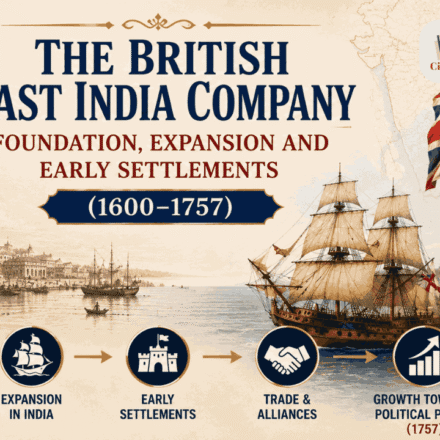
British East India Company: Foundation, Expansion and Early Settlements (1600–1757)

Chapter Summary
| Chapter Information | Details |
|---|---|
| Series | Modern History of India (1707–1947) |
| Module | Rise of British Power in India |
| Historical Period | 1600–1757 |
| Historical Phase | Establishment and Expansion of the British East India Company before Plassey |
| Previous Chapter | European Trading Companies in India (1498–1765): Portuguese, Dutch, English and French |
| Current Chapter | The British East India Company: Foundation, Expansion and Early Settlements (1600–1757) |
| Next Chapter | The Carnatic Wars (1746–1763): Anglo-French Rivalry for Supremacy in India |
| Core Theme | Evolution of the English East India Company from a trading corporation into the dominant European power in India before the Battle of Plassey. |
| Key Personalities | Queen Elizabeth I, Sir James Lancaster, William Hawkins, Sir Thomas Roe, Emperor Jahangir, Charles II, Job Charnock, Farrukhsiyar, Robert Clive |
| Key Places | London, Surat, Agra, Madras (Fort St. George), Bombay, Calcutta (Fort William), Hooghly |
| Key Concepts | Royal Charter, Joint-Stock Company, Mercantilism, Factory System, Presidency Towns, Farman, Commercial Capitalism, Corporate Empire |
| Major Events Covered | Royal Charter (1600), Battle of Swally (1612), Surat Factory (1613), Sir Thomas Roe’s Embassy (1615–1619), Madras (1639), Bombay (1668), Calcutta (1690), Farrukhsiyar’s Farman (1717), Prelude to Plassey (1757) |
| Historical Significance | Explains how the English East India Company gradually transformed from a commercial enterprise into a powerful political institution, laying the administrative, military, and financial foundations of British rule in India. |
| Exam Relevance | Highly important for UPSC Prelims, UPSC GS-I (Modern History), JKPSC, JKAS, State PCS, CDS, CAPF, SSC, UGC-NET History, and university examinations. |
Timeline: The Rise of the British East India Company (1600–1757)
| Year | Event |
|---|---|
| 1600 | Queen Elizabeth I grants the Royal Charter to the English East India Company. |
| 1601 | First voyage under Sir James Lancaster. |
| 1608 | Captain William Hawkins reaches Jahangir’s court. |
| 1612 | Battle of Swally; English defeat the Portuguese. |
| 1613 | First permanent English factory established at Surat. |
| 1615–1619 | Sir Thomas Roe’s embassy at Jahangir’s court. |
| 1639 | Madras acquired; Fort St. George established. |
| 1661 | Bombay received by England from Portugal. |
| 1668 | Bombay leased to the East India Company. |
| 1690 | Job Charnock establishes Calcutta. |
| 1698 | Company acquires zamindari rights over Calcutta, Sutanuti, and Govindpur. |
| 1700 | Fort William becomes headquarters in Bengal. |
| 1717 | Farrukhsiyar grants the famous Farman. |
| 1746–1763 | Carnatic Wars begin transforming the Company into a political power. |
| 1757 | Battle of Plassey marks the beginning of Company rule. |
The previous chapter explained how various European trading companies entered India and competed for commercial influence. Among these companies, the English East India Company eventually emerged as the most successful, not because it possessed overwhelming military superiority from the beginning, but because it gradually developed an extraordinary ability to combine commercial enterprise with diplomacy, financial management, institutional innovation, and political strategy.
This chapter examines that transformation in detail. It traces the Company’s journey from its establishment in London in 1600 to the eve of the Battle of Plassey (1757), showing how a private commercial corporation laid the foundations of one of the largest empires in world history. Understanding this evolution is essential because almost every subsequent development in Modern Indian History—from Plassey and Buxar to the Revolt of 1857 and the rise of Indian nationalism—can ultimately be traced back to the institutional foundations established during this formative period.
Introduction
Few institutions in world history have undergone a transformation as remarkable as the English East India Company. Established at the beginning of the seventeenth century as a commercial enterprise seeking profitable trade with Asia, it possessed neither territorial ambitions nor sovereign authority over foreign lands. Its directors in London were primarily merchants interested in spices, textiles, and commercial profit rather than empire-building. Yet within little more than a century and a half, this private joint-stock corporation had become the most powerful political institution in the Indian subcontinent, exercising authority over territories far larger than many contemporary European kingdoms.
The Company’s rise cannot be understood merely as the story of successful merchants. It represents the intersection of several major historical developments that transformed the early modern world. The expansion of European maritime exploration, the emergence of mercantilism, the growth of joint-stock capitalism, the prosperity of the Mughal economy, and the gradual political fragmentation of eighteenth-century India together created conditions in which commercial corporations acquired unprecedented political influence. The English East India Company stood at the centre of this transformation.
Unlike earlier European powers, the Company did not initially rely upon conquest. During its first century in India, it operated within the framework of the Mughal Empire, seeking trading privileges through negotiation rather than military force. It established factories with imperial permission, cultivated diplomatic relations with Mughal emperors and regional governors, and concentrated on exporting Indian textiles, silk, indigo, saltpetre, and spices to European markets. The Company’s prosperity depended upon peaceful commerce, and its officials understood that cooperation with Indian authorities was essential for commercial success.
However, the political landscape of India changed profoundly during the eighteenth century. As Mughal authority weakened and regional states competed for influence, the Company gradually expanded beyond its original commercial role. Fortified settlements became administrative centres, commercial agents acquired diplomatic responsibilities, merchant ships were increasingly accompanied by armed escorts, and factory guards evolved into disciplined military forces. By adapting to these changing circumstances, the Company developed the institutional capacity to intervene in Indian politics while continuing to pursue commercial objectives.
This gradual evolution distinguishes the English East India Company from every other European trading corporation operating in Asia. It neither abandoned commerce for conquest nor separated political authority from economic interests. Instead, it integrated trade, finance, diplomacy, military organization, and administration into a unified institutional framework capable of responding to changing historical conditions. The foundations laid between 1600 and 1757 therefore explain not only the Company’s commercial success but also the emergence of British political dominance in India.
For students of Modern Indian History, this chapter marks the beginning of the story of British India. It demonstrates how commercial privilege became political influence, how trading settlements developed into administrative capitals, and how a private corporation gradually acquired the characteristics of a sovereign state. The chapters that follow—covering the Carnatic Wars, the Battle of Plassey, the Battle of Buxar, and the expansion of British rule—are best understood against the institutional background established during this formative period.
The Foundation of the English East India Company: The Royal Charter of 1600 and the Birth of a Corporate Empire
Why Was the English East India Company Established?
The establishment of the English East India Company on 31 December 1600 was not an isolated event but the culmination of profound political, economic, and intellectual transformations that were reshaping Europe during the sixteenth century. The Renaissance had stimulated scientific curiosity and maritime exploration, while the Age of Discovery had demonstrated that direct sea routes could bypass traditional overland trade networks. At the same time, the rapid expansion of international commerce encouraged European monarchies to seek new markets, reliable sources of luxury commodities, and greater control over global trade. England, which had initially lagged behind Portugal and Spain in overseas expansion, now sought to establish its own commercial presence in Asia. The creation of the English East India Company represented Britain’s first systematic attempt to participate in the immensely profitable trade of the Indian Ocean and marked the beginning of a relationship that would eventually transform both Britain and India.
The immediate economic motivation behind the Company’s establishment was the extraordinary profitability of the Eastern trade. Europe possessed an insatiable demand for spices such as pepper, cloves, cinnamon, nutmeg, and mace, which were indispensable for preserving food, preparing medicines, and flavouring cuisine. Alongside spices, Indian cotton textiles, silk, indigo, precious stones, perfumes, and luxury handicrafts commanded exceptionally high prices in European markets. However, these commodities reached Europe through a long chain of intermediaries consisting of Arab merchants, Venetian traders, and Ottoman authorities, each adding substantial costs before the goods finally reached Western Europe. English merchants recognized that direct maritime access to Asia would eliminate these intermediaries, reduce costs, and generate enormous commercial profits.
Political developments in Europe further strengthened England’s determination to enter the Asian trade. During the sixteenth century, Portugal and Spain had emerged as the dominant maritime powers, dividing much of the non-European world between themselves under the Treaty of Tordesillas (1494). Portuguese fleets controlled the sea route around the Cape of Good Hope and exercised considerable influence over the Indian Ocean through their fortified ports and naval patrols. England, excluded from this lucrative commerce, increasingly viewed overseas expansion as both an economic necessity and a matter of national prestige. The growing rivalry between Protestant England and Catholic Iberian powers, particularly after the defeat of the Spanish Armada in 1588, created favourable conditions for England to pursue an independent maritime policy.
The institutional mechanism through which England sought to compete with established European powers was the joint-stock company. Earlier overseas ventures financed by individual merchants often failed because long-distance voyages required enormous capital investments and involved considerable risks arising from storms, piracy, disease, and uncertain markets. The joint-stock model solved this problem by allowing numerous investors to pool their capital while sharing both profits and losses. Instead of relying upon the wealth of a few individuals, commercial enterprises could mobilize financial resources from a broad group of shareholders, thereby making large-scale overseas trade economically viable. This innovation represented one of the earliest and most significant developments in the history of modern corporate capitalism.
Recognizing these opportunities, a group of influential London merchants petitioned Queen Elizabeth I for official permission to trade with the East Indies. Responding favourably, the Queen issued the famous Royal Charter on 31 December 1600, formally establishing “The Governor and Company of Merchants of London Trading into the East Indies.” The Charter granted the newly created Company an exclusive monopoly over English trade east of the Cape of Good Hope and west of the Strait of Magellan for an initial period of fifteen years. This monopoly ensured that no other English merchants could legally engage in trade within this vast geographical region without the Company’s authorization.
The Royal Charter provided the Company with powers that extended well beyond ordinary commercial privileges. It authorized the Company to acquire property, establish factories, appoint officials, frame internal regulations, maintain its own seal, negotiate agreements with foreign rulers, and defend its commercial interests whenever necessary. Although these powers were intended primarily to facilitate overseas trade, they effectively created a semi-sovereign corporate institution capable of exercising governmental functions outside England. In retrospect, historians regard these provisions as the constitutional foundations upon which the future British Empire in India would eventually be constructed.
The Company’s organizational structure reflected a remarkable combination of private enterprise and royal authority. It was governed by a Governor, assisted by a Court of Directors, who were elected by the shareholders, collectively known as the Court of Proprietors. This system ensured that commercial decisions remained largely in the hands of experienced merchants while allowing the English Crown to supervise the Company’s broader strategic interests. Unlike the Portuguese empire, which operated directly under royal administration, the English model delegated overseas expansion to a private corporation whose primary objective remained commercial profitability. This institutional distinction would prove crucial in explaining the Company’s later flexibility and capacity for adaptation.
Initially, neither the English government nor the Company’s directors envisaged the establishment of a territorial empire in India. Their ambitions were fundamentally commercial. The principal objective was to obtain spices from Southeast Asia and luxury goods from India through peaceful trade. Early Company officials were instructed to avoid unnecessary military conflicts, cultivate cordial relations with local rulers, and establish permanent trading stations wherever favourable commercial opportunities existed. The idea that this merchant corporation would one day govern millions of people and administer one of the world’s largest empires lay far beyond the imagination of its founders.
Nevertheless, certain features of the Company’s institutional design unintentionally prepared it for future political expansion. The authority to negotiate treaties enabled it to conduct diplomacy independently of the English Crown. The permission to maintain armed guards for protecting its factories gradually evolved into the establishment of permanent military forces. Its monopoly over English eastern trade generated enormous financial resources, while its corporate continuity ensured stable administration despite changes in governments and monarchs. These characteristics distinguished the English East India Company from ordinary merchant associations and allowed it to respond effectively to changing political circumstances in Asia during the following centuries.
Modern historians often describe the English East India Company as one of the earliest examples of a multinational corporation possessing both commercial and political powers. Historians such as Philip J. Stern argue that the Company should not merely be viewed as a trading organization that accidentally acquired an empire. Instead, its constitutional structure, legal privileges, and corporate organization gave it many of the characteristics of a sovereign political institution from the very beginning. While empire was not its original objective, the institutional framework established by the Royal Charter made imperial expansion a historical possibility once favourable political conditions emerged in India.
The Royal Charter of 1600, therefore, occupies a pivotal place in both British and Indian history. It marked the formal birth of the English East India Company, introduced a new model of corporate organization capable of mobilizing vast financial resources, and inaugurated England’s sustained participation in Asian commerce. More importantly, it created an institution whose combination of commercial enterprise, legal autonomy, financial strength, and administrative continuity would eventually enable it to transform from a body of merchants into the governing authority of the Indian subcontinent. The history of British India, in many respects, began not on the battlefield but with a royal document issued in London that established one of history’s most influential corporate institutions.
CivilsCentral Historical Insight
The Royal Charter of 1600 did far more than create a trading company. It established an institution with corporate autonomy, legal personality, financial continuity, and limited sovereign powers. Although founded for commerce, these institutional features enabled the English East India Company to evolve into one of the most powerful political organizations in world history, illustrating how the rise of modern capitalism and imperial expansion became deeply interconnected.
The Early Voyages and the Search for a Place in the East: From Sir James Lancaster to William Hawkins (1601–1611)
How Did the English East India Company Begin Its Journey to India?
The issuance of the Royal Charter in 1600 marked only the beginning of the English East India Company’s story. A charter, however comprehensive, could not by itself establish commercial success. The Company’s monopoly over English trade with the East would remain merely a legal privilege unless it could successfully navigate thousands of kilometres of unfamiliar oceans, compete against experienced European rivals, and secure the confidence of powerful Asian rulers. The decade that followed the Company’s establishment therefore became a period of experimentation, maritime exploration, diplomatic learning, and commercial adaptation. During these formative years, the Company laid the foundations of its future empire not through conquest but through a series of carefully organized commercial expeditions.
The Company’s first voyage departed from England in 1601 under the command of Sir James Lancaster, one of England’s most experienced navigators. Unlike the Portuguese, whose voyages had been financed directly by the Crown, Lancaster’s expedition represented the practical application of the new joint-stock system. Investors had pooled their capital with the expectation that successful trade in Asia would yield substantial profits. This commercial motivation shaped every aspect of the expedition, from the selection of ships and crew to the choice of trading destinations. The voyage therefore demonstrated not only England’s maritime ambitions but also the growing importance of private corporate enterprise in overseas expansion.
Lancaster’s expedition travelled around the Cape of Good Hope, crossed the Indian Ocean, and reached Southeast Asia after a long and hazardous journey. The fleet secured profitable cargoes of spices from regions such as Aceh and Bantam before returning to England with enormous financial gains. The success of the voyage justified the confidence of investors and established that English merchants could compete successfully in the lucrative eastern trade. More importantly, it convinced both the English Crown and London’s commercial community that long-distance Asian commerce could become a permanent and highly profitable enterprise rather than an occasional maritime adventure.
Despite this encouraging beginning, the Company soon discovered that establishing itself in Asia would be far more difficult than conducting occasional trading voyages. The Portuguese had already spent more than a century building an extensive network of fortified ports stretching from Africa to India. Their naval squadrons patrolled the principal sea routes, while their diplomatic influence among coastal rulers enabled them to dominate maritime commerce. Similarly, the Dutch East India Company (VOC), established in 1602, possessed substantial financial resources and rapidly emerged as a formidable commercial competitor. The English therefore entered an Asian trading world in which most strategic opportunities had already been claimed by more experienced rivals.
Faced with this reality, the Company’s directors gradually shifted their attention from the spice-producing islands of Southeast Asia towards the Indian subcontinent. India offered advantages that extended beyond the spice trade. It possessed one of the world’s largest textile industries, flourishing commercial cities, abundant agricultural production, and above all the protection of the politically stable Mughal Empire. Rather than attempting to challenge Portuguese dominance through direct military confrontation, Company officials concluded that long-term success depended upon obtaining official permission from the Mughal authorities to establish permanent trading settlements.
The Company’s first significant diplomatic initiative in India came with the arrival of Captain William Hawkins at the Mughal court in 1608. Hawkins reached the port of Surat, intending to secure commercial privileges that would permit the English to establish regular trade within the Mughal Empire. His mission represented a new phase in Company policy. Military confrontation alone could not guarantee commercial success; diplomatic recognition from the Mughal emperor had become equally important. Consequently, Hawkins proceeded to the imperial court of Emperor Jahangir, carrying a letter from King James I of England requesting favourable treatment for English merchants.
Hawkins’ audience with Jahangir demonstrated both the opportunities and challenges confronting the English. Possessing knowledge of the Turkish language, Hawkins was able to communicate effectively with the emperor, who received him with considerable courtesy and even appointed him to a position within the Mughal court. Jahangir showed genuine interest in developing relations with England and appeared willing to encourage English trade. However, the Company’s ambitions encountered vigorous opposition from the Portuguese, whose representatives had long enjoyed influence at the Mughal court. Recognizing that English commercial expansion threatened their established monopoly, Portuguese officials used both diplomacy and political pressure to obstruct Hawkins’ efforts.
As a result, Hawkins failed to obtain the permanent commercial privileges he had sought. His experience nevertheless proved invaluable for the Company. It revealed that success in India required more than profitable merchandise or skilled navigation. English merchants needed to understand Mughal administrative procedures, cultivate influential court officials, negotiate patiently with imperial authorities, and counter the diplomatic influence exercised by rival European powers. These lessons profoundly influenced the Company’s future strategy, encouraging a greater emphasis on formal diplomacy rather than reliance upon purely commercial negotiation.
The failure of Hawkins’ mission did not discourage the Company; instead, it prompted a more systematic approach to securing its position in India. Company officials increasingly appreciated that the Mughal Empire was neither politically fragmented nor economically dependent upon European trade. The English approached India not as conquerors entering a weak kingdom but as merchants seeking admission into one of the wealthiest and most powerful empires of the early modern world. This recognition encouraged a policy of patience, negotiation, and respectful diplomacy that distinguished the Company’s early decades in India.
These early voyages also strengthened the Company’s institutional capabilities. Each expedition generated valuable information regarding ocean currents, seasonal monsoon winds, navigational hazards, commercial practices, commodity prices, and political conditions across the Indian Ocean. The accumulation of such knowledge gradually transformed the Company into an organization possessing not only commercial capital but also extensive geographical, diplomatic, and administrative expertise. This continuous process of institutional learning became one of its greatest competitive advantages over time.
By 1611, therefore, the English East India Company had not yet established permanent political influence in India, but it had acquired something equally important: experience. It had demonstrated the profitability of eastern trade, understood the necessity of diplomatic engagement with the Mughal Empire, recognized the challenges posed by Portuguese competition, and developed an increasingly sophisticated organizational structure capable of adapting to unfamiliar environments. These experiences prepared the Company for the decisive developments that would soon follow, particularly the Battle of Swally (1612) and the establishment of its first permanent factory at Surat.
The Company’s earliest voyages thus represent far more than exploratory expeditions. They illustrate the gradual emergence of a corporate institution learning to operate within a complex international environment where commerce depended upon navigation, diplomacy, political negotiation, and strategic adaptability. Long before it became a territorial power, the English East India Company first became a remarkably effective learning organization—an institution capable of transforming early setbacks into the foundations of future success.
CivilsCentral Historical Insight
The first decade of the English East India Company was a period of institutional learning rather than imperial expansion. Through the voyages of Sir James Lancaster and the diplomatic mission of William Hawkins, the Company realized that commercial success in India depended not merely on maritime skill but on understanding Indian political institutions, cultivating diplomatic relationships, and patiently adapting to one of the world’s most sophisticated commercial economies.
The Battle of Swally (1612) and the Establishment of the First English Factory at Surat
How Did the English Secure Their First Permanent Foothold in India?
The diplomatic mission of William Hawkins revealed that goodwill alone would not secure the English East India Company’s position in India. Although Emperor Jahangir received Hawkins with honour, Portuguese influence at the Mughal court remained sufficiently strong to obstruct English commercial ambitions. The Company therefore faced a difficult challenge. It needed to convince the Mughal authorities that the English could not only conduct profitable trade but also protect maritime commerce against Portuguese interference. This opportunity emerged unexpectedly in 1612, when a naval confrontation off the coast of Gujarat fundamentally altered the balance of European power in western India. The Battle of Swally became one of the most decisive events in the early history of the English East India Company because it transformed the English from relatively unknown merchants into respected maritime partners of the Mughal Empire.
During the opening years of the seventeenth century, the Portuguese continued to dominate the Arabian Sea through an extensive network of fortified ports and powerful naval squadrons. Their long-established bases at Goa, Diu, and Daman enabled them to regulate shipping routes along the western coast of India, while the Cartaz System gave them considerable influence over maritime commerce. Portuguese officials regarded the arrival of the English as a direct threat to this monopoly and repeatedly attempted to prevent English ships from trading with Indian ports. Their strategy relied upon naval intimidation, diplomatic pressure on Mughal officials, and occasional armed confrontation to discourage English commercial expansion.
The immediate conflict arose when Captain Thomas Best, commanding an English fleet, arrived near the port of Surat in 1612. Portuguese naval commanders, determined to prevent the English from establishing commercial relations with the Mughal Empire, launched an attack against the Company’s ships near the village of Swally (Suvali), located north of Surat. Although the Portuguese possessed greater experience in Indian waters and enjoyed a reputation for naval superiority built over more than a century, the English fleet demonstrated remarkable discipline, superior artillery, and effective tactical coordination during the engagement.
The Battle of Swally ended in a decisive English victory. Portuguese ships suffered significant damage and were forced to withdraw, while the English successfully protected their vessels and maintained control over the immediate maritime area. Although the battle involved relatively small naval forces by later standards, its political consequences were far greater than its military scale might suggest. For the first time since the Portuguese arrival in India, another European power had successfully challenged Portuguese naval dominance in the Arabian Sea. The myth of Portuguese invincibility had been broken.
The significance of the English victory extended well beyond European rivalry. The Mughal authorities had long been dissatisfied with Portuguese attempts to interfere in maritime trade and with their occasional attacks upon pilgrim ships travelling to the holy cities of Mecca and Medina. The Portuguese had frequently used their naval strength to exert pressure upon Indian merchants and coastal authorities, creating resentment among Mughal officials responsible for protecting imperial commerce. The English victory therefore demonstrated that an alternative European trading partner capable of resisting Portuguese aggression had emerged.
Recognizing the strategic implications of the battle, Emperor Jahangir reconsidered the Company’s position within the Mughal Empire. The English had not merely requested commercial privileges; they had proven their ability to defend maritime trade and challenge Portuguese interference. This significantly enhanced their credibility in the eyes of the Mughal administration. As a result, the Emperor granted the English permission to establish their first permanent trading factory at Surat in 1613, marking a decisive turning point in the Company’s history.
The establishment of the Surat Factory represented far more than the construction of a commercial warehouse. In the terminology of the seventeenth century, a factory referred to a permanent trading establishment managed by Company officials known as factors, whose responsibilities included purchasing goods, negotiating with local merchants, supervising exports, maintaining accounts, and representing the Company’s commercial interests. The Surat Factory therefore became the Company’s first permanent administrative headquarters in India and the centre from which English trade with the Mughal Empire would be coordinated for several decades.
Surat itself was ideally suited for this purpose. Situated on the western coast of India in present-day Gujarat, it ranked among the wealthiest ports of the Mughal Empire and served as the principal gateway for maritime commerce with the Persian Gulf, the Red Sea, East Africa, and Southeast Asia. The city was also an important departure point for Muslim pilgrims undertaking the Hajj to Mecca, making it economically and strategically significant within the Mughal imperial system. By establishing its headquarters at Surat, the Company gained direct access to one of the busiest commercial centres in Asia.
From Surat, the English East India Company rapidly expanded its commercial activities. Indian cotton textiles from Gujarat, indigo, silk, saltpetre, spices, and precious commodities were purchased for export to Europe, while silver imported from England flowed into the Mughal economy in exchange for these goods. The Company’s trade complemented rather than displaced existing commercial networks. English merchants depended heavily upon Indian bankers, brokers, transporters, artisans, and merchant communities, all of whom played indispensable roles in facilitating overseas commerce. The success of the Surat Factory therefore rested upon close cooperation with India’s already sophisticated commercial institutions rather than their replacement.
The English victory at Swally also had important psychological consequences. It demonstrated to Company officials that military preparedness could strengthen commercial negotiation without necessarily leading to territorial conquest. The English did not capture ports or annex territory after the battle; instead, they converted military credibility into diplomatic advantage. This pattern—using limited military success to obtain political concessions and commercial privileges—would later become a defining characteristic of Company expansion throughout India.
Historians often regard the Battle of Swally as the true beginning of the English East India Company’s permanent presence in India. The Royal Charter of 1600 had created the Company as a legal institution, while the voyages of Lancaster and Hawkins introduced it to Asian commerce and Mughal diplomacy. However, it was only after Swally that the Company acquired a secure territorial base from which it could organize regular trade, build administrative capacity, and establish enduring relationships with Indian merchants and Mughal officials. In many respects, Surat became the first laboratory in which the Company learned how to operate successfully within the complex political and commercial environment of India.
The events of 1612–1613 therefore represent a decisive milestone in the evolution of the English East India Company. They demonstrated that commercial success depended upon a careful combination of maritime strength, diplomatic negotiation, institutional organization, and cooperation with Indian authorities. More importantly, they established a pattern that would continue throughout the Company’s history: commercial privileges were increasingly secured through a combination of economic influence and strategic power, enabling a private trading corporation to acquire growing political significance without immediately abandoning its mercantile character.
CivilsCentral Historical Insight
The Battle of Swally was far more than a naval engagement between the English and the Portuguese. It marked the moment when the English East India Company proved its strategic value to the Mughal Empire. By converting military credibility into commercial privileges, the Company secured its first permanent base at Surat and demonstrated a pattern that would later underpin British expansion across India—using limited military success to achieve long-term political and economic objectives.
Sir Thomas Roe’s Embassy and the Consolidation of English Trade (1615–1619)
How Did Diplomacy Strengthen the Company’s Position in India?
The victory at the Battle of Swally (1612) and the establishment of the Surat Factory (1613) provided the English East India Company with its first permanent foothold in India. Yet Company officials clearly understood that military success alone could not guarantee long-term commercial prosperity. The Mughal Empire remained one of the most powerful and prosperous states in the world, exercising effective control over most of the Indian subcontinent. Any foreign trading company wishing to expand its commercial activities required not merely local permission but the confidence and protection of the Mughal emperor himself. Consequently, the English increasingly shifted their strategy from naval confrontation to diplomatic engagement, recognizing that stable commerce depended upon stable political relationships. This realization culminated in one of the most important diplomatic missions in the history of early British India—the embassy of Sir Thomas Roe.
In 1615, King James I of England appointed Sir Thomas Roe as his official ambassador to the court of Emperor Jahangir. Unlike earlier Company representatives such as William Hawkins, who primarily represented the commercial interests of the East India Company, Roe arrived as the accredited envoy of the English Crown. His mission reflected an important evolution in English policy. The East India Company remained a private corporation, but its commercial ambitions increasingly received diplomatic support from the English monarchy. The objective was not to establish political control over India but to secure permanent commercial privileges through formal relations between two sovereign powers.
Sir Thomas Roe reached Jahangir’s court at Ajmer, where the Mughal emperor was then residing. The Mughal court represented one of the most magnificent political institutions of the early modern world. Rich ceremonial traditions, elaborate administrative procedures, and a highly centralized imperial bureaucracy characterized Jahangir’s government. Roe quickly realized that negotiations in such an environment required patience, cultural sensitivity, and a thorough understanding of Mughal political customs. Unlike the Portuguese, who had often attempted to combine diplomacy with intimidation, Roe deliberately adopted a policy of courtesy, restraint, and respectful negotiation.
One of Roe’s greatest strengths lay in his realistic understanding of the Company’s position. He recognized that the English were not dealing with a weak kingdom that could be coerced through military pressure. On the contrary, the Mughal Empire possessed enormous wealth, a sophisticated administrative system, and military resources far exceeding anything the Company could deploy in India. Consequently, Roe consistently advised Company officials to avoid unnecessary military conflicts and to concentrate instead upon cultivating the goodwill of Mughal authorities. His famous advice that the Company should seek “peace with all nations” reflected a pragmatic appreciation that commerce flourished best in conditions of political stability.
The embassy achieved considerable diplomatic success. Although Roe did not secure every privilege he initially requested, he succeeded in obtaining a series of important concessions that substantially strengthened the Company’s commercial position. Mughal officials permitted the English to establish and maintain factories at several locations, protected Company merchants from arbitrary interference by local authorities, and generally encouraged the expansion of English trade within imperial territories. These concessions did not grant exclusive commercial rights, but they provided the Company with a stable legal framework within which it could conduct business across different regions of the Mughal Empire.
Equally significant was the atmosphere of mutual confidence that developed between Roe and Emperor Jahangir. The emperor appreciated the ambassador’s respectful conduct and was intrigued by English gifts, scientific instruments, and European craftsmanship. Roe, in turn, admired the wealth, administrative efficiency, and political stability of the Mughal Empire. His detailed correspondence with Company directors in London provided one of the earliest comprehensive English descriptions of Mughal administration, court ceremonies, taxation, trade, and political organization. These reports became invaluable sources of information for future Company officials, enabling them to understand the institutional environment within which they operated.
The diplomatic achievements of Roe’s embassy extended beyond the immediate commercial concessions. They fundamentally transformed the Company’s approach towards India. Earlier English expeditions had often concentrated on maritime competition with the Portuguese and the search for profitable commodities. Roe demonstrated that successful commerce depended equally upon diplomacy, legal recognition, and long-term political relationships. The Company increasingly recognized that sustained commercial expansion required cooperation with Indian authorities rather than confrontation. This diplomatic tradition remained one of the defining characteristics of Company policy for several decades.
The embassy also exposed the limitations of Portuguese influence within the Mughal Empire. For many years, Portuguese representatives had attempted to portray the English as unreliable newcomers lacking naval strength and commercial credibility. However, the English victory at Swally, combined with Roe’s skilful diplomacy, gradually convinced Mughal officials that the English represented a useful alternative European trading partner. Without directly displacing the Portuguese, the Company successfully established itself as a respected participant in India’s commercial system, thereby reducing Portugal’s long-standing monopoly over European trade with the Mughal Empire.
Economically, the period following Roe’s embassy witnessed a steady expansion of English commercial activity. Factories were established or strengthened at Agra, Ahmedabad, Broach (Bharuch), and other important commercial centres connected to the Surat headquarters. These factories enabled the Company to purchase high-quality cotton textiles, indigo, silk, saltpetre, and luxury goods from different regions of the Mughal Empire. The Company’s commercial network gradually became more diversified, reducing dependence upon a single port and creating a stable supply chain linking Indian producers with European markets.
The success of Roe’s mission also illustrated an important institutional characteristic of the English East India Company—its remarkable ability to learn from experience. William Hawkins’ earlier mission had revealed the difficulties of securing commercial privileges amid Portuguese opposition. Roe refined this approach by separating diplomacy from commercial rivalry and emphasizing cooperation with the Mughal state. Instead of attempting dramatic political concessions, he patiently built trust through continuous negotiation and respectful engagement. This capacity to modify strategy in response to changing circumstances became one of the Company’s greatest long-term strengths.
Modern historians frequently regard Sir Thomas Roe’s embassy as one of the defining moments in the early history of British India. It did not establish British political authority, nor did it immediately transform the Company’s fortunes. Rather, it created the diplomatic foundations upon which subsequent commercial expansion rested. By securing imperial recognition, strengthening institutional legitimacy, and encouraging peaceful relations with the Mughal Empire, Roe enabled the Company to expand steadily during the seventeenth century without relying upon territorial conquest.
The years between 1615 and 1619 therefore marked the successful consolidation of the English East India Company’s position in India. The Company had progressed from uncertain maritime expeditions to permanent commercial settlements supported by imperial authority. It had demonstrated that diplomacy could often achieve objectives that military force alone could not accomplish. More importantly, Roe’s embassy reinforced a principle that would shape Company policy for generations: lasting commercial success in India depended upon understanding and working within the existing political order before attempting to reshape it.
CivilsCentral Historical Insight
Sir Thomas Roe’s embassy transformed the English East India Company from a foreign merchant enterprise into a recognized commercial partner of the Mughal Empire. His greatest achievement was not the acquisition of dramatic privileges but the establishment of a diplomatic tradition based on negotiation, patience, and institutional cooperation. This peaceful consolidation of commercial rights enabled the Company to strengthen its economic position long before it acquired political power.
The Expansion of the Company’s Trading Network: Madras, Bombay and Calcutta (1639–1700)
How Did the English East India Company Build Its Three Presidency Towns?
The diplomatic achievements of Sir Thomas Roe secured the English East India Company’s commercial future within the Mughal Empire, but the Company’s directors soon realized that long-term prosperity required more than imperial permission and a single trading centre. Surat had emerged as an important commercial headquarters, yet it remained dependent upon the goodwill of Mughal officials and was vulnerable to changing political circumstances. Moreover, India’s vast coastline offered access to different commercial regions, each specializing in distinct products and connected to separate international markets. To expand its operations and reduce dependence on a single port, the Company gradually established permanent settlements along the eastern and western coasts of India. These settlements—Madras, Bombay, and Calcutta—would later develop into the famous Presidency Towns, forming the administrative, commercial, and eventually political foundations of British India.
The first major step in this expansion occurred on the Coromandel Coast of southeastern India. During the early seventeenth century, this region had emerged as one of Asia’s foremost centres of textile production. The fine cotton fabrics woven in its towns were highly valued not only in Europe but also across Southeast Asia, the Persian Gulf, and East Africa. Recognizing the commercial potential of the region, the Company sought permission to establish a permanent trading settlement independent of Portuguese influence and relatively distant from Mughal administrative control.
In 1639, Company representative Francis Day, acting under the direction of Andrew Cogan, negotiated with the local ruler of Chandragiri, a successor state of the declining Vijayanagara Empire, for the lease of a small strip of coastal land. On this site, the Company established Madraspatnam, which soon became known simply as Madras. To protect its commercial interests and provide security for its merchants, the Company constructed Fort St. George, completed in 1644. This fort became the first substantial English fortification in India and soon developed into the administrative headquarters of Company operations on the Coromandel Coast.
The establishment of Madras marked an important evolution in Company policy. Earlier factories, such as Surat, had functioned primarily as trading establishments within existing Indian cities. Madras, by contrast, developed as an English-controlled settlement where the Company exercised increasing authority over administration, trade, taxation, and urban planning. Indian merchants, artisans, weavers, and labourers gradually settled around the fort, creating a rapidly growing commercial town. Thus, while commerce remained the principal objective, Madras also represented the beginning of the Company’s experiment in urban administration and local governance.
A second major opportunity arose on the western coast under entirely different circumstances. In 1661, the marriage of King Charles II of England to the Portuguese princess Catherine of Braganza included the transfer of the island of Bombay as part of her dowry. Initially administered directly by the English Crown, Bombay soon proved expensive to maintain and difficult to develop without substantial commercial investment. Recognizing the Company’s growing experience in overseas administration, Charles II leased Bombay to the East India Company in 1668 for the nominal annual rent of £10.
Bombay possessed advantages that Surat could never fully provide. Its magnificent natural harbour offered excellent protection for shipping throughout the year, making it one of the finest ports on the western coast of India. Unlike Surat, which remained under Mughal jurisdiction, Bombay came under direct Company administration, enabling Company officials to regulate commerce, improve infrastructure, encourage immigration, and strengthen coastal defences without depending upon imperial officials. Over time, Bombay gradually replaced Surat as the principal headquarters of English trade in western India and emerged as an increasingly important centre of shipbuilding, maritime commerce, and naval operations.
The Company’s expansion into Bengal represented the third and perhaps most consequential stage of its early development. During the seventeenth century, Bengal ranked among the wealthiest provinces of the Mughal Empire. Its fertile agriculture, thriving textile industry, silk production, saltpetre manufacturing, and extensive river network made it one of the richest commercial regions in Asia. European merchants regarded Bengal as an exceptionally profitable market, and the English East India Company sought to establish a permanent base from which it could participate more effectively in this flourishing economy.
After several unsuccessful attempts to secure a stable settlement, Company official Job Charnock established a trading station in 1690 on the eastern bank of the Hooghly River. Although modern historians continue to debate whether Charnock should be regarded as the sole founder of Calcutta, his settlement marked the beginning of the Company’s permanent presence in the region. During the following years, the Company acquired the zamindari rights over the villages of Sutanuti, Govindpur, and Kalikata, which gradually merged to form the city later known as Calcutta.
Recognizing the growing importance of Bengal, the Company constructed Fort William to protect its commercial establishment from both external threats and local disturbances. Like Fort St. George in Madras, Fort William served not merely as a military installation but as an administrative centre from which Company officials supervised trade, maintained records, resolved disputes, and coordinated commercial activities across eastern India. By the beginning of the eighteenth century, Calcutta had emerged as the Company’s principal headquarters in Bengal and would later become the capital of British India.
The development of Madras, Bombay, and Calcutta fundamentally transformed the organizational structure of the English East India Company. Each settlement evolved into the headquarters of a distinct administrative division known as a Presidency, governed by a President and assisted by a council of senior Company officials. These Presidency governments exercised authority over factories within their respective regions, supervised commercial operations, maintained accounts, administered justice among Company employees, and coordinated relations with Indian rulers. Although originally designed for commercial administration, the Presidency system gradually acquired many characteristics of regional governments, foreshadowing the later political organization of British India.
The Presidency Towns also reflected the Company’s remarkable capacity for institutional adaptation. Rather than relying exclusively upon one commercial centre, it created a decentralized administrative network capable of responding to the diverse economic and political conditions of different regions. Madras specialized in the textile trade of the Coromandel Coast, Bombay became the principal maritime centre of western India, and Calcutta developed into the commercial gateway to the immensely prosperous markets of Bengal. This geographical diversification reduced commercial risks while expanding the Company’s economic influence across the subcontinent.
The growth of these settlements also stimulated significant social and economic changes. Indian merchants, craftsmen, dockworkers, bankers, translators, and labourers migrated to the new Company towns in search of commercial opportunities. Markets expanded, ports became increasingly active, and new urban communities emerged around the fortified settlements. Although administered by the Company, these towns remained economically dependent upon Indian enterprise and labour. The prosperity of Madras, Bombay, and Calcutta therefore reflected a continuous interaction between European corporate institutions and India’s vibrant commercial economy.
By 1700, the English East India Company had achieved something unprecedented among European trading corporations operating in India. It possessed three strategically located commercial capitals connected by maritime routes, supported by fortified settlements, administered through a structured Presidency system, and integrated into India’s existing commercial networks. These towns remained primarily centres of trade rather than political power, yet they provided the institutional framework that would later support territorial expansion during the eighteenth century. In retrospect, the Presidency Towns represented far more than successful commercial settlements—they became the enduring administrative pillars upon which the British Empire in India would eventually be constructed.
CivilsCentral Historical Insight
The establishment of Madras, Bombay, and Calcutta marked the transition of the English East India Company from a collection of isolated factories to a territorially organized corporate institution. The Presidency Towns combined commerce, administration, fortification, and governance within a single institutional framework, creating the administrative architecture that later enabled the Company to transform commercial influence into political sovereignty.
The Company’s Commercial Organization and the Factory System
How Did the English East India Company Conduct Trade in India?
The rapid expansion of the English East India Company’s settlements across India during the seventeenth century presented a new challenge. Establishing factories at Surat, Madras, Bombay, and Calcutta was only the first step; the Company now required an efficient administrative and commercial system capable of coordinating trade across thousands of kilometres of coastline and numerous inland markets. Success depended not merely upon acquiring trading privileges but upon creating a disciplined institutional framework that could purchase goods, maintain accounts, supervise employees, negotiate with Indian merchants, and transport commodities safely to Europe. It was through this elaborate commercial organization that the Company evolved from a group of adventurous merchants into one of the world’s most sophisticated corporate enterprises.
At the heart of the Company’s commercial system was the factory, a term that often causes misunderstanding today. In the seventeenth century, a factory did not refer to a manufacturing establishment but to a permanent commercial office or trading station where Company officials, known as factors, lived and conducted business. These establishments served as centres for purchasing goods, storing merchandise, maintaining financial records, corresponding with Company headquarters, and supervising local commercial operations. Factories functioned as the Company’s administrative nerve centres, connecting Indian producers with European markets through an organized corporate network.
Each factory was managed according to a carefully defined administrative hierarchy. At its head stood the Chief Factor or President, assisted by a council of senior officials responsible for finance, commerce, correspondence, judicial matters, and warehouse management. Junior factors gradually learned the Company’s methods before rising through the administrative ranks. Every commercial transaction, contract, expenditure, and shipment was meticulously recorded, reflecting the Company’s emphasis on accountability and financial discipline. These detailed records enabled the Court of Directors in London to supervise distant operations with remarkable efficiency despite the enormous geographical distance separating Britain from India.
The Company’s commercial operations depended fundamentally upon cooperation with Indian merchants and producers. Contrary to the impression that European companies independently controlled Indian trade, the English possessed neither sufficient knowledge nor sufficient manpower to conduct large-scale commerce without local assistance. Indian merchant communities acted as intermediaries between Company officials and local producers, while brokers, commonly known as banias, negotiated prices, arranged supplies, interpreted regional commercial practices, and facilitated transactions across different markets. These intermediaries became indispensable partners in the Company’s success.
Equally important were the Indian banking houses, which provided the financial infrastructure necessary for large-scale commerce. Influential banking families such as the Jagat Seths in Bengal and numerous merchant-bankers in Gujarat supplied credit, transferred funds through hundis, advanced loans, exchanged currencies, and financed commercial transactions across distant regions. Rather than replacing India’s sophisticated financial institutions, the English East India Company initially relied heavily upon them. The Company’s commercial success therefore rested upon its ability to integrate itself into India’s existing economic networks rather than create entirely new ones.
The principal commodities exported by the Company reflected the extraordinary diversity of India’s economy. During the seventeenth century, cotton textiles emerged as the single most valuable export. Fine muslins from Bengal, calicoes from the Coromandel Coast, and printed cotton fabrics from Gujarat enjoyed enormous demand throughout Europe, Africa, and Southeast Asia. Alongside textiles, the Company exported silk, indigo, saltpetre, pepper, opium, raw cotton, sugar, and various luxury goods. These commodities generated substantial profits because Indian manufacturing possessed exceptional quality, skilled craftsmanship, and competitive prices unmatched in many parts of Europe.
In exchange for these goods, the Company imported relatively few European manufactured products into India. Instead, it relied primarily upon bullion, particularly silver, to finance its purchases. This reflected the economic realities of the period. The Mughal Empire produced many of the manufactured goods desired in Europe, while Europe possessed comparatively few products capable of attracting large Indian markets. Consequently, enormous quantities of silver flowed from Europe into India through Company trade, contributing to the expansion of monetary circulation within the Mughal economy. Only in the eighteenth century, with the Company’s growing political influence, would this pattern gradually change.
Maintaining the quality of exported goods required a highly organized procurement system. Company officials frequently entered into contracts with Indian weavers and artisans, advancing money to secure future production. This practice, known as the dadni system, enabled the Company to ensure regular supplies of textiles while providing artisans with working capital. Although mutually beneficial in its early stages, the increasing use of advances also allowed Company officials to exercise greater control over production, particularly during the eighteenth century. What began as a commercial arrangement gradually evolved into an instrument through which the Company influenced local manufacturing.
The transportation of goods represented another major organizational challenge. Commodities produced in inland manufacturing centres had to be collected, inspected, packed, and transported to coastal factories before shipment to Europe. This required cooperation with Indian transport networks, warehouse owners, packers, and shipping contractors. Seasonal monsoon winds further influenced commercial schedules, compelling the Company to synchronize procurement, storage, and maritime departures according to the rhythms of Indian Ocean navigation. Such logistical coordination demanded exceptional administrative planning and contributed significantly to the Company’s growing institutional sophistication.
The Company also developed an elaborate system of commercial correspondence linking its factories with the Court of Directors in London. Ships carried not only merchandise but also detailed reports concerning prices, political developments, commodity availability, market conditions, and relations with Indian authorities. Decisions taken in London influenced commercial policy across Asia, while information gathered in India shaped future Company strategy. Although communication required many months, the regular exchange of information created one of the earliest examples of coordinated multinational corporate management.
The remarkable efficiency of the Company’s commercial organization distinguished it from many contemporary trading enterprises. It combined centralized financial supervision with considerable local flexibility, allowing individual factories to respond to changing market conditions while remaining accountable to Company headquarters. This institutional balance between central control and regional autonomy enabled the Company to expand across diverse political environments without losing organizational coherence. In many respects, its commercial administration anticipated the management practices later associated with modern multinational corporations.
Historians increasingly regard the English East India Company’s factory system as one of its greatest institutional achievements. Before it acquired territories or commanded large armies, the Company perfected the art of long-distance commercial administration. Its factories functioned simultaneously as warehouses, accounting offices, diplomatic centres, judicial institutions, and administrative headquarters. By integrating finance, logistics, procurement, correspondence, and local partnerships into a single organizational framework, the Company created a commercial machine capable of operating across continents with remarkable effectiveness.
The factory system therefore represented far more than an arrangement for buying and selling goods. It established the administrative habits, financial discipline, institutional continuity, and managerial expertise that later enabled the Company to govern territories as efficiently as it had once managed trade. Long before it became the ruler of India, the English East India Company had already become one of history’s most advanced corporate organizations.
CivilsCentral Historical Insight
The strength of the English East India Company did not initially lie in military conquest but in its exceptional commercial organization. Through its network of factories, disciplined administration, meticulous accounting, partnerships with Indian merchants and bankers, and efficient logistical systems, the Company developed an institutional capacity unmatched by its European rivals. This commercial bureaucracy later became the administrative foundation upon which British political rule in India was built.
The Farrukhsiyar Farman (1717): The Magna Carta of the English East India Company
How Did the Company Obtain Extraordinary Commercial Privileges in India?
By the beginning of the eighteenth century, the English East India Company had established itself as a respected commercial institution with thriving settlements at Madras, Bombay, and Calcutta. Its ships regularly sailed between India and Europe, its factories operated across several regions, and its commercial organization had become increasingly sophisticated. Yet despite this remarkable progress, the Company’s operations continued to face significant obstacles. Local Mughal officials frequently imposed customs duties, delayed the movement of goods, interpreted imperial regulations differently, and occasionally interfered with Company trade for personal gain. Although the Mughal emperors had generally encouraged foreign commerce, the absence of uniform commercial privileges created uncertainty and increased the Company’s operating costs. Company directors therefore sought a comprehensive imperial decree that would place their commercial activities on a secure legal foundation throughout the Mughal Empire. This objective was finally realized during the reign of Emperor Farrukhsiyar in 1717, when one of the most consequential documents in the history of British India was issued.
The political circumstances surrounding the grant of the Farrukhsiyar Farman reflected the changing condition of the Mughal Empire itself. Following the death of Emperor Aurangzeb in 1707, the empire entered a period of political instability marked by succession disputes, increasing provincial autonomy, and weakening central authority. Although the Mughal Empire remained one of the largest and wealthiest states in the world, its administrative cohesion had begun to decline. Regional governors acquired greater independence, influential noble factions competed for power at the imperial court, and the emperor increasingly depended upon alliances with powerful political groups to maintain authority. These developments created new opportunities for foreign trading companies capable of offering diplomatic support, financial resources, and commercial cooperation.
Recognizing the importance of securing permanent commercial privileges, the English East India Company dispatched an embassy to the Mughal court headed by John Surman in 1715. Accompanying the mission was the Company’s surgeon, William Hamilton, whose role would unexpectedly become crucial to the embassy’s success. According to contemporary accounts, Emperor Farrukhsiyar suffered from a serious illness during this period, and Hamilton’s successful medical treatment greatly impressed the emperor. Although historians caution against attributing the entire success of the embassy solely to this episode, there is little doubt that Hamilton’s medical assistance strengthened the Company’s position during negotiations and created a favourable atmosphere for diplomatic discussions.
After prolonged negotiations, Emperor Farrukhsiyar issued the Farman in 1717, granting the English East India Company a series of unprecedented commercial privileges. The decree represented the most extensive collection of trading concessions the Company had yet received from any Indian ruler. While earlier permissions had been limited to specific factories or regions, the Farman established a far more comprehensive legal framework governing the Company’s commercial activities across significant parts of the Mughal Empire.
Among its most important provisions was the Company’s right to conduct duty-free trade in Bengal, subject only to the payment of a fixed annual sum of 3,000 rupees. Company officials could transport goods using official passes known as dastaks, which exempted their merchandise from the numerous customs duties ordinarily imposed by local authorities. This concession substantially reduced transaction costs, accelerated the movement of goods, and gave the Company a significant commercial advantage over many Indian merchants, who remained subject to regular customs taxation.
The Farman also confirmed and expanded the Company’s existing privileges in Gujarat and the Deccan, enabling English merchants to trade with greater security across western and southern India. Furthermore, it granted permission for the Company to rent additional villages surrounding Calcutta, strengthening its territorial presence in Bengal. Although these acquisitions appeared relatively modest at the time, they allowed the Company to expand the area under its effective administrative influence and laid the foundations for the later development of Calcutta into its principal political and commercial headquarters.
From the Company’s perspective, the Farrukhsiyar Farman represented an extraordinary commercial triumph. By obtaining imperial recognition of its trading privileges, the Company reduced many of the uncertainties that had previously complicated its operations. Lower customs costs increased profitability, while legal recognition from the Mughal emperor enhanced the Company’s prestige among Indian merchants and provincial officials. The decree significantly improved the Company’s competitive position at a time when European rivalry in India remained intense.
However, the Farman also produced consequences that neither the Mughal court nor the Company could fully anticipate. The privilege of using dastaks gradually became a source of serious conflict between the Company and provincial authorities in Bengal. Although originally intended to facilitate the Company’s own trade, Company servants increasingly used these passes for private commercial activities or extended their benefits to Indian intermediaries in exchange for personal profit. As a result, substantial quantities of goods escaped customs duties, causing considerable revenue losses for the Bengal administration. Local officials repeatedly protested against what they regarded as widespread abuse of imperial privileges, while Company representatives insisted upon their legal rights under the Farman.
These disputes revealed a deeper structural problem within the declining Mughal administrative system. The emperor’s decrees often depended upon provincial officials for implementation, yet weakening central authority made consistent enforcement increasingly difficult. Consequently, conflicts over customs duties, commercial privileges, and administrative jurisdiction became more frequent during the first half of the eighteenth century. What had begun as disagreements over trade gradually evolved into political disputes concerning sovereignty, legal authority, and the limits of Company privileges.
Historians have therefore attached exceptional importance to the Farrukhsiyar Farman. The eminent historian Percival Spear famously described it as the “Magna Carta of the English East India Company in India.” The comparison highlights the constitutional significance of the decree. Just as the Magna Carta of 1215 became a foundational document in English constitutional history, the Farman of 1717 provided the legal basis upon which the Company later justified many of its commercial and administrative claims. While the analogy should not be interpreted literally, it captures the document’s enduring importance in the Company’s institutional evolution.
Modern historical scholarship, however, emphasizes that the Farman did not itself establish British political power in India. Its immediate objective remained commercial rather than territorial. The Mughal emperor intended to encourage foreign trade, not to surrender sovereignty. Nevertheless, by granting extensive privileges to a highly organized corporate institution, the Farman unintentionally strengthened an organization whose financial resources, administrative capacity, and political ambitions would expand dramatically during the decades that followed. As the authority of the Mughal Empire weakened, the Company increasingly interpreted these commercial privileges in ways that enhanced its own autonomy and influence.
In retrospect, the Farrukhsiyar Farman of 1717 marked the high point of the English East India Company’s relationship with the Mughal Empire as a commercial partner. The Company had secured legal recognition, extensive trading privileges, and growing administrative authority without resorting to territorial conquest. Yet these very privileges also sowed the seeds of future conflict. Disputes over the interpretation and implementation of the Farman would contribute significantly to the deteriorating relationship between the Company and the Bengal administration, culminating in the political crises that preceded the Battle of Plassey (1757). Thus, a document intended to facilitate trade ultimately became one of the constitutional stepping stones in the Company’s transformation from merchant to ruler.
CivilsCentral Historical Insight
The Farrukhsiyar Farman of 1717 represented the culmination of more than a century of English commercial diplomacy in India. By granting extensive customs exemptions and administrative privileges, it elevated the English East India Company to an unprecedented position within the Mughal commercial system. Ironically, the very privileges designed to encourage trade later became sources of political conflict, illustrating how commercial concessions could gradually evolve into instruments of imperial expansion.
From Merchants to Political Actors: The Company’s Growing Influence and the Road to Plassey (1717–1757)
How Did a Trading Company Begin to Interfere in Indian Politics?
The Farrukhsiyar Farman of 1717 represented the highest point of the English East India Company’s success as a commercial organization within the Mughal Empire. By securing extensive trading privileges, customs exemptions, and legal recognition, the Company had achieved what generations of its merchants had long sought—a stable and profitable position in one of the world’s richest economies. Yet history often demonstrates that great commercial success creates new ambitions. During the four decades following the Farman, the Company gradually underwent a transformation that neither its founders nor the Mughal emperors had originally anticipated. It remained, in legal terms, a trading corporation, but its increasing wealth, military resources, administrative experience, and political influence enabled it to intervene more actively in the affairs of Indian states. The period between 1717 and 1757 therefore represents the crucial transitional phase during which the English East India Company evolved from a commercial enterprise into an emerging political power.
This transformation cannot be understood without examining the profound changes occurring within the Mughal Empire after the death of Aurangzeb in 1707. Although the empire continued to possess immense prestige and considerable territorial extent, its political cohesion steadily weakened. Successive emperors struggled to maintain effective control over distant provinces, while powerful nobles increasingly pursued their own regional interests. Provincial governors such as the Nawabs of Bengal, the Nizam of Hyderabad, and the rulers of Awadh acquired growing autonomy, often functioning as virtually independent sovereigns while continuing to acknowledge the symbolic authority of the Mughal emperor. The gradual decentralization of political power fundamentally altered the environment in which European trading companies operated.
The weakening of central authority produced both opportunities and uncertainties for the English East India Company. Under a strong and centralized Mughal administration, commercial privileges granted by the emperor generally provided adequate protection. However, as provincial governors exercised greater independence, Company officials increasingly found themselves negotiating separately with local rulers, revenue officials, customs officers, and military commanders. Commercial disputes that might previously have been resolved through imperial authority now became matters of regional political negotiation. Consequently, the Company was compelled to engage more directly with provincial politics in order to safeguard its economic interests.
Nowhere were these developments more significant than in Bengal. By the early eighteenth century, Bengal had become the Company’s most valuable commercial centre. Its fertile agriculture, flourishing textile industry, silk production, and strategic river network generated enormous profits. At the same time, the province itself enjoyed considerable prosperity under a succession of capable Nawabs who maintained effective administration despite the declining authority of the Mughal emperor. Ironically, it was precisely because Bengal was prosperous and politically organized that conflicts between the Company and the provincial government acquired increasing importance.
The Farrukhsiyar Farman became the principal source of these disputes. Company officials insisted that the customs exemptions granted by the emperor entitled them to transport goods freely throughout Bengal using dastaks. The Nawabs of Bengal, however, argued that these privileges were being systematically abused. Increasingly, Company servants engaged in private trade, using official passes to avoid paying customs duties on goods that were not part of the Company’s authorized commercial operations. Some even allowed Indian merchants to use Company dastaks in exchange for personal commissions. As a result, the Bengal administration suffered substantial revenue losses while local Indian merchants found themselves competing against traders who enjoyed unfair fiscal advantages.
The Nawabs regarded this situation as a direct challenge to their administrative authority. From their perspective, the issue extended beyond lost revenue. If a foreign corporation could independently determine which goods would be taxed and which would not, the government’s ability to regulate commerce and maintain financial stability would gradually erode. Consequently, successive Nawabs attempted to restrict the misuse of dastaks and ensure that Company officials complied with provincial regulations. These efforts, however, were interpreted by the Company as violations of the imperial privileges granted under the Farman, leading to increasingly bitter disagreements.
Meanwhile, the Company’s own institutional character was changing. During its first century in India, military forces had existed primarily to defend factories, warehouses, and merchant shipping. By the middle of the eighteenth century, however, these defensive forces had become considerably larger and more professional. The Company recruited Indian soldiers known as sepoys, trained them according to European military methods, and placed them under British officers. Fortifications at Madras, Bombay, and Calcutta were strengthened, while Company officials increasingly viewed military preparedness as an essential component of commercial security. Although these forces remained relatively small compared with the armies of major Indian states, they represented a significant departure from the Company’s original purely mercantile character.
European developments also accelerated this transformation. Throughout the eighteenth century, Britain and France emerged as fierce global rivals, competing for colonies, trade, and maritime supremacy. Their conflicts in Europe inevitably spread to Asia, where both the English East India Company and the French East India Company became instruments of broader imperial competition. The Carnatic Wars (1746–1763) demonstrated that European commercial companies were now willing to intervene directly in Indian political disputes, support rival claimants to regional thrones, and employ military force to protect their strategic interests. Although these conflicts occurred primarily in southern India, they profoundly influenced Company thinking across the subcontinent.
The Company’s directors also recognized that political influence could produce commercial advantages more effectively than negotiation alone. Friendly rulers could grant favourable trading privileges, reduce taxation, permit territorial expansion, and provide military protection. Consequently, Company officials increasingly cultivated alliances with influential Indian nobles, bankers, and merchant groups whose support could strengthen their position within regional politics. This growing interaction between commerce and politics marked a decisive departure from the Company’s earlier policy of avoiding involvement in internal affairs.
The Company’s financial resources further enhanced its political influence. Decades of profitable trade had generated substantial capital, enabling it to finance military operations, maintain fortified settlements, and extend credit to local rulers when necessary. Wealth accumulated through commerce gradually became an instrument of diplomacy and political negotiation. Indian bankers, merchants, and officials increasingly recognized the Company as not merely a foreign trading organization but as a powerful corporate institution capable of influencing regional affairs.
By the 1750s, tensions in Bengal reached unprecedented levels. The Company’s expanding fortifications at Calcutta, continued misuse of dastaks, refusal to recognize certain provincial regulations, and growing political confidence alarmed the Bengal administration. At the same time, Company officials became increasingly unwilling to accept limitations imposed by the Nawab. Mutual suspicion replaced earlier cooperation, and commercial disagreements gradually evolved into constitutional disputes concerning sovereignty, taxation, military authority, and the rights of a foreign corporation operating within an Indian state.
When Siraj-ud-Daulah became the Nawab of Bengal in 1756, he inherited these unresolved tensions. Determined to assert provincial authority, he viewed the Company’s activities with deep suspicion, particularly its unauthorized fortification of Calcutta and its interference in Bengal’s commercial administration. The confrontation between the Nawab and the Company would soon culminate in one of the most decisive events in Indian history—the Battle of Plassey (1757). Although that battle is often remembered as a military engagement, its origins lay in decades of evolving commercial relationships, constitutional disputes, administrative conflicts, and political ambitions that had gradually transformed a merchant corporation into an influential political actor.
The period between 1717 and 1757 therefore marks one of the most significant transitions in the history of the English East India Company. It neither abandoned commerce nor openly sought empire. Instead, commercial interests increasingly required political engagement, while political influence generated new commercial opportunities. The boundary separating trade from governance became progressively blurred. By the eve of Plassey, the Company remained officially a trading corporation, yet it possessed the financial strength, military organization, diplomatic experience, and administrative capacity of a regional political power. The transformation was incomplete, but the direction of history had become unmistakably clear.
CivilsCentral Historical Insight
The years between the Farrukhsiyar Farman (1717) and the Battle of Plassey (1757) witnessed the gradual politicization of the English East India Company. Declining Mughal authority, disputes over commercial privileges, the growth of Company military power, and European imperial rivalry combined to transform a merchant corporation into an increasingly influential political institution. Plassey was therefore not the beginning of this transformation but its decisive culmination.
Historical Significance of the English East India Company (1600–1757)
Why Is the Early History of the English East India Company a Turning Point in Indian History?
The history of the English East India Company between 1600 and 1757 occupies a unique position in the making of modern India. During this period, the Company did not establish a territorial empire, overthrow the Mughal Empire, or directly govern large parts of the subcontinent. Its primary identity remained that of a commercial corporation engaged in overseas trade. Yet beneath this outward appearance, a series of gradual institutional, economic, military, and political developments fundamentally altered the balance of power between India and Europe. The significance of this period therefore lies not in dramatic conquest but in the slow and almost imperceptible transformation of a private trading company into an organization capable of exercising sovereign authority. It was during these one hundred and fifty-seven years that the foundations of British rule in India were quietly but decisively laid.
Perhaps the Company’s greatest historical achievement was the creation of an entirely new model of imperial expansion. Earlier European empires, particularly those of Portugal and Spain, had largely depended upon direct royal administration supported by military conquest and religious missions. The English East India Company introduced a different institutional model. It was a joint-stock corporation operating under a royal charter, financed by private investors, managed by elected directors, and driven primarily by commercial profit. This combination of private enterprise and public authority represented one of the earliest examples of corporate imperialism in world history. The British Empire in India was therefore not initially constructed by the British state but by a commercial organization whose administrative powers gradually expanded beyond the sphere of trade.
Economically, the Company integrated India more closely into the emerging global trading system of the seventeenth and eighteenth centuries. Indian cotton textiles, silk, indigo, saltpetre, spices, and other commodities reached European markets in unprecedented quantities, while silver from Europe entered the Mughal economy through Company trade. Indian manufacturing acquired an increasingly international market, and ports such as Surat, Madras, Bombay, and Calcutta developed into major centres of global commerce. During this early phase, the relationship remained largely commercial rather than colonial, and India continued to enjoy a favourable balance of trade because European demand for Indian products greatly exceeded Indian demand for European manufactures.
Institutionally, the Company developed one of the most sophisticated administrative systems of the early modern world. Its network of factories, Presidency governments, accounting procedures, correspondence systems, procurement mechanisms, and financial management practices demonstrated an extraordinary level of organizational efficiency. Long before it governed territories, the Company had mastered the administration of complex commercial operations spread across continents. This institutional experience proved invaluable after 1757, when the Company suddenly found itself responsible not merely for trade but also for taxation, justice, diplomacy, and governance. In many respects, the administrative state that later emerged under British rule evolved directly from the Company’s commercial bureaucracy.
The establishment of the Presidency Towns—Madras, Bombay, and Calcutta— represented another enduring contribution of this period. Initially created as commercial settlements, these towns gradually became centres of administration, finance, shipping, and urban development. They later evolved into the three principal capitals of British India, serving as headquarters for provincial governments, military commands, judicial institutions, and educational establishments. Even in contemporary India, these cities remain among the country’s most important economic and administrative centres, illustrating the long-term historical legacy of the Company’s early urban expansion.
The Company’s relationship with Indian political institutions also underwent a profound transformation during these years. Initially, Company officials approached the Mughal Empire as merchants seeking permission to trade within a powerful and well-governed state. Their success depended upon diplomacy, negotiation, and cooperation with Indian rulers. However, the gradual weakening of Mughal authority after 1707 altered this relationship. Commercial privileges increasingly required political protection, while political influence offered new commercial opportunities. The Company adapted rapidly to these changing circumstances, demonstrating a remarkable institutional flexibility that many contemporary Indian states struggled to match.
Equally significant was the Company’s growing military organization. The maintenance of armed guards to protect factories gradually evolved into the recruitment of disciplined sepoy armies, supported by European officers and modern artillery. Although these forces remained relatively modest before 1757, they represented an important innovation in the military history of the subcontinent. The Company increasingly possessed the capacity not merely to defend its commercial establishments but also to intervene in regional political conflicts whenever its economic interests appeared threatened.
The Farrukhsiyar Farman of 1717 symbolized both the success and the future dangers of the Company’s rise. Intended by the Mughal emperor as a commercial concession designed to encourage overseas trade, it inadvertently granted privileges that significantly strengthened the Company’s institutional autonomy. The widespread misuse of dastaks, growing disputes over customs duties, and increasing friction with provincial authorities illustrated how commercial privileges could gradually evolve into constitutional controversies concerning sovereignty itself. By the middle of the eighteenth century, the Company had begun to interpret its commercial rights in increasingly political terms, foreshadowing the conflicts that would culminate in the Battle of Plassey.
The early history of the Company also demonstrates the importance of institutional continuity in explaining historical change. Unlike many Indian political regimes, whose stability often depended upon the abilities of individual rulers, the Company functioned as a permanent corporate institution. Directors changed, governors retired, and monarchs died, yet the Company itself continued to accumulate experience, capital, records, commercial intelligence, and administrative expertise across generations. This continuity enabled it to pursue long-term objectives with remarkable consistency and adapt successfully to changing political environments. The strength of the Company therefore resided not merely in its wealth but in its institutional resilience.
Modern historiography has offered diverse interpretations of this transformation. Earlier imperial historians often portrayed the Company’s rise as evidence of British administrative superiority and commercial enterprise. Nationalist historians challenged this perspective by emphasizing the Company’s exploitative character and the gradual erosion of Indian sovereignty through commercial expansion. More recent scholarship adopts a more nuanced interpretation. Historians such as Philip J. Stern, Sanjay Subrahmanyam, and P.J. Marshall argue that the Company should be understood as a hybrid institution—simultaneously a commercial corporation, a diplomatic actor, a military organization, and eventually a territorial state. Its evolution resulted not from a predetermined imperial plan but from continuous interaction between European corporate institutions and the changing political conditions of early modern India.
The period from 1600 to 1757 therefore should not be viewed simply as the prelude to British conquest. It was an era during which the Company developed the financial resources, administrative capacity, diplomatic experience, urban infrastructure, and military organization necessary for future expansion. Without these institutional foundations, the victories at Plassey (1757) and Buxar (1764) would almost certainly have produced only temporary military successes rather than the establishment of a durable colonial state.
The story of the English East India Company before Plassey is thus fundamentally the story of preparation rather than conquest. It reveals how commerce generated wealth, wealth financed institutions, institutions created political influence, and political influence ultimately enabled territorial power. By the time the Company entered the battlefield at Plassey in 1757, its transformation had already advanced far beyond that of an ordinary trading corporation. The empire that emerged after Plassey was not created in a single battle; it had been patiently constructed through more than a century and a half of commercial expansion, institutional innovation, diplomatic engagement, and strategic adaptation.
CivilsCentral Historical Insight
The true significance of the English East India Company before 1757 lies not in the territories it conquered but in the institutions it created. Through its corporate organization, Presidency system, factory network, commercial bureaucracy, diplomatic engagement, and military preparation, the Company developed the structural capacity to exercise sovereign power. Plassey merely revealed the political potential of institutions that had been evolving since the Royal Charter of 1600.
Historiography: How Historians Interpret the Rise of the English East India Company
Did the Company Always Intend to Build an Empire?
Few questions in modern Indian history have generated as much scholarly debate as the origins of the English East India Company’s political power. Was the Company established with a hidden imperial ambition from the very beginning, or did it gradually become a territorial power because changing political circumstances in India compelled it to assume new responsibilities? Historians have answered this question in remarkably different ways over the past two centuries. Their interpretations reflect not only new historical evidence but also changing perspectives on colonialism, capitalism, state formation, and global history. Understanding these debates is essential because they shape our broader understanding of how British rule emerged in India.
The earliest interpretations were largely produced during the nineteenth century by imperial historians, many of whom viewed the expansion of the Company as a story of British enterprise, administrative efficiency, and civilizational progress. Writers such as James Mill and later Vincent Arthur Smith portrayed the Company’s rise as an almost inevitable consequence of superior British institutions, disciplined administration, naval strength, and political foresight. In this interpretation, the Company’s commercial success gradually exposed it to political responsibilities that Indian rulers were increasingly unable to fulfil because of administrative decline and internal conflict. British expansion therefore appeared as a rational response to political instability rather than an act of deliberate conquest.
Imperial historians also emphasized the supposed contrast between European corporate discipline and the perceived weaknesses of eighteenth-century Indian states. According to this view, the Company’s centralized management, financial accountability, and military organization enabled it to overcome fragmented regional powers that lacked similar institutional coherence. Although such interpretations significantly influenced colonial historiography for many decades, modern scholarship has criticized them for overlooking the economic motivations of the Company and for presenting colonial expansion as both inevitable and beneficial.
A very different interpretation emerged during the twentieth century with the rise of Indian nationalist historiography. Historians such as R.C. Dutt, Tara Chand, and later Bipan Chandra argued that the Company should fundamentally be understood as an instrument of economic exploitation rather than merely an efficient commercial institution. In this perspective, the Company’s primary objective was the accumulation of profit, and political intervention became a means of protecting and expanding its commercial interests. The gradual acquisition of political authority after 1757 therefore represented the logical extension of economic ambitions that had existed from the Company’s earliest years.
Nationalist historians paid particular attention to the consequences of the Company’s growing privileges, especially the misuse of the Farrukhsiyar Farman (1717), the abuse of dastaks, and the increasing interference of Company officials in the administration of Bengal. Rather than interpreting these developments as unfortunate accidents, they viewed them as evidence of a corporation steadily extending its influence at the expense of Indian sovereignty. From this perspective, the transformation from merchant to ruler was neither accidental nor inevitable but driven primarily by the pursuit of commercial monopoly and political dominance.
The emergence of Marxist historiography introduced yet another dimension to the debate by emphasizing the relationship between capitalism and imperial expansion. Historians such as Irfan Habib interpreted the English East India Company within the broader development of European commercial capitalism. According to this approach, overseas expansion resulted from the growing demand of capitalist economies for markets, raw materials, and profitable investment opportunities. The Company represented not merely a trading organization but an institution through which capitalist accumulation increasingly extended beyond Europe into Asia.
Marxist historians also highlighted the Company’s corporate structure as an important historical innovation. The joint-stock system enabled the mobilization of large amounts of private capital, while monopoly privileges protected commercial profits from domestic competition. Political expansion, therefore, emerged when economic interests required military protection and administrative control. Empire was viewed less as the result of individual ambition than as the structural outcome of expanding capitalist relations operating on a global scale.
From the late twentieth century onwards, revisionist historians challenged both imperial and nationalist narratives by questioning the assumption that the Company possessed a coherent imperial strategy from the beginning. Among the most influential scholars in this tradition is P.J. Marshall, who argues that the Company’s early history should be understood primarily as a commercial enterprise adapting pragmatically to changing political circumstances. According to Marshall, Company officials during the seventeenth century neither possessed the resources nor the intention to establish territorial rule. Their principal concern remained profitable trade, and political authority emerged gradually as opportunities and challenges evolved during the eighteenth century.
Marshall emphasizes that many of the Company’s political decisions were reactive rather than pre-planned. The weakening of Mughal authority, increasing provincial autonomy, European rivalry, and local political conflicts created situations in which Company officials found themselves assuming administrative responsibilities they had not originally sought. From this perspective, the British Empire in India was not the product of a predetermined blueprint but the consequence of continuous adaptation to an increasingly unstable political environment.
One of the most influential contributions to recent scholarship comes from Philip J. Stern, whose work has fundamentally reshaped the understanding of the East India Company. Stern argues that historians should stop viewing the Company simply as a business corporation that accidentally became an empire. Instead, he describes it as a “company-state”—an institution that possessed many characteristics of sovereignty from its very foundation. The Royal Charter of 1600 authorized the Company to make regulations, negotiate treaties, administer justice, maintain armed forces, and govern its own employees overseas. These powers meant that the Company exercised limited forms of political authority long before it acquired territorial possessions.
According to Stern, the Company’s later political expansion should therefore be understood not as a sudden transformation but as the gradual extension of powers already embedded within its corporate constitution. The boundary between commerce and governance was never entirely clear. The Company’s factories, forts, diplomatic missions, and Presidency governments all exercised forms of authority that resembled those of sovereign states, even while remaining primarily commercial institutions.
Another major contribution comes from Sanjay Subrahmanyam, whose work situates the English East India Company within the broader context of interconnected global history. Rather than studying European expansion in isolation, Subrahmanyam emphasizes the continuous interaction between European merchants, Indian rulers, Asian commercial networks, and global economic systems. In this interpretation, the Company’s rise resulted not solely from British initiative but from complex negotiations involving Mughal officials, Indian merchants, regional political changes, and international commercial developments. Empire emerged through interaction rather than unilateral conquest.
Contemporary historiography therefore rejects simplistic explanations based upon either British superiority or inevitable colonial expansion. Most modern historians recognize that the Company’s evolution resulted from the interaction of multiple factors: the growth of commercial capitalism, institutional innovation, the decline of centralized Mughal authority, regional political transformations, European geopolitical rivalry, and the Company’s remarkable capacity for organizational adaptation. No single factor alone adequately explains its rise.
The historiographical debate also reminds us that history is not merely the study of events but the interpretation of evidence. The same Royal Charter, the same factories, the same commercial privileges, and the same diplomatic missions have produced remarkably different conclusions depending upon the questions historians ask and the broader intellectual traditions within which they write. Consequently, understanding historiography enables students not only to remember historical facts but also to appreciate why historical interpretations continue to evolve.
The story of the English East India Company before 1757 therefore remains one of the richest fields of historical inquiry. Whether viewed as a merchant corporation, an instrument of capitalism, a company-state, or an adaptive political institution, its history demonstrates how commerce, law, diplomacy, military organization, and governance became increasingly interconnected in the making of the modern world. The debates surrounding its rise continue to shape our understanding of colonialism, state formation, and the origins of the British Empire in India.
CivilsCentral Historical Insight
Modern historiography no longer asks whether the English East India Company was either a merchant enterprise or an imperial state. Instead, historians increasingly recognize that it was both. Its commercial organization, legal authority, diplomatic activity, and military capacity evolved together, allowing a private corporation to exercise many functions of sovereignty long before it formally acquired territorial rule. The Company’s rise illustrates how empire can emerge gradually through institutions as much as through conquest.
Conclusion
The story of the English East India Company between 1600 and 1757 is far more than the history of a successful trading corporation. It is the story of one of the most remarkable institutional transformations in world history. Founded through the Royal Charter of 1600 as a private joint-stock company with the modest objective of participating in the profitable trade of the East, the Company gradually evolved into an organization possessing commercial wealth, administrative sophistication, diplomatic influence, military capability, and ultimately political ambition. This transformation did not occur through a single decision or a carefully designed imperial blueprint. Rather, it emerged through decades of adaptation to changing economic opportunities, regional politics, European rivalries, and the gradual weakening of Mughal authority.
During its first century in India, the Company’s success rested primarily upon commerce. Through the voyages of Sir James Lancaster, the diplomatic initiatives of William Hawkins and Sir Thomas Roe, the victory at the Battle of Swally, and the establishment of permanent factories at Surat, Madras, Bombay, and Calcutta, the Company secured a stable place within India’s vibrant commercial economy. It developed an efficient factory system, established Presidency administrations, built partnerships with Indian merchants and bankers, and created one of the most sophisticated corporate organizations of the early modern world. These institutional achievements, rather than military conquest, became the true foundation of its future power.
The Farrukhsiyar Farman of 1717 marked the culmination of this commercial phase by granting the Company extensive trading privileges throughout the Mughal Empire. Yet the very concessions that strengthened its commercial position also altered its relationship with Indian political authorities. Disputes over customs exemptions, the misuse of dastaks, the expansion of Company fortifications, and the growth of private armies gradually blurred the distinction between trade and governance. As Mughal central authority weakened and regional states asserted greater autonomy, the Company increasingly found itself acting not merely as a merchant organization but as an influential political actor.
The significance of this period therefore lies in the creation of institutional capacity. Before the Company conquered territories, it had already mastered administration. Before it collected land revenue, it had perfected financial management. Before it governed provinces, it had established Presidency governments. Before it defeated Indian rulers, it had developed disciplined military forces and diplomatic expertise. The victories that followed at Plassey (1757) and later Buxar (1764) became possible because the institutional foundations of empire had already been constructed during the preceding century and a half.
Modern historians increasingly agree that the Company’s rise cannot be explained by a single cause. It resulted from the interaction of commercial capitalism, corporate innovation, maritime expansion, Mughal political change, European imperial rivalry, and the Company’s exceptional ability to learn, adapt, and accumulate institutional experience across generations. Its evolution demonstrates that empires are often built gradually through commercial privileges, administrative structures, financial networks, and legal authority long before they are established through military conquest.
The early history of the English East India Company thus represents one of the greatest turning points in Indian history. It marks the transition from the age of European maritime commerce to the age of colonial empire. More importantly, it illustrates how economic enterprise can gradually evolve into political sovereignty when supported by strong institutions, strategic adaptability, and favourable historical circumstances. By 1757, the Company was no longer merely a merchant seeking access to Indian markets; it had become a corporate power prepared to reshape the political destiny of the Indian subcontinent.
With the Battle of Plassey, the next chapter in Indian history begins—not the story of the Company’s arrival in India, but the story of its transformation into the dominant political power that would lay the foundations of nearly two centuries of British rule.
Chapter Summary
- The English East India Company was established on 31 December 1600 through the Royal Charter of Queen Elizabeth I as a joint-stock company with a monopoly over English trade in the East.
- The Company’s early voyages under Sir James Lancaster proved the profitability of direct maritime trade with Asia and demonstrated the potential of corporate overseas commerce.
- William Hawkins and later Sir Thomas Roe pioneered diplomatic relations with the Mughal Empire, securing recognition and commercial privileges through negotiation rather than conquest.
- The Battle of Swally (1612) broke Portuguese naval dominance on the western coast and enabled the Company to establish its first permanent factory at Surat (1613).
- The Company gradually expanded its commercial network by establishing the Presidency settlements of Madras (1639), Bombay (1668), and Calcutta (1690), which later became the administrative pillars of British India.
- Through its factory system, disciplined administration, partnerships with Indian merchants and bankers, and efficient financial organization, the Company developed one of the world’s earliest multinational corporate structures.
- The Farrukhsiyar Farman (1717) granted extensive commercial privileges, including customs exemptions through dastaks, significantly strengthening the Company’s position within the Mughal Empire.
- During the first half of the eighteenth century, declining Mughal authority, disputes over commercial privileges, European rivalries, and the Company’s growing military strength gradually transformed it from a trading corporation into an influential political institution.
- Historians interpret the Company’s rise from multiple perspectives—imperial, nationalist, Marxist, revisionist, and global—but generally agree that its success resulted from the interaction of commerce, institutions, diplomacy, and changing political conditions.
- By 1757, the English East India Company had already acquired the administrative experience, financial resources, military organization, and political influence necessary to begin the transition from commerce to colonial rule.
Frequently Asked Questions (FAQs)
1. What was the English East India Company?
The English East India Company was a joint-stock trading corporation established on 31 December 1600 through a Royal Charter issued by Queen Elizabeth I. Initially created to conduct profitable trade with the East Indies, it gradually evolved into a powerful political and administrative institution that laid the foundations of British rule in India.
2. Why was the English East India Company established?
The Company was established to enable English merchants to participate directly in the lucrative trade of spices, textiles, silk, indigo, and other luxury goods from Asia. It also aimed to challenge the commercial dominance of the Portuguese and Spanish in the Indian Ocean.
3. What was the significance of the Royal Charter of 1600?
The Royal Charter of 1600 granted the Company a monopoly over English trade east of the Cape of Good Hope. It also gave the Company legal authority to establish factories, appoint officials, negotiate treaties, and protect its commercial interests, making it one of the earliest corporate institutions with quasi-sovereign powers.
4. Who was Sir James Lancaster?
Sir James Lancaster commanded the Company’s first voyage to the East in 1601. His successful expedition demonstrated that English merchants could profitably trade with Asia and established confidence in the Company’s commercial model.
5. Why is the Battle of Swally (1612) considered important?
The Battle of Swally marked the first major English naval victory over the Portuguese in Indian waters. It broke Portuguese naval dominance on the western coast and persuaded Emperor Jahangir to permit the English to establish their first permanent factory at Surat.
6. What was the role of Sir Thomas Roe in Indian history?
Sir Thomas Roe served as the ambassador of King James I to the court of Emperor Jahangir between 1615 and 1619. Through diplomacy, he secured important trading privileges for the Company and established a tradition of peaceful commercial relations with the Mughal Empire.
7. What was a ‘factory’ in the context of the East India Company?
A factory was not a manufacturing unit. It was a permanent trading establishment where Company officials, known as factors, purchased goods, stored merchandise, maintained accounts, negotiated with local merchants, and managed commercial operations.
8. Why were Madras, Bombay, and Calcutta important?
These three settlements became the Company’s Presidency Towns:
- Madras (1639) became the headquarters on the Coromandel Coast.
- Bombay (1668) developed into the principal port on the western coast.
- Calcutta (1690) emerged as the Company’s most important commercial centre in Bengal.
Together, they formed the administrative and commercial backbone of British India.
9. What was the Farrukhsiyar Farman of 1717?
The Farrukhsiyar Farman was an imperial decree issued by Emperor Farrukhsiyar granting the English East India Company extensive commercial privileges, including duty-free trade in Bengal through dastaks and permission to expand its settlements. It is often described as the “Magna Carta of the English East India Company in India.”
10. What were Dastaks?
Dastaks were official passes that allowed the English East India Company to transport goods without paying certain customs duties. Although intended for Company trade, they were increasingly misused by Company officials for private commerce, leading to serious disputes with the Nawabs of Bengal.
11. Why did the English East India Company become politically influential?
The Company’s growing wealth, efficient administration, fortified settlements, disciplined military forces, and extensive commercial privileges gradually increased its political influence. As Mughal authority weakened after 1707, the Company began intervening in regional politics to protect and expand its commercial interests.
12. Did the English East India Company originally intend to establish an empire?
Most modern historians believe that the Company was initially created for commerce rather than conquest. However, its corporate structure, military organization, diplomatic powers, and the changing political conditions in eighteenth-century India gradually transformed it into a territorial and political power.
13. Why is the period 1600–1757 considered significant in Indian history?
The period marks the transformation of the English East India Company from a foreign trading corporation into a powerful political institution. During these years, it established its commercial network, Presidency Towns, administrative machinery, and military organization, creating the institutional foundations that enabled British colonial rule after the Battle of Plassey (1757).
14. How did the English East India Company differ from the Portuguese in India?
The Portuguese Empire was directly administered by the Portuguese Crown and relied heavily on naval dominance and fortified ports. In contrast, the English East India Company was a private joint-stock corporation that expanded primarily through trade, diplomacy, corporate administration, and later political intervention.
15. What is the biggest historical legacy of the English East India Company before 1757?
The Company’s greatest legacy before 1757 was the creation of a highly efficient commercial and administrative system. Through its factories, Presidency governments, corporate bureaucracy, diplomatic engagement, and military preparation, it developed the institutional capacity that later enabled it to establish British rule over large parts of India after the Battle of Plassey.
About The Author