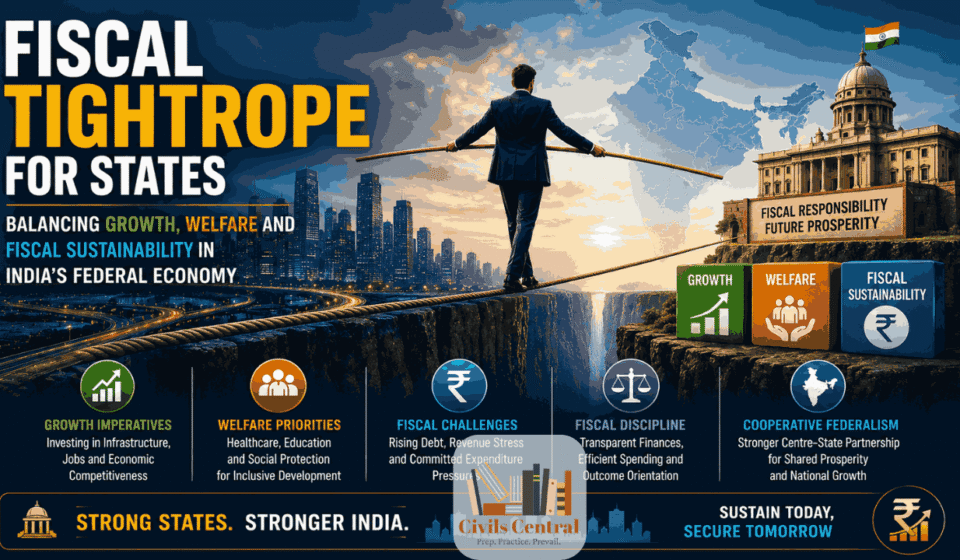
Fiscal Tightrope for States: Balancing Growth, Welfare and Fiscal Sustainability in India’s Federal Economy

Why State Finances Matter More Than Ever?
India’s development story is often narrated through the lens of national economic growth, fiscal policy, and reforms undertaken by the Union Government. Yet, the real engine of public service delivery lies much closer to citizens—in the states. Whether it is building schools and hospitals, maintaining roads, ensuring law and order, implementing welfare programmes, or responding to natural disasters, state governments bear the primary responsibility for delivering public goods and services. Consequently, the health of state finances is no longer merely a regional concern; it has become a critical determinant of India’s macroeconomic stability, developmental trajectory, and the success of its cooperative federal structure. Recent years have exposed an increasingly complex fiscal landscape for Indian states. While expectations from state governments have expanded significantly—with demands for higher capital expenditure, social protection, climate resilience, urban infrastructure, and digital governance—their fiscal space has not expanded proportionately. Instead, many states are navigating a delicate balancing act between developmental aspirations and fiscal prudence. This balancing act has aptly been described as a “fiscal tightrope.”
The phrase captures the dilemma confronting state governments. On one side lies the imperative to sustain economic growth through investments in infrastructure, education, healthcare, and social welfare. On the other lies the necessity to maintain sustainable debt levels, comply with fiscal responsibility legislation, and preserve macroeconomic stability. Excessive borrowing today can constrain future development, while excessive fiscal austerity can undermine growth and welfare.
This challenge has become even more pronounced in the aftermath of the COVID-19 pandemic, the implementation of the Goods and Services Tax (GST), changing patterns of Union transfers, rising interest payments, and the increasing frequency of climate-induced disasters that impose substantial fiscal costs on state governments. Simultaneously, political competition has intensified demands for welfare-oriented expenditure, including subsidies, cash transfers, and free public services, adding further pressure on already stretched budgets.
The debate surrounding state finances therefore extends beyond accounting exercises or budgetary arithmetic. It raises fundamental questions regarding fiscal federalism, intergovernmental relations, public expenditure efficiency, debt sustainability, and the appropriate balance between welfare commitments and long-term economic growth.
For UPSC aspirants, understanding this issue requires an integration of economics, polity, governance, public administration, and current affairs. Questions on state finances frequently appear in the General Studies papers, Essays, Interviews, and even Preliminary Examination through concepts related to fiscal deficit, Finance Commission, GST Council, fiscal responsibility legislation, and cooperative federalism.
Why is This Topic in News?
The fiscal position of Indian states has attracted renewed attention following recent assessments by the Reserve Bank of India (RBI), discussions surrounding state borrowing limits, and debates over the quality of public expenditure. Several developments have brought state finances into the policy spotlight:
- Rising debt levels in several states have prompted concerns regarding long-term fiscal sustainability.
- Increasing expenditure on subsidies, social welfare schemes, and election-related promises has intensified discussions on fiscal discipline.
- Greater emphasis on infrastructure-led growth has required states to substantially increase capital expenditure while simultaneously managing revenue deficits.
- Climate-related disasters, public health emergencies, and urbanisation have expanded expenditure obligations beyond traditional budgetary estimates.
- Discussions surrounding the Sixteenth Finance Commission have revived debates on the principles governing fiscal transfers between the Union and the States.
- The post-GST fiscal architecture continues to influence states’ revenue autonomy and dependence on Union transfers.
Consequently, the fiscal health of states has emerged as a central issue not merely for economists but also for policymakers, investors, credit rating agencies, constitutional bodies, and civil service aspirants.
Understanding State Finances
Before analysing the fiscal challenges confronting states, it is essential to understand the architecture of public finance in India’s federal system.
Unlike unitary countries where fiscal authority is concentrated in the national government, India follows a federal model under which both the Union and the States possess constitutionally assigned taxation powers and expenditure responsibilities. The Constitution recognises that governance functions are distributed across multiple levels, requiring corresponding financial arrangements.
Accordingly, the Constitution provides for:
- Distribution of taxation powers.
- Assignment of expenditure responsibilities.
- Intergovernmental fiscal transfers.
- Borrowing powers.
- Institutional mechanisms for fiscal coordination.
The objective is to ensure that each level of government possesses adequate financial resources to discharge its constitutional responsibilities while maintaining macroeconomic stability.
However, the distribution of expenditure responsibilities and revenue powers is inherently asymmetric. States undertake a substantial share of public expenditure but possess comparatively limited taxation authority. This mismatch gives rise to the concept of Vertical Fiscal Imbalance (VFI)—one of the defining features of India’s fiscal federalism.
India’s Fiscal Architecture
                 Government Finance

                        │
        ┌───────────────┴────────────────┐
        │                                │
  Union Government                 State Governments
        │                                │
 National Defence              Health
 External Affairs              Education
 Railways                      Agriculture
 National Highways             Police
 Monetary Policy               Local Infrastructure
                               Water Supply
                               Urban Development
                               Public Health
Although the Union Government controls broader macroeconomic functions such as defence, foreign affairs, monetary coordination, and national taxation, states are responsible for delivering many citizen-centric public services. As a result, nearly two-thirds of government expenditure that directly affects people’s daily lives occurs at the state level.
This makes financially sound state governments indispensable for achieving inclusive economic growth and improving human development indicators.
Revenue and Expenditure Responsibilities
The fiscal challenge confronting states arises largely because their expenditure responsibilities significantly exceed their own revenue-generating capacity.
Major Expenditure Responsibilities of States
State governments finance a diverse range of essential services, including:
- Public health infrastructure.
- School education.
- Agriculture and rural development.
- Police and public order.
- Urban development.
- Irrigation.
- Drinking water supply.
- State highways and roads.
- Electricity distribution.
- Welfare programmes.
- Disaster management.
- Local government transfers.
Collectively, these functions account for a substantial share of public expenditure in India and directly influence the quality of governance experienced by citizens.
Major Revenue Sources of States
States generate revenue primarily through:
Own Tax Revenue
- State Goods and Services Tax (SGST).
- State excise duty (primarily on alcohol).
- Stamp duty and registration fees.
- Motor vehicle tax.
- Electricity duty.
- Land revenue.
Own Non-Tax Revenue
- User charges.
- Mining royalties.
- Fees and licences.
- Interest receipts.
- Dividends from State Public Sector Enterprises.
Transfers from the Union
- Share in divisible pool of central taxes.
- Finance Commission grants.
- Centrally Sponsored Scheme assistance.
- Other grants-in-aid.
Despite these revenue sources, states remain significantly dependent on transfers from the Union Government. This dependence varies considerably across states, with economically weaker states relying much more heavily on central transfers than industrialised states possessing broader tax bases.
The structural gap between expenditure obligations and revenue capacity forms the central challenge of India’s fiscal federalism and explains why state finances remain under persistent stress.
Fiscal Federalism
Fiscal federalism refers to the principles governing the distribution of financial powers and responsibilities among different levels of government within a federal system. It seeks to reconcile two objectives that may sometimes appear contradictory: ensuring national macroeconomic stability while preserving the fiscal autonomy of states.
In India, fiscal federalism is designed to enable states to perform their constitutional functions effectively despite disparities in economic development, resource endowments, and revenue-generating capacity. Since richer states naturally possess larger tax bases than poorer ones, a purely decentralised fiscal system could exacerbate regional inequalities. To address this, the Constitution provides mechanisms for intergovernmental transfers that redistribute resources and promote balanced development across the country.
The Indian model of fiscal federalism is therefore based on three foundational principles:
- Assignment of Functions: Clearly demarcating expenditure responsibilities between the Union and the States through the Seventh Schedule.
- Assignment of Resources: Distributing taxation powers so that both levels of government have constitutionally recognised sources of revenue.
- Fiscal Equalisation: Using Finance Commission transfers and grants to reduce vertical and horizontal fiscal imbalances while supporting equitable development.
This framework aims to balance fiscal autonomy with national cohesion. However, changing economic realities, the introduction of GST, rising welfare commitments, and increasing borrowing requirements have placed significant strain on this delicate equilibrium, making the fiscal management of states one of the most important policy challenges facing India today.
Constitutional Framework Governing State Finances
Understanding the fiscal challenges of Indian states requires a firm grasp of the constitutional architecture that governs public finance. The Constitution does not merely allocate legislative powers between the Union and the States; it also establishes a carefully designed fiscal framework to ensure that both levels of government possess adequate financial resources to discharge their constitutional responsibilities. This arrangement reflects the principle that political federalism cannot function effectively without fiscal federalism.
Unlike many federations where states enjoy broad taxation autonomy, the Indian Constitution assigns the most buoyant and broad-based taxes—such as income tax (other than agricultural income), customs duties, and corporation tax—to the Union Government. States, meanwhile, are entrusted with taxes that are either location-specific or administratively suited to subnational governments. Since expenditure responsibilities assigned to states are substantially greater than their independent revenue-raising powers, the Constitution provides elaborate mechanisms for fiscal transfers and revenue sharing.
The constitutional provisions governing public finance are spread across Part XII (Articles 264–300A), supplemented by the Seventh Schedule, Finance Commission provisions, Goods and Services Tax (GST) arrangements, and fiscal responsibility legislation enacted by Parliament and state legislatures.
Constitutional Architecture of Fiscal Federalism
| Constitutional Provision | Significance |
|---|---|
| Article 246 | Distribution of legislative powers between Union and States |
| Seventh Schedule | Union List, State List and Concurrent List determine taxation powers and expenditure responsibilities |
| Articles 268–281 | Distribution of revenues between Union and States |
| Article 280 | Establishment of the Finance Commission |
| Article 282 | Grants for public purposes |
| Article 293 | Borrowing powers of States |
| Articles 279A | Establishment of the GST Council |
Together, these provisions constitute the constitutional foundation of India’s fiscal federalism.
Distribution of Taxation Powers
One of the defining features of India’s fiscal system is the constitutional allocation of taxation powers. The Constitution follows the principle that taxation powers should correspond broadly with administrative efficiency and economic considerations.
Taxes Assigned to the Union
The Union Government collects taxes that are national in character and have broad tax bases, including:
- Corporation Tax
- Customs Duties
- Income Tax (excluding agricultural income)
- Integrated GST (IGST)
- Union Excise Duties on specified products
- Certain Cesses and Surcharges
These taxes are relatively buoyant because they grow alongside economic expansion.
Taxes Assigned to States
State Governments possess taxation powers over activities closely linked with local economic activity.
Major state taxes include:
- State GST (SGST)
- State Excise Duty (primarily liquor)
- Stamp Duty
- Registration Fees
- Motor Vehicle Tax
- Electricity Duty
- Land Revenue
- Taxes on Mineral Rights (subject to Parliament)
Following GST implementation, many earlier indirect taxes such as VAT (on most goods), entry tax, entertainment tax and luxury tax were subsumed into GST, reducing states’ independent taxation autonomy.
The Seventh Schedule and Expenditure Responsibilities
The Seventh Schedule distributes legislative competence into three lists:
Union List
The Union performs functions requiring national coordination, including:
- Defence
- Foreign Affairs
- Railways
- Currency
- Banking
- National Highways
- Telecommunications
- Atomic Energy
These functions generally involve macroeconomic management or national sovereignty.
State List
States are responsible for public services that directly affect citizens’ daily lives.
These include:
- Police
- Public Order
- Public Health
- Agriculture
- Irrigation
- Fisheries
- Local Government
- Public Markets
- Land Administration
- Hospitals
- State Roads
Consequently, states account for the majority of expenditure on social and economic services.
Concurrent List
Both Union and States legislate on:
- Education
- Forests
- Labour
- Electricity
- Social Security
- Environmental Protection
In practice, this often requires fiscal coordination between both levels of government.
The Problem of Vertical Fiscal Imbalance (VFI)
One of the central concepts in Indian public finance is Vertical Fiscal Imbalance. Vertical Fiscal Imbalance refers to the mismatch between: Revenue powers available to states and expenditure responsibilities assigned to them.
Simply put, States spend much more than they can independently raise.
Illustration
Revenue Powers

Union  ███████████████████████████

States ███████████

-----------------------------------------

Expenditure Responsibilities

Union  ██████████████

States ███████████████████████████████
This imbalance is intentional rather than accidental.
The framers believed that:
- National taxes should be centrally administered.
- States should receive predictable fiscal transfers.
- Poorer states should receive greater support.
- Macroeconomic stability should remain with the Union.
Therefore, Vertical Fiscal Imbalance is corrected through:
- Tax devolution
- Finance Commission grants
- Centrally Sponsored Schemes
- Other grants
Horizontal Fiscal Imbalance
While Vertical Fiscal Imbalance exists between the Union and all States collectively, Horizontal Fiscal Imbalance exists among the States themselves. Not all states possess identical economic capacity.
For example:
| Higher Fiscal Capacity | Lower Fiscal Capacity |
|---|---|
| Maharashtra | Bihar |
| Gujarat | Jharkhand |
| Karnataka | Odisha |
| Tamil Nadu | Assam |
Industrialised states naturally generate larger tax revenues than relatively less developed states.
If every state relied only on its own taxes:
- richer states would continuously improve public services,
- poorer states would fall further behind.
This would undermine national unity and balanced regional development. Hence, fiscal equalisation is a major objective of the Finance Commission.
Finance Commission: The Backbone of Fiscal Transfers
The Finance Commission is among the most significant constitutional institutions supporting cooperative federalism.
Constitutional Basis
Article 280: The President constitutes a Finance Commission every five years.
Functions
The Commission recommends:
- Distribution of net tax proceeds between Union and States.
- Allocation among individual States.
- Principles governing grants-in-aid.
- Measures to strengthen State finances.
- Resources for Panchayats and Municipalities.
- Any additional matter referred by the President.
The recommendations are advisory but have historically carried significant weight.
Why Finance Commission Matters
It serves several objectives simultaneously:
✔ Corrects Vertical Fiscal Imbalance.
✔ Reduces Horizontal Fiscal Imbalance.
✔ Promotes cooperative federalism.
✔ Encourages fiscal discipline.
✔ Supports national development priorities.
Tax Devolution
Tax devolution refers to the constitutional sharing of central taxes with states. Unlike discretionary grants, tax devolution is:
- formula-based,
- predictable,
- unconditional.
This provides states greater flexibility in designing expenditure priorities. The share allocated to states has evolved over successive Finance Commissions.
For example:
- 14th Finance Commission significantly increased tax devolution to strengthen fiscal autonomy.
- 15th Finance Commission recalibrated the share following the creation of new Union Territories while balancing defence and national priorities.
Tax devolution remains the single largest source of untied funds for many state governments.
Grants-in-Aid
While tax devolution provides general resources, grants address specific needs. These include:
Revenue Deficit Grants
Provided to states whose post-devolution revenues remain insufficient.
Sector-Specific Grants
Support:
- Agriculture
- Health
- Education
- Judiciary
- Statistics
- Urban governance
Disaster Management Grants
Used for:
- Floods
- Cyclones
- Earthquakes
- Droughts
- Climate-related emergencies
Local Government Grants
Support Panchayats and Urban Local Bodies. These grants strengthen grassroots governance under the 73rd and 74th Constitutional Amendments.
Article 293: Borrowing Powers of States
Article 293 governs state borrowing.
States may borrow:
- from the domestic market,
- financial institutions,
- the Union Government.
However, if a state has outstanding loans from the Union Government, its future borrowing requires Union consent. This provision is increasingly debated because states often argue that borrowing restrictions limit developmental expenditure, whereas the Union maintains that coordinated borrowing is essential for macroeconomic stability.
Fiscal Responsibility Framework
To prevent excessive debt accumulation, most states have enacted Fiscal Responsibility and Budget Management (FRBM) laws. These laws seek to ensure:
- prudent fiscal management,
- reduction of deficits,
- debt sustainability,
- transparency,
- intergenerational equity.
Typical fiscal targets include:
- limiting fiscal deficit,
- containing public debt,
- reducing revenue deficit,
- improving fiscal transparency.
Temporary relaxations are permitted during exceptional circumstances such as pandemics, severe economic downturns, or natural disasters.
GST and Changing Fiscal Federalism
The introduction of the Goods and Services Tax marked the most significant restructuring of India’s fiscal federalism since Independence.
Prior to GST, states possessed considerable autonomy over indirect taxation through VAT, entry tax, entertainment tax, and luxury tax. GST subsumed many of these taxes into a unified national framework, replacing independent taxation with a system of shared decision-making.
While GST has created a common national market and improved tax efficiency, it has also increased the dependence of states on GST compensation, intergovernmental coordination, and the functioning of the GST Council. This has fundamentally altered the fiscal relationship between the Union and the States, making cooperative decision-making indispensable for revenue stability.
Key Constitutional Articles to Remember
| Article | Theme |
|---|---|
| 246 | Distribution of legislative powers |
| 268–281 | Distribution of taxes |
| 270 | Taxes shared between Union and States |
| 275 | Grants-in-aid |
| 279A | GST Council |
| 280 | Finance Commission |
| 282 | Discretionary grants |
| 293 | State borrowing |
Key Takeaway
The constitutional framework equips states with significant expenditure responsibilities but comparatively limited revenue autonomy. Fiscal transfers, borrowing arrangements, and cooperative institutions such as the Finance Commission and GST Council are therefore not optional mechanisms—they are essential pillars sustaining India’s federal structure. Yet, structural asymmetries, changing tax architecture, and rising expenditure commitments continue to test this balance, setting the stage for the fiscal pressures that define the “fiscal tightrope” faced by Indian states.
Revenue Architecture of State Governments
A government’s ability to spend is ultimately determined by its ability to mobilise financial resources. For state governments, fiscal sustainability depends not only on controlling expenditure but also on maintaining a stable, diversified, and growing revenue base. Over the past decade, however, the revenue architecture of Indian states has undergone significant transformation, particularly after the introduction of the Goods and Services Tax (GST). While GST has improved tax harmonisation and created a common national market, it has also altered the fiscal autonomy of states and increased their dependence on intergovernmental transfers.
To understand why many states are walking a fiscal tightrope, it is essential to first examine where states obtain their revenues and how these revenues are utilised.
Anatomy of a State Budget
Every state budget consists of two broad components:
1. Revenue Account
The Revenue Account records the government’s regular income and day-to-day expenditure.
Revenue Receipts
These are receipts that do not create liabilities or reduce assets. They include:
- Own Tax Revenue (OTR)
- Own Non-Tax Revenue (ONTR)
- Share in Central Taxes
- Grants from the Union Government
Revenue Expenditure
This includes expenditure incurred for maintaining government services and meeting recurring obligations. Examples include:
- Salaries and pensions
- Interest payments
- Subsidies
- Administrative expenses
- Grants to local bodies
- Maintenance of public assets
- Social welfare schemes
Revenue expenditure is necessary for governance but does not directly create durable assets.
2. Capital Account
The Capital Account records transactions that either create assets or alter liabilities.
Capital Receipts
These include:
- Market borrowings
- Loans from financial institutions
- Recovery of loans
- Disinvestment proceeds (where applicable)
Capital Expenditure
Capital expenditure results in the creation of productive assets such as:
- Highways
- Irrigation canals
- Schools
- Hospitals
- Metro systems
- Water supply projects
- Digital infrastructure
Capital expenditure contributes directly to long-term economic growth by enhancing productive capacity.
Structure of State Government Finances
                    STATE BUDGET

         ┌────────────────────────────┐
         │                            │
 Revenue Account               Capital Account
         │                            │
 Receipts                     Receipts
 Expenditure                  Expenditure
         │                            │
 Current Services        Asset Creation
A fiscally healthy state generates sufficient revenue receipts to meet its routine expenditure while borrowing primarily for productive capital investments.
Major Sources of Revenue for States
State governments mobilise resources from four principal sources.
I. Own Tax Revenue (OTR)
Own Tax Revenue represents taxes collected directly by the state government. It is the most important indicator of a state’s fiscal capacity and economic strength because it reflects the state’s ability to generate resources independently. Major components include:
State Goods and Services Tax (SGST)
Since the implementation of GST in 2017, SGST has become the largest source of tax revenue for most states. It is levied on intra-state supply of goods and services and is collected concurrently with Central GST (CGST).
The buoyancy of SGST depends upon:
- Consumption levels
- Economic growth
- Compliance
- Digital tax administration
State Excise Duty
State excise is primarily levied on alcoholic beverages meant for human consumption, which remain outside the GST framework. This tax is particularly significant because:
- States enjoy complete autonomy over its rates.
- Revenue collections are relatively stable.
- Demand is less cyclical.
For several states, excise constitutes the second-largest source of own tax revenue.
Stamp Duty and Registration Fees
These arise from property transactions. Revenue depends heavily upon:
- Real estate activity
- Urbanisation
- Land values
States experiencing rapid urban growth generally witness higher collections.
Motor Vehicle Tax
Levied on vehicle registration and ownership. Revenue grows alongside:
- Automobile sales
- Urban expansion
- Commercial transport
Electricity Duty
Collected on electricity consumption. Although modest in comparison with SGST, it remains an important source for industrialised states.
Other Taxes
These include:
- Land Revenue
- Taxes on Mineral Rights
- Profession Tax (where applicable)
Composition of Own Tax Revenue
| Revenue Source | Importance |
|---|---|
| SGST | Largest source |
| State Excise | Highly stable |
| Stamp Duty | Linked with property market |
| Motor Vehicle Tax | Growing urban revenue |
| Electricity Duty | Moderate contribution |
| Land Revenue | Limited significance today |
Own Non-Tax Revenue (ONTR)
Taxation is not the only source of state income. States also earn non-tax revenues from:
User Charges
Examples include:
- Water charges
- Transport services
- Irrigation fees
- Hospital services
Many economists argue that user charges remain significantly underpriced in India.
Mining Royalties
Resource-rich states derive substantial revenues from mining. Examples include:
- Odisha
- Chhattisgarh
- Jharkhand
- Rajasthan
Fluctuations in commodity prices directly influence these receipts.
Dividends
State Public Sector Enterprises occasionally pay dividends. However, many State PSUs remain financially weak, limiting this source of revenue.
Fees and Licences
Examples include:
- Driving licences
- Registration fees
- Environmental clearances
- Commercial permits
Share in Central Taxes
Not all revenues collected by the Union are retained by it. A constitutionally determined portion of the divisible pool is transferred to states through tax devolution based on the recommendations of the Finance Commission.
These transfers are particularly important because:
- They are untied.
- States may allocate them according to their priorities.
- They provide stable fiscal support.
For many poorer states, tax devolution exceeds their own tax collections.
Grants from the Union Government
Grants supplement tax devolution and support specific objectives. Major categories include:
Finance Commission Grants
These include:
- Revenue deficit grants
- Local body grants
- Disaster management grants
- Sector-specific grants
Centrally Sponsored Schemes (CSS)
Examples include:
- PM POSHAN
- Jal Jeevan Mission
- National Health Mission
- PMGSY
- Samagra Shiksha
These schemes require varying levels of state contribution, creating additional fiscal commitments.
Other Grants
These may support:
- Special projects
- Infrastructure
- Disaster relief
- Centrally approved initiatives
Revenue Composition of States
                 STATE REVENUE

         ┌────────────────────────┐
         │                        │
 Own Revenue              Central Transfers
         │                        │
 ├── Own Taxes            ├── Tax Devolution
 └── Non-Tax Revenue      └── Grants
This composition reveals an important reality. Even economically stronger states rely significantly on Union transfers, while fiscally weaker states depend on them extensively.
Why Revenue Mobilisation Has Become Increasingly Challenging
Despite multiple revenue sources, states face structural constraints.
1. Limited Taxation Powers
The Constitution reserves many buoyant taxes for the Union Government. Examples include:
- Corporation Tax
- Customs Duties
- Income Tax
Consequently, states have relatively fewer high-growth taxation instruments.
2. GST Reduced Independent Tax Flexibility
Before GST, states could independently modify VAT rates. After GST:
- Tax rates are jointly decided through the GST Council.
- States cannot unilaterally increase SGST rates on most goods and services.
- Fiscal autonomy has therefore narrowed.
Although cooperative decision-making has strengthened the common market, it has reduced states’ independent policy space.
3. Dependence on Consumption
Since SGST depends primarily on consumption, economic slowdowns immediately affect revenue collections. Periods of:
- inflation,
- recession,
- weak consumer demand,
often reduce state tax growth.
4. Weak Non-Tax Revenue
Many services remain heavily subsidised. For political and social reasons, governments often hesitate to revise user charges.
Examples include:
- irrigation,
- water supply,
- public transport,
- electricity.
Consequently, cost recovery remains low.
5. Rising Dependence on Transfers
Several states derive a substantial proportion of their total revenue from Union transfers. While transfers promote equity, excessive dependence reduces fiscal flexibility. Delays or changes in transfer mechanisms can significantly affect state budgets.
Expenditure Pattern of States
Revenue generation is only one side of the fiscal equation. The expenditure profile of states has expanded dramatically over the last two decades. Major expenditure heads include:
Social Services
- Education
- Health
- Nutrition
- Women and Child Development
- Social Justice
Economic Services
- Agriculture
- Irrigation
- Rural Development
- Roads
- Energy
- Industries
Administrative Services
- Police
- Judiciary
- Civil Administration
Committed Expenditure
This category deserves special attention because it leaves governments with limited fiscal flexibility. Committed expenditure includes:
- Salaries
- Pensions
- Interest payments
These expenditures must be incurred irrespective of prevailing fiscal conditions. In several states, committed expenditure accounts for well over half of revenue receipts, leaving relatively limited resources for developmental spending.
Revenue Expenditure versus Capital Expenditure
One of the most important indicators of fiscal quality is the composition of expenditure rather than merely its size.
| Revenue Expenditure | Capital Expenditure |
|---|---|
| Consumption-oriented | Investment-oriented |
| Salaries | Roads |
| Subsidies | Irrigation |
| Interest Payments | Hospitals |
| Maintenance | Schools |
| Administrative Costs | Public Infrastructure |
Economists generally argue that borrowing should finance capital expenditure rather than recurring revenue expenditure. Borrowing to fund salaries, subsidies, or routine administration creates future debt without generating productive assets or enhancing the economy’s repayment capacity.
Fiscal Terms
Revenue Receipt: Income that neither creates liabilities nor reduces assets.
Revenue Expenditure: Recurring expenditure for administration and service delivery that does not create assets.
Capital Receipt: Receipts that create liabilities or reduce assets, such as borrowings.
Capital Expenditure: Spending that creates durable public assets and contributes to long-term growth.
Own Tax Revenue (OTR): Taxes collected directly by the state government.
Own Non-Tax Revenue (ONTR): Income from fees, royalties, dividends, user charges, and other non-tax sources.
Why States Are Walking a Fiscal Tightrope?
The fiscal challenges confronting Indian states cannot be attributed to a single policy decision or an isolated economic event. Instead, they are the outcome of multiple structural, institutional, economic, and political factors that have gradually intensified over the past decade. States today operate in an environment where public expectations have expanded significantly, while their fiscal flexibility has narrowed. They are expected to simultaneously accelerate economic growth, invest in infrastructure, improve healthcare and education, strengthen social protection, respond to climate disasters, and maintain fiscal discipline.
This balancing act has become increasingly difficult because expenditure obligations are rising faster than revenue growth. Consequently, many states have been compelled to rely more heavily on borrowings, resulting in higher debt servicing costs and shrinking fiscal space for future development.
The phrase “Fiscal Tightrope” therefore symbolises the delicate balance that states must maintain between developmental spending and fiscal sustainability. Leaning excessively towards austerity may constrain growth and weaken public service delivery, while excessive borrowing or populist expenditure can jeopardise macroeconomic stability and burden future generations.
The following sections examine the principal factors responsible for the growing fiscal stress experienced by Indian states.
1. Rising Welfare Commitments and the Expanding Role of the State
In a developing democracy like India, state governments play a central role in promoting social welfare. Over time, the scope of government intervention has expanded beyond traditional public goods to include income support, food security, employment generation, health insurance, housing, education, and social protection for vulnerable groups.
Several factors have contributed to this expansion:
- Rising public expectations from governments.
- Increased urbanisation and demand for public services.
- Demographic pressures, particularly among youth.
- Greater political competition leading to welfare-oriented electoral commitments.
- The need to reduce poverty and inequality.
While welfare expenditure can promote inclusive development and improve human capital, it also places sustained pressure on state budgets. Many welfare schemes involve recurring expenditure that cannot be easily curtailed once introduced, thereby reducing fiscal flexibility.
The challenge is not the existence of welfare programmes themselves, but ensuring that they remain fiscally sustainable, well-targeted, and accompanied by adequate revenue mobilisation.
2. Committed Expenditure: The Inflexible Component of State Budgets
A significant proportion of state expenditure is committed expenditure, which refers to spending that governments are legally or administratively obligated to incur irrespective of prevailing fiscal conditions.
The three major components are:
- Salaries of government employees.
- Pension payments to retired employees.
- Interest payments on outstanding debt.
Unlike discretionary expenditure, these obligations cannot be postponed without serious administrative or legal consequences.
Why is committed expenditure a concern?
High committed expenditure reduces the fiscal space available for productive investments such as roads, irrigation projects, hospitals, schools, and digital infrastructure. As these mandatory payments increase over time, governments find it increasingly difficult to allocate resources towards growth-enhancing sectors.
For many states, a substantial share of revenue receipts is absorbed by these three items alone, leaving limited resources for developmental expenditure.
Composition of Committed Expenditure
Revenue Receipts

│
├── Salaries
├── Pensions
├── Interest Payments
│
└── Remaining Fiscal Space
       ↓
Developmental Expenditure
The larger the committed expenditure, the smaller the fiscal room available for future-oriented investments.
3. Rising Interest Payments: The Cost of Past Borrowing
Borrowing is not inherently undesirable. In fact, prudent borrowing to finance productive capital expenditure can stimulate economic growth and generate future revenues. However, excessive borrowing over prolonged periods increases the burden of interest payments.
Every rupee spent on servicing past debt is a rupee that cannot be invested in:
- Education
- Healthcare
- Infrastructure
- Rural development
- Climate adaptation
This phenomenon is often described as the crowding out of developmental expenditure.
Moreover, higher interest payments create a vicious cycle:
- Higher borrowings increase debt.
- Larger debt results in higher interest payments.
- Higher interest payments widen fiscal deficits.
- Larger deficits require additional borrowings.
Unless interrupted through higher growth or fiscal consolidation, this cycle can become self-reinforcing.
4. Growing Debt Burden and Fiscal Sustainability
Public debt is a valuable policy instrument when used judiciously. It enables governments to finance infrastructure, respond to emergencies, and smooth expenditure over time. The problem arises when debt grows persistently faster than the economy’s capacity to service it.
What determines debt sustainability?
A state’s debt remains sustainable if:
- Economic growth exceeds the effective interest rate on debt.
- Borrowed resources finance productive investments.
- Fiscal deficits remain within prudent limits.
- Debt is transparently reported and managed.
Conversely, debt becomes problematic when borrowings finance recurring consumption rather than asset creation.
Productive Borrowing
- Highways
- Metro rail
- Irrigation systems
- Industrial infrastructure
- Renewable energy projects
These investments enhance productivity and support future revenue generation.
Unproductive Borrowing
- Salaries
- Subsidies without targeting
- Routine administrative expenditure
- Election-time giveaways
Such expenditure does not generate future income to service the debt. Therefore, the quality of borrowing is often more important than its absolute size.
5. Revenue Deficit: Borrowing for Consumption
One of the most worrying indicators of fiscal stress is the persistence of revenue deficits.
A Revenue Deficit occurs when: Revenue Expenditure exceeds Revenue Receipts.
This implies that the government is unable to finance its routine administrative and welfare expenditure from its regular income. As a result, it may be forced to borrow simply to meet day-to-day expenses. This is fiscally unsound because borrowing should ideally finance capital formation rather than current consumption.
Why is a persistent revenue deficit undesirable?
- It increases debt without creating productive assets.
- It reduces intergenerational equity.
- It weakens fiscal sustainability.
- It limits future developmental expenditure.
A fiscally prudent state aims to eliminate the revenue deficit while using borrowings primarily for capital investment.
6. Fiscal Deficit: The Overall Borrowing Requirement
The Fiscal Deficit represents the total borrowing requirement of the government.
It reflects the gap between: Total Expenditure and Total Receipts (excluding borrowings).
A moderate fiscal deficit is not necessarily harmful. During economic slowdowns or emergencies, governments may deliberately increase borrowing to stimulate demand or support recovery. However, persistently high fiscal deficits indicate structural imbalances between expenditure and revenue.
Consequences of Excessive Fiscal Deficits
- Rising public debt.
- Higher interest burden.
- Reduced investor confidence.
- Possible increase in borrowing costs.
- Limited fiscal flexibility during future crises.
Maintaining fiscal deficits within prudent limits is therefore essential for macroeconomic stability.
7. Declining Fiscal Space after GST
The introduction of GST transformed India’s indirect taxation system by creating a unified national market. However, it also reduced the independent tax policy space available to states. Before GST, states could adjust Value Added Tax (VAT) rates to respond to changing fiscal circumstances.
Post-GST:
- Tax rates are decided collectively through the GST Council.
- States cannot independently alter rates for most goods and services.
- Revenue performance depends heavily on national economic conditions and GST compliance.
While cooperative decision-making has enhanced tax efficiency, it has also constrained states’ fiscal autonomy.
8. Expanding Infrastructure Needs
India’s aspiration to become a developed economy requires substantial investments in:
- Roads
- Urban transport
- Water supply
- Renewable energy
- Digital infrastructure
- Industrial corridors
- Healthcare facilities
- Educational institutions
A significant share of these investments must be undertaken by state governments. Infrastructure projects involve high upfront costs but generate benefits over many years. Consequently, states often rely on borrowings to finance them. The challenge lies in balancing the need for higher capital expenditure with debt sustainability.
9. Climate Change and Disaster-Related Expenditure
Climate change has emerged as a major source of fiscal uncertainty for states. Increasing frequency of:
- Floods
- Cyclones
- Heatwaves
- Droughts
- Landslides
- Glacial lake outburst floods
has significantly increased expenditure on:
- Disaster relief.
- Rehabilitation.
- Climate-resilient infrastructure.
- Crop compensation.
- Public health responses.
These expenditures are often unpredictable and difficult to accommodate within annual budgets, placing additional pressure on already stretched finances.
10. Urbanisation and Rising Service Delivery Costs
India’s rapid urbanisation has fundamentally altered the expenditure profile of state governments. Urban populations require:
- Metro rail systems.
- Sewage treatment.
- Drinking water.
- Affordable housing.
- Solid waste management.
- Public transport.
- Pollution control.
Unlike rural infrastructure, urban services involve continuous maintenance and operational expenditure, increasing recurring fiscal commitments.
11. Demographic Pressures
India’s young population presents both an opportunity and a fiscal challenge. States must invest in:
- Schools
- Universities
- Skill development
- Employment programmes
- Healthcare
- Nutrition
These investments are essential for harnessing the demographic dividend but require sustained financial commitments over decades.
12. Political Economy of Fiscal Populism
One of the most debated aspects of state finances is the increasing prevalence of fiscally expensive electoral promises. Competitive politics has led several states to announce:
- Free electricity up to specified limits.
- Loan waivers.
- Cash transfer schemes.
- Free public transport for selected groups.
- Subsidised consumer goods.
- Expanded social welfare benefits.
While some of these programmes address genuine social needs, others may create long-term fiscal liabilities if introduced without corresponding revenue sources or expenditure rationalisation.
The challenge for policymakers is to strike a balance between social justice and fiscal responsibility, ensuring that welfare measures remain targeted, transparent, and fiscally sustainable.
Structural Drivers of Fiscal Stress
| Factor | Fiscal Impact |
|---|---|
| Rising welfare commitments | Higher recurring expenditure |
| Committed expenditure | Reduced fiscal flexibility |
| Interest payments | Crowding out development spending |
| Persistent revenue deficits | Borrowing for consumption |
| High fiscal deficits | Rising debt burden |
| GST-related constraints | Reduced tax autonomy |
| Infrastructure needs | Increased capital borrowing |
| Climate change | Unpredictable expenditure |
| Urbanisation | Higher service delivery costs |
| Fiscal populism | Long-term liabilities |
Debt Dynamics, Off-Budget Borrowings and Fiscal Sustainability: Are State Finances Becoming a Concern?
The fiscal position of a government cannot be assessed merely by examining its annual budget. A more meaningful evaluation requires an understanding of how much the government owes, why it has borrowed, whether the borrowed funds are being used productively, and whether future revenues will be sufficient to repay these obligations. This broader perspective is captured through the concept of debt dynamics.
For Indian states, debt has become an increasingly important policy issue. Borrowing has enabled states to finance infrastructure, respond to the COVID-19 pandemic, expand social welfare programmes, and support economic recovery. However, rising debt levels have also increased concerns regarding fiscal sustainability, especially when borrowings finance recurring expenditure rather than productive investments.
The challenge is therefore not the existence of debt itself but the quality of borrowing, transparency in debt management, and the state’s capacity to service its obligations without compromising future development.
Understanding Public Debt
Public debt refers to the accumulated liabilities of a government arising from past borrowings. State governments borrow from a variety of sources to bridge the gap between expenditure and revenue.
Major Sources of State Borrowing
- Market borrowings through State Development Loans (SDLs)
- Loans from the Union Government
- Loans from financial institutions
- Multilateral and bilateral assistance (routed through the Union)
- National Small Savings Fund (where applicable)
Borrowing is generally undertaken to finance fiscal deficits and capital expenditure. However, the long-term impact of debt depends on why the borrowing occurred.
Productive vs Unproductive Borrowing
One of the most important distinctions in public finance is between productive and unproductive borrowing.
| Productive Borrowing | Unproductive Borrowing |
|---|---|
| Infrastructure | Salaries |
| Irrigation | Routine administration |
| Schools | Subsidies without targeting |
| Hospitals | Consumption expenditure |
| Renewable Energy | Election giveaways |
| Digital Infrastructure | Revenue deficit financing |
Productive Borrowing
When borrowed funds create durable public assets, they contribute to higher economic growth, increased productivity, employment generation, and future tax revenues. Such investments improve the government’s ability to service its debt over time.
Unproductive Borrowing
Borrowing to finance routine administrative expenses or recurring consumption does not create assets capable of generating future economic returns. Persistent reliance on such borrowing weakens fiscal sustainability and transfers today’s financial burden to future generations.
Debt Sustainability: When Does Debt Become a Problem?
A common misconception is that high public debt is inherently undesirable. In reality, debt is sustainable as long as a government’s repayment capacity grows alongside or faster than its liabilities.
Debt sustainability depends on several factors:
- The rate of economic growth.
- The effective interest rate on debt.
- The size of fiscal deficits.
- The composition of expenditure financed through borrowing.
- The credibility of fiscal institutions.
If economic growth consistently exceeds the interest rate paid on debt, governments can stabilise or even reduce their debt burden relative to the size of the economy. Conversely, if debt accumulates faster than economic growth, interest payments consume an increasing share of public resources, reducing the capacity to invest in development.
Debt Sustainability Cycle
Higher Borrowing
        │
        ▼
Higher Public Debt
        │
        ▼
Higher Interest Payments
        │
        ▼
Reduced Fiscal Space
        │
        ▼
Need for Additional Borrowing
        │
        ▼
Further Increase in Debt
Breaking this cycle requires stronger revenue mobilisation, prudent expenditure management, and sustained economic growth.
Fiscal Sustainability: Beyond Annual Budgets
Fiscal sustainability refers to the ability of a government to maintain current policies without allowing debt to grow uncontrollably or compromising future economic stability.
A fiscally sustainable state should be able to:
- Meet current expenditure obligations.
- Service existing debt.
- Invest in infrastructure and human development.
- Respond to emergencies.
- Avoid imposing excessive financial burdens on future generations.
Fiscal sustainability therefore balances three objectives:
- Promoting economic growth.
- Maintaining macroeconomic stability.
- Preserving intergenerational equity.
Off-Budget Borrowings: The Hidden Dimension of Public Debt
One of the most debated issues in recent years has been the increasing use of off-budget borrowings by some state governments.
What are Off-Budget Borrowings?
Off-budget borrowings are liabilities incurred outside the regular budget but ultimately backed by the government. Instead of borrowing directly, governments may instruct:
- State Public Sector Enterprises (SPSEs),
- Special Purpose Vehicles (SPVs),
- Development corporations,
- Infrastructure agencies,
to raise loans for projects that are effectively government responsibilities. Although these borrowings may not immediately appear in the state’s budget, repayment obligations often fall on the government through guarantees, grants, or future budgetary support.
Why are they used?
Governments may resort to off-budget borrowings to:
- Finance infrastructure without breaching fiscal deficit limits.
- Accelerate project implementation.
- Avoid immediate pressure on budgetary indicators.
Why are they a concern?
Excessive reliance on off-budget borrowings can:
- Reduce fiscal transparency.
- Understate the true level of public debt.
- Create hidden liabilities.
- Increase risks for future budgets.
- Weaken investor confidence if contingent liabilities materialise.
For these reasons, there has been increasing emphasis on bringing such liabilities into the formal fiscal framework and improving disclosure standards.
Contingent Liabilities: Potential Future Obligations
Not all fiscal risks arise from existing debt. Governments may also face contingent liabilities, which are obligations that become payable only if certain events occur.
Examples include:
- Guarantees provided to State Public Sector Enterprises.
- Guarantees for infrastructure projects.
- Guarantees extended to cooperative institutions.
- Guarantees for power distribution companies.
These guarantees do not immediately affect the fiscal deficit. However, if the guaranteed entity defaults, the state government may have to assume the liability. High contingent liabilities therefore represent potential fiscal risks even if current debt indicators appear comfortable.
State Public Sector Enterprises (SPSEs) and Fiscal Risks
State governments own numerous enterprises operating in sectors such as:
- Electricity distribution.
- Transport.
- Infrastructure.
- Housing.
- Industrial development.
- Irrigation.
Many SPSEs perform important public functions but often face financial stress due to:
- Operational inefficiencies.
- Underpricing of services.
- Delayed tariff revisions.
- High transmission and distribution losses (in the power sector).
- Weak corporate governance.
Financially weak SPSEs may require repeated budgetary support, guarantees, or debt restructuring, thereby increasing the fiscal burden on the state.
The Fiscal Responsibility and Budget Management (FRBM) Framework
To promote prudent fiscal management, India introduced the Fiscal Responsibility and Budget Management (FRBM) framework, under which both the Union and most states enacted fiscal responsibility legislation.
The framework aims to:
- Maintain fiscal discipline.
- Limit excessive borrowing.
- Ensure debt sustainability.
- Improve fiscal transparency.
- Promote long-term macroeconomic stability.
Key Objectives
- Reduce fiscal deficits to prudent levels.
- Eliminate or minimise revenue deficits.
- Contain public debt.
- Enhance transparency in budgetary reporting.
- Protect intergenerational equity.
States are expected to align their fiscal policies with these objectives while retaining flexibility during extraordinary circumstances such as pandemics or natural disasters.
Why Fiscal Rules Need Flexibility?
Strict fiscal rules can strengthen discipline, but they should not become so rigid that they prevent governments from responding to crises. For example:
- During a pandemic, higher borrowing may be necessary to finance healthcare and economic relief.
- After a major cyclone or earthquake, immediate reconstruction spending cannot always be accommodated within existing fiscal limits.
- During economic slowdowns, temporary fiscal expansion may help revive demand and employment.
The challenge is therefore to distinguish between temporary, growth-supporting borrowing and persistent structural fiscal imbalances.
The RBI’s Assessment of State Finances
The Reserve Bank of India (RBI) periodically publishes reports analysing the fiscal position of state governments. These assessments provide valuable insights into emerging trends and risks.
Key themes highlighted in recent analyses include:
- States have increased capital expenditure, particularly on infrastructure, which is generally considered a positive development because it enhances long-term productive capacity.
- At the same time, several states continue to face pressure from rising committed expenditure, especially salaries, pensions, and interest payments.
- The quality of expenditure is increasingly important; borrowing should ideally finance asset creation rather than routine consumption.
- Improving tax administration, strengthening own tax revenue, and rationalising subsidies are essential for enhancing fiscal resilience.
- Transparent reporting of off-budget borrowings and contingent liabilities is necessary for maintaining credibility and informed fiscal policymaking.
Overall, the RBI’s perspective suggests that while the aggregate fiscal position of states remains manageable, continued vigilance is required to prevent the accumulation of hidden liabilities and to ensure that borrowing supports sustainable growth.
Debt, Growth and Development: Finding the Right Balance
The debate on state debt should not be framed as a choice between borrowing and fiscal austerity. Developing economies require substantial public investment to build infrastructure, improve human capital, and support structural transformation.
The critical question is whether borrowing finances investments that generate future economic returns. A state that borrows to build irrigation networks, logistics infrastructure, digital connectivity, or quality healthcare systems may strengthen its future revenue base and improve debt sustainability.
Conversely, a state that relies on borrowing primarily to finance recurring consumption may experience rising debt without corresponding growth in repayment capacity. Thus, the quality, transparency, and productivity of public expenditure are as important as the quantity of borrowing itself.
Key Concepts at a Glance
| Concept | Meaning | Why It Matters |
|---|---|---|
| Public Debt | Accumulated government liabilities | Reflects long-term fiscal obligations |
| Debt Sustainability | Ability to service debt without destabilising finances | Ensures macroeconomic stability |
| Off-Budget Borrowings | Borrowing outside the formal budget | May create hidden fiscal risks |
| Contingent Liabilities | Potential obligations arising from guarantees | Can become future debt |
| FRBM Framework | Fiscal rules for responsible borrowing | Promotes discipline and transparency |
| Productive Borrowing | Borrowing for asset creation | Supports long-term growth |
| Unproductive Borrowing | Borrowing for recurring expenditure | Weakens fiscal sustainability |
Capital Expenditure vs Revenue Expenditure
In public finance, the size of government expenditure is only one dimension of fiscal analysis. Equally important is how the money is spent. Two states may spend identical amounts, yet achieve vastly different developmental outcomes depending on whether their expenditure creates productive assets or merely finances recurring consumption.
For this reason, economists increasingly emphasise the quality of public expenditure rather than focusing solely on the level of fiscal deficits or debt. High-quality expenditure enhances productivity, stimulates economic growth, improves human capital, and strengthens future revenue generation. Low-quality expenditure, in contrast, may increase fiscal burdens without creating lasting economic value.
This distinction is particularly relevant in the context of Indian states, where expanding developmental needs coexist with constrained fiscal resources.
Understanding Capital Expenditure
Capital Expenditure (CapEx) refers to spending that creates durable public assets or enhances the productive capacity of the economy. Examples include:
- Construction of highways
- Metro rail projects
- Irrigation canals
- Schools and universities
- Hospitals
- Digital infrastructure
- Renewable energy projects
- Water supply systems
- Industrial parks
- Logistics infrastructure
Unlike routine administrative spending, capital expenditure produces benefits over many years.
Why Capital Expenditure is Growth Enhancing
Capital investments generate a multiplier effect throughout the economy. For example:
A new highway:
- reduces transportation costs,
- attracts private investment,
- improves market access,
- creates employment,
- enhances industrial competitiveness,
- increases future tax revenues.
Thus, capital expenditure contributes simultaneously to economic growth and fiscal sustainability.
The Capital Expenditure Cycle
Capital Investment
        │
        ▼
Better Infrastructure
        │
        ▼
Higher Productivity
        │
        ▼
Economic Growth
        │
        ▼
Higher Tax Revenue
        │
        ▼
Improved Fiscal Capacity
This virtuous cycle explains why economists often support borrowing for productive infrastructure.
Understanding Revenue Expenditure
Revenue expenditure consists of recurring expenses required for the day-to-day functioning of government. Examples include:
- Salaries
- Pensions
- Interest payments
- Administrative expenditure
- Subsidies
- Maintenance
- Grants
- Welfare transfers
- Procurement of medicines
- School operational expenses
Revenue expenditure is indispensable because governments cannot function without teachers, doctors, police personnel, judges, or administrators. However, unlike capital expenditure, it generally does not create durable physical assets.
Capital Expenditure vs Revenue Expenditure
| Capital Expenditure | Revenue Expenditure |
|---|---|
| Creates assets | Does not create assets |
| Long-term benefits | Short-term benefits |
| Enhances productivity | Supports ongoing services |
| Generates future returns | Recurring obligation |
| Suitable for borrowing | Ideally financed through current revenue |
The objective of fiscal policy is not to reduce revenue expenditure indiscriminately but to ensure that sufficient resources remain available for productive capital investment.
Capital Expenditure and the Multiplier Effect
Public investment often generates a multiplier effect significantly larger than routine consumption expenditure. For instance:
Investment in:
- highways,
- ports,
- irrigation,
- electricity,
- digital infrastructure,
stimulates:
- private investment,
- manufacturing,
- logistics,
- exports,
- agricultural productivity,
- employment.
Consequently, capital expenditure contributes both directly and indirectly to GDP growth.
Why States Need Higher Capital Spending
India’s aspiration to become a developed economy by 2047 requires unprecedented public investment.
States will have to finance:
Physical Infrastructure
- Roads
- Bridges
- Rail connectivity
- Airports
- Inland waterways
Social Infrastructure
- Schools
- Universities
- Medical colleges
- Hospitals
- Primary healthcare
Digital Infrastructure
- Broadband connectivity
- Digital governance
- Smart cities
- Data infrastructure
Climate Infrastructure
- Flood protection
- Coastal resilience
- Water conservation
- Renewable energy
- Urban climate adaptation
These investments cannot be postponed without compromising long-term development.
The Quality of State Finances
The quality of public finances depends upon several indicators rather than any single fiscal statistic.
Characteristics of High-Quality State Finances
✔ High capital expenditure
✔ Strong own tax revenue
✔ Moderate debt
✔ Limited revenue deficit
✔ Transparent budgeting
✔ Low off-budget liabilities
✔ Efficient subsidy targeting
✔ Strong fiscal transparency
Characteristics of Weak Public Finances
✘ Persistent revenue deficits
✘ Excessive borrowing for consumption
✘ High committed expenditure
✘ Large hidden liabilities
✘ Weak tax administration
✘ Poor quality expenditure
✘ Delayed infrastructure investment
The Role of the Sixteenth Finance Commission
The Sixteenth Finance Commission assumes particular importance because Indian states face an increasingly complex fiscal environment characterised by:
- changing GST dynamics,
- demographic shifts,
- climate change,
- rising infrastructure requirements,
- widening regional disparities,
- increasing social sector commitments.
Major Issues Before the Commission
The Commission is expected to examine:
- Appropriate tax devolution between the Union and States.
- Formula for horizontal distribution among states.
- Fiscal sustainability.
- Incentives for reforms.
- Local government finances.
- Disaster risk financing.
- Climate-related expenditure needs.
- Public debt management.
The recommendations will significantly influence India’s fiscal federal architecture for the coming years.
RBI’s Broad Policy Recommendations
The Reserve Bank of India has consistently emphasised that states should focus not merely on reducing deficits but on improving the quality of fiscal management. Broad policy directions include:
Strengthening Own Tax Revenue
States should:
- improve GST compliance,
- strengthen digital tax administration,
- reduce tax evasion,
- expand the tax base.
Rationalising Subsidies
Subsidies should become:
- targeted,
- transparent,
- fiscally sustainable,
- outcome-oriented.
Untargeted subsidies impose long-term fiscal costs without necessarily improving welfare.
Increasing Capital Expenditure
Borrowing should increasingly finance:
- infrastructure,
- logistics,
- irrigation,
- health,
- education,
- renewable energy.
These sectors enhance long-term productivity.
Improving Debt Transparency
States should:
- disclose contingent liabilities,
- report off-budget borrowings,
- strengthen fiscal reporting.
Transparency improves investor confidence.
Enhancing Public Financial Management
This includes:
- outcome budgeting,
- digital expenditure tracking,
- better procurement,
- improved audit systems,
- timely budget execution.
Way Forward
Addressing the fiscal challenges of states requires a balanced approach that preserves fiscal responsibility without undermining developmental priorities.
1. Enhance Revenue Autonomy
States should strengthen:
- tax administration,
- digital compliance,
- property tax reforms,
- user charge rationalisation where appropriate,
- non-tax revenue mobilisation.
2. Improve the Quality of Expenditure
Priority should shift towards:
- capital expenditure,
- human capital,
- climate resilience,
- infrastructure,
- innovation,
- productivity-enhancing investments.
3. Rationalise Committed Expenditure
States should gradually improve efficiency in:
- pension management,
- administrative expenditure,
- subsidy delivery,
- public employment policies,
without compromising essential public services.
4. Strengthen Fiscal Transparency
Governments should:
- fully disclose off-budget borrowings,
- publish contingent liabilities,
- improve debt reporting,
- strengthen legislative oversight.
5. Promote Cooperative Fiscal Federalism
The Union and States should continue to strengthen institutions such as:
- Finance Commission,
- GST Council,
- Inter-State Council,
- sectoral coordination mechanisms.
Predictability and trust are essential for fiscal stability.
6. Build Climate-Resilient Public Finance
Future budgets should explicitly integrate:
- disaster preparedness,
- climate adaptation,
- green infrastructure,
- sustainable urbanisation,
- resilient agriculture.
Climate finance will increasingly become a core component of state fiscal policy.
7. Adopt Outcome-Based Budgeting
Expenditure should be evaluated not only by how much is spent but also by what outcomes are achieved.
Examples include improvements in:
- learning outcomes,
- healthcare indicators,
- irrigation efficiency,
- road connectivity,
- employment generation.
Outcome budgeting strengthens accountability and improves public value.
Conclusion
The fiscal challenges confronting Indian states are not merely questions of balancing annual budgets; they reflect the broader evolution of India’s federal democracy and developmental state. States today stand at the forefront of delivering public services, building infrastructure, responding to climate change, and driving inclusive growth. Yet they must perform these expanding responsibilities within a framework of constrained revenue powers, rising expenditure commitments, and the imperative of maintaining macroeconomic stability.
Walking this fiscal tightrope requires more than fiscal austerity or increased borrowing. It demands high-quality public expenditure, robust revenue mobilisation, transparent debt management, targeted welfare policies, and stronger cooperative federal institutions. Borrowing should finance productive investments that expand the economy’s future capacity rather than recurring consumption. Similarly, fiscal responsibility should not become synonymous with underinvestment in education, health, or infrastructure, which are foundational to long-term prosperity.
As India advances towards the goal of becoming a developed nation by 2047, the fiscal health of its states will increasingly determine the success of this transformation. A resilient framework of fiscal federalism—characterised by autonomy, accountability, transparency, and solidarity between the Union and the States—will be indispensable. Ultimately, sustainable state finances are not an end in themselves; they are the means through which constitutional promises of welfare, equity, and balanced regional development can be realised for every citizen.
Key Constitutional Articles
| Article | Provision | UPSC Importance |
|---|---|---|
| Article 246 | Distribution of Legislative Powers | Fiscal Federalism |
| Article 268 | Duties levied by Union but collected by States | Taxation |
| Article 269 | Taxes levied and collected by Union but assigned to States | Federal Finance |
| Article 270 | Distribution of GST & Central Taxes | Frequently Asked |
| Article 271 | Surcharge for Union Purposes | Prelims Favourite |
| Article 275 | Grants-in-aid | Finance Commission |
| Article 279A | GST Council | Important |
| Article 280 | Finance Commission | Very Important |
| Article 281 | Finance Commission Report | Governance |
| Article 293 | Borrowing by States | GS III |
Important Constitutional Bodies
| Institution | Constitutional Status | Role |
|---|---|---|
| Finance Commission | Constitutional | Tax Devolution |
| GST Council | Constitutional | GST Policy |
| CAG | Constitutional | Public Audit |
| RBI | Statutory | Debt Management & Fiscal Stability |
| NITI Aayog | Executive Body | Cooperative Federalism |
Important Economic Terms
Fiscal Deficit
Difference between Total Expenditure and Total Receipts (excluding borrowings).
Revenue Deficit
Revenue Expenditure – Revenue Receipts.
Primary Deficit
Fiscal Deficit – Interest Payments.
Public Debt
Accumulated borrowings of Government.
Fiscal Consolidation
Gradual reduction of fiscal deficit and debt.
Fiscal Space
Government’s ability to spend without threatening fiscal sustainability.
Counter-Cyclical Fiscal Policy
Higher government spending during economic slowdown.
Debt Sustainability
Ability to repay debt without financial instability.
Vertical Fiscal Imbalance
Mismatch between expenditure responsibilities and revenue powers of different levels of government.
Horizontal Fiscal Imbalance
Differences in fiscal capacity among states.
Frequently Asked Reports
| Report | Released By | Importance |
|---|---|---|
| State Finances: A Study of Budgets | RBI | Very Important |
| Indian Public Finance Statistics | Ministry of Finance | Important |
| Economic Survey | Government of India | Very Important |
| Union Budget | Ministry of Finance | Highly Important |
| Finance Commission Report | Finance Commission | Must Read |
REVISION MIND MAP
                     STATE FINANCES

                           │
        ┌──────────────────┼──────────────────┐
        │                  │                  │
 Revenue             Expenditure          Borrowing
        │                  │                  │
Own Tax Revenue      Revenue Exp.      Fiscal Deficit
Own Non-Tax          Capital Exp.      Public Debt
Tax Devolution       Welfare           SDLs
Grants               Infrastructure    Off-Budget Borrowing
        │                  │                  │
        └────────── Fiscal Federalism ───────┘
                           │
                 Finance Commission
                           │
                     GST Council
                           │
                  Cooperative Federalism
                           │
                 Fiscal Sustainability
                           │
                  Developed India @2047
About The Author