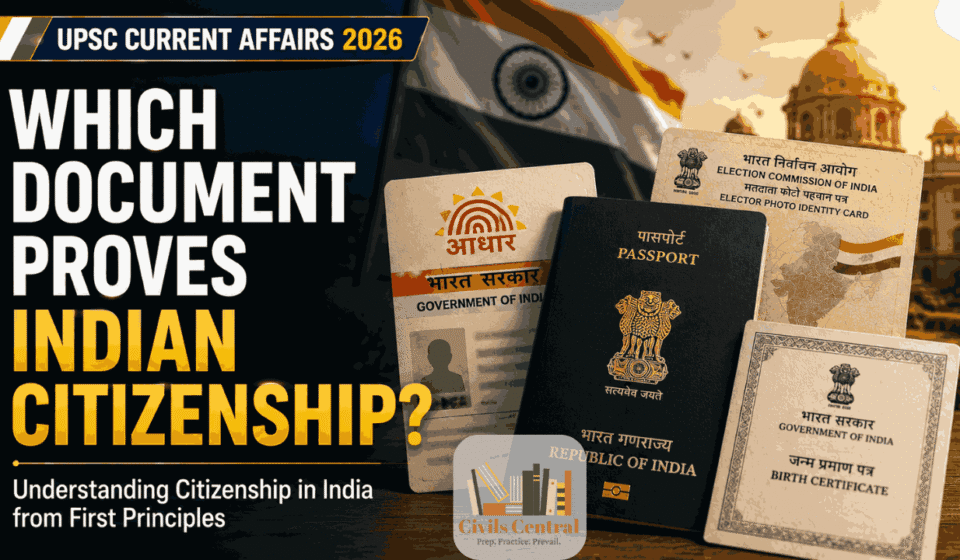
Which Document Is Proof of Indian Citizenship? Constitutional & Legal Position Explained | UPSC

A Question That Every Indian Thinks Has an Easy Answer
Imagine you are standing at an international airport. A traveller confidently presents an Indian passport to immigration officials. Almost everyone would assume that the person is unquestionably an Indian citizen. Now imagine another situation. During the Special Intensive Revision (SIR) of electoral rolls, election officials ask a voter to produce documents proving eligibility. The voter presents an Indian passport. Surprisingly, officials explain that the passport is strong evidence of citizenship but is not conclusive legal proof in every dispute.
This immediately raises several important questions:
- If a passport is not conclusive proof, then what is?
- Does Aadhaar prove citizenship?
- Does possessing a Voter ID automatically make someone an Indian citizen?
- Why doesn’t India issue a universal citizenship certificate?
- How is Indian citizenship actually determined under law?
These questions are no longer merely academic. They have become central to debates on electoral rolls, migration, border management, the Citizenship Amendment Act (CAA), the National Register of Citizens (NRC), and governance.
To answer them, we must go back to the very foundations of the Indian Constitution and understand what citizenship really means.
Why in News?
The issue gained national attention after the Ministry of External Affairs (MEA) clarified that an Indian passport should not be treated as conclusive proof of Indian citizenship in every legal dispute. The clarification came amid public discussions related to the Election Commission’s Special Intensive Revision (SIR) of electoral rolls.
The MEA explained that passports are issued under the Passports Act, 1967, while citizenship is determined under the Citizenship Act, 1955. Although passport authorities conduct verification before issuing a passport, the existence of a passport alone does not legally settle every dispute regarding citizenship.
The discussion has revived broader questions about documentary proof of citizenship in India, especially in the context of voter registration, migration, birth registration, and identity documentation. This development is important because UPSC frequently links current affairs with constitutional principles, making it essential to understand the legal framework governing citizenship rather than relying on common assumptions.
What is Citizenship?
Before understanding documents, we must first understand the idea itself. Citizenship is not merely an identity document. It is a legal relationship between an individual and the State. This relationship creates both rights and duties. Think of citizenship as a legal contract. The State promises to protect you, guarantee constitutional rights, and recognise you as a member of the political community. In return, the citizen owes allegiance to the Constitution, obeys laws, pays taxes where applicable, and participates in democratic processes.
A tourist may stay in India. A foreign student may study in India. An expatriate may work in India. A refugee may live in India for years. But none of them become Indian citizens merely because they reside in India. Citizenship is a legal status conferred under constitutional and statutory provisions.
Citizenship
Legal membership of a sovereign State.
Provides:
- Political rights
- Constitutional protection
- Legal recognition
- National allegiance
UPSC Takeaway: Citizenship is a legal status—not merely possession of an identity document.
Nationality, Citizenship, Residence and Domicile: Do Not Confuse These Terms
One of the most common mistakes made by aspirants is using these terms interchangeably.
Citizenship
Citizenship refers to the legal membership of a State. It grants political rights such as the right to vote, contest elections (subject to eligibility), and hold certain constitutional offices.
Nationality
Nationality is the legal bond between an individual and a sovereign nation in the sphere of international law. In many countries, nationality and citizenship overlap, but they are conceptually distinct.
Residence
Residence simply means living in a particular place. A foreign national residing in India is a resident but not necessarily a citizen.
Domicile
Domicile refers to the place regarded as a person’s permanent home and is relevant in matters such as admission, employment, succession, and personal laws. A person may have an Indian domicile without satisfying the legal requirements for citizenship in every context.
Comparison Table
| Basis | Citizenship | Residence | Domicile | Nationality |
|---|---|---|---|---|
| Legal membership | Yes | No | No | International legal bond |
| Political rights | Yes | No | No | Depends on domestic law |
| Voting | Yes | No | No | Usually linked with citizenship |
| Permanent home | Not necessary | No | Yes | Not based on residence |
| Governed by | Citizenship Act | Local laws | Private law principles | International & domestic law |
Evolution of Citizenship in India
Unlike many countries, India became independent after Partition in 1947. Millions of people crossed newly created borders between India and Pakistan. Some migrated into India. Some migrated out. Some returned later. Others had uncertain legal status.
The Constituent Assembly therefore faced an extraordinary challenge:
Who should become an Indian citizen on 26 January 1950?
The Constitution answered this question through Articles 5 to 11, which dealt with citizenship at the commencement of the Constitution. However, the framers recognised that future situations—migration, births, foreign marriages, naturalisation—would require detailed legislation. Therefore, Article 11 empowered Parliament to regulate citizenship by law.
This led to the enactment of the Citizenship Act, 1955.
Constitutional Framework: Articles 5–11
Article 5 – Citizenship at the Commencement of the Constitution
A person became an Indian citizen if, on 26 January 1950, they had domicile in India and satisfied specified conditions relating to birth, parentage, or residence.
Article 6 – Rights of Migrants from Pakistan
Recognised citizenship for certain persons who migrated from Pakistan to India, subject to prescribed conditions.
Article 7 – Migrants to Pakistan
Provided rules for persons who migrated to Pakistan after 1 March 1947, with limited exceptions for those who returned under a permit for resettlement.
Article 8 – Indians Living Abroad
Recognised citizenship for persons of Indian origin residing outside India who registered with Indian diplomatic or consular authorities.
Article 9 – Voluntary Acquisition of Foreign Citizenship
A person voluntarily acquiring citizenship of another country would cease to be an Indian citizen, subject to the law made by Parliament.
Article 10 – Continuance of Citizenship
Continued the citizenship rights of those recognised under the Constitution, subject to laws enacted by Parliament.
Article 11 – Power of Parliament
Empowered Parliament to make laws regarding acquisition and termination of citizenship.
The Citizenship Act, 1955: Why Was It Needed?
The Constitution only addressed citizenship at its commencement. It could not anticipate every future scenario involving births, migration, marriages, overseas Indians, or loss of citizenship. Therefore, Parliament enacted the Citizenship Act, 1955, under Article 11.
This Act is the principal legislation governing citizenship in India today. Over time, it has been amended to respond to changing demographic, security, and humanitarian concerns, including significant amendments in 1986, 1992, 2003, 2005, 2015, and 2019.
Five Modes of Acquiring Indian Citizenship
The Citizenship Act provides five principal methods:
- Citizenship by Birth
- Citizenship by Descent
- Citizenship by Registration
- Citizenship by Naturalisation
- Citizenship by Incorporation of Territory
Each mode has distinct eligibility conditions and has been modified through various amendments, particularly regarding citizenship by birth after 1987 and 2004.
Citizenship Decision Flow
Person claims Indian Citizenship
              │
              ▼
Was citizenship acquired by Birth?
              │
      ┌───────┴────────┐
      │                │
     Yes              No
      │                │
Check legal conditions ▼
                By Descent?
                      │
             Registration?
                      │
             Naturalisation?
                      │
      Incorporation of Territory?
                      │
                      ▼
         Citizenship determined under
          the Citizenship Act, 1955
Key Takeaways for Prelims
- The Constitution deals with citizenship under Articles 5–11.
- Parliament derives its power to regulate citizenship from Article 11.
- The Citizenship Act, 1955 is the principal law governing citizenship.
- Citizenship is a legal status, not merely an identity document.
- Documents may serve as evidence of citizenship, but whether they constitute conclusive proof depends on the governing law and the context of the dispute.
Why Is There So Much Confusion?
Ask ten people this simple question: “Which document proves Indian citizenship?”
You will probably get ten different answers.
Some will say Passport. Others will say Aadhaar. Some believe Voter ID is enough because only citizens can vote. Others may point to a Birth Certificate, PAN Card, or Ration Card.
This confusion exists because people often fail to distinguish between identity, residence, eligibility, and citizenship.
For UPSC, understanding this distinction is more important than memorizing lists of documents.
The Golden Rule to Remember
No identity document creates citizenship. Citizenship is acquired only under the Constitution and the Citizenship Act, 1955. Documents merely serve as evidence of facts relevant to determining citizenship.
Think of citizenship as the destination and documents as different pieces of evidence that help establish whether a person has reached that destination.
Concept
Citizenship
      │
      ▼
Acquired under Citizenship Act
      │
      ▼
Needs Evidence
      │
      ├── Birth records
      ├── Parentage
      ├── Residence
      ├── Passport
      ├── Citizenship Certificate
      └── Other official records
Remember: Evidence is not the same as legal entitlement.
Why Doesn’t India Have a Universal Citizenship Certificate?
Many countries issue a single national citizenship certificate. India generally does not. Instead, citizenship is determined by applying the provisions of the Citizenship Act, 1955 to the facts of each individual case. Only certain categories of persons—such as those who acquire citizenship by registration or naturalisation—receive formal citizenship certificates. Most Indians who are citizens by birth or descent never receive such a certificate.
Consequently, citizenship in India is often established through a combination of documentary evidence rather than a single universal document.
Does an Indian Passport Prove Citizenship?
Why is a Passport Issued?
A passport is issued under the Passports Act, 1967 by the Ministry of External Affairs. Its primary purpose is to:
- Facilitate international travel.
- Certify the holder’s identity and nationality for travel purposes.
- Enable the Government of India to extend diplomatic protection abroad.
It is not issued under the Citizenship Act, 1955.
Why Is a Passport Strong Evidence?
Before issuing a passport, authorities verify:
- Identity
- Address
- Police records
- Supporting documents
- Nationality claims
Therefore, an Indian passport is strong evidence that the holder is an Indian citizen. However, if it later emerges that the passport was obtained through fraud, concealment, forged documents, or factual error, its existence does not conclusively settle a citizenship dispute. The passport may even be impounded or revoked in accordance with law.
Why Did the MEA Clarify This?
The Ministry of External Affairs clarified that passports should not automatically be treated as conclusive proof of citizenship in every legal proceeding because:
- The Passport Authority is not the final adjudicating authority on citizenship disputes.
- Citizenship is determined under the Citizenship Act.
- Courts and competent authorities may examine all relevant evidence when citizenship is contested.
Passport
Purpose: International travel document.
Issued under: Passports Act, 1967.
Does it create citizenship? No.
Does it strongly indicate citizenship? Yes.
Is it always conclusive proof? No, especially where citizenship is disputed.
Can Aadhaar Prove Citizenship?
This is perhaps the most misunderstood document in India.
Why Was Aadhaar Created?
Aadhaar was introduced to provide every resident with a unique digital identity to improve the delivery of welfare benefits, reduce duplication, and strengthen governance. The key word is resident, not citizen.
Who Can Obtain Aadhaar?
Any person who satisfies the prescribed residency requirement under the Aadhaar law may enrol, regardless of citizenship. This means:
- Indian citizens can obtain Aadhaar.
- Certain foreign nationals who meet the residency criteria may also obtain Aadhaar.
Hence, possession of an Aadhaar card does not establish Indian citizenship.
Supreme Court Position
In the Aadhaar judgment (2018), the Supreme Court upheld the constitutional validity of Aadhaar while recognising it primarily as a tool for establishing identity. It does not convert a resident into a citizen or serve as conclusive proof of citizenship.
Aadhaar
Purpose: Digital identity.
Issued by: UIDAI.
Eligibility: Residents.
Proof of Citizenship? No.
Proof of Identity? Yes.
Does a Voter ID Prove Citizenship?
Only Indian citizens who satisfy the legal requirements are eligible to be enrolled as electors. Therefore, at first glance, many people assume that a Voter ID conclusively proves citizenship. The legal position is more nuanced. The Election Commission prepares electoral rolls based on applications and verification. If an ineligible person is mistakenly included, that inclusion does not automatically confer citizenship. Thus:
- A Voter ID is evidence that a person has been enrolled as an elector.
- It is not, by itself, the final legal determination of citizenship.
This distinction has become especially relevant during revisions of electoral rolls.
Does a Birth Certificate Prove Citizenship?
A birth certificate records:
- Date of birth.
- Place of birth.
- Parentage (where applicable).
It is issued under the Registration of Births and Deaths Act. A birth certificate does not automatically prove citizenship. Whether a person born in India is an Indian citizen depends on the citizenship law applicable on the date of birth, particularly the provisions governing citizenship by birth.
For example:
- A person born before the relevant amendments may satisfy different legal conditions than someone born later.
- Therefore, the birth certificate is important evidence but must be read together with the Citizenship Act.
Does a PAN Card Prove Citizenship?
No. A PAN is issued by the Income Tax Department for tax administration. Foreign nationals liable to pay tax in India may also obtain a PAN. Therefore:
- Identity for taxation — Yes
- Citizenship — No
Does a Driving Licence Prove Citizenship?
A driving licence certifies that a person is authorised to drive a motor vehicle. It is issued under the Motor Vehicles Act. Its purpose is road safety and licensing—not citizenship determination. Hence, it is not proof of citizenship.
Does a Ration Card Prove Citizenship?
A ration card is issued to facilitate access to subsidised food and welfare benefits under the Public Distribution System. It reflects household eligibility for welfare schemes. It is not a document determining citizenship.
Citizenship Certificate: The Strongest Documentary Proof
Unlike most Indians who become citizens by birth or descent, individuals who acquire citizenship through:
- Registration, or
- Naturalisation
receive a formal Citizenship Certificate issued by the competent authority.
Such certificates are among the strongest documentary evidence of citizenship because they directly record the legal grant of citizenship under the Citizenship Act.
Comparative Table
| Document | Main Purpose | Proof of Identity | Proof of Residence | Proof of Citizenship |
|---|---|---|---|---|
| Passport | International travel | Yes | Limited | Strong evidence, but not conclusive in every dispute |
| Aadhaar | Digital identity | Yes | Yes | No |
| Voter ID | Electoral participation | Yes | Limited | Not conclusive |
| Birth Certificate | Record of birth | Supports identity | No | Depends on citizenship law |
| PAN | Tax administration | Yes | No | No |
| Driving Licence | Driving authorisation | Yes | Yes | No |
| Ration Card | Welfare benefits | Limited | Household residence | No |
| Citizenship Certificate | Legal recognition under Citizenship Act | Yes | Yes | Yes (strong legal evidence) |
UPSC Prelims Practice MCQs
Q1. Which of the following documents, by itself, conclusively proves Indian citizenship in every legal dispute?
(a) Aadhaar Card
(b) Voter ID Card
(c) Passport
(d) None of the above
Answer: (d)
Explanation: Citizenship disputes are determined under the Citizenship Act, 1955. No commonly held identity document is universally conclusive in every legal context.
Q2. Aadhaar is primarily issued to:
(a) Citizens of India only
(b) Residents meeting the prescribed eligibility conditions
(c) Taxpayers only
(d) Voters only
Answer: (b)
Q3. Passports in India are issued under:
(a) Citizenship Act, 1955
(b) Passports Act, 1967
(c) Foreigners Act, 1946
(d) Registration of Births and Deaths Act
Answer: (b)
Possible UPSC Mains Question
“Identity documents and citizenship documents are not synonymous.” Discuss this statement in the context of India’s constitutional and legal framework. (15 Marks)
| Document | Citizenship? |
|---|---|
| Passport | Strong evidence, not always conclusive |
| Aadhaar | No |
| Voter ID | No |
| PAN | No |
| Birth Certificate | Context-dependent |
| Citizenship Certificate | Yes |
Why Did the Constitution Need Special Provisions on Citizenship?
On 15 August 1947, India became independent, but freedom also brought one of the largest human migrations in history. Millions crossed the newly created borders between India and Pakistan. Families were divided, records were lost, and many people were uncertain about which country they legally belonged to. The framers of the Constitution had to answer a fundamental question:
Who is an Indian citizen on the day the Constitution comes into force?
This was not merely a legal issue—it was a humanitarian, political, and constitutional challenge. Therefore, instead of leaving the matter entirely to Parliament, the Constitution itself included Articles 5 to 11, laying down the initial framework of citizenship.
However, the Constituent Assembly also understood that citizenship is not static. Births, migration, marriage, foreign citizenship, and changes in national boundaries would continue to occur. Hence, it empowered Parliament under Article 11 to make detailed laws, leading to the enactment of the Citizenship Act, 1955.
Why This Topic Matters for UPSC?
This chapter is one of the most frequently tested areas of Indian Polity. UPSC has repeatedly asked questions on:
- Articles 5–11
- Citizenship by Birth
- Citizenship Amendment Act (CAA)
- Overseas Citizen of India (OCI)
- Constitutional powers of Parliament
- Single Citizenship in India
- Constitutional philosophy behind citizenship
A clear understanding of these provisions is essential for both Prelims and Mains.
Constitutional Philosophy Behind Indian Citizenship
Before examining individual Articles, it is important to understand the philosophy adopted by the Constitution. Unlike countries with dual federal citizenship (such as the United States), India follows the principle of Single Citizenship. This means that every Indian is only a citizen of India, irrespective of the State in which they reside.
For example:
- A resident of Kerala is not a separate citizen of Kerala.
- A resident of Punjab is not a separate citizen of Punjab.
Every person enjoys one common citizenship, reinforcing national unity and equality.
Why Did the Constitution Adopt Single Citizenship?
The Constituent Assembly deliberately rejected the idea of State citizenship because India had recently experienced Partition. The framers wanted to avoid regional divisions and strengthen national integration. Single citizenship ensures:
- Equality before law throughout India.
- Free movement across States.
- Equal employment opportunities in the Union (subject to constitutional provisions).
- A stronger sense of national identity.
Articles 5–11 Explained
Article 5 – Citizenship at the Commencement of the Constitution
Article 5 determined who became an Indian citizen on 26 January 1950, the day the Constitution came into force. A person was recognised as a citizen if they had:
- Domicile in India; and
- Fulfilled specified conditions relating to birth, parentage, or residence.
Why was domicile important?
Citizenship is not based merely on physical presence. Domicile reflects an intention to make India one’s permanent home. Thus, Article 5 combined legal residence with permanent allegiance.
Article 6 – Rights of Migrants from Pakistan
Partition displaced millions of people. Article 6 provided citizenship to certain persons who migrated from Pakistan to India, subject to prescribed conditions such as migration before or after specific dates and, where applicable, registration.
Why was it necessary?
Without Article 6, many refugees who had permanently settled in India would have remained stateless or without clear legal status.
Article 7 – Persons Who Migrated to Pakistan
Article 7 dealt with individuals who migrated from India to Pakistan after 1 March 1947. As a general rule, such persons were not recognised as Indian citizens. However, exceptions existed for those who returned to India under permits for resettlement or permanent return in accordance with the applicable legal framework.
This reflected the complex realities of Partition while attempting to provide legal certainty.
Article 8 – Persons of Indian Origin Living Abroad
Many persons of Indian origin were living outside India at the commencement of the Constitution. Article 8 enabled such persons to acquire Indian citizenship by registering with Indian diplomatic or consular authorities, subject to the prescribed conditions.
This provision reflected India’s continuing connection with its overseas communities.
Article 9 – Voluntary Acquisition of Foreign Citizenship
Article 9 states that a person who voluntarily acquires the citizenship of another country shall not continue as an Indian citizen, subject to the law made by Parliament.
Why?
India does not recognise full dual citizenship. A person cannot ordinarily enjoy the complete rights and obligations of citizenship in India and another sovereign State simultaneously. This constitutional approach later influenced the creation of the Overseas Citizen of India (OCI) scheme, which is not equivalent to dual citizenship.
Article 10 – Continuance of Citizenship
Article 10 guarantees that persons recognised as citizens under the Constitution shall continue to enjoy that status, subject to any law made by Parliament. It ensures continuity while allowing future legislative regulation.
Article 11 – Power of Parliament
Article 11 gives Parliament the authority to make laws regarding:
- Acquisition of citizenship.
- Termination of citizenship.
- All other matters relating to citizenship.
This Article is the constitutional basis for the Citizenship Act, 1955.
Constitutional Scheme
Constitution
      │
      ▼
Articles 5–11
      │
      ▼
Initial Citizenship
      │
      ▼
Article 11
      │
      ▼
Parliament
      │
      ▼
Citizenship Act, 1955
      │
      ▼
Rules, Amendments and Administration
Citizenship Act, 1955
The Citizenship Act operationalises Article 11 by providing detailed rules for:
- Acquisition of citizenship.
- Loss of citizenship.
- Registration procedures.
- Naturalisation.
- Overseas Citizen of India (OCI).
- Renunciation and termination.
The Act has evolved through multiple amendments to address changing social, demographic, and security concerns.
Five Modes of Acquiring Citizenship
1. Citizenship by Birth
A person may acquire citizenship by birth if the statutory conditions applicable on the date of birth are satisfied. The rules have changed over time through amendments, making the date of birth legally significant.
2. Citizenship by Descent
A person born outside India may acquire citizenship through Indian parentage, subject to the conditions laid down in the Act and relevant rules.
3. Citizenship by Registration
Certain specified categories of persons, such as eligible persons of Indian origin or spouses of Indian citizens (subject to statutory conditions), may apply for citizenship through registration.
4. Citizenship by Naturalisation
A foreign national who satisfies the prescribed residence and other statutory requirements may apply for Indian citizenship through naturalisation. Naturalisation reflects the principle that long-term integration into Indian society can justify the grant of citizenship.
5. Citizenship by Incorporation of Territory
If a new territory becomes part of India, Parliament may provide for the citizenship status of its inhabitants. A historical example is the incorporation of territories such as Goa into the Union of India.
Loss of Citizenship
The Citizenship Act also specifies how citizenship may cease.
Renunciation
An Indian citizen may voluntarily renounce citizenship in accordance with the Act.
Termination
Citizenship may terminate upon the voluntary acquisition of another country’s citizenship, subject to the applicable legal provisions.
Deprivation
In specified circumstances, such as fraud in obtaining citizenship, the Central Government may deprive a person of citizenship acquired through registration or naturalisation, following the procedure prescribed by law.
Major Amendments to the Citizenship Act
Citizenship (Amendment) Act, 1986
This amendment tightened the rules for citizenship by birth, moving away from an unrestricted birth-based approach.
Amendment of 1992
The law was amended to recognise citizenship by descent through either parent, reflecting greater gender equality.
Amendment of 2003
One of the most significant amendments. It introduced:
- National Register of Citizens (NRC).
- National Identity Register framework.
- Overseas Citizen of India (OCI) provisions (later refined).
It also further modified citizenship by birth requirements.
Amendments of 2005 and 2015
These amendments expanded and streamlined the OCI framework, including the merger of the earlier PIO and OCI schemes.
Citizenship (Amendment) Act, 2019 (CAA)
The CAA amended the Citizenship Act to provide a special pathway to citizenship by naturalisation for specified categories of migrants belonging to six religious communities from Afghanistan, Bangladesh, and Pakistan who entered India on or before the prescribed cut-off date and satisfied the conditions laid down in the Act.
The Act has been the subject of extensive public debate and constitutional scrutiny, making it highly relevant for UPSC.
Institutions Involved in Citizenship Administration
| Institution | Role |
|---|---|
| Ministry of Home Affairs | Nodal ministry for citizenship matters |
| Ministry of External Affairs | Passport issuance and consular services |
| Election Commission of India | Electoral roll preparation (not final citizenship adjudication) |
| Registrar General of India | Registration systems and population records |
| UIDAI | Aadhaar enrolment and identity management |
| State Governments | Verification and administrative support |
Landmark Supreme Court Judgments
Aspirants should be familiar with broad principles emerging from judicial decisions:
- Citizenship is determined according to the Constitution and the Citizenship Act.
- Identity documents are not automatically conclusive proof of citizenship.
- Citizenship issues involve both statutory interpretation and constitutional principles.
- Administrative decisions must comply with due process and natural justice.
Practice MCQs
Q1. Which Article empowers Parliament to make laws relating to citizenship?
(a) Article 9
(b) Article 10
(c) Article 11
(d) Article 12
Answer: (c)
Q2. India follows which model of citizenship?
(a) Dual Citizenship
(b) Provincial Citizenship
(c) Single Citizenship
(d) Commonwealth Citizenship
Answer: (c)
Q3. Which of the following is not a mode of acquiring citizenship under the Citizenship Act, 1955?
(a) Birth
(b) Registration
(c) Naturalisation
(d) Election
Answer: (d)
UPSC Mains Questions
10 Marks
Discuss the constitutional philosophy behind the adoption of single citizenship in India.
15 Marks
Examine the constitutional and statutory framework governing Indian citizenship. How has the Citizenship Act, 1955 evolved to address changing national requirements?
| Constitutional Provision | Core Idea |
|---|---|
| Article 5 | Citizenship at commencement |
| Article 6 | Migrants from Pakistan |
| Article 7 | Migrants to Pakistan |
| Article 8 | Indians abroad |
| Article 9 | Foreign citizenship |
| Article 10 | Continuance |
| Article 11 | Parliament’s power |
How Does a Person Become an Indian Citizen?
Suppose three children are born on the same day.
- One is born in Delhi to Indian parents.
- Another is born in London to an Indian mother.
- A third is born in Paris to foreign parents but later lives in India for many years.
Will all three automatically become Indian citizens? The answer is No.
Whether a person becomes an Indian citizen depends not only on the place of birth but also on when they were born, who their parents are, their migration history, and the provisions of the Citizenship Act, 1955.
This is why UPSC repeatedly asks questions on the five modes of acquiring citizenship.
Concept Builder
Indian Citizenship
        │
        ▼
Can be acquired through
        │
 ┌──────┼─────────────┐
 │      │             │
Birth  Descent   Registration
 │
Naturalisation
 │
Incorporation of Territory
Why Did India Create Different Modes of Citizenship?
Every country faces different situations. Some people are born in the country. Some are born abroad to Indian parents. Some marry Indian citizens. Some migrate permanently. Sometimes new territories become part of a country. A single rule cannot cover all these situations.
Therefore, the Citizenship Act provides five different legal routes.
1. Citizenship by Birth
This is the most common method through which Indians acquire citizenship. However, the law has changed over time.
Phase I: 26 January 1950 – 30 June 1987
During this period, India largely followed the principle of Jus Soli (Right of the Soil). A person born in India during this period generally became an Indian citizen regardless of the nationality of the parents, subject to limited exceptions under the law.
Why?
India had just become independent. The focus was on nation-building and inclusion. Migration issues had not yet become a major security concern.
Phase II: 1 July 1987 – 2 December 2004
The Citizenship (Amendment) Act, 1986 introduced stricter conditions. A person born in India during this period became an Indian citizen only if at least one parent was an Indian citizen at the time of birth.
Why was the law changed?
Growing concerns over illegal migration, particularly in border States such as Assam, led Parliament to modify the earlier approach.
Phase III: On or After 3 December 2004
The Citizenship (Amendment) Act, 2003 further tightened the law. A person born in India on or after this date is a citizen only if:
- Both parents are Indian citizens; or
- One parent is an Indian citizen and the other is not an illegal migrant, as defined by law.
This reflects a greater emphasis on balancing inclusion with national security and immigration control.
| Born Between | Rule |
|---|---|
| 1950–1987 | Birth in India generally sufficient |
| 1987–2004 | One parent must be Indian |
| After 2004 | One parent Indian + other not an illegal migrant (or both Indian) |
2. Citizenship by Descent
Citizenship by descent applies to persons born outside India. The underlying principle is Jus Sanguinis (Right of Blood), meaning citizenship is based on parentage rather than place of birth. Eligibility depends on:
- Date of birth,
- Citizenship status of the parent(s),
- Compliance with statutory conditions, including registration where required.
Example
An Indian citizen working in Japan has a child there. The child is not born in India. Can the child become an Indian citizen? Yes, subject to the provisions of the Citizenship Act and applicable rules regarding citizenship by descent.
Always remember that citizenship by descent is governed by parentage, not place of birth.
3. Citizenship by Registration
Registration is meant for specified categories of persons who already have a close connection with India. It is not open to every foreign national. The Citizenship Act identifies eligible categories, subject to conditions prescribed by law.
These include, for example:
- Certain persons of Indian origin,
- Eligible spouses of Indian citizens,
- Certain minor children,
- Other categories specified under the Act.
Why Registration?
Registration recognises an existing and substantial relationship with India. Unlike naturalisation, it is not intended for persons with no prior connection to the country.
4. Citizenship by Naturalisation
Naturalisation allows a foreign national to become an Indian citizen after satisfying the conditions laid down in the Citizenship Act. The rationale is that a person who has lived in India for the prescribed period, integrated into society, and fulfilled the statutory requirements may be granted citizenship.
The Central Government considers such applications in accordance with the Act and Rules.
Difference Between Registration and Naturalisation
| Registration | Naturalisation |
|---|---|
| Existing connection with India | No prior Indian origin necessary |
| Limited to specified categories | Open to eligible foreign nationals satisfying statutory conditions |
| Simpler legal route for eligible persons | More comprehensive eligibility requirements |
5. Citizenship by Incorporation of Territory
Sometimes a new territory becomes part of India. The people residing there cannot be left without citizenship. Therefore, Parliament may determine the citizenship status of the inhabitants of such territories.
Historical Examples
- Goa (1961)
- Puducherry (de facto transfer in 1954; de jure transfer in 1962)
- Sikkim (1975)
These instances illustrate how incorporation of territory can require specific legal arrangements regarding citizenship.
Five Modes of Citizenship
Citizenship Act, 1955
          │
          ▼
 ┌────────────────────┐
 │ Birth              │
 │ Descent            │
 │ Registration       │
 │ Naturalisation     │
 │ Incorporation      │
 └────────────────────┘
Citizenship by Birth
1950
 │
 │ Birth generally sufficient
 │
1986 Amendment
 │
 │ One parent Indian citizen
 │
2003 Amendment
 │
 │ One parent Indian
 │
 │ Other not illegal migrant
 │
Present
Jus Soli vs Jus Sanguinis
One of the most important conceptual areas for UPSC.
| Feature | Jus Soli | Jus Sanguinis |
|---|---|---|
| Meaning | Right of the Soil | Right of Blood |
| Based on | Place of birth | Parentage |
| Example | Traditional U.S. approach (with constitutional basis) | Many European countries historically |
| India | Limited application through evolving statutory rules | Increasing emphasis after amendments |
Why Did India Shift?
Initially, India adopted a relatively liberal approach because:
- Nation-building was the priority.
- Partition had created humanitarian challenges.
Over time, concerns about:
- Illegal migration,
- Border management,
- National security,
led Parliament to tighten the citizenship-by-birth provisions through successive amendments.
Comparison Table
| Mode | Based On | Typical Beneficiary |
|---|---|---|
| Birth | Birth in India subject to statutory conditions | Children born in India meeting legal requirements |
| Descent | Parentage | Children born abroad to eligible Indian parent(s) |
| Registration | Existing connection with India | Eligible persons of Indian origin and specified categories |
| Naturalisation | Residence and statutory eligibility | Eligible foreign nationals |
| Incorporation | Territorial change | Residents of newly incorporated territories |
Common Mistakes Aspirants Make
Mistake 1
“Anyone born in India is automatically an Indian citizen. ❌ Incorrect.
The applicable legal conditions depend on the date of birth and the Citizenship Act.
Mistake 2
“Registration and naturalisation are the same. ❌ Incorrect.
Registration is available only to specified eligible categories with an existing connection to India, whereas naturalisation applies to eligible foreign nationals under the statutory conditions.
Mistake 3
“Citizenship law has remained unchanged since 1955.” ❌ Incorrect.
The Act has been amended multiple times, including in 1986, 1992, 2003, 2005, 2015, and 2019.
UPSC Practice MCQs
Q1. Citizenship by descent is primarily based on:
(a) Place of birth
(b) Parentage
(c) Residence
(d) Religion
Answer: (b)
Q2. The tightening of citizenship by birth provisions in India was mainly brought about through amendments in:
(a) 1976 and 1980
(b) 1986 and 2003
(c) 1991 and 1996
(d) 2015 and 2019
Answer: (b)
Q3. Which of the following is not a mode of acquiring citizenship under the Citizenship Act, 1955?
(a) Birth
(b) Registration
(c) Election
(d) Naturalisation
Answer: (c)
UPSC Mains Questions
10 Marks
Explain the evolution of citizenship by birth under the Citizenship Act, 1955. Why has Parliament amended these provisions over time?
15 Marks
Discuss the five modes of acquiring Indian citizenship under the Citizenship Act, 1955. How do they reflect the balance between humanitarian concerns and national security?
| Mode | Key Basis |
|---|---|
| Birth | Date of birth + statutory conditions |
| Descent | Parentage |
| Registration | Existing legal connection with India |
| Naturalisation | Residence and statutory eligibility |
| Incorporation | Territorial integration |
Why Do CAA, NRC and NPR Create So Much Debate?
Few topics in Indian Polity have generated as much public discussion as the Citizenship Amendment Act (CAA), National Register of Citizens (NRC), and the National Population Register (NPR). For many aspirants, these terms become confusing because they are often discussed together. However, they are distinct legal and administrative concepts with different objectives.
A common misconception is that CAA, NRC, and NPR are parts of a single programme. In reality:
- CAA deals with a specific pathway to citizenship for certain eligible migrants.
- NRC is a register intended to identify Indian citizens in a particular context.
- NPR is a register of usual residents prepared for administrative purposes.
- OCI is a lifelong visa and overseas privileges scheme—not dual citizenship.
UPSC is interested not in political debates, but in the constitutional, legal, administrative, and governance dimensions of these concepts.
Historical Background
To understand CAA and NRC, we must go back to Partition (1947). Partition displaced millions across the newly created borders of India and Pakistan. Migration continued for decades, particularly into border States such as Assam, West Bengal, and Tripura. In Assam, prolonged concerns over illegal migration led to widespread protests during the late 1970s and early 1980s.
This culminated in the Assam Accord (1985), which sought to address issues of illegal migration while protecting the linguistic and cultural identity of Assam. The Citizenship Act was subsequently amended to implement parts of the Accord.
Citizenship Amendment Act (CAA), 2019
What is CAA?
The Citizenship (Amendment) Act, 2019 amended the Citizenship Act, 1955 to provide a special pathway to Indian citizenship by naturalisation for certain categories of migrants from:
- Pakistan
- Bangladesh
- Afghanistan
belonging to the following six religious communities:
- Hindus
- Sikhs
- Buddhists
- Jains
- Parsis
- Christians
who entered India on or before 31 December 2014, subject to the conditions prescribed in the Act and Rules. It also reduced the required period of residence for naturalisation for these eligible categories.
Why Was CAA Introduced?
The stated objective was to provide relief to specified religious minorities who had faced persecution or feared persecution in the three neighbouring countries where Islam is the state religion or enjoys a constitutionally significant position.
The Government argued that these communities lacked another natural homeland in the region and therefore required a humanitarian pathway to citizenship.
Why Has CAA Been Debated?
The Act has generated extensive constitutional and policy debates.
Supporting Arguments
- Humanitarian protection for persecuted minorities.
- Faster integration into Indian society.
- Regularisation of long-term residents.
- Consistency with India’s tradition of providing refuge.
Concerns Raised
- Exclusion of certain other religious communities and neighbouring countries.
- Questions relating to equality under Article 14.
- Interaction with the secular character of the Constitution.
- Concerns in some North-Eastern States regarding demographic and cultural impacts.
These issues are presently part of broader constitutional discussions.
What is NRC?
NRC stands for National Register of Citizens. It is a register intended to identify persons who are recognised as Indian citizens in accordance with the applicable legal framework.
Assam NRC
The NRC has been implemented in Assam pursuant to directions of the Supreme Court in the context of the Assam Accord and the special legal framework applicable to the State. Its objective was to identify persons who could establish eligibility under the prescribed legal criteria.
Nationwide NRC
There has been public discussion regarding a nationwide NRC. However, no nationwide NRC has been implemented. For UPSC, distinguish clearly between:
- NRC in Assam (specific historical and legal context).
- Discussions about a nationwide NRC (policy debate).
What is NPR?
The National Population Register (NPR) is a register of usual residents. A usual resident is a person who has resided in an area for the prescribed period or intends to reside there for the prescribed period, as defined under the relevant rules. Unlike citizenship registers, NPR includes both:
- Indian citizens, and
- Foreign nationals who satisfy the prescribed residency criteria.
Purpose of NPR
- Improve governance.
- Better planning and delivery of public services.
- Create an updated population database.
- Assist administrative planning and disaster management.
Difference Between NRC and NPR
| NRC | NPR |
|---|---|
| Register of citizens | Register of usual residents |
| Based on citizenship | Based on residence |
| Citizenship-focused | Population database |
| Legal basis under citizenship framework | Prepared under the Citizenship Rules linked to population registration |
What is OCI?
Many people believe OCI means dual citizenship. This is incorrect. OCI stands for Overseas Citizen of India. It is a special immigration and overseas engagement scheme for eligible foreign nationals of Indian origin.
OCI Provides
- Multiple-entry lifelong visa.
- Exemption from repeated registration requirements in specified circumstances.
- Parity with Non-Resident Indians (NRIs) in certain fields, subject to law.
OCI Does Not Provide
- Voting rights.
- Right to contest elections.
- Eligibility for constitutional offices.
- Indian passport.
- Full political rights of Indian citizens.
NRI vs OCI vs Indian Citizen
| Feature | Indian Citizen | OCI | NRI |
|---|---|---|---|
| Indian Passport | Yes | No | Yes (because an NRI remains an Indian citizen residing abroad) |
| Voting Rights | Yes | No | Yes, subject to the applicable legal provisions |
| Constitutional Offices | Yes (subject to qualifications) | No | Yes, if otherwise eligible |
| Citizenship | Yes | No | Yes |
Common Mistakes Aspirants Make
Mistake 1
CAA and NRC are the same. ❌ Incorrect.
CAA concerns a pathway to citizenship for specified eligible migrants; NRC concerns identification of citizens.
Mistake 2
NPR contains only citizens. ❌ Incorrect.
NPR records usual residents, not only citizens.
Mistake 3
OCI means dual citizenship. ❌ Incorrect.
OCI is an overseas privileges scheme, not dual citizenship.
Mistake 4
CAA removes the citizenship of existing Indian citizens. ❌ Incorrect.
CAA deals with granting citizenship to specified eligible categories; it does not strip existing Indian citizens of citizenship.
Practice MCQs
Q1. The Citizenship (Amendment) Act, 2019 primarily relates to:
(a) Cancellation of citizenship
(b) A special pathway to citizenship for specified eligible migrants
(c) Issuance of passports
(d) Preparation of electoral rolls
Answer: (b)
Q2. Which of the following correctly distinguishes NPR from NRC?
(a) Both contain only citizens.
(b) NRC is a register of citizens, whereas NPR is a register of usual residents.
(c) NRC records taxpayers.
(d) NPR records only foreign nationals.
Answer: (b)
Q3. Overseas Citizen of India (OCI) holders are:
(a) Full dual citizens of India
(b) Eligible to vote in Lok Sabha elections
(c) Granted an Indian passport
(d) Foreign citizens enjoying specified privileges under Indian law
Answer: (d)
UPSC Mains Questions
10 Marks
Differentiate between the Citizenship Amendment Act (CAA), the National Register of Citizens (NRC), and the National Population Register (NPR).
15 Marks
Discuss the constitutional and administrative issues associated with the implementation of citizenship-related laws in India. Suggest measures to balance national security with constitutional values.
| Term | Key Idea |
|---|---|
| CAA | Special pathway to citizenship |
| NRC | Register of citizens |
| NPR | Register of usual residents |
| OCI | Overseas privileges for eligible foreign citizens of Indian origin |
Complete Timeline of Indian Citizenship
1947
│
│ Partition of India
│
1950
│ Constitution comes into force
│ Articles 5–11
│
1955
│ Citizenship Act enacted
│
1985
│ Assam Accord
│
1986
│ Citizenship by Birth provisions tightened
│
1992
│ Citizenship by Descent amended
│
2003
│ NRC provisions introduced
│ Citizenship by Birth amended again
│
2005
│ OCI scheme expanded
│
2015
│ PIO merged with OCI
│
2019
│ Citizenship Amendment Act (CAA)
│
2024
│ CAA Rules notified
Mind Map
INDIAN CITIZENSHIP
│
├── Constitution
│     ├── Articles 5–11
│     └── Article 11 → Parliament
│
├── Citizenship Act, 1955
│     ├── Birth
│     ├── Descent
│     ├── Registration
│     ├── Naturalisation
│     └── Incorporation
│
├── Loss
│     ├── Renunciation
│     ├── Termination
│     └── Deprivation
│
├── Important Laws
│     ├── Passport Act
│     ├── Citizenship Rules
│     └── CAA
│
├── Institutions
│     ├── MHA
│     ├── MEA
│     ├── UIDAI
│     ├── Election Commission
│     └── RGI
│
└── Current Affairs
      ├── Passport
      ├── Aadhaar
      ├── NRC
      ├── NPR
      └── OCI
Revision Table
| Topic | Remember |
|---|---|
| Constitution | Articles 5–11 |
| Parliament’s Power | Article 11 |
| Main Law | Citizenship Act, 1955 |
| Citizenship Types | 5 |
| Loss of Citizenship | 3 |
| Passport | Strong evidence, not universally conclusive |
| Aadhaar | Identity, not citizenship |
| Voter ID | Electoral enrolment, not conclusive citizenship proof |
| OCI | Not dual citizenship |
| NRC | Register of citizens |
| NPR | Register of usual residents |
Important Articles
| Article | Topic |
|---|---|
| 5 | Citizenship at commencement |
| 6 | Migrants from Pakistan |
| 7 | Migrants to Pakistan |
| 8 | Indians Abroad |
| 9 | Foreign Citizenship |
| 10 | Continuance |
| 11 | Parliament’s Power |
Most Important Acts
| Act | Why Important |
|---|---|
| Constitution | Citizenship provisions |
| Citizenship Act, 1955 | Main citizenship law |
| Passport Act, 1967 | Passport issuance |
| Aadhaar Act | Identity |
| Registration of Births and Deaths Act | Birth records |
| Representation of the People Act | Electoral rolls |
Comparison Table
| Passport | Aadhaar | Voter ID |
|---|---|---|
| Travel | Identity | Voting |
| Strong evidence | Resident identity | Electoral enrolment |
| Not universally conclusive | Not citizenship | Not conclusive citizenship proof |
Another Important Comparison
| NRC | NPR |
|---|---|
| Citizens | Residents |
| Citizenship Register | Population Database |
| Limited context (Assam implementation) | Administrative database |
OCI vs NRI
| OCI | NRI |
|---|---|
| Foreign Citizen | Indian Citizen |
| No Voting | Voting Rights (subject to law) |
| No Passport | Indian Passport |
Read these:
- The Constitution of India: Historical Background and Salient Features
- Fundamental Rights Explained
- Directive Principles of State Policy (DPSPs)
- Union and State Executive
- Election Commission of India
- Representation of the People Act
- Constitutional Bodies in India
- Parliament and Law-Making Process
- India’s Refugee Policy
- Border Management and Internal Security
About The Author