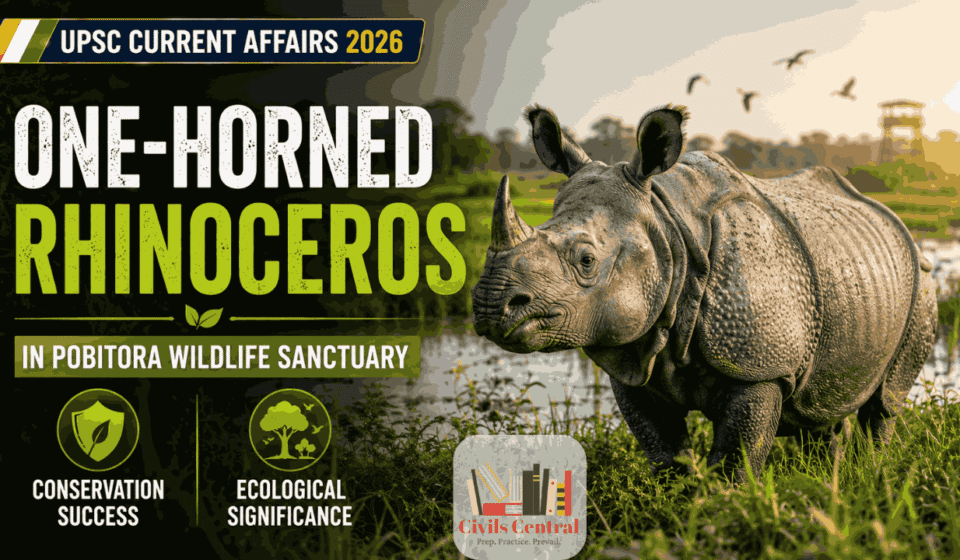
One-Horned Rhino: Pobitora Wildlife Sanctuary Conservation Success Explained | UPSC

Why Does the Fate of a Single Rhino Matter?
Imagine standing in the floodplains of Assam on an early winter morning. Thick fog slowly lifts from vast stretches of tall elephant grass. Suddenly, a massive grey animal emerges from the grasslands. Its thick armour-like skin makes it appear like a prehistoric creature, yet it grazes peacefully on fresh grass. This is the Indian One-Horned Rhino, one of India’s greatest wildlife conservation success stories.
Now imagine if this magnificent species disappeared forever. The loss would not simply mean the extinction of another animal. It would indicate the degradation of entire wetland ecosystems, collapse of biodiversity, weakening of ecological balance, and failure of conservation governance. Protecting the rhino, therefore, is not merely about saving a species—it is about preserving ecosystems that support countless plants, animals, and human communities.
This is why every news related to the Indian rhinoceros—whether in Pobitora Wildlife Sanctuary, Kaziranga National Park, or elsewhere—becomes important for UPSC.
Why in News?
Recently, the population of the Indian One-Horned Rhinoceros in Pobitora Wildlife Sanctuary (PWS) continued to attract attention because the sanctuary maintains one of the highest rhino population densities in the world despite occupying a relatively small geographical area. Wildlife authorities have also focused on habitat management, anti-poaching measures, and strategies for reducing human–wildlife conflict arising from the growing rhino population.
The developments highlight both the success and the challenges of wildlife conservation in India. While increasing rhino numbers reflect effective protection, they also create pressure on limited habitat, making population management and habitat expansion critical for long-term conservation.
The Story of India’s Rhinoceros
Millions of years ago, rhinoceroses roamed vast regions across Europe, Asia, and Africa. Today, only five surviving species remain, making rhinos among the world’s most threatened large mammals.
India is home to the Greater One-Horned Rhinoceros, scientifically known as Rhinoceros unicornis. Historically, this species occupied the fertile floodplains extending from Pakistan through northern India to Myanmar. Extensive hunting during the colonial period, agricultural expansion, deforestation, and habitat destruction caused a drastic decline in their population.
By the beginning of the 20th century, only a few hundred individuals survived, primarily in Assam and parts of Nepal. Recognising the imminent threat of extinction, conservation efforts were initiated through legal protection, establishment of protected areas, and strict anti-poaching measures.
Today, India shelters the majority of the world’s population of the Greater One-Horned Rhinoceros, making the country globally responsible for its conservation.
Understanding the Indian One-Horned Rhinoceros
What is the Indian One-Horned Rhinoceros?
The Indian One-Horned Rhinoceros is the largest rhinoceros species in Asia and one of the largest terrestrial mammals after elephants. Unlike African rhinos, which possess two horns, this species has only one horn made entirely of keratin—the same protein found in human hair and nails.
Its thick folded skin resembles natural body armour, earning it the nickname “armoured rhinoceros.”
Scientific Classification
| Category | Details |
|---|---|
| Kingdom | Animalia |
| Phylum | Chordata |
| Class | Mammalia |
| Order | Perissodactyla |
| Family | Rhinocerotidae |
| Genus | Rhinoceros |
| Species | Rhinoceros unicornis |
Why Does the Rhino Have Only One Horn?
Contrary to common belief, the horn is not a bone. It is composed of compacted keratin fibres without any bony core. The horn serves multiple ecological functions:
- Defence against predators
- Territorial competition
- Protecting calves
- Digging for water and minerals
- Display during mating
This is why poaching for rhino horns is particularly tragic. A horn can regrow if removed naturally, but poaching almost always kills the animal.
Adaptations That Make Rhinos Unique
Evolution has equipped the Indian rhinoceros with several remarkable adaptations.
Thick Skin
The skin acts as protective armour against predators, thorny vegetation, and injuries during fights.
Excellent Sense of Smell
Although rhinos have poor eyesight, they possess an exceptionally strong sense of smell, allowing them to detect danger from considerable distances.
Semi-Aquatic Behaviour
Rhinos frequently wallow in mud and shallow water to regulate body temperature and protect themselves from insects and parasites.
Herbivorous Diet
They primarily feed on:
- Elephant grass
- Aquatic plants
- Shrubs
- Leaves
- Fruits
- Agricultural crops near forest boundaries
This grazing behaviour also maintains grassland health by preventing excessive vegetation growth.
Why Are Rhinos Called Keystone Herbivores?
A useful way to understand rhinos is to view them as “ecosystem engineers.”
Flowchart
Rhino Grazing
↓
Controls Grass Growth
↓
Maintains Open Grasslands
↓
Supports Deer, Wild Buffalo, Elephants
↓
Maintains Predator–Prey Balance
↓
Healthy Ecosystem
The disappearance of rhinos would therefore alter vegetation structure and reduce habitat suitability for many other species.
Distribution of the Indian One-Horned Rhinoceros
India hosts nearly three-fourths of the global population of the species. Major populations occur in:
- Kaziranga National Park
- Pobitora Wildlife Sanctuary
- Orang National Park
- Manas National Park
- Jaldapara National Park
- Dudhwa National Park
Among these, Kaziranga supports the largest population, while Pobitora has the highest density of rhinos per square kilometre.
Pobitora Wildlife Sanctuary
Pobitora Wildlife Sanctuary is located in Morigaon district of Assam, on the floodplains of the Brahmaputra River. Despite covering a relatively small area, it has earned global recognition for harbouring one of the highest densities of the Greater One-Horned Rhinoceros.
Why is Pobitora Ideal for Rhinos?
Several geographical and ecological features make Pobitora an excellent habitat:
- Fertile alluvial floodplains
- Extensive tall grasslands
- Seasonal wetlands (beels)
- Abundant perennial water sources
- Nutrient-rich soil deposited by Brahmaputra floods
Seasonal flooding, though often viewed as destructive, actually rejuvenates grasslands by depositing fresh sediments and controlling invasive vegetation. Thus, floods play a vital ecological role in maintaining rhino habitats.
UPSC Concept
Keystone Species
A keystone species is one whose ecological impact is disproportionately greater than its population size. Its removal causes significant changes in ecosystem structure and functioning.
Examples:
- Tiger
- Elephant
- Rhino
- Sea Otter
Habitat Ecology: Why Does the Indian Rhino Live Only in Certain Areas?
One of the most common questions UPSC asks is not merely “Where is a species found?” but “Why is it found there?” Understanding the ecological requirements of a species helps answer multiple conceptual questions in both Prelims and Mains.
The Greater One-Horned Rhinoceros is a habitat specialist. It cannot survive in just any forest. Instead, it thrives in a unique combination of grasslands, wetlands, and riverine forests.
The Ideal Rhino Habitat
Imagine a rhino’s daily routine:
- It spends hours grazing on tall grasses.
- It drinks large quantities of water.
- It wallows in mud pools to regulate body temperature.
- It seeks shade in nearby forests during the hottest part of the day.
Thus, a suitable habitat must provide all these resources within a relatively small area.
Components of a Rhino Habitat
| Habitat Component | Why It Is Important |
|---|---|
| Tall alluvial grasslands | Primary source of food |
| Wetlands and marshes | Drinking water and wallowing |
| Riverine forests | Shelter during extreme weather |
| Seasonal floodplains | Soil rejuvenation and fresh grass growth |
| Open spaces | Easy movement and territorial behaviour |
Floods and Rhino Conservation
Brahmaputra Floods
↓
Fresh Alluvial Soil
↓
Rapid Grass Regeneration
↓
Improved Food Availability
↓
Healthy Rhino Population
↓
Healthy Wetland Ecosystem
Why is Pobitora So Important Despite Being Small?
Many aspirants assume larger protected areas are always better for conservation. Pobitora Wildlife Sanctuary challenges this assumption. Although it covers a relatively small geographical area compared to Kaziranga National Park, it supports an exceptionally high density of rhinos.
Reasons
- Highly productive alluvial grasslands.
- Rich wetland ecosystem.
- Effective anti-poaching measures.
- Continuous habitat management.
- Community participation.
- Adequate food availability.
However, this success has also created a new challenge. High density means increased competition for space. As rhino numbers increase within a limited habitat, animals increasingly move outside the sanctuary, leading to human–wildlife conflict.
Human–Rhino Conflict
Conservation success often creates unexpected management challenges. When rhinos leave protected forests in search of food or space, they enter agricultural lands and villages.
Causes
- Habitat saturation.
- Encroachment around protected areas.
- Shrinking wildlife corridors.
- Seasonal flooding.
- Agricultural expansion.
Impacts
On Farmers
- Crop damage.
- Property destruction.
- Economic losses.
On Rhinos
- Injuries.
- Accidental deaths.
- Retaliatory attacks.
- Increased stress.
On Government
- Compensation burden.
- Law-and-order challenges.
- Increased conservation expenditure.
Major Threats to the Indian One-Horned Rhinoceros
Despite remarkable conservation success, rhinos continue to face numerous threats.
1. Poaching
The greatest threat remains illegal hunting for rhino horns.
Why are rhino horns valuable?
Although scientific evidence shows that rhino horn has no proven medicinal value, illegal international markets continue to fuel demand. Poachers often use sophisticated weapons and exploit difficult terrain.
Consequences
- Population decline.
- Loss of breeding adults.
- Disruption of ecological balance.
- Increased conservation costs.
2. Habitat Fragmentation
Rhinos require large connected landscapes. Construction of:
- Roads,
- Railways,
- Settlements,
- Agricultural fields,
breaks habitats into isolated patches.
Fragmented populations become more vulnerable to:
- Inbreeding.
- Disease outbreaks.
- Reduced genetic diversity.
3. Invasive Alien Species
Many wetlands are increasingly invaded by species such as Mikania micrantha (commonly called the “mile-a-minute weed”), which suppress native grasses. Since rhinos primarily feed on native grasses, invasive plants reduce food availability and alter habitat quality.
4. Climate Change
Climate change affects rhino habitats in multiple ways.
Examples
- More intense floods.
- Longer dry spells.
- Changing vegetation patterns.
- Increased disease risk.
- Wetland degradation.
Thus, climate adaptation has become an essential component of wildlife conservation.
5. Human Encroachment
Growing population pressure around protected areas leads to:
- Illegal grazing.
- Firewood collection.
- Fishing.
- Settlement expansion.
Such activities reduce habitat quality and increase conflict.
Conservation Status
Understanding the legal and international status of species is a favourite UPSC Prelims area.
| Category | Status |
|---|---|
| IUCN Red List | Vulnerable |
| CITES | Appendix I |
| Wildlife (Protection) Act, 1972 | Schedule I species |
| IUCN Mega Herbivore | Yes |
What Does Schedule I Mean?
Species listed under Schedule I receive the highest level of legal protection in India. Offences involving Schedule I species attract stringent penalties, including imprisonment and fines.
Important Terminologies
Keystone Species
A species whose ecological role is disproportionately large compared to its population. Example: Rhino.
Flagship Species
A charismatic species used to promote conservation.
Examples:
- Tiger
- Elephant
- Rhino
Umbrella Species
Protecting one species indirectly protects many others sharing the same habitat. Rhinos are excellent umbrella species because conserving grasslands benefits:
- Swamp Deer
- Wild Buffalo
- Hog Deer
- Numerous birds
- Reptiles
- Amphibians
Indicator Species
Species whose presence reflects ecosystem health. Although rhinos are primarily considered flagship and umbrella species, a stable rhino population also indicates healthy floodplain grasslands.
Comparison Table
Kaziranga vs Pobitora
| Feature | Kaziranga National Park | Pobitora Wildlife Sanctuary |
|---|---|---|
| Protected Area Type | National Park | Wildlife Sanctuary |
| State | Assam | Assam |
| Rhino Population | Largest in the world | Very high density |
| Area | Much larger | Comparatively small |
| Habitat | Grassland, wetlands, forests | Grasslands and wetlands |
| Tourism | International | Regional and National |
Government Initiatives
Indian Rhino Vision (IRV) 2020
Objective
To increase the rhino population and distribute it across multiple protected areas in Assam.
Why Was It Needed?
If most rhinos remain concentrated in a single park, a disease outbreak or natural disaster could wipe out a large proportion of the population. Therefore, conservation now focuses on creating multiple secure populations rather than one large population.
Wildlife Protection Act, 1972
This landmark legislation:
- Prohibits hunting.
- Regulates wildlife trade.
- Creates protected areas.
- Provides legal protection to endangered species.
For rhinos, it serves as the backbone of conservation efforts.
National Rhino Conservation Strategy
India increasingly focuses on:
- Habitat improvement.
- Scientific monitoring.
- Genetic diversity.
- Community participation.
- Technology-based surveillance.
- Anti-poaching intelligence.
India’s Rhino Conservation Story
Conservation is often associated with alarming headlines about declining wildlife populations. However, the story of the Greater One-Horned Rhinoceros (Rhinoceros unicornis) stands out as one of the world’s most remarkable conservation success stories. At the beginning of the 20th century, rampant hunting and habitat destruction had reduced its numbers to fewer than 200 individuals. Today, thanks to sustained conservation efforts, India is home to more than 75% of the global population of this species.
This remarkable recovery has been possible due to a combination of:
- Strong legal protection
- Expansion of protected areas
- Scientific wildlife monitoring
- Community participation
- Effective anti-poaching operations
- Political commitment
The success demonstrates that conservation is not merely about protecting animals but about managing ecosystems through good governance.
International Perspective
Wildlife conservation is a global responsibility because animals do not recognize political boundaries. International cooperation is essential to combat illegal wildlife trade, share scientific knowledge, and coordinate conservation efforts.
Convention on International Trade in Endangered Species (CITES)
The Greater One-Horned Rhinoceros is listed under Appendix I of CITES, which prohibits international commercial trade in the species and its body parts except under exceptional circumstances.
UPSC Takeaway: Appendix I provides the highest degree of protection under CITES.
International Union for Conservation of Nature (IUCN)
The IUCN Red List categorizes the Greater One-Horned Rhinoceros as Vulnerable. Although the population is recovering, threats such as habitat fragmentation, poaching, and climate change continue to pose significant risks.
Convention on Biological Diversity (CBD)
India, as a Party to the CBD, is committed to:
- Conserving biodiversity
- Promoting sustainable use of biological resources
- Ensuring fair sharing of benefits arising from genetic resources
Rhino conservation contributes directly to these objectives.
Sustainable Development Goals (SDGs)
Rhino conservation supports multiple SDGs:
| SDG | Contribution |
|---|---|
| SDG 13 | Climate Action through ecosystem resilience |
| SDG 15 | Life on Land by protecting biodiversity |
| SDG 6 | Healthy wetlands improve water ecosystems |
| SDG 12 | Sustainable use of natural resources |
| SDG 17 | International cooperation in conservation |
Constitutional and Legal Framework
Wildlife conservation in India derives strength from constitutional provisions and statutory laws.
Constitutional Provisions
Article 48A
Inserted by the 42nd Constitutional Amendment, it directs the State to protect and improve the environment and safeguard forests and wildlife.
Article 51A(g)
It is the Fundamental Duty of every citizen to protect and improve the natural environment, including forests, lakes, rivers, and wildlife, and to have compassion for living creatures.
Seventh Schedule
Forests and protection of wild animals are placed in the Concurrent List, enabling both the Union and State Governments to legislate.
Wildlife (Protection) Act, 1972
The Act provides:
- Protection of endangered species
- Regulation of hunting
- Establishment of National Parks and Wildlife Sanctuaries
- Creation of wildlife crime enforcement mechanisms
- Penalties for illegal wildlife trade
The Greater One-Horned Rhinoceros receives the highest level of protection under the Act.
Challenges in Rhino Conservation
Although India has achieved notable success, several challenges remain.
1. Habitat Saturation
Protected areas like Pobitora have a very high rhino density. Limited space increases competition for food and encourages animals to move into surrounding villages.
Solution
- Expand habitat
- Restore wildlife corridors
- Develop additional protected areas
2. Human–Wildlife Conflict
Expansion of agriculture and settlements near protected areas increases interactions between humans and rhinos, leading to crop damage and occasional injuries.
Solution
- Community-based conservation
- Timely compensation
- Awareness campaigns
- Barrier management
3. Climate Change
Changing rainfall patterns and extreme floods affect grasslands and wetlands, altering the ecological balance.
Solution
- Climate-resilient habitat management
- Wetland restoration
- Long-term ecological monitoring
4. Illegal Wildlife Trade
Despite strict laws, illegal demand for rhino horns persists in international black markets.
Solution
- Strengthen Wildlife Crime Control Bureau
- International cooperation
- Advanced surveillance technologies
- Intelligence-based enforcement
5. Invasive Species
Aggressive invasive plants reduce the availability of native grasses required by rhinos.
Solution
- Scientific removal of invasive species
- Restoration of native vegetation
- Continuous habitat management
Way Forward
India’s future conservation strategy should focus on:
- Expanding protected habitats to reduce population pressure.
- Restoring ecological corridors between fragmented landscapes.
- Using drones, GPS collars, AI-based surveillance, and camera traps for monitoring.
- Strengthening community participation through eco-development committees.
- Enhancing coordination among forest departments, local communities, and law enforcement agencies.
- Integrating climate adaptation into wildlife management plans.
- Promoting responsible eco-tourism that benefits local communities while minimizing ecological disturbance.
Practice MCQs
Q1. The Greater One-Horned Rhinoceros is naturally found in:
A. Dry deciduous forests
B. Mangrove forests
C. Floodplain grasslands and wetlands
D. Alpine meadows
Answer: C
Explanation: The species is adapted to floodplain grasslands, marshes, and riverine ecosystems, particularly in the Brahmaputra basin.
Q2. Under the Wildlife (Protection) Act, 1972, the Greater One-Horned Rhinoceros enjoys:
A. Schedule II protection
B. Schedule IV protection
C. Schedule I protection
D. No legal protection
Answer: C
Explanation: Schedule I provides the highest level of legal protection to endangered wildlife.
Q3. Which international convention regulates global trade in rhino horns?
A. Ramsar Convention
B. Convention on Biological Diversity
C. CITES
D. UNFCCC
Answer: C
Q4. Pobitora Wildlife Sanctuary is located in:
A. Arunachal Pradesh
B. Assam
C. West Bengal
D. Meghalaya
Answer: B
Q5. Which statement is correct?
- Rhino horns are made of bone.
- Rhino horns consist mainly of keratin.
A. Only 1
B. Only 2
C. Both 1 and 2
D. Neither 1 nor 2
Answer: B
Explanation: Rhino horns are composed of keratin, the same protein found in human hair and nails.
UPSC Mains Practice Questions
10 Marks
“Discuss the ecological significance of the Greater One-Horned Rhinoceros in maintaining the health of floodplain grassland ecosystems.”
15 Marks
“Evaluate India’s conservation strategy for the Greater One-Horned Rhinoceros. Discuss the achievements, challenges, and the way forward in the context of sustainable biodiversity management.”
Revision Table
| Topic | Key Point |
|---|---|
| Scientific Name | Rhinoceros unicornis |
| IUCN Status | Vulnerable |
| CITES | Appendix I |
| Habitat | Floodplain grasslands and wetlands |
| Major Indian States | Assam, West Bengal, Uttar Pradesh |
| Largest Population | Kaziranga National Park |
| Highest Density | Pobitora Wildlife Sanctuary |
| Protection | Wildlife (Protection) Act, 1972 |
Mind Map
Greater One-Horned Rhinoceros
│
├── Habitat
│   ├── Grasslands
│   ├── Wetlands
│   └── Riverine Forests
│
├── Distribution
│   ├── Kaziranga
│   ├── Pobitora
│   ├── Orang
│   ├── Manas
│   ├── Jaldapara
│   └── Dudhwa
│
├── Threats
│   ├── Poaching
│   ├── Habitat Fragmentation
│   ├── Climate Change
│   ├── Human–Wildlife Conflict
│   └── Invasive Species
│
├── Conservation
│   ├── Wildlife (Protection) Act
│   ├── Indian Rhino Vision
│   ├── Anti-Poaching
│   └── Community Participation
│
└── International
    ├── IUCN
    ├── CITES
    ├── CBD
    └── SDGs
Common Mistakes Aspirants Make
- Confusing Pobitora Wildlife Sanctuary with Kaziranga National Park.
- Assuming rhino horns are made of bone instead of keratin.
- Believing all rhino species have one horn; only the Greater One-Horned Rhinoceros has a single horn.
- Treating floods only as disasters rather than recognizing their ecological role in maintaining floodplain grasslands.
- Memorizing species names without understanding habitat ecology and conservation principles.
Also Read:
- Wildlife (Protection) Act, 1972 – Complete UPSC Notes
- National Parks and Wildlife Sanctuaries of India
- Ramsar Sites in India
- Biodiversity Conservation in India
- Human–Wildlife Conflict: Causes and Solutions
- CITES Explained for UPSC
- IUCN Red List Categories
- Assam Geography and Ecology
- Environment and Ecology Complete Notes for UPSC
- Protected Area Network of India
Conclusion
The story of the Greater One-Horned Rhinoceros is a testament to India’s ability to reverse the decline of an endangered species through science-based conservation, strong legal frameworks, and community participation. Yet, the growing population in Pobitora Wildlife Sanctuary also reminds us that conservation is a continuous process. The challenge is no longer just preventing extinction but ensuring that expanding wildlife populations coexist harmoniously with human communities. For UPSC aspirants, this topic beautifully integrates ecology, governance, ethics, constitutional provisions, and sustainable development, making it highly relevant for Prelims, Mains, Essay, and the Personality Test.
About The Author